




Abstract
This article makes three crucial, related arguments. First, most European analyses of immigration and social welfare fail to consider how these policies intersect to shape the social reproduction of populations, instead sticking to notions of welfare chauvinism, social citizenship, and deservingness. Second, welfare/immigration analyses are usually set at the national level, but subnational comparisons can challenge tidy welfare state regime categorizations, revealing both nuance and policy opportunities. Third, a focus on social reproduction regimes that includes welfare and immigration policies reveals how jurisdictions border the extraction of social reproductive labour, with impacts on who gets in and under which conditions, and on the distribution of paid and unpaid social reproductive work within immigrant and established families in Canada. Developing our feminist border analysis, we illustrate our approach through a comparative analysis of Quebec and Ontario to show how social reproductive borders extract care labour and from whom, under diverging policy regimes.
A provoking question
In our review of recent immigration statistics from Canada, a question arose starkly. Why do Canada's two largest provinces, Ontario and Quebec, present such sharp differences in the uptake of two distinct sets of national immigration programs: those for parents and grandparents (hereafter PGPs) and those for home childcare and support workers? Ontarians used these programs extensively; Quebecers used them much less.
Was the answer to do with subnational immigration policy control? Immigration programs in Canada are set by the federal government, but Quebec has its own immigration policies that set targets, selection, and other specifications. While all provinces in Canada have taken on a larger role in immigration since the 1990s, Quebec's role is defined by specific agreements with the federal government that give it substantive control of economic immigration within its territory, including home childcare and support workers but, interestingly, not family reunification programs – including the PGPs sponsorship and visa programs. Further, we looked for evidence that Quebec was restricting the use of these programs in provincial immigration policy and found none. The Canadian home childcare and support worker program is an immigration policy designed to address care labour needs, bringing workers to fill jobs in private homes doing childcare, housework, and/or personal care for those with disabilities, illness, and frailties (Banerjee et al., 2018). Relatedly, PGP program data shows that most visiting and migrating parents and grandparents, who come via three programs - the PGP sponsorship, the PGP super visa and regular visas - contribute substantially to childcare and housework (CIC, 2014; Vanderplaat et al., 2013).
Thus, both these immigration pathways help to address Canada's social reproduction challenge. Like other countries with below replacement birthrates and rapid population aging, Canada has significant labour shortages, including an acute shortage across paid social reproductive sectors, often termed the care economy (Armstrong et al., 2021; Braedley and Luxton, 2021): childcare, old age care and disability support, healthcare, and education. While poor working conditions and low wages have meant that the care labour supply has been tenuous for decades, the situation worsened with the COVID-19 pandemic as workers left these sectors for better working conditions. Immigration continues to be presented as an antidote to this labour challenge (Anderson and Shutes, 2014; IRCC, 2022c). Across high income jurisdictions, immigrants are being recruited into these sectors. They are overwhelmingly women, racialized, often underpaid, and vulnerable to exploitation and abuse (Pandey et al., 2021; Turcotte and Savage, 2020). In Canada and elsewhere, many of these workers have limited access to social supports, welfare, and citizenship, and face difficulties in bringing their spouses, children, and parents to join them (Boccagni, 2013).
This article seeks to answer the following questions: Could a difference in the demand for care labour in Ontario and Quebec households explain the difference in these programs’ uptake? If so, what factors are involved? In what follows, we first outline our feminist bordering approach to these questions. We argue that welfare/immigration scholarship should bracket concerns about social citizenship to attend to social reproduction. Next, we apply our approach to a sub-national analysis of Quebec and Ontario, showing how nationally focused analyses may miss important distinctions at other levels of scale. Using existing data, our analysis calls into question assumptions about the relationship between immigration and welfare policies. We conclude by arguing that welfare/immigration regime analysis can be enhanced by attention to social reproductive borders.
Why a feminist border analysis? From social citizenship to social reproduction
European critical scholarship on the welfare/immigration nexus has been concerned with limits to migrants’ social citizenship rights (Bendixsen, 2018; Careja and Harris, 2022). This literature unpacks the differential governance of migrant welfare through “categories of deservingness” while delineating how the neoliberal language of austerity legitimates welfare chauvinism (Carmel and Sojka 2021; Jørgensen and Thomsen, 2016; Keskinen, 2016; Rosenberger, 2019). A range of studies shed light on how social citizenship is increasingly soaked in ethnic and classed discriminations – such as in UK housing (Guentner et al., 2016) – while becoming increasingly spatialized, as in Danish urban areas with high migrant populations now considered problems for the welfare state (Seemann, 2021).
This literature also asks how restrictions on welfare operate as migration deterrents, exposing that some countries’ welfare limitations act as “post-entry migration control” (Ataç and Rosenberger, 2019: 2) with a punitive intent (Dickson and Rosen, 2021; Norocel, 2016). Barker's (2018: 80) study shows how Swedish policies re-envision national borders as a “wall” protecting an ethnically defined national community from a perceived threat to long-term welfare regime sustainability posed by migrants and asylum seekers.
Building on our feminist border analysis (Braedley et al., 2021), we offer an alternative angle. If welfare is contingent on social reproduction, what exactly is being bordered in societies that engage in bordering practices through their welfare and immigration regimes? Developing this line of thought, we set aside questions of social citizenship and deservingness to consider how borders organize the work of social reproduction.
There are three elements to this analysis:
A focus on social reproduction. An understanding of borders as labour extraction tools. An inquiry into how tensions between welfare and immigration unfold in family life that leaves aside official immigration categories.
A focus on social reproduction
A feminist border analysis begins with the conceptual assumption that social reproduction is “best understood as work” (Braedley and Luxton, 2021: 1). Defined as the work involved in reproducing the labouring population daily and generationally, social reproduction is disproportionately assigned to women. It includes caring for frail and disabled adults, bearing, raising, and educating children, doing housework, transmitting culture, and sustaining community. Globally, this labour force is gendered, overworked, and undervalued, whether the work is paid or unpaid (Bakker and Silvey, 2008; Rai et al., 2014). Gendered, racialized global care chains are essential to the functioning of capitalism across borders. They bring social reproduction workers from remittance-dependent jurisdictions to high income ones, while leaving reproductive gaps behind (Fudge, 2012; Parreñas, 2015).
In welfare/immigration debates, paid work is often identified as a condition for welfare access (Kremer, 2016). Welfare-as-reward-for-work policies conveniently forget the generational social reproductive labour embodied in the labouring population, including immigrants raised by mothers and other family members in countries of origin. This offshore social reproductive labour is an essential component of labour migration, captured by the economies of immigrant-receiving countries.
In considering social reproduction, a feminist border analysis shifts inquiry from questions of “who should benefit”, instead, asking: how do welfare state regimes provide for, intensify, and shift the work of social reproduction, therefore increasing or decreasing demand for immigrant reproductive labour and, in turn, the offshore social reproduction that produces this labour?
Understanding bordering as labour extraction tool
We acknowledge that while borders keep people out through enforcement and criminalization of migration, that is not all they do (Côté-Boucher, 2020). Borders are also devices that articulate the global circulation of people through ‘differential inclusion’ where inclusion is always “subject to varying degrees of subordination, rule, discrimination, and segmentation” (Mezzadra and Neilson, 2013: 159). A feminist border analysis reveals how borders activate social reproductive labour at transnational, national, and subnational scales, constituting and deploying intersecting relations of gender, race, class, and age. It interrogates bordering practices, attending to their stratifying, hierarchizing effects across multiple scales as they circulate and mobilize labouring bodies, and enable the extraction of social reproductive labour (Truong, 1996; Williams, 2019).
“Borders capture labor”, Jones (2016: 132) tells us, or rather, borders extract labor. But borders are not only embedded in immigration and welfare policies. Bordering keeps migrant labour in check by controlling access to legal status and social citizenship rights. A feminist border analysis goes further to point out that such restrictions are essential to the global extraction of (social reproductive) migrant labour. Whether that extraction is a cause or a consequence of bordering remains up for debate. But a feminist border analysis takes seriously the notion that social reproductive labour is transferred across ‘circuits of migration’ (Arat-Koç, 2018; Kofman, 2012; Kofman and Raghuram, 2015) that follow well-worn paths traced by postcolonial networks. Borders, thus defined, provide high income countries with the extraction capabilities to capture (cheap) social reproductive labour from the Philippines, India, and the Caribbean and bring it to Dubai, Toronto, New York, and London.
Starting with the tensions between welfare and immigration in the lives of families
Finally, a feminist border analysis diverts from research approaches that rely on state-produced policy and program categories (e.g., family reunification, refugees, economic streams). Instead, it asks: How do families address their social reproductive needs? How are welfare and immigration policies implicated? From this epistemic angle (Mezzadra and Neilson, 2013), a feminist border analysis starts with the lives and needs of families, challenging state immigration categories to generate fresh ideas about immigration and welfare. As Kofman (2012: 145) asserts, “in leaving different circuits (family and labor) disconnected, we seem to be hanging onto traditional gendered knowledges in terms of categories of migration”.
In short, a feminist border analysis leaves aside concerns about welfare deservingness as well as pre-established state immigration categories to go beyond conventional understandings of bordering as a set of enforcement activities that excludes irregular migrants. Instead, it begins with how families, both established and immigrant, organize social reproduction. Such analyses reveal how welfare/immigration regimes rely on borders to extract the paid and unpaid labour necessary to sustain life, while also creating unmet welfare needs. In the following section, we develop this analysis through our two Canadian cases, the welfare-immigration regimes of Quebec and Ontario.
Contours of Canada's subnational immigration/welfare regimes: Quebec and Ontario
In analyzing the welfare/immigration nexus and its role in bordering social reproduction, the Canadian case is both illustrative and instructive. A settler state with a federal system, the Canadian welfare state is particularly decentralized (Banting and McEwen, 2018) with a Constitution that recognizes provincial autonomy in welfare matters (Haddow, 2015), including education, healthcare, long-term care, childcare, and social services. Further, there is no single Canadian immigration policy. While it was once a federal responsibility, immigration has become increasingly bilateral with involvement from the provinces (Paquet, 2019).
Subnational analysis of welfare and immigration policies is not only relevant to Canada. There are social policy parallels in Scotland and Flanders (Béland and Lecours, 2008). In Italy, Switzerland, and Germany, regions have responsibility for some welfare benefits, and in Sweden and Norway, municipalities are responsible for social care and other programs (Daigneault et al., 2021). Immigration bordering, as one aspect of the global movement of goods, people, and capital, operates at all levels of scale (Sassen, 2015).
Given our theory and this context, we return to our question about the sharp distinctions between Quebec and Ontario families in their use of two seemingly unrelated immigration programs: parent and grandparent (PGP) sponsorship and visa programs and home childcare and support worker programs. Working toward a comparison of social reproduction regimes in these jurisdictions, we examine this puzzle of differential immigration program uptake by considering demographics, political economies of care, and immigration regimes. We draw on existing data to show how these Canadian provinces are tackling social reproductive challenges - including demographic decline, access to care, and labour shortages - through combinations of welfare and immigration policy. 1
The sketched result suggests that the effects of subnational policy are significant for both immigration and welfare. Provincial policies compose different arrangements to border social reproduction. In Quebec, a more socialized welfare model has been adopted, with investments in public health, childcare, and older adult care. In Ontario, a familialized social reproduction regime is in place, leaving wealthier families with options to import paid care labour or, in the case of immigrant families, bring in parents and grandparents. Poorer families are offered few options beyond their own unpaid domestic labour.
Similar demographic challenges, different approaches
Quebec and Ontario are Canada's two largest provinces in terms of population size, land mass, and GDP. According to Statistics Canada (2022d, 2023b), in 2021 Ontario was the most populous province with almost 15 million people, generating 38.1% of the Canadian GDP. Quebec was the second most populous province with 8.6 million people and 20.1% of the Canadian GDP. Both Quebec and Ontario are rapidly aging societies with a similar percentage of the population over 65 – approximately 20% and 18% respectively (Statistics Canada, 2022f). They are confronted with below replacement fertility rates – 1.52 children per woman in Quebec, 1.34 in Ontario (Statistics Canada, 2021), and deepening labour shortages across most sectors (Statistics Canada, 2022e). However, they have experienced modest population growth due to immigration. Between 2016–2021, the Quebec population increased by 4.13% and Ontario's increased by 5.77%. Quebec's population is older than Ontario's with a median age of 43 compared to 40.7 years. In comparison, the median age of immigrants in both jurisdictions is 29–30 years old (Institut de la statistique du Québec, 2022b; Ontario Ministry of Finance, 2020).
Reliance on immigration as a solution for low-fertility rates and labour shortages differs in the two provinces. According to 2021 census data, 29.56% of the Ontario population was born abroad, compared to only 14.23% for Quebec (Statistics Canada, 2022c). This difference will likely increase with time: in 2021, 48.9% of the share of new immigrants to Canada landed in Ontario, against only 12.4% for Quebec (IRCC, 2022a). Table 1 allows comparison of the demographic data.
Demographic comparison.
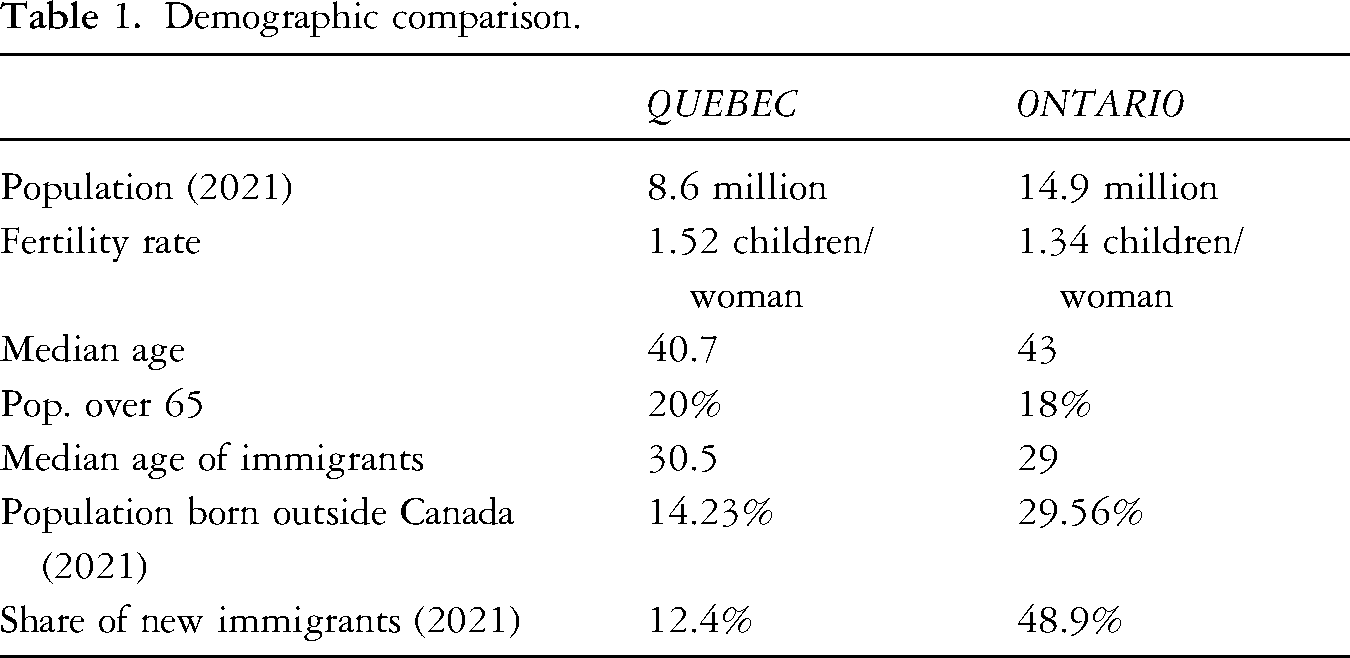
In sum, these demographics indicate Quebec and Ontario's distinct challenges in maintaining a labour force, and related social reproduction. They also provide a first element to answer our question about Quebec's lower reliance on PGPs and home child care and support worker programs. With a smaller population, there are proportionally slightly more babies born in Quebec, likely due to more generous family policies designed to promote women's labour force participation (Jenson, 2002). Both provinces apply an ageist immigration selection criterion that favours younger immigrants for naturalization, in keeping with Canada's “point” system. The results for median age and proportion of older people are similar. But there are also differences. Ontario relies heavily on younger working age immigrants to replenish its population, while Quebec has dramatically lower rates of permanent immigration, despite some of the deepest labour shortages of all Canadian provinces – particularly in the health care sector. In what follows, the contours of distinct deployments of social reproductive borders that extract migrant care labour will be traced in both jurisdictions.
Distinct care economies
While all welfare policies relate to social reproduction, two policy areas are particularly implicated in shaping social reproduction in welfare/immigration regimes due to their rapidly increasing reliance on immigrant labour: long-term care and childcare. These areas are important to our argument. Our data suggests that where these regimes leave gaps in care, families with sufficient means are more likely to bring in PGPs and home child care and support workers to help fill those gaps.
Long-term care homes and home care (LTC) for frail and disabled adults in Quebec and Ontario are weak systems with inadequate services, a situation tragically demonstrated by the high rate of death in LTC homes during Covid, as confirmed in public inquiries (Kamel, 2020; Ombudsman of Ontario, 2023). Access to Quebec's publicly funded LTC homes is limited, with beds available for 2.5% of the population over 65, compared to 3.3% in Ontario (Hébert, 2021). While provinces pay LTC home health and social care costs, residents pay for room and board. LTC home resident costs are lower in Quebec. In 2022, resident fees for semi-private long-term care home residence were $1687 a month in Quebec (Régie de l’assurance maladie, 2022) and $2280 a month in Ontario (Ontario Ministry of Long Term Care, 2022). Ontario's higher costs are a disincentive, particularly for women who have lower pension earnings than men (MacDonald, 2015), and shift more work to unpaid familial carers who are disproportionately women.
A higher percentage of older Quebecers live in senior's residences than in the Ontario context. Quebec has the highest ratio in Canada of senior adults over 75 living in seniors’ residences - 18.4% compared to 5.5% in Ontario (CMHC, 2020). This suggests a less familial, two-tiered institutional approach to social care for older adults and perhaps some reduced demand for private migrant care work in households. In both provinces, publicly funded home care is available to those who live in households, including senior's residences, but only as a residual care service for those with high need and insufficient unpaid support. Publicly funded home care services are limited in both provinces, but there is a slightly higher percentage of households receiving this care in Quebec (Gilmour, 2018).
Until recently, Ontario's child care system was two-tiered, with a tiny, fragmented publicly funded system for very low-income households, and expensive market-based child care as the main source, consistent with conservative views that raising young children is mothers’ business (Bezanson, 2010). However, in 2020, the federal government committed significant funding to early learning and childcare and began to negotiate federal-provincial agreements aimed at reducing the cost of childcare to $10 a day across the country. Ontario was the last province to sign an agreement. At the time of writing, parents in most Ontario communities have yet to experience cost relief although changes are underway (MacDonald and Friendly, 2022). As shown in Table 2, the average cost for licensed childcare for an Ontario toddler (two year-old) in 2019 was $1320 monthly, in a market system with variable pricing based on the child's age. 2
Comparison of social reproduction regimes (Quebec/Ontario).
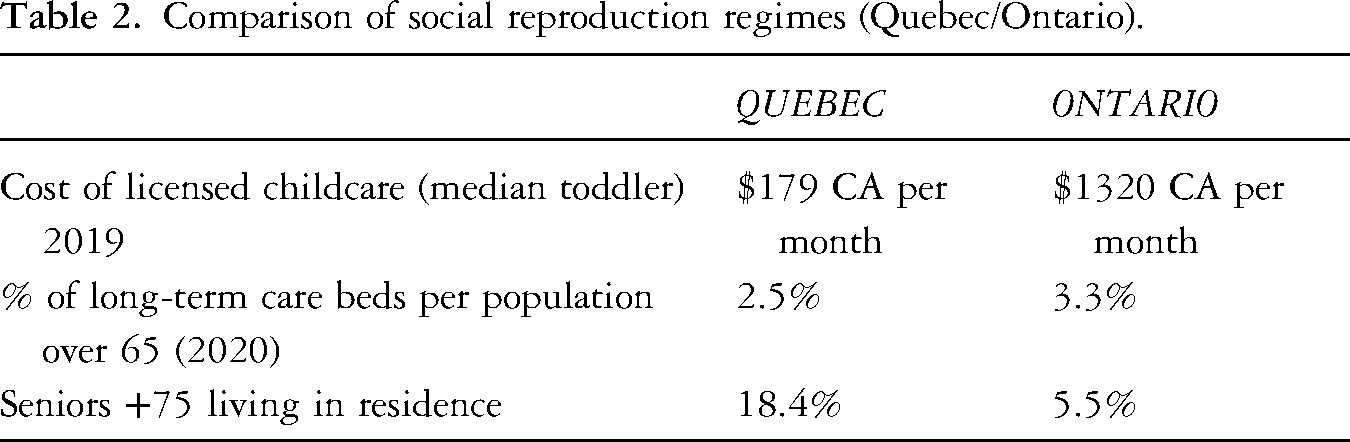
In contrast, the cost in the publicly funded Quebec childcare system in 2019 was $ 8.50 a day or $179 a month per child (Ministère de la famille, 2020; Parent Quality Childcare, n.d). Quebec's childcare programs increased employment among women, thus addressing some labour shortages, and contributed to lower poverty rates for families with children (van den Berg et al., 2017) despite a growing commercialization of childcare services (Mathieu, 2019). Created in 1997, the Quebec childcare system came with generous maternal/parental leave and targeted benefits for low-income families. The result is significant welfare support to families with children, consistent with social democratic welfare regimes.
In contrast, Ontario's social reproduction regime has an adamantly liberal, residual social policy orientation that maintains individual and family responsibility for social reproduction with state support only when families cannot afford to pay or fail to care. Since this welfare regime leaves wide care gaps for families living under its jurisdiction, Ontario's answer to diminishing labour force supply and care labour needs is immigration. Together, long-term care and childcare delivery, quality, and costs in Ontario indicate a familialized model. Ontario's welfare/immigration regime is predicated on the assumption that low-waged and unpaid social reproductive work will be provided by families, households, and communities, or, in the absence of local sources, from abroad.
Distinct immigration regimes
Built on usurped indigenous lands, Canada is a country of immigration and a settler society. It has also long relied on a strong naturalization policy. In a record year, 431,645 immigrants received permanent Canadian residency in 2022. But the country has also developed a growing dependence on temporary migrant workers who made up 4.1% of the total of the labour force in 2019 – up from 1.9% in 2010 (Statistics Canada, 2022b).
Subnational devolution of immigration selection power complicates this story (Paquet, 2019). 3 Ontario's elected governments have varied in the degree to which they have exerted provincial control of immigration, but care economy workers have been increasingly targeted in the Ontario Immigrant Nominee Program, a partnership with the federal government. In contrast, in 1991, Quebec negotiated a complete and permanent devolution of responsibility in matters of economic immigration selection, settlement, and integration, and has recently developed specific immigration programs for health care workers. Further, in the case of home childcare and support workers programs, Quebec offers only limited rights to permanent residency.
Despite different approaches, immigration has not addressed Canada's high labour shortages (Statistics Canada, 2022e), including in Quebec and Ontario's care economy. With an older population and less reliance on immigration than Ontario, Quebec healthcare and social services job vacancies were at 8.3% at the end of 2022, up from 3.9% pre-pandemic (Institut de la statistique du Québec, 2022a). Less acute but still high, Ontario's job vacancies in health care and social assistance were increasing in 2022, with 6.5% vacancies at year end (Statistics Canada, 2023a).
In summary, Canada's subnational welfare/immigration regimes have developed contrasting answers to similar demographic and care economy challenges. While Quebec chose a more social democratic route to attend to older adults and children care needs, Ontario has maintained a familial and market-based approach. Consequently, Canadian families achieve social reproduction differently. As a result of care gaps and labour shortages in the healthcare and social services sectors, both these subnational regimes rely on temporary immigration and visa programs to extract low-waged and unpaid social reproductive migrant labour, but differently.
Why are there differences in PGPs and careworker immigration?
Given these brief, distinct portraits of social reproduction in Quebec and Ontario, we return to our question: how can we make sense of the differences in PGP and home childcare and support worker migration? This section provides a detailed portrait of those differences. 4
While parents and grandparents come to Canada for many reasons, one dominates: to help with childcare. According to a 2014 government evaluation report on family immigration, 85% of sponsored PGPs provided at least some care and/or housekeeping for their children and grandchildren (CIC, 2014). In both Ontario and Quebec, sponsored PGPs were more likely to be women (between 57 and 60%), with the majority between 55 and 75 years. Many of these grandmothers come to care.
PGPs enter through a host of immigration and visa programs, including the PGP Sponsorship program that offers permanent residency. In any given year, PGP sponsorship applications far exceed policy targets. Families must then find alternatives. Some PGPs enter through a federal super visa program offering temporary residency of up to five years, and multiple entries for up to ten years, with required return to country-of-origin at prescribed intervals. About 17,000 super visas are issued annually across Canadian jurisdictions (IRCC, 2022b). Finally, many PGPs enter, less detectably, through regular visitor's visas (for up to 6 months).
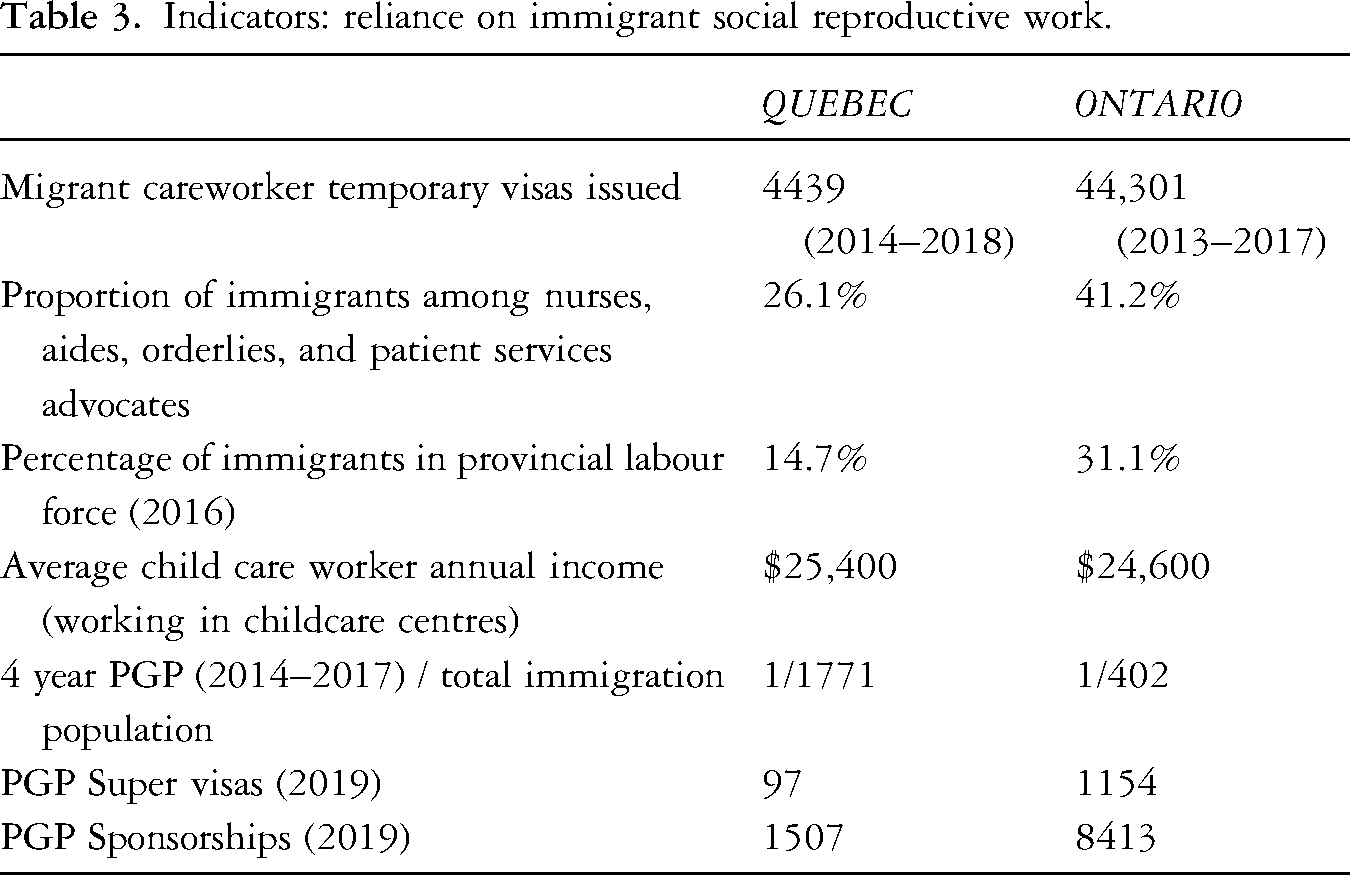
The policy message is clear: while PGPs are welcome as temporary visitors and childcare providers, only some are welcome as permanent residents. Further, even though sponsored PGPs are permanent residents, families must sign a formal undertaking of financial responsibility for 20 years after arrival in most of Canada, and 10 years in Quebec (Braedley et al., 2021). Annual numbers of sponsored PGPs are low when compared to the overall permanent residents approved each year in Canada. In 2019, 20,000 of about 341,000 total permanent resident admissions were PGP sponsorships. Ontario immigrant families sponsored 8413 of these PGPs and brought in 1154 temporary PGPs with the super visa. When calculated as a ratio with the total Ontario immigrant population, this is 1 PGP for every 402 Ontarians born outside of Canada. In Quebec in the same year, Quebec immigrant families sponsored 1507 PGPs and brought in 97 PGPs on super visas; a ratio of 1 PGP for every 1771 Quebecers born outside of Canada.
These ratios indicate a deep social reproduction contrast between immigrant families living in Quebec and Ontario. They also suggest that in the context of Ontario's familial, residual social reproduction regime, immigrant families with sufficient means make strategic use of immigration for care support.
Uptake of the national home childcare and support worker immigration programs confirm these differences. Since 2019, immigrant workers have entered Canada through a two-stream Home Child Care Provider Pilot and Home Support Worker Pilot program (formerly the Canada Caregiver Program). In 2021, Quebec admitted 126 and Ontario admitted 1450 of these workers (IRCC, 2021: 51). Given that Ontario's population is just 1.6 times that of Quebec, and that Quebec's birth rates and percentage of the population over 65 are both higher than Ontario (Statistics Canada, 2021, 2022a), this significant difference provokes curiosity.
These workers, brought in to care for children and older adults in private homes, are offered temporary residence. In Quebec, immigrant home childcare and support workers are considered “low-skilled” and at the time of writing, may be barred from permanent residency in Quebec although could apply their work experience to apply for permanency in other regions of Canada. In Ontario, these workers do not encounter this barrier and can apply for permanency after 24 months of successful employment. But the number of those admitted far exceeds the permanent residency spots reserved for them (Hanley et al., 2017). Their own social reproduction is also not a policy concern.
In contrast, immigrant workers in Quebec's health and long-term care services are considered high-skilled temporary workers and may apply for permanent residency after 12 months of employment, compared to 24 months in the rest of Canada. Further, care workers may come to all Canadian jurisdictions as temporary migrants through provincial nominee programs for skilled and semi-skilled care workers, or as spouses of economic immigrants. Each program has distinctions among jurisdictions.
Looking across these programs and the social reproduction regimes they reflect and shape, our comparison suggests that when welfare policies produce lower social reproduction deficits for immigrant and established families, extraction of PGPs and migrant care worker labour is lower. Table 3, below, offers some of the immigration indicators used to make this assessment. In other words, when welfare policies distribute some social reproduction to the state, both immigrant and established families rely less on the paid and unpaid work of migrant workers and migrant grandparents. Immigrant workers, including temporary workers, may be recruited for state-organized care services, but these services are likely to be unionized, considered skilled, and lead more smoothly to permanent residency. For both PGPs and home childcare and support workers, access to permanent status and welfare is limited, enhancing their vulnerability.
By exploring interplays of socio-demographics, social welfare, and immigration policies across levels of scale, we have begun an analysis that shows how welfare/immigration regimes deploy national and subnational bordering to extract the social reproductive labour of immigrant and established women, articulating how these sub-national jurisdictions organize social reproduction through distinct social welfare orientations - more social-democratic in Quebec, liberal-familial in Ontario. The articulation of immigration policy to welfare policy substrates helps to explain the dramatically different uptakes of two national immigration programs in Quebec and Ontario. To conclude, we return to our conception of social reproductive borders, to consider why these distinctions matter.
Conclusion: shifting the analysis to social reproductive borders
Welfare/immigration regimes unfold at different scales. In the Canadian case, immigration and bordering policies, ranging from visas to temporary worker programs, are bundled in a robust strategy to support capital accumulation, commodifying immigrants as labour power. This strategy aims to increase Canada's labouring population with both temporary and permanent workers while making it possible for provinces to restrict their welfare access.
At the subnational level, provinces deploy social reproductive borders in particular combinations of welfare and immigration, to mitigate care gaps. Ontario deploys market-based arrangements to attract young working age immigrants to fill its labour shortages, while keeping welfare obligations low. The province leave most care for young children, the sick, and vulnerable adults in the hands of families. The results of this racialized and gendered policy choice emerged clearly from statistics. Ontario's low fertility rate suggests that families (and women) are dealing with this dearth of social reproductive support by having fewer children. Those families who can afford to hire help or financially support parents and grandparents use immigration policy as a substitute for welfare services. Home child care and support workers, while promised an opportunity at permanent residency, are bordered by the reserved number of permanent residency spots available annually to migrants in their category. Sponsored PGPs are also bordered. They may access full welfare benefits after 20 years of residency, if they live so long. Other PGPs remain temporary residents. But their social reproductive labour is extracted, none the less.
The welfare path taken by Quebec is more social-democratic. But where Barker (2018) contends in the Swedish case that “walling the welfare state” involves excluding as many migrants as possible, we show that social-democratic societies may also choose to use borders to enable social reproductive labour extraction while excluding migrants from welfare, but differentially. In Quebec, where stronger welfare arrangements reduce the need for care labour within families and households, PGPs enter in small numbers, and those who are sponsored by families wait 10 years to receive welfare benefits: half the period sponsored PGPs experience in the rest of Canada. But those who arrive as home child care and support workers are bordered from permanent residency in the province.
These Canadian cases carry lessons for theorizing the relationship between welfare and immigration anew. Social reproduction is an increasing concern for both states and capital interests as labour gaps open wider in response to austerity politics, the pandemic, population aging, and low fertility rates. A feminist border analysis inquires and compares how social reproductive borders enable, challenge, support, or undermine a racialized, gendered, and ageist advanced capitalism in a historical moment when questions of population and replacement of the labour force have become pressing (Bhattacharyya, 2018). In considering the future of social policy research in the context of global migration, population aging, and political economic shifts, insights into social reproductive borders open empirical and theoretical questions about contemporary capitalism and the state at all analytical levels of scale. As others (Mahon and Robinson, 2011; Williams, 2019) have argued, this quickly evolving context invites a renewed focus on global social reproductive justice.
At the centre of our analysis, we have elaborated the concept of social reproductive borders. Now sustaining what Petersen (2003: 78) calls the “reproductive economy” or care economy – that is, the “dependence of production and accumulation on women's work and feminized labor” – social reproductive borders have developed and refined to address care gaps produced by the complex relations between markets, families, communities, and states, at many levels of scale. Transfers of care work, well-being, and wealth from lower income to high income jurisdictions happen through and along social reproductive borders.
Taking this approach shifts debates about welfare/immigration regimes from questions of social citizenship, belonging, and welfare deservingness. Like social citizenship perspectives, it highlights the reality that little work can be accomplished until people have rest, food, clothing, shelter, education, health care, and supportive relationships with others. It includes consideration that some people are not ready to work, prevented from working, beyond working or worked out, and still need these resources. But a feminist border analysis recognizes that all these resources require work, daily and generationally. It raises questions about the extent to which care economies are predicated on the circulation, control, and extraction of migrant care labour. It opens avenues to consider the relationship between paid and unpaid work, social reproduction, immigration, welfare, and GDP. Its emphasis on borders highlights how welfare and immigration policy filter care labour mobilities (Mezzadra and Neilson, 2013) to fill social reproductive gaps.
A feminist border analysis thus illuminates whose social reproductive work is acknowledged as work, whose social reproductive work is paid and benefits from social protection, whose social reproductive work is legally protected by labour standards and done with or without citizenship status. It takes up the ways that gender, age, class, and race are implicated. Without denying welfare chauvinism, it turns the logic of dependence around. It interrogates whether and how welfare/immigration regimes bank on migrants’ social reproductive labour to keep welfare costs low. Hence, a feminist border analysis does not ask: “what kinds of supports should the welfare state provide to (rights-bearing) migrants?” Rather, the question that emerges is: “how are welfare/immigration regimes sustained by migrants’ social reproductive labour?” This analysis invites new calculations that expose shifts and changes in the sources, kinds, and conditions of social reproductive labour, in the international circulation of social reproductive labour, and the dependencies of contemporary welfare states and capital interests on borders to ensure this labour extraction.
Indicators: reliance on immigrant social reproductive work.
Footnotes
Funding
SSHRC Insight Grant Bordering Old Age, Bordering Care: Comparing Welfare State Approaches: 435-2019-0663.