




Abstract
This study investigates factors that encourage and discourage women entrepreneurship in Saudi Arabia. The research uses the Adult Population Survey (APS) and analysed data collected from 1,305 women. Findings show that perceived capability, opportunity perception, risk perception, social network and informal investment significantly influence women’s propensity to entrepreneurship. However, the entrepreneurial propensity of women who have financed others’ businesses is negative. This study highlights the need for entrepreneurship researchers to examine factors that mobilize and inhibit entrepreneurial initiatives among women and study cognitive and social capital variables in an integrated framework.
Executive Summary
The effectiveness of enterprises operated by women was a major focus of earlier studies on women entrepreneurs. However, this study examines variables influencing Indian women’s propensity for entrepreneurship through social capital and cognitive perspective. This research aims to steer the understanding of women entrepreneurs at a niche level. Many different theories have been proposed to explain the elements impacting women’s entrepreneurship. These approaches have, however, faced criticism for methodological, conceptual and predictive strength flaws. The explanation of entrepreneurship has recently shifted to include cognitive and social capital views. For this, the Adult Population Survey (APS), created and sponsored by the Indian team of Global Entrepreneurship Monitor (GEM), has been used to gather data from 1,305 women from the Kingdom of Saudi Arabia (KSA). Given that the dependent variable is binary, the data were analysed using logistic regression. The findings indicate that women’s proclivity for entrepreneurship is influenced by perception regarding starting a business. We examined two factors, cognitive and social capital, where perceived capability and opportunity perception significantly influence women’s propensity to entrepreneurship whilst risk perception hinders it. Additionally, social networks and informal investment encourage, but the entrepreneurial propensity of women of KSA who have financed other businesses stands to be negative. This prompts entrepreneurship researchers to examine the factors responsible for mobilizing and inhibiting entrepreneurial initiatives among women, reasserting entrepreneurial attitude in the existing literature and studying the cognitive and social capital variables in an integrated framework. This article provides, insights for policymakers to formulate effective policies supports women’s initiatives and their decision to start a business. It is one of the pioneering initiatives that demonstrate social capital and cognitive variables affect women’s likelihood of entrepreneurship in Saidi Arabia’s evolving social environment.
It turns out that there is unrealized economic development potential in half of the human population (Ahl, 2006; Terjesen Amorós, 2010). It is widely acknowledged that women have the potential to contribute to economic progress (Hisrich Öztürk; Rankin, 1999, 2001), a phenomenon that holds good for Saudi Arabia as well. Many researchers such as Hughes et al. (2012) observed this phenomenon as an inevitable rule of change for growth and progress. Given the productivity and the potential held by the women as per their research, it becomes clear how important female entrepreneurship is. Thus, it is imperative for the authorities to build a contextualized knowledge of the driving forces of women’s entrepreneurship before designing some national interventions thorough policies to boost entrepreneurship done by women, a failure which ‘may result in the underutilization of human and as a result, in the perpetuation of lower living standards and the implementation of costly and ineffective policies’ (Langowitz Minniti, 2007).
One may come across several studies while conducting a literature review on women entrepreneurship (Ahl, 2006; Ali et al., 2021; Berger Kuckertz, 2016; Brush et al., 2009; Cetindamar et al., 2012; Farani et al., 2017; Klyver et al., 2013; Langowitz Minniti, 2007; Lindvert et al., 2017; Noguera et al., 2013; Simmons et al., 2014; Welsh Kaciak, 2018; Yadav Unni, 2016). However, most of them appear to focus mainly on the investigations of the financial performance and growth of entrepreneurial initiatives being managed and run by a female (Ahl, 2006; Arafat et al., 2020; Verheul et al., 2010). Issues more pertinent and potent, such as the possibility and propensity of venture creation by women remained relatively ignored (Hughes et al., 2012; Hussain et al., 2022); even fewer of these women, it was found, are likely to contemplate venturing overseas (Arafat et al., 2022; Jafari-Sadeghi et al., 2021). It is further noted that even though entrepreneurship has immense potential and relevance for less developed and developing countries, the scholars working on entrepreneurship largely have focused on the developed world only (Gupta et al., 2009), possibly for easy access to related research funding, data and other pieces of information. This phenomenon is more evident in the case of research related to women entrepreneurship, where researchers have endeavoured to conduct and theorize in developed economies (Welter et al., 2006). It is evidently clear that across the world, gender disparity does exist in venture creation where men are more oriented to engage in entrepreneurial initiatives as compared to women (Arafat Saleem, 2017; Hughes et al., 2012; Minniti et al., 2005). However, Bosma and Harding (2007) have reported that developing countries have a larger percentage of women entrepreneurs than developed nations. Thus, the space for women’s contribution to the entrepreneurial initiatives in the Kingdom of Saudi Arabia (KSA) as well need not be ignored. Given the very limited availability of research on women entrepreneurship in KSA and recent gender equality–related initiatives, it is more logical and timelier to conduct an objective study in the said area.
Most of the research conducted in the developing world, irrespective of gender consideration and more so if related to women entrepreneurs, has largely focused on issues like the contribution of collective efforts (Datta Gailey, 2012), the role of training (Anwar Saleem, 2018; Field et al., 2010), level of adaptability and knowledge (Goyal Parkash, 2011) and using intellectual resources (Arafat et al., 2020) in forming the entrepreneurial initiatives.
However, most of the available research literature may be criticized on the following grounds:
(a) The data and information gathered by the researchers come from the existing entrepreneurs, hence leading to survival and hindsight biases. Consequently, the inhibited and failed entrepreneurs could not be taken into account for the major part.
(b) These studies have not reached an agreement on explaining the forces responsible for entrepreneurial initiatives (Yadav Unni 2016).
It is only in selected research that cognition has been highlighted by authors like Grégoire et al. (2011), Khan et al. (2020) and Mitchell et al. (2007), while some others and Afandi et al. (2017) and Lindvert et al. (2017) studied social capital-based research to reflect upon the factors responsible for the higher propensity of women entrepreneurship.
In this research, we describe women’s entrepreneurship in the special setting of the KSA via cognitive and social capital lenses. The cognition approach has been used because of its ability to explain the entrepreneurial phenomenon in a much clearer manner than the other entrepreneurial theories (Arafat et al., 2020; Arenius Minniti 2005; Baron, 2004; Liñán Chen 2009; Mitchell et al., 2007). Since the 1960s, this method has constantly been recognized in cognitive psychology (Shaver Scott, 1991). Furthermore, the cognitive method is gaining popularity in explaining why some people decide to start their own businesses. It highlights how mental processes, which we acquire, store, transform and use the information to carry out various tasks, such as addressing issues or making decisions, have an impact on what we say and do as humans (Baron, 2004; Saleem et al., 2022). Naturally, choosing to launch a new business enterprise might be one of these choices.
THE SAUDI ARABIA CONTEXT
In the developing world, one of the economies with the fastest pace of growth is Saudi Arabia. In the largest economies, it is among the top 25 and the largest in the Middle East and North Africa region. Extractive industry via diversification is the engine of an economy (Oxford Business Group, 2007, 2015). The oil industry is the chief driving industry for the economy of the country, with 50% of the GDP coming from it on average, amounting to 90% of the total exports and revenues of the government.
As per the data of 2020 World Bank’s Doing Business, Saudi Arabia stands at the 13th rank among 183 economies in ‘ease of starting a business’, demonstrating good state support to budding entrepreneurs. Efforts are being made to provide institutional support to empower youth to become entrepreneurs. Only a few studies have concentrated on entrepreneurship in the kingdom, despite its prominence and importance throughout the nation. The GEM database is increasingly used in research (Arafat et al., 2020; Bergmann et al., 2014; Ramos-Rodríguez et al., 2015), the same is true in the case of KSA as well. In addition, new research focused specifically on women entrepreneurs shows that they are establishing businesses at higher pace than in the past and are likely to continue to do so with more encouragement and support from their families. However, there are numerous challenges like difficulties accessing finance, societal conventions that are mostly male-oriented and a dearth of training and mentorship (Ahmad, 2011; Danish Smith, 2012).
As venture owners, women, on a major level, encounter role conflict; nevertheless, the impression of family support reduces this emotion, resulting in improved performance (Khan et al., 2022; Welsh et al., 2021). Scientists who are entrepreneurs are another group that has attracted some notice. According to the study, younger scientists with more human capital start new firms more frequently than their more senior counterparts with less human capital (Alshumaimri et al., 2012). In numerous additional studies (Kayed Hassan, 2010) and research on the association between performance and market orientation in the context of Saudi Arabia (Bhuian Habib, 2004), the contribution of Islam to entrepreneurial activity is being highlighted.
However, research on the elements that affect new company start-ups among Saudi Arabian people, including women, is still rather scarce. To fill the gap, the present article endeavours to investigate and highlight the factors that encourage/discourage the women of Saudi Arabia from becoming entrepreneurs. More precisely, this study seeks to determine how the instrumental elements of cognitive and social capital perspectives connect to Saudi women’s propensity for entrepreneurship (Arafat Saleem, 2017; Arafat et al., 2020; Davidsson Honig, 2003; Khan et al., 2020; Passaro et al., 2018). Scholars have observed that women’s ability for venture creation can be better understood by employing the cognitive and the social capital approach (Arafat Saleem, 2017; Khan et al., 2019; Langowitz Minniti 2007). Many entrepreneurship scholars have started looking for reasons for the given level of women entrepreneurship (Brush et al., 2017; Khan et al., 2022; Langowitz Minniti, 2007). Thus, this article endeavours to facilitate a better understanding of women entrepreneurship and addresses some of the enquiries about women’s inclination and motivation for venture creation, contributing to women entrepreneurship literature. Further, the developed world’s research is less likely to explain the phenomenon in the developing world. The cultural, educational and regional contexts also play a pivotal role in the development or dearth of women entrepreneurship (Cetindamar et al., 2012; Welsh Kaciak, 2018). Thus, many authors have strongly recommended replicating similar research to make the studies more contextualized and understandable (Kuschel Lepeley, 2016; Neupert Baughn, 2013; Poggesi et al., 2019; Valliere Peterson, 2009). The present study analyses data on women entrepreneurs of KSA, which represents a unique context compared to any other country in the world (Arafa Saleem, 2017; Iakovleva et al., 2011).
THEORETICAL FRAMEWORK AND HYPOTHESES
Entrepreneurs manage the multiplicity of opportunities and challenges at different levels of entrepreneurial progress (Robichaud et al., 2007). Entrepreneurship involves dealing with varying obstacles and challenges arising from the different natures of businesses and the different contextual situations in which the businesses operate (Brixy et al., 2012). Consequently, the researchers studying entrepreneurship to have a thorough grasp of the steps and stages of entrepreneurship by applying permutations and combinations of different theories (Afandi et al., 2017; Welter, 2011; Zahra et al., 2014). The very existence of a multiplicity of models and theories is a sufficient argument to conclude that each may have its own limitations (Abu Bakar et al., 2017; Ramos-Rodríguez et al.,2012). However, the literature currently available indicates that social and cognitive methods may be good enough to use as a framework for describing entrepreneurship (Grégoire et al., 2011; Liñán et al., 2011; Mitchell et al., 2004). It is against these observations that this study has integrated both of these approaches.
Cognition Approach
A key component of entrepreneurial conduct, according to several studies, is cognitive processing (Arafat et al., 2020; Baron, 2004; Krueger et al., 2000; Mitchell et al., 2004; Pryor et al., 2016; Shaver Scott, 1992). Of the cognitive processes, researchers considered perception as the focal component influencing entrepreneurial behaviour. Three crucial perspectives demonstrated by the literature on cognitive entrepreneurship are perceived capability, opportunity perception and risk perception (Arafat et al., 2018; Liñán et al., 2011 ; Lopez-Nicolas et al., 2005).
Initial entrepreneurship research focused on key traits like independence, locus of control, motivation and risk-taking capacity, that are the personality characteristics with most significance (Borland, 1975; Brockhaus Sr, 1980; Collins Moore, 1964; Gartner, 1989; Jennings Zeithaml, 1983; Kets de Vries, 1985; McClelland, 1961).
Many researchers also blended entrepreneurial traits with demographic factors, namely age, gender, ethnicity, education, work and ethnicity experience (Arafat et al., 2020; Cooper et al., 1994; Cooper Dunkelberg, 1987; Reynolds et al., 1994), resulting in greater comprehension of how demographic variables and personality characteristics affect entrepreneurship. Not all researchers agree with this approach in determining the roles of influencing factors on entrepreneurship; some of them have their reservations about the methodology employed in conducting the research, along with the lack of predictive ability in the approach (Gartner, 1989; Krueger et al., 2000; Robinson et al., 1991). However, more recently, the cognitive perspective has been recognized as a superior approach in explaining the various contextual factors and their effects on entrepreneurship (Baron, 2004; Grégoire et al., 2011; Guzmán Javier Santos, 2001; Krueger Carsrud, 1993; Mitchell et al., 2004, 2007).
The cognitive perspective explains behaviour in relation to mental processing, namely attitude and perception (Krueger, 2003). Entrepreneurs may obtain pertinent information, store it, evaluate it and use it to solve issues and make decisions with the aid of this sort of mental thinking (Mitchell et al., 2002). Studying perception revealed major insights into the individual’s behaviour as an entrepreneur (Kolvereid, 1996; Krueger, 2003; Liñán et al., 2011; Liñán Chen, 2009). The environment that our consciousness and senses enable us to perceive is reflected in our perception (Krueger, 2003). Perception frequently lacks objectivity and is influenced by how individuals personally interpret situations (Arenius Minniti, 2005; Liñán et al., 2011).
We used extensively researched perception for this study, namely: (a) opportunity perception, (b) risk perception and (c) perceived capabilities that may be affecting the female entrepreneurial propensity in Saudi Arabia.
Opportunity Perception
Economic opportunities are better positioned by people with entrepreneurial mindset (Kirzner, 1979). Venkataraman (1997) and Shane and Venkataraman (2000) described entrepreneurship as an initiative to incarcerate to seize valuable possibilities. Opportunity identification is, therefore, the most distinctive and essential constituent of entrepreneurial behaviour that instigates entrepreneurial start-ups (Khan et al., 2019; Kuckertz et al., 2016; Sorensen Sorenson, 2003). The social status of men and women differs in a developing country; hence, the likelihood is that women would perceive opportunities differently as compared to men (DeTienne Chandler, 2007). It is understandable that given the gender variance and how they socialize it makes sense that when recognizing business prospects, each group will have a distinct perspective of recognizing entrepreneurial opportunities (DeTienne Chandler, 2007). Many scholars found variance in interest in entrepreneurial activities, that is, women having less interest when compared to their male counterparts (Baughn et al., 2006; Langowitz Minniti, 2007). Some researchers have also pointed out that women not only have a different perception, but because of their uneven standing in a patriarchal culture, they have less prospects for entrepreneurship (Ahl, 2002; Khan et al., 2020; Mousa Wales, 2012; Pernilla, 1997; Schiller Crewson, 1997; Wilson et al., 2007). Women, frequently in the face of unfriendly settings, on the other hand, are encouraged to create new mechanisms at various stages of the entrepreneurial process (Ojong et al., 2021). On this basis, it would be fair to conclude that they will undoubtedly be willing to become entrepreneurs if they are introduced to entrepreneurial opportunities.
Therefore, we hypothesized:
H1: Opportunity perception has a favourable impact on Saudi Arabian women’s entrepreneurial propensity
Risk of Perception
Risk perception is a difficult proposition in venture creation (Caliendo et al., 2009). It is well established that entrepreneurs inevitably take a risk at some point in their venture (Bhasin, 2012; Battistella et al., 2012; Kirby, 2004). Failure is an indispensable probability associated with every business activity, and hence individuals’ decision of venture creation is bound to imbibe the possibility of failure that one has to perceive (Minniti Nardone, 2007). Thus, risk perception is nothing but an individual’s ability to understand and compute the probability of failure while carrying out one or more meaningful goals (Conroy et al., 2002; Rausch Rachel Dinur, 2011). Based on the research analysis, women had higher levels of risk perception and were more risk-averse, thus explaining the gender gap in entrepreneurship (Wagner, 2007). As a result, we suggest the following:
H2: Risk perception has a negative influence on the entrepreneurial propensity of women.
Capabilities Perceived
Capability, including knowledge and skill, is an indispensable factor in venture creation (Papagiannidis Li, 2005). The relevance of perceived capabilities has been acknowledged in the research on entrepreneurship, which has discovered that perceived capabilities are positively related to entrepreneurial initiatives (Boyd Vozikis, 1994; Minniti Nardone, 2007; Noguera et al., 2013; Tsai et al., 2016). Researchers have noted that women belittle abilities and skills, particularly in male-dominated fields (Anna et al., 2000). Such misled perceptions of women inhibit the possibility and propensity of women taking entrepreneurial challenges (Gupta Bhawe, 2007). On the contrary, scholars have also found that women are more trustworthy than males and are more likely to establish their own businesses since they have greater entrepreneurial knowledge and skills (Gatewood et al., 2002; Menzies Tatroff, 2006). In addition, a family’s ties with internal and external stakeholders foster trust, which is a strategic resource for the family business. Therefore, being trustworthy, female entrepreneurs should use it to their advantage and strive to create trust and a positive reputation by providing the greatest working conditions for staff, interacting effectively with consumers to win their loyalty, and obtaining lower-cost financing from creditors (Chaudhary et al., 2021). This inevitably reflects a bigger possibility of women success if they may rightly perceive their capabilities. As a result, we suggest the following:
H3: The entrepreneurial propensity of women is positively impacted by perceived capabilities.
The Approach of Social Capital
The role of social capital is optimally recognized in explaining entrepreneurial activity (Afandi et al., 2017; Davidsson Honig, 2003; De Carolis Saparito, 2006; Saleem et al, 2022; Tsai Ghoshal, 1998). Social capital enables an individual to access relevant information and resources that help venture creation (Davidsson Honig, 2003; Larson Starr, 1993). Taking into account the value of social capital when making decisions about the venture, we have chosen two factors: informal investment and social network. In prior investigations, these factors produced good outcomes (Arafat et al., 2018; Klyver et al., 2008; Klyver Hindle, 2007; Ramos-Rodríguez et al., 2012; Pindado et al., 2018; Pindado Sánchez, 2017).
Social Networks
An individual may be immensely benefitted from the experiences of others while taking up entrepreneurial initiatives and decisions (Delmar Davidsson, 2000; Scherer et al., 1991). Having a network with existing entrepreneurs may enable individuals to develop a positive attitude and understanding required to overcome entrepreneurial challenges, as per planned behaviour theory (Ajzen, 1991). Networking is very crucial, mostly for females who are entrepreneurs (Klyver Tejesen, 2007). If an entrepreneur has greater networks, they will be more successful (Shane et al., 2002).
The ‘role theory’ of Veciana (2007) also establishes that networking with any existing entrepreneur in direct relationships or otherwise may enhance the propensity of starting a new venture. Further, potential entrepreneurs’ interaction with existing entrepreneurs may have a bearing on the decision of venture creation. Such a network may also help them access financial institutions, governmental bodies, and so on, causing the establishment of ventures (Khan et al., 2022). As a result, we hypothesized:
H4: The entrepreneurial propensity of KSA women is positively impacted by social networks.
Investing Informally
There is an observable boost in the willingness to launch a new venture in individuals having a prior engagement in angel investment in some venture, or with investing in a business operated by a family or an acquaintance. The planned behaviour theory rightly asserts that such angel investors tend to have a positive approach towards entrepreneurship (Ajzen, 1991). The exposure of the business angels or informal investors to decision-making processes early on, through investment or by financing other businesses informally, develops a relatively higher risk-taking behaviour in the individuals than those lacking any such prior experience. More often than not, angel investors launch or assist new firms (Amit et al., 1993; Stuetzer et al., 2013; Verheul et al., 2015). Further, the role theory asserts that angel investors become familiar with current business owners and experience their environment. Therefore, their first-hand information, intimacy and enhanced awareness familiarize them with the success stories of other entrepreneurs, thus instilling confidence in them to realize that creating new ventures is also viable for them (Veciana, 2007).
There is also the network theory, which is another proposition which propounds that people who have made an informal investment or supported a firm as a business angel are likely to have easy access to the resources and essential data needed for launching and sustaining a business (Larson Starr, 1993). Women corporate leaders are less likely to employ internal and borrowed funding, according to empirical research. Internal financing willingness is moderated both negatively and favourably by social capital and the external institutional environment (Wang et al., 2021). As a result, the following hypothesis is made:
H5: KSA women’s propensity for entrepreneurship is positively influenced by having invested in other businesses informally.
METHODOLOGY
We used the APS, financed and put together by the Indian team of GEM, to gather and assemble the data for the current study. Babson College in the United States and London Business School in the United Kingdom founded GEM, a renowned organization for entrepreneurial research, in 1998. This information source is widely utilized in many types of research (Aidis et al., 2008; Boudreaux et al., 2019; Schmutzler et al., 2019; Stenholm et al., 2013; Thai Turkina, 2014). A total of 1,835 KSA females have been included in our sample. However, due to the binary nature of the dependent variable’s data used in our research, the logistic regression approach was employed to analyse the data. Table 1 presents the variable description.
Variable Description.
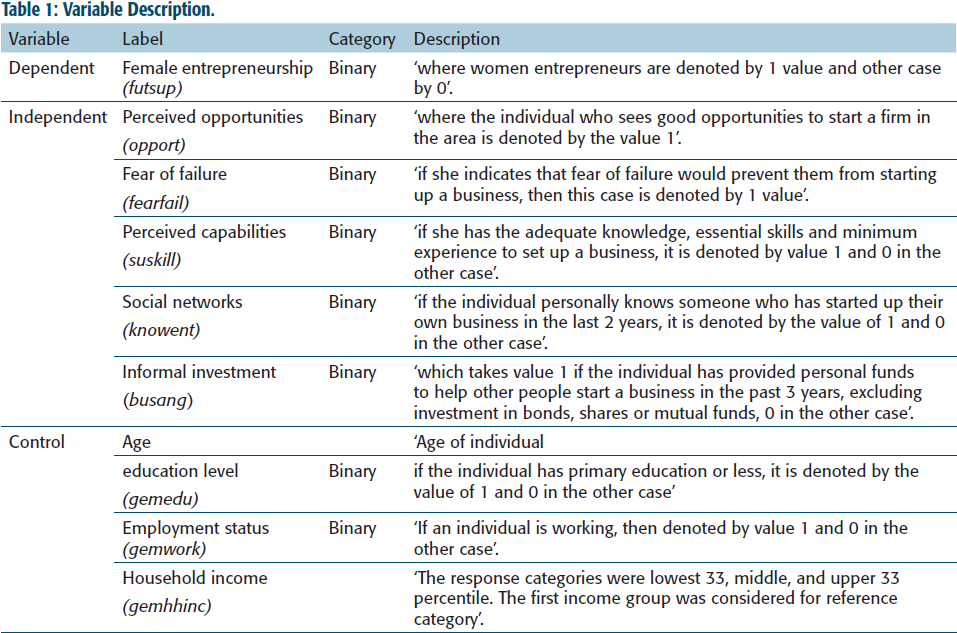
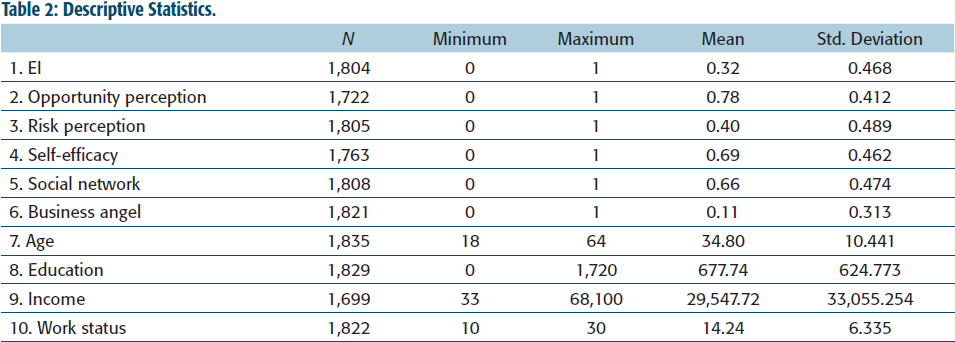
Table 2 presents the descriptive statistics of women of KSA, gathered through GEM data, with 35 mean ages of the respondents. The table indicates that just 32% of the women in KSA are intentional entrepreneurs. It is encouraging to note that 78% of women feel that they can identify opportunities to launch a new firm, and the degree of risk perception is considerably low, with just 40%. In comparison, 60% feel they can manage business risk in starting a new business. Sixty-nine percent of the women in KSA have a high level of assurance in perceiving their capabilities required to muster the courage to create and sustain a new business. The data also reflect that high socializing Arab culture has facilitated 66% of women in forging a social network with existing entrepreneurs. However, it appears that due to a culture of lower participation in financial decisions, only 11% of women are business angels or informal investors.
Descriptive Statistics.
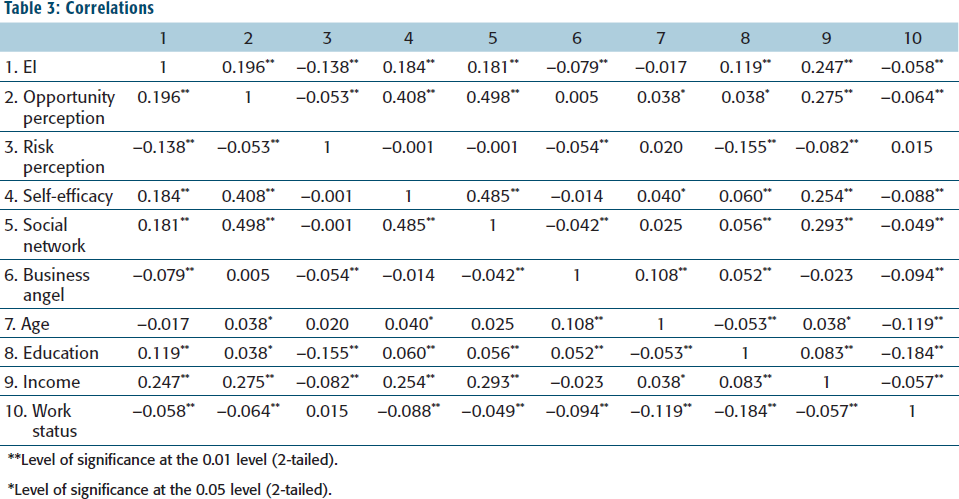
To check multicollinearity in Table 3, for hypothesis relationship, correlational analysis has been conducted to provide some initial support for the associated hypothesis. The correlation matrix reflects no multicollinearity problem as the correlation matrix for all the indicators shows less than 0.6.
To test the better fit for our model, we have used an omnibus test (see Table 4) wherein the value of chi-square is found to be of significance (chi-square = 205.483, df = 14, p < .000); Thus, our model fits the data well. It was further counter-checked through Hosmer and Lemeshow’s goodness-of-fit test. The p-value is higher than .05 in Table 5; therefore, the model is acceptable and a good fit. (Since a good model fit hypothesis is not rejected if p > .05.)
Correlations
**Level of significance at the 0.01 level (2-tailed).
*Level of significance at the 0.05 level (2-tailed).
Omnibus Tests.

Hosmer–Lemeshow Test.

Hypotheses Testing
In order to test the listed hypotheses for the study, we used the logit regression model, and the results are shown in Table 6. The first hypothesis is accepted as the results show that the significance level is 0.002 or p < .05 for this variable. Thus, we safely conclude that opportunity perception positively influences women’s entrepreneurial propensity in Saudi Arabia.
Logistic Regression.
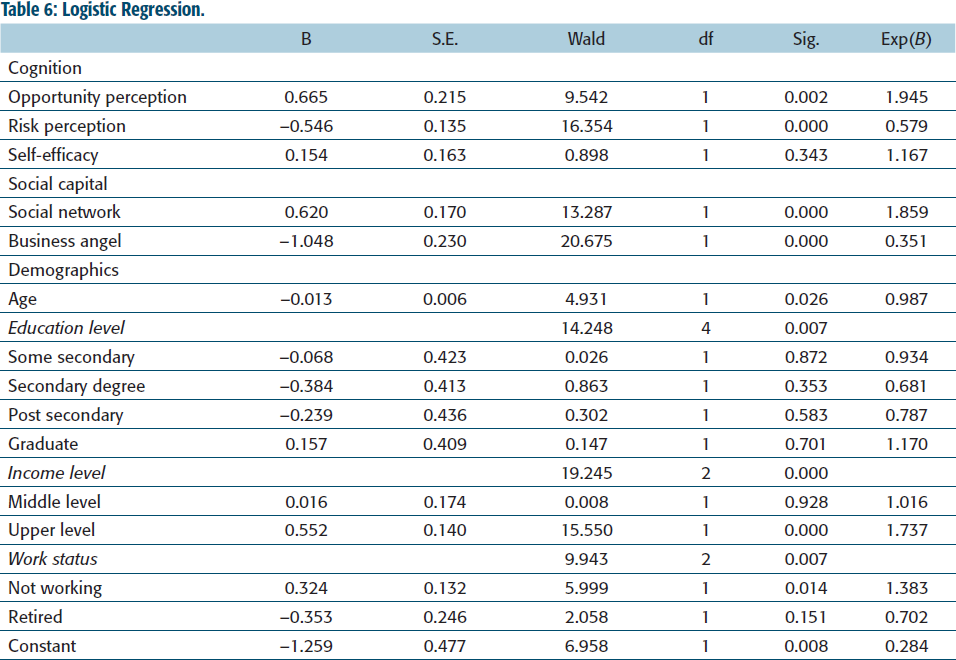
The second hypothesis presumes that the inclination of women entrepreneurs is influenced by how they perceive risk. The high negative value for this construct reflects the fact that all the women perceiving a higher degree of risk in establishing and running new ventures are found reluctant in establishing/creating their firms. Table 6 shows that risk perception having a negative value of .546 adversely affects the inclination to launch a new business by the women of KSA. The significance level is p < .000, and hence we accept the hypothesis.
In the third hypothesis, we have proposed that the perceived capability positively influences the likelihood that women will start businesses. We find that the value of the construct is only 0.164 and the marginal outcome is not significant (p <.343). Hence, the third hypothesis stands rejected.
The fourth hypothesis suggested that the social networking of women has a favourable impact on people’s propensity for entrepreneurship. With p < .05 (p < .000), the marginal result is significant, and hence we accepted the hypothesis. The odds ratio is 1.859, representing that women having stronger social networks are almost twice as likely to initiate their businesses when compared to women who do not have good social networking.
The fifth hypothesis proposed that women engaging in angel investment, or had invested in someone’s business informally had a greater likelihood of launching a company themselves (particularized in the context of KSA). Table 6 shows that this predictor’s marginal effect was negative and significant (p <.01). Thus, the hypothesis stands rejected. The rejection of the said hypothesis reflects that being a business angel discourages women of KSA from entrepreneurial initiatives of their own. It seems contrary to the world practice of angel investors being more inclined to start their own businesses in the future.
Age shows a negative influence on entrepreneurial intention, which means that the chances of a start-up decrease as age increases. Overall, education significantly influences entrepreneurial intention, but the individual influence of education is not significant. Income has a significant effect on entrepreneurial intention. However, in comparison to lower-income levels, the middle-level income group has no significant influence, while people belonging to higher income show a greater likeliness in starting their businesses. Out-of-work people are more likely by 1.3 times to launch their business, while the retired people show an absence of interest in the same.
DISCUSSION
The study aims to test the propensity of KSA women, under the fast-changing social conditions and norms, to develop and nurture entrepreneurial ventures, given the influence of cognitive factors, namely perceived capabilities. Along with social capital considerations like informal investment with the already-existing entrepreneurs and social network, opportunity and risk perception are considered.
We consider this article to be one of the pioneering initiatives to show how cognitive factors and social capital affect women’s likelihood to start their businesses in the fast-changing social set-up of KSA. We have utilized the extensive database gathered by the GEM KSA team from the adult population of the country. This paper clearly reflects the fact that the likelihood of women starting their businesses is significantly influenced by how they perceive the opportunities for doing so. Perceived capabilities also influence women’s decision to engage in entrepreneurship, while risk perception inhibits their opinion and initiative to become entrepreneurs. Social network is a motivating factor in the entrepreneurial propensity of women, while encouraging them to launch their business, being an informal investor.
The findings of this paper offer some important implications for the KSA policymakers and researchers. First, this study has attempted to call entrepreneurship researchers (Brush et al., 2017; Saleem et al., 2022) to examine the factors responsible for mobilizing or inhibiting entrepreneurial initiatives among women. The findings of this paper reassert the importance of factors understudy in formulating entrepreneurial attitude in the currently available literature (Arenius Minniti, 2005; Koellinger et al., 2013), particularly in the case of women entrepreneurs (BarNir et al., 2011; Díaz et al., 2010; Koellinger et al., 2011; Minniti Nardone, 2007; Saleem et al., 2022). These findings are consistent with past research on female entrepreneurs (Arafat et al., 2020; BarNir et al., 2011; Díaz-García Jiménez-Moreno, 2010; Noguera et al., 2013). However, we discovered that the probability of women becoming entrepreneurs in KSA increased by barely two times when compared to many other nations when angel investors or informal investments are made in other people’s firms (Arafat et al., 2018; Ramos-Rodríguez et al., 2012) in studies that are general rather than gender-specific.
Further, the study also addresses researchers’ call to study the influence of socio-capital factors and cognition on the propensity of entrepreneurial activities in an integrated frame (Arafat Saleem, 2017; Matricano, 2016; Passaro et al., 2018). In a nutshell, women entrepreneurship in KSA is influenced by cognitive factors, namely opportunity perception. This finding reasserts past research (Arafat Saleem, 2017; Noguera et al., 2013; Saleem et al., 2022). Women may, therefore effectively detect business opportunities due to a reasonable degree of education and orientation, which positively affects their inclination to become entrepreneurs.
Another possible reason for this result is that the women in KSA are financially well off. As a result, instead of acting out of desperation, their business decisions are driven by opportunity (Desai, 2011; Margolis 2014).
The study flags risk perception as an inhibitor to women’s decision to pursue entrepreneurship. This assertion inevitably confirms earlier studies on entrepreneurship done by women (Koellinger et al., 2013; Noguera et al., 2013; Saleem et al., 2022). This research demonstrates how important risk perception is as a cognitive element that affects entrepreneurial inclination globally, including in the KSA. However, this view has some exceptions (Shinnar et al., 2012; Tsai et al., 2016).
In keeping with earlier studies, this study also shows perceived capabilities as a variable positively influencing the probability of women-led enterprises (Bayon et al., 2015; Brush et al., 2017; Klyver Schenkel, 2013; Noguera et al., 2013; Saleem et al., 2022; Shinnar et al., 2014). The possible reason for this is the high degree of confidence and financial wellness amongst the women in KSA. The view of women’s entrepreneurial capability as a cognitive decision-making factor for ventures is anticipated to improve as wealth and social opening-up enhances. Thus, the study of cognitive factors is essentially exciting and worth mentioning.
Concerning the social capital factor, women’s entrepreneurial propensity of KSA is positively correlated. Starting a business relies on elements like capital and infrastructure, but growing a business has more to do with the entrepreneur’s characteristics, which are heavily influenced by the family of the entrepreneur (both directly and indirectly). A fresh perspective on corporate success and family conditioning emerged (Staniewski Awruk, 2021). Having friends or neighbours controlling business ventures in the social network was highly correlated with the likelihood of women’s entry, as the chance of women having such a network stands to be almost double compared to those who do not have such connectivity. As a member of social networks, social capital positively influences how a new firm is assessed, enabling women in exchanging business information and hence develop a desired understanding (Weber Milliman, 1997), business resources and contacts (Duchesneau Gartner, 1990; Ramos-Rodríguez et al., 2012; Veciana, 2007; Wyrwich et al., 2016).
It is, however, strange that the entrepreneurial propensity of women of KSA who have financed others’ businesses stands to be negative. This contradicts most of the research findings wherein, in most cases, the propensity to become an entrepreneur who had been an angel investor in the recent past was high enough (Amatucci, 2016; Burke et al., 2014; Meroño-Cerdán López-Nicolás, 2017). The possible reason seems to be that, so far, KSA is a highly closed society for women, and there may not be enough social recognition and respect for women angel investors. However, with the gradual opening up of society, there seems to be a likelihood of increasing venturing initiatives on the part of women, as angel investors are often more updated about the business trends when compared to those who are not.
IMPLICATIONS OF THE STUDY
The present study has revealed information on two major variables, namely cognition factors and social capital factors. The former included information on risk perception and perceived capability, while the latter explained social networks and informal investment. It is suggested that to augment the inclination of women of KSA to become entrepreneurs; policymakers should take special consideration of the prominent underlying factors related to cognition and perception in their policy deliberations. The study confirms that, like any other women populace across the world, KSA women’s perception of risk is an entrepreneurial barrier and consequently has an effect on their decision to initiate new ventures. This risk-awareness is helpful to the women in figuring out the best options to enable themselves and find ways to cope-up (Cacciotti et al., 2016). Educators at the various levels of the system should make women students comfortable with expressing feelings, emotions and decisions that may influence their entrepreneurial actions (Shepherd, 2004). According to evidence, positive self-perceptions have a substantial influence on one’s propensity to start their business. It demonstrates that starting a business is not always in volitional control (Kolvereid Isaksen, 2006), provided that the entrepreneurial climate in the nation may be less hospitable (Arafat et al., 2019). Hence, policymakers have to concentrate on fostering entrepreneurial capabilities among women and nurturing a conducive national environment that facilitates and supports the endeavours of women entrepreneurs and the country’s initiatives in the area.
Additionally, women are far more likely to establish their firms when they have access to networking opportunities and angel funding, two social capital factors. As a result, policymakers now have options for developing a generous environment for developing networks and building social capital. The planners and trainers must ensure ice-breaking and should promote the interaction of women with existing entrepreneurs. Such interaction facilitation would surely minimize indecision and hesitation on one hand while increasing the sharing of ideas and information and mobilizing resources for new venture creation on the other.
This article disclosed that women who happen to be angel investors at some stage of their lives are 30 times more likely to create their own venture. Therefore, encouraging opportunities for women to make informal investments and make them comfortable over time should be a focus. Policies need to be framed to encourage women to become angel investors initially and consequently facilitate women entrepreneurship. Additionally, informal investors could be motivated by factors other than money, such as increased sociability and personality development. The national policymakers and existing entrepreneurs should understand and appreciate the non-financial reasons of angel investors choosing not to start their ventures and should, while formulating policies, consider these factors (Klyver et al., 2017).
LIMITATIONS AND OPPORTUNITIES FOR FUTURE RESEARCH
The data from the APS collected by the Global Entrepreneurship Monitor (GEM) provide the foundation of the current study. The parameters of measuring human behaviour in relation to entrepreneurship in the research, and the influencing factors of variable nature like cognition and social capital, have limitations when employed or studied to optimally capture the constructs. The pattern of data collection as a single item for each construct and the nature of data being dichotomous response and so on, used by the GEM, inhibited the possible usage of many advanced statistical tools, such as PLA-SEM, that may better express the behaviour and interaction amongst the variables. Further, the three components of opportunity—discovery, recognition and creation—are well known (George et al., 2016; Shane Venkataraman, 2000). Our limitation is the operationalization of constructs, that is, we used data gathered by GEM to capture the one-dimensional opportunity, that is, the opportunities of discovery, while skipping the other two dimensions.
Moreover, this article does not cover a few relevant social capital and perceptual factors due to their unavailability in the context of KSA. We suggest to scholars that a multi-level analysis considering more factors needs to be undertaken in the future. It is also recommended that researchers consider initiating qualitative data support to the quantitative inferences made in this study in the future.
Footnotes
DECLARATION OF CONFLICTING INTEREST
The authors declared no potential conflicts of interest with respect to the research, authorship and/or publication of this article.
FUNDING
The author received no financial support for the research, authorship and/or publication of this article.

e-mail:
e-mail:
e-mail: