




Abstract
Executive Summary
In the present era, the role of women entrepreneurship has been recognized in the process of economic development worldwide; hence, it must be promoted. Before designing any policy intervention to boost women entrepreneurship, it is important to understand the factors driving women to become entrepreneurs. The previous research on women entrepreneurship was preoccupied with performance of businesses run by women. This research aimed at answering the question: ‘What motivates or discourages the women of a society or an economy from becoming an entrepreneur?’ More specifically, this research investigates factors affecting the entrepreneurial propensity of Indian women through the lenses of cognitive and social capital perspectives. The present study is steered to enhance the understanding of women entrepreneurship at a niche level.
Scholars have tried to explain factors affecting women entrepreneurship using myriad of approaches. However, these approaches have been criticized on methodological, conceptual and predictive ability weaknesses. Recently, cognitive and social capital perspectives have gained currency in explaining entrepreneurship. The purpose of this study was to examine the influence of cognitive factors—opportunity perception (Hypothesis 1), risk perception (Hypothesis 2) and perceived capabilities (Hypothesis 3)—and social capital factors—social networks (Hypothesis4) and informal investment (Hypothesis 5)—on women’s entrepreneurial propensity in India, a developing country.
A data set of Global Entrepreneurship Monitor Adult Population Survey including a sample of 1305 Indians was used and binary logistic regression technique was employed to analyse the data. The finding shows that the entrepreneurial opportunities have no significant influence on women entrepreneurship; risk perception discourages women from becoming entrepreneurs, and perceived capabilities influence the decision of women to engage in entrepreneurship; social network motivates women to be entrepreneurial, and being an informal investor encourages them to start their venture. Surprisingly, we do not find support for opportunity perception. Therefore, policymakers should pay more attention to these factors of perception and social networks so that, the propensity of a woman to become entrepreneur would be increased.
INTRODUCTION
Women entrepreneurs boast huge but untapped potential for economic growth (Ahl, 2006; Terjesen < Amorós, 2010). Their role has been recognized in the process of economic development worldwide (Hisrich < Öztürk, 1999; Hofstede < Bond, 1988; Rankin, 2001). Hence, numerous studies highlight the role of women entrepreneurship in the country’s economy. Furthermore, Hughes et al. (2012) said that it must be viewed as an emancipatory act of change creation. As the importance of women entrepreneurship is evident hence, before designing any policy intervention to boost women entrepreneurship, it is important to understand the factors driving women to become entrepreneurs and ‘failure to understand these factors may result in the underutilization of human capital and, as a result, in the perpetuation of lower living standards and the implementation of costly and ineffective policies’ (Langowitz < Minniti, 2007, p. 341).
Although a myriad of research has been conducted on women entrepreneurship, they were preoccupied with the investigation of the financial performance and growth of businesses run by women (Ahl, 2006; Fagenson, 1993; Sexton < Bowman-Upton, 1990; Verheul et al., 2010) and some relevant and possible useful lines of research, such as venture creation, was given relatively little attention (Hughes et al., 2012). Even though entrepreneurship plays an important role in developing countries, the majority of the entrepreneurship scholars have narrowed down their attention to the developed world only, especially western economies (Gupta et al., 2009). It is particularly true in the context of women entrepreneurship, as scholars have theorized and tested their research in matured economic contexts (Hughes et al., 2012; Welter et al., 2006). It is acknowledged across the world that males are more likely to engage in entrepreneurship than females (Arafat < Saleem, 2017; Minniti et al., 2005). However, female participation in entrepreneurship is higher in developing economies in comparison to developed economies (Bosma < Harding, 2007). Yet very few studies are available on women entrepreneurship in developing economy context like India.
Nevertheless, some studies have been carried out in India. Still, these researches have highlighted the role of training (Field et al., 2010), collective efforts (Datta < Gailey, 2012), skills, knowledge and adaptability (Goyal < Parkash, 2011), and intellectual capital (Arafat et al., 2020) in shaping the entrepreneurial activity of females. However, these studies have been criticized on some fronts: first, much of these studies have focused on existing entrepreneurs which have led to survival and hindsight bias; second, they have not reached an agreement on explanations of entrepreneurial activity (Yadav < Unni, 2016). Recently, this criticism has been highlighted more prominently in entrepreneurship literature to reflect upon existing research. For example, Grégoire et al. (2011) and Mitchell et al. (2007), offered cognitive, and Afandi et al. (2017) and Lindvert et al. (2017) proposed social capital perspectives based inquiry to enhance the understanding on women entrepreneurship.
Against this backdrop, this research aimed at answering the question: ‘What motivates or discourages the women of a society or an economy from becoming an entrepreneur?’ More specifically, this research investigates factors affecting the entrepreneurial propensity of Indian women through the lenses of cognitive and social capital perspectives. The present study is steered to enhance the understanding of women entrepreneurship at a niche level. They also reacted to the important inquiries of scholars about women’s motivation for entrepreneurial activities and significantly contributed to women entrepreneurship literature. First, there is a growing interest among the entrepreneurship scholars to explore reasons accountable for a lower level of entrepreneurship among females (Brush et al., 2017; Langowitz < Minniti, 2007). Therefore this study analyses the significance of different factors affecting entrepreneurial activities among women. Second, this investigation attempts to respond to researchers’ call for more significant considerations to be given to the social capital and cognitive factors which influence women's engagement in entrepreneurial activities (Arafat < Saleem, 2017; Davidsson < Honig, 2003; Matricano, 2016; Passaro et al., 2018). Many scholars have also argued that women’s entrepreneurial activities can be better assessed through the lenses of the cognitive and social capital approach by focusing on the propensity of women to become entrepreneurs (Langowitz < Minniti, 2007). Third, the research conducted in western developed countries cannot be generalized to non-matured economies, mainly related to female entrepreneurship, because country context plays a pivotal role in explaining women entrepreneurship (Cetindamar et al., 2012; Welsh < Kaciak, 2018). Therefore, studies in matured economies (De Vita et al., 2014; Kuschel < Lepeley, 2016; Lerner et al., 1997; Neupert < Baughn, 2013; Valliere < Peterson, 2009) have urged for replication of their research in developing countries context. This research is conducted in India, representing an entirely different context from North America and other economically developed countries (Arafat < Saleem, 2017; Iakovleva et al., 2011).
The remainder of the article is structured as follows: The next section deals with the theoretical framework and hypotheses development. The third section details the methodology used for this research. In fourth section, results have been reported. The last section discusses the major findings and implications for policymakers and future researchers.
THEORETICAL FRAMEWORK AND HYPOTHESES
Entrepreneurial phenomenon involves many obstacles and challenges due to its selective nature (Brixy et al., 2012). At every stage, entrepreneurs come across several opportunities and challenges that must be researched in a different way (Robichaud et al., 2007). Thus, the scholars of entrepreneurship research study different phases and stages of entrepreneurship to develop concrete understanding (Afandi et al., 2017) by integrating various theoretical lenses (Welter, 2011; Zahra et al., 2014). Many theoretical perspectives indicates that none prevails, and all suffer from some limitations (Abu Bakar et al., 2017; Ramos-Rodríguez et al., 2012). Furthermore, the existent literature suggests that social and cognitive approaches should be considered as sound frameworks in explaining entrepreneurship (Grégoire et al., 2011; Liñán et al., 2011; Mitchell et al., 2004); therefore, this study investigated by integrating both the frameworks.
THE ENTREPRENEURIAL COGNITION APPROACH
Many entrepreneurship scholars (Baron, 2004; Krueger et al., 2000; Mitchell et al., 2004; Pryor et al., 2016; Shaver < Scott, 1992) have argued that cognitive processing is a vital facet of entrepreneurship. Researchers also considered perceptions as the central component of cognition (Arafat et al., 2018; Liñán et al., 2011). The cognitive entrepreneurship literature shows three important perceptions: opportunity perception, risk perception and perceived capability.
Primarily, entrepreneurship research was focused on the key traits differentiating entrepreneurs from non-entrepreneurs with psychology and organizational behaviour (Gartner, 1989). These studies found that internal locus of control, need for independence, achievement motivation, need for control, and risk-taking propensity were the most important personality traits (Borland, 1975; Brockhaus Sr, 1980; Collins < Moore, 1964; Jennings < Zeithaml, 1983; Kets de Vries, 1985; McClelland, 1961). Furthermore, trait perspective was harmonized by demographic factors such as gender, age, education, ethnicity and work experience (Cooper < Dunkelberg, 1987; Cooper et al., 1994; Reynolds et al., 1994). Both of these approaches enhanced our understanding about the relationship of personality traits and demographic factors with entrepreneurship. However, some scholars have criticized these perspectives on methodological, conceptual and predictive ability weaknesses (Gartner, 1989; Krueger et al., 2000; Robinson et al., 1991). Recently, cognitive perspective has gained currency in explaining entrepreneurship (Baron, 2004; Grégoire et al., 2011; Guzmán < Javier Santos, 2001; Krueger < Carsrud, 1993; Mitchell et al., 2004, 2007).
The cognitive view emphasized the fact that what we do or say is affected by mental processing, like attitudes and perceptions (Krueger, 2003). This processing of mind helps individuals in procuring relevant information, storing, assessing and utilizing it to complete various tasks such as problem-solving and decision making. In the context of entrepreneurship, Mitchell et al. (2002) have defined cognition as ‘the knowledge structures that people use to make assessment, judgment or decisions involving opportunity evaluation, venture creation and growth’. Moreover, perceptions have been proved to be informative to researchers in gaining insight into the individual's engagement in entrepreneurial activities (Kolvereid, 1996; Krueger, 2003; Liñán < Chen, 2009; Liñán et al., 2011). It can culminate that perceptions are the key elements of the entrepreneurial cognitive approach. They reflect our surroundings that we capture through senses and consciousness (Krueger, 2003). In essence, perception is based on our subjective interpretation of an actual situation and may lack objectivity in some cases (Arenius < Minniti, 2005; Liñán et al., 2011). For this research, we are using widely studied perceptions that may affect the entrepreneurial propensity of women in India.
PERCEPTUAL FACTORS
Opportunity Perception
Individuals with entrepreneurial mindsets are more likely to observe economic opportunities (Kirzner, 1979). In a similar vein, some scholars (Shane < Venkataraman, 2000; Venkataraman, 1997) explained entrepreneurship as searching for profitable opportunities. Therefore, opportunity recognition is regarded as one of the most distinguishing and crucial expressions of entrepreneurial behaviours. In addition, the study of Sorensen < Sorenson (2003) shows that opportunity perception is one of the essential constituents of entrepreneurial startups. Kuckertz et al. (2017) explained opportunity perception as recognition. Since women have different social status than men in a society, they will act in a different way to perceive opportunities (DeTienne < Chandler, 2007). Authors have ascertained the significance of the entrepreneurial opportunities’ recognition, particularly in terms of gender. It can be understood that if women are different from men in the socialization process, their perceptions are likely to be different when recognizing entrepreneurial opportunities (DeTienne < Chandler, 2007).
Notably, some scholars (Baughn et al., 2006; Langowitz < Minniti, 2007) have observed that usually entrepreneurship was considered less interesting for women than their male counterpart. Furthermore, researchers have examined various social factors to identify that women have fewer entrepreneurial opportunities due to their unequal status on par with their male counterparts in a typical patriarchal society (Mousa < Wales, 2012; Schiller < Crewson, 1997; Wilson et al., 2007). Also, these authors agreed that more entrepreneurial opportunities are not presented to women because the prevailing social stereotype environment in which males have the advantage to exploit entrepreneurial activities (Ahl, 2002; Pernilla, 1997). So, if they are exposed to entrepreneurial opportunities (EO), certainly they will also be willing to become an entrepreneur. Hence, it is proposed:
Hypothesis 1: Opportunity perception has a positive influence on the entrepreneurial propensity of women.
Risk Perception
For the startup process, the most important obstacle is risk perception (Caliendo et al., 2009). Many scholars advocate that entrepreneurs may not be indisposed to risk (Battistella et al., 2012; Bhasin, 2012; Kirby, 2004). Risk and failure are associated with the identification and exploitation of any business activity. Therefore individuals’ decision to create new business is prejudiced by these possibilities (Minniti < Nardone, 2007). Risk perception is related to the computation of threats to an individual’s ability to carry out one or more individually meaningful goals when one fails to achieve his endeavour (Conroy et al., 2002; Rausch < Dinur, 2011). The literature suggests that as compared to men, women have higher levels of risk perception. This can explain the gender gap in entrepreneurship (Wagner, 2007). Women are found to be more averse to risk as compared to men. However, a recent study explains that the main discrepancy lies in the way perception is shaped among men and women in an environment (Langowitz < Minniti, 2007). Therefore, we propose the following hypothesis:
Hypothesis 2: Risk perception has a negative influence on the entrepreneurial propensity of women.
Perceived Capabilities
Creating a successful business requires the necessary entrepreneurial skills (Papagiannidis < Li, 2005). In addition, the literature on women entrepreneurs has recognized the importance of perceived capabilities, and many scholars (Boyd < Vozikis, 1994; Minniti < Nardone, 2007; Noguera et al., 2013; Tsai et al., 2016) have found that perceived capabilities are positively associated with entrepreneurial initiatives. Past research has revealed that women often tend to undermine their knowledge and skills, particularly in the activities considered to be conventionally men-dominant (Anna et al., 2000). This perception of women about themselves rightly explains why entrepreneurial activities are low among women. It has also been confirmed that proactive females, after getting exposed to stereotypes of male entrepreneur, start failing to identify their knowledge and skills.
Consequently, they start declining their entrepreneurial propensity (Gupta < Bhawe, 2007). In the same fashion, many studies have shown that males have a more favourable perception of their entrepreneurial capability than females due to societal pattern. However, some scholars (Gatewood et al., 2002; Menzies < Tatroff, 2006) argued that women, who have entrepreneurial skills and knowledge, enjoy superior trustworthiness than their male counterparts and are more likely to start their own business. Therefore, we propose the following hypothesis:
Hypothesis 3: Perceived capability has a positive influence on the entrepreneurial propensity of women.
The Social Capital Approach
A large number of scholars (Aldrich < Zimmer, 1986; Arafat et al., 2018; Brush et al., 2017; Davidsson < Honig, 2003; De Carolis et al., 2009; De Carolis < Saparito, 2006; Gedajlovic et al., 2013; Tsai < Ghoshal, 1998) have acknowledged the role of social capital in explaining the entrepreneurial activity. According to Ramos-Rodríguez et al. (2012, p. 581), ‘social capital is clearly related with social network theory’. Possession of social capital facilitates social-exchange (Emerson, 1972), access to relevant information and resources required for entrepreneurship (Davidsson < Honig, 2003). Considering the importance of social capital in venturing decision, two social capital variables namely, social network and informal investment are considered in this study. These variables have yielded satisfactory results in previous studies (Arafat et al., 2018; Klyver < Hindle, 2007; Klyver et al., 2008; Pindado < Sánchez, 2017; Pindado et al., 2018; Ramos-Rodríguez et al., 2012).
Social Networks
Many researchers have emphasized on the role of indirect experience which can influence the individual’s entrepreneurial propensity (Delmar < Davidsson, 2000; Scherer et al., 1991). According to planned behaviour theory (Ajzen, 1991), knowing existing entrepreneurs may inculcate favourable attitudes by collapsing barriers. Therefore, personal interactions with the entrepreneurs feasibly impact the social norms with regard to starting a new business. For entrepreneurs, another most critical factor is networking, mainly for female entrepreneurs (Klyver < Terjesen, 2007). Entrepreneurs are more successful if they have better networks (Scott Shane < Cable, 2002). Networking helps in recognizing more feasible opportunities and access to further and superior resources. If an individual knows an existing entrepreneur, it also increases individuals’ perception to control the required activities for starting a business.
Furthermore, taking into account ‘role theory’, Veciana (2007) stated that knowing an entrepreneur either from direct relationships (friends, family or relatives, and so on) or their geographic environment may increase the likelihood of starting a business. Therefore, women who can acquire and reproduce entrepreneurs’ role would be more willing to grow as entrepreneurs. In addition, network theory contends that social networks help entrepreneurs getting required information, feasible venture ideas and better resources to start a business (Larson < Starr, 1993). If people belonging to an entrepreneur’s network are also entrepreneurs, then the business idea, information and resources are definitely of better quality. In addition, existing entrepreneurs’ interaction with the potential entrepreneurs can influence the decision of becoming an entrepreneur by guiding the new entrepreneurs to get benefitted from their associations of financial institutions and public authorities, consequently, leading to venture creation. Thus, the following hypothesis is proposed:
Hypothesis 4: Social networks have a positive influence on the entrepreneurial propensity of women.
Informal Investment
Apart from the above-mentioned social factor, investment by individuals with little earlier understanding of entrepreneurship can influence their propensity to become an entrepreneur. As per the planned behaviour theory, they tend to positively approach entrepreneurship (Ajzen, 1991). Those individuals, who have played the role of business angels or informal investor by investing or financing others business informally, tend to have a relatively moderate risk-aversion behaviour than other potential individuals. Thus, they are more likely to set up or support new business (Amit et al., 1993; Stuetzer et al., 2013; Verheul et al., 2015). Moreover, by adopting role theory, business angels become more familiar with existing entrepreneurs and get exposed to the existing business environment. Therefore, they are more likely to pay attention to the success stories of entrepreneurs that help them realize that startup is also viable for them (Veciana, 2007).
In addition, network theory proposes that those who have financed or invested informally as business angel are gained in terms of easy availability and access to important information and resources required for starting and sustaining a business (Larson < Starr, 1993). This lead in proposing the following hypothesis:
Hypothesis 5: Having financed others’ business as an informal investor has a positive influence on women's entrepreneurial propensity.
METHODOLOGY
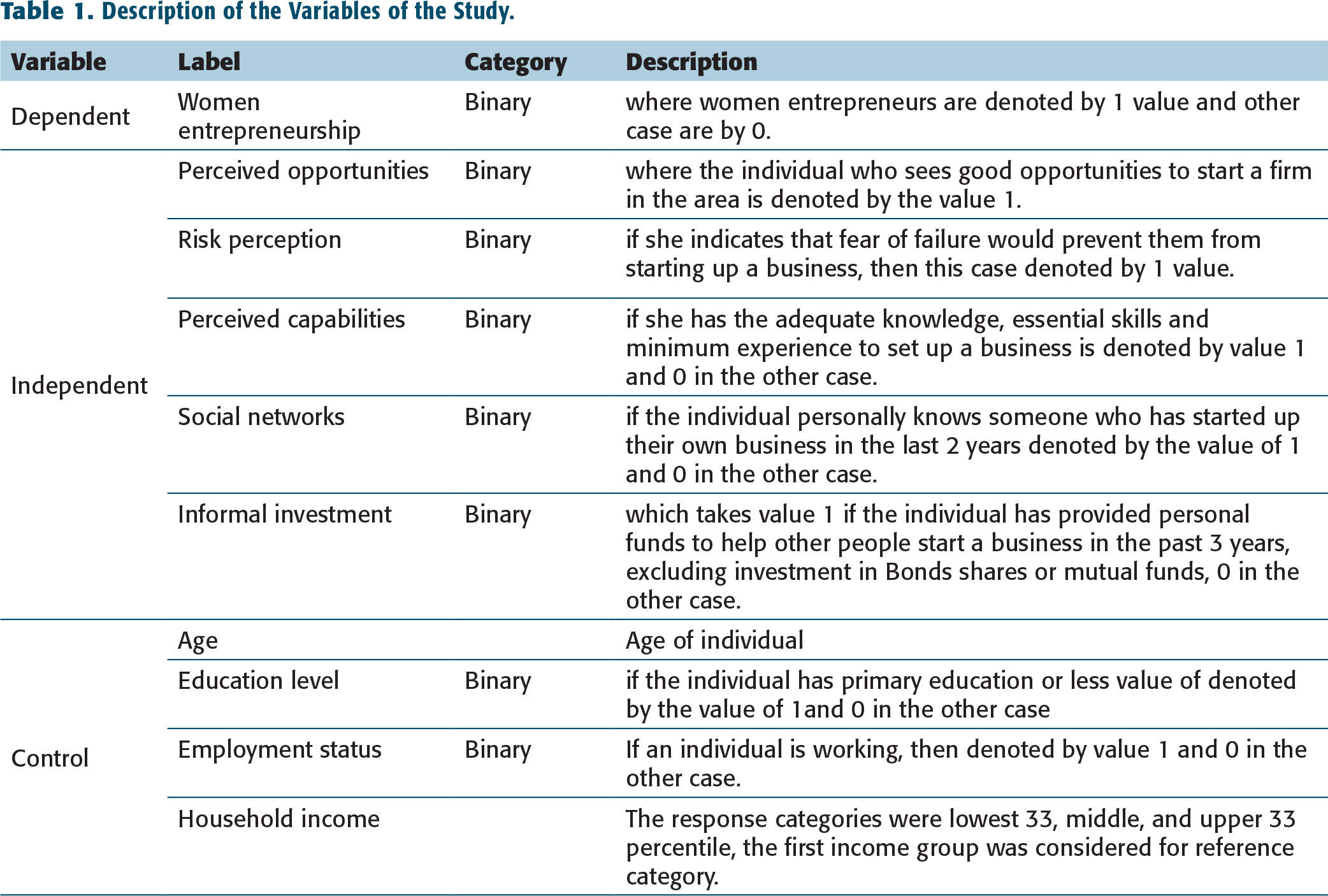
This research relies on the data collected and compiled under Adult Population Survey (APS) funded by the Global Entrepreneurship Monitor (GEM) India team. GEM is an acclaimed entrepreneurship research organization founded by Babson College and London Business School in 1998 (Reynolds et al., 2005). It has been extensively used in recent studies (Aidis et al., 2008; Boudreaux et al., 2019; De Clercq et al., 2013; Estrin et al., 2013; Klyver et al., 2013; Schmutzler et al., 2019; Stenholm et al., 2013; Thai < Turkina, 2014). We are using a sample of 1305 Indian women of GEM’s APS (GEM, n.d.). Furthermore, we are using a logistic regression technique to analyse the data as the dependent variable, and a majority of independent variables are binary.
Measures
Description of the Variables of the Study.
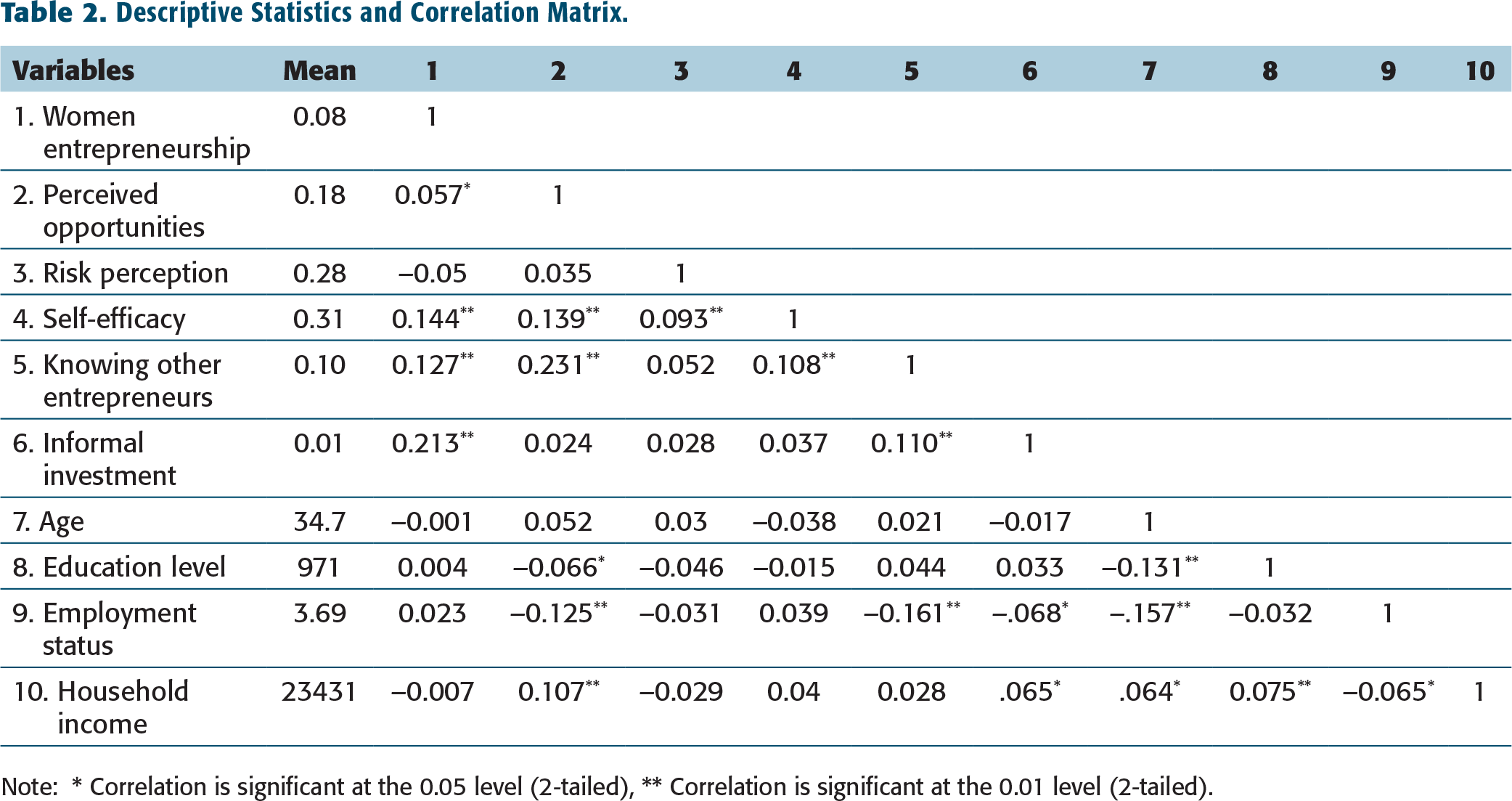
Results: Descriptive Statistics
Descriptive Statistics and Correlation Matrix.
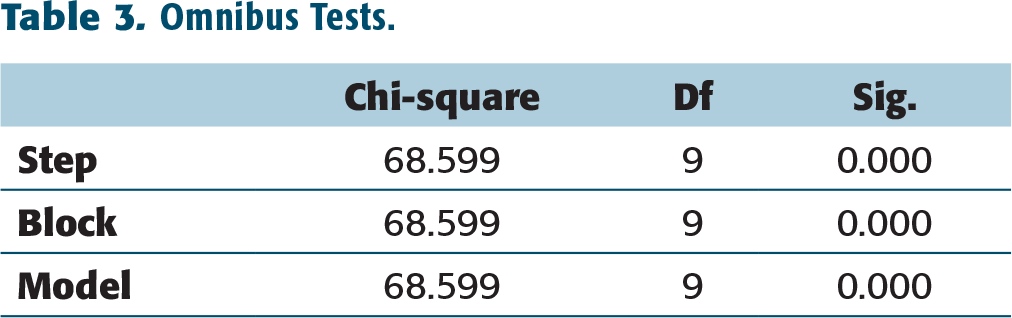
The omnibus test shows that the chi-square value is significant (chi-square = 68.599, df = 9, p<.000); hence our model is a good fit (see Table 3). We have also performed Hosmer and Lemeshow’s goodness-of-fit test. The hypothesis of an adequate model fit is not rejected if p>.05. Table 4 indicates the p-value is greater than .05; hence, the model is a good fit and acceptable.
Omnibus Tests.
Hosmer and Lemeshow Test.

Results: Logistic Regression
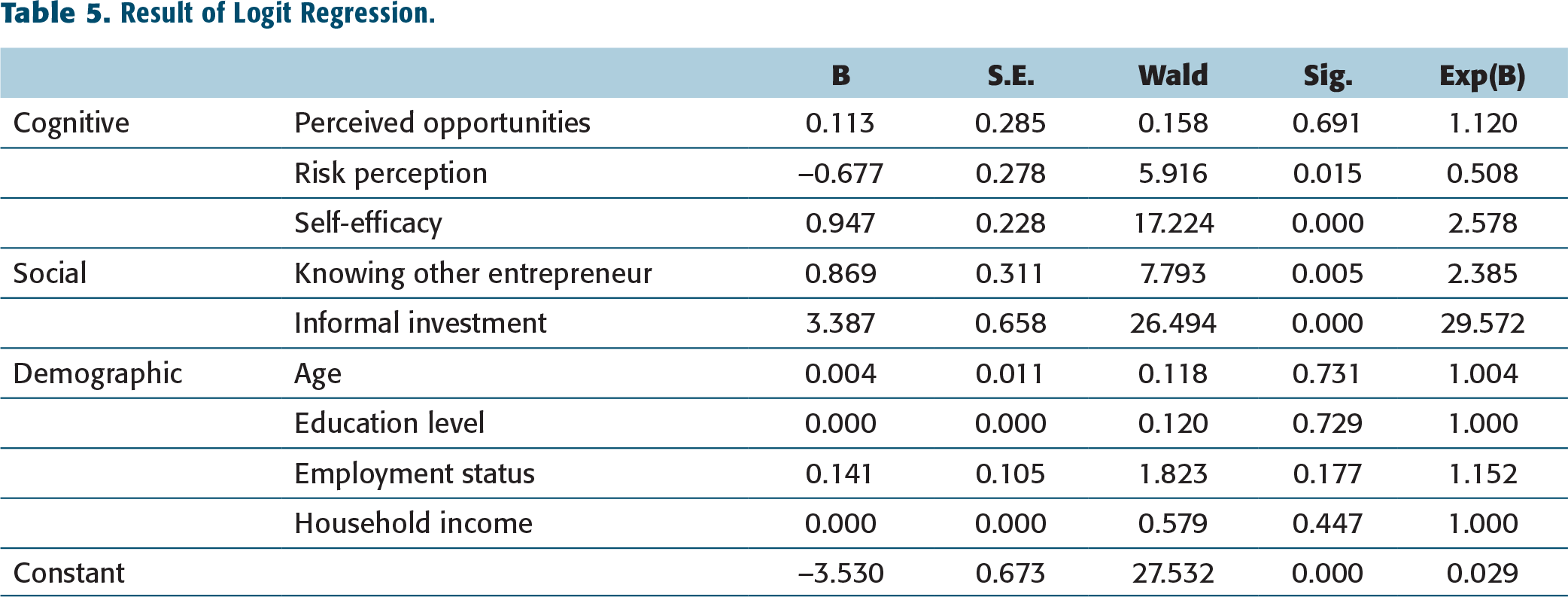
The result of the logit model regression is detailed in Table 5. Hypothesis 1 proposed that opportunity perception has a positive impact on the entrepreneurial propensity of women, but in this study, results were not significant for this variable, so we do not accept this hypothesis.
Hypothesis 2 projected that risk perception has a positive influence on the entrepreneurial propensity of women. The marginal outcome for opportunity perception is significant (p<.05). Thus, this hypothesis is accepted. However, risk perception has a negative impact on the propensity of setting up a new firm. The odds value for this construct points-out that those who perceive a higher degree of risk shows less desirability to create their own firm.
Hypothesis 3 projected that perceived capability has a positive influence on the entrepreneurial propensity of women. For this variable, the marginal outcome is significant and positive (p< .01). Hence, this hypothesis is accepted. The odds ratio suggests that women with perceived capability have 2.12 times higher entrepreneurial propensity than women.
Hypothesis 4 proposed that social networks have a positive influence on the entrepreneurial propensity of women. The odds ratio is 2.38, which reflect that the women who have a strong network are 2.38 times more likely to own their business. The marginal outcome is positive and significant (p<.01). Thus, this hypothesis is accepted.
Result of Logit Regression.
DISCUSSION
The purpose of this study was to examine the influence of cognitive factors—opportunity perception, risk perception and perceived capabilities—and social capital factors—social networks and informal investment—on women’s entrepreneurial propensity in India, a developing country. To the best of the authors’ knowledge, this study is the first to demonstrate the effects of cognitive and social capital factors on women entrepreneurs of India, which possess different features from western counterparts. Using a large dataset gathered from Indian adults by GEM India team, the present study highlighted that the entrepreneurial opportunities have no significant influence on women entrepreneurship; risk perception discourages women from becoming entrepreneurs, and perceived capabilities influence the decision of women to engage in entrepreneurship; social network motivates women to be entrepreneurial, and being an informal investor encourages them to start their venture. Surprisingly, we do not find support for opportunity perception.
Notably, this study offers some important implications for entrepreneurship practice and research. First, the responds to the call of entrepreneurship scholars (Brush et al., 2017; Langowitz < Minniti, 2007) to explore reasons accountable for what mobilize
Second, the study also responded to researchers’ call for more significant considerations to socio-capital and cognitive factors, and their influence on the engagement in entrepreneurial activities (Arafat < Saleem, 2017; Davidsson < Honig, 2003; Matricano, 2016; Passaro et al., 2018) and use of an integrated framework to study entrepreneurial phenomena. Summarizing cognitive factors findings, this investigation found the perception of opportunities does not influence women entrepreneurship in India. This finding does not confirm past research (Arenius < Minniti, 2005; Langowitz < Minniti, 2007; Noguera et al., 2013). This unexpected finding can be attributed to the fact that the level of competency and education among Indian women is much lower than that of men and women from other countries (The World Bank, 2020). Hence, due to a lower level of education and entrepreneurial orientation, women cannot perceive opportunity; thus, it does not influence their entrepreneurial propensity. Another conceivable reason for this non-significant result is that India is a developing country. Usually, people in a developing country start their business as an act of necessity rather than an opportunity (Desai, 2011; Margolis, 2014). Further, the findings of the study indicate that among Indian women, risk perception or risk aversion is a detractor to women entrepreneurship. This finding also confirms the previous research on women entrepreneurship (Koellinger et al., 2013; Langowitz < Minniti, 2007; Noguera et al., 2013; Shinnar, et al., 2012). This finding reasserts the importance of risk perception as cognitive variables in affecting entrepreneurial propensity. However, there are some exceptions to this view (Shinnar et al., 2012; Tsai et al., 2016). Future researchers are encouraged to explore the reasons for this conflicting finding.
In accordance to previous researches, this study revealed that perceived capabilities increase the probability of women-led businesses. The finding also advances the understanding to previous results showing the same relationship (Arenius < Minniti, 2005; Bayon et al., 2015; Brush et al., 2017; Klyver < Schenkel, 2013; Langowitz < Minniti, 2007; Noguera et al., 2013; Shinnar et al., 2014; Zhao et al., 2005). In this way, this finding also establishes the relevance of perceived capability (perception of entrepreneurial capability) as a cognitive driver of venturing decision. The findings of this study about social capital factors were essentially interesting and worth mentioning. With reference to entrepreneurial propensity, having friends or neighbours in business as a part of the social network and having invested in other businesses as an informal investor, was strongly associated with a probability of women’s entry. Social capital has a constructive effect on the assessment for setting up a new business as being part of social networks minimize vagueness, and uncertainty, moreover, provides help in exchanging the information (Weber < Milliman, 1997), useful resources and private connections, and shows that role of an entrepreneur is conceivable (Duchesneau < Gartner, 1990; Ramos-Rodríguez et al., 2012; Veciana, 2007; Wyrwich et al., 2016). The venturing likelihood of women who have financed others’ business is 30 times higher. In this case, it depicts a very strong possibility of becoming an entrepreneur who has invested in others’ business. This finding was also supported by previous research (Amatucci, 2016; Burke et al., 2014; Meroño-Cerdán < López-Nicolás, 2017). Third, this research proves that in a developing economy, where country context plays a vital role in explaining women entrepreneurship (Welsh < Kaciak, 2018), like India, perception of opportunity is not positively associated with entrepreneurial propensity. Contrary to Langowitz and Minniti (2007), Tsai et al. (2016) and Alvarez et al. (2011), who found a strong relationship between opportunity perception and entry of women into entrepreneurship, this study result suggests that perception of opportunity was not significantly associated with the entrepreneurial propensity in India. In developing countries where most people start their business because of necessity, perception of opportunity does not influence entrepreneurial propensity. Whereas studies in matured economies like the United States and Spain suggest that perception of opportunity are important for women entrepreneurship; this finding can be concluded that in developing country like India ability to perceive opportunity has no bearing on entrepreneurial startup.
IMPLICATIONS OF THE STUDY
This study’s results indicate the decisive role of four major variables pertaining to cognition factors, that is, risk perception and perceived capability; and social capital factors, that is, social network and informal investment. Therefore, policymakers should pay more attention to these factors of perception and social networks so that, the propensity of a woman to become entrepreneur would be increased. This study confirmed that risk perception is a barrier to women entrepreneurship and affects the women’s decision to start their own business. The awareness of risk among the women can help them explore the best option available to cope with (Cacciotti et al., 2016). For educators, students should be educated about the feelings and emotions and their impact on entrepreneurial actions (Shepherd, 2004), so women also should be educated about such entrepreneurial intentions and their impact on entrepreneurial activities. Furthermore, the positive influence of perceived capability on entrepreneurial propensity indicates that starting a business is not under volitional control (Kolvereid < Isaksen, 2006) and the national environment is less munificent for entrepreneurship in India (Arafat et al., 2020). Therefore, the government should focus on developing entrepreneurial capability and creating a favourable entrepreneurial environment for women entrepreneurs.
Nevertheless, the two social capital factors, that is, knowing other entrepreneurs and informal investment, have a strong influence on a women’s entrepreneurial propensity. This opens avenues for policymakers in the area of social capital and networking. Authorities should promote networking by facilitating the interaction between women and existing entrepreneurs. Such provisions will decrease indecision and hesitation, increase information exchange, and mobilize resources needed for starting a business. As this study disclosed, those women who have invested informally are 30 times more likely to become entrepreneurs; therefore, more attention should be given to women on encouraging informal investment. Nationwide programs must be aimed at fostering informal investment among women, consequently promoting women entrepreneurship. And lastly, informal investors also have non-economic motives. Hence, policymakers and entrepreneurs should acknowledge their non-financial investment motives and must have a better understanding about such motives before drafting the policy (Klyver et al., 2017).
LIMITATIONS AND OPPORTUNITIES FOR FUTURE RESEARCH
The research is based on survey data gathered by GEM. The number of items measuring entrepreneurship and its explanatory variables such as social capital and cognition are limited in capturing the whole construct. The kind of items (single item for each construct and dichotomous response, and so on) used by the GEM to collect data does not allow to use of more precise statistics, such as structural equations modelling that may explain the different interaction among the variables. Another limitation of this study is the operationalization of constructs, as we know that opportunity has three aspects: discovery, creation and recognition (George et al., 2016; Shane < Venkataraman, 2000). The measure used by GEM to capture the opportunity is one-dimensional, that is, the discovery of opportunities. Moreover, some relevant perceptual and social capital factors have not been included in the analysis because they were not available for India. Also, we suggest to future scholars that they should conduct multilevel analysis considering some institutional factors.
Footnotes
ACKNOWLEDGEMENT
Sana Arif Ansari for her copy editing service and GEM INDIA Team, Entrepreneurship Development Institute of India (EDII) Ahmedabad for conducting GEM India Study every year.
DECLARATION OF CONFLICTING INTERESTS
FUNDING
The authors received no financial support for the research, authorship and/or publication of this article.