



Abstract
In developed economies, there is evidence that the work mode defined in statistics as ‘entrepreneurship’ includes those measured as amongst the poorest. With reference to theory on the impact of capitals, intersecting sources of disadvantage and the theorised variability of interpretations of value, this article explores poverty and entrepreneurship in the developed nation context of the UK. Using a two-stage qualitative analysis with 42 participants who are experiencing poverty, it investigates if their circumstances represent a reproduction of capitals-deficits prior to, or if they have emerged since, their entrepreneurship. Findings include evidence of both, demonstrating for the first time that entrepreneurship can be a context of downwards socio-economic trajectory. By exploring idiosyncratic, intersecting circumstances, the research further evidences that value(s) sought of and attributed to entrepreneurship are context-bound and vary by different types of background and capitals. The paper thus evidences that entrepreneurship may perpetuate or even worsen poverty for some people, this effect may be linked to the type of education and other capitals of individuals, and lack of financial return may be tolerated in favour of other values realised of entrepreneurship.
Introduction
This paper explores the experiences of a sample of so-called ‘entrepreneurs’ who are living in poverty in the UK. With reference to theories of value and the effects of capitals on entrepreneurship, the research investigates how these individuals arrived in their circumstances and how they manage their life and work activities. The central contributions include new data on entrepreneurship and poverty in a developed nation, and to our knowledge, the first evidence that entrepreneurship can represent downward socio-economic fortunes.
Poverty is most often a focus in developing nations (e.g. Abubakar and Mitra, 2013; Hashim and Gaddefors, 2023), yet it is experienced everywhere. While absolute poverty identified by the World Bank (2025) as income lower than $2.15 per day is less common in developed nations compared with developing ones, it does occur. If one is not in work and not in receipt of state benefits this level of destitution is both possible, and indeed, observed (Elmes, 2018). More common though is relative poverty. Measurements of this vary, but in the UK a government research brief reports 16% of the population live in poverty defined as income that is below 60% of the median (Francis-Devine, 2022) and according to the Big Issue (2022) rates of this relative poverty are increasing. Around 37% of those so affected are in work (UK Government, 2024), and this includes those in any kind of independent employment, defined in statistics as ‘entrepreneurs’ (e.g. Bosma and Kelley, 2019; UK Parliament, 2024).
While the notional entrepreneur conjures the image of an individual responding to an opportunity to develop a new venture, in fact, in most countries, including developed ones, more than 95% of independent ventures have fewer than 10 employees. In the UK, according to the Federation for Small Business (2024), nearly three quarters of the business stock is actually self-employed people and sole traders. Amongst these, rates of low-yield entrepreneurship are increasing throughout the developed world (e.g. Baumberg and Meager (2015) in the UK; Hatfield (2015) throughout Europe), and this work can lack labour market security, skill reproduction security, income security and representation security, and Butler (2015) asserts that it is a distinct and prevailing feature of this time in history.
Yet, despite this evidence, in developed economies most rhetoric presents the idealised entrepreneur as freed from reliance on employing organisations or state welfare and instead prospering through independent business, self-employment and what Ojomo (2016) refers to as ‘modularised work’, with an implied subsequent improvement in personal circumstances (e.g. Elert et al., 2019; EU, 2013). This rhetoric is appealing, especially to governments because the inference is aspiration, opportunity and wealth-generation. This is not the reality of much of this type of work though; in the employment literature there is consistent reportage that some of the labour conflated in the ‘entrepreneurship rate’ comprises precarious contracted labour, piece work and gig work (Bögenhold, 2019; Karnani, 2016; Williams, 2008) and low incomes (Murphy, 2015), up to 40% lower than employment according to the ONS (2018). This ‘entrepreneurship’ is largely no more than making a living independently in the absence of financial alternatives (Block et al., 2015). To date there is little understanding of how and why people end up in this work and life situation in developed nations. That therefore is the central rationale of this paper.
From a theoretical perspective, the paper refers to the influence of capitals (financial, human, social, etc.), personal circumstances and the external environment as critical features of the context of entrepreneurship (Jayawarna et al., 2014; Lee et al., 2019). This context also includes the value sought of entrepreneurship and the paper refers to the Theory of Venturing (ToV) in Galloway et al. (2019) which applies a critical realist epistemology to propose that the value attributed to entrepreneurship by entrepreneurs is idiosyncratically and reflexively perceived in unique circumstances and it may not follow the requirement that financial value-adding is achieved.
The article proceeds with a review of knowledge about entrepreneurship, capitals and marginalisation, leading to a research agenda that relates to poverty, work and value. A section explaining the methodological approach is followed by findings from an empirical qualitative investigation amongst a sample of entrepreneurs in the UK who are experiencing poverty. A discussion of findings is presented thereafter, including new knowledge that entrepreneurship can reduce socio-economic circumstances, and implications of this for practice and research.
Entrepreneurship theory and the notion of value
In business and economics theories, poverty entrepreneurship is oxymoronic; the purpose of entrepreneurship is to develop financial value, and where it does not, entrepreneurship has failed. Underpinned by this, popular and academic discourse almost always associates entrepreneurship with growth and prosperity (Audretsch, 2006). Entrepreneurship is considered meritocratic and agential allowing individuals to break free from background socio-economic constraints (Brändle and Kuckertz, 2023; Kevill et al., 2019; Perren and Jennings, 2005). The assumption of the financial value-adding of entrepreneurship is a global phenomenon and Mallett and Wapshott (2015) argue that political consensus on the value of entrepreneurship ensures that this hegemony is rarely questioned.
Yet 30 years ago, Gimeno et al. (1997) published evidence of poverty in entrepreneurship in the developed nation context of the USA. In that study, they observed three ways financially restricted entrepreneurship prevails: by using accumulated resources, such as retained profit; by accessing external constituents such as welfare or debt finance; and by prioritising psychic income. Psychic income includes personal motivators such as identity, lifestyle, esteem, etc., and Gimeno et al. found a link between psychic income and acceptance of lower financial performance in their American sample. Rindova et al. (2009: 479) similarly assert that business persistence can be a function not of financial success, but of some ‘strong personal strategic value’.
In response to the disjoint between entrepreneurship theory and observed practice, Galloway et al. (2019) proposed an alternative ToV: that entrepreneurship is an embedded and dynamic process involving pursuit of opportunities to realise value, but where that value is idiosyncratically perceived, complex and evolving. The process of entrepreneurship involves the reflexive interaction of an individual's agency with context, including the economic environment, their available capitals and their background life experiences. From this position, an individual may pursue entrepreneurship to realise some value, but where that is uniquely reflexively understood. Critically, in ToV the value perceived may include any number of things, and not necessarily the pursuit of wealth. There is support for this in the empirical literature, where affective rewards, such as esteem, joy, social participation are observed (Stirzaker et al., 2019; Walker and Brown, 2004). The opportunity to be part of a community (Julien et al., 2023) or even just to be in work (Kautonen et al., 2010) are other key values observed. As such, ToV allows that individual wealth may go downwards if some alternative value is prioritised over it. More generally, by proposing that value is idiosyncratic, reflexive and myriad, ToV helps to explain the huge range of entrepreneurship we see in the real world, including the financially dubious, and provides a rationale for the persistence in this work mode amongst people for whom it is producing poverty outcomes. It is to the literature on poverty and entrepreneurship that we turn next.
Entrepreneurship, capitals and poverty
Throughout scholarly literature, it is well established that background circumstances and context have a profound effect on ongoing socio-economic experiences and outcomes (Toubøl and Larsen, 2017). Studies of work and incomes have evidenced how poverty can be linked to lack of capitals, leading to low-quality work, which in turn may have the compounding effect of reducing capitals further.
There has been useful engagement with, and development of, capitals-based theories in entrepreneurship studies. Over 20 years ago Anderson and Miller (2003) found that those with socio-economic backgrounds with robust human, social and financial capital are likely to create ventures with correspondingly robust profitability and growth, while the opposite is found where there are capitals deficits. Martinez Dy (2020) proposes further that other disadvantages intersect with capitals deficits, perpetuating stratification and inequality. Even within developed nations that appear to be meritocratic but in fact are fundamentally stratified, circumstances such as gender, location, age, etc. all have an observed effect. For example, empirically Jayawarna et al. (2014) and Meliou and Mallett (2021) find quality of entrepreneurship can be gendered, which they suggest points to a moderating factor of childcare responsibilities.
In terms of poverty entrepreneurship specifically, Lee and Cowling (2012) surmise that it is reasonable to expect that individuals with low capital resources and other circumstances of disadvantage will be more likely to create lower quality ventures than those who have higher capitals resources. Again, there is evidence supporting this: Block et al. (2015), Dvouletý et al. (2018), Jayawarna et al. (2014), Lee et al. (2019) and Toledo-López et al. (2012) all discuss links between necessity entrepreneurship (in the absence of reasonable employment alternatives) and low financial, human and social capital resources, and Refai et al. (2024) and Julien et al. (2023) find capitals deficits leading to precarious enterprises amongst their respective refugee and economically marginalised samples.
Lee et al. (2019), Kevill et al. (2019) and Hashim and Gaddefors (2023) discuss poverty in entrepreneurship as complex and compounding. Lack of human capital, for example, exacerbates lack of social capital (and vice versa), and these influence the availability of financial capital, which in turn influences access to means of developing human and social capital. Antecedent poverty is thus a disadvantage in its own right since it may transcend and even compound other disadvantages. This is highly relevant to entrepreneurship studies. In the social class literature, Savage et al. (2013) and Standing (2014) have both proposed new socio-economic hierarchies relevant to the developed modern world, and both models include ‘precariat’ to denominate those in precarious and marginalised work, most often conducted in the mode that public and policy discourse refers to as entrepreneurship. Elmes (2018: 1051) refers to this precariat as an ‘underclass’ that has to focus on finding employment, health, shelter and food rather than ‘developing the social and technical capabilities necessary to improve their economic condition’. While this implies a developing economy scenario, in fact Elmes (2018) was referring to the USA. Smith and Air (2012) and Julien et al. (2023) study entrepreneurship in these circumstances in the developed nation contexts of the UK and France respectively, finding in both cases, a reproductive effect of entrepreneurship on poverty. Elsewhere though, both Lenton (2017) in the UK and Sorgner et al. (2017) in Germany, find individuals with university degrees in their studies of low-value entrepreneurship, suggesting high levels of human, and presumably social, capital. Following this, Dencker et al. (2019) propose that perhaps different types and qualities of capitals interact variously in an economic environment. To date, though entrepreneurship studies that include inspection of socio-economic deficit and stratification in developed nations are rare (Kevill et al., 2019) and there is an absence of any evidence that the socio-economic reproduction found in Smith and Air (2012) and Julien et al. (2023) is the only explanatory factory for poverty in entrepreneurship. From this a research agenda is extrapolated.
A research agenda
The current body of knowledge on entrepreneurship and socio-economic trajectory includes plenty of evidence of the potential and observed capacity for entrepreneurship to develop wealth and upwards social mobility, some evidence of socio-economic reproduction, often attributed to complex and overlapping capitals deficits, but no inspection of the possibility that entrepreneurship may also represent downwards social mobility. There is no exploration that engages with how people in a developed economy arrive in low-income entrepreneurship, nor indeed, how value is understood by these practitioners themselves. This is the key rationale for the empirical study reported in the following sections. In particular, the research sought to:
investigate if entrepreneurship can be observed to diminish wealth in a developed nation context; explore the routes to and experiences of poverty entrepreneurship and the influence of capitals, circumstances and value(s) sought of this mode of work.
A qualitative methodology was adopted to afford an inductive, bottom-up approach to knowledge development.
Methodology
The research sought to elicit rich data on the background and current circumstances of individuals who are experiencing poverty entrepreneurship, including their capitals (or deficits) and any intersecting sources of disadvantage. As such, a qualitative methodology that affords a view of experiences from the perspectives of those affected was adopted (Bertaux, 1981). Poverty is defined as per the UN classification of income poverty: that which falls below a state-defined threshold (UNESCO, 2017). Since the research refers to the UK, income poverty is that which the UK government classifies as below the level required to sustain a household and therefore requires top-up from state benefits (Francis-Devine, 2022; UK Government, 2020).
The research adopts a critical realist epistemology that allows a material reality within which people act (Ackroyd and Fleetwood, 2000). Social life, including work, comprises the interaction between agents and structures, where structures influence actions and actions affect structures (Suddaby et al., 2016) and this process cumulatively and over time leads to social recreation or transformation (Archer, 1995, 2003). Specific to entrepreneurship, critical realism is a useful lens since it allows for myriad circumstances, including individuals’ capitals and the socio-economic environment, all to have an impact on entrepreneurial actions as proposed in ToV (Galloway et al., 2019). Critical realism also allows that context may be reproduced or altered via the reflexive interaction of agent with structure, in this case via entrepreneurship.
Fieldwork involved qualitative interviews with 42 entrepreneurs, purposefully sampled on the basis that they were experiencing income poverty and as such were either in receipt of, or entitled to, top-up income benefits. Participants were hard-to-reach for two main reasons. First, they are autonomous workers, not formally connected to larger organisations. Second, there is stigma associated with poverty. Therefore, consistent with other studies with hard-to-reach groups, this research applied multi-pronged recruitment, including advertising on social media and local radio and in locations the target sample were likely to visit, such as supermarkets in deprived areas. While shopping vouchers were offered to encourage uptake, participation was on a voluntary basis and this does risk self-selection bias. A further limitation is that interviews can only provide subjective post-hoc accounts remembered fallibly after a period of reflection and further experience. These limitations were considered tolerable since accounts of individuals’ experiences and their understanding of these were sought. It was clear that no testimony was representative of poverty entrepreneurship, rather the point was to explore entrepreneurship in contexts peculiar to each participant. To this end, rapport and conversation were encouraged, affording exploration of complex personal and work-related data (Stake, 1995). Interviews were conducted in participants’ homes or in public parks or cafes, they lasted at least 1 h, and were recorded and transcribed verbatim.
Analysis was conducted in two stages. Stage 1 involved applying the stratified process described in Miles et al. (2014) of data reduction, data presentation and data explanation. To mitigate interpretation bias (Danermark et al., 2002), each author (five people) reviewed the transcripts individually and identified themes. Subsequently, data reduction was achieved through the collaboration of all authors to refine interpretations. Relevant evidence from transcripts was agreed by consultation and collaboration to achieve data presentation. Data explanation was reached by consensus on interpretation of meaning through discussion and agreement by the authors.
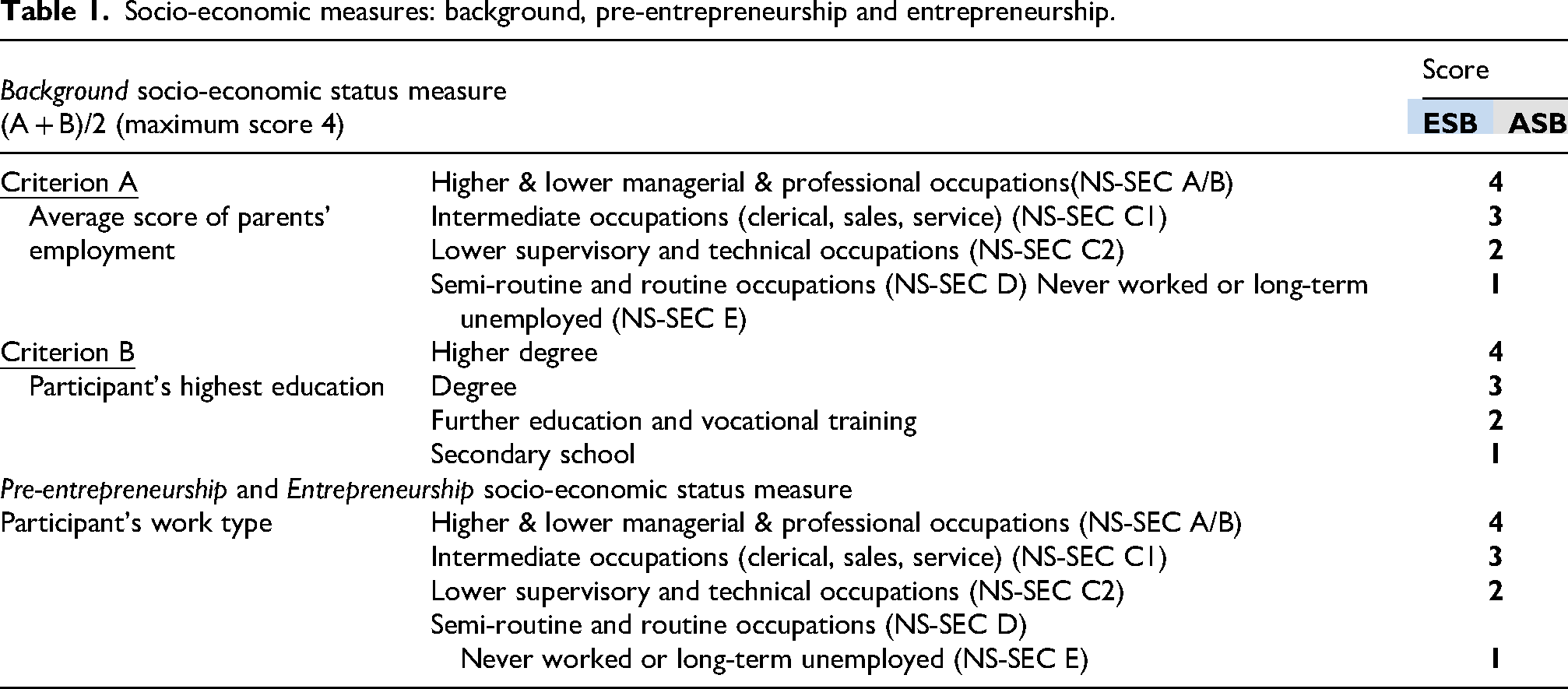
Stage 2 analysis was conducted post-interviews. This involved collating participant data to explore the trajectory of socio-economic fortunes; specifically, if a participant's current economic condition was representative of their life experiences to date, or if it emerged in entrepreneurship. As per other studies of socio-economic status (e.g. Jayawarna et al., 2014), composite measures were created. Since all participants in this study were included because they were experiencing poverty, further criteria antecedent to wealth status, were explored. These included parental and participant occupation and educational attainment level applied to three periods in participants’ life courses: Background, Pre-entrepreneurship and Entrepreneurship. Based on these, scores of between 1 (lowest socio-economic indicator) and 4 (highest socio-economic indicator) were assigned. The Background score included parental occupation and the education level and type of the participant. Pre-entreprenership and Entrepreneurship scores included occupation level and occupation type of the participant. Occupation was classified using the National Statistics Socio-economic Classification (NS-SEC) (ONS, 2019). Education/occupation type was categorised into the broad binary of ‘explicit skills-based’ (ESB), such as business or engineering, and ‘arts or social-based’ (ASB), such as crafts or care. While these attributions are admittedly blunt, they afforded some insight about the types of skills in this sample. The factors used to score socio-economic status are presented in Table 1. Circumstances data, including gender, age, health status, and caring responsibilities were also gathered.
Socio-economic measures: background, pre-entrepreneurship and entrepreneurship.
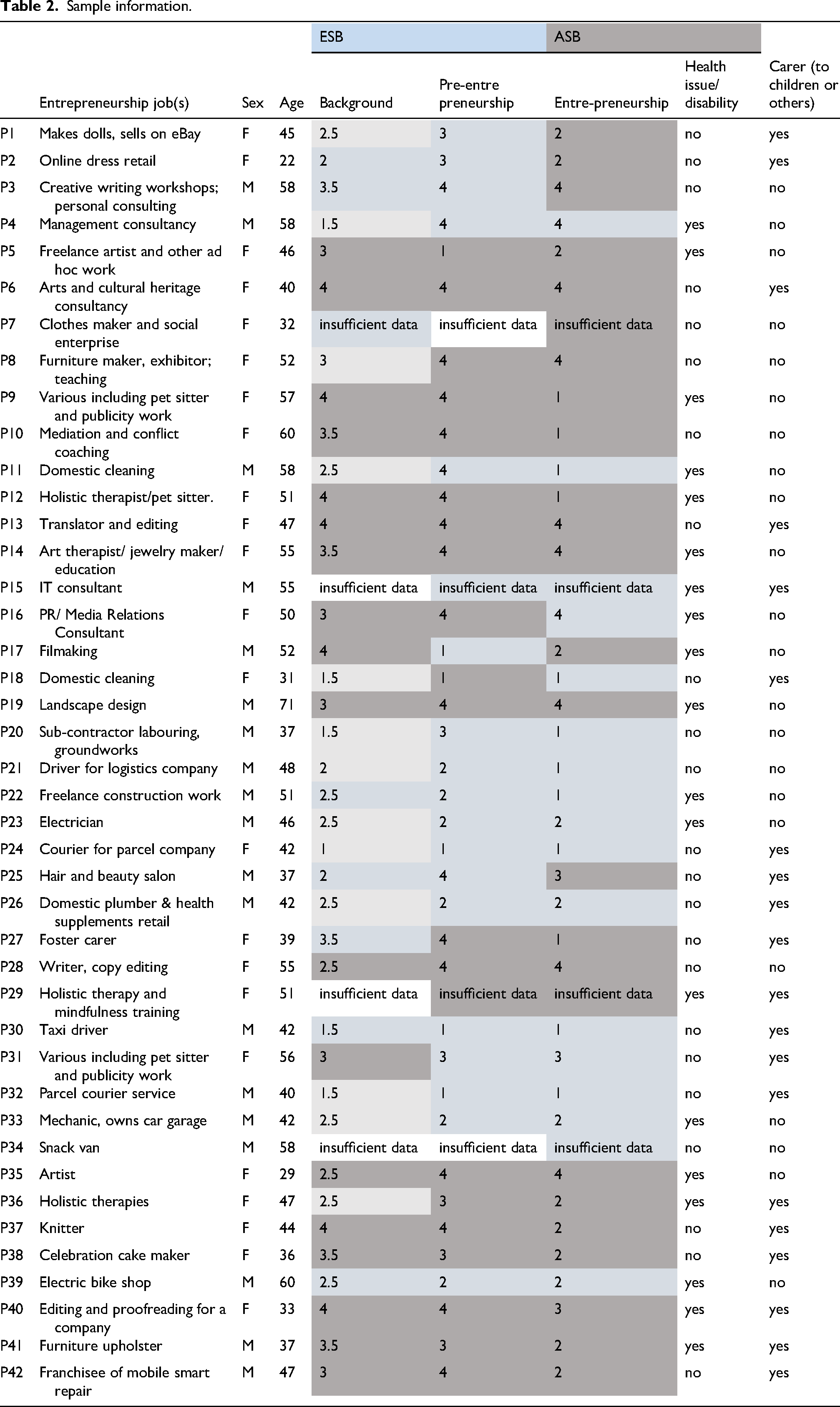
Initial observations of the data, presented as Table 2, are that of the 19 men and 23 women in the sample, ages ranged from 22 to 71, 20 had caring responsibilities and 19 were in chronic poor health or disabled. These latter came as a surprise since the sampling procedure and advertisements made no mention of seeking people with these issues.
Sample information.
Findings
Findings associated with the two key aims of the research – to explore the socio-economic trajectory of poverty entrepreneurship and the context and experiences of it – are presented below.
Background and trajectory: Can entrepreneurship diminish wealth?
Table 2 illustrates that in terms of background socio-economic circumstances few in the sample had come from circumstances of deprivation; among the 38 participants who provided sufficient composite data, only six had background scores below 2. Education seems to have a particular effect here. First, there is a preponderance of high levels of education; of the 39 participants who gave education information, 26 had a degree (17 women and 9 men). Further, 14 of the 17 women had an ASB degree (3 out of the 9 men had the same). Providing further nuance, Table 2 illustrates that the mostly female participants with an ASB degree had reasonably high-scoring socio-economic backgrounds; in fact, all of those with the highest possible background score had an ASB degree. Those with ASB education seemed likely to have first found employment in arts and social work and then based their subsequent entrepreneurship in these areas. Those with ESB or secondary education were likely to have pursued employment in ESB sectors, though there are seven cases where ASB enterprises had been created, in some cases following employment in other sectors.
In terms of trajectory, Tables 3 and 4 show that while there is evidence that for some participants socio-economic scores have increased from Background to Entrepreneurship (N = 9), they have reduced for others (N = 24). Further, there is evidence that some participants improved their socio-economic fortunes when they joined the workforce (17 participants improved scores from Background to Pre-entrepreneurship), but that improvement was not always sustained when they engaged in Entrepreneurship (eight sustained the increase, but nine experienced a drop as entrepreneurs).
Socio-economic scores and trajectories and education and business orientation.
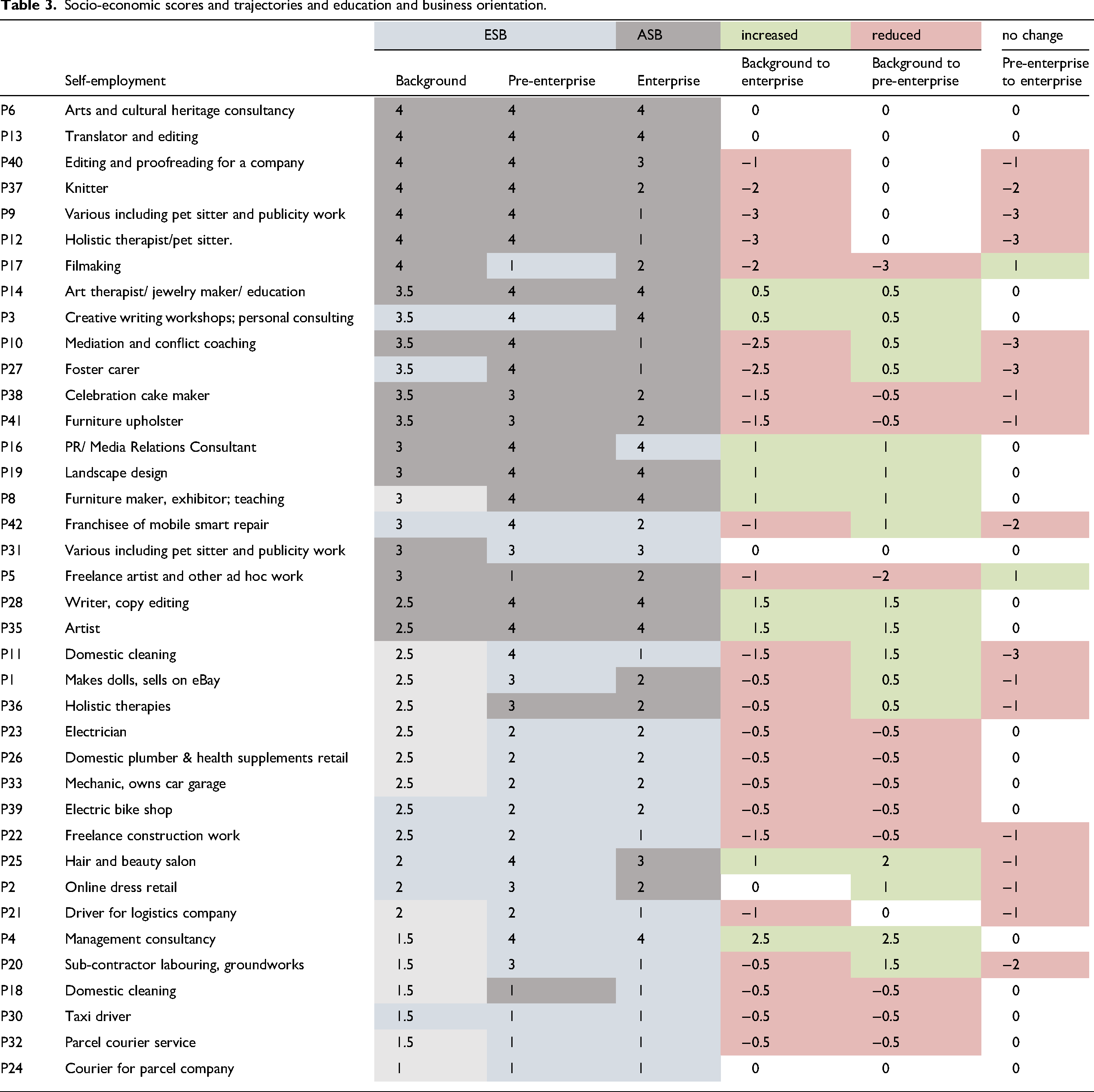
Socioeconomic changes background-pre-entrepreneurship-entrepreneurship.

Most notable, there is clear evidence that of the few participants who had relatively low-resource backgrounds (with scores below 2), only one (P4) had improved circumstances in entrepreneurship. In addition, of the 13 people with scores of 3.5 or 4 and including high levels of education, all but four were in worse socio-economic shape according to the measures used in this study, and again, it is notable that all but two have ASB education. This is, of course, a qualitative study and the key criterion for eligibility was poverty, so there is clear sample bias and no extrapolation of these findings can be made to wider entrepreneurial populations. The point here is that, for these participants at least, there is evidence of diminished rather than improved socio-economic circumstances as a consequence of entrepreneurship. There is little evidence of the background ‘precariat’ or underclass studied elsewhere. Instead, the evidence in this sample is that, for the most part, poverty entrepreneurship was not representative of background socio-economic status, nor indeed, low levels of human capital, but rather, was linked to types of capital and personal circumstances. P33 for example, started his garage 20 years previously and had enjoyed some success. At the time of the fieldwork, however, was suffering poor health. He explains: I became really unwell and didn’t work. But I returned to work against the direction of my doctor. All my savings had gone by then. When a normal employee can’t work through sickness they are paid sick pay. When you’re self-employed and you become sick, you can no longer carry on with your business. [But] I still have to pay all my business costs. I still have to pay the bank every month. I still have to pay the rent, the electric. I get rates relief but I have zero income. So all of my costs remain and all of my earnings disappear. I ain’t got any future. There's been a few good years, but now its hand to mouth. (P33)
The experiences of poverty entrepreneurship
Interviews revealed evidence about the experiences of participants, including the types of work they did. Table 2 includes a brief description of these, and there is representation of piecework, contracts, gig-work, micro-business, self-employment and trades, each categorisable as entrepreneurship by statistical definitions. In terms of poverty, low income and even deprivation were unequivocally evidenced. No-one had any savings and all participants lived on income earned week by week that had to be topped-up monthly by benefits. The following testimonies illustrate: I actually budget on a maximum of £2 a day for food. The budget for my electricity is £1 a day …I started selling things on ebay… because I thought, ‘how can I get money’; (P22) Now that it is coming up to winter, my gas and electric is more expensive and I don’t have more money to pay for it. What I will have to do is just not pay something else… On the last week before we get my wage, the last four or five days, I’ve literally got no money. (P24) There's a few times where I did think to myself, ‘I don’t know if I’m going to have money for food or heat’. (P6) There's not a lot left to feed ourselves… we are just on the bares of our backsides to put it politely. (R34) What was stopping me from working was the childcare and finding a job that was going to fit around that…. (P24) I have two separated elderly parents both needing care, both having disabilities. So it was quite difficult for me to go out and get a full-time job… And my husband was also ill, he was dying of cancer. So it was easier for me to be working for myself and dictating my hours. (P36) I had a serious accident and I was off [employment] for quite a long time. So that gave me time to think what I was going to do, and I was told by the doctor that I had to be careful given I had physical job; (P39) It was a mixture of things. My health would dictate when I could and couldn’t work because I still had mobility issues…so it meant I had to be flexible. If Im standing two or three hours one day then I can’t work the next morning because I’ll be stiff. So I have to move my diary around me and my physical mobility. (P36)
More generally, whether because of role, or health, or otherwise, entrepreneurship was a pragmatic work choice to generate household income. It was not the ideal work scenario for any of the participants, instead, ‘making do’ and bricolage are more appropriate descriptions of the reasons given for being an entrepreneur. Notwithstanding that, affective value emerged too; in particular, the value attributed to being in work and contributing, as P39 noted, I just wanted to get back working again. Art therapist P14 also referenced the effect on her self-esteem, and P16, who had terminal cancer and was a carer to her disabled husband felt it gave her an identity beyond her immediate circumstances. These sorts of sentiments were expressed by others in the sample, regardless of health and other circumstances, and these resonate with the ‘psychic income’ observed by Gimeno et al. (1997). P2, a clothes retailer, expresses it thus: When you’re sitting at home…with two children you can lose heart quite easily because you’re like, ‘whats the point’ about yourself. So…the business is quite good to help me stay motivated. (P2)
Pertinently, those in the sample who had ASB qualifications or roles were especially keen to stress the value of working in a creative or social capacity. This was particularly evident where the work had some artistic or social output, including the value of producing art and the altruism of social offerings. As P35 puts it, I’m an artist, it's the only thing that keeps me sane, my mind focussed…so its good in that sense. Similarly, P28 who was previously unemployed noted: I just reached a point when I was about 50 when I was reflecting on my life and I just decided ‘I love writing, and I’m going to make that my profession’… and that's why I went down that route. (P28)
For most participants, the data also testifies to entrepreneurship not as context of independence and autonomy via modularised work, as per Ojomo (2016), but instead as the opposite. P27, for example, became a foster carer following redundancy, upon which she was unable to find work flexible enough to care for her own child. Her husband is a self-employed gardener and between them they earn below the government income-poverty threshold. She describes her employment situation thus: I work exclusively for the Council…they provide me with my registration and if there was ever a cause for concern, [they] would deregister me. I can only work for them. So even though I’m self-employed, I don’t have freedom of movement and ability to work for multiple employers…It's a very odd situation in that we’re deemed self-employed. We’re bound to these employers, but we don’t set our rate of pay, they set it. They tell me what I’m going to receive. There's no negotiation. (P27) I work through every night, and I’ve got to accept it. And if I decline it then…I’ve been told by other drivers, ‘don’t [refuse] work because they’ll take it out on you the next day and not give you any work’. It's like punishment. Even though you’re self-employed. (P21)
Discussion
As we might expect amongst a sample of people in a developed nation who were selected on the basis that they were living in poverty, in terms of socio-economic trajectory, there was little evidence of upwards social mobility. Instead, throughout the life courses of these participants both reproduction and decline of previous socio-economic circumstances were observed. Critically, antecedents do not include a lack of capitals per se; rather it is the qualities of these capitals and idiosyncratic circumstances that seem to have most effect. There is evidence of a few in the sample who have a background of relative deficit. In some cases, there was some improvement in their fortunes when they moved into work, but the evidence is that most did not maintain this improvement when they became entrepreneurs. In addition, some participants had backgrounds of relative affluence, yet their socio-economic circumstances had reduced and there is some evidence of this being pertinent for those with education and careers in ASB sectors. Overall, there is no evidence of the poverty in this sample being a legacy of ‘underclass’ origins, as per Elmes (2018). Instead for most in this research, entrepreneurship seems to be part of a new experience of deprivation. Consequently, in terms of socio-economic status, for most of the people in this sample, poverty is a symptom of their entrepreneurship rather than a representation of where they started. This suggests that contrary to developing the fortunes of people, entrepreneurship can reduce them, a far cry from the economically value-adding effect much referenced by popular discourse.
For each participant, the value(s) attributed to entrepreneurship were context-bound, and as per ToV (Galloway et al., 2019), were perceived reflexively and idiosyncratically within unique circumstances. Amongst these circumstances there was evidence of sources of disadvantage, often multiple and overlapping as per Martinez Dy (2020) and Kevill et al. (2019), that informed not only the option for entrepreneurship work, but also the quality of it. The research does include some evidence of a gender disadvantage, and that presents in two ways. First, human capital type seemed to have an effect, with women in the sample more likely to have ASB education, which seems to have lower currency in the labour market than other types. Second, the tendency for women to have family responsibilities seemed to have an effect (13 of the 20 in this sample with caring responsibilities were women). The high incidence of participants with health and ability challenges may also suggest a particular intersection with poverty. As a qualitative study, it is impossible to extrapolate, but the need for more research is strongly implied.
Broadly though, external structural conditions including an inflexible and sometimes hostile labour market were observed to compound lack of financial and other capitals, with entrepreneurship generally emerging as the only, or least worst, means of generating income. Despite this, the research includes rationales for entrepreneurship beyond financial concerns, and this contributes to understanding why people pursue and prevail in poverty entrepreneurship.
Beyond the socio-economic, in this research the recurring theme of value emerges and there is clear resonance with ToV (Galloway et al., 2019), in that the value sought by and attributed to entrepreneurship was myriad. Rather than describe their entrepreneurship exclusively in terms of income-necessity, resonant with the ‘psychic income’ described in Gimeno et al. (1997), reported value(s) included personal affective rewards such as flexibility and esteem, and a desire to work for oneself. Particularly apposite, participants in ASB sectors asserted a desire to achieve what P36 called ‘spiritual rewards’, and some evidence that this was the key reason that financial underperformance was tolerated. Further, along with other participants in the sample, some ASB entrepreneurship also evidences Gimeno et al.'s contention that welfare benefits can be used to augment financially unfeasible business. But in terms of value, the participants in this study had created their own jobs, engaged with work, and were managing their circumstances as well as they could.
Despite the reported affective rewards, entrepreneurship had clearly not enabled any of the participants in this study to ‘flourish’ though, and indeed, had not even relieved the need to alleviate poverty via the welfare system. Participants were not prospering, and they were not contributing to wider socio-economic prosperity. There were examples of diminution of normatively-understood entrepreneurship, including P33's typical-entrepreneurship-story-gone-wrong. His entrepreneurship had served him well and made economic contribution – his garage employed several people over the years – but when his circumstances declined, so too did his economic fortunes: I’ve put 15 years into this business, if you say on average £100,000 a year, my business has put £1.5million into this economy and some weeks I eat beans. (P33)
Conclusion
In general, whether precarious labour or bona-fide business in decline, entrepreneurship can be a far cry from the emancipatory, contributory ideal of popular rhetoric. The new evidence contributed in this paper supports the contention that entrepreneurship may be pursued as a least worst option, often as a consequence of intersecting sources of disadvantage and lack of work alternatives in unique contexts, and while various values are realised, it can comprise precarity and poverty. From a critical realist perspective, individuals who have either capitals deficits, or who have capitals-types and circumstances that are mismatched to the requirements of the labour market have specific challenges as entrepreneurs. The reflexive interaction of agents in these contexts can have a compounding effect on socio-economic circumstances, including producing low incomes that require state support to mitigate destitution. Contrary to the aspirational rhetoric, therefore, entrepreneurship is observed in this study to be a work context of reduced fortunes and downwards socio-economic mobility in a developed nation.
Implications for policy, support and practice
Research exploring entrepreneurship as a context of poverty informs policy and support of those so engaged. In the sample in this study the education and experience levels of participants generally were high suggesting no reason to assume low levels of human capital. There are however potential implications for support for those people in artistic and social sectors to improve the market feasibility of their activities. Additionally, for those who engage in entrepreneurship as a consequence of caring responsibilities or because of ill-health or disability there are implications regarding support as these circumstances are observed to affect the motivations for and the experiences of entrepreneurship as a work option amongst this sample. More broadly, it is critical that any interventions and support maintain cognisance of the antecedent and ongoing aspirations of practitioners. Working on the assumption that the only value of entrepreneurship is financial will not serve the interests of those who persist for other reasons. Support and policy will continue to be of limited relevance to people who have found themselves defined as entrepreneurs because of some structure-related demographic or circumstantial reason.
Implications for research
From a knowledge-building perspective we argue there is a critical need to explore the realities of entrepreneurship inclusively as practiced. Beyond the celebratory rhetoric, in developed nations particularly, there is little critical engagement. The results in this paper are strongly suggestive of a need to explore the socioeconomic effects of different types of entrepreneurship and engage research that has the capacity to observe and analyse the lived experiences of individuals, regardless of the economic categorisation of the nation they happen to live in.
While this paper focuses on those who are experiencing poverty, it would be interesting to test with a broader sample using a more finely tuned composite measure, with income data included. In addition, the finding that some people justify lack of (economic) success in business by associating it with some other social or artistic value, or indeed, by inhabiting an identity aligned with that narrative, has implications for research on the psychology of entrepreneurship and in studies of the arts and caring sectors. The suggestion of a gender effect is also worthy of further exploration as is research amongst entrepreneurs in poor health or disabled. More generally, the reduced circumstances found amongst those in this sample with higher education and relatively well-off backgrounds suggest a need to explore the effects of different types of human and social capital and their relationships with work and incomes.
Contrary to the aspirational rhetoric, this study finds that entrepreneurship can diminish wealth as well as augment and reproduce it in a developed nation. We position the paper as a call for researchers to consider the multitude of values that are sought from entrepreneurship. We also urge the research community to report the realities and the precarity of this form of labour rather than ratify the rhetoric about it that policymakers and practitioners like to hear.
Footnotes

Funding
The authors received no financial support for the research, authorship, and/or publication of this article.
Declaration of conflicting interests
The authors declared no potential conflicts of interest with respect to the research, authorship, and/or publication of this article.