




Abstract
Executive Summary
This study is located in the context of high-performance work systems (HPWS) in India. Extant literature indicates that the darker side of HPWS and work intensification impact employee lives and trigger work–family conflict (WFC) experiences. With the shift in organizational focus on employee well-being, it has become imperative to understand and unpack WFC experiences of employees in the Indian sociocultural context to design effective and contextual remedial mechanisms. Responding to this need, WFC experiences of employees in Indian HPWS contexts were closely examined in this study to unpack the role of prevalent sociocultural factors. Additionally, the study explored how employees coped with these life situations. Since organizations are now beginning to work towards enhancing the well-being of employees, this study offers insights into what coping mechanisms are deliberately or inadvertently in use to evaluate their effectiveness. Studying the nature of WFCs and coping mechanisms from a sociocultural lens, this study identifies and develops four major themes. Passive acceptance of WFC, unambiguous communication, emotional and instrumental support from family, informational support at work emerged as the four significant themes discussed at length in this article. Insights generated from the discussion of these themes point overarchingly towards the highly personalized and localized, individual-level approach prevalent amongst employees of HPWS in response to WFC episodes. The discussion and conclusion sections highlight the need for well-designed and mindful organizational interventions built upon an understanding of the sociocultural factors at work to effectively mitigate the employee stress generated by the HPWS environments. This work is especially relevant in an era of pandemic-related work models, millennial workers and work intensification due to the increased digitalization of workplace practices.
The comprehensive HR practices adopted by organizations can have significant consequences for the employees. Many researchers argue that these lead to positive job attitudes and a positive psychological contract between the employees and the organization (Appelbaum et al., 2001; Pichler et al., 2017). Fu (2013) argued that HPWS first results in creating human capital, followed by an efficient deployment of this capital. The resulting resource pool, when efficiently used by organizations, results in a better performance at the organizational level as well. This was termed by researchers as the ‘practice-resource-uses-performance’ linkage model.
However, many researchers feel that HPWS may not be as mutually beneficial for employees and organizations as it is made out to be. The increased focus on organizational performance and the adverse impact on employees clouds the positive effects of HPWS on employees. As argued by Godard (2001) and Legge (1995), HPWS exploit employees in the name of a supportive and participative work environment, extracting more out of the employees than the benefits that accrue to them (Pichler et al., 2017). The argument that employees perform better in HPWS is also questionable. Some researchers feel that employees are made to work for longer hours and contribute to overall organizational objectives (complex by nature) in HPWS. Intensification of work (Godard & DeLaney, 2000) results in employees feeling greater pressure of performance and increased stress. Job intensification and increased stress have been cited as important characteristics of HPWS and can have serious implications for employees juggling between work and family responsibilities. Although highly rewarding, the very nature of a HPWS places great demands on employees’ time, energy and attention, impacting the family life of the employees and creating conflict.
In the context of changes in the work environment and demography of the Indian workforce, the issue of work–family conflict (WFC) experienced by employees has gained significance. WFC has been defined as the simultaneous pressure from the work and family domain, making it difficult for an individual to discharge his/her role-related responsibilities efficiently and effectively (Greenhaus & Beutell, 1985). Work and family domains are no longer strictly separated from each other, as earlier. With larger numbers of women joining the workforce, traditional role responsibilities have blurred, and both men and women partake in work and family role responsibilities.
A factor of significance in the context of WFC and HPWS is the sociocultural environment of India, where this research is situated. Sociocultural factors determine the type and flow of social support, the job attitudes of employees, the salience of work and non-work roles and the approach adopted by them in moving from WFC to a more integrated work-life solution. Cultural traits of collectivism–individualism, gender egalitarianism, power distance and so on influence general attitudes in work and family domains. Social norms determine the ease of availability of social support in work and family domains, the participation of women in employment and the relative importance of work/family domain over the other.
WFC is socially and culturally a highly contextual variable, and research in this area has shown differences in the experiences of people belonging to culturally different nations of the world (Spector et al., 2007; Yang et al., 2000). Work and family domains are embedded in the larger social structure of the society, and so it can be reasonably assumed that social norms and cultural influences will not only affect WFC experiences but also shape the attitude and response of people towards coping with these experiences. Whereas on one hand, the entry-level participation of women in the workforce has gone up (Rustagi, 2010), on the other hand, the percentage of nuclear families has gone down from 70.34% to 70.11% (as per Census of India 2011). A cause for this may be the increased need for parental support by dual-earning couples.
Set in a work environment characterized as HPWS, the present study aims at exploring the experiences of WFC and the coping mechanisms adopted by employees to manage the conflict and reduce the adverse effects of the same. The study is set in the context of the sociocultural environment in India, which is rapidly modernizing and is a witness to important changes in the job market post globalization. The study explores the sociocultural factors that help employees cope more effectively with their lived experiences of WFC. This study will help place the response mechanisms of people in the context of the sociocultural environment in which they live and the significant bearing that it has in shaping their attitudes. It will enable organizations to take cognisance of employees’ coping mechanisms and their implications for organizations.
HPWS, WFC and Sociocultural Influences
HPWS refers to a system of separate but inter-connected HR practices designed to enhance employees’ skills and efforts (Datta et al., 2005). Researchers have argued that HPWS result in greater job autonomy for the employees, increased employee participation in decision-making processes and greater flexibility to introduce newer job designs (Carvalho & Chambel, 2014). In a detailed research examining the impact of HR practices classified as HPWS, Huselid (1995) found strong support for the hypothesis that investment in such practices is associated with low employee turnover and greater productivity and corporate financial performance. By following rigorous selection, training and employee development plans and offering adequate autonomy to the employees for decision-making, HPWS create a work environment that affects the work culture in a positive manner.
Some researchers have talked about the ‘dark side’ of HPWS, stating that HPWS benefits organizations at the cost of employees. Macky and Boxall (2008), in their study on employees in New Zealand, found that in organizations where pressures of performance are high and employees feel overworked. Work time eats into their family time. Employees experienced greater dissatisfaction at work and reported stress, strain and fatigue. There was an increased need for re-designing jobs to reduce unnecessary pressures.
As part of HPWS, supervisory control is supplemented with peer-group control practices in organizations. In this case, the peer group, which may comprise people working in the same team or same department, exercise control over each other’s performance. This form of control, according to Barker (1993), can be more powerful and restrictive by nature and can create increased stress and pressure of performance on the employees. When people prioritize family over work, the same is noted carefully and closely by peers and they may consciously create an environment of guilt and stress for such employees (Pichler et al., 2017).
Various components of an organizational environment can create difficulties for the employees to manage the demands of their work and non-work life. Organizational time demands in the form of number of hours devoted at work, ease associated with the uptake of work–life balance initiatives and managerial support and sensitivity to employees’ family responsibilities are some of these (Bailyn, 1993; Thompson et al., 1999; Thomas & Ganster, 1995). These organizational factors determine employee perception of face time and organizational supportiveness for non-work life.
Blagoev et al. (2018) examined various causes of long working hours in organizations. They found that the reasons can vary from organizational expectations to mutually reinforcing practices, policies and reward systems that reinforce the idea of an ideal worker. The researchers found that by offering facilities like on-site childcare, which is directed towards improving employees’ work–life balance, these policies actually result in employees devoting more hours to work. Fear of marginalization results in the prevalence of long work hours and, despite ‘flexible’ options available, these are not taken up.
Researchers have found significant differences in the response mechanisms of people towards the inter-role conflict faced by them, based on whether they belonged to individualist or collectivist cultures (Spector et al., 2007). The researchers found higher instances of WFC in individualist cultures, where people strongly value their non-work life, and the intervention of work in non-work life is seen as a major disruption. This contrasts with collectivist cultures where work is seen as a significant contributing factor to the family and not necessarily as a competing factor. Growth and increased responsibility are seen as a matter of pride in collectivist cultures, and the family is often willing to offer the support required for such growth in the bread-earner’s career.
Boundary theory (Ashforth et al., 2000) helps explain if work and family roles are kept distinct by an individual, or then the boundary dividing them is permeable. Boundary management refers to the strategies, principles and practices one uses to organize and separate role demands and expectations into specific realms of home and work. Researchers working on WFC have found family domain boundaries to be more permeable than work domain boundaries: It is easier for work-role responsibilities to flow into the family domain than vice versa.
In a research by Reid and Ramarajan (2016), people were asked about their perception of an ‘ideal worker’. Three types of workers were identified. The first category was acceptors, who accept WFC as an inevitable consequence of working in a high-pressure work environment. The second category was of revealers, who, in direct contrast to the acceptors, make the issue of WFC public by talking about it with their co-workers, managers and others at the workplace. The third category of passers comprises those who manipulate their work time to make accommodations for family-role responsibilities. They are successful as long as the co-workers or managers do not know their manipulations. About 43% of the respondents reportedly belonged to the category of ‘acceptors’, that is, they accepted WFC and never raised the issue with management, to maintain their image of an ideal worker. So, the ‘acceptors’, who can be found in different cultures of the world, are faced with the additional pressure of accepting the demands of their work-life, making compromises in personal life and not displaying any aggression in the work domain about lack of work–life balance. About 27% of the respondents belonged to the category of passers, who give an impression of being ‘ideal workers’ (without actually being one) and most times end up getting points/scores that are similar to ‘acceptors’. The consequence of this on their WFC experiences has not been captured in research. However, it may have other individual-level consequences in the form of psychological stress, the need to change jobs more frequently and feeling of insecurity. By pretending to be ideal workers, passers perpetuate the ideal worker culture. The balance respondents, categorized as revealers, faced the brunt of being open about the work-life challenges and did not give in to the ideal worker syndrome. This may help them manage WFC experiences, but they may have other implications for their professional life.
What emerges from the literature is that the individualism–collectivism characteristic of culture has a significant bearing on how people perceive their work and family role responsibilities and react to them. There is lesser segmentation and greater integration of work and family domains in collectivist nations (Schein, 1984, cited in Annor, 2016). This results in blurring of the boundaries separating the two domains. Although in collectivist nations, family-role responsibilities extend beyond the immediate family (to a larger set of extended family and community); the same gets reciprocated in the form of greater support and co-operation by the members of the family for the bread-earner (Powell et al., 2009). The collectivism trait of our sociocultural environment manifests in the work domain too, where employer–employee relations are guided by ‘mutual obligations for protection in exchange of loyalty’ (Hofstede, 2011). This can manifest in greater support from supervisors to subordinates (in a more family-like setting at the workplace) in collectivist nations. Therefore, the reliance can shift from organizational policies to a personal relationship between superiors and subordinates, in gaining any kind of ‘favours’.
Another important trait that defines the sociocultural environment of a country is the degree to which the society in general, and organizations in particular, promote gender equality and work towards a reduction in gender role disparity. This can have important implications for working professionals and may govern the length of their service, career-growth path and so on (Annor, 2016). With society modernizing, we may witness more and more women attaining higher education degrees and a greater participation in workforce. But how long can they sustain themselves in a high-performing work system depends on how much gender egalitarianism the society promotes. With a greater occupancy in family role demands, childcare and elder-care responsibilities, the amount of inter-role conflict experienced by women may be greater and different from what men experience. Also, in a bid to move towards a more gender-egalitarian society, men partake more in family role responsibilities, leading to a greater WFC for them.
Indian sociocultural environment is characterized by collectivism and a moderate level of gender-egalitarianism, which results in high family centrality, high work and family role demands, traditional gender role being quite visible and work as a contributor to the family. Thus, despite the high level of role overload experienced by professionally qualified and working people, they appeared ‘happily exhausted’ to researchers exploring WFC in a typical Indian sociocultural context (Raina et al., 2020). Given these sociocultural traits, it is imperative to examine the HPWS environment that impact the WFC experiences of employees due to a paucity of research in India in this domain. The present study, therefore, aims at capturing a better understanding of the role of sociocultural factors to aid or restrict the efforts of employees to attain a better work–life balance while working in a specific work environment such as HPWS.
The Study
The study was designed to understand the WFC experiences of people working in HPWS and the influence of sociocultural factors in shaping their coping mechanisms. An interpretive research paradigm was considered to be most suitable for the present study as it would allow the researchers to study the social reality of WFC experiences in HPWS and the prevalent sociocultural influences by exploring the subjective interpretations of the respondents firmly located within their context.
Purposive sampling was employed as the participating organization needed to be characterized as HPWS. Organizations with strategic HRM practices and those aligning their HR practices with the overall organizational strategy are generally characterized as HPWS. Past research exploring the impact of HPWS on various organizational and employee outcomes has been conducted on organizations having comprehensive HR practices in place and have not been restricted to a particular sector or industry (Hartog & Verburg, 2006; Jensen & Messersmith, 2013; Takeuchi et al., 2009). Drawing from past research on HPWS and to fulfil the need for the present study, an organization with robust internal HR policies to best utilize its available workforce was purposefully selected. A consultancy firm with businesses spread out nationally and internationally serving client companies was selected. The consultancy company, a large MNC, had pan-India operations, and the Delhi and Mumbai offices were approached to collect data. Employees who agreed to participate in the study were highly qualified, with professional degrees and their job primarily involved analysis and strategy development for client organizations. The compensation and incentive packages were lucrative (as emerged from the discussion with the respondents and the HR head). Of the 15 respondents, 11 were male and 4 were female participants; 12 were married and 3 were unmarried, and of the 12 married respondents, 10 enjoyed parenthood status.
Open-ended, in-depth interviews were used to collect detailed responses and detailed descriptions of experiences, contextually relevant factors and coping strategies. The interviews were conducted in English, each lasting for about 90 minutes. The interview protocol was followed and anonymity was assured to the participants in representing data. Participants were probed in-depth, and follow up questions were asked, where required, to draw out details of the context and challenges of working in HPWS, WFC experiences and the coping strategies adopted. Interviews were recorded, with the permission of the participants. Field notes and memos were maintained to capture their reflexivity and important dimensions that could guide the analytic process. Each interview was transcribed and studied to identify segments that would lead to the next step of thematic analysis. The transcripts, researchers notes and memos were used for the analytic process.
Each participant was the unit of analysis. Thematic analysis was conducted by searching for patterns across the data sets in the participants’ responses, and coding was carried out inductively. Coding was carried out manually to identify and label data segments at each unit of analysis by continuously making sense of the patterns in the data, leading to the development of subthemes and themes. The thematic analysis allowed data reduction while also developing broader themes in response to the research questions. The researchers carried out the coding separately, leading to the theme development process. The codes generated for the first few transcripts were compared, and differences were resolved through discussion to retain stronger and more representative codes. Analytic memos were developed to capture the dimensions of the sub-themes, themes, make notes about the emerging patterns, and how these related to the research questions. The initial analytic steps of coding were carried out simultaneously with data collection, and the addition of participants to the study was halted once saturation was achieved and no new information or codes were being generated.
Results
A typical workday, as reported by the respondents, stretched to about 10–12 hours. Most of the work in the consultancy was organized in the form of teams, with people from diverse specializations working together to create solutions for the client companies. The respondents felt that working together in teams generally created better camaraderie, leading to the pooling of knowledge and arriving at more viable solutions for the project at hand. Each member was required to contribute optimally for the task to be completed in time. As a respondent (female), the team leader, said,
Each one has a role to perform, and they are not completely replaceable. Once in a while if someone is on leave etc., others may pitch in, else things become difficult, especially for the leader, as the ultimate onus is on us to ensure the smooth and timely completion of the project. The leader’s responsibilities increase manifold if the team doesn’t work optimally.
To extract maximum productivity from the employees, organizations generally set monthly or quarterly targets for the departments or teams. It becomes the collective responsibility of the department/team to achieve them. This calls for complete involvement of all, as the departmental and individual performance evaluation is contingent upon the contribution made by each member. Hence, the respondents experienced that even though the organization offered family-friendly initiatives, it was not easy to avail them due to the fear of backlash from co-workers and line managers. Some respondents were aware of the leave and flexi-time policy offered by the organization. In contrast, a few were not even fully aware of the work–life balance initiatives of the company.
With the internet and mobile connectivity, an employee can be reached 24×7 for work-related issues. Since family boundaries were permeable, employees did not feel free even on the weekends or vacations. ‘Face time’ was important and one could not afford to stay away from the workplace for a long time. It was important to be noticed by the boss and the management, else one’s performance evaluation suffered later on. This feeling added to the already existing role demands and prohibited employees from availing of any work–life balance policies offered by the organization.
With a work environment that was highly demanding, creating intense pressure of performance on employees, it was important to see how employees devise their coping mechanisms to deal with WFC. This aspect of the WFC—the response to the conflict and the strategy adopted by respondents to reduce their WFC experiences—was discussed in depth during the interviews. From the codes that were generated, four major themes were conceptualized, as discussed below.
Themes
In discussing the issue of WFC and the coping mechanisms, what emerged upfront was the acceptance of WFC as an ongoing process. Quoting respondent A, who had a long and diverse work experience,
I have worked in 3 different organizations in the last 14 years of my career and realized that WFC is inevitable.… It is present in all organizations and at all levels…. One cannot escape it, so it is better to accept it and work towards finding a solution to it…. What can we do to help ourselves out of the situation.
WFC issues may not present themselves at the same level continuously; there are episodes of high WFC as reported by the respondents. This, they said, is not unique to their current job or position in the organization. They have experienced simultaneous demands from work and family domains in earlier jobs, and those were also difficult to manage. But, working in an HPWS does make a job more challenging as one has to prioritize work over non-work life.
Dimensions of Passive Acceptance: How People Understand, Interpret & Make Sense of the Situation They Face and Develop a Coping Mechanism for the Same.

The respondents said that one of the possible reasons for WFC can be the attitude of prioritizing work over family. Work carries higher salience as respondent B said, ‘It is our bread and butter, if we are being paid to do the job, we have to give the required time and attention to our job. Else we will soon be replaced’. This attitude of prioritizing work over family may result from the respondents’ social conditioning, where due to social norms and economic reasons, people tend to put greater efforts at work (a typical characteristic of collectivist economies), especially since they have families to support.
Prioritizing one’s job and the ongoing nature of WFC while working in an HPWS results in an attitude of accepting WFC. There was little or no aggression in the attitude of the respondents, as respondent C said, ‘Accepting the conflict is important if we want to resolve it and despite changing organizations, I have realized that no matter where you work, work–family conflict will always be there’. This attitude of accepting WFC manifested in behavioural and action outcomes, both of which were more directed towards adjustments and accommodations in the non-work domain of the individual.
One of the changes that the respondents talked about was standardizing recurring situations in work and family domains so as to make them less unpredictable. As D, a married respondent with small children, said, ‘One starts identifying patterns of high and low demands in work and family domains and starts planning in advance for the same. Situations that challenged work–life balance earlier are more in control now as less is left to chance’.
Of the two directions of WFC, work-to-family conflict was more pronounced than family-to-work conflict. That is, there were more instances of work interfering in family domain than vice versa. There is an increased emphasis on achieving organizational goals and targets and in staying ahead of the competition. Employees working in these organizations are expected to contribute their best to the attainment of organizational objectives. Under such circumstances, a large majority of the respondents said that adopting a solution-oriented approach is more sensible rather than fretting over the causes of the conflict.
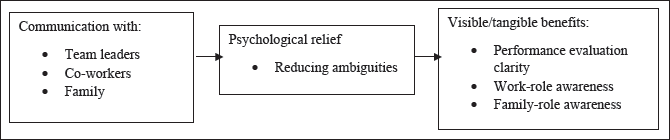
Dimensions of Unambiguous Communication: Understanding the Visible Advantages of Smooth, Uninterrupted Flow of Communication in Work & Family Domains.
An investigation into the behavioural outcomes of the coping strategy adopted by the respondents indicated an inward-looking approach, such as devising individual ways of dealing with the conflict, mainly concerning adjustments and accommodations in the non-work domain. Raising the issue of WFC with the organization or the HR team was not considered as a more viable option. Sociocultural factors in affecting the behaviour and actions of employees also manifested in other spheres of professional life, like ‘Overtime pay is a matter of right there (abroad) and even Indians working abroad claim the same. However, in India, they don’t exercise this right and accept overtime as a part of the work norm’ (as reported by a participant (E) who had worked in a few countries abroad).
The respondents felt that by adopting an approach of conflict resolution, they could ensure a peaceful co-existence of both domains. However, this passive acceptance of the conflict resulted primarily in making adjustments at the individual level (planning personal schedules better, roping in social support in work and non-work domains) rather than involving the organization to find a more comprehensive or more suitable solution.
Smooth, two-way communication emerged as an important coping mechanism developed by the respondents to help reduce their WFC experiences.
In the discussions with the respondents, they emphasized how two-way communication with their peers and team members, team leaders and the family helped in clearing a lot of misunderstandings and gaining a lot of information. At the organizational level, the respondents discussed communication with team members and team leaders, and there was little reference to any two-way communication with top management. Power-distance is one of the social norms that define collectivist nations, and it is probable that communication with top management was generally one-way.
HPWS comprises a set of HR policies aimed at improving and maximizing employee performance. It can work synergistically towards a superior organizational performance. It is, therefore, extremely important that organizational policies, performance expectations from employees, performance management standards and employee career advancement plans are communicated clearly to them so as to avoid any negative consequences arising out of lack of communication.
Lack of clear communication created a lot of ambiguity for employees regarding the expected performance and the performance evaluation criteria to evaluate their performance. This added to the work-role stress and resulted in many of them working longer and harder, putting greater effort at work (echoed by many respondents) due to the ambiguity. With clear communication from top management and team leaders, the respondents said they were able to focus better on their core job. As respondent K said,
Our KRAs (key result areas) are defined in the beginning of the year, but, during the year, we are involved in doing so many tasks which are so different from our KRAs … the HR evaluates our performance based on our pre-defined KRAs, but we may get instructions from our bosses regarding completely different tasks to be performed…. There is a lot of confusion about what exactly are we supposed to do and how will we be evaluated.
In such situations, clear communication from team leaders becomes essential.
It was not just about work-related information that communication with team leaders is considered vital. At an informal level too, discussions with the team leader helped build stronger bonds, creating a feeling of belongingness and helping the team leaders in developing a better understanding of the personal background of the team members. This emotional support was considered valuable by the respondents, as a married female respondent (respondent H) said,
We look up to our team leader/line manager for help and support and even when they listen to our problems, it provides a sense of satisfaction to us … with minimum interaction with the top management, the immediate boss is very important and if he is not co-operative then things become very difficult.
Discussions with co-workers on work-related issues helped gain better clarity about the job to be performed. Communication helped employees understand the WFC experiences of others and improved/changed their perceptions about their co-workers. This form of communication was very helpful for male employees, as one of them (respondent F) said,
This increased participation in family-role responsibilities is new to our generation and we don’t actually have ‘role models’ in our seniors (and even within family) to help and guide us in work–life balance issues. So, discussion with peer group is quite informative and we learn from each other’s experiences.
It reduces any form of misunderstanding that may develop among co-workers. Respondent G talked about a highly cross-cultural work environment in organizations and said, ‘People from diverse backgrounds and ethos have diverse attitudes and approach towards work and family obligations … unless we interact and understand their perspective and talk about ourselves, we may not get a holistic idea about what others are going through in life’. When reduced, the fear of co-worker antagonism led to employees not fearing being branded lazy or as shirkers if they opted for any family-friendly policy offered by the organization.
Equally important was the need to communicate clearly about work demands and work-related challenges in the family domain. It enhanced family-role awareness of people, as shared by respondent J:
Initially things were not so smooth and streamlined, with my wife also working, there were times when both of us had to travel out of town for work … last minute calls to parents were made to help with childcare. Now things are more systematic…. As a working couple, we know of each other’s schedule for the next 15–20 days and can plan our programmes accordingly. Parents can also be informed well in advance if their help or presence is required.
So, effective communication was successfully used by many respondents in developing clearer ideas of what is expected of them in work and family domains.
Dimensions of Family Support: Consequences of Continuous Support from Family and Its Bearing on Work- and Family-Level Adjustments.

Passive acceptance of WFC resulted in respondents making greater adjustments in the non-work domain. This magnified the significance of emotional and instrumental support from family (the most dominant component of the non-work domain).
Emotional support creates a sense of trust, warmth and respect and strengthens the feeling of belongingness in an individual. Instrumental support was considered as the tangible support offered in terms of help, guidance, companionship or even monetary support. However, this is not the only meaning that instrumental support may carry; each form of support, whether emotional or instrumental, may carry multiple meanings for the recipient (Semmer et al., 2008). In a study by Barling et al. (1988), the researchers found evidence to instrumental support as being emotional too. Help, guidance, counselling, facilitating the uptake of family-friendly policies may denote instrumental support. But the psychological relief that it provides to the recipient cannot be ignored. It assures the recipient of the relationship he/she shares with the provider and that they are being cared for, which is an essential source of psychological relief/support for them.
In the present study, it emerged that the family was a vital source of both these forms of support. However, support came at the cost of making heavy adjustments in the family domain, which can have implications for both family and the organizations in the long run.
As seen with most collectivist nations, a job is accorded high priority and contributes to the family domain. This can be due to the context of a large population and comparatively lower per capita income. An increase in job responsibilities was considered to be important not just for the prestige associated with it but also for economic reasons. So, the family was willing to make sacrifices for the career-growth prospects of the
bread-earner. As one male married respondent (respondent A) said, ‘All holidays, family celebrations, etc., are planned as per my schedule … my work schedule carries precedence over the school schedule of the kids’.
Throughout the discussion on the nature of the coping mechanisms adopted by the respondents, it emerged that their ability to devote long hours to work was possible only because of an atmosphere of social support from their family domain.
Male respondents said that they could give undivided attention to their job only because of the support of their spouses. Spouses who were gainfully employed earlier had stepped down from the job or moved to a more convenient job to facilitate taking care of the family. As one male respondent (L) said,
My wife was also working in a large MNC, but with small children and old parents, it was becoming increasingly difficult to manage work and family both. So, she took a leave from her job and is self-employed now. This gives her more control over her routine now.
The family domain boundary was more permeable than the work domain boundary, allowing work to intervene in the family more than vice-versa. Generally, spouses (wives) had to quit their careers or take sabbaticals to fulfil family domain responsibilities. This raises important questions about gender diversity at the HPWS workplace and the lack of effective HR policies that can ensure longer careers for females in HPWS.
Female respondents reported that devoting long hours to work was possible mainly because of parental support. They reportedly faced heavier WFC where parental support was not easily available. Although there were fewer female participants in the study, those who participated talked about parental support and ease of availability of house help as critical in enabling them to work for long hours.
Within the family domain, it was not just about spousal support but also parental support, which was considered the most trustworthy and reliable when meeting childcare responsibilities. As a married female respondent (M), who hailed from a small town, said, ‘We are not even thinking of having kids, our parents are not in a position to stay with us, and we cannot just move back to our hometowns. So, we are delaying parenthood as much as we can’. This is a very significant way in which the personal life of the employees was affected as a consequence of working in a challenging and demanding work environment. The study suggests that the avoidance approach for childcare responsibilities was the unfortunate coping mechanism here.
At the same time, some respondents were posted away from the family and valued the family support in facilitating undivided attention to work. According to the unmarried male respondent (N), ‘I miss the comfort of staying with the family and tend to feel lonely at times. I would love to move back to be with my family as I miss the emotional support that I get from them’. The married male respondent (P) who was posted away from the family (with his wife and children staying with his parents) expressed immense relief:
It is a matter of great relief to me that my wife and children are staying comfortably with my parents, and I don’t have to worry about my parents too. My job as it is takes up most of my time and I don’t have to worry about my family…. I can pay undivided attention to my job.
The family contributed towards developing better bonds with co-workers by being a part of informal get-togethers. As respondent H said, ‘By having informal get-togethers, where our families also participate, my family is more aware of my colleagues now.… This permeates into the work domain too and adjustments and roping in informal support becomes easier’. So, the ability of an individual to develop better relations at the workplace was also facilitated by the support that one received from members of the immediate family. This reflects the larger sociocultural environment of the country, where work and family domains are not strictly segregated and work generally permeates into the family domain.
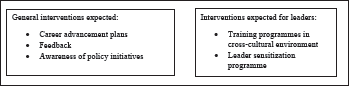
Respondents revealed that even though they did not rely too much on formal organizational support, they did have expectations from the management and the HR department. They expected the organization to give them regular feedback, have more transparent communication about the family-friendly initiatives and develop a career-advancement plan for the employees. Some interventions were expected specifically for those occupying position of team leaders, such as leader sensitization programmes or specific trainings to leaders, to make them more adept at handling a cross-cultural workforce.
Expected Informational Support at Work: Expectations of General and Specific Support Expected by Employees from the Organization.
The employees talked about not being informed about the work–life balance initiatives of the organization (if any), which dimmed their possibility of availing of the same. If line managers and top management in an organization recognize the salience of the non-work life of their employees and their need to strike a balance between work and non-work domains, then informational support about work–life balance initiatives can be easily shared by supervisors. As reported by respondent I, “We only get to know as much as is communicated and facilitated by our immediate superior … any flexible work arrangement or leave facility can be put to use only by the communication from immediate senior/team leader’. The respondents said that for many situations, policies exist, but there is a lack of uptake of the same. Respondent E (who had worked abroad) said,
Policies on paper are the rule.… Once they are put on paper, the employees get to know of them and can avail of them. This does not happen here … an employee knows only as much as is communicated to him by his line manager…. Nobody knows the written policies, nor do they bother to find it out … they only have a vague idea of the employee benefit policies. For them, as long as their line manager listens to them and understands their problem, they are happy. If he doesn’t, they accept it as their fate.
Getting regular feedback on one’s performance was considered vital as it instils a certain confidence in the employees that their efforts are in the right direction. It also helps reduce ambiguities and work-role-related uncertainties, which add to the existing role demand pressures the employees face. A few respondents spoke about the necessity of the organization seeking feedback from them to develop family-friendly initiatives. As respondent H (married female respondent) said,
The social set-up here is different and at times we feel the HR implements its global policies here, without considering the specific requirements of our society. It would be nice if they involve us by at least taking some feedback from us on what we expect as work–life balance initiatives.
She mentioned about the positive impact of a small initiative regarding a leave policy, where the HR team sought suggestions from the employees, ‘It feels good when once in a while such actions are taken by the management.… It creates a feel-good factor among the employees’. Another respondent B said, ‘Instead of organizing get togethers and off-site programmes, the HR can involve us more in developing policies for us, take our feedback and understand what will help us in securing a better work–life balance’.
Feedback, communication about policy initiatives and developing career-advancement plans for the employees may not have a direct link to WFC. Still, these mechanisms can go a long way in creating a more friendly workplace, building trust in management and developing a sense of belongingness towards the organization. These may indirectly reduce the WFC experiences of the employees. The respondents talked about the workplace becoming more cross-cultural. People from different towns and cities within the country and those from other nations, people from different generations and genders, make the workforce very diverse. In such situations, to understand the diverse needs of the workforce and to develop a more cohesive team, it is important that the HR department takes up certain leader-specific interventions. Specific training and leader-sensitization programmes can be initiated from time to time, making the attitude of team leaders more understanding and co-operative. Respondent K, when talking about his previous organization, mentioned ‘There were regular training programmes for leaders to make them aware of the changing demands of the workforce. This was especially helpful as the workforce has become culturally more diverse now than ever before’.
Discussion
The study’s objective was to explore the WFC experiences of employees working in HPWS and understand their coping behaviours when they experience WFC. The study specifically considered the Indian sociocultural environment as it can significantly influence peoples’ attitudes, responses and coping mechanisms. The sociocultural environment sets the context of the study and enables an understanding of the coping mechanisms adopted.
With organizations moving towards flatter organizational structures, work has been increasingly organized in teams. The team targets and team performance-based pay and incentive policies adopted by organizations create a greater workload for the employees, and, as a result, employees find themselves heavily involved in their work role demands (Bret & Stroh, 2003, cited in Macky & Boxall, 2008). The same sentiment was shared by the respondents who felt that although teamwork results in pooling knowledge, it creates performance pressure as teams can attain their targets only if each member contributes optimally.
It emerged that the general attitude towards WFC, which was of acceptance and the commonly adopted response to the same, in the form of making more accommodations in the personal domain, were strongly shaped by sociocultural factors. The behaviour of gathering social support in work and family domains was shaped out of sociocultural norms. People seek support from others through informal relations rather than depending on formal policies. Xiao and Cooke (2012) observed a similar acceptance of the conflict in their study on Chinese employees. The study sample reportedly adapted their individual coping mechanisms to deal with the conflict, rather than having too many expectations from the organization. India and China can be considered to be closer culturally as compared to the Western nations of the world, hence a similar ‘acceptance of the conflict’ was observed in the present study.
Having open lines of communication emerged as an important coping mechanism, which was more experiential by nature. Communication played a vital role in developing stronger bonds with the co-workers, reduced misunderstanding and also provided vital information about organizational policies and their uptake. Employees said that discussing their WFC issues with their bosses and colleagues resulted in solution-oriented advice from them and harnessing supportive behaviour from them whenever required. Communication from the top management also provided clarity regarding role expectations, performance appraisals and availability of family-friendly policies. This enhanced clarity leads to better task performance, task evaluation and policy uptake. Two-way communication with line managers also helped better understand each other’s perceptions and expectations. This is especially true for multi-national organizations with employees from different cultural backgrounds and different ethos.
The efficiency and effectiveness with which HR management practices are followed in an organization is determined by the unambiguous manner in which it can send out communication regarding the organizational values, policies and priorities to its employees (Ostroff & Bowen, 2016, in Cafferkey et al., 2018). The authors emphasized on the importance of ‘visibility’ in HRM practices, which is basically about unambiguous communication of HRM practices in a way that the employees easily understand. Researchers who were a part of a 21-nation study on role conflict, ambiguity and overload (Peterson et al., 1995) also agreed that work roles carry ambiguities and complexities. These ambiguities create a feeling of lack of clarity regarding work roles and may give rise to a feeling of work overload too.
The respondents accorded high importance to social support from family. With work being prioritized over family, family domain boundary was more permeable, allowing work-role related responsibilities to flow in more smoothly. As a result, the job of the bread-earner was not just his/her responsibility but a collective responsibility of the entire family. People were willing to make adjustments in the family domain to help them focus more on their job. The joint family system is still quite popular in the country, making it easier to rope in support from parents, siblings and extended family members. Ease of availability of house help also contributed to a more supportive family environment. Many male respondents talked about their spouses stepping down from their jobs (where the spouse was also engaged in a challenging and demanding work environment) and moving to lesser demanding jobs, self-employment or quitting jobs altogether to take care of family-role responsibilities. So, family social support did come at a cost, in the form of sacrificing the career growth opportunity by the spouse. This has implications not just for organizations but also in the non-work domain in the form of economic, social and psychological consequences. If organizations aim at a more gender diversified workforce, it needs to reconsider its HR policies.
Workplace social support was a result of the informal support system created by employees themselves by roping in maximum support from co-workers and immediate superiors. It was a function of the lateral interactions that employees had and the informal relations they developed due to working together. There was lesser reliance on formal policy support, although wherever present, these policies added to the perception of a supportive workplace. Employees had expectations regarding work–life balance policies from the organization, but communication with top management was restricted. Also, there was a limited uptake of work–life balance policies wherever these were available, as employees were apprehensive of the negative repercussions associated with their uptake. This further increased the importance of informal support at the workplace and highlighted the need for having stronger formal sources of support at the workplace. When team managers ensure a stronger enforcement of high-performance HR practices, it results in a higher individual-level in-role performance and organizational citizenship behaviour. So, the role of line managers or team managers/leaders is important in the way HPWS are implemented and in generating desired employee response (Pak & Kim, 2016). Similarly, team leaders and managers should be roped in to communicate family-friendly initiatives and formalize the important sources of informal support. In a qualitative study by Chatrakul Na Ayudhya and Lewis (2011), the researchers found that any form of organizational support received was seen as a ‘bonus’ or ‘favour’ and not as an entitlement. It did create a feeling of positivity for the organization, but the participants said they would never take such support for granted.
The results of the study provide rich insights on several aspects of the participants’ WFC experience in HPWS contexts. Enhanced and focused communication at the workplace and formal social support policies are simple and easy to implement strategies to ensure that employees have a more integrated and balanced work and non-work life. Organizations can invest in developing better structural support for their employees, as simpler steps taken by the organizations can have significant and far-reaching consequences for the employees. Rather than employees struggling at the individual level to find solutions to their WFC problems, initiatives taken at the level of organization will have a wider sphere of influence. This will reduce the over-dependence on family social support and will result in a greater number of women not just joining the workforce but also sustaining themselves in high-pressure work environments. It can improve the gender ratio at workplace, and organisations will be able to harness female talent better. Employees working in HPWS contexts should understand the importance of discussing WFC issues at the organizational level to initiate policy changes in tune with their needs. The over-reliance on non-work sources of social support should be reduced to avoid straining family resources.
Conclusion
The study provided much-needed insight into the WFC experiences of employees in an HPWS and their coping strategies when they face WFC. Organizations need to consider the coping mechanisms adopted by employees more seriously as WFC should not be framed at the individual level rather it is the responsibility of the whole organization. Organizations are powerful institutions that can positively influence and address the concerns of employees through their right policy initiatives. This can be made possible by seeking feedback from employees about their requirements for family-friendly initiatives. As was observed from the responses, employees felt that communication with top management was generally top-down only. They received little opportunity to express their concerns to the management and hence relied on informal support at their workplace.
WFC affects an employee at an individual level, and all employees working in an organization may not experience a similar level of WFC. However, the consequences of the conflict are limited not just to the individual himself but also spread out to the work and family domain. Organizations endeavour to increase and improve their productivity, performance and profits, which are strongly dependent on the performance and efficiency of their human resources. Employees may take steps to manage their WFC experiences at their own level by involving their family and immediate co-workers, but the spillover effect of this has important implications for the organizations.
It is important for research in the area of WFC to look at the employees’ attitude towards WFC and the adjustments made by them to integrate their work and non-work domains. The adverse consequences of WFC on work and family domains are well researched. Future research focusing on coping strategies, employee attitudes regarding WFC in other work contexts can further help policymakers in organizations to draft more suitable work–life balance initiatives.
Footnotes
Declaration of Conflicting Interests
The authors declared no potential conflicts of interest with respect to the research, authorship, and/or publication of this article.
Funding
The authors received no financial support for the research, authorship and/or publication of this article.
e-mail:
e-mail: