




Abstract
Executive Summary
The year 2020 will go down in the annals of history as the year of COVID-19, the year the whole world was left devastated. Even in 2021, countries are being ravaged by the virus, with no immediate end in sight. In fast-moving and uncertain situations, leaders face many questions for which they might not have any answers (Argenti, 2020). Therefore, the question is how leaders can manage the communication environment with clarity, consistency and empathy during this period of extreme disruption (Glinska, 2020). Crisis communication is generally defined as the accumulation and dissemination of information during crisis situations to alleviate the severity of the crisis. This study outlines and analyses the communication strategies and measures adopted by the management of one of the biggest manufacturing industries of the country, the Steel Authority of India Limited, Rourkela Steel Plant (RSP), during this ongoing COVID-19 crisis. A survey on the efficacy of the communication measures adopted by the management was conducted on 345 employees. The results showed a high level of support for all the implemented communication measures. Yet employees at the junior level articulated a need for better communication exchange with the top management. They perceived their voices as going unheard and sought additional communication channels connecting them to the highest authority. Considering the feedback received from the employees, additional communication measures were adopted. RSP’s Mass Contact Exercise was revived in an online format. A mobile app was developed containing all information and guidelines that an employee would need regarding precautions, prevention, testing and treatment of COVID-19. Quick and clear communication at every juncture let RSP tide through arguably the toughest pandemic period. Thus, it should always be ensured that appropriate communication channels are effectively implemented for vital information to reach every corner of the organization.
Keywords
INTRODUCTION
In 2020, when the crisis first struck, India, like multiple other countries, desperately sought ways to stay afloat in the pandemic, which proved to be dystopian in the true sense of the term. The scenario had been exceedingly tough for everyone, more so for people at the helm of affairs in the leading industries of the country. Argenti (2020) observed that in fast-moving and uncertain situations, leaders face many questions for which they might not have any answers. Therefore, the question that arises is how leaders can manage the communication environment with clarity, consistency and empathy during this period of extreme disruption (Glinska, 2020).
COMMUNICATING IN TURBULENT TIMES
With so much at stake, communicating effectively during the pandemic assumes enormous significance, as prompt and accurate information dissemination has become the need of the hour (Mcmullan & Smith, 2020). The Oxford English Dictionary defines crisis as a ‘time of great danger, difficulty, or confusion when problems must be solved, or important decisions must be made’. In an organizational setting, a crisis is a ‘critical event or point of decision which, if not handled in an appropriate and timely manner, may turn into a disaster or catastrophe’ (businessdictionary.com). These definitions are in line with the definition given by Coombs (2007), who suggested that crisis times can seriously impact an organization’s performance and generate negative outcomes. Marsen (2020) observed that crises differ depending on the type of crisis, the loss to the company, the stakeholders involved and the organization’s history and reputation. The COVID-19 pandemic is a once-in-a-century crisis without any precedent. No rulebook was available for leaders to connect quickly with employees or related communities to assuage their feelings, allay their apprehensions about the crisis or reassure them about their future (Mendy et al., 2020). Marsen (2020) further added that managing a crisis effectively is crucial to an organization’s ability to restore control over the situation, keep the company’s image intact and establish trust among the employees and the community.
Coombs (2010) suggested that three key terms relate to organizational crisis—crisis, crisis management and crisis communication. The three are inextricably interconnected and must be mapped from crisis to crisis management to crisis communication. He defined crisis management as ‘a set of factors designed to combat crises and to lessen the actual damages inflicted’. He further proposed that this set of factors can be divided into three categories—pre-crisis, crisis and post-crisis. These three phases are critical since they reflect upon the nature of crisis management and pre-empt the attributes of the organization’s crisis communication. According to Coombs (2010), pre-crisis communication primarily involves collecting information relating to crisis risks, decision-making about potential crises situations and training people about the crisis management process. Crisis communication that follows pre-crisis communication is generally defined as the accumulation and dissemination of information during crisis situations to alleviate the severity of the crisis. It involves internal and external stakeholders such as customers, clients, service providers and media. For a massive system such as the Rourkela Steel Plant (RSP), it includes the township residents and some of the peripheral adopted villages, dependent on RSP for daily subsistence.
Theoretical Framework of the Study
Multiple theoretical models exist that direct organizational communication during crisis times. Researchers have developed theories that seek to identify and understand the different types of crises and crisis communication. Some of the key models that have guided research on communication crisis are corporate apologia (Hearit, 2001, 2006), image repair theory (Benoit, 1995, 1997), situational crisis communication theory (SCCT; Coombs, 2007), discourse of renewal theory (DRT; Seeger et al., 2003) and integrated crisis mapping model (ICM; Jin et al., 2007, 2010). Hearit (2001) defined corporate apologia as a ‘response to criticism that seeks to present a compelling competing account of organisational accusations’. It focuses on apologizing for any crisis and provides defensive communication strategies for such apologies. Hearit (2006) identified five strategies that the organization could use to posit its counterpoint: denial, counterattack, differentiation, apology and legal. Benoit’s (1995) image repair theory emphasizes communication strategies that aim to restore the organization’s image after the crisis. The strategies range from denial to mortification, on the other, with evasion of responsibility, reducing offensiveness of event and corrective action bringing up the middle. Sellnow et al. (1998) observed that each strategy could be applied discretely or in combination with the others.
The SCCT developed by Coombs (2007) ‘evaluates the reputational threat posed by the crisis situation and then recommends crisis response strategy based upon the reputational threat level’. According to Coombs (2010), the communication plans subsequently get centred on the crisis type, crisis history and prior reputation of the organization. SCCT, thus, maintains that communication affects people’s perceptions in a crisis, as ‘the words used and actions taken by the management affect how people perceive the organisation and/or the crisis’. Hence, within the framework of SCCT, Coombs (2014) offered crisis response strategies based on denial, diminishment, rebuilding and bolstering. The DRT emphasizes lessons learnt and opportunities inherent within a crisis, with a focus on reforming the image of the organization with its post-crisis actions and communications (Seeger et al., 2003). Thus, organizational learning, ethical communication and positive communication form the basis of this theoretical perspective on crisis communication.
While these theories are primarily situation-based crisis communication theories, the integrated ICM developed by Jin et al. (2010) suggests that a more comprehensive approach would be to shape crisis responses from an emotion-based perspective. This model proposes that a crisis is an intensely emotional experience that affects the emotional and mental well-being of individuals. Thus, organizations should recognize the distress of the people affected by the crisis and orient their strategies to address the requirements arising from their traumatic experiences. Considering four key negative emotions such as anger, fright, anxiety and sadness that are most likely to be experienced by the affected public, the model proposes that the organization must first understand the public’s ‘emotional demands so as to communicate accordingly and align with the coping strategy needed by the primary public’ (Jin et al., 2007). In the ICM model, the public’s coping strategies range from cognitive to conative and situate these with the degree of organizational engagement that ranges from low to high, depending upon the type of crisis involved.
The present study aimed to outline and analyse the communication strategies and measures adopted by the management of one of the biggest manufacturing industries of the country during this ongoing COVID-19 crisis, located within the theoretical propositions of Coombs’ SCCT along with the DRT and ICM models of crisis communication.
ROURKELA STEEL PLANT: AN OVERVIEW
The RSP is the first integrated public sector steel plant in the country. It is one of the largest industrial units in Odisha. The plant commenced production of hot metal in 1959 and is an integral part of the maharatna company, Steel Authority of India Limited (SAIL). With an installed hot metal capacity of 4.5 million tons per annum, RSP is a major producer of sophisticated steel products, comprising a wide variety of special-purpose steels. It is not a stand-alone industry with just a limited pool of people on its payroll but an industrial behemoth that has the responsibility of taking care of the welfare of more than 12,000 employees, 8,000 plus contract workers while also providing necessary services to around 6,00,000 people residing in the township. The plant is spread over 45.13 square kilometres that include residential quarters, shopping complexes, roads, sewage lines, educational institutions, libraries, parks, sports complexes, recreational clubs, community centres, night shelters, an airstrip and several other amenities that need to be managed on a day-to-day basis. From a pothole on the road to a snake found in the residential quarters or water seepage in one of the 4,000 plus shops in the township, it is the responsibility of the steel plant management to solve the problem.
Facing COVID-19: Communication Interventions at RSP
In India, even though the virus had started spreading from the last week of February 2020, it was not until mid-March that the situation began to draw attention. A nationwide lockdown was announced on 24 March 2020. A complete shutdown, except for essential services, being enforced in a staggered manner added to the uncertainties prevalent in all aspects of life and living.
Challenges are not new for RSP. Steel being an extremely cyclic industry, the RSP collective has gone through multiple vicissitudes on the business front in the last 60 years. Be it the threat of cheap imports, the slowdown in the international market, or competition from leaner and meaner players in the private sector, the RSP has always experienced external volatilities while striving to be on the path of progress. There was a time when the financial crunch at RSP was so severe that people shifted to other cities, tagging Rourkela as a ‘dead city.’ However, with a collective and renewed effort from all concerned, RSP could be brought back to a path of profitability. Recently, to overcome technological obsolescence and remain industry-competitive, RSP has carried out massive modernization and expansion that has more than doubled its rated capacity. Dasgupta et al. (2020) suggested that ‘sectors of industry that are constantly innovating or face more competition and adversity seem to be doing better and preparing better’ in this crisis period. Thus, RSP, with its years of struggle, is relatively well-experienced in handling crisis situations.
For any organization, ensuring the safety and security of its employees takes priority. Iconic entrepreneur Richard Branson had once stated that ‘employees come first, if you take care of your employees, they will take care of the clients’. RSP adopted this principle and immediately prioritized its efforts to take care of its employees in the wake of the COVID-19 pandemic. For RSP, the ambit of the employees also includes their families and all other establishments that are directly or indirectly dependent on it for their existence. RSP has several sensitive heavy equipment, processes, and systems, including water and power supply and distribution network, which operate round the clock and require constant vigil and monitoring. Irrespective of any crisis, keeping vital units such as blast furnaces or coke ovens safe and running is the utmost priority for the management. Any stoppage would lead to colossal damage to the machinery, and it would take months to restore normalcy. This would also severely affect production and result in huge financial loss to the state and national exchequers. Thus, as the pandemic struck, keeping the Plant functioning at its optimum and taking care of all its stakeholders became quite challenging.
RSP, too, like other entities, was caught almost unawares when the crisis struck. The multiple parameters essential for the smooth functioning of a plant of the size of RSP were critically evaluated, and immediate actions were taken pre-empting the vulnerable areas that would require special attention. Communicating effectively with all stakeholders was a major concern. Gaining organizational attention is important as the collective identification of immediate and non-immediate threats (Gómez, 2018) holds the key to smoothen the functional processes of any organization. With time, ‘organisations have adopted technology-driven solutions, where managers communicate time-critical information via multiple channels including but not limited to email, intranet, video conferencing, and other tools’ (Sanders et al., 2020). RSP also initiated multiple new communication channels, including webinars, video conferencing, social media apps, community radio, and an in-house TV channel, in addition to conventional emails, intranet, departmental meetings and the plant public address (PA) system.
Communicating to Stakeholders
Communication is the lifeblood of any organization. When it comes to a manufacturing industry such as steel, it sometimes holds the difference between an organization surviving or perishing. Therefore, disseminating up-to-date information in a time-bound manner is critical to the sustenance of the industry. However, with more than a year gone by in the pandemic, the most challenging aspect has been the absence of any clear-cut information regarding the virus. Information has been aplenty, but the challenge has been to sieve the essential messages from the information overload. Matters were made worse by the non-availability of any specific medicine or vaccine until almost recently and the changing behaviour of the virus. Rumours were rife, and it was evident that the management had to act first to stem the panic and anxiety arising out of a surfeit of misinformation. In the beginning, informing people about the dos and don’ts of the disease held paramount importance; thus, a multi-tier communication strategy was drawn considering the scale and distribution of the target audience. Here, the target clientele was the whole township; hence, working in tandem with the government officials, the communication mediums were quickly put into place. With the government guidelines being revised and changing rapidly, it was clear that the communication strategies had to be devised in tune with the dynamics of the situation.
Communication Initiatives Taken by RSP
Studies show that if an organization takes undue time to respond to a crisis, it fails miserably in the perception factor among the public and stakeholders. This observation has become particularly important in the age of social media, which facilitates immediate, two-way symmetric communication (Marsen, 2020). Thus, going by the diktat that quick response to a crisis is advantageous to any organization, the plant management immediately communicated with all the stakeholders using multiple ways and means.
The first action was a video message of the CEO that was recorded by Rourkela Steel Television (RSTV)—the in-house cable TV network of RSP—and circulated through social media platforms such as WhatsApp, Twitter, Facebook and YouTube. The message appealed to everyone to stay calm and vigilant and to strictly adhere to the guidelines issued by the state and central governments. Regular announcements about COVID-19 guidelines were made in various public places of the township and at all the Plant entry gates through the PA system. A short film made by the Public Relations Department on the disease and its protocols was circulated through social media platforms such as Facebook, WhatsApp, Twitter and YouTube. Multiple hoardings and banners were put up in strategic locations of the Plant and the township to generate awareness about COVID-19 Leaflets denoting COVID-19 protocols were distributed in marketplaces as well as in the residential colonies of the steel township.
Amid all these measures, it was also crucial to keep all the employees informed about the initiatives taken by RSP in response to the pandemic. This was deemed essential to dispel their doubts and anxieties and at the same time to enhance their confidence in the management’s ability to tackle the crisis in an organized and coordinated manner. Information about incidents that could create panic was quickly disseminated to all the stakeholders through multiple channels. Subsequently, a workplace advisory was issued detailing all the standard operating procedures (SOPs) in the prevailing circumstances to provide clear instructions to the employees and other service providers. A media strategy was also implemented to counter the spread of fake news which could generate fear and anxiety and demoralize the employees. It was ensured that every preventive measure of RSP about COVID-19 was routinely published by the local media, with the designated personnel constantly in touch to provide clear messages and enlist media support.
Addressing the Lockdown Challenges
When the lockdown was announced in March 2020, it was something that had never been experienced before. Reaching out to employees at this juncture, clarifying their doubts, and assuring them and their family members that the RSP management was taking every possible precaution was highly crucial. The CEO, through teleconference, advised the senior management team to be in constant touch with their junior colleagues to address their apprehensions. The CEO’s message about the extensive steps taken by the steel plant in collaboration with the local administration to prevent the disease from spreading was translated into Odia and Hindi. The message was widely disseminated through emails, the intranet portal and social media channels.
The first COVID-19 case at RSP was reported on 12 April 2020. The entire town was engulfed in apprehension and fear. The cleaning and sanitization activities were intensified both in the steel township and the steel plant. Several essential sanitization measures that were implemented were extensively publicized through conventional and social media to enhance the confidence of the employees and residents of the steel city. In another initiative, the employees and their family members were invited to participate in COVID-19 awareness drives involving creative activities such as poster designing, poetry writing, short essay writing and sharing video messages to create a sense of participation and involvement among everyone. These creative outputs of the members of Team RSP showcasing their tales of hope, health and well-being were given wide circulation. Efforts were taken to build a rapport between the management and the employee unions, and the executive association, which played a huge role in maintaining a peaceful and harmonious work environment. A COVID-19 testing centre was set up immediately in RSP’s Ispat General Hospital. This news was shared widely through all communication mediums.
The unlock process brought with it a separate set of challenges. After the prolonged lockdown phase, reduced production, and low business, bringing the Plant back to track by rejuvenating the employees was an uphill task. RSP had to make up for the production loss, improve the techno-economics and save the cash outflow by rekindling energy and enthusiasm. Hence, two important HR initiatives were launched: ‘Unmukt’ for senior executives and ‘Spandan-Galvanizing People into Action’ for non-executives and low- and mid-level executives. These interactive series of programmes were organized with adherence to all COVID-19 protocols. Besides, several webinars were organized for different segments of employees. The top management participated in these initiatives, interacted with the employees, discussed ideas, weighed the feasibility of their suggestions and set a timeframe for implementing many of the ideas. To bridge the gap between the top management and employees in different echelons, a link named CEO Connect was created in the intranet portal of the Plant. Any employee could share their views directly with the head of the steel plant through CEO Connect. These initiatives were perceived as a space for junior employees to build confidence as the senior officials listened to their varied suggestions and proposals for the betterment of the plant.
VALIDATING THE COMMUNICATION MEASURES: ANALYSING FEEDBACK FROM EMPLOYEES
Today’s world is always on, its actors are interconnected and events evolve in real-time (Lin et al., 2016). A crisis triggers debates, criticisms, reactions, opinions and responses as well as watercooler moments, stories, influencers, Internet memes, impulsive behaviours of solidarity and protest, emotional outpourings, and other stakeholder initiatives and actions (Pieters & Van Achte, 2018). In a world where stakeholders are highly interconnected and where copious quantities of informal discussions appear as a reaction to situations that are complex to understand, it is an ‘illusion one can manage the communication with a guaranteed positive result in safeguarding one’s own reputation’ (Marynissen & Lauder, 2020).
In an attempt to understand the efficacy of the communication measures adopted by the management, feedback was collected from the employees of RSP through a five-point Likert scale questionnaire in August 2020.
The questionnaire comprised four close-ended questions, ranging from strongly disagree to strongly agree. The fifth question was open-ended to obtain feedback on the communication strategies and channels perceived to be most effective by the employees. The questionnaire was brief, considering that it would have been challenging to get the responses from the busy employees otherwise. The questions included the following:
Has the top management communicated to you regarding the ways and means of facing the COVID-19 challenge? Has the top management been able to communicate a sense of safety during the pandemic situation? Has the top management been able to communicate a sense of confidence during the pandemic situation? Have you received timely information from the management during the various stages since the onset of COVID-19? Which communication channels used by the management to convey the messages regarding COVID-19 challenges were most effective for you? (rate from 1–10, the most effective medium to be rated as 1): (1) RSTV channel on YouTube; (2) WhatsApp groups; (3) Facebook (Shilpa Konark); (4) Twitter Handle of SAIL, RSP; (5) Intranet portal of RSP; (6) newspapers; (7) webinars; (8) hoardings and banners; (9) public announcements and leaflets; (10) departmental meetings.
The sample size was 345, including 105 executives and 240 non-executives from various levels. Since the proportion of non-executives is much higher than executives, the data was collected accordingly. Following a random sampling method, data was collected anonymously from the employees. It was ensured that feedback was received from both men and women, covering various units of the Plant, and from all age groups. The responses were collected physically through hard copies. Multiple units comprising different levels of employees were approached simultaneously, and responses were collected within a very short period. The public relations (PR) department of RSP assisted in the collection process. The response rate was 100% as the data was collected by the plant’s PR department. The mean age of the sample was 43.54 (SD = 8.76), with a range of 23 to 59 years, out of which 78% of respondents were male and 22% were female. The number of women respondents was less as it reflects the total male-female ratio for the whole plant.
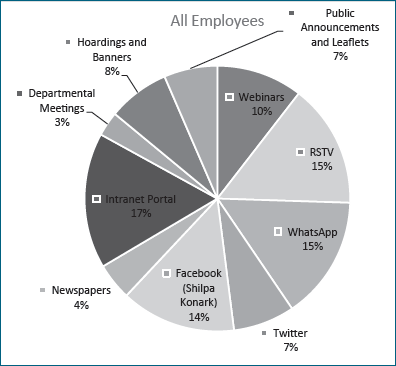
Feedback on the first four close-ended questions from both groups of employees was evaluated by drawing the frequencies and means for each question. Almost 84% of the employees showed support towards the efficacy of the communication measures adopted by the management of RSP. The fifth question that aimed to get information on the best communication channel during crisis times in today’s age of social media obsession drew some interesting results. Expectedly, across all age groups and all levels, it was found that social media platforms such as WhatsApp, Facebook and Twitter were popular information receiving forums. RSP’s intranet portal and internal webinars also received high preference from many employees across different levels, ages, and genders. Interestingly, RSTV, the in-house TV channel of RSP, received a high degree of preference from all employees. Conventional information dissemination mediums such as hoardings, banners, public announcements and leaflets were also observed to be preferred channels for some employees (Figure 1).
Some of the critical comments that were received through the open-ended section of the questionnaire included the following:
Inadequate quarantine/isolation measures for employees and their family members Need for better and more treatment facilities for employees Need for more COVID-19 testing facilities More frequent interactions of top management with junior employees Further broadening of the reach of the communication exercises Intensification of the sanitization activities Provision of better care for COVID-19 warriors
Upon analysis of the open-ended section of the questionnaire, one aspect stood out. While some sections of the employees, particularly the senior and middle level, felt gratified that the CEO communicated to them directly through webinars and the intranet portal, employees at the junior level wanted to have more channels of communications to reach out to the top management. Coombs (2007) posited that ‘a crisis creates a need for information’. To manage the associated psychological stress that a crisis engenders, the stakeholders need as much information as possible and as many times as feasible. According to Jin et al. (2010), people respond both intellectually and emotionally to events around them, and this shapes the future course of their own lives. When people ‘are faced with a worrisome situation’, leaders should help the employees ‘articulate and come to terms with their complex emotions’ (Clifton & Harter, 2019)—demonstrating both vulnerability and empathy aids in building relationships that pave the path for employee loyalty and engagement (Maylett & Wride, 2017). The need to communicate frequently with the top management was a recurrent wish that was delineated in the comments section by the junior level employees.
Communication Channels Preferred by Employees for Receiving Information.
Another aspect that was visible was the concern for the doctors, nurses, and paramedical staff working in the medical and health care units of RSP. These are the real COVID-19 warriors, and ensuring their well-being should carry utmost importance was the response recorded by most of the respondents. The suggestion was to adhere to strict and effective COVID-19 SOPs for medical staff that would ensure their well-being to a large extent. A few employees also quoted an issue of battery discharge during the thermal scanning. While this might look like a minor problem, it has the potential to send out wrong messages.
The results suggest that no matter how much effort the RSP management had taken to communicate with the employees during the coronavirus crisis, there was still a section that felt deprived of contact with the senior management. They perceived their voices as going unheard and sought additional communication channels connecting them to the highest authority. ‘All crises involve effective communication’ (Ulmer et al., 2017). Therefore, organizations, be it a start-up or a steel behemoth such as RSP, need to heed this and reorient their strategies to devise effective communication among all stakeholders. The integrated crisis model is observed to hold relevance here. The fear and anxiety sensed by the ‘primary public’, in this context the junior employees, necessitated further communication measures from the management to connect and provide space for their voices to be heard.
LESSONS LEARNED AND MEASURES ADOPTED FROM FEEDBACK RECEIVED
Bagchi (2006) points out that the intranet site of an organization is more than just a nice-looking thing; it holds the potential to be the most important communication - real estate. Considering the responses received from some sections of employees, the RSP management decided to intensify their communication initiatives. In this context, Mcmullan and Smith (2020) suggest that when employees are made to feel respected and when their health is prioritized, they stay dedicated and motivated. Learning to evolve within the crisis is a key proposition of DRT, which was evident in the measures adopted by RSP.
Some of the additional communication initiatives that have been adopted from October 2020 by RSP include the following:
‘Mass Contact Exercise’: It is a mass communication exercise that was held every week in RSP since 2012. Around 500 employees get a chance to interact with the CEO along with other senior functionaries. However, it was stopped in March 2020 because of the COVID-19 outbreak. This was revived and relaunched on the online platform in a new format. Now, around 100 non-executive employees get an opportunity to take part in every session and interact with the CEO.
Separate online interaction sessions are being organized for each grade of executives in which the CEO and all the Executive Directors discuss the various issues about the Plant. The executives are encouraged to share their thoughts on how to bring back normalcy in the Plant and improve the Plant’s performance .
Right from the location and frequency of the testing centres to the protocol to be adhered to, when someone gets infected with COVID-19, all information is provided through circulars.
A separate section was introduced in the intranet portal where information relevant to the employees is posted. Some examples are given below.
Workplace advisory
How to protect yourself from COVID-19
Quick response team for COVID-19
Guidelines for ‘work for home’ or ‘staggered working hours’
Usage of personal protective products
Regulations on movement of employees and their family members
Guidelines from the Government of India and Government of Odisha on lockdown and shutdown
Registration Centre details
FAQs on COVID-19
Post-COVID-19 management protocol
Day-wise COVID-19 negative test reports of employees
Guidelines after COVID-19 tests
Advisory on tours/travels
Effective use of the ‘Aarogya Setu’ app
A film documenting the steps taken by RSP and featuring employees who had recovered from COVID-19 was made.
Various other steps were taken, such as establishing a Plasma Bank at the hospital, creation of COVID-19 care centres exclusively for employees and their family members.
Corona-free Suraksha Chakras were formed in every department in the plant. This team of employees keep track of the health conditions of all the employees and their family members.
A mobile APP has been developed, which can be downloaded by any employee from the Google Play store and contains all the information and guidelines that an employee would need regarding the precautions, prevention, testing, and treatment of COVID-19.
Marsen (2020) argued that ‘lesson learning’ is integral to crisis communication. A proper foundation for open and effective communication channels among different levels, departments, and sections should be established immediately (Lee, 2012). During times of crisis and uncertainty, it is the leadership voice that provides credence. Employees look up to leaders to provide them with the much-needed empathy and direction in managing the unpredictability of the situation. Communicating to stakeholders even in normal times is never easy, requiring continuous efforts and plans to send messages that reach the appropriate audience at the right time. Communicating during crisis periods is even more complex and turbulent. The management can only take certain measures to ensure that the flow and intensity of communication continues unabated. The final endorsement can come only after being evaluated by the employees. It should be ascertained whether the steps taken improve the organization’s standing in the stakeholders’ eyes (Kronick, 2020). Appropriate channels of communication should be effectively implemented for vital information to reach every corner of the organization. In most cases, crises do not come announced. Though an organization obviously cannot be prepared for every tough situation, an eco-system of positivity can undoubtedly lay the foundation for a robust response to any challenge.
CONCLUSION
To create a cohesive mindset among employees and generate a positive and proactive approach, management must build a relationship based on trust and credibility. From an organizational perspective, effective crisis management is crucial to regaining organizational control, restoring the company’s image, and gaining stakeholder trust (Marsen, 2020). For RSP, this invaluable underpinning came in handy when the crisis unfolded. Despite few dissenting voices wishing for better communication during the pandemic period, it was observed that the RSP management quickly reached out to the employees through every possible media available, staying in touch with them continuously and reassuring them about their safety and security. Swift and direct communication of the facts let the organization tide through arguably the toughest period of the pandemic.
While the survey findings reinforce this fact, it is also endorsed by action. Two national records were set in July 2020. On 2 July, RSP created a new national record by making 48 blows from a single converter on a single day in its steel melting shop-2. In the background was the smooth coordination and contribution by 10 different departments, overcoming all the apprehensions of COVID-19. Another national record was created on 17 July 2020, when the steel plant achieved a turnaround time of 2 hours and 15 minutes for a bogie open both sides (BOBS)-type railway wagon rake. It surpassed the previous national record of two hours and 20 minutes registered in January 2015. Subsequently, on 21 July 2020, it again improved the turnaround timing efficiently to two hours and five minutes. After the lockdown period, the steel plant witnessed many units clocking more than 100% of their rated capacities. The plant completed the financial year 2020–2021 by producing 3,573,000 tons of hot metal, representing a growth of 5.7% over FY 2019–2020. Similarly, 3,207,284 tons of saleable steel was produced in FY 2020–2021, against the previous year’s 3,205,318 tons, despite the ongoing pandemic.
Footnotes
Declaration of Conflicting Interests
FUNDING
The authors received no financial support for the research, authorship and/or publication of this article.