



Abstract
Care has become increasingly recognised as fundamental to ethical music education practice, yet the concept encompasses diverse theoretical approaches reflecting varied contextual needs and scholarly traditions. While this diversity highlights the complexity of care, it can present challenges for operationalising concepts in empirical research. This study addresses the need for heuristic clarity by identifying theoretical patterns across care scholarship in music education. Using Walker and Avant’s concept analysis methodology, this study analysed 33 peer-reviewed sources published between 2000 and 2024, identified through systematic searches of four electronic databases. Data were analysed through collaborative coding and consensus analysis, thereby establishing defining attributes, antecedents, and consequences. Specifically, five interdependent attributes were identified: Relational Attentiveness, Responsive Reciprocity, Vulnerable Competence, Empathetic Compassion, and Transformative Responsibility. Key antecedents enabling care include educator ethical preparedness, recognition of student vulnerability, and supportive institutional contexts, while consequences encompass transformative outcomes for student well-being, agency, and musical engagement alongside enhanced teacher fulfilment. This study establishes care as a sophisticated and multidimensional practice requiring developed skill, critical awareness, and contextual navigation. The proposed framework offers a systematic perspective designed to complement, rather than replace, existing contextual approaches to understanding care in music education.
Introduction
Music education is widely recognised for promoting physical engagement, emotional expression, and cognitive development (del Barrio & Arús, 2024), with documented effectiveness in fostering cooperation, communication, and positive peer relationships among students (Varner, 2023). Research across health contexts has documented the impact of music on emotional regulation and social connection (MacDonald et al., 2012; Weinberg & Joseph, 2017). However, the extent to which these documented benefits are realised depends largely on the quality of the pedagogical relationship and the framework guiding teaching practice. This has prompted researchers to examine how care ethics can systematically guide teacher-student interactions to optimise educational outcomes in music learning environments.
Care ethics emerged from feminist scholarship as a challenge to traditional moral theories that emphasised abstract rules over relationships and context. Gilligan (1982) provided crucial evidence that women’s moral reasoning often focused on maintaining relationships and responding to particular situations rather than applying universal principles. Building on this foundation, Noddings (1984) developed a theory of caring relationships, arguing that ethical action should emerge from attention to specific people and situations rather than following predetermined rules. While initially describing this as a feminine approach, Noddings (2013) later used the term “relational approach” to emphasise that caring is a fundamental human capacity available to everyone, not just women. Noddings (2015) further expanded this framework to address justice, arguing that rights-based ethical principles are insufficient on their own and should be complemented by direct relational responsiveness to effectively meet specific human needs.
This feminist challenge to abstract ethics has been expanded by scholars like bell hooks (1994, 2001) and Tronto (1993), who position care as a political practice essential to democratic society. Specifically, Tronto argues that democratic citizenship requires collective attention to care work and systematic support for human interdependence. Rather than treating care as a private emotion, these theorists argue that caring requires public attention to human vulnerability and systematic efforts to create conditions where all people can flourish. Contemporary scholarship has further developed care ethics through critical race theory, queer theory, and intersectional feminist perspectives, culminating in works like The Care Manifesto (The Care Collective et al., 2020) that explicitly connect caring practices to social justice and anti-oppressive politics.
Music education contexts present unique challenges for implementing care ethics. Research indicates that musical engagement requires an emotionally open state termed “musical vulnerability” (MacGregor, 2022; Richerme, 2016), wherein students’ receptivity to the emotional dimension of music can both foster creative expression and heighten their susceptibility to negative psychological and emotional experiences. Performance anxiety is also prevalent in musical environments (Patston, 2014), highlighting the necessity of adopting a specialised care approach that focuses on psychological safety while achieving educational goals. Additionally, care practices implemented without cultural awareness risk perpetuating educational inequalities by reinforcing Western pedagogical norms and values, thereby inadvertently marginalising students from diverse cultural backgrounds (Howard, 2020; Janes, 2021). These considerations demand specialised understanding of how care functions within music education’s distinctive emotional and cultural landscape.
Music education scholars have developed sophisticated theoretical frameworks for understanding care across diverse contexts. Hendricks (2018, 2023, 2025) distinguishes between caring for (meeting immediate needs), caring about (concern for broader well-being), and caring with (collaborative relationships), while her recent works expand these frameworks to address power, privilege, cultural responsiveness, and practical implementation. Enriching this landscape, Silverman (2020) connects care ethics to virtue ethics, positioning caring teaching as the cultivation of human flourishing. Morelli (2022) reveals how care and uncaring operate simultaneously through practices of (un)attentiveness and (in)competence, while Edgar (2014) and Parker (2016) examine the specific relational dynamics of care within instrumental and choral settings, respectively. Extending this discourse to broader democratic values, Boyce-Tillman (2020) theorises an ecology of eudaimonia where musical engagement promotes flourishing through aesthetic, social, and spiritual dimensions, while Jorgensen (2020) advocates for a radically humane approach where people become central to musical learning.
Although this theoretical diversity reflects the contextual strengths of care ethics, it poses challenges for researchers seeking to translate the concept of care into empirical research designs. To address this complexity without attempting to standardise care, this analysis aims to provide heuristic clarity as a complementary research tool. Therefore, this study employs concept analysis methodology (Walker & Avant, 2019) to identify common patterns across care scholarship, providing conceptual insights that can support empirical research while preserving care’s responsiveness to particular relationships and settings. The guiding question is: What defining attributes, antecedents, and consequences characterise care as described in music education literature?
Methodology
Research Design
This study employed a concept analysis, following the eight-step framework developed by Walker and Avant (2019), to examine the concept of care in music education. This integrated methodology combines the comprehensive scope of a systematic literature review with the analytical rigour of concept analysis, providing a structured approach for clarifying concepts that are frequently used but lack precise definition (Foley & Davis, 2017).
Concept analysis offers a systematic procedure for synthesising diverse literature to identify defining attributes, antecedents, and consequences of complex concepts (Walker & Avant, 2019). Originally developed in the nursing field, this approach has been successfully adapted to educational contexts where conceptual clarity is essential for building coherent knowledge and effective practice (Choi, 2016). Recent applications in education and music education have examined constructs such as the scholarship of teaching and learning (Mirhosseini et al., 2018) and self-compassion (Oosthuizen, 2024).
Walker and Avant’s (2019) framework comprises eight systematic steps: (1) selecting a concept; (2) determining the aims of analysis; (3) identifying all uses of the concept; (4) determining defining attributes; (5) constructing a model case; (6) identifying borderline and contrary cases; (7) identifying antecedents and consequences; and (8) defining empirical referents. These steps ensured a rigorous and transparent synthesis of the literature on care in music education.
Search Strategy
A comprehensive literature search was conducted across four electronic databases: ERIC, Scopus, Web of Science, and ProQuest. These databases were selected for their extensive coverage of education, music, psychology, and interdisciplinary literature relevant to music education and care concepts (Bramer et al., 2017). The search was limited to English-language publications from 2000 to 2024 to capture contemporary understandings while ensuring scholarly rigour through peer-reviewed articles and seminal scholarly books. The search strategy employed both controlled vocabulary and free-text terms, combining care-related concepts with music education terminology. The complete search string with Boolean operators is provided in Appendix 1.
Inclusion and Exclusion Criteria
Literature was included if it: (1) was published in English between 2000 and 2024; (2) addressed “care” as a concept within music education contexts; (3) included theoretical discussion, empirical research, or systematic practical applications related to caring practices in music education; and (4) provided sufficient conceptual depth about “care” to enable meaningful analysis.
Sources were excluded if they: (1) used “care” only in passing without substantive engagement; (2) focused exclusively on music therapy without clear educational relevance; (3) addressed general educational care without specific attention to music education; or (4) consisted of editorials, opinion pieces, or brief communications lacking systematic conceptual development.
Selection Process
The literature selection followed a systematic multi-stage process using the web-based platform Rayyan for collaborative screening and audit trail maintenance (Ouzzani et al., 2016). Initial database searches yielded 580 records. After the removal of 209 duplicate records, 371 unique sources remained for screening. Three independent reviewers conducted a title and abstract screening of these 371 articles. In this phase, 319 records were excluded because they did not meet the inclusion criteria (n = 304) or were not in English (n = 15). This initial screening resulted in 52 articles being sought for full-text retrieval. One article could not be retrieved, leaving 51 articles for full-text eligibility assessment. During the full-text review, a further 18 articles were excluded because they were not directly related to the concept of care (n = 4) or for other reasons determined during a final collaborative review (n = 14). To ensure analytical balance, the study employed a strategic selection process for the large edited volume (i.e., Hendricks, 2023). All chapters were reviewed, and eight were selected for in-depth analysis based on their distinctive contextual applications and unique theoretical contributions. Finally, this systematic process resulted in 33 sources providing conceptually relevant data for analysis, as illustrated in the Preferred Reporting Items for Systematic Reviews and Meta-Analyses (PRISMA) flow diagram (see Figure 1). The complete list of these publications is provided in Appendix 2.
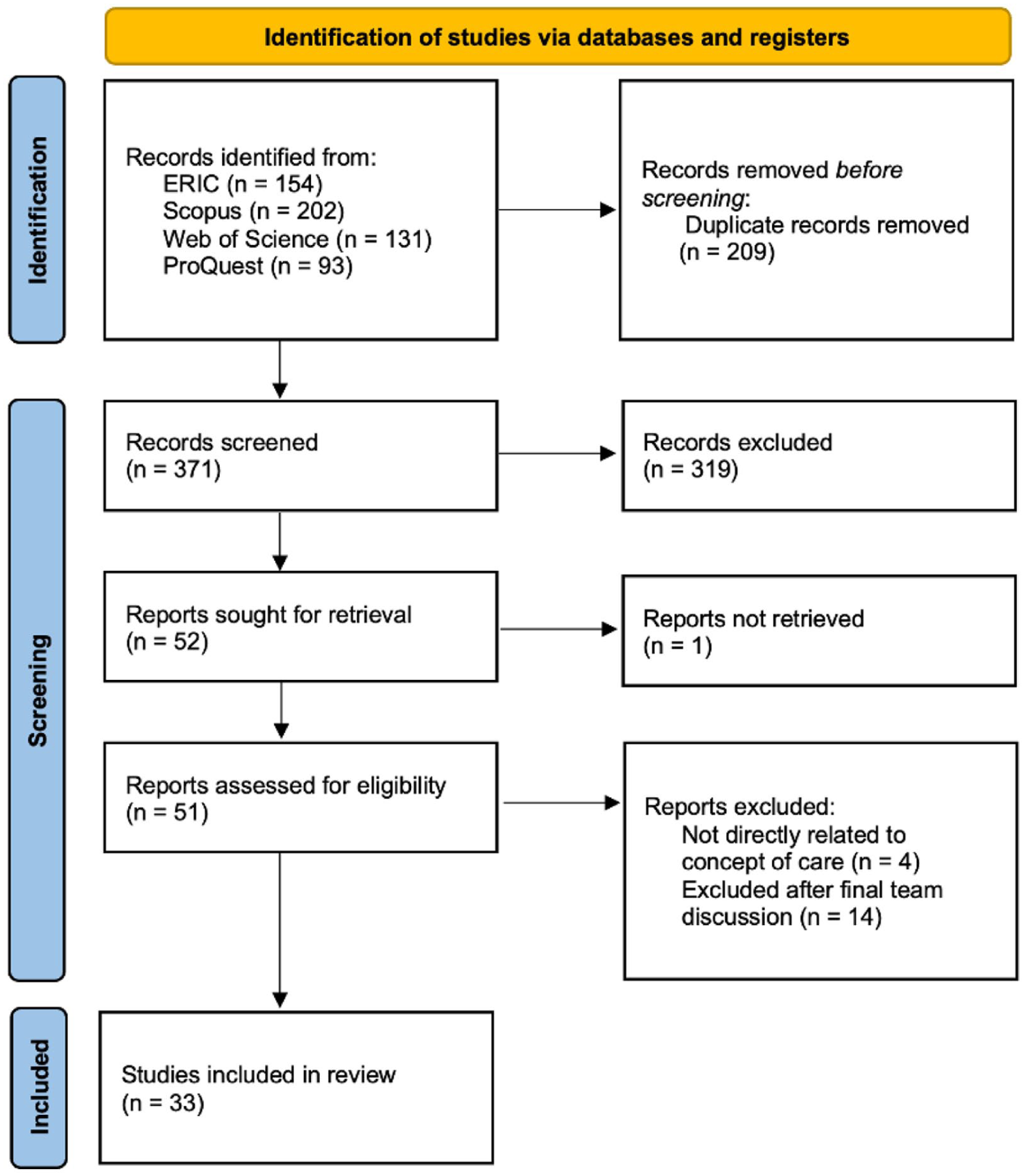
PRISMA flow diagram (Page et al., 2021).
Data Extraction and Analysis
Data extraction employed a standardised form based on Walker and Avant’s (2019) framework, capturing bibliographic information, theoretical frameworks, care definitions, contextual applications, attributed characteristics, antecedents, consequences, and empirical indicators. Three researchers with complementary expertise in music education pedagogy, care ethics, and systematic review methodologies collaborated on the concept analysis process. Initial coding was primarily conducted by the first author, with regular consensus meetings among all team members to review codes, discuss interpretive differences, and develop conceptual categories.
Multiple strategies ensured methodological rigour and transparency following established standards for systematic literature reviews (Page et al., 2021). Rayyan provided transparent documentation of screening decisions. Reviewers at each stage effectively mitigated individual bias through documented disagreement resolution mechanisms. The collaborative analysis process enhanced conceptual understanding through diverse perspectives, while detailed analytical memos documented all decision-making processes, ensuring analytical traceability.
Findings
The concept analysis of care in music education revealed three interconnected dimensions: antecedents that establish conditions for care, defining attributes that characterise caring practice, and consequences that emerge from enacting care (see Figure 2).
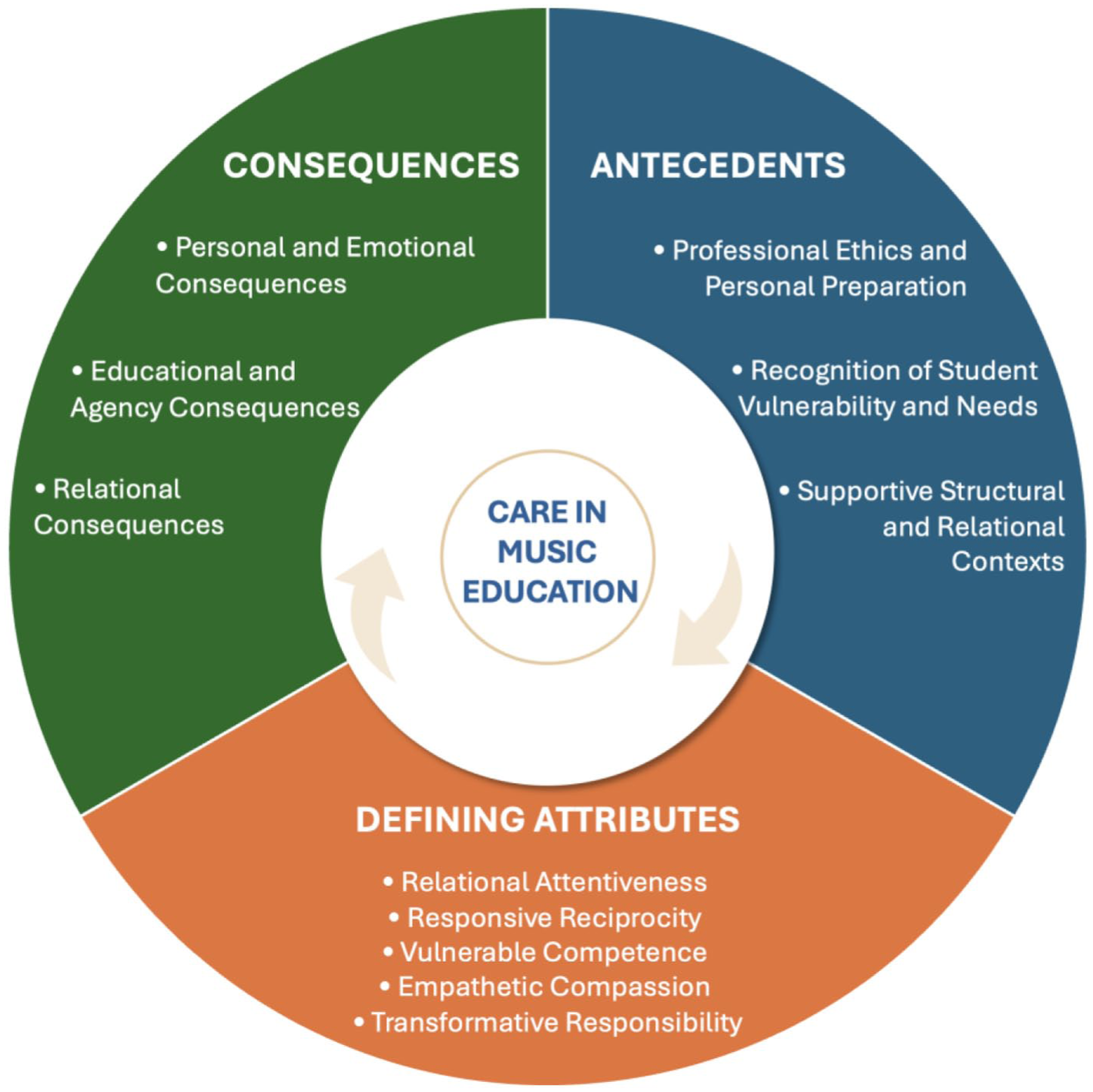
Conceptual model of care in music education based on Walker and Avant’s framework.
Defining Attributes
According to Walker and Avant (2019), defining attributes are the core characteristics most frequently associated with a concept and serve to differentiate it from other related concepts. Analysis of the literature reveals care in music education as comprising five interconnected attributes: Relational Attentiveness, Responsive Reciprocity, Vulnerable Competence, Empathetic Compassion, and Transformative Responsibility. While presented sequentially for analytical clarity, these attributes function interdependently in practice: attentiveness enables responsive action; responsiveness requires vulnerable competence; empathetic understanding motivates compassionate engagement; and compassion generates transformative responsibility within relational contexts.
Relational Attentiveness
The most foundational attribute of care is its relational nature, which is activated through conscious attentiveness. The literature establishes that relation is ontologically basic to human experience (Noddings, 2012), asserting that the “caring relation is ethically (morally) basic” (p. 771) to educational practice (Edgar, 2014). This relational foundation has been explicitly theorised within music education scholarship (Silverman, 2012; van der Schyff et al., 2016). This attribute moves beyond passive observation to an active, receptive listening to the expressed and unexpressed needs of students. It requires what Morelli (2022) terms an “earnest curiosity” (p. 328) that enables practitioners to question their own biases while openly discovering the characteristics of their context and participants. Such attentiveness involves what Hutton (2022) identifies as key elements of caring connections: awareness, empathy, and attention to individuals.
Responsive Reciprocity
This attribute captures the dynamic and practical characteristics of care in music education. It is the thoughtful action taken based on attentiveness, acknowledging the fundamental vulnerability present in musical learning (MacGregor, 2022). As Morelli (2022) argues, responsiveness requires educators to perceive students “on their own terms” (p. 330) rather than through predetermined expectations. This involves a reciprocal, dialogic engagement where students’ voices are heard, for example, in choosing repertoire (Edgar et al., 2023). This reciprocal engagement embodies what Pettersen (2012) distinguishes as “mature care” (p. 11). In contrast to unidirectional or paternalistic approaches, mature care is premised on mutual give-and-take between individuals of equal worth, transforming care from an altruistic gesture into a collaborative relational practice (Elliott, 2020; Geldenhuys & Morelli, 2022).
Vulnerable Competence
This attribute recognises that genuine care requires professional competence enacted through vulnerable engagement. Competence is framed not merely as musical expertise, but as the developed capacity to understand context, build trust, and navigate the inherent vulnerability of musical learning (Morelli, 2022). This capacity requires educators to acknowledge two forms of vulnerability simultaneously: students’ inherent “openness to being affected” (MacGregor, 2022, p. 36), and educators’ own vulnerability, which must be shared to establish trust and authentic connection (Bucura, 2022; Hendricks, 2023). Successfully addressing these dual vulnerabilities embodies what Van Manen (2015) conceptualises as “pedagogical tact” (p. 35): the improvisational sensitivity through which educators navigate the inherent unpredictability and relational complexity of teaching moments (Hogle, 2018). This tactfulness requires simultaneous awareness of context, accuracy in discerning students’ needs, and a willingness to remain vulnerable within the encounter.
Empathetic Compassion
This attribute bridges affective understanding and caring action through empathy and compassion. The literature consistently distinguishes empathy from sympathy, with empathy identified as fundamental to caring relationships in music education contexts (Hendricks, 2023; Hendricks et al., 2021; Taylor, 2018). This is then extended to compassion, which is the active response to support another based on this shared understanding (Edgar, 2014; Hendricks, 2023). Compassionate music teaching is characterised by qualities like trust, patience, inclusion, and authentic connection (Hendricks, 2018), creating warm and welcoming learning environments where students feel safe (Gee, 2024; Goodrich, 2023).
Transformative Responsibility
The final attribute encompasses the ethical obligation to facilitate positive change within individuals and society. This involves a “transformative view of care” (Morelli, 2022, p. 325) that aligns with the goal of community music to achieve social betterment (Silverman, 2012). This responsibility is action-oriented, compelling educators to move beyond intention and take accountability for the outcomes of their actions by challenging oppressive structures and actively disrupting practices that perpetuate inequality (Howard, 2022; Lee & Smith, 2023). This responsibility encompasses fostering “critical consciousness” (van der Schyff et al., 2016), enabling students to recognise and challenge injustice through musical practice. Ultimately, it empowers students to leverage their musical voices as tools for personal agency and collective social change.
Illustrative Cases: Model, Borderline, and Contrary
In accordance with Walker and Avant’s (2019) methodology, the following hypothetical cases are scenarios designed by the authors to illustrate whether the defining attributes of care are present, partially present, or absent in music education contexts.
Model Case: Demonstrating Integrated Care
A model case illustrates the strong presence and integration of all five attributes (Walker & Avant, 2019). In this scenario, Ms. Mary, a hypothetical educator, exmplifies this integration. Her Relational Attentiveness involves actively engaging students in conversations about their personal lives and emotional states, treating each person as an independent individual within a complex network of interpersonal relationships. Her Responsive Reciprocity manifests through thoughtfully adapting repertoire, rehearsal strategies, and grading based on student input and observed engagement, creating collaborative learning experiences. She models Vulnerable Competence by openly acknowledging teaching challenges and musical mistakes, such as admitting, “I am not right all of the time” (Hutton, 2022, p. 44), which builds trust while making it safe for students to take risks. Her Empathetic Compassion emerges through authentic relationships where she feels with students as equals rather than from pity, setting aside ego to reflect rather than react punitively. Finally, her Transformative Responsibility challenges conventional hierarchical norms by promoting inclusion, valuing diverse musical backgrounds, and viewing her role as contributing to the human flourishing of students and to a “life in service of something larger than the self” (Elliott, 2020, p. 111).
Borderline Case: Illustrating Partial or Incomplete Care
A borderline case highlights how good intentions are insufficient when key attributes are weak or absent (Walker & Avant, 2019). Mr. David demonstrates partial care with significant limitations. His Relational Attentiveness focuses primarily on musical correctness rather than holistic student needs, bordering on benign neglect. While highly competent in producing technically proficient students, his Vulnerable Competence is limited because he maintains unwavering expertise, reinforcing hierarchical “maestro” dynamics (Hendricks & McPherson, 2023, p. 416) that discourage student vulnerability. His Responsive Reciprocity exists for technical adjustments but lacks the depth of reciprocal partnership, feeling like one-way knowledge transfer. His Empathetic Compassion remains a detached concern for musical outcomes rather than a “shared human experience” (Hendricks, 2018, p. 5), potentially focusing on student “deficits” (Churchill & Hall, 2023, p. 551). His Transformative Responsibility is confined to producing excellent musicians within established traditions without challenging power structures or inequalities, making his good intentions potentially “uncaring” in practice (Morelli, 2022, p. 324).
Contrary Case: Illustrating the Absence of Care
A contrary case refers to instances where defining attributes of care are clearly absent in music education (Walker & Avant, 2019). Mrs. Susan exhibits a complete lack of Relational Attentiveness. She views students as passive information vessels, adhering strictly to a predetermined curriculum without listening to individual needs or emotional states. Responsive Reciprocity is non-existent; she blames students for struggles rather than adapting methods, operating within a strict hierarchy where students receive but cannot respond. While musically competent, her lack of vulnerable openness creates an oppressive atmosphere where she presents as infallible, stifling student agency and authentic expression. Empathetic Compassion is absent as she displays judgment rather than understanding, adopting deficit views that position students as objects of remediation rather than resourceful agents, failing to recognise their cultural assets and capabilities (Churchill & Hall, 2023). Her approach undermines Transformative Responsibility by reinforcing power imbalances through “standardised practices” without ethical consideration, resulting in “exclusion, disengagement, and frustration” (MacGregor, 2022, p. 30) in fundamentally uncaring spaces (Morelli, 2022).
Antecedents: Enabling Conditions for Care in Music Education
Antecedents are the conditions that must be in place for the concept to occur (Walker & Avant, 2019). The analysis indicates that care in music education requires three interconnected categories of enabling conditions that function cyclically to create and sustain caring relationships: (1) professional ethics and personal preparation; (2) recognition of student vulnerability and needs; and (3) supportive structural and relational contexts.
Professional Ethics and Personal Preparation
Music educators should cultivate specific internal dispositions. Foundational responsibility encompasses both addressing social justice (Morelli, 2022) and forstering holistic student well-being (Silverman, 2012, 2020). This manifests through mindful presence, defined as physical and emotional availability that deepens towards full engagement with the expressed and unexpressed needs of students (Hendricks et al., 2023).
In addition, critical prerequisites include epistemic humility, which involves resisting assumptions about student needs while maintaining openness to multiple perspectives, and self-awareness of personal identity, biases, and emotional vocabulary (Edgar et al., 2023; Hendricks, 2023). Equally essential are educator self-care and emotional regulation, recognising that caring for others requires attending to one’s own well-being and developing trauma-informed competencies (Walzer, 2021).
Recognition of Student Vulnerability and Needs
Educators are required to recognise student vulnerability as inherent to musical experience. Performance, creative expression, and identity exploration create inherent openness that, when met with care, transforms potential vulnerability into opportunities for connection (MacGregor, 2022). This requires moving beyond assumptions towards active listening and observation of students’ actual experiences, particularly their desires for identity affirmation, belonging, and agency (Edgar et al., 2023). As Noddings (2013) emphasises, care must be grounded in understanding the “natures, ways of life, needs, and desires” (p. 14) of students rather than imposing predetermined educational outcomes. Such understanding necessarily includes recognition of community cultural wealth, which Tsui et al. (2023) describe as the diverse strengths, knowledge systems, and resources students bring from their cultural backgrounds, challenging deficit-based assumptions about student needs.
Supportive Structural and Relational Contexts
Institutional support requires organisations to actively value care through systems reflexivity, defined as the dialectical interplay between thought and action enabling institutions to “see, interrogate, and reimagine taken-for-granted structures” (López-Íñiguez & Westerlund, 2023, p. 125). Trust and psychological safety create relational foundations through seven facets: “vulnerability, confidence, benevolence, reliability, competence, honesty, and openness” (Hendricks et al., 2023, p. 14). These elements establish “brave spaces” for meaningful risk-taking (Goodrich, 2023, p. 284). Furthermore, democratic structures replace hierarchical transmission models with collaborative meaning-making (van der Schyff et al., 2016). Relational continuity provides temporal foundations for sustained caring relationships (Hendricks, 2018).
Consequences: Outcomes of Caring Practices
Care in music education yields meaningful outcomes that reshape emotional experiences, pedagogical practices, and relational dynamics. These outcomes manifest across three interconnected domains that demonstrate the holistic impact of caring approaches.
Personal and Emotional Consequences
Caring pedagogical practices profoundly influence the emotional well-being and personal growth of students, fostering what the literature describes as human flourishing (Elliott, 2020; Silverman, 2012, 2020). By prioritising healing and self-care, this approach helps students develop essential life skills such as empathy for others and resilience (Hutton, 2022; Lee & Smith, 2023). Caring environments create psychologically safe spaces where students’ emotional needs are met, which is particularly crucial for healing from relational trauma (Humphrey, 2022). Furthermore, care transforms the inherent vulnerability of musical performance from a potential source of anxiety into an opportunity for growth, enhancing students’ personal fulfilment, self-esteem, and identity development (MacGregor, 2022). These emotional outcomes position music education as a practice that nurtures and amplifies students’ whole personhood.
Educational and Agency Consequences
The integration of care fundamentally reshapes teaching and learning practices, leading to distinct pedagogical shifts. It prompts a move away from traditional, teacher-centred models towards more individualised and supportive learning environments where teachers engage with rather than lecture at their students (Fletcher et al., 2024). This is manifested in pedagogical strategies that emphasise student choice, democratic interactions, and learner-centred instruction (Hutton, 2022). A caring approach also influences curriculum design, demanding that teacher education programmes help preservice teachers view classrooms as sites of caring connection and infuse concepts of mature care into their practice (Geldenhuys & Morelli, 2022). This focus on ethical professionalism encourages educators to re-evaluate their roles as agents who must address social and cultural responsibilities, leading to a collective sense of mission and musical engagement (Hendricks, 2018, 2023), which in turn inspires students’ virtues (Edgar, 2014; Silverman, 2012).
Relational Consequences
The most significant consequences of care emerge in the relational domain, strengthening connections at every level. At its core, care builds authentic connections between teachers and students, grounded in empathy and trust (Hendricks, 2018, 2023). This fosters reciprocal engagement where teachers and students can both be the “one-caring” and the “cared-for” (Noddings, 2013, pp. 4, 28), leading to a “symmetrical and reciprocal trust” that is correlated with high levels of achievement (Hogle, 2018, p. 17). These strong interpersonal bonds aggregate to cultivate a broader sense of community and belonging within the classroom or musical ensemble. This caring community, in turn, promotes greater social awareness, helping to heighten racial tolerance and develop a sense of compassion towards all peoples and their music, thereby challenging inequitable social structures (Howard, 2022; Lee & Smith, 2023). These relational outcomes culminate in eudaimonia, which represents human flourishing through meaningful musical engagement. This extends beyond individual benefits to create systemic transformation in how music education nurtures whole personhood, community connection, and social change, positioning care as a fundamental reimagining of music education’s purpose and potential (Hendricks, 2023; Holdhus, 2023).
Empirical Referents
Empirical referents are the observable indicators that provide evidence of a concept and demonstrate how it can be measured (Walker & Avant, 2019). The analysis in this study indicates that “care in music education” is not measured by any single, standardised instrument. Instead, the literature relies on a multi-method approach that combines qualitative inquiry into lived experiences with direct observation of pedagogical practices.
While some studies employ quantitative tools, such as an adapted version of the Griffith Empathy Measure for children or musical values surveys to assess dispositions related to care (Hendricks et al., 2021), the predominant “instruments” are qualitative. The most frequently cited methods for observing care are semi-structured interviews with teachers, students, and parents; lesson and rehearsal observations; and the analysis of teacher reflective journals and other artefacts (Fletcher et al., 2024; Hogle, 2018; Humphrey, 2022; Hutton, 2022; Parker, 2016).
Specific methodologies, such as Interpretative Phenomenological Analysis (Fletcher et al., 2024; Southcott, 2009) and duoethnography (Lee & Smith, 2023) are also used to explore the nuanced, subjective experiences of caring. Additionally, autoethnography is highlighted as a method for exploring deep personal experiences, emotions, and topics that resist systematic analysis in traditional research (Gouzouasis & Ryu, 2015). Ultimately, the literature suggests that a comprehensive understanding of care requires this holistic approach, as no single tool adequately captures the complexity of its defining attributes in practice.
Discussion
Conceptual Contributions to Music Education Theory
This concept analysis provides definitional clarity for care in music education, establishing it as a sophisticated practice requiring specific professional competencies, institutional support, and ethical commitments rather than simple intuitive teaching behaviours. While existing scholarship has explored care across various music education contexts, this framework offers a systematic theoretical synthesis to identify coherent patterns across this diverse literature.
This framework demonstrates how each core attribute incorporates existing theoretical foundations within music education contexts. Relational Attentiveness integtates Noddings’ (2012) receptive attention with active listening for students’ expressed and unexpressed needs in musical learning environments. Responsive Reciprocity moves beyond traditional hierarchical teacher-student relationships, evolving towards what Pettersen (2012) describes as mature care that requires educators to adapt teaching methods through genuine dialogue with students (Hutton, 2022). Vulnerable Competence addresses a unique paradox in music education: educators must demonstrate professional expertise while remaining personally open to being affected by students’ experiences, engaging with the inherent vulnerability of musical learning (MacGregor, 2022). Empathetic Compassion transforms emotional understanding (Hendricks, 2018) into supportive action within musical learning contexts, while acknowledging the complexities and potential pitfalls of empathy in educational relationships (Hendricks & Hess, 2024). Transformative Responsibility positions social justice as inherent to caring practice, aligning with the argument that care constitutes political action rather than merely responding to individual needs (Morelli, 2022).
Integration with Existing Literature on Ethics of Care
The findings extend the diverse perspectives presented in The Oxford Handbook of Care in Music Education edited by Hendricks (2023). While the handbook intentionally prioritises contextual variety to honour the individualised nature of care, this concept analysis complements that contextual richness. By offering a systematic theoretical synthesis, this study identifies common patterns comprising defining attributes, antecedents, and consequences that operate across diverse music education contexts.
This framework also engages with the critical analysis of (un)caring practices by Morelli (2022), which demonstrates that caring and uncaring actions can coexist through (un)attentiveness, (un)responsiveness, and (in)competence. The five attributes identified here extend Morelli’s critical insights from community music contexts to formal educational settings, while maintaining her emphasis that care constitutes a political rather than neutral practice.
The framework integrates foundational care ethics theory with music education complexities. Building on Noddings’ (1984, 2013, 2015) foundational work on the caring relation and justice, and Tronto’s (1993) political framework of care phases, this analysis reveals attributes that function simultaneously within musical learning contexts. This provides theoretical grounding specifically designed for music education rather than adapted from general educational models.
Care in Diverse Musical Learning Contexts
Understanding care in music education requires attention to how these five attributes might manifest across diverse institutional contexts. In primary and secondary music classes, Relational Attentiveness could involve actively listening to students’ expressed and unexpressed needs over multiple years of instruction, fostering exploration of individual contexts and backgrounds. Responsive Reciprocity might emerge through adapting repertoire and teaching strategies based on student input, creating dialogic spaces where students’ voices are genuinely heard. In higher education and conservatory settings, Vulnerable Competence could require teachers to share their own vulnerability, to demonstrate musical risk-taking while maintaining professional authority in performance instruction, and to exercise pedagogical tact to build trust and authentic connection. Empathetic Compassion might translate into creating warm and welcoming environments characterised by patience and inclusion, where emerging artists feel safe to take musical risks. In community music programmes, Transformative Responsibility could be demonstrated by challenging oppressive structures and fostering critical consciousness, as exemplified in embodied music and dance-music practices grounded in Ubuntu philosophy, which activates social well-being through collective artistic interactions that facilitate the transformation of participants (Kibirige, 2024). Across all contexts, these attributes function interdependently, with their specific expression shaped by the unique relational dynamics of each setting.
Implications for Music Teacher Education and Practice
This conceptual framework provides practical guidance for music teacher education by establishing specific competencies that caring practitioners require. Rather than assuming care emerges naturally from good intentions, the five attributes suggest that teacher preparation programmes need systematic attention to developing relational skills, professional vulnerability, and ethical awareness. The identification of three antecedent categories indicates that preparing caring educators requires attention to personal readiness, institutional support structures, and democratic pedagogical approaches rather than focusing solely on individual dispositions.
For practising educators, this framework also offers concrete strategies for implementing caring practices. The analysis suggests that caring pedagogy requires specific actions such as implementing democratic interactions that foster student choice and voice (Hutton, 2022), creating inclusive classroom communities where students feel safe and valued (Gee, 2024), and adapting approaches to diverse contexts from virtual learning environments (Bucura, 2022) to specialised populations. Significantly, these caring practices align with contemporary curriculum priorities. For example, the music curriculum standards in Norway emphasise the unique ability of music to foster health and life skills, including building interpersonal relationships, promoting emotional understanding, and contributing to the formation of a positive self-image and mental health (Norwegian Directorate for Education and Training, 2020).
Limitations and Future Research
This conceptual analysis has some limitations that need to be acknowledged. First, the systematic search was restricted to English-language publications, potentially excluding valuable perspectives from non-Western educational contexts and limiting cultural generalisability. Second, the analysis relied exclusively on published literature, potentially missing important practitioner knowledge and lived experiences that have not been formally documented in academic sources. Third, while Walker and Avant’s framework provides systematic structure, it may impose artificial boundaries on a concept that operates fluidly across contexts. The five attributes are deeply interconnected rather than discrete categories, suggesting that linear categorisation may not fully capture the contextual, dynamic, and relationally situated nature of pedagogical concepts.
These limitations illuminate several critical areas for future research. Most of the existing literature originates from Western contexts; studies exploring how care manifests in diverse cultural settings could challenge assumptions about universal caring practices. Research exploring care in emerging contexts, such as online music learning platforms or intergenerational music programmes, would expand the understanding of how caring practices adapt to different institutional structures and cultural frameworks. Qualitative studies using ethnographic, phenomenological, or participatory approaches could examine how the five attributes operate in practice across different musical traditions and cultural contexts, providing insights into the lived experiences of caring pedagogy. Additionally, longitudinal studies examining how caring relationships develop and evolve in specific music education settings would reveal the temporal dimensions of pedagogical care.
Conclusion
This study demonstrates that care in music education can be systematically understood through five interconnected attributes: Relational Attentiveness, Responsive Reciprocity, Vulnerable Competence, Empathetic Compassion, and Transformative Responsibility. Employing Walker and Avant’s (2019) concept analysis methodology, this research establishes care as a coherent theoretical construct with clear defining attributes, antecedents, and consequences.
The framework reveals care as fundamentally relational and political, requiring both professional expertise and personal openness within supportive institutional contexts. While these five attributes provide theoretical coherence, their manifestation varies across diverse cultural contexts and pedagogical settings. Rather than depending on individual teacher dispositions, caring practice emerges through the dynamic interaction of educator preparation, democratic structures, and organisational commitment to equity and well-being.
These findings contribute to the field of music education, providing the necessary theoretical precision for systematic research, professional development, and institutional planning while respecting the contextual specificity that caring practice requires. The conceptual clarity achieved through this analysis offers practitioners and researchers a systematic framework for examining, developing, and evaluating caring practices across diverse music education contexts.
Footnotes
Appendix 1: Complete Search Strategy
Appendix 2. Complete List of Publications Identified in Database Search ( N = 33)
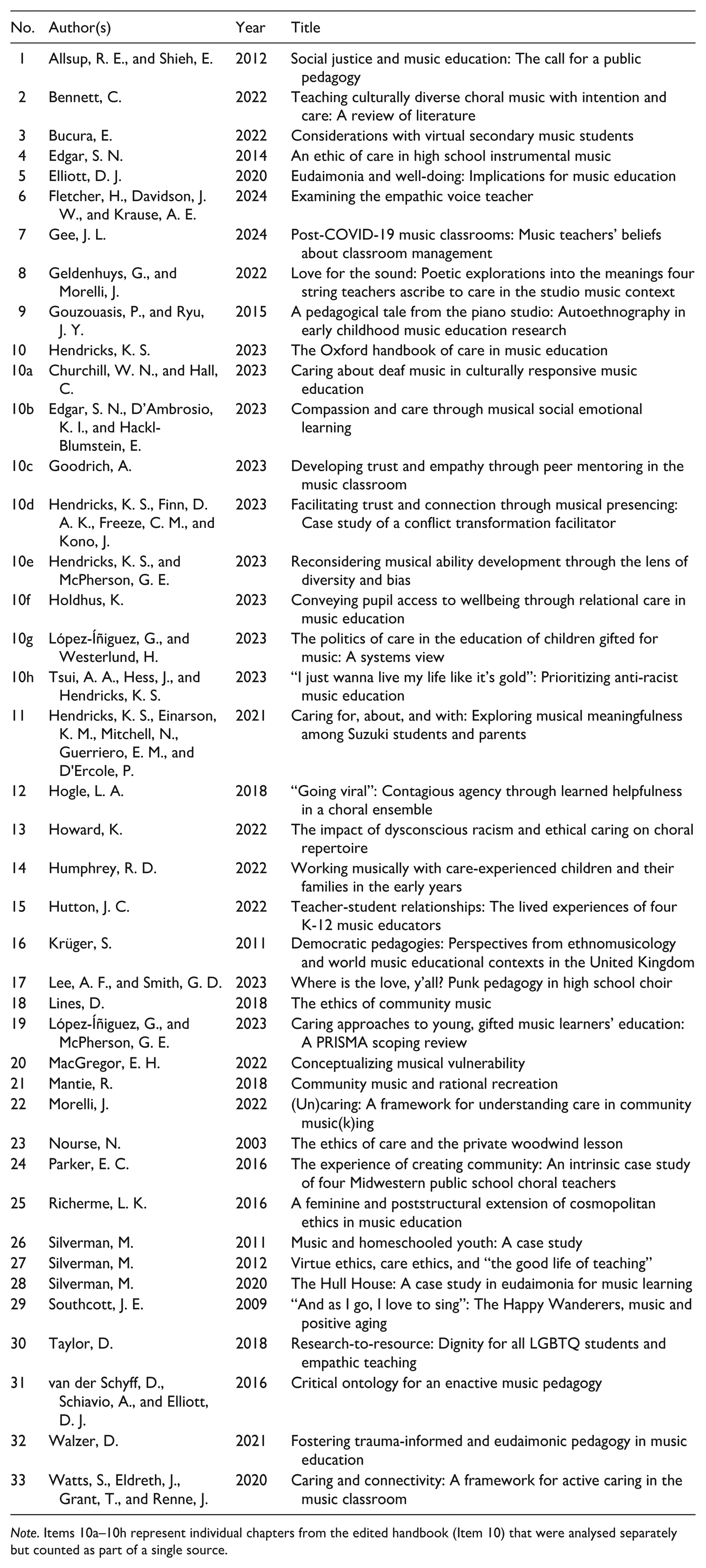
| No. | Author(s) | Year | Title |
|---|---|---|---|
| 1 | Allsup, R. E., and Shieh, E. | 2012 | Social justice and music education: The call for a public pedagogy |
| 2 | Bennett, C. | 2022 | Teaching culturally diverse choral music with intention and care: A review of literature |
| 3 | Bucura, E. | 2022 | Considerations with virtual secondary music students |
| 4 | Edgar, S. N. | 2014 | An ethic of care in high school instrumental music |
| 5 | Elliott, D. J. | 2020 | Eudaimonia and well-doing: Implications for music education |
| 6 | Fletcher, H., Davidson, J. W., and Krause, A. E. | 2024 | Examining the empathic voice teacher |
| 7 | Gee, J. L. | 2024 | Post-COVID-19 music classrooms: Music teachers’ beliefs about classroom management |
| 8 | Geldenhuys, G., and Morelli, J. | 2022 | Love for the sound: Poetic explorations into the meanings four string teachers ascribe to care in the studio music context |
| 9 | Gouzouasis, P., and Ryu, J. Y. | 2015 | A pedagogical tale from the piano studio: Autoethnography in early childhood music education research |
| 10 | Hendricks, K. S. | 2023 | The Oxford handbook of care in music education |
| 10a | Churchill, W. N., and Hall, C. | 2023 | Caring about deaf music in culturally responsive music education |
| 10b | Edgar, S. N., D’Ambrosio, K. I., and Hackl-Blumstein, E. | 2023 | Compassion and care through musical social emotional learning |
| 10c | Goodrich, A. | 2023 | Developing trust and empathy through peer mentoring in the music classroom |
| 10d | Hendricks, K. S., Finn, D. A. K., Freeze, C. M., and Kono, J. | 2023 | Facilitating trust and connection through musical presencing: Case study of a conflict transformation facilitator |
| 10e | Hendricks, K. S., and McPherson, G. E. | 2023 | Reconsidering musical ability development through the lens of diversity and bias |
| 10f | Holdhus, K. | 2023 | Conveying pupil access to wellbeing through relational care in music education |
| 10g | López-Íñiguez, G., and Westerlund, H. | 2023 | The politics of care in the education of children gifted for music: A systems view |
| 10h | Tsui, A. A., Hess, J., and Hendricks, K. S. | 2023 | “I just wanna live my life like it’s gold”: Prioritizing anti-racist music education |
| 11 | Hendricks, K. S., Einarson, K. M., Mitchell, N., Guerriero, E. M., and D'Ercole, P. | 2021 | Caring for, about, and with: Exploring musical meaningfulness among Suzuki students and parents |
| 12 | Hogle, L. A. | 2018 | “Going viral”: Contagious agency through learned helpfulness in a choral ensemble |
| 13 | Howard, K. | 2022 | The impact of dysconscious racism and ethical caring on choral repertoire |
| 14 | Humphrey, R. D. | 2022 | Working musically with care-experienced children and their families in the early years |
| 15 | Hutton, J. C. | 2022 | Teacher-student relationships: The lived experiences of four K-12 music educators |
| 16 | Krüger, S. | 2011 | Democratic pedagogies: Perspectives from ethnomusicology and world music educational contexts in the United Kingdom |
| 17 | Lee, A. F., and Smith, G. D. | 2023 | Where is the love, y’all? Punk pedagogy in high school choir |
| 18 | Lines, D. | 2018 | The ethics of community music |
| 19 | López-Íñiguez, G., and McPherson, G. E. | 2023 | Caring approaches to young, gifted music learners’ education: A PRISMA scoping review |
| 20 | MacGregor, E. H. | 2022 | Conceptualizing musical vulnerability |
| 21 | Mantie, R. | 2018 | Community music and rational recreation |
| 22 | Morelli, J. | 2022 | (Un)caring: A framework for understanding care in community music(k)ing |
| 23 | Nourse, N. | 2003 | The ethics of care and the private woodwind lesson |
| 24 | Parker, E. C. | 2016 | The experience of creating community: An intrinsic case study of four Midwestern public school choral teachers |
| 25 | Richerme, L. K. | 2016 | A feminine and poststructural extension of cosmopolitan ethics in music education |
| 26 | Silverman, M. | 2011 | Music and homeschooled youth: A case study |
| 27 | Silverman, M. | 2012 | Virtue ethics, care ethics, and “the good life of teaching” |
| 28 | Silverman, M. | 2020 | The Hull House: A case study in eudaimonia for music learning |
| 29 | Southcott, J. E. | 2009 | “And as I go, I love to sing”: The Happy Wanderers, music and positive aging |
| 30 | Taylor, D. | 2018 | Research-to-resource: Dignity for all LGBTQ students and empathic teaching |
| 31 | van der Schyff, D., Schiavio, A., and Elliott, D. J. | 2016 | Critical ontology for an enactive music pedagogy |
| 32 | Walzer, D. | 2021 | Fostering trauma-informed and eudaimonic pedagogy in music education |
| 33 | Watts, S., Eldreth, J., Grant, T., and Renne, J. | 2020 | Caring and connectivity: A framework for active caring in the music classroom |
Note. Items 10a–10h represent individual chapters from the edited handbook (Item 10) that were analysed separately but counted as part of a single source.

Author Contributions
Funding
The authors received no financial support for the research, authorship, and/or publication of this article.
Declaration of Conflicting Interests
The authors declared no potential conflicts of interest with respect to the research, authorship, and/or publication of this article.