



Abstract
The UK conservatoire sector remains heavily oversubscribed with privately educated and socioeconomically advantaged students. This study examines the lived experiences of state-schooled students navigating pathways to music conservatoires, framed by Bourdieu’s concepts of habitus, capital and field. Through qualitative interviews with 21 alumni from state school backgrounds, this study examines how the middle-class norms and values embedded in classical music education perpetuate exclusionary practices. Despite financial precarity, imposter syndrome and systemic biases, participants in this study demonstrate resilience and adaptive agency. By amplifying marginalised voices, the research critiques the conservatoire talent pipeline, exposing the symbolic violence embedded in institutional structures. It argues that ‘elite but not elitist’ rhetoric masks deep rooted hierarchies and calls for transformative reforms across the sector. In doing so, the study generates valuable new insights into cultural reproduction, specifically for those pursuing classical music training and makes a significant contribution to conservatoire research.
Introduction
The UK’s nine major music conservatoires occupy a vital position in higher education (HE) as specialist institutions for training the next generation of classical musicians. These conservatoires cultivate internationally renowned performers and shape pedagogical frameworks within advanced classical music training (Bull, 2019; Perkins, 2013), while functioning as gatekeepers to professional opportunities in the classical music sector (Presland, 2005).
Globally diverse, UK conservatoires attract approximately 1,300 international students annually, with total enrolments around 8,400 (HESA, 2022). In general, studying music at a conservatoire differs from studying music at a university (see e.g. Comunian et al., 2014; Ford, 2010). Not only must students possess high levels of practical ability on their instrument but also the length of the programme, along with the intense vocational nature of the conservatoire curriculum, is what sets these institutions apart from their university counterparts.
Access and Participation in UK Music Conservatoires
Conservatoires take a distinctive approach and position themselves outside the mainstream university model. However, data show that UK conservatoires remain exclusionary. Undergraduate admissions hinge on oversubscribed, audition-centric processes that naturalise structural inequities under neoliberal meritocratic ideals (Burt-Perkins & Mills, 2009; Davies, 2004; Kingsbury, 2001; Lawson et al., 2025; Smith, 2021). Applicants from more socioeconomically advantaged backgrounds disproportionately benefit from early access to preparatory training, instruments and cultural capital (Davies, 2004). Data from the Universities and Colleges Admissions Service (UCAS) show that students from advantaged backgrounds are around six times more likely to gain entry to conservatoires than their disadvantaged peers (UCAS Conservatoires, 2015). This disparity is reflected in admissions policies that often assume prior access to extensive musical training. For example, the Royal College of Music’s Access and Participation Plan (APP) identifies ABRSM Grade 8 Distinction as a typical entry benchmark, a level that is frequently inaccessible to state-school students, particularly in the context of declining music education provision in schools (Bath et al., 2020; Kingsbury, 2001; Royal College of Music [RCM], 2019). As a result, institutions such as the Royal College of Music and the Royal Academy of Music (RAM) admit fewer state-school students than even the Universities of Oxford and Cambridge (HESA, 2022), reinforcing a progression pipeline that continues to favour those from privately educated backgrounds (Bates, 2021).
State-school students, those from low socioeconomic backgrounds, and Black students remain starkly underrepresented in conservatoires (HESA, 2022; UCAS Conservatoires, 2024). POLAR4 data show how Quintile 5 (this being those from the most advantaged backgrounds) applicants dominate acceptances, while Quintiles 1 to 2 (most disadvantaged) stagnate below 15% of total admissions (UCAS Conservatoires, 2024). This is further reflected in data showing that four of the longest-standing UK conservatoires (Royal Academy of Music, Royal College of Music, Royal Northern College of Music and Royal Conservatoire of Scotland), consistently fall short of state-school recruitment benchmarks (HESA, 2022). For example, in 2018/2019, the Royal College of Music admitted just 39.7% state-school students against a benchmark of 89.6% (HESA, 2022).
Exploring Access Through Bourdieu’s Framework
This study explores the lived experiences of state-school students navigating the pathways to and through conservatoire admissions, critically examining the barriers they face through Bourdieu’s (1972, 1984) concepts of habitus, capital, and field (Moore, 2012). Bourdieusian analysis reveals how institutional norms privilege those possessing pre-existing cultural capital, thereby embedding class hierarchies and (re)producing social codes (Hart, 2019; Reay et al., 2009; Stahl et al., 2017; R. Wright, 2015). While there is a substantial body of research examining teaching and learning within conservatoires (Burt-Perkins & Mills, 2009; Gaunt et al., 2012; Miller & Baker, 2007; Mills, 2004, 2005; Perkins, 2013; Presland, 2005; Renshaw, 1986; Rumiantsev et al., 2020), comparatively little attention has been given to the experiences of students who remain marginalised within these spaces (Moore, 2012).
By tracing their trajectories, from aspirational beginnings through to reflections following auditions, the research illuminates the structural and symbolic barriers faced by these young people and their families, alongside the agentic strategies they employ. Central to this analysis is the interplay of cultural, economic, and social capital that shapes their pathways. This exploration not only amplifies the voices of those marginalised within UK Higher Music Education (HME) but also reveals the mechanisms through which structural inequities, endemic to elite arts training, are (re)produced, resisted, and renegotiated. It is also worth noting that the UK’s class system has deep historical roots, with persistent educational inequalities linked to social background and opportunities across schooling and into HE (Themelis, 2013). Research shows that social class continues to shape educational attainment and progression in Britain, with working-class students facing structural constraints that are (re)produced through institutions, policy, and intergenerational disadvantage (Holt-White et al., 2024; Thompson, 2018). In exploring these issues, the study seeks to understand the lived experiences of state-school students on their journeys to UK music conservatoires, and to examine the extent to which economic, social, and cultural capital influence these experiences.
Classical Music as a Mechanism of Cultural Legitimacy
Bourdieu’s (1984) assertion that ‘nothing more clearly affirms one’s ‘class’ than tastes in music’ (p. 18) remains foundational to critiques of classical music’s role in legitimising social hierarchies. While scholarship has extensively analysed the structural inequities embedded in classical music education (Bull, 2019; Scharff, 2018; R. Wright, 2015), less attention has been paid to the lived experiences of state-schooled students negotiating these competitive, merit-based institutional pathways. Bourdieu’s (1984) conceptualisation of classical music as ‘legitimate culture’ (p. 18) highlights its dual role as an artistic tradition and a tool of social stratification. Works like Bach’s Well Tempered Clavier, Bourdieu (1984) argues, exemplify the bourgeois demand for art that transcends social concerns, masking its complicity in reinforcing class distinctions under the guise of aesthetic autonomy (Bourdieu, 1984). In other words, Bach’s Well-Tempered Clavier may seem like just music, but it plays a part in maintaining class divisions by disguising its social function as purely artistic (Bourdieu, 1984). Building on this, Prior (2013) notes that this idea of artistic autonomy enables institutions to avoid criticism of inequality by presenting exclusion as simply the result of talent, rather than as a consequence of institutional bias. Johnson (2002) builds on this by describing classical music as a means of cultural snobbery, while Bennett et al. (2009) emphasise its role as a networking tool for elites, maintaining what they call ‘ghostly memories of legitimate cultural capital’ (Bennett et al., 2009, p. 75).
The association of classical music with whiteness and middle-class identity further entrenches the art forms exclusivity. Bull (2019) and Coulangeon (2005) show that conservatoires and concert halls continue to be dominated by socioeconomically privileged groups, with institutional practices, like audition repertoires focused on the Eurocentric canon, marginalising students from state schools and minority backgrounds. Getz (2015) adds that classical music’s reputation as ‘stuffy’ or inaccessible reinforces these dynamics, deterring participation from those lacking familial or educational exposure to the art form.
Habitus, Capital and Field: A Framework for Exclusion
In this study, Bourdieu’s (1984, 1986, 1993) tripartite model of habitus, capital, and field provides a structural lens to dissect how conservatoires naturalise inequality. Firstly Habitus, defined as the ‘embodied dispositions’ shaped by early socialisation (Bourdieu, 1984), determines individuals’ fluency within institutional fields. Students who have been exposed to high quality music education and experience with formal music education may enter conservatoires with a habitus attuned to unspoken norms, knowledge of audition protocols, familiarity with canonical repertoire, and comfort in formal performance settings. This alignment between habitus and field may render their success as seemingly effortless, obscuring the advantages conferred by preparatory training (Bourdieu, 1984). Conversely, students with little or no prior exposure to this world might encounter dissonance, with their habitus misaligning with the conservatoire’s tacit codes. Put more simply, habitus is the set of habits, knowledge, and ways of behaving shaped by early experiences that help some students navigate the world of conservatoires and classical music more smoothly than others. King (2000) frames habitus as the link between structure and agency, raising important questions: To what extent can students from non-traditional or unfamiliar backgrounds truly adapt to fields that are structurally shaped to exclude them? Moreover, how do institutions like conservatoires, through their own institutional habitus, continuously position these students as outsiders?
Secondly, we have Capital, which in Bourdieu’s (1986) terms, encompasses the economic, cultural and social resources that determine positional advantage. In music education, economic capital enables access to private tuition, high-quality instruments, and extracurricular opportunities, resources which are disproportionately available to privately educated students (Burnard et al., 2015). Cultural capital, as Bourdieu (1986) theorises, comprises the embodied knowledge, skills, and dispositions that confer social advantage within specific fields, such as familiarity with institutional norms, conservatoire audition protocols, canonical repertoire expectations and performative codes of legitimate musicianship. These forms of cultural capital are often transmitted intergenerationally, with middle-class families providing early exposure to musical training, concert attendance and mentorship (Bourdieu, 1984). For instance, a student raised in a household accustomed to classical music may navigate audition requirements more easily, selecting appropriate repertoire and adopting stylised performance practices, while those without such exposure face symbolic barriers. This extends to subtle behaviours, such as how they respond to the conservatoire environment, their posture, or modes of speech. In this way, conservatoires may celebrate cultural capital accrued through middle-class culture, naturalising inequality under the guise of artistic excellence. Perkins (2013) highlights how hierarchies within conservatoires reflect these disparities, with faculty and peers perceiving students with the ‘right’ habitus as more ‘naturally’ talented.
Social capital, by contrast, refers to the resources and advantages derived from networks and relationships, particularly those linking conservatoires to professional orchestras, competitions, and educators. Bull (2019) documents how middle-class students leverage familial connections to secure mentorship and career opportunities, resources largely inaccessible to students from disadvantaged state-school backgrounds. This distinction helps clarify that cultural capital relates to what students know and can do, whereas social capital concerns who they know and the networks they can access. It is important to recognise that structural inequalities also shape attainment of institutional benchmarks, such as ABRSM Grade 8 distinctions. Students from working-class backgrounds frequently have reduced access to lessons, instruments and sustained private tuition, factors that may constrain their likelihood of achieving a Distinction. Additionally, it is plausible that the most experienced or highly sought-after private teachers command higher fees, rendering their instruction less accessible to lower-income families. Differential access to high-quality teaching may therefore represent a further mechanism through which existing disparities in musical achievement are (re)produced. Taken together, these considerations could suggest that differences in attainment should be understood within a broader context of unequal access to resources and instruction. From this perspective, variation in outcomes is not a reflection of student ambition or ability, but of material and social constraints, highlighting how conservatoires’ ostensibly-meritocratic criteria can inadvertently reinforce existing inequalities rather than suggesting that such requirements should be removed.
Finally, we have the field of classical music education, with what Bourdieu (1993) refers to as the ‘space of competition’ (Bourdieu, 1993) and one which operates as a microcosm of broader power struggles. Conservatoires and the field of classical music, as institutional fields, privilege individuals who embody the ‘right’ combination of habitus and capital, while marginalising others through symbolic violence (Bourdieu & Wacquant, 2002), including the devaluation of non-canonical repertoires and the dismissal of alternative pedagogical approaches (Scharff, 2018). R. Wright (2015) further argues that the field’s exclusionary logic is masked by meritocratic narratives, which frame success as the result of individual grit rather than inherited privilege. Yet, as Bull (2019) cautions, this framing oversimplifies the interplay of structure and agency, neglecting how institutional practices, such as audition panels dominated by middle-class adjudicators, actively (re)produce inequality.
Bourdieu’s concepts of habitus, capital, and field help us begin to understand how students navigate conservatoire pathways. Habitus shapes their dispositions based on background, while capital (cultural, social or economic) provides key resources. The field defines the social space with specific rules and values. Together, these concepts illuminate how structures influence students’ experiences and opportunities, highlighting the challenges faced by those from less advantaged backgrounds.
Institutional Habitus and the Myth of Meritocracy: Elite or Elitist?
Between 2015 and 2020, over 60% of conservatoire entrants hailed from private schools, despite these institutions educating just 7% of UK HE students (UCAS, 2015–2020; HESA, 2020). Börjesson and Broady (2016) provide a framework to examine whether these institutions are truly elite or elitist, and to understand how they function within the landscape of elite education. First, their ‘meritocratic’ definition positions elite institutions as spaces selecting for ‘scholastic merit’ (Börjesson & Broady, 2016, p. 16). However, as Davies (2004) and Burt-Perkins and Mills (2009) note, conservatoires legitimise forms of merit (such as technical mastery of an instrument) that correlate strongly with private education and familial cultural capital.
Secondly, Börjesson and Broady’s ‘social’ definition frames elite education as a mechanism for intra-generational (re)production, where dominant groups secure their status by training offspring in institutionalised codes (Börjesson & Broady, 2016, p. 18). This aligns with Bourdieu’s (1984) argument that children raised in households steeped in ‘legitimate culture’ enter fields predisposed to succeed. Bull (2019) and Scharff (2018) illustrate this dynamic in conservatoires, where middleclass students leverage generational knowledge of audition processes, repertoire expectations, and networking strategies to secure admission and career advancement. The conservatoire’s institutional habitus then, this being, the unspoken norms and values shaping daily practices, further entrenches exclusion. This is what Lareau et al. (2016) term as the ‘hidden curriculum’ of elite institutions, where success depends on fluency in dominant cultural practices rather than raw talent itself. For state-schooled students entering the conservatoire, this then raises questions on how they negotiate agency in a field that devalues their embodied experiences and if so, what strategies do they employ to resist or adapt to institutional habitus?
Emerging scholarship has begun to centre the experiences of state-schooled students, challenging the Bourdieusian focus on structure by highlighting moments of agency and resistance. Bull (2019) and Scharff (2018) document how marginalised students navigate conservatoires by forming peer networks, seeking alternative mentors, or reinterpreting canonical works through non-traditional lenses. These acts of ‘habitus negotiation’ (Abrahams & Ingram, 2013) suggest that while institutional fields constrain agency, they do not wholly determine outcomes. However, such adaptations often come at a cost. Research by Bathmaker (2016) and Lehmann (2013) reveals that state-schooled students frequently experience imposter syndrome, emotional exhaustion and financial strain as they attempt to bridge cultural divides. Echoing this tension, participants in Perkins’ (2013) study critique conservatoires for perpetuating hierarchies that prioritise and disproportionately reward students perceived as institutionally favoured, often those whose cultural capital aligns with established institutional expectations or middle-class musical practices (Perkins, 2013).
This systemic bias highlights how institutional habitus legitimises existing power structures, positioning more advantaged students as archetypes of artistic excellence while marginalising those whose deviate from the unspoken ideal. This candid critique shows how conservatoires legitimise certain forms of cultural capital, positioning certain students as implicit while relegating others to perpetual outsider status. Further to this, the tension between conservatoires’ widening participation initiatives and their entrenched institutional practices complicates pathways to their doors. While programmes targeting state-schooled students such as outreach workshops or subsidised tuition aim to democratise access, they often fail to address the deeper and more systemic inequities. R. Wright (2015) argues that such initiatives risk tokenism unless accompanied by structural reforms, such as diversifying audition panels, decolonising curricula and valuing non-traditional repertoires. If not addressed, it could be that state-schooled students risk remaining peripheral actors in a field whose rules and norms remain structurally exclusionary.
By their nature, and seen through Börjesson and Broady’s (2016) dual framework, conservatoires can be understood as both elite (selecting for high levels of skill and achievement) and elitist (in that their structures and institutional habitus systematically advantage those from privileged backgrounds). However, this study’s primary concern is not merely to categorise conservatoires but to delve into how students from state schools and more disadvantaged backgrounds navigate these complex and often exclusionary environments. Understanding the lived experiences of these students is essential to uncovering the real-world implications of these institutional definitions, and to identifying the strategies they employ to resist, adapt to, or challenge entrenched inequalities within elite music education.
Research Design
This study adopted a qualitative, intersectional approach to explore the trajectories of state-school-educated students entering UK music conservatoires, with particular attention to structural inequalities in access and participation. Conducted over 14 months (March 2021–May 2022), the research utilised hybrid interview methods (both Zoom and in-person) to comply with COVID-19 safety protocols. Ethical approval was obtained at the institutional level, ensuring participant anonymity and informed consent throughout. A retrospective qualitative design was employed to examine participants’ accounts of experiences spanning 4 decades (1980s–2010s). This approach enabled an in-depth exploration of how changes in educational policies, conservatoire admissions practices, and broader sociocultural contexts were perceived to have shaped pathways to the conservatoire.
Participant Recruitment
Purposive sampling (Tongco, 2007) was used to recruit participants who met two criteria: (1) Admission to a UK conservatoire at an undergraduate level and; (2) Attendance at a non-selective UK state school. This approach was necessary because conservatoire admissions are disproportionately dominated by students from privately educated backgrounds. Recruitment targeted diversity across gender, race, class, and generational cohorts with ‘information power’ (Braun & Clarke, 2022) being achieved through interviews with 21 participants whose journeys spanned 1980s to 2010s.
Data Collection
Semi-structured interviews were conducted using a topic guide structured around four phases: (1) Early musical socialisation; (2) Secondary education; (3) Post-16 pathways and (4) Conservatoire auditions and readiness. Interviews were audio-recorded, transcribed verbatim, and anonymised. Reflexive journaling captured researcher positionality, mitigating biases arising from the author’s dual role as a state-school educated musician and academic.
Participant Demographics: An Intersectional Perspective
While all participants in this study were educated within the UK state-school system, differences exist within this cohort, shaping divergent pathways to conservatoire admission. These variations include intersectional identities (e.g. White vs. Global Majority ethnic backgrounds), instrument specialisation (e.g. strings vs. brass), geographical disparities (urban vs. rural) and socioeconomic circumstances (parental occupation and other determinants of social class, e.g. education, income, household resources). Such diversity can lead to unequal access to preparatory training, mentorship, and cultural capital, thus highlighting how systemic inequalities, even among state-school-educated students, can occur. Put simply, even within a state-schooled population, not all students face the same level of disadvantage. It is therefore essential to move beyond top-level data and interrogate the nuanced differences within this group to fully understand how privilege and exclusion operate.
These nuanced disparities allow the study to also challenge homogenising narratives about state-schooled applicants, revealing how institutional selection processes in conservatoires interact with multifaceted axes of disadvantage. The table below outlines the study cohort (N = 21) and reflects demographic disparities (Table 1):
Overview of Participant Demographics.
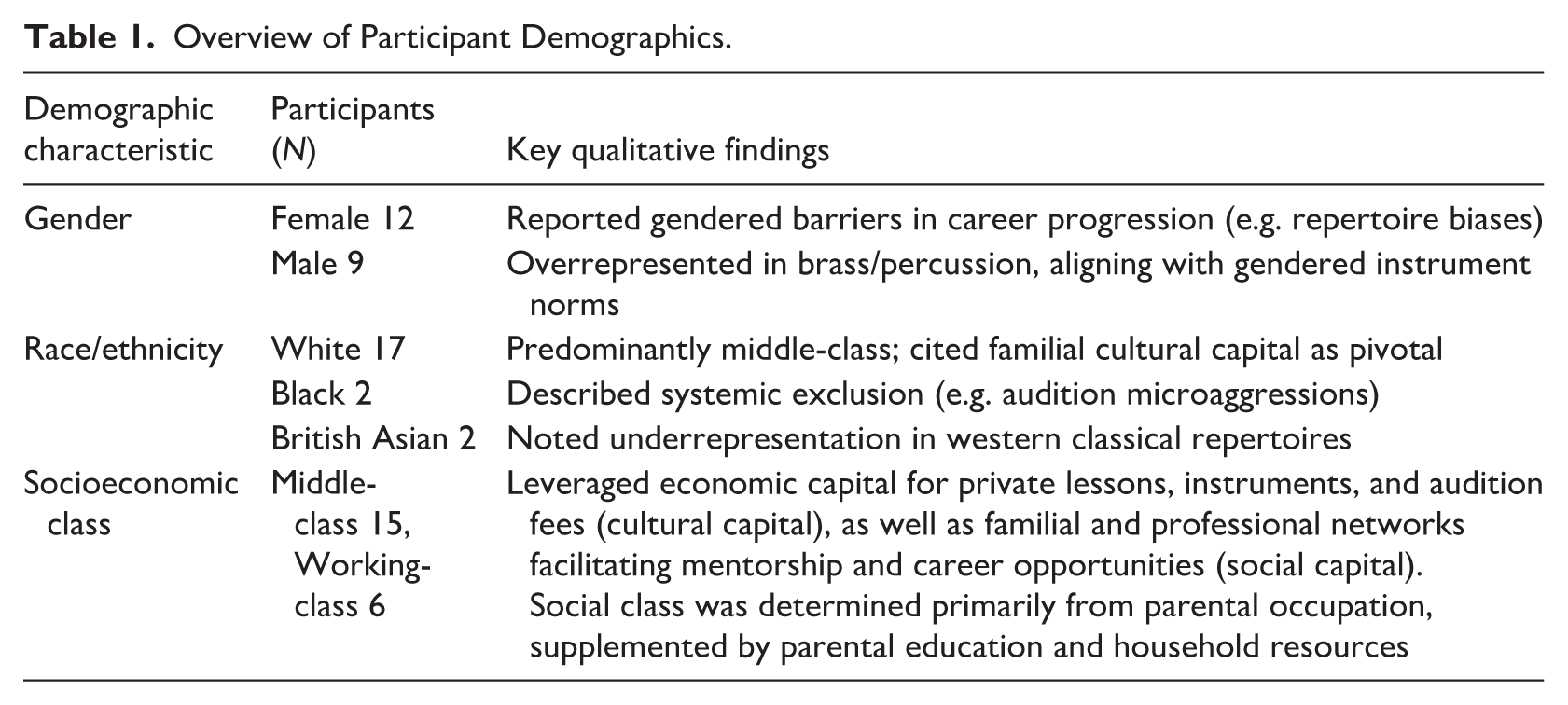
In this study, participants were asked to self-identify their class type, a process that allowed them to position themselves within a social hierarchy (Bottero, 2004; D. Wright, 1997) while also recognising the possibility of misidentification (Friedman et al., 2021). This was complemented by objective measures, including parental occupation, education, household income, access to musical tuition and instruments, and early familial experiences, drawing on Bourdieu’s (1986, 1987) concepts of capital and habitus. Contextual data from UCAS POLAR4 and sector reports further highlighted disparities in access to conservatoires for students from disadvantaged backgrounds (Arts Council England, 2021; UCAS Conservatoires, 2022). By combining subjective and objective indicators, this approach provided a nuanced understanding of participants’ socioeconomic backgrounds and differentiated working-class from middle-class trajectories.
Data Analysis
Data were analysed through Braun and Clarke’s (2022) Reflexive Thematic Analysis (RTA), a six-phase iterative process prioritising inductive theme development. NVivo software facilitated coding, with themes validated through peer debriefing. This was triangulated with Bourdieusian field analysis (Bourdieu & Wacquant, 1992), which interrogated how habitus (embodied dispositions), capital (resources), and field (conservatoire and classical music education structures) intersected to (re)produce inequalities. While this study is theoretically anchored in Bourdieu’s conceptual framework, its inductive design intentionally accommodates empirical nuances that extend beyond Bourdieusian parameters. By focusing participants’ lived experiences as the primary locus of analysis, the research identifies emergent themes, such as intersectional barriers and agentic resilience that both complement and complicate Bourdieu’s original formulations. This approach enables a dialogic interplay between theory and data, wherein Bourdieu’s constructs (e.g. habitus, capital) serve as heuristic tools rather than prescriptive categories.
Limitations
This study is qualitative and purposefully focused on a relatively small group of state-school-educated conservatoire students, so its findings offer context-rich insights rather than statistically generalisable claims (Leung, 2015). Qualitative research prioritises depth of meaning and contextual understanding over broad representativeness, meaning transferability of findings to other contexts should be made cautiously. The interpretive nature of thematic analysis also means that researcher positionality and context shape the analysis, despite efforts at reflexivity and triangulation. Thus, while this study contributes theoretically and empirically, it does not aim to predict patterns outside its specific cohort and context.
Findings and Discussion
From the findings, four central themes emerged: parental engagement; the ‘meritocratic musician’; becoming ‘serious’; and feeling like a ‘fish out of water’. The themes identified in this study are interwoven, each influencing and reinforcing the others, rather than existing in isolation. This interconnectedness reflects the complex and multifaceted nature of participants’ experiences, where factors such as socioeconomic background, cultural capital, and institutional norms collectively shape their journeys.
Parental Engagement
The role of parental engagement emerged as pivotal in shaping participants’ trajectories toward conservatoire education, yet its manifestations and efficacy were profoundly stratified by socioeconomic and cultural capital. Bourdieu’s (1984, 1986) conceptualisation of cultural and social capital underpinned these disparities, with participants’ narratives revealing how familial resources, that being, economic, cultural and social, mediated access to the specialised training and networks critical for conservatoire admission. For many participants, parental support entailed significant financial sacrifice, particularly among working-class families. Parents sought private tuition, funded instruments, and facilitated participation in competitions and summer schools, opportunities identified as catalysts for accruing ‘conservatoire capital’ (Bath et al., 2020). However, such support was unevenly distributed. Working-class families often struggled to sustain these investments, while middle-class families also experienced challenges, though the ways they negotiated their agency and leveraged cultural, social, and economic capital appeared more effective in mitigating financial strain.
My parents scraped together money for lessons, but when my instrument needed repairs, it set us back months. I missed out on masterclasses because we couldn’t afford the travel. (Richard, Brass Player).
This economic precarity has exacerbated the decline of state-school music provision (Bath et al., 2020), leaving working-class participants reliant on diminishing institutional resources. In contrast, middle-class families have leveraged financial stability to secure consistent training, instruments, and extracurricular opportunities, reinforcing Bourdieu’s (1984) assertion that cultural capital remains tethered to inherited advantage. Hall’s (2018) concept of ‘musical mothering’ resonates strongly in these findings, with mothers across class backgrounds providing various essential emotional and logistical support. For the six working-class participants, however, this labour often intersected with pressures to transcend structural barriers. Laura, a working-class pianist from the North of England, reflecting on her mother’s rigorous approach, noted: I think my mum wanted me to have a skill, she wanted me to have a talent and she saw that I was becoming quite good at it [the piano] and so it became very, very high pressured . . . I had to work hard, it wasn’t just something I could kind of mess about at so it was very serious, it was all very interesting because you know I grew up in a very deprived environment and yet there was this real need to be excellent and for everything to be rigorous and I think that was more the case because this was kind of an opportunity for me to be really good at something, to be different from everybody else at school and so, that did happen eventually. (Laura, Pianist)
Nicola (Vocalist) similarly emphasised her mother’s role in navigating unfamiliar terrain: My mum had no clue about the classical music world, but she was my biggest supporter. She made sure I did the best with what we had. (Nicola, Vocalist)
While Hall (2018) frames maternal care as central to musical development, this study highlights its classed dimensions. Middle-class mothers often drew on their own cultural capital to demystify conservatoire pathways, whereas working-class mothers compensated for institutional gaps through intensified affective labour, for example, by providing extensive emotional support, encouragement, and time-intensive practice supervision. Familial cultural capital also significantly shaped early musical socialisation. Victoria, a middle-class composition student, whose parents held music degrees, described her upbringing as suffused with ‘natural’ exposure to the classical canon: I come from one of those families who just love music . . . my mum did music at university and my dad is a big Baroque fan so I’d say in that sense, I do come from a musical family. (Victoria, Composer)
Such narratives contrast sharply with working-class participants’ experiences of ‘extreme unfamiliarity’ (Richard, Brass Player), where parents lacked the cultural fluency to navigate elitist musical ecosystems. Bourdieu’s (1986) linkage of social capital to economic resources is further crystallised here: while Victoria’s parents sourced a ‘reasonably priced’ teacher through professional networks, Richard’s family relied on the Yellow Pages, securing a tutor only after what he described as being, a protracted financial strain. Participants’ parental support was also occasionally supplemented or substituted by extended family members, reflecting the role of wider kinship networks in facilitating musical development. Middle-class participant, Katie (Brass Player), credited her grandfather’s informal mentorship: ‘He taught me tunes on the keyboard, and my parents encouraged that. Their interest made me feel it was worthwhile’ (Katie, Brass Player). For working-class participants, however, such intergenerational support rarely compensated for systemic deficits. Richard’s grandparents, like his parents, lacked musical connections, reiterating how social capital remains contingent on class position (Bourdieu, 1986).
The findings for this theme highlight the interplay of economic, cultural, and social capital in mediating parental engagement in music education. While affective labour (Hall, 2018) mitigated some barriers for working class participants, it could not offset the structural advantages conferred by middle class families’ capital. As Laura’s account illustrates, parental aspirations often collided with material constraints, rendering musical success a site of both resilience and stratification. This aligns with Lareau’s (2011) ‘concerted cultivation’ framework, where class disparities in parental strategies perpetuate unequal access to elite artistic fields – a dynamic starkly evident in the erosion of state music education and the privatisation of conservatoire pathways.
The ‘Meritocratic Musician’
The concept of meritocracy, framed as success determined by individual ‘talent’ and ‘effort’ (Littler, 2018; Young, 1958), pervaded participants’ narratives of their journeys to conservatoire. Yet their experiences revealed stark contradictions between meritocratic ideals and the structural realities of unequal access to resources, opportunities, and cultural validation. Participants universally internalised the belief that hard work and dedication were prerequisites for success. Fred (Pianist), for instance, linked his technical progress to parental sacrifices: I noticed a change in my playing around 13 or 14, which influenced my parents to invest more. It put pressure on me, but I wanted to prove it was worth it. (Fred, Pianist)
However, working-class participants highlighted how effort alone could not surmount systemic inequities. Laura (Pianist), despite achieving conservatoire admission through relentless practice, reflected: I had to work harder than everyone else. At auditions, I felt I was competing against people who’d had every advantage. (Laura, Pianist)
Such accounts align with Goldthorpe’s (2003) critique of meritocracy, which identifies how class origins mediate the translation of ability into opportunity. For working-class participants, the financial burden of graded exams (ABRSM), theory tests, and instrument maintenance created additional hurdles. Zachary, a working-class violinist noted: We skipped grades to save money. Even theory exams became a cost barrier. Hard work matters, but so do your parents’ finances and connections. (Zachary, Violinist)
These narratives underscore Littler’s (2018) argument that meritocracy obscures how ‘physiological facility’ or ‘self-identity’ are contingent on material resources, something amplified by the erosion of state-school music provision (Bath et al., 2020). ABRSM graded exams emerged as a key site where meritocratic ideals intersected with classed inequalities. Conservatoires often treat Grade 8 distinctions as indicators of preparedness or credible applicants (RCM, 2019), reinforcing Bourdieu’s (1986) notion of institutionalised cultural capital. Middle-class participants, such as Michaela (Brass Player), leveraged early access to lessons and instruments to accumulate distinctions. In contrast, working-class participants navigated financial pragmatism: Laura skipped grades to reduce exam fees, while Zachary’s teacher restructured his syllabus to minimise costs. These strategies reflect economic constraints rather than lack of ambition, highlighting how access to distinctions and, by extension, institutional recognition remains unevenly distributed along class lines.
These experiences show how ABRSM frameworks, while ostensibly meritocratic, can privilege those with economic capital to sustain consistent training and examination fees. Participation in school-based Gifted and Talented Programmes (GTPs) further illustrated the classed dynamics of meritocratic labelling. All GTP-identified participants in this study were middle-class, echoing critiques that such schemes disproportionately benefit advantaged students (Radnor et al., 2007). Michaela (Brass Player) recalls the GTP programme at her school as an opportunity to give her ‘extra time to practice’ and to do what she ‘actually loved doing’. Hymer and Michel’s (2002) observation that GTP definitions rely on teachers’ subjective assessments, often influenced by middle-class cultural norms, resonates here. Working-class participants reported feeling alienated in school music programmes, with one participant also noting subtle discouragement from teachers. This aligns with Ball’s (2011) contention that educational policies framing meritocracy as ‘legitimate competence’ (Ball, 2011) obscure how capital shapes opportunity.
It was evident that many of the middle-class participants, socialised in environments saturated with classical music (concerts, private lessons, familial expertise) and described their trajectories as ‘natural’ (Victoria, Composer). In contrast, working class participants like Richard (Brass Player) articulated a dissonance between their habitus and conservatoire expectations. These disparities reflect how the meritocratic ideal, epitomised in Davies’ (2004) framing of conservatoires as sites where ‘talent + effort’ guarantees success, fails to account for the uneven distribution of capital required to develop such talent. While middle-class participants accrued institutional advantages (ABRSM distinctions, ensemble placements) through economic and cultural privilege, working-class aspirants navigated delayed entry, financial constraints, and alienating environments.
While participants’ belief in meritocracy motivated perseverance, their journeys underscore Littler’s (2018) contention that race, class, or gender remain embedded barriers. ABRSM exams, GTPs, and audition processes, though framed as neutral, function as classed gatekeepers, rewarding those whose habitus and resources align with elite cultural codes (R. Wright, 2015). These findings affirm Bourdieu’s (1984) assertion that talent is not innate but cultivated through unequal access to capital, rendering meritocracy a discourse that naturalises, rather than disrupts, inequality
Becoming ‘Serious’
The transition to self-identifying as a ‘serious’ musician emerged as a pivotal juncture in participants’ journeys, marked by their resolve to pursue classical music professionally and demand recognition within a field historically coded as elite (Bull & Scharff, 2017, 2021). This process, however, was profoundly shaped by class-inflected pressures to prove legitimacy in a domain where middle-class cultural norms dominate (Bull, 2019). Working-class participants framed seriousness as a necessity borne of external validation struggles. Their narratives underscored a determination to prove their belonging in a field where their social and cultural capital were frequently questioned. For example, Laura (Pianist) described how she felt she had to maintain intense focus and commitment, noting that it ‘was very serious’, highlighting that there was no room for casual engagement.
Working-class participants’ hyper-focus on technical mastery and institutional recognition reflected their navigation of a field where their cultural fluency was frequently perceived as lacking. Chris (Composer) further articulates the psychological toll: Every time I told teachers how serious I was, I felt I wasn’t being taken seriously. It pushed me to say, ‘Look at me now’ – I proved them wrong, but it meant working twice as hard. (Chris, Composer)
In contrast, middle-class participants described seriousness as an extension of their socialised engagement with classical music’s ‘inner depth’ (Bull & Scharff, 2017, p. 288). Their habitus, cultivated through familial exposure to concerts, private tuition, and institutional norms, allowed them to frame seriousness as an organic evolution rather than a defensive posture. Rather interestingly, all participants in the study critiqued their state-school music provision, describing curricula they perceived as inadequate for nurturing serious musicianship. Olivia, a middle-class pianist, highlighted dissonance between her skills and classroom dynamics: To be blunt, I was better than the teachers at playing the piano and it did feel awkward . . . but it was uncomfortable . . . I did feel like there was a little bit of ‘yes you are good and we cannot really do anything more for you’ and instead of being recognised, I felt a little invisible, which looking back is quite odd, isn’t it? (Olivia, Pianist)
While Reay et al.’s (2009) ‘fish out of water’ metaphor specifically describes working class students navigating middle-class educational norms, Olivia’s experience reflects a parallel dissonance: her technical mastery and seriousness about classical music rendered her incongruous within a system ill-equipped to nurture high-level musicianship. Her frustration, here, underscores how state-school music provision often fails to accommodate students whose aspirations exceed curricular boundaries, regardless of class. For Olivia, ‘becoming serious’ necessitated transcending institutional apathy, a challenge compounded by her awareness of peers at specialist music and dance schools (e.g. Chetham’s) who benefited from tailored training. Positive educational experiences thus hinged on access to individual mentors, a privilege this study found to be stratified by class. As Alice, a middle-class flautist stressed, ‘a good teacher is vital for anyone wanting to make it in classical music’.
Middle-class participants more frequently recounted mentorship from teachers with conservatoire connections, echoing Elliot Major et al.’s (2020) finding that one-to-one tutoring boosts attainment. Working-class participants, however, described navigating this terrain alone, compounding their isolation. Bernstein’s (1975) framework of instrumental (skill acquisition) and expressive (value internalisation) orders illuminates participants’ dual burdens. All recognised the necessity of technical excellence, but middle-class participants more readily embraced classical music’s expressive ethos, that being, its emotional and social codes. Working-class aspirants, lacking early immersion in these norms, often reduced ‘seriousness’ to relentless practice, as Laura’s journey illustrates. This dichotomy reflects Bourdieu’s (1984) assertion that the expressive order, that being, the ‘love of art’, is itself, a form of cultural capital, unevenly distributed along class lines.
The pressure to excel permeated all narratives but assumed distinct classed forms. For working-class participants, seriousness was entwined with familial sacrifice: My parents scraped together money for lessons. I couldn’t waste that, it had to lead somewhere. (Zachary, Violinist)
Middle-class participants, while equally driven, framed their rigor as passion rather than obligation. This bifurcation really brought to light just how becoming ‘serious’ operates as both personal aspiration and structural imperative, shaped by the capital required to fall safely within elite artistic fields.
Feeling Like a ‘Fish Out of Water’
The metaphor of being a ‘fish out of water’ has been widely documented in educational contexts (Franceschelli et al., 2016; Macdonald, 2011; Winstone & Hulme, 2019), particularly in studies of working-class students navigating elite HE institutions (Reay et al., 2009). Bourdieu and Wacquant (1992) conceptualise this dissonance through habitus: when individuals encounter fields misaligned with their social conditioning, they lose the intuitive ease of a ‘fish in water’, instead confronting a destabilising cultural mismatch. For participants in this study, these tensions were experienced as an interaction between social conditioning and material constraint, manifesting both in economic barriers during ABRSM exams and in anxieties surrounding classical concert attendance. These challenges however reached their peak during conservatoire auditions, where participants across socioeconomic backgrounds reported heightened discomfort and feelings of being ‘out of place’ in the conservatoire environments, a space governed by unwritten, middle-class norms. Working-class participants faced further compounded barriers: I just felt this rush of excitement and anxiety thinking I’ve worked so hard to get here . . . this is my time to shine, and something just didn’t feel quite right . . . I first really realised that places like this [the conservatoire] were not for the likes of me (Liam, Pianist)
This ‘cultural shock’ (Oberg, 1960), marked by unfamiliar institutional practices, Eurocentric repertoires, and exclusionary social networks mirrored findings on working-class marginalisation in elite cultural spaces (Reay et al., 2009). The study also found that Global Majority participants described a double burden, navigating racial and class-based exclusion simultaneously. For example, Curtis, a Black working-class brass player, described an ‘air of suspicion’ surrounding his presence during auditions, connecting this to broader experiences of alienation he had faced as a young Black man. Similarly, Sam, another Black working-class participant, recalled being misidentified as a jazz musician despite auditioning for Western classical music, which left him feeling immediately out of place. These experiences can suggest that intersecting racial and class-based pressures may have contributed to participants’ sense of not fully belonging within the conservatoire environment. Bourdieu’s (1999, 2004) concept of habitus clivé, that being a ‘cleft habitus’ arising from drastic shifts in social conditions, provides a framework for understanding participants’ experiences here. Working-class students described a disjuncture between their embodied dispositions and the conservatoire’s middle-class habitus, resulting in a ‘torn sense of self’ (Bennett et al., 2009).
I still don’t feel like I fit in . . . I kept thinking, when are they going to catch me out? (Sam, Brass Player)
This dissonance reflects Bourdieu’s (2008) ‘coincidence of contraries’ (p. 100), where aspirational alignment with musical goals clashed with alienation from institutional norms. Participants’ audition experiences often acted as a precursor to this ‘habitus shock’, exposing them to the conservatoire’s ‘hidden curriculum’ of classed and racialised expectations (Harrison & Greenfield, 2011; Jay, 2003). Reay et al. (2010) theorise institutional habitus as a mediating force shaping classed identities in HE. For participants in this study, conservatoire auditions were their first real ‘feel of the game’ and revealed systemic inequities in cultural capital acquisition. Working-class students lacked prior exposure to the ‘rules’ of elite musical training (e.g. audition etiquette, networking), exacerbating feelings of the classic impostor syndrome (Bravata et al., 2020).
Despite these barriers, working-class participants demonstrated resilience, adapting through mentorship and strategic capital accumulation – something Bourdieu’s works rarely delve deeply into. Some of these participants also showed signs of internalising some aspects of middle-class habitus (Bourdieu, 1984; R. Wright, 2015), enabling them to navigate institutional codes while retaining a critical awareness of their outsider status.
Conclusion
This study examined how structural inequalities shape the journeys of state-school educated students into UK conservatoires, using Bourdieu’s concepts of habitus, capital, and field. It highlights the tension between personal agency and systemic barriers, revealing how underrepresented students navigate institutional gatekeeping. Parental engagement played a key role: middle-class families used economic and cultural capital to access training and networks, while working-class participants often faced financial precarity and institutional indifference. Though all participants internalised meritocratic ideals, mechanisms like ABRSM exams and Gifted and Talented schemes largely benefited those with pre-existing capital. Becoming a serious musician was a pivotal moment for all the participants, although again this was shaped by class. Working-class students felt the need to prove their legitimacy whereas middle-class students saw it as a natural progression. These inequities became more pronounced at audition stage, where participants encountered a cleft habitus, a mismatch between their identities and institutional expectations. Despite their resilience, participants exposed a system that rewards middle-class norms under the guise of meritocracy. If this study makes one thing clear, it is that meaningful change in conservatoires requires a fundamental rethink of auditions, expanded access to early training, and a commitment to dismantling deficit narratives. Put simply, the future of classical music depends on ensuring that opportunity is shaped by talent, not background.
Footnotes

Author Contributions
Funding
The author disclosed receipt of the following financial support for the research, authorship, and/or publication of this article: This research received financial support from the UKRI Economic and Social Research Council.
Declaration of Conflicting Interests
The author declared no potential conflicts of interest with respect to the research, authorship, and/or publication of this article.