



Abstract
When children commence instrumental music tuition, learning difficulties can emerge to disrupt predictable learning processes and impact musical development. However, children’s experiences of learning difficulties, including how they present, are managed and can be supported, are rarely examined in music research. This longitudinal, qualitative study used Participatory Action Research and Interpretative Phenomenological Analysis methodologies to examine the lived experience of fourteen 7-year-old beginner cellists. It focussed on how children’s learning difficulties emerged in the music studio and affected their continued engagement, and how the instrumental music teacher supported children with difficulties. Unexpectedly, half (N = 7) of the young learners encountered challenges, including memory and processing difficulties, impulse, attention and focus issues, intrusive synaesthesia, fine motor skill difficulty, dyslexia and persistent anxiety. Children’s highly individualised experiences of their learning difficulties were impacted by their motivations, self-perception and ratio of skill acquisition. A reflexive pedagogical approach by the teacher, together with pragmatic support and emotional guidance from parents, influenced the children’s learning behaviour and continued investment, contributing to their longer-term musical engagement. This study offers a unique contribution to the literature by providing a rare investigation of children’s emergent learning difficulties, as revealed in the instrumental music studio.
Keywords
Learning difficulties and requirements, including physical, sensory and cognitive differences and conditions such as dyslexia, dyscalculia, dyspraxia, dysgraphia, attention deficit hyperactivity disorder and language processing issues present challenges that can inhibit predictable learning (Baker, 2021). Learning difficulties require additional support through teaching adjustments, modified resources and complementary pedagogical strategies that go beyond mainstream teaching to facilitate effective learning and successful musical development (Hyde et al., 2013). Evidence of learning difficulties may emerge when children commence instrumental music tuition (Hammel & Hourigan, 2011); difficulties may be hidden, unapparent or remain undisclosed to the instrumental teacher and school (Benham, 2020a). Learning difficulties have been associated with emotional and behavioural issues (Cristofani et al., 2023) and can impact learners’ affective attributes (Westwood, 2008). However, early recognition of children’s learning difficulties can remediate related emotional and behavioural problems and support ongoing education engagement (Hall, 2008).
Research on children’s lived experiences of learning difficulties in music education has been scarce. To our knowledge, at the time of writing, no studies have specifically investigated how children’s learning difficulties may be revealed and/or concealed in and through musical skill development during early instrumental music tuition. Most research instead has focussed on teacher attitudes and preservice music teacher training (Jones, 2015), including developing inclusive music practice for learners with difficulties and disabilities in group or general music classroom settings, with only some attention to one-to-one lessons (Dumlavwalla & Bugaj, 2020).
Yinger et al. (2023) identified only 15 music education studies published in the last 50 years that have focussed on perspectives of children with a disability, all of which involved children with diagnosed disabilities or known learning requirements. Yinger et al. (2023) recognised the ethical issues surrounding the inclusion of children with disabilities in research activities. They suggested solutions, such as devising participatory studies involving child participants in data collection processes through interviews, drawing, lyrics, video and audio recordings, improvisations and composition. Such processes position children as co-researchers and alleviate power imbalances while also shifting the paradigm of conducting music education research about children to researching with children (Lewis & Porter, 2004; Yinger et al., 2023).
Gerrity et al. (2013) sought to foreground children’s perspectives and parents’ views on learning music with a mixed-methods study investigating optimal conditions for growth for students with individual needs. Recommendations include teaching strategies such as repetition, offering choice, extending response time, clear instruction, defined expectations, behaviour plans and a positive environment. Prioritising children’s experiences, Thornton and Culp (2020) investigated music learning and engagement for students with physical differences through analysis of student, parent and instrumental music teacher interviews. Findings from emergent themes indicate the need for teachers to listen to learner perspectives, focus on student-centred goals, persevere when faced with uncertainty, collaborate and be adaptive with resources.
Studies advising teachers on appropriate accommodations for learners with diagnosed conditions are important for progressing music pedagogy (Benham, 2020b). However, Gooding and Yinger’s (2014) integrative review of teaching students with disabilities in string and orchestral environments indicates that many studies rely on expert opinions, leading to contradictory suggestions for teaching strategies and environmental improvements. Findings suggest more research is needed to support students with disabilities in string teaching. Benham (2020a) agrees that there is a lack of guidance on how music educators, particularly string teachers, can effectively support learners with disabilities. Support is critical to address as students with disabilities increasingly participate in school string programs (Bugaj, 2016).
Morrow’s (2023) research into dyslexia and music reading in string studio settings found that 52 out of 53 string teachers experienced teaching students who struggled to read music through typical instruction methods. Morrow identified a lack of studies on reading difficulties and an inconsistency in remediation methods, drawing critical links between insufficient teacher support and students’ decision to quit. Morrow’s (2023) research highlights a misalignment between the standard sequence of instruction in stringed instrument pedagogy (for example, method books commence with open strings and classroom approaches focus on D major) and the logical sequence of teaching note reading. Furthermore, although usually not problematic for typical learners, ambiguities requiring greater scaffolded instruction may have far-reaching impacts on students with difficulties such as dyslexia, dyscalculia, memory issues and maintaining focus. Findings indicate the need for teacher awareness of how widely accepted incongruities between long-held traditions in instrument-specific pedagogies and general approaches to music literacies may further challenge young beginner musicians with learning difficulties.
All previous research has focussed on learners with known and diagnosed conditions; however, a gap in the literature exists relating to uncovering children’s social, emotional and musical experiences of learning difficulties, including parents’ views, as they emerge during early instrumental music learning in the mainstream studio setting. One valuable approach to addressing this gap is to explore children’s lived experiences of emergent difficulties in situ (Hourigan, 2014). Investigating conventional one-to-one teaching contexts is especially important because this is where inclusive teaching most incisively occurs in everyday music education (Dumlavwalla & Bugaj, 2020). Giving voice to children and enabling their capacities to reveal experiences allows them to illuminate their perspectives and thereby gain a deeper understanding that can inform inclusive teaching practices (Thornton & Culp, 2020). Further, using a social model approach that recognises people’s inherent differences as an integral part of being human and considers how societal responses to disability determine a person’s experience of disability in music education (bell et al., 2020; Bremmer, 2023; Howe et al., 2015) offers unique insights valuable for advancing knowledge and disability studies (Lubet, 2009).
Therefore, the present study drew on a social model thinking approach, foregrounding individual difference as a personal characteristic (bell et al., 2020) to investigate 7-year-old children’s experiences of emergent learning difficulties as they commenced cello lessons, progressed learning during the first 18 months of tuition and continued their engagement for an additional 3 years. The research questions were:
RQ1: How do learning difficulties in 7-year-old children emerge in the instrumental music studio and affect continued musical engagement?
RQ2: How can the instrumental music teacher support children with emergent learning difficulties?
Method
Design
This study was part of a larger longitudinal doctoral project whereby the first author, a teacher-researcher, worked with fourteen 7-year-old cello students in a one-to-one instrumental music setting to investigate children’s lived experience of cello skill development and her reflexive teaching practice during the first 18 months of lessons. Learners’ longer-term engagement and the teacher-researcher’s reflexivity were explored for 3 further years. The present study focusses on an unanticipated finding concerning seven student participants whose learning difficulties emerged during the research, providing a unique data set within the larger study. It remains deliberately inclusive of all seven students to reflect that half the student cohort presented with challenges, each needing to be appraised and managed in the teacher’s pedagogical practice. The University of Melbourne Human Research Ethics Committee provided ethical approval (ID 1544350) for the research, and the school where the first author worked, a K-12 independent school with over 2,500 students in an Australian metropolitan region, agreed to the study to be conducted onsite. An independent advocate, the Coordinator of Junior Music, recruited participants, mitigated dependency issues, provided impartial support and regularly consulted with all stakeholders throughout the research period.
Participants
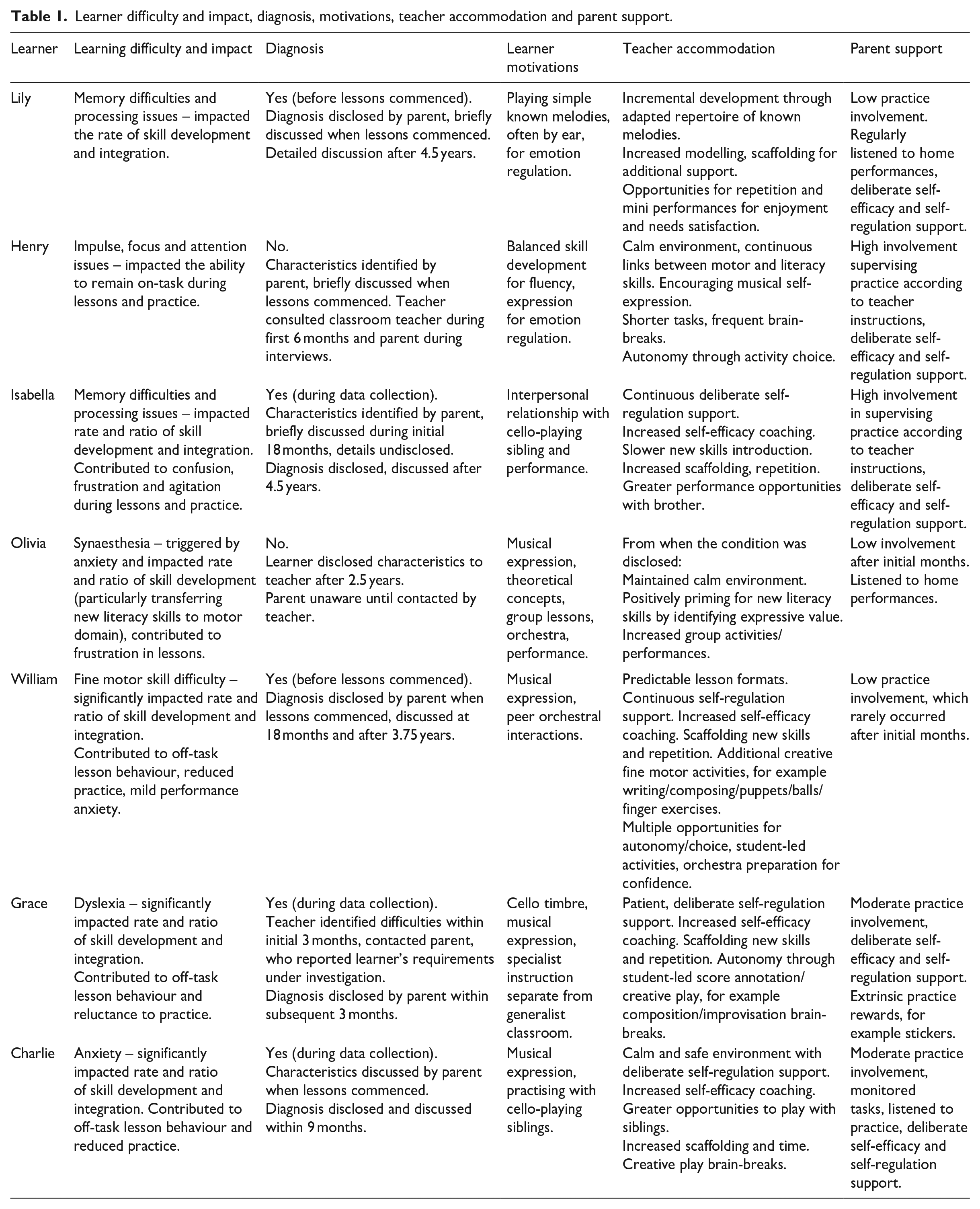
After completing a 10-week term of introductory string classes as part of the Year 2 curriculum, fourteen 7-year-old students (nine girls and four boys) enrolled in one-to-one cello lessons with the first author. The children and their parents were invited to participate in the research without obligation by the independent advocate and provided informed written consent before data collection. Students were from middle to high socio-economic backgrounds, and the well-resourced school offered a broad curriculum underpinned by inclusive teaching practice. This study focusses on seven of the fourteen students from the larger project, four girls and three boys, who experienced emergent learning difficulties (Table 1). We used pseudonyms for all participants to protect their identities.
Learner difficulty and impact, diagnosis, motivations, teacher accommodation and parent support.
Procedure
Participatory Action Research (PAR; Cochran-Smith & Lytle, 2015; Kemmis et al., 2014) and Interpretative Phenomenological Analysis (IPA; Eatough & Smith, 2017; Smith et al., 2009) were employed to conduct the larger project, including the research presented in this article. In education research, PAR is characterised by the practitioner taking the dual role of teacher and researcher, research questions arise from the teacher’s practice and student learning is interwoven with the teacher’s intentions and interpretation (Cochran-Smith & Lytle, 2015). IPA is a qualitative approach to investigating participants’ lived experiences, extracting key themes that characterise their thoughts and feelings about events (Smith et al., 2009). The researcher’s role, providing insider perspectives to the interpretative process, is valued as further enhancing the analysis’s interpretation. IPA tracks thematic material across small samples, honouring individuals’ perspectives rather than reducing participants’ experiences to established pathologies, theories or categories. As such, IPA is anchored to phenomenological philosophy, hermeneutic ideology and idiographic approaches to understanding human experience (Smith et al., 2009; van Manen, 1990).
Data were collected within the first 18 months through:
(1) A weekly lesson observation, participation and reflection protocol that recorded teaching and learning processes, teacher-student interactions, teacher reflections and reflexivity (Conway & Jeffers, 2004; Engward & Goldspink, 2020);
(2) A weekly skill development rubric (Wesolowski, 2012) that provided a formative assessment (Payne et al., 2019) of children’s skill development, including motor skills, cognition and expression.
(3) A weekly practice communication journal used by the teacher-researcher, students and parents.
In accordance with IPA protocols, semi-structured interviews with participants produced data for analysing the learners’ lived experience of musical skill development and their perceptions of ongoing engagement (Eatough & Smith, 2017). The children and parents were interviewed separately when lessons commenced, after 18 months and at yearly intervals for up to 3 years. Within the initial 18 months, children participated in additional interviews at the end of each term. During interviews, participants were asked questions regarding their lived experiences of cello learning and to reflect on nuanced aspects of their interests, capacities, investment and engagement.
Data analysis
The PAR data underwent cumulative inductive analysis at three monthly intervals. The first author examined and interpreted patterns in learner behaviour, interactions, practice and parent communication and compared datasets with skill development metrics drawn from rubrics. Data coding revealed trends in the children’s learning processes, dispositions, behaviours and rate/ratio of musical development. Trend analysis revealed three learner experience and skill development groups (Table 2), which provided the opportunity to examine children’s experiences of emergent difficulties in the context of their music learning. Additionally, the first author conducted comparative progress measures each school term as part of her teaching responsibilities, contributing to assessment and reporting conventions. After 18 months, assessment outcomes informed student quartile rankings (top 25% as first quartile, etc.). The longitudinal data on the children’s sustained learning was analysed compared to their early learning experiences. Table 2 provides an overview of the three learner experience and skill development groupings, including the 18-month quartile ranking and longer-term outcomes. Throughout the analytic process, the second and third authors acted as critical friends validating PAR processes (Kemmis et al., 2014).
Learner experience and skill development groupings.
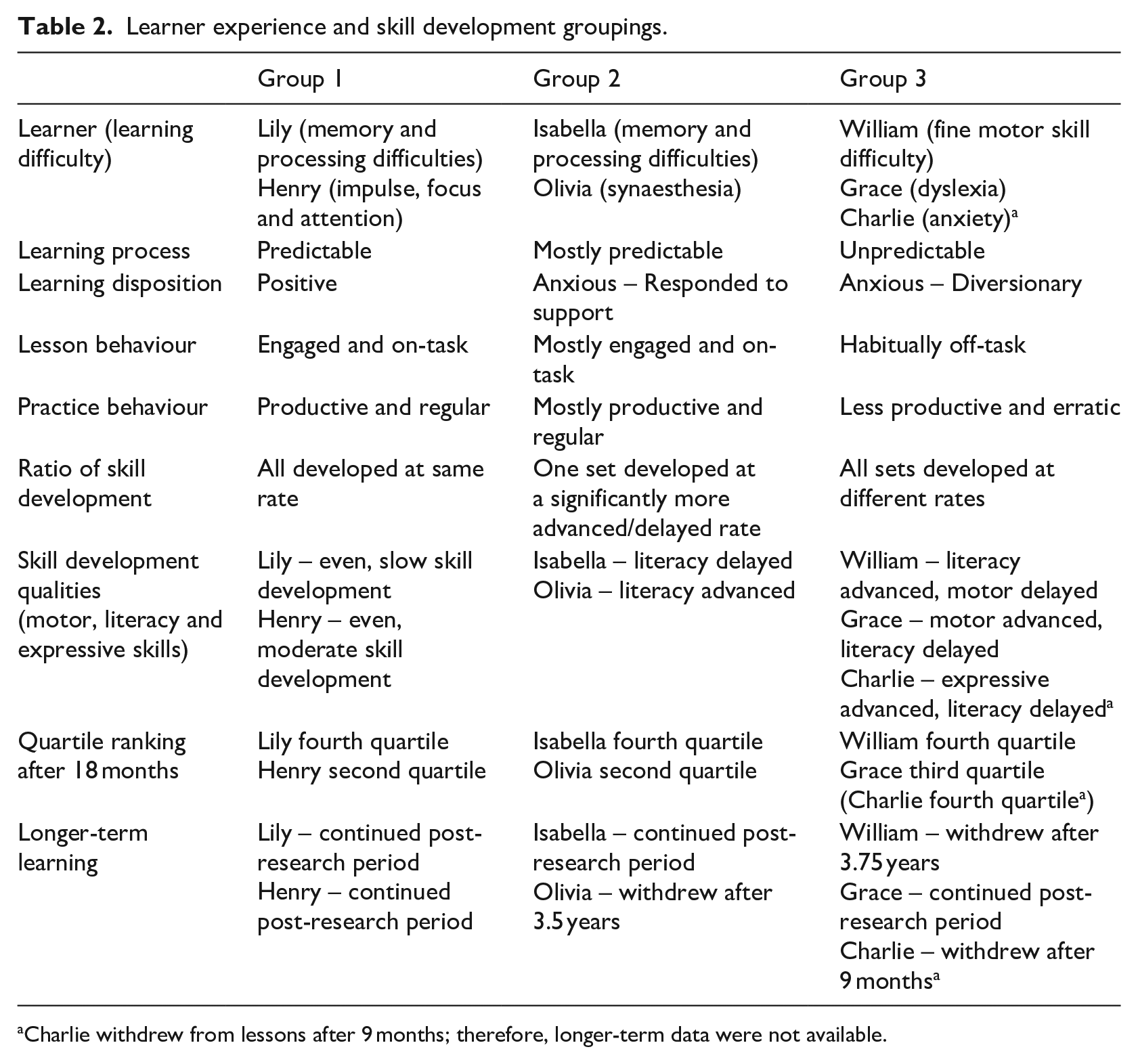
Charlie withdrew from lessons after 9 months; therefore, longer-term data were not available.
IPA involved careful re-reading of interviews, extensive notetaking, highlighting essential themes and identifying thematic connections between participant experiences (Smith et al., 2009). The first author’s data coding was verified and validated in consultation with the second and third authors. Two IPA strategies, Abstraction and Contextualisation, were vital to the analysis. Abstraction refers to finding patterns between emergent themes leading to an overarching super-ordinate theme (Smith et al., 2009, p. 96). Contextualisation places emergent themes in the context of the participant’s narrative and considers their life milieu (Smith et al., 2009, p. 98). After 18 months, the first author merged and analysed PAR data and IPA themes and validated integration through critical discussion with the second and third authors. Throughout, the first author engaged in reflexive discussion about her teaching experiences with the other authors, thereby supporting essential components of IPA and PAR methodologies (Eatough & Smith, 2017; Kemmis et al., 2014) and mitigating potential biases and assumptions. The school management, independent advocate and generalist teachers were consulted on learners’ requirements, further supporting analysis authentication (Kemmis et al., 2014). Analytic processes resulted in detailed portraits of children’s experiences in early learning, including the unexpected prevalence of learning difficulties and the idiosyncratic ways they were uncovered and managed.
Results
The results pertain to the seven children from the original cohort of fourteen who experienced emergent learning difficulties extending beyond individual differences. These included memory and processing difficulties (Lily and Isabella), impulse, attention and focussing issues (Henry), intrusive synaesthesia (Olivia), fine motor skill difficulty (William), dyslexia (Grace) and persistent anxiety (Charlie). Table 1 presents an overview of the children’s difficulties, learning motivations, teacher accommodations and parental support. All interviewed parents were mothers who held the primary role of supporting their child’s cello learning.
When lessons commenced, the school did not share the children’s learning requirements with the music staff, suggesting they were unknown or there was a communication breakdown. During the first interviews, Lily’s mother indicated Lily had overcome a short-term memory disorder, and William’s mother referred to his motor skill difficulty; neither discussed implications. Henry’s mother suggested her son had trouble maintaining attention and focus, but not with the cello. Isabella’s mother indicated a tendency for her to rush while learning. Grace’s mother mentioned she had trouble reading books but not music. Charlie’s mother identified that Charlie lacked confidence and expressed concern for his well-being following his best friend’s terminal illness diagnosis.
Within the first 18 months, Isabella, Grace and Charlie’s difficulties presented in the generalist classroom and were formally diagnosed. These diagnoses were shared with the first author only when she sought clarity on their learning difficulties. Isabella was diagnosed with working memory and auditory processing disorders, and Grace’s diagnosis was dyslexia. Charlie received support for anxiety associated with his friend’s death and withdrew from the study after 9 months; therefore, longitudinal data were unavailable. As Charlie’s challenges are beyond the study scope, they will not be discussed further. Henry’s class teacher noted that attention and focus issues affected his behaviour, but no diagnosis was established. Olivia kept her experiences of intrusive synaesthesia private, first disclosing difficulties during a cello lesson. As participants’ trust in the teacher-researcher developed, they became more willing to discuss experiences, which reflected an unfolding awareness of their difficulties and a readiness to accept and manage implications.
Diagnoses provided context that informed teaching; however, none of the diagnosed learners provided professionally devised individual learning plans. Furthermore, diagnoses did not account for how children managed musical skill acquisition challenges. Teacher reflexivity was critical to teaching modifications (see Table 1) and students’ sustained engagement. This process involved the teacher’s critical analysis of lesson protocol entries, including reflections on pedagogy, learner behaviours and teacher-student-parent interactions. Reflexivity prompted the teacher to question previous expectations regarding student achievement, standardised developmental milestones, their abilities to acquire skills through conventional instruction and assumptions about students’ ambitions. Teaching adjustments were based on an empathetic evaluation of learners’ motivations, socio-behavioural learning patterns, intrapersonal traits, dispositions and parent involvement.
Integrating findings regarding the children’s learning experience and skill development with their quartile ranking and longer-term engagement into the three groupings presented in Table 2 foregrounds the pedagogical importance of analysing children’s holistic experience of playing an instrument beyond learning difficulties. The groupings revealed that children with similar learning difficulties did not share common learning approaches. For example, although Lily and Isabella experienced memory difficulties and processing issues and were in the fourth quartile, their overall learning experiences and skill development varied significantly. Similarly, learners in each group occupied different quartiles, suggesting that similar learning behaviours and skill development qualities did not necessarily result in sharing a common standard. Overall rankings showed that no students with learning difficulties occupied the first quartile. Further results revealed little in common, except perhaps the time frame, in the two students who ceased learning: Olivia (second quartile) and William (third quartile), who stopped after 3.5 and 3.75 years, respectively.
The three groupings showed that longer-term learners had more typical learning pathways with steady skill development. In Group 1, Lily (fourth quartile) and Henry (second quartile) experienced a stable rate and ratio of skill development and enacted positive learning dispositions and cooperative behaviours, contributing to predictable progress. Both identified their parents’ roles in constructive intrapersonal trait development. In Group 2, Isabella (fourth quartile) and Olivia (second quartile) demonstrated differences in overall ability and skill development. However, both experienced anxieties linked to performative worry in new skill acquisition and integration. Isabella’s parents’ daily emotional guidance was critical to her self-efficacy development. Olivia’s condition was unknown to her parents. In Group 3, William (fourth quartile), Grace (second quartile) and Charlie (fourth quartile) experienced intrapersonal conflict associated with their difficulties during their learning. They concealed traits through distracting, avoidance behaviours, were inhibited by challenges and perceived inadequacy, contributing to unpredictable learning and uneven skill development. William’s practice was unregulated by parents. Grace’s parents viewed her cello playing as an area for potential excellence and supported her emotionally volatile practice with extrinsic rewards.
The following section presents data for each child, including idiographic evidence from interview excerpts. Subheadings are participant comments (IPA ‘gems’) that capture the higher-order meaning of their experiences (Eatough & Smith, 2017, p. 201).
‘I’m the one that’s playing it’. Lily
When lessons commenced, Lily’s Mum described her as ‘a visual. . .hands-on learner’ who needed ‘confidence’. She disclosed that Lily had a ‘speech therapist’ for a ‘mild short-memory disorder. . .she’s improved. . .gone past that’. After 3.5 years, she detailed Lily’s comprehension, vocabulary and working memory issues, expressing significant concerns for future learning.
Lily’s musical skill development was even, but progress was far slower than her peers (fourth quartile). However, Lily’s learning behaviour was consistently mature and determined in all contexts (lessons, practice and orchestra rehearsals). Analysis revealed that although Lily struggled with procedural learning, her commitment to cello stemmed from her profound satisfaction in musical skill development, pride from her family’s affirmation and emotional regulation during performance. A productive classroom-teacher relationship also helped Lily learn from her mistakes and strengthen her autonomy, which her parents further supported. After 2.5 years, Lily explained, ‘If I get it wrong, it doesn’t really matter because it’s what I play, and nobody can be better than who they are now. . .Some [of that idea comes] from Dad and Mum, but [mostly] from me because I’m the one that’s playing it and thinking of what I should do or what would make it better’. Intrapersonal support was central to Lily’s persistence. However, during her final interview, her mother discussed how Lily’s resilience was shaped by the grit developed during rehabilitation after a significant accident and by managing a congenital medical condition. Lily continued learning cello after the research period.
‘When I get to relax, it just makes it better for me to concentrate’. Henry
Henry struggled with impulse control, attention and focus during classroom learning. When lessons commenced, these behaviours were identified by his classroom teacher, observed during interviews and described by his mother, ‘Henry’s character, number one, you must gain his interest. . .Once you gain his attention, make it interesting, you’ve got him. Otherwise, it’s really difficult to steer information into him because he’s fidgety. . .He’s a little bit better with cello’. Henry reported how connections between motor skills and expression contributed to emotional and physical regulation. After one year, Henry explained, ‘It’s because I’m relaxing. . .The music [helps me relax, and] when I get to relax, it just makes it better for me to concentrate’.
Henry’s ADHD-like behaviour moderated during lessons when he experienced autonomy. He thrived when motor skill development was linked with musical expression, as this harnessed excess energy and channelled focus, and he exhibited stable progress (second quartile). At home, Henry’s mother supervised practice, shared his musicianship with humour and both parents guided resilience. Henry’s investment grew, and he continued learning beyond the research period.
‘Cos I’m dumb!’ Isabella
Isabella’s learning requirements emerged through behaviour observation while learning new concepts. When transferring literacy concepts to motor skills, Isabella became confused, agitated and defeated, suggesting a negative self-image. After 7 months, Isabella explained, ‘I always got confused with second finger [laughs]. . .I always did that [gestures third finger] for some reason. . .cos I’m dumb’.
Isabella’s behaviour and self-concept compromised balanced skill acquisition (fourth quartile), obscuring learning difficulties during the initial 18 months. Teaching modifications included a reduced pace in introducing new skills, increased scaffolding, repetition and coaching for self-efficacy. Isabella’s satisfaction with musical expression and her bond with her cello-playing brother was critical for her motivation. Additionally, Isabella’s mother served as a home mentor, coaching her to help develop persistence. With incremental successes, Isabella’s disposition improved, and after 18 months, she described skill acquisition as ‘easy’ and ‘fun’.
After 4.5 years, Isabella’s mother revealed Isabella’s ‘auditory processing difficulties which encompasses a lot [and] working memory [difficulties], I can’t remember’. These diagnoses offered modest insight; however, her reflection ‘encompasses a lot’ underscored how the diagnoses raised additional questions, and her inability to recall Isabella’s memory disorder suggested she viewed the diagnosis as irrelevant. Instead, she valued intrapersonal trait development and described her role, ‘We try to instil in them that you don’t give up if something’s hard. You’ve got to be accountable. . .responsible. . .determined. . .resilient. It’s the only way you learn’. Entering secondary school, Isabella emphasised the significance of the cello in her life, ‘It’s what I do for a living!. . .Obviously! I’m doing it next year. So, great!’
‘I mostly see colours when I’m nervous’. Olivia
Olivia’s challenges emerged after 2.5 years while transferring a new cognitive concept of slurred bowing into the motor domain. Frustrated, Olivia described difficulty reading because she saw ‘colours and blobs’ over the music changing in quality and shape, disappearing and reappearing. Olivia indicated that intense synaesthetic perceptions profoundly affected many aspects of her life, revealing a link between performance-related anxiety and skill acquisition, ‘I mostly see colours when I’m nervous’ and how associated confusion and shame impacted her self-perception. Olivia also described sophisticated compensation strategies, such as using peripheral vision, blinking rapidly and playing before the sensations changed.
Analysis of Olivia’s skill development (second quartile) indicated that music literacy was her dominant skillset, with motor and expressive skills requiring support. These findings suggested that although synaesthesia impacted Olivia’s note reading, its management had a broader impact on skill transfer and integration. Despite difficulties, Olivia’s resilience, strategies and investment in socio-emotional rewards from orchestral participation and performances were crucial to her investment and motivation. However, when the COVID-19 pandemic stopped all peer musical interactions, Olivia lost interest in cello and discontinued lessons after 3.5 years. The full impact of online learning and social isolation on Olivia’s motivation and experiences of synaesthesia was unknown.
‘I’m going to invent a cello that plays for you!!’ William
When lessons commenced, William’s mother briefly identified his motor skill difficulty, ‘His fine motor skills are a little bit hampered. And that’s through doing this [physically making a digital tablet swiping gesture]’. During early learning, William excelled in literacy and enjoyed musical expression. However, he hid his motor skill difficulties with distracting behaviours, resisted technical development, which progressed more slowly and required additional support for resilience. Compounding William’s difficulties was an ineffective home practice routine lacking structure and support. These negative factors contributed to markedly disparate skill development (fourth quartile), and within 8 months, William stopped practising and progress plateaued. He experienced increasing worry during lessons and performances, described himself as ‘not good with left hand’, and said that in the future, ‘I’m going to invent a cello that plays for you!!’ After 18 months, William’s Mum provided further background and a burden of responsibility, ‘He has an underdeveloped muscle here [indicates area between thumb and index finger]. . .It’s because he doesn’t write. I was a bad mother who was very busy. I had two children. At home, I gave him an iPad instead of a crayon. So, he’s [swiping gesture]. Instead of saying, ‘Draw a picture, William’, give him my phone!’
William continued learning with modified teaching strategies for two further years, and despite enduring self-doubt, he enjoyed playing in an orchestra with friends. Social connections sustained William’s interest until a broken arm halted lessons, and his father withdrew him from tuition due to perceived disinterest. William’s mother explained, ‘My husband said, ‘He’s not doing it anymore because he’s not practising!’. . .We’re wondering whether we can get him to do something else. We might try him with piano. He does play the piano at home; it drives us nuts. He seemed to have more of an interest in piano than cello’.
William revealed at his exit interview that he ‘didn’t really want to stop cello, it’s just that I wasn’t practising enough, because I was afraid of it being extended for no reason. And after I got my cast removed, I can’t hold a bow properly’. He explained, ‘It was Mum who said, ‘Right, I’m going to enrol you for piano, and I’m going to stop cello’. . .I thought, ‘Ok, don’t I get a say in this?’ The misalignment of William’s desire to continue the cello and his parents’ practice expectations suggested a possible misunderstanding of how to manage his difficulty. It underscored challenges for William’s autonomy, revealing difficulties children can experience in self-advocacy and needs satisfaction. Subsequently, William commenced trumpet, hoping it would be easier because it had ‘only three buttons’.
‘It’s kind of blurry to me’. Grace
Grace’s cognitive issues were undisclosed when lessons commenced; however, initial interviews revealed underlying concerns. Grace felt confident about note reading because ‘there’s only four notes’. Her mother indicated that although Grace ‘had trouble reading’ books, she was ‘impressed with what she knows’, predicting ‘she’ll go well’ with music literacy. During the first 3 months, Grace’s difficulty emerged with a comment while reading: ‘It’s kind of hard because. . .it’s kind of blurry to me’. Suggesting visual issues, the teacher-researcher contacted Grace’s parent, who indicated Grace’s literacy challenges were being investigated. Grace was subsequently diagnosed with dyslexia. During the following 3 months, Grace engaged in learning strategies such as chunking, memorisation and visual associations to manage reading difficulties. Fluency in short pieces was achieved quickly, contributing to Grace’s enjoyment of expression and motor skill development. However, as new left-hand skills and a more comprehensive range of notes were introduced, Grace’s behaviour became increasingly off-task and non-compliant. During practice, Grace described fragility in focus affecting her mood, self-regulation and skill acquisition. These issues contributed to uneven skill development (third quartile). After 9 months, Grace described her confusion in music notation and teacher annotations, specifically referring to the number 3 (third finger). From this point, Grace implemented a personal coding system and gained learning ownership. After 18 months, Grace explained, ‘I write the notes, and if it’s a finger, I write what note it’s on. Then, I know it and. . .I remember’.
Grace’s mother fostered her resilience throughout her learning, reassuring her they were ‘trying all different ways to see how you learn and what’s best’. This pragmatic perspective was supported by an uncompromising belief in music education’s value and her daughter’s future cello playing, which continued beyond the research period. After over 2.5 years, she explained, ‘She has difficulty with reading, writing, and spelling. . .but this is something she can do. . .She can’t not give it her best, then I’ll let her quit. . .This is something she can be proud of. . .and say, ‘I achieved this!’
Discussion and conclusion
This study investigated how seven of fourteen students commencing cello lessons encountered learning difficulties. Although a limited body of research has examined children’s perspectives of known learning difficulties in music classrooms (for example, Gerrity et al., 2013; Thornton & Culp, 2020), the present study captured children’s experiences of learning difficulties as they emerged in the instrumental music studio. Critically, these learning difficulties were not made known to the teacher-researcher prior to lessons commencing but were uncovered during data collection and analysis through evaluating learning behaviour, deciphering connections between children’s avoidance tendencies and skill development, analysing participants’ accounts and reflections and interpreting experiences. The unexpected prevalence and range of learning difficulties in the sample, along with the unsystematic ways they were uncovered, provide compelling evidence of the scope and relevance of emergent difficulties for young musicians learning an instrument and further indicate the need for teachers to be compassionate and critically observant to learner behaviour, and investigative of nuances in musical skill development.
Disclosure of difficulties was challenging for participants. Two mothers minimised their children’s difficulties and formal diagnoses during the first interviews, and four others alluded to learning issues. All were reluctant to discuss associated characteristics and strategies in detail. Growing trust in the teacher-researcher through establishing supportive relationships over the years contributed to more transparent discussions with participants. Examples include Olivia’s disclosure, which was her first time speaking about intrusive synaesthesia; William’s mother’s admission of responsibility related to his difficulty; and Grace’s improved behaviour after voicing and devising personalised notation strategies. Participants’ initial reluctance to communicate the challenges suggests they potentially anticipated stigma, which for some was linked to shame and guilt (Katz et al., 2022) and, for parents, concerns for their children’s futures (Fernández-Alcántara et al., 2017). This finding indicates the need for schools to provide increased opportunities for all stakeholders in children’s learning to communicate difficulties in an environment underpinned by appropriate support structures.
Our three groupings of children’s learning experiences and skill development (Table 2) reveal that none of the seven students ranked in the top quartile. Achieving a lower standard than their peers in the broader study may be attributed to confronting more significant challenges and, for some, undertaking less practice. However, progress was not a determinant of successful engagement. It seems the emotional and self-regulatory benefits of playing the cello outweighed the challenges, especially for Group 1 and 2 students, who experienced more stable learning processes and skill development. For example, Lily (fourth quartile) was motivated by the personal benefits her repeated performances of simple melodies provided her family. Isabella (fourth quartile) and Olivia (second quartile) enjoyed forging new musical relationships with family and friends, which helped them push through difficulties. Henry’s (second quartile) experience was perhaps quite different from his peers because, instead of presenting additional challenges, playing the cello provided Henry relief from hyperactivity and attention issues (Wilde & Welch, 2022).
In contrast to the consistent engagement observed in most of the cohort, Group 3 learners experienced unpredictable learning processes, disparate skill development and demonstrated nervous, off-task behaviour. Group 3 children were not at risk of their negative emotional-behavioural responses impacting mental health (Cristofani et al., 2023). However, they exhibited increased anxiety (Zuppardo et al., 2023), avoidance behaviours and reduced self-regulatory capacities related to worry about underperforming and exposure. They required more intensive self-efficacy support (Tabassam & Grainger, 2002) from the teacher-researcher to avoid entering cyclic patterns of failure that could have led to disengagement (Hyde et al., 2013). Findings in learning behaviour and skill development prompt us to reflect on how intensely frustrating and confusing learning difficulties can be for novice musicians. These insights draw awareness to how performance pressure during skill acquisition can be magnified for children with difficulties and compounded by inflated and perhaps unreasonable demands to demonstrate immediate success.
Lily, Henry, Isabella and Grace’s mothers provided positive influences; they recognised the personal benefits of instrumental music education and embraced their supporting role. These mothers were home coaches and mentors alongside fathers who shared similar beliefs. Grace’s mother identified how the cello offered Grace rare opportunities to succeed and flourish. The role of parental support in children’s practice is well-documented (Ilari, 2018; McPherson, 2009), and our findings provide further evidence of parents’ convictions in assisting children to manage emotions, build resilience and enjoy developing musicianship. Longer-term learners exhibited these qualities consistently, deriving pleasure from playing the cello for emotional regulation and engaging in collaborative musical activities. However, it is also necessary to consider the possible negative impacts of parents describing their children as overcoming difficulties and developing attributes such as resilience and persistence through determination and effort alone. Such portrayals potentially minimise the extent of children’s challenges and associated emotional requirements. Implications include placing additional pressure on learners to achieve typical progress without the appropriate support and perhaps further marginalising and silencing those who experience difficulties. The tensions in William’s experience offer a novel perspective on opposing family member beliefs and priorities, specifically in learner/child autonomy versus parental control, because although William’s difficulty was challenging, he wanted to continue learning. However, insufficient practice led his father to discontinue lessons without consulting William, his mother, or the teacher-researcher.
Our study investigated how the teacher effectively supported children with learning difficulties. Through reflexive teaching (Cochran-Smith & Lytle, 2015) and occupying an insider’s role (Berger, 2015), the teacher-researcher adopted a strengths-based approach that aligned with principles of equity in music education and social interactions in pedagogy (Kivijärvi & Rautiainen, 2021). She responded to children’s experiences of emergent difficulties, focussing their musical development on personal areas of motivation (Table 1). The overarching reflexive pedagogical approach prioritised providing a calm environment that promoted learner autonomy alongside deliberate self-regulatory support mechanisms. Teaching strategies included increased scaffolding (Küpers et al., 2014), repetition and targeting skills through improvisation, composition, musical games and creative play, which built rapport through shared musicianship. Educational implications are consistent with inclusive education research as the teacher-researcher’s open-minded and curious approach to individual abilities (Schuppert & Altenmüller, 2022), multiple means of instruction and task modifications and consultation with class and support teachers (Darrow & Adamek, 2017, 2018) positively influenced learner confidence. Evolving pedagogy contributed to student-centred teaching, with flexibility and adaptability in moment-to-moment interactions that supported learner engagement (McPherson et al., 2012). Reflexivity underpinned teacher empathy for parents who discussed their views on the vital role of music in their children’s lives and their hopes that learning the cello would help remediate their children’s difficulties and foster intrapersonal traits. Together, reflexive practices during the research period challenged the teacher-researcher’s previous assumptions regarding learners’ predictable rates of progress and obligations to comply with institutional expectations for student achievement. These shifts in the teacher-researcher’s pedagogical viewpoint prompt us to question expectations for learner progress for former students who may have discontinued lessons and point to implications for schools more broadly to provide improved awareness and inclusivity by measuring music students’ success not merely in terms of evaluating standard, but through benchmarking enjoyment, fulfilment and creative engagement.
This research was limited by the small sample size and idiosyncratic way difficulties emerged; however, the unforeseen prevalence of difficulties, communication barriers, behavioural and developmental challenges and longer-term implications raise issues for further research. Future investigations could develop: (1) a music learning difficulty framework linking children’s learning behaviours and skill development ratios to specific difficulties for use in mainstream music studio settings; (2) a model for effectively communicating student learning difficulties and individual plans across school structures; and (3) forms of parental support within schools to reduce learning difficulty stigma, foster productive stakeholder dialogues and prioritise nurturing music learners’ capacities and motivations. While previous research has focussed on teaching advice and accommodations for learners with known and diagnosed difficulties, our findings highlight that children’s learning difficulties may be obscured during early learning and disrupt typical patterns of musical skill development. However, supportive measures for learner engagement as difficulties are uncovered include spending additional time sensitively listening to students’ perspectives, monitoring developmental patterns, linking learning behaviour to task mastery and cultivating trust while targeting enjoyment in learning to play a musical instrument.
Footnotes
Author contribution(s)
Funding
The author(s) disclosed receipt of the following financial support for the research, authorship, and/or publication of this article: Stephanie MacArthur received a Melbourne Conservatorium Director’s Award for her PhD thesis, which assisted in funding the writing of this journal article.
