



Abstract
Research continues to show that school physical education and health (PEH) is complicit in the reproduction of inequities related to, for instance, gender, sexuality, ethnicity, religion and social class. In this paper, we present findings from a participatory action research (PAR) project with 11 PEH teachers at two upper-secondary schools in Sweden, aimed at enhancing understandings and enactments of social justice pedagogies. Data generated through observations, interviews, focus groups, workshops and teacher reflections were analysed through a thematic analysis ( Braun and Clarke, 2022) and informed by the concept of teaching for equity and social justice ( Freire, 1970). The findings highlight how the teachers associated social justice pedagogies in PEH with an emphasis on: (1) ‘inclusion’; (2) ‘equity/equality’; (3) ‘adaptations to teaching and assessment’; and (4) ‘relationships’. The findings also demonstrate how, based on the importance they placed on relationships, the teachers developed pedagogies that aimed to create: (1) ‘conditions for building relationships’; (2) ‘continuous engagement from teachers and students’; (3) ‘student involvement and reflection’; and (4) ‘connections with and within the subject’. Although the findings draw attention to productive understandings and enactments of social justice pedagogies, we also argue that the teachers, to some extent, conflated equality of opportunity with equity of outcome and continued to focus on managing inequities within the framework of taken-for-granted practices and knowledge within the subject. We conclude that more work is needed to support teachers in not only addressing the inequities students bring to the classroom, but also in challenging the norms that make these inequities matter.
Introduction
School physical education and health (PEH) has the potential to make an important contribution to young people's physical, cognitive, emotional and social development (Opstoel et al., 2020), which can help build more inclusive, equitable and socially cohesive societies (Benn et al., 2011). It can also provide opportunities for young people to develop the knowledge and skills needed to navigate and respond to social inequities and precarity (Kirk, 2020). At the same time, research continues to show how PEH is complicit in the reproduction of inequities as related to, for instance, gender, sexuality, ethnicity, religion and social class (e.g. Enright and O'Sullivan, 2010; Fitzpatrick, 2019; Landi, 2018; Walseth, 2015).
The study on which this paper is based is a continuation of the EDUHEALTH project on social justice in PEH across Sweden, Norway and New Zealand, which identified how broader curricular and school policy interact to facilitate the enactment of social justice pedagogies in PEH. These pedagogies include building good relationships, teaching for social cohesion and explicitly teaching about and acting on social inequities (Gerdin et al., 2021). This study not only further explores and adds to these findings in the Swedish context, but it also involves conducting action research with teachers to further develop and support the enactment of social justice pedagogies in PEH practice.
In this paper, we present some findings from a participatory action research (PAR) project at two different upper-secondary schools in Sweden that aimed to address the following two research questions: (i) What are Swedish PEH teachers’ understandings of social justice pedagogies? (ii) How do they enact social justice pedagogies in PEH practice? The paper concludes with some reflections on the challenges of conducting PAR with PEH teachers and bringing about social change in PEH practice.
Educational policy and PEH in Sweden
According to the Swedish Education Act (2010), all students in Sweden have the right to an equitable education, where the teaching is adapted to the students’ needs and conditions. This does not mean that all students need to do exactly the same things to reach the goals or that teaching needs to be designed in the same way. Instead, it means that teachers must plan teaching with consideration for all students’ different conditions, knowledge levels and needs (Swedish National Agency for Education, 2011; Larsson, 2016). The school's core values and mission are outlined in the curriculum, and these guidelines apply to all teachers in Swedish schools. Under the heading ‘equitable education’, the following statement appears: Equitable education does not mean that teaching must be designed in the same way everywhere or that the school's resources must be distributed equally. Consideration must be given to the students’ different conditions and needs. There are also different ways to reach the goal. The school has a special responsibility for those students who, for various reasons, have difficulties in reaching the goals of the education. Therefore, teaching can never be designed equally for everyone. (Swedish National Agency for Education, 2011: 6)
Teaching in school subjects must therefore be adapted to the needs and conditions of all students. It must be based on the students’ backgrounds, knowledge and previous experiences to promote their continued knowledge development and learning. Schools must also actively promote equal opportunities to learn, regardless of gender identity, and counteract gender patterns that limit students’ learning (Swedish National Agency for Education, 2011). In practice, this means that schools, in how they organise education, need to consider how students ‘are treated and what demands and expectations are made of them’, as these factors contribute ‘to shaping perceptions of what is female and what is male’; ‘the school should therefore organise education so that students meet and work together, and test and develop their abilities and interests, with the same opportunities and on equal terms, regardless of gender’ (Swedish National Agency for Education, 2011: 6).
In Sweden, the school subject PEH is understood as part of public health policy. Having skills and knowledge related to physical activity and health is described as an asset for both the individual and society (Swedish National Agency for Education, 2011). According to the Swedish PEH curriculum, the subject should contribute to promoting a healthy lifestyle. Through positive experiences of movement and outdoor education (‘friluftsliv’), students should encounter a range of different activities in PEH (e.g. games, dance, swimming and orienteering). They should develop all-round movement competencies as well as a belief in their own physical abilities. Students should also develop knowledge about how they can maintain good health throughout their lifespan. Teaching in PEH for Years 1–9 should, for instance, give students opportunities to develop their ability to ‘plan, implement and evaluate sports and other physical activities based on different views of health, movement and lifestyle’ (Swedish National Agency for Education, 2011: 48). Teaching in PEH for Years 10–12 should further give students opportunities to develop the ‘ability to take an ethical stand on issues of gender patterns, gender equality and identity in relation to the performance of exercise and sport’ (Swedish National Agency for Education, 2011: 2). However, it does not always look like that in practice.
Several reports and studies (see e.g. Swedish Schools Inspectorate, 2018; Quennerstedt, 2019) show that PEH practice is largely adapted to (male) students with a (organised) sports background. The teaching content is dominated by ball games and competitive moments where students feel that their physical abilities are exposed, which does not create equitable conditions for students to develop knowledge in the subject or a desire to participate in the lessons. Students who do not fit within the norm for the subject feel excluded and often withdraw from certain lessons or miss lessons altogether (Swedish Schools Inspectorate, 2018; Quennerstedt, 2019). Despite curricula in Sweden calling for teachers to address equity, PEH teachers still have problems catering for the diverse needs and conditions of all their students (Ekberg, 2016; Larsson et al., 2018), with achievement and higher grades in PEH often being linked to active participation in sport clubs (Svennberg et al., 2014). Students who do not participate in organised sport in their leisure time experience feelings of anxiety and inadequacy (Ekberg, 2016). PEH teachers themselves tend to focus more on making the students interested in and motivated to engage in (more) physical activity and sport rather than health (Schenker, 2018). The most marginalised group currently in Swedish PEH is foreign-born girls (Jansson et al., 2022), although Högman et al. (2022) recently also drew attention to marginalisation of rural students. Furthermore, the latest government report on PEH in Sweden (Swedish Schools Inspectorate, 2018), which includes voices of students in Years 7–9 (age 13–15) highlighted issues of exclusion and inequities in terms of: not all students attending regularly; too much focus being on sports and ball games; competitive situations providing unequal conditions; situations where students feel unsafe; girls and boys experiencing the subject differently; and reflective conversations about learning being absent.
Against this backdrop, the aim of this study is to contribute to a better understanding of Swedish PEH teachers’ perceptions of and approaches to inclusion, equity and social justice in PEH. Before presenting the methodology used, the next section will discuss the theoretical framework underpinning the study.
Inclusion, equity and social justice and PEH
A rapidly growing body of literature focuses on inclusion, equity and social justice in the PEH subject (see e.g. Azzarito et al., 2017; Flintoff, 2015; Thorjussen & Sisjord, 2018); however, there is still no precise and clear way of defining these concepts (Robinson and Randall, 2016). According to Evans (2014), this is because the concepts have lost their meaning, as they are constantly used without critical reflection. Evans (2014) further argues that while teachers understand the importance of working with inclusion, equity and social justice in their teaching, this does not necessarily mean that they know how to implement these concepts. As a result, many students are excluded from teaching right from the start (Evans, 2014). Cuervo (2020) argues that inclusion includes more than just an equal distribution of material resources; it also includes removing obstacles from the activity, building relationships and creating an inclusive environment for everyone. In this paper, we draw on Evans and Davies’ (2017) differentiation between equality and equity, with the former referring to the provision of equal opportunities for all students, while the latter is concerned with achieving greater equality of outcome for all students.
Social justice is related to concepts such as inclusion, equality, social cohesion, democracy and justice. The meaning of social justice can vary depending on the context in which it is expressed, as social norms and cognitive understanding differ based on how a society is constructed (Schenker et al., 2019). According to Bell (2016), the concept of social justice is both a goal and a process. What is desirable is a process that allows all individuals to participate on equal terms and that creates opportunities for them to fulfil their needs. Sensoy and Di Angelo (2017) connect social justice with social differences and power hierarchies, highlighting its impact on one's own life and the lives of others. Lynch et al. (2022) argue that social justice is about equalising the differences that exist between students’ conditions to succeed in the subject. Teachers must work to improve the social factors that contribute to inequitable conditions in teaching. To achieve this, obstacles must be removed or rules adjusted. Gerdin et al. (2021) also describe that teaching practices in PEH characterised by social justice should create opportunities for students to identify, challenge and transform the unequal power relations that exist in education, particularly those related to health and physical activity. In order to do this, students also need to become aware of the injustices that exist in teaching and how social justice can be achieved (Gerdin et al., 2021).
According to Freire (1970), education should not only focus on the acquisition of information, but also on developing learners’ ability to think critically and engage in social and political action. Freire believed that education should empower learners to challenge the status quo and work towards creating a more just and equitable society. He saw education as a tool for liberation, one that should be used to break down oppressive structures and promote social change. In essence, Freire argued that the role of schooling should be to empower learners to become agents of social transformation by developing ‘conscientização’ (‘critical consciousness’; Freire, 1970). Freire (1970) suggested that the first step towards achieving conscientização was for teachers and students to establish a respectful relationship. Teachers need to recognise the knowledge students bring to the school so that teachers and students can co-construct learning based on the curriculum and the knowledge that comes from students’ lived experiences. Freire's dialogical approach is further based on trust between teachers and students, which, in turn, needs to be underpinned by love, humility and faith (Freire, 1970). Horizontal pedagogical relationships enable dialogue to emerge and ensure that ideas are presented as guidance rather than imposed, further empowering the learner and co-creating learning (Giroux, 2001).
Studies drawing on Freire have argued that school PEH should be a space for critical reflection, dialogue, and the development of social consciousness (see e.g. Luguetti et al., 2019; Philpot, 2016). Freire's pedagogy emphasises the importance of creating a learning environment that encourages critical thinking and dialogue, where students are not just passive recipients of information, but active participants in their own education. In the context of PEH, this means that students should be encouraged to reflect on the social and cultural factors that shape their attitudes towards physical activity, as well as the ways in which PEH can contribute to broader social issues, such as health inequities and social justice. By fostering a sense of social consciousness and critical reflection, school PEH has the potential to become a powerful tool for promoting social change and empowering young people to become (physically) active and engaged (healthy) citizens.
Drawing on the broad scope of social justice theories (Lather, 1998), including the works of Freire as well as other critical and transformative pedagogy scholars, such as Tinning (2017) and Ukpoduku (2009), Gerdin et al. (2021) identified three central themes in PEH teachers’ enactment of social justice pedagogies – relationships, teaching for social cohesion, and explicitly teaching about, and acting on, social inequities – and subsequently proposed nine pedagogies for social justice in PEH. In this paper, our analysis of the data generated from the PAR with the Swedish PEH teacher draws on Freire’s (1970) theorising of critical and dialogical pedagogy, along with the social justice pedagogies proposed by Gerdin et al. (2021). We will now outline the methodology used in the study upon which this paper is based.
Methodology
This study is founded on the assumption that more equitable learning outcomes in the physical, cognitive, emotional and social development of young people can be achieved when practices of inclusion, equity and social justice are enacted in school PEH classrooms. To move beyond the mantra of equality of opportunity and focus on achieving greater equity in PEH (Evans and Davies, 2017), teachers need to identify and address PEH practices that reproduce exclusion and inequity. Underpinned by these beliefs, this study aimed to provide a better understanding of how Swedish PEH teachers (can) enact values of inclusion, equity and social justice in practice. These new understandings were developed through doing PAR.
PAR
In our action research with the PEH teachers, we drew on the PAR methodology (Alfrey and O’Connor, 2020). PAR involves democratic participation in real-world problem-solving by local stakeholders (Lawson et al., 2015), where researchers conduct research ‘with’ rather than ‘on’ participants, who are ‘co-researchers’ rather than ‘subjects’. The focus of PAR is on explicitly taking action to improve conditions while simultaneously researching the change process (Lawson et al., 2015; Nieuwenhuys, 2004). PAR has the dual objectives of producing knowledge and action directly useful to a group of people and ‘empowering people at a deeper level through the process of constructing and using their knowledge’ (Nieuwenhuys, 2004: 210) through a process of ‘plan, do, study, act’ (Lawson et al., 2015: ix).
Action research is a circular process with steps that include planning, development and reflection, with the aim of changing an already established practice (Kemmis, 2009). In action research, an important aspect of development is that practitioners are invited to understand their practice better and, through a process of critically analysing themselves, change what they say, what they do and how they relate to different concepts of teaching (Kemmis, 2009). In this study, this process meant an invitation to transform what the teachers, as well as we as researchers, think and say about teaching for inclusion, equity and social justice in PEH. In this endeavour, we drew on Kemmis’s (2009) action research process consisting of two cycles (see Figure 1): (revised) plan, action, observe and reflect, evaluate and rethink.
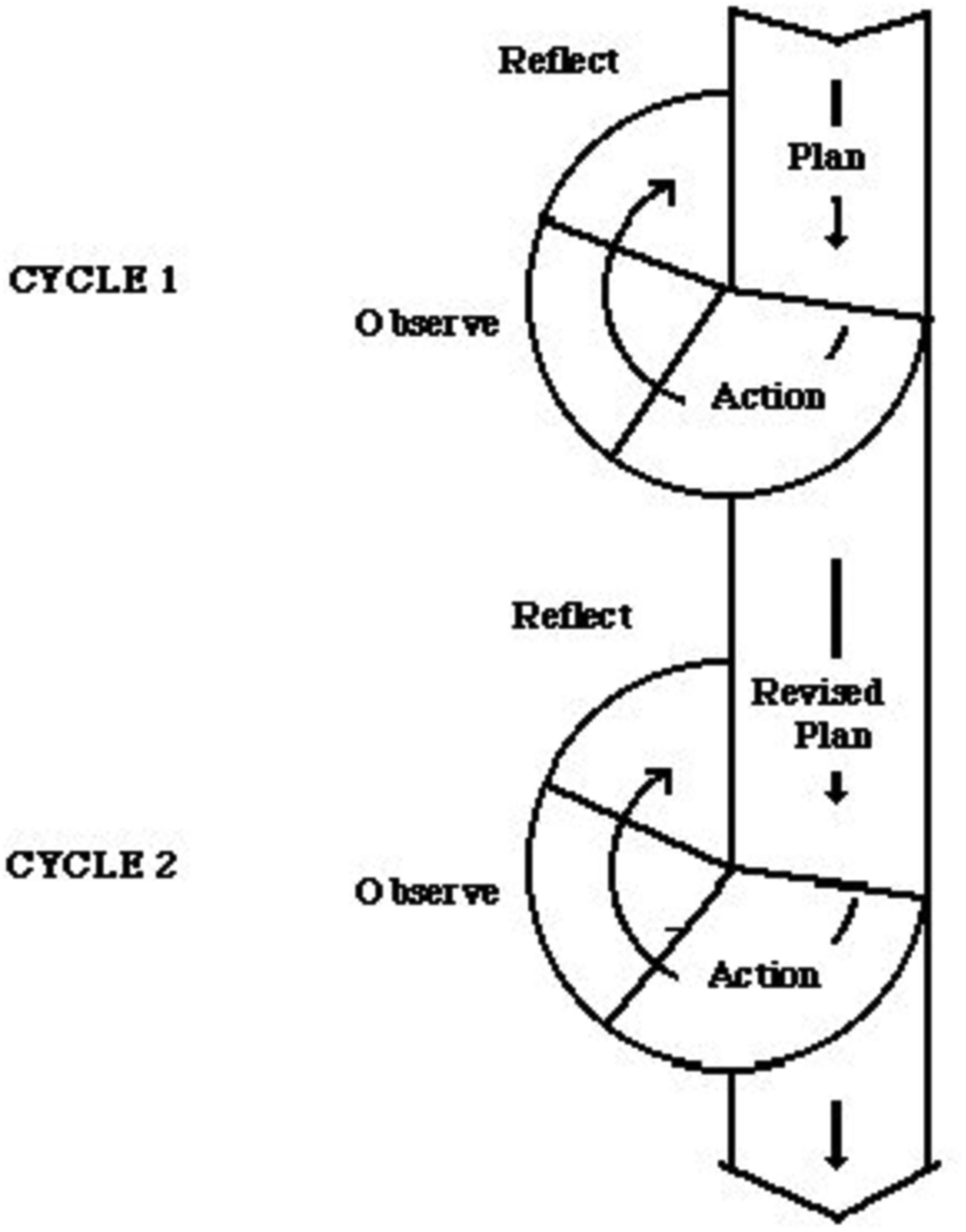
The action research process based on Kemmis (2009).
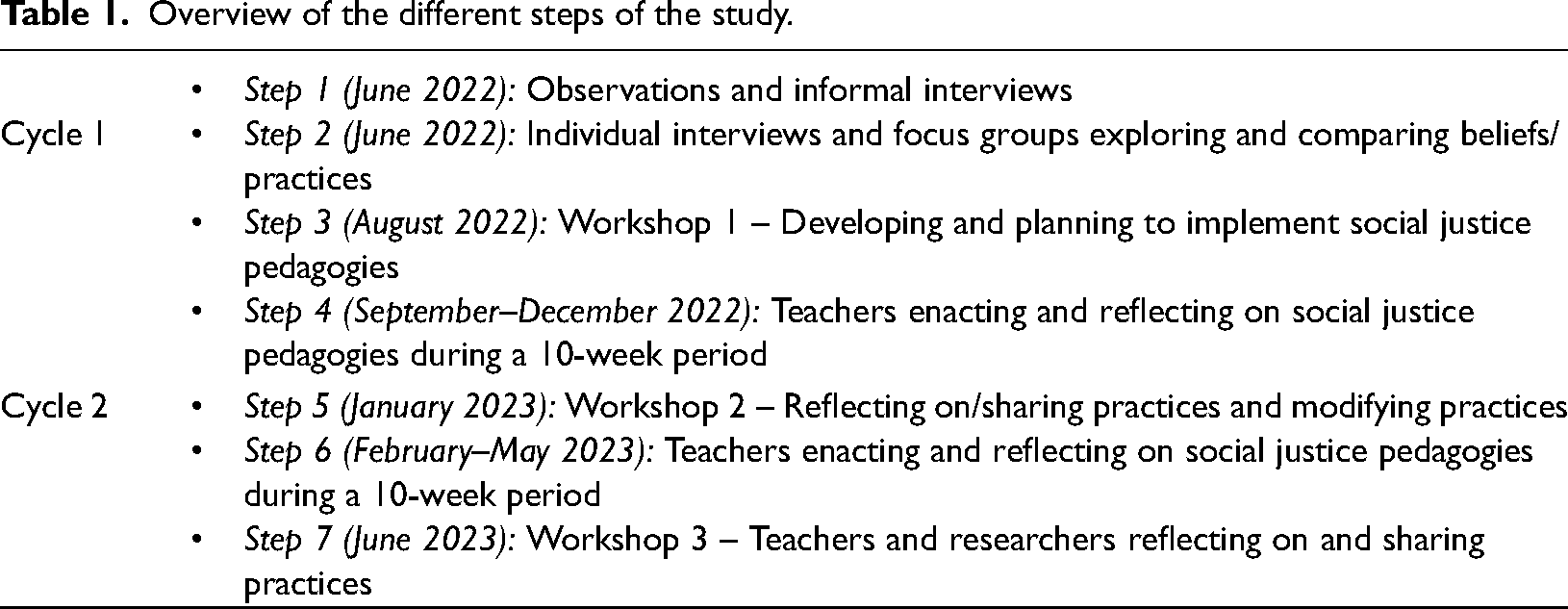
In total, the three researchers and the participant-teachers worked together over a 12-month period, from June 2022 to June 2023. Table 1 provides an overview of the different stages of the study.
Overview of the different steps of the study.
Research participants
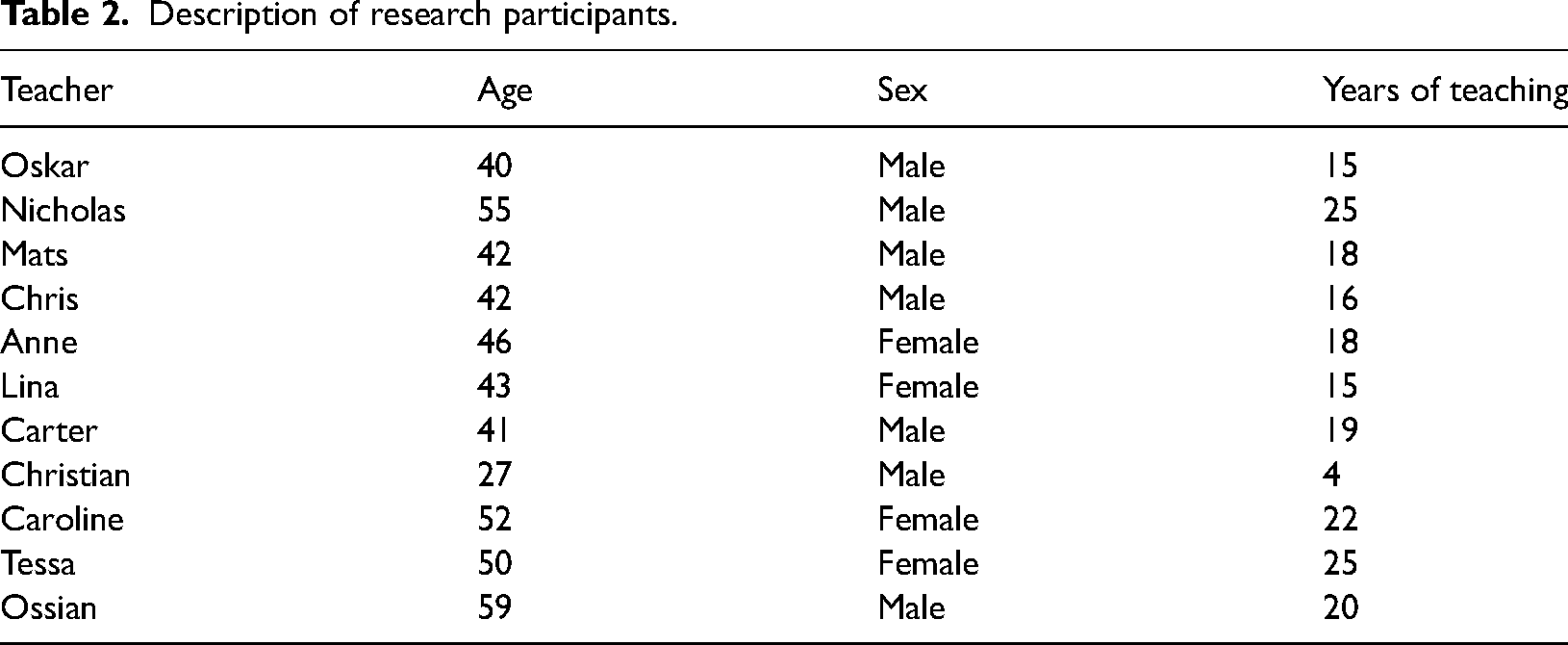
The two upper-secondary schools (students aged 16–19) and teachers involved in the study were selected through purposive sampling (Bryman, 2016) and are located in two different cities in southern Sweden. These two cities and schools were purposively selected due to the researchers’ previous relationship with them as part of the practicum component of their PEH teacher education programme. Some of the participant-teachers had also been involved in a previous research project. When discussing their involvement in the PAR study, and in order to capture a range of different perspectives on social justice pedagogies, it was decided that the entire PEH departments at these two schools (a total of 11 teachers) would participate in the study as part of their professional development. For a description of the research participants see Table 2.
Description of research participants.
Since no personal or sensitive data were collected, and all participants were aged 15 years or older, the study was considered low-risk and received ethical approval from a regional ethics committee (DNR: EPK 774-2021). Before the study commenced, the teachers were informed that their participation was strictly voluntary, that their anonymity and confidentiality would be guaranteed, and that the data collected would only be used for research purposes. All teacher names referred to in this paper are pseudonyms.
Data collection
As indicated in Table 1, the PAR study and associated data collection began with observing the participating teachers’ PEH lessons and conducting informal interviews immediately following these observations. In total, 11 PEH lesson observations and subsequent interviews were carried out. This first step was crucial for the researchers to become more familiar with both the PEH lesson context and the teachers. These observations and informal interviews also informed the second step by providing contextually relevant questions for the individual interviews (n = 11) and focus groups (n = 3, with 3–4 participants per group) that explored and compared the participant-teachers’ beliefs and practices related to social justice pedagogies in PEH. In particular, these individual interviews and focus groups asked questions about the teachers’ understandings of inclusion, equity, social justice and some of the main social inequities they experienced in PEH. Examples of broader, pre-determined questions asked during these interviews and focus groups included: How do you perceive the concepts of inclusion and equity? What issues related to inclusion and equality do you encounter at your school or in your classes? How do you address inclusion and equity in your school or teaching? and How do the curriculum and policy documents for PEH support or limit efforts toward inclusion and equity? Additionally, contextually relevant questions based on the observations included: How do you deal with students who, for various reasons, are unable or unwilling to participate in the regular lesson (e.g. act as bystanders or go for a walk)? How do you resolve issues with students who do not bring their PE kit or do not wish to get changed for the lesson and/or use the changing rooms? and How do you vary your teaching practices based on the particular student group (e.g. sporty versus non-sporty students) and type of class (e.g. students enrolled in academic or vocational programmes)? The interviews and focus groups ranged from 30 to 90 minutes in duration. They were audio-recorded, conducted and transcribed in Swedish, with excerpts later translated into English for reporting in this paper.
It is important to note that the researchers did not carry out any rigorous or formal data analysis (Cornish et al., 2023) as part of preparing for the first workshop (see ‘Data analysis’ section). Instead, at the first workshop, the researchers and teachers came together to discuss and negotiate the experiences and understanding collected during the first two steps. Based on a shared understanding of the importance of building relationships in PEH, it was decided that the teachers’ ‘action’ in the first cycle of the PAR study (Step 4) would focus on exploring and reflecting on this in practice. Throughout this cycle, the teachers were asked to keep a reflective journal (n = 11), which could be shared and discussed with the researchers at the next workshop (Step 5).
The teachers’ and researchers’ reflections on the action in the first cycle during the second workshop led to the teachers refining their broader focus on building relationships to being more specific about some of the key tenets of this form of social justice pedagogy (which are represented by the themes in the second findings section below). Step 6 then involved the teachers enacting and reflecting on these refined pedagogies for building relationships. In the final step, the teachers and researchers met once again during a final workshop where the focus was on sharing and reflecting on the practices enacted in the second cycle of the PAR study. All three workshops where audio-recorded, transcribed and included in the data analysis, along with the teachers’ reflective journals and the data collected during the observations, interviews and focus groups.
Data analysis
Data analysis in PAR studies is complex and typically occurs both throughout and after the study. It should be noted (as mentioned above) that no rigorous or formal data analysis (Cornish et al., 2023) was conducted during the two different cycles of the PAR study. The rationale behind this was that the researchers should not overtly influence the teachers’ decisions and reflections on their enactment of pedagogies for social justice. However, throughout the study and particularly in preparation for the first two workshops, where the teachers decided on the focus of their enactment of social justice pedagogies, the researchers developed what Fine and Torre (2019: 437) would call a ‘best bad draft’ analysis for the teachers to respond to and discuss. In the first cycle of the PAR study, this analysis cohered around what the teachers had expressed during the initial interviews concerning issues of inclusion, equity and social justice and how to promote these in PEH practice. In the second cycle, it involved attempting to identify and break down the key aspects of the teachers’ work on building relationships that they could then further enact and reflect on as part of cycle two.
Once the PAR study was completed, a formal data analysis was conducted. The data generated through observations, individual interviews, focus groups, workshops and teacher reflections were analysed through thematic analysis (Braun and Clarke, 2022) in alignment with principles of teaching for equity and social justice (Freire, 1970). More specifically, the analysis followed a six-phase thematic analysis approach consisting of familiarisation with the data, initial and advanced coding, identifying and naming themes, and reporting findings (Braun and Clarke, 2022). The first phase of data analysis was conducted by the principal investigator and lead author, who constructed a number of initial themes. In the next phases, the other two authors reviewed these initial themes and provided feedback. During this phase, the teachers were also asked to provide feedback on how well these themes represented their understandings and enactments of social justice pedagogies. The themes constructed during this phase were then compared and reframed based on the study's two key research questions. The final themes related to the first research question, which addressed the teachers’ understandings of social justice, were as follows: (1) inclusion, (2) equity/equality, (3) adaptations to teaching and assessment and (4) relationships. For the second research question, which focused on their enactments of social justice pedagogies, the themes were: (1) conditions for building relationships, (2) continuous engagement from teachers and students, (3) student involvement and reflection and (4) creating connections with and within the subject.
Findings
In the following sections, we present the findings from this PAR study in relation to the two key research questions regarding PEH teachers’ understandings and enactments of social justice pedagogies.
Understandings of social justice
Based on the first research question, the observations, individual interviews and focus groups explored the teachers’ understandings of social justice both in school generally and more specifically in PEH. The teachers’ responses demonstrated that they perceived social justice as encompassing inclusion, providing equal or equitable opportunities for all students, adapting teaching practices and assessment to meet students’ diverse needs, and building relationships.
Inclusion
When the discussions about the teachers’ interpretations of social justice began, many of them decided to first discuss this in terms of ‘inclusion’ and being ‘fully inclusive’, which meant that all students were given the opportunity to participate based on their own conditions. Some of the teachers responded as follows: That everyone should be able to participate based on their own conditions. That we as teachers give all students the opportunity to participate fully in the lessons. (Oskar, focus group) That all students are involved and participate in the lesson according to their own unique conditions. (Anne, individual interview)
The teachers also stated that students should be given the same opportunities to participate in the lesson activities, regardless of socio-cultural background factors, such as socio-economic status, ethnicity or disability. They believed that it was also the teacher's responsibility to include students who, for whatever reason, did not bring PEH kit to the lesson: The possibility to carry out the learning tasks regardless of socio-economic conditions, functional variations or prior experiences. (Nicholas, individual interview) That everyone can participate regardless of previous knowledge, if born in Sweden or not, and in PEH uniform or not. (Carter, individual interview)
Furthermore, the teachers described the need to apply individual adaptations according to the students’ specific needs and to design teaching practices where all students could participate based on their own conditions: For example, we had two students in wheelchairs, then we carried out as many activities as possible where they did not have to feel left out. When it didn't work for some reason, they always had the opportunity to adapt the activity to their own conditions. The carried out, for example, these stretching exercises where I could converse with them and they got to justify their choices of exercises that I could use as grade-based conversation. (Tessa, focus group)
Equity/equality
The second key concept expressed by the participant-teachers in their understanding of social justice was that it involved promoting ‘equity/equality’ in the PEH classroom. Some of the participants, for instance, highlighted that all students should be given the same conditions to develop their knowledge and abilities in the subject: Everyone must be given opportunities to perform at their level and according to their conditions in the subject so that they can reach as high as they can. (Anne, individual interview)
However, it seemed to be difficult for the teachers to distinguish between equity and equality. On the one hand, the teachers linked equity to expressions such as ‘the equal value of all people’ (Tessa, individual interview) and the belief that no one should be discriminated against because of sex, gender, functional variations, ethnicity or religion: That all students have the same value and must be treated equally, regardless of, for example, ethnic affiliation, sexual orientation or disability. (Christian, focus group)
Several of the teachers also chose to highlight the need to constantly treat students with dignity and respect. One of the teachers expressed this as follows: In order for the student to be able to have good health, we must treat the student with dignity and respect regardless of the background or obstacles the student has. (Ossian, focus group)
On the other hand, some argued that some students might need special treatment: It is important, for instance, when it comes to the changing rooms … to offer them their own changing room if someone has difficulty getting changed with others, find solutions together with the students so that everyone can participate. (Nicholas, individual interview) All students, based on, for instance, their gender, ethnic background, sexual orientation, should get the help and support they need to succeed to the greatest extent possible in the subject. The same applies if a student has any type of disability. (Tessa, focus group)
Christian problematised the dilemma from a fairness perspective, balancing the provision of equal opportunity with the achievement of greater equity of outcomes, and stated that ‘Sometimes injustice is the most fair and equal’. He further explained that: Equity is not only about gender or disability, but also about, among other things, origin, disposition. These factors are all important to take into account in our subject given that we have a subject that puts the students on display a lot. Sometimes injustice is the most fair and equal. Taking into account all these different aspects is not easy and requires a lot of time. But that time is well worth spending, even if in some groups you never seem to get there. (Christian, focus group)
Adaptations to teaching and assessment
When the teachers were asked to identify issues of social justice within their teaching practice, they tended to refer more to equality rather than equity. The teachers described compensatory and sometimes individualised approaches to achieve equality. These were some of the responses: Well, we have been dealing with this gender thing for the longest time, it feels like, you have it in everything from group divisions, who gets to do demonstrations, answer questions… For example, I let the students answer questions by giving the question to every other girl and boy… We try to adapt so that regardless of ethnicity they should feel that their previous experiences are taken advantage of and taken into account. As far as disabilities are concerned, it is often about using different aids to adapt practices to make it possible for students with various disabilities to participate. (Tessa, focus group) That this [adaptations to teaching and assessment] looks very different depending on the student and needs. A student with a disability may not always want to participate with the class but wants to be active. Do their own training sometimes or participate with the class sometimes depending on the activity. (Mats, focus group)
Indeed, many of the teachers talked about differentiated teaching and assessment. They said they worked to offer different approaches and extra adaptations for all students to reach the achievement goals in the subject. They planned lessons to enable students’ learning in several ways, for example, by offering opportunities for students to practise their skills in different ways through different activities and degrees of difficulty: I offer many opportunities to pass the knowledge requirements, offer alternative forms of teaching both verbally, in writing and physically. (Mats, focus group) Different learning tasks have the same goal, but different exercises. Like for example, to be able to rotate, which the student can demonstrate in different ways by doing somersaults on the mat, rotating forward in bars or rings. (Nicholas, focus group)
The teachers also disseminated information in different ways, for example, in writing or orally, through imagery or video clips. The teachers highlighted that they usually varied their type of assessment according to the students’ needs, where the students, in some cases, had the choice of assessment type, as the following quote illustrates: That they can take an oral test if they have dyslexia or that they can choose which strokes they want to be assessed in volleyball if they have any muscle disease, etc. (Mats, focus group)
The teachers also raised several scenarios when extra adaptations should be implemented, linked to the students’ personal needs, disabilities and religious factors. One teacher mentioned that when regular teaching is not enough to include all students, he usually had ‘individual conversations with the students who need additional support’ (Oskar, individual interview). Another teacher described how students were sometimes offered a separate changing room for religious reasons, but when this was not possible, learning activities were adapted so that getting changed was not a requirement: Some students are not allowed to get changed with others for religious reasons, and then we try to find their own changing rooms or other possibilities to facilitate this. However, it can be difficult as it is dependent on the gym facilities. I do what I can to influence but also try to adjust the teaching so that changing is not a requirement every time. It's good if there is some free time after the lesson so that the students can possibly go home and shower before the next lesson starts. (Christian, individual interview)
However, the teachers also used other strategies to create a more equitable teaching space in PEH. Many of them, for instance, reported that they modified activities and games by removing or adding rules. These changes could include requiring students to complete a certain number of passes before being allowed to score or replacing the traditional ball with a different type of ball, as illustrated in the following quote: For example, when we have ball sports, I offer different kinds of ball games that are not the traditional ones. It can be with different kinds of balls, equipment, short passes, changing teams, etc. This is appreciated by many and often makes it fairer and more inclusive for everyone. (Oskar, focus group) In ball games I often adapt games to include a certain number of passes before a goal is scored, more balls, etc. If, for example, someone in the class is in a wheelchair, adapt the rules so that the student can participate. (Mats, individual interview)
The teachers also said that they offered different approaches by ‘level-adjusting their teaching’ (Anne). For example, they used various ability maps in orienteering and provided different levels of difficulty on obstacle courses. The teachers described how the activities were adapted in different ways depending on the students’ abilities: For example, if you are going to have an obstacle course, there must be many different ways to get around and where different degrees of difficulty are included so that it becomes a challenge for everyone. The exercises/stations need to be as varied as possible so that those who are strongest/fastest are not always the ones being the ‘winner’… Even if we are careful that it should not be a competition and we de-emphasize this, there are always some who compete anyway. (Nicholas, focus group) For example, when you do orienteering, this does not have to be timed. The focus should be on being able to read a map, hold a map and move with a map. Moving quickly is coordination and cardio training. If you are in a wheelchair, are in cast or have weak muscle strength, the activity can take place on a smooth, paved surface. Being in the forest is then not a must. Relays can be carried out in pairs to make it easier for the visually impaired. (Anne, focus group)
Relationships
Underpinned by the importance the teachers placed on students developing strong and secure relationships with each other and with the teacher in their understanding of social justice, they described different ways of building relationships with the students. One of the teachers conveyed the significance of all ‘students being seen by the teacher’ (Oskar, focus group), talking to and greeting all students, and paying attention to their progress. The teachers believed that a close relationship with the students enabled the adaptation of PEH practices to the students’ interests. The teachers also highlighted the importance of using the same group division for a longer period of time in order to create safe and trusting relationships and build a sense of community. The teachers explained their efforts to build relationships in the following way: When you have a relationship, it is easier for me and the student to talk to each other about problems that arise that make it difficult for the student to reach certain goals. After that, the student and I can come up with adaptations that will make it easier for the student to reach the goals. (Anne, individual interview) The relationship and communication between teacher-student, student-teacher is also incredibly important. If there is no communication, the consequence can be that some students fall through the cracks. (Mats, focus group)
The teachers emphasised the importance of spontaneous conversations with the students, for example, in the classroom or the corridor before and after the lesson, because ‘valuable information can be exchanged and trust strengthened’ (Oskar, focus group).
Enactments of social justice pedagogies
After being observed and interrogating their understandings of social justice pedagogies, the teachers decided to focus their ‘action’ in the PAR study on building relationships. Establishing good relationships with the students was identified as the most crucial prerequisite for developing social justice pedagogies in PEH, grounded in a safe and trusting environment. As described in the data collection section, the first cycle involved a broad focus on building relationships. However, the experiences and reflections from this first cycle led to a more nuanced understanding and a refined approach to relationship-building. In the participant-teachers’ experiences of attempting to build relationships in the name of social justice in PEH over the course of the two cycles of the PAR study, four central themes can be discerned.
Conditions for building relationships
The first theme concerns the starting point in creating conditions for building good relationships. For example, the teachers initially discussed aspects related to their overall work situation and efforts to ensure they had the necessary resources and appropriate class compositions. In the first workshop, one of the teachers (Christian) said the following: Being able to build good relationships with the students is all about having the access to the right resources and yeah, well, having classes that are not too big. I mean it is really hard to build relationships when you have like 15 PEH classes per week and each class has nearly 30 students. That's like 500 students to build a relationship with. (Christian, workshop 1)
Despite these challenges, the teachers also emphasised the importance of creating a safe, trusting and welcoming environment for the students both before and after the lesson. Many of the problems that seemed to have arisen in connection with the PEH lessons, according to the teachers, involved students’ anxiety or fear of, for example, being in the changing room or being subjected to harassment in various ways during the lesson. In the initial focus group, where the focus was on exploring the teachers’ identification of social justice issues in their practice, the teachers said that sometimes this involved students being verbally or physically abused before or after the lesson based on what took place during the lesson. The teachers then gave examples of what they had started doing as a result of these issues being highlighted in the PAR study to create a safer and more respectful environment. Oskar, for instance, stated: Yeah, we work really hard on making sure that the students feel welcome and a sense of belonging. You know, making sure there are no issues in the changing rooms and that the students get to know each other better. We have also introduced stricter rules around phone use, which many students felt was an issue before, during and after the lessons. (Oskar, workshop 2)
Another strategy that the teachers developed as part of the study in their effort to improve the conditions for building relationships was collaborating with teachers from other subjects and with school management: We are now more active in involving the rest of school staff like the principal and class mentors to support our work on inclusion and equity. There is greater awareness now from everyone which really helps. (Tessa, workshop 3)
Continuous engagement from teachers and students
The second theme identified in the data focuses on creating relationships right from the start and jointly establishing a form of ‘social contract’ with the students regarding their behaviour during lessons and towards other students. In the final workshop, one of the teachers (Caroline) reflected on her involvement in the PAR study and the new practices that were developed: As part of being involved in this project we now in Year 1 together with the students come up with a form of social contract which involves how the students should behave towards each other and the teacher where we now put a big focus on inclusion and equity. (Caroline, workshop 3)
What the teachers further experienced and reflected on during the year-long PAR study is that building relationships is not something that can be done just at the beginning of the school year, but rather needs to be an ongoing effort throughout the year. The teachers found that they especially needed to work hard on building and maintaining relationships at different points throughout the school year and course of the PEH programme. Based on their experiences and reflections from the PAR study, the teachers now tried to use their time beyond PEH lessons to interact with students more often outside the classroom. This included meeting with them in other school environments and engaging in conversations both individually and in groups: We try to seek out our students in breaks and sit down with them at lunch time and talk about everything from the latest football game to what we are doing next time in PEH. (Christian, workshop 3)
Student involvement and reflection
The third theme evident in the teachers’ efforts to enact pedagogies that foster strong relationships centres on actively involving students in the teaching practice in various ways, including its structure and evaluation. The focus was not only on subject-specific knowledge, but also on social and generic abilities, such as empathy and (self-)reflection: I now try to involve the students even more, not just like what sport they want to play or what type of exercises they like to do but I also make them think, talk about and assess the interaction and learning that takes place. Like if everyone is included or able to learn but also how well they behave towards each other, like is he or she being a good team- and classmate. (Mats, workshop 3)
One of the other participant-teachers provided an example of how they had developed a practice at their school that involved having the students reflect on how the PEH lessons were experienced physically, psychologically and socially. In the workshop at the end of the PAR study, Caroline stated: I now want my students more and more to reflect on how they feel when they do different activities, not only physically but also mentally and socially. (Caroline, workshop 3)
Creating connections with and within the subject
The fourth theme in the teachers’ development of practices that build good relationships centres on creating a relationship or a connection with and within the subject for the students. In relation to this theme, the teachers reported on how they now work with their students to include different types of content and activities in PEH, using different strategies to help more students develop a positive relationship or connection with the subject and its purpose. At the end of the PAR study, Mats reflected on his changed practices: My goal as a teacher has always been for students to find some sport or type of physical activity that they like and will carry on with later in life and I used to always have lots of different things that they could try in PEH but now [as a result of being involved in the PAR study] I more try and get the students to come up with and find new activities so in a way they are changing what we do but they still have to argue how those activities help them achieve the goals in the curriculum. (Mats, workshop 3)
One of the other participant-teachers (Oskar) chose in the final workshop to stress the importance of maintaining a continued and continuous focus on building good relationships between both students and teachers to promote greater inclusion and equity in the PEH classroom: Adapting your teaching practices has in recent years become a prerequisite for successful teaching that reaches everyone. It is important that you as a teacher maintain a safe and trusting environment where there is an accommodating and non-judgmental climate where the students dare to participate and feel that they are able to succeed. (Oskar, workshop 3)
Discussion and conclusion
The overall aim of this paper was to explore Swedish PEH teachers’ understandings of social justice and their enactments of social justice pedagogies. The teachers’ perceptions of social justice in PEH were broad and suggest that there is no precise answer to what social justice means within this context (Robinson and Randall, 2016). Nevertheless, the majority of the teachers’ perceptions in this study share some common features, particularly related to the interrelated concepts of inclusion and equity.
The teachers described inclusion as an approach that ensures all students can participate based on their own conditions, feel safe and have good relationships in the classroom (Mordal Moen et al., 2020). In the teachers’ descriptions of inclusion, it was also evident that it is not the students who must adapt to teaching practice, but the teachers who must adapt their teaching to the existing student group. Indeed, Standal (2015) believes that inclusive teaching practices in PEH not only enable participation for all students, but also provide students with the opportunity to participate at a level that is best suited to them and their unique conditions.
When describing equity, the teachers mentioned that equity does not mean that everyone receives the same, but rather it is about creating equal conditions or opportunities for all students to develop and reach achievement goals, regardless of their socio-cultural background. As suggested by Standal (2015), most of the teachers in the study believed that the students, regardless of gender, ethnicity, social background, sexual orientation or (dis)ability should be offered adaptations according to their own abilities. Equitable and socially just teaching methods are therefore about working in different ways to equalise the differences that exist between students, which means that teaching practices can or should never, or seldom, be designed equally for everyone (Larsson, 2016; Philpot et al., 2021). However, the findings also revealed some confusion among the teachers regarding the difference between equality and equity. This confusion could possibly be explained by the fact that, in Sweden, it is legally problematic to categorise people and provide extra support or treatment based on factors such as gender, ethnicity and sexual orientation, as this can lead to further discrimination and marginalisation (SFS, 2008: 567). Rather, the teachers expressed the view that all students, regardless of background, should receive the same opportunities. Another explanation could be that the teachers simply conflate and use the terms equality and equity interchangeably (Evans and Davies, 2017). Nonetheless, there is a risk that PEH teachers may be too focused on providing equality of opportunity rather than achieving greater equality of outcome for their students (Philpot et al., 2021).
In the quest for greater inclusion and equity, the teachers in this study also highlighted the importance of differentiated teaching and assessment. Several teachers described how they employed different didactic choices in their teaching to facilitate more inclusive and equitable learning environments (Lynch et al., 2022). Furthermore, some of the teachers, recognising the dominance of competitive, sporty male students in Swedish PEH (Larsson, 2016; Larsson et al., 2018; Quennerstedt, 2019), provided examples of how they addressed these social inequities by, for instance, avoiding traditional competitive sporting activities and assigning speaking turns based on gender (every other girl/boy). Other teachers gave examples of how they ensured that students with different disabilities could participate and develop in the subject according to their own conditions. This indicates that these teachers have the ability to identify marginalised groups and social inequities and to counter these inequities without disadvantaging any group, which Tinning (2012) believes is essential for creating more inclusive PEH practices. The use of differentiated and modified activities in PEH may not only facilitate a more inclusive and socially just learning environment, but may also raise students’ awareness of issues of positionality and power that certain activities are constituted by. These findings signal the importance of teachers helping their students to ‘live with and learn from what is different’ (Freire, 1998: 24) than what is commonly found in the PEH classroom.
One of the recurring themes in this study reaffirms the need to build relationships and create a safe classroom environment in PEH to achieve greater inclusion and equity (Cuervo, 2020; Huitfeldt, 2015; Mordal Moen et al., 2020). Huifeldt (2015) emphasises the importance of good relationships in understanding how teachers should relate to and respond to different students in the class. The teachers in this study, similar to what Mordal Moen et al. (2020) reported, emphasised that building good relationships with students involves getting to know them, and their interests, needs and experiences. Many of the participant-teachers spoke about PEH as a space were they, as teachers, need to show the students that they genuinely care about them and want to know more about them not only as students, but also as individuals outside of school. The teachers, for instance, recounted how they caught up with the students during breaks and lunch to talk about everything from homework, music, food and sport to the latest television series they were watching. The results thus show that the teachers in this study have a commitment and a willingness to collaborate with the students and spend time getting to know them to create inclusive and equal teaching. The teachers’ responses also highlight the importance of student influence on PEH practice. Oni and Adetoro (2015) argue that a lack of student influence can result in teaching that is not adapted to the students’ interests, experiences or needs, which is incompatible with inclusive and equitable teaching practices. Ultimately, Penney et al. (2018) believe that it is through the teacher's positive and caring attitude and ability to relate to and collaborate with the students that more inclusive and equitable PEH practices are achieved. Teachers showing that they care, have empathy for their students and actively build good relationship between both teacher and student and among the students themselves can be seen as the first step towards creating an inclusive, equitable and socially just learning environment in PEH. Indeed, Freire (1970) suggested that to achieve a critical consciousness and make a change in praxis, horizontal relationships built on trust and love must first be established. In this sense, pedagogies of care for all students and pedagogies that build relationships can be seen as foundational pedagogies for social justice in PEH (Mordal Moen et al., 2020).
In conclusion, the engagement of the PEH teachers in this PAR study provided them with time and space where, together with other teachers and researchers, they could explore and negotiate their understandings of how issues of inclusion, equity and social justice come to matter in PEH practice. It also offered them an opportunity to co- and (re)construct localised and subject-specific practices aimed at greater inclusion, equity and social justice. In particular, these participant-teachers were able to identify and further develop pedagogies based on a shared sense of the importance of building relationships in PEH. The teachers entered the PAR study with a broad understanding that good relationships were important, but through their experiences and reflection in this study, they were able to collaboratively refine and define some of the key tenets of pedagogies that build relationships between both teachers and students, and among students themselves. Similar to Alfrey and O’Connor’s (2020) study with Australian teachers, we acknowledge the challenge of transforming practice, but we also argue that this PAR study provided these teachers with the time and space to engage in repeated action and reflection, which has the potential to continue ‘to be transformative of their identities and philosophies as [H]PE teachers’ (299).
However, when reflecting on the outcomes and experiences of this PAR study, it appears that the teachers, to a great extent, continued to focus on managing inequities within the framework of established teaching content and taken-for-granted knowledge within the subject (Philpot et al., 2021). The difficulties for the teachers in challenging assumptions based on prevailing notions of what constitutes PEH practice are clearly noticeable. The teachers in this study, for instance, often chose traditional and competitive sports and ball games that therefore required adaptations to be more inclusive, rather than selecting other forms of content that would require fewer adaptations. At the same time, perhaps this is, to some extent, an impossible task for individual teachers and schools, as they are still heavily influenced by a persistent PEH culture underpinned by discourses of sport, performance and competition (Linnér et al., 2022). One of the teachers (Tessa) in this study did, however, provide ‘a glimmer of hope’ in this regard when, in the final workshop, she questioned why the Swedish school subject is still called ‘idrott och hälsa’ (where despite the common translation as ‘physical education and health’, it could also be translated as ‘sport and health’) and suggested that a better name would be ‘rörelse och hälsa’ (‘movement and health’) to challenge the ongoing dominance of sport in PEH practice. The question therefore remains as to how teachers can be encouraged both to address the inequities that students bring to the classroom and, at the same, to challenge the norms and dominant discourses that make these inequities matter. Regarding the teachers’ ability to challenge and change the norms that pervade PEH, there still seems to be a need for further education and perspectives that can help teachers take this step in their understanding and enactment of social justice pedagogies in PEH practice.
Footnotes
Acknowledgements
We would like to thank the Swedish Research Council for Sport Science for financing the project upon which this paper is based. We would also like to thank all the teachers who participated in this study.
Declaration of conflicting interests
The authors declared no potential conflicts of interest with respect to the research, authorship, and/or publication of this article.
Funding
The authors disclosed receipt of the following financial support for the research, authorship, and/or publication of this article: This work was supported by the Centrum för idrottsforskning (grant number CIF 2021/9).
