



Abstract
This article investigates selected processes of self-regulated learning (SRL) in online string instrument lessons. We explore: (i) the factors that motivate teachers and students to commence and maintain online teaching and learning, (ii) the synchronous and asynchronous social interactions that occur between teachers, students and peers and (iii) the structuring of the online/physical learning environment. The participants were five international string teachers and six students, voluntarily teaching and learning online in a non-formal educational context. Data sources include lesson observations, semi-structured interviews and questionnaires. A theoretical’ thematic analysis method was used to analyse the data. The findings indicate that the possibility of online lessons overcoming geographical barriers led to the involvement of teachers and students, and persistence came with the realisation of student performance progress. Teachers attempted to overcome the impracticability of technique-related physical manipulation by stimulating students’ mental imagery. They also reported the importance of exploring interactions through social media platforms to encourage students to seek help. To account for lessons taking place at students’ homes, teachers reinforced the importance of providing instructions to promote environmental structuring. Finally, despite the physical distance, teachers affirmed that they established bonds of affection with students.
Keywords
Introduction
In the online teaching and learning context, teachers are not physically present, and sometimes their interactions with students do not occur in real time. Communication is entirely facilitated by technology and may occur simultaneously (synchronous communication tools) or at different times through online platforms that can be accessed at any hour (asynchronous communication tools). Research has suggested that these characteristics require students to assume greater responsibility for their learning, as they have fewer external regulations due to the physical absence of the teacher and greater flexibility in terms of time and place to learn (Azevedo et al., 2008; Broadbent & Poon, 2015; Pelikan et al., 2021; Schunk & Zimmerman, 1998).
Consequently, the investigation of self-regulated learning (SRL) in online lessons has garnered greater focus in recent years, and researchers indicate a strong link between self-regulation and students’ academic success in online courses (Xu et al., 2023). Although there have been studies examining self-regulation in online general education (Bol & Garner, 2011; Broadbent & Poon, 2015; Jansen et al., 2020), and works exploring self-regulation in musical learning through digital tools and in blended and emergency remote teaching contexts (Brook & Upitis, 2015; Montgomery et al., 2019; Mutavdžin et al., 2021; Wan & Gregory, 2018; Wan et al., 2023), we found a research gap in the exploration of SRL processes in online instrumental lessons – particularly those involving string instruments. Thus, based on the premise that online lessons have particularities since interactions are mediated by technologies and teachers and students are in different learning spaces, in this study, which is grounded in the works of Zimmerman (1998) and McPherson and Zimmerman (2011), we intend to explore processes associated with the following dimensions: motivation (e.g. factors to start and continue learning and teaching online), online/physical environment (e.g. promotion of environmental structuring) and social factors (e.g. synchronous and asynchronous interactions, promotion of interaction between students and affective aspects).
Theoretical framework
Self-regulated musical learning
According to Zimmerman (2000), ‘self-regulation refers to self-generated thoughts, feelings and actions that are planned and cyclically adapted to the attainment of personal goals’ (p. 14). This concept is rooted in Bandura’s (1986) cognitive social theory, which views self-regulation as a triadic process encompassing personal, behavioural and environmental processes. Zimmerman (1998) and McPherson and Zimmerman (2011) categorised a series of self-regulation musical learning processes (e.g. setting goals, selecting task strategies, self-monitoring, environmental structuring and help seeking) into six dimensions, namely: motive, method, time, behaviour, physical environment and social factors. Thus, these authors see SRL as a theory composed of multidimensional processes. In the music SRL literature, it is common for researchers to choose to analyse processes of specific dimensions depending on the aims or sources of data collection of the project (see Dos Santos & Gerling, 2011; Miksza et al., 2012). This article will focus on the self-regulation sub-processes of the motive, physical environment and social factors dimensions.
The motive dimension encompasses, for example, the processes that make students get involved with and continue learning (McPherson & Zimmerman, 2011). The physical environment dimension includes behaviours such as environmental structuring, that is, choosing a place without distractions, and tools to support learning and to maintain focus (Zimmerman, 1998). Seeking help from teachers, parents and peers, and using external resources such as books and video recordings, are self-regulated behaviours categorised in the social factors dimension (McPherson & Zimmerman, 2011). Since SRL is based on a theory of social learning, this last dimension also encompasses social-interactive processes and affective aspects related to these interactions.
Literature review
As highlighted in the introduction, a lack of work that uses the SRL theory to explore online lessons of musical instruments, especially string ones, was found after searching databases. Thus, this session highlights works exploring hybrid courses, digital tools and remote classes from the lens of self-regulated learning. The results presented intend to focus on the processes of the dimensions addressed in this work (motive, social factors and online/physical environment).
Self-regulated musical learning through digital tools in face-to-face, online and blended educational settings
For face-to-face musical lessons, researchers have explored digital tools that facilitate the development of students’ self-regulated practice behaviours (Brook & Upitis, 2015; Wan & Gregory, 2018; Wan et al., 2023). Wan and Gregory (2018) analysed 15 digital tools to understand how they could increase students’ motivation to practise. The results indicated that a limited number of selected tools helped students in this regard. One of these, also investigated by Brook and Upitis (2015), was an online digital portfolio called iSCORE, which incorporated self-regulated learning principles and was designed to support goal setting, learning new repertoires and teacher–student and student–student interactions outside of the lesson. According to Brook and Upitis (2015) and Wan and Gregory (2018), this tool helped students to be more self-regulated through features that supported interaction and collaboration between teachers and students and facilitated the receiving of feedback beyond regular lessons.
Wan et al. (2023) investigated how use of a software application influenced piano beginners’ self-regulation during practice. The results indicated that some features of the app, such as those that allowed students to hear the music that they were practising at different speeds and those that allowed them to hear piano hands separately, helped students to develop aural familiarity, problem solving and adoption of task strategies. The study also emphasised the crucial role of the participating teacher in encouraging the use of the application, since, when the teacher did not facilitate its use, the students did not fully explore its functionality and potential benefits.
In the online or blended music learning contexts, we found a limited number of works that used SRL as a theoretical lens. Montgomery et al. (2019) analysed students’ self-regulated behaviours through their interaction with materials available in an online learning environment of a blended Music Teacher Education course. The self-regulated behaviour most associated with good academic performance was access frequency, and the authors also highlighted the importance of building an online environment that supports students’ adoption of self-regulated behaviours.
Online music education and the COVID-19 pandemic
Mutavdžin et al. (2021) investigated student perceptions of their teacher’s promotion of SRL before and during the COVID-19 pandemic. Their findings indicated that students perceived more significant support from teachers to self-regulate their learning before the pandemic than during; moreover, during the pandemic, students who had in-person meetings felt more encouraged by their teachers to engage in self-regulated learning processes. The work by Mutavdžin et al. (2021) is part of the body of research that reported the experiences of teachers and students in remote lessons during the COVID-19 health crisis.
Various terms are used to define the distancing protocols implemented to prevent the spread of SARS-CoV-2, and most of them do not adequately define distance learning models adopted on an emergency basis. For Hodges et al. (2020), the term emergency remote teaching (ERT) is better used and differs from other terms carefully defined by authors in the field of distance education (DE) and online education (OE). For them, OE has been considered for decades and is characterised as a planned and systematised instruction, unlike ERT, which is adopted temporarily as a response to a specific circumstance where not all students have access to technological resources, and there is no systematic planning of teaching and learning activities. Furthermore, in ERT contexts, teachers and students do not voluntarily get involved in teaching and learning, and this may influence their motivation levels (López-Íñiguez et al., 2022; Shaw & Mayo, 2022).
Thus, it should be noted that literature on online music education argues that the online format requires planning and pedagogical change (Gohn, 2020; Johnson, 2020), as it involves more than simply transposing traditional classroom methods to a computer interface. For example, the literature investigating online instrumental lessons in formal learning contexts reported that it requires an interdisciplinary team formed of teachers, sound engineers and instructional designers (Davies, 2015; Levinsen et al., 2013) and should provide interaction not only through synchronous communication tools but also asynchronous ones (Okan & Arapgirlioglu, 2019).
Understanding the distinctions between OE and ERT is crucial in the context of this study. Even though the data were gathered during the COVID-19 pandemic, it is important to stress that both teachers and students had already willingly embraced the online modality rather than finding themselves suddenly obligated to do so. Participating teachers actively planned and organised their teaching practices for this format and were not adapting or improvising their lessons. Hence, considering its specific characteristics, this research falls within the domain of online education in non-formal learning settings.
Aim and research questions
This research aims to explore the motivation, social interactivity and learning environment aspects in online string instrument lessons, utilising the SRL theoretical framework developed by McPherson and Zimmerman (2011) and drawing from the existing literature on online instrumental instruction. The research questions that guide this study are:
RQ1: Why do students and teachers choose online tuition, and why do they continue to use this modality? Are there demotivating factors that affect them in this experience?
RQ2: What particularities exist in the synchronous and asynchronous social-interactive exchanges between teachers and students?
RQ3: How do teachers encourage students to interact with their peers, seek help, consult other resources and structure their learning environment?
Method
Participants and sampling
Three violin and two cello teachers, and six students participated in this study (see Table 1). Data were collected from October to December 2021, during which period some participants’ countries of residence were adopting distancing measures to contain COVID-19. Purposive sampling (Robson & McCartan, 2016) was used to identify teachers and students who voluntarily taught and learned online and were fluent in Portuguese, based on the already highlighted differences between ERT and OE (Hodges et al., 2020). The invitation to participate was made via a disclosure on social media. The interested teachers went through a screening process to check whether they met all the criteria for participation (Schoch, 2019). All teachers held a music degree and taught Western classical music in non-formal contexts (private lessons and a public university extension course) in countries in South America, North America and Europe. Furthermore, the chosen teachers each had more than 5 years teaching experience, and three of them had already been teaching online prior to the pandemic.
Participants.
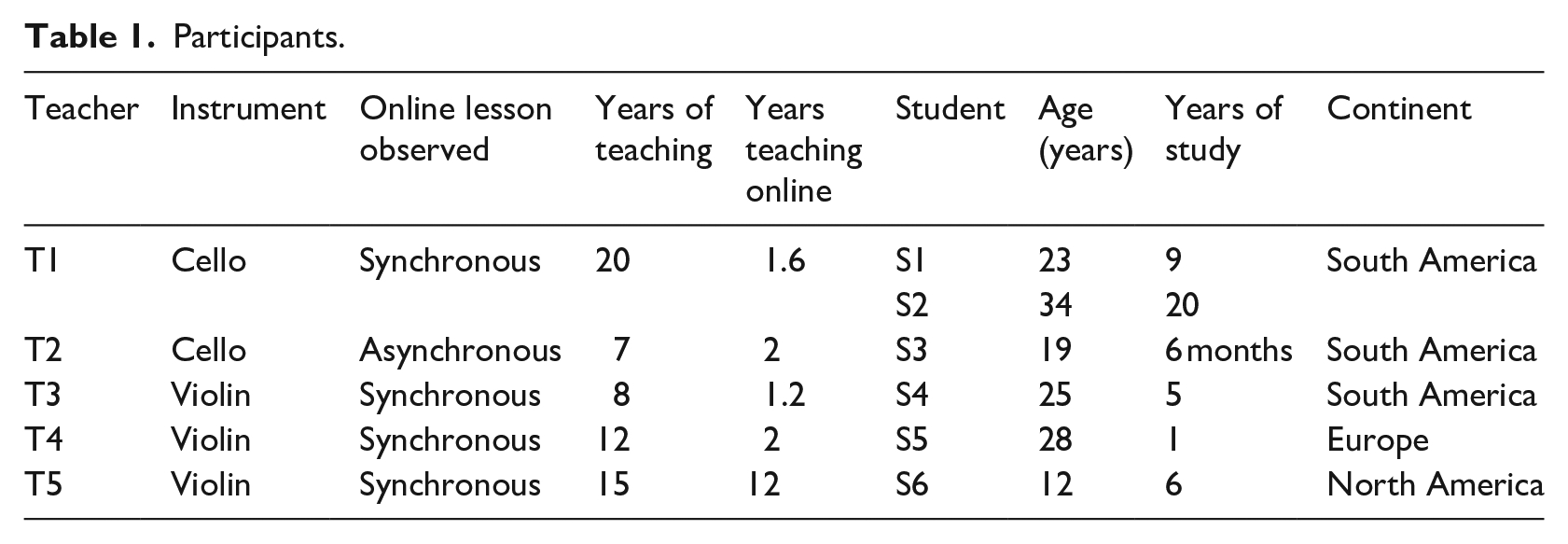
The teachers selected the students according to the criteria given by the researchers: over 12 years old and not professional musicians. Given that a teacher’s repertoire for teaching self-regulated learning strategies depends on the student’s age (McPherson & Zimmerman, 2011), the inclusion of participants across a spectrum of ages and at various stages of instrumental proficiency development was sought to guarantee a comprehensive data set. The sample size aligns with a traditional characteristic of case studies in qualitative research since the focus is on ‘a specific event, person, place, thing, organization or unit’ (Schoch, 2019, p. 246).
All teachers gave one-to-one lessons, except T1, who gave group lessons. The Council of Ethics of the University of Aveiro approved the data collection, and participants gave their informed consent.
Data collection and analysis
A collective case study (Stake, 2000) was conducted where each teacher–student(s) dyad was considered a case, using the following data sources: video recordings of lessons, semi-structured interviews, questionnaires and the researcher’s field diary.
We analysed three synchronous lessons each from T1, T3, T4 and T5, ranging from 30 to 60 minutes. T2 and S3 exchanged recordings – T2 sent video lessons, and S3 submitted performance recordings to be examined by T2 – consequently we analysed four of T2’s video lessons, ranging from 5 to 8 minutes in duration, alongside nine recordings from S3, lasting between 1 and 4 minutes. Overall, we coded a total of 10 hours and thirty minutes of lessons recordings.
Semi-structured interviews were conducted with the teachers, examining their pedagogical practices, specifically those promoting SRL skills in online lessons. The lessons were video-recorded to analyse both teacher and student behaviours. We also sent an online questionnaire to students to gather demographic data and their perspectives on learning online. The first author observed and recorded the lessons and conducted the interviews.
Using SRL theory as a lens, we conducted a theoretical thematic analysis (Braun & Clarke, 2006). Firstly, we seek to understand the motivational bases of teachers and students to learn and teach online voluntarily (Q1). This theme emerged from specific questions we asked participants (e.g. ‘What motivated you to take/give online musical instrument lessons?’; ‘What are the positive and negative points of taking/giving online lessons?’). The codes generated from this exploration were associated with the motive dimension based on the premise that this dimension is related to one’s efforts to initiate and continue learning (McPherson & Zimmerman, 2011). In this category, the teachers’ points of view were also considered since their motivations and demotivation factors can influence their pedagogical practices, one of the themes of interest in this work.
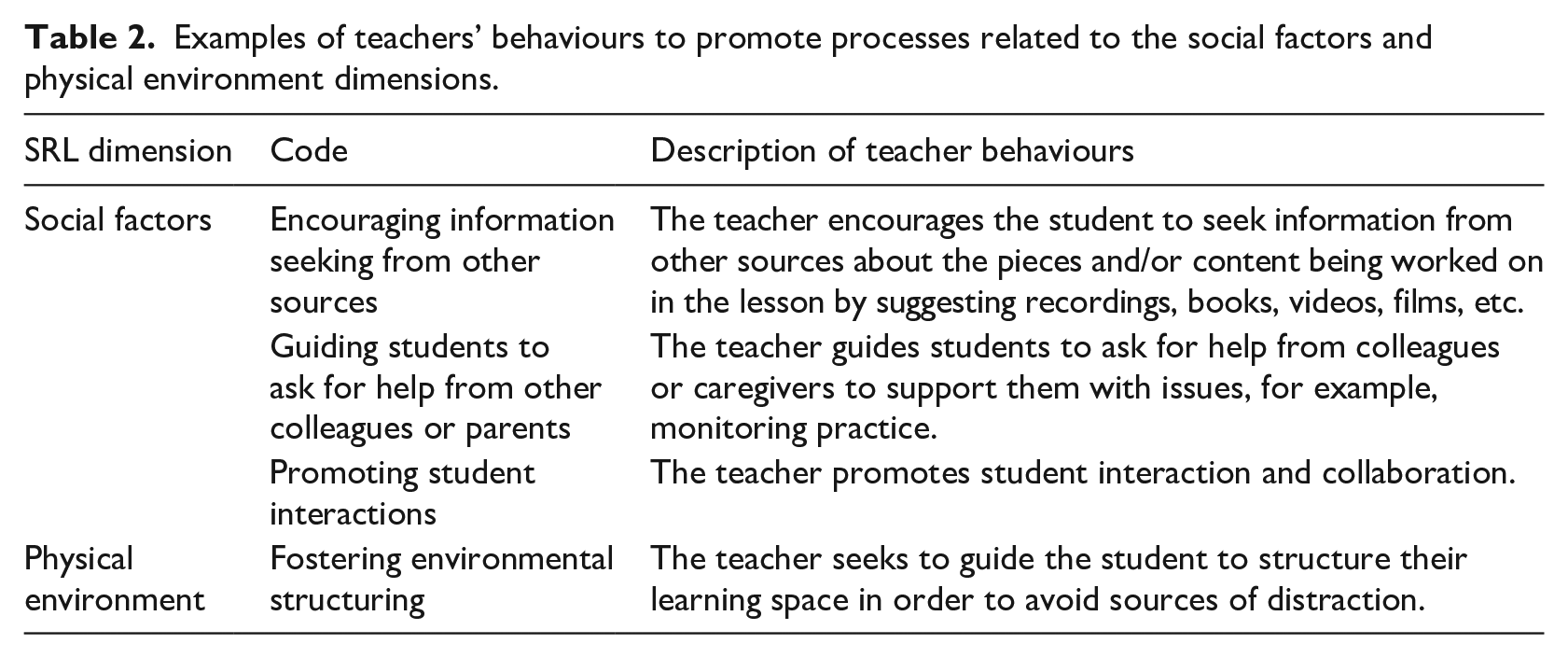
Related to the dimension of social factors, the particularities of social interactions in online lessons and the mediators responsible for them (synchronous and asynchronous communication tools) were included in our analysis (Q2). Subsequently, based on Miksza (2012) and McPherson and Zimmerman (2011), we analysed teachers’ instructions to promote SRL principles related to the social factors and physical environmental dimensions (Q3). See examples of teachers’ behaviours for promoting these processes in Table 2.
Examples of teachers’ behaviours to promote processes related to the social factors and physical environment dimensions.
The data were analysed using the NVivo software, version 1.0, and after completing the initial coding, we created the categories to structure the data. The data were triangulated to find patterns in the different sources of data collection and thus increase the reliability of the findings (Robson & McCartan, 2016).
Findings
In this section, we present, the motivational factors that influence teacher and student engagement with online learning; outline the synchronous and asynchronous interactions between teachers and students and any consequent affective aspects; and address environmental structuring for online lessons. The current work adopts a descriptive method to showcase its findings but falls short of including statistical analysis due to a scarcity of quantitative data.
Motivating and demotivating factors for teaching and learning online
The data analysis showed that even for students and teachers choosing to learn and teach online, the COVID-19 pandemic significantly influenced this process. Teachers who started online teaching before the pandemic stated that there was an increase due to them being forced to migrate all their face-to-face lessons online and a rise in voluntary demand for online lessons. However, T2, who taught only online, did not mention the pandemic and its impact on his teaching activities.
Look, at the beginning of online lessons, it was connected to the pandemic. That cannot be denied. We were already researching this before at the university. But then, what we thought would be a gradual growth process . . . [T1]
T1 saw it as an opportunity to start an online course focusing on cello students in South America who lived far from city centres and could not access face-to-face lessons. In this regard, teachers who had students struggling with a lack of trained teachers in their hometown said that they felt they were doing something very ‘meaningful’ for these students’ lives, as they were enabling access to music education. T2 also mentioned that it enabled him to improve his teaching skills, as the number learning in his studio increased from ‘four to 120’ (opportunity to teach more students).
But in the first experiences with these students, I saw that it was going to make a big difference in their lives, [. . .] I also wanted to do it, and I want to continue because I see that it’s going to be something significant in the life of each one of them, right? You saw S4; she doesn’t have a teacher [in her home town] . . . [T3] We had lessons [face-to-face] here; it’s just that they never resumed after the pandemic, so the teacher [T3] is my salvation and a fresh start. . . [S4]
It was not only students in small towns who needed access to teachers, there were students in larger cities who did not receive specialist guidance. These students saw the online lessons as a chance to access specialised teachers who lived ‘in different parts of the world’. Some connected with these teachers’ work through social media platforms, such as Instagram or YouTube (social media influence).
After moving to another country, the potential of overcoming long geographical distances (spatial flexibility) was one of the reasons why T2, T3 and T5 started to teach online, since this format allowed them to continue working with their hometown students. Students, for their part, stated that one of the reasons for choosing to learn online was the ‘practicality’ and ‘comfort’ of learning at home, and that it enabled ‘better schedule management’ and avoiding ‘traffic,’ ‘travel expenses’ and, in some cases, the ‘bad weather’. Teachers noted that these factors positively influenced student attendance, punctuality and optimised lesson time (better use of lesson time and greater student attendance).
If it weren’t for online lessons, I wouldn’t be able to take violin lessons due to my personal schedule! It’s easy to access; I can do it anywhere in the comfort of my home or when travelling! [S5]
Teachers were significantly influenced to start their distance lessons by colleagues or institutions with extensive experience in online teaching. Similarly, students were influenced by friends (peer influence). However, teachers also reported feeling judged by colleagues or family members (peer prejudice).
As far as my family is concerned, nobody really understands what I do. My family is a bit confused “What? What are you doing? Teaching lessons online. But does it work?” [T4]
Nevertheless, teachers stated that the main reason for continuing to teach online was to observe student progress, and the students also said that they could feel their own progress.
And then the results started to come, and the results were even better than when I gave face-to-face lessons. And that’s when I realised it worked well, and I started investing more. [T2] I don’t feel that I’m progressing less because I’m taking online classes. [S5]
Students and teachers pointed out that one of the main demotivating factors in online lessons was dealing with poor sound quality, which prevented them from ‘hearing the real resonance’ of the instruments (T1: ‘Sound projection can’t be worked on online’). According to the teachers, the pandemic also contributed to the demotivation of some students. T5 declared that job losses and financial problems caused by the Covid-19 crisis resulted in loss of capacity to pay for lessons. In all these circumstances, teachers showed understanding by, for example, offering discounts or free lessons and supporting the students in difficult situations. Figure 1 sets out the motivating and demotivating factors for starting and continuing to learn and teach online.
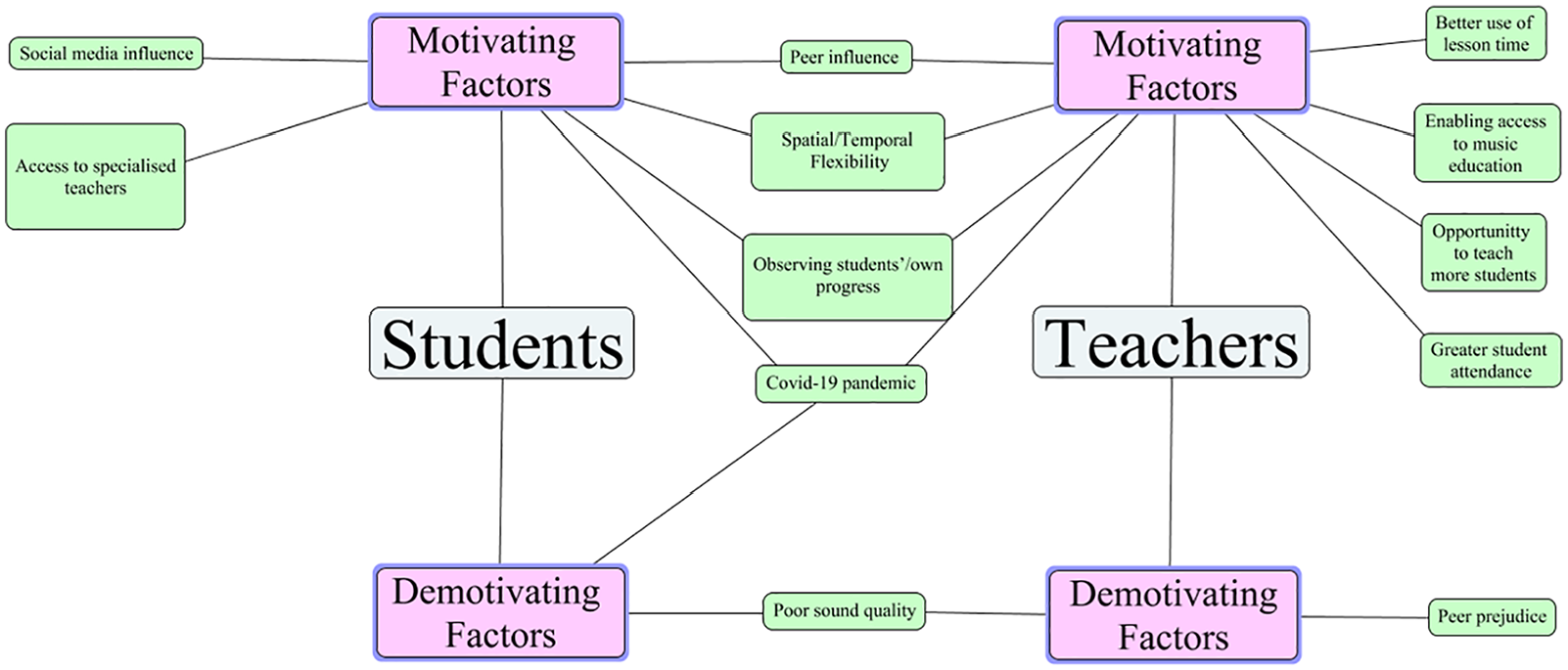
Coding scheme for the category motivating and demotivating factors for teaching and learning online.
Synchronous and asynchronous interactions
Teacher–student synchronous interactions
The teachers highlighted the need to consider communicating without physical contact and to adopt a resilient attitude when faced with communication failures. Students also mentioned that sometimes it was difficult to understand the teacher’s corrections regarding body posture.
Posture correction is very compromised because it is not always possible to understand or visualise what the teacher demonstrates or corrects. [S5] My main concern was to be very empathetic, and realise that “look, they [the student] don’t understand this,” I’ll explain it again, I’ll explain it again, I’ll explain it again in a different way, always in different ways until things start to sink in and start working. [T4]
Teachers T3 and T4 said that they dealt with the physical distance by using instructions to ‘evoke sensations’ (stimulation of student’s mental imagery). This pedagogical approach was observed during a T3 lesson, where metaphors were used to exemplify body movements such as vibrato (T3: ‘Memorise this movement here [demonstrates], as if you were knocking on the door’).
Always also bringing in the sensation, “ah, feel that way, imagine that”, also working on imagination and sensation. I feel that when I work with this, it speeds things up [the results]. It ends up resolving without even the issue of being present or not. [T3] My lesson is not just verbal; it is very verbal, with many mental strategies, “imagine this, imagine that” and demonstrations. [T4]
According to T5, the impracticality of kinaesthetic instructions and playing along with the student made students more independent and focused (increasing students’ autonomy and focus). She explained that in the face-to-face lesson, she corrected aspects such as posture, bow position and so forth, just by touching the student, whereas online she needed to give instructions on body posture, and the students had to correct it themselves. Teachers and students also highlighted that sharing online content during the synchronous lesson was easier due to the ease of being in front of the computer (encouraging the seeking for information in other resources).
Online [teaching] requires much more independence from the student than face-to-face, because I can’t take the hand [of the student] or play with them, take the bow and move the bow, and have physical interaction. When online: they must be more attentive to my directions, and I take on a coaching role rather than necessarily playing together; I demonstrate, but I’m not playing simultaneously. [T5] Sometimes, being with the computer also gives the teacher an extra tool, exemplifying what he is talking about with, for example, YouTube videos. (S1)
Student–student synchronous interactions
Teachers reported promoting student–student interaction monthly or weekly through group lessons (where each student played individually), online auditions and live chatting in private streams on YouTube, and T3 and T5 mentioned including music theory games during group lessons. During these times they encouraged students to comment positively on the performance of colleagues. For T3 the interaction between students during these lessons positively influenced their learning because beginners could learn from the more advanced students.
Sometimes there is a student who is playing the one-octave scale. Another one plays the three-octave scale, so the student is already situating himself, learning visually, and listening to his colleague. [T3]
All of T1’s lessons were small group lessons; he designs all his classes this way, believing that teaching in small groups online encourages dialogue and creates a ‘support network’ among students, although in the three observed lessons of T1, the promotion of interaction between the two students being taught was not recorded.
The other day a student came to me with the most beautiful fourth-finger vibrato I’ve ever seen. So, then, “How do you do it? Explain it to us; let’s go.” And I think that ends up encouraging the conversation. . . Samuel [a famous piano teacher] once told me that his class did 60% of the work, that is, they did it between themselves. [T1]
T2 said that he promoted student interaction during live streams on YouTube, analysing one of the student’s recordings during these lessons, which all the students could watch and comment on in real time via the chat. For S3, these live streams allowed him to learn a lot from his peers. Except for T5, who instructed her student to ask her mother to monitor her violin practice, teachers were not observed directly guiding students to ask for help from other colleagues or caregivers.
Teacher–student asynchronous interactions
Whilst some teacher–student interactions are suppressed in online lessons (kinaesthetic interaction and playing together), teachers did report an increase (compared with face-to-face lessons) in asynchronous interactions facilitated by social networking and electronic mail. All teachers emphasised the importance of being available beyond the main lesson to interact with the students via instant messaging apps, social media (‘stories’ shared on Instagram using the feature ‘close friends’ 1 ) and email, highlighting use of these communication channels as a way of answering students’ questions (responding to questions outside of the main lesson), sharing recordings, scores, books, articles and so forth (encouraging information seeking from other resources), and also receiving students’ recordings in order to overcome the poor sound quality of the synchronous lesson. Regarding online content sharing, teachers were concerned when directing their students’ consumption of musical materials (T5: ‘Because even YouTube is dangerous, we have to filter it’).
If you have any questions or want to know about any issues, you can send them to me via WhatsApp during the week, and I will help you. . . [T3] Nowadays, it’s easy to send the method and talk to the student informally, right? It flows much more; I have contact with them [. . .] it’s a contact that I didn’t have with my students when I was 20, 21 years old, this direct contact: it’s direct, we talk, I send audio, I send excerpts, and I help to guide a lot of things. [T3]
Student–student asynchronous interactions
Teachers reported creating groups in instant messaging apps (WhatsApp and Telegram) to send notifications about the lessons and to encourage student interaction and content sharing. T1 and T2 mentioned that students used the groups to chat about music and share links to music events.
For T2, a strength of his online course were the messaging groups used to share his video lessons and the students’ video recordings, and thus, all students could access their colleague’s lessons and recordings. According to T2 and S3, in these groups students supported each other’s learning by praising their performance and learned together through watching their classmates’ recordings.
I think it [the group] is essential because the student can watch another student [performance recording]; this is very important for the dynamics of my course because they begin to identify the same difficulties in the other colleague; they learn from their colleague’s mistake. [T2] In the Telegram application, we have the [name of the online course of T2] group. In this group, all the teacher’s students can chat, share songs and scores, and show exciting things related to the cello and many other things. In this group, everyone is very kind and encourages each other in cello practice. In addition to cello-related matters, I met several people in the group, even some students from my city. This community is very participatory and serves as motivation for studies as well. [S3]
T2 acknowledged that at the beginning of his online course, he didn’t promote interaction between the students, but after this experience, he felt the necessity to motivate the students into creating these shared moments of contact. T4 admitted to not encouraging interaction between students.
Affective aspects
Teachers and students separated by long distances, some of whom had never met in person, claimed to be able to connect and establish emotional bonds. For most teachers, the connection was made by opening a space for informal dialogue and empathetic listening, seeking to understand what was happening in the student’s life beyond the instrument lesson. For them, these informal dialogues also gave clues about the student’s interests, which helped them when choosing repertoire, for example. The teachers also stated that students established bonds between themselves because they talked easily with each other and even arranged face-to-face meetings.
So, you must know a little about the person behind that piece of wood [the instrument] to use more suitable approaches. But maybe the word is empathy, closeness. . . empathy, which is understanding a person’s life and that everyone has a different background [T1] That part of the connection stays, and it’s exciting; it’s very nice to see the human relationships that develop from there. And that’s a bit of a taboo, isn’t it? [T4]
Fostering environmental structuring
As the lessons occurred at home, some teachers gave the students instructions for structuring their environment, asking them to notify family members about the lessons, organise the space and materials and recharge electronic devices beforehand. The teachers also invested in their own electronic devices – microphones, ring lights, laptops, headphones, webcams and wireless mouse – to improve the online lesson experience.
I always ask them to get organised, [. . .] I usually talk to them about it because this is a normal occurrence. After all, you are “inside the person’s house”, so you must guide their organisation, so that they can prepare for the lesson in their own house. [T3]
During the analysis of the lesson recordings, it was noted that there was a constant teacher concern with the adjustments to technical support, such as camera positioning, microphone volume and software settings. These instructions were especially present at the beginning of lessons.
Discussion and conclusions
This study explored teacher and student motivations, social interactivity and the online/physical learning environment in online string instrument lessons. Participants frequently referred to the Covid-19 pandemic: on the one hand, it permitted a deeper exploration of the possibilities of the online format, but on the other, teachers noted its negative impact on student motivation due to the consequent social and economic problems. Spontaneous online learning initiatives, a year and a half after the start of the pandemic (the period in which the data collection took place), may indicate that the mandatory use of ERT has increased students’ awareness of the advantages of learning online, as all participating students started learning this way during the pandemic.
Some teachers felt insecure and judged by their peers for not working within a traditional teaching model. However, seeing the progress made by their students and how meaningful online lessons were for them boosted teachers’ confidence. Students felt their progress too, which encouraged them to continue with this mode of learning. These findings are in line with previous research that reported the effectiveness of online lessons on student performance outcomes (Okan & Arapgirlioglu, 2019) and an increase in teachers’ confidence over time (Pike, 2017).
The findings also indicate that there were communication difficulties at the beginning due to the impossibility of kinaesthetic instruction, an issue that is seldom discussed in distance courses in other fields of learning. However, in music teaching, where motor actions form part of the skills to be developed, it is often raised by teachers as a limitation to start with (Aaberg, 2023; Biasutti et al., 2022; Pike, 2017), a perspective which, as indicated by Pike (2017), is natural since almost all teachers learned their instrument and started their teaching career in face-to-face settings.
Participants in this study reported referring to physical sensations in their instructions to overcome the impossibility of real physical contact, and this sensory input was coded as a stimulation of mental imagery. Anderson (2013) identifies mental imagery as a self-regulatory strategy that occurs when a student imagines an experience in order to better understand a task, and this learning strategy offers better outcomes when the student has previously experienced the movement. Therefore, when teaching a particular movement or position, teachers should evoke the ‘mental images’ of everyday actions (such as knocking on the door). Authors such as Levinsen et al. (2013) also touch on this strategy, although further research is required to fully understand its impact in online lessons.
The absence of physical manipulation was seen not only as a challenge but also as a possibility to explore the students’ independence, because the teacher has to give instructions for movements and positions from which students must make any corrections themselves. This characteristic is also discussed to a degree by Aaberg (2023), Levinsen et al. (2013) and Pike (2017). For example, Levinsen et al. (2013) argue that the impossibility of pointing and writing on the student’s score made the lesson more dialogical. In contrast, this study found that the dynamic of the synchronous lesson was directed very little towards dialogue, with minimal intervention from the students.
Regarding content sharing, according to Bol and Garner (2011), students are predisposed to non-linear navigation through online learning materials, and therefore, developing SRL skills is extremely important for them. The findings indicate a concern on the part of teachers to regulate the online content that students consume by sharing pre-selected content and avoiding navigation behaviour that has a negative impact on their learning.
Authors identify help seeking as an essential self-regulatory skill (Zimmerman, 2000; McPherson & Zimmerman 2011). For this to occur in a context where students are physically distant and where teaching is often individualised, it is essential that teachers create spaces to encourage collaboration. Findings revealed that some teachers used groups on instant messaging apps, live streaming, small group classes and online auditions, all of which can boost help-seeking behaviours.
For Creech (2012) and McPherson and Zimmerman (2011), student–teacher and student–student relationships influence students’ engagement in learning. When discussing distance education, there may be an association between physical distance and affective distance (what T4 called a ‘taboo’). However, this study reveals that teachers can forge meaningful connections with their students by cultivating an empathetic stance, such as actively listening to students, even without face-to-face interaction.
During online lessons, the teacher and the student are in two separate physical environments, which, as indicated by the SRL theory, should be structured to ensure the student’s self-regulation (Zimmerman, 2000). The findings in this study suggest that the teacher needs to provide instructions on organising the physical setting to make the student’s home a place more conducive to self-regulation. At the same time, teachers showed a need to invest in better electronic devices to optimise their teaching practices.
The practical implications of this study hold relevance for string teachers aiming to foster students’ self-regulation in online lessons. In general, authors in the field of online music education focus on synchronous lessons, and few studies are dedicated to discussing the consequences of asynchronous interactions. However, our findings highlight the importance of asynchronous social interactivity, and, therefore, teachers should establish communication channels to demonstrate their availability, and to encourage students to seek assistance beyond regular lessons. Additionally, teachers can actively promote student interaction to cultivate a supportive and collaborative learning environment. Furthermore, by allowing students to embrace the autonomy afforded by learning online, teachers can create a space where dialogue plays a central role in that process.
Some limitations of this study must be recognised and considered for future research in the field of online music education. The data generated in this study came from the observation of synchronous and asynchronous lessons, but there was no data collection in other learning spaces (groups of instant messaging apps, group lessons and live streams) and, therefore, future research must expand data collection to include these additional areas. Furthermore, the data collection procedures revealed little in the way of students’ perspectives, and so future research could include semi-structured interviews to gain deeper insights into the students’ thinking. Regarding the data analysis approach, future research can highlight how the processes of each dimension of SRL can relate to or influence each other.
Finally, this research also has limitations regarding the size of the sample and the number of lessons observed, which cannot be representative of all online instrumental lessons. Thus, the sample size did not allow for an appropriate statistical analysis, meaning the data obtained cannot be generalised. For fully representative studies, more extensive observations would be needed.
Footnotes
Funding
The author(s) disclosed receipt of the following financial support for the research, authorship, and/or publication of this article: This research had the financial support of FCT (Fundação para a Ciência e a Tecnologia), Portugal, through the research grant awarded to the first author, with the reference UI/BD/151260/2021, and the scientific employment program awarded to the second author, with the reference DOI 10.54499/CEECIND/03404/2017/CP1459/CT0047.
