




Abstract
Women’s participation in professional orchestras has changed the gender dynamics in the Australian music workplace. Traditional binary gender bias is pervasive in all industries, but little is known about how women in music navigate misogyny to achieve equality and realise career success. Thirteen Australian female principal players took part in semi-structured interviews to explore their experiences of the Australian musical workplace. Female principal players felt they encountered unconscious and conscious bias from tertiary training to their professional lives. The audition process, designed to promote impartiality, left women feeling disempowered with opaque and confusing criteria for job selection. Women believed they were treated differently to men and often felt isolated and unsupported. navigated prejudice and stereotyping within established male cultures and promoted inclusivity and diplomacy to achieve the best musical outcomes. Female principal players balanced family responsibilities with their professional careers and recognised more efficient ways of working. Women overcame self-doubt and fostered equality in the workplace. They were undeterred by the lack of female role models and determined to be strong female role models for the next generation. Future studies will investigate how awareness of bias in music can equip young musicians to demand and promote change in the industry.
Introduction
Women’s representation in professional orchestras has increased since the implementation of blind auditions. This rise of equality has changed the gender dynamics of the musical workplace. Unconscious binary gender bias can impact women at all stages of their careers, from recruitment to job advancement (Blau & Kahn, 2016). All workplaces can be susceptible to impartiality, and women need to negotiate established male cultures to progress in their careers (Scharff, 2015). In every workplace, women balance multiple roles, and manage the complexities of being professionals and primary caregivers (Flippin, 2017). To date, there have been few investigations into how women navigate gender dynamics in the orchestral workplace. This study explores Australian female principals’ experiences in Australian professional orchestras.
Unconscious gender bias in the workplace
Unconscious gender bias impacts women in the professional workplace. Professional business women have experienced stereotyping from senior male colleagues based on their appearance (Roberts & Brown, 2019) and female board directors have acknowledged barriers in career progression as a result of their gender, while the majority of their male counterparts refuted there was any gender bias in their decision-making (Groysberg & Bell, 2013). In hospital management, most CEOs are female, but predominately in smaller institutions, whereas men are more likely to hold CEO roles in major hospitals (Soklaridis et al., 2017). In the legal profession, males outnumber females in law firms, and gendered pay disparity is more apparent in the higher paying positions (Price & Price, 2020). Traditionally in these male dominated professions, such as engineering, women have felt unsupported, and the toxic environment has led them to consider different career options (Goodman et al., 2002).
Gender representation in the workplace
Binary gender bias is pervasive, and ‘boys’-clubs’ still predominate the work environment (Price & Price, 2020). Men support men and their relationships foster leadership positions and promotions (Soklaridis et al., 2017) while women are judged by their physical appearance (Klein & Shtudiner, 2021), and are often overlooked when their personality does not complement their male colleagues (Wu, 2020). Successful women in senior positions are not respected equally (Barthelemy et al., 2016), their leadership styles are questioned by their male colleagues (Griffiths et al., 2019), and they are often the topic of discussion in the workplace (Heilman et al., 2004; Parks-Stamm et al., 2008). They can be viewed as ‘token’ which can reflect negatively on their ability to perform the role (Soklaridis et al., 2017) or disrupt male work dynamics (Roberts & Brown, 2019), dissuading women from seeking leadership roles in the promotion cycle (Ellemers et al., 2004).
Challenges for women in the workplace
Women in the workplace report they are often treated differently to their male colleagues (Roberts & Brown, 2019). They were often overlooked and not credited for their contributions and were careful not to appear as aggressive or forceful in order to not upset male co-workers (Arnold et al., 2018). Women tend to be judged on their personalities rather than their skill and professional proficiency (Price & Price, 2020) and their perceived lack of assertion is regarded as a lack of confidence and ability (Chemers et al., 2001; Ülkü-Steiner et al., 2000). Women balance multiple roles where they are often primary caregivers, while managing a full-time position (Flippin, 2017). In the workplace, they can be perceived as less dedicated and focused due to family commitments (Seierstad & Kirton, 2015), resulting in demotion and pay reduction for work absences, part-time hours, or extended leave (Eagly & Carli, 2007). Recruiters consider parental leave and job absenteeism in the job application process which can disadvantage women (Oh & Mun, 2022).
Gender bias in the classical music industry
In the classical music industry, it appears gendered dynamics are prevalent. Gendered musical instrument choice has led to an under-representation of females in the classical music industry (Scrine, 2016) and women remain a minority in the ‘masculine’ sections of symphony orchestras (Stronsick et al., 2018). Screened orchestral auditions were implemented in the 1960s to counter gender bias in the appointment of women to the classical music workplace, which increased the chance of first round success by 50% (Goldin & Rouse, 2000). While screens are vital to promoting gender equity, audition panels often rely on a sighted audition or trial to confirm candidates are the ‘right fit’ for the position (Fang & O’Flaherty, 2020).
Gender representation in the orchestra
In current orchestras internationally women represent under 45% of players, with the majority in the upper register sections while the higher paying sections, brass, and percussion, remain ‘almost exclusively male territory’, and there are fewer women in the more renowned orchestras globally (Sergeant & Himonides, 2019). In a review of major US symphony orchestras, the majority of principal positions were held by men (Hoyt, 2010), and a decade later in the major UK, Europe and north America orchestras, men occupy 65% of Principal, Co, Sub and Associate-Principal chairs (Sergeant & Himonides, 2019). Women have reported on the challenges they face in joining the workforce and feel uncomfortable promoting themselves (Scharff, 2015). Women in the music profession are often the primary caregivers (Scharff, 2018) and travelling expectations impact on family commitments, which results in a shift to teaching roles for female musicians, rather than continuing with performance opportunities (Noriega, 2010).
Challenges for women in the orchestra
In the music workplace, women feel undervalued by their male colleagues and their performance ability is often underestimated due to their lack of assertiveness (Fischer-Croneis, 2016). They do not feel afforded the same respect as their male counterparts (Scharff, 2015) and are perceived as being unsuitable for leadership positions (Hamer, 2019). Women do not often seek career advancement (Pelloquin, 2020) and have shown a dislike for self-promotion as it can be considered immodest and arrogant (Scharff, 2015). Women have often felt uncomfortable under the gaze of the conductor (Yuhan, 2021) and male conductors often have trouble separating a women’s attractiveness from her professional playing (Hamer, 2019). Female principal players report feeling imposter syndrome (Yarbough, 2016), under pressure to perform optimally and feel the need to justify their decisions and actions (Gross, 2022). The lack of senior female role models (women who hold principal positions) discourages young women from pursuing the profession (Amos et al., 2015; Duchen, 2015) and re-enforces conformity bias (Bonnycastle, 2018).
Aim
The aim of this study is to explore current Australian female principal player’s experiences of the orchestral workplace. It will explore the personal insights of current principal players on auditions, the music profession, the orchestral working environment, mentoring and leadership opportunities, and the barriers and enablers to career success.
Method
Participants
Thirteen female orchestral principal players in Australian orchestras volunteered to take part in the study. Potential participants were identified from the websites of Australia’s major ensembles. Recruitment information was distributed via the ensembles’ administrators, who forwarded a recruitment email and participant information statement to each of the female principal players outlining the nature of the study and inviting them to contact the researchers.
Materials
The semi-structured interviews focused on women’s orchestral experience. Topics covered: educational background and description of orchestral positions and principal posts; experiences of the profession; the audition process; the future of the industry. Participants were encouraged to speak freely about their experiences.
Procedure
The institutional ethics committee approved the project, all participants received information about the project and gave consent individually prior to commencement. Due to the COVID-19 pandemic, interviews were conducted over Zoom and lasted between 30 min and 2 hr. Participants were introduced to the purpose of the interview and consented to be recorded. Participants were offered anonymity and are identified by participant number (P1, P2 etc).
Analysis
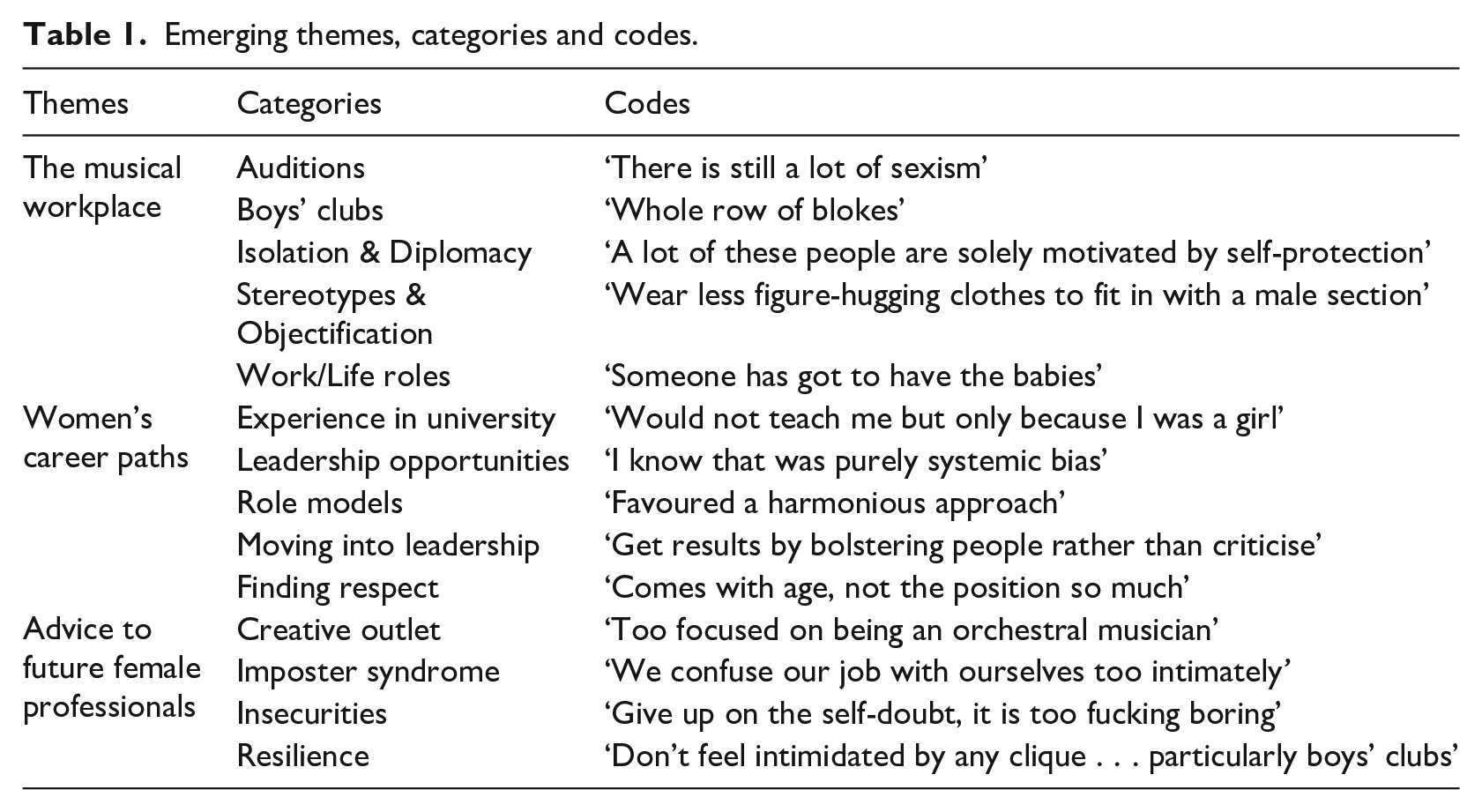
Interviews were transcribed verbatim and analysed thematically (Braun & Clarke, 2012). The analysis revealed three overarching themes that characterised women’s lived experiences in the musical workplace, women’s career paths and women’s advice to future female music professionals (see Table 1).
Emerging themes, categories and codes.
Results
The musical workplace
Gaining entry into the music profession
Women found the auditioning process challenging and were often mystified by the tacit criteria used to judge candidates during blind rounds. They were surprised at their success or failure in the audition process, based on their own evaluation of their performance. Women felt disempowered by the audition process:
‘We can absolutely rip ourselves to shreds trying to oblige and be what we think the interview panel wants us to be, but in the long run we are not the ones making the decisions’. (Participant 2)
Audition panel decisions were not obvious, and women were unable to gauge the rationale for candidate selection in non-blind rounds. Women were dismayed to observe gender politics affecting audition outcomes:
‘I’ve seen some really capable women fail auditions because the principal was psycho or someone on the panel just could not cope for so many different reasons. It is so dependent on these people and their personalities as it is a small world. . . . There is still a lot of sexism, especially in the brass world’. (P6)
Women’s experience of comments from audition panels revealed innate gender bias from panel members. They had received comments on their physical appearance, on being ‘too feminine’ and ‘distracting’. One player was told she ‘breathes like a girl’ and should make her breathing less audible and noticeable and ‘it came out in a kind of a sexist way’ (P6). One was told her hair was too distracting and she needed to conform. The panel said that:
‘One good thing about men is their hair does not move much. So, they told me I should cut it off or cover it if I wanted to do well. So, I was thinking why are you looking at my hair, just listen to how I play?’ (P9)
All women thought screens were important to remove bias or any extraneous-musical factors in the initial audition rounds and to promote equality. Blind auditions ensure focus on candidates’ playing capabilities and ensure more robust evaluations. Women questioned the ‘risk’ involved giving someone a job without knowing their identity as ‘if they are the best person on the day, they deserve a shot’ (P6).
Boys’ clubs
In the orchestra, women often felt outnumbered and found it challenging to participate in the established male culture, sitting in a ‘whole row of blokes’ (P2). Women felt they had to navigate a gendered workplace with ‘difficult colleagues’ (P6), where it was considered more important to maintain a collegial work environment than to assert musical ideas. They were aware that in some orchestras, concertmasters had their group of ‘acolytes. . . friends which is a bit of a boys’ club’ (P8). These male-only ‘cliques’ impacted the atmosphere in the orchestra, where ‘the rest of the orchestra is left deeply distrustful which is not very healthy’ (P8).
Isolation and diplomacy
Women managed the sense of isolation in the musical workplace. Keeping everyone in the section on side made for an easier work environment, even if it led to a ‘less good musical result, as you cannot really push too hard’ (P6), and were careful not to put forward too many opinions. Women reported unpleasant experiences dealing with male superiors that left them cautious of voicing their opinion during rehearsals as they were criticised for being ‘too outspoken’, ‘I have been dismissed from gigs not from my playing, but my outspokenness I suppose’ (P6).
Diplomacy became a key factor in successful working relationships because of women’s experiences managing poor behaviour from male colleagues. When not in the principal role, women in male-dominated sections often felt isolated and less like their peers, because ‘as an only female in a section, I have got to be telling all those guys that is not appropriate, you cannot talk like that’ (P2). Women felt powerless calling out male colleagues’ mistakes in rehearsals, and when they were accused of musical errors made by senior male colleagues, they were forced to absorb the artistic director’s criticism:
‘[He] stopped the orchestra again and absolutely hammered me. We got to the break and this principal says, “oh sorry about that”, I was completely shattered’. (P2)
Women reflected on the often-precarious position of managing male egos in the work environment, feeling that they were expected to blend in, and not appear threatening. Women who outshone male colleagues inadvertently found their colleagues could get ‘angry, but he could not do anything, so he took his anger out on me’ (P6). Some male principal players found that the presence of women upset the balance of power and ‘a lot of these people are solely motivated by self-protection so if you come in and do something threatening, it is in their interest to get rid of you’ (P6).
Stereotypes and objectification
Women had experienced discomfort in the gendered workplace where male players were treated differently than female players, regardless of job rank, and women were judged based on their appearance or attractiveness rather than their performance skills. Male conductors, especially guest conductors, were described as disrespectful and their gaze often left women feeling frustrated and uncomfortable as ‘they have got this mental thing if they find someone attractive, and they do not know what to do about it’ (P4). Concert attire could cause unnecessary distractions. This cohort of women sought to minimise unwanted attention from male conductors, and would dress down in ‘masculine, less figure-hugging clothes so [they] could fit in with a male section’ (P9). Women felt powerless to report their impressions of bias as ‘you cannot technically say that person has actually said something misogynistic to you, but you just know and feel it’ (P4).
Work/life roles
Women balanced orchestral work with family commitments. They were often the primary caregivers and, as for many women, the responsibility of caring for young children often left them physically and emotionally exhausted even before rehearsals had commenced. The reality of orchestral work included days of rehearsals and nights of concerts, making music ‘a hard job to do because the nights are long and tiring’ (P8). Women often were reluctant to mention their family obligations at work but recognised that ‘someone has got to have the babies and that is how the world has gone around’ (P3). They stuck together and shared responsibilities of childcare backstage while their female peers were performing on stage, in a concerted effort to retain their jobs. These women were cognisant of the indignity and hilarity of breastfeeding during rehearsal breaks, but ‘would not have it any other way’ (P7).
To maximise the work/life balance, women with children were accomplished in ‘golden practice’ hour for focused preparation time. Their limited time ‘turned out to be a positive as [I] learn to practice efficiently’ (P10). Their increased productivity improved their confidence in managing their time effectively, because ‘you have to believe in yourself, and not in a defiant way, but just in a calmly confident way that you know what you’re doing’ (P7). Women were cognisant of maximising their limited preparation time and came to the realisation that ‘it is ok to say no and that is ok as you are not weak or copping out by saying no, you just know what your limits are’ (P7).
Job sharing in orchestras allows musicians who have children to have greater flexibility with their performance schedule ‘if they want a certain program off’ (P4). Women felt reassured that their jobs were not in jeopardy when they required time off for family commitments or the pursuit of solo or chamber work. Employers were accommodating, ‘as long as I made sure someone was good enough or appropriate to sit in my chair’ (P8).
Women’s career paths
Experience in university
From conservatorium training, women were treated differently to their male peers and were perceived as ‘tokens’. Even in the 90s, male tutors would say such things as ‘it is nice to have you here and to give you an education before you go off and have babies’ (P3). Women reported being side-lined by male instrumental tutors and were separated from their male peers in lessons not based on their skills, but gender, as the male tutor ‘did not want to and would not teach me but only because I was a girl’ (P2). Women reported that gender disparity made it ‘kind of tricky to relate and they would have loved to talk to a female about it especially at tertiary level’ (P7).
Leadership opportunities
In conservatoria, men showed more ambition and as a result were favoured over women for leadership opportunities. Women reported that men would put up their hands to seize leadership experience while young women ‘would watch young boys and men around me be given leadership opportunities when they were no better or able than I’ (P2). While women were focused on refining their playing skills and honing their ensemble proficiency, their reticence to self-nominate for leadership positions meant they ‘did not really know how to lead and communicate until I sat in the principal chair which is a hard pill to swallow’ (P1). Women agreed that being a principal was not the goal in their early careers and ‘I think the leadership thing is vexed’ (P2). Women were showed restraint in applying for principal positions until they were ‘130% ready’ to win the chair, as they believed ‘I know that was purely systemic bias, but you can’t choose to be a leader, other people [have to] recognise it in you’ (P2).
Role models
Women were susceptible to imposter syndrome and felt deterred from pursuing leadership positions. During tertiary education, women were disappointed by the lack of female tutors/mentors however it was ‘not a deliberate choice but a bit of a shame’ (P9) as most lecturers and the leaders were men. Traditionally, leaders were ‘gruff in rehearsal and a bit bossy’ (P3) and these women were reluctant to espouse this type of behaviour. Women were encouraged by female principal players who promoted a more ‘harmonious approach’ (P4) and were disparaging about musicians who ‘might have a lot to offer but are really arrogant which does not interest me at all’ (P10). Women reported positive male role models who would ‘shield’ their players and ‘not throw us under the bus in any way’ (P6) if any mistakes occurred during rehearsals. Women drew inspiration from their mentors’ instrumental abilities and ‘wear [their] heart on the sleeve for everyone to see and enjoy it’ (P7).
Moving into leadership roles
When they achieved leadership roles, women were cautious, tactful and composed compared to their male colleagues. Women were frustrated with male principal player’s egos and ‘the mentality of when you win a principal job, you stop learning and you sit on the top and that is it’ (P6). Male principal players generally maintained a hierarchical approach in their leadership style and did not promote consensus in decision-making. Women chose to use a team approach when addressing their section and/or male colleagues. They promoted equality and avoided confrontation to achieve optimal results:
‘I always try to be as inclusive as possible and not single anyone out. . . I try to get results by bolstering people to get the best result rather than criticise’ (P8)
Finding respect
Women were aware of the lack of female role models in the industry and wanted to be ‘agent[s] of change’ (P6). Women felt hope with the rise of new ensembles in Australia as ‘it is quite incredible that they all have female directors’ (P10). Women felt that when they were young, they were judged by male colleagues and were easily dismissed ‘as just a young thing’ (P8). Women acknowledged that ‘blatant sexism’ from male conductors was no longer acceptable in the orchestral workplace, and ‘sometimes it’s not ok if someone’s carrying on like a pork chop’ (P8). Respect from senior males towards females has improved, however women noted ‘that comes with age, not the position so much’ (P8). Senior orchestral female musicians acknowledged the unexpected appreciation from the younger males and looked forward to ‘enjoying that for a while before I retire or before it gets awkward, and they want to get rid of me!’ (P7). While orchestras were becoming more cognisant of gender bias, promoting quotas of female musicians, women were frustrated that they were not considered on their merit, an extraordinary ‘pool of humans . . . creating an amazing sound’ (P1).
Advice to future female music professionals
The most successful female musicians would strive to be the best in all aspects of their playing (chamber, solo competitions, guest-principal with international orchestras). Women discussed the importance of having an orchestral job for the income security but were keen to have ‘a more creative outlet away from the formal symphony orchestral model’ (P7). They acknowledged the long hours of preparation and practice that came with the job often resulted in them being ‘too focused on being an orchestral musician [and] you can miss out on things you love and personal development’ (P5). These women described their ‘wiggly’ (P7) career paths and their drive to succeed:
‘I was so driven that I had to keep going. I don’t why I thought I had to be able to do it all, but I did. I just thought if I didn’t keep going, I would give up as it was really hard with a baby and a job and travelling’ (P7).
Women reported feeling the imposter syndrome in the workplace and reflected how they often ‘confuse our job with ourselves too intimately’ (P2). Women advised young females to not allow feelings of insecurity to become debilitating and to ‘give up on the self-doubt, it is too fucking boring’ (P2). They encouraged young players, noting ‘it takes just patience to learn how you fit within this in a big school of fish’ (P1). These women espoused resilience, hard work, and resourcefulness to achieve a successful career in the classical music industry. They were aware of gender bias in the classical music industry and encouraged young women not to ‘feel intimidated by any clique . . . particularly boys’ clubs’ (P8). Women encouraged young female professionals to stay determined in their practice as ‘us females have to work so much harder than the men and I have been fighting for this my whole life and it is still at the dirt bottom end’ (P1). They were undeterred as ‘more than half the world is female. It should not be a controversial topic; it is just a fact’ (P9).
Discussion
Successful women principal players in Australian orchestras described their experiences of the orchestral music industry from a female perspective. They explained the challenges of entering the music profession through blind and sighted auditions, their experiences of unconscious and conscious gender bias and on their approaches to navigating prejudices and stereotyping in the male-dominated workplace. They reflected on how they managed the inevitable life/work balance and their strategies to foster a more female-positive environment. They shared an ambition to promote impartiality for all in the musical workplace and provided advice for emerging female musicians to develop resilience and strength, and to approach their careers with confidence.
Orchestral auditions provided women with the first insights into the complexities of the music profession. The rise of the blind audition may remove bias from the entry-point to the orchestral workplace (Goldin & Rouse, 2000), but it did not improve panels’ decision-making processes. Panels were cognisant of the auditionee’s sex by hearing them inhale during the performance (Phelps, 2010). Women were surprised that their success in auditions was not always based on their technical and musical ability but other external factors (Bennett, 2008). Even these experienced female professionals were unable to determine the tacit criteria that was used to select successful candidates (Groysberg & Bell, 2013). When blind auditions progressed to sighted auditions, women experienced explicit bias because of the way they looked (Hamer, 2019). It appears that the process that was intended to promote impartiality was often opaque and was perceived to be prone to prejudice (Fang & O’Flaherty, 2020).
In the orchestral workplace, women encountered an established male environment (Sergeant & Himonides, 2019). Women experienced isolation and found it difficult to integrate with expected behaviours (Wu, 2020). They were aware of being treated differently to their male colleagues as in other professional industries (Roberts & Brown, 2019), and often felt unsupported. Women in orchestras believed their lack of assertiveness and their pursuit of collegiality was perceived as an absence of confidence (Halstead, 2017), and felt judged unduly based on their appearance or attractiveness rather than professional skills (Price & Price, 2020). Women were subject to stereotyping and objectification by males (Roberts & Brown, 2019) which meant they were disadvantaged in being promoted for leadership positions (Groysberg & Bell, 2013). The male gaze often made women uncomfortable and diverted attention from the task at hand (Hamer, 2019).
Affinity bias, where men support men, was prevalent (Soklaridis et al., 2017), and women could be undervalued and undermined by their male colleagues (Heilman et al., 2004). Women in senior roles were not always afforded the respect of the position and could be perceived as nominal appointments (Soklaridis et al., 2017), or have their success diminished in favour of less-qualified men (Ellemers et al., 2004). Principal women’s chosen leadership styles did not accord with traditional male approaches (Hamer, 2019) and they pursued more diplomatic interactions to advance workplace relations (Roberts & Brown, 2019). Imposter syndrome was common, even when women were overwhelmingly the best candidate for the role (Hernandez & Lacerenza, 2023). The underrepresentation of female leaders in Principal orchestral positions perpetuated gender bias in the workplace (Duchen, 2015).
Female musicians balanced family responsibilities with their professional careers (Flippin, 2017). They felt uncomfortable mentioning family obligations at work to avoid judgement in the workplace (Scrine, 2016). The potential for women to manage maternity leave and childcare was often considered negatively, disadvantaging women (Curtis, 2013). As in all workplaces, women who were the primary carers for young children (Scharff, 2018) were often left exhausted physically and emotionally (Phelps, 2010). International orchestras have modified rehearsal schedules to help musicians manage the time-pressures of having a family and a full-time job (Marková, 2022). Women had difficulty practising outside of normal business hours as childcare generally fell to them, but optimised practice time, and recognised more efficient ways of working (Noriega, 2010). For ensembles that required extensive touring, musicians who had parental responsibilities (Dobson, 2011) made conscious decisions to move to more stable state-based symphony orchestras (Bennett, 2008).
Women tackled feelings of self-doubt in their work performance abilities (Yarbough, 2016) and confidence (Whiteley, 2013) and encouraged emerging female professionals to support one another and to secure the cooperation of like-minded male colleagues in order to improve their chances of success (Arnold et al., 2018). They recognised the lack of female role models (Amos et al., 2015) and now, as senior leaders, realised they are agents of change for the next generation of female musicians. Women’s motivation for success was fuelled by a deep passion for developing their craft (Creech et al., 2008). These experienced women advocated resilience, dedication and self-confidence as the key contributors to their successful career (Griffiths et al., 2019). Women valued the whole musician (Scharff, 2015) and promoted the introduction of new leadership styles to achieve the best results (Hoyt, 2010).
Conclusions and future directions
In this study, it appears gendered dynamics were engrained in the orchestral workplace. Female musicians experienced the same types of unconscious and conscious bias as women in other professions. These women were unprepared for navigating the established male culture but remained undeterred in their career goals and were determined to succeed in their roles in the orchestra. Women prided themselves on their capacity to manage the complexities of the workplace, and how they normalised new ways of interacting and leading to achieve their musical goals. They encouraged the next generation of female musicians to be resilient and confident in their performance abilities, to foster support networks, and to stay true to their career ambitions. This study makes an important contribution to gender dynamics in the music workplace by investigating women’s experiences of working in professional orchestras. Future studies will investigate how to equip young musicians with knowledge and skills to demand and effect change in the music industry.
Footnotes
Acknowledgements
Sincere thanks to the 13 participants for taking part in this study.
Declaration of conflicting interests
The author(s) declared no potential conflicts of interest with respect to the research, authorship, and/or publication of this article.
Funding
The author(s) received no financial support for the research, authorship, and/or publication of this article.
