



Abstract
This article takes its’ starting point in the ongoing debate about gender and gender equality in higher music education (HME) institutions where new policies, projects and initiatives have been developed during the first decades of the 21st century. This article’s analysis is framed by feminist scholarship on gender equality, and gender mainstreaming, as well as music education research about gender and gender equality. The aim is to investigate how gender and gender equality is talked about in classical music higher education, analyse how it is experienced and in what terms it is described. The main research question is, how is gender and gender equality constructed among leaders, teachers and students in three HME institutions in Nordic (Finland), Baltic (Estonia) and Central European (Hungary) countries. It is based on qualitative thematic semi-structured interviews with 45 participants, analysed with qualitative data-driven content analysis. In the discussion we argue that gender and gender equality are, in our material, constructed as being about women, that gender is rarely related to other types of discrimination or inequalities and that the cause of gender inequality is individualised. The conclusions suggest steps for further pursuing gender equality in HME.
Introduction
This article takes its’ starting point in the ongoing debate about gender and gender equality in higher music education (HME) institutions in which new policies, projects and initiatives have been developed during the first decades of the 21st century. While the research debate about gender equality and music education is not new (see Green, 1997) the sexual harassment scandals of 2017 in many art institutions reactivated gender equality work. In the European context, Erasmus+ programmes and other European grants require policies on gender equality for all participating institutions as part of the European Union’s gender mainstreaming programme, and these requirements ensure that all HME institutions in Europe discuss such policies. In the context of research on gender equality in HME (Bogdanovic, 2015; de Boise, 2018) this article aims at investigating how gender and gender equality is talked about in classical music higher education and analyse how it is experienced and in what terms it is described. The main research question is, how is gender and gender equality constructed among leaders, teachers and students in three HME institutions in Nordic (Finland), Baltic (Estonia) and Central European (Hungary) countries. 1 In order to de-identify participants we do not compare institutions nor participant groups based on gender, age or role; rather, we show the similarities, diversity and range of experiences in every-day discourse across these institutions and groups. In the discussion we also pay attention to what is not talked about, further, we elaborate on what this means for HME. In the conclusions we suggest some steps for further pursuing equality in HME.
Feminist theory and previous research about gender equality in HME
To understand how gender and gender equality is constructed discursively in HME we use gender as a processual concept, not as a social category existing a-priori to the interviews. Gender is further understood as co-constructed with other social categories like class, race and sexuality and as constructed in discourses with material effects. In feminist studies the view of gender as co-constructed in relation to other relevant social categorisations is a common perspective (Lykke, 2010), while empirical research might focus on one or several categories at a time. As Butler (1995) argues, ‘gender’ is a contingent category comprising a political foundation central to analysis in feminist theory. The anti-essentialist claim of poststructuralist feminist theory argues that there is no essential gender, and that gender is an unstable category, yet the claim does not exclude political ambitions: the aim to change situations of gender inequality and improve women’s lives. The discourse on gender and gender equality in education and other societal organisations is influenced by such discussions in feminist theory but also by gender equality politics where methods of gender mainstreaming have dominated in the past decades. Gender mainstreaming is ‘a process to promote gender equality. It is also intended to improve the effectiveness of mainline policies by making visible the gendered nature of assumptions, processes, and outcomes’ (Walby, 2005, p. 321). According to Walby (2005, pp. 321–322) gender mainstreaming includes diverse methods for promoting gender equality. The simple definition of gender equality is as the goal for all genders to have the same rights and opportunities, but in feminist theory gender equality is often understood in broader terms as the end of all sexism, sexist exploitation and oppression (Hooks, 2000). Depending on how gender equality is understood, gender mainstreaming has, according to Walby (2005), struggled with various tensions, for example those revolving around the opposition of mainstream politics and feminist politics for gender equality; tensions dealing with inclusion of other power trajectories such as class, race and sexuality; and tensions related to the problem of envisioning gender through difference or sameness. These tensions in gender equality work are, for Walby (2005), potentially productive for feminist theory, but can also derail gender equality work. In his recent research on gender equality in HME, de Boise (2018) has highlighted a focus on counting women, he critiques this focus for not pursuing equality for all. He argues (de Boise, 2019) that gender mainstreaming policies risk excluding other power imbalances and be reduced to binary thinking about gender. However, Squires (2005) has argued that there are different approaches to gender mainstreaming and that a transformative gender mainstreaming where the goal is to transform the core of an organisation (rather than adding women) is possible.
In previous research focusing on the gendered dimensions of music education Bennett (2008) argued that despite women’s high participation in (Australian) music education and professions they have fewer career opportunities, fewer positions in leadership and more interrupted careers than male musicians. A recent study mapping gender, class and racialised inequalities in UK higher music education (Bull et al., 2022) concluded that women, non-white persons and people with working-class backgrounds are underrepresented. The higher up in the hierarchy and the more prestigious the institutions are, the more significant was the under-representation (Bull et al., 2022, pp. 11–13). These results are echoed in studies of participation in the classical music profession (Scharff, 2015). The existence (or absence) of women in various positions of music education and music work has been understood in research as impacting future generations of musicians, since students either see female role models or women in certain positions as rare or absent (Howley, 2021). Further, cultural barriers have been found to face women throughout their careers in music, despite existing employment policies, practices and procedures (Bogdanovic 2015, p. 19). Mapping the representation of and opportunities for women in music has also been complemented by research investigating, for example, how women practise music through instrument choice and how gender equality is pursued in higher music education (e.g. Blix et al., 2021). Certain music careers have been found to be heavily coded as masculine, composers for example, and therefore particularly hard to access for women (Bennett et al., 2018; Macarthur, 2014). Also, gender differences in music teaching have been shown to exist both between how teachers teach according to gender, how female teachers are better organised, and how students are treated in teaching situations (Zhukov, 2008, 2012). Focusing on organisational, structural and cultural aspects research has, further, shown gender differences in the economic conditions of work in the field of music performance, in the content of the work (teaching, performing and administrative work) and in the contracts offered to musicians (full-time versus part-time; permanent versus short-term) (Bennett, 2008; Scharff, 2015). On a macro level the canon of Western art music has been concluded to be shaped by ideas about masculinity through the value ascribed to male composers and their work in the canon of music history (Citron, 1993).
Overall, research on gender, gender equality and music education has often focused on the conditions and practices of girls and women within music education and in music careers. A recent survey (Vastakaiku, 2023) with 2055 Finnish respondents working or studying in the music sector (47% female, 46% male and 2% nonbinary) revealed that, according to the women’s experiences, the most unequal genre was rap/hiphop/r’n’b, and the most equal was classical music. Even though other genres might also be worth studying, we focus on the discourse and interpretation of ‘gender and gender equality’ among participants in classical music higher education. In other words, we analyse how gender and gender equality are constructed in talk by people working or studying in HME institutions. There are not many studies that have analysed this topic in interviews with students, teachers, and leaders across three countries. Further, we will compare our findings with the above-discussed research.
Methods
The larger project, material and ethical issues
The interview material analysed here was collected in the research project Conservatory cultures with the overall aim to investigate the construction of nation and gender in HME in Europe focusing on national contexts where nationhood has been hard-won. We used interviewing as a method to collect a material that allowed us to analyse how people construct meaning in talk about (among other things) gender and gender equality. Two researchers of the project (Ann Werner and Cecilia Ferm Almqvist) interviewed 22 teachers and leaders and 23 students from the classical music performance programmes in three higher music education institutions – The Liszt Ferenc Academy of Music (Hungary), Estonian Academy of Music and Theatre (Estonia) and The Sibelius Academy, University of the Arts Helsinki (Finland). They conducted qualitative thematic, semi-structured interviews that are typically used for collecting participants’ experiences, understandings and opinions about chosen topics (Kvale & Brinkmann, 2009). Some interviews were conducted online in the autumn of 2021 while most were conducted on site at the institutions in spring 2022. The aim of this article is to analyse how gender and gender equality discourse is presented; epistemologically we are studying how gender and gender equality are constructed in participants’ talk and experiences. Further, we recognise that talk and experiences are central for the everyday practices of gender and gender equality in institutions.
The three institutions were evenly represented in the interview material. Among the student participants, there were 17 female and 6 male participants, among the teachers and leaders, there were 9 female and 13 male participants. Students (with one exception) represented piano, strings, percussion and voice. Teachers and leaders represented piano, organ, strings, brass, percussion, voice, composing and conducting, and there were also leaders who were not practising musicians. The interviews were conducted in English, since it was relatively easy to find participants who felt themselves fluent enough. For one institution an interpreter was available and was used in one interview. Since the research group also included members from the three countries, possible native words and phrases from the participants were not a problem in the process. In addition, the interview sessions were long. In the student interviews the researcher took extra care to invite and encourage participation by using a mind map of themes to prevent shyness and difficulties with power imbalance. In the interviews with teachers and leaders the researcher and the participants were on equal levels of their academic careers. All participants received written and oral information about the research project’s aims and were guaranteed confidential use of the material. All participants gave informed consent to participating, and the leadership of all three institutions consented to the study. The codes for good practice in research from each institution were adopted. The study gathered as little personal data as possible, and no sensitive information about the participants was collected. The recorded interviews (containing the voice as personal data) were stored safely according to policy on research data at the university of the PI, the transcriptions of the interviews were de-identified for the purposes of analysis and publication, and only the two researchers performing the interviews had access to the full material.
Data analysis
The whole interview material was large (1300 transcribed pages times new roman 12 pt, space 1.5), and consisted of themes relevant for the Conservatory Cultures project. The first author of this article had been interviewing half of the participants and had gone through all the material. Thus, we had an overview of the material and could continue the analysis on our focus area by extracting quotes from the full transcribed interview material using the keywords ‘equal’, ‘gender’, ‘binary’, ‘female’, ‘male’, ‘woman’, ‘man’, ‘trans’, ‘black’, ‘discrim’, minority’ and ‘repertoire’. The extracted quotes included the entire conversation on the topic, with both the researchers’ questions and the participants’ responses; the quoted made 73 pages of data. We selected only quotes that discussed the topic ‘gender and gender equality’ understood broadly and considered talk about all inequality and discrimination as relevant, and we excluded quotes that just mentioned one of the keywords without elaborating any opinions or experiences at all. For the set of quotes extracted, we used a qualitative data-driven content analysis, focusing on how gender and gender equality were discussed. In this analysis we followed the procedure from familiarisation, induction of comments, coding and elaboration, to interpretation and checking (Bauer et al., 2014). We coded the quotes using a data-driven perspective and organised them into subcategories and categories: a bottom-up categorisation. We wanted to be open to all data and not restrict ourselves to ideas we, the authors, had about gender and gender equality (King, 2004). The three themes, eight categories and 17 subcategories that this analysis resulted in are shown in Table 1. Below, each category is discussed separately, each THEME forming a subchapter (from 4.1 to 4.3) where categories are written in bold print and the
Themes, categories and subcategories.
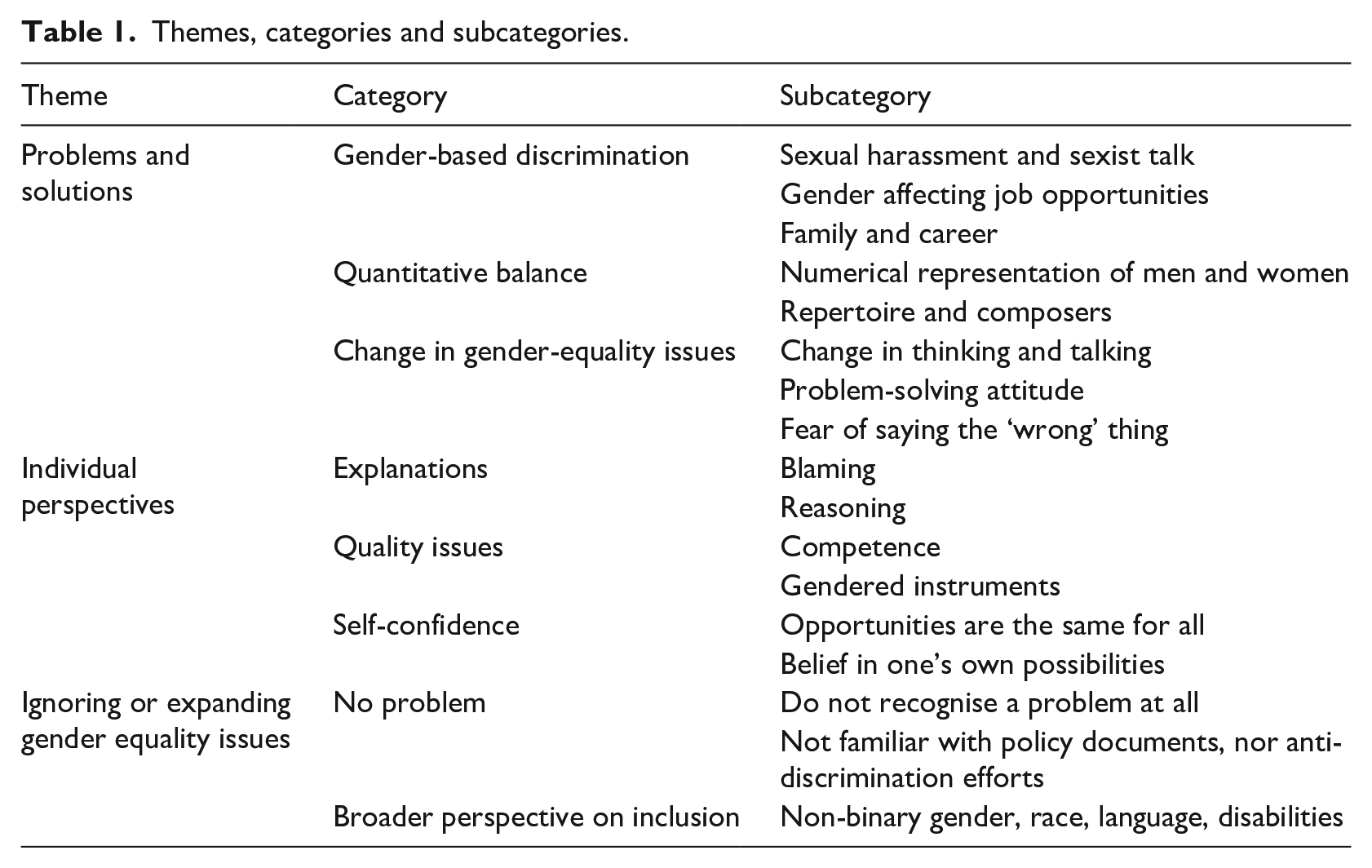
In the analysis below, we do not analyse the quotes quantitatively, but we do roughly describe the prevalence of similar quotes when needed. We use ‘some’ indicating minority; ‘individual’ indicating that there were two-three quotes of this kind: while ‘one’ indicates a kind of quote occurring only once.
Validity
Validity of the research was addressed throughout the entire research process. We used data collection and data analysing methods by which we could find answers to our research question. The main themes of the research were chosen according to earlier research (theory-driven set-up), and the open-ended interview questions dealt with teaching, work/studies, social aspects, the institutions, policy and practice, assessment, gender and diversity. The interview questions were made as clear as possible. All themes were covered in each interview, although the same exact questions in the same order were not posed to all participants, leaving possibilities for the participants to raise issues they considered relevant for the topic. The participants were chosen from three HME institutions in three different countries and they represented various positions, roles and ages. All participants had voluntarily decided to accept the invitation. The two interviewers recognised power relations included in the interview situation and paid special attention to respectful ways of discussion. They also made clear to the participants that all opinions are equally acceptable and correct and that the interview data will be transcribed, analysed and reported confidentially. In the article, we have described the method of analysis and the creation of the themes, categories, and subcategories. The second author conducted the primary analyses, after which the results were discussed and confirmed by the two authors together. Below, we use quotes from the interview data to let the readers evaluate the results. All these actions are aimed at making the process as transparent as possible.
Results
Theme one: PROBLEMS AND SOLUTIONS
The first theme was named PROBLEMS AND SOLUTIONS. It consisted of three categories which were further divided into eight subcategories. The first (and largest in terms of the number of quotes) category was created for quotes that dealt with
The gender-based discrimination was also related to
The comments about combining
The second category,
The third category included quotes describing a positive
Theme two: INDIVIDUALISED PERSPECTIVES
The second theme was named INDIVIDUALISED PERSPECTIVES, and it was divided into three categories and, further, into six subcategories. The first category included quotes on
The second category of the second theme included comments on
The third category was about
Theme three: IGNORING OR EXPANDING GENDER EQUALITY ISSUES
The third theme was named IGNORING OR EXPANDING GENDER EQUALITY ISSUES and it was divided into two categories and three subcategories. The first category included quotes stating that there were
The second category of theme three included a
Discussion
As stated, the interviews were conducted in English with one exception, and the participants were not able to use their native language. The language could have made it difficult for them to express subtle opinions and issues; yet the rich data showed that this was not the case. An overall remark about the material is that most often when questions about gender, gender equality and diversity were asked, the answers given discussed women even though that was not the term used in the questions. Women’s participation in instruments and professions in which women have been rare was discussed (having female bassoon players, percussionists, composers; see Bennett et al. 2018, or conductors; see Howley, 2021), but men were seldom mentioned unless in relation to women (equal number of women and men). Terms like ‘female composers’ or ‘female conductors’ were used, and as stated by Howley (2021), any composer would probably like to be judged on composing, not gender. At the same time, ‘male composers’ were only occasionally discussed as ‘male’. Masculinity has for long been dominant in the canon of classical music, both in the sounding music and in the history constructed around male composers (Citron, 1993), in some professions of classical music it still is (Macarthur, 2014). The construction of gender and gender equality in HME was for participants shaped by this idea about masculinity, affecting the construction of some instruments and professions – like composers, conductors and brass – more than others. The same could be said for other answers discussing, for example, career opportunities or family: gender was often constructed as being about women’s careers and families. While it is established that women have challenges pursuing a career in HME (Bull et al., 2022) and in the music profession (Scharff, 2015) tying gender equality to women is also potentially risky as women are in this discourse posed as fundamentally different from men and as ‘the problem’ for gender equality to solve. Emphasising difference may lead to women being firmly put back in their gendered positions (cf. Walby, 2005). Further, the binary construction (men and women) excludes the existence of other genders (de Boise, 2018, 2019). Even when gender was constructed through sameness and in comments stating that gender was irrelevant, the sentences were formulated so that women were put forward as equally capable as men (not men as equally capable as women). In such sentences, attention is drawn to the need to emphasise women’s competences – which reveals the participants’ assumptions that there is no shared understanding about gender-equal competences. In addition, the focus on women as a group constructs women as different – and separate – from men by the very focus on the group. Squires (2007) argues that a common approach in gender equality politics is gender quotas, that is, to focus on numbers and to add women to an already existing structure without deconstructing the ideas about gender embedded in it. She argues (Squires, 2005) that this strategy of inclusion has weaknesses, often it is presented as driven by quality – women will make the organisation better – and when quality is not improved the strategy fails.
Acker (2006) has, in line with Squires, argued that inequality regimes inside organisations are linked to inequality in surrounding society, its’ history and culture. The workplace itself can also have organisational structures and practices, worker agencies and cultural assumptions that make working easier for men than women (Banihani et al., 2013). Acker argues that to work in male dominated professions where masculinity has been part of the culture of the profession ‘women must make adaptations to expectations that interfere with family responsibilities’ (Acker, 2006, p. 446). According to some participants in our study, women are constructed as the people who must make adaptations if they want to work as classically trained musicians in highly respected orchestras and as soloists. Further, Acker (2006, p. 460) argues that inequality regimes of gender, class and race are interconnected in organisations. Acker acknowledges that there are differences between different organisations and professions, but states that class is related to posts, wages and hierarchical positions, and that gender and racialised identities are integrated in this structure. In order to combat inequality all three need to be addressed. Still, only rarely did we see participants’ answers discuss gender inequality in a broader way than as a binary construct where men/women are the only options, including non-binary identities or inequality issues of class and race. Even though the scholarly debate about racism and critical pedagogy in music education (Hess, 2017) exists, only individual participants discussed the issue of racism, and no-one discussed class. The tension identified by Walby (2005) between gender and other power trajectories in gender mainstreaming did exist in the material, and gender dominated the talk. The focus on women displays an interpretation of gender and gender equality where gender is constructed as an isolated social category, and only individual participants raised ideas of diversity of other genders, or race and language. Following Acker (2006, pp. 459–460) who argues that power imbalances of gender, race, and class must be addressed together to pursue gender equality, the way gender equality was addressed here would have limited effect on changing inequality regimes.
Finally, responsibility for gender inequality in classical music programmes was individualised in much of the participants’ talk. Mainly, the participants saw other people, often the older generation of teachers, as the main hindrance to gender equality by being out of touch with equality issues. Even though those individual participants who were well acquainted with gender equality work at their institution did not describe gender equality in terms of individual matters, the overall individualisation of gender equality stood in contrast with the gender equality work performed in HME through institutions’ policy and equality work. While many of the issues of gender equality addressed in the interviews could be recognised from previous research on gender in music education (de Boise, 2018; Howley, 2021; Zhukov, 2008) the individualisation of inequality performed by the participants can be contrasted with previous research where cultural, structural and organisational responsibility is highlighted – not individualism. This article presents results that complicate the pursuit of gender equality in classical HME by displaying a focus on women and an individualisation of gender and gender equality issues in talk and experiences among students, teachers and leaders. Further, we show that these ideas exist in different European contexts. The strong individualism among participants could make them resistant to organisational change for increased gender equality in HME.
Conclusions
Who are the institutions in HME catering for in their classical music programmes (and who should they cater for)? The ideal of inclusion for everybody and ideas of expert education are difficult to combine in any higher education field, but the HME has a responsibility to ensure that music belongs to and is accessible to everyone. If HME wants to bear this responsibility, we suggest educators and leadership in HME work on recognising their assumptions and ways of talking about gender and gender equality as primarily about women and individuals. The results of our analysis show a focus on women in the discourse and an individualisation of blame. Arguing that the ideas displayed here show us tendencies among students and staff, institutions need to strengthen their work on structural understandings of multiple inequalities and their interplay. By efforts to address inequality regimes (in plural) on structural levels rather than adding women to the teaching staff or repertoire, gender equality can be pursued. This requires a change of mind-set where the ideas of women being rare in some specific music professions (e.g., Bennett et al., 2018; Howley, 2021) or women seen as a group that is different from men are not put at the centre for gender equality work. Our study focused on classical music departments in three HME institutions, which, according to the Vastakaiku (2023) survey, is also the most equal of musical genres. Vastakaiku’s results showed that women more often than others felt that equality was not applied in practice; however, among music students, the differences between men and women were smaller. Even though classical music and HME institutions have been at the heart of this article, there is an urgent need for studying gender equality issues among musicians in all music genres and outside HME.
Footnotes
Funding
The author(s) disclosed receipt of the following financial support for the research, authorship, and/or publication of this article: The author(s) carried out research within the project Conservatory Cultures (project S2-20-0010) funded by The foundation for Baltic and East European studies 2020-2024.
