




Abstract
Background:
The present study was designed to investigate the MMP9 genetic variants (rs20544 and rs17576) and plasma MMP9 in patients with schizophrenia spectrum disorders and their relation with cognition and suicide attempt.
Methods:
The study comprises 216 patients with schizophrenia spectrum disorders and 216 age-matched controls. MMP-9 genetic variants were genotyped using a TaqMan Allelic Discrimination assay in schizophrenia and controls. Addenbrooke’s Cognitive Examination III (ACE-III) scores were used to evaluate cognitive status. Suicidal ideation was assessed using the Columbia suicide severity rating (CSSR) scores. The genetic data were analyzed using the χ2 test, and plasma MMP-9 levels were compared across schizophrenia genotypes using the Kruskal-Wallis test.
Results:
The GG variant (OR: 1.99, 95% CI: 1.182–3.38, p = .007), AG variant (OR: 1.76, 95% CI: 1.101–2.823, p = .01) and G allele (OR: 1.45, 95% CI: 1.11–1.90, p = .004) of rs17576 showed higher frequency in patients with schizophrenia in comparison with controls. The CC genotype variant (OR: 0.4916, 95% CI: 0.2723–0.8874, p = .01) and the C allele (OR: 0.776, 95% CI: 0.580–1.021, p = .04) of rs20544 showed lower frequencies in patients with schizophrenia compared with controls. Plasma MMP9 levels were higher in TT (p = .01) and CT genotypes (p = .01) in comparison with the CC genotype of rs20544 in schizophrenia. Plasma MMP-9 levels were not significantly different among genotypes of the rs17576 variant.
Conclusion:
We conclude that the MMP9 genetic variants were associated with schizophrenia spectrum disorders, but not with cognitive impairment and suicide attempt.
The rs17576 variant of the MMP9 gene increases the risk of schizophrenia. The rs20544 polymorphism reduces the risk of schizophrenia. A weak association was found between the rs20544 variant and suicide attempt, which was not significant.Key Messages:
Schizophrenia is a debilitating psychiatric disease that affects close to 24 million individuals globally. 1 Of note, it is estimated that one among 300 people (0.32%) suffers from the disorder, while many remain undiagnosed. 2 Despite reduced prevalence, the disease burden of schizophrenia is substantial and is associated with considerable mortality and morbidity. 2 One of the major pathogenic hallmarks of schizophrenia is cognitive impairment, which earlier studies attributed to alterations in synaptic plasticity. 3 Indeed, cognitive behavioral therapy has been reported to enhance functional and occupational performance in schizophrenia patients. 4 The leading cause of the lowered life expectancy in people with schizophrenia is suicide. It has been reported that the suicide rate in lifetime is about 10% and the risk is higher during the first 10 years of their illness. 5
Matrix metalloproteinase 9 (MMP-9) is a zinc-dependent endopeptidase involved in the remodeling of the extracellular matrix (ECM). Owing to their proteolytic effect on the ECM, MMPs critically participate in the remodeling of neuronal synaptic plasticity. 6 MMP9 modulates hippocampal N-methyl-D-aspartate receptor (NMDA) activity, resulting in negative symptoms of schizophrenia. 7 Increased MMP9 levels are associated with abnormally long and thin dendritic spines, 8 impaired long-term potentiation 9 and lower hippocampal volumes in schizophrenia. 10 Dysregulation of MMP9 has been implicated in various psychiatric diseases, such as schizophrenia and bipolar disorder. 11 Earlier studies have investigated three SNPs of the MMP9 gene (rs3918242, rs20544, and rs17576) in psychiatric conditions. Among these SNPs, rs3918242 and rs20544 were investigated in schizophrenia12,13 and rs17576 was studied only in bipolar disorder 14 as per the literature. The rs17576 (Glu279Arg) is a functional promoter variant located in exon 6, and rs20544 is located in the 3’UTR region of the MMP9 gene. 13 The rs17576 polymorphism was found to increase MMP-9 gene expression and MMP-9 enzyme activity in breast cancer. 15 Previous studies from Egypt and Saudi Arabia have found an association of the rs17576 polymorphism with Behcet’s disease and ischemic stroke risk, respectively.16,17 Since some of the gene loci related to synaptic plasticity are common for both bipolar disorder and schizophrenia, and the rs17576 polymorphism was found to be associated with bipolar disorder, 14 we wanted to assess whether rs17576 was associated with schizophrenia. Abolghasemi et al. have revealed that the rs20544 SNP of the MMP-9 gene enhances the schizophrenia risk in an Iranian population. 18 A genetic association study has shown that the MMP9 gene (rs20544) polymorphism was associated with chronic delusions in schizophrenia. 19 The rs20544 C/T polymorphism was demonstrated to alter the structure of MMP-9 mRNA, resulting in reduced MMP-9 levels. 13 However, the reports about the association of these MMP-9 polymorphisms with cognitive impairment in schizophrenia are inconsistent across different populations. It is not known whether the reported association in other ethnicities is replicable in the Indian population, and whether it is mediated by MMP9 expression at the protein level. Also, the relation of MMP-9 genetic variants and plasma MMP-9 with suicide attempt and cognition was not reported. The current study was designed to investigate the single-nucleotide polymorphisms of MMP9 and plasma MMP9 levels in schizophrenia and their association with suicide attempt and cognition status.
Methods
Ethical Considerations
The Institutional Ethics Committee approved the study. The STREGA guidelines are used in this study, and the same have been uploaded as supplementary online material. The current study was done in a tertiary care hospital. Before the research, written informed consent was obtained from all the study participants.
Participants Recruitment
The study comprised 216 participants with schizophrenia spectrum disorders aged 20–50 years, diagnosed based on DSM-5 criteria, and 216 age-matched controls. All the study participants were from the same ethnicity (Tamil population).
Inclusion Criteria
All cases of schizophrenia spectrum disorders (age 18–45 years) diagnosed based on DSM-5 criteria were included. A qualified psychiatrist made the diagnosis of schizophrenia. For controls, individuals (age 18–45 years) without any psychiatric conditions screened by the modified MINI screening scale were included.
Exclusion Criteria
The exclusion criteria were common for both, which included participants with type II diabetes, cancer, renal, cardiac, or hepatic diseases, neurological disorders, and inflammatory disorders (SLE, Rheumatoid arthritis, etc.). Individuals with a family history of any known psychiatric condition and who have used substances for the past three months were also excluded.
Sample Size Calculation
The sample size was calculated as follows: minor allele frequency (MAF) for rs20554 (0.1651), schizophrenia prevalence (0.3%), power (0.90), and significance at 5%. The sample size was 216 for both groups. Sample sizes were also calculated for rs17576 (n = 150) and MMP9 levels (n = 36). Since the sample size was largest for rs20544, it was selected for the study.
Assessment of Clinical Characteristics
Positive and Negative Syndrome Scale (PANSS) 20 was used to analyze schizophrenia severity. Cognitive dysfunction was assessed using the ACE-III (Addenbrooke’s cognitive examination) scale. 21 Cognitive dysfunction was identified if the ACE-III score is less than 82.22,23 Suicidal ideations at the time of interview were analyzed by the Columbia suicide severity rating (CSSR) Scale. 24 Data regarding the history of lifetime suicide attempt was recorded using a self-structured Proforma.
Sample Collection and MMP-9 Estimation
Five milliliters of blood sample were collected in an EDTA tube and centrifuged. Plasma was used for estimating MMP9 by ELISA (Elabscience, USA, Catalog number: E-MSEL-H 0026).
DNA Extraction and Genotyping
DNA was extracted using the reagent kit Qiagen (Germany). DNA quantification was performed using a NanoDrop™ 2000. Genotyping analysis for MMP9 genetic variants (Assay ID for rs17576 is C_11655953_10, Assay ID for rs20544 is C_1340602_10) was done in real-time PCR (BioRad Laboratories Inc., Berkeley, California) using TaqMan probes from Thermo Fisher USA as per the procedure standardized in the laboratory. The allele present in the reaction mixture was directly counted using an allele plot in Q-PCR. Randomly, 30% of the total samples were selected, and PCR was replicated to rule out any analytical error.
Statistical Analysis
Data normality was assessed using the Kolmogorov-Smirnov test. The Mann-Whitney U test/Student t test was used to compare the data between controls and schizophrenia. The association between MMP9 and cognitive scores was analyzed using the Spearman correlation test. By comparing observed and predicted allele frequencies in cases and controls, the Hardy-Weinberg Equilibrium was assessed. The frequencies of genotypes and alleles were calculated by direct counting. Results from the genotyping analysis (OR [CI]) were compared using the χ2 test (Graph Pad InStat 3.0), and the genetic model analysis was used to confirm the results. We analyzed each SNP using genotypic (co-dominant), dominant, recessive, and allelic tests.25,26 The genotypic (co-dominant, 2-df) test is our primary model; dominant, recessive, and allelic tests are reported as secondary. The reference genotype for all comparisons is the major-allele homozygote in controls (rs17576: AA; rs20544: TT). One-way ANOVA and the Kruskal-Wallis test were used to compare ACE-III scores and plasma MMP9 levels across MMP9 gene variants. A p value of <.05 was considered statistically significant. However, for multiple pairwise comparisons, the p value was adjusted using the Bonferroni correction.
Results
The general and clinical parameters were in accordance with an earlier report from our laboratory. 27 Drug-free cases (n = 123) were more compared to drug naïve cases (n = 93). The total PANSS score was 61.67 ± 22.40, and the total ACE-III score was 64.63 ± 17.4. There was a significant (p = .024) increase in plasma MMP9 in schizophrenia [579.40 (384.45–1165.47) pg/ml] compared to controls [575.00 (350.31–776.90) pg/ml]. However, MMP-9 was not significant after applying the Bonferroni correction.
MMP9 Polymorphism in Controls and Schizophrenia
Table 1 shows the genotype and allele frequencies of the MMP9 gene (rs17576 and rs20544) in controls and schizophrenia cases. The distributions of rs17576 and rs20544 were in agreement with the Hardy-Weinberg equation (HWE) in controls and cases (Supplementary Tables S1 and S2).
Genotype and Allele Frequency Data of rs17576 and rs20544 (MMP-9 Gene) Between Schizophrenia Cases and Controls.

p < .007 was considered statistically significant after adjusting for multiple comparisons using Bonferroni correction.
Among the genotypes of rs17576, the GG variant (OR: 1.99, 95% CI: 1.182–3.38, p = .0068), AG variant (OR: 1.76,95% CI: 1.101–2.823, p = .0122), and G allele (OR: 1.45, 95%CI: 1.11–1.90, p = .004) were higher in schizophrenia and suggested increased risk for the development of schizophrenia. Genetic model analysis showed that the dominant model (AG+GG) was significantly associated with schizophrenia (OR: 1.85, 95% CI: 1.19–2.87, p = .004).
Among rs20544 genotypes, the CC variant (OR: 0.4916, 95% CI: 0.2723–0.8874, p = .01) and the C allele (OR: 0.776, 95% CI: 0.580–1.021, p = .04) conferred protection against the development of schizophrenia. However, the results were not significant after applying the Bonferroni correction. Genetic model analysis showed that the recessive model (CT+TT) increases schizophrenia risk (OR: 2.147, 95% CI: 1.245–3.701, p = .003).
Association of MMP9 Polymorphism (rs20544) with ACE-III Scores in Schizophrenia
Table 2 shows plasma MMP9 and cognitive scores for the rs20544 genetic variants in patients with schizophrenia. MMP9 was significantly elevated in the TT genotype of the rs20544 polymorphism compared with the CC and CT genotypes in cases (p < .05) (Figure 1). However, MMP-9 was not significant after applying the Bonferroni correction. We did not find any significant difference in cognitive scores or disease severity among rs20544 genotypes. When MMP9 genotypes were compared in schizophrenia patients with different cognitive scores, we observed that the rs20544 variant was not associated with cognitive status (Table 3).
Levels of MMP-9 (pg/ml), Total PANSS Score, and Total ACE-III Scores Among Various Genotypes of rs20544 Among Schizophrenia Cases.
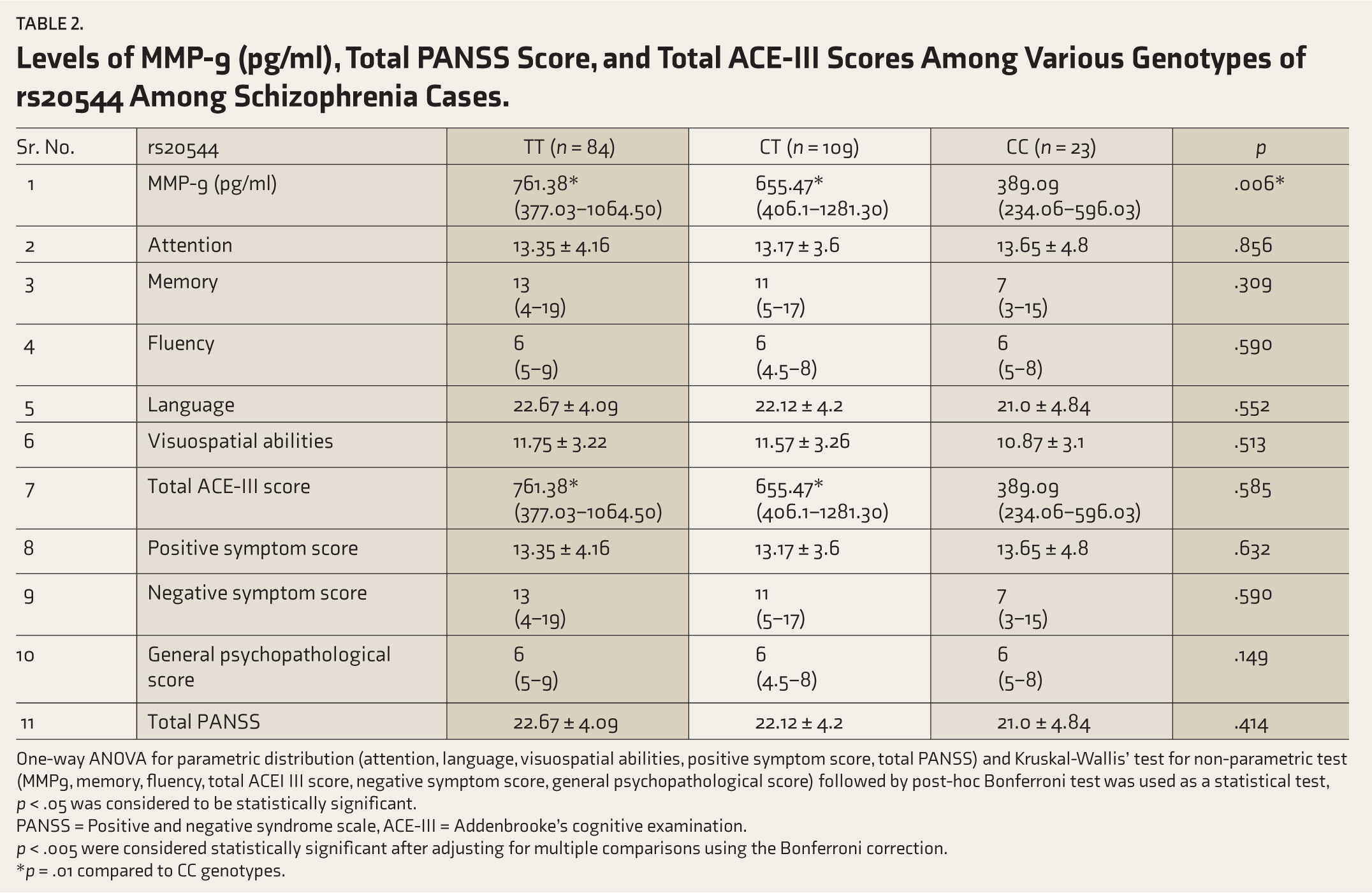
One-way ANOVA for parametric distribution (attention, language, visuospatial abilities, positive symptom score, total PANSS) and Kruskal-Wallis’ test for non-parametric test (MMP9, memory, fluency, total ACEI III score, negative symptom score, general psychopathological score) followed by post-hoc Bonferroni test was used as a statistical test, p < .05 was considered to be statistically significant.
PANSS = Positive and negative syndrome scale, ACE-III = Addenbrooke’s cognitive examination.
p < .005 were considered statistically significant after adjusting for multiple comparisons using the Bonferroni correction.
*p = .01 compared to CC genotypes.
Matrix Metalloproteinase 9 Levels in Different Genotypes of the rs20544 Polymorphism in Schizophrenia Spectrum Disorder.

MMP-9 Genetic Variants in Schizophrenia Cases with Normal Cognitive Function and Mild and Severe Cognitive Impairment.
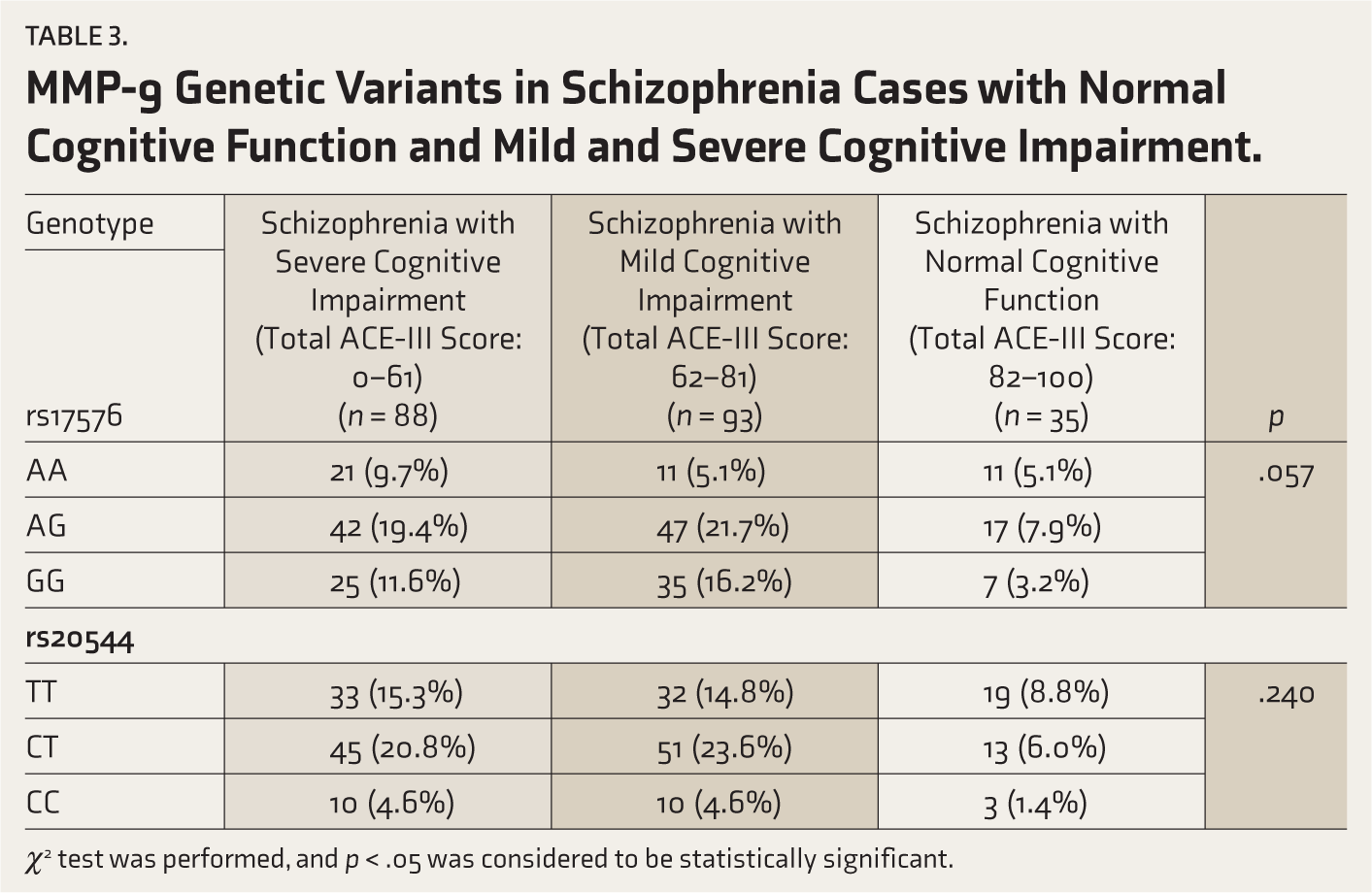
χ2 test was performed, and p < .05 was considered to be statistically significant.
We did not find any differences in plasma MMP9, PANSS, or cognitive domains among rs17576 genotypes in schizophrenia (Supplementary Table S2).
Association of the MMP9 Polymorphism with Suicide Attempt in Schizophrenia
Genotype frequency distribution analysis of the studied MMP9 polymorphisms rs17576 and rs20544 in schizophrenia cases with and without suicide attempt is shown in Table 4. We did not identify any association of the studied MMP9 polymorphisms with suicidal ideation in schizophrenia patients (Supplementary Table S3). However, we found a weak association between the rs20544 variant and suicide attempt, which was not significant (p = .07).
Genotype Frequency Distribution of MMP-9 Polymorphism in Schizophrenia Cases With and Without a History of Suicide Attempt.
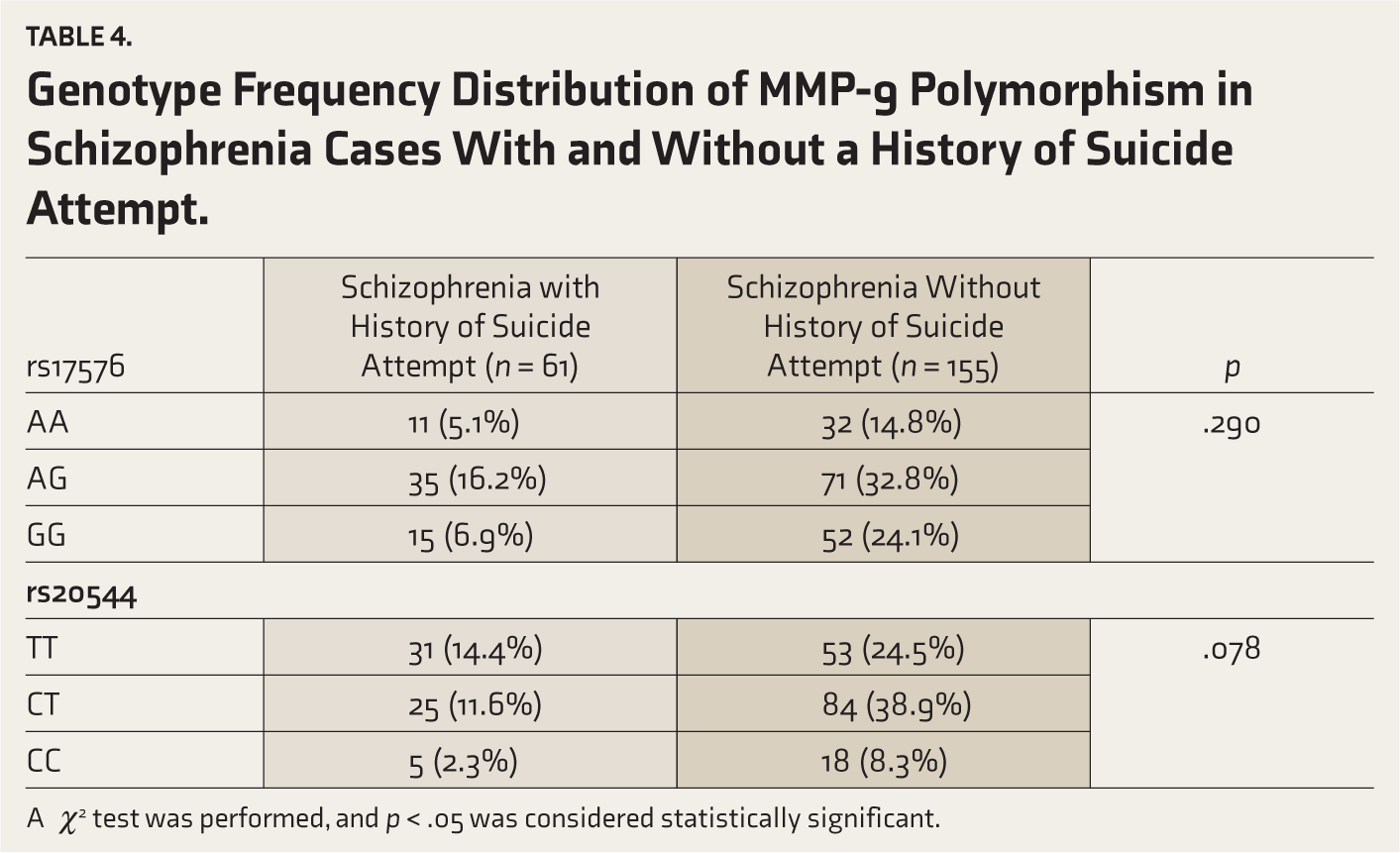
A χ2 test was performed, and p < .05 was considered statistically significant.
Linkage Disequilibrium Analysis of the MMP9 Gene
A Linkage Disequilibrium (LD) analysis of the MMP9 gene situated on chromosome 20 was performed (Supplementary Figure S1). A pairwise analysis of rs20544 and rs17576 is shown. A weak LD was observed between the pairs, as shown in the LD plot.
Discussion
In the current study, the G allele and the GG and AG genotypes of the rs17576 variant of the MMP9 gene were found to increase the risk of schizophrenia. Through genetic model analysis of rs17576, we found that the dominant model (AG+GG) was associated with schizophrenia risk. Among rs20544 variants, the CC genotype and C allele conferred protection against schizophrenia. Furthermore, in a genetic model analysis of rs20544, we observed that the recessive model (CT+TT) was associated with schizophrenia.
Earlier investigators have demonstrated that MMP9 was associated with the pathogenesis of schizophrenia, but the reports about the association of MMP9 polymorphisms with cognitive impairment in schizophrenia are inconsistent. 12 We analyzed two SNPs of MMP9 (chromosome 20q11-13), that is, rs17576 and rs20544, and characterized their relationship with cognitive status and suicide attempts. The rs17576 and rs20544 distributions were in concordance with the Hardy-Weinberg Equilibrium.
To the best of our knowledge, in the published literature, the relevance of rs17576 has been investigated in bipolar disorder, but not in schizophrenia patients. Among the genotypes of rs17576, we found that the GG variant, AG variant, and G allele enhance the risk of the development of schizophrenia. When genetic model analysis was done, we found that the dominant model (AG+GG) had a significant association with schizophrenia. The rs17576 variant was not significantly associated with cognitive status in schizophrenia.
Earlier investigators have reported that the rs20544 SNP was related to schizophrenia. 18 In the current study, we observe that the CC genotype and the C allele of rs20544 conferred protection against the development of schizophrenia. Genetic model analysis showed that the recessive model (CT+TT) was linked to schizophrenia. Previous researchers have demonstrated that the rs20544 polymorphism was associated with chronic delusions in schizophrenia. 18 However, cognitive and disease severity scores did not differ significantly between the rs20544 genotypes.
MMP9 levels are known to be altered in psychiatric disorders. 28 In the current study, we observed that plasma MMP-9 levels were higher in the TT and CT genotypes than in the CC genotype at rs20544 in schizophrenia. The rs 17576 genotypes did not show any difference in plasma MMP9 levels.
In the present study, MMP9 SNPs were not related to suicidal ideation in patients with schizophrenia. However, we found a weak association between the rs20544 variant and suicide attempt, which was not significant (p = .078). Also, a weak LD was observed between the pairs rs17576 and rs20544 of the MMP9 gene (Supplementary Table).
The main limitation of the study is the small sample of patients with suicidal ideation. Since the study involves only a single center, it lacks generalizability. Allele frequency disparities across populations were not studied, and the results need to be replicated across populations to address the issue of population stratification and the need for subjective phenotyping in genetic association studies. Cognitive data in controls were not collected due to ethical concerns. ACE-III is a questionnaire that takes around 20 minutes to administer. Since it is time-consuming and participants may be uncomfortable spending additional time, the institute’s ethics committee did not permit us to use the ACE-III scale in the control group.
Conclusion
We conclude that the rs17576 variant of the MMP9 gene may increase the susceptibility to schizophrenia. The rs20544 polymorphism may be protective against the risk of schizophrenia. Since it is a single-center study, the results need to be validated in multicenter studies across different parts of India. Future studies can explore MMP9 gene-environment interactions and their association with cognitive dysfunction in schizophrenia. Further longitudinal follow-up studies are needed to investigate the effect of drugs on MMP9 gene expression.
Supplemental Material
Supplemental material for this article available online.
Supplemental Material
Supplemental material for this article available online.
Footnotes
Consent for Publication
Written informed consent was obtained for publication.
Data Availability Statement
The data that support the findings of this study are not publicly available due to privacy reasons, but are available from the corresponding author upon reasonable request.
Declaration of Conflicting Interests
The authors declared no potential conflicts of interest with respect to the research, authorship, and/or publication of this article.
Declaration Regarding the Use of Generative AI
None used.
Ethical Approval
The study was approved by the JIPMER Ethics Committee (Human) (JIP/IEC/2018/076 dated 10/05/2018). Prior to the study, we obtained written informed consent from all the participants.
Funding
The authors disclosed receipt of the following financial support for the research, authorship, and/or publication of this article: This study was funded by the Indian Council of Medical Research (ICMR), New Delhi, India (Grant No. 5/4-4/161/M/2020 – NCD-II). The funder had no role in the study design, data collection, data analysis, interpretation, or reporting of the study.
Patient Consent
Written informed consent was obtained from all individual participants included in the study.
References
Supplementary Material
Please find the following supplemental material available below.
For Open Access articles published under a Creative Commons License, all supplemental material carries the same license as the article it is associated with.
For non-Open Access articles published, all supplemental material carries a non-exclusive license, and permission requests for re-use of supplemental material or any part of supplemental material shall be sent directly to the copyright owner as specified in the copyright notice associated with the article.
