




Abstract

To the editor,
I read with interest Tanuja et al.’s paper about the first Taijin Kyofusho (TKS) case series from India. 1 TKS is originally a Japanese word, similar in meaning to social anxiety disorder, and characterized by intense fear from interpersonal situations related to thoughts, feelings, or the conviction that one’s body parts or functions in social interactions are inadequate or offensive to others. 2 Although TKS has often been reported to have originated in Japan and is defined in the DSM-5 as a culture-based symptom, the case series from India indicates that it is found globally and may transcend cultures.
In Japan, Morita therapy, invented by Shoma Morita in 1919, is one of the leading psychotherapies for neuroses3,4 and TKS has a long history of treatment with this type of method. Morita therapy had been considered a treatment specific to East Asian cultures; however, it has recently been widely applied in the West and is now considered a human nature-based treatment applicable worldwide. 3 In his own studies on TKS published a century ago, though the problem of diagnostic criteria validity is acknowledged, Shoma Morita discussed jiko-shisen-kyofu (18th case), fear of blushing (16th case), and olfactory reference syndrome. 5 Shoma Morita is particularly proud of his treatment method for fear of blushing 5 and has been known to have refined and perfected Morita therapy as an effective treatment method. 6
Recently, a meta-analysis of treatment for fear of blushing has been published 7 ; however, unfortunately, Morita therapy, which is widely and effectively used in Japan, was not included because of the lack of English case reports and quantitative efficacy evaluations. Quantitative studies of the effectiveness of Morita therapy have been limited to other conditions, not to fear of blushing.9,10
Based on Morita therapy, the classification of cases with fear of blushing is as follows: those who tend to pay more attention to their inner selves’ experience triggers, such as being accused of blushing in public. This will cause them to pay more attention to blushing, and a fixed symptom will appear.3,4
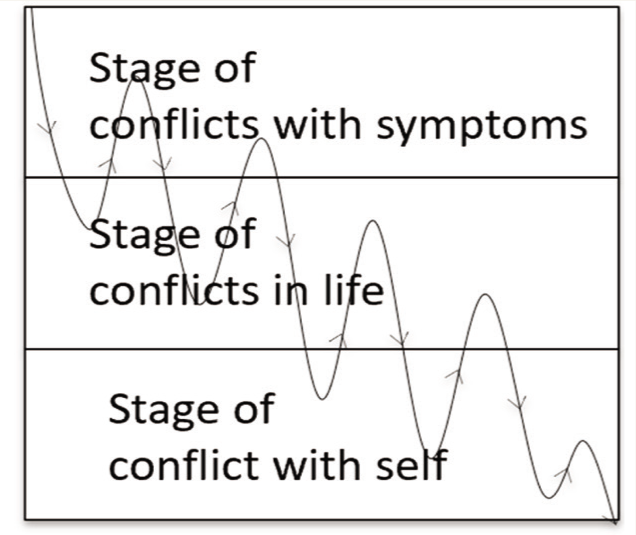
The course of treatment is generally the reverse of this process (symptom→how to live→self). 8 Morita explained to his patient that it is normal to turn red in tense situations and advised him to achieve his personal goals in his own way, thereby avoiding certain behavioural patterns that exacerbate the symptoms. Gradually, Morita shifted his focus to drawing out the patient’s zest for life by focusing on “raw-desire”, as Morita therapy calls it, that underlies fear. Furthermore, Morita mentioned the neurotic thinking that the patient is bound by his portrayal of his ideal self and intervened to help him accept his real self. In this way, the patient gradually moved away from an obsession with the symptoms of blushing and toward maturation of the way of life and the way of self 5 (Figure 1.).
Transition of Therapeutic Themes in Morita Therapy.
Morita therapy for TKS is very effective, but most research on this topic has been presented in the Japanese language. Further quantitative research is required to determine its effectiveness as a treatment for TKS in India.
Footnotes
Declaration of Conflicting Interests
The author declared no potential conflicts of interest with respect to the research, authorship and/or publication of this article.
Funding
The author received no financial support for the research, authorship and/or publication of this article.