




Abstract

For decades, tobacco consumption has been a public health concern in the world, especially South East Asia Region, which currently accounts for 81% of global smokeless tobacco users and is home to >22% of global adult smokers aged ≥15 years.1, 2 Asia is not only the world’s largest tobacco producer but also the largest tobacco consumer. 3 The tobacco industry in this region has been facilitated by complex cross-border factors, including trade liberalization, direct foreign investment, global marketing, transnational tobacco advertising, promotion, and sponsorship. 4 Aggressive marketing by the tobacco industry has boosted sales of tobacco products to unprecedented heights. 5 This article is a story of the evolution and current status of surrogate advertisement for tobacco products in the South East Asia Region and the challenges faced by national policy-makers in their efforts to combat this menace.

The Beginning of Regulation
In response to the globalization of the tobacco epidemic, WHO Framework Convention on Tobacco Control (FCTC) was developed in 2003, which contained evidence-based practices to reduce the demand and supply of tobacco. Under the FCTC, parties were directed to institute comprehensive bans and restrictions on tobacco advertising and promotion on radio, television, print, and other media of mass communication, such as the Internet, along with strict prohibition on tobacco sponsorship of international events, activities, and/or participants therein. 6 In addition, there were several instances of public and legal outrage by government and non-governmental organizations against advertisements and media portrayals endorsing tobacco use. Public interest litigations were filed in India against tobacco companies sponsoring sports teams, smoking in public places, and glamourizing the portrayal of tobacco use in television and cinematic productions. These concerns were given due recognition by the courts, forcing the authorities to take notice.7, 8
Despite vehement opposition by the tobacco industry, between 1989 and 2012, many Southeast Asian countries imposed varying restrictions on advertising tobacco products in their respective nations. Cambodia, Indonesia, Laos, Malaysia, Myanmar, Philippines, Singapore, Thailand, India, and Vietnam instituted regulations on advertising tobacco products. 9 Singapore introduced the Control of Advertisement and Sale of Tobacco Regulations, 2003, and Act, 2011; Philippines introduced bans on all forms of tobacco advertising in mass media, except at the point of sale, in 2003; Malaysia introduced the Control of Tobacco Product (Amendment) Regulations, 2004; Maldives banned all forms of tobacco advertisements on domestic TV and newspapers, and Laos passed the Decree 369 (Ban on Tobacco Advertisement), 2010. India introduced the Cigarettes and Other Tobacco Products (Prohibition of Advertisement and Regulation of Trade and Commerce, Production, Supply, and Distribution) Act (COTPA), 2003, and the National Tobacco Control Program in 2007, putting a complete ban on advertising of cigarettes and other tobacco products and laid down punishments (imprisonment and monetary penalty) for related offenses. India also had the Cable Television Networks Rules, 1994, section 7(2), which prohibited advertising tobacco products, alcohol, and other intoxicants.
Surrogate Advertisement—The Ace up the Industry’s Sleeve
The tobacco industry attempted, rather successfully, to circumvent the bans and restrictions on advertising tobacco products through “surrogate advertisement”, a form of advertising that establishes a brand or product message inside an advertisement that is presumably for another brand or product.10, 11 Surrogate advertisement works by fortifying brand extension and brand recall, as opposed to expanding the sales of the product advertised. 12 Before long, tobacco companies were seen associating themselves with lifestyle retail stores, producing mouth fresheners and packaged mineral water, and even sponsoring award shows. 12 Several research studies documented the adverse effects of surrogate advertisements on viewers. A 2001 marketing survey revealed that advertising directly influenced the consumption habits of 431 million people in India and indirectly impacted 275 million non-consumers, mostly from the lower income group. 10 Other studies explored the socio-demographic characteristics of the viewers affected by surrogate advertisements and reported that adolescents, young adults, males, and those from lower income groups responded favorably to the hidden message in such advertisements. It was also noted that these advertisements tend to bombard the viewers’ senses with repeated mentions of the brand, high frequency of advertisements, glamourized content, and catchy slogans.7, 8, 10, 11, 13, 14
The Cat and Mouse Game
It did not take long for the lawmakers to understand the gravity of the risk posed by these advertising practices, especially in the context of harm due to second-hand smoke and the adolescent and youth population initiating tobacco use at an early age. Thailand, one of the first few southeast Asian countries to pass laws against surrogate advertisement, mandated the prohibition of brand extension by tobacco companies under the Tobacco Products Control Act, 1992. 15 Vietnam, the host of the 22nd South-East Asia games in 2003, declared the event “tobacco-free,” that is, no tobacco sales, sponsorship, advertising, or any form of promotion permitted at any games site. Substantial efforts were made to provide useful and accurate information about tobacco use to athletes, spectators, staff, and other visitors. British American Tobacco (BAT) was called out publicly in its sponsored social responsibility initiatives in Sri Lanka and Bangladesh. 14 With a similar intent, in 2012, Jakarta prohibited tobacco advertising during the daytime, permitting them only between 9:30 pm and 5:00 am. 16
India made several amendments to its existing laws to regulate surrogate advertisements for tobacco products. The Cable Television Networks Rules, 1994, were amended in 2007, by which advertisements that violated the Advertising Standards Council of India (ASCI) codes were not permitted on television. In 2009, it was made mandatory for advertisements created by tobacco companies to be previewed and certified by the Central Board of Film Certification under the Ministry of Information and Broadcasting. 17 In 2010, another directive issued by the Ministry of Information and Broadcasting, Government of India, directed all TV channels to stop showing any advertisement aimed at the brand extension of tobacco companies. 5
However, despite continued modifications in laws, tobacco companies managed to find ways and means to continue surrogate advertisement of tobacco products in the South East Asia Region. 16 A major factor that made this possible was the huge revenue contributed by tobacco sales to the government exchequer, making a total ban impractical. 17 Another factor that recently came to light was the mounting evidence of tobacco industry interference in the governance of South East Asian countries, with tobacco companies showcasing themselves as ethical corporations engaged in social responsibility initiatives.18, 19 This may also explain why Southeast Asian countries’ regulations fail to lay down strict punishments for violations. 19 Diversification of surrogate advertisements on the Internet and online gaming event sponsorship by tobacco companies is another emerging phenomenon that runs unregulated globally, with no federal or state laws existing for prevention or control.1, 20
Over time, surrogate advertising evolved into smarter and more subtle brand placements, just toeing the line of the law and easily falling through the cracks and loopholes (Table 1). And even after years of the cat and mouse game between tobacco companies and the laws catching on, the consumer response essentially remained in the favor of tobacco companies, as reported by recent studies and substantiated by continued high sales of tobacco products despite extensive demand reduction measures.6, 21 In a 2019 consumer survey, >56% of tobacco consumers were unaware of the concept of surrogate advertising, and >32% reported noticing the tobacco company brand along with the product in the advertisement. More than 70% of tobacco consumers reported that advertisements by tobacco companies inspired their tobacco brand and product preferences, while >80% agreed that advertisements can alter consumer perceptions about the product advertised.8, 22
Areca Nut—The New Face of Surrogate Advertisement for Tobacco
A recent player in the surrogate advertisement game is the areca nut, commonly grown in India, Pakistan, Thailand, Malaysia, and South Pacific islands. Areca nut chewing is a common practice in India, several parts of southeast Asia, the South Pacific islands, and Taiwan and is mentioned in ancient religious texts of the region. 23 Areca nut is mixed with tobacco and slaked lime, among other additives, and sold as gutkha, a form of smokeless tobacco. Areca nut mixed with slaked lime and flavoring agents but without tobacco, famously known as pan masala, is sold in India and neighboring countries.24–26 Areca nut has been reported to have a lower dependence potential than cigarettes and smokeless tobacco but is a known carcinogen definitively associated with oral cancers and oral sub-mucous fibrosis.24, 27 Importantly, despite some addiction potential, being a food product, areca nut and its preparations did not fall under the purview of regulations on production, sales, consumption, transport, or storage in any South East Asian Country until the last decade. 28
After the imposition of bans and restrictions on advertisements of tobacco-containing products, tobacco companies have brought areca nut preparations into public focus as a fairly innocuous lifestyle choice.29, 30 Large billboards are displayed openly in cities and sports events routinely sponsored by tobacco companies under the masquerade of areca nut preparations and mouth fresheners, a common sight in Singapore, Malaysia, Philippines, and India. Celebrities, both Bollywood and Hollywood, have been roped in to endorse these products.23, 29 Tobacco control activists have been protesting against these advertisements for years, warning about the potential health hazards of areca nut and the sinister brand placement by tobacco companies. The areca nut market in South East Asia has shown steady growth in the last two decades and promises to grow further. 31 Incidences of oral cancers have also been projected to increase likewise. 28 Considering the ill effects of areca nut on health, after intervention by the Ministry of Public Health of China, the Hunan Province Areca Nut Food Industry Association banned the advertisement of areca nut and its preparations in 2019 as a first step towards control of areca nut use and associated harms.
Timeline of Tobacco Advertisements and Control Measures in the South East Asia Region
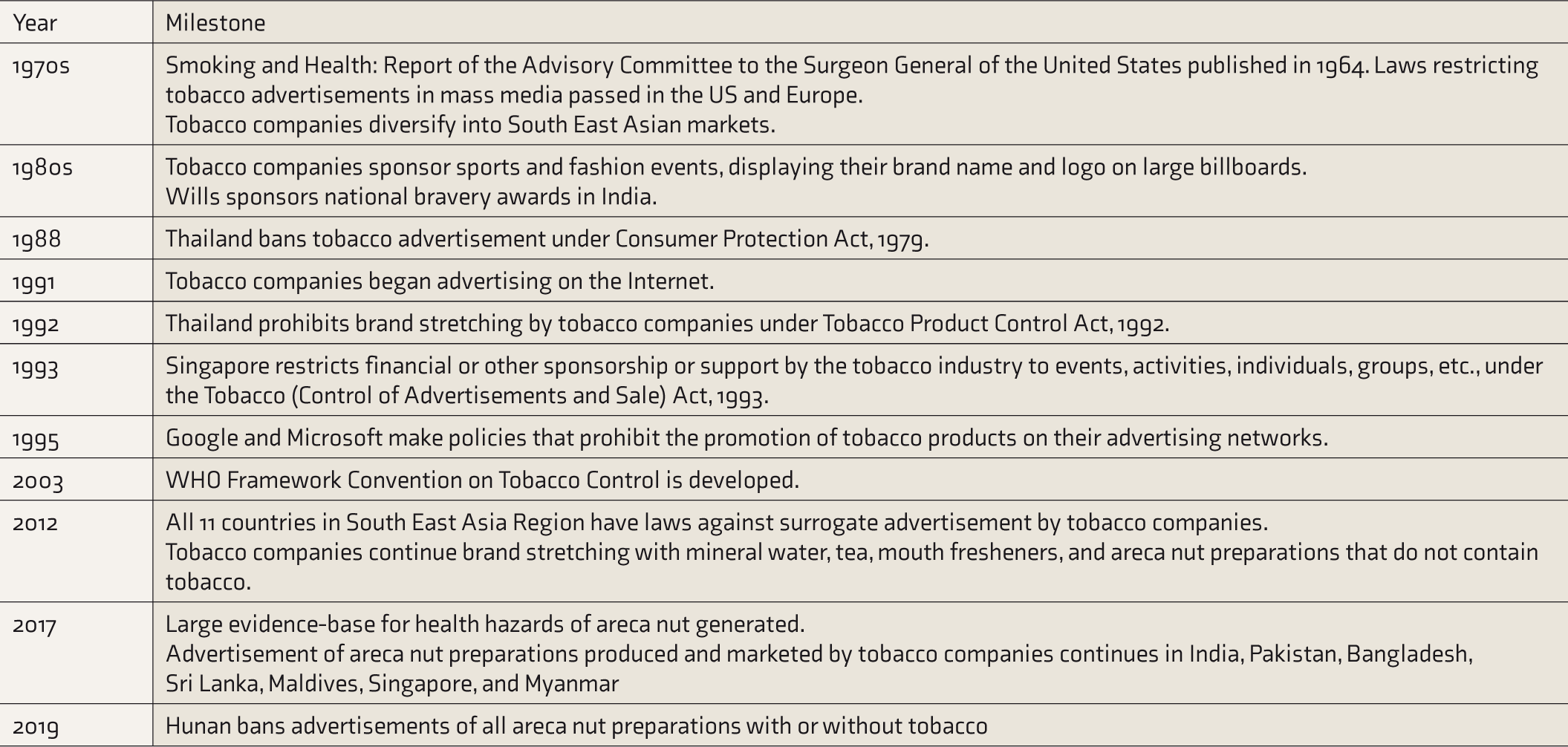
On the other hand, advertisement of areca nut preparations produced and marketed by tobacco companies continues rampantly in India, Pakistan, Bangladesh, Sri Lanka, Maldives, Singapore, and Myanmar. In the last year, at least seven Indian celebrities have signed agreements with tobacco companies to endorse their products, in clear violation of the ASCI guidelines that state that celebrities should not participate in advertisements of products that, by law, require a health warning in their ads or packaging. This received flak from the public and representative government and non-governmental organizations and propelled the Indian government to notify updated guidelines to the Central Consumer Protection Authority on June 9, 2022, empowering it to levy substantial monetary penalties on not just manufacturers and advertisers but also endorsers of misleading advertisements. 32
However, despite increasing sensitization among the public and sporadic outcry against surrogate advertisement in South East Asia Region, tobacco companies continue to find innovative ways to imprint their presence on impressionable minds (Table 1). Thus, it is recommended that the government authorities in Southeast Asian countries take bolder action to control this menace. Limiting daily hours or frequency of showing the advertisement, prohibition of such advertisements during high television viewing hours, control of point of sales promotions, stricter code of ethics for advertisement production companies and endorsers, and harsher punishments and penalties for those found in violation of the rules are needed to protect the young generations from such manipulative tactics and encourage them to lead healthier lives. 29
Also, there is a need for in-depth systematic research assessing the social, public health, trade, and financial impact of new laws and policies, for effective implementation and modification, as needed.
Footnotes
Declaration of Conflicting Interests
The authors declared no potential conflicts of interest with respect to the research, authorship, and/or publication of this article.
Funding
The authors received no financial support for the research, authorship, and/or publication of this article.