




Abstract
Introduction:
India’s National Mental Health Programme (NMHP) was initiated in 1982. In 2016, the Indian Council of Medical Research (ICMR) organized a Brainstorming Meeting on Prioritization of Mental Health Research. Recognizing the need for improving mental healthcare by building a cadre of mental health researchers based on focus areas of the NMHP, the ICMR organized a research training cum capacity building workshop in collaboration with the Cross-Fertilized Research Training Programme (funded by Fogarty International Centre, NIH, USA) in 2016. The workshop successfully prepared and reviewed 12 single and multicenter research proposals in priority areas of mental health research, which were awarded by the ICMR to middle- and junior-level research faculty and NGO.
Methods:
A National Coordination Unit (NCU) was set up to mentor investigators and to coordinate, train, and monitor the progress of their projects. Investigators were paired with senior mentors and also participated in four capacity building workshops focusing on proposal-writing, evaluation, and process tracking.
Results:
Following discussions with ICMR program officers, the NCU formulated standard operating procedures for ethical conduct, data collection, data sharing, progress reporting procedures, and manuscript preparation for all research projects. Regularly scheduled long-distance communications with investigators using social media and group communications were planned. NCU partnered with the ICMR Database Management Unit to build a shared online platform for real-time data entry and storage, and organized two project review meetings where it also coordinated with US faculty to organize public workshops on manuscript writing and qualitative research.
Conclusions:
The NCU will ensure timely completion of research projects, data entry and analysis, and reports and project publications. It is feasible to evaluate progress with the NMHP through coordinated multisite research that also enables research capacity building. Results from these projects will help in formulating policies by the Ministry of Health Government of India for achieving objectives of the NMHP.
1. National and international agencies, working in collaboration, initiated capacity building in research on national mental health priorities, got 12 projects funded. 2. The National Coordination Unit was set up to coordinate, train, and monitor project progress and formulated and implemented standard operating procedures. 4. The NCU will ensure regular mentoring, organize research training workshops, guide publications and regularly monitor and evaluate progress removing roadblocks if any.Key Messages:
The 15% global disease burden is explained by mental, neurological, and substance use disorders in India, which is more than that all developed countries together. 1 Only about 10% of those with mental health disorderss are considered to receive evidence-based interventions 2 . People with mental disorders get care at district hospitals (60%), while 40% travel about 10 km to reach these services. 3 The burden of mental, neurological, and substance use disorders in India is estimated to increase by 23% between 2013 and 2025. 1
To deal with its unfulfilled mental health demands, India’s National Mental Health Programme (NMHP) was initiated in 1982 and after this the District Mental Health Programme (DMHP) was launched in 1996. 4 The programme focused more on the severely mentally ill, while other issues such as suicide prevention, dealing with workplace stress, and teenaged mental health could not be addressed. There was perceived focus on medication management and also lack of continuous and devoted supervising and facilitating mechanisms. 5 Though the DMHP proposed more extensive training for health care workers, gains could not be realized in this area. In their review, Jain and Jadhav opined that community mental health service in India is not culturally planned and needs to be studied at ground level. 6 In addition, implementation of the NMHP needed to be evaluated.
A workshop on “Prioritization of Mental Health Research” was organized by the Indian Council of Medical Research (ICMR) on May 12, 2016, to identify NMHP focus areas for research. The workshop attendees recommended initiating a set of coordinated research projects directed at evaluating the NMHP and simultaneously building research capacity within its scope. Following this meeting, two of the authors (VLN and SND) who attended the workshop and were conducting an NIH-funded Fogarty Institute Training Programme in India—the “Cross-Fertilized Research Training for New Investigators in Egypt and India” (CFRT) 7 — were invited by the ICMR authorities to formulate ways to encourage young faculty to conduct mental health research supported by regular mentoring, specifically focusing on areas relevant to the NMHP. Following discussions, the ICMR organized a five-day capacity building workshop in November 2016 on implementation research, in conjunction with CFRT faculty from India and the USA. 8 Middle- and junior-level faculty were invited to participate through a nationally disseminated advertisement. Each applicant provided their biodata and a brief research proposal; 24 applicants were selected following review. During the five-day workshop, all successful applicants were mentored to formulate research projects which were then developed and submitted to ICMR for funding. Participants submitted a total of 12 projects (multicentric 5; single 7) with 21 grants (24 investigators) which were subsequently funded after due diligence. 8 While some sites had multiple PIs, all multicentric projects worked together with one name and a common protocol.
All research projects commenced in 2018. To coordinate between multiple sites, to provide real-time technical advice, and to monitor the progress of research at all sites, a National Coordinating Unit (NCU) was established, headed by SND. The NCU serves as the bridge between sites, investigators, database management team, and the ICMR. This paper describes the mechanisms and goals of the NCU.
Materials and Methods
The 24 PIs were trained in conceptualizing a research question and converting it into a research proposal at the initial Grantathon.
8
PIs were trained in research fundamentals and generating data on their research questions. In addition, they also learnt the minutiae of research administration—from how to hire research assistants, undertake research with technological support, participate in conferences, and to be productive. The research proposals were submitted to and funded by ICMR. After funding, PIs needed intensive support related to program initiation, administrative issues, and other aspects of research projects, which were carried out by the NCU with active support of ICMR headquarters (HQ ICMR). To fulfill the aim of mentoring and coordinating PIs, Data Management Unit (DMU), and HQ ICMR, the following methods were adopted:
Research training and mentoring: This was conducted initially during the Grantathon at Delhi and continued through active review and specific workshops during the project review meetings at Delhi and Bengaluru. Coordination, uniformity, and procuring tools: All PIs were requested to use validated and free-for-use tools to the greatest extent possible, as an online database for all projects was envisaged. PIs were also encouraged to use the same tool for similar evaluations for comparability. NCU began with collection of all evaluation tools thus ensuring a level playing field. But between the grantathon in 2016 and funding in 2018, several tools were copyrighted and monetized. The NCU undertook a major exercise to obtain necessary permissions, or help PIs procure the tools they needed with authorization from the DG ICMR. Some tools/new manuals were expanded, tweaked, changed, or modified and the NCU helped this exercise. Monitor progress and resolve roadblocks: Through multimodal methods as listed below. Ensure quality: Through online meetings, online platform, personal interactions, and field visits. Compilation of the progress of these projects. Overall investigator support—solving the problems related to methods, methodology, tools, preparation of report, budget, and communication outside the group for scientific matters.
To achieve the above objectives, following methods were adopted:
Consensus standard operating procedures (SOPs): SOPs are sets of instructions that can be taken as a mandate, covering those attributes of operations that lend themselves to a definite or standardized procedure without losing efficiency.
9
SOPs were developed for smooth functioning of multiple projects. Coordination with ICMR and DMU: NCU acted as a bridge between the funding agency, faculty and investigators to expedite research. Being mental health workers ourselves, we could help the computer scientists at the DMU build a suitable database. Communication:
Building social groups: Group communication was established, using modern means of communication including digital messaging platforms. Teleconferencing review meetings: In order to ensure adherence to objectives of their own proposal, maintaining time schedule of the project and meeting research goals, regular and as-needed telephonic review meetings were created. Face-to-face biannual review meetings: The purpose of regular group project review meetings was to obtain an update on the status of activities, identify problems, and so on. It was planned to hold review meetings of faculty, ICMR, DMU, and all PIs biannually to evaluate progress and smoothen the path of all projects. One-on-one on-site meetings: As needed.
Results
The capacity building model was successful in attracting young faculty incubate their ideas. Projects were proposed, written, reviewed, improved, 8 and subsequently funded. The NCU acts as a bridge between the premier medical research agency of India—the ICMR—and middle and junior level faculty, many of whom had never successfully received a funded research project prior to this project.
The first aim was to formalize terms and conditions of work, not the least because a new database and online data entry was envisioned. During meetings with the funding agency, database management experts, and the NCU, SOPs were proposed, which would include all aspects of research. The drafts were circulated among stakeholders and final SOPs were prepared. These were designed to remain in force for the duration of the projects, until all academic manuscripts related to the data collected are published and until all claims are settled between ICMR, NCU, and PI sites. The SOP covers all aspects of program operation and provides guidance to all stakeholders on how to handle particular situations. The stakeholders of the Task Force projects on capacity building projects, ICMR-NMHP, are Division of Non-Communicable Diseases (NCD), HQ ICMR, DMU ICMR, National Coordinating Unit, CEIMH, ABVIMS-Dr. RML Hospital (NCU), and Principal Investigators of Research Projects funded by ICMR under Capacity Building, ICMR-NMHP (PI). Some important SOPs are tabulated in Table 1. The SOPs were signed by all investigators and NCU, and are retained at the ICMR HQ (Appendix 1).
Essential Elements of Standard Operating Procedures (SOPs)
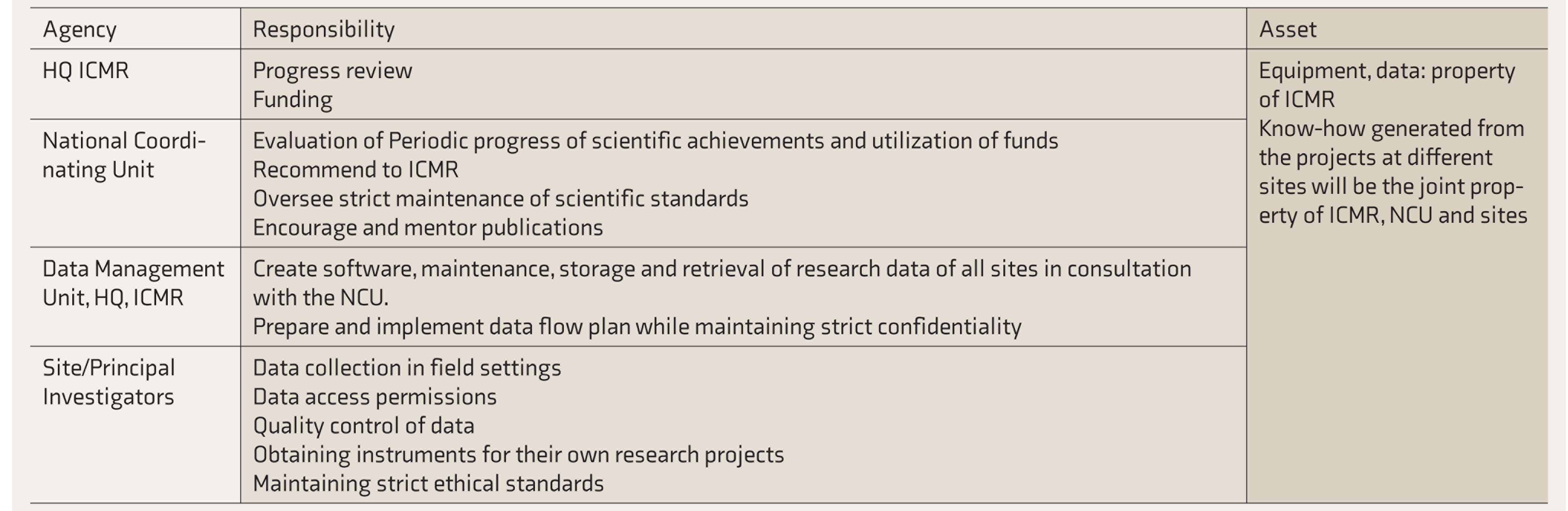
HQ, headquarter; ICMR, Indian Council Medical Research; NCU, National Coordination Unit.
Coordinating 12 projects involving 21 sites and 24 PIs requires continuing communication. Several channels were established for smooth communication between the four arms of the Task Force. Distance communication was ensured by establishing chat groups on social media platform WhatsApp and an email group. These groups helped members develop cross linkages between themselves as well. While the social media and email groups disseminated suggestions and news, they helped the PIs remain in contact with NCU on day-to-day basis. Problems were solved as quickly as possible. PIs contact each other and help whenever needed. Detailed instructions, deadlines, and documents are shared on emails.
In addition, monthly telephone review meetings were started between the NCU and PIs to review project progress. While PIs from multicentric projects discussed progress together, single site PIs either joined in or communicated separately in their own turn. We discussed issues around recruitment, database, ethical issues, any other problems, and ideas for manuscripts. These target setting calls increased recruitments, and many PIs were able to start writing their manuscripts. This is a very successful ongoing process that motivates the PIs. Some visits by the NCU, ICMR HQ, and even faculty were carried out at various sites to build trust and inculcate bonding.
Biannual meetings were planned and two were conducted. The two-day first review meeting took place at Delhi in March 2019. All PIs presented their projects’ progress and described challenges. These were reviewed by the ICMR HQ, NCU, and faculty of the CFRT. Breakout groups of PIs and CFRT faculty collaboratively developed solutions. Most projects were in the initiation, tool procurement, and translation phases, and faced challenges regarding copyright and local language translations. Solutions were suggested by the faculty regarding data collection, sampling issues and improvements.
Before the second review meeting, held at Bengaluru in September 2019, all PIs were expected to recruit at least one-third of their total sample. Since the database was now operational, PIs provided objective proof of their achievements by entering recruitment data in the database. Progress was reviewed by the ICMR HQ and CFRT faculty from University of Pittsburgh, USA, Mansoura and Cairo Universities in Egypt, and Indian faculty. The research issues faced by the PIs were discussed and consensus solutions were suggested. Attendees recommended some changes in ongoing projects for increasing their scientific merit and implementation practicality. Most sites had achieved recruitment targets, which was very satisfying. Some had translated instruments, developed research SOPs and developed implementation manuals. Manuscript writing was encouraged.
During both meetings, faculty from the University of Pittsburgh Graduate School of Public Health organized public scientific workshops to educate participants on research methods. The first meeting included a workshop on manuscript writing, and the second included one on qualitative research. These workshops were widely attended and appreciated.
The NCU also took the lead in facilitating budget preparation, developing, and implementing codal formalities for tools. After projects were approved, NCU guided all PIs in making budget in correct format and facilitated administrative procedures which were prerequisites for funding. PI documents were processed as a group, and thus disbursement of funds happened simultaneously. NCU is currently facilitating the second-year review of projects and budget transfer.
A database was planned for real-time data entry for all projects in collaboration with DMU. NCU facilitated communication between database software experts and the PIs. NCU collected all project research tools and advised DMU on how to incorporate them in the database. The first database structure was presented by DMU in the first review meeting but was found to be unsuitable for the scope and depth for such large amounts of data. Hence DMU shifted the database on DHIS2 platform. The database was launched before the second review meeting and populated by all PIs. Continual tweaking and improvement has ensured acceptability of this online database which will be a research resource in perpetuity. Full care has been taken to ensure data safety, confidentiality, and protection of copyright.
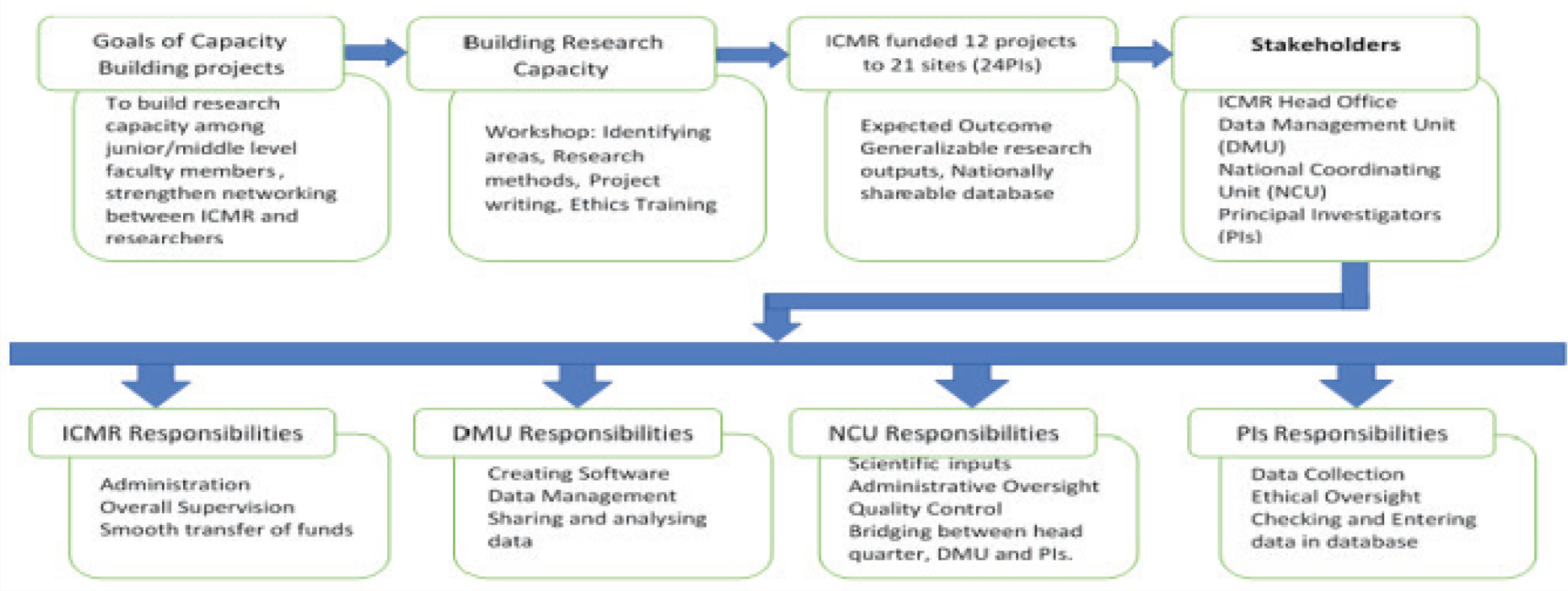
NCU also facilitated obtaining tool copyrights with support from ICMR, NCD. ICMR NCD led efforts to communicate with copyright holders and ensured compliance of all formalities required by publishers or authors of the instruments. Through the good offices of the ICMR, permission for 14 tools was received. Process is ongoing for others. Some tools were only for sale; these tools were purchased. Full care has been taken to ensure the copyrights and sale agreements are not breached by the database. Figure 1 illustrates the design of the project; and responsibilities of various arms of this project.
The Projects: All funded projects focus on various objectives of NMHP. A very important aim of NMHP is suicide prevention services. “A multicentric randomized controlled trial to evaluate the efficacy of telephone based psychosocial interventions on future suicide risk in suicide attempters” and one single PI “Psychological intervention by videoconference for vulnerable family members of farmers who have committed suicide” projects on suicide. Both are RCTs investigating the effect of counseling through electronic media (telephone and videoconferencing) on suicide attempters or families affected by suicide. These projects can suggest economical methods of reaching to the suicide attempters and their families to prevent suicide or reduce its aftermath.
The Figurative Presentation of the Design of the Project and Responsibilities of Various Arms
List of Projects
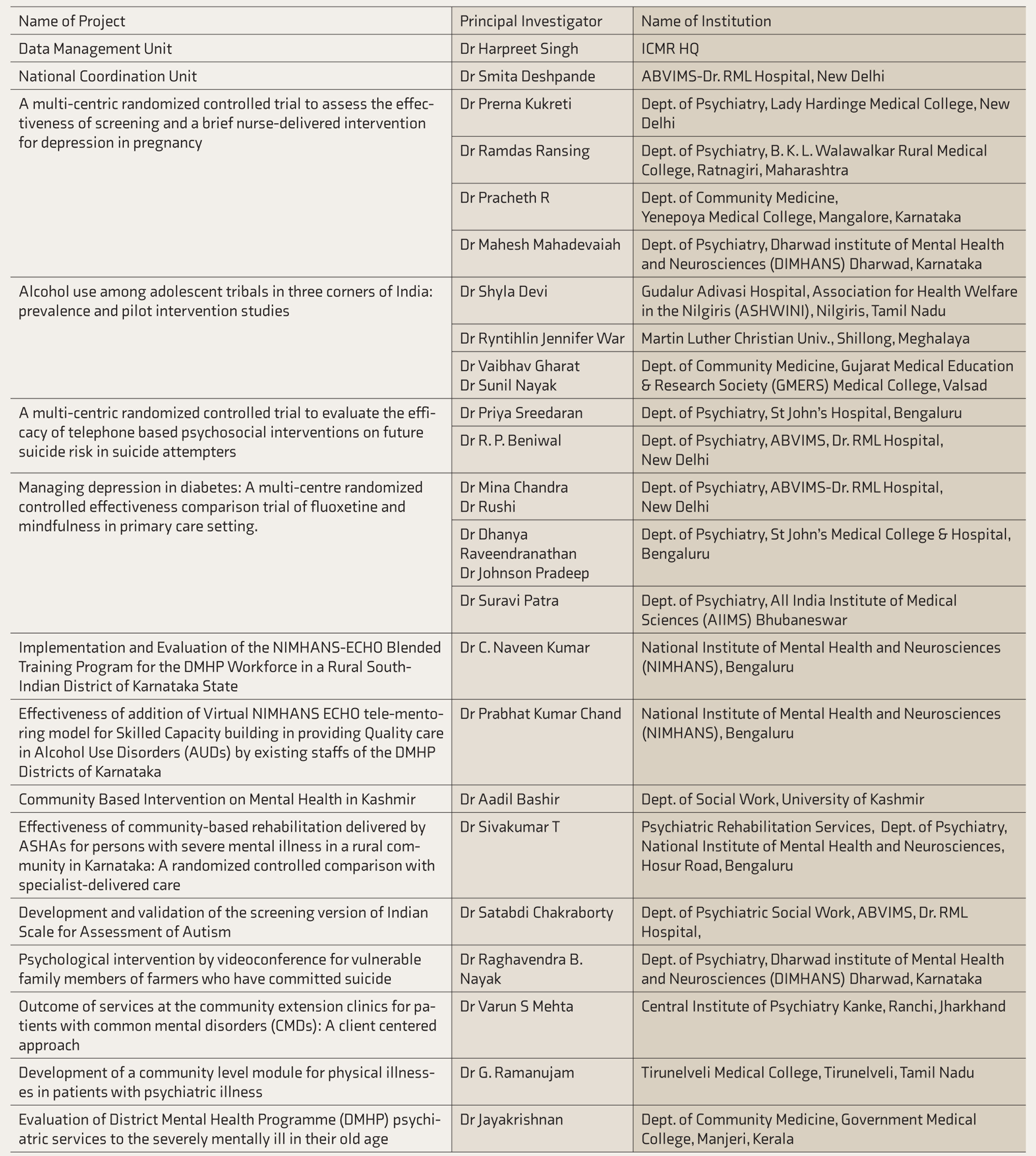
ABVIMS, Atal Bihari Vajpayee Institute of Medical Sciences; ICMR, Indian Council for Medical Research; RML, Ram Manohar Lohia
Two proposals aim at empowering general health staff on diagnosis and intervention for depression in physical illness (“Managing depression in diabetes: A multi-centre randomized controlled efficacy trial comparing Fluoxetine and Mindfulness in primary care setting”) or during pregnancy (“A Multi-Centric Randomized Controlled Trial to Assess the Effectiveness of Screening and a Brief Nurse-Delivered Intervention for Depression in Pregnancy”). The first aims to develop a sustainable model for the management of depression in patients with diabetes at the primary health care level, and second is to train nurses to screen the pregnant women for depression and give brief intervention. This is in consonant with NMHP goals of training general physicians in mental health issues. The project “Development of a community level module for physical illnesses in patients with psychiatric illness” has been planned to identify comorbid physical illness in persons with psychiatric illness applying survey design, and develop an interventions program for both physical and mental health through a task-shifting and stepped-care model using telemedicine technology within the public health system. Similarly, another proposed study “Effectiveness of community-based rehabilitation delivered by ASHAs for severe mental illness in rural community in Karnataka: A randomized controlled comparison workers with specialist-delivered care” is implementing training to ASHA workers in rehabilitation of severely mentally ill applying a randomized controlled design.
The project “Evaluation of District Mental Health Programme (DMHP) psychiatric services to the severely mentally ill in their old age” is in congruence with the goal of the capacity building projects evaluating the DMHP by studying their reach to senior citizens with mental illness and to identify barriers. In another survey study “Community Based Intervention on Mental Health in Kashmir” in tension ridden Kashmir aims at screening the population in that area for anxiety and depression and to establish a community counseling center in Budgam District of Kashmir where 26% of prevalence of mental disorders is reported. 10
A multicentric project “Effectiveness of addition of Virtual NIMHANS ECHO tele-mentoring model for Skilled Capacity building in providing Quality care in Alcohol Use Disorders (AUDs) by existing staffs of the DMHP Districts of Karnataka” based in Bengaluru proposes to apply an easily available (and affordable) technology NIMHANS ECHO model to the DMHP. The other collaborator is applying the same technology to overcome the barriers (continuous hand-holding and regular monitoring of the program implementation) in effective mental health care delivery in a rural health setting. If found successful, this has the potential to be extended throughout the country.
An evaluation study “Outcome of services at the community extension clinics for patients with Common Mental Disorders (CMDs): A client centred approach” aims to study the outcome of the services provided at the outreach clinic which in turn could help in improving the standards of care across the state.
The tribal population needs attention for mental health issues in India; a multicentric project “Alcohol use among adolescent tribals in three corners of India: prevalence and pilot intervention studies” is studying prevalence of alcohol use among tribal adolescent population and intervening with life skill teaching.
A study “Development and Validation of the Screening Version of Indian Scale for Assessment of Autism” aims to develop a screening version of Indian Scale for Assessment of Autism (ISAA) so that it can be used more extensively even in primary health care centers, so that not a single child with this disorder is missed out. All projects and their PIs are listed in Table 2.
Discussion
Enhancing health research capacity will facilitate countries like India to identify interventions that are efficient in their cultural and geographic surroundings, to implement and reproduce results, and ultimately to enhance the implementation of National Mental Health Policy (Ministry of Health and Family Welfare, 2014). Our “grantathon” model 8 enabled the establishment of a funded consortium of Indian mental health researchers in a comparatively short period of time, as medium or early level researchers were trained to design and start running research projects. The researchers were empowered to design clinical and translational research questions and receive funding. They are successfully continuing their research projects. In fact, considering the success of this model, the pan-Indian association—Indian Association of Private Psychiatrists (IAPP) organized a similar meeting with CFRT faculty which resulted in two other research projects that received funding from IAPP and CFRT.
SOPs act as a resource to inform roles and responsibilities. They help in management, ensure compliance of study design, and spell out collaboration rules. SOPs can act as source document to provide a level of formal accountability for all stakeholders. 11 They aid a coordinated approach. Our SOPs were detailed and incorporated all aspects of research yet were simple, easy to understand, and focused. We took good care that every stakeholder could understand and follow procedures. Till the present, we have not encountered any difficulty in implementing SOPs.
The review meetings helped to evaluate progress and assess targets by focusing on the research. Innovative ideas developed as various researchers and faculty from different disciplines met, and solutions to problems were found with contributions from different stakeholders. Suggestions from principal investigators of other research projects were also very useful and ideas germinated through these dialogues. The qualitative research workshop, part of second review meeting, stimulated new ideas and many investigators included some qualitative aspects in the study. Biannual meetings thus germinated new ideas for further research. More subtly, review meetings encouraged bonding as a research group. Some investigators are now taking their collaborative ideas forward separate from the bigger Task Force.
ICMR will receive these research results as important outcomes which can be implemented in the country. They may help in formulating policies by the Ministry of Health Government of India. Group research proposals increased the visibility of the funding agency, aiding them in developing their mission statements and strategic planning. 12 Research organizations have a central role in ensuring exchange of ideas and networking. This requires the allocation of resources for these activities for organizations to support joint activities. The outcomes of this capacity building program can be measured by the number of papers published. The i-MANN database, which is under development, is another major achievement. Projects are developing a number of deliverables in the form of manuals, training programs and the like which will be published. An intangible but the most important outcome will be building up research infrastructure for mental health research in the country.
Mentoring is very important for the advancement of a successful research career, and it needs to be aimed at developing collaborative research. 13 Mentoring produces benefits in research capacity, career fulfillment, and career success for both mentor and mentee. 14 Capacity building is a process for development of competence and capability to carry out and publicize high-quality research in organizations and systems.15,16 Capacity building training for implementation science requires both mentoring and partnership. Evaluation of research capacity building programs put forward challenges, including defining “research capacity building” and assessing it. 16 Propagation and implementation of research outcomes into system are mandatory to close the gap between an effective treatment and new research conclusions being implemented in routine management. 17
Some ongoing challenges, however, continue. The project proposals were completed and reviewed within four months of the capacity building workshop in 2016 but could be started only in September–October 2018. Some institutions were beginners in research funding. This resulted in avoidable delays in project initiation. As in other groups, productivity varies widely and may require further handholding and evaluation. On the whole, however, this experiment has been successful so far in improving the research climate at several sites.
A new venture is bound to encounter challenges. The present capacity building model with close mentoring and monitoring has successfully overcome several challenges, including recruitment across diverse populations, keeping to timelines, developing and implementing the database, gradual monetization of free tools, and unforeseen ones such as the pandemic. PIs will continue to publish their research addressing thrust areas of the NMHP, evaluate implementation models across the country, and bring results to the attention of policy makers. Coordination across new researchers in multicentric projects has been a novel experience on how strangers can work together yet retain their uniqueness.
Conclusion
The “grantathon” model initiated in 2016 successfully took off. Over a period of time, the 24 PIs built new research infrastructure and learnt to tackle problems as they arose. As their projects demanded, PIs worked together to develop training programs for implementation of mental health targets, prepared manuals and published papers in international peer reviewed journals. The journey was rudely interrupted by the pandemic. It faltered but arose and continues in spite of the virus. The ICMR should seriously examine this model for wider use, as also help disseminate the results of these projects across the country.
Footnotes
Acknowledgements
This work is supported by the Indian Council of Medical Research (ICMR) under Capacity Building Projects for National Mental Health Programme (ICMR-NMHP) Task Force. We thank Dr. Soumya Swaminathan (then Secretary, Dept. of Health Research, DHR), Dr. Balram Bhargava (Secretary DHR). We thank the faculty of “Cross-Fertilized Research Training for New Investigators in India and Egypt” (D43 TW009114, HMSC File No. Indo-Foreign/35/M/2012-NCD-1, funded by Fogarty International Centre, NIH). We thank the National Coordinating Unit for logistic support and the ICMR Data Management Unit for designing the database. The content of this manuscript is solely the responsibility of the authors and does not necessarily represent the official views of NIH or ICMR. NIH and ICMR had no role in the design and conduct of the study; collection, management, analysis, and interpretation of the data; preparation, review, or approval of the manuscript; and decision to submit the manuscript for publication.
Declaration of Conflicting Interests
The authors declared no potential conflicts of interest with respect to the research, authorship, and/or publication of this article.
Funding
This protocol paper describes the methodology of a research project funded under 'Capacity Building Task Force for Mental Health Research in India' funded by the Indian Council of Medical Research vide file number 5/4-4/151/M/2017/NCD-1. International mentors were funded by the training program 'Cross Fertilized Research Training for New Investigators in India and Egypt' funded by FIC, NIH (No. D43 TW009114).
Standard Operating Protocol Formulated for the Capacity Building Projects
Capacity Building Projects, ICMR-NMHP
The capacity building projects, ICMR-NMHP have following stakeholders:
Division of Non-Communicable Diseases (Headquarter), ICMR (HQ-ICMR) Data Management Unit, ICMR (DMU) National Coordinating Unit, CEIMH, PGIMER-Dr. RML Hospital (NCU) Principal Investigators of Research Projects funded by ICMR under capacity building, ICMR-NMHP (PI)
Mentors who taught and guided the PIs are special invitees.
The basic responsibility of all four arms of the capacity building projects, ICMR-NMHP is to facilitate smooth running of the research projects sanctioned for achieving their goals in the larger interest of the Indian public.
Data Management Unit (DMU) under Dr. Harpreet Singh will be primarily responsible for data management, developing and managing software, storing, retrieving, sharing, and analyzing data whenever required. DMU will be in charge of all data of all projects.
The main responsibility of NCD-III headquarter under the leadership of Dr. Ravinder Singh is administration and overall supervision of the projects and units. He will facilitate administrative help from funding agency and smooth transfer of funds.
National Coordinating Unit (NCU) under Prof. Smita N Deshpande will facilitate the projects in terms of scientific inputs, administrative oversight (meeting deadlines, meeting scientific targets, quality control), and bridging between headquarter, DMU, and PIs.