




Abstract
Background:
Studies of alcohol use among college students in India have reported a male preponderance, but a recent large study suggested that alcohol use is increasing in young females. This increase in use among the young females is of concern as they experience poorer outcomes and a higher risk for addiction. Hence, we aimed to examine the gender-specific correlates of alcohol use among college students in the district of Ernakulum, Kerala.
Methods:
From 58 colleges, 5,784 students completed a self-administered questionnaire that assessed use of alcohol, use of tobacco and illicit drugs, psychological distress, suicidality, symptoms of attention deficit hyperactivity disorder, and history of sexual abuse.
Results:
Of the questionnaires, 342 had incomplete responses and had to be discarded, and the rest (n = 5,442, 94.1%) were analyzed. lifetime alcohol use was reported by 39% males and 12.6% females. In the multivariable logistic regression analysis using a full model, male students using alcohol compared to male non-users were older, non-Muslim, had poor academic performance, and used other substances. Female users, compared to female non-users, were non-Muslim, had urban residence, used tobacco, and had higher psychological distress, higher suicidal thoughts, and higher lifetime exposure to sexual abuse.
Conclusion:
Gender-specific differences extend across sociodemographic and psychological domains. Incorporation of these may improve the effectiveness of public health strategies addressing alcohol use.
Study reports on gender differences in alcohol use among college students in India. Male users, compared to male non-users, were older, non-Muslim, had poor academic performance, and used other substance. Female users, compared to females non-users, were non-Muslim and had urban residence, higher level of tobacco use, psychological distress, suicidal thoughts, and history of sexual abuse.Key Messages:
Existing studies among college students from India have not examined gender differences in the correlates of alcohol use. Examining this may be critical in designing gender-specific public health strategies to tackle alcohol use among young adults. It is in this background that we report the gender differences in the correlates of alcohol use among college students in an Indian district. In addition to sociodemographic factors, other associations examined included the use of other substances (tobacco and illicit drugs), psychological distress, lifetime suicidality and sexual abuse, and features of ADHD.
The findings reported are the secondary analysis of data that further reported alcohol use among college students in the district of Ernakulam, Kerala.5 The primary objective of the larger study was to examine various psychological issues among college-going students.
Material and Methods
The survey was conducted in 58 colleges in the district of Ernakulam, of Kerala in 2014–2015. The district had 123 colleges offering specialized courses, with approximately 50,000 students enrolled. A master list was initially prepared subcategorizing the colleges into the courses they offer, that is, medical, dental, nursing, engineering, law, arts and sciences, homeopathy, Ayurveda, and fisheries science. The institutions were selected using cluster random sampling. At least 40% of institutions in each subcategory were randomly selected. For courses in which colleges were few in number (medical, dental, law, homeopathy, Ayurveda, and fisheries science), at least 50%, were selected. From each college, the administration allocated students of odd or even years (i.e., the first year and the third year, or the second year and the fourth year). In colleges where there were multiple divisions in a single year, a single division was randomly allocated. All students who were present in the class on the day of the survey were invited to participate.
The questionnaire, initially prepared in English, was translated into Malayalam (the vernacular language) and then back-translated to check for conceptual congruence. Consenting students had the freedom to opt to answer either the Malayalam or English version of the self-administered questionnaire.
The students were invited to participate after explaining the objectives of the survey. They were also informed that the information they provide would remain anonymous and that the answers will not impact their academic grades.
The survey was supervised by the staff from the Dept. of Psychiatry, Government Medical College, Ernakulam (formerly Cochin Medical College).
This study received approval from the Institute Ethics Committee.
Assessment Tools
The sociodemographic profile was assessed using a checklist (age/sex/area of residence/ religion/socioeconomic status/academic performance).
Use of alcohol and other substances was assessed using Alcohol, Smoking and Substance Involvement Screening Test (ASSIST), which is validated for use in developing countries.10 For the purpose of this paper, only lifetime use of alcohol, tobacco, and illicit drugs (cannabis, solvents, and other substances grouped together) was considered.
In addition, psychological distress was assessed using the Kessler’s Psychological Distress Scale (K10)11; lifetime sexual abuse was assessed using four questions from Child Abuse Screening Tool Children’s Version (ICAST-C), two pertaining to non-contact sexual abuse and two to contact sexual abuse12; childhood ADHD symptoms were retrospectively assessed using Barkley Adult ADHD Rating Scale-IV (BAARS-IV)—childhood symptoms self-report,13 and two questions pertaining to suicidal thoughts and attempts were asked to screen for lifetime suicidality.
Statistical Analysis
Data was analyzed by using SPSS 15.0.14 Based on the lifetime use of alcohol, both male and female students were grouped into users and non-users. A full model of multivariable binary logistic regression analysis was done to assess the effect of sociodemographic variables, academic performance, other substance use, psychological distress, lifetime suicidality, lifetime sexual abuse, and significant ADHD symptoms across genders, using two sets of analysis (male users vs male non-users, female users vs female non-users). The difference between the odds ratios (ORs) of these factors between males and females was tested based on regression coefficient and standard error. The results are reported in the form of OR and 95% confidence intervals (CI). All tests were two-tailed, and statistical significance was set at P < 0.05.
Results
A total of 5,784 students took part in the survey. Of the questionnaires, 342 (5.9%) had to be discarded as they were incomplete, and the rest (n = 5,442, 94.1%) were analyzed. Of them, 3,545 (64.8%) were females, with a mean age of 20.3 years (range 18–25 years). Lifetime use of alcohol was reported by 1,168 (21.4%) students (males—726 [39%]; females—442 [12.6%]).
In the multivariable logistic regression analysis using a full model, male students who reported alcohol use, in comparison to male non-users, had higher odds of being older, being non-Muslim, having poor academic performance, and using tobacco and illicit drugs (Table 1).
Gender Differences in Academic and Psychosocial Correlates Among Alcohol Users
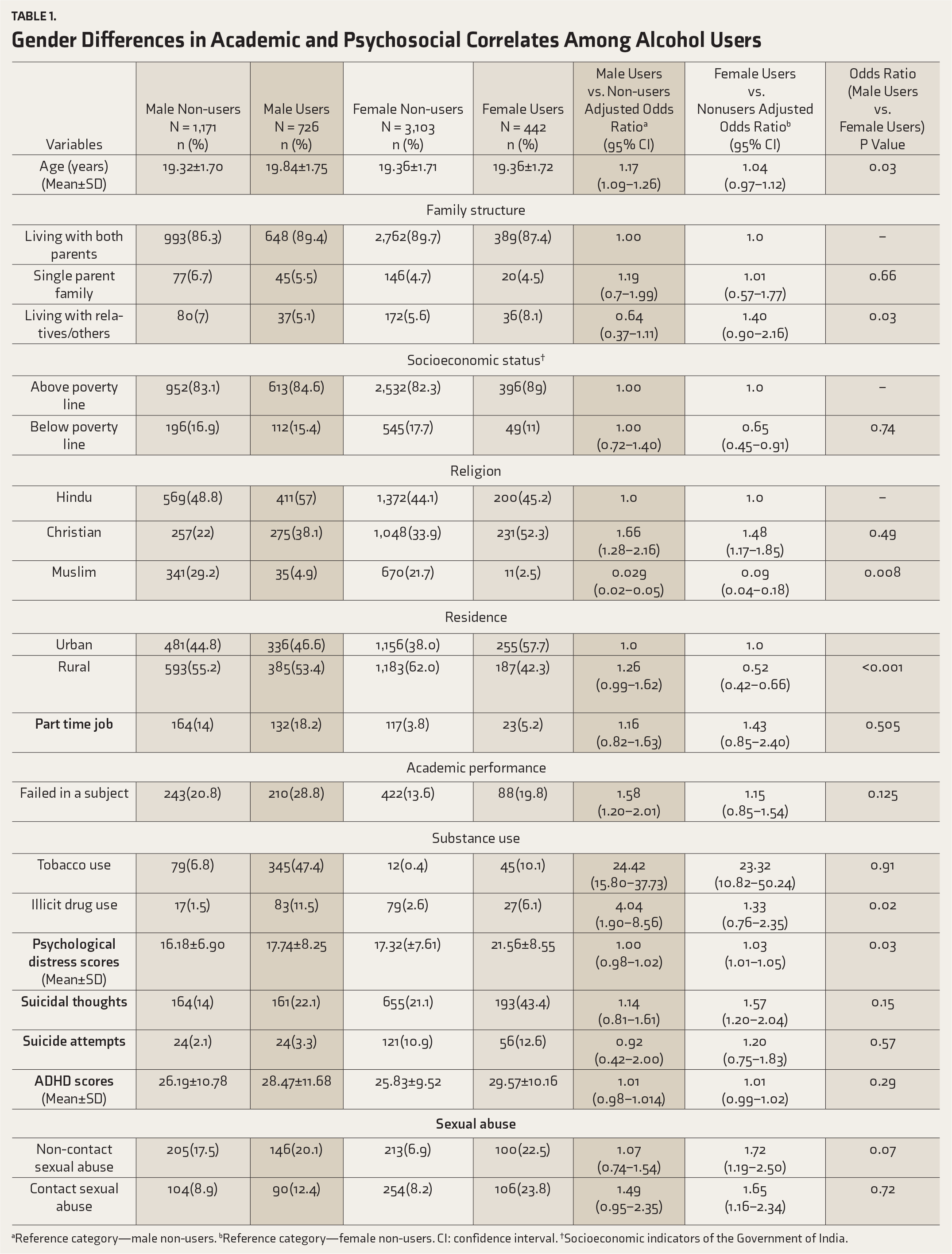
aReference category—male non-users. bReference category—female non-users. CI: confidence interval. †Socioeconomic indicators of the Government of India.
The ORs of male and female students using alcohol were compared. In males, the risk of alcohol use was higher with older age and illicit drug use. In females, not living with parents, having an urban residence, and higher psychological distress indicated a higher risk (Table 1).
Discussion
In this paper, we report the gender-specific differences in correlates of alcohol use among college students from the state of Kerala, India. The higher proportion of females in our sample is reflective of the pattern of enrollment in higher educational institutions in Kerala.15 The state of Kerala has the highest per capita consumption of alcohol (8.3 liters) in India, with approximately 10% of the population drinking problematically.16 In our study, increasing age was a risk factor for alcohol use only among males. Most studies show consumption to increase with age,1,2 but there are inconsistencies, with some researchers reporting a decrease or no change.17 The lack of consistency has been explained by the variation in age range and academic year (consequently, workload) of students across studies.16
Among our students, both males and females who were Muslims were less likely to drink, reflecting the strict moral proscriptions of Islam having a significant influence in reducing use among the Muslim students.18
Female students, in our study, from an urban background had a higher risk of alcohol use, but the place of residence did not influence male drinking. This is in variance to most previous studies from other countries that have reported a higher risk among students from both genders who were from a rural background.1,2 Two factors in Kerala may contribute to this difference. First, urban centers have witnessed significant economic and social transformation, with consequent liberalization of social norms, which appear to foster female drinking. Second, the proportion of licensed outlets is higher in the urban centers, possibly providing increased access to alcohol.
While the socioeconomic status did not have any association with alcohol use among our students, most previous studies have suggested that students of higher socioeconomic status who have access to disposable income have increased risk of substance use.1 In India, most college students, irrespective of their economic background, are financially supported by their families, and parents often restrict access to disposable money.
In our study, female students living with relatives were at higher risk of using alcohol. Living in less controlled situations or non-traditional family structures has been reported to increase the risk of alcohol use.17
Though it has been consistently reported that alcohol use impairs academic performance irrespective of gender,1,2 in our sample, only the male students using alcohol had impaired academic performance. A significantly higher proportion of males in our study, as reported in the prior paper, reported hazardous use (males—27.8%; females—5.4%),5 suggesting that only hazardous use may correlate with academic decline.
In our sample, both males and females using alcohol had higher rates of tobacco use. In addition, male alcohol use was associated with the use of illicit drugs. This finding of the use of one drug significantly increasing the risk for another has been reported in multiple studies.1,6,17
Female users in our sample had higher psychological distress. The relationship between alcohol use, gender, and psychological distress is complex, and the findings have been inconsistent. It has been previously reported that rates of psychological distress are higher among women users,6,19 but there are also studies among males, reporting increased depressive symptoms leading to heavier alcohol use.8,20 Female alcohol users (but not males) in our sample also had more suicidal thoughts, suggesting that the higher psychological distress in alcohol-using females in our study, compared to males, may have conferred an increased risk of suicidality. Previous studies have implicated psychological distress and alcohol use to increase suicidality, with subjects having both reporting the highest risk.19
A higher proportion of female students using alcohol in our study reported a past history of sexual abuse. Multiple studies have consistently reported this association, with prospective studies suggesting that alcohol use increases the risk of initial and subsequent sexual assault, with females more likely to experience harm.7,8,21
There was no correlation of alcohol use with ADHD among subjects of either gender in our sample. This is contrary to robust findings linking ADHD with alcohol and other substance use disorders in late adolescence and early adulthood.9 Our findings however, may have been prone to recall bias, as subjects were asked to retrospectively recollect childhood symptoms, limiting its validity.
The present study has several limitations. Suicidality and sexual abuse were assessed using limited questions. The cross-sectional nature of the study limits any conclusion with regards to the causality. Many factors that mediate the relationship between gender and alcohol use, like peer influences and family history, were not examined. Since the questionnaire was anonymous, it was not possible to offer interventions for students who reported psychological issues. Considering this, mental health professionals from the Dept. of Psychiatry, Government Medical College, Ernakulam, who supervised the survey, provided students with telephone numbers for contact to seek help if they perceived a need. Recognizing the need for interventions, a summary of the study findings and suggested intervention strategies were submitted to the Department of Collegiate Education, Government of Kerala. This report has since been accepted, and currently, all government arts and science colleges in the state have trained counselors who provide mental health interventions to the students in need.
The strengths include using mostly structured instruments in a large sample, with the response rate being comparable to previous large anonymized surveys on substance use among college students in India.22 Hence, the findings are generalizable within the state.
To conclude, this study suggests that differences exist in the sociodemographic and psychological domains between male and female alcohol users and between users and non-users of the same gender.
Footnotes
Acknowledgments
The authors wish to thank all the staff at all participating colleges who provided administrative and logistic support for the research project, and Mr Ajayakumar and team who helped with data entry. We also thank all students who took part in this survey.
Data Sharing Statement
Deidentified individual participant data (including data dictionaries) will be made available, upon publication, to researchers who provide a methodologically sound proposal for use in achieving the goals of the approved proposal. Proposals should be submitted to tsjaisoorya@gmail.com.
Declaration of Conflicting Interests
The authors declared no potential conflicts of interest with respect to the research, authorship, and/or publication of this article.
Funding
The authors received no financial support for the research, authorship, and/or publication of this article.