




Abstract
We tested whether residents of Germany are more willing to help refugees from Ukraine compared to Syria and examined underlying psychological factors (perceptions of similarity, intergroup threat and the association with Islam). Across three experiments (total N = 3,119), a significant pro-Ukrainian preference emerged: Ukrainian refugees (vs. Syrian refugees) were perceived as less threatening (both realistically and symbolically), elicited less safety threat and were seen as more similar. Study 1 (N = 991) showed that perceptions of threat and similarity mediated the impact of refugees' nationality on helping intentions. Study 2 (N = 938) further demonstrated that perceptions of Syrian refugees as predominantly Muslim contributed to heightened perceptions of threat, which was associated with reduced helping intentions. In Study 3 (N = 1,190), we employed vignettes to manipulate refugees’ nationality (Ukrainian/Syrian) and religion (Muslim/Christian). Participants perceived Ukrainian refugees portrayed as Christian (vs. Muslim) as more similar to themselves and less threatening and were more willing to help them. There was no effect of religion on helping behaviour, threat and similarity perceptions for Syrian refugees. The implications of these findings are discussed.
‘Why don’t we see this caring and this love? Why?’ he asked. ‘Are Ukrainians better than us? I don’t know. Why?’
In 2015, the European Union, Norway and Switzerland recorded their highest numbers of refugees since the early 1990s, with a record 1.3 million asylum applications being filed (Pew Research Center, 2016). The three main refugee groups came from Syria, Afghanistan and Iraq, and the majority of them were accepted in Germany and Sweden. Notably, a strong divide in reactions to refugees has emerged both among the European states and among their citizens (Wagner, 2015). Some EU countries (i.e., Czech Republic, Hungary, Poland and Slovakia) refused to accept any of these refugees and erected border fences (Dingott Alkopher, 2018). Emphasizing the prevalent interpretation of the situation, the events of 2015–16 have been commonly referred to as the ‘refugee crisis’. By and large, the refugees were fleeing war in their countries, yet many politicians, especially on the right, focused on concerns over the potentially negative implications of accepting large numbers of refugees, and anti-refugee protests erupted in many countries (ABC News, 2015; BBC News, 2015; Gander, 2015; Voice of America, 2016).
In stark contrast to this, following Russia’s attack on Ukraine on 24 February 2022, European countries showed an unprecedented level of solidarity with Ukraine and Ukrainian people. There was a coordinated effort to offer support (European Commission, 2022), including special rights to stay and work in the EU (BBC News, 2022; European Commission, n.d. a). This political and legal support was paralleled by an overwhelmingly positive response by European citizens eager to help Ukrainians fleeing the war by welcoming them into their communities and even opening their own homes to them (e.g., Golebiowska et al., 2024; Hughes, 2022; Pratt & LaRoche, 2022). In Germany, one of the main receiving countries alongside Poland (Eurostat, n.d.), many residents provided donations, private means of transportation and accommodation for Ukrainian refugees (Grammaticas, 2022). The contrast between help offered to Ukrainians and to other refugee groups (mostly from Muslim countries) soon became conspicuous (e.g., dubbed ‘selective solidarity’ in a policy briefing; Storz, 2023) and publicly debated (e.g., Chapple, 2022; Wieland & Hauswald, 2022).
Addressing the question posed by the Sudanese refugee Albagir quoted above, the present research investigated the psychological mechanisms underlying the vastly different reactions to refugees coming from the Middle East and Africa compared to those from Ukraine. We aimed to furnish a better understanding of the sources of double standards in treatment of different groups of refugees. Specifically, we examined the roles of perceived threat and similarity, as well as the perceived religion of the refugees in shaping the accepting society’s willingness to offer help and support.
Predictors of intergroup helping
Helping is an intentional act aimed at benefitting another person (Dovidio & Penner, 2004). However, when considering helping behaviour between groups, this definition needs to be expanded, for within the helping relationship, the group memberships of the help-giver and the help-recipient play a decisive role. Generally (although there are exceptions, e.g., Saucier et al., 2005), people are more likely to help members of their ingroups (i.e., those who share their group membership) than members of outgroups (i.e., those who do not share a group membership, e.g., Dovidio et al., 1997; Stürmer & Siem, 2017). This tendency can be explained by social identity theory (SIT), which argues that ingroup favouritism allows people to achieve and maintain positive self-esteem (Hewstone et al., 2002; Tajfel & Turner, 1979). These effects occur when particular group memberships become salient and people perceive themselves and others in terms of group memberships rather than their individual traits (Turner et al., 1987). Experimental evidence by Levine et al. (2005), for instance, indicates that people are more likely to offer help to a fellow fan of the same football team as compared to a rival team. Meta-analytic evidence also confirms the presence of a distinct pro-ingroup bias in altruism (Balliet et al., 2014). Thus, group membership matters when it comes to helping other people. However, as illustrated by the vastly different reactions to refugees coming from different countries (presumably all outgroups to the host societies), help offered to outgroups is not unitary. The present research examined three psychological processes that we believe play a key role in explaining the observed differences in support for different refugee groups: the perceived similarity of the outgroup to the ingroup, perceived threats posed by the outgroup and the outgroup’s religious affiliation. Below, we elaborate the relevance of these factors to intergroup helping and to the particular context of our studies.
Perceived similarity
Differences in intergroup helping are often explained by a greater perceived similarity, and the resulting greater empathy, between the self and fellow ingroup members as compared to outgroup members (Stürmer & Siem, 2017). Specifically, it is argued that shared group membership and the associated perceptions of similarity connote kinship and promote kin-like responses to others’ distress (Park & Schaller, 2005). By the same token, outgroups perceived to be more similar to the ingroup, and therefore to be psychologically ‘closer’, should be more likely to receive help. This assumption has found empirical support. In a study of prosocial behaviour towards refugees using a dictator game, Hellmann et al. (2021) found that citizens of host countries donated more money to refugees when they perceived them to be closer to the self. Similarly, the greater perceived closeness with refugees was a significant positive predictor of Poles’ helping behaviour towards Ukrainian refugees (Kossowska et al., 2023).
Furthermore, a recent study by Sinclair et al. (2023) demonstrated that UK citizens’ greater willingness to help and hire refugees from Ukraine (vs. Yemen) was in part explained by the greater perceived similarity of Ukrainians. These authors argued that the greater perceived similarity of Ukrainians (vs. Yemenis) to the native population is due to perceived differences in terms of values, beliefs, traditions and shared history. Using a similar rationale, we suggest that Germans’ greater willingness to support Ukrainian refugees compared to refugees from the Middle East and Africa is at least partly due to the fact that Ukrainians are seen as culturally more similar.
Threat perceptions
While perceived similarity reduces ingroup biases in helping behaviour, threat perceptions exacerbate it. Perceived threats — that is, the anticipation of negative consequences for the self or the ingroup — are among the fundamental causes of negative intergroup behaviour (e.g., Sherif et al., 1961). In intergroup contexts, threats often pertain to the welfare of the ingroup, including its political and economic power (realistic threat), but can also concern less tangible issues such as threats to the ingroup’s value system, belief system or ‘way of life’ (symbolic threat; see Stephan & Stephan, 2000). Both realistic and symbolic threats are relevant when considering host societies’ responses to refugees and can undermine willingness to help. In fact, refugees arriving in Europe in 2015–16 were often portrayed as not only a burden to the welfare systems of receiving countries but also as a threat to their culture (see Neft, 2022). In addition to these group-level threats, more personal threats also come into play. For example, Landmann et al. (2019) documented that safety threat, which reflects concern over an increase in violence and crime due to the presence of refugees, explains negative attitudes towards refugees and support for restrictive migration policies.
Can differences in perceived threats posed by different refugee groups account for biases in helping intentions among citizens of receiving countries? Sinclair et al. (2023) demonstrated that, over and above perceptions of similarity, perceived realistic, symbolic and safety threats each accounted for significant amounts of variance in differential helping intentions towards Yemeni and Ukrainian refugees among UK citizens. This indicates that willingness to support refugees is at least in part determined by the extent to which they are seen as competing over resources, as undermining local culture and values, and as presenting a risk of crime and violence. What is somewhat surprising, however, is that Yemeni refugees were perceived as more threatening than Ukrainian refugees in terms of all three types of threat, even though their group is much smaller and therefore puts much less pressure on resources (see Sinclair et al., 2023). The present research aims to replicate the role of perceived threat as a factor underlying biases in helping intentions towards different refugee groups among German citizens. Furthermore, we also consider the role of religion associated with refugee groups as a more distal factor that feeds into both perceptions of similarity and threat.
Religious affiliation
The importance of religious group membership is unmatched by identification with any other social group as religion provides epistemological certainty and an all-encompassing belief system (Ysseldyk et al., 2010). While religion can be a positive force at the individual level, it is also an established predictor of ingroup bias and negative outgroup attitudes (Hunsberger & Jackson, 2005; Johnson et al., 2012), especially towards refugees and asylum seekers (Anderson & Ferguson, 2018; Deslandes & Anderson, 2019). Crucial to the current research, citizens of European, predominantly Christian countries are more likely to accept Christian asylum seekers compared to Muslim ones (Bansak et al., 2016). Muslims have been particularly stigmatized and ostracized by Western societies since the terrorist attacks in New York and Washington in 2001, leading to the group becoming one of the most disliked and unwanted in the West (Goodwin et al., 2017; Pew Research Center, 2017).
We suggest that the greater willingness to receive and assist Ukrainian refugees as opposed to refugees from Middle Eastern and North African countries in many European countries (e.g., Sinclair et al., 2023) can be explained by differences in religious affiliation ascribed to the refugees and that this is due to religious affiliation’s role in predicting perceived similarity and threat. First, we suggest that refugees’ religious affiliation significantly predicts perceived similarity, such that Muslim groups are viewed as less similar to the ingroup than Christians. This is because there are a number of real (Czymara & Eisentraut, 2020) and perceived (Pew Research Center, 2006; Rowatt & Al-Kire, 2021) differences in value priorities between Muslim immigrants and Christian natives in European host countries. Second, religious affiliation is likely associated with threat perceptions. Given the role of religious identities in claiming absolute truths and providing ‘sacred’ worldviews (Ysseldyk et al., 2010), religious outgroups are likely to pose some level of symbolic threat (Brandt & Crawford, 2020). Muslims in particular are also more likely to evoke perceived realistic threat than Christians since a significant component of Islamophobia seems to be a belief in a conspiracy theory that Muslims aim to secretly colonize the West (Uenal et al., 2021). Third, following a number of terrorist attacks by Islamist groups in Europe and biased media portrayal of Muslims (West & Lloyd, 2017), Muslims have become associated with terrorism, giving rise to perceived safety threats among non-Muslims in Europe (Obaidi et al., 2018; Tartaglia et al., 2019).
In sum, our research aims to replicate findings by Sinclair et al. (2023) of systematic differences in the treatment of different refugee groups in a novel context: German citizens’ willingness to help refugees from the Middle East and Africa versus refugees from Ukraine. We expect to replicate a pro-Ukrainian bias as well as provide further evidence for the mediating roles of perceived similarity and threat. We extend previous research by examining the role of perceived religious affiliation of refugee groups and predict that religion associated with refugee groups is a more distal explanatory factor that feeds into both perceptions of similarity and threat. That is because we believe that one of the main differences between refugees from the Middle East and Africa and those from Ukraine that shapes people’s reactions to them is the fact that one group is predominantly Muslim whereas the other is predominantly Christian.
Research context
We conducted our research in Germany, a country that accepted one of the largest groups of asylum seekers from the Middle East (i.e., Syria [431k], Afghanistan [159k], Iraq [128k]) and Africa (e.g., Eritrea [19k]) in the years 2015–16 (European Commission, n.d. b; Pew Research Center, 2016). At the time of writing, Germany has also accepted the largest (nearly 1.2 million) number of Ukrainian refugees (Eurostat, n.d.) fleeing Russian aggression. The arrival of refugees in 2015–16 led to a wave of solidarity in parts of the German population, which was expressed primarily in donations of various kinds (Becker et al., 2018). This solidarity was referred to with the term ‘Willkommenskultur‘ [welcoming culture] (Funk, 2016). However, the sudden increase in the number of refugees and the need for the government to handle the situation were also referred to as a ‘crisis’. This more negative connotation reflected an increase of intergroup anxiety, cultural angst (Reese et al., 2015) and anti-immigration attitudes since 2015 (Decker, 2015) in other parts of the German population. An equally negative impression may arise with regard to the rather incapacitating measures taken towards the refugees by the German government (state and federal), such as a residence obligation, restrictions on access to the housing and labour markets (Hinger, 2020) or the distribution of food vouchers (Boese, 2015), which tended to keep refugees in a dependent relationship (Becker et al., 2018).
The German government dramatically revised its immigration policies towards refugees from Ukraine (Neft, 2022). This was reflected in the immediate granting of work permits (Pieper & Richtmann, 2022), free use of public transportation and the provision of protection without asylum procedures (Neft, 2022). These measures aimed to restore the autonomy of Ukrainian refugees as quickly as possible (see Becker et al., 2018). Following the government, the German population also welcomed Ukrainian refugees, leading to the emergence of a new welcoming culture (Neft, 2022) that seemed to qualitatively exceed that witnessed in 2015–16 (e.g., German citizens offered their private housing to Ukrainian refugees [Neft, 2022] and engaged in rallies and protests against the war in Ukraine [Bakkenbüll, 2022]).
Overview of studies and hypotheses
This research aimed to empirically establish whether German citizens were indeed less likely to offer help to refugees coming from the Middle East compared to refugees from Ukraine. Furthermore, it examined the role of perceived similarity, threat and religious affiliation as predictors of helping intentions in order to test the following hypotheses:
H1: Refugees’ region of origin (Middle East/Africa vs. Ukraine) will lead to differences in the host society citizens’ willingness to help, such that Ukrainian refugees would be more likely to be offered help compared to Middle Eastern and African refugees.
H2: Refugees from Ukraine will be perceived as more similar (H2a) and less threatening (H2b) compared to those from the Middle East/Africa.
H3: Refugees from Ukraine (compared to those from the Middle East/Africa) will be perceived as having a lower perceived proportion of Muslims (H3a), which will partially explain target group differences in similarity (H3b) and threat (H3c).
H4: The differences in perceptions of refugees will mediate the effects of refugee region of origin on helping intentions such that stronger helping intentions towards Ukrainian refugees are explained by seeing them as having fewer Muslims in their ranks (H4a), as well as perceiving them to be more similar (H4b) and less threatening (H4c).
H5: We also expected that religion will be a more distal predictor of helping than perceptions of threat and similarity (i.e., we expected to find a serial mediation effect), whereby refugees’ origin would predict the perceived religion (i.e., seeing them as being vs. not being predominantly Muslim), which in turn would predict perceptions of similarity and threat and, lastly, helping intentions.
To test these predictions, we re-analysed results from three 1 experimental studies. All three studies were initially conducted as part of larger projects constituting students’ MA and BA thesis projects at the University of Osnabrück and the University of Münster. Working with existing datasets means that the measures used in the studies vary somewhat (we elaborate on this for each individual study when introducing them below). The original research projects were all pre-registered (Study 1: https://aspredicted.org/1Q4_7Z8; Study 2: https://aspredicted.org/dw3vh.pdf; Study 3: https://aspredicted.org/CK9_3FQ); registrations expected to find the main effect tested herein (i.e., that refugees from Ukraine, compared to Middle East/Africa, would be perceived more positively and more likely to receive help). However, the precise formulation of other hypotheses differed from project to project and was dictated by the students’ research agenda. As such, besides the basic main effect of nationality (more positive perceptions of Ukrainians), our hypotheses should be treated as exploratory. Accordingly, the power analyses presented in the pre-registration documents are not relevant to the analyses presented. The sample sizes (N = 938+) in our studies were large enough to detect a correlation as small as r = .089, with α = .05 and 80% power. This sample size (i.e., at least N = 938) also had a power of 1.00 to detect a serial indirect effect via perceived religiosity and realistic threat, via perceived religiosity and symbolic threat and via perceived religiosity and safety. This gives us confidence that the studies were sufficiently powered to test our predictions. In all studies, the questionnaires were designed using Unipark (https://ww3.unipark.de/www/front.php) and the data were collected by Respondi (https://www.respondi.com/) using sex, age and education level quotas to match the general German population. All data were collected in 2022 and can be accessed on OSF: https://osf.io/z8wca/. It is important to note that the studies encompassed a number of project-specific measures not reported in this article (e.g., a measure of feeling thermometer and emotional reactions in Study 1, predicted likelihood of successful integration in Study 2 and dogmatism and regulatory focus in Study 3). The data files accessible on OSF are complete and contain all measures used in the studies with labels (i.e., item content) translated into English. Study 1 received ethical approval from the ethics committee of the University of Osnabrück, while Studies 2 and 3 were approved by the Ethics Committee of the Faculty of Psychology and Sports Science at the University of Münster.
Data were analysed using IBM SPSS Statistics 28.0. Between-group effects were tested using methods appropriate to the study design: one-way ANOVAs (Study 1, one between-subjects factor with three levels), t-tests (Study 2, one between-subjects factor with two levels) and two-way ANOVAs (Study 3, two between-subjects factors with two levels each). Mediation and moderation analyses were conducted using the Process macro (v. 4.0, Hayes, 2017).
Study 1
Study 1 tested the basic premise of this paper: that Ukrainian and Middle Eastern refugees are perceived differently and that citizens of host societies are not equally eager to help them. Additionally, this study included reactions to refugees from Eritrea (one of the largest refugee groups of African descent in Germany; European Commission, n.d. b) to explore whether there would be any differences in perceptions of the latter two groups.
Participants
A total of 1,146 people completed the questionnaire. Among those, there were n = 38 participants who indicated a nationality other than German. There were also a number of second-generation immigrants (n = 93 indicated that their mother and n = 113 that their father was not German). A further n = 23 participants did not agree to their data being used upon being debriefed (these categories were not exclusive). All these participants were excluded from analyses, leaving a final sample of N = 991 (Mage = 46.3, SD = 14.6, range: 18–82); 441 identified as women (44.5%), 549 as men (55.4%) and one person as ‘other’ (.1%).
Procedure
The study used an experimental design with one between-subjects factor: country of origin of the refugees (Ukraine vs. Syria vs. Eritrea). Participants were randomly assigned to one of the three conditions, with n = 336 being asked about refugees from Ukraine, n = 329 from Syria and n = 326 from Eritrea. The study took place online. After completing the questionnaire, respondents were thanked and fully debriefed.
Measures
Unless otherwise indicated, the measures used a 1 (‘strongly disagree’) to 7 (‘strongly agree’) answer scale.
Similarity perceptions were measured with 10 items, e.g., ‘Refugees from [country] have similar norms and values to people in Germany’. The scale was reliable (α = .93).
Perceptions of realistic and symbolic threat were measured with one item each: ‘The immigration of refugees from [country] will damage prosperity in Germany in the long term’ and ‘Due to the immigration of refugees from [country], there is no risk that German culture will be lost’. The symbolic threat item was reversed prior to analyses so that higher scores indicate greater threat.
Helping intentions were measured with 12 items that tapped into individual (e.g., ‘I would offer refugees from [country] to stay with me temporarily’) and group-based actions (e.g., ‘I would be willing to donate to an organization advocating for refugees from [country]’) that people can engage in to help refugees. Answers were given on a 1 (‘strongly disagree’) to 7 (‘strongly agree’) scale. An exploratory factor analysis (EFA) revealed the presence of two latent factors that, somewhat contrary to expectations, split the items into low-cost (e.g., signing a petition) and high-cost help (e.g., long-term engagement in voluntary help), rather than individual- and group-level help (EFA is reported in Appendix 2 in the Supplement). Thus, two composite scores were computed to reflect those two types of help: low-cost help (six items, α = .92) and high-cost help (α = .88).
Results
Means, standard deviations and correlations among all measures in the three conditions are presented in Table 1. A series of one-way ANOVAs yielded significant differences between conditions. Post-hoc comparisons using the Bonferroni test demonstrated that Ukrainian refugees were seen as more similar to Germans than refugees from Syria (p < .001) and Eritrea (p < .001) who did not differ from each other (p = 1.000), F(2, 988) = 204.08, p < .001, η2 = .29. The pattern of results was identical with regard to realistic threat (F(2, 988) = 16.48, p < .001, η2 = .03). For symbolic threat, we found that Ukrainians were seen as less threatening than Syrians (p < .001) and Eritreans (p < .001) and Eritreans were seen as less threatening than Syrians (p = .003), F(2, 987) = 28.70, p < .001, η2 = .06. Our participants were also more willing to engage in both low- and high-cost help (F(2, 988) = 25.87, p < .001, η2 = .05, and F(2, 988) = 17.38, p < .001, η2 = .03, respectively) towards Ukrainians as compared to Syrians (p < .001) and Eritreans (p < .001), with the latter two groups not being different from one another (p ⩾ .136).
Means, standard deviations and correlations in all conditions in Study 1.
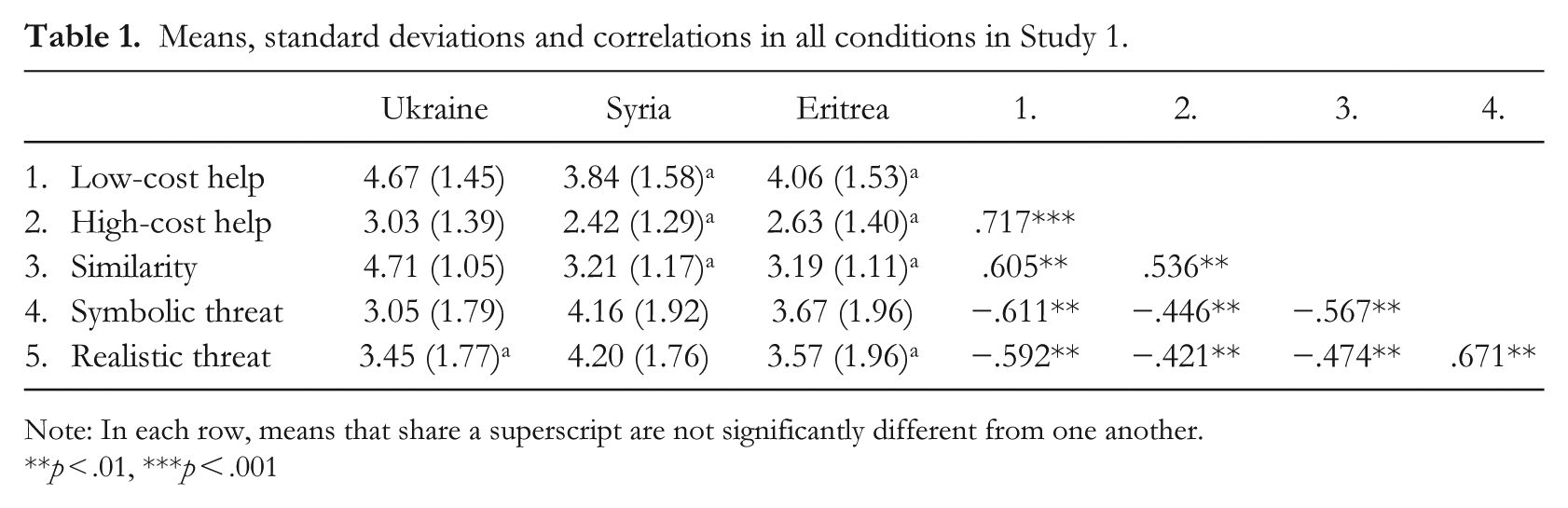
Note: In each row, means that share a superscript are not significantly different from one another.
p < .001
Lastly, to test whether perceptions of similarity and threat mediated the effect of the country of origin on helping intentions, two mediation models were computed using the Process macro (v. 4.0, model 4, Hayes, 2017). Country of origin was entered as a multicategorical independent variable in which Ukraine served as the reference category. Perceptions of similarity, symbolic and realistic threat were entered as parallel mediators, and helping intentions (low- and high-cost) served as separate dependent variables.
As predicted, ratings of Ukrainian refugees as more similar, less symbolically threatening and less realistically threatening than Syrian refugees and as more similar and less symbolically (but not realistically) threatening than Eritrean refugees mediated the effects of refugee nationality of low-cost and high-cost helping intentions (see Figure 1 for path coefficients and indirect effects).
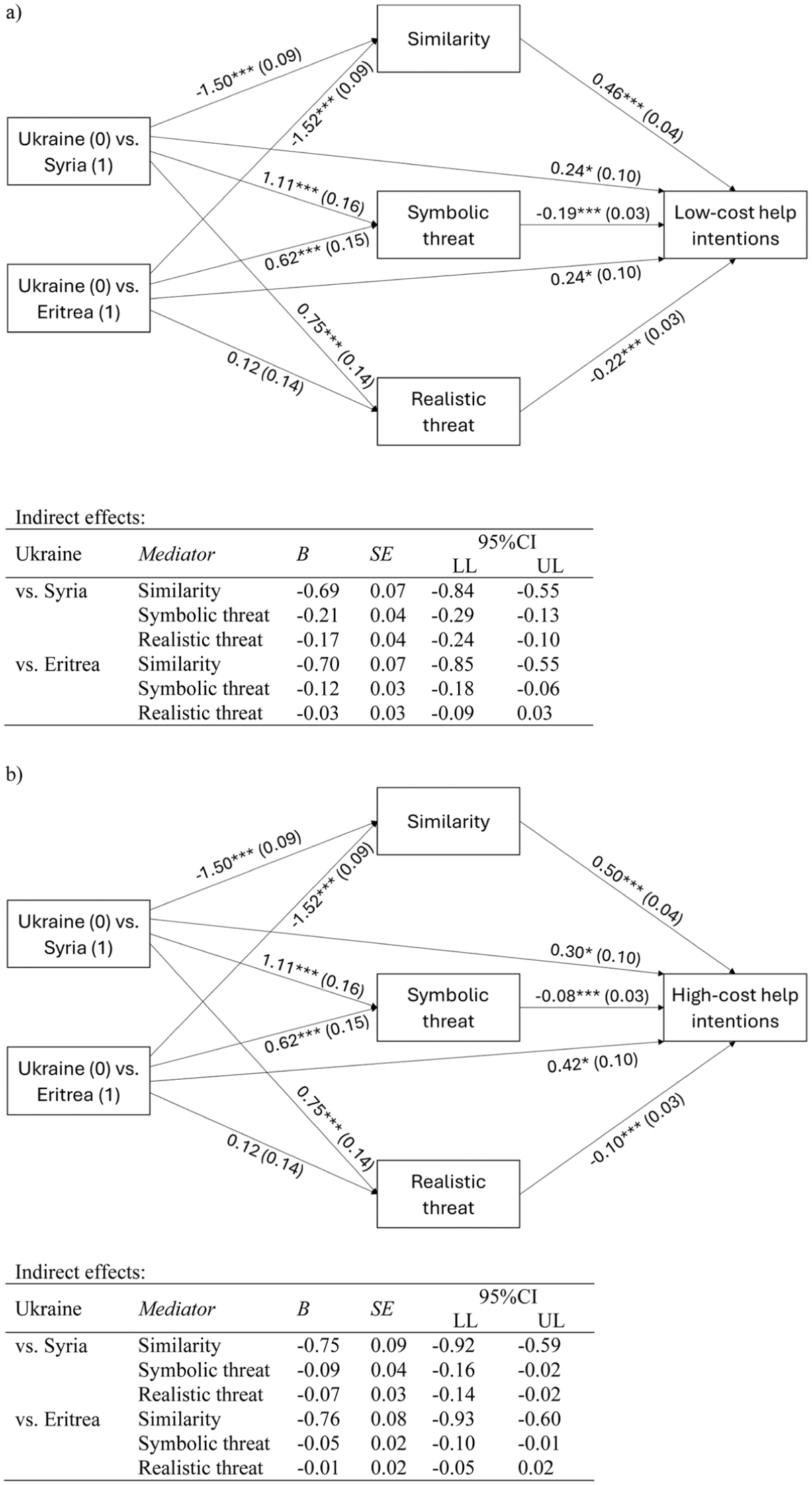
Mediation of the effect of refugees’ country of origin on helping intentions (a = low-cost; b = high-cost) via similarity and threat perceptions.
Discussion
Study 1 demonstrated that, among German participants, refugees coming from Ukraine are seen as more similar and less symbolically threatening than those from Syria and Eritrea. They are also seen as less realistically threatening than refugees from Syria, but similarly realistically threatening as those from Eritrea. Participants were significantly more willing to offer help — both low- and high-cost — to Ukrainian compared to Syrian and Eritrean refugees, who did not differ from one another. Lastly, the differences in perceptions of refugees mediated the effect of refugee nationality on helping. These results supported our hypotheses and replicated findings from the UK (Sinclair et al., 2023), but they did not explain possible sources of the difference in perceptions of refugee groups, an issue that we aimed to address in Study 2.
Study 2
The main goal of Study 2 was to investigate whether it is the perceived religion of the refugees that explains the observed differences in perceptions and helping intentions. We also employed a more comprehensive measure of intergroup threat that included safety threat, symbolic threat and realistic threat (Landmann et al., 2019) and an additional dependent variable, alongside willingness to help: willingness to accept refugees in Germany. This latter variable was included because it taps into participants’ support for their country accepting vs. sending back refugees and in that it reflects participants’ policy preference regarding refugee support.
Participants
We collected data from N = 971 participants but excluded n = 33, which left a final sample of N = 938. The excluded participants indicated having a Syrian (n = 3) or Ukrainian (n = 6) migration background, or both (n = 1). Four participants indicated that they were not German citizens and n = 20 held other citizenships (alongside German citizenship). In the final sample, there were 453 men (48.3%) and 485 women (51.7%) (Mage = 46.3, SD = 14.8; range: 18–69).
Procedure
Akin to Study 1, Study 2 used an experimental design with one between-subjects factor: origin of the refugees (Ukraine vs. Syria). There were n = 462 in the Ukraine condition and n = 476 in the Syria condition. 2
Measures
Perceptions of threat were measured using nine items based on Landmann et al. (2019), with three items each tapping into symbolic (e.g., ‘The immigration of refugees affects German culture’), realistic (e.g., ‘The immigration of refugees increases the tax burden on Germans’) and safety threat (e.g., ‘Refugees living here threaten security in Germany’). The answer scales ranged from 1 (‘strongly disagree’) to 6 (‘strongly agree’). Composite scores were calculated for each type of threat with reliabilities of α = .91, α = .87 and α = .96, respectively.
Perception of religious affiliation of the refugees was measured with one item that asked participants to estimate the percentage of Ukrainian/Syrian refugees coming to Germany who belong to the Muslim faith. Answers were given on a scale from 0% to 100%.
Helping intentions were assessed using eight items (Boje, 2019) that asked about participants’ willingness to engage in a number of actions, e.g., ‘help by donating money’ or ‘help by inviting to your home for food’. The answers were given on a scale from 1 (‘not at all’) to 7 (‘very much’). An EFA revealed a single-factor solution with an Eigenvalue of 5.78 that explained 72.3% of variance; thus, all items were averaged to create a composite score (α = .94).
Willingness to accept refugees in Germany was measured with a single item: ‘How would you rate refugees on a scale of 1 to 7, where 1 means Germany should definitely send them back to their home country and 7 means Germany should definitely allow them to stay?’ This study did not include a measure of similarity perceptions.
Results
Table 2 presents means and standard deviations for all measures by experimental condition and bivariate correlations among variables in the study. Perceptions of threat (all three types) were positively related to perceived percentage of Muslims in the refugee group and negatively related to helping and acceptance of refugees. Willingness to help and accept refugees were also negatively related to the perceived percentage of Muslims.
Means, standard deviations and correlations among variables in Study 2.
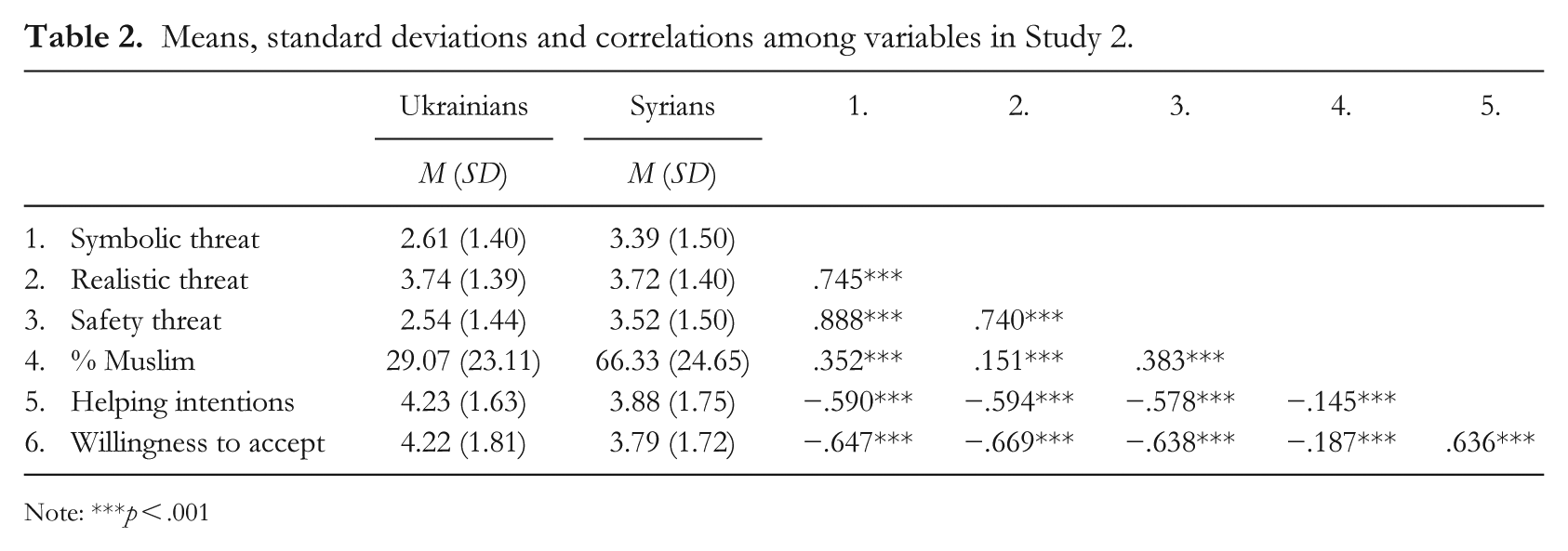
Note: ***p < .001
A series of independent sample t-tests with a Bonferroni correction (p < .008) showed that, as in previous studies, people were less willing to offer help, t(926) = 3.02, p = .002, d = .20, and to accept, t(926) = 3.64, p < .001, d = .24, refugees from Syria than refugees from Ukraine. Refugees from Syria were also perceived as more symbolically threatening, t(936) = −8.20, p < .001, d = −.54, and as posing a greater safety threat, t(936) = −10.20, p < .001, d = −.67, but there was no difference in terms of realistic threat, t(936) = .24, p = .812, d = .02. Syrian refugees were also perceived as having a larger proportion of Muslims, t(936) = −23.87, p < .001, d = −1.56.
Next, two mediation analyses were conducted using custom models in Process (v. 4.0, Hayes, 2017) in which the experimental condition (0 = Ukraine, 1 = Syria) was entered as the independent variable and helping intentions and willingness to accept refugees in Germany were entered as dependent variables, respectively. Assessment of the percentage of Muslims in the refugee group served as the more distal and the three types of threat as the more proximal predictors of the dependent variables (i.e., percentage of Muslims preceded threat variables in the model).
The experimental condition (i.e., whether a participant was rating Ukrainian or Syrian refugees) was a significant predictor of the estimated percentage of Muslims, which in turn predicted greater symbolic, realistic and safety threat perceptions. These perceptions, in turn, predicted both lower willingness to help refugees and to accept them in Germany. The serial indirect effects (via percentage of Muslims and threat) were negative and significant in both models (see Figure 2a and b for path coefficients and indirect effects). Notably, the main effect of the experimental condition on symbolic threat became non-significant when the perception of refugee groups as Muslim was entered into the model, indicating that this effect was fully mediated by perceived religion. Interestingly, when the percentage of Muslims was accounted for, the experimental condition had a negative effect on realistic threat — i.e., Syrian refugees were seen as less realistically threatening than Ukrainians, leading to a significant and positive simple indirect effect whereby Syrians (compared to Ukrainians) were seen as less realistically threatening and in turn elicited greater helping and acceptance intentions. We return to this finding in the general discussion.
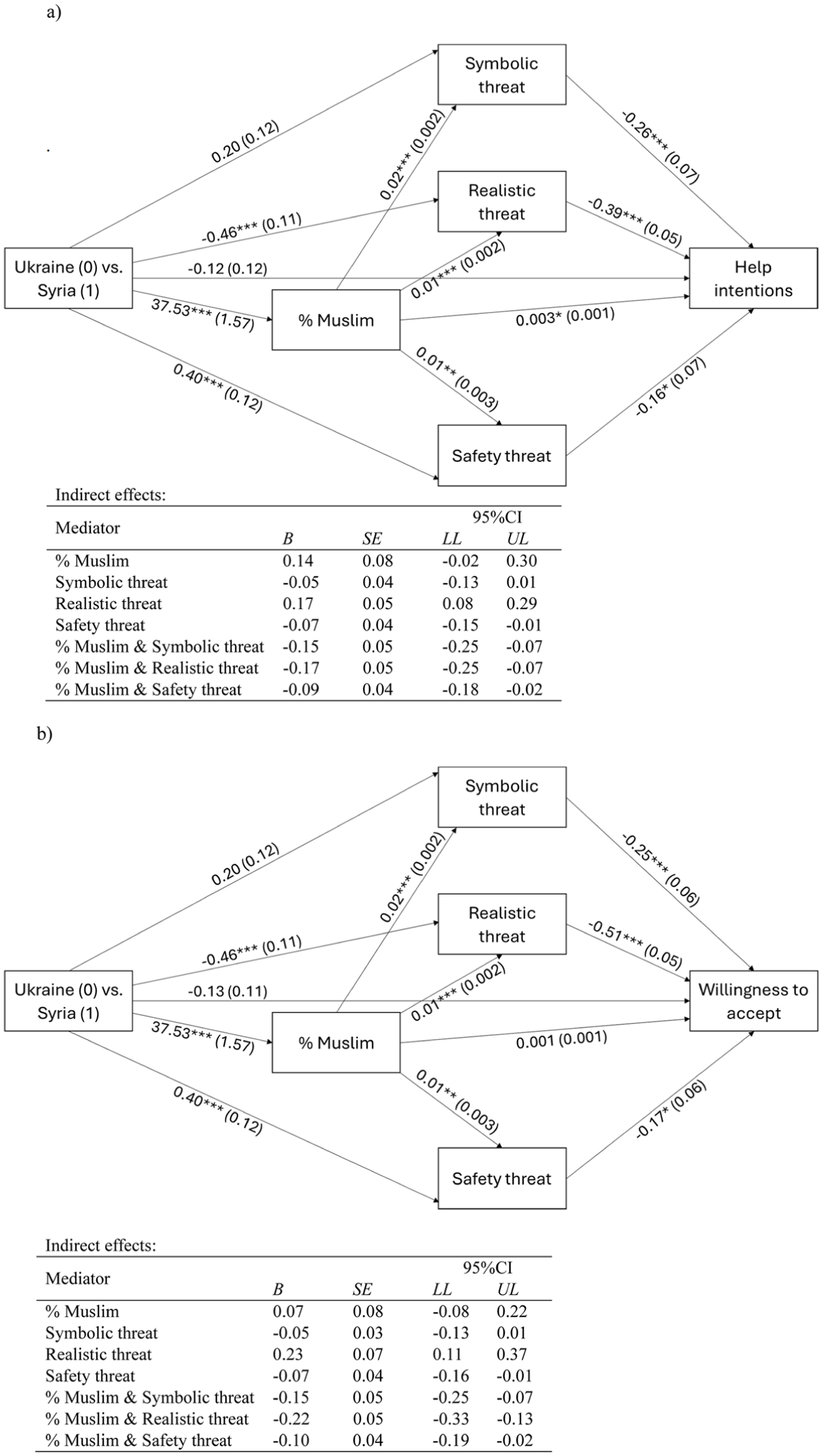
Mediation of the effect of refugees’ country of origin on (a) helping intentions and (b) willingness to accept refugees via perceived proportion of Muslims among the refugee group and three types of intergroup threat (Study 2).
Discussion
Study 2 replicated the main effect of refugees’ country of origin on perceptions of threat and helping intentions. Participants were more willing to offer help to Ukrainian than Syrian refugees, more willing to accept them in their country and perceived them as less threatening. Providing support for our hypothesis that the key to explaining these differences lies in the religion of the refugee groups, we also found that percentage of Muslims mediated the effect of refugee nationality on threat perceptions. These results were obtained using a more nuanced measure of threat than in Study 1. However, in this study, we only measured rather than manipulated religion of the refugee group, precluding any claims about causality regarding this factor. This issue was addressed in our final study. This study also again included a measure of similarity, which was an important predictor of helping in Study 1.
Study 3
The goal of Study 3 was to manipulate the perceived religious affiliation of refugees on similarity and threat perceptions and on helping intentions towards them. To do so, we recruited a large sample of German citizens and used a 2 × 2 experimental design that manipulated both country of origin and religion of the refugees.
Participants
One thousand three hundred and thirty-seven participants accessed the study. 3 Five participants were excluded for reporting impossible age values, n = 138 took an unrealistically short time (< 4.5 minutes) to complete the study and n = 4 were excluded because they provided the same answer to all questions. None of the participants indicated having a migration background. The final sample comprised N = 1,190 participants. There were 578 (48.6%) women, 608 (51.1%) men and four (.4%) participants who indicated ‘other’ (Mage = 45.5, SD = 14.5, range: 18–75).
Procedure
Study 3 used an experimental design with two independent factors: refugee country of origin (Ukraine vs. Syria) and refugee religion (Christian vs. Muslim). 4 This resulted in four experimental conditions: Christian Ukrainian refugee (n = 204); Muslim Ukrainian refugee (n = 193); Christian Syrian refugee (n = 392); and Muslim Syrian refugee (n = 401).
Instead of asking participants questions about different groups of refugees, in Study 3 we used vignettes (see Appendix 3 in the Supplement) and presented a singular case — a refugee named Naser who fled to Germany. This was done because we thought that a scenario in which we present the majority of refugees from Syria as Christian or the majority of refugees from Ukraine as Muslim would not be believable, whereas an individual refugee story gave us a lot more flexibility. All vignettes were kept very similar in content and length and simply differed in Naser’s country of origin (Syria vs. Ukraine) and his religion (Christianity vs. Islam). After reading the vignette, participants completed measures of dependent variables, asking them how they felt towards ‘refugees like Naser’.
Measures
Unless otherwise indicated, the measures used a 1 (‘strongly disagree’) to 5 (‘strongly agree’) answer scale.
Similarity perceptions were measured with 1 item: ‘How similar is Naser to you?’ Participants indicated their answer on a scale from 1 (‘not at all similar’) to 7 (‘very similar’).
Perceptions of symbolic, realistic and safety threat were measured with the same nine items as in Study 3. Composite scores were calculated for each type of threat with reliabilities of α = .88, α = .91 and α = .96, respectively.
Willingness to accept refugees in Germany was measured with one item: ‘How would you rate refugees on a scale of 1 to 7, where 1 means Germany should definitely send them back to their home country and 7 means Germany should definitely allow them to stay?’
Results
Table 3 presents means and standard deviations for all measures by experimental condition. Table 4 presents bivariate correlations among variables. The perceived similarity of refugees like Naser to oneself was negatively related to threat and positively related to willingness to accept refugees in Germany. Threat (all three types) was negatively related to willingness to accept refugees.
Means and standard deviations of all variables in Study 3 and results of a two-way ANOVA testing the main and interactive effects of the experimental manipulation (nationality of refugees: Ukraine vs. Syria; and religion of refugees: Christian vs. Muslim).
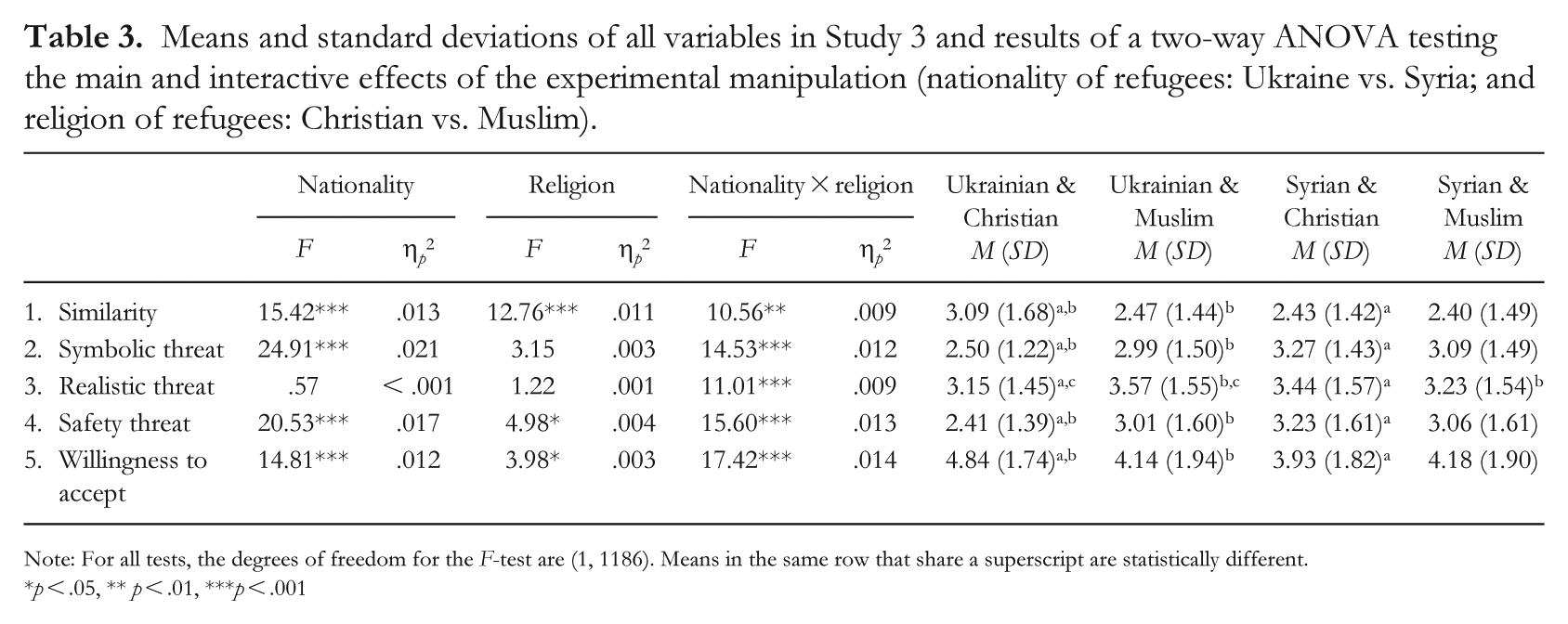
Note: For all tests, the degrees of freedom for the F-test are (1, 1186). Means in the same row that share a superscript are statistically different.
p < .05, ** p < .01, ***p < .001
Correlations among variables in Study 3.
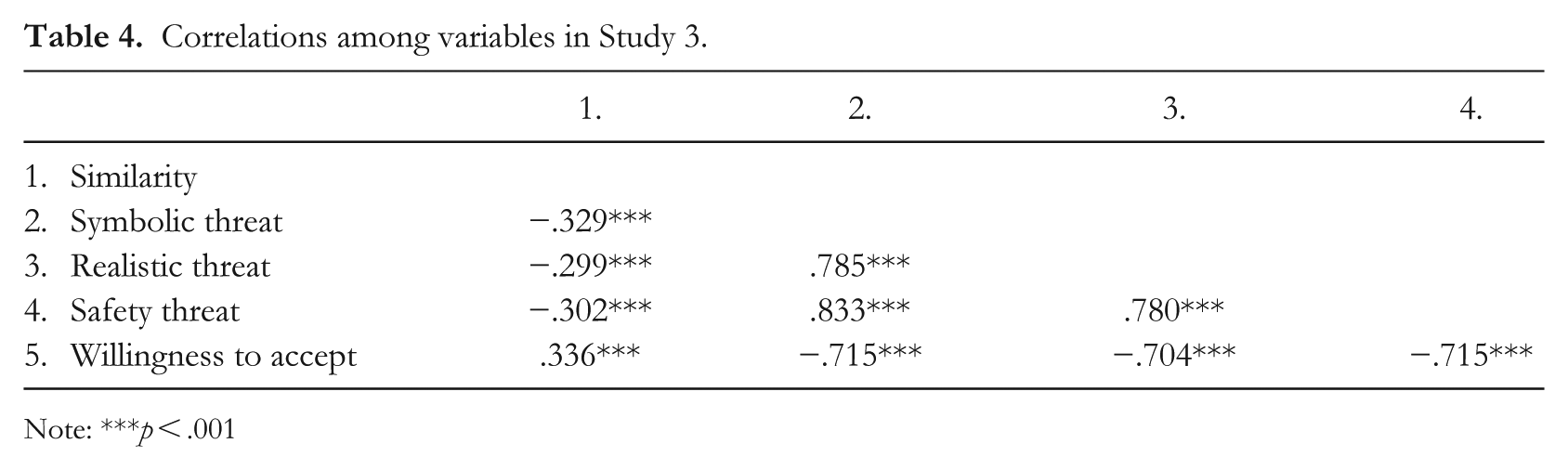
Note: ***p < .001
Experimental effects were compared using a two-way ANOVA with two between-subjects factors: nationality (Ukraine vs. Syria) and religion (Christian vs. Muslim). Post-hoc comparisons were conducted using the Bonferroni test. Table 5 presents the results of those tests.
Means, standard deviations and results of a two-way ANOVA comparing the effects of nationality and religion of the refugee on variables of interest in Study 3.
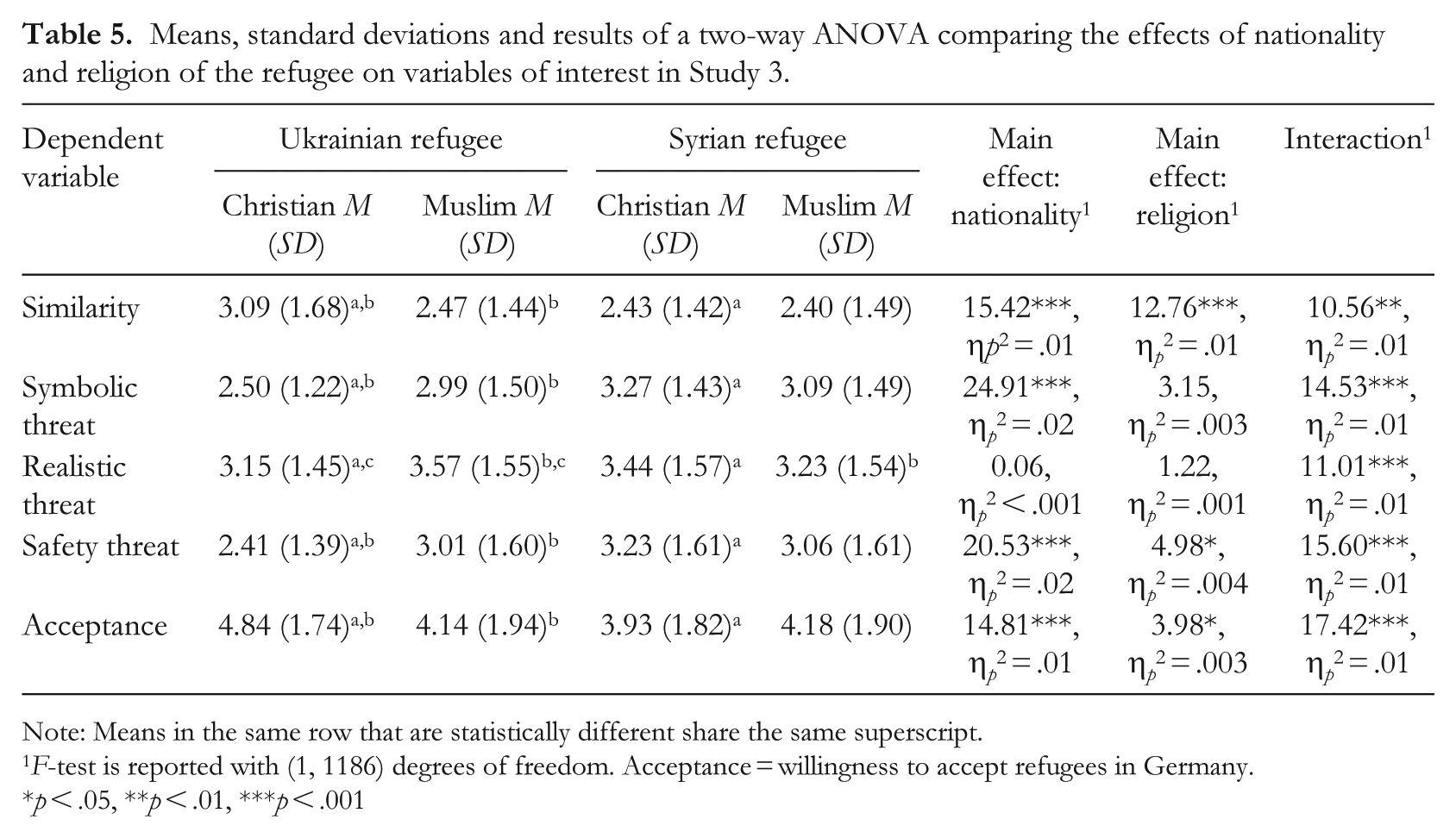
Note: Means in the same row that are statistically different share the same superscript.
F-test is reported with (1, 1186) degrees of freedom. Acceptance = willingness to accept refugees in Germany.
p < .05, **p < .01, ***p < .001
For perceived similarity, the main effects and the interaction were all significant. Religion had an effect only for Ukrainian refugees — people perceived Ukrainians as less similar when the person in the manipulation was Muslim as compared to Christian (p < .001). The effect of religion was not significant for Syrian refugees (p = .780). Muslims were perceived as equally similar regardless of nationality (p = .634), but among Christians, Ukrainians were seen as more similar than Syrians (p < .001).
For symbolic threat, the effect of nationality was significant, but the effect of religion was not. These main effects were qualified by a significant interaction. Again, people perceived Ukrainians as more symbolically threatening when the person in the manipulation was Muslim, compared to Christian (p < .001). The effect of religion was not significant for Syrian refugees (p = .078). Muslims were perceived as equally threatening regardless of their nationality (p = .408), but in the Christian refugee condition, Ukrainians were seen as less threatening than Syrians (p < .001).
The effects of nationality and religion were not significant for realistic threat, but they were qualified by a significant interaction. People perceived Ukrainians as more realistically threatening when the person in the manipulation was Muslim, compared to Christian (p = .007). The effect of religion was not significant for Syrian refugees (p = .055). Muslims were perceived as less threatening when they were Ukrainian than Syrian (p = .013). When the person in the manipulation was described as Christian, Ukrainians were seen as less threatening than Syrians (p = .029).
The effects of nationality and religion were both significant for safety threat and were qualified by a significant interaction. People perceived Ukrainians as more of a safety threat when the person in the manipulation was Muslim as compared to Christian (p < 001). The effect of religion was not significant for Syrian refugees (p = .137). Muslims were perceived as equally threatening regardless of nationality (p = .683), but Ukrainians were seen as less threatening than Syrians in the Christian condition (p < .001).
We found significant main effects of nationality and religion as well as a significant interaction for willingness to accept refugees. Religion had an effect only for Ukrainian refugees — people were less willing to accept Ukrainian refugees if the person in the manipulation was Muslim as compared to Christian (p < .001). The effect of religion was not significant for Syrian refugees (p = .059). Muslims were similarly likely to be accepted regardless of nationality (p = .819), but Ukrainians were more likely to be accepted than Syrians in the Christian conditions (p < .001).
Lastly, an analysis of moderated mediation was conducted to investigate the interactive effects of country of origin and religion on perceptions of refugees and willingness to accept them in Germany. This analysis was conducted because, unlike in Study 2, which allowed for testing of our serial mediation hypothesis (H5), Study 3 aimed to test whether perceived religion of the refugees causally impacted perceptions of similarity and threat and, in turn, willingness to help. Process macro v 4.0, model 7 (Hayes, 2017) was used to conduct the analysis. Country of origin was entered as the independent variable, perceived religion as the moderator, similarity and threat perceptions served as parallel mediators, and willingness to accept refugees in Germany was the dependent variable (see Figure 3).
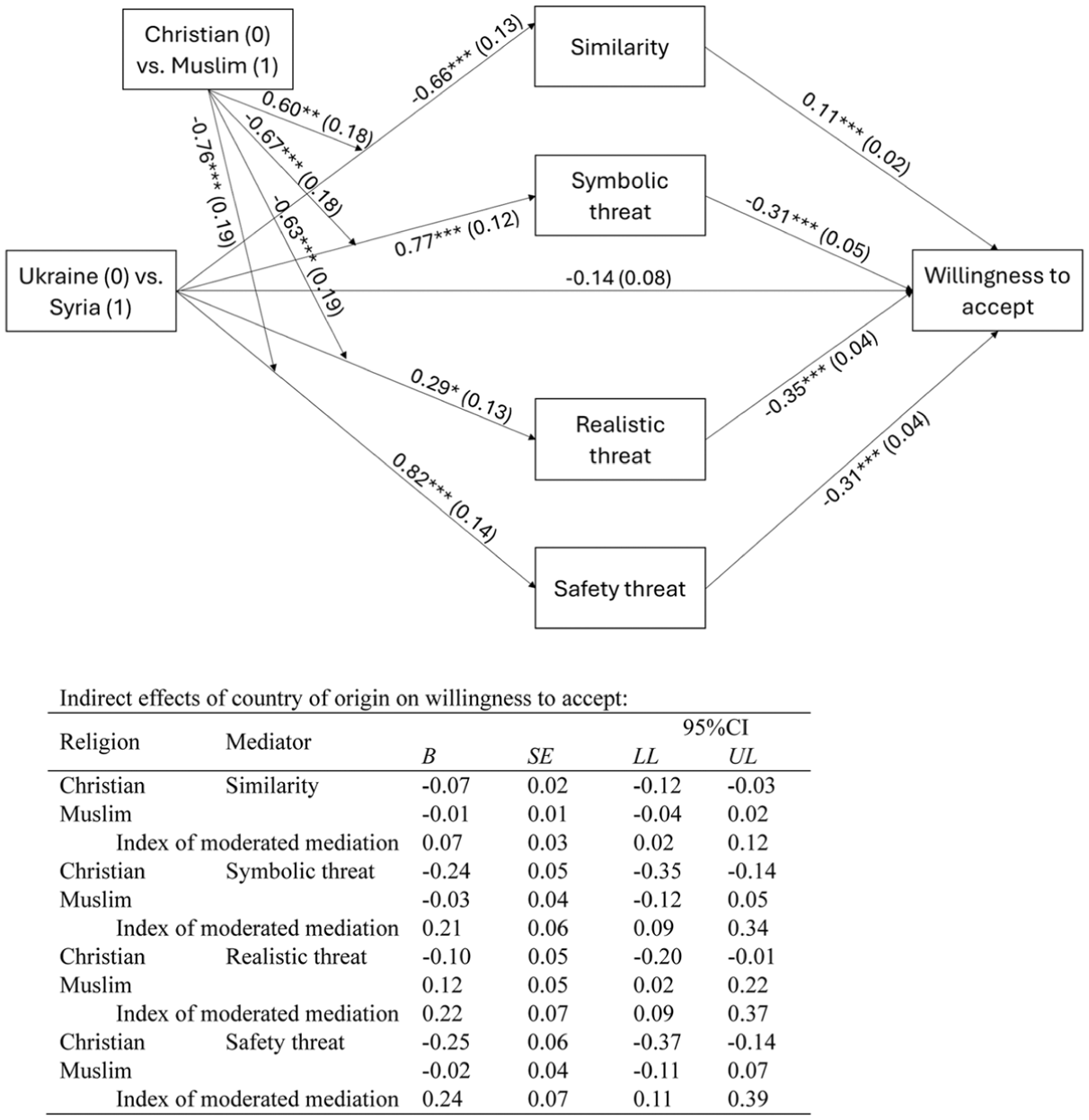
Mediation of the effect of refugees’ country of origin and religion on willingness to accept refugees via perceptions of similarity and three types of intergroup threat (Study 3).
As predicted, nationality and perceived religion of refugees interacted significantly in predicting the mediators and the dependent variable. For perception of similarity, symbolic threat and safety threat, nationality made a difference only for Christians, whereby Syrians were perceived as less similar, more symbolically threatening and posing more of a safety threat than Ukrainians, and this predicted lower willingness to accept them in Germany. For Muslims, it did not matter whether a person in the manipulation was described as a Ukrainian or a Syrian. In terms of realistic threat, among Christians, Ukrainians were seen as less threatening than Syrians, but among Muslims, they were seen as more threatening than Syrians. Consequently, the indirect effect of nationality was only significant for Christians (via perceptions of similarity, symbolic and safety threat) and significant but in opposite directions for Christians and Muslims via realistic threat. In other words, when participants were evaluating Christian refugees, they saw Ukrainians as more similar and less threatening (symbolically, realistically and in terms of safety) than Syrians, which in turn explained a greater willingness to help them. When the refugee in the vignette was described as Syrian and Muslim, participants were more likely to accept refugees than when he was described as Syrian and Christian (via lower realistic threat).
Discussion
Study 3 replicated and extended our previous results. It demonstrated again that refugees’ country of origin powerfully shapes reactions towards refugees, with those from Ukraine being seen as more similar and less threatening (symbolically and in terms of safety). Our participants were also significantly more likely to accept refugees from Ukraine than those from Syria. The effects of perceived religion were overall somewhat less pronounced, with Muslim refugees seen as less similar, posing more of a safety threat (but not different in terms of symbolic and realistic threat) and less likely to be accepted in Germany. These main effects were, however, qualified by a significant interaction between the manipulated country of origin and religion of the refugees. Specifically, we found that if the refugee in the vignette was described as Syrian, it did not matter whether he was also described as Muslim or Christian (with the exception of realistic threat, where we found that Muslim Syrians were seen as less threatening than Christian Syrians, which could be an unfamiliarity effect). However, when the person in the vignette was described as Ukrainian, their religion mattered. Christian Ukrainian refugees were perceived more favourably on all measures and were more likely to be accepted in Germany. Perceptions of similarity and threat mediated the impact of country of origin on acceptance of refugees, but the indirect effects were found mostly for Christians and not for Muslims.
General discussion
The goal of our studies was to provide an empirical test of double standards in helping behaviour towards refugees from Ukraine compared to refugees from Syria that became evident in German society during the migration of refugees from Ukraine in 2022. Furthermore, we were interested in testing psychological mediators that could explain the different levels of helping intentions. Taken together, the three studies show consistently that Germans were more willing to help and welcome refugees from Ukraine compared to those from Syria. Results further illustrate that they were more likely to help refugees from Ukraine because Ukrainians were perceived to be more similar to Germans and as posing less symbolic, realistic and safety threat (see also Sinclair et al., 2023). In light of the social identity theory (Hewstone et al., 2002; Tajfel & Turner, 1979), one could wonder whether (and to what extent) Ukrainians were more likely to be categorized as part of a shared ingroup than other refugee groups due to their closeness to an ingroup prototype in terms of norms, values, religion or ethnicity.
Our findings also provide novel insights into a further factor that explains why Germans were less willing to help refugees from Syria compared to Ukraine: the perceived religion of refugees. In Study 2, we found that refugees from Syria (compared to Ukraine) were more likely to be perceived as Muslim. Moreover, results indicated that Germans were less willing to help and accept refugees from Syria to the extent that Syrian (vs. Ukrainian) refugees were perceived as being more likely to be Muslim. We also found an indirect effect whereby, after controlling for perceived religion, Syrian refugees were seen as less realistically threatening than Ukrainians, which in turn was related to greater helping intentions. Though not expected, this effect is understandable — when the variance in threat perceptions due to religion was removed, the remaining variance in threat was likely due to other factors (e.g., the size of the group [larger for Ukrainians at the time of data collection]) that could make Ukrainians seem more realistically threatening than Syrians.
In Study 3, we investigated the causal effect of religion on threat perceptions and willingness to accept refugees. Overall, results suggest that religion led to different responses for Ukrainian refugees but not for Syrian refugees: when Ukrainian refugees were characterized as Christian, they were more likely to be accepted, perceived to be more similar and less threatening (in terms of symbolic, realistic and safety threat) compared to when Ukrainian refugees were characterized as Muslim. However, for Syrian refugees, it did not matter whether they were characterized as Christian or Muslim — there was no boost in positive perceptions when they were portrayed as Christian.
These findings might be interpreted in at least two ways. First, they imply that although important, perceived religion alone does not fully explain why people are more or less willing to help refugees. There are certainly several other aspects that need to be considered: for instance, the different levels of knowledge about the causes of flight in the German population, the different times of migration and the perception of an emergency. At the time of data collection (2022), Germans knew exactly why refugees from Ukraine migrated to Germany — because of the Russian war against Ukraine. In contrast, they are likely to have had less knowledge about the reasons why people from Syria migrated to Germany because the peak of migration of Syrian refugees occurred seven years prior. These differences in knowledge about the causes of migration and the different time intervals of migration may have contributed to greater empathy for Ukrainian compared to Syrian refugees. This interpretation is in line with recent work illustrating that factors such as sense of common fate and a feeling of togetherness predicted helping of Ukrainians (Kossowska et al., 2023), feelings which are linked to empathy and perceived forcedness (see also Echterhoff et al., 2020, 2022).
Furthermore, research also suggests that the perception of an emergency predicts helping behaviour (Albayrak-Aydemir & Gleibs, 2021). Russian forces attacked Ukraine in February 2022; thus, there was a direct emergency for Ukrainian people. While Ukrainians were described as victims of the Russian invasion in media reports, Syrians were portrayed as eliciting a refugee ‘crisis’, suggesting that European countries were the ‘victims’ who had to cope with the sudden increase in the number of refugees (Azevedo et al., 2021). Thus, the perception of an emergency and the unambiguous classification of Ukrainian refugees as victims of the war are likely to have contributed to stronger helping intentions towards Ukrainian compared to Syrian refugees.
However, a second, alternative interpretation of the findings of Study 3 is that the portrayal of a Syrian refugee as Christian was more unrealistic than the portrayal of a Ukrainian refugee as Muslim due to entrenched stereotypes of those groups. If participants were less likely to believe that a Syrian refugee could be Christian, it is less surprising that we did not find an effect of religion for refugees from Syria. However, regardless of whether people believed that Syrians could plausibly be Muslim or Christian, it is important that religion did play a critical role in how participants perceived and intended to act towards refugees from Ukraine.
There is a lot of work illustrating that racism directed at Muslims is prevalent in Germany (Deutsches Zentrum für Integrations- und Migrationsforschung [DeZIM], 2022). Our work contributes to these findings, because threat perceptions are important predictors of prejudice and discrimination (Stephan & Stephan, 2000). Moreover, although we did not assess racism against Muslims, we assessed a more passive form discrimination: a lack of action and a lack of help towards those in need. According to research on intergroup helping, helping relations are power relations and helping can keep people in lower-status positions or establish preconditions for help-recipients to be able to help themselves (e.g., Becker et al., 2018; Nadler, 2002). Withholding help is a form of passive harm (Cuddy et al., 2007a) that can have detrimental consequences for those who would benefit from it (e.g., Täuber & Moughalian, 2022). Thus, we want to emphasize here that our research does not suggest that Germans’ welcoming orientation and help provided to refugees from Ukraine is problematic but rather that people use double standards when providing help and support for different groups of refugees.
Limitations, strengths and directions for future research
We would like to acknowledge some limitations of the present work. First, we brought together and re-analysed a diverse set of studies on the same research questions but with different measures. We therefore did not measure all constructs in all of our studies (e.g., similarity was missing in Study 2) and employed somewhat different operationalizations of perceived threat across studies. Moreover, the pre-registrations and power analyses for the original hypotheses were largely (with the exception of the main effect of the refugee nationality on helping, similarity and threat) not applicable to the set of exploratory hypotheses tested herein. This might constitute a weakness of the present work and might be a source of bias in our results. However, it is also a strength that the overall findings and central message of all studies converge, and that we were able to replicate the central findings across studies (including the additional study described in the Supplement) using different measures can also be considered a strength of the current paper.
Second, it is a limitation that all studies were conducted in only one context (Germany). However, the present studies also contribute to the existing work on helping refugees conducted in other countries by providing converging evidence of the presence of double standards in treatment of refugees. For instance, one study suggests that Poles’ helping intentions were driven by feelings of closeness, anticipatory fears and community norms of helping (Kossowska et al., 2023). Similarly, Sinclair et al. (2023) found that British people were more likely to help refugees from Ukraine, compared to those from Yemen, because of higher perceived similarity and lower perceived threat. It remains to be tested whether the psychological mechanisms on solidarity with refugees operate similarly or differently in other cultural contexts (e.g., in non-WEIRD [Henrich et al., 2010] or predominantly Muslim countries).
Third, our measure of perceived religion (Study 2) and, especially, our manipulation of religion in Study 3 have their own limitations as well. In Study 2, we used a fairly simple measure of perceived religion that asked participants to assess the percentage of Muslims among Syrian or Ukrainian refugees, whereas the manipulation in Study 3 was not as impactful as intended (i.e., it by and large did not affect attitudes towards Syrians), which might have been the result of participants doubting the possibility of a Syrian refugee being Christian or by the fact that the name of the refugee in the vignette might be more strongly associated with Islam. To address these shortcomings, in future studies we will aim to employ multidimensional measures of perceived religiosity and cultural distance to better capture the nuanced nature of these concepts. As well, to better disentangle the effects of religion and nationality, we hope to measure attitudes towards groups that are more religiously diverse (rather than predominantly Muslim or Christian like in the context of the current work). However, we also want to emphasize that this work was grounded in real-world events, and this is what guided our choice of refugee groups to study (and thus predetermined their attributes).
Fourth, it is interesting to note that in Study 1 we found similar effects for low-cost and high-cost helping intentions, because prior work illustrated that there are different predictors for the two types of action intentions (Becker et al., 2022). Specifically, positive contact with migrants predicted benevolent help (a form of low-cost helping behaviour) because people felt more empathy and positive emotions towards the migrants, whereas politicized contact (contact that considers group-based inequality) predicted costly solidarity-based actions because people felt more anger about the discrimination of migrants and had a stronger identification with the Black Lives Matter movement. Thus, future work could test potential moderators. For instance, it is reasonable to assume that more left-wing people with a strong commitment to humanity and an anti-racist identity might help all refugees to similar degrees, or that people very high in nationalism might avoid any help for refugees at all, irrespective of the refugees’ nationality.
Lastly, there are other possible factors that might account for the differences in helping that were not measured in the current project, for example, empathy or dehumanization, both shown to predict helping (Cuddy et al., 2007b; Stürmer & Siem, 2017). Including these alongside predictors tested herein would be an important future direction for this line of work.
Limitations of our studies also point to interesting directions for future research. We would like to expand our exploration of the role of perceived religion in helping, by incorporating a measure of anti-Muslim (e.g., Imhoff & Recker, 2012) prejudice to test whether the mere presence of Muslims in the refugee group has an effect on helping intentions when the effects of anti-Muslim bias are accounted for. We also hope to develop more complex manipulations of religiosity that incorporate cultural and ethnic aspects of religious identity in order to avoid oversimplifying the real-world complexity associated with religion.
Intergroup helping is a dynamic process in which help is both offered/given and accepted/received. Future studies would do well to investigate the effects of group membership and meta-perceptions on people’s intentions to offer and receive help (e.g., taking inspiration from Borinca et al., 2021). It would also be important to conduct similar, but fully pre-registered, studies again to gauge whether the differences in perceptions and willingness to help different groups of refugees persist. Our data were collected in 2022, during a period of great enthusiasm and mobilization to help Ukrainian refugees. However, evidence exists that with time, attitudes towards Ukrainians might become slightly less positive (Moise et al., 2024), which could impact the presence of the positive bias towards them evidenced in this work. Lastly, our focus on real, ongoing migration due to conflict did not allow us to disentangle our proposed mechanisms from others such as geographical or temporal closeness of the refugees, but this could be addressed explicitly in future experimental research.
Conclusion
Since Russia's invasion of Ukraine in early 2022, Europeans have displayed remarkable solidarity and support of Ukrainian refugees that seemed to be qualitatively different from previous reactions towards refugees from other regions (e.g., the Middle East), particularly in the aftermath of the 2015 refugee migration. The goal of the present work was to empirically test this observation and investigate whether Germans (a heretofore unexamined context) were more willing to help refugees from Ukraine compared to Syria and to examine the underlying psychological factors (perceptions of similarity, threat and the association with Islam). Across all three studies, a significant pro-Ukrainian preference emerged consistently: Ukrainian refugees were perceived as less threatening (both realistically and symbolically), elicited less safety threat, were seen as more similar compared to Syrian refugees and were more likely to be offered help and refuge. Importantly, we provided evidence for an explanatory factor that was not examined in prior work by testing the idea that Ukrainian refugees are more likely to receive help than Syrian refugees because people believe that Syrian refugees are more likely to be Muslim (whereas Ukrainian refugees are more likely to be Christian). Indeed, we showed that Ukrainians are more likely to receive help when they are portrayed as Christian (compared to Muslims), whereas for Syrian refugees, experimental manipulation of their religion did not matter. Overall, the results of the present studies illustrate that help providers use double standards in their decision of whom to help and that anti-Muslim prejudice seems to play a significant role in the unequal treatment of different refugee groups. We hope that the knowledge about some of the psychological mechanisms of these disparities in help can be used by policymakers and the non-profit sector to design interventions (e.g., targeting beliefs about similarity and threat) aimed at promoting a more overall welcoming culture in Germany and beyond.
Footnotes
Notes
Supplementary Material
Please find the following supplemental material available below.
For Open Access articles published under a Creative Commons License, all supplemental material carries the same license as the article it is associated with.
For non-Open Access articles published, all supplemental material carries a non-exclusive license, and permission requests for re-use of supplemental material or any part of supplemental material shall be sent directly to the copyright owner as specified in the copyright notice associated with the article.
