



Abstract
The present study prospectively examines associations between citizens’ perceived symbolic and realistic threat and mental health before and after refugee settlement in their neighbourhood. Citizens in two Amsterdam (the Netherlands) neighbourhoods participated in the study (N = 280). A follow-up measurement after the settlement of refugees was conducted in one neighbourhood (n = 66). Cross-sectional results confirm that higher levels of perceived symbolic and realistic threat were both associated with poorer mental health. A prospective longitudinal analysis showed no increase in realistic or symbolic threat, but mental health was poorer in citizens after refugee settlement. Higher threat perceptions among citizens in the area before the settlement of refugees predicted poorer mental health after the settlement. This association was stronger than the reverse association (poorer mental health predicting higher threat perceptions). Policymakers should consider experienced threat levels among citizens when developing and communicating refugee settlement policies.
Forced migration is, and will probably remain to be, a major and controversial political theme. The recent violent conflicts in Ukraine, Afghanistan, Eritrea, and Syria, as well as climate change-related ecological disasters, are expected to result in a further increase in forced migration of large numbers of people in the near and far future. Indeed, in 2022, the total number of first-time asylum applicants to the EU was 889,280, an increase of 40% compared to 2021 (N = 634,040), and an increase of 27% from 2019 (N = 701,025) before the COVID-19 pandemic (Eurostat, 2023). In 2022, the majority of non-Ukrainian asylum applicants came from Syria (N = 134,125; 15%). In addition to these numbers, a total of 3,888,345 individuals fled Ukraine and received temporary protection in an EU country between February 2022 and March 2023 (Eurostat, 2023). Filippo Grandi, the United Nations High Commissioner for Refugees, pointed out that “we are witnessing a changed reality in that forced displacement nowadays is not only vastly more widespread but is simply no longer a short-term and temporary phenomenon” (The Office of the United Nations High Commissioner for Refugees [UNHCR], 2020, p. 6).
This development has important consequences for the political climate in Western countries. For example, during the UK’s EU membership referendum in June 2016, uncontrolled migration was a key topic (Henderson et al., 2017). Also, Western European political leaders showed reservations about providing asylum to Afghan refugees after the takeover by the Taliban, in fear of a revival of populist parties in their countries (Bennhold & Erlanger, 2021). The large numbers of refugees due to the Ukraine–Russia war posed new challenges for receiving them and arranging housing for those who stay (Solomon & Pronczuk, 2022).
The present paper focuses on an understudied aspect related to forced migration, that is, how does the anticipated settlement of refugees influence subjective threat feelings and mental health of citizens living in the neighbourhoods where refugees will be settled? This question is important as higher levels of perceived threat are associated with more negative attitudes towards the settlement of refugees (Cowling et al., 2019). Furthermore, there is ample evidence that threatening stressful experiences are associated with poorer mental health (Luhmann et al., 2012). In the present article, we focus on two specific types of threat, symbolic and realistic threat, which citizens may experience in relation to refugee settlement in their neighbourhood. We investigate if high levels of symbolic and realistic threat can have negative consequences for the mental health of citizens.
Threat Perceptions Associated With Refugees
Recent meta-analytic studies have identified several variables associated with negative attitudes towards refugees. Predictors of negative attitudes towards refugees are: being male, having a low level of education, having a religious affiliation, and being politically conservative (Anderson & Ferguson, 2018; Cowling et al., 2019). Another potential key variable is intergroup threat associated with refugee settlement. Intergroup threat theory (Stephan et al., 2000, 2016) poses that intergroup threat is experienced when members of one group perceive that another group can cause them harm. Two different forms of intergroup threat can be distinguished: realistic threat and symbolic threat. Realistic threat refers to the physical safety of oneself and close others (family members, close friends, neighbours). It also concerns material interests such as anticipated job (in)security or available housing. In contrast, symbolic threat refers to a perceived threat to one’s culture and the shared norms, values, and beliefs of people in that culture. While these two forms of threat are described as separate constructs in the literature, they are often strongly correlated (Riek et al., 2006).
In a meta-analysis of data collected in Australia, Croatia, UK, Germany, India, Israel, Italy, the Netherlands, Turkey, and the US, Cowling et al. (2019) reported that negative attitudes towards refugees were strongly correlated with realistic (r = .82) and symbolic threat (r = .76). Furthermore, in a study of the UK’s EU membership referendum in June 2016, it was found that higher levels of realistic and symbolic threat perceptions regarding migration were strongly associated with a vote for the UK to leave the EU (MacDougall et al., 2020). This shows that threat perceptions regarding migration among civilians can have profound consequences for policymaking and the political climate in a host country. Taken together, the literature suggests that symbolic and realistic threat perceptions are key predictors of citizens’ attitudes towards refugees.
Subjective Threat and Mental Health
Whether the settlement of refugees in a neighbourhood can affect the mental health of citizens living in that neighbourhood, is an understudied topic. In the present research, we examine the possibility that citizens who experience higher levels of threat from the anticipated settlement of refugees in their neigborhood will report lower levels of mental health after settlement.
There is abundant evidence from the stress literature that when people experience threatening stressors over a long period of time, their physiological health deteriorates (for a review, see DuPont et al., 2020). A meta-analysis conducted by Luhmann et al. (2012) provides evidence for the notion that stressful life events that disrupt routines and require change and adjustment reduce mental well-being directly after the occurrence of the event. Also, an abundance of research in the context of the COVID-19 pandemic has shown that prolonged stress-related negative emotions are related to lower mental well-being (e.g., Satici et al., 2022). It is important to note that past research focused on stressors and threat at the intrapersonal or interpersonal level. The present research focuses on threat at the intergroup level.
Surprisingly, little research has directly examined this relation between symbolic and realistic intergroup threat and mental health. An exception is a correlational study among 1,515 adults in Northern Ireland by Schmid and Muldoon (2015). They found that perceived intergroup threat related to the conflict between Unionists and Republicans was associated with poorer psychological well-being, an important indicator of mental health. Importantly, they only observed this relationship among individuals who were intensely exposed to conflict through direct or indirect experiences. This is in line with research on intractable conflict (severe intergroup conflict that lasts for a long period of time, affecting at least one generation) posing that exposure to conflict over time negatively affects mental health as a consequence of negative emotions, including feeling threatened (Bar-Tal, 2007; Muldoon & Trew, 2000; Myers et al., 2009; Nasie et al., 2021).
There are some important differences between the study by Schmid and Muldoon (2015) and the present research. First, the social context is different. Northern Ireland is a social context characterized by decades of political violent conflict (the so-called “Troubles”), while the context where the present research is conducted (the Netherlands) has no history of such conflict.
Second, in the context of intractable conflict, there is a clear “out-group,” which is associated with negative emotions, including feelings of intergroup threat, that is, feelings of threat to the in-group posed by an out-group (Bar-Tal, 2007; Coleman, 2003). There may also be individual-level concerns of intergroup anxiety, which refers to discomforting feelings and nervousness in anticipation of experiencing actual contact with out-group members (Stephan & Stephan, 1985). This individual-level form of threat is associated with negative out-group attitudes, as illustrated by two studies of Catholics and Protestants in Northern Ireland (Paolini et al., 2004). Feelings of intergroup anxiety have also been associated with negative affect and avoidance of out-group members (Greenland et al., 2012). It remains unclear, however, whether the settlement of refugees in a neighbourhood is experienced as threatening, and whether it can negatively influence mental health in citizens to a similar extent.
Third, the study by Schmid and Muldoon (2015) was a correlational study, so no test of causality could be conducted. In the present research, we conducted a longitudinal study of associations between perceived realistic and symbolic threat and mental health before and 6 months after the settlement of refugees in a neighbourhood. This allows for a comparison of the effect of threat levels before refugee settlement on mental health after settlement, versus the reverse effect of mental health on perceived threat levels. This is important as it may also be that people who have better mental health are also more resilient to threat-induced stress as a consequence of being better able to regulate negative emotions (Taylor & Stanton, 2007; Troy & Mauss, 2011).
The Present Study
Based on the above review, this study tests the following hypotheses:
Hypothesis 1: Higher realistic and symbolic threat perceptions related to the anticipated settlement of refugees in a neighbourhood are associated with poorer mental health of citizens in that neighbourhood.
Hypothesis 2: Higher realistic and symbolic threat perceptions before the settlement of refugees in a neighbourhood predict poorer mental health of citizens 6 months after the actual settlement of refugees in that neighbourhood. This association is expected to be stronger than the reverse one (i.e., poorer mental health before settlement as a predictor of realistic and symbolic threat perceptions after settlement).
We tested these hypotheses in a prospective study in two neighbourhoods in Amsterdam, the Netherlands. At the time the data were collected, the Dutch government decided to relocate 2,500 refugees (mostly Syrian and Eritrean refugees who had been granted asylum between 2016 and 2019) from asylum seeker centres to different municipalities across the Netherlands, including Amsterdam. To this aim, housing complexes for refugee settlement needed to be built in Amsterdam neighbourhoods. The housing plans met with resistance among groups of local citizens who staged petitions and protests against the plans (“Bewoners IJburg vrezen komst statushouders” [“Citizens of IJburg Fear Arrival of Refugees”], 2016). We obtained survey data from local citizens in two Amsterdam neighbourhoods where these housing projects were planned. In one of these neighbourhoods, we conducted a second measurement 6 months after the refugees were actually settled, which allows us to prospectively examine associations between threat perceptions and mental health over time.
We also registered participants’ postal code to examine the role of geographical distance to the housing projects. Specifically, in an explorative analysis, we examined whether citizens who live closer to the settlement location experience more realistic and symbolic threat and have worse mental health. Previous research on the not-in-my-backyard (NIMBY) and the locally unwanted land use (LULU) groups/movements revealed that proposals the local community believes have negative consequences can face opposition. Opposition is particularly likely when negative consequences closer to the home are expected (Popper, 1985; Wexler, 1996). In line with this, we anticipated that citizens living nearer the housing projects for refugees will feel more affected by the settlement, and therefore will experience more realistic and symbolic threat and, over time, poorer mental health compared to citizens who live further away.
Method
Participants
A total of 280 citizens (47.5% male; Mage = 53.4 years, SDage = 13.6) from two neighbourhoods in Amsterdam participated in the study. The first neighbourhood is referred to as Location 1 (n = 173), while the second neighbourhood is referred to as Location 2 (n = 107). After the refugees settled in their neighbourhood, 66 citizens from Location 1 participated in the follow-up study. This was 38% of the total number of participants at Location 1.
The general population of the two neighbourhoods consisted of 2,840 citizens at Location 1 and 2,910 citizens at Location 2 (https://onderzoek.amsterdam.nl/interactief/dashboard-kerncijfers). 41% of the citizens at Location 1 and 16% at Location 2 had a non-Western (i.e., Surinamese, Antillean, Turkish, Moroccan) migration background.
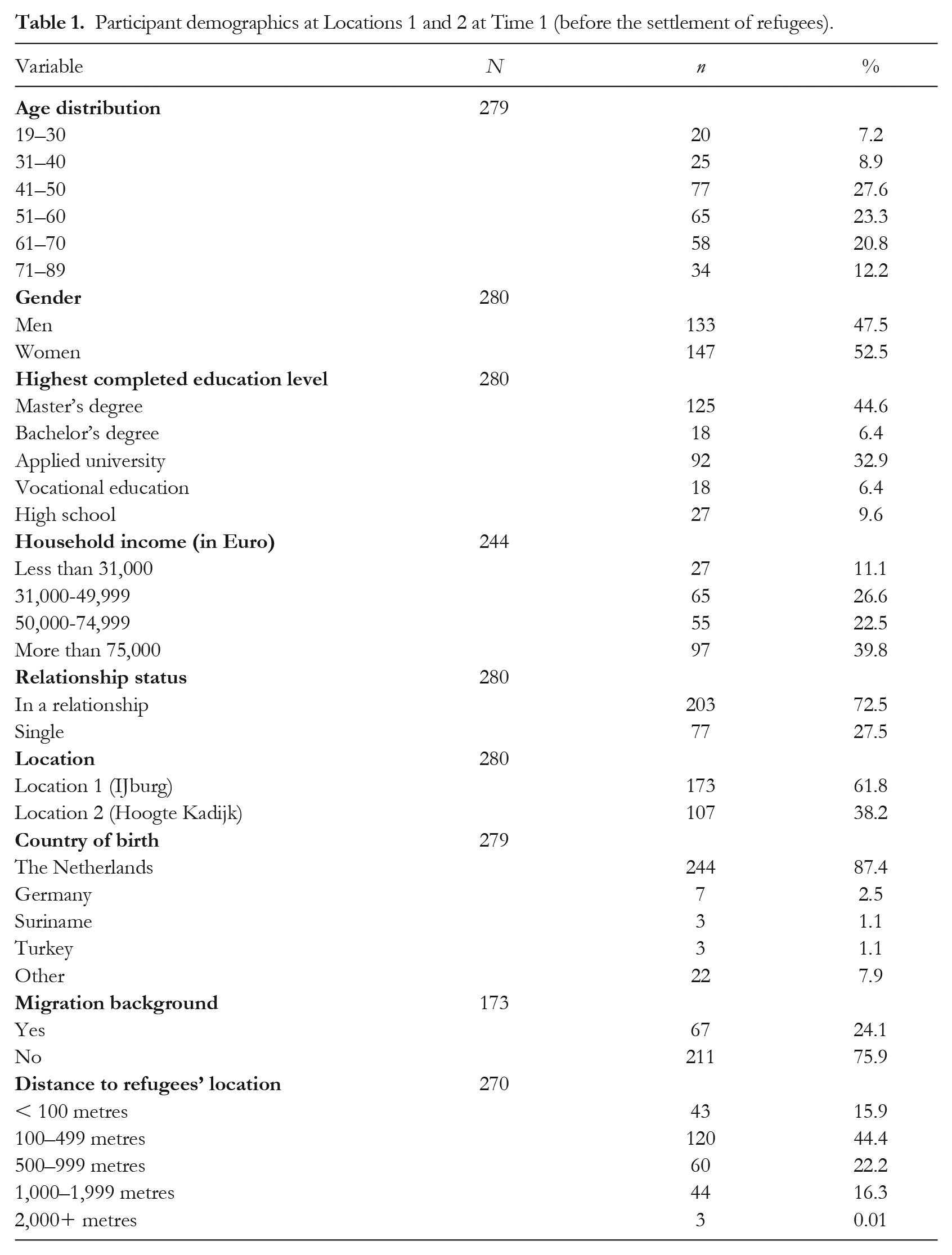
The demographics of our sample before the settlement of refugees at the two locations are presented in Table 1. The sample was highly educated (83.9% had an applied university degree or a university degree, compared to 31.8% in the Netherlands as a whole in 2018 https://opendata.cbs.nl/#/CBS/nl/dataset/85266NED/table?searchKeywords=opleidingsniveau). Most of the participants were in a relationship (72.5%, compared to 46.5% in the Netherlands as a whole in 2018; https://opendata.cbs.nl/#/CBS/nl/dataset/03747/table?searchKeywords=burgerlijke%20stand), and 24.1% had a non-Western migration background (i.e., born abroad themselves or at least one of their parents born abroad, compared to 13% in the Netherlands as a whole in 2018; https://opendata.cbs.nl/statline/#/CBS/nl/dataset/70751ned/table?ts=1715895876443.
Participant demographics at Locations 1 and 2 at Time 1 (before the settlement of refugees).
A power analysis was conducted using G*Power 3.1 (Faul et al., 2007) to examine the effect size that could be reliably detected. Unlike the study by Schmid and Muldoon (2015), the social context of our study was not characterized by extreme intergroup conflict. However, based on their findings that greater perceived threat was overall associated with poorer psychological well-being, we anticipated a medium-sized overall negative association between, respectively, realistic and symbolic threat perceptions and mental health. The power analysis showed that in a linear multiple regression analysis with two predictors (symbolic and realistic threat) and an alpha of .05, a minimum of 68 participants would be required to detect a medium effect size (f2 = .15; Cohen, 1992) with 80% power. As we had 280 participants, our sample met the requirement for our cross-sectional analyses. For the longitudinal regression analyses, we had 66 participants, which was slightly below the required number to detect a medium effect size with 80% power.
Procedure
Participants were recruited through flyers that were spread in the neighbourhoods inviting citizens of the locations aged 16 years and older to participate. In addition, printed versions of the survey were distributed door-to-door (researchers rang the doorbell and, if no one answered, the survey was left in the mailbox including a prepaid return envelope). In our invitation to participate, the study was described as “A survey about your well-being as resident with regard to the arrival of refugees in the neighbourhood and how the municipality deals with this issue.” Advertisements were posted on social media pages (Facebook pages involving the community at both locations). Also, an interview about the study was published in a local newspaper including a call for participation.
Participation in the study was on a voluntary basis. A survey was completed either online or on paper before the refugees settled in their neighbourhood and (for participants in Location 1) also 6 months after their settlement.
Participants at Location 1 completed the questionnaires between February and May 2018 (Time 1 [T1]). The refugees at Location 1 arrived in June 2018. After the refugees settled in their neighbourhood, citizens from Location 1 who indicated that they were willing to participate in the follow-up study received a postsettlement survey in December 2018 (Time 2 [T2]; n = 66). At Location 2, only a premeasurement was conducted and completed between April and May 2019 (T1), before the arrival of the refugees in June 2019. Ethical approval for the study was obtained beforehand from the Ethics Review Board of the Faculty of Social and Behavioral Sciences, University of Amsterdam (2017-CP-8630).
Measures
The reliabilities reported below for the presettlement measurement (T1) include participants from both locations. The reliabilities reported for the postsettlement measurement (T2) are only for citizens at Location 1 who completed this measurement.
Perceptions of threat
Perceptions of threat were measured using two subscales derived from the Dutch version of the Intergroup Threat Measure (Stephan et al., 1999). These scales of threat measurement have been used before in a Dutch context (e.g., Velasco González et al., 2008; Wirtz et al., 2016). Symbolic threat was measured with seven items (T1: α = .82; T2: α = .86; e.g., “Refugees should learn to adapt to the values and norms of the Dutch society as soon as they arrive”). Realistic threat was measured with eight items (T1: α = .87; T2: α = .90; e.g., “Refugees benefit more from the Dutch society than they contribute”). Participants indicated their endorsement of each statement on a 5-point Likert scale (1 = very low, 5 = very high). Higher scores indicated greater feelings of symbolic and realistic threat.
Mental health
Mental health was measured using the Dutch version of the Mental Health Continuum-Short Form (MHC-SF; Lamers et al., 2011; for an English version, see Keyes et al., 2008). This self-report questionnaire includes three subscales, respectively measuring emotional well-being (three items; T1: α = .76; T2: α = .88; e.g., “During the last month, how often did you feel that you were part of a community (such as a social group, your neighbourhood, your city)?” “During the past month, how often did you feel that your life had meaning?”), and psychological well-being (six items; T1: α = .79; T2: α = .83; e.g., “How often did you feel that your life had meaning?”). Participants were asked how often they had had these experiences in the past month on a 6-point scale (1 = never, 6 = every day). The three subscales of the MHC-SF were collapsed into a single indicator of mental health (T1: α = .88; T2: α = .87). Lower scores indicated poorer mental health.
Demographic questions
Demographic questions were answered about age, gender (1 = male, 2 = female), household income (1 = less than 31,000 EUR annually, 4 = more than 75,000 EUR annually), highest completed education level (1 = primary school, 6 = university), relationship status (1 = in a relationship, 2 = single), and migration background (1 = no migration background, 2 = migration background). Participants were asked to provide their postal code which was used to determine their distance (in metres) to the refugee housing complex “in a direct line” using Google Maps.
Results
Table 2 shows the descriptive data and correlations of the demographic and model variables for the total sample (Locations 1 and 2 combined) at T1 (before the arrival of refugees). Regarding the demographic variables, gender was found to correlate significantly with symbolic threat but not with realistic threat. Female participants reported significantly less symbolic threat than male participants. Participants with more education experienced less realistic threat (but did not differ in reported symbolic threat) than participants with less education. No significant associations between symbolic or realistic threat and income level were found. Participants who were in a relationship reported less symbolic threat, but relationship status was unrelated to realistic threat. Geographical distance to the location of refugees was not correlated with symbolic threat, realistic threat, or mental health. In all subsequent analyses, we therefore included gender, education, and relationship status as covariates.
Means, standard deviations, and correlations of demographics, symbolic threat, realistic threat, the collapsed threat scale, and mental health for participants at both locations at Time 1.
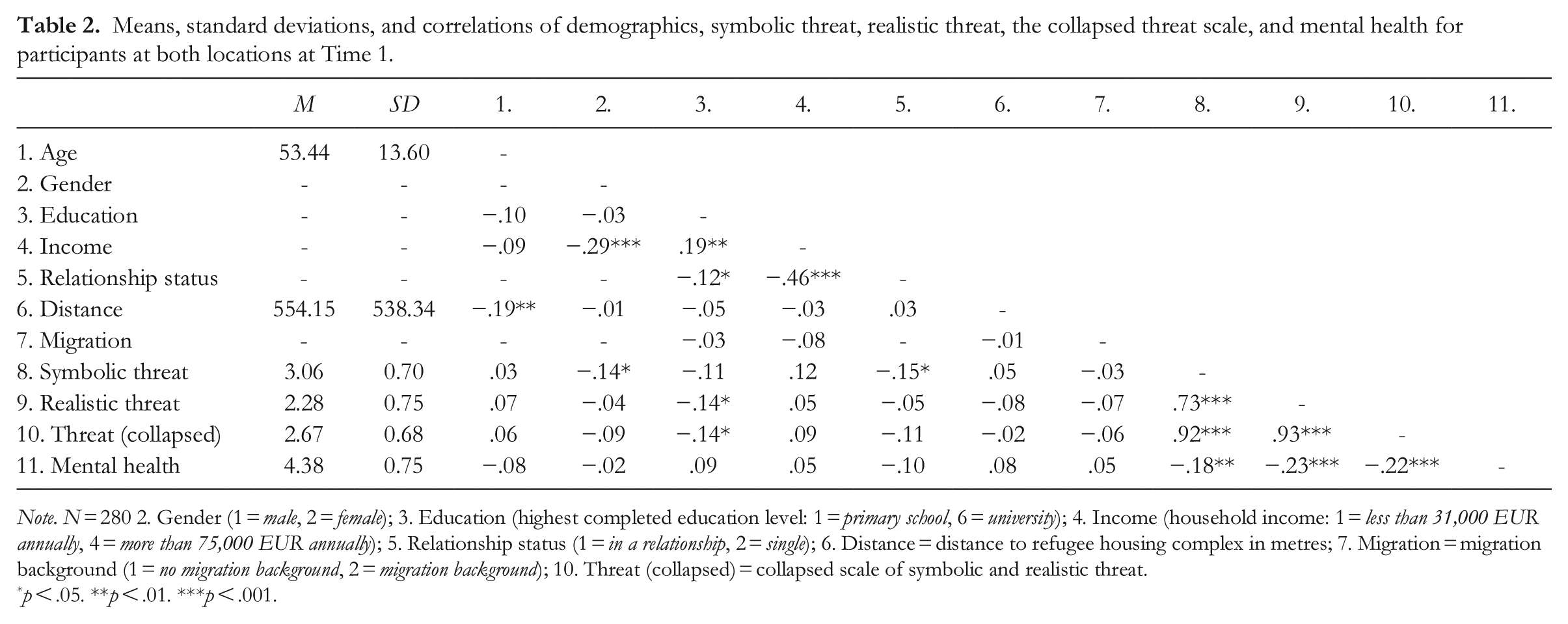
Note. N = 280 2. Gender (1 = male, 2 = female); 3. Education (highest completed education level: 1 = primary school, 6 = university); 4. Income (household income: 1 = less than 31,000 EUR annually, 4 = more than 75,000 EUR annually); 5. Relationship status (1 = in a relationship, 2 = single); 6. Distance = distance to refugee housing complex in metres; 7. Migration = migration background (1 = no migration background, 2 = migration background); 10. Threat (collapsed) = collapsed scale of symbolic and realistic threat.
p < .05. **p < .01. ***p < .001.
Symbolic and realistic threat were both negatively correlated with mental health. This means that before the refugees arrived in the neighbourhood, citizens who experienced more symbolic and realistic threat also reported poorer mental health. As expected, symbolic and realistic threat were strongly correlated. Those individuals who experienced more symbolic threat also experienced more realistic threat.
Hypotheses Testing
We conducted a linear multiple regression analysis on the entire sample (Locations 1 and 2) at T1 to examine whether higher symbolic and realistic threat perceptions were negatively associated with mental health. We first conducted a regression analysis separately for symbolic and realistic threat. Both symbolic threat (B = −0.21, p = .001, 95% CI [−0.33, −0.08]) and realistic threat (B = −0.23, p < .001, 95% CI [−0.34, −0.11]) were negatively associated with mental health at T1.
We then conducted a multiple regression analysis including both forms of threat simultaneously as predictors of mental health at T1. Higher realistic threat was significantly associated with poorer mental health (B = −0.19, p = .028, 95% CI [−0.36, −0.02]), while no significant association was found between symbolic threat and mental health (B = −0.06, p = .514, 95% CI [−0.24, 0.12]). Considering that symbolic and realistic threat correlated strongly (see Table 2; r = .73, p < .001), we conducted a multicollinearity analysis with symbolic and realistic threat as predictor variables of mental health at T1. The results showed similar variance inflation factor (VIF) values for symbolic (VIF = 2.11) and realistic threat (VIF = 2.11). Following the criterion that VIF values higher than 3 become problematic (Shrestha, 2020), we concluded there was no collinearity problem in this analysis.
Another concern could be that as the T1 participant data at Locations 1 and 2 were collected 1 year apart (2018 and 2019), events on a global or national level could have affected the results in the two groups. To examine possible differences, we conducted a t test of differences in the threat and mental health variables of the T1 measurement, comparing the data of participants at Locations 1 and 2. The results showed no significant differences between participants at Location 1 and 2 in regard to the T1 measurements; results for symbolic threat: t(278) = 0.79, p = .433, d = 0.10, 95% CI [−0.15, 0.34]; realistic threat: t(278) = 1.16, p = .247, d = 0.14, 95% CI [−0.10, 0.38]; mental health: t(278) = 1.47, p = .142, d = 0.18, 95% CI [−0.06, 0.42].
In sum, the results support Hypothesis 1 that more symbolic and realistic threat perceptions among citizens in the neighbourhood before the settlement of refugees are associated with poorer mental health. When analysed separately, symbolic and realistic threat were both negatively related to mental health. When both variables were included, a significant effect was only found for realistic threat. But it should be noted that both forms of threat were strongly correlated, which could explain the absence of a significant effect for symbolic threat.
Next, we conducted prospective longitudinal analyses to test the prediction that more threat related to the anticipated settlement of refugees (T1) predicts poorer mental health in citizens after refugee settlement (T2).
Selective attrition
To test for selective attrition between T1 and T2 of participants at Location 1, a multivariate analysis of variance (MANOVA) was conducted to examine whether participants who only completed T1 (n = 107) significantly differed from participants who completed both T1 and T2 (n = 66), controlling for gender, education, and relationship status. No significant differences were found in reported symbolic threat (T1 only: M = 3.11, SD = 0.72; T1 and T2: M = 3.05, SD = 0.77), F(1, 168) = 0.40, p = .529, η2 < .01; realistic threat (T1 only: M = 2.38, SD = 0.73; T1 and T2: M = 2.22, SD = 0.87), F(1, 168) = 1.67, p = .198, η2 < .01; or mental health (T1 only: M = 4.43, SD = 0.75; T1 and T2: M = 4.42, SD = 0.83), F(1, 168) = 0.03, p = .872, η2 < .01.
Differences between time points
To examine differences between T1 and T2 at Location 1 for overall threat, symbolic threat, realistic threat, and mental health, four paired-samples t-test analyses were conducted. The results are given in Table 3. As can be seen, no differences in symbolic, realistic, and overall threat were found. However, mental health was significantly poorer after the settlement of refugees compared to before.
Results of a paired-samples t test comparing symbolic threat, realistic threat, threat (collapsed scale), and well-being at Location 1 before (T1) and after (T2) the settlement of refugees.
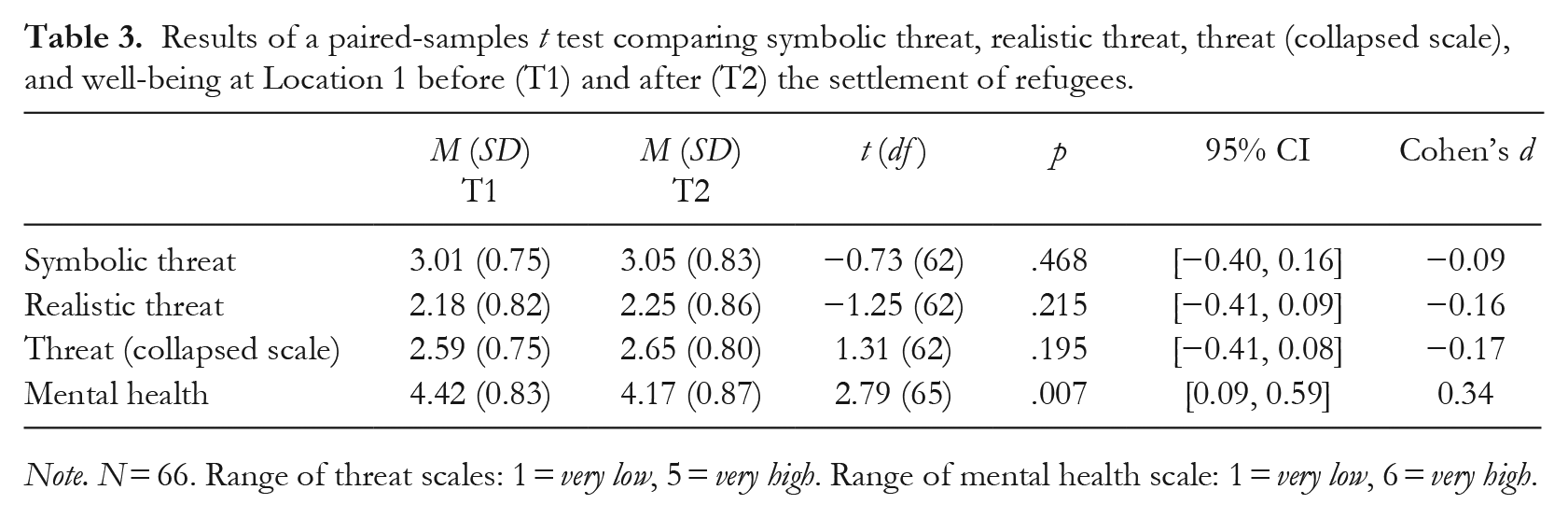
Note. N = 66. Range of threat scales: 1 = very low, 5 = very high. Range of mental health scale: 1 = very low, 6 = very high.
Cross-lagged panel analyses
To test Hypothesis 2, a cross-lagged panel analysis using multiple regression analysis was performed. We conducted analyses separately for symbolic and realistic threat.
Two sets of multiple regressions were conducted on the T1 and T2 assessments of participants from Location 1. First, T2 mental health was regressed on T1 mental health and T1 perceived symbolic threat. Second, T2 symbolic threat was regressed on T1 symbolic threat and T1 mental health. The analyses thus control for the correlation between the T1 variables and for the stability of the variables over time. The results for symbolic threat are given in Figure 1. T1 symbolic threat was negatively associated with T2 mental health (B = −0.34, p = .003, 95% CI [−0.56, −0.12]). In contrast, T1 mental health was unrelated to T2 symbolic threat (B = 0.02, p = .750, 95% CI [−0.12, 0.17]). In sum, higher symbolic threat perceptions in anticipation of refugee settlement were associated with lower levels of mental health in citizens after refugee settlement. Citizens with lower levels of mental health before refugee settlement did not report more symbolic threat after settlement.
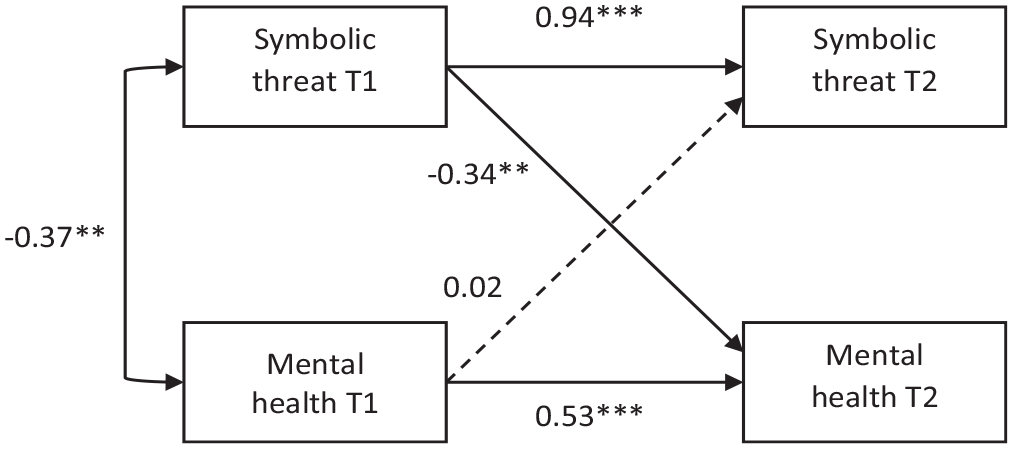
Cross-lagged panel analysis of associations between symbolic threat and mental health at Time 1 and Time 2 (n = 66); gender, education, and relationship status are included as covariates.
The analysis was repeated for realistic threat. The results for realistic threat are given in Figure 2. A similar pattern was found, T1 realistic threat was negatively associated with T2 mental health (B = −0.30, p = .003, 95% CI [−0.50, −0.10]). T1 mental health was not associated with T2 realistic threat (B = 0.01, p = .867, 95% CI [−0.14, 0.16]).
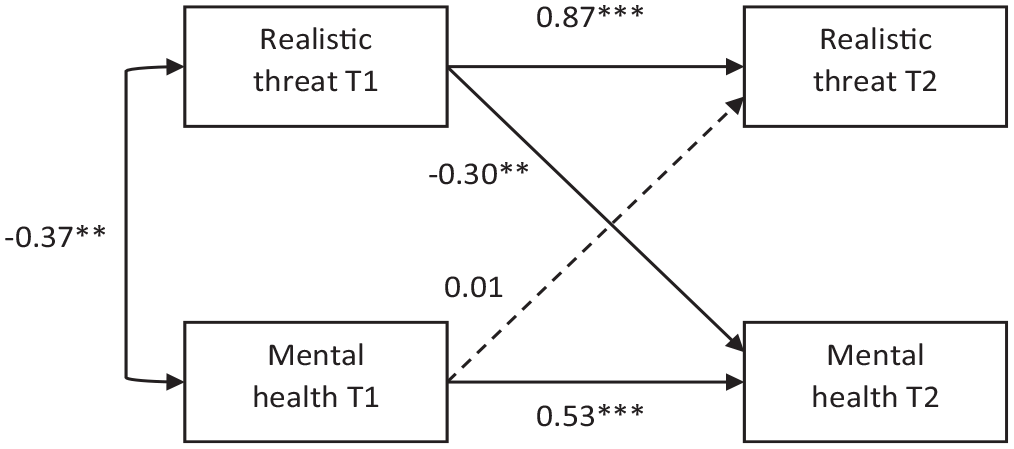
Cross-lagged panel analysis of associations between realistic threat and mental health at Time 1 and Time 2 (n = 66); gender, education, and relationship status are included as covariates.
We also conducted a multiple regression analysis where both forms of threat and mental health at T1 were simultaneously included as predictors of mental health at T2 (see Figure 3). Both forms of threat at T1 were significantly and negatively correlated with T1 mental health (T1 realistic threat: r = −.38, p = .001; T1 symbolic threat: r = −.37, p = .001). When both types of threat were simultaneously included at T1, the associations were negatively, but not significantly, related to T2 mental health (results for T1 realistic threat: B = −0.16, p = .325, 95% CI [−0.47, 0.16]; results for T1 symbolic threat: B = −0.21, p = .247, 95% CI [−0.56, 0.15]). In sum, because they correlated strongly, T1 symbolic and T1 realistic threat did not uniquely predict T2 mental health above and beyond each other.
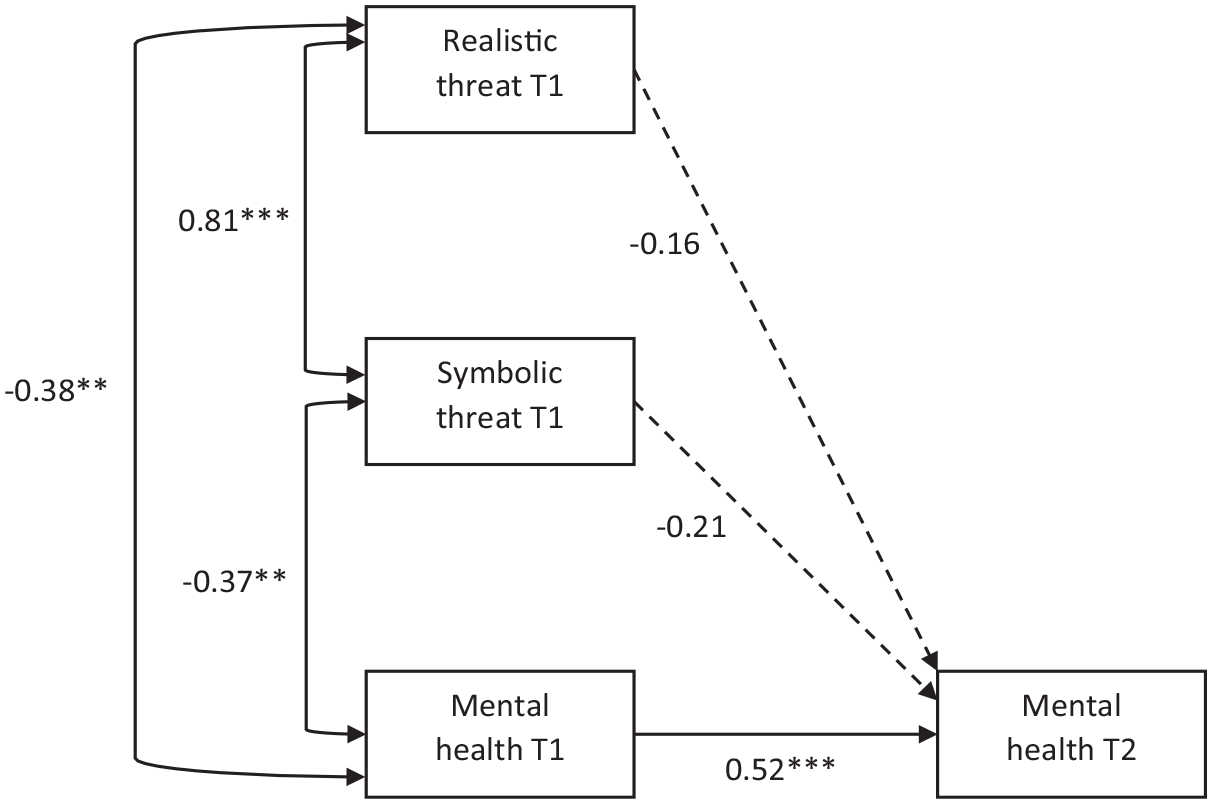
Cross-lagged panel analysis of associations between symbolic threat, realistic threat, and mental health at Time 1, and mental health at Time 2 (n = 66); gender, education, and relationship status are included as covariates.
As the two types of threat variables correlated strongly (r = .81, p < .001), we again conducted a multicollinearity analysis with symbolic threat, realistic threat, and mental health at T1 as predictors of mental health at T2. The results showed VIF values of 2.97 for T1 symbolic threat, 2.99 for T1 realistic threat, and 1.18 for T1 mental health. Following the criterion mentioned earlier (Shrestha, 2020), we concluded there was no collinearity problem in this analysis.
In sum, higher symbolic as well as realistic threat perceptions in anticipation of refugee settlement were associated with poorer mental health in citizens after refugee settlement. Citizens with poorer mental health before refugee settlement did not report more realistic or symbolic threat after settlement. These results support Hypothesis 2 that more symbolic and realistic threat perceptions before settlement are associated with poorer mental health 6 months after refugee settlement.
Explorative Analyses of Distance to Location
Explorative analyses were conducted to examine whether mental health and perceived symbolic and realistic threat differed between participants living closer to or further away from the refugees’ location before and after their arrival. Distance to the two locations was treated as a continuous independent variable. Distances varied from about 45 metres to 3,019 metres to the refugee settlement location. For these analyses, we standardized the distance variable, and linear regression analyses were run for each outcome variable separately. In the analyses, we controlled for gender, education, and relationship status. No significant associations were found between distance to the refugee settlement location and, respectively, mental health (T1: B = 0.05, p = .226, 95% CI [−0.03, 0.14]; T2: B = 0.06, p = .583, 95% CI [−0.16, 0.28]), symbolic threat (T1: B = 0.03, p = .422, 95% CI [−0.05, 0.12]; T2: B = 0.11, p = .308, 95% CI [−0.11, 0.33]), or realistic threat (T1: B = −0.07, p = .130, 95% CI [−0.16, 0.02]; T2: B = −0.05, p = .655, 95% CI [−0.27, 0.17]) before (T1; Locations 1 and 2; N = 280) and after (T2; Location 1 only; n = 66) the arrival of refugees.
Discussion
The present study examined how refugee settlement in two Amsterdam (the Netherlands) neighbourhoods affected citizens’ realistic and symbolic threat perceptions, and how intergroup threat was associated with citizens’ mental health. Our results show that higher symbolic and realistic threat perceptions related to the settlement of refugees in a neighbourhood were associated with poorer mental health among citizens in the two neighbourhoods, thereby supporting Hypothesis 1. A postsettlement measurement in one of the two neigborhoods showed that, in line with Hypothesis 2, more symbolic and realistic threat before the settlement of refugees predicted poorer mental health after the settlement. The reverse association was not significant, so those individuals with poorer mental health before refugee settlement did not report more threat after refugee settlement.
To our knowledge, the present study is the first to empirically and prospectively test how intergroup threat related to refugee settlement is associated with mental health of citizens in the settlement neighbourhood. It thereby extends previous work that focuses on intergroup threat feelings and attitudes toward refugees (Anderson & Ferguson, 2018; Cowling et al., 2019). Together, our findings suggest that, in the present context of refugee settlement, those citizens who are more prone to feel threatened by the settlement are also more likely to report lower levels of mental health before and after refugee settlement.
We do point out that our participants were recruited from only two locations in one city in the Netherlands. Further research is therefore needed to replicate our findings in other urban and in more rural contexts.
Nevertheless, the overall decrease in mental health in the neighbourhood is noteworthy considering that mental health levels in residents from urban neighbourhoods of comparable urban density in the Netherlands did not show such a significant change. We base this on analyses we conducted with the LISS (Longitudinal Internet Studies for the Social Sciences) panel, administered by Centerdata, Tilburg University, the Netherlands. The LISS panel is a representative sample of Dutch households drawn from the population register. A survey is conducted every year, including measures on mental health. We obtained data collected in 2017 (4 months before our premeasurement at Location 1) and data collected in 2018 (the period of our postmeasurement). A total of 767 people were included in the analyses who lived in urban areas of comparable density as residents in the present study. A paired-sample t test showed no difference in mental health levels in the LISS panel participants when comparing the 2017 to the 2018 data, t(766) = 1.47, nonsignificant; 95% CI [−0.12, 0.02]). A more detailed description of the LISS panel and the analyses is provided in the supplemental material.
Our findings are in line with a previous study by Schmid and Muldoon (2015), who reported a negative association between threat perceptions and psychological well-being among citizens in Northern Ireland who were either directly or indirectly exposed to the conflict. However, their study was conducted in a different social context, characterized by long-term violent political conflict. The present study shows that also in a context that has no long history of intergroup conflict, the experience of symbolic and realistic intergroup threat is related to poorer mental health.
Our longitudinal analyses show that residents who reported more symbolic and realistic threat before refugee settlement in their neighbourhood had significantly poorer levels of mental health 6 months after the refugee settlement. The fact that the reverse association was not significant suggests that poorer mental health before the settlement did not result in more threat 6 months after the settlement. These results support the possibility of a causal effect of increased intergroup threat related to refugee settlement on deteriorated mental health of citizens in the neighbourhood.
It is important to note that the overall levels of symbolic and realistic threat were not very high and did not increase 6 months after the settlement of refugees in the neighbourhood (see Table 3). At Location 1, symbolic threat levels were around the midpoint of the scale (1 = very low, 5 = very high) 6 months after the settlement of refugees (M = 3.05, SD = 0.83), t(62) = 0.46, nonsignificant, 95% CI [−0.16, 0.26]. Realistic threat levels were significantly below the scale midpoint (M = 2.25, SD = 0.86), t(62) = −6.94, p < .001, 95% CI [−0.97, −0.53]. This is first evidence that refugee settlement does not decrease threat levels, but it also does not increase threat feelings over time.
What could explain why some individuals are more affected by the anticipated settlement of refugees than others? Previous research by Verkuyten and colleagues (Bagci et al., 2022; Verkuyten & Martinovic, 2017) shows that a threat to the sense of ownership of the country and the neighbourhood can result in more negative emotions, such as anger or fear. A prolonged experience of negative emotions has been shown to be associated with a decrease in mental well-being (e.g., Satici et al., 2022). We would expect, therefore, that residents who felt threatened in their sense of ownership also felt more negative emotions in anticipation of the refugee settlement, which in turn negatively affected mental health. Besides its theoretical relevance, this would also have implications for policymaking and communication efforts by authorities. Possibly, involving residents at an early stage in the refugee settlement procedure could lower experienced threat to ownership by creating greater controllability related to refugee settlement. Related to this, we did not find significant associations between geographical distance to the refugee location and, respectively, reported levels of threat and mental health. Before the settlement of refugees in the neighbourhoods, the municipality informed residents through letters, door-to-door newspapers, resident meetings, social media (Twitter, Facebook), and the municipality’s websites (Onderzoek, Informatie en Statistiek, 2019). This timely communication and involvement of (in particular) residents living close to the settlement location may possibly have helped to attenuate existing concerns.
Limitations and Future Directions
Our study design allowed for a prospective longitudinal test of the association between threat and mental health before and after the actual settlement of refugees in a neighbourhood. This is a unique feature of this study, as most of the work done on attitudes towards refugees is cross-sectional, either before or after the arrival of refugees. Nevertheless, a consequence of the relatively small number of participants is that we cannot draw strong conclusions about the causal (long-term) effect of intergroup threat on mental health. Multiple follow-up measures including larger samples would allow for a stronger test of the development of threat levels and mental health over time.
Our participants mostly had high education and income levels, so it would be valuable if future research also includes greater numbers of low socioeconomic status citizens. However, considering the robust meta-analytic findings of a positive association between education and attitudes towards refugees (Anderson & Ferguson, 2018; Cowling et al., 2019), the effects in our study are likely to be at least as strong in samples with less education or lower income levels.
It should be noted that attrition rate was quite high (38% of the participants at Location 1 participated in the follow-up measurement, which implies an attrition rate of 62%). We do not have an explanation for this high rate of attrition other than the passage of time. Importantly, our analyses of selective attrition showed no differences on the measures of realistic threat, symbolic threat, or mental health between participants at T1 who did and did not participate at T2. We also did not find significant differences on these variables when comparing T1 results for participants from Location 1 (whose data were collected in 2018) and Location 2 (data collected 1 year later, in 2019).
The present study was conducted in two ethnically diverse neighbourhoods in Amsterdam, a capital city in Western Europe. The findings cannot be easily generalized to other social contexts, such as cities with less ethnic diversity and less densely populated cities and villages. These are all important moderators that were beyond the scope of this study. Similarly, it would be interesting to examine if our findings extend from the settlement of refugees to other developments imposed upon neighbourhoods, such as large infrastructural projects or energy transition initiatives.
Finally, at both study locations, housing of the refugees was concentrated within a single building, and the refugees themselves were mostly single young men of Syrian and Eritrean background. Future research should consider how other forms of refugee settlement (i.e., not centralized but spread across neighbourhoods) and settlement of other types of refugees (with a different ethnic background) could affect citizens’ threat perceptions and, thereby, mental health. For example, a recent study in 15 European countries by Bansak et al. (2023) showed that EU citizens (N = 14,856) had more positive attitudes towards asylum seekers from Ukraine than towards asylum seekers from Syria, Pakistan, Iraq, Eritrea, or Afghanistan. Possibly, Ukrainian refugees are considered more “similar” to Europeans than those from the other nations. Indeed, Yitmen et al. (2018, 2022) found that greater perceptions of similarity with refugees are associated with more social acceptance of refugees by citizens. Importantly, and relevant for the present research, they found that reduced intergroup threat perceptions mediated this association.
Conclusion
To our knowledge, this is the first study showing that symbolic and realistic threat perceptions in regard to refugee settlement are related to citizens’ poorer mental health. As such, the present study makes an important contribution to the immigration literature, as it employed a unique longitudinal design in which associations between threat perceptions and mental health were prospectively investigated before and after the arrival of refugees. In regard to policymaking, our findings imply that if authorities want to intervene to prepare citizens for the arrival of refugees, they should focus on reducing levels of symbolic and realistic threat. Countering threat levels related to refugee settlement can improve attitudes towards refugees (Anderson & Ferguson, 2018; Cowling et al., 2019), and our findings suggest it could also prevent deteriorated mental health in citizens.
Supplemental Material
sj-pdf-1-gpi-10.1177_13684302241248001 – Supplemental material for Effects of refugee settlement on citizens: A prospective longitudinal study of associations between perceived intergroup threat and mental health
Supplemental material, sj-pdf-1-gpi-10.1177_13684302241248001 for Effects of refugee settlement on citizens: A prospective longitudinal study of associations between perceived intergroup threat and mental health by Allard R. Feddes, Hannah J. Arjangi-Babetti, Susan Bosdijk, Lisa Klawitter, Annelies H. Romers, Sofia Tsaousoglou, Bertjan Doosje, Marieke Effting and Arnold A. P. van Emmerik in Group Processes & Intergroup Relations
Footnotes
Acknowledgements
We would like to thank Nikita Feringa, Judith Heijnen, Nadine Krijnsen, Daniela Maijer, Maria Möllers, Bernadette Paschertz, Lisa Salzmann, Eva Sliedrecht, Hilde Steutel, Noor van Brakel, Sanne van der Ent, Marieke van Gerwen, and Julia van Nijkerk for their help with data collection in this project.
Declaration of Conflicting Interests
The author(s) declared no potential conflicts of interest with respect to the research, authorship, and/or publication of this article.
Funding
The author(s) received no financial support for the research, authorship, and/or publication of this article.

Supplemental Material
Supplemental material for this article is available online.
References
Supplementary Material
Please find the following supplemental material available below.
For Open Access articles published under a Creative Commons License, all supplemental material carries the same license as the article it is associated with.
For non-Open Access articles published, all supplemental material carries a non-exclusive license, and permission requests for re-use of supplemental material or any part of supplemental material shall be sent directly to the copyright owner as specified in the copyright notice associated with the article.
