




Abstract
While radical right parties championing anti-immigrant platforms have made electoral gains throughout Europe, anti-immigrant sentiment—a key indicator of radical right support—has not dramatically increased during this same period. In this article, we seek to help make sense of this paradox by incorporating a contextual factor missing from previous studies: levels of anti-immigrant violence. Our key argument is that higher levels of collective violence targeting immigrants raise the salience of the immigrant/native boundary, which activates both positive and negative views of immigrants and makes these attitudes more cognitively accessible and politically relevant. This argument implies that exposure to violence against immigrants should strengthen existing prejudice (or empathy) toward immigrants and engender feelings of affinity (or antipathy) for radical right parties. Analyses of the German portion of the European Social Survey (ESS 2014 − 2019) and the Anti-Refugee Violence in Germany (ARVIG 2014 − 2017) datasets reveal a powerful interaction effect: exposure to higher levels of collective violence increased the probability of feeling closest to radical right parties among those who held neutral, negative, and extremely negative views of immigrants. However, these events were not associated with radical right sympathies among those holding pro-immigrant attitudes. We conclude that when violence against immigrants resonates with public opinion on immigrants, it opens new political opportunities for radical right parties. These findings should inform future research on the politicization of international migration, especially studies investigating how anti-immigrant attitudes translate into political outcomes.
Introduction
In the first two decades of the twenty-first century, political parties with explicitly anti-immigrant platforms made electoral gains on both sides of the Atlantic Ocean (Bustikova 2014; Eger and Valdez 2015; Parker 2018; Arzheimer and Berning 2019). Although there is disagreement over which factors best explain the rise of the party family known as the “radical right” (Arzheimer 2018), there is a remarkable consensus that anti-immigrant sentiment has been essential to its growth: no radical right party has been electorally successful without mobilizing grievances over immigration (Arzheimer 2008; Ivarsflaten 2008, 3; Grande, Schwazbözl, and Fatke 2019; Abou-Chadi, Cohen, and Wagner 2022). Not surprisingly, research on electoral behavior often suggests that increasingly negative views of immigrants best explain rising support for the radical right (e.g., Berning and Schlueter 2016, 89). But evidence at both the individual and country level runs counter to this logic: panel data from the United States and from Western European countries do not indicate that individuals’ attitudes toward immigrants have fundamentally changed in recent years (Kustov, Laaker, and Reller 2021), nor do pooled cross-sectional data from the United States (Eger, Mitchell, and Hjerm 2022) or European countries (Bohman, Eger, and Hjerm 2013; Stockemer et al. 2019) suggest that, in general, public opinion toward immigrants has dramatically worsened over time.
This article seeks to help make sense of this paradox of increasing support for the radical right in the absence of clear evidence of a rise in anti-immigrant sentiment. To do so, we offer an account that implicates the polarizing impact of collective violence against immigrants, a factor missing from prominent explanations of sources of radical right-wing party sympathies and support (see Arzheimer 2018 for a review). We argue that higher levels of collective violence will heighten the salience of in-group/out-group boundaries and galvanize positive and negative attitudes toward immigrants. This heightened attention to immigrants makes radical right sympathies more or less likely, depending on the positive or negative valence of attitudes toward immigrants. This argument implies that an interaction effect exists between collective violence targeting immigrants and immigration attitudes on radical right sympathies.
In this article, we follow Tilly’s (2003, 3) definition of collective violence as “episodes of social interaction that (1) immediately inflicts physical damage on persons and/or objects…, (2) involves at least two perpetrators, and (3) results at least in part from coordination among persons who perform the damaging acts.” Our research strategy, first, focuses on the impact of collective violence on individuals' attitudes toward immigrants. In the second step, we analyze how these factors are related to radical right sympathies. Our main argument is that collective violence and attitudes toward immigrants together underlie an individual's political affinity with the radical right, the party family whose key concern is immigration (Rydgren 2007, 244).
Our key theoretical argument is inspired by social movement scholars who suggest a connection between collective violence and sympathy for political movements (Tilly 2003; Koopmans and Olzak 2004; Baggetta and Myers 2022). This work notes that collective violence not only emerges from a strong sense of collective identity but also can construct new movement identities in the wake of violence (Gould 1995). Previous research suggests that collective violence against immigrants may encourage native-born residents to adopt the view that immigrants have mainly harmful consequences for their country (Igarashi 2021). When collective violence resonates with anti-immigrant sentiment, an individual's attraction to political parties that make nativist or neo-nationalist (Eger and Valdez 2019) claims about the threat of immigration should grow. However, other research suggests that violent events targeting immigrants may, instead, generate positive affect, such as empathy, toward immigrants (Jacobsson and Blom 2014). In such cases, sympathizing with a radical right party should be unlikely. Thus, we contend that the interaction of collective violence with negative or positive attitudes toward immigrants produces diverging affinities for radical right parties. An increasingly expanded base that holds these activated and negative views opens opportunities for radical right parties to grow. However, collective violence also has the potential to set limits on these parties’ growth by increasing opposition to these parties among those with pro-immigrant attitudes.
This article focuses on Germany because it was one of the countries at the center of debates about immigration during the so-called “European migration crisis,” prompted by those fleeing wars in Syria, Afghanistan, and Iraq in 2015 (Czymara and Schmidt-Catran 2017). Germany has experienced large increases in immigration in recent decades and, during this particular crisis, accepted more refugees than any other European Union country (Pew Research Center, 2016). Contrary to expectations, however, anti-immigrant sentiment in Germany has not increased as a result of this surge in immigration (e.g., Czymara and Schmidt-Catran 2017), but violence directed against immigrants has (Benček and Strasheim 2016).
The empirical analyses that follow combine survey data and contextual indicators from Germany, made available as part of the European Social Survey (ESS), with another contextual-level dataset, Anti-Refugee Violence in Germany (ARVIG), which tracks collective violence against immigrants throughout Germany between 2014 and 2017 (Benček and Strasheim 2016; 2018). Following current practice (e.g., Goerres, Spies, and Kumlin 2018; Igarashi 2021), we use multilevel regression analysis to capture the influence of both individual- and state (lander)-level measures.
Our goal is to contribute to several research areas, including analyses of immigration attitudes (Czymara and Schmidt-Catran 2017; Czymara and Dochow 2018; Weber 2019; Wagner et al. 2020; Kromczyk, Khattab, and Abbas 2021), anti-immigrant violence (Ireland 1997; Jäckle and König 2017, 2018; Frey 2020), the effect of anti-immigrant violence on individuals’ attitudes (Igarashi 2021), and radical right-wing voting (Goerres, Spies, and Kumlin 2018; Arzheimer and Berning 2019; Schaub et al. 2021) in Germany and beyond. Ultimately, we aim to contribute to the cross-national literature on the radical right by examining how collective violence may transform attitudes toward immigrants into political support for (or rejection of) anti-immigrant parties. As far as we know, ours is the first statement and test of this hypothesis.
To develop these ideas, this article proceeds as follows. First, we provide a brief overview of scholarship on immigration attitudes and radical right sympathies, emphasizing the gap between theoretical expectations and empirical trends that motivates our study. We, then, advance a theoretical argument that highlights both the salience effect of collective violence and individuals’ attitudes toward immigrants, which together affect sympathy for radical right parties. This argument implies two hypotheses that specify that the effect of collective violence will depend on the valence of attitudes about immigrants (i.e., whether individuals hold negative or positive views of immigrants). After discussing data sources and estimation procedures, we present results that show support for the hypothesis that collective violence has divergent effects on individuals’ political sympathies that depend upon individuals’ stance toward immigrants. We end with a discussion of the implications of our findings for the study of conflict, group threat, and the politics of immigration.
Immigration, Threat Perceptions, and the Radical Right
Because this article aims to help explain the recent surge in support for radical right parties in the absence of a similar surge in anti-immigrant sentiment, we need to engage in the ongoing debates over the relationships among immigration, out-group prejudice, and support for the radical right (Hjerm 2007; Lancee and Pardos-Prado 2013; Pottie-Sherman and Wilkes 2017; Amengay and Stockemer 2019). According to group threat and competition theories (Blalock 1967; Olzak 1992), large numbers of immigrants raise native-born perceptions that newcomers reduce the standard of living in many ways, including competition over scarce jobs, housing, and welfare benefits, increases in crime, and overcrowding (e.g., Semyonov, Gorodzeisky, and Raijman 2006; Schneider 2008; Fox and Guglielmo 2012, but see Hainmueller and Hiscox 2007; Hjerm 2007; van Heerden and Ruedin 2017; Eger, Mitchell, and Hjerm 2022). The competition/threat perspective holds that surges in immigration increase the likelihood that hostilities perpetrated by native-born and/or ethnic majorities toward immigrants will arise in host countries (Quillian 1995; Coenders and Scheepers 2008; Hangartner et al. 2019; Velásquez and Eger 2022), including collective violence (Olzak 1992; Koopmans and Olzak 2004). Even a slight decline in ethnic homogeneity, this research shows, triggers ethnic antagonism (Olzak, Shanahan, and West 1994).
Since most radical right parties actively seek to restrict immigration, it seems reasonable to expect that competition/threat perspectives can explain the rise in support for right-wing parties. However, the empirical evidence from studies linking objective increases in immigration to sympathy for radical right parties is mixed. Evidence supporting theories of ethnic competition and group threat has been documented in studies of electoral outcomes for parties with anti-immigrant platforms in Sweden (Rydgren and Tyrberg 2020), the United Kingdom (Kaufmann 2017), Norway (Sørensen 2016), and Russia (Alexseev 2006). Yet a meta-analysis of 48 studies published between 1990 and 2017 reveals that neither levels of nor increases in objective immigration (i.e., official statistical counts, as opposed to individuals’ subjective perceptions of the size of the immigrant population) have consistent effects on support for radical right parties in Western Europe (Amengay and Stockemer 2019).
These diverse results suggest either that the empirical relationship between objective immigration and out-group prejudice is weaker than presumed (e.g., Pottie-Sherman and Wilkes 2017, 244) or that the perceptions of immigrants matter more than actual immigration numbers (Gorodzeisky and Semyonov 2020). Indeed, evidence from Germany shows that threat perceptions matter for radical right support, even in regions with little immigration (Berning and Schlueter 2016; Schmitt-Beck 2017), and that neither the immigrant population's relative size nor asylum flows are related to radical right sympathies in this country (Goerres, Spies, and Kumlin 2018).
Theoretical Argument: Collective Violence, the Salience of Group Boundaries, and Polarization
In this section, we propose that exposure to collective violence is an important missing piece for understanding diverging trends among immigration flows, anti-immigrant sentiment, and affinity for radical right parties with anti-immigrant platforms. Specifically, we argue that collective violence, a contextual-level variable, amplifies the effect of individuals’ immigration attitudes, whether pro-immigrant or anti-immigrant. The resulting cross-level interaction between collective violence targeting immigrants and individuals’ attitudes about immigrants generates polarization in affinity for political parties. A crucial test of our argument rests on finding evidence that the effect of collective violence on party preferences depends upon the valence of attitudes toward immigrants (i.e., whether attitudes about immigrants are positive, negative, or neutral). However, our argument does not rely on attitudinal change. Instead, we contend that collective violence targeting immigrants draws attention to the immigration issue, making attitudes toward immigrants more cognitively accessible and politically relevant.
Our theoretical argument unfolds in two steps: First, we argue that exposure to collective violence against immigrants increases the salience of the immigrant/native boundary (Olzak 1992; Esteban and Ray 2008), reinforcing existing attitudes toward immigrants (Koopmans and Olzak 2004). Second, we argue that collective violence interacts with both positive and negative attitudes toward immigrants and that this interaction is politically polarizing, producing extremes in affinities for radical right parties. Thus, we expect that more exposure to collective violence against immigrants will be associated with greater sympathy for radical right parties among those holding more extreme anti-immigrant views and greater opposition to radical right parties among those more favorable to immigrants.
Collective Violence Increases Sympathy for Radical Right Parties
In this section, we apply arguments from research on social movements and collective violence to identify three mechanisms theoretically responsible for the relationship between collective violence and political attitudes. The first is the salience of group identities. Research on race and ethnic conflict finds that collective violence directed against an identifiable target heightens within-group solidarity on both sides of the boundary line (Olzak in press), rendering membership on either side of this boundary more visible (Fox and Guglielmo 2012). Previous research on native-born reactions to immigration points to the consequences of boundary activation: reduced support for social policies that include immigrants as beneficiaries (Eger 2010) and increased support for policies designed to exclude immigrants (Hopkins 2010). Due to its very nature, collective violence targeting immigrants ought to resonate most with those holding extremely negative attitudes toward immigrants.
Signaling is a second mechanism that theoretically connects collective violence to political affiliations. Prior research shows that collective action communicates a group's increased capacity to mobilize significant amounts of material and organizational resources critical for influencing the voting public or policymakers (McCarthy and Zald 1977). Because collective violence is a dramatic event, it has the potential to capture media and public attention, signaling the importance of an issue and mobilizing supporters beyond a movement's narrow base (Rensmann 2018). 1 Further, a high volume of collective violence may increase the legitimacy of violent acts by creating the perception that hostile acts directed against immigrants are acceptable (Koopmans and Olzak 2004; Koopmans, Michalowski, and Waibel 2012).
Previous research also identifies a third possible mechanism linking collective violence to political attitudes: the politicization of in-group/out-group boundaries, or when key actors in a political debate frame an out-group's presence as threatening (Fox and Guglielmo 2012; Olzak and Shanahan 2014; Rydgren and Tyrberg 2020). Violence against foreigners may increase native-born perceptions of insecurity or fears of instability and affect their view of immigrants (Igarashi 2021). A variety of studies also suggest that media coverage of immigrants (Boomgaarden and Vliegenthart 2009) or the political articulation of immigration issues (Bohman 2011) can shift public opinion toward more negative views of immigrants and immigration policy. Events such as crime by immigrants can increase residents’ perceptions of threat, thereby increasing the chances that violence will be used against immigrants (Jäckle and König 2018; Frey 2020). Research by Sniderman, Hagendoorn, and Prior (2004) and Sniderman and Hagendoorn (2007) identified the processes by which dramatic and unexpected “trigger” events — those that amplify the perception of immigrants as constituting an imminent threat — influence prejudice (see also Legewie 2013). We consider collective violence against immigrants as one type of trigger event that promotes political realignments by channeling support for parties, leaders, and platforms that express negative opinions about immigrants (Frey 2020).
Based on the scholarship reviewed above, we argue that collective violence targeting immigrants will resonate most with those holding negative attitudes toward immigrants. We also expect that individuals who express negative views of immigrants will find radical right parties with anti-immigrant platforms even more attractive if they have been exposed to higher levels of collective violence against immigrants.
Collective Violence Also Increases Opposition to Radical Right Parties
Other research examining immigration's effects reminds us that attitudes toward immigrants are heterogeneous and that support for immigration may also result from exposure to immigrants (van Heerden and Ruedin 2017). For example, Ivarsflaten and Sniderman (2021) show that while some proportion of native-born Europeans are steadfastly hostile to immigrants, a significant number accept, support, and even endorse an immigrant presence (see also Ivarsflaten, Blinder, and Ford 2010). Further evidence of polarization comes from Eger, Larsen, and Mewes (2020), who find that Europeans were significantly more likely to hold either the most exclusive attitudes or unconditionally inclusive attitudes toward immigrants after the 2015 migration crisis than in the previous decade.
We identify another theoretical mechanism that specifies a different relationship between collective violence and radical right sympathies: empathy. If the argument that collective violence increases the salience of group boundaries holds, then attacks on immigrants should also influence those who support immigrants. However, collective violence targeting immigrants should not have the same adverse influence on those with positive views of immigrants. Indeed, violence against immigrants may evoke empathy for immigrants and encourage backlash protests opposing such attacks (Braun and Koopmans 2010; Jäckle and König 2017, 27) and anti-immigrant sentiment more generally. For example, Jacobsson and Blom (2014) found that pro-immigrant sentiment increased in Norway, following a right-wing terrorist event perpetrated by an individual with an anti-immigration agenda (see also Koopmans 1996). Moreover, evidence from experiments using vignettes shows that threats to immigrants (in the form of economic hardship or political repression) significantly raise empathy and support for immigrants among subjects. As Newman et al. (2013, 600) conclude, “receiving information about the hardships faced by immigrants actually increased [positive attitudes] even in the presence of threatening media information about immigrants.”
Implications and Hypotheses
Our theoretical argument implies that exposure to violence against immigrants strengthens existing prejudice (or empathy) toward immigrants and engenders feelings of affinity (or antipathy) for radical right parties. We expect collective violence to generate greater sympathy for a radical right party among those with strong anti-immigrant sentiment. Put differently, for those who hold negative views of immigrants, we posit that collective violence has a galvanizing effect on radical right sympathies. Because violence can also elicit empathy toward immigrants as victims, instead of reinforcing antipathies, we additionally expect collective violence to make sympathy with radical right parties unlikely among those more favorable to immigrants. Thus, we expect collective violence to have a polarizing effect on political affinities.
In sum, we argue that collective violence targeting immigrants increases the salience of the immigrant/native boundary and, in the process, makes attitudes about immigrants more cognitively accessible and politically relevant. However, we also argue that the valence of attitudes held toward immigrants matters for how collective violence influences political sympathies, leading to two hypotheses:
Data and Methods
Individual-Level Data
To test our hypotheses, we assemble data from multiple sources. Individual-level data from Germany come from the cumulative file of the ESS (2020), a comprehensive, biennial survey covering over 30 European countries between 2002 and 2018. 2 Due to the availability of key contextual data, our main analyses only feature data from the last three rounds (ESS7, ESS8, ESS9), administered in 2014–2015, 2016–2017, and 2018–2019, respectively. After excluding respondents with missing data, we retain 98 percent of these samples (|NESS7 = 2,979; |NESS8 = 2,796; |NESS9 = 2,301).
Our analyses focus on two key variables. The first, attitudes toward immigrants, combines three items that measure whether respondents at the time believed immigrants contributed positively or negatively to society: “Is immigration bad or good for country's economy?”; “Is the country's cultural life undermined or enriched by immigrants?”; and “Do immigrants make country worse or better place to live?” The Cronbach's alpha for our German sample is 0.85, and previous cross-national research has also combined these items to measure anti-immigrant sentiment (e.g., Gorodzeisky and Semyonov 2020). Original responses were coded from 0 to 10, and, before calculating the row mean, we rescaled the items from −5 to 5 to reflect attitudes that were negative and positive. We treat this variable as a dependent variable in the first set of analyses and a key independent variable in the test of our hypotheses.
Our main dependent variable indicates the political party to which a respondent felt closest at the time of the interview. Because this measure is independent of a respondent's prior voting record, we can assess party affinities, regardless of which political party respondents supported in the past. By analyzing this measure of emotional attachment to a party rather than a previous vote, we are also able to consider the attitudes of first-time voters. 3 For each ESS round, we create a binary variable to indicate whether the respondent sympathized most with any German party identified by the literature on radical or far right parties as such (e.g., Norris 2005; Eger and Valdez 2015, 2019; Schmitt-Beck 2017; Arzheimer and Berning 2019; Mudde 2019). During the period covered by the ESS, radical right parties were the Republicans (Die Republikaner, REP) between 2002 and 2012; the National Democratic Party of Germany (Nationaldemokratische Partei Deutschlands, NPD) between 2004 and 2018; and AfD between 2014 and 2018. Because we test our formal hypotheses with ESS data from 2016/2017 and 2018/2019, our main dependent variable measures sympathy for NPD or AfD. In these years, 97 percent of radical right sympathizers felt closest to AfD.
Figure 1 illustrates our empirical puzzle well. We aggregate data from all nine ESS rounds, allowing us to compare temporal variation in affinity for radical right parties with the relative stability of attitudes toward immigrants. On average, attitudes toward immigrants became slightly more positive between the first and second decades of this century but changed little between 2012 and 2018. Meanwhile, an increasing proportion of the sample felt closest to the radical right family of political parties, beginning in 2014, one year after AfD's federal election debut and its near miss at reaching the electoral threshold (4.7 percent of the federal vote) required for entering the German Parliament (Bundestag).
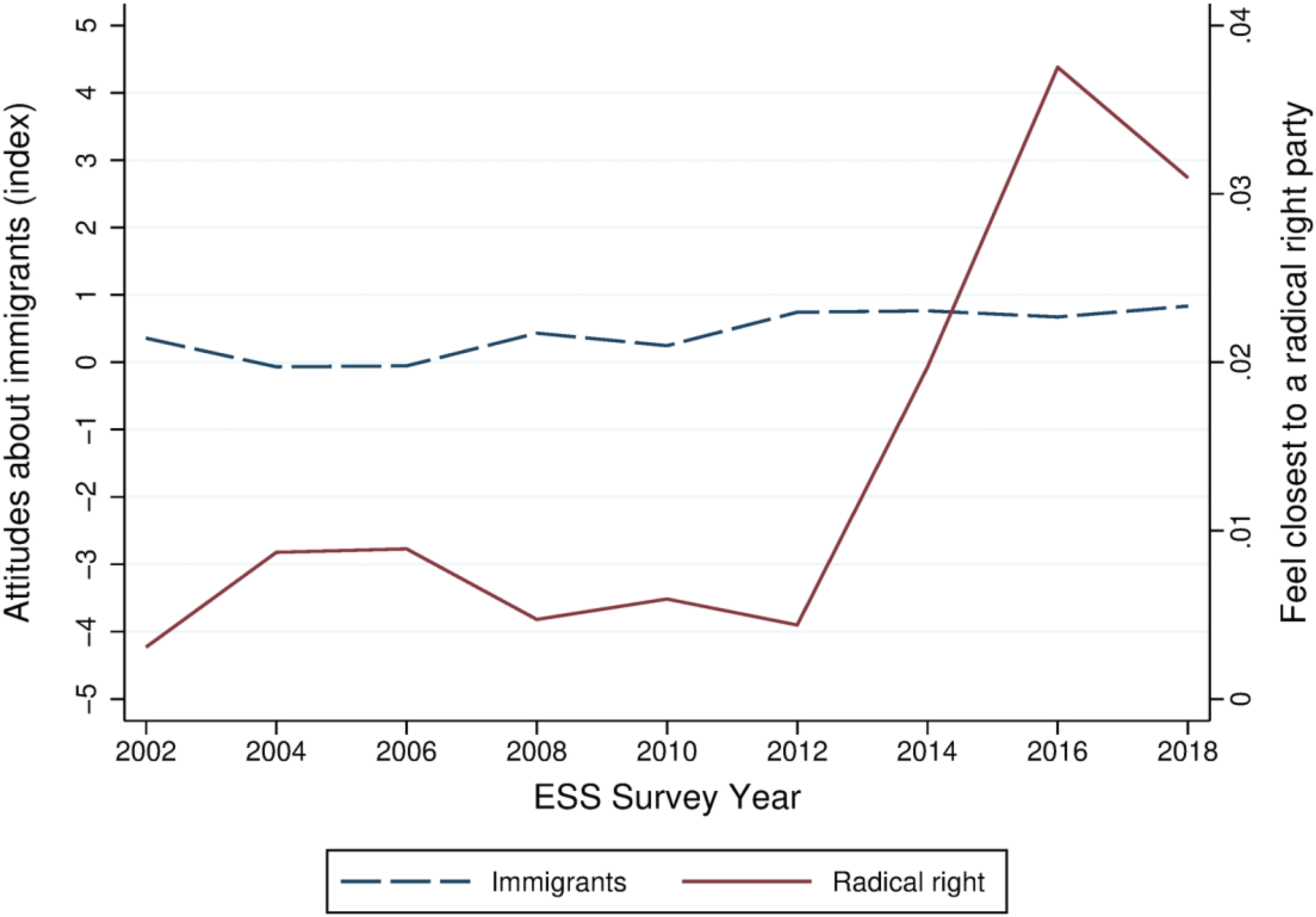
Attitudes toward immigrants and radical right parties, 2002–2018. Source: European Social Survey (ESS)1-9e01 notes: y-axis 1 (left) represents average attitudes towards immigrants, rescaled to −5–5 to reflect negative or positive views (0 = neutral). y-axis 2 (right) shows the proportion who feel closest to a radical right party.
Analyses of both dependent variables include demographic controls, such as a continuous measure of age and a categorical measure of sex. Based on variables about respondents’ and their parents’ birth country, we also generated a categorical measure of immigration status/nativity: 0 “native-born with two native-born parents,” 1 “native-born with one or two foreign-born parents,” and 2 “foreign-born.” To capture theoretical arguments associated with ethnic competition (Olzak in press) and group threat theories (Blumer 1958), we included a categorical measure of labor force status: 1 “employed in paid work,” 2 “education,” 3 “unemployed, looking,” 4 “unemployed, not looking,” and 5 “not in the labor force,” as well as a continuous measure of subjective income. We also controlled for years of education, as previous research consistently finds that education is inversely related to anti-immigrant sentiment (e.g., Hainmueller and Hiscox 2007). Finally, following Maxwell’s (2019) ideas about the effect of cosmopolitan residence, we used a dichotomous variable to identify whether the respondent lived in a metro area (i.e., big city or suburbs/outskirts of a big city) or elsewhere (i.e., farm, country village, town or small city). Political leanings are also likely to be path dependent, so our models of radical right sympathies included two variables to control for past political behavior. The first is a trichotomous vote variable: 1 “yes,” 2 “no,” and 3 “not eligible.” The second is dichotomous and speaks to whether the respondent previously voted for a radical right party: 0 “no” and 1 “yes.” Respondents who did not vote were coded as not voting for a radical right party. Descriptive statistics for all variables are in Table 1.
Descriptive Statistics.
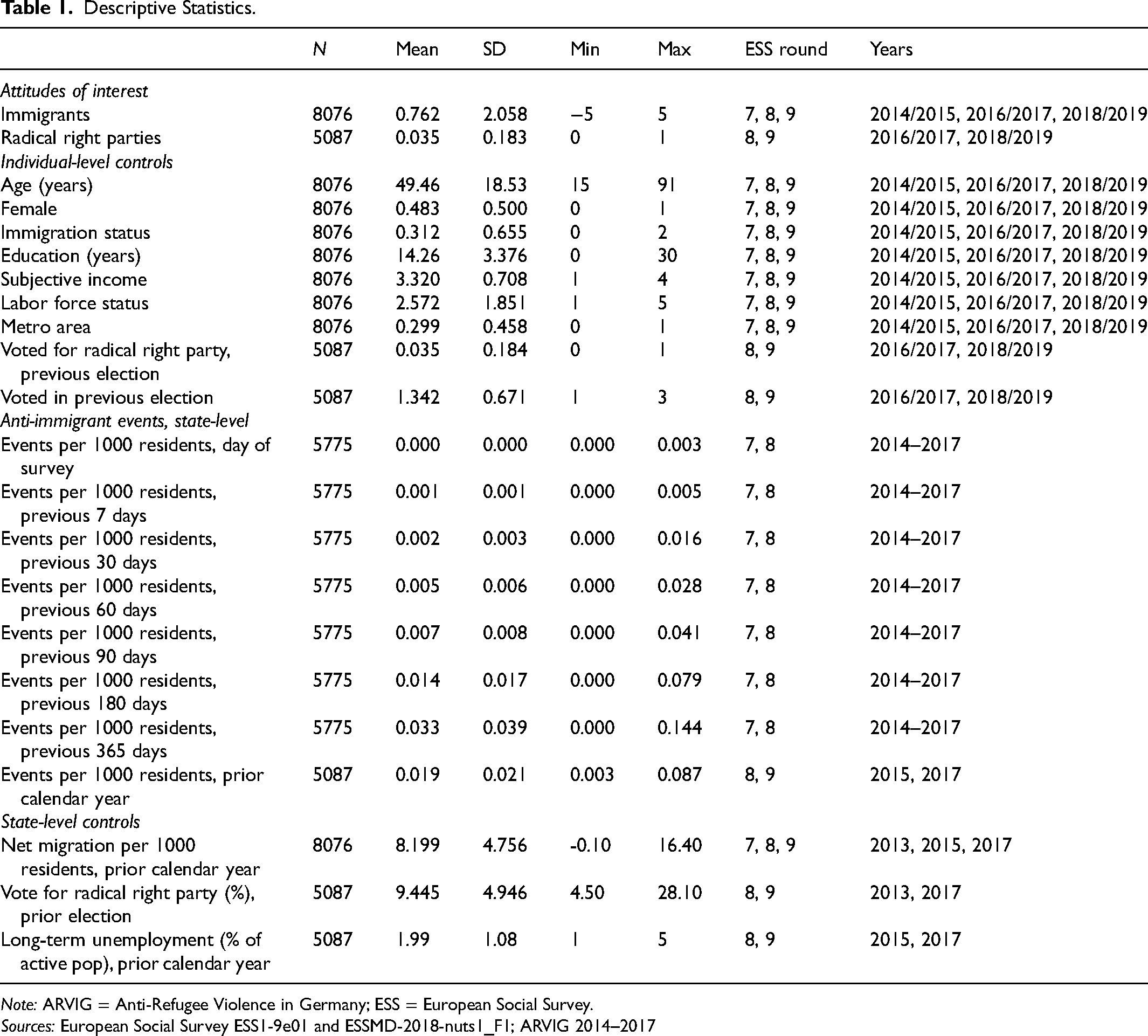
Note: ARVIG = Anti-Refugee Violence in Germany; ESS = European Social Survey.
Sources: European Social Survey ESS1-9e01 and ESSMD-2018-nuts1_F1; ARVIG 2014–2017
Contextual Data
Counts of anti-immigrant events come from the dataset Anti-Refugee Violence in Germany (ARVIG). The authors of this dataset, Benček and Strasheim (2016; 2018), used webscrapings of two civil-society organizations tracking attacks and violent protests against refugees and other immigrants to create a georeferenced event dataset on anti-immigrant violence in Germany between 2014 and 2015. The first release of these data has been validated in previous research (Igarashi 2021). We obtained an updated version of the dataset, which also includes counts for 2016 and 2017, from Benček and Strasheim in February 2020.
Table 2 reports the regional distribution of the nearly 7000 violent events that took place in Germany between January 2014 and November 2017. The largest number of events (1046) took place in the eastern German state of Saxony and the fewest (18) in the northwestern German state of Bremen. Figure 2 illustrates the incidence of collective violence targeting immigrants over time, demonstrating not only between-state but also within-state variation. For example, many German states saw a rise in events between 2015 and 2016, during the height of the migration crisis, with dramatic spikes in Baden-Württemberg, Bavaria, North Rhine-Westphalia, and Saxony just prior to the EU-Turkey deal that officially marked the end of the crisis. Counts in other states, like Hamburg and Saarland, were more consistent over time.
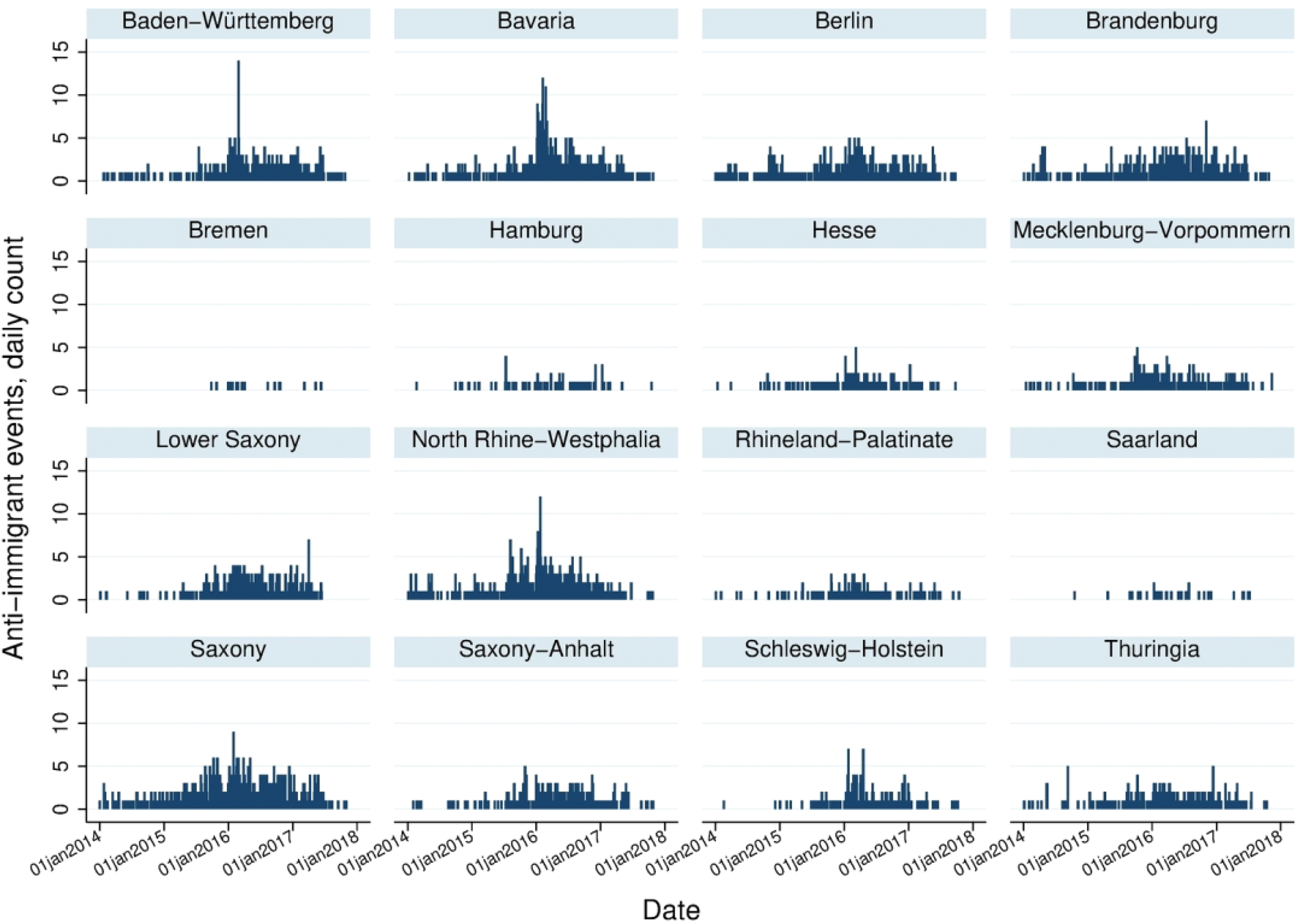
Daily counts of anti-immigrant events, by German state. Source: Anti-Refugee Violence in Germany (ARVIG) 2014−2017.
Event Count, January 1, 2014 — November 11, 2017.
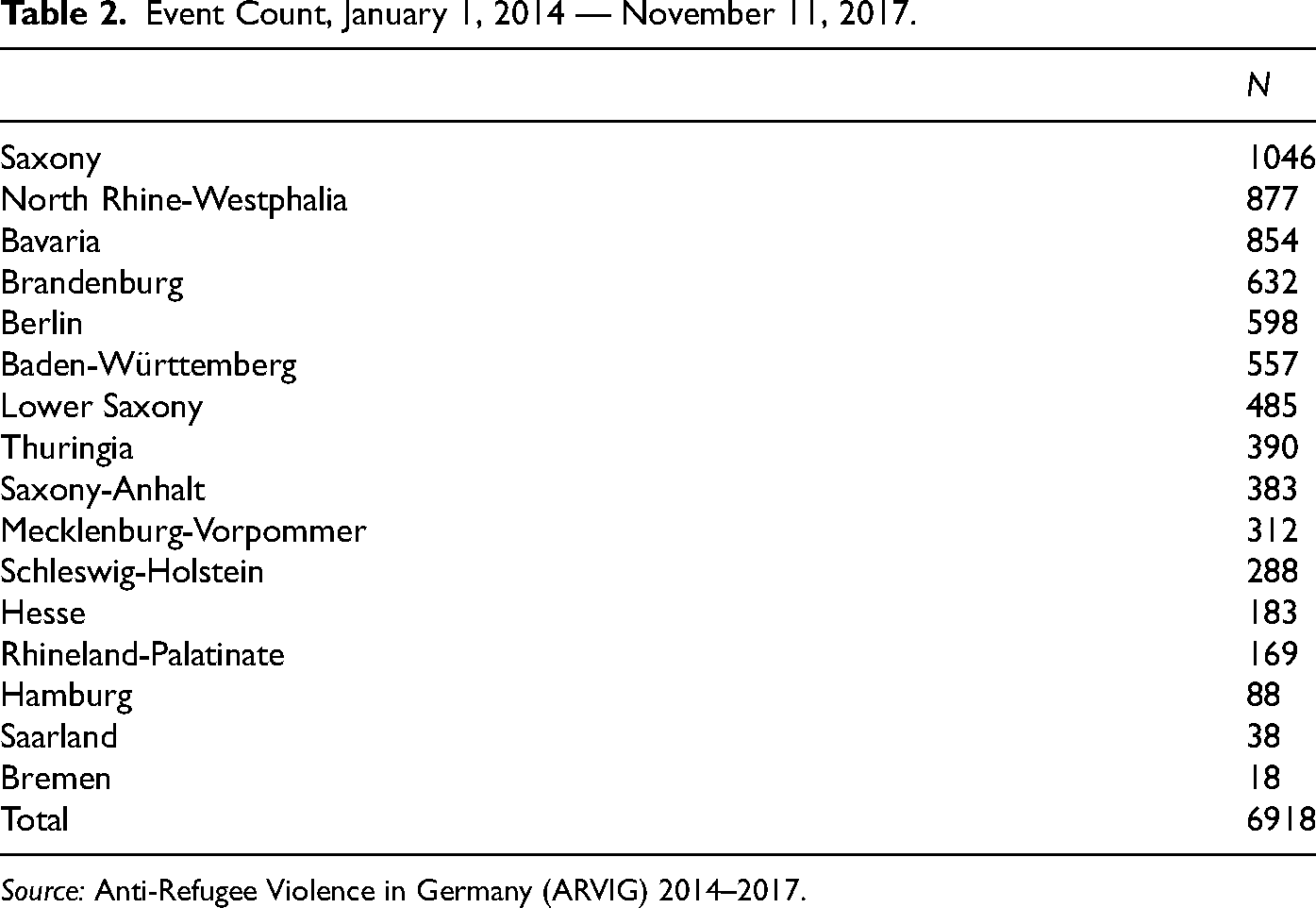
Source: Anti-Refugee Violence in Germany (ARVIG) 2014–2017.
State-level controls come from two sources. First, we obtained 2013 and 2017 federal state election results from the German government office responsible for elections and used these data to create a state-level measure of voting for a radical right party. This measure was calculated as the percentage of the regional population that voted for REP, NPD, or AfD. Second, we made use of contextual data from official sources such as Eurostat compiled by the Norwegian Centre for Research Data and provided by ESS for merging with the survey. 4 We used the NUTS1 5 data file so that we could control for demographic and economic conditions at the federal state level: crude rate of net migration (with statistical adjustment for unexplained population change) expressed per 1000 residents and long-term unemployment expressed as a percentage of the active population. We also standardized our count of anti-immigrant events per 1000 residents. 6
Combining Datasets
Our research design combines data on individual characteristics and counts of collective violence at the state level from the ESS and ARVIG datasets. This strategy was first used by Igarashi (2021), who tested the hypothesis that anti-immigrant sentiment is, in part, driven by concerns with safety and security. However, our empirical analyses depart from his in several ways. First, his analysis focused specifically on attitudes toward refugees, which other recent research using ESS data reveals are distinct from attitudes toward immigrants more generally (Abdelaaty and Steele 2022). Second, Igarashi did not analyze political party preferences, as we do. Third, compared to our analysis, Igarashi relied on fewer rounds of data, combining only the 2014−2015 ARVIG data with the ESS8 fielded in 2016−2017. Fourth, as we explain below, we innovated in that we take into consideration the timing of respondents’ interviews. Further, our theoretical contribution differs from Igarashi's: we not only link collective violence with attitudes toward immigrants but also explain how collective violence mobilizes (or fails to mobilize) radical right sympathies.
Because we are interested in a contextual variable's impact on an individual-level outcome, our analytical strategy requires combining pooled cross-sectional survey data at the individual level with contextual data based on state of residence. While the use of hierarchical datasets has become standard in the social and political sciences (and in analyses of anti-immigrant sentiment using ESS data, e.g., Bohman 2011; Gorodzeisky and Semyonov 2020; Igarashi 2021), we also take into consideration the timing of both the events and respondents’ interview date when merging contextual data. To our knowledge, using the exact day and month of one's interview to merge contextual data has not been done previously, most likely because it has not been a theoretical priority to consider fluctuations in a contextual-level variable within a relatively short interval.
There are theoretical reasons to believe that recent events may influence behavior and attitudes more than events occurring earlier (Olzak, Shanahan, and McEneaney 1996). However, there are also reasons to believe that even a distant history of ethnic/racial violence in a region can raise rates of subsequent group conflict (King, Messner, and Baller 2009) or radical right support (Hoerner, Jaax, and Rodon 2019). Accordingly, we calculate the cumulative number of attacks on immigrants in each state over different time periods. Figure 3 depicts the count of events (top panel) between 2014 and 2017 and the count of ESS7-9 interviews (bottom panel) in Germany between 2014 and 2019. Because the ARVIG data do not exist before 2014 or extend through the winter of 2019, to ensure proper time ordering of events and attitudes, we calculated event counts over different time intervals so that they preceded the dates of various ESS rounds. Specifically, we generated population-weighted regional event counts — over 7, 30, 60, 90, 180, and 365 interval-days — and linked them to ESS7 and ESS8 respondents based on the date of their interview. We also created a population-weighted count of the number of events on the day of the interview and linked these counts to ESS7 and ESS8 respondents. Given the gap between the end of ARVIG and the administration of ESS9, these variables do not exist for the most recent round of survey data. We additionally created a population-weighted event count from the prior calendar year (i.e., January 1 through December 31). Such a measure, which summarizes information from the previous year or recent years, is standard in research that analyzes relationships between contextual variables and individual-level outcomes (e.g., Quillian 1995; Semyonov, Gorodzeisky, and Raijman 2006; Eger, Larsen, and Mewes 2020). We link this variable to both ESS8 and ESS9 respondents.
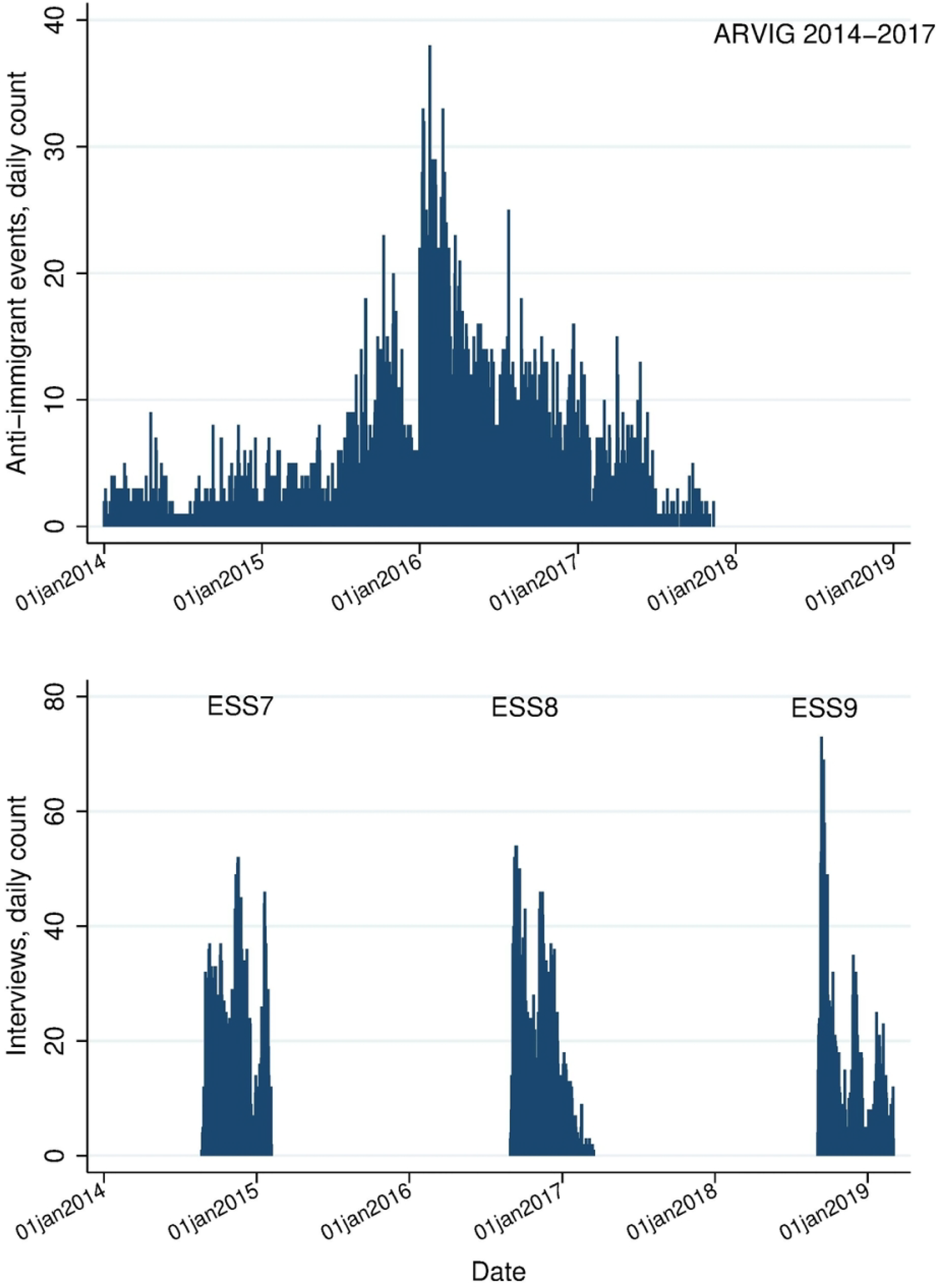
Timeline of anti-immigrant events and survey interviews. Sources: ARVIG 2014–2017; ESS7–ESS9. ARVIG = Anti-Refugee Violence in Germany; ESS = European Social Survey.
Research Design and Estimation Methods
Our analysis combines information from multiple time points, using cross-sectional survey data on attitudes and political party affinities with cumulative and lagged measures of event counts aggregated to the state level. There are several advantages to using multiple rounds of cross-sectional data. First, we are interested in isolating the effect of the 2015 migration crisis on survey responses that followed closely in time. Second, we are equally interested in whether the effects of collective violence on attitudes changed or remained constant across different time periods. Therefore, we present results separately for different surveys, as well as analyses that combine adjacent survey rounds.
To account for our dataset's nested structure (Snijders and Bosker 2011), we ran multilevel mixed-effects linear regression models in Stata 17 (mixed). When we analyzed one round of data, we used two-level models, which take into account the repeated observations specific to each of the 16 states (level 2) and assign a random intercept for each. Analyzing two rounds of data together required a three-level model that takes into account the repeated observations of characteristics specific to each of the 32 state-years (level 2) in addition to the 16 states (level 3) and assigns random intercepts accordingly (Schmidt-Catran and Fairbrother 2016). Because the highest level is only 16 units, all models were estimated with restricted maximum likelihood (REML) Satterthwaite approximation for small samples (see Stegmueller 2013). Results hold using the chi-squared distribution, which is the default in Stata's procedure.
Our second dependent variable is binary, indicating if a respondent felt closest to a radical right party (or not). We hypothesize that the effect of collective violence against immigrants depends on the valence of respondents’ attitudes toward immigrants. This proposition implies a cross-level interaction effect. Given the difficulties associated with interpreting interaction effects in logistic regression (Ai and Norton 2003) and other problems comparing coefficients across different models, we followed Mood (2010) and used a linear probability model to test Hypothesis 2. To avoid biased estimates, we also included a random slope for the lower-level variable (i.e., attitudes toward immigrants) in our cross-level interaction (Heisig and Schaeffer 2019).
Results
Attitudes Toward Immigrants
Table 3 summarizes results from 32 multilevel models of the relationship between anti-immigrant events and attitudes toward immigrants. For each model, we only include one population-weighted event variable, and the coefficients and standard errors reported here represent the relationship between that key independent variable and the dependent variable. The first column reports those statistics for models 1–7, which include respondents surveyed in autumn 2014 and early 2015 (ESS7), and the second column reports those statistics for models 8–14, which differ only in that they also control for state-level net migration. In autumn 2014 and early 2015, attitudes toward immigrants were more pro-immigrant in regions with greater collective violence against immigrants. These results suggest that, before the 2015 migration crisis, violence against immigrants was not merely a function of hostile attitudes in a given region. Instead, on the eve of the migration crisis, this collective violence may have generated sympathy for immigrants.
Summary of 32 Multilevel Models of Anti-immigrant Events and Attitudes Towards Immigrants.
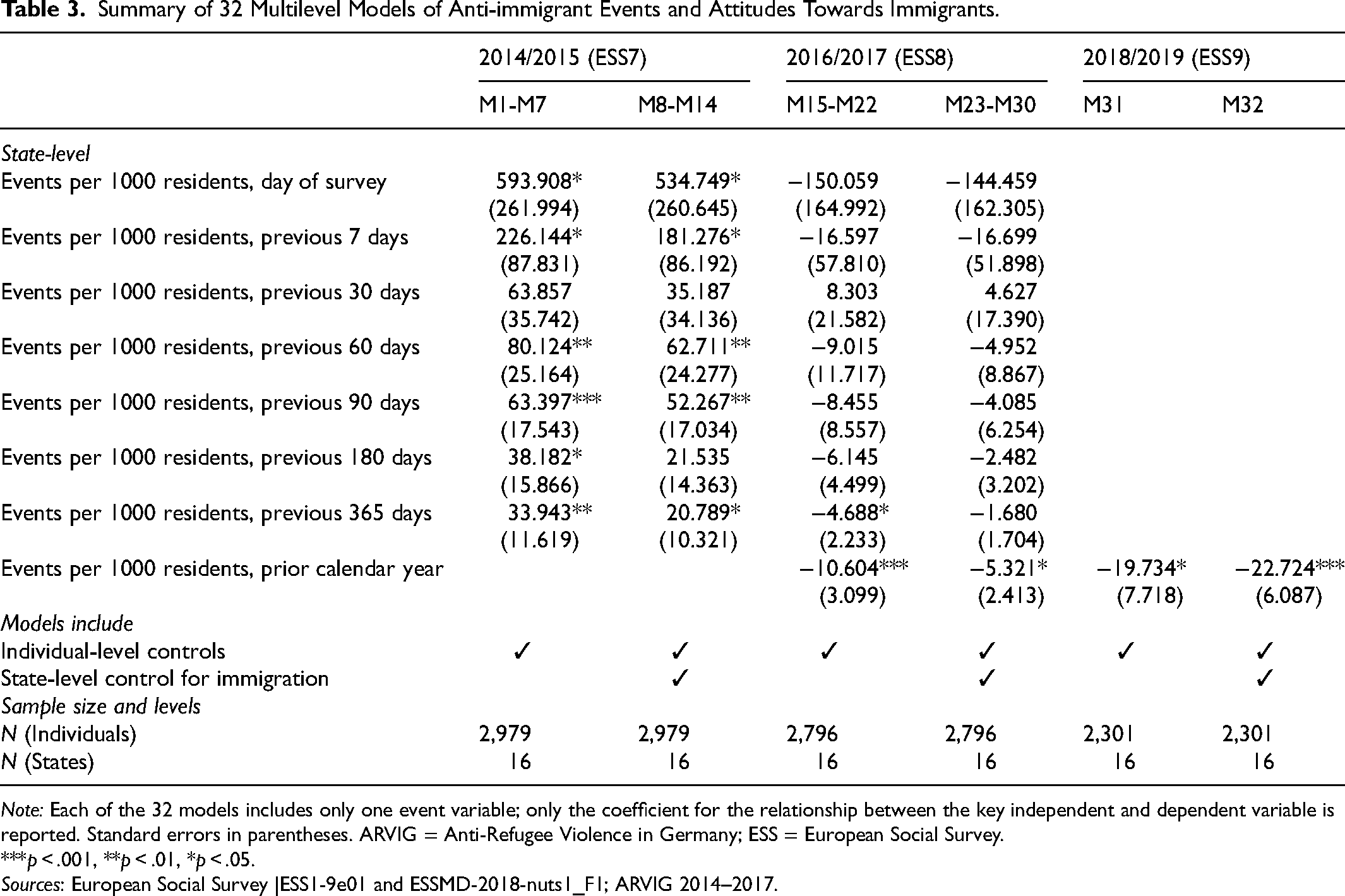
Note: Each of the 32 models includes only one event variable; only the coefficient for the relationship between the key independent and dependent variable is reported. Standard errors in parentheses. ARVIG = Anti-Refugee Violence in Germany; ESS = European Social Survey.
***p < .001, **p < .01, *p < .05.
Sources: European Social Survey |ESS1-9e01 and ESSMD-2018-nuts1_F1; ARVIG 2014–2017.
Two years later, in the wake of the 2015 migration crisis in Europe, the relationship between collective violence and attitudes looks quite different. The third and fourth columns report statistics for models 15–22 and models 23–30, respectively, all of which feature respondents surveyed after the migration crisis, in autumn 2016 and early 2017 (ESS8). The only difference between the two sets of models is the inclusion of the state-level control for net migration. In autumn 2016 and early 2017, the direction of all relationships was negative, although only two of the population-weighted counts of events were significant. First, the level of collective violence in the previous 365 days, which includes the spike in anti-immigrant events during the height of the 2015 migration crisis, was inversely related to attitudes toward immigrants. However, this variable was not significant after controlling for net migration. 7 Second, the level of collective violence in the previous calendar year had a similar negative effect and, importantly, remained significant even when net migration was also considered. This pattern is repeated in models 31 and 32, where the relationship between collective violence and attitudes was assessed, using survey data from autumn 2018 and early 2019 (ESS9).
Taken together, these results show a relationship between collective violence and attitudes toward immigrants that varied not only over time but also in the length of time in question. In 2014, recent acts of violence toward immigrants may have inspired pro-immigrant sentiment. By contrast, by autumn 2016, only the cumulative number of violent attacks over the previous 365 days or prior calendar year was associated with attitudes while the effect of recent attacks disappeared. Further, by autumn 2016, the direction of effects changed such that events were associated with anti-immigrant sentiment.
Radical Right Sympathies
Our two hypotheses specify that the interaction of anti-immigrant events and attitudes toward immigrants will influence radical right sympathies. Table 4 reports results from models of attitudes toward radical right parties, specifically feeling closest to a radical right party (NPD or AfD) in 2016 or 2018 (ESS8-ESS9). Model 1 includes only demographic controls, and results show that being female, being a student, and having a higher subjective income were all negatively associated with feeling closest to a radical right party. Across models, being female is the only demographic measure that was inversely associated with sympathy for the radical right. In model 2, we introduce our key independent variable: events per 1000 residents in the prior calendar year (i.e., 2015 or 2017). Results demonstrate that exposure to higher rates of collective violence against immigrants in one's state of residence increased the probability of feeling closest to a radical right party. Model 3 shows that those who voted for a radical right party in the previous federal election were more likely to feel closest to a radical right party. Our results also reveal that those who were eligible to vote in the past but did not participate in the previous election were also more likely to sympathize with a radical right party. Model 4 indicates that holding more positive attitudes toward immigrants decreased the probability of feeling closest to a radical right party, even controlling for prior political behavior, confirming these attitudes’ importance for radical right sympathies. These relationships hold when models include the contextual controls of net migration, long-term unemployment, and radical right voting at the state level, none of which were significantly related to radical right sympathies (models 5–7). 8
Anti-immigrant Events and Radical Right Sympathies, 2016 and 2018.
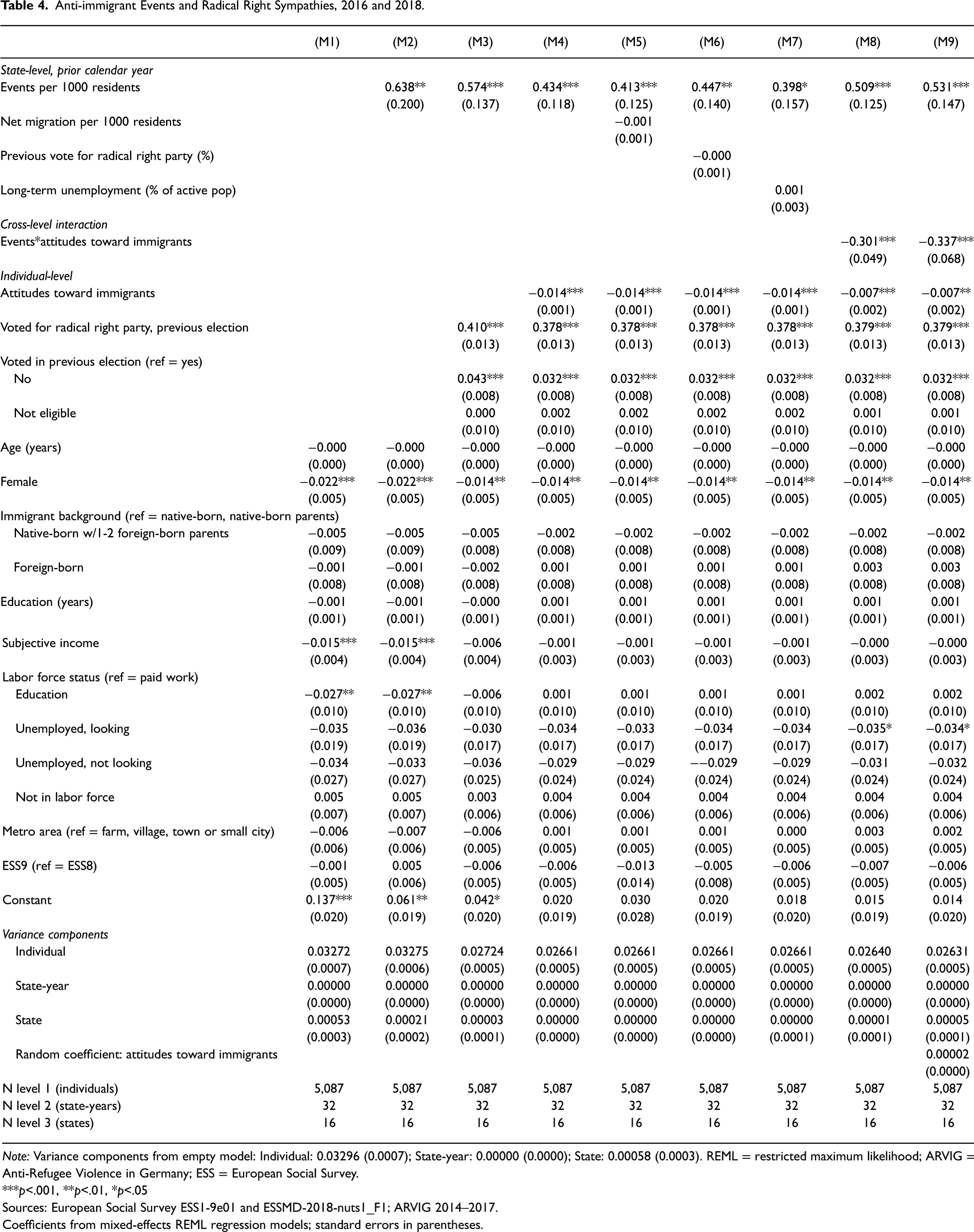
Note: Variance components from empty model: Individual: 0.03296 (0.0007); State-year: 0.00000 (0.0000); State: 0.00058 (0.0003). REML = restricted maximum likelihood; ARVIG = Anti-Refugee Violence in Germany; ESS = European Social Survey.
***p<.001, **p<.01, *p<.05
Sources: European Social Survey ESS1-9e01 and ESSMD-2018-nuts1_F1; ARVIG 2014–2017.
Coefficients from mixed-effects REML regression models; standard errors in parentheses.
The two interaction hypotheses hold that collective violence against immigrants has a polarizing effect on radical right sympathies and that this effect depends upon an individual's sentiment concerning immigrants. To test these hypotheses, we included a cross-level interaction between state-level collective violence and individual-level attitudes toward immigrants in model 8. To avoid biased estimates, we also added a random slope for our lower-level predictor in model 9 (Heisig and Schaeffer 2019). To be clear, our prediction is symmetric: those who held views that anchored either the positive or negative end of the attitudinal scale ought to be most affected by violent events in opposing directions.
Figure 4 provides empirical support for our polarization hypothesis: predicted probabilities from model 9 show that these events had a polarizing effect on radical right sympathies. For those who held negative and extremely negative views of immigrants, exposure to collective violence against immigrants increased the likelihood of feeling closest to either NPD or AfD. The converse also holds. Among those holding more pro-immigrant attitudes, collective violence did not translate into feeling closest to either party. However, it is revealing that anti-immigrant events increased the probability of sympathizing with the radical right among those whose views on immigrants were neutral.
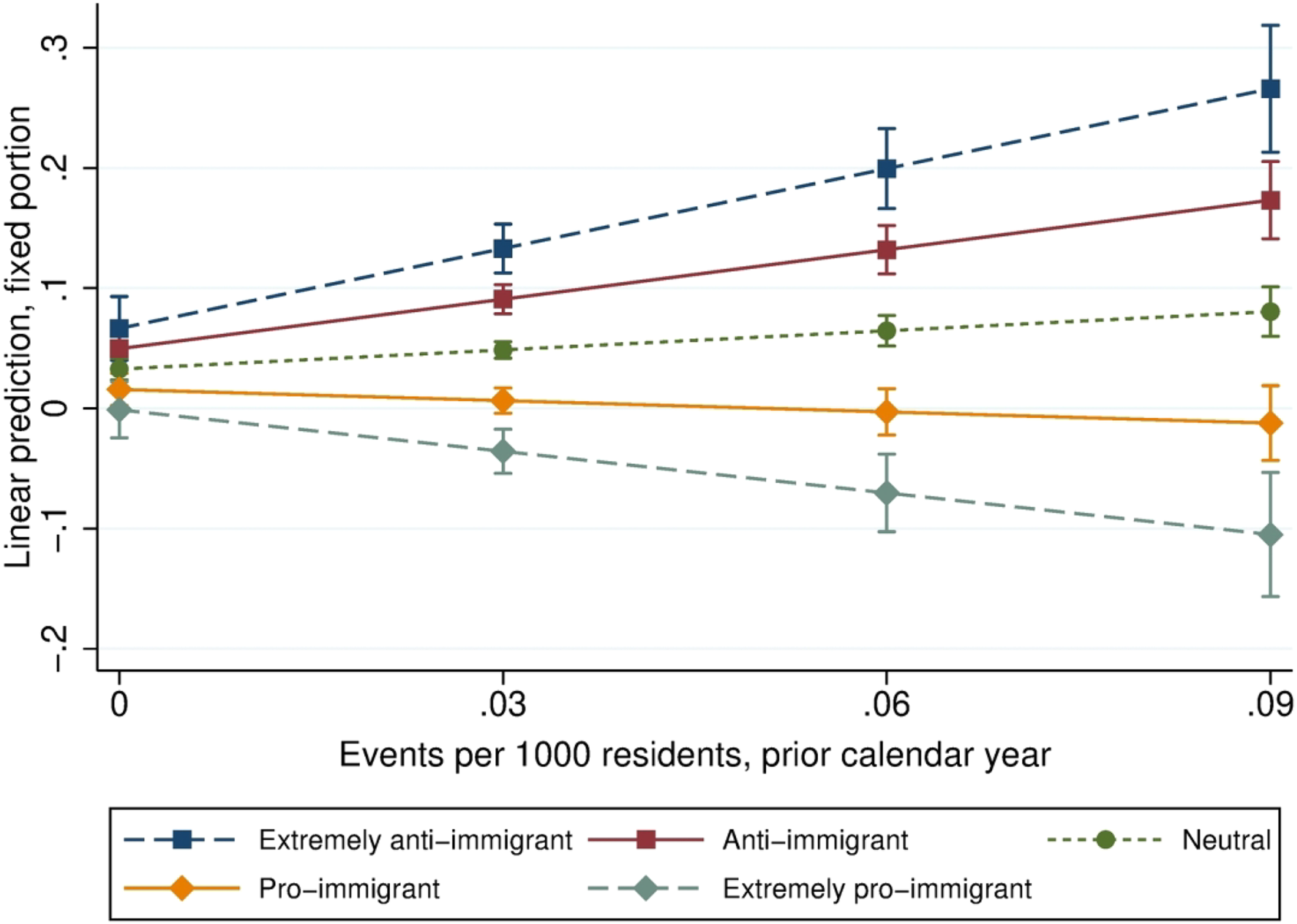
Polarizing effect of anti-immigrant events on attitudes toward radical right parties Sources: ESS1-9e01 and ARVIG 2014–2017 Notes: Predictive margins with 95% confidence intervals from model 9 (includes individual-level controls and a random coefficient for attitudes towards immigrants); RRP = NPD or AfD. NPD = Nationaldemokratische Partei Deutschlands; AfD = Alternative für Deutschland; ARVIG = Anti-Refugee Violence in Germany; ESS = European Social Survey.
In sum, we find evidence of a robust effect of collective violence on attitudes toward both immigrants and the radical right. Moreover, we see a reversal in the effect of collective violence on attitudes toward immigrants after 2015. In 2014, before the migration crisis, the effect of collective violence was associated with more positive views of immigrants, but this effect was reversed by autumn 2016. This interval also witnessed an uptick in collective violence. Furthermore, we found evidence for an interaction effect between collective violence and attitudes toward immigrants that galvanized greater sympathy for the radical right among those with negative and neutral—but not positive—views of immigrants.
Discussion and Conclusions
We began this article by noting that attitudes toward immigrants do not appear to have changed considerably in North America or Europe in recent decades or even in the wake of the 2015 European migration crisis (Czymara and Schmidt-Catran 2017; Stockemer et al. 2019; Kustov, Laaker, and Reller 2021). Yet radical right political parties and politicians espousing anti-immigrant views have gained supporters during this same period (e.g., Arzheimer and Berning 2019). These facts pose a challenge to theories predicting that surges in immigration invariably drive hostility toward out-groups (Olzak in press), thereby enabling the rise of radical right parties (Rydgren and Tyrberg 2020), whose platforms express anti-immigrant sentiment and policies. Our theoretical efforts were motivated by a desire to make sense of these seemingly contradictory trends and mixed empirical findings.
This article contributes theoretically to the literature on attitudes toward immigrants and radical right parties by adopting an approach that emphasizes the influence of collective violence on the salience of in-group/out-group boundaries. We proposed that attacks on immigrants will raise the salience of social group boundaries based on nationality and nativity (e.g., Olzak 1992; Koopmans and Olzak 2004). Most work on collective violence emphasizes only the socially undesirable consequences, such as rising xenophobia that encourages more violence (e.g., King, Messner, and Baller 2009). In this article, we develop a more nuanced argument, positing that collective violence would activate both pro-immigrant and anti-immigrant sentiments. We argue that the combination of collective violence and attitudes contributes to an electorate polarized by concerns over immigration. Accordingly, we contend that collective violence not only encourages opponents of immigration to gravitate toward political parties with anti-immigrant platforms but also boosts opposition to these parties among those with pro-immigrant attitudes. Note that this explanation of variation in radical right sympathies does not require evidence of an increase or decrease in anti-immigrant sentiment. Instead, we argue that collective violence makes the issue of immigration more salient by drawing attention to the immigrant/native boundary, increasing the cognitive accessibility of attitudes about immigrants and heightening these attitudes’ political relevance.
With these arguments, we redress some of the imbalance found in previous work that has mainly emphasized only the negative influence of collective violence on attitudes toward refugees in the wake of the 2015 migration crisis (e.g., Igarashi 2021). By contrast, our argument implies that the effect of collective violence is not one-sided: If it raises the salience of group boundaries, it ought to activate both anti-immigrant and pro-immigrant frames and galvanize support for political parties whose messages resonate with those frames. Thus, collective violence against immigrants acts as a political catalyst, one that is polarizing.
To test these ideas, we combined ESS surveys (2014−2019) with ARVIG event data (2014−2017). The empirical results lend support to our claims. Our first analysis showed that the effect of collective violence on attitudes toward immigrants reversed course over the 2014–2019 period. In 2014, before the 2015 migration crisis, the relationship between events and attitudes was positive, suggesting that collective violence against immigrants created a sympathetic backlash effect. However, this effect changed direction over time and as the number of violent events increased. By 2016, exposure to collective violence was associated with anti-immigrant sentiment. Comparing the results over the entire 2014–2019 period makes clear that the average relationship between collective violence and attitudes varied substantially. These attitudinal patterns are consistent with a period effect related to the migration crisis (Velásquez and Eger 2022).
Our analysis goes beyond previous research investigating the relationship between collective violence and attitudes toward immigrants by addressing how different levels of collective violence and different types of attitudes toward immigrants combine to produce either sympathy or antipathy toward radical right parties. To the best of our knowledge, our research offers the first evidence that documents how collective violence interacts with attitudes to explain affiliations with political parties espousing anti-immigrant positions. Specifically, we posited that exposure to collective violence against immigrants makes radical right sympathies more and less likely, depending upon the valence of one's attitudes toward immigrants. Our results support these hypotheses. Thus, we conclude that individuals’ political responses to immigration depend upon both individual-level attitudes and regional-level contexts that increase the salience of immigration, such as local collective violence targeting immigrants.
Given our claims, it is worthwhile to consider an alternative to our explanation: Are outbreaks of collective violence mobilized by residents already holding the most virulent anti-immigrant views? While we lack data on participation in collective violence, 9 our findings from 2014, before the 2015 migration crisis, run counter to this scenario. During this period, collective violence at the state level was associated with more positive attitudes toward immigrants, meaning that at least initially, these events occurred in places where people held pro-immigrant views. By 2016, however, this situation had changed, and collective violence was associated with negative sentiment toward immigrants. The change in the relationship between exposure to collective violence targeting immigrants and views of immigrants raises the next question: why did this reversal occur?
Our social movement perspective suggests an answer emphasizing the heterogeneity of attitudes toward immigrants. Over time, collective violence galvanizes attitudes toward immigrants at both ends of the spectrum. On one hand, our analysis implies that when violence against immigrants resonates with public opinion on immigrants, it opens new political opportunities for radical right parties that espouse anti-immigrant views. On the other hand, violence against immigrants may also generate support for immigrants and initiate a backlash against radical right parties. We find evidence of both claims.
To conclude, we identify limitations to this article that invite future research to improve upon our work. First, because we did not use panel data at the individual level, we cannot address questions about whether these events changed individual attitudes. Second, our data are limited to the ESS survey rounds and by the period observed in the AVRIG data, which meant that we could not pool all three waves of ESS data in either analysis. While data availability led us to analyze survey data separately, this strategy, nevertheless, yielded an important finding: the direction of the relationship between collective violence and attitudes toward immigrants varied over time. Finally, we would be remiss to ignore potential methodological problems, identified by many scholars (e.g., Lorenzini et al. 2022), related to data on events gathered from media reports. It is possible that small, local events are underreported or not covered by the sources used here. Relatedly, collective violence is just one indicator of hostility, and everyday displays of anger, discrimination, and slights constitute more common signals to immigrants that they are unwelcome (Ivarsflaten and Sniderman 2021). Such activity may also raise the salience of these group boundaries for native-born bystanders, even without surges in immigration. Our work did not analyze more subtle forms of hostility, but future research should.
In sum, the analyses presented here support our theoretical claim that exposure to collective violence targeting immigrants galvanizes attitudes toward immigrants and polarizes political sympathies with radical right parties. We find that exposure to collective violence increased the probability of sympathizing with a radical right party among those whose who held neutral, negative, and extremely negative views of immigrants. However, these events were not associated with radical right sympathies among those holding pro-immigrant attitudes. While we tested our theoretical claims using data from Germany, these results should inform future cross-national and other country-case research on the politicization of international migration, especially studies investigating how anti-immigrant attitudes translate into political outcomes.
Footnotes
Acknowledgments
The authors thank David Benček and Julia Strasheim for sharing the latest version of the ARVIG dataset and for their advice and guidance regarding the use of their respective data in our research. Any mistakes made are our own. They also thank Andrea Bohman and Paul D. Sniderman for their incisive feedback. Additionally, the authors are grateful to participants from the Mannheim Centre for European Social Research (MZES) research colloquium for their insightful remarks and recommendations. Lastly, the authors thank the IMR Editor, Associate Editor, and two anonymous peer reviewers for their constructive and useful suggestions.
Declaration of Conflicting Interests
The author(s) declared no potential conflicts of interest with respect to the research, authorship, and/or publication of this article.
Funding
The author(s) disclosed receipt of the following financial support for the research, authorship, and/or publication of this article: The Marianne and Marcus Wallenberg Foundation (Marianne och Marcus Wallenbergs Stiftelse [MMW]) Grant No. 2014.0019) and the Swedish Research Council for Health, Working Life and Welfare (Forskningsrådet för hälsa, arbetsliv och välfärd [FORTE] Grant No. 2016-07177).
