




Abstract
This study, based on in-depth interviews with 50 African migrants living in the United Kingdom, argues for a more nuanced approach to studying their remittance behavior. Drawing from the tension-centered approach, we posit that African migrants derived their remittance behavior in tensional ways based on the philosophy of Ubuntu, which is both enabling and constraining, stemming from the social context of the home and host countries. This occurs through ongoing negotiation with allegiance to Ubuntu from their home African country, their acculturation to the host country, and migrants scaling back from remitting due to ongoing experiences. In addition to examining migrant remittance behavior as a dynamic and contested negotiation, the sociocultural implications of such remittance behavior patterns are identified. We conclude by discussing some implications for future research on remittance behavior. Our research thus contributes to a more fine-grained understanding of the remittance behavior of African migrants.
Introduction
The motivations driving migrant remittance—encompassing altruism, exchange or self-interest, and insurance—have attracted significant scholarly attention from literature (Lianos and Pseiridis 2014; Lartey 2016; Nnyanzi 2016; Song and Liang 2019; Ehwi, Maslova, and Asante 2021; Souza 2021). More importantly, scholars have raised the awareness of the constant tension between remitting money home for altruism and self-interest in relation to the dilemmas surrounding responsiveness to the social cultural norms of migrants’ home countries (Agarwal and Horowitz 2002; Carling 2008; Baak 2015). This logic suggests that substantive tensions will arise in migrants attempting to remit money back home. For example, in sub-Saharan Africa, there is a sociocultural norm that puts a lot of pressure on migrants to meet the needs and obligations of their family members (Mbiti 1969; Ayisi 1979; Mangoma and Wilson-Prangley 2019) while neglecting their personal needs and interests. This line of research continues to have major implications, given the ongoing personalization of remittance decisions and contexts and the increased importance of context in influencing remittance (Arestoff, Kuhn-Le Braz, and Mouhoud 2016). Some studies on remittance have called for a more complex and situated understanding of the social context in which people choose to and do remittance activities (Lianos and Pseiridis 2014; Shooshtari et al. 2014; Amoyaw and Abada 2016; Ehwi, Maslova, and Asante 2021). However, most studies only look at one factor’s approach to remittance behavior, and they don’t pay as much attention to changes in behavior over time or the sociocultural implications at stake.
In response, we propose a tension-centered approach to understanding remittance behavior, whereby the decision-making to remit, or the social construction of remittance behavior through sociocultural contexts across macro/societal and micro/personal levels, is foregrounded. This tensional approach centers on the dynamic and contested nature of remittance behavior so that we note how African migrants’ remittance sending decisions and behavior shift over time as personal and sociocultural contexts change, and migrants renegotiate what it is (in fact) about their remittance motive that guides their remittance behavior. In doing so, it problematizes distinctions between home and host country sociocultural norms that drive remittance behavior so that we may recognize remittance behavior as transcending both micro and macro levels of social experience. Moreover, the tension-centered approach highlights that remittance behavior depends not merely on the individual decision-making processes and family dynamics but may also be derived from moral dilemmas and ongoing experiences and circumstances (Agarwal and Horowitz 2002; Nyamnjoh 2005; Fleischer 2007; Baak 2015; Puppa and Ambrosini 2022). This is especially important given the significance of migrant remittances to developing nations, which may have a detrimental effect on the sender who engaged in moral and social struggles both inside themselves and in the larger society (Velayutham and Wise 2005; Baak 2015; Cohen and Zotova 2021). We thus note the slippages and complications that arise for African migrants, recognizing that remitting money back home necessarily involves “living with tensions” (Trethewey and Ashcraft 2004).
We situate this study in the field of remittance behavior, drawing from in-depth interviews with 50 African migrants living in the United Kingdom from different African countries. This context highlights an additional contribution to extant research—tracing how remittance behavior is closely tied to the sociocultural norms at stake (Velayutham and Wise 2005; Lianos and Pseiridis 2014; Baak 2015; Zewdu 2021), as the contours of a field's work evolve gradually. While scholars have argued that remittance behavior is profoundly dependent on individual decision-making processes and family dynamics (Lianos and Pseiridis 2014; Puppa and Ambrosini 2022), we trace how the sociocultural norms of Ubuntu shape migrants’ remittance behavior. In the context of our study, Ubuntu refers to an African philosophy characterized by values, beliefs, and customs that emphasize the collective responsibility and interconnectedness of individuals, motivating migrants to support their family and community members financially as an expression of shared humanity and solidarity (Arestoff, Kuhn-Le Braz and Mouhoud 2016; Sambala, Cooper, and Manderson 2020; Abubakre, Faik, and Mkansi 2021). For African migrants, there is a struggle to uphold both the “moral values” and “sociocultural” norms and expectations of the Ubuntu philosophy in remitting money back home while struggling with internal dilemmas of sending money home (Velayutham and Wise 2005; Baak 2015; Nyamnjoh 2020). Remittance behavior is thus fraught with sociocultural tensions of Ubuntu for such African migrants.
Our study makes three significant contributions. First, we expand current remittance behavior literature (Lianos and Pseiridis 2014; Song and Liang 2019; Mishra, Kondratjeva, and Shively 2022; Kpodar et al. 2023) and provide a more nuanced understanding of why African migrants adopt their remittance behavior. Notably, our empirical results serve as evidence that remittance behavior by African migrants is deeply tensional and consequently influences the migrants’ remittance behavioral outcomes. Accordingly, one of this study's key contributions is the proposition that a tension-centered approach is not only compatible with remittance behavior but may also be an important shaper of specific remittance motives and behaviors of African migrants. This is important because prior remittance literature has largely treated remittance behavior as a static emotional outcome (Lianos and Pseiridis 2014; Biyase, Fisher, and Pretorius 2021), yet the remittance behavior is dynamic and is sometimes negotiated retrospectively by migrants at different periods of their lives and situations (Carrasco and Obućina 2023). Second, we emphasize the importance of sociocultural context when researching remittance behavior (e.g., Agarwal and Horowitz 2002; Carling 2008; Shimada 2011) by drawing on an African philosophy—Ubuntu—that illuminates our understanding of different approaches to the remittance behavior of African migrants. Recent research exploring migrant remittances suggests that sociocultural contexts can shape the complex negotiations of decisions migrants engage in for different kinds of remittance behavior (Lianos and Pseiridis 2014; Baak 2015; Mahmud 2021). By drawing on the Ubuntu philosophy, we extend the application of the sociocultural perspective in remittance research and suggest that Ubuntu has consistent patterns associated with African migrants’ remittance motives, which shape their remittance behavior. Finally, by applying an Ubuntu African philosophy lens, we develop a framework that provides insight into the remittance behavioral patterns that African migrants employ.
In the remainder of this article, we first review relevant research on remittance behavior and the connection with Ubuntu. Next, we outline our data collection and analysis methods. We then describe three tensions that African migrants negotiated in our study—allegiance, acculturation, and scaling-back—enabling them to decide their remittance behavior. We conclude by discussing some implications for future research related to the dynamic tensions characterizing remittance behavior, the role of sociocultural norms of migrants’ home and host countries and shaping policy on remittances.
Theoretical Background
Remittance Behavior and Ubuntu: Altruism Versus Self-Interest
Migrant remittance behavior, the decision to send money home, is primarily the result of workers migrating abroad and has since become a substantial portion of the direct transfers made by Sub-Saharan African migrants to their home countries (Möllers et al. 2015; Kpodar et al. 2023), mainly for the purpose of supporting extended family members (Freund and Spatafora, 2008). In this regard, remittance frequently forms part of an implicit family agreement aimed at enhancing the family’s financial and social status (Stark and Lucas, 1988; Mahmud 2021; Mishra, Kondratjeva, and Shively 2022). These agreements are usually embedded within existing social relationships (Mangoma and Wilson-Prangley 2019). Researchers have explored a range of possible determinants of remittance behavior, such as “Migrant Characteristics” and “Household Characteristics” (Funkhouser 1995), or more specific categories such as “Individual Characteristics and Financial Capacity to Remit,” “Motivation to Migrate,” “Family Obligations,” and “Investments in Country of Destination” (Menjivar et al. 1998; Ilahi and Jafarey 1999; Foster and Rosenzweig 2001; Agarwal and Horowitz 2002). Remittance behavior is also fostered through individual decision-making processes and family dynamics contexts (Lianos and Pseiridis 2014).
Researchers have also examined the motives for remittances, such as self-interest, pure altruism, and enlightened self-interest (unofficial agreements with relatives back home) (Lucas and Stark 1985; Rapoport and Docquier 2006; Zewdu 2021). On the one hand, studies that focus on the altruistic motive typically indicate that migrants frequently send money home to help their family members’ consumption patterns (Ehwi, Maslova, and Asante 2021; Frankel 2011; International Monetary Fund (IMF), 2005; Song and Liang 2019). On the other hand, studies that focus on self-interest or enlightened self-interest motives indicate that migrants send money home for investment purposes driven by aspirations for inheritance, self-acclamation, and business investment for future returns (Lartey 2016; Nnyanzi 2016).
While remittances in the African context as a research field are gaining increased momentum (Mangoma and Wilson-Prangley 2019; Ehwi, Maslova, and Asante 2021), missing from these studies is the “social context” of remittance behavior, as described through countless anecdotes and situational case studies (e.g., Becker 1988). More specifically, although some researchers (e.g., Hagen-Zanker and Siegel, 2007; Rapoport and Docquier 2006) have attempted to investigate the true motivations of migrants and the balance between altruism and self-interest, they have primarily identified broad variations without taking into account contextual exigencies or the lived experiences and circumstances of migrants (Carling 2008). Remittance behavior—the decision of whether to remit money out of self-interest or altruism—becomes crucial because migrants engage in complex valuations of internal and external (or perceived moral) values. Migrants frequently have to choose between acting selfishly or altruistically when sending money home, and they must do so while fully understanding the consequences of their choice (Ehwi, Maslova, and Asante 2021). This brings to the forefront the role of the African context in remittance behavior. To corroborate this, scholars note that while the role of migrants and their household characteristics to determine their remittance behavior is crucial, also key are the specific contextual factors, such as sociocultural norms, that affect remittance behavior (Lianos and Pseiridis 2014).
In this paper, we attempt to look at the contextual factors that can influence the remittance behavior of African migrants. By African migrants, we refer to migrants from different African countries but have similar experiences on remittances. The African migrant’s home country, that is, the African context, is readily recognized to be different from other contexts (Baak 2015; Nyamnjoh 2020). At the center of this difference is the concept of Ubuntu—a genre of philosophy that can be translated as “African humanness” (Broodryk 2002, 13), “humanity” (Shutte 2001, 2), “humanism or humaneness” (Mnyaka and Motlhabi 2009, 63), or “the process of becoming an ethical human being” (Mkhize 2008, 35). Ubuntu serves as the foundational principle in many sub-Saharan African cultures, embodying values of caring, community, harmony, and hospitality, as well as emphasizing respect and responsiveness (Mangaliso 2001; Hoffmann and Metz 2017). Described as the capacity for compassion, reciprocity, and dignity (Bekker 2008), Ubuntu is characterized by harmony and continuity, underscoring the interconnectedness of individuals. According to Karsten and Illa (2005, 613). “Ubuntu expresses an African view of the world anchored in its own person, culture, and society, which is difficult to define in a Western context.” Most scholars explain Ubuntu as collectivism by referring to an African aphorism: “umuntu, ngumuntu, ngabantu” (or slight variations thereof), which itself can be translated in various ways, such as “I am, because we are; and since we are, therefore I am” (Mbiti 1969, 106), or “persons depend on persons to be persons” (Shutte 2001, 8), thereby contrasting it with Western individualism. For the purpose of this study, although there are some African countries where the concept of Ubuntu is more prominent, especially in the southern part of Africa, such as South Africa and Zimbabwe, the practices, philosophy, and behavior underpinning Ubuntu are also commonly shared across other African countries where the cultures are collectivist in nature. Therefore, the core essence of Ubuntu is relevant and applicable across migrants from other parts of Africa.
The connection between Ubuntu and remittances has been rarely recognized (Nyamnjoh 2005; Fleischer 2007). Not only is the decision by African migrants to remit money home based on Ubuntu, but also the consequences of this decision, such as shame, guilt, fear of ostracism, and loss of face (Velayutham and Wise 2005; Lindley 2009). This is especially true for African migrants, who are often faced with the obligation to send remittances to kin and family members (Akuei 2005; Baak 2015). Thus, studies on remittances by African migrants tend to reify this obligation for African migrants, privileging remittance as altruistic, whereas others are not. For instance, research on how migrants saw remittances as altruism emphasizes intense commitment to remittance (e.g., Agarwal and Horowitz 2002; Cai 2003; MacDonald and Koh 2003; Osili 2007; Shimada 2011) while neglecting how ongoing experiences might mitigate this dedication or change its direction. Nevertheless, scholars like Baak (2015) point out that the obligation to remit money home constitutes a dilemma for some African migrants, who may put up with inadequate pay, physically demanding work, unsafe working conditions, and strain on personal relationships with kin and family because the epithet of remittance behavior is “determined by a moral economy of obligations and responsibilities” (Velayutham and Wise 2005, 27).
Thus, defining remittance behavior as altruism or self-interest risks marginalizing the broader and hidden context of remittance behavior, the complex negotiations of decisions that migrants engage in for different kinds of remittance behavior, and the sociocultural contexts that shape such processes. On the one hand, African migrants show a strong commitment to Ubuntu, which motivates them to send money home for charitable purposes and gives them a sense of identity and solidarity that makes up their sense of self (Agarwal and Horowitz 2002; Carling 2008; Shimada 2011). On the other hand, we contend that, despite the tendency to embrace the “Ubuntu” philosophy, African migrants moderated their beliefs in response to specific situations. Carling (2008) outlined the necessity of striking a “balance” while highlighting the normative challenges these migrants face. Even though “it’s not easy for some migrants to send money home,” continual dialogue with such uncertainties about remittance behavior in relation to the prevailing Ubuntu philosophy can aid migrants in more effectively defending their choices. Therefore, to make sense of their decision and remittance behavior within the context of the larger Ubuntu philosophy, African migrants are continuously involved in reflexive positioning. The next section introduces a tension-centered approach to capture African migrants’ remittance behavior.
A Tension-Centered Approach to Remittance Behavior
Our study draws on the “tension-centered” approach (Putnam 1986; Poole and Van De Ven 1989)—which interpretive and poststructural scholars have recognized—holds that ironies, paradoxes, dialectics, and contradictions are essential to both organizing and disordering social reality for individuals (Putnam 1986; Stohl and Cheney 2001; Trethewey and Ashcraft 2004; Kärreman and Alvesson 2009). More specifically, the tension-centered approach could be expanded to theorize migrant remittance behavior in the context of African migrant remittances. In this sense, tensions are enduring dualisms that influence a person’s experience positively and negatively (Jian 2007; Quinane, Bardoel, and Pervan 2021; Douglas, Roberts, and Ford 2024; Vu and Fan 2024). As a result, migrants must continually balance the two extremes of the tension when making remittance decisions and determining their remittance behavior. For example, some migrants constantly bear a human cost and must labor very hard to meet their financial obligations while upholding “sociocultural” norms and expectations of remitting money back home (Velayutham and Wise 2005; Baak 2015; Ehwi, Maslova, and Asante 2021).
The tension-centered approach reframes remittance behavior by looking at it through a “components lens” and demonstrates how remittance sending decisions and behavior are highly perpetual and deeply tensional. Remittance behavior is far from being a static emotional outcome; rather, given the African contexts that draw on Ubuntu philosophy, it becomes an ongoing process based on decision-making, whereby migrants negotiate with themselves on the decision of whether to remit money home for altruism (others) or pure self-interest (self). Our focus is on “remittance behavior,” where migrants prioritize remittances in different ways based on their motives, which can range from pure self-interest to altruism (Lianos and Pseiridis 2014). In this sense, the goal of remittances requires interacting (via decision-making) with the many remittance behaviors at play, which have both favorable and unfavorable effects in the African context and continually move between these opposing poles. This tensional approach to remittance behavior depends on both macro- and micro-level determinants of remittances.
We adopt the tension-centered approach for the following reasons. First, the tension-centered approach allows us to interrogate the motive of remittances in the African migrant context—such as altruistic and pure self-interest—since both positive drivers and negative constraints must be co-negotiated by migrants through regular decision-making (Lianos and Pseiridis 2014; Kpodar et al. 2023). This centers conflict between pure altruism and pure self-interest. Thus, the tension-centered approach helps in explaining the dilemma of remittance behavior. Remittance decisions may therefore be justified due to migrants’ continuous shifting across these tensions rather than their eventual settlement on one pole of these tensions. Second, as noted by Das (2012) and Menjivar et al. (1998), the tension-centered approach acknowledges that remittance behavior is dynamic and is sometimes negotiated retrospectively by migrants at different periods of their lives and situations. In order to trace how migrants make decisions based on fragmented past and present experiences, often focusing on their current circumstances is necessary to connect them retrospectively and, in turn, define their orientation to the future.
Finally, the tension-centered approach foregrounds the social consequences of remittances. Scholars have noted that the decisions made by individuals to send money home are based on prevailing sociocultural norms that are context-specific, in ways that favor relationships and shared identities (Agarwal and Horowitz 2002; Carling 2008; Shimada 2011). In sub-Saharan Africa, for example, there is a sociocultural norm that puts a lot of pressure on migrants to meet the needs and obligations of their family members (Mbiti 1969; Ayisi 1979; Mangoma and Wilson-Prangley 2019). These requirements and obligations might include making monetary contributions to cover medical or school costs, as well as making arrangements for the financial support of social gatherings like weddings and dowry payments (Mbiti 1969; Luke, Munshi, and Rosenzweig 2004; Abur and Mugumbate 2022). These demands result from a large percentage of the populace being unemployed and, as a result, not having a steady source of income. Consequently, social pressure contributes to the commodification of the “moral values” found in the Ubuntu philosophy, fostering an internalized sense of “humanity” in migrants that then forces them to comply with their kin and family members’ demands for money (Mnyaka and Motlhabi 2005; Hallen 2015; Ewuoso and Hall 2019). The tension-centered approach draws attention to the shared identity negotiation practices that migrants engage in. These practices aim to control the decisions that migrants make regarding remittances, but they also resist dominant structures and discourses, drawing their identity from their ongoing struggles with relational interests and sociocultural norms. Remittances have social implications in various contexts, but for African migrants in particular, they become very important.
Thus, our study is primarily concerned with exploring the motives behind remittances and whether the remittance patterns that African migrants exhibit are linked to the contextual characteristics of Ubuntu. Specifically, we seek to investigate the following research question: What tensions do African migrants negotiate when sending money home, and how do these tensions influence their approach to remittances, if at all? Rather than a “components” approach to remittance behavior, we are attuned to how African migrants draw from both positive and negative experiences, opportunities, and potential constraints to remittance behavior.
Method
Research Design
Our research employs a qualitative method (specifically, in-depth interviews) to examine migrants’ personal stories about remittances, given our focus on the tensions at stake. This approach is appropriate since qualitative data is collected in close proximity to the phenomenon being studied and emphasizes people's lived experiences, which helps construct the meanings they attach to events surrounding them (Miles, Huberman, and Saldana 2013). Our research focused on a diverse and heterogeneous group of African migrants living in the United Kingdom, whom we studied and interviewed. This approach allowed us to collect detailed and rich data that accurately reflected the experiences of these migrants. With this approach, we were able to construct a narrative of the events and remittance behavior while also gaining insight into the meanings they attached to these experiences (Miles, Huberman, and Saldana 2013).
Data Collection
Participants for the study were recruited using different social association groups (religious and scholarly groups) of African migrants living in the United Kingdom. These social groups allowed us to contact participants throughout the United Kingdom who self-identified as African migrants with strong links to their home country. Also, participants must have lived in the United Kingdom for at least two years and periodically remitted money to their home country. Participants were also asked to recommend their contacts for the study. In all such cases of snowball sampling, referees turned out to be members of the social groups and criteria for inclusion initially targeted.
We recruited 50 participants from six African countries, of whom 34 were males and 16 were females, reflecting a gender distribution that aligns with broader patterns observed in migrant professional cohorts. While 24 of the participants are from Nigeria, the others are from Ghana (five participants), Kenya (six participants), Malawi (four participants), Zambia (five participants), and Zimbabwe (six participants). The sample included individuals employed as university lecturers, healthcare practitioners, consultants, business managers, and professionals in fields such as information technology, finance, and law. While some participants possessed doctoral and postgraduate qualifications, with 17 having a PhD and 13 possessing a master's degree, others held undergraduate qualifications, with 10 possessing an undergraduate degree, and the rest possessed vocational certifications such as NVQs or industry-specific credentials like ACCA. The length of participants’ residence in the United Kingdom varied considerably, ranging from two years to over two decades. Geographically, they were dispersed across key urban centers including London, Birmingham, Nottingham, Manchester, Sheffield, Liverpool, and Edinburgh, among others. These cities have a record number of African migrants in the United Kingdom (UK Office of National Statistics 2020). Notably, university lecturers constituted a significant proportion of the sample, with many having established sustained careers in academia. Healthcare practitioners were also well represented, occupying both clinical and managerial roles. Additionally, the cohort included individuals engaged in consultancy, finance, and entrepreneurial activities (Eisenhardt 1989; Miles and Huberman 1994; Yin 2009). This diverse sample underscores the wide-ranging career pathways and settlement experiences among skilled migrants in the United Kingdom. The varied professional trajectories observed reflect migrants’ capacity to navigate occupational transitions, acquire advanced qualifications, and integrate into different sectors of the labor market. These insights contribute to a deeper understanding of migrants’ economic participation and social integration within the United Kingdom’s professional landscape.
Our data collection took place over 6 months (from July to December 2022). All interviews were in English and were either video-recorded or audio-recorded, with an average of 30–60 min. The interview protocol began with “grand tour” questions, like “Tell me the story of when, how, and reasons for moving to the UK,” to encourage free participation. Subsequently, participants were asked about their experiences of sending money home, their reasons for sending money home, who they sent it to, and who they sent it to. They were further asked to elaborate on their answers, providing specific examples from their most recent experiences or representative exemplars, so that we might be able to tease out how tensions related to remittances intersected through particular episodes. At the end of the interview, participants were asked for parting comments or additional information that the protocol might have missed. After conducting the 50 interviews, we realized that we reached theoretical saturation when additional data did not reveal any fresh theoretical insights or new categories (Charmaz 2006; Fusch and Ness 2015).
Data Analysis
Our interpretive approach involved an iterative process of simultaneously collecting data, analyzing the data, and seeking new informants based on information we deemed important to the research objectives. This process resulted in an evolving and increasingly focused sample until no additional embellishment of themes occurred. Given that the validity of qualitative research is determined by the information richness of the sample size (Patton 2014), a sample of 50 respondents was deemed sufficient. Throughout the process, we employed NVivo software for data storage and to facilitate the categorization of our data. We employed multiple layered interpretations using the first and second-order categorizations and aggregate dimensions (Van Maanen 1979; Mbalyohere and Thomas 2022). The interview quotes were selected for their thematic representativeness and explanatory capacity. The names of the interviewees are fictitious.
Identifying First-Order Codes
Our first round of coding generated relationships between data and ideas (Locke, Feldman, and Golden-Biddle 2022), with two authors independently generating codes directly from interview data. During this stage, we focused on “what is really going on here?” (Gioia, Corley, and Hamilton 2013) from the perspective of the data collected. We emphasized presenting observed “facts” from the data (Van Maanen 1979). In this regard, our analysis commenced by breaking down the text until we observed the emergence of first-order codes that effectively categorized segments of text and accurately represented the perspectives of our participants (Suddaby 2006; Plakoyiannaki, Wei, and Prashantham 2019). This approach demonstrated flexibility as it involved a series of iterative data analyses, along with frequent coding and recoding. For example, we simplified the extensive range of codes by assigning labels and creating comprehensive definitions and parameters for each code. In total, we identified 20 first-order codes, which were then used to create 7 s-order categories. The coding process continued until no new codes or categories were identified, resulting in a consensus among all co-authors. After multiple rounds of coding and recoding, we consolidated our codes into a total of 3 aggregate dimensions.
Developing Second-Order Categories
We expanded upon our first-order codes during the second phase by clustering similar codes together to form higher-order concepts, thereby reducing our first-order codes to a more manageable number (Cloutier and Ravasi 2020; Locke, Feldman, and Golden-Biddle 2022) and also creating broader categories with commonalities and connections between our first categories (Strauss and Corbin 1998). Similar to our previous coding process, this was an iterative approach, involving a dynamic interchange between emerging theoretical themes and the data. This often necessitated the adjustment of category labels and definitions based on continuous engagement with the literature on remittances (e.g., Lianos and Pseiridis 2014; Kpodar et al. 2023) and data analysis. We persisted in this process until we comprehensively accounted for and categorized all the data, and no new categories emerged.
Theoretical Coding
Following Gioia, Corley, and Hamilton (2013), we clustered our second-order concepts into three aggregate dimensions. This allowed us to distill further our second-order concepts into an overarching, higher theoretical dimension. Aggregate dimensions consist of interweaving induction and abduction, the latter promoting the creative process of theoretical development, which ideally is “knowledge enriching” (Magnani and Gioia 2023, 43). We, therefore, ended up with three aggregate dimensions—allegiance, acculturation, and scaling back—that theoretically explain the tensions on remittances. For example, we aggregated categories like “duty towards family/others in home country” and “sacrifice they are willing to make” under the theme “allegiance.” Similarly, we aggregated categories like “emerging preference for individual investment” and “thinking about the future” under the theme “acculturation.” Furthermore, we aggregated categories like “adverse effect on physical and mental health,” “reflecting on the cost of remitting,” and “stifling hard work and creativity of recipients” under the theme “scaling back.” Finally, we examined how the themes are linked to each other and their relevance to existing theories to identify a suitable framework. Consistent with our overarching inductive approach, we reevaluated the data from a theoretical standpoint. We found that the literature on Ubuntu and remittance behavior most effectively encapsulated our participants’ experiences. By visualizing these concepts and delineating interconnected sequences, we formulated our model. The next section describes our findings.
Findings
The participants who were interviewed for the study are immigrants of the first generation who maintain a deep emotional connection to their families and the traditional beliefs and customs of their countries of origin. They displayed a strong sense of connection and appreciation of “African” culture that obligates them to help and share their resources from a distance. Our analysis revealed that African migrants in our sample see their remittance behavior along three tension-laden areas. We labeled these as allegiance to home country's social values, acculturation in the host country, and scaling back from remitting to underpin the narrative of the study—the willingness to remit and the questioning of its sustainability. Each of these areas was a site of ongoing contestation, so participants’ remittance behavior was situated in the complex values of Ubuntu. The first tension (allegiance) refers to migrants in which they show commitment to the home country’s values (Ubuntu philosophy) of remitting money home based on altruism. The second tension (acculturation) denotes migrants that show reduced commitment to the home country's values (Ubuntu philosophy) and instead show commitment to the host country’s values by remitting money home based on self-interest. The final tension (scaling back) refers to migrants in which remittance behavior was associated with reflecting on the Ubuntu and the impact it has on both the sender and encouraging dependency on the part of the recipient. Figure 1 provides exemplary quotes generated for each category and serves as the basis for the following section and our framework, as seen in Figure 2.
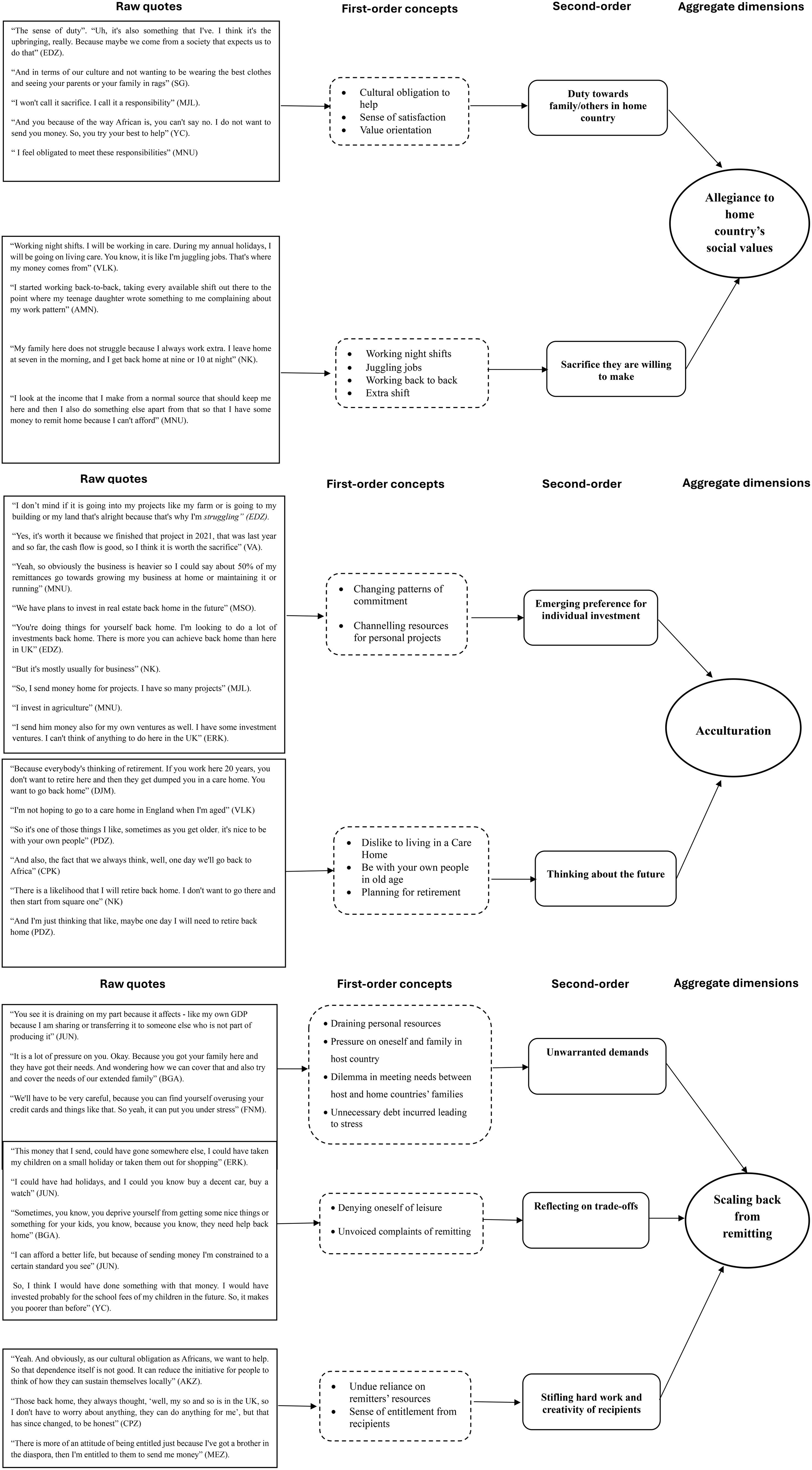
Data structure.
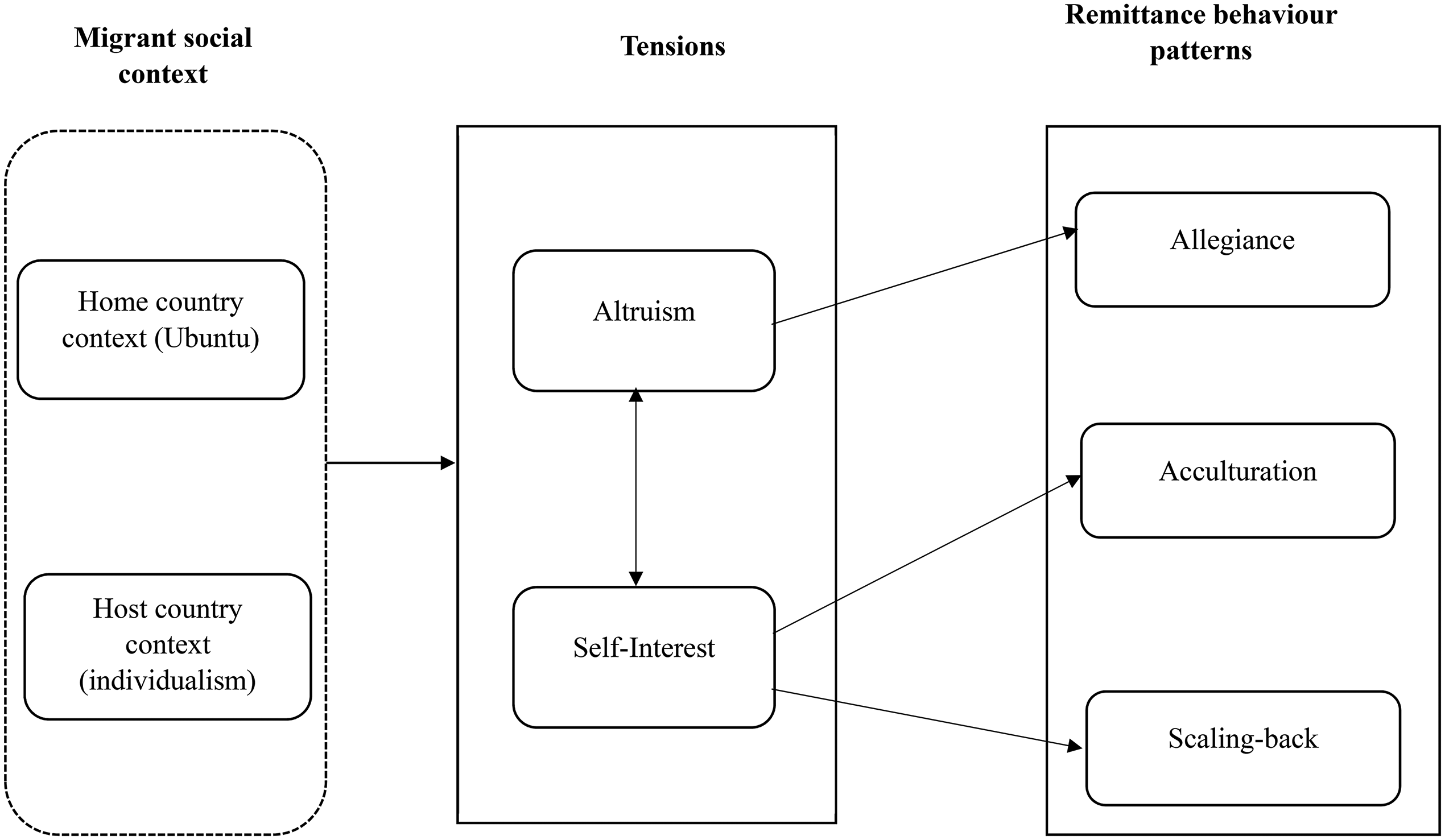
Remittance behavioral patterns framework for African migrants.
Allegiance to Home Country's Social Values
Most commonly, participants described how they found commitment to the Ubuntu philosophy rewarding. This was especially through duty towards family and others in their home country and the sacrifice they were willing to make.
Duty Toward Family/Others in Home Country
While we expected African migrants’ remittance behavior to be based on either altruism or self-interest, our participants emphasized that this was for altruistic motives based on the moral values of the Ubuntu philosophy. For instance, participants highlighted how having a “sense of duty” due to cultural obligation enabled them to send money home for altruistic motives instead of self-interest. For instance, with regards to supporting their parents, they unanimously considered it their obligation and a duty they embrace willingly. Consequently, sending money back home is regarded as a gesture of gratitude towards their parents, a method to demonstrate their care, and the ability to provide more now that they are in a “better” position financially. The sense of duty to what was expected of them is palpable in quotes like: And in terms of our culture, and not wanting to wear the best clothes and seeing your parents or your family in rags. (SG) If you want to look back, you know, you are possibly from Africa, and yeah, we always take certain responsibilities to be ours. And we would rather suffer the pain than if somebody else suffered the pain. You feel you are responsible, and as a result, you want to sacrifice to fulfil that responsibility. (CL) I mean, we Africans, we Nigerians especially and we kind of live in a very social communal setting. So, when you are overseas you have responsibilities back home to parents, relatives and friends who have needs. (MNUN)
These selected quotes and many more position the act of remitting as representing a sense of obligation, but also as an expression of continued deep emotional connection between them [migrants] and their immediate family, extended family, and friends. Interestingly, most participants were quick to state that the cultural obligation to help also meant that they had a social and moral duty to always think of the extended family and those they felt connected to and how they could uplift their standard of living. One participant noted that, “It’s a moral obligation. You know, because you already come from that community, you know, that’s what they need. So, yeah, it’s almost like a sense of duty” (PAN). They felt they had an obligation to help, especially older people in their communities, and contribute to their comfort, like one participant joyfully noted, “It actually gives you a warm glow effect. You feel better compensated by that feeling that you’re joining the effort to help. So that’s how I feel anyway” (ER).
In talking to participants of the study, it became clear how they feel about remitting. It is like they “owe” something to them [families in home country] and self, as one participant succinctly explained: “You feel like you owe it a duty both to God and your conscience to make a difference in somebody else's life” (MSO), and others felt they must explain themselves or negotiate should they fail to meet the obligations and expectations. To that end, one participant noted: I made it very clear to my family that for the next three months I need a little sabbatical from financial expenses and God being good, I have siblings who were able to shoulder that burden. (DZ)
This demonstrates a very strong sense of duty, one that undoubtedly places that responsibility over migrants even from a distance. Thus, sustaining the sense of belonging to families in their home country remains and continues to underpin the resources they remit.
Sacrifice They Are Willing to Make
Participants were not blind to the challenges of a sense of duty towards family/others in their home country. For some participants, the desire to be seen as fulfilling their obligations to family and friends through the distribution of financial resources drove them to juggle jobs, work back-to-back, pick extra shifts, and cut spending for family here in the United Kingdom. As VLK—a participant of a very high qualification attained here in the United Kingdom and with a full-time job that paid relatively well—pointed out: I have a full-time job, but I’ve got another side hustle that I will do on weekends; I will be working night shifts. I will be working in care. During my annual holidays, I will be going on living care. You know, it is like I’m juggling jobs. Yeah, yeah. That’s where my money comes from. (VLK)
Her dilemma reflects the double binds at stake, so that African migrants must negotiate their emotions and commitment to the “sense of duty” to remit money in order to help family and others in their home country. Another noted, “I started working back-to-back, taking every available shift out there” (AMN), yet another added; “My family here does not struggle because I always work extra. I leave home at seven in the morning, and I get back home at nine or 10 at night” (NK).
In this excerpt, although the participants reiterated the stress associated with a sense of duty, this stress does not so much detract from helping family and others in the home country. In another example, a participant pondered over the sacrifice she has to make to remit money home because she can’t afford it with her normal source of income: I look at the income that I make from a normal source that should keep me here and then I also do something else apart from that so that I have some money to remit home because I can't afford. (MNU)
What was interesting to note, however, was that, though participants stated that they were more than happy to extend the financial and/or material support, an underlying tone in the narratives pointed to the fact that most of these migrants were not remitting out of abundance or surplus but from a position of great personal sacrifice. Of greater interest, however, was that most participants, as if to contradict themselves, were of the view that the sacrifice was fulfilling and therefore happy and, in most cases, willing to make especially if it is for their parents and immediate family. Sharing resources they now have access to here in United Kingdom shows their continued allegiance to social values of caring and generosity, as one participant stated, “If I'm eating here, they need to eat too. If I'm having a life here, they need to have the life that I have too” (DBG).
To many participants, the extra things they are willing to engage in to have money to remit are dwarfed by the sense of being “human” and a duty they feel is theirs to fulfill even if it means they are taking up jobs and living lives often incommensurate with their level of education. Thus, even as allegiance to Ubuntu allowed African migrants to emphasize remittance behavior such as altruism, they noted the underlying sacrifice they have to make even at the expense of themselves and families.
Acculturation (Focusing on Self-Centric Belief System in the Host Country)
Emerging Preference for Individual Investment
Our findings show that while migrants are committed to the values orientation of their home countries, resulting in their strong sense of duty and responsibility, there are also strong indications to suggest that they are reconsidering their commitment. We noticed that most participants began to shift the focus from helping others and the wider community to talking about the money they were starting to remit for themselves. There seems to be a rising interest in facilitating individual investment over helping the “others.” For example, these excerpts are illustrative of how migrants are now engaging in productive personal projects: “I don’t mind if it [referring to money sent] is going into my projects like my farm or is going to my building or my land that’s alright because that’s why I’m struggling.” “You’re doing things for
Findings seem to indicate that over time the altruism tendencies as expressed in their eagerness to show allegiance are slowly dissipating as they learn to navigate their new society—the United Kingdom. This, however, does not mean that they stop remitting to support family and others, but there is a sense in which their prolonged stay here in the United Kingdom, these participants are starting to imbibe the United Kingdom Western notion of self-centric belief system (individualism) as further illustrated by the following quotes, with italics as their own emphasis. “So, I now mostly send money home for business or for my projects. I have so many projects” (MJL) and “I send him [my brother] money also for my own ventures as well. I have some investment ventures. I can't think of anything to do here in the UK.” (ERK), “I am investing in agriculture.” (MNU) and “I have switched to support my business back home, like 80% went into my business”. (VIG)
This notion of self-centeredness as described in the foregoing quotes as “I,” “my own,” “I have,” and “I am” largely eschews the community value-based orientation that is understood to mean the good of kinship or wider community supersedes the needs of the individual, including the one making the sacrifice. Based on the presented narratives, one would argue that a changing social-economic landscape is pointing towards higher levels of individualism and hence the increased focus on individual projects back home and for others, here in the United Kingdom.
Thinking About the Future
The emerging preference for self-interested motivations to remit or use money for oneself is based on several factors such as “dislike to living in a care home” here in the United Kingdom, “be with your own people [in Africa] in old age,” “planning for retirement” and “securing a future for myself and my children.” Nevertheless, it is important to point out that there was a divide in how participants attributed these factors to shaping their thoughts about their future. We noticed that for our participants, not wanting to be in a care home here in the United Kingdom and the nostalgia for being with “own” people in old age was driving them to seriously start planning for retirement and hence the increased focus on self. Because everybody is thinking of retirement. If you work here 20 years, you don’t want to retire here and then they get dumped in a care home. You want to go back home. (DJM) So, my projects definitely are to raise my personal standards back in Kenya, because I’m
Another added, “So, it's one of those things I like, sometimes as you get older, it’s nice to be with your own people” (PDZ). What we see here are the pull and push factors for some participants to think about the future. For instance, the idea of going to a care home in old age is a push factor for some and a rather foreign concept for most of the participants in our study. Participants joked about this “care home” arrangement as they contrasted it with the environments back in their home countries where communal living and care is the norm. Others considered the business opportunities in their home countries as a pull factor because with the money they earn and save in the United Kingdom a lot can be done to prepare for a comfortable retirement in their home countries. Although several other participants were still undecided about their future, they still wanted to position themselves in such a way that they were ready either to retire here in the United Kingdom or back home. When I’m older, I won’t have to suffer so much. This is what I’m trying to do. That’s how I look at it. There is a likelihood that I will retire back home. And I don’t want to go there and then start from square one. You know, that’s when you want to build your house and find some property and you want to settle down. And so, I do it along the way. But then, when I go there, I don’t want to do what I’m doing here [UK]. (NK)
These views are representative of many others who have come to a realization that no one but themselves will secure their future, and the time to start doing that is now. The implication of this realization is the increasing interest in self.
Scaling Back from Remitting to Others
Participants noted that remittance behavior is influenced by ongoing evaluation of sustainability vis-à-vis unwarranted demands for help and their reflection on the trade-offs of remitting. This set of themes emerged from deep introspection of their remittance experiences during the interview process in ways that were somewhat disturbing to them as they reflected on their experiences with us.
Unwarranted Demands for Help
Remittance behavior was based not on an absolute commitment to Ubuntu, but a complex negotiation of collectivism and individualism. Asking participants to further reflect on the sustainability of remitting money back to families within the context of African cultural values and those of the United Kingdom, it became clear then that participants were not completely at ease with the outflow and distribution of their resources. It appears most participants were finding it a challenge to maintain the pull or tension of the two realities—the expectation to “care for all” based on their early socialization in Africa and that of “individualism” in the United Kingdom. In most of Africa, your family is not just the nuclear family; it includes the extended family, for which you are expected to care for. So, when it comes to demands on migrants, the pressure is intense as they must be seen to be inclusive and supportive to remain true to their cultural values. However, participants were directly and indirectly beginning to question the logic of the expectations placed on them and the sense of duty they felt was theirs to help. One participant from Nigeria said that “because they think you’re abroad, the level of responsibility doubles. So, they just feel, you know, you’re living big, and the requests keep coming in” (MAU). In another instance, a participant lamented that he felt pressured meeting needs for his family in the United Kingdom and the home country. It is a lot of pressure on you. Okay. Because you have got your family here and they have got their needs. And wondering how we can cover that and also try and cover the needs of our extended family. (BGA)
Another stated that he was starting to resent this whole remitting business as it was draining his personal resources and taking away from his personal success. You see it is draining on my part because it affects - like my own GDP because I am sharing or transferring it to someone else who is not part of producing it. It is like me labouring on behalf of someone else who doesn’t participate. (JU)
The quotes above are indicative of migrants feeling the overwhelming demands of supporting very large numbers of people in their home countries. This feeling of unwarranted demands has been heightened by the dismal economic growth of the United Kingdom economy coupled with a high cost of living, forcing participants to rethink their “African generosity.” This means that the economic situation of these participants in the United Kingdom could in some instances make it is difficult for them to provide support for their family here and family/friends in Africa.
Thus, participants’ ongoing experiences of unwarranted demands for help and their collectivists or individualism approach to remittances blurs conventional commitment to Ubuntu, respectively, and foregrounds instead the ongoing tensions at stake. Their response to unwarranted demands for help occurred retrospectively, whereby migrants considered multiple incidences of these unwarranted demands for help; even as they acknowledged this orientation of caring for all was fluid and deeply contested.
Reflecting on the Trade-Offs of Remitting
Participants emphasized how, instead of an absolute commitment to Ubuntu, they constantly tussled with their commitment to Ubuntu. While participants alluded to having a sense of duty and therefore being “happy” to make the sacrifice, however, beneath this sentiment lies a deep and concerning reflection on the reasons why they are compelled to continuously deprive themselves of a certain level of comfort and quality of life that is in line with the positions they hold and the level of education they have attained. Participants pointed out that they engage in a form of “negotiation” when it comes to remittances, now more than ever, as they sense the need to reduce their commitments and concentrate on their own well-being and that of their family residing here in the United Kingdom. For example, a participant said that: I could have had holidays, and I could you know buy a decent car, buy a watch as
Participants in the above quotes are actively involved in a process of engaging in deep and introspective personal reflection regarding the money they remit, particularly in response to what they perceive as unwarranted or excessive requests. It is noteworthy to highlight that while it is deemed culturally acceptable and even expected for natives in the United Kingdom to indulge in “luxurious” purchases or to generously treat their loved ones to a memorable vacation experience, such actions would likely be met with disapproval and criticism by their (migrants) extended family members should they become aware of these choices, labeling them as overly individualistic or perhaps even selfish.
The findings of the study also uncover a profound sense of remorse experienced by migrants when they contemplate the realization that the burden of sacrifice extends beyond themselves to include their children. This introspective reflection sheds light on the multidimensional nature of the challenges faced by migrants, highlighting the interconnectedness of their experiences and the ripple effects that echo through their families. It underscores the complex web of responsibilities and decisions that migrants must navigate as they seek to carve out a better future for themselves and their loved ones, grappling with the weight of their choices (remittance) and the implications for future generations.
One participant exemplified this by saying “this money that I send, I could have gone somewhere else, I could have taken my children on a small holiday or taken them out for shopping” (ER). Others, while reflecting, termed this as deprivation by saying: Sometimes, you know, you deprive yourself from getting some nice things or something for your kids, you know, because you know, they need help back home. (BG) So most mostly
The society in which the offspring of migrants are raised exhibits stark contrasts with that of their parents, thereby giving rise to a set of anticipations from the younger generation that their parents would provide them with opportunities akin to those enjoyed by their peers, such as embarking on vacations. Consequently, a certain degree of dissatisfaction is emerging due to the harsh realization that as parents they have denied their children from engaging in extracurricular activities that are deemed crucial for their personal development as well as building their self-esteem.
What is evident here, therefore, is the challenge of balancing one's own personal ambition against the various cultural and societal expectations placed upon them. This delicate balancing act often leads to unexpressed conflicts and contemplations within oneself, which amounts to tension. The reason behind this lies in the fact that the act of remitting money back to one’s home country by most migrants necessitates a certain exchange or compromise, a notion that is currently undergoing scrutiny and re-evaluation by these migrants as highlighted in this study. Keeping this internal conflict and reflection in mind, a participant noted, “What exactly is wrong in spending money on yourself? No, there's absolutely nothing wrong, because you do deserve it obviously” (MOE). Thus, it results in unvoiced internal reflections among migrants.
Stifling Hard Work and Creativity of Recipients
With prolonged residence and assimilation/acculturation of British cultural norms, it is no surprise that participants are taking the courage to question their remittance behavior and the unintended consequences on the part of the recipients. There exists a sentiment among migrants that they have played a role in the emergence of this unwarranted dependence on their provisions, consequently engendering a sense of dependency and entitlement displayed by certain recipients. Several participants alluded to endless requests for support and assistance in paying for school fees, rent, food, weddings, funerals, and health treatment that come from siblings, parents, aunts, uncles, cousins, distant kin, and even friends. They felt that their open support over time has contributed to entrenching an attitude of being entitled to support from those in the diaspora, which they now realize is, in the long term, counterproductive for both sides. Yeah, and obviously, as our cultural obligation as Africans, we want to help. So that dependence itself is not good. It can reduce the initiative for people to think of how they can sustain themselves locally. (AKZ)
The notion of “sustaining themselves locally” is germane to a wider debate on bottom-up solutions to societal problems, and as such, migrants could here be starting to champion local creativity and ownership rather than an overreliance on external help or aid.
Other participants were concerned that their relatives were taking their support for granted and therefore making less hard work or striving hard enough to achieve for themselves. With ease of communication aided by technology, some migrants talked of experiencing a relentless flow of fictitious demands, leaving them overwhelmed. The quote below speaks to the increasing dependence and sustaining the unnecessary culture of dependency on the migrants. The migrants become their first point of call even for demands that might not be considered as needs, but they still make them sound real and urgent. Some relatives are becoming very unscrupulous even though they are sitting pretty, and they’ve got the means to do certain things. Because there is always someone who is a phone call away, someone who is a WhatsApp message away who can provide so they don’t do it for themselves. So yeah, like sometimes you are told a lot of things that have not even happened. (CLZ) So, people take you on a guilty trip, ‘saying no, but you are my brother. You know, you should help me’. But in reality, when you think about it, these guys are probably living a better life than you are living here, right? Yeah. They’re sitting in homes watching Premier League football and stuff like that. (EDZ)
Another perceptive participant went further to draw a contrast between the United Kingdom and their country, Malawi, yet a common set up for countries represented in the study. I think that’s our [African] way of life, isn’t it? And over here [UK], people don’t feel they are obliged to help anyone. Sometimes not even their children when they are of a certain age, then they have to take care of themselves. (FNM)
However, participants were quick to protect their parents from this dependency syndrome, as most believed, culturally, children must take the responsibility to look after their parents. This is so well illustrated by two participants who use different standpoints (culture and Christianity expectations) to justify their unquestionable support for parents: Culturally, it’s the youngest son that stays home and looks after the parents, and unfortunately, I left (Kenya) but I still bear the duty of looking after my parents. I am the youngest child, and as the youngest son, so, I have the obligation to look after my parents. (NK) For parents, you have to do it. Because if you’re a Christian like me, it’s a command to take care of your parents, and so you just want to attract that kind of blessing from time to time. (KN)
Other participants added; “If my parents need money for fertilizer, I’ve got to send, if my parents need money for fuel for their car. I’ve got to do it.” (ALZ), and “So, I am basically the only one here, it is sort of a responsibility for me, and I regularly must send money home to my mom. (MDON)
Having identified this dependency as not sustainable and a factor that stifles creativity for recipients to self-sustain, why then were they continuing to support unwarranted demands? The unexpected response from a participant summed it all up. “So, it's actually a mindset, it's a brainwashing, that's what has happened” (NK).
Findings suggest that most participants do not want to continue rationalizing the practice of dependency or unwarranted expectations together with a sense of entitlement that disables the drive to provide for oneself. They are caught in the middle of two relevant scenarios, and how they navigate that remains to be of interest.
Discussion
This study contributes to the body of literature that advocates for a more nuanced approach to remittance behavior—one that recognizes remittance as a tension-centered process of decision-making (Kpodar et al. 2023). Rather than purely decision-making, African migrants derived their remittance behavior in tensional ways from circumstances and factors that were both enabling and constraining, stemming from the sociocultural norms of Ubuntu. This is achieved through continuous negotiations involving allegiance, acculturation, and scaling back. African migrants’ remittance behavior was influenced by their allegiance to Ubuntu, which included duty towards family and others in their home country and the sacrifices they were willing to make. Meanwhile, participants assessed their acculturation to Ubuntu by looking at their growing preference for individual investment as well as their thinking of the future when they are not able to work again. Lastly, participants considered how scaling back on remitting money home shaped their behavior, especially due to unwarranted demands and their reflection on trade-offs, and the negative impact on recipients by stifling hard work and creativity. In each of these cases, remittance behavior was dynamic and contested, as participants thought back on their various remittance experiences and connected them to analyze the larger sociocultural African context and the macro narrative that resulted from their remittances. Finally, we discuss some important implications for future research on remittance behavior.
Contributions
First, our study aims to advance Ubuntu and remittance research by focusing on the intricate negotiation of remittance behavior. This remittance behavior is influenced by various factors, including individual decision-making processes, family dynamics, and situated and broader discourses (Song and Liang 2019; Mishra, Kondratjeva, and Shively 2022). The theoretical framework of the tension-centered approach allows us to investigate how negotiating remittance behavior is “messy” and complex (Trethewey and Ashcraft 2004), layered with opportunities and challenges that require decision-making (Lianos and Pseiridis 2014; Kpodar et al. 2023). This is achieved by migrants, who must shape (and reshape) their remittance behavior for various remittance motives to justify their remittance behavior (Lianos and Pseiridis 2014). Reflecting on their unique experiences, African migrants derived their remittance behavior from both the positive aspects of the Ubuntu philosophy and its negative constraints (Hoffmann and Metz 2017). These constraints affected or irritated them, and they were challenged to start reevaluating their motives for remittances (from altruism to self-interest) and altering their beliefs and commitment to the Ubuntu philosophy (Velayutham and Wise 2005; Baak 2015). For instance, while participants valued allegiance and commitment to the Ubuntu philosophy, which encourages them to send money home for charitable purposes and provides them with a sense of identity and solidarity that forms the basis of their sense of self (Agarwal and Horowitz 2002; Carling 2008; Shimada 2011), they were also aware of the fissures and paradoxes involved (e.g., unwarranted demands, the trade-offs, and the negative impact on stifling hard work and creativity of recipients).
Second, our study showed that participants’ decisions about their remittance behavior were influenced by their circumstances and were not fixed in place. As migrants made decisions to suit various motives at stake, their previous decisions about the reasons for their remittances were continually reviewed and adjusted by ongoing experiences (and vice versa). Therefore, even though some participants may have first embraced the Ubuntu philosophy and demonstrated a strong commitment in the hopes of acting purely altruistically, they soon came to the realization that the “reality” of sending money home based on altruism required them to start thinking about themselves and start prioritizing their own interests (Carling 2008, 2020). Nevertheless, rather than deciding to break free from their “ubuntuness” in remittance behavior, participants who actively encountered these constraints continually reevaluated their motives for remittance but demonstrated their commitment to Ubuntu—even when navigating challenging Ubuntu constraints. This was especially clear in the negotiations surrounding scaling back, such as in seeking to “help” family members, they have to deny themselves of leisure, drain personal resources, or even incur debt in order to fulfill their demands. However, it also had consequences for their ongoing commitment to the Ubuntu philosophy (i.e., African humanness) at large. Participants shared instances in which their passion or dedication to supporting friends and family back home was severely challenged, owing to undue reliance on their resources and sense of entitlement from recipients (e.g., friends or family members), yet their socioculturally imbibed duty towards helping family and others often bolstered this commitment at the end.
Third, our study traced the importance of sociocultural norms that influence African migrants’ remittance behavior, thereby connecting the individual and macro sociocultural contexts of remittance behavior. Participants actively linked remittance behavior with the ongoing tensions of the sociocultural norms, even as they sought to downplay the sociocultural influences in remittance behavior (Lianos and Pseiridis 2014; Ehwi, Maslova, and Asante 2021). A more nuanced appreciation of the influence of the host country context also emerged, especially in relation to the tensions inherent in dislike of living in a care home, wanting to be with their own people in old age, and stressing the importance of planning for retirement. In these situations, sociocultural norms of the host country (i.e., the United Kingdom) play an important constitutive role so that the “self-interest motive” of remittance behavior is privileged over the sociocultural norms of the home country (i.e., Ubuntu). That is, the sociocultural context of remittance behavior transcends home country influences on remittance motives to shape broader societal discourses and sociocultural norms, according to which participants had to align themselves (Agarwal and Horowitz 2002; Carling 2008; Shimada 2011). This study thus helps connect the sociocultural context of “home” and “host” countries so that how migrants decide their remittance behavior is inherently connected to the sociocultural contexts.
Finally, there are research and policy implications for our findings. On the one hand, remittance researchers seeking to understand the remittance behavior of migrants need to recognize and understand the sociocultural context of both the host and home countries of migrants. Our study provides a tension-centered approach to educate scholars alike on an important antecedent of African migrants’ remittance behavior emerging from their home and host country context. On the other hand, our study shows that African migrants’ remittance behavior might not always prioritize remittance as purely altruistic. African migrants have competing motives, and pursuing those motives may result in remittance behavior that is significantly different from that anticipated of non-African migrants (especially those from developed and non-African developing countries), where altruistic motives are less important. Our research provides scholars and policymakers with a lens for understanding African migrants’ remittance-related motives, which are often grounded in the Ubuntu philosophy.
Limitations and Future Research
Our research is not without limitations. Our findings are based on data collected from African migrants from only eight sub-Saharan African countries living in the United Kingdom. As per our inclusion criteria, we know that these migrants remit money back home. We looked for common patterns in the data, but since we only looked at migrants with strong ties back home, we were unable to discuss other motivations of remittances (Lucas and Stark 1985). Limiting the study to migrants from eight African countries may have limited the generalizability of our findings. We acknowledge that the categories we created and the interpretations we made represent analytical rather than statistical generalizations (Yin 2009); as a result, a useful way to improve generalizability would be to look at our framework across a larger range of migrants from several African countries that do not meet our inclusion requirements. This would enable broader perspectives on how the remittance behavior of African migrants is shaped by the Ubuntu philosophy. Moreover, our sample is not representative of African migrants in the United Kingdom, given that it mostly consists of highly skilled migrants. Based on our data, we suggest insights emerging from our study are contextual and can provide valuable ground for further testing to increase our depth of understanding and therefore encourage future research to address this limitation.
Despite these limitations, our study highlights important avenues for future research. One research avenue could be the development of longitudinal studies that explore how remittance behavior evolves as a migrant's Ubuntu philosophy changes over time. By offering insights into the remittance behavior of migrants at various times, such studies may be able to make further contributions. Our research also enriches the theoretical lens through which researchers can examine migrants’ remittances by suggesting that Ubuntu is a deliberate perspective for understanding African migrants’ remittance behavior. Ubuntu focuses on how an African migrant's decisions and behavior regarding remittances are influenced by the “collectivist aspect of existence” (Mkhize 2008). Although studies on the relationship between Ubuntu and remittances have been conducted, none of them use the tension-centered perspective as a lens. Thus, future research could adopt a tension-centered lens to explain other idiosyncratic behaviors of African migrants, such as choosing to invest strategically (at home versus in the host country), migration decisions after retirement (whether to return home or stay back in the host country), and family structures.
Lastly, future research can also focus on the variations among African migrants that clarify why, in spite of their Ubuntu values, some migrants are less likely to send money home than others. One explanation might be that they are second or third-generation migrants who do not have strong ties to their home country, but there could be other reasons, such as family conditions in which remittance is less needed or family constraints that inhibit remitting money back home. A related avenue for future research is the extent to which the remittance behavior patterns that African migrants exhibit reflect the remittance motive they adopt. It could be argued, for example, that both allegiance and altruism are consistent with remittance motives. By contrast, for African migrants to remit money home based on self-interest, an even longer time frame may be needed to shift their thinking about remittances.
Conclusion
Our study highlights the importance of sociocultural contexts in shaping the remittance behavior of African migrants. We contend that, given our limited understanding of African migrants’ remittance behavior, it can be problematic to overlook an important distinctiveness of African migrants: their Ubuntu values. Further theoretical and practical insights for the remittance literature can be obtained by developing a deeper understanding of the influence of sociocultural contexts on the remittance behavior of African migrants. We encourage researchers to carry out more work in this crucial area of study.
Footnotes
Declaration of Conflicting Interests
The authors declared no potential conflicts of interest with respect to the research, authorship, and/or publication of this article.
Funding
The authors disclosed receipt of the following financial support for the research, authorship, and/or publication of this article: This work was supported by the Nottingham Trent University (grant number Seed Corn fund).
