




Abstract
Lebanon has many migrant domestic workers, most of whom are women. While migrant domestic workers’ contracts prohibit pregnancy and childbearing, a substantial number of women give birth in Lebanon, and their children are at risk of statelessness. Through our examination of nationality laws and birth registration regulations, and their implementation in both Lebanon and migrants’ origin countries, this article offers an intersectional, gender analysis of conditions contributing to the risks of statelessness for such children. It seeks to contribute new insights into a seemingly intractable problem in Lebanon. Our investigation of laws and regulations is situated within a discussion of Lebanon's kafala system of migrant sponsorship that structures conditions under which migrant workers live. We triangulate our analysis by drawing on 13 semistructured interviews with key informants in Lebanon. We demonstrate that the risk of statelessness for children born to migrant domestic workers in Lebanon is enmeshed in a complex gendered and racialized conjunction of controls exercised over migrant domestic workers’ reproductive capacity, mobility, migration status, and right to pass on their nationality to their children. Based on this analysis, we identify potential strategies to secure citizenship for migrant domestic workers’ children at risk of statelessness. Our article makes analytical and empirical contributions to an emergent body of scholarship focusing on the growing phenomenon of childhood statelessness in “irregularized” migration contexts.
Introduction
Much of the research on the risks of statelessness in migratory contexts focuses on contexts of forced migration or displacement (Albarazi and van Waas 2016). However, the global rise in employment migration in recent decades (including forms of precarious and irregularized migration) has demanded attention to the risk of statelessness for children born in host countries to migrants who lack legal status (Petroziello 2019; van Waas 2007). States worldwide have generally been resistant to granting citizenship to the children of undocumented migrants, fearing that “anchor babies” could help secure parents’ legal status and serve as a pull factor for further immigration (Bhabha 2009, 449). The challenge of proving these children's connection to either the state of birth or the state of their parents’ nationality poses the risk of a “generation of stateless children” worldwide (van Waas 2007).
A small but growing body of scholarship on migrant women who give birth to children while working and living overseas provides rich empirical insights into the social, political, emotional, and moral dimensions of the lived experiences of such women and their children. For instance, Constable's (2014) ethnographic study of Filipina and Indonesian migrant domestic workers who have children while working in Hong Kong explores how these women are caught between the paradoxes of patriarchal moral expectations within both Hong Kong and their origin countries. Similarly, Mahdavi (2011) observes how emotional ties to children born overseas can “immobilize” migrant women and their children in the Gulf cities of Dubai, Abu Dhabi, and Kuwait City, while Petrozziello explores the indirect forms of gender discrimination (2018) and the gendered “bordering practices” of control (2019) over Haitian migrant women and their descendants in the Dominican Republic. We situate our article in this scholarship on migrant mothers and seek to contribute an analysis of the gendered and racialized dimensions of legal and bureaucratic frameworks and practices that contribute to the risk of statelessness among children born to migrant domestic workers in Lebanon.
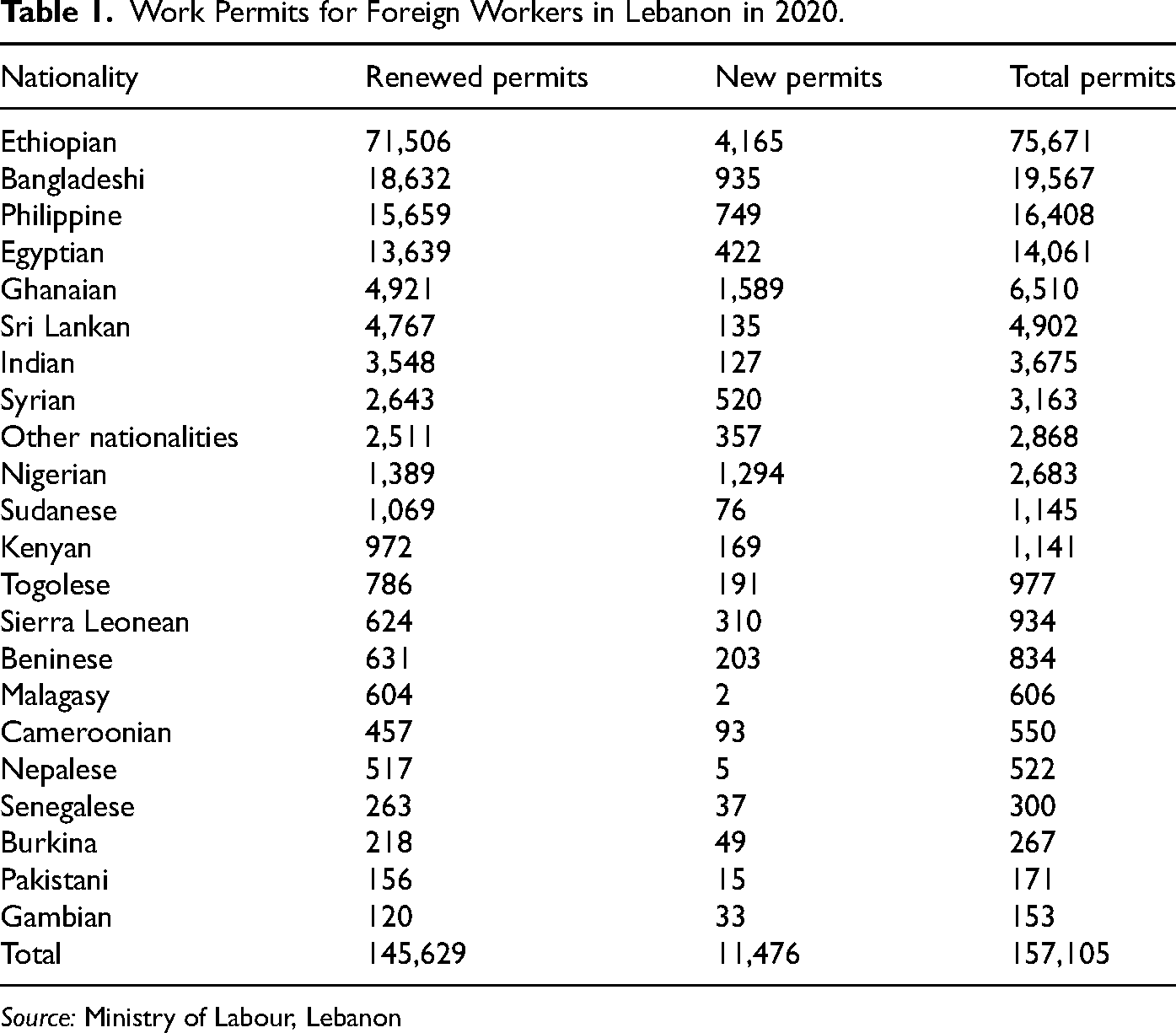
Since the late 1970s, Lebanon has hosted many migrant domestic workers, predominantly women (Moukarbel 2009; Pande 2013). During and after the civil war in Lebanon (1975–1990), Lebanese employers shifted from employing local women to migrant women since domestic work had become increasingly stigmatized for Lebanese workers, and since employers were also apprehensive about having “local” domestic workers in their homes, due to factional/sectarian politics (Jureidini 2009). Initially, in the 1970s, primarily Sri Lankan and Filipina women were employed as domestic workers; since the 1990s, they were joined by women from Ethiopia, Nepal, and Bangladesh (Fernandez 2014). According to the Lebanese Ministry of Labour, there were 157,105 documented foreign workers 1 in Lebanon in 2020 (see Table 1), fewer than the official total of 209,674 in 2015. This decline is attributable to Lebanon’s multiple political, economic, and coronavirus disease 2019 (COVID-19) crises since 2019. As a few of our interviewees observed, if the figures included undocumented workers, the number of domestic workers would be much higher.
Work Permits for Foreign Workers in Lebanon in 2020.
Source: Ministry of Labour, Lebanon
The employment contract domestic workers sign upon arrival explicitly prohibits them from becoming pregnant or having children (ILO 2012), although many women do give birth while in Lebanon (Insan 2015). The fathers may be Lebanese or other migrants (documented or undocumented) of Syrian, Egyptian, Bangladeshi, Sudanese, and other nationalities (Fernandez 2014). Unofficial estimates suggest that 5 percent of migrant domestic workers have children in Lebanon, and many of those children are at risk of statelessness (Fernandez 2017).
This article takes a cue from scholars of statelessness who contend that “citizenship is about more than citizenship law” (Redclift 2016, 112, see also Allerton 2017 and Bhabha 2011) and draws on gendered (Lee 2005) and intersectional feminist (Brennan 2019; Brennan, Murray and Petrozziello 2021) approaches to statelessness that look beyond the law. We argue that gender discriminatory provisions in nationality laws and birth registration regulations create risks of statelessness for children born overseas to migrant women. Our intersectional feminist analysis demonstrates how this risk of disenfranchisement is also produced through nonlegal, structural, and social inequalities. We argue that the risk of statelessness for children born to migrant domestic workers in Lebanon is enmeshed in a complex gendered and racialized conjunction of controls exercised over these women's reproductive capacity, mobility, migration status, and right to pass on their nationality to their children. This article is, first, a contribution to understandings the nexus between gendered and racialized citizenship in migratory contexts (see Constable 2014; Mahdavi 2011; Petrozziello 2019 generally; see Mikdashi 2022 on Lebanon). Second, we seek to contribute to the emergent structural and intersectional analyses of statelessness (Brennan, Murray and Petrozziello 2021).
To demonstrate our argument, the article proceeds in seven parts. First, we outline key concepts that suggest the importance of analyzing both legal and nonlegal factors contributing to the statelessness of children of migrants. The second section presents the research design and methods. The third section reviews legal and bureaucratic contexts and practices in Lebanon that constrain migrant women and their children, focusing on the kafala system for the sponsorship and management of migrant labor in Lebanon, Lebanese laws on nationality and citizenship, and birth registration procedures in Lebanon. In the fourth section, we analyze the nationality laws and birth registration procedures of Ethiopia, the Philippines, Bangladesh, and Nepal (countries with nationals working as migrant domestic workers in Lebanon) to identify the gaps that produce statelessness for their children born in Lebanon. The fifth section examines the socio-economic factors that exacerbate the risks of statelessness for migrants’ children. The sixth section documents some of the strategies deployed by migrant mothers in their quest to secure nationality for their children. To wrap up, the conclusion discusses this article's contributions to scholarship on gender, migration, and statelessness and the prospects for reform in Lebanon.
Understanding Childhood Statelessness
An emergent body of scholarship (see Bloom and Kingston 2021, and the recently established journal Statelessness and Citizenship Review) and the UNHCR's 10-year IBELONG campaign to end statelessness (2014–2024) have generated greater attention to statelessness in recent years, notwithstanding the relatively low number of states that signed the two Statelessness Conventions. 2 A stateless person is defined in the 1954 Convention as an individual “who is not considered a national by any State under the operation of its law.” 3 The right to nationality is enshrined as a human right in international law through Article 15 of the 1948 Universal Declaration of Human Rights, which states that “Everyone has the right to a nationality.”
The right to a nationality is also recognized as a child rights issue, explicitly articulated in Article 7 of the 1989 Convention on the Rights of the Child (CRC), which asserts the “right of every child to acquire a nationality and to be registered at birth” (OHCHR 1989). It is important to note that the CRC is the most universally ratified human rights treaty in the world. 4 The right to nationality for children has been described as a “cross-cutting” and “enabling right,” given its intersection with 41 other civil, political, social, economic, and cultural rights mentioned in the CRC (Vela 2017). Beyond the CRC, the issue of children's right to nationality has also been recognized in regional human rights frameworks (ISI 2017). Despite this strong and well-established rights-based discourse and despite significant global advocacy efforts to eradicate childhood statelessness, it remains a prevalent phenomenon across the world (UNHCR 2015). The United Nations Children's Fund (UNICEF 2021) estimates that globally, 237 million children under 5 years are not registered at birth and are at risk of statelessness.
Legal analysis of the limitations of nationality laws has been the dominant approach in efforts to eradicate childhood statelessness (Bhabha 2011). Within the legal approach, Stein (2016) acknowledges the importance of the CRC but notes that neither the Convention nor the Committee responsible for monitoring its implementation provides clear guidance on exactly what the right to acquire a nationality entails in practice. Focusing on implementation, de Groot (2014, 144) argues that “the pivotal juncture in guaranteeing a person's right to a nationality is the moment of birth,” stating further that if “a child does not secure a nationality at birth, he or she may be left stateless for many years, or even a lifetime—with severe consequences.”
Birth registration is, therefore, recognized by the UN Committee on the Rights of the Child as an important prerequisite for children's acquisition of nationality (OHCHR 2005). Since birth registration is undertaken by governments, it implies official approval, which “makes the birth certificate by far the most effective tool for ensuring that nationality is conferred on the child” (van Waas 2007, 447). The UN Committee on the Rights of the Child has explicitly stated that birth registration must be “available to all children—including asylum-seeking, refugee and migrant children—irrespective of their nationality, immigration status or statelessness” (OHCHR 2005, 6). Birth registration has even been integrated as a prominent target within the Sustainable Development Goals (United Nations 2015).
The contentious issue is whether a state has an obligation to provide nationality to children born to migrants residing in its territory. A UNHCR report that draws on consultation with stateless children and youth proposes that “in almost all cases of childhood statelessness, the best solution is to give children the nationality of the country they were born in and have lived all their lives” (UNHCR 2015). However, application of “jus soli” or birth-right citizenship, is often practically challenging for children of migrants whose status is perceived to be “irregular,” especially since public and/or political discourses in many countries frequently seek their parents’ expulsion (van Waas 2007). The pathway of jus sanguinis, or acquisition of the parents’ citizenship, is, therefore, often the only realistic option for children born to foreign migrants in most countries. However, even if children born overseas are entitled to jus sanguinis citizenship, they can still be at risk of statelessness due to bureaucratic and other barriers their parents may experience in registering their births (White 2009).
Beyond the laws, social and economic barriers can also undermine migrant parents’ access to birth registration, particularly for the children of undocumented migrants, as a few studies have shown (Mahdavi 2011; Petrozziello 2019). Extant legal scholarship tends to lack an intersectional analysis of such systemic barriers to birth registration and further, focuses on obstacles at the individual level such as parents’ awareness and attitudes rather than on structural obstacles, which can be considerable, as we demonstrate for Lebanon. In a study of the risks of statelessness for children of irregularized migrants, van Waas (2007, 452) highlights reasons for parents’ lack of awareness: “as non-nationals who may not speak the language of the host State, migrants are less well informed about the necessary requirements and procedures for obtaining birth registration.” Additionally, a lack of prioritization, financial barriers, time constraints, and limitations on freedom of movement may all influence parents’ failure to register their children at birth. Ensuring birth registration may also be incompatible with immigration rules; in particular, parents’ real or perceived fears of repercussions upon exposure to immigration authorities can be a disincentive for undocumented migrants to register the birth of children (van Waas 2007). Migrant parents who are undocumented may also avoid hospitals in the host country and/or lack the funds for hospital births (Petrozziello 2019). Children born through home birth (especially without a registered midwife) may, therefore, be at greater risk of statelessness because their birth may not be registered automatically (ibid.).
Drawing on the scholarship briefly summarized above, our article recognizes the importance of investigating both legal and non-legal factors that contribute to the risks of childhood statelessness in migratory contexts. We therefore complement our analysis of the legal contexts with an intersectional analysis of the social, economic and bureaucratic barriers migrant mothers face in securing nationality for their children born in Lebanon.
Research Design and Methods
The research design of this study comprised a legal review, literature review, and qualitative interviews to identify the conditions that produced the risk of statelessness for children of migrants in Lebanon. Drawing on a literature review, we analyzed how the regulations of the kafala and Lebanese laws related to nationality and birth registration produced gendered and racialized constraints on the status, mobility, and reproductive capacity of migrant domestic workers in Lebanon. Next, drawing on data extracted from the Global Nationality Laws Database (GNLD) (GLOBALCIT, n.d.), we examined the nationality laws of four origin countries of migrant domestic workers in Lebanon—Ethiopia, the Philippines, Bangladesh, and Nepal—to analyze the gendered constraints on the transfer of nationality by women to their children born overseas. We selected Ethiopia, the Philippines, and Bangladesh as countries with the largest numbers of migrant domestic workers in Lebanon (see Table 1). We also selected Nepal for closer scrutiny, as its gender-discriminatory nationality laws produce particularly problematic conditions for the relatively small numbers of Nepali women in Lebanon.
We triangulated the legal review with qualitative, semi-structured interviews with 13 key informants in Lebanon. We obtained ethics clearance for the interviews from the University of Melbourne's Human Research Ethics Committee. The positionality of authors Albarazi and McGee as fluent Arabic speakers with prior experience of conducting related research in Lebanon was vital to the successful organization of interviews in a challenging context. They identified interviewees through their professional networks in Lebanon and through direct contact. Interviewees included six staff from non-governmental organizations (NGOs) working closely with migrant domestic workers, three representatives from migrant worker organizations, two from embassies of migrant workers’ origin countries, one from the International Labour Organization (Beirut), and a Lebanese journalist. As this sample was small and as some participants did not want to be identified, we use the generic term “Interviewee,” along with a number when referring to them.
The prevailing context of multiple crises (political, economic, and COVID-19) in Lebanon at the time of interviews in 2020–21, exacerbated by the impact of the Beirut Port explosion in August 2020, meant that although interviews were originally planned in-person, they had to be conducted via Zoom and phone. In this challenging research context, some potential interviewees were uncontactable or declined, as they were prioritizing their crisis response work or were uncomfortable with remote interviews. A limitation of this study is that we were unable to secure interviews with Lebanese government representatives from either the Ministry of Labour and Social Affairs or the General Directorate of General Security (GDGS), which regulates migrants in Lebanon. A further limitation is the absence of interviews with the migrant mothers of children at risk of statelessness; we could not seek such interviews, given the prevalent crisis context and the difficulty of conducting such interviews remotely. However, we draw on a review of secondary literature (NGO reports, media, and academic articles) to triangulate and support our analysis. Notwithstanding the limitations, the interviews generated rich empirical insights on the laws and regulations, the variance between laws and their implementation, the challenges facing children of migrant workers at risk of statelessness, and potential pathways to redressing their situation.
Legal and Bureaucratic Contexts in Lebanon
In this section, we first demonstrate how the kafala authorizes patriarchal controls over migrant women's mobility and reproductive capacity, which produces and perpetuates irregular status amongst migrant domestic workers. We argue that their irregular status is, in turn, a key factor underpinning the risk of statelessness for their children. We then discuss gender discrimination in Lebanese nationality laws and birth registration procedures that further contribute to the risk of statelessness for such children.
The Kafala in Lebanon
The kafala is the system of administrative regulations and practices governing migrant workers in Lebanon (Fernandez 2014; Pande 2013). As Interviewee 12 noted, the kafala is not a single law but a mixture of ministerial decrees, ministerial memos, and regulations. Each migrant worker must have a kafeel – a Lebanese citizen who acts as their sponsor and is responsible for processing their iqama (residence permit, issued by GDGS), as well as their ijazet amal (work permit, issued by the Ministry of Labour). The kafeel is, therefore, both residence sponsor and employer and ties the migrant worker's residence status to their employment contract, giving the kafeel considerable power over the migrant worker's mobility. The kafeel is legally required to pay for the migrant worker's repatriation at the end of the contract period (Pande 2013). Crucially, if the employment contract is terminated by either party, the migrant worker's residence permit is automatically invalidated and s/he is required to exit the country (ibid.). If a migrant worker wants to leave the country, s/he must obtain permission from the kafeel (ibid.). Moreover, an illegal but normalized practice of kafeels is to confiscate the migrant domestic worker's passport and iqama documents as a mechanism of mobility control to prevent them from running away (ibid.). While these controls over mobility are applicable to both men and women migrant workers, there is a gender-specific intensification of controls over migrant women employed as domestic workers, since they reside in the kafeel's home (Fernandez 2014).
Migrant domestic workers’ mobility is further constrained by their conditions of employment. Although the Standard Unified Contract which regulates the terms and conditions of employment of migrant domestic workers in Lebanon stipulates the salary, maximum weekly hours of work, annual and sick leaves, and health insurance, it is well documented that many kafeels breach these conditions (Human Rights Watch 2010; Moukarbel 2009; Pande 2013). Migrant domestic workers have limited recourse to legal protections from such contract breaches, as they are explicitly excluded from the jurisdiction of labor law in Lebanon, as specified in Article 7 of the Lebanese Labour Code (Argus 2010; Kerbage and Essim 2011, 22). As several reports on migrant domestic workers in Lebanon show, many women find themselves in exploitative employment situations or subject to gender-based violence (Human Rights Watch 2010; Lilian Diab et al. 2022; Mansour-Ille and Hendow 2018). In such situations, migrant domestic workers have limited options, as they cannot change employers unless the kafeel signs a release waiver (Fernandez 2020). Although “running away” from the kafeel is often the migrant domestic worker's only option, it automatically invalidates her residence permit and irregularizes her status (Fernandez 2020; Pande 2013).
Migrant domestic workers who “run away” may seek to “regularize” their status by negotiating with the kafeel to transfer their iqama to another kafeel or to let them work “freelance” for other employers (Fernandez 2020; Johnson 2012). Although “freelance” arrangements are common and give workers greater freedom of mobility and employment, such arrangements are technically illegal, as migrant workers are supposed to only be employed by their sponsor (ibid.). Freelance arrangements usually come at a steep cost, where women pay the kafeel a commission two or three times the actual cost of the iqama to remain a sponsor “on paper” (Fernandez 2020). Women who “run away” and cannot pay the price to become “freelancers” remain undocumented and at risk of being stopped by the police, put in detention, and deported (ibid.). The longer they remain undocumented, the larger the fine they would have to pay to exit the country (ibid.). These structural constraints result in many migrant women becoming “irregularized” in Lebanon (ibid.).
Importantly, the kafala also imposes restrictions on migrant women's reproductive capacity through a strict “No Pregnancy Policy,” even though this policy is gender discriminatory and in contravention of General Recommendation 26 issued by the Committee for the Elimination of Discrimination against Women (CEDAW 2008). Migrant women are expected to undertake pregnancy tests before and after arrival in Lebanon, and pregnancy provides grounds for immediate repatriation, as explained in an Information Guide prepared by the Lebanese Ministry of Labour in coordination with the International Labour Organization (ILO 2012, 22). When migrant domestic workers do become pregnant, either due to voluntary relationships or following rape, fear of repatriation can compel them to “run away” from their employers, automatically irregularizing their residence status.
The irregularized status of migrants who become pregnant and give birth to children in Lebanon heightens the invisibility of their children within Lebanese government systems. The case of Priyha, a Sri Lankan migrant domestic worker whose situation was documented by the Catholic NGO Caritas in Lebanon, highlights the risks of statelessness for the children of these workers (Caritas 2014). Priyha arrived in Lebanon on a contract in 1999 but ran away from her employer after suffering abuse and harassment. She met Samir, a Sudanese national in 2000, and they were married shortly after by an Islamic Sheikh. As neither Priyha nor Samir had residence permits, their marriage could not be officially registered. Without a marriage certificate, Priyha and Samir could only register the births of their four sons with the local mayor, but not at the foreign birth registry at the Ministry of Interior. Their children were, thus, unable to attend local public schools, due to the family's lack of residence permits. Nor could the family exit Lebanon, since they had been there over a decade without residence permits and could not afford the accumulated fines.
The kafala must also be understood as a racially stratified occupational hierarchy of migrant workers who are explicitly and permanently excluded from claims to nationality and citizenship (Fernandez 2021). Like other countries in the Middle East with the kafala system, Lebanon has no legal pathways for migrants to settle (ibid.). Importantly, as noncitizens, migrant workers in Lebanon are excluded from the rights of citizens to organize (Mansour-Ille and Hendow 2018), and as noted above, these exclusions are further gendered in that women migrant domestic workers are denied the protections of Lebanese labor law.
We see, therefore, that the institution of the kafala produces gendered and racialized constraints on migrant domestic workers and that these constraints become intensified for a woman who gives birth while in Lebanon. In a cascading series of consequences, the women's resultant irregularized status makes it difficult for marriages and births to be registered and, therefore, for children to access education and health services, ultimately posing challenges for the mother and child to exit Lebanon. As we discuss below, this situation becomes even more complex, and risks of statelessness exacerbated, when combined with gaps and gender discriminatory provisions in the laws on nationality and regulations on birth registration.
Lebanese Laws on Nationality Relevant to Migrant Workers’ Children
Research on stateless children born to labor migrants has been overshadowed in Lebanon by the complex political context of a population of between 80,000 and 2000,000 stateless people of Lebanese origin (Frontiers Ruwad 2009), as well as a long-term resident population of stateless Palestinian refugees, and a relatively recent population of nearly 1 million Syrian refugees. Although Lebanon is a party to international law instruments that include potentially important protections relevant to children at risk of statelessness, 5 the country's own laws (and their implementation in practice) are highly problematic and fail to ensure the rights of such children.
The first regulation of Lebanese nationality through Decree 15 in 1925 left many people (and their descendants) out of the country's original body of citizens, and subsequently, Lebanese laws on the acquisition of nationality and citizenship have been politically contested but largely unchanged, despite several amendments (Parolin 2009). Moreover, Lebanon has not ratified the 1954 or the 1961 Conventions on Statelessness, and there is no institution officially responsible for stateless persons in the country, nor any legally recognized status for “stateless persons” to correspond with internationally recognized rights. While it is beyond the scope of this article to discuss the broader contours of political contestations around statelessness in Lebanon, here, we analyze specific aspects of Lebanese nationality laws of relevance to children born to migrant workers.
First, Lebanon's nationality law of 1925 is deeply discriminatory to women, since it follows a principle of paternal jus sanguinis nationality, 6 with a few important implications. While the law allows foreign spouses of Lebanese men to obtain Lebanese citizenship, this right is denied to foreign spouses of Lebanese women (van Waas 2014). Crucially, Lebanese nationality law grants Lebanese citizenship only to children born to a Lebanese father (ibid.). There is an exception to this law when the father is unknown, but this proviso is rarely implemented in practice (Frontiers Ruwad 2009). Further, there is a risk of statelessness for the children of male migrants and Lebanese women, since the children of Lebanese mothers do not have an automatic right to Lebanese citizenship.
Despite these gender discriminatory provisions, Lebanon's nationality law also states that any child who is born on Lebanese territory and would otherwise not acquire any other nationality at birth should be considered a Lebanese citizen. While this guarantee could potentially be used to protect the children of migrant domestic workers from being stateless (Frontiers Ruwad 2009) in practice, it has not been implemented as a safeguard against statelessness. Moreover, racialized social conceptions of who is “Lebanese” (see Ataman 2015) undermine the potential for implementation of such a safeguard especially if an abandoned or orphaned child of migrant workers does not “look Lebanese” to officials at GDGS. For example, Interviewee 11 recounted the exceptional case of a young man in Lebanon who was the son of a Sri Lankan mother and Nigerian father and was abandoned when he was six when both parents left Lebanon. Without identity documents from either the Nigerian or Sri Lankan embassies, the only document he had was from UNHCR recognizing him as stateless. While the potentially positive legal provision noted above could allow the Lebanese state to lawfully grant this young man nationality, it did not do so, despite NGO advocacy efforts on his behalf.
The preceding assessment of how Lebanon's nationality law functions in practice shows little scope for the children of migrant workers born in the country to acquire Lebanese nationality, even in the case that they fail to acquire the citizenship of either parent through the jus sanguinis principle of nationality transfer. The barriers to granting nationality to such children are not only legal, but also informed by patriarchal social values.
Birth Registration of Migrants’ Children in Lebanon
Lebanon has complex administrative procedures for registering births, and as several of our interviewees noted, these procedures can be significant obstacles to the acquisition of nationality for children born to migrant domestic workers. Underlying birth registration regulations are patriarchal norms on marriage that penalize unwed parents (even if they are citizens) for “non-marital” children born out of wedlock.
Migrants can apply at the special registry for foreigners for an official birth certificate (wathiqat al-wilade), issued by local mukhtars (mayors) (Interviewee 10). If the application is not made within one year of the child's birth, a court order, DNA test, and the support of a lawyer are required to process the birth certificate (ibid.). The primary challenge migrant mothers face in applying for a birth certificate is to produce a valid residence permit, a birth notification (shahadet al-wilade) from the hospital, and a marriage certificate (ibid.). Below, we examine the extent of difficulty in obtaining each of these three documents.
As noted earlier, many migrant domestic workers who become pregnant leave their employers and are unlikely to have valid residence or work permits, unless they managed to re-negotiate with their kafeel to transfer their sponsorship and/or work as “freelancers.” A 2011 child rights report notes that children born to migrant domestic workers who outstayed their residence permits usually do not have birth registration papers (Manara Network 2011, 48). Similarly, a survey conducted by a child rights organization found that while all Lebanese children were registered, 10 percent of children born to documented migrants and 63 percent of children born to undocumented migrants were not registered (Insan 2014).
According to several interviewees, obtaining a birth notification signed by the doctor/gynaecologist in Lebanon is relatively straightforward if parents pay the hospital/birth fees. Interviewee 6 noted that prior to the Syrian refugee crisis, if a migrant domestic worker was unable to pay the hospital fees, the hospital would sometimes give the notification free of charge. In recent years, however, Interviewee 6 stated, private hospitals can no longer afford such charity, and demand payment of fees before issuing a birth notification. As noted by Interviewee 8, some migrant domestic workers give birth at home, using a “doula” or a local midwife, and, therefore, do not receive a birth notification from a hospital.
Under Lebanese laws, registration of a civil marriage between foreigners is not allowed, making obtaining a marriage certificate difficult for inter-faith couples. However, two foreigners can enter a religious marriage, usually officiated by an Islamic Sheikh (Fernandez 2017). Migrant domestic workers who marry men of Sudanese, Egyptian, or Syrian nationality often have their marriages officiated this way (ibid.). Marriage certificates are possible for women who marry Lebanese men, but these couples must register with the Lebanese civil status registry office to be able subsequently to register the birth of their children (Interviewee 10). Note that patriarchal norms make the marriage certificate a compulsory requirement for birth registration, which is a problem if the woman does not want to marry the child's father (particularly in cases of rape) or if the man denies he is the biological father and refuses to marry the migrant woman.
There are additional obstacles to the registration of children of migrants in Lebanon beyond the regulatory requirements. First, there are language, cost, and time barriers. Registration documents are in Arabic, and the cumulative fees are often out of reach for migrant domestic workers. As Interviewee 8 stressed, the strict limitation on having to register within one year of the child's birth means that if the child is older, the parents would need a lawyer's intervention, which a migrant worker would likely be unable to afford.
Second, it should be noted that the mukhtars responsible for birth registrations are allowed a substantial degree of discretion within the 1951 Lebanese Law on the Registration of Personal Status. This discretionary power can sometimes work in favor of migrant women, as noted by Interviewee 10 and 13, when some mukhtars are flexible and allow the birth registration process based on statements from three witnesses (for example, two Lebanese citizens, and one representative from the migrant woman's community). However, the mukhtar's discretionary power is also open to gender discrimination and racial bias. As Interviewee 8 observed, in locations outside Beirut, mukhtars may be less accommodating to a migrant woman and refuse to register her child unless she presents her passport and/or iqama, or, alternately, they may require the presence/approval of the kafeel, who, as noted above, has often confiscated these documents.
Third, strong patriarchal and racist norms inform the widely held public and policy perspective that migrant domestic workers are in Lebanon solely to work, not to have a social life, have partners, get married, or have children (Interviewee 6). In 2014, Public Notice No. 1778 (Ministry of Justice 2014) issued instructions to public notaries asking for the addition of a clause to the responsibilities of Lebanese kafeels that disallowed any migrant worker to be married to or have relationship ties to any person residing on Lebanese territories. A kafeel who discovered a marriage was expected to notify GDGS. However, the Ministry of Justice overturned this directive in July 2015, due to lobbying pressure from civil-society stakeholders and the media (Obeid 2015). Around the same time, GDGS also began obstructing the renewal of residence permits for children of migrant workers (Insan 2015). Until 2014, if a child's father was a documented migrant worker and the parents had marriage documents, the child could be registered for residency permits with GDGS (ibid.). The renewal of residency permits for children below four years old was permitted without cost, and after four years, extensions were dependent on school enrollment (ibid.). Although GDGS did not publicly issue any policy directive regarding nonrenewal of residence permits for children, civil-society organizations noticed that nonrenewal of permits began to systematically happen in 2014, even when both parents were documented migrants and did not have previous problems registering their children.
We demonstrated above how the compounding patriarchal and racist constraints within Lebanon's legal context put children of migrant workers at risk of statelessness. Since the implementation of Lebanon's nationality law does not follow the birthright citizenship principle of nationality acquisition, migrant workers’ ability to obtain a birth certificate for their child is vital to securing the child's nationality documents from their origin country, as we discuss below.
Legal Contexts of Migrants’ Origin Countries
This section reviews nationality laws and birth registration procedures of Ethiopia, the Philippines, Bangladesh, and Nepal, four origin countries for migrant domestic workers in Lebanon. The objective here is to understand whether children born overseas to women of these nationalities can secure their mother's nationality. We first undertake a legal review of the nationality laws and then discuss the birth registration procedures for children born to nationals of these countries. We also explore the gaps in implementation of nationality laws and birth registration procedures, since, even if laws and procedures provide rights to legal citizenship, the discretionary power of officials may affect women's ability to access such rights for their children.
Nationality Laws of Migrants’ Origin Countries
Drawing on data from the GNLD, we analyze jus sanguinis acquisition of nationality, as this process is relevant to the circumstances of migrant domestic workers whose children were born in Lebanon. Our analysis acknowledges the importance of Lee's (2005: 121–2) critique of the paternal jus sanguinis principle as a “patriarchal imperative of citizenship” that protects the male bloodline, as is the case in the context of Nepal. As a preamble, it is important to note that for children born within the territory of Ethiopia, the Philippines, and Bangladesh, acquisition of nationality takes place “without discretion” (i.e., automatically), requiring no action by the parent/s and with no scope for official intervention. Another important factor is whether the transfer of nationality is equal for both parents. The gender-discriminatory provisions of Nepali law mean that Nepali mothers face more obstacles to transfer their nationality to their children, even if they are born within Nepal.
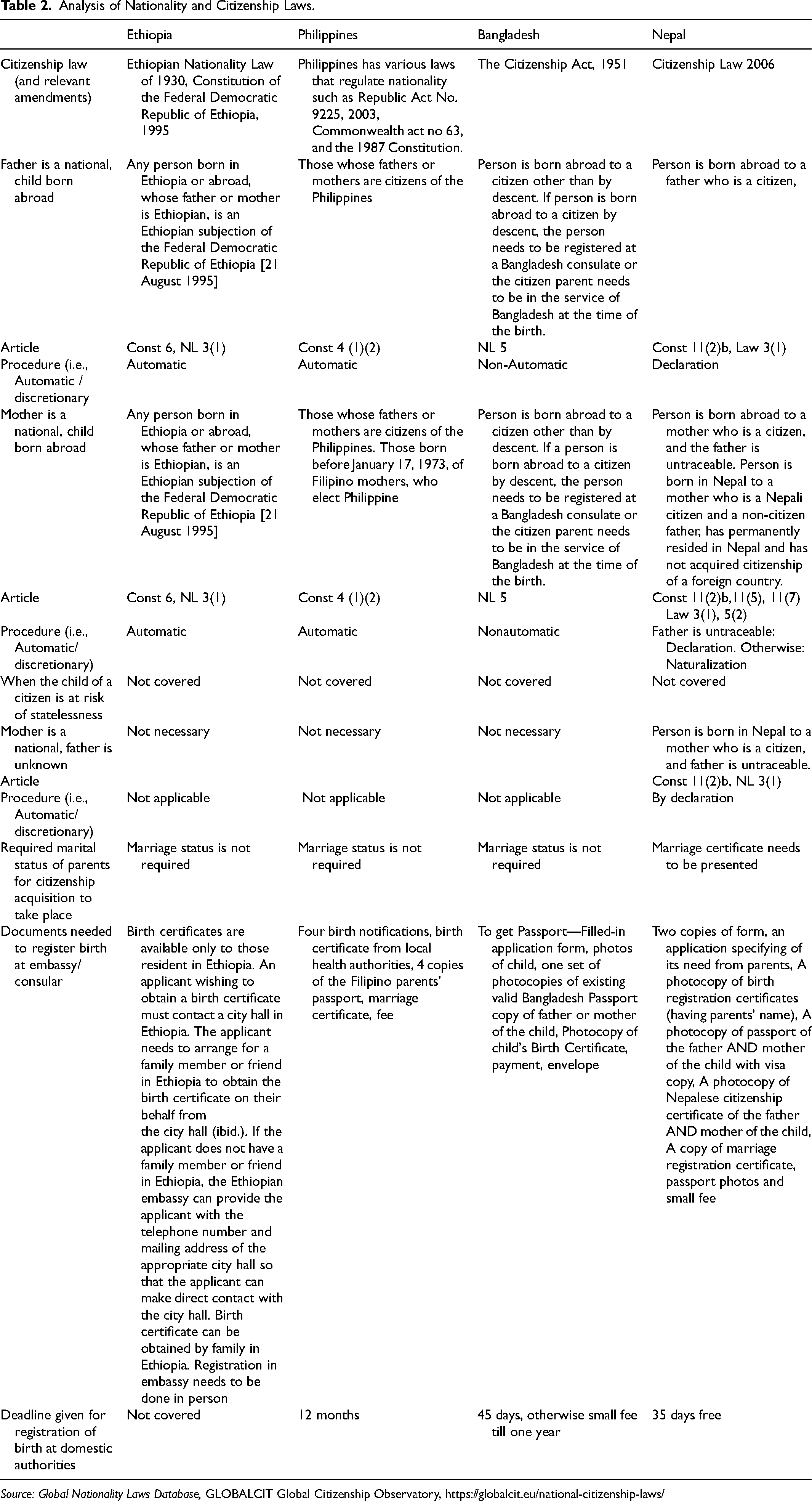
Table 2 focuses on the laws when a child is born outside the territory, identifying the variations when the father and the mother are nationals. Ethiopia and the Philippines are the two countries where the acquisition of nationality for children born abroad—to either a citizen father or mother—is automatic. In theory, children born abroad would be Ethiopian or Filipino citizens, without any action needing to be taken by their parents. The laws of Nepal and Bangladesh outline steps parents should take to ensure that their child acquires the state's nationality when born abroad. These steps tie confirmation of citizenship to the registration of the child at the respective state's authorities overseas. For nationals of these two countries, there is a significant concern that if a child's mother is unable to follow the required processes to register her child born overseas, the child will not acquire her nationality. Although the procedures to ensure that the child acquires the mother's nationality may be clear, as we go on to show, there are multiple reasons why these procedures may be a challenging and perhaps inaccessible process for migrant women in Lebanon.
Analysis of Nationality and Citizenship Laws.
Source: Global Nationality Laws Database, GLOBALCIT Global Citizenship Observatory, https://globalcit.eu/national-citizenship-laws/
The gender discrimination a Nepali woman faces in transferring nationality to children born within Nepal also creates challenges for her to transfer nationality to her children born overseas. Nepali law states that a child can get citizenship when a “person is born abroad to a mother who is a citizen, and the father is untraceable.” However, owing to recent amendments to Nepal's Citizenship Act 2006, including the introduction of punitive action against the mother if the father is found to be a foreigner, the government's attitude toward providing citizenship to single mothers remains hostile (Ghimire 2022). This recent amendment highlights the patriarchal norms that inform citizenship law in Nepal.
The acquisition of nationality for children of migrants may be simpler if the mother's country allows dual nationality (according to Interviewee 11). In principle, since the Philippines’ law is explicit in permitting dual citizenship, citizenship can be conferred on children of migrants without any consideration of whether the child will be a single or dual national; however, as Constable (2014) observes, in practice, it is often difficult for Filipina women to access birth registration for their children born overseas. Since Ethiopia does not allow dual nationality under any conditions, the Ethiopian embassy requires confirmation that the child does not possess any other citizenship (Interviewee 11). Ambiguity around access to another citizenship through a foreign father, therefore, problematizes conferral of Ethiopian citizenship, as the child may have the right to access another citizenship even if this right has not been, and might never be, secured.
Birth Registration Procedures for Migrants’ Children Born Overseas
All four countries have some consular assistance available in Lebanon where their nationals can register a child born in Lebanon (at least in principle). However, the level of consular representation can impact access to services, including confirmation of citizenship. While the Philippines and Bangladesh have embassies in Lebanon, Ethiopia only has a Consulate, and Nepal only has an Honorary Consul (the Nepalese embassy in Egypt provides consular services).
Drawing on data from the GNLD for each of the four countries, Table 2 summarizes the procedures to register a child at the embassy/consulate, the documents needed for birth registration, and the deadline for birth registrations. Crucially, all countries except Ethiopia require a birth certificate issued by the country where the birth occurred. If the parent is unable to provide a birth certificate (because they do not possess pre-requisite documents or because it is too burdensome and costly), they may be unable to register their child's birth at their embassies. From the written procedures, it is unclear what an alternative process would be if the parent cannot provide a birth certificate.
Ethiopian nationality law does not require their citizens to register the child's birth according to the regulations of the overseas country they reside in, instead, they need to register the birth in Ethiopia. To register the child's birth in Ethiopia (even if the child is born overseas), the parents need a hospital birth notification, a court document confirming parentage, or a baptismal certificate, and an acknowledgment from their “kebele” (local government authority in Ethiopia). Notably, Ethiopian nationality law does not stipulate a time limit to complete this process, nor do parents have to register the birth in person (they could ask a family member to complete the process in their absence). These provisions allow parents greater flexibility in registering their children born overseas.
Examination of the nationality laws in the GNLD shows that Ethiopia and Bangladesh do not require a marriage certificate to register children born overseas. However, nationals of the Philippines and Nepal do need a marriage certificate to register their children overseas. In the case of Nepal, this requirement is unsurprising, given gender discrimination in the transfer of nationality from mothers. Official procedures are unclear when nationals of Nepal and the Philippines cannot present a marriage certificate to embassies, thus creating a barrier to the registration of children born overseas.
The GNLD also documents deadlines for registering a birth at an embassy without penalty, which are usually stipulated to prevent parents from neglecting the task. For the Philippines, the deadline for birth registration is one year from the child's birth. Bangladeshi parents have 45 days, and Nepali parents have 35 days to register births. When a parent misses the deadline, they face additional procedures to register their child (e.g., fines or needing to take the case to court). These penalties constitute obstacles to birth registration, especially for families living in foreign countries. Ethiopia is the exception, as there is no deadline for the birth registration of a child born outside the country, which provides parents with some leeway.
The preceding analysis of the legal and procedural contexts of migrant-origin countries demonstrates multiple and gendered constraints in nationality laws and birth registration regulations that can create significant barriers to acquiring nationality for migrants’ children born overseas. However, it is also clear that the automatic acquisition of nationality (in the case of Ethiopia and the Philippines) and flexible birth registration procedures (in the case of Ethiopia), if implemented and recognized correctly, would be best practice in ensuring that children of migrant domestic workers are not born stateless.
Non-Legal Factors Exacerbating the Risk of Statelessness
Additional factors that can exacerbate the situation are the awareness and capacity of the migrant woman herself, patriarchal norms, and access to consular assistance, each of which is discussed below, drawing on insights from key informant interviews.
First, migrant domestic workers may have widely varying levels of awareness, skills, and capacities to negotiate the complex laws and regulatory procedures described above. As noted by some interviewees, most migrant women generally lacked awareness about their rights. They also lacked knowledge of relevant laws and procedures when they have children in Lebanon. They may be unaware, for instance, of birth registration processes and requirements—whether with the Lebanese authorities or their embassies. Moreover, while the majority were literate in their own languages, they were unlikely to have more than secondary education. Often, navigation of these processes requires language skills in Arabic or English or a translator's support. Migrant women were often also constrained by fear instilled in them by the kafeel and/or employment agent, who used scare tactics to keep them compliant; consequently, when women needed to approach authorities to get certain documents or to register their child, this fear may have paralyzed them.
Patriarchal norms in Lebanon can complicate women's access to citizenship for their children. As noted previously, nationality laws in Lebanon privilege men. Accordingly, mothers do not have the right to make autonomous decisions regarding their children. Patriarchal norms are most frequently observed when the father of a migrant woman's child is Lebanese and unwilling to marry the mother or acknowledge the child as his own. Interviewee 10 noted that it was difficult for the mother to complete the birth registration process independently if the father's name was mentioned in the hospital birth notification, as the mukhtar would generally ask for the father's presence. The father may refuse to acknowledge the child or obstruct the child's birth registration, as illustrated in a narrative by Interviewee 6 about the child born to a Nepali woman and male Lebanese soldier who refused to recognize the child as his. The mother sought support from an NGO to establish the child's paternity. Since the father was a soldier, the legal aid team was forced to go through the Military Court rather than the regular court system. The Military Court prevented access to a DNA test, rendering the child at risk of statelessness. Therefore, patriarchal norms were not simply manifested in individual Lebanese men's actions (here, refusal to recognize paternity) but can often be institutionally mandated and reinforced. Patriarchal norms similarly underlie the requirement that the father must permit the child to exit the country with the mother.
Access to consular assistance also constrains migrant women from registering their child's birth. Not all migrants’ countries had the appropriate embassy support in Lebanon. For instance, Interviewee 6 mentioned that Ghana, Gabon, and Kenya (countries with few migrants in Lebanon) had no embassy or consulate. He also observed that migrants from countries such as Nepal, with only an Honorary Consulate in Lebanon, did not have access to the same level of services as those with Embassies. Further, Honorary Consulates often employed local Lebanese staff part-time, who might be more dismissive of migrant workers. Lack of adequate support from an embassy and/or (honorary) consulate could exacerbate nonregistration of births and subsequent risks of statelessness.
Even if an embassy was present in Lebanon, as Interviewee 2 pointed out, migrant domestic workers may be unable or unwilling to access its services. They may be unaware of the embassy location, particularly if working outside Beirut. Women may not have days off (or only a Saturday or Sunday) and may not have freedom of movement to enable them to visit the embassy. According to Interviewee 6 and confirmed by Interviewee 12, women from countries with migrant worker travel bans to Lebanon (such as Ethiopia, Nepal, and Bangladesh), and undocumented women may assume that the embassies would not assist them and, thus, avoid approaching them.
Strategies to Avoid the Risks of Childhood Statelessness
Thus far, we have focused on the gendered constraints of laws, procedures, and social practices. It is also important to document some of the strategies deployed by migrant mothers in their quest to secure nationality for their children. These strategies often mirror, or are responses to, the constraints discussed in the previous section. First, we discuss the “strategic disappearance of the father” as a tactic used by migrant domestic workers. Then, we examine the support provided by embassies and the solidarity support work of migrant worker communities and NGOs.
The “strategic disappearance of fathers” is sometimes used by unmarried mothers to avoid their children getting trapped in a rightless limbo in Lebanon. According to Interviewee 12, if the father (Lebanese or migrant) was missing or the mother did not know his whereabouts, she was often advised not to register his name on the birth notification or certificate. As noted previously, Lebanese law's patriarchal norms stipulate that the father has ultimate authority over the child and that his permission is required if the woman wants to take the child out of the country. However, as Interviewee 9 noted, the absence of the father's name on the birth certificate or notification was like a “green light” for the authorities to allow the child to exit the country, as such children were considered “shameful.” Interviewee 3 narrated the case of an Ethiopian woman who had a child with a Lebanese father. When she enquired at the Ethiopian embassy about birth registration, she was told the child would not be allowed to be Ethiopian if the father was Lebanese, so she did not mention this. The Ethiopian embassy asked for a hospital birth notification but also asked her to get her family to register the child at the kebele in Ethiopia. The woman's mother was unaware that she had a grandchild in Lebanon, which caused great emotional turmoil. The woman's mother eventually registered the child's birth in Ethiopia, enabling the woman to process a laissez passer to return to Ethiopia with the child.
A second mitigating strategy involved migrant mothers accessing support from embassies, notwithstanding the constraints on consular support discussed previously. According to several interviewees, embassies’ flexibility regarding the requirement for a Lebanese birth certificate was particularly crucial. Interviewee 1 explained that Filipina women needed a birth certificate (from Lebanon), a marriage certificate, and a hospital birth notification to obtain a birth certificate from the Philippine embassy. However, if the first two certificates were unavailable, they noted that the Embassy could process the child's registration with a birth notification alone. Moreover, a valid residence permit in Lebanon was not a requirement. Interviewee 4 observed a similar waiver of document requirements was made by the Bangladeshi Embassy for women without the required Lebanese birth certificate, hospital birth notification, and/or valid residence permit.
Interviewees also noted embassies’ differential capacity to respond to their nationals. Several commented that the Philippines embassy tended to offer stronger support, often attributed to better “culture” or “governance capacity.” Interviewee 9 offered a nuanced perspective, arguing that embassies/consulates’ efficacy varied according to the history of emigration and the long-term presence of these authorities within Lebanon. As the Philippines had a much longer history of emigration and was actively investing in improving civil registration and vital statistics systems, their embassy had an accumulation of institutional knowledge and practices that enabled them to be more responsive to their citizens overseas. She further noted that an underlying racialized hierarchy of migrant workers in Lebanon (which offered lighter-skinned migrant domestic workers from the Philippines higher wages and better treatment than those from Ethiopia) allowed the Philippines embassy to exercise stronger leverage with Lebanese authorities when advocating for its citizens.
Solidarity strategies of support from migrant communities and/or NGOs were also described by several interviewees as important in enabling migrant mothers to navigate birth, and birth registration procedures and to exit Lebanon with their children. For instance, Interviewee 8 observed that Egna Legna (an Ethiopian migrant worker support organization) referred pregnant women to Médecins Sans Frontières, which provided free birth services in hospitals to refugees and migrants if they registered in the first trimester of pregnancy. Interviewee 10 further described how Enga Legna raised funds for the repatriation of over 120 children of migrants and their mothers during the multiple crises of 2020 in Lebanon. Interviewee 13 observed that their organization supported migrant mothers in approaching the embassy for assistance and presented community witnesses when required by mukhtars for birth registration. Church networks also provided important financial and counseling support, as observed by Interviewee 3. However, women's needs often exceeded the capacity of these support systems, and many women were unaware of or unable to access available support.
Conclusion
Our analysis in this article has sought to expand the focus of scholarship on migratory statelessness beyond the strictly legal to an intersectional gender analysis of the influence of nonlegal factors that produce statelessness. As we showed, the risk of statelessness for a child born to a migrant domestic worker in Lebanon is not merely due to inadequacies in nationality laws and birth registration procedures but also contingent on the multiple intersecting sources of marginalization faced by the child's mother, due to her gender, nationality, race/ethnicity, marital status, and migration status. A primary source of marginalization under the kafala is the irregularization of a woman's migrant status when she becomes pregnant. Her marginalized status is also further reinforced through the patriarchal norms and racial discrimination that undergird the provisions of nationality laws, birth registration regulations, and social practices in Lebanon and the migrants’ origin countries. These multiple marginalizations can, therefore, produce significant barriers jeopardizing her child's access to nationality and rights.
Migrant mothers’ situation is further compounded by the challenges of negotiating the complex bureaucratic procedures of Lebanon and migrant domestic workers’ origin countries. Moreover, as Interviewees 9 and 10 observed, the issue of stateless children of migrants has become a political-diplomatic blame game among large institutional stakeholders in Lebanon, rather than one migrant domestic workers can resolve themselves. Reforms are required in Lebanon's nationality laws and birth registration procedures, the kafala, and the nationality laws of migrant domestic workers’ origin countries.
To be clear, we recognize that reform of Lebanese nationality law to provide jus soli nationality to all children born on its territory, or to permit Lebanese women to transfer their citizenship to children, is unlikely given the broader demographic implications of such reforms, and more unlikely by the caretaker government in power since the deepening of the political crisis in 2019. Moreover, while jus soli nationality could be a good solution for avoiding the risk of statelessness for children born to migrants in Lebanon, it might potentially disempower the mothers to take the children back to their countries of origin and potentially empower abusive men (in cases where the child is born out of rape). We argue that it might be more feasible to leverage Lebanon's ratification of the CRC to advocate for reform and simplification of birth registration regulations so that only the hospital-issued birth notification is required, and parents’ marital and residence status are irrelevant.
We argue further reforms conferring labor rights to migrant domestic workers (e.g., the right to exit employment contracts without automatically invalidating their residence permit) could reduce the production of undocumented migrant workers, and the consequent risk of statelessness for their children. The extended political and economic crisis in Lebanon has forced recognition of the unsustainability of the kafala. According to Interviewee 12, in 2019, for the first time, a Lebanese minister urged the International Labour Organization to coordinate a working group to formulate a plan to reform the kafala. The group identified a clear medium-term objective to secure the recognition of domestic work under Lebanese labor law.
Resolving risks of statelessness through reform of nationality laws in migrants’ origin countries is also likely to be resistant to “quick fixes.” More promising avenues for change might be to ensure the automatic acquisition of a migrant woman's nationality for her children born overseas and to increase the flexibility of embassies’ procedural requirements for birth registration of such children. Given that all countries in this study primarily follow the jus sanguinis principle of conferring nationality, embassies facilitating the registration of children of their nationals could potentially alleviate the risks of childhood statelessness we described. Moreover, the informal practices noted in this article of some embassies waiving or relaxing documentary requirements suggest that they already exercise some discretionary power.
The implications of our findings for migration studies and policy more broadly are that an in-depth analysis of social and political contexts is an essential complement to the analysis of nationality laws to understand how the phenomenon of migratory statelessness is produced. Such analysis can then inform pragmatic policy solutions that draw on existing informal practices to address the risk of statelessness.
Footnotes
Declaration of Conflicting Interests
The authors declared no potential conflicts of interest with respect to the research, authorship, and/or publication of this article.
Funding
The authors disclosed receipt of the following financial support for the research, authorship, and/or publication of this article: This work was supported by the Statelessness Hallmark Research Initiative, University of Melbourne.
