




Abstract
Contrary to narratives in the media, most African migrants move across borders within the continent, and most often to other countries in their immediate region. Drawing on a sample of roughly 43,000 people from 36 African countries, this article uses multilevel models to investigate the factors influencing support for either free cross-border movement or government restrictions on immigration. In contrast to previous studies, this article illuminates the substantial importance of regional economic communities within Africa and associated policies around mobility and labor market integration. Empirically, the quantitative results demonstrate that individual support for open borders is significantly higher in regional blocs with well-established free movement protocols and supportive policies, compared to those residing in blocs with more restrictive mobility and labor market integration policies. To better understand the country-level variation within these blocs, I draw on secondary literature to highlight the importance of certain economic, demographic, and security considerations, which likely both shape and reflect citizens’ attitudes toward open borders. This is a novel contribution to the public attitudes toward immigration policy literature, which has neglected the importance of regional frameworks even though they are a crucial instrument in determining national-level migration and integration policy within Africa and beyond.
Introduction
In the context of Africa, many may be surprised to learn that the continent has one of the fastest-growing immigrant populations in the world but a relatively low global rate of emigration (only ahead of Asia and North America). This contradicts the disproportionate media attention on Africans emigrating from Africa to Europe or North America (African Union 2021). According to The Brookings Institution (2018, 55), “79 percent of sub-Saharan African migrants move within the same region.” Still, policies and practices regarding the acceptance or restriction of migrants and asylum seekers vary significantly across the African continent, and our understanding of their origins and the reasons behind differing public perceptions remains limited.
Only a few studies have examined public attitudes toward border policy across Africa (Whitaker and Giersch 2015; Gordon 2022). However, neither of these studies examined the role of regional economic communities (RECs) and their protocols. This article analyzes these regional frameworks and demonstrates their importance through regression models and analysis of secondary literature. In doing so, the article advances a new area of focus for explaining public attitudes toward open borders, which may have applications for research and policy on regional mobility and integration in other contexts with RECs such as Latin America and Asia.
Empirically, a series of regressions shows that support for open borders is substantially higher in countries that are members of ECOWAS (Economic Community of West African States) and the EAC (East African Community) relative to SADC (Southern African Development Community) members, which do not have a regional migration protocol in force and thus have far more restrictive policies toward mobility and integration of labor markets (Nshimbi and Fioramonti 2014). By contrast, ECOWAS and EAC stand out on the continent in terms of their protocols and policies to encourage free movement. The other main RECs coded in the sample are COMESA (Common Market for Eastern and Southern Africa), ECCAS (Economic Community of Central African States), and AMU (Arab Maghreb Union). Like SADC, AMU is the only other REC in Africa that does not have an instrument to facilitate free movement within the region (Nita 2013). 1
Furthermore, in line with my argument about the importance of regional frameworks, countries that are party to multiple overlapping agreements often exhibit levels of public support for open borders that fall in between where one would predict based on the average score for each regional bloc. For example, Malawi is part of SADC and COMESA but evinces higher levels of support than most SADC countries (Malawi's mean score is 2.66, while SADC's average is 2.60 and COMESA's average is 2.76). Meanwhile, Tanzania is part of the EAC and SADC and scores higher (2.67) than most SADC members but lower than all EAC members (the bloc average is 3.00).
Insights from secondary literature reveal that country-level variation within the regional communities is also explained, in part, by countries’ economic and demographic circumstances and concerns about security. Unsurprisingly, more prosperous countries with stable security and political climates are attractive destinations for migrants fleeing conflict or seeking greater opportunity. In several instances, these destination countries, such as Botswana, Namibia, Gabon, and South Africa, have formulated more restrictive policies or de facto practices in response to these inflows. Another factor is that certain political elites and media outlets have deployed anti-immigrant rhetoric related to perceived threats to the economy, crime, and public services, which is likely to increase anti-immigrant attitudes (Schlueter, Masso and Davidov 2020).
The plan for the rest of the article is as follows. Section two provides a theoretical framework connecting public attitudes with REC policies. I also draw on the secondary literature to examine country-level variation in public attitudes within the regional blocs. I then review the empirical literature on other determinants of attitudes toward immigration and cross-border movement. Section three describes the research design and selection of the dependent and independent variables. In Section four, I present the quantitative results for a series of multi-level models. Section five concludes, discusses study limitations, and identifies avenues for future research.
Public Attitudes Toward Immigration Policy and REC Policies
The central theoretical claim of this article is that regional protocols on free movement are likely to both shape and be informed by public attitudes toward immigration policy within Africa. On the one hand, regional agreements and policies—which shape national-level policies and practices—along with public perceptions of their effectiveness, likely influence how people view immigration policies and whether they support restrictions or free movement, following a top-down model. On the other hand, public views on immigration policy can also influence national decision-makers, who then convene as member states to set policies within regional bodies, following a bottom-up model. 2 As I will argue below, public attitudes are likely shaped by economic, demographic, and security factors, as well as how these factors interact with immigration policy and its enforcement. While both the bottom-up and top-down models are plausible, it is important to note that the regional frameworks and protocols on free movement, as well as countries’ decisions to join or leave blocs, largely predate the 2014 Afrobarometer survey data by several years. Still, the causal relationship between attitudes and regional policies could run in both directions and might be conceived of as a feedback loop (reciprocal causation). Unfortunately, the lack of available panel data before and after the establishment of the RECs and major policy changes make it difficult to confidently adjudicate the primary direction of the relationship using a pre- and post-test research design.
I begin by sketching out the top-down model, whereby regional frameworks are likely to shape national policies and practices, which can affect how citizens perceive and interact with immigrants, influencing their public attitudes toward open border policy. The importance of regional frameworks and the idea of facilitating free intra-continental movement can be traced to the Organisation of African Unity (OAU) founding in 1963. Later, the Lagos Plan of Action for the Economic Development of Africa 1980–2000 explicitly called for African countries to allow the free movement of goods and labor. The plan also recognized five regional zones (North Africa, Southern Africa, East Africa, West Africa, and Central Africa), which would inform the establishment of RECs (Wachira 2018).
In 2012, the African Union Assembly made the decision to establish a Continental Free Trade Area (CFTA), and in 2018 the African Union adopted the Protocol to the Treaty Establishing the African Economic Community Relating to Free Movement of Persons, Right of Residence and Establishment. Article 28 asserted that “Regional Economic Communities shall be the focal points for promoting, following up and evaluating implementation” and “reporting the progress towards free movement of persons in their respective regions” (African Union 2018, 15). In that same year, Article 2.2 of the revised Migration Policy Framework for Africa recommended that AU Member States, “harmonise and strengthen implementation of AU and REC free movement provisions related to residence and establishment, in order to aid labour mobility” and “revise national employment policies and labour codes” to align them with the provisions (African Union Commission 2018, 38).
In light of the treaties and decisions discussed above, it is clear that RECs should be the focal point for understanding how AU Member States formulate and implement policy toward cross-border movement and labor market integration. Following Rwengabo (2015), the RECs constitute “regional migration regimes,” which “implies a formally codified set of rules guiding States’ migration policies and practices within a broader regional cooperation framework.” Yet, the RECs have taken distinct paths with the EAC and ECOWAS enacting free movement protocols that encourage their member states to implement policies aligned with the protocols and conducive to mobility and labor market integration. By contrast, SADC (and AMU) have struggled to agree on such protocols and member states’ policies remain far more restrictive as a result. 3
I hypothesize that there are three potential top-down channels through which regional blocs promoting free movement, such as the EAC and ECOWAS, can shape positive views toward open border policy. By contrast, in regional blocs that are more restrictive and lack free movement protocols (e.g., SADC), citizens are less likely to hold positive views toward open borders. The posited channels are as follows.
The first possible channel is that regional protocols and policies and, importantly, aligned national-level policies in the EAC and ECOWAS provide a strong signal from the REC and the state that free movement should be viewed positively as it brings economic, demographic, and socio-cultural benefits. By contrast, the absence of an overarching regional free movement protocol and restrictive and haphazard policies in many SADC countries send signals to citizens that the state does not support free movement and is concerned about economic, demographic, and security threats (e.g., Botswana's and South Africa's historically incoherent, inconsistent, and often restrictive policies and practices toward migrants and asylum-seekers serve as prime examples). This signal channel aligns with group norm theory, which suggests that “policies also function as normative expectations about appropriate intergroup relations” (Schlueter, Masso, and Davidov 2020, 651). The prediction based on group norm theory is that more permissive (restrictive) policies toward immigrants will correspond to more (less) inclusive norms and thus less (more) anti-immigrant prejudice (Schlueter, Masso, and Davidov 2020, 651), perhaps due to decreasing (heightening) one's inter-group threat perceptions (Schlueter, Meuleman, and Davidov 2013). As Visintin, Green, and Sarrasin (2018, 910) write: “[policies] convey the level of tolerance toward immigrants expected by the authorities.” There is ample empirical support for this association between policies and attitudes in cross-national samples in Europe (Schlueter, Meuleman and Davidov 2013, 2; Callens and Meuleman 2017; Visintin, Green, and Sarrasin 2018). For example, Schlueter, Meuleman, and Davidov (2013) find that more permissive immigrant integration policies are correlated with decreased perceptions of group threat from immigrants. In parallel, Callens and Meuleman (2017) find that more inclusive integration policies are associated with lower perceptions of economic threat.
Apart from group norm theory, the signal channel also aligns with the work of Zaller (1992, 7–8) on the crucial role of consensus among political elites (defined to include “politicians, higher-level government officials, journalists, some activists”) in shaping public opinion. He argues that, as citizens are generally time-constrained and have limited political awareness, their attitudes are shaped by the prevailing elite consensus, which he refers to as “elite discourse” or “elite cues.” This elite consensus, reflected in both policies and public statements of policy positions likely influences individual attitudes toward key political issues. Writing on European integration, Hooghe and Marks (2005) theorize that when political elites in a country are divided on regional integration (i.e., no clear consensus), exclusive national identity is likely to be activated and mobilized against it. In contrast, where elites are united in support of integration, national identity will either have no effect or be positively correlated with support for the process. A similar dynamic may apply in African contexts, where stronger elite consensus favoring integration in EAC and ECOWAS countries contrasts with the more fragmented and restrictive policies seen in some SADC countries.
The second possible channel is that EAC and ECOWAS regional policies promoting free movement result in greater cross-border migration of labor and skills, which results in more people experiencing or observing these benefits in their home countries or via their family members and friends who have moved to another country. To give an illustrative example from Kenya, Mutava (2024, 22) states: “Many immigrants have actively participated in the host community workforce, enriching industries ranging from agriculture to commerce with their skills and expertise. The host communities also sell products to the refugee and migrant communities, resulting in mutual dependence.” In contrast, the absence of supportive policies in SADC results in less cross-border migration of labor and skills, which results in fewer people observing the benefits of labor mobility (e.g., Botswana and Namibia are illustrative examples).
Related to the first channel on signals and norms, the third possible channel hinges on the fact that open regional policies in the EAC and ECOWAS promote cross-national exchanges that can foster a stronger regional identity or citizenry that transcends national boundaries (e.g., “East African” or “West African”). Writing about the EAC, Rwengabo (2015, 14) argues that the free movement protocol likely increases intra-EAC migration, cross-border residences, cross-national marriages, and other socio-economic and cultural exchanges that affect people's self-definitions and identities, which are more conducive to forming a “Regional Citizenry,” or in Mutava's (2024) words, “an ‘East African’ identity, complementing their national identity.” An important aspect of this process is that the creation of a “regional migration regime engenders a new migration ethos” (Rwengabo 2015, 43). He continues: “once a regional regime is adopted, States adjust their national policies so as to reap the benefits of operating through a formal inter-governmental arrangement (Abbot and Snidal 1998). The resulting regional and national adaptations to the formal commitment build not just a migration regime on article but migratory practices by individuals, groups, and communities” (Rwengabo 2015, 43). These practices will, according to Rwengabo (2015), influence self-notions of belonging and their perceptions of, and attitudes toward non-nationals. Here, a useful comparison can be made to the European Union's (EU) open border policies, as multiple studies in Europe have shown that a stronger European identity, connected to inclusive EU policies, is associated with lower levels of prejudice toward immigrants (cf. Visintin, Green, and Sarrasin 2018). SADC presents a stark contrast in terms of its inability to promote a strong regional identity. Kornegay (2006, 5) writes that Southern African states “have been negligent as far as the issues of regional citizenship and identity are concerned. Governments throughout the region have, over the past decade, pursued laws, policies and politics that have tended to suppress ethnic, cultural, social and religious diversity and identities in the name of nation building and narrowly defined state sovereignty.”
In addition to these top-down channels, I propose a potential bottom-up model, where citizens can influence their national governments to adopt more open policies within the EAC and ECOWAS, or conversely, push for more restrictive policies within SADC. The model is as follows. Citizens’ attitudes are shaped by underlying economic, demographic, and security factors including the size of the economy, the level of development, the relative skill sets of locals versus immigrants, as well as political stability and conflict. Citizens can influence national policymakers through informal political processes (e.g., civil society action, lobbying, protests) and formal processes (e.g., elections in democratic countries), which can affect national-level policymakers’ actions in regional bodies. As Visintin, Green, and Sarrasin (2018, 919) write: “While policies shape shared attitudes by formally defining acceptable expressions regarding immigrants, shared attitudes also play a part in policymaking, for example, through influencing the election of representatives aligned with the stance regarding immigration.” In the case of the EAC and ECOWAS, broad public support could be conducive to strengthening regional policies supporting free movement. By contrast, in SADC, lower public support could prompt policymakers to block or dilute regional policy changes that would facilitate free movement. For instance, it is possible that public attitudes played a role in Botswana, Namibia, and South Africa's decision to effectively kill the 1995 Draft Protocol on Free Movement of Persons. 4
Having outlined the potential mechanisms, I discuss the specific regional protocols and policies of ECOWAS and the EAC, the most open blocs favoring free movement, and juxtapose those with SADC's position. Drawing on secondary literature, I then examine country-level variation in support for open borders within the regional blocs, which helps to identify the import of other economic, demographic, and security factors.
The first standout REC regarding free movement is the EAC, which codified free movement in Article 104 of the Treaty for the Establishment of the East African Community in 1999. Specific provisions were subsequently delineated in the Protocol on the Establishment of the East African Community Common Market in 2009, which entered into force in 2010, including facilitating mobility and the free movement of labor, while prohibiting discrimination against immigrants. It also requires providing information to the public including a “transparency requirement or requirements to offer a website explaining rules on entry and stay of natural persons” (Lavenex, Lutz, and Hoffmeyer-Zlotnik 2023, np). Further, it contains dispute settlement mechanisms for mobility provisions and for migrant rights provisions as well as commitments on nondiscrimination of migrant workers and protection of refugees while guaranteeing migrant workers equal access to social security (Lavenex, Lutz, and Hoffmeyer-Zlotnik 2023).
Within the EAC, Kenya and Uganda have demonstrated stronger alignment with, and a superior commitment to upholding these free movement provisions. Moreover, they are both typically well regarded on the continent and globally with regard to the openness of their refugee policies. For example, Kenya has legislation that provides opportunities for refugees to engage in social and economic activities and expands integration and inclusion measures at local and national levels. It also has an employment act that covers migrant workers in various aspects of employment including their fundamental rights. Finally, its Citizenship and Immigration Act, 2011 provides for dual citizenship and married women “can now confer citizenship to their husbands from foreign countries” (IOM (International Organization for Migration) 2023, 38–40). Notwithstanding these welcoming policies, certain immigrant groups, such as Somali refugees, have been targeted as security threats and subjected to rights violations. Many have faced confinement in large refugee camps like Dadaab, where their freedom of movement and opportunities for integration are severely limited. Still, this discriminatory treatment hasn’t prevented local Kenyans from providing support to Somalis, potentially linked to longstanding social ties facilitated by intermarriage and historical integration (Muhumad and Jaji 2023).
Also in the EAC, Uganda has one of the most open policies toward accepting and providing workers’ rights to migrants and asylum-seekers on the continent (Easton-Calabria 2021). According to Larson and Lewis (2024, 5), “Uganda also has a strong national commitment to hosting refugees that is reflected in its progressive immigration policies, which include the right to education, employment, and plots of land for cultivation.” Along with Rwanda, Kenya, and Uganda agreed to adopt a single East African tourist visa to facilitate free cross-border movement.
Despite the complexity of these individual country cases, the preceding discussion outlines how these policies and practices, with some exceptions, generally align with and likely support the proposed top-down mechanisms: (a) a strong and clear signal to locals that accepting immigrants, asylum seekers, and refugees brings benefits to the country; (b) greater free movement of labor and skills, which results in East Africans experiencing or observing these benefits in their home countries or via their family members and friends who have emigrated; and (c) greater integration and cross-national exchanges and marriages, which can foster a stronger East African regional identity. In other words, citizens may be influenced by these positive state signals, economic benefits, and an inclusive regional identity shaped by cross-national exchanges, which are likely associated with more favorable views toward open border policies. Additionally, citizens’ more open public attitudes could induce or prompt government officials to formulate policies within the RECs that are more welcoming toward immigrants.
The data bear this out: Kenya and Uganda are ranked 2nd and 3rd, respectively, in terms of favoring open borders, with average scores of 3.17 and 3.19, which sit in between support open borders (=3) and strongly support open borders (=4).
ECOWAS’ history of supporting free movement extends even farther back than the EAC's. The 1979 ECOWAS Free Movement Protocol was the first such protocol in Africa and, according to Castillejo (2019, 20), “is by far the most far reaching and effective” (also see Nshimbi and Fioramonti 2014, 53). Four supplementary protocols were adopted in subsequent years to expand the integration provisions and guarantee freedom of movement for citizens of all Member States. The provisions included obligating Member States to: provide valid travel documents to their citizens, grant “the right of residence in its territory for the purpose of seeking and carrying out income earning employment” to citizens of the REC, limit basis for expulsion to select categories, and provide “equal treatment with nationals for migrant workers” who are in compliance with residency regulations (non-discrimination principle) (Adepoju, Boulton, and Levin 2010, 2). Today, citizens of ECOWAS member states can enter and reside in any ECOWAS member state as long as they possess valid documents. Other key achievements include the adoption of the ECOWAS-tagged national passport by fourteen out of the fifteen ECOWAS member states as well as the creation of an alternative harmonized document, the ECOWAS Travel Certificate. The latter is currently the most frequently used document for movement within the region (Castillejo 2019, 21).
While the ECOWAS average level of support for open borders (2.90) is the second highest after the EAC (3.00), there is important intra-REC variation in policy implementation. Sierra Leone ranks as the most favorable country in the entire Afrobarometer sample, with an average level of support of 3.24. Burkina Faso ranks fourth at 3.16. One posited reason for these higher rankings is that “tolerant approaches” are applied in practice in Sierra Leone and Burkina Faso, despite legislative gaps. For example, in Sierra Leone, nationals of ECOWAS Member States can often regularize their stays based on “duration of stay, family ties, or employment” despite not holding the required stay and work permits because national and foreign workers are treated equally (IOM (International Organization for Migration) 2015, 297). Similarly, in Burkina Faso, ECOWAS Member States nationals do not need to obtain the common stay permit and spouses and children can unify with migrant family members and seek employment. In both countries, deportations or expulsions are rare and based on criminal acts or threats to public order rather than breaking immigration rules (IOM (International Organization for Migration) 2015). These policies are likely conducive to the three top-down posited mechanisms: positive signals, greater economic benefits of labor mobility, and a stronger regional identity.
At the same time, policymakers and citizens are also responding to underlying conditions. Sierra Leone and Burkina Faso are smaller and less developed countries, who are less concerned about immigration compared to emigration. By contrast, Nigeria, Ghana, and Côte d’Ivoire are the largest countries within the region with annual Gross Domestic Products (GDPs) that greatly exceed those of fellow ECOWAS Member States. Nigeria's annual GDP is over 440 billion USD while Ghana and Côte d’Ivoire have annual GDPs of over 70 billion USD (World Bank, 2024). Given their economic weight and larger populations, these countries often make larger financial contributions to ECOWAS, which could lead to resentment toward free movement (Castillejo 2019). In addition, with better economic opportunities in agriculture, mining, and fishing, and more stable security situations, the coastal countries of Ghana and Côte d’Ivoire are often the destination for migrants or asylum-seekers from Sahel countries such as Mali, Niger, and Burkina Faso (Flahaux and De Haas 2016; Yaro and Setrana 2023). Because of their superior economic and security conditions, it is perhaps unsurprising that national policies are weak and fragmented with regard to promoting free movement and deep integration. Despite the openness of the ECOWAS protocols and provisions, these national conditions and national policies are likely associated with mean scores that fall just above the African average (between 2.74 and 2.80), well below some of their ECOWAS counterparts (see Figure 1).
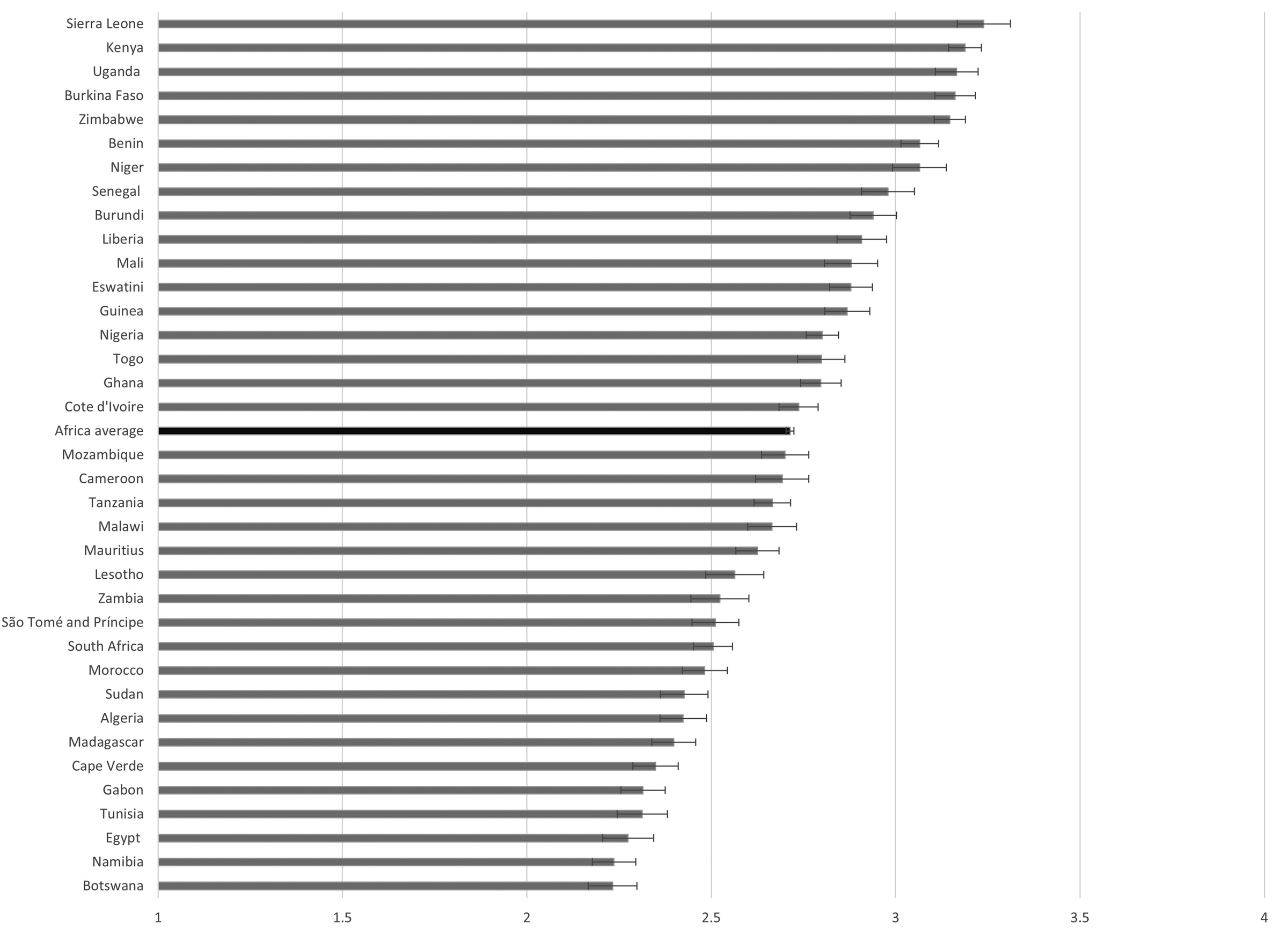
Average level of support for open borders.
The last section of this discussion centers on SADC, which differs starkly from ECOWAS and the EAC in that it does not have a regional migration protocol in force (Nshimbi and Fioramonti 2014). Although SADC began efforts to guarantee free regional movement in the 1990s, key countries in the REC, such as Botswana, Namibia, and South Africa have opposed these efforts. SADC produced the 1995 Draft Protocol on Free Movement of Persons in SADC, but South Africa, Botswana, and Namibia declined to support this Protocol because of concerns about the impact of an influx of migrants on domestic labor markets, security and public health concerns, and loss of sovereignty over controlling national borders (Oucho and Crush 2001; Crush, Williams, and Peberdy 2005). The Protocol was dropped as a result. The SADC Secretariat redrafted the protocol to include several provisions for “migration control” to allay the concerns of the dissenting governments, which resulted in The Protocol on the Facilitation of Movement of Persons in SADC in 2005 (Nshimbi and Fioramonti 2014). These “migration control” provisions contrast sharply with ECOWAS and the EAC protocols and include an explicit “limitation of mobility commitments based on security interests,” explicit mention of “the objective of migration control,” a “commitment to prevent irregular migration,” and a “commitment on regulatory cooperation on migration control” (Lavenex, Lutz, and Hoffmeyer-Zlotnik 2023). While the protocol is not in force because it has not reached the minimum required threshold of two-thirds of member states ratifying it, the framework and its migration control provisions are an important guide to policies and practices in the bloc, especially for the most restrictive Member States that pushed for the control provisions. Moreover, without a formal framework facilitating free movement, national laws and bilateral agreements are the main mechanisms governing these flows in SADC.
In line with the larger ECOWAS countries that evince lower support for open borders (Nigeria, Ghana, and Côte d’Ivoire), it is perhaps unsurprising that most migrants within the SADC region prefer to settle in South Africa, Botswana and Namibia, which have far stronger economies and employment opportunities, and more stable political climates compared to their neighbors (Nshimbi and Fioramonti 2014; Yaro and Setrana 2023). Also unsurprisingly, these three countries score among the lowest in terms of support for free movement. Botswana and Namibia occupy the bottom two places of the rank-ordering with an average of 2.23 while South Africans rank above North African countries and a few others with an average of 2.50 (see Figure 1).
In Botswana, Campbell and Crush (2015) notes that “xenophobic attitudes are highly prevalent amongst the citizenry and within government and manifested in a range of negative stereotypes.” These stereotypes, often directed at immigrants like Zimbabweans, suggest they pose threats to crime rates and the economic prosperity of Botswana—a narrative disseminated by the media, politicians, and police. Moreover, Botswana's small, ethnically homogeneous population of less than three million is characterized by high levels of patriotism and nationalism and a strong pride in belonging to the dominant Tswana ethnic group (Campbell, Kandala, and Oucho 2018), which may contribute to lower support for open borders.
South Africa, in contrast, is the largest and most economically powerful country in the region. It is also ethnically and racially diverse, with a significant immigrant population from SADC countries and elsewhere. Based on its 2022 Census, Statistics South Africa estimates that there are roughly 2.4 million immigrants living in the country, including an estimated 530,000 people who are South African citizens (Statistics South Africa 2024, 23). Out of a total population of slightly more than 62 million people, immigrants are estimated to make up roughly 3.9 percent of the population (Statistics South Africa 2024, 6). The vast majority of immigrants originate from other countries in SADC, with most coming from Mozambique and Zimbabwe based on each of the last three censuses (2001, 2011, 2022) (Statistics South Africa 2024). Over the past 30 years, Mozambicans and Zimbabweans have migrated to their more prosperous southern neighbor, with many seeking greater economic opportunity while others have escaped conflict or political persecution. Many Zimbabwean migrants are skilled and educated and fled amid acute political crises and government repression during the 2000s (Hirsch 2023). While South Africa has had more open policies toward these immigrants in the past, South African immigration regulations have become increasingly strict and tend to discourage immigration, especially of the “unskilled” (Nshimbi and Fioramonti 2014). Not only are public views toward migrants likely shaped by these policies but messaging from political elites and segments of the media has often been strongly anti-immigrant, casting foreigners as a threat to safety, the economy, and public services. The official government responses to anti-immigrant attacks (which have been horrific) have often denied xenophobia (Landau 2010; Campbell and Crush 2015; Moyo and Nshimbi 2020), while activist and academic accounts of the anti-immigrant violence have sometimes elided the role of “elite political manipulation and precedents that informed and, to some degree, animated the violence” (Landau 2010, 215). Furthermore, rather than highlighting the contributions of immigrants to the economy, Crush et al. (2017, x) write that the government “has yet to acknowledge that migrant-owned informal enterprises make a valuable contribution to the economy of the country, including through job creation for South Africans.” Here, again, it is useful to refer to the work of Zaller (1992, 7–8), who underscores how most members of the public are unlikely to read carefully about the facts, but may rely instead on simplistic information from political elites who provide “a highly selective and stereotyped view of what has taken place.”
I argue that the signals sent by the state—through its actions within SADC, its own immigration policies and enforcement, and its political messaging—have likely been detrimental to fostering positive public perceptions of immigrants, aligning with the first top-down channel. Furthermore, despite the economic contributions made by many immigrants in South Africa, the country's policies, along with anti-immigrant rhetoric, have frequently hindered migrants, such as skilled workers from Zimbabwe, from regularizing their legal status and effectively integrating into the labor market (Hirsch 2023), consistent with the second top-down channel. To be clear, the bottom-up model is also possible and indeed there may be a reciprocal causal relationship in that South African policymakers are also responding to public sentiment when they formulate and implement their policies.
Within the SADC region, Zimbabwe offers a stark contrast to South Africa both in terms of policy (and state signals) and in terms of economic, demographic, and political circumstances. Zimbabwe's mean score of 3.15 is the fifth highest on the continent in supporting open borders (well above the SADC average of 2.60). There are several possible reasons for this divergence. First, Zimbabwe is also part of COMESA and has been a leader in implementing the provisions of the COMESA Protocol on the Free Movement of Persons, Services, Labour, and the Right of Establishment and Residence. It also introduced a relaxed visa regime in March 2016 (International Organization for Migration (IOM) 2017). Second, Zimbabwe is a relatively smaller economy with a far lower GDP per capita and less political stability. Moreover, in contrast to other SADC countries such as Botswana and South Africa, which have relatively high rates of net in-migration, Zimbabwe's has net out-migration. In other words, many Zimbabweans are either migrants themselves or have family members and friends who have moved to other countries in the SADC region, where they experience or observe the economic benefits of migration. All of these factors make it likely that people will be more favorable to free movement.
To summarize, the discussion above has demonstrated that countries that are Member States of certain RECs (ECOWAS and the EAC) have demonstrated a strong commitment to free movement and regional integration in their protocols and provisions, and that these frameworks and aligned policies likely influence (top-down model) and reflect (bottom-up model) the views of the public. By contrast, key Member States of SADC have resisted full integration and free movement, resulting in greater restrictions and migration control provisions. These policies and practices, alongside anti-immigrant rhetoric from elites and the media, likely shape and mirror the restrictive views held by certain segments of Southern Africans, particularly in Botswana, Namibia, and South Africa.
To carry out the regression analyses, I assign countries to all their (overlapping) regional blocs. In an additional robustness check, I create a set of nine dummy variables so that countries are assigned to mutually exclusive categories, while still accounting for their overlapping membership: (1) ECOWAS; (2) AMU; (3) EAC and SADC; (4) EAC and COMESA; (5) EAC, COMESA, and ECCAS; (6) ECCAS only; (7) SADC and COMESA; (8) COMESA only; (9) SADC only. Table 1 lists the countries and their respective RECs for all the models.
Countries and Their Respective RECs.
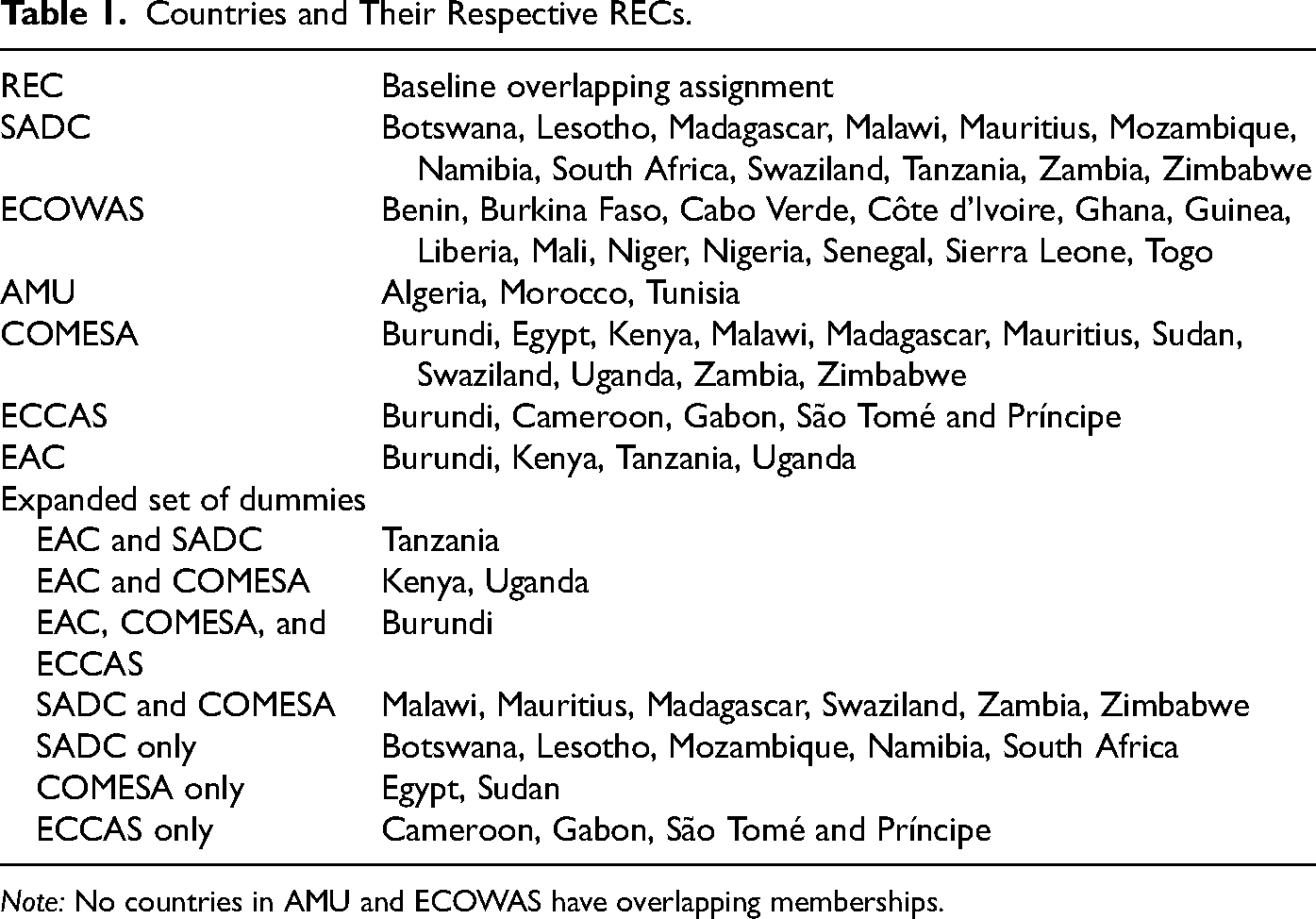
Note: No countries in AMU and ECOWAS have overlapping memberships.
In addition to the importance of regional protocols and policies, there are other country-level and individual-level factors that could influence public views toward open borders. At the country-level, the preceding discussion mentioned the potential importance of economic conditions or GDP per capita. There are a few hypotheses about why GDP per capita should be negatively associated with attitudes toward open borders. First, people in less developed countries may be more supportive of open borders due to their own considerations about seeking economic opportunities and a higher quality of life abroad (e.g., Zimbabwe, Burkina Faso) (Gordon 2022). Conversely, people in more developed countries that have achieved relative economic prosperity and possess favorable economic conditions or resource endowments (e.g., oil in Gabon or diamonds in Botswana) may wish to safeguard those resources for themselves and their fellow nationals.
Beyond the African context, a substantial body of literature explores how individual economic and social factors shape attitudes toward immigrants. This article investigates these hypotheses within the limitations of the Afrobarometer survey data. First, one main hypothesis and debate, centers around egocentric (pocketbook) economic concerns and the labor market competition hypothesis. The hypothesis stipulates that some native-born citizens will oppose migrants if they believe that new arrivals will create competition for their jobs or place downward pressure on their wages (discussed in Dancygier and Donnelly 2013 and Mayda 2006). Thus, a model based on economic self-interest predicts that individuals’ preferences toward immigration policy will be shaped largely by their perception of immigrants’ impact on their economic welfare based on their skill level, employment status, or occupation.
However, empirical support for this hypothesis is contested. Hainmueller and Hopkins (2014) reviewed 100 studies across 12 countries in North America and Western Europe and found that attitudes towards immigrants are not strongly correlated with personal economic circumstances or fears of employment competition with new arrivals. The same finding of no relationship prevailed in a cross-national study of African attitudes (Gordon 2022), Latin American attitudes (Meseguer and Kemmerling 2016), and more specifically, studies of Chileans’ (Lawrence 2015), Mexicans’ (Meseguer and Maldonado 2015), and South Africans’ (Gordon 2017b) views toward immigrants.
By contrast, Mayda (2006) found that skilled workers (as proxied by education or occupation) were more likely to support immigration in countries where locals were more skilled than immigrants (i.e., more developed countries) but opposed immigration otherwise. Unfortunately, there are no reliable data on the relative skill levels of immigrants versus local citizens for the Afrobarometer countries. Furthermore, the Afrobarometer does not collect high-quality data on individual skill levels or years of experience within occupations. Lacking data on skill level, many studies in the literature have used education or occupation as crude proxies for individual skill (Mayda 2006, also described in Hainmueller and Hopkins 2014). This approach is limited in several regards, and certainly for the Afrobarometer data, which classify people into 13 occupational categories. Within each category, there are likely to be varying degrees of skill. There are many highly skilled workers with years of experience in various sectors, including traders, construction, agriculture, forestry, mechanics, electricians, and plumbers. Moreover, the data are unclear about the particular roles people perform within categories such as “Retail/Shop,” “Security Services,” or “Clerical or secretarial.”
Because most of the literature on attitudes toward immigrants emphasizes the role of education (sometimes as a proxy for skill), I use education in my preferred baseline specification and substitute in occupational categories in alternative models as a robustness check.
Apart from individual economic concerns, a second strand of literature points to sociotropic concerns about the host country's economy, welfare system, and public goods provision. Although not the primary driver, the review by Hainmueller and Hopkins (2014) uncovers some support for the hypothesis that sociotropic concerns about effects on the national economy influence immigration attitudes. In the previously mentioned study of Latin American countries, Meseguer and Kemmerling (2016) find that fears of a larger tax burdens affect attitudes. By contrast, in a study of twenty European countries, Sides and Citrin (2007, 497) found that “the effect of satisfaction with the economy, while important in many countries, is not consistently robust.” In parallel, in South Africa, Gordon (2017a, 831) found that sociotropic concerns were not correlated with support for border closures. To examine sociotropic or fiscal concerns, I utilize Afrobarometer's survey question on expectations about the country's economic conditions in 12 months’ time. In line with most of the studies cited above, I hypothesize that more pessimistic respondents favor restrictions.
Another stream of literature speaks to concerns about security, terrorism, and crime. In the Mayda (2006) study mentioned previously, she finds that concerns about the impact of immigration on crime rates are also associated with immigration attitudes. In addition, Meseguer and Maldonado (2015) find that Mexicans who believe immigrants are a security threat are more likely to view them negatively. To examine the import of concerns about security, I carried out factor analysis to create a fear index, where feeling unsafe walking in one's neighborhood and fearing crime in one's home define the common factor. Following the literature, I anticipate that more fearful respondents are less supportive of free movement. 5
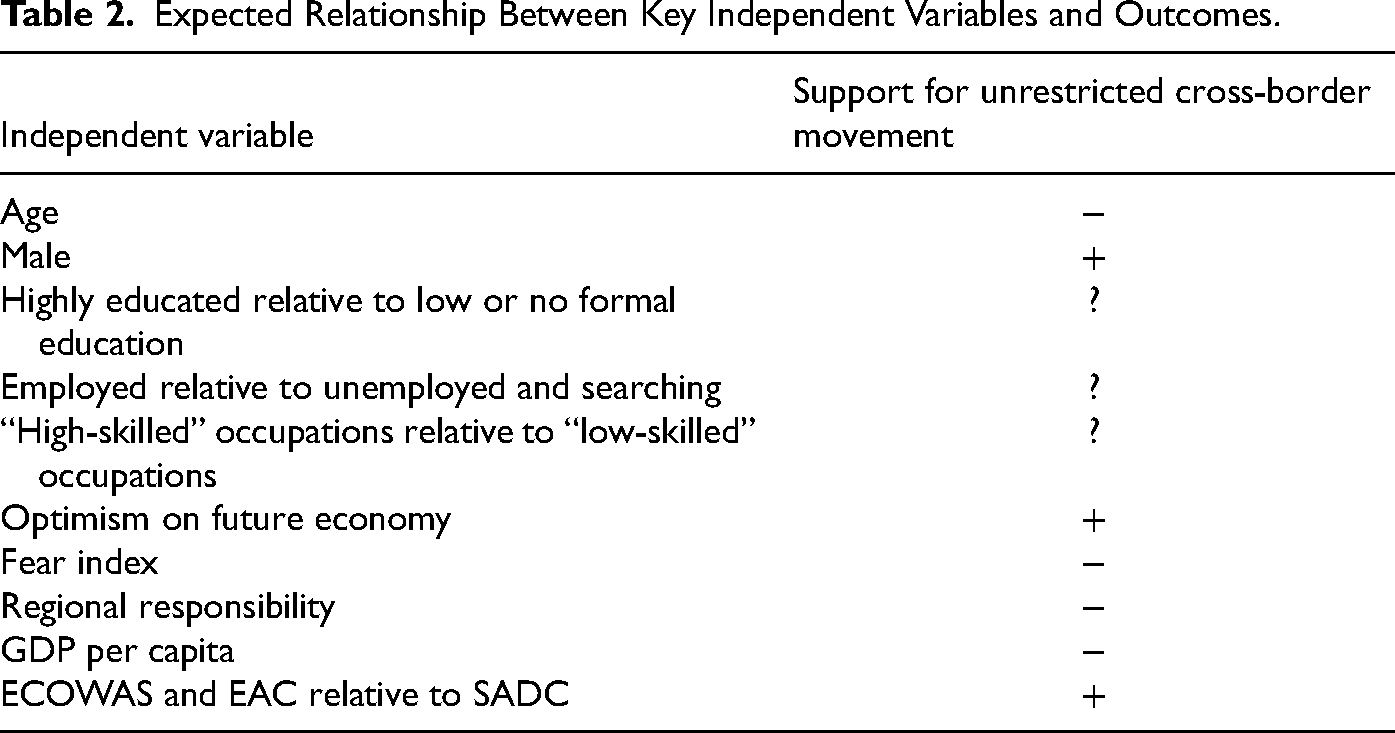
Regarding other individual-level covariates, a few studies have found that older people and women are more likely to support restrictions on immigration (Mayda 2006; O’Rourke and Sinnott 2006; Richey 2010). Finally, the Afrobarometer survey asks whether governments have a duty to intervene to prevent human rights abuses in other countries in the region or whether governments should respect the sovereignty of other countries in the region to make their own decisions. This is an important question gauging whether individuals have a mentality that supports regional responsibility. Higher values correspond to stronger agreement with national sovereignty while lower values correspond to stronger agreement with regional intervention. In line with Gordon (2022), I hypothesize that support for national sovereignty will be negatively associated with support for open borders. In Table 2, I present the expected relationships between the outcome variable and covariates.
Expected Relationship Between Key Independent Variables and Outcomes.
Data and Estimation Strategy
The data used in this article are from the Afrobarometer survey's sixth round, which was conducted between 2014 and 2015 in 36 African countries. Importantly, the sixth round includes a question on the degree to which citizens support free movement across borders (whereas other rounds do not). The sample size for the sixth round was 53,935 person (household) interviews, but roughly 43,000 people from 36 countries remain in the baseline regression analyses.
Afrobarometer surveys use a clustered, stratified, multi-stage, area probability sample (Isbell 2017). In all countries, individual-level observations (obtained from an individual within a visited household) are nested within clusters by design. A multilevel model can account for this clustering and is the appropriate choice if higher levels are associated with individual-level outcomes (i.e., clustering matters) (Steenbergen and Jones 2002). As an empirical check, a variance components model on the dependent variable shows that cross-country differences account for eight percent of the variance on average for the dependent variable. This is above a five percent threshold and justifies the use of the hierarchical model (Hayes 2006, 394).
The dependent variable is attitude toward free cross-border movement. The Afrobarometer survey question was: Which of the following statements is closest to your view: Statement 1: People living in [West/South/East/North/Central] Africa should be able to move freely across international borders in order to trade or work in other countries; Statement 2: Because foreign migrants take away jobs, and foreign traders sell their goods at very cheap prices, governments should protect their own citizens and limit the cross-border movement of people and goods.
The response options were: 1 = Agree strongly with Statement 1, 2 = Agree with Statement 1, 3 = Agree with Statement 2, 4 = Agree strongly with Statement 2, 5 = Agree with Neither. I remove the “neither” responses (which make up two percent of the sample) to avoid making assumptions about their views (i.e., placing them in the middle of the scale). For ease of interpretation, I invert the response codes so that those most supportive of free movement (i.e., strongly agree with Statement 1) score the highest on a scale running from 1 to 4. I run all models using the four-category outcome in order to preserve the substantial variation in the data. Figure 2 shows that collapsing the categories would be ill-advised for most countries based on the distribution of responses. It would be unproblematic only for a few countries such as Burkina Faso, South Africa, or Zambia.
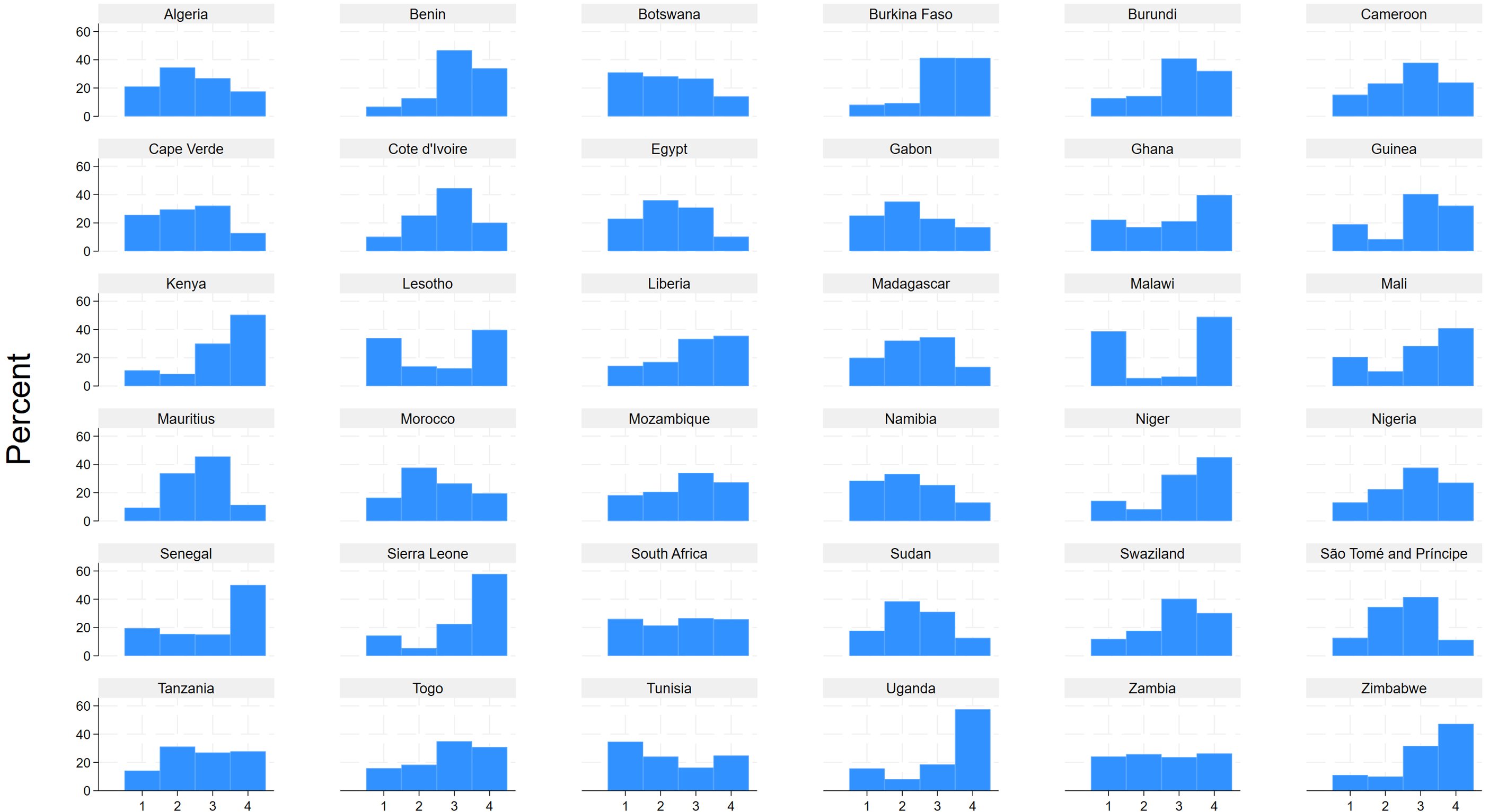
Attitudes toward free movement.
Table 3 provides descriptive statistics for the covariates included in the baseline model. 6 For the outcome variable, the majority of respondents (60 percent) either agree or strongly agree with free movement. This point bears repeating: contrary to anti-immigrant and xenophobic narratives from some politicians and media outlets, the majority of Africans are supportive of free cross-border movement and do not favor government restrictions.
Descriptive Statistics.
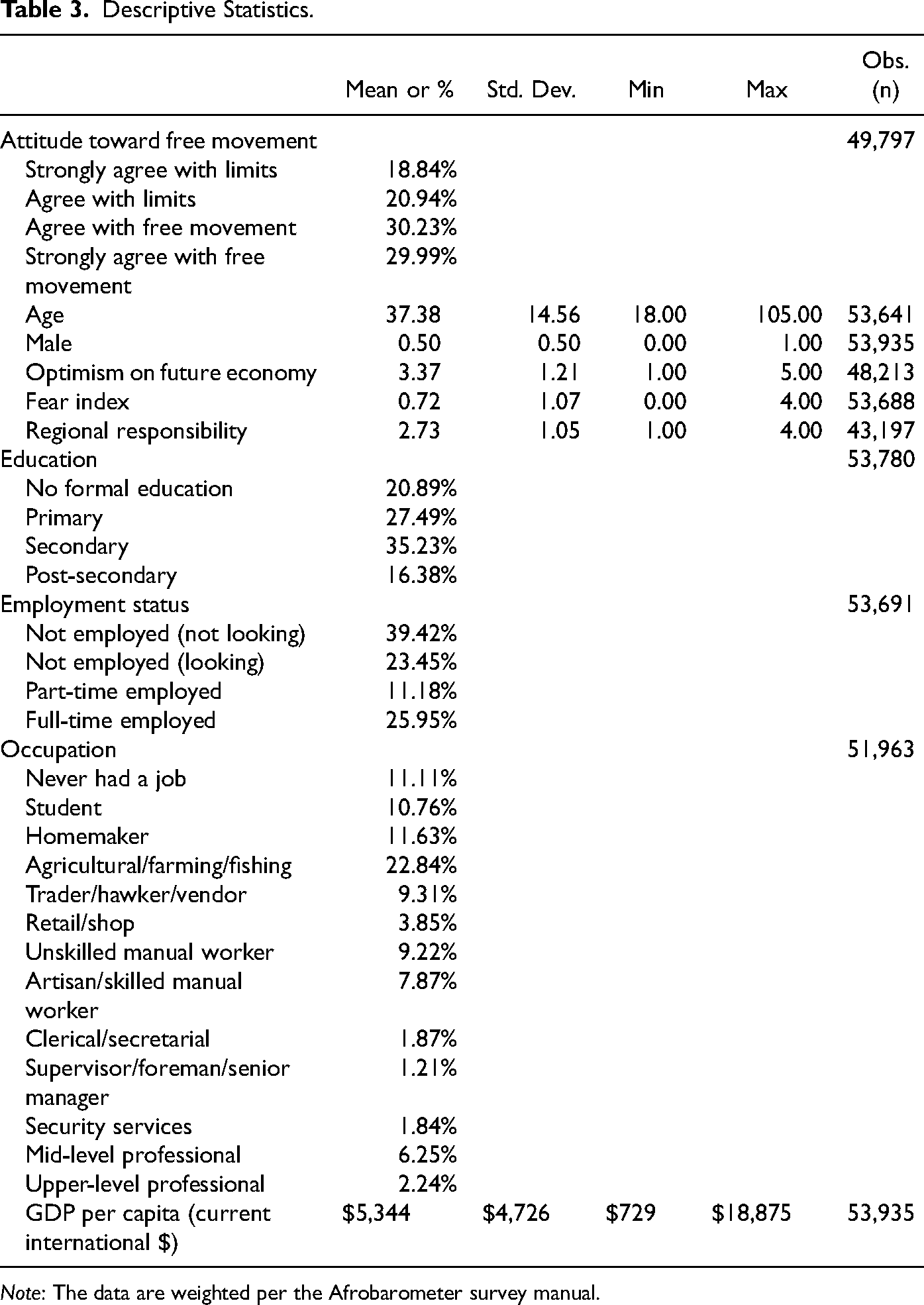
Note: The data are weighted per the Afrobarometer survey manual.
Regression Results
Table 4 presents the regression results for the baseline model. 7 For all models, the intercept variances are positive and statistically significant, suggesting a high level of between-cluster (country) variation in the outcome scores (or the variance of the unadjusted cluster means) (Enders and Tofighi 2007, 127). Multicollinearity tests revealed no violations of model assumptions. Unless otherwise mentioned, the reference category for education is no formal education and the reference category for employment status is not employed (and looking). The reference category for the regional economic blocs is SADC.
Baseline Model Results on Attitudes Toward Cross-Border Movement.
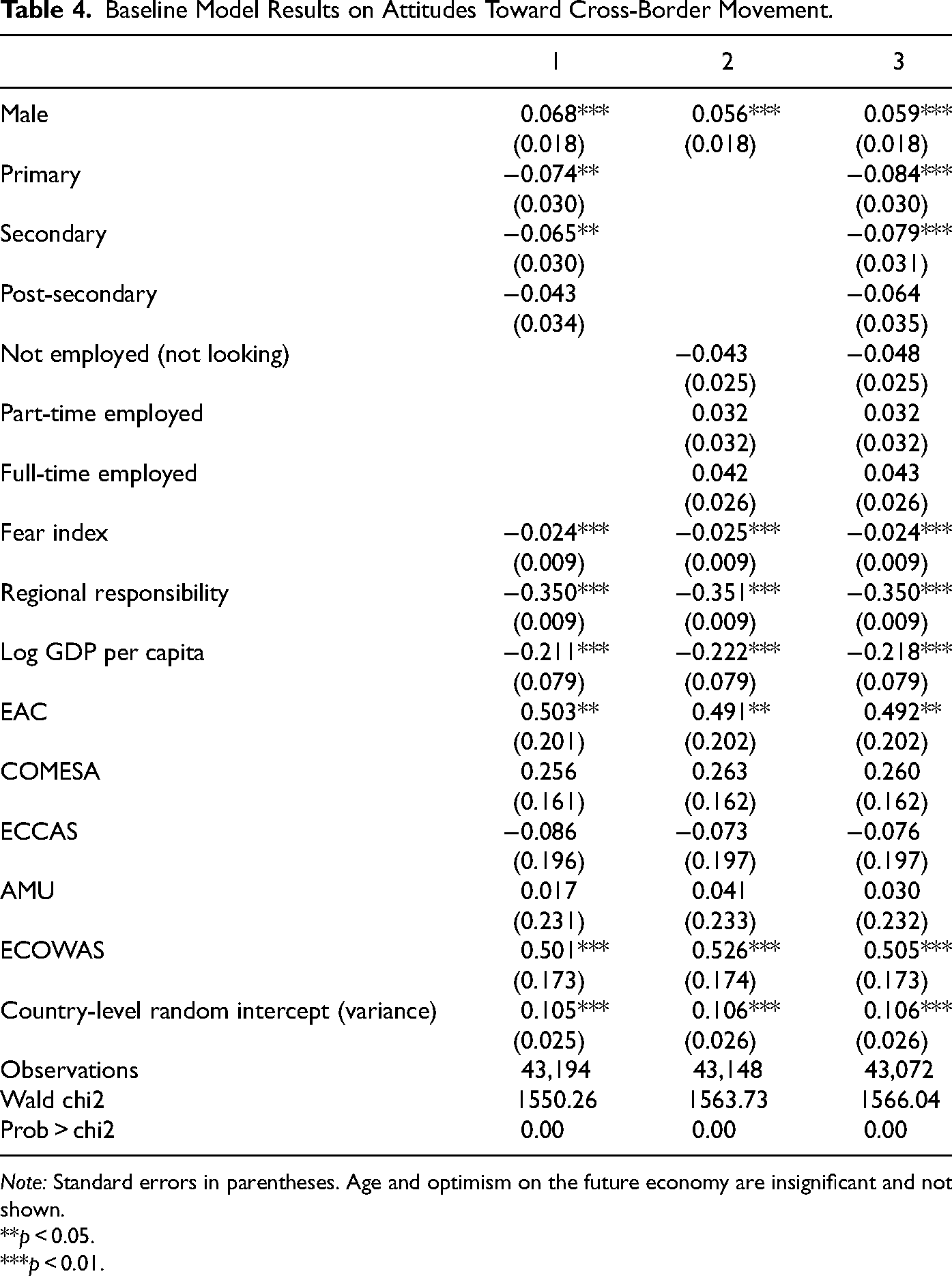
Note: Standard errors in parentheses. Age and optimism on the future economy are insignificant and not shown.
p < 0.05.
p < 0.01.
At the country level, being a member of ECOWAS or the EAC has a sizable and statistically significant positive association with supporting open borders relative to SADC. Exponentiating the coefficients on ECOWAS and the EAC (both 0.50) in column 1 of Table 4 provide an odds ratio of 1.65. In other words, the odds of stronger support for open borders increase by 1.65 times on average if one resides in ECOWAS or EAC relative to SADC.
In line with the earlier discussion of country cases within the RECs, log GDP per capita is negatively associated with support for free movement, which is consistent with Gordon (2022). Respondents in richer countries in Africa tend to favor restrictions while respondents in less developed countries are more likely to favor open borders. This result provides support for the notion that respondents in richer countries such as Botswana, South Africa, and Gabon may wish to preserve their relative economic prosperity (a status quo bias). At the same time, this result also aligns with the idea that respondents in less developed countries such as Zimbabwe or Burkina Faso desire greater work opportunities or safety abroad given their difficult economic and security circumstances.
Importantly, while the models show that country-level economic circumstances are important correlates of negative attitudes toward open borders, the individual-level results on education, employment, and “high-skilled” occupations run counter to pocketbook or labor market competition hypotheses. These results are, however, in line with a large part of the literature including Hainmueller and Hopkins (2014), Meseguer and Kemmerling (2016), Lawrence (2015), Gordon (2017b), and Gordon (2022). First, there is no evidence in these baseline models that more educated (or skilled) respondents are more likely to support free movement compared to those without formal education. This is contrary to a labor market competition prediction that unskilled or low-skilled respondents would be the most likely to oppose free movement because of concerns about the lack of available jobs and downward pressure on their wages. In fact, there is some limited evidence that the opposite is true; respondents with primary or secondary education are less likely to support free movement compared to individuals with no formal education (the reference category). This provides some support for the suggestion in Gordon (2022, 284) that people at “both the bottom and top of the education hierarchy benefit from greater regional integration and, therefore, are more likely to see visa liberalization as an opportunity.”
Similarly, there are no statistically significant associations with attitudes toward free movement compared to the reference category of not employed and looking. Based on the pocketbook (egocentric) hypotheses, one prediction would be that the category of not employed and looking would hold the least favorable view of open borders because they are most concerned about labor market competition.
In parallel, the robustness checks using covariates for the occupational categories are not aligned with the labor market competition hypotheses (see Supplemental Table A1 in the Supplemental Appendix). Several occupational categories are more likely than people who have “never had a job” (11 percent of the sample) to support free movement. However, there are no statistically significant differences between categories that are often classified in earlier studies as “skilled” or “unskilled.” For example, “unskilled manual workers” and “agricultural/farming/fishing/forestry workers,” typically classified as unskilled or low-skilled in the literature, do not evince less support for free movement compared to “artisans or skilled manual laborers” or “upper-level professionals.” 8 To be clear, this is not to argue that people are not concerned about the economic impacts of immigrants; rather, the results of this article show that these concerns are not more pronounced among the less educated, less skilled, or unemployed.
The regressions also reveal interesting findings that do not support the predictions of sociotropic or fiscal theories. Contrary to multiple studies in the literature (Hainmueller and Hopkins 2014; Meseguer and Kemmerling 2016), people who are more pessimistic about the future economy are not more likely to look unfavorably upon cross-border movement. These results align with Gordon's (2017a) study in South Africa and, to an extent, with Sides and Citrin's (2007) study based on a sample of European countries.
By contrast, security concerns stand out as an important correlate of attitudes toward international movement. The consistent negative association is aligned with the earlier prediction that fearful respondents will be less likely to support free cross-border movement. In line with Gordon (2022), another consistently significant correlate of attitudes is the extent to which an individual agrees with the view that governments in the region have a duty to intervene in neighboring countries to prevent human rights abuses versus governments in the region should respect the independence of other nations to make their own decisions. People who strongly agree with respecting national sovereignty (non-intervention) are substantially less likely to support free movement.
Contrary to a few results in the literature, age is not correlated with the outcome variable. Men are more likely to support free movement, which aligns with other results in the literature.
Importantly, all of these results are robust to the inclusion of various country-level factors that were mentioned or alluded to in the discussion of country cases: the size of the population, the stock of immigrants as a percentage of the population, the annual rate of change in the immigration stock for both sexes between 2010 and 2015, the number of out-migrants as a percentage of the population, the number of in-migrants as a percentage of the population, and net migration as a percentage of the population. 9 Table 5 presents those results. While the previous set of results is highly consistent, none of the estimated coefficients for the additional country-level covariates is statistically significant. This is somewhat unsurprising given the substantially stronger average levels of support for open borders in the EAC and ECOWAS relative to SADC.
Robustness Checks with Additional Covariates.
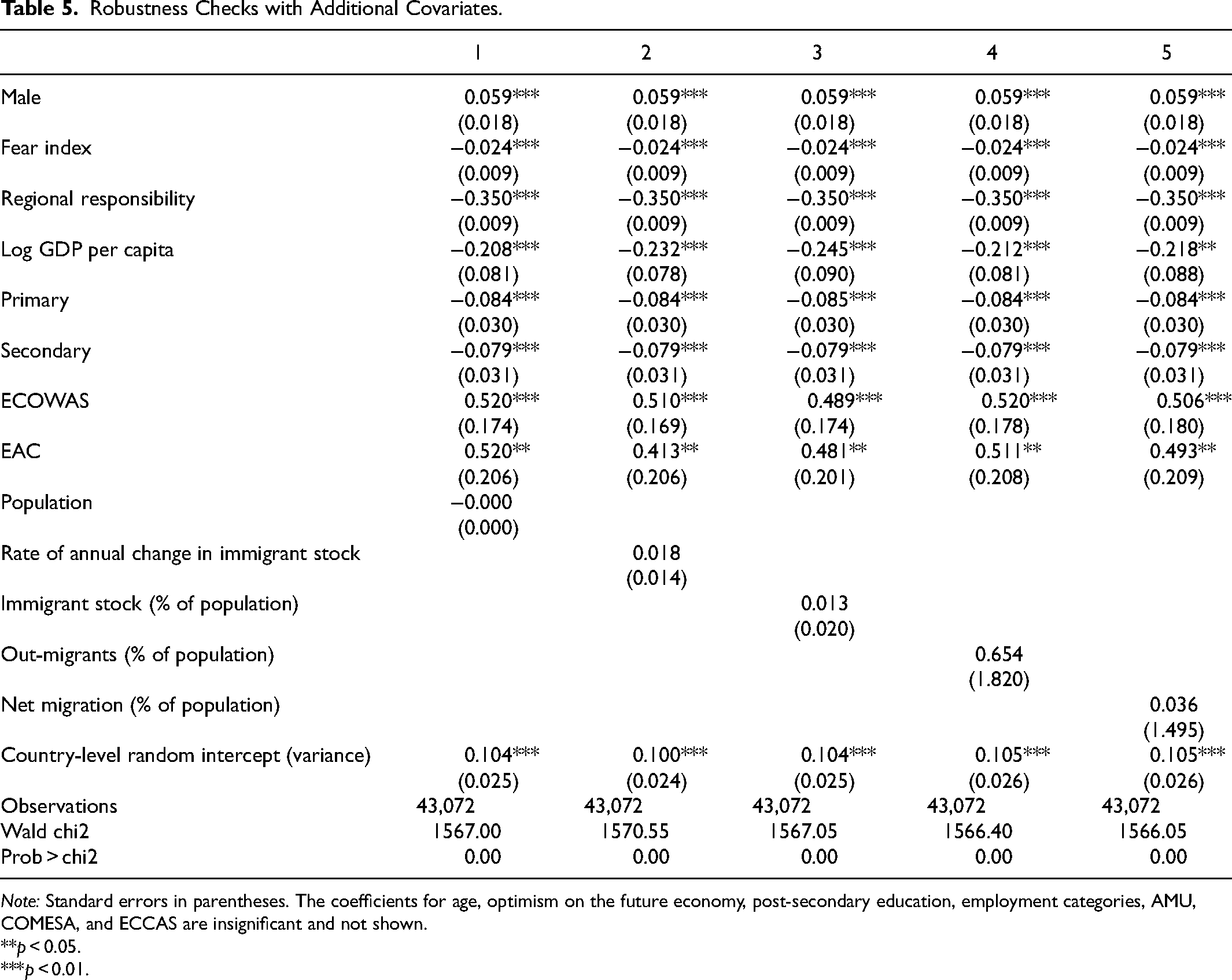
Note: Standard errors in parentheses. The coefficients for age, optimism on the future economy, post-secondary education, employment categories, AMU, COMESA, and ECCAS are insignificant and not shown.
p < 0.05.
p < 0.01.
Finally, these results are robust to creating a broader set of mutually exclusive categories (Table 6). The results in Table 6 add important nuance to the previous discussion. Three groupings of countries support greater free movement compared to the SADC only reference category: (1) ECOWAS, (2) EAC and COMESA, and (3) SADC and COMESA. While the first two results are unsurprising, the third requires further explanation, and aligns with the overall argument of the article. Countries in SADC and COMESA (Madagascar, Malawi, Mauritius, Eswatini, Zambia, and Zimbabwe) have made greater strides in implementing the COMESA visa protocol compared to those in the SADC-only category (Botswana, Lesotho, Mozambique, Namibia, and South Africa), which lacks a free movement protocol. Although one might expect the COMESA-only group to show stronger support for free movement, this category is limited to Egypt and Sudan, two countries that have been less successful in implementing the free movement protocol. 10
Robustness Checks With Broader Set of REC Categories.
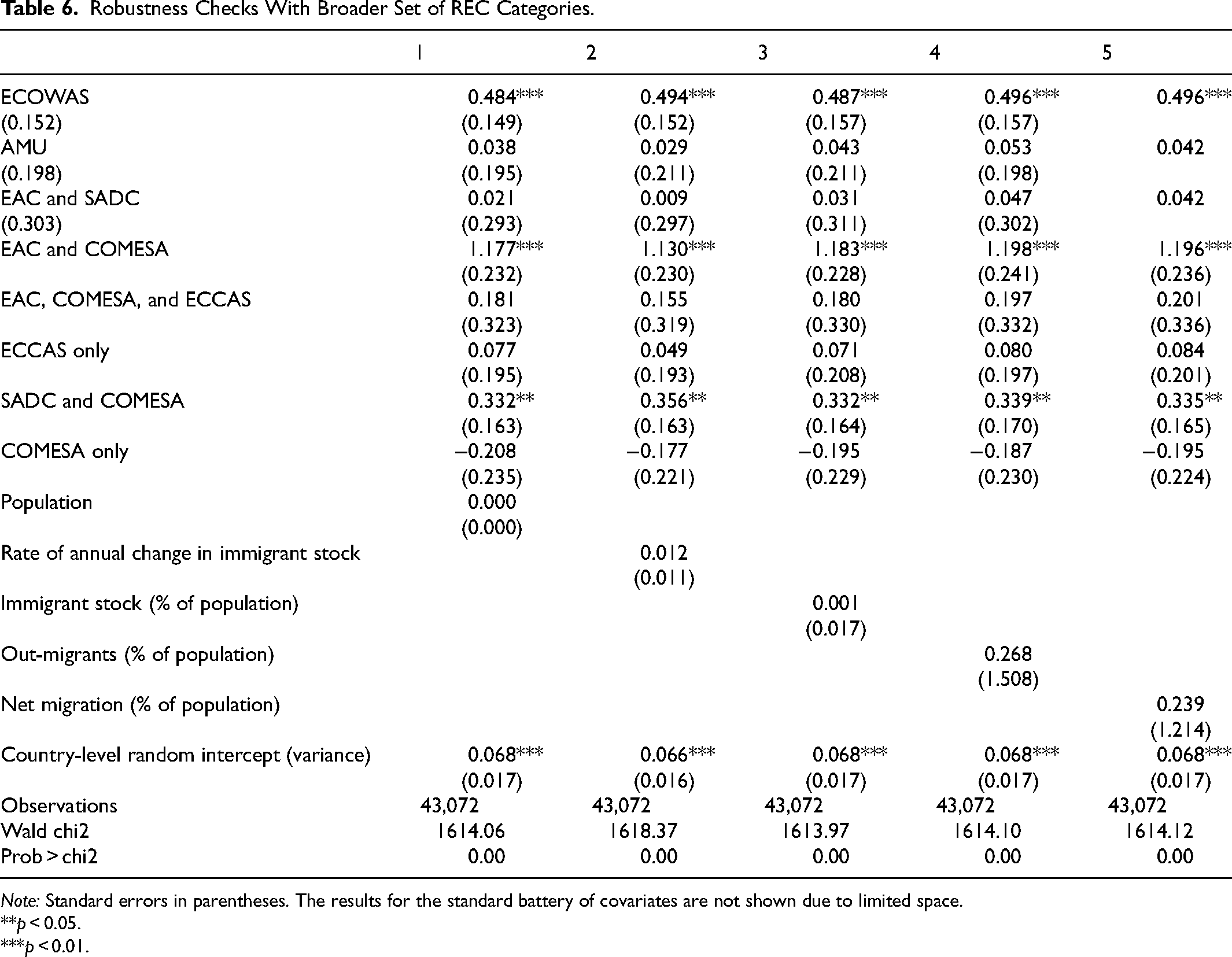
Note: Standard errors in parentheses. The results for the standard battery of covariates are not shown due to limited space.
p < 0.05.
p < 0.01.
Conclusions, Study Limitations, and Future Research
This article employed a multilevel research design to examine variation in attitudes toward restrictions on cross-border movement across 36 African countries. In a novel contribution, the article demonstrates the importance of regional economic blocs and their provisions around free movement. I propose a theoretical framework that outlines both top-down and bottom-up mechanisms likely linking regional mobility protocols, along with corresponding national policies and practices, to individual attitudes toward immigration policy.
The article demonstrates that the ECOWAS and the EAC have the most far-reaching and effective measures to promote free movement while SADC is far more restrictive. Regression analyses show that citizens of Member States in the more open blocs are significantly more likely to support free movement compared to SADC residents. Further, the paper draws on secondary literature to examine important country-level variation within the blocs, which is likely due to countries being members of multiple overlapping blocs (e.g., Zimbabwe implementing COMESA's free movement protocol), and due to economic, demographic, and security conditions that are conducive to more (or less) restrictive policies and practices.
Unsurprisingly, national-level GDP per capita, individual support for national sovereignty, and individual-level fear are all negatively associated with open attitudes toward cross-border movement. By contrast, in line with much of the literature, people in the African context seem to be less concerned about potential negative effects of immigrants on their individual economic welfare. Those without formal education (the group most likely to be threatened by labor market competition) are not more likely to oppose free movement compared to groups with more education. Similarly, the unemployed and searching are not less likely than any other employed group to support free movement. Both of these results are contrary to a labor market competition prediction that these groups would be the most concerned about having to compete with more people for low-skilled jobs. In parallel, there are no statistically significant differences between occupational categories that are often classified in earlier studies as “skilled” or “unskilled.” Respondents also appear to be less concerned about potential negative effects on the national economy (a socio-tropic hypothesis).
This study is not without limitations. First, the Afrobarometer survey does not ask respondents about their immigration views with regard to specific attributes of migrants (e.g., country of origin, skill level, religion, asylum seeker or refugee status). Second, like many cross-national studies, the Afrobarometer data provide only imperfect proxies for a respondent's skill level. Third, while this article outlines theoretical mechanisms and draws from secondary literature to suggest a plausible link between public attitudes toward immigration and REC’s policies, the cross-sectional observational data and research design do not permit strong causal claims regarding either the proposed bottom-up or top-down models. Although individual country cases are complicated and may not be fully representative of the broader sample of African countries, there is evidence to suggest that the causal relationship between public attitudes and regional policies could be bidirectional, functioning as a feedback loop. At times, citizens’ attitudes are likely to be influenced by their country's policy signals, experiences, or perceptions of the effects of these policies and impacts on their regional vis-à-vis national identity, all of which are likely shaped by regional-level policies. Additionally, citizens can also impact national governments, potentially pushing them toward adopting more open or restrictive policies within their RECs. However, the absence of panel data tracking citizens’ attitudes before and after the formation of RECs or significant policy shifts make it difficult to definitively establish the direction of this relationship through a pre- and post-test research design. Future within-country studies could leverage upcoming policy changes to employ such designs and make stronger causal inferences. Finally, the external validity of the empirical findings may be constrained by the limited coverage of the Afrobarometer survey across all REC countries. This is especially true for the ECCAS category, which lacks respondents from member countries such as Rwanda, the Republic of Congo, the Democratic Republic of Congo, Equatorial Guinea, the Central African Republic, Chad, and Angola. Similarly, Rwanda, the Democratic Republic of Congo, South Sudan, and the newly admitted Somalia are absent from the EAC category, while Angola, the Democratic Republic of Congo, Seychelles, and the Comoros are not included in the SADC category.
Despite these limitations, these preliminary findings are important contributions and indicate promising avenues for future research. This article's quantitative results and discussion of RECs and country cases demonstrate the import of regional economic frameworks in shaping national legislation and practices, which in turn are likely to influence public views toward migration policy in Africa. Conversely, citizens’ perceptions of immigration policy and its consequences are also likely to influence the policies that Member States advocate for in regional bodies. Studying this feedback loop and collecting more direct evidence on the suggested mechanisms could be a fruitful area of research in other contexts with regional economic blocs such as Latin America and Asia.
Given that the data in this article are observational, future experimental work may wish to randomly assign primes to individual respondents regarding regional- and national-level policies and elite or media rhetoric about the efficacy of immigration policies. This type of research would help to provide more rigorous evidence of the posited causal linkages in this article and how they operate. Moreover, these studies could randomly assign more fine-grained, accurate measures of skill-level and other traits to hypothetical migrants, which would constitute a significant improvement over proxies that are often used with existing cross-national datasets. In addition, this area of research would greatly benefit from qualitative studies, such as interviews, archival research, and media content analysis, to better understand how regional frameworks influence citizens and how, in turn, citizens can shape regional-level policies.
Overall, gaining a better understanding of these linkages could provide valuable insights for policymakers at regional and national levels as well as for media and other civil society organizations. This knowledge could guide actions aimed at enhancing integration policies, building more inclusive communities and identities, and fostering positive perceptions of immigrants from diverse backgrounds.
Supplemental Material
sj-doc-1-mrx-10.1177_01979183241303703 - Supplemental material for Regional Economic Communities and Attitudes Toward Free Cross-Border Movement in Africa
Supplemental material, sj-doc-1-mrx-10.1177_01979183241303703 for Regional Economic Communities and Attitudes Toward Free Cross-Border Movement in Africa by Zack Zimbalist in International Migration Review
Footnotes
Acknowledgements
Thanks are due to Nadège Compaoré, Arabo K. Ewinyu, Michael Mutava, Kudakwashe Vanyoro, Anthony Kaziboni, and the editors and anonymous reviewers at the International Migration Review for their suggestions. Some of the research and writing was completed under the auspices of a WU (Vienna University of Economics and Business) International Research Fellow grant.
Declaration of Conflicting Interests
The author declared no potential conflicts of interest with respect to the research, authorship, and/or publication of this article.
Funding
The author received no financial support for the research, authorship, and/or publication of this article.

Supplemental Material
Supplemental material for this article is available online.
Notes
References
Supplementary Material
Please find the following supplemental material available below.
For Open Access articles published under a Creative Commons License, all supplemental material carries the same license as the article it is associated with.
For non-Open Access articles published, all supplemental material carries a non-exclusive license, and permission requests for re-use of supplemental material or any part of supplemental material shall be sent directly to the copyright owner as specified in the copyright notice associated with the article.
