Abstract
This study evaluates whether the trajectories of forced migrants, specifically Syrian refugees moving towards Germany, exhibit path dependency—meaning that their migration decisions are influenced by past events and their previous migration experiences. Using data from the IAB-BAMF-SOEP survey of refugees, this article investigates whether these migration trajectories adhere to a Markov process, where the likelihood of future migrations depends solely on the current state. By employing global and local Markov score tests, the article systematically tests the Markov assumption across different migration routes, focusing on Turkey, Lebanon, and Egypt as transit countries. The findings indicate that shorter, reactive migrations from Syria to Lebanon and Turkey exhibit path dependency, meaning their likelihood is influenced by recent events. Conversely, longer, logistically complex migrations, such as from Syria to Egypt and from transit countries to Germany, adhere to the Markov property, suggesting path independence. This distinction highlights the impact of route difficulty and destination accessibility on migration behaviors. The implications of the findings are also significant for the use of the Markov property in computational models of migration. Researchers should exercise caution when applying the Markov assumption indiscriminately across different migration contexts, as its validity can vary based on external factors such as policy changes and route accessibility.
Introduction
The migrant's trajectory has emerged as a critical locus of study following the wave of literature that redefined the migration process as a dynamic continuum rather than an abstract transition between two fixed points. The trajectory is increasingly recognized not only as a means to an end, but as a decisive element that shapes the decision-making process, influencing both immediate choices and long-term migration outcomes. As articulated by Schapendonk (2012), the lived experiences and subjective perceptions of mobility and immobility, such as being physically stuck or psychologically stranded, play crucial roles in shaping migrant aspirations and future movements. Schapendonk's perspective and subsequent research suggest that the continuous interaction between migrants’ experiences and the environments through which they move can establish patterns of behavior and decision-making that are recursively reinforced over time, suggesting a potential path dependency. The effect of path dependent behavior and decisions in migration trajectories is particularly salient in contexts where migrants must navigate through and react to varying political climates and crises (BenEzer and Zetter 2015). The sudden and often violent nature of forced displacement necessitates leaving without a clear plan of action or final destination, introducing nonlinearities into the decision-making process, as evidenced by Syrians and Eritreans en route to Europe, where variable resources and flexible goals interact with recent experiences to shape subsequent decisions (Mallett and Hagen-Zanker 2018). However, despite the fact that the trajectory is widely recognized as influential, much is still unknown about its precise effect. This paper aims to formally evaluate whether the trajectories of forced migrants, specifically Syrian refugees moving towards Germany, exhibit such path dependency. Utilizing data from the IAB-BAMF-SOEP survey of refugees, this article investigates whether forced migration trajectories exhibit path-dependency by testing whether they adhere to a Markov process—a statistical method where the likelihood of a future state is dependent solely on the current state rather than the entire sequence of previous states.
Conceptually, this article's inquiry into path dependency is framed by a broader discussion on the decision-making processes of migrants, particularly how individuals navigate and respond to different environments and impediments. Although there is a growing body of research examining the influence of trajectories on decision making, much of it has focused on individual-level perspectives to explain how journeys affect migration outcomes, highlighting subjective and intangible factors (Hagen-Zanker et al. 2023). Existing studies have provided valuable qualitative insights, such as McMahon and Sigona (2021), who document how encounters with death and violence during migration shape the trajectories and decisions of migrants, highlighting the significant impact of life-threatening experiences on the routes taken towards Europe. Similarly, Sunagic (2024) employs narrative interviews with Syrian refugees to understand how the desire for a better life mediates risk perception during sea crossings to Europe, showcasing how aspirations shape migration decisions beyond utilitarian risk calculations. These qualitative insights are also complemented by broader quantitative studies, although granular information on migrants’ trajectories is less common due to the challenges of collecting data on mobile populations. A notable exception is the TRANSMIT project that collects data from multiple points along migrants’ trajectories (on departure, en route, and after arrival), though its emphasis is on longer-term integration outcomes. Most quantitative research on trajectories therefore relies on cross-sectional surveys that collect information about the journeys ex post, and provide insights into the aggregate dynamics of migration decisions. These studies reveal how local conditions, policies, and other meso-level factors impede or encourage mobility in transit countries (Triandafyllidou et al. 2023; Zufferey 2021). For instance, the migration trajectories of both Central American migrants and Syrian refugees involve significant adaptations in response to route accessibility, policy changes, and resource availability, necessitating constant route and destination adjustments (Balcilar and Nugent 2019; Gundacker, Keita and Ruhnke 2024; Pries and Savci 2023). Missing from the current understanding A comprehensive view of how the structural features of the migration journey themselves affect migration outcomes is missing from the current understanding.
To address the gap in understanding the impact of macro-level characteristics of the route on migration outcomes, this paper aims to systematically analyze the spatial and temporal components of migration trajectories, focusing on the timing of movements from Syria to Germany via Turkey, Lebanon, and Egypt. The trajectory is defined as the collection of countries visited, time spent in each country, and the timing of migration events to determine how these factors influence migration decisions. The analysis is segmented by individual transitions (migrations between countries) to capture the effects of both initial and subsequent migration decisions. The Markov property is utilized to evaluate whether the likelihood of future transitions is determined solely by a migrant's current state (the country where they are staying) or whether it is also influenced by the timing and sequence of previous movements. Additionally, the results are interpreted through the thresholds framework (Velde and Naerssen 2011), later extended to the forced migration context by Mallett and Hagen-Zanker (2018), to examine the decision-making processes at various stages of migration. This combined approach aims to uncover patterns of path dependency and deepen the understanding of the broader dynamics at play in forced migration.
From a methodological standpoint, the interest in the Markov property extends beyond what it reveals about path dependency and other properties of migration trajectories. The ability to assume that transitions between two countries (and in general any two states) are path independent is also of practical importance for modeling stochastic processes—such as migration flows—as it greatly reduces the computational complexity and simplifies the interpretation of models. With respect to migration specifically, the Markov assumption has been applied in several different contexts to more easily estimate transition probabilities between places. For example, in the context of return migration, Constant and Zimmermann (2012) analyze repeat or circular migration between host and home countries using a Markov chain approach, shedding light on the dynamics of migrants’ decisions to leave, return, or move repeatedly between locations. Additionally, Pan and Nagurney (1994) highlight that a non-homogeneous Markov chain and time-varying transition probabilities can provide a more realistic model of migration. Other uses for the Markov-based models include inter-city migration (Prieto Curiel et al. 2018), refugee movements (Huang and Unwin 2020), and in combination with the use of gravity models (Yu et al. 2024). However, while the property holds significant value for practical modeling applications, it cannot be known beforehand whether the assumption holds (Titman and Putter 2022), and in practice it is almost never empirically evaluated before it is assumed. Therefore, by applying the recent advancements in testing of the Markov property for general multi-state models to the migration context (Piulachs et al. 2024; Titman and Putter 2022), this paper seeks to not only deepen the understanding of the influence of a migrant's trajectory on (im)mobilty, but also contribute a validated approach for other migration researchers to more rigorously scrutinize the Markov assumption.
Evaluating Path Dependency
Local and Global Score Test for the Markov Assumption
To test whether the collection of sequences in the dataset follows a Markov process, the general test for multi-state models developed by Titman and Putter (2022) is employed, drawing on the analysis for semi-Markov models outlined in Piulachs et al. (2024). The discussion begins with an intuitive explanation of how the test operates, followed by a more technical definition. The foundation of the test lies in constructing groups of individuals who occupy different states (here countries) j at a given point in time s, and comparing the future transitions they undergo. Essentially, if the Markov assumption holds, the future transitions for the individuals in different groups, regardless of their state at time s, should be statistically indistinguishable, as the Markov property stipulates that the future is independent of the past, given the present. The test is motivated by two estimators of transition probabilities in multistate models and derives its functionality by exploiting the differences in the assumptions between the two. The first is the Aalen–Johansen (AJ) estimator, which assumes the Markov property to estimate transition probabilities between states (Aalen and Johansen 1978). The second is the Landmark Aalen–Johansen (LMAJ) estimator, which, in contrast, was developed for scenarios where the Markov assumption may not hold and adjusts the estimation process by considering the system's state at a landmark time s, and it recalculates transition probabilities from this point forward (Putter and Spitoni 2018). The log-rank test statistic leverages the distinction between these two estimators by comparing the observed number of transitions for groups of individuals—defined by their state at the landmark time s (using the concept underlying the LMAJ estimator)—against what would be expected under a purely Markov process (as estimated by the AJ estimator). In essence, the more similar the predicted number of transitions from the two estimators, the more evidence there is that a trajectory follows a Markov process.
The test is operationalized as follows, first two groups of subjects are identified as
Under Markovian conditions the transition probabilities from state j are functions of the transition intensities

The local test of Markovianity is constructed by comparing the observed number of transitions out of state j for the group S and its complement

The log-rank statistic can also be modified to include individual covariates, such as age, gender, or socioeconomic status. This can be achieved by incorporating a Cox proportional hazards model-like approach where the hazard (or intensity) of transition is a function of these covariates. Let

Finally, to evaluate the Markov property for the entire sequence, a global test can be constructed that aggregates information across multiple transitions and times, as s is designed to vary over
The combination of local and global tests provides the dual advantage of insights into specific transition points, enabling researchers to identify at what stages the Markov assumption may not hold, and an assessment of the overall Markovian nature of the migration process across all states and transitions. Implementation of the local and global test is facilitated by the mstate package (de Wreede, Fiocco and Putter 2011) in R.
Conceptual Foundations for Migration Decisions
To better understand the role that a migrant's trajectory plays in the subsequent migration processes in more than a purely abstract sense, it is necessary to examine the underlying decision-making mechanisms and the specific environmental conditions in which these decisions take place. This analysis is anchored in the ‘thresholds’ framework (Velde and Van Naerssen 2018), drawing on the more recent work by Mallett and Hagen-Zanker (2018), which extends the original theory to include migration in forced contexts. The framework delineates the decision-making process of forced migrants through a series of psychological and situational thresholds—indifference, trajectory, and locational—and is particularly apt to analyze migrants’ total trajectories, as it encapsulates both initial and subsequent decisions and accounts for differences in environmental factors along one's journey.
The indifference threshold is the first barrier to migration that a potential migrant must overcome, serving to distinguish initial and subsequent decisions. For those who have not yet left, the desire to migrate is understood to be multifaceted, influenced by a blend of perceived opportunities, economic conditions, risk tolerance, social pressures, and migration policies. These factors interlink to form a complex decision-making environment where potential migrants weigh immediate needs against long-term aspirations within the context of available information and perceived uncertainties (Bijak and Czaika 2020
After surpassing the indifference threshold, migrants confront the trajectory and locational threshold, where they determine the logistics of their migration and select a specific destination. Unlike the indifference threshold which functions as a binary switch, once individuals have solidified their desire to migrate, the second two thresholds are addressed iteratively for subsequent migrations as new opportunities and hurdles arise. In the context of forced migration, the trajectory and locational threshold can be approached somewhat interchangeably. Mallett and Hagen-Zanker (2018, 342) note that while first deciding on a final destination before a route may seem like the logical sequence, that is not always how things transpire; instead, “when people leave without a clear destination in mind, it is their experiences ‘on the road’, the people they encounter, and the information gathered which all shape where they go next”.
The first, and final, destination for a majority of Syrians was a neighboring country, with Turkey and Lebanon by far the most popular destinations (UNHCR 2022). The open and semi-porous nature of the land borders and investment in camps served to facilitate extemporaneous movements as the impact of the conflict accelerated. While Lebanon may have initially appeared a more natural choice for many Syrians due to shared language and cultural similarities, Turkey's emphasis on hospitality—and the prominent role it took on in public discourse (misafirperverlik)—played a crucial role in attracting refugees. Rooted in religious and nationalist discourses, the ethic of hospitality was actively promoted by the Turkish state and widely embraced by Turkish citizens, fostering an environment of generosity and support (Alkan 2021). Subsequently, as the conflict matured, the size and sophistication of networks within Turkey and Lebanon made the two countries accessible to chain-like migration (van Uden and Jongerden 2021). This welcoming atmosphere largely persisted until 2016 when the EU-Turkey deal and attempted Coup d'état altered the political climate (Kaya 2023).
Egypt also served as a popular initial destination and transit country for Syrians. Egypt's unique political landscape made it a particularly attractive detention, as it is one of only two Arab states to sign the 1951 Convention Relating to the Status of Refugees and unlike neighboring countries, Egypt allowed Syrian refugees considerable freedom of movement and access to services (Rashed 2023). However, while Egypt and Syria share a longstanding and intertwined political history, the two countries do not share a land border, making movements between the two countries more costly and logistically complicated. This had a direct impact on who was able to migrate to Egypt, with the majority being white-collar professionals with above-average incomes (Ibid). As conditions evolved and additional factors such as international asylum policies, camp conditions, and labor laws impacted daily living conditions, many Syrians reassessed their initial choices, leading to secondary movements within host countries or towards more distant destinations in Europe.
As for onward migration decisions, including choice of a specific location, decisions tend to operate as a function of resources available and satisfaction with current location. Mallett and Hagen-Zanker (2018) find within their sample that migrants prioritize locations that offer security, employment, education, and decent living conditions. Such perceptions guide their decisions about ‘final’ destinations—places where they feel they have a reasonable chance of achieving these objectives. For the case of Syrians in Turkey, Balcilar and Nugent (2019, 1) formulated the desire to leave Turkey as a function of one's trajectory, finding “the more and higher the quality of services provided to the refugees, the more likely they are to remain in Turkey”. A similar trend emerged in Lebanon where extended stays in camps with a limited outlook on durable solutions increased aspirations to leave (Fiddian-Qasmiyeh et al. 2022). In Egypt as well, while Syrians enjoy freedom of movement and more services than in Lebanon and Turkey, social and economic hardships often push them to seek better living conditions elsewhere (Rashed 2023). Aside from quality-of-life considerations, other aspects of migrants’ trajectories, such as duration of stay within a country, also influence aspirations. Research from Turkey indicates that longer stays increase the likelihood that a refugee will aspire to permanent settlement in another country (Balcilar and Nugent 2019). In practice though, the translation of aspiration to actual movement is constrained by resources, with few possessing the capacity to undertake onward migration. Van Hear (2006), in the aptly titled “I Went as Far as My Money Would Take Me,” writes how financial resources and access to various forms of capital significantly influence the paths and destinations available to refugees. For most Syrians in either Turkey, Lebanon, and Egypt attempting to reach continental Europe by land or by sea, smuggling was the only viable option and cost each between $1,000 to $8,000 per person. This was unattainable for many lower wage workers. Thus, while duration in Turkey might increase the aspiration for resettlement, without sufficient economic or social capital, these aspirations may not translate into actual migration.
Migrant trajectories significantly influence individual migration decisions by determining the real-time options and necessitating adjustments based on the evolving challenges and opportunities encountered en route. These trajectories, shaped by interactions with various actors, the accessibility of information, and previous migration experiences, not only affect the immediate decisions about movement directions but also longer-term decisions regarding settlement and integration into new societies. However, the potential of trajectories to shape migration decisions is constrained by external factors such as financial resources, border policies, and social networks, which can limit the choices available to migrants and thus the paths they are able to pursue.
From Syria to Germany
Characteristics of the Sample Population
The data on migration movements and routes is drawn from the IAB-BAMF-SOEP Survey of Refugees, a collaboration between the Institute for Employment Research (IAB), the Federal Office of Migration and Refugees (BAMF), and the German Socio-Economic Panel Study (SOEP). The primary variable of interest in the analysis is the description of an individual's trajectory. The IAB-BAMF-SOEP survey collects data on migrants’ overall biography, including the trajectory, which is collected as a self-reported, monthly log of their country of residence from birth until the date the survey was taken. Information about individuals’ trajectory is formatted as a spell dataset though without ‘parallelities’ and gaps, meaning individuals’ residence are recorded to occupy only once place of residence each month. The analysis focuses on the period 2012–2015 to capture the most significant migration flows prior to the EU-Turkey deal, which marked a pivotal shift in migration dynamics. The article addresses the impact of data granularity and the selection bias inherent in analyzing migration solely among those who have arrived in Germany in the discussion section. Further, information about an individual's migration trajectory can also able to be matched to questions from the general survey which includes additional demographic details.
During the data cleaning process, the dataset was restricted to respondents who identified Syria as their country of origin and were categorized as having a refugee or ‘refugee-like’ background. Further, given this article is interested in the role of the trajectory, respondents who did not report having resided in a transit country—defined as a country other than Syria or Germany—were excluded. These two restrictions yielded a sample of 3858 respondents that traveled through 45 unique transit countries
2
. At this stage, the matrix of possible transitions between all possible countries of transit was too sparse to produce a reliable estimate. This sparsity issue arises because the test statistic is uniformly zero unless there is a direct path from state l under the condition that
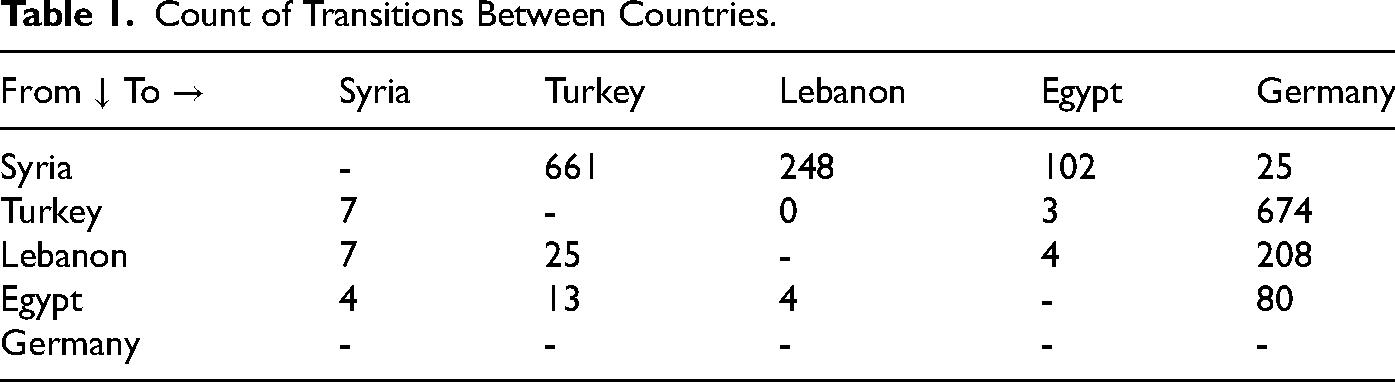
The respondents’ demographic characteristics generally mirror those of the Syrian population in Germany, skewing male (60%) and younger, although the average age in the sample (39) was slightly higher than the German population’s, which may be due to the fact that only adults over the age of 18 were surveyed. The mean number of transitions in the dataset was 2.99 with the most popular occurring between Turkey to Germany (674), Syria to Turkey (661), and Syria to Lebanon (248). Table 1 details the full list of transitions between the countries. By construction, Germany acts as an absorbing state, meaning there are no transitions after arrival. Instances where individuals remain in the same state (e.g., Turkey to Turkey), or “self-loops”, are accounted for through the passage of time spent in each state, which is used to calculate transition intensities and probabilities. This ensures that periods of immobility in addition to mobility are fully incorporated into the analysis.
Count of Transitions Between Countries.
Testing the Markov Assumption
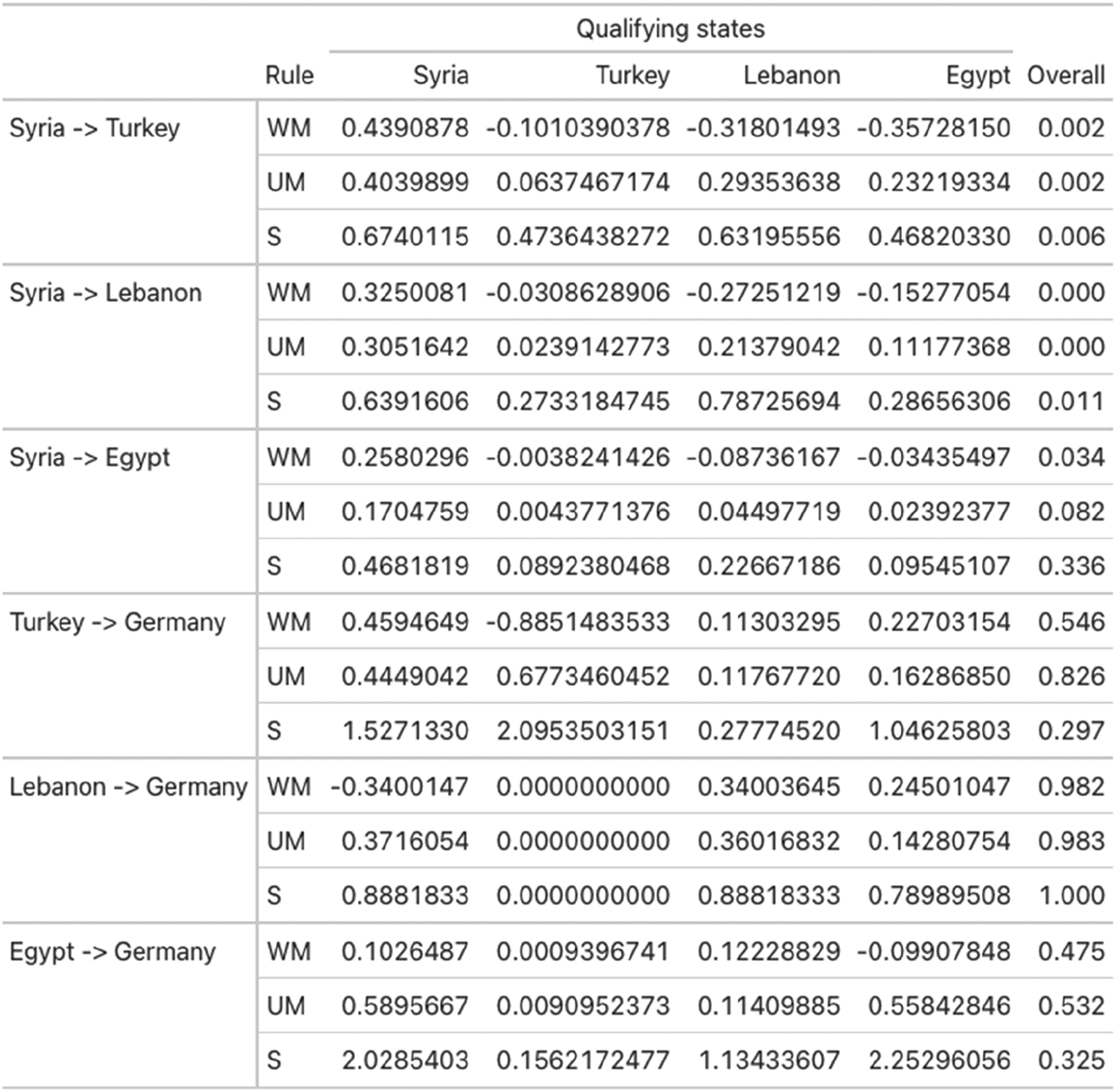
To assess the overall impact of the trajectory—defined as the countries visited, time spent in each country, and the timing of migration events—the analysis starts with the results from the global test with age and gender as covariates. Figure 1 illustrates each of the six transitions of interest plotted by the p-values of their weighted mean and supremum test statistics, which are generally the two more conservative tests (Titman and Putter 2022). The global scores for all transitions and qualifying states can be found in the Appendix. To read the graph, the lower the p-values the stronger the suggestion that the Markov assumption does not hold, meaning the migration exhibits path dependency. Visibly apparent in Figure 1 is the separation of the movements from Syria to Lebanon and Turkey from the rest of transitions. The lower scores for these two routes suggest that the movements are path dependent, meaning the likelihood of migration is conditional on one's previous trajectory. Given that individuals had not yet migrated, the impact of one's trajectory in this case suggests that recent events in Syria influenced the likelihood of migrating to Turkey or Lebanon. While this finding alone is not a novel contribution, it does provide confirmation that the monthly granularity of the data is precise enough to capture the influence of recent events on migration decisions. In contrast, for migrations from Syria to Egypt and from the countries of transit to Germany, there is no substantial evidence of path dependency meaning that individuals were equally likely to undertake these migrations irrespective of their preceding trajectory.
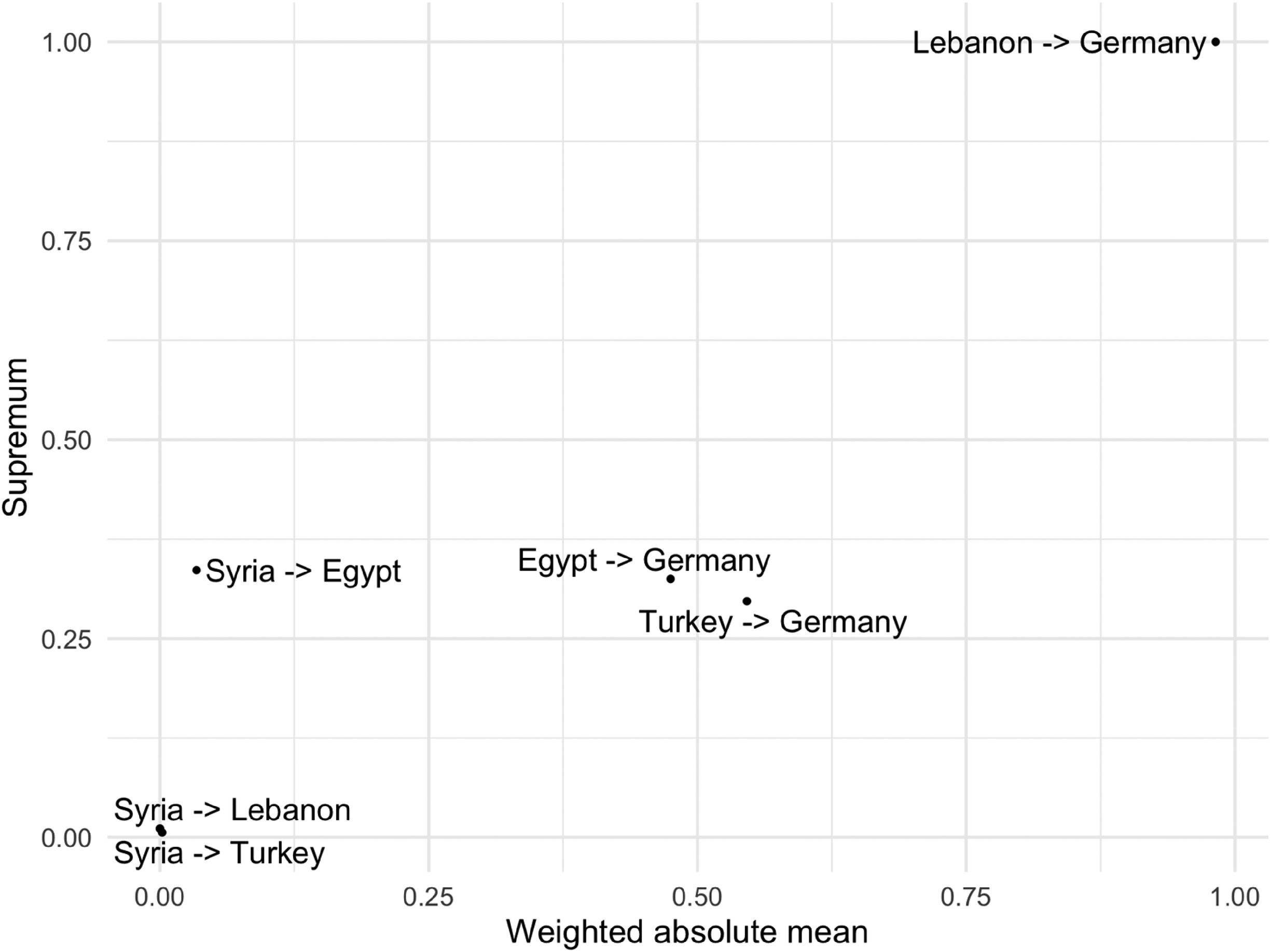
Global test for path dependency.
The findings from the global test suggest that the nature of the destination (location threshold) and difficulty of the route (trajectory threshold) play a crucial role in determining whether migrations adhere to the Markov property. The path dependency observed in initial migrations corresponds to an effect on the indifference threshold, as evidenced by the migrations from Syria to Lebanon and Turkey. In these cases, since migrants have not yet visited or spent time in other countries, the effect of one's trajectory can be interpreted as the influence of recent events in Syria or the timing of the migration that conditions the likelihood of their mobility and influences when they cross the indifference threshold. While Figure 1 indicates evidence of path dependency in the migrations from Syria to Lebanon and Turkey, this effect appears to be moderated by the accessibility of the destination, or negotiation with the location and trajectory thresholds, as evidenced by the adherence to the Markov property in the Syria to Egypt transition. One possible explanation is that the ease of the border crossing from Syria to Lebanon or Turkey facilitates a more reactive migration response, with movement closely tied to immediate events in Syria. In these cases, the effect of one's trajectory indicates that the decision to migrate is influenced more by immediate circumstances and the need for rapid response, leading migrants to opt for more accessible destinations. In contrast, the migration from Syria to Egypt, which lacks accessible land routes, requires significant resources and advanced planning, making the decision to migrate an isolated event influenced more by current capabilities and less by the immediate conditions in Syria. The same principle also holds for the three subsequent migrations where one's trajectory, including the country of transit and the timing of their stay, has no measurable bearing on future migration outcomes, suggesting that the accessibility of destinations and restrictions on ability to move is what drives the adherence to the Markov property. The distinction between where the Markov assumption holds, according to the global test, therefore appears to be a function of destination-specific challenges and resource availability in influencing whether migrations exhibit path dependency.
To explore these dynamics in greater depth, the local test statistics are analyzed, which offer a more pointed temporal perspective on path dependency across different transitions. Figure 2 depicts the local test static for each transition with Syria as the qualifying state. The solid black lines in each panel in Figure 2 depict the log-rank test statistic process from January 2012 to March 2015 for the six transitions. To read the graph, the first 100 wild bootstrap traces depicted by the thin gray lines sit within the pointwise 2.5% and 97.5% quantiles of the wild bootstrap traces and the outer black dots depict the ± 95% quantile of the wild bootstrap replicates of the supremum test statistic. In essence, when the solid black line is outside of the gray shaded area that indicates a departure from Markovianity. Therefore, it appears for the transitions from Syria to Lebanon and Turkey at no point is there evidence in favor of the Markov assumption, meaning path dependency persists throughout the observed period. In contrast, the stability of the test statistic in the second row of Figure 2 indicates that the relatively more complex and resource-intensive migrations from Turkey, Lebanon, and Egypt to Germany consistently adhere to the Markovian behavior for Syria as the qualifying state, meaning time spent in Syria or being in Syria at a particular point in time has no bearing on future movements. Further, the same holds when considering the country of departure as the qualifying state as depicted in Figure A2–4 in the appendix.
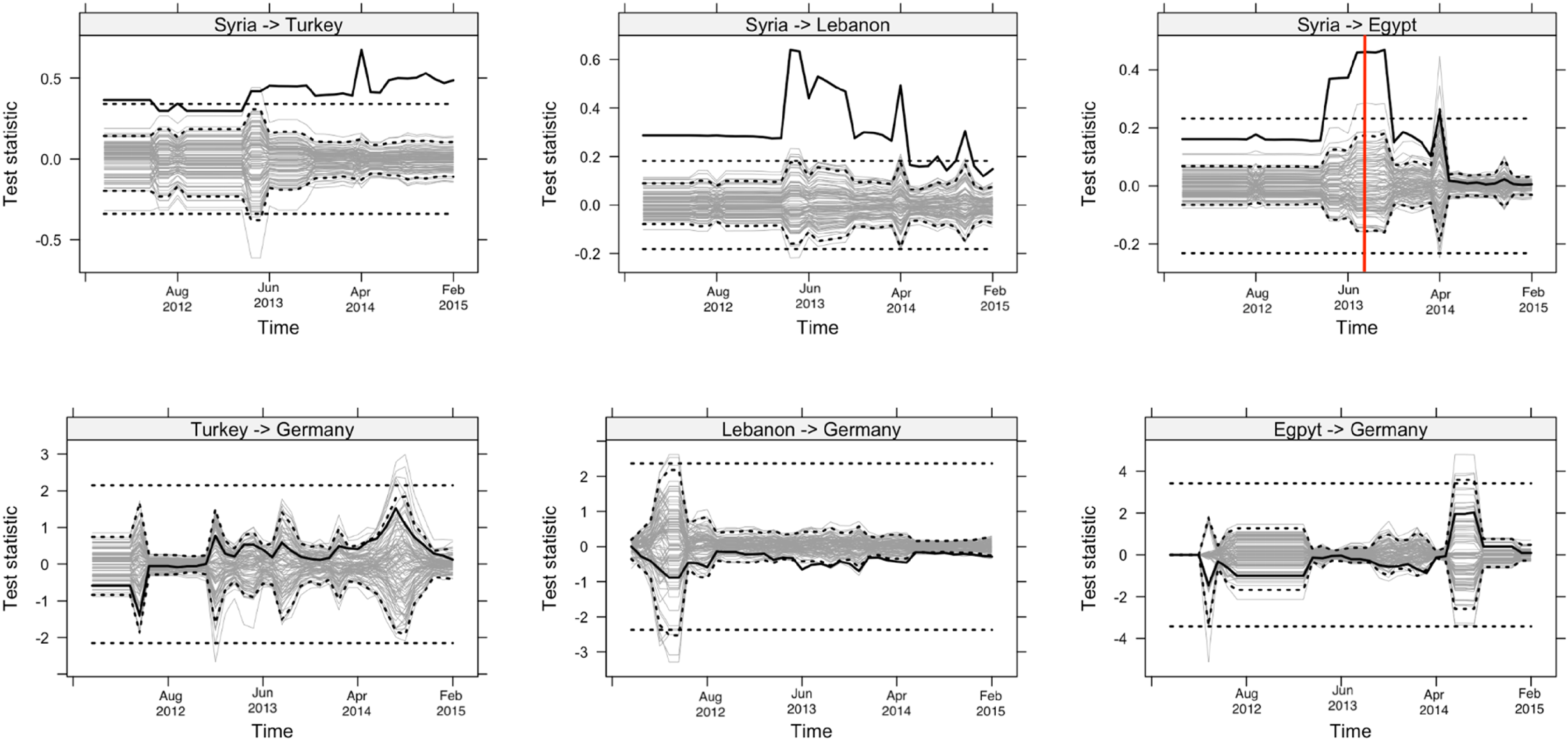
Local log-rank process for each transition with Syria as the qualifying state.
In contrast, the local test reveals that the validity of the Markov property in migrations from Syria to Egypt is not as homogeneous as in the other cases. Consider the top right panel in Figure 2, which displays the local test for migration from Syria to Egypt. The movement of the solid black line, which represents the log-rank test statistic, from outside the bootstrap traces to them indicates that this transition was initially path dependent, similar to migration to Jordan and Turkey, but then switched shapely in late 2013. It then remained path independent after February 2014. This shift from path dependency to independence appears to correlate with exogenous changes, notably the alterations in Egyptian visa policies for Syrians in reaction to perceived security threats. In July 2013, Adly Mansour who led Egypt's interim government enacted tighter border controls and imposed a new visa requirement on Syrians entering the country which marked a significant shift from the previous, more open policy where Syrians could enter the country and stay with only their passport (Rashed 2023). While the new restrictions had immediate effects, namely the refusal of Syrians who attempted to enter the country without the new visa (Amnesty International 2013), the full effect of these changes was not realized until October, when the arrival of Syrians tapered off nearly completely (Baldwin 2013). Additionally, the growing instability in Syria, exacerbated by the acceleration in use of chemical weapons and expansion of ISIS in late 2013 (Wilson Center 2019), further influenced migration trends, compelling Syrians to adapt to rapidly changing conditions and privileged destinations that were able to be accessed with fewer political restrictions. The increased logistical complexity in migration to Egypt combined with the need for more immediate action in response to worsening conditions in Syria effectively altered migrants’ negotiation with the trajectory threshold, as the access to the country became more difficult. This shift suggests that a different calculus regarding destination accessibility—where advanced planning and resources become critical—can affect migration outcomes and path dependency, making the process more regulated and predictable, in line with the characteristics of a path-independent model.
To explore the potential influence of demographic factors, I included age and gender as covariates in the analysis. Specifically, I employed Cox proportional hazards models for each migration transition, incorporating age and gender to assess their impact on the likelihood of moving from one country to another over time. This survival analysis technique effectively handles time-to-event data, allowing for the modeling of the hazard—or risk—of migration at any given time point.
The Cox model provides hazard ratios (HRs), which indicate how the hazard of migration changes with a one-unit increase in the covariate, holding other factors constant. A hazard ratio greater than one suggests an increased risk of migration associated with the covariate, while a hazard ratio less than one indicates a decreased risk. For example, if the hazard ratio for age is 1.02 in the transition from Lebanon to Germany, it means that with each additional year of age, the hazard of migrating from Lebanon to Germany increases by 2%, holding gender constant. Figure 3 presents a forest plot of the hazard ratio estimates along with their 95% confidence intervals for each covariate and transition. Each point represents the estimated hazard ratio, and the horizontal line through the point depicts the 95% confidence interval (CI). The vertical dashed line at HR = 1 serves as a reference point indicating no effect of the covariate on the hazard of migration. If the confidence interval crosses this line, the effect is not statistically significant at the 5% level.
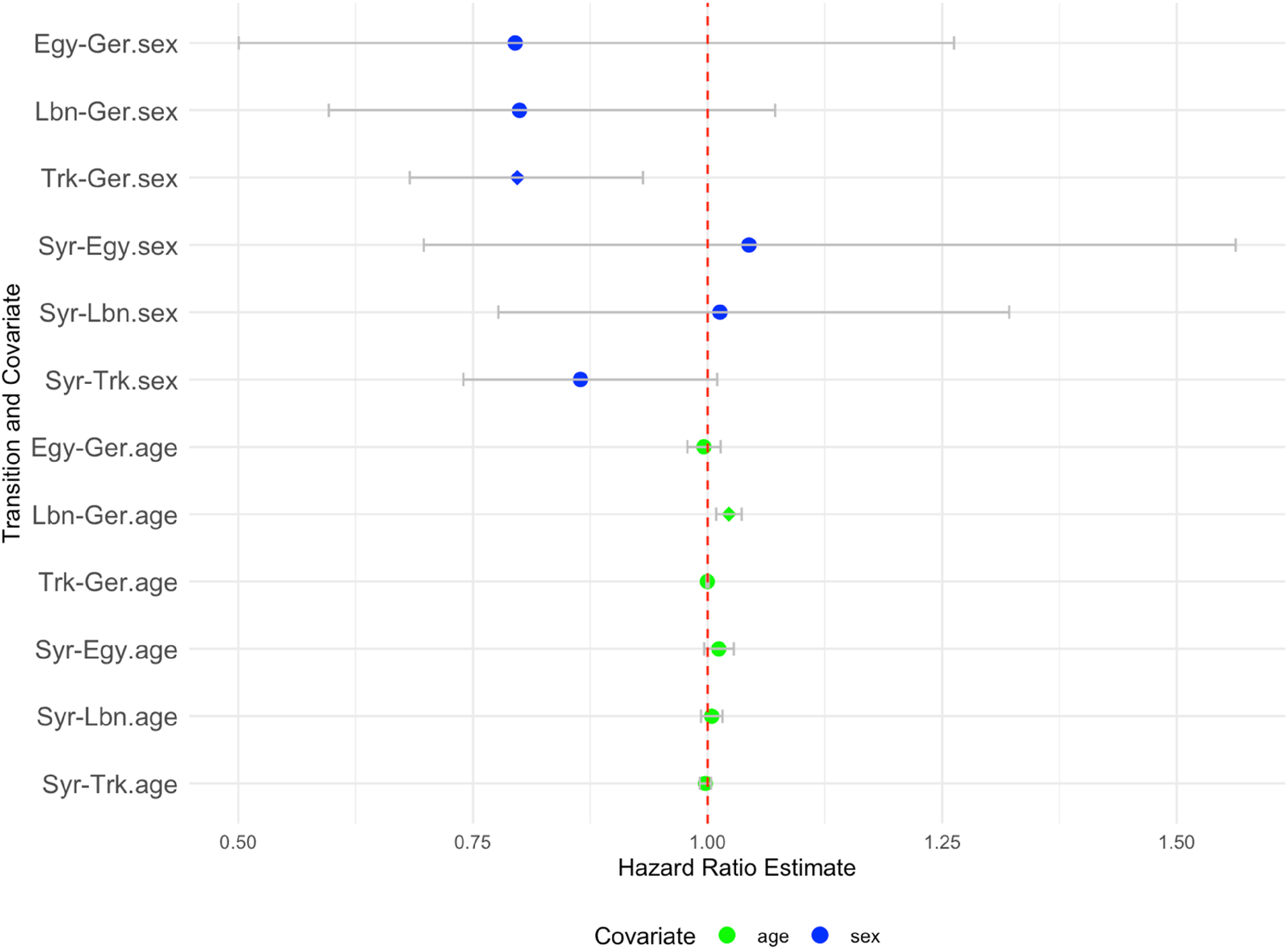
Forest plot of hazard ratios by transition and covariate.
The findings reveal that while some hazard ratios are statistically significant—such as gender in the Turkey-to-Germany transition and age in the Lebanon-to-Germany transition—there is generally no consistent pattern indicating a strong effect of either age or gender on the likelihood of migration. Moreover, given that 12 statistical tests at the 5% significance level were conducted, there is approximately a 46% chance of observing at least one significant result purely by chance (the multiple comparisons problem), suggesting that some significant findings may be due to random variation rather than true effects.
Discussion
Generally speaking, the results indicate that migration adheres to the Markov assumption and is path independent when access to the target destination is constrained or moderated by the difficulty of the route or exogenous factors. In the case of migration to Europe, the constraints were primarily logistical and financial. The rugged terrain and the overland or maritime routes required specific arrangements with smugglers, who are often the only feasible means of transit. These movements necessitate substantial financial outlay upfront, and the decisions involved are typically reactive to immediate possibilities for crossing, rather than current conditions or previous experiences. Similarly, the migration from Syria to Egypt after the visa policy change in 2013 provides another example of path independence induced by policy constraints. The imposition of visa requirements created a strict prerequisite that all potential migrants had to meet, regardless of their prior experiences or the timing of their decision to migrate. Those unable to secure a visa were barred from entry, making any previous plans or routes largely irrelevant. This policy shift made the migration process more regulated and uniform, significantly reducing the influence of individual migrants’ histories on their ability to migrate. The process thus became more about meeting current, external criteria than about following a trajectory shaped by previous stops or experiences.
However, it's crucial to consider some limitations when interpreting the results. First, the sample exhibits a structural selection bias. The fact that all of the respondents in the sample ultimately reached Germany is indicative of the fact that they were able to afford the costly journey to Europe and the desire to do so. While route difficulty influenced migration behaviors within this group, it also acted as a filtering mechanism, excluding those who lacked the resources or motivation to continue. Therefore, when analyzing path dependency in broader populations, it is important to acknowledge that varying levels of route difficulty and accessibility can lead to significant disparities in migration behaviors. For individuals with fewer resources, the results may differ significantly, as more challenging routes might deter migration altogether or result in different migration patterns. This suggests that other trajectories and groups need to be tested individually to accurately assess the validity of the Markov property across different migrant populations, accounting for varying levels of resource availability and route difficulty.
Second, the granularity of the data, which focuses on cross-border migration on a month-to-month basis, limits insight into local migration tendencies. This granularity did not substantially impact the analysis since it was common for migration from Syria to Germany to play out over the course of several months (Pries and Savci 2023). However, this limitation may obscure the full extent of path-dependent behavior, particularly in shorter, intra-national migrations. For these shorter movements, where there are likely lower barriers or restrictions, the initial hypothesis—driven by similarities to the Syria-to-Turkey and Syria-to-Lebanon migrations—is that they may not adhere to the Markov principle. Testing this would however require finer-grained data. Therefore, the results are not generalizable to shorter migrations where the dynamics and constraints can differ markedly.
The findings from this study also have significant implications for the use of the Markov property in models of migration. The results indicate that the assumption of path-independent transitions may hold for some migration routes but not others, depending on the nature of the destination and the difficulty of the route. This suggests that researchers should be cautious when applying the Markov property universally across different migration contexts. It may be necessary to evaluate the Markov assumption on a case-by-case basis, particularly in contexts where external factors, such as policy changes and route accessibility, play a critical role. Further, these findings should be seen as complementary to qualitative work on the topic of migration trajectories and lived experiences by offering a systematic framework to assess when and where external factors, such as policy constraints or logistical challenges, condition migration behavior. In cases like the migration from Syria to Egypt, where the Markov property only partially applies, the use of semi-Markov models may be necessary to capture the nuances of migration behavior. Semi-Markov models can accommodate variations in transition probabilities that depend on both the current state and the time spent in that state, providing a more flexible framework for contexts with mixed adherence to the Markov property.
Conclusion
The findings indicate that while the Markov property holds for longer, logistically complex migrations, such as from Syria to Egypt and the migrations from transit countries to Germany, it fails for more immediate and reactive migrations like those from Syria to Lebanon and Turkey. This distinction underscores the influence of route difficulty and destination accessibility on migration behaviors, suggesting that path dependency is more pronounced in less challenging migrations. The methodology employed in this study is particularly adept for analyzing complex event history data, such as those encountered in studies of forced migration. By segmenting the migration timeline at significant landmarks—points where external influences are likely to alter migration dynamics—the framework allows researchers to assess the independence of future migration steps from past trajectories. The integration of Cox models enriches the analysis by adjusting for covariates that might affect migration transitions, ensuring that the evaluation of the Markov property is conditioned on relevant factors. This comprehensive approach not only tests the memoryless property of migration processes but also provides insights into the factors influencing migration decisions, offering a valuable tool for understanding the complexities of forced migration. By providing a validated approach to test this assumption, the study offers a framework for future research on migration processes.
Footnotes
Declaration of Conflicting Interests
The author declared no potential conflicts of interest with respect to the research, authorship, and/or publication of this article.
Funding
The author received no financial support for the research, authorship, and/or publication of this article.

Notes
Appendix