




Abstract
Millions of children are forcibly displaced worldwide due to wars, civil conflicts, and natural disasters. Displacement disrupts the lives of children making child labor a serious risk. However, little is known about this topic due to the difficulty of finding datasets for this population. In this study, we use a large representative dataset of Syrian refugees in Turkey, the largest refugee group in any single country, to examine the incidence of child labor and its determinants. The incidence of paid work is remarkably high among boys: 18.8 percent of 12–14 year-olds and 48.0 percent of 15–17 year-olds are in paid employment. These percentages are considerably higher than the corresponding values we estimate for pre-war Syria at 7.6 percent and 29.0 percent, respectively. We find that children from poorer households with more dependents and younger, less educated, and female household heads and children living in industrialized regions of Turkey and originating from rural Syria are more likely to work. A key finding is that being older at arrival is highly associated with child labor. Difficulties with school integration, on the one hand, and availability of job opportunities, on the other, have created a group of young out-of-school children at work. Placing these children in vocational training that allows them to work while learning a trade under the scrutiny of the Ministry of Education may help protect their well-being.
Introduction
Globally, the number of forcibly displaced children reached 31 million as of the end of 2018 (UNICEF, 2020). Of these, nearly 14 million are refugees. 1 UNICEF (2020) estimates that while less than 5 percent of adults who live in a country other than where they were born are refugees, this figure reaches a third among children. The single biggest contributor to the recent upsurge in the number of child refugees—a 119 percent increase from 2010 to 2018—is the war in Syria. Since its start in 2011, nearly 6.8 million Syrians—half of whom are children—have had to seek refuge in neighboring countries: Turkey, Jordan, Lebanon, and, to a lesser extent, Iraq and Egypt (UNHCR, 2022). Turkey hosts the highest number of refugees in the world. As of July 2022, there are 3,650,601 Syrian refugees in Turkey, most of whom (98.7 percent) live in non-camp areas (Turkey Presidency of Migration Management, TPMM, 2022). In this paper, we investigate the patterns of child labor among Syrian refugees in Turkey and examine the association between child labor and a rich set of socioeconomic factors using a representative dataset.
Several studies point to a high child labor risk among Syrian refugee children in neighboring countries (UNHCR, 2013; Save the Children, 2015; UNICEF, 2015; Habib et al. 2019; Maadad and Matthews 2020; de Hoop, Morey and Seidenfeld 2019). Moreover, many of these child laborers work in strenuous and exploitative conditions, 2 with significant long-term adverse consequences as reported in the literature. 3 Most of the Syrian child laborers do not attend school; for instance, in Turkey, fewer than 3 percent of child workers aged 12–17 are enrolled in school. Hence, they might be trapped in poverty in the long run. In fact, UNICEF (2014) highlights the risk of a “lost generation” among Syrian refugees.
While extensive literature exists on child labor among local populations, the incidence and type of child labor among refugees could be different for several reasons. First, refugee households are generally much poorer. Fleeing a conflict zone, many refugees leave their physical assets behind. In addition, adult refugees’ labor market outcomes in the destination countries are worse than natives’ in most settings (see, e.g., Brell, Dustmann and Preston 2020, and Demirci and Kırdar 2021). 4 A lower parental income increases the likelihood of child labor. Second, refugee children are typically less likely to be enrolled in school because adjusting to a new schooling system and environment might be difficult. This is substantially exacerbated when the language of instruction is different from that in the refugees’ home country, as in our context, especially for children who arrive at later ages. Closing the schooling gap might be difficult for children who dropped out of school during the conflict and forced migration process. Moreover, the long-term effects of the traumatic events of conflict and forced migration on children's physical and mental health might make school integration even more difficult. Third, in civil war contexts, refugee children are more likely to have deceased parents, exacerbating parental income, and school integration problems. Fourth, refugee households typically have socioeconomic traits other than low income that further increase the risk of child labor, such as less educated and younger parents and many family members.
In our empirical analysis, we use the 2018 Turkey Demographic Health Survey (TDHS), which includes a sample of Syrian refugees (TDHS-S). To the best of our knowledge, this is the first survey that provides a representative sample of Syrian refugees in Turkey and includes a rich set of variables on their socioeconomic characteristics, including information on their migration history and origins in Syria. 5 We use multivariate regression analysis in assessing the association between various individual and household-level factors and children's propensity for paid employment. In addition, we analyze the heterogeneity in these associations by gender and age group (12–14 and 15–17).
We calculate that the incidence of child labor among Syrian refugees is remarkably high among boys. The employment rate of boys aged 12–14 is 18.8 percent, while that of boys aged 15–17 is 48.0 percent. These figures are particularly striking when judged against the employment rate of working-age adult (18–64) Syrian men at 60.1 percent. In comparison, girls’ employment rates are 5.2 percent and 8.5 percent, respectively, for the same age groups. Our analysis of the 2009 Syria Family Health Survey (SFHS-2009) shows that while the incidence of child labor in pre-war Syria was not low (29% among boys aged 15–17), employment rates for all age groups rose significantly after their arrival in Turkey.
Our empirical analysis of the factors associated with child labor shows that refugee children who arrive in Turkey after the age of 8 are much more likely to be employed than early arrivers, which is consistent with the finding of Kırdar, et al. (2021) that age-of-arrival is a critical factor for school integration of refugee children. In addition, it takes about a year after arrival until refugee children enter the labor market in significant numbers. Not surprisingly, higher levels of household wealth and education of the household head are associated with a lower probability of child labor, pointing to the role of poverty in child labor among refugees. Other household characteristics that increase the child labor risk are having a young or female household head and originating from rural areas in Syria. Finally, we find that children living in more industrial regions of Turkey have a higher likelihood of employment.
When we examine the associations by gender, we find that whether or not the father is alive is highly and positively associated with boys’ employment, whereas whether or not the mother is alive is positively associated with girls’ employment—suggesting networking effects as well as work sharing. Another interesting finding is that household composition matters much more for girls’ employment than boys’. In particular, girls’ employment is negatively associated with the number of adult males and the number of elderly individuals in the household. While the former finding suggests that the availability of other wage earners reduces the need for girls to work, the latter finding implies that elderly household members increase the opportunity cost of employment more for girls than boys, given the traditional gender roles. Furthermore, the mother tongue turns out to be highly associated with boys’ paid employment but not girls’. Boys whose native language is Arabic or Kurdish are less likely to be employed than boys who speak Turkish (e.g., the Turkmen from Syria). Finally, in our analysis by children's age group, we find that younger children (12–14 age group) are much more likely to work in households where the head is young or less educated.
Our contribution to the migration and child labor literature is twofold. Firstly, to the best of our knowledge, this is the first study that uses a nationally representative dataset to establish the factors that increase the risk of child labor in the context of the largest refugee group in any single country. Most studies in the literature on forced migration consider their impact on host societies (for a review, see Becker and Ferrara 2019; Maystadt et al. 2019; Ruiz and Vargas-Silva 2013; Verme and Schuettler 2021 and references therein). In contrast, little evidence exists regarding child labor among refugees based on representative data. To the best of our knowledge, the only exception is Krafft et al. (2018). Using the 2016 Jordan Labor Market Panel Survey (JLMPS), they find that only 2 percent of Syrian refugee boys aged 10–14 are employed (compared to 17.4% for boys aged 12–14 in our context). 6 That study, however, does not examine the factors that increase the risk of child labor. Other more localized studies on child labor among refugee children include Meyer et al. (2020) on South Sudanese children in Uganda and Hoque (2021) on Rohingya children in Bangladesh. All report a high incidence of child labor among refugee children. 7
Secondly, we contribute toward building an evidence base for better migration and refugee policy development. We highlight the high child labor risk among refugee children in economies open to child labor, and we demonstrate how poverty and challenges in school integration, particularly concerning children arriving at older ages in the host country, push children to the labor market. We argue and demonstrate that the “lost generation” results from multiple factors, some of which can be avoided with appropriate and timely policy. Our findings also point to the importance of developing apprenticeship programs. Given the high employment rates and the difficulty of school integration of children who arrive at later ages, it is crucial to provide them with skills that ease their labor market integration toward better jobs.
Background Information
The conflict in Syria started in March 2011. By April 2011, the first group of Syrian refugees had already arrived in Turkey. Initially, they were settled in camps along the border with Syria, but as the numbers escalated and the war was prolonged, many moved out of the camps. By the end of 2018, there were 3.6 million Syrian refugees in Turkey, of which 1.6 million were children under the age of 18 and 1.1 million were school-age children (5–17). At the time, less than 5 percent of refugees lived in camps (TPMM, 2022; Refugees Association, 2021). 8 Initially, children in camps were schooled within camp premises with the initiative of camp administrators, which later came under the authority of the Ministry of National Education (MoNE) and turned into Temporary Education Centers (TECs) (Emin 2016). These schools were later opened in off-camp areas as well. TECs followed the Syrian school curriculum and taught in Arabic. 9 In the 2014–2015 school year, Syrian families were allowed to enrol their children in public schools. A gradual transfer of Syrian students from TECs to public schools was also planned. As of the 2019–2020 school year, TECs are closed and the transfer of Syrian children to public schools is nearly complete (MoNE, 2021).
Whether in camps or not, Syrian refugee children and their families receive various types of social assistance. The biggest program geared toward Syrian refugees is the Emergency Social Safety Net (ESSN) program implemented in 2017 under the EU Facility for Refugees in Turkey. The ESSN program is not universal but provides cash transfers to refugee households fulfilling certain criteria. Notwithstanding national and international efforts, poverty remains widespread among the refugee population. Over three-quarters of the Syrian refugee population are in the bottom wealth quantile as measured by the information provided in our main data set.
While children younger than 15 are not allowed to work in Turkey, restrictions exist on the type of work in which 15–17-year-olds can engage. Notwithstanding strict regulations, child labor remains a concern (Dayıoğlu and Kırdar 2022). The most recent Child Labor Survey of TurkStat suggests that 720 thousand native children aged 5–17 were employed in 2019, making up 4.4 percent the child population (TurkStat, 2020). 10 In the same year, 30.8 percent of working children were in agriculture, 23.7 percent in industry and 45.5 percent in services. Totally, 63.3 percent were employed as employees and the rest as unpaid family workers (mostly in agriculture).
Neither Syrian children aged 15–17 nor adults can formally work unless they have a work permit. Until 2016, obtaining a work permit was not possible because, under Turkish law, Syrians fleeing the war were not recognized as refugees but as people under “temporary protection.” A regulation passed in 2016 made it possible for Syrian refugees to obtain work permits; however, certain restrictions exist on their formal employment. 11 Therefore, the number of work permits issued has remained low at 13,290 in 2016, 20,966 in 2017, and 34,573 in 2018—the year of our analysis (Turkish Ministry of Labor and Social Security, 2022). Nonetheless, the TDHS-S data suggest that nearly 60 percent of adult Syrian men work for pay in Turkey, and the overwhelming majority (98.5%) do so informally (Özgören and Aslan 2020). Informal employment, while providing a means of income, pays little. ILO (2021) suggests that Syrian workers work for long hours (over 45 h per week) but earn less than the minimum wage.
The Syrian refugee context in Turkey is similar to that in other developing countries in many respects. First, the overwhelming majority of refugees in Turkey live in urban areas. In this sense, the situation of refugees in Lebanon, Jordan, and Pakistan and Venezuelans in Latin American countries are similar. In contrast, as Clemens, Huang and Graham (2018) have described, refugees generally live in camps in Bangladesh, Ethiopia, and Kenya. Second, refugees in Turkey primarily work in the informal labor market, as do most refugees in low- and middle-income countries. Many studies report high informality rates for Venezuelan migrants in other Latin American countries (see, e.g., Bahar, Dooley and Huang (2018), Delgato-Prieto (2022), and Lebow (2021) for Colombia; Olivieri et al. (2021) for Ecuador; and Shamsuddin et al. (2021) for Brazil). 12
Conceptual Framework
There is growing literature on the impact of labor migration on children's schooling and labor market outcomes, with a particular focus on independent child migrants (Edmonds and Shrestha, 2009). In these contexts, migration is a choice variable similar to the choice of work and schooling. Due to the forced nature of migration in our context, we think of the child's time allocation decision to involve work (economic and household chores), schooling, and leisure, similar to the time allocation choices open to native children. The child will work (and perhaps, also go to school) when the pecuniary and non-pecuniary returns to the chosen activity (or a combination of such) net of pecuniary and non-pecuniary costs are higher than any other activity (see Edmonds (2010) for a formal model).
Although refugee and native children face similar choices, a host of factors are likely to increase refugee children's employment likelihood more decisively. As primary causes of child labor, the literature points to poverty, income shocks, and limited access to schooling. 13 In the early years of the conflict, refugee children may have had limited access to school, given that it took time to design and adopt a systematic approach towards their schooling. At the start, children were given education in Temporary Education Centers that were specifically set up for Syrian refugees. The turning point came in the 2014–2015 school year with their acceptance to public schools. Kırdar et al. (2021) find that once the differences in socioeconomic characteristics are accounted for, no difference exists in the school enrollment of Syrian children who arrive in Turkey at or before the age of eight and native children. The gap, however, persists for refugee children arriving when older. These findings suggest that the refugee-native schooling gap is more to do with integration problems than supply bottlenecks. Children who come at later ages have difficulty integrating into the schooling system due to war-induced interruptions in schooling, frequent changes in place of residence, and the language barrier.
Poverty and adverse income shocks are likely to force Syrian refugee households to use child labor as a coping mechanism. 14 In the seminal work of Basu and Van (1998), children work only when household income falls below the subsistence level. 15 In their theoretical contribution, multiple equilibria are possible. If adult wages are low so that household income falls below the subsistence level, children are put to work. If adult wages are high enough, only adults work. Many Syrian households suffered dramatic declines in their wealth and income, having lost their immovable assets to the war or left them behind and had to quit their income-generating activities. Furthermore, most Syrian adult workers are employed in the informal sector for low wages, partly due to legal restrictions on their formal employment. This means that they not only have lower earnings but also face higher income shocks due to the precarious nature of their jobs. Labor market-related shocks adversely affecting adult household members also increase children's employment risk (Duryea, Lam and Levison 2007). Moreover, the paid employment rate of Syrian women (ages 18–64) in Turkey, estimated at 5.8 percent in 2018, is low, which further increases the risk of (male) child labor. 16
Children's agency is often ignored in economic models where the decision on their time use is often assumed to be made on their behalf by their parents. This is likely true for young children but not necessarily for adolescents. Older Syrian children—particularly boys—may find it easier to impose their preferences to drop out of school and enter the labor market in a situation where the head of the household (often the father of the child) is no longer able to provide for the household. 17 This is likely to be particularly true in labor markets open to child labor.
On the demand side, the low productivity levels of small-scale establishments in Turkey (Taymaz, 2009) and their low-profit margins generate demand for child labor who can be employed informally at much lower wages than adults. Using the 2018 THLFS, we calculate—for workers in the informal sector—that the monthly earnings of 15–17-year-old children compared to adults (18–64-year-olds) is 36 percent lower among males and 27 percent lower among females. In addition, Aksu et al. (2022) find that the arrival of refugees lowered wages in the informal sector relative to wages in the formal sector—raising the demand for informal workers. The arrival of refugees also increased the establishment of new small firms in the refugee-dense regions (Akgündüz et al. 2020)—raising the demand for informal workers as small firms in Turkey are more likely to employ workers informally.
The long tradition of apprenticeship in Turkey, where children who drop out of school are placed by their families in small establishments so that they can learn a trade, also creates a demand for child labor. Although apprenticeship is highly regulated and children can only become an apprentice once they turn 15 (and complete at least lower secondary education), weak enforcement and monitoring result in the exploitation of children.
Data and Empirical Methodology
The data comes from the Syrian Migrant module (2018 TDHS-S) of the 2018 Turkey Demographic and Health Survey (TDHS). Representative of the Syrian population in Turkey, TDHS-S covers 1,826 refugee households residing both in and outside camps. The sampling frame relies on the refugee registration system maintained by the Presidency of Migration Management (TPMM). 18 A multi-stage stratified sampling is used in the selection of sample households. The response rate is 95 percent (HUIPS, 2019). We mainly rely on the TDHS-S for empirical analysis but also use the 2009 Syria Family Health Survey (SFHS) as a complementary data set to provide background information on Syrian children before the onset of the war.
The 2018 TDHS-S collected considerable information on the demographic and socio-economic characteristics of sample households, including the paid employment status of household members aged 12 and over. 19 Since our target group consists of children, we restrict our sample to 12–17-year-olds. The 2018 TDHS-S includes 1,460 children in this age group. As the vast majority of Syrian refugees migrated to Turkey with their families, the number of unaccompanied children is minimal.
The 2009 SFHS is a nationally representative household survey conducted as part of the Pan Arab Project for Family Health (PAPFAM). Apart from detailed demographic information on all household members, the 2009 SFHS provides information on children's employment and schooling status, allowing for an assessment of their situation preceding the war. The total number of children aged 12–17 is 17,941.
In analyzing the correlates of child labor using our main data set, the 2018 TDHS-S, we use a linear probability model where the dependent variable is paid employment among refugee children. In line with the child labor literature, we consider individual and household characteristics of children as the main determinants. Individual characteristics include the age and gender of the child, the child's relationship to the household head, age at arrival and number of years since arrival in Turkey, mother tongue (Turkmen, Arabic, Kurdish, other), place of birth (province center, district center, and sub-district/village) and the province of birth. Household characteristics include household wealth, household age and sex composition, survival status of mother and father, and sex, age, and education level of the household head. Household wealth is constructed using ownership of household assets. 20 We, then, generate deciles of wealth using both refugee and native samples. 21 Deciles higher than five are combined under the fifth decile because of the low number of cases in these deciles. The household composition variables include all in logarithmic form (log(x+1)): 22 number of adult men and women (aged 18–59), number of elderly (above 65) and number of children [(i) under age 7, (ii) aged 7–14, (iii) aged 15–17]. We also include regional controls (at the NUTS-1 level) and controls for the location type (urban and camp).
Since direct controls for the employment status of family members—which are jointly determined with children's employment—would be endogenous, we account for the potential workers using the number of family members in various age groups. For the same reason, we do not include direct controls for children's schooling status.
Apart from estimations for the whole sample, we conduct separate analyses for girls and boys and for younger (aged 12–14) and older (aged 15–17) children. Since more than one child may come from the same household, we cluster the standard errors at the household level. In addition, we use the sampling weights throughout the analysis.
Descriptive Statistics
Figure 1 shows paid employment rates in panel (A) and school enrollment rates in panel (B) for Syrian children in Turkey, based on the 2018 TDHS-S, and Syrian children in Syria before the war, based on the 2009 SFLS. Since the Syrian refugees in Turkey disproportionately originate from northern Syria, we weigh the province averages in Syria by the share of refugees in Turkey originating from each Syrian province based on birth-province information.
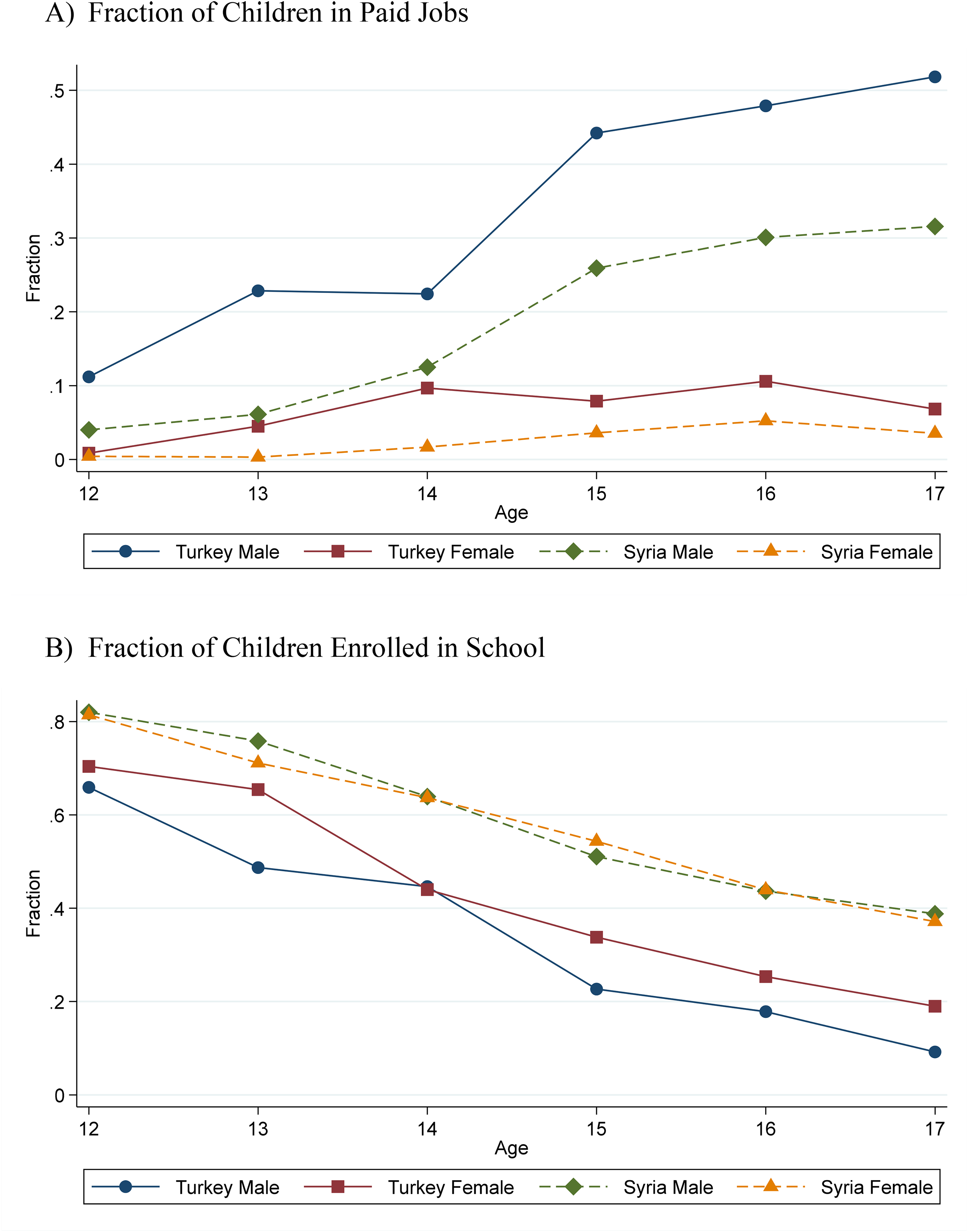
Fractions of Syrian Refugee Children in Paid Employment and in School in Turkey (2018 THDS-S) and in Syria before Arrival (2009 SFHS). Notes: The data for Turkey come from the Syrian Migrant module (2018 TDHS-S) of the 2018 Turkey Demographic and Health Survey and the data for Syria come from the 2009 Syria Family Health Survey (SFHS). The data for Syria is weighted according to the distribution of origin provinces of Syrian refugees in Turkey.
Panel (A) of Figure 1 shows that Syrian refugee boys are more likely to be employed in Turkey than in Syria at each age. While the same is valid for girls, the gap is much smaller. For instance, among 15–17-year-olds, the paid employment rate is 29 percent for boys and 4.2 percent for girls in Syria but 48.0 percent for boys and 8.5 percent for girls in Turkey. Panel (B), on the other hand, shows that it is less likely for Syrian boys and girls to be in school in Turkey than in Syria. While school enrollment drops with age, irrespective of whether children live in Turkey or Syria, sharper decreases are recorded in Turkey, particularly for boys. Among 15–17-year-olds, 43.9 percent of boys and 44.8 percent of girls attend school in Syria, but the corresponding rates are 16.4 percent for boys and 25.2 percent for girls in Turkey. Note that the enrollment and schooling rates in Syria that we use as a benchmark come from the year 2009. Assuming that secular developments would have increased schooling and reduced child labor over time, the gaps we are showing in Figure 1 are likely to be underestimated. We must also note that our data pre-dates the COVID-19 pandemic, which might have caused further adversities in the lives of refugee children. 23
Panels (A) and (B) also suggest a correlation between school drop-out and employment take-up among boys in Turkey. Whenever a sharp drop occurs in school attendance, we observe a sharp rise in employment (see, for instance, those aged 12–13 and 14–15). No such correlation is observed among girls. As girls drop out of school, they do not appear to be entering the labor market in large numbers. We also observe that only a tiny fraction of refugees in Turkey (8 of 1,460 children) are enrolled in school and also have paid jobs. This is also the case in Syria, where the overwhelming majority of children in paid employment (nearly 97%) do not attend school.
A potential concern in the interpretation of Figure 1 is that Syrian refugee children in Turkey and children in Syria before the war might not be comparable if a selection exists in the migration decision to Turkey. We examine this possibility using the 2009 SFHS and the 2018 TDHS. In particular, we check how the educational attainments of Syrian adult refugees and adults in Syria before the war compare. We follow the same birth cohorts in the two datasets due to their different survey years. In addition, since Syrian refugees in Turkey are more likely to be from the northern part of the country, we weigh the provincial means of educational outcomes in the 2009 SFHS by the origin-province distribution of Syrian refugees in Turkey. The results in Appendix Table A1 show that younger cohorts of refugees are slightly positively selected in terms of education and older birth cohorts are slightly negatively selected. Overall, the two groups are similar in terms of education.
Table 1 presents the basic descriptive statistics based on the 2018 TDHS-S separately for the total sample and employed children. 24 Refugee children in our sample are, on average, 14.3 years old. Their mean age at arrival is 10.5, with over three-quarters arriving after age 8. Totally 95 percent of children have been in Turkey for at least a year or longer, with an average stay of 3.9 years. On the other hand, employed children are about a year older and arrived in Turkey when 11.5 years old but have been in Turkey for about the same number of years as the average child. Although female children constitute nearly half of all children, they make up only 15 percent of working children.
Descriptive Statistics on Refugee Children.
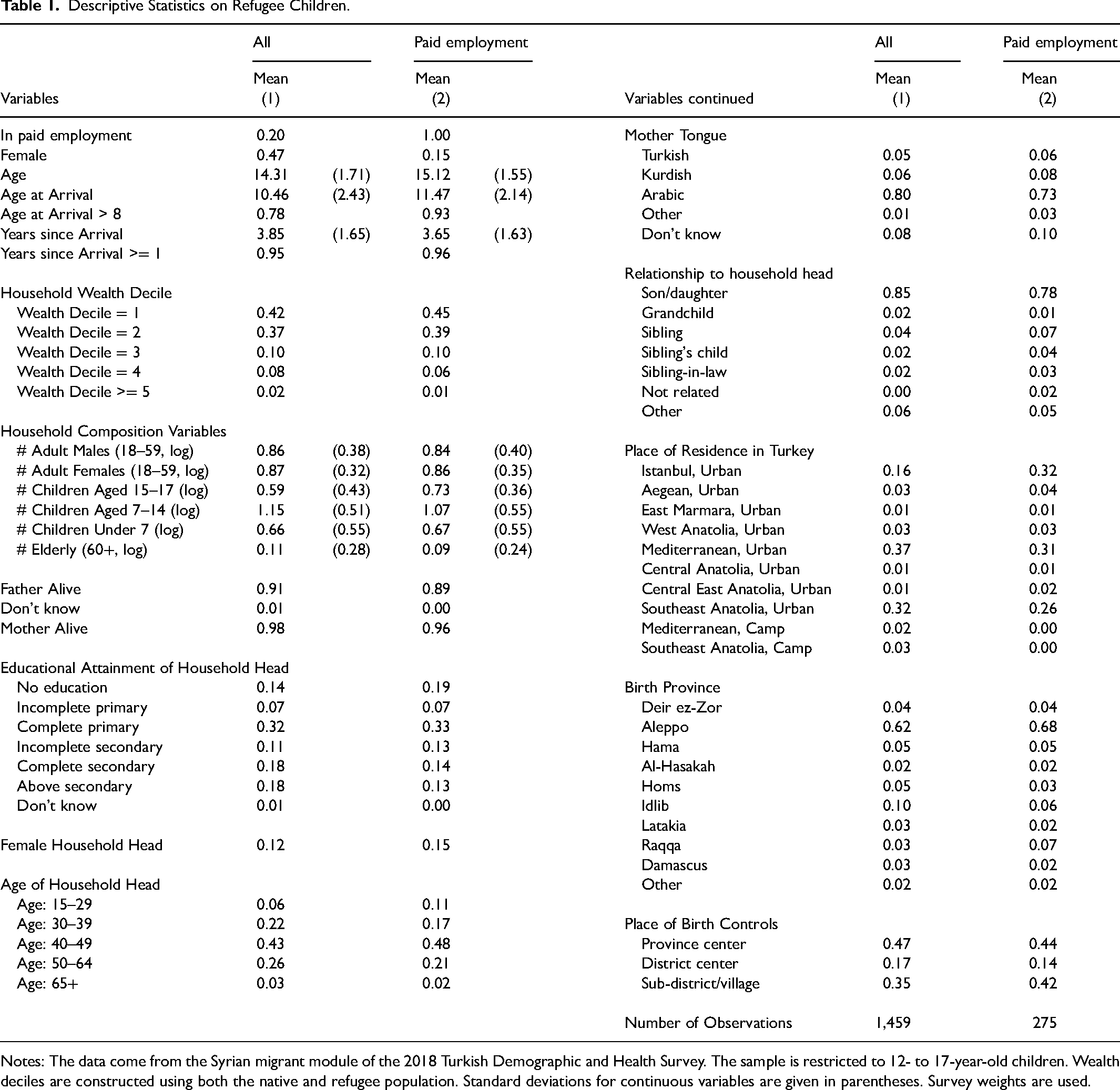
Notes: The data come from the Syrian migrant module of the 2018 Turkish Demographic and Health Survey. The sample is restricted to 12- to 17-year-old children. Wealth deciles are constructed using both the native and refugee population. Standard deviations for continuous variables are given in parentheses. Survey weights are used.
The average size of a Syrian household in our sample is 8. On average, the household head is 44.3 years old and has 6.6 years of education. The human cost of the war is apparent from the fact that nearly 10 percent of children's fathers are deceased. The proportion who have lost their mother is 2 percent. Working children come from more crowded households, where the head is younger and less educated. A slightly higher proportion of working children have experienced a maternal or paternal death. The mother tongue of 80 percent (73%) of children (employed children) is Arabic. For the rest, it is mainly Kurdish or Turkish. The majority of children (85%) are sons and daughters of the household head, although this proportion is slightly lower (78%) among working children. We do not observe any child in our dataset who is unrelated to the household head. Judged based on the wealth index, 45 percent of working children and 42 percent of all children are in the bottom decile.
The distribution of Syrian households across Turkey is not even. Refugees are mainly clustered in three regions: Southeast Anatolia (32%), the Mediterranean (34%), and Istanbul (16%). Their concentration in Southeast Anatolia and the Mediterranean can be explained by the proximity of these regions to the Syrian border. Indeed, the birthplace of nearly three-quarters of refugee children is either Aleppo (62%) or Idlib (10%), both of which share a border with Turkey. Istanbul, on the other hand, is a megacity with diverse job opportunities. It boasts the highest proportion of employed children (32%). It must also be noted that the movement of Syrian refugees across Turkish provinces is restricted and subject to the permission of the TPMM. Syrian refugees who change their province of residence without authorization cannot benefit from public services or assistance.
Determinants of Child Labor
All Children
We present the estimation results in Table 2 for four different specifications, which differ primarily by how age at arrival and years since arrival are specified. Due to perfect collinearity between age, age at arrival, and years since arrival, using all three variables requires restrictions. Therefore, we use age and age-at-arrival dummies in the first specification and age and years-since-arrival dummies in the second specification. The results on age-at-arrival and years-since arrival dummies (provided in Figure A1 of the Appendix) show that controlling for age, children who arrive after age 8 have a higher likelihood of employment than those who arrive at an earlier age and children who are in their first year of residence in Turkey are less likely to be employed than those with longer duration of residence. Therefore, we generate an indicator variable for age at arrival that takes the value of one for those who arrive after age 8 and zero otherwise and an indicator variable for years since arrival that takes the value of one after one year in Turkey and zero otherwise. The restrictions imposed on the combined structure solve the perfect collinearity problem, and we use both indicator variables as well as age dummies in specification three. The fourth specification adds control variables for place and province of birth to specification three.
Determinants of Child Labor.
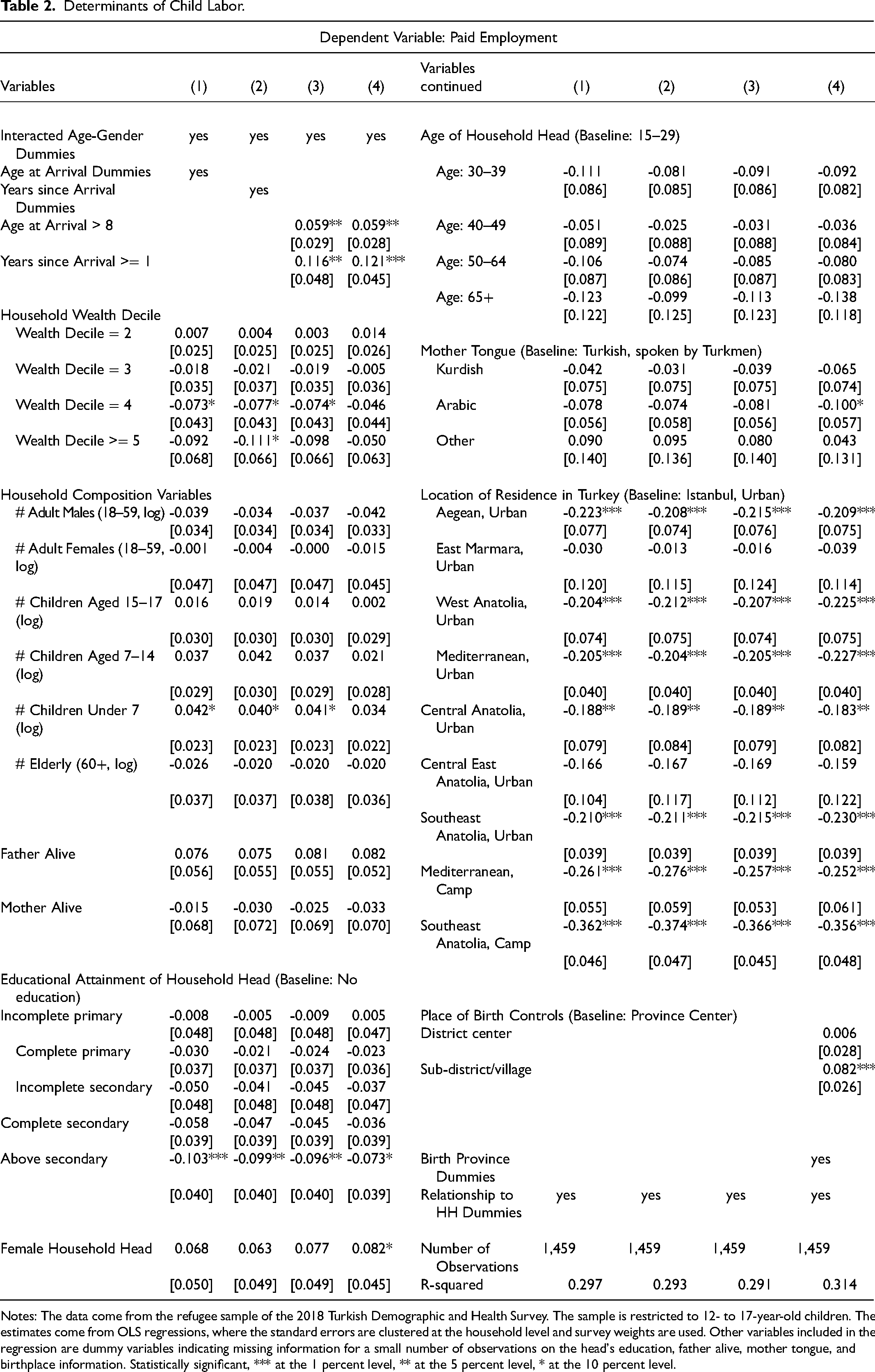
Notes: The data come from the refugee sample of the 2018 Turkish Demographic and Health Survey. The sample is restricted to 12- to 17-year-old children. The estimates come from OLS regressions, where the standard errors are clustered at the household level and survey weights are used. Other variables included in the regression are dummy variables indicating missing information for a small number of observations on the head's education, father alive, mother tongue, and birthplace information. Statistically significant, *** at the 1 percent level, ** at the 5 percent level, * at the 10 percent level.
Table 2 shows that children who arrive after age 8 are 5.9 percentage points more likely to be engaged in paid work than those who arrive at age 8 or earlier. This finding is likely to result from differences in children's school enrollment by age at arrival. 25 Examining the factors that explain native-refugee differences in school enrollment, Kırdar et al. (2021) find that (controlling for several background characteristics) refugee children who arrive at or before age 8 display no differences in school enrollment than native children. In contrast, refugee children who arrive later lag behind primarily because they never enroll in school and when they do, they tend to drop out. In terms of years since arrival, Table 2 indicates that refugee children are about 12 percentage points less likely to be in paid work in their first year of residence than in later years. This is expected as it takes time for refugees to acclimatize to their new surroundings and find jobs. Age-by-gender effects (provided in Figure A2 of the Appendix) display similar patterns to those in Figure 1, even after controlling for other variables. The gender employment gap becomes remarkable at higher ages; for instance, among 17-year-olds, boys are 40 percentage points more likely to work than girls.
The dummy variables for household wealth deciles in Table 2 indicate that children living in households with higher wealth are less likely to participate in paid employment. The negative coefficient for the fourth wealth decile is statistically significant at the 10 percent level (after accounting for several variables that are correlated with wealth, such as the age and education level of the household head). While the coefficient of the dummy for the fifth and higher deciles of wealth is either marginally significant or not statistically significant at conventional levels, the magnitude of the coefficient is larger than that of the fourth wealth decile. Including the place of origin variables (specification 4) reduces the magnitude of the wealth indicators and their statistical significance, although our qualitative result that children are less likely to be employed in wealthier households still holds. The place of origin information is likely to capture some of the variations in economic well-being among refugee households.
In terms of household composition, only the number of children under age 7 is associated with the paid employment of 12- to 17-year-old children. Each child under age 7 is associated with a 4–4.2 percentage point rise in paid employment. This suggests that a higher dependency ratio in the household raises the need for older children to work as a coping mechanism. When the father is alive, the coefficients are consistently positive and large in magnitude but marginally statistically insignificant at conventional levels. The positive coefficients suggest network effects for children in finding work discussed in more detail below.
Table 2 also shows that children's paid work monotonically decreases with the household head's education level. Children in households where the head has attained education beyond secondary school are about 10 percentage points less likely to be in paid jobs than children in households where the head has no education. Suggestive evidence (either marginally statistically insignificant or weakly statistically significant) exists that children's paid work is more likely when the household head is female. In terms of the age of the household head, compared to the baseline group of young household heads (aged 15–29), heads in other age groups are less likely to have children working. While this is not statistically significant at conventional levels, the coefficient magnitudes are large. Table 2 also indicates that children whose mother tongue is Arabic or Kurdish are less likely to have paid jobs than children whose mother tongue is Turkish. The evidence for this finding is weaker, though, as the coefficients are either statistically significant at the 10 percent level or marginally statistically insignificant. Potential explanations can be the poorer language skills of Syrian children of Arab or Kurdish origin or employers’ preference towards children of Turkmen origin.
Table 2 further indicates that living in the two most industrial regions of the country (Istanbul and Eastern Marmara) is associated with a much higher likelihood of refugee children working in paid jobs. Moreover, this association is quantitatively large. Refugee children in these two regions are 20–30 percentage points more likely to be in paid jobs. This finding can be explained by higher job opportunities for children in these regions and the sorting of refugee families with a higher propensity toward child labor into these regions. As noted earlier, the movement of refugees across Turkey is highly restricted. Therefore, the relatively high job availability in these regions is likely to be the main explanatory factor for the higher child labor risk in Istanbul and the surrounding areas. Finally, characteristics of the origin region in Syria also matter in children's employment. Children originating from villages have an 8.2 percentage point higher probability of holding a paid job compared to those from province centers. As discussed below, this result is mainly driven by girls’ behavior.
Results by Gender
Table 3 provides the estimation results for separate samples of boys and girls. Several variables affect the employment probability of boys and girls similarly; however, the magnitude of the effects is higher for boys due to their higher levels of paid employment. These variables are household wealth, female household head, and region of residence in Turkey. The patterns of the associations of these variables with paid employment for both girls and boys are similar to those reported in the previous section for the total child population.
Determinants of Child Labor by Gender.
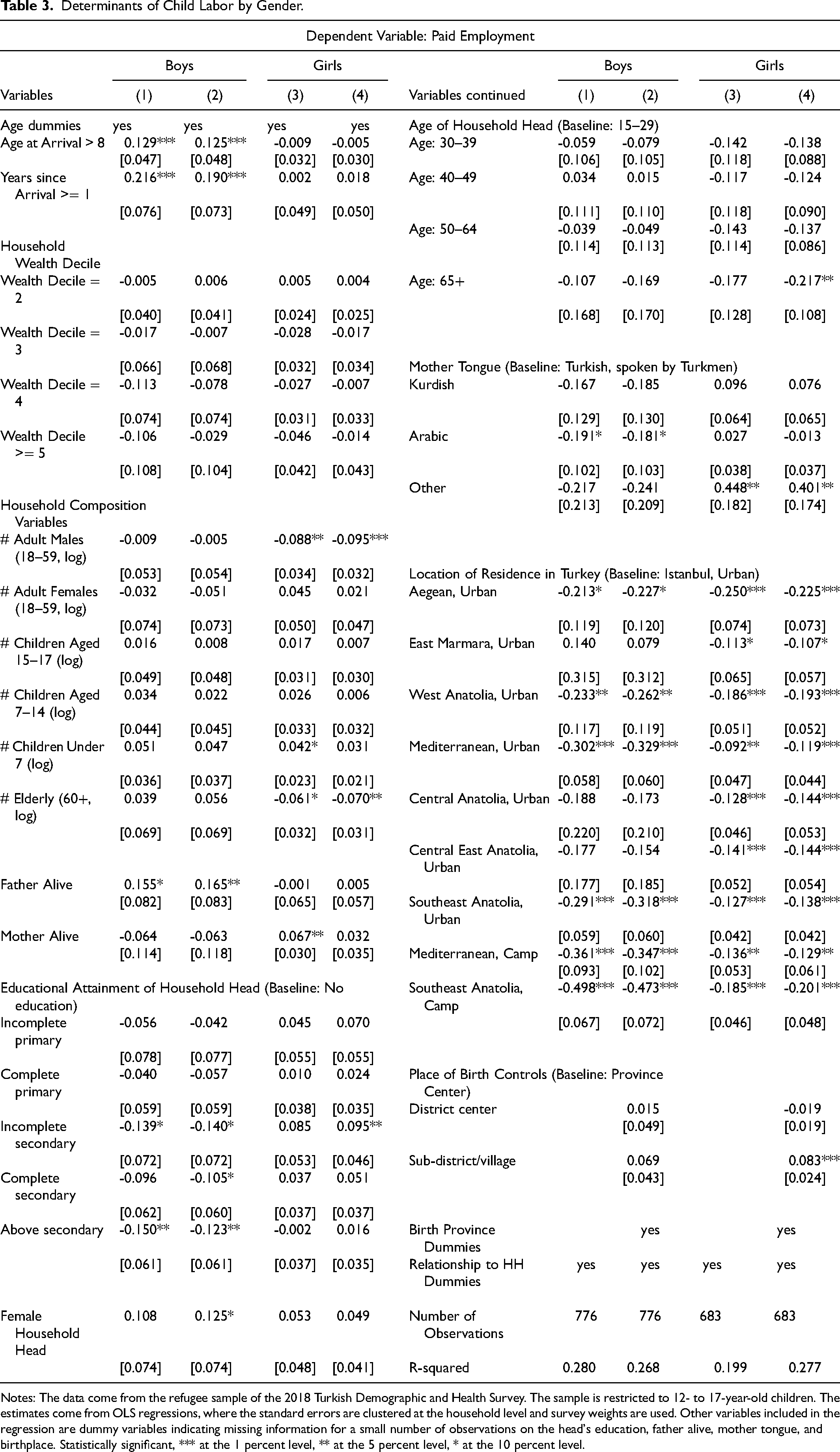
Notes: The data come from the refugee sample of the 2018 Turkish Demographic and Health Survey. The sample is restricted to 12- to 17-year-old children. The estimates come from OLS regressions, where the standard errors are clustered at the household level and survey weights are used. Other variables included in the regression are dummy variables indicating missing information for a small number of observations on the head's education, father alive, mother tongue, and birthplace. Statistically significant, *** at the 1 percent level, ** at the 5 percent level, * at the 10 percent level.
For some variables, however, the association with paid employment is much stronger for boys than for girls. These include age at arrival, years since arrival, father alive, education level of household head, and mother tongue. Age at arrival and years since arrival have almost no effect on girls. In contrast, the likelihood of paid employment is about 13 percentage points higher for boys who arrive after age 8 than boys who arrive younger. Unlike the findings for the total sample and for boys, 26 the education level of the household head does not seem to matter for girls’ employment. In addition, compared to boys whose mother tongue is Turkish, Arabic-speaking and Kurdish-speaking boys (but not girls) are less likely to be in paid employment. In fact, Arabic-speaking boys are 18–19 percentage points less likely to be in paid employment than Turkish-speaking boys. 27
While the father being alive matters for boys’ employment, the mother being alive matters for girls’ employment. Boys are almost 15 percentage points more likely to work when their fathers are alive and girls are about 7 percentage points more likely to work when their mothers are alive. Parental death may affect children via various channels that include psychological and economic well-being. In the absence of adequate safety nets, loss in income due to parental death may drive more children to the labor market. Emotional trauma, on the other hand, may bring about school failure, increasing school dropout. That we observe the presence and not the absence of parental death to increase children's employment and the gendered nature of the effect suggests networking effects as well as work sharing; it is likely that boys work in the same workplace with their fathers and girls with their mothers. For girls, the mother's presence in the household may also mean that there is less demand for their time at home, freeing them for paid work.
Some variables, on the contrary, matter more in girls’ paid employment than boys’. An interesting one is household composition. The existence of adult males is associated with a lower employment probability for girls but not for boys. In fact, each adult male is associated with about a 9 percentage point drop in the employment probability of girls. In other words, the availability of adult laborers matters for girls’ but not for boys’ employment. Similarly, the existence of the elderly in the household is associated with a lower probability of girls’ paid employment. This is expected because, in the traditional separation of work by gender, care work falls more heavily on girls, increasing the opportunity cost of paid work more for girls than boys. The results also indicate that when the household head is young (aged 18–29), the probability of employment rises more for girls than for boys. Having a young household head may imply lower household earnings, as earnings typically rise in the early part of the life cycle, requiring children's wage employment regardless of gender. Similarly, originating from villages in Syria increases the employment probability more for girls than boys, which can be explained by the more widespread child labor practice in rural areas and, therefore, such households’ greater acceptance of employment among girls.
Results by Age Group
Since Figure 1 shows highly different employment rates for the 12–14 and 15–17 age groups (especially for boys), we conduct our analysis for these age groups separately, the results of which are given in Table 4. For several variables, the patterns of the associations with paid employment are similar for the two age groups, as discussed in the main findings. These variables include age at arrival, years since arrival, household wealth, female headship, mother tongue, region of residence in Turkey, and village status of the origin region in Syria. Note that, for these variables, the magnitudes of the associations are higher for the older age group as the levels of paid employment are higher.
Determinants of Child Labor by Age Group.
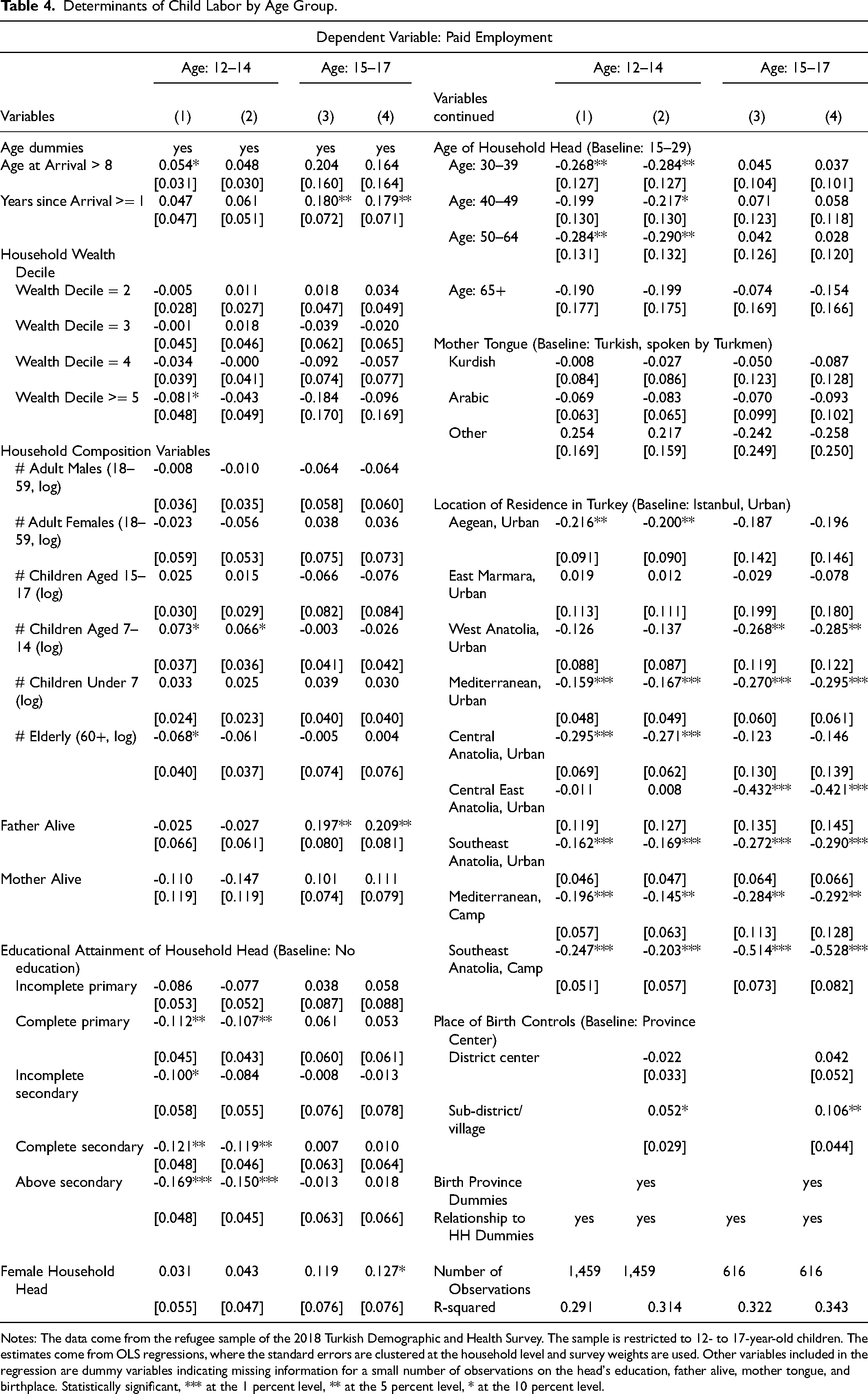
Notes: The data come from the refugee sample of the 2018 Turkish Demographic and Health Survey. The sample is restricted to 12- to 17-year-old children. The estimates come from OLS regressions, where the standard errors are clustered at the household level and survey weights are used. Other variables included in the regression are dummy variables indicating missing information for a small number of observations on the head's education, father alive, mother tongue, and birthplace. Statistically significant, *** at the 1 percent level, ** at the 5 percent level, * at the 10 percent level.
The association of some variables with paid employment, however, is stronger for the younger age group. First, the existence of the elderly in the household has a negative association with paid employment of younger children but not older children. This might suggest that while younger children help care for the elderly, older children enter the labor market. Second, the education level of the household head is strongly associated with younger children's paid employment status, whereas it almost does not matter for older children. Among younger children, those whose heads have above secondary education are 15–17 percentage points less likely to be in paid employment than those whose heads have no education. Third, young household heads are a much higher risk factor for younger children than older children. Quantitatively, when the household head is below 30 years of age, the employment probability of 12- to 14-year-olds is at least 20 percentage points higher. The only factor that matters more in older children's employment probability is whether or not the father is alive. This factor is associated with a 20 percentage point rise in the employment probability for older children.
Determinants of Child Labor in Syria
Using the 2009 SFHS, we also examine the determinants of child labor in pre-war Syria primarily to see how they compare to the determinants of child labor in Turkey. The covariates we use are similar to those described above except those pertaining to the migration history of children, which are not relevant, and the mother tongue and survival status of parents, which are not available in SFHS. In place of regions of Turkey, we use regions in Syria and the wealth index available in the data. The descriptive statistics and regression results are given in Appendix Tables A2 and A3, respectively. The results suggest that the determinants of paid employment in Turkey and Syria are broadly similar and the effects are in the expected direction. 28
A striking difference, however, relates to the considerably stronger negative effect of household head education on children's paid employment probability in pre-war Syria than in Turkey. The risk that children work in Syria decreases monotonically with higher schooling credentials of the household head (Appendix Table A3). Compared to children in households where the head has no education, children in households where the head has secondary or even primary education have a lower incidence of paid work. In Turkey, however, compared to children in households where the head has no education, only children in households where the head has an education level above secondary school have a lower child labor risk (Table 2). For older children (15–17-year-olds) in Turkey, the household head education does not reduce the risk of child labor. The difficulties adult Syrians face in access to the formal labor market and in getting their credentials recognized in Turkey are the possible reasons behind these observations, which, in turn, reduce parents’ ability to protect their children.
Discussion and Conclusion
In this paper, using representative micro-data, we examined child labor among the largest refugee group in a single country. We find that Syrian refugee children in Turkey have a remarkably high probability of paid employment: 48.0 percent of 15- to 17-year-old and 18.8 percent of 12- to 14-year-old boys are in paid employment. Although the corresponding rates among girls are lower—5.2 percent among 12- to 14-year-olds and 8.5 percent among 15- to 17-year-olds—they are nonetheless significant.
Our examination of the correlates of child labor among refugee children suggests that Syrian households use child labor as a coping mechanism. Although the employment rate among adult men is high, they work informally in precarious and low-paying jobs. Syrian women's labor market participation is traditionally low, but their employment rate in Turkey is even lower than the pre-war level in Syria. In the absence of labor supply adjustment on the part of adult women, high poverty rates push children into the labor market. Our finding that children who arrive in Turkey after age 8 have a higher likelihood of paid employment suggests that integration difficulties at school contribute to the factors that push children into paid work. Child labor among refugees is also positively associated with living in industrialized regions in Turkey, originating from villages in Syria, having Turkish as a mother tongue, and having a female, young, or less-educated household head. Children whose parents have survived the war also have a higher employment probability.
The remarkably high child labor levels for refugees in Turkey are also potentially alarming for other refugee contexts. As discussed earlier, refugees in many other countries face similar conditions; these include Syrian refugees in Jordan and Lebanon, Venezuelan refugees in other Latin American countries, and Afghan refugees in Pakistan. Many studies, though not with a nationally representative dataset as we have, also report a high incidence of child labor and low schooling for refugees in these countries (Bahar, Ibáñez and Rozo 2021; Save the Children, 2022; Habib et al. 2021, Hoque 2021; Meyer et al. 2020; Summers, Crist and Streitwieser 2022).
In contrast, using a representative sample, Krafft et al. (2018) report a low prevalence of child labor among Syrian refugees in Jordan. Several factors may explain the gap. Firstly, the language barrier is not present for Syrian refugees in Jordan, which probably helped ease their school integration. Secondly, the labor market in Jordan is not as open to child labor as it is in Turkey. The Child Labor Survey of Jordan conducted in 2007 suggests that only 2.1 percent of native 5–17-year-olds are employed (including unpaid family work, own-account work, and wage work). The employment rate is 2 percent among 12–14-year-olds and 7 percent among 15–17-year-olds (ILO, 2009).
We find that poverty, which refugees in all these contexts face, is one of the key risk factors. Therefore, improving the labor market status of refugee adults and financially supporting them would be essential in reducing refugee households’ reliance on child labor as a coping mechanism. In terms of the Basu and Van (1998) model, such an improvement would trigger a move from a ‘bad’ equilibrium, where both children and adults work, to a ‘good’ equilibrium, where only adults work. The Emergency Social Safety Net (ESSN) Program implemented in Turkey—the largest humanitarian program for refugees in the world—is an important initiative for improving the living conditions of refugees. The high child employment rates we observe occur despite this program, which reduces child labor significantly (Aygün et al. 2021). Our results suggest ways to improve the targeting of this program. Observable characteristics of refugee households, such as the educational level and age of the household head, their origins in Syria, and the age composition of children at arrival, which are highly associated with child labor and observable to the benefactor, could be included as part of the ESSN criteria.
Keeping children in school keeps them out of the labor market (Guarcello, Lyon and Rosati 2008; Dayıoğlu and Kırdar 2022). However, school integration of refugees is a major hurdle for developing countries with limited capacity. Although capacity constraints were not an issue in Turkey, slow policy response and the language barrier were. In particular, school integration of older children who have been out of school for some time and cannot speak Turkish has been a significant issue. Our findings highlight the importance of developing special schooling programs for children who arrive at a later age.
The expansion of the conditional cash transfer program in 2017 to include refugee children was an important policy change to improve children's school retention rate. For older child refugees (ages 15–17) who are already out of the schooling system, the Vocational Education and Training Program (VET) of the Ministry of Education can be a viable option. 29 Children who participate in this program are placed in establishments where they can learn a trade while attending school one day a week. With recent amendments made to the relevant law regulating vocation training (Law no. 3308), successful completion of the program leads to a high school diploma. However, enrolling in VET requires that children have at least completed lower secondary school. For refugee children who dropped out earlier, remedial courses can be offered so that they can at least finish secondary school by taking external exams.
The current high rates of child labor in Turkey among a refugee population where 46 percent are under 18, as well as the strenuous and exploitative conditions they frequently find themselves in, have worrisome long-term adverse implications for these children. As noted earlier, the growing evidence from around the world suggests that Syrian refugee children's experiences in Turkey are not unique. The risk is a lost generation of children with low human capital. It also implies the potential failure to integrate the host and refugee populations and the risk of future social conflicts. In the case of Turkey, this is highly important as the protracted nature of the Syrian war makes their return to Syria unlikely. Therefore, a concerted effort is needed to improve the lives of refugee children, particularly those who had to leave school prematurely and enter the world of work. The continued support of international bodies is essential in financing some of the special programs suggested to bring about a swift change in children's lives and avoid backlash in public sentiment against refugees.
Supplemental Material
sj-docx-1-mrx-10.1177_01979183231171551 - Supplemental material for The Making of a “Lost Generation”: Child Labor among Syrian Refugees in Turkey
Supplemental material, sj-docx-1-mrx-10.1177_01979183231171551 for The Making of a “Lost Generation”: Child Labor among Syrian Refugees in Turkey by Meltem Dayıoğlu, Murat Güray Kırdar, and İsmet Koç in International Migration Review
Footnotes
Acknowledgements
We thank the editor, Holly Reed, and three anonymous referees, Murat Demirci, Maissam Namer, and İnsan Tunalı, as well as the participants of the Syria Migration Workshop at Hacettepe University and the Social Citizenship and Migration Program lecture series at Leiden University for their valuable comments and suggestions. Kirdar gratefully acknowledges financial support from the European Commission, MSCA-IF-2020 Global Fellowship, Project 101024877. The usual disclaimer holds.
Declaration of Conflicting Interests
The author(s) declared no potential conflicts of interest with respect to the research, authorship, and/or publication of this article.
Funding
The author(s) disclosed receipt of the following financial support for the research, authorship, and/or publication of this article: Kirdar gratefully acknowledges financial support from the EuropeanCommission, MSCA-IF-2020 Global Fellowship, Project 101024877.

Supplemental Material
Supplemental material for this article is available online.
Notes
References
Supplementary Material
Please find the following supplemental material available below.
For Open Access articles published under a Creative Commons License, all supplemental material carries the same license as the article it is associated with.
For non-Open Access articles published, all supplemental material carries a non-exclusive license, and permission requests for re-use of supplemental material or any part of supplemental material shall be sent directly to the copyright owner as specified in the copyright notice associated with the article.
