




Abstract
The digitalization of professions and the new modes of (remote) work have resulted in an increase in work-related lifestyle mobilities such as digital nomadism. This paper deals with the meanings and configurations of digital nomadic work as recounted by digital nomads themselves. What meanings do digital nomads attach to digital nomadic work? What spatial or other configurations does digital nomadic work entail? What does the examination of meanings attached to digital nomadic work and its configurations tell us more broadly about the rising phenomenon of work on the move? The study data come from qualitative interviews with twenty digital nomads in Mallorca, Spain (2021–2022) and from observation in co-working and co-living spaces, networking meetings, and informal get-togethers. Although the nomads often described digital nomadic work as the opposite to traditional and classical nine-to-five office work, I argue that it should not be approached as such. The study findings show that despite expressing a strong anti-office sentiment and describing digital nomadic work as a way to escape “traditional office work,” digital nomads paradoxically end up “mimicking” and replicating the organizational aspects of office-based work. A closer examination of digital nomadic work's spatial configurations further shows that it has distinct temporal, material and performative dimensions, which is why it deserves analysis in its own right. More research is needed on the paradoxical aspects of digital nomadic work for us to understand whether digital nomadism, as a precursor to work-related mobilities, speaks of broader trends in mobile, digitalized work.
Introduction
Digital nomadism is an example of emerging lifestyle mobilities and the changing nature of work in the post-industrial context. It results from the past decades’ global developments, namely digitalization, economic accumulation, more general freedom of movement for (some) individuals, the increase in knowledge-based economies, and the so-called “gig economy” (Cohen, Duncan, and Thulemark 2015; Benson and Osbaldiston 2016; Kannisto 2016; Thompson 2021). In this paper, I understand digital nomadism as a work-related form of lifestyle mobility that is the result of mobile subjects (digital nomads), who frequently and multi-transitionally cross national borders, staying for different lengths of time in different states and traveling between them—without the intention to return to their country of birth (Cohen, Duncan, and Thulemark 2015; Müller 2016; Hannonen 2020).
Digital nomadism already existed well before COVID-19 (Makimoto and Manners 1997; Schlagwein 2018), but the recent pandemic-induced changes in work practices and the meanings attached to work have had an impact on digital nomadism, the extent of which, however, remains largely unresearched. The post-pandemic context has been characterized by an increase in remote work opportunities and jobs, particularly in sectors of knowledge work but also in “traditional” jobs, that is, not only in freelancing and the IT-sector (MBO Partners 2024). The MBO Partners’ State of the Independence report (2024), titled Nomading Normalizes in 2024, states: “The COVID-19 pandemic has had the single most significant impact on the growth and makeup of digital nomads” (4).
Cohen and Stanik (2021) claim that the main bulk of the existing research on digital nomadism has unsurprisingly treated the thematic of work. The nexus of work and digital nomadism has been approached in the form of work practices (Nash, Jarrahi, and Sutherland 2021; Bonneau, Aroles, and Estagnasié 2023), through case studies on co-working spaces (Lee et al. 2019; Orel 2019; Chevtaeva and Denizci-Guillet 2021) and through examining how nomads balance work and leisure (Reichenberger 2018; Orel 2019; Thompson 2019; Cook 2020). Scholars have also shown how digital nomads describe the meaning of digital nomadic work as an escape from office-based jobs (Müller 2016; Mancinelli 2019). The narrative of the “freedom” to determine where to work, live and travel forms the core of the digital nomad imaginary (Mancinelli 2019), although the reality of “location independence” has proven to be more complex (Thompson 2018; Mancinelli 2019; Cook 2023). Theoretically, studies of digital nomadic work have focused on the specific spatial configurations it entails by studying co-working spaces (Aroles, Granter, and de Vajauny 2020; Nash, Jarrahi, and Sutherland 2021; Aroles, Bonneau, and Bhankaraully 2023; Bonneau, Aroles, and Estagnasié 2023), or on its virtual dimensions and new technologies as enablers of digital nomadic work (Fabbri and Charue-Duboc 2016; Sutherland and Jarrahi 2017; Lee et al. 2019; Orel 2019).
This paper builds on this body of literature to examine digital nomadic work. It tackles the following questions: What meanings do digital nomads attach to digital nomadic work? What spatial or other configurations does digital nomadic work entail? What does the examination of the meanings attached to digital nomadic work and its configurations tell us more broadly about professional lives on the move? The analyzed data consisted of ethnographic fieldwork, that is, qualitative interviews with 20 digital nomads of various nationalities in Mallorca, Spain (2021), and of observation in co-working spaces, informal get-togethers, and other events of relevance. The findings show that digital nomads describe digital nomadic work as a way to escape “traditional office jobs” and express a strong anti-office sentiment to this effect. However, the ethos of freedom stands in contrast to the reality of digital nomadic work, which entails specific spatial, temporal, material, and performative dimensions. A closer examination of such configurations shows that paradoxically, digital nomads end up “mimicking” certain aspects of office-based jobs when arranging their work practices. Therefore, I argue that digital nomadic work should not be approached as a mere opposite to traditional and classical nine-to-five office work and that it deserves analysis (and theorization) in its own right. Future studies could address how the configurations of mobile, digitalized work differ—but potentially also imitate—the classical office-based modalities of work.
The paper proceeds as follows: I first discuss digital nomadism as evidence of the rise of the mobile workforce, then move on to the theoretical discussion. This is followed by a description of the methodology, and finally, I present the analysis and discussion.
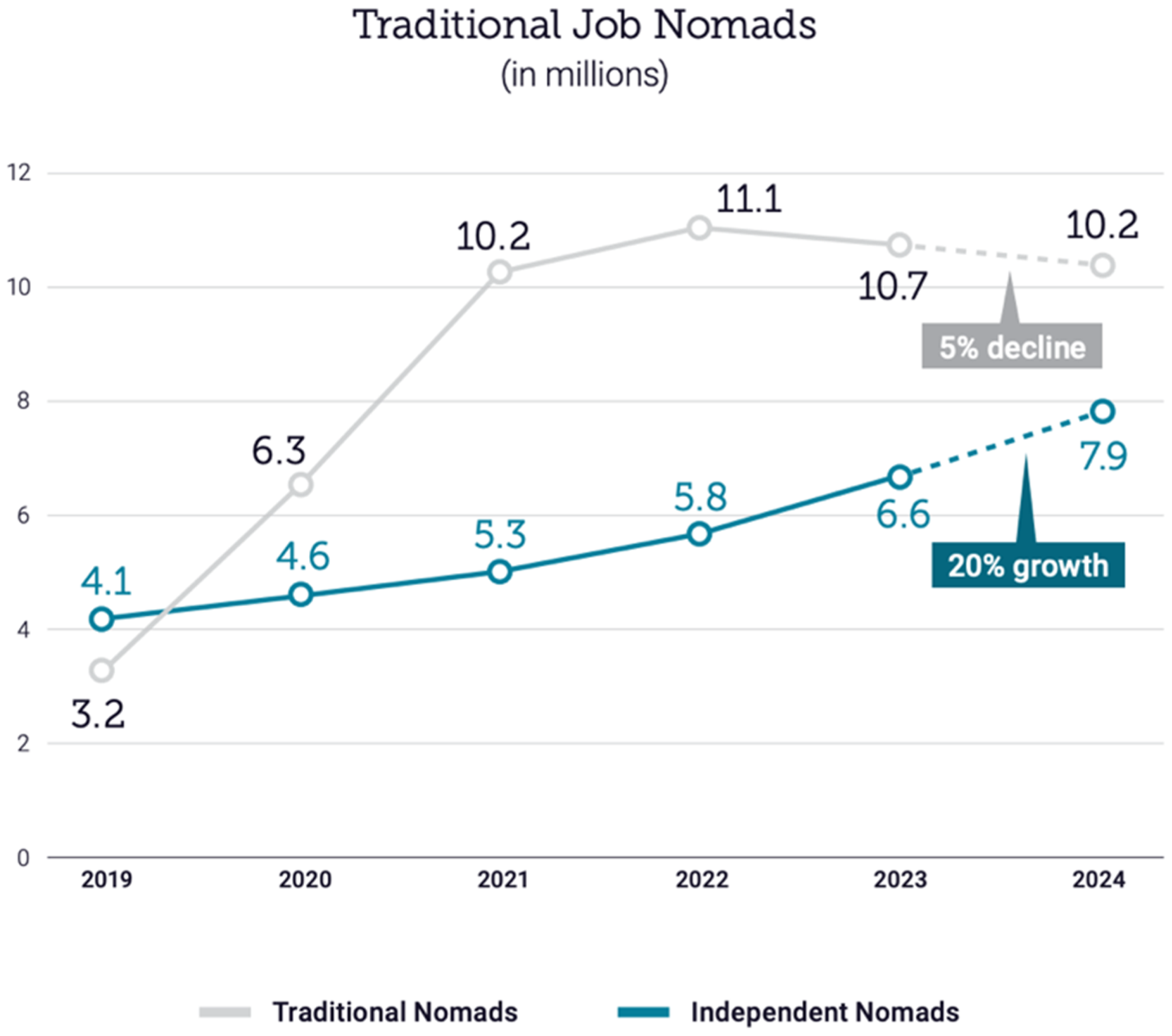
Traditional job nomads (in millions).
The Context: Digital Nomads and the Rise of the Mobile Workforce
Already in 1997, Makimoto and Manners predicted that the number of digital nomads would grow because of technological developments in the new millennium. The authors linked the phenomenon to the rise of new technologies that would revolutionize the world of work and lead to more workers becoming mobile. Digital nomadism became a more mainstream phenomenon in 2014–2015, following the emergence of dedicated online communities, a growing number of events targeted at digital nomads, and an increase in the number of co-working spaces (Schlagwein 2018). This is not to say that the phenomenon did not exist prior to 2014–2015. For instance, Tim Ferris’ book, The Four Hour Work Week: Escape 9-5, Live Anywhere, and Join the New Rich (2007), contributed to the popularization of digital nomadism. It presented the idea of escaping the nine-to-five work week and becoming financially independent by harnessing the benefits of greater purchasing power in Global South destinations, while receiving salaries from Global North countries, a practice referred to as geoarbitrage.
More recently, aspects such as digitalization, economic accumulation, more general freedom of movement for (some) individuals, the increase in knowledge-based economies, and the so-called “gig economy” have all facilitated the increase of lifestyle mobilities, including digital nomadism (Cohen, Duncan, and Thulemark 2015; Benson and Osbaldiston 2016; Kannisto 2016; Thompson 2018). Digital nomadism inscribes to the broader transformations taking place in flexible work and work-from-anywhere practices becoming more common, a trend that was already visible well before the pandemic (Izak, Reissner, and Shortt 2023; Voll, Gauger, and Pfnür 2023). Digital nomadism is also an example of the overall increase in work-related mobilities in the post-pandemic context, alongside diverse forms of “workationing” (Voll, Gauger and Pfnür 2023).
Nevertheless, the COVID-19 pandemic and what has been named the “revolution of remote work” played a major role in shaping digital nomadism. For instance, the MBO Partners report (2024, 5) shows that the number of so-called “traditional job nomads” rapidly increased during the pandemic year and slightly declined after 2023 due to back-to-office policies, whereas the number of “independent nomads” has steadily grown since 2019 (see Graph 1). It is important to make the distinction between “corporate nomads” (company-employed) and independent nomads (freelancers, contractors) because they face different time constraints and geographical limitations that shape their travel opportunities and work practices (see Cook 2023; Estagnasié and Bianco 2023; Marx et al. 2023).
Over the past decade, digital nomadism has become increasingly commodified. This is visible in the number of services, such as co-working spaces, offered specifically to digital nomads (Toivanen 2023). Lee and colleagues (2019) suggest that co-living and co-working spaces have facilitated the parallel expansion of the digital nomad lifestyle. The number of co-working spaces has increased rapidly: in 2005, there were allegedly three co-working spaces in the world, whereas in 2022 the estimated number of co-working spaces was 18,700–19,400 globally (Ones 2022; Statista 2023; Zippia 2023). This trend is part of the rapid development of the digital nomad infrastructure (DNI) that has taken place in the last decade (Toivanen 2023). The DNI refers to “services and infrastructures, both pre-existing and emerging, and offered by both public and private sector actors that digital nomads make use of to lead a mobile lifestyle” (Toivanen 2023, 74). Several such services and infrastructures are aimed at accommodating digital nomads’ work-related needs and enable them to work while on the move (e.g., digital nomad visa schemes, nomad insurance programs, co-working spaces). In other words, this infrastructure affords certain labor arrangements by providing the material conditions for flexible work.
Simultaneously, digital nomadism has received abundant media attention as a form of hyper-mobility, portrayed as the extreme form of freedom. Digital nomads are often presented as escaping the shackles of traditional office work and as trading their sedentary jobs for a life on the beach. Research has also shown that digital nomads associate their lifestyle choice with an ethos of freedom (Mancinelli 2019). However, it seems that the ethos of working from wherever, whenever, does not entirely correspond to the reality of the digital nomad lifestyle (Mancinelli 2019; Nash, Jarrahi, and Sutherland 2021; Thompson 2021; Cook 2023). Often presented as the opposite to traditional nine-to-five corporate and office-based jobs, both by nomads themselves and popular media discourse, previous literature shows that digital nomadic work does not always align with the narratives of “freedom” and “location independence” fostered by digital nomads.
Configurations of Professional Lives on the Move
Spatialities have been studied in the context of organizational work. For instance, Halford (2008, 927) argues that “Enter any work organisation and we are, necessarily, engaged in complex spatialities: engaged with the meanings, materialities and bodily performances embedded in and produced by these organisations of space and spatialities of work.” Drawing from Henri Lefebvre's theory of space, who suggests that spatiality is produced through practices, planning and imagining, Taylor and Spicer (2007, 335) in turn identify three dimensions of organizational space: “the practices of distance and proximity; the planning of spatialized power relations; and the imagined experiences.” These all come together in a social space through the different scales that exist in and around organizations, that is, spatial levels (micro, meso, macro), which are relational and in which social activity takes place. What happens to work when this physical spatiality is no longer present, at least not in the same way as in office-based work? What structures digital nomadic work when the individuals engaging in such work operate outside organizational premises?
As a form of work-related hyper-mobility, digital nomadism provides an excellent case for delving more deeply into the configurations of professional lives on the move and the broader trend of the normalization of working across transnational geographies. In this paper, digital nomadic work is understood as digitalized labor that is performed in a multi-local, geographically flexible manner and that enables mobility as a lifestyle choice (Nash et al. 2018, 2021). Digital nomads are conceptually distinguished from remote workers more broadly (Thompson 2019), but also from mobile workationers, professional expatriates and mobile digital workers, whose lifestyle choices are not characterized by a permanent or continuous state of traveling (Bonneau and Enel 2018; Voll, Gauger, and Pfnür 2023). This conceptual distinction is important, as digital nomads’ mobility inscribes into travel patterns that have specific spatial and temporal characteristics (Bozzi 2024). For instance, the MBO Partners’ report (2024, 11) shows that digital nomads spent 5.7 weeks on average in one destination and traveled to 6.6 destinations in 2024. This may influence the spatiotemporal dynamics in working patterns, routines and overall work arrangements in comparison to other kinds of work-related mobilities that might include returning to the office. Adjectives such as location-independent, free and hyper-mobile are used to describe the digital nomadic lifestyle. The digitalized labor in the context of digital nomadic mobilities, however, is not free from the surrounding physical and social world and its structures, constraints and normativities in the way that the popular imaginary of digital nomadism would suggest.
Previous research on nomads’ work practices (Nash, Jarrahi, and Sutherland 2021; Aroles, Bonneau, and Bhankaraully 2023), their usage of co-working spaces (Lee et al. 2019; Orel 2019; Chevtaeva and Denizci-Guillet 2021), and the nexus of remote working and mobilities more broadly (Cohen, Duncan, and Thulemark 2015; Hermann and Paris 2020; Thompson 2021) suggests that digital nomadic work inscribes into specific spatiotemporal configurations, as part of the broader work-from-anywhere trend (Voll, Gauger, and Pfnür 2023). However, Nash and colleagues (2021) suggest that due to the prominent role of technology in digital nomadic work, the emphasis on “space” has, indeed meant virtual, digital spaces. Countering the presentation of digital nomads as being entirely location-independent, Nash and colleagues (2021) show how digital nomads are dependent on digital infrastructures, technologies and on finding suitable spaces to work. In their study on the relationship between workspaces and work practices, the authors showed that the physical, as well as the material space, plays a significant role in digital nomadic work. The question of materiality relates directly to infrastructure, as spaces offer “resources for human action” (Halford 2008, 935). One example of this are co-working spaces, which offer a physical/material space (Fabbri and Charue-Duboc 2016), a social space (Lee et al. 2019) and digital/information infrastructure (Sutherland and Jarrahi 2017; Nash, Jarrahi, and Sutherland 2021) for digital nomads and are, thus, part of the larger DNI that enables material and social conditions of leading a digital nomadic lifestyle (Toivanen 2023).
Digital nomadic work is shaped by the availability of digital and material infrastructures (such as an internet connection) and suitable working spaces, but also by temporal constraints. Indeed, another major theme in previous research has been the difficulty in maintaining the boundary between work and leisure and how to timewise decide on a working pattern throughout the day (Reichenberger 2018; Orel 2019; Thompson 2019; Cook 2020). Studies that touch upon the temporal dimension of digital nomadic work point toward the observations made by Estagnasié (2023) in her study on how remote workers (including digital nomads) (re)create their workspace by “working the time.” By this, she refers to “the actions carried out on the initiative of individuals to dedicate time to work—for example, blocking time in a calendar” (188) and approaches it as a form of metawork—work that makes working possible. This is reminiscent of Aroles and colleagues’ (2023) observation on the distinctiveness of digital nomads’ metawork activities. Indeed, the authors suggest that metawork is made purposely invisible, to create an image of professionalism and reliability (for metawork, see also Salzman and Palen 2004).
Methodology and Data
The data consist of ethnographic fieldwork conducted by the author, i.e., qualitative interviews with twenty digital nomads of various nationalities. The interviews were conducted in Majorca, Spain (October 2021–January 2022). Majorca was chosen as a fieldwork site as it had a prominent number of digital nomads during the winter of the data collection. The island went through lockdown in early 2021 and the state of emergency was extended to May 2021. Once the travel restrictions in countries such as Germany and the United Kingdom eased in the spring of 2021, the island experienced a major surge in the number of tourists and likely in the number of digital nomads (Majorca Daily Bulletin 2021). Concerning the temporal and geographical specificities of the digital nomad community in Majorca, several interviewed nomads described how they had planned to travel to South-East Asia, but due to the ongoing pandemic restrictions and the insecure global situation, they had opted to remain within the European Union. Most of the interviewed nomads were, indeed, European Union nationals. The data also included field notes based on observation in co-working space, cafés, informal get-togethers and observation conducted at other smaller events for digital nomads, including skill-sharing sessions. The digital nomads who took part in this study were identified through snow-balling sampling (through recommendation by other nomads), via the observed events, and digital nomad Facebook and WhatsApp groups. The interviews were conducted in English (with one exception in Finnish).
The interviewed digital nomads had diverse professional, nomadic and other backgrounds. Most were European Union nationals, and France, Germany and Poland were the most prominent countries of citizenship, but some interviewees were also from Slovakia, Hungary, Portugal, Serbia, Finland, and the Netherlands. Others were citizens of Peru, Israel, Egypt, New Zealand, and the United States. Most interviewees were in their 30 s or 40 s and worked in various IT-related professions (online marketers, social media content creators, consultants, engineers, developers, customer support technicians) but some worked in professions that had become more digitalized after the COVID-19 pandemic (including professions such as teaching English or yoga, translating or working in the hospitality sector). The ratio of digital nomads who were “independent” job holders, that is freelancers, to those who worked for a company, i.e., “corporate nomads” was roughly 60/40. On average, the interviewed digital nomads had been leading a nomadic lifestyle for five years (between 1 and 12 years). What also became visible in this study (with the data collection taking place between 2021 and 2022), was the increase in the number of nomads who worked in “traditional” jobs, meaning jobs other than in freelancing and in the IT sector (see MBO Partners 2024).
The semi-structured qualitative interviews lasted between thirty and ninety minutes. The recordings were subsequently transcribed. The ethnographic dataset was analyzed using thematic analysis (Braun and Clarke 2022), which, through its examination of digital nomadic work's spatial configurations, enabled three other dimensions that intersect with it to be identified: temporal, material, and performative. The spatial dimension included references to space and place on different scales, including the physical/virtual and sensory spaces where the act of working was located, and the national/bureaucratic jurisdictions and territories where the worker was located. The temporal dimension entailed references to work time management (temporal structuring of work/leisure) and the time zone in which the actual working took place. The material dimension included references to the material resources and arrangements required to successfully complete work, in other words, material objects such as laptops but also other resources (e.g., subscriptions to co-working spaces), which were essential for gaining access to such materialities. Lastly, the performative dimension emerged when discussing metawork, i.e., the work needed to complete work (planning and arranging working conditions, booking co-working subscriptions, appearances of professionalism and hiding one's geographical whereabouts). In terms of the ethnographic data and their analysis presented here, I have focused on the meanings of digital nomadic work to digital nomads and on these four dimensions that characterize the configurations of digital nomadic work.
I take ethics into consideration through anonymity and data protection—all the cited interviewees are referred to using a pseudonym. The research participants signed a consent form. No ethical approval was required by the funding agency nor the affiliated institution. As for researcher positionality, this varied, depending on different moments during the fieldwork (Baser and Toivanen 2018). I referred to myself as “a part-time nomad,” telling the research participants about my prior mobility background and the years I have lived abroad. I worked together with two nomads, which made my positionality that of a participant observer. Consequently, I was positioned as somebody familiar with their nomadic lifestyle—as a partial insider but also as a researcher who was there to document their lifestyle. In my positionality as a researcher, I received many questions about the different facets of the nomadic lifestyle, and participants compared my observations with their own experiences.
Analysis
Meanings Attached to Digital Nomadic Work: Anti-Office Movement in the Making?
Digital nomadism is seen as having countercultural and alternative lifestyle components, in the sense that it embodies a resistance to sedentary ways of life and an escape from the nine-to-five “rat race” (Mancinelli 2019; Hermann and Paris 2020; Thompson 2021). Aligning with previous research (Thompson 2018; Mancinelli 2019; Cook 2020), the interviewed digital nomads also described freedom as their primary reason for having chosen a nomadic lifestyle—and sometimes also their profession/job. This often meant the freedom to be allegedly location-independent and to move and work where one wanted, freedom from strict office hours, and the freedom to decide how one spends their leisure time.
The “freedom narrative” was such a powerful narrative that practically all the interviewed nomads mentioned it (see Mancinelli 2019), regardless of whether they were “corporate nomads” or working in a freelancing capacity. Having a location-dependent job was contrasted against this freedom to choose from where to work (and where to travel). It was described as being able to escape the “rat race” and the office, and many were not able to return to the office. Leila and Anna were two digital nomads who framed their choice to become a digital nomad in terms of “freedom” from the office. Leila was employed by a company whereas Anna was working as a freelancer. But I know I wouldn’t like an office job because I was always a person who loves to travel and be free a lot. I don't like to have a specific schedule and I don't like the fact that you waste so much time on commuting to one place and going back home and I just feel like that's such, everyone has that life, you know, it's so normal to do that. Leila, 26, Virtual assistant, Spain I can’t be persuaded a salary anymore. It's about my dreams, like working in Thailand. I want to be free. Anna, 38, Social media content creator, Sweden
This freedom from the office and the state, which present their structural/temporal/spatial constraints to the nomadic lifestyle, and celebrates location independence, is a part of the digital nomad imaginary and was central to the digital nomads’ narratives (Reichenberger 2018; Mancinelli 2019; Cook 2020, 2022; Thompson 2021). Although previous research has paid attention to this “freedom talk,” few have analyzed how such aspirations of freedom stem from a strong anti-office sentiment. The interviewees made sense of their nomadic lifestyle choice not only in terms of crafting a working life that suited their particular needs, but also in relation to escaping what they considered to be a toxic, stress-induced, office-based working life. Traditional office-bound work was not considered to provide the optimal conditions for productivity, efficiency, better work/life balance and overall well-being. The lived experience of physical organizational spaces was often characterized by toxicity, lack of trust and autonomy, risk of burnout and stress, and time wasted “appearing busy” in the eyes of co-workers and employers. Taylor and Spicer (2007) speak of organizational space as materialized power relations, and claim that managerial control is exercised through such an abstracted presence of disciplinary authority. This is visible in Linda's account below: The disciplinary gaze had shaped her experience of office culture. In my previous job, the culture was very toxic. If someone came in, like, one minute after nine, everyone would look at them like, you are late. I also had my colleagues stalking me at like 5:30pm. I don’t want to stand up now and leave to go home because that means I’m the first person to leave. Linda, 25, freelancer in online marketing, the Netherlands
Having experienced such organizational culture, she decided to become a freelancer and made the transition to a digital nomadic lifestyle. At times, however, the transition to remote work came from the employer, or was a choice opted by digital nomads who had their own companies. David, who had his own online marketing business, describes the profound transformation in the remote work policy in his own company. I communicate with clients and suppliers. This has changed over two years—we used to have a meeting once a month, but this is no longer the case. This year we’ve made contracts without meeting the clients in person. For instance, six months ago somebody asked if I could come to the office, and I replied no way! We used to have an office with seven people in Tel Aviv, and then I woke up to the fact that I hated it. So, I decided that we would only hire people who work via Skype. David, 35, Online marketing business owner, Israel
Indeed, the interviews revealed that engaging in digital nomadic work was not considered merely the opposite to traditional, office-based work in terms of the work practices and location dependence. Being “anti-office” was more than simply contrasting digital nomadic work with traditional work—it very much defined the core of the nomads’ current working lives and was defined positively in comparison to everything that the traditional, “unfree” and “toxic” working lives and organizational cultures represented. Related to this, the choice of transitioning to digital nomadic work was narrated as a choice linked to one's own mental well-being.
This strong anti-office sentiment meant—also something that previous research has focused less on—that even if the parameters of the mobile lifestyle would change and even if the nomads would move into a more sedentary lifestyle, they would still not wish to return to the office. Only two of the interviewed nomads considered it possible that they could work again in a traditional nine-to-five office job without the option of working partially or fully remotely. In the nomads’ current life situation, the nomadic lifestyle and the desire to work in a location-independent manner did fit well together. However, the anti-office sentiment would potentially persist even if they decided to become more sedentary. Angelina, who works as a project manager for an international broadcasting company, phrases it as follows: I knew I never wanted to work in an office. I tried it for a few months at a time and I’d just go mental…. If I did (look for another job), it would have to be a condition that I work remotely. I wouldn’t even look at applying for jobs that were location-based or anything. I’m very stubborn. This is what I want to do. Angelina, 32, Project manager, UK
Indeed, what emerged from the collected material was a strong opposition to working in an office and with traditional work configurations: “I always knew I don’t want to work in an office, I never want to return” (Olivia, 28 years old, Software engineer, Poland). This reveals that a change is taking place in remote work, and in how remote work is becoming the “new normal” (Newbold et al. 2021). How this new normal will specifically play out for freelancing nomads and “corporate nomads,” as they need to abide by different time constraints (having meetings in specific time zones) and geographical limitations (not traveling outside the European Union, for instance), remains an open question. Some interviewees also linked their anti-office sentiment to the broader societal change in the values attached to work and working lives that they were witnessing. This change was also linked to wanting a better work-life balance, even at the expense of one's income level. Ahmed views this in the following manner: I think that change [in work] is not only about being able to work remotely, but I think it's also a generational change in today's world where, I don't know, like at some point, it's also about the satisfaction you get from work, the boss you have, the type of stress levels you want to have… All this kind of work–life balance, I think after a certain time, you're more willing to overcompensate with money. Because with money, you just do lifestyle inflation, and you just end up spending more because you're getting miserable. So, it doesn't really work out. I've been through that as well, so I understand. Ahmed, 32, IT consulting business owner, Egypt
Ahmed's account raises an interesting issue concerning the generational change, and work and work–life balance more broadly. Often, the kind of work digital that nomads found meaningful and where they wanted to spend their leisure hours was considered more important than their salary level or personal career-building goals. This speaks of a potentially wider change in the values attached to work, leisure and lifestyle. For instance, we witnessed the “Great resignation” wave that took place in the United States in 2021, when employees resigned in masses in the wake of the Covid19 pandemic, often in search of more flexibility in working hours (Pew Research Center 2022). What are the ramifications of this growing anti-office sentiment and changing values in working lives and how will they impact work-related mobilities more broadly? This requires more attention in future research.
The Spatial Configurations of Digital Nomadic Work
In terms of physical spatiality, the interviewed digital nomads worked in multiple different settings: (1) co-working spaces, (2) their accommodation (often co-living or Airbnb-rented apartments), (3) in public spaces such as libraries, cafés and restaurants, and (4) at their company's office for the company-employed nomads when they needed to visit headquarters. Preferences dictated the choice of location: Online meetings required a quiet space, making the rented apartment/Airbnb a preferred choice over co-working and public spaces. Depending on the type of work nomads had to do on specific days or time of the day, they strategically chose different locations in which to work and to complete specific work tasks. This meant that the digital nomads spatially navigated between different places during the day, between working from “home” (often Airbnb flats) and from public spaces such as libraries, cafés or co-working spaces.
In discussing space as a lived experience, Taylor and Spicer (2007) observe that previous research has emphasized the symbolic and imaginary dimensions of experiencing space. An interesting aspect of the lived experience of different workspaces in the collected data was the sensory experiences of the chosen place. I was invited to work with two other nomads, Elisa and Luciana, in a local café, the upstairs area of which was usually empty during the day but gradually started filling with customers in the after-work hours. I had met Elisa and Luciana at the weekly digital nomads’ meeting. They had discovered that the waiters in this local café, which had a fast internet connection, let them spend hours working upstairs if they occasionally ordered coffees and some food. The waiters quickly got used to them arriving in the morning and ordering coffees. When I accompanied them, we set our equipment upstairs and left the café in the afternoon. During the first days, the music had been loud, but at their request, it had been silenced upstairs, which allowed us to have online meetings. So, this temporary space to work was modified for working purposes, the sensory dimension being essential. This sensory experience of a chosen location was also repeated in the interview data. Whereas some interviewees preferred quiet spaces, such as libraries, with as little distraction as possible, others such as Mike, preferred to be surrounded by “ambient noise” to enhance productivity. When asked where he usually worked, he replied: Yeah, sometimes in co-working spaces. I haven't done much here. I don't know why; I just haven’t gotten around to it. But usually at home or in co-working spaces, coffee shops and in Palma there aren’t many options, like Starbucks is a good place, because you know this space, because it's a multinational corporation. You don't feel bad sitting there for three hours. Whereas if you go to like a local café, you don't want to be sitting there on your laptop for three hours having bought only one coffee. I don't know why there's not more businesses that focus exactly on this. So, most times I come here, there can be at least three other people on laptops just working. As if for some reason, it's easier to focus when you're surrounded by ambient noise. So, I get more work done here than I do at home, at home I’m too easily distracted and I just go for a nap if I’m tired. Mike, 37, designer, New Zealand
Mike's account also indicates the ethical aspect of selecting a place to work that would not be inconvenient for local business owners. In fact, a frequent discussion among the observed digital nomads was on laptop-friendly places to work, one such example being the café where I worked with Luciana and Elisa, with them asking me to not to spread the word about the place as it would quickly fill up with other digital nomads, and they might be asked to leave. Overall, we can say that the digital nomads bring, albeit temporarily, the workplace into being through different social and spatial practices. The nuances of the transformative impact that digital nomads have on different public spaces would deserve more scholarly attention beyond the gentrification debate (see Bozzi 2024).
I find Taylor and Spicer's observations on the production of space and on the different scales (micro, meso and macro) that the organizational space can occupy relevant to understanding that, although digital nomads often work outside the physical spaces of organizations, their spatial practices, materialized relations of power, and imaginaries form a social space that operates on different spatial scales. The authors reference micro-scales when talking of private workspaces, such as homes. In addition to home-like settings, digital nomads’ workspaces extend to meso-level spaces, as identified by the authors, such as semi-public spaces (libraries, co-working spaces, cafés). At the macro-level (global or national economy, state or region), digital nomads are also embedded in different bureaucratic and national spaces that structure their movement and lengths of stay in one particular state and destination. However, they still need to comply with the existing nation-state structures (Mancinelli and Germann Molz 2023) and as Cook (2022, 307) observes, nomads must “negotiate tax systems, residency rules, and understand how states conceptualize and enforce worker protections, often managing these negotiations across multiple states.” This also goes to show how both micro- and macro-spatialities are practiced by digital nomads, as is visible in Jean's account: Jean: So, the problem is not being in South Africa, it's more the working thing. They don’t want you to work there. They want you to be there and spend money, but they don’t want you to work, that's tricky… Researcher: Yes, so the question is then, where is work located? Jean: Well, that's what the companies can’t see. At one point, I went to Mexico, and I just stayed during the pandemic. My boss said after, I think, three/four months that I have to come back for tax reasons. Because they get into a legal problem, but as a freelancer, it's different because normally you’re not working for longer than three months for them. Jean, 37, Digital project manager, Germany
The spatial discrepancy of where the worker is physically located, where the work is done, and where the employer is located is a major issue, not only in terms of law and jurisdiction, but in terms of worker protection, taxation and other aspects that are very much constructed on a nation-state-centered, sedentary basis. For instance, Brown (2015) highlights the difficulty in defining where digital nomadic work physically takes place in terms of jurisdiction and law (see also Dreher and Triandafyllidou 2023). The interviewed nomads also reflected on this. Paul reflected on this multi-spatiality of work by discussing where the actual act of work takes place. His work involved being in the Facebook metaverse, with a virtual reality headset and making an avatar do things for him. He aptly asked: where is my work situated, here or somewhere else? Where is it situated when he is working on his laptop in Majorca, when the avatar is doing the work by his command in the data center in America, and when the company that employs him is located in another country altogether: Yes, especially in the Facebook metaverse I mean, you actually have this VR headset and your avatar is doing the work, the avatar is the one pointing to the whiteboard and that's the work. But that's not happening here. That's happening in a data center in America. Paul, 35, Engineer, United States
This compelling example illustrates how digital nomadism transforms the spatial dynamics of work, blurring the boundaries between the laboring individual, the virtual “worker,” and the organizational entity, and how each one is situated in distinct geographies.
Material, Temporal, and Performative Dimensions of Digital Nomadic Work
Analyzing the spatial configurations of digital nomadic work also reveals distinct material, temporal, and performative dimensions.
This aligns with de Loryn's (2022) study on digital nomads’ needs for certain material conditions and on their readiness to pay for suitable working places. Requiring financial resources to secure a suitable place to work, the interviewed nomads aimed to optimize the material conditions in which they worked. Such material conditions were also a determining factor in the choice of destination with a certain level of DNI, as was knowledge of existing co-working spaces and a good internet connection (Toivanen 2023). Accessing suitable material conditions to be able to complete one's work required resources in the form of subscription fees to co-working spaces, or paying for beverages in cafés, but also the active maintenance of work equipment. Inquiries about routers, laptops, chargers, and ergonomic equipment (chairs, laptop stands or monitors) to enhance one's working conditions were common. The interviewees also described traveling with their laptops, chargers, external memories, screens, headsets, and other technological equipment that was deemed necessary. Humphry (2014) suggests that nomadic practices are a general feature of contemporary work. She (2014, 201) aptly notes that “as knowledge work becomes increasingly mediated by mobile technologies and nomadic practices become progressively mundane and ordinary, more research needs to be done to tease out material relations and their social impact.” This relates to the production of material spaces, as public spaces such as cafés and hotel lobbies are increasingly starting to accommodate mobile, digitalized workers.
Secondly, spatialities intersect with distinct temporalities in digital nomadic work. Although nomads do have some flexibility in choosing where they physically do their day's work, complete location independence is not a reality for most. In fact, most nomads were restricted by temporal constraints. They often preferred to be in a similar time zone as their employers and clients, rather than having to work during inconvenient hours, such as at night. For this reason, locations such as the Canary Islands, Morocco, South Africa, Mauritius, and Southern European countries were a preferred option for nomads, whose employers/clients were based in an European Union country. This “temporal location dependence” to some extent also dictates the duration and frequency of the mobility patterns in which nomads engage.
In fact, only very few of the interviewed nomads had the complete freedom to choose their working hours. The freelancers had the most freedom, but this also depended on their clients’ demands. Alternatively, some nomads described how working in a public space, or a co-working space was more productive than working from their accommodation. In cafés, they had a “time limit,” which created pressure to complete specific job tasks in a given time. Estagnasié (2023) also describes how remote workers “work the time” through different practices and with the aim that time is flexible. However, the author concluded that they still do so according to the clock time of organizational life. Interestingly and paradoxically, the interviewed digital nomads largely followed organizational clock time, often working from nine to five or at least a set number of hours per day. Although Linda was a freelancer, she organized her day around the office hours of her previous job, the atmosphere of which she had nevertheless described as toxic: Researcher: Do you make a clear separation between work and leisure? Interviewee: I wish. I’m in the process of that, because I’ve been working with some of my clients for like three years, and we are super close. And they text me on WhatsApp, sometimes even on the weekends and now I feel like I need to set some boundaries to really let them know like “Hey, I’m available between like nine to five on weekdays”, and after that I also need my spare time. I’m not so good with that, actually. I feel like I should work between nine to five at least. So, for example, two weeks ago, we went to the beach on, like, Wednesday afternoon. I felt super uncomfortable. I was like, oh my god, I might get a phone call. Maybe I forgot something or like, yeah, I was super stressed about things. So that's a really challenging thing for me. I still need to work on that. Linda, 25, Freelancer in online marketing, The Netherlands (italics added by author)
The need for self-discipline, metawork, and the division between work and leisure become intertwined in digital nomadic work, and this raises a critical question about the freedoms that digital nomads enjoy, particularly those that are contrasted with traditional office-based work. Below, Maya describes the pressure to work, or more precisely, the expectation to project an image of hard work to her clients: You live, you work, you have to work. It's not like a vacation or holiday and that you’re just sipping pina coladas on the beach. You still have to work so it actually brings a lot of anxiety and it's stressful and complicated. Maya, 27, Freelancing digital marketing expert, Serbia
Bonneau and colleagues (2023) speak of digital nomads’ fear of appearing unprofessional and unreliable and how leisure-driven activities can be seen as undermining nomads’ professionalism. Maya's account further shows how this performance of professionalism relates to the imaginaries attached to the specific destinations in which digital nomads spend their (leisure) time. Both Maya and Linda evoke the beach, contesting the popular image that digital nomads are “just sipping pina coladas on the beach.” Such metawork activities to appear professional and not as if one is on holiday seems to characterize digital nomadic work, arguably more than it would have in traditional office-based jobs, where productivity and performance are tied to physically showing up at the office. Indeed, while contesting the toxicity of traditional office culture, several interviewees simultaneously mentioned the need to appear busy, productive, and professional while conducting a digital nomadic lifestyle. For company-employed digital nomads, one way to project productivity was to leverage being in an earlier time zone, giving the impression of starting the workday online before co-workers. Other strategies involved blurring the surroundings in online meetings or having a simple white wall as a background, trying not to look too tanned, and avoiding references to one's whereabouts.
Aroles and colleagues (2023) make observations on the metawork (the work that makes work possible) that digital nomadic work necessitates. The authors suggest that the digital nomad lifestyle can require a great deal of invisible (meta)work such as mobilizing different resources and materialities to be able to complete professional tasks. The authors also show how digital nomads, being outside the organizational setting, need to convey an image of being reliable and constantly available. In other words, although not under the employer's disciplinary gaze in the same physical space, such as an office, digital nomads resort to metawork in the form of performances of professionalism in online interactions with clients, co-workers or employers. The authors conclude that while metawork is encountered in most, if not all professions, “in the context of digital nomadism, there is an obvious attempt to hide it to produce an image of professionalism, smoothness and ease” (1272). Paradoxically, the seemingly location-independent lifestyle is not always as “free” as the digital nomad imaginary would assume.
The Freedom Paradox
The reality of digital nomadic work entails an interesting paradox between the narrative of freedom, often described as freedom from traditional office work, and the spatiotemporal constraints that it entails. To put it simply, the meanings attached to digital nomadic work do not always align with the realities of digital nomadic work. This also means that digital nomadic work should not be considered the direct opposite—the flipside of the coin—to traditional and classical nine-to-five office work. One major reason for this is that such a strong anti-office sentiment did not automatically translate into digital nomads not working in office-like environments. In fact, this study showed instances in which the interviewed nomads ended up mimicking some features of the traditional office jobs, in a way, replicating an office-like setting. One of the most common ways to do this was to sign up at a co-working space that offered an office-like environment in which to work. Furthermore, the interviewees had designed routines of waking up at a certain hour and finishing the day at a certain time (even if this was not required), walking to a co-working space or a café as if they were commuting to work, having a mic open with a remotely located team to spur spontaneous discussions as in a physical office, and so on. When not in meetings, several interviewees also opted to work in environments with other people (cafés, co-working spaces) to feel more productive, thus mimicking the feeling of being in a traditional open landscape office space. Furthermore, in the realm of digital nomadic work—beyond organizational premises—the employer's disciplinary gaze became individually imposed self-discipline. The digital nomads internalized and adopted the organizational clock, and strived to project professionalism, all the while navigating the challenge to establish a healthy boundary between work and leisure. Thus, it seems that the “office” followed these digital nomads, even when they traveled.
Such attempts to imitate or replicate office-like settings were not considered paradoxical to the anti-office sentiment nor were they considered contradictory to the ethos of “freedom” that most interviewed nomads referenced. Why, then, did digital nomads replicate such office-like settings on the move while claiming to be escaping the office? Partially, it seems to be a question of the nature of (digitalized) work in late-capitalist economies that requires certain spatiotemporal configurations (following traditional office hours, for instance, and working a specific number of hours per day to project an image of professionalism), but I would argue that there is more to this. It seems that digital nomads have, to some extent, internalized a certain set of habits and norms related to work, visible in self-disciplining practices. Also, it is possible that replicating the same work routines and practices enables creating a sentiment of familiarity while on the move.
Hence, I argue that digital nomadic work deserves analysis in its own right, without the normative residue originating from seeing classical office-based work as the “normal” against which digital nomadic work should be analyzed. This paper shows that digital nomadic work has specific spatial, temporal, material and performative dimensions that become visible in everyday work practices, yet can significantly differ from the meanings that digital nomads attach to digital nomadic work. The findings of this paper are also significant in the context of lifestyle migration and other forms of work-related mobility, as digital nomadism reflects the broader transformations that work, mobility, and lifestyle are undergoing. Indeed, digital nomadism can be considered a precursor of emerging trends, illustrating the future of mobile, digitalized work within late-capitalist economies. This can have significant policy implications at the local level, as an increasing number of individuals engage in work-related lifestyle mobilities directed at specific destinations, potentially also shaping urban public spaces and their materialities. At the same time, at the national level, the concept of digitalized work is becoming increasingly detached from specific geographies, raising such existential questions as where and how work is done and by whom.
Conclusion
Digital nomadism is rapidly becoming a more mainstream phenomenon, which means that an increasing number of individuals are engaging in digital nomadic work. This paper has examined the meanings attached to digital nomadic work as narrated by self-identified digital nomads, and shown that they actually contradict the realities of this type of work. The imaginary of a digital nomadic lifestyle (and work) was largely based on a diverse set of freedoms. The digital nomads’ accounts emphasized freedom as the core of their nomadic lifestyles and working lives. This often meant the freedom to be location-independent, to move and work where one wanted, to choose a desirable job, to be free of strict office hours, and to decide how to spend their leisure time. Simultaneously, the interviewed nomads expressed a strong “anti-office” sentiment, which was more than a simple contrast to digital nomadic work. It very much defined the core of their current working lives and became defined positively in comparison to everything that traditional and “toxic working lives,” with hierarchy and control, represented. Indeed, the nomads’ accounts can be as echoing the broader changes currently taking place in the meanings attached to (remote) work.
However, such a strong anti-office sentiment did not automatically translate into digital nomads not working in office-like environments. In fact, this paper also shows instances in which the interviewed nomads ended up mimicking some features of traditional office jobs, in a way replicating such aspects of office-like settings. Furthermore, the digital nomads resorted to self-disciplining practices and often followed organizational clock time, even when this was not necessary. They also engaged in various forms of metawork while struggling to maintain a balance between work and leisure. Therefore, the findings show that the organizational setting, i.e., the office, follows digital nomads, even as they aspire to escape from its shackles.
This examination of digital nomadic work configurations shows that it has specific spatial, temporal, material and performative aspects that become visible in everyday work practices. The paper has argued for considering digital nomadic work configurations in their own right, instead of treating them as the mirror opposite of traditional, more sedentary office-based work. Indeed, with the profound transformations in working lives and the digitalization of work in late-capitalist societies, the number of individuals engaging in multilocal, geographically flexible work has grown rapidly. Therefore, in light of the phenomenon of work-related lifestyle mobilities and migrations—of which digital nomadism is a precursor—there is a pressing need for more research on the configurations of geographically flexible, digitalized labor.
Footnotes
Acknowledgments
I warmly thank the reviewers as well as the Editors of International Migration Review and the Editor of the Special Issue for their insightful comments on this article. The completion of this study would not have been possible without the funding granted by the Academy of Finland Research Fellow project, “Digital Nomadism: Lifestyle Mobilities, Nation-state and the Mobile Subject” (project number: 333153).
Declaration of Conflicting Interests
The author declared no potential conflicts of interest with respect to the research, authorship, and/or publication of this article.
Funding
The author disclosed receipt of the following financial support for the research, authorship, and/or publication of this article: This work was supported by the Academy of Finland (grant number 333153).
