




Abstract
We examine digital nomadism through the lens of the Intelligent Careers framework and compare this emerging career form with more traditional migrant careers. We show how digital nomads navigate their career paths by leveraging online platforms for casual storytelling and knowledge sharing. Our analysis uses probabilistic topic modeling to analyze 66,601 Reddit posts from the DigitalNomad subreddit to uncover insights into digital nomads’ career management strategies. We categorize discussions under the three competencies of the Intelligent Careers framework: knowing-why (motivations and aspirations), knowing-how (skills and adaptability), and knowing-whom (networks and social capital). Most of the conversations concerned practical aspects of nomadic life (knowing-how), differentiating their narrative from the more permanent and often structural hurdles that migrants typically face. Discussions on the knowing-why on the other hand highlight the integration of work and leisure as a significant motivator, while at the same time debating the loss of “home.” The knowing-whom conversations reveal digital nomads’ reliance on online and offline networks for support and work opportunities, showcasing the role of digital platforms in fostering community and collaboration among nomads and revealing strategies for maintaining personal relationships and friendships across boundaries. Digital nomads in some ways resemble migrant actors (e.g., through cost-benefit calculations), but are also significantly different because of temporary nature of their movement and completely portable work lives. We contribute to the broader discourse on contemporary careers and the future of work in the digital era, emphasizing the importance of adaptability, network building, and aligning personal values with career aspirations.
Keywords
Introduction
In the post-pandemic era, digital technologies are often seen as one of my main drivers of change, leading to new debates regarding the “future of work.” These new ways of working have blurred many traditional boundaries, for example between the location of work versus residence. They have thus created new career and life trajectories, often described by the term “digital nomadism,” that in some way may be seen as an antidote to “classic” migration trajectories (Hensellek and Puchala 2021; Triandafyllidou 2023).
Specifically, these contemporary careers of “digital nomads” (DNs) encompass being able to decide and adopt a mobile lifestyle, balancing one's desire to explore, travel, and live in multiple locations, while still completing one's work tasks independent of location (Benton and Hooper 2022; Dreher & Triandafylliodou 2023). Certainly, these new career types can be described as more boundaryless than ever before, offering opportunities beyond organizational, national, and even work-life boundaries (e.g., Arthur 2014).
Yet, this seeming ability by the career actor to take control, plan, and navigate one's career based on personal preferences and an ever-evolving life structure, while leading to more global, varied and even irregular (i.e., “gig” economy related) career journeys (Petriglieri, Ashford and Wrzesniewski 2019), remains a phenomenon little understood and explored. Specifically, the focus of this study is the motivations to engage in DN lifestyle and how these may differ compared to a more traditional and permanent migration narratives. Thus, by analyzing DNs’ casual storytelling shared online with other nomads, we seek to answer the following research questions: How does DNs’ informal narrative (based on Reddit conversations) informs our understanding of the future of work? And how do these career forms differ from what is traditionally considered and known as migrant careers?
Through qualitative analysis of a very unique dataset, we seek to obtain better understanding of what we consider extreme examples of “new career” types or “nomadic careers,” a lifestyle approach to career management characterized by location flexibility and fluidity (Arifa, Khapova and Baroudi 2022), supported by advanced technologies. This move has also been accompanied by a self-directed approach to career management where agency seems to dominate over the role of existing career structures (Wilhelm and Hirschi 2020). This contemporary career dynamics to many career actors represents an appealing move, and it offers an alternative to more permanent migration patterns.
In this study, we focus on the fact that careers cannot be understood without considering the unique context in which they develop as well as the web of social and human capital that careers are embedded in (Higgins and Kram 2001; Pringle and Mallon 2003). Yet how these are construed within the realm of digital nomadism remains poorly understood. The evolving landscape of digital nomadism is convolutedly connected to the future of work paradigm, which exemplifies a pioneering response to the rapidly changing work environment, marked by an unprecedented level of autonomy in determining where, when, and how work is performed; harnessing digital technologies to craft personalized career paths and work contexts (Thompson, 2020; Broek et al. 2023)
The move away from organizational boundaries, as context for our careers, has precipitated the study of what has been labeled as Intelligent careers (Arthur, Claman and DeFillippi 1995). This framework will be used as the backdrop for our understanding of DN narratives. It is described by the three individual-level competencies (Arthur, Claman and DeFillippi 1995), also known as three types of career capital, starting from knowing-why (i.e., motivations and identification with the work one does), knowing-how (i.e., accumulated knowledge and personal/professional experiences), and knowing-whom (networks of relationships or social capital). Each of the competencies mirrors a specific arena of personal competency or a different form of knowledge.
For DNs as the focus of this study, the accumulation of the three ways of knowing may span several countries, locations, and types of work, all in a very short period of time (DeFillippi and Arthur 1994; Arthur and Rousseau 1996). Yet, as a point of comparison, the traditional migration discourse (i.e., Zikic 2015; Zikic and Richardson 2016) portrays skilled migrant foreign career capital for example as a major hurdle and a challenge in terms of entering the local labor market and obtaining some sort of legitimacy among the local professionals (de Haas 2021). This is in sharp contrast to what is currently emerging as the DN lifestyle, where the “career capital” is fully portable and is the point of departure for their move. That is, through new forms of remote work, and digital technologies, these individuals are seemingly much less bounded by the contextual norms and requirements related to work context in general. Yet, these career actors are also less likely to seek permanency and instead are driven by being on the constant “move.” Thus, we are exploring how career capital of DNs and their motivation especially, juxtapose the more classic migration narratives, coming together into what is considered the “future of work.”
Our research attempts to offer insights and theoretical contributions for the study of careers of DNs and the future of work, specifically focused on unveiling digital nomadism as an evolving career form that leverages digital technology for location-flexible paths and contrasting DNs’ portable “career capital” with traditional migration challenges. The rest of the paper is structured as follows. We begin by explaining the role of context in DNs’ careers, followed by how — based on the extant literature — the existing DN research identifies elements of this lifestyle choice that would fit each section of the intelligent careers framework. We follow this up with an exploration of Reddit conversations among DNs, identifying the structure of themes present in the conversation, and wrapping it up with a discussion focused on the “why” elements of career capital for this type of the future of work, placed within the agency versus structure debate.
Theoretical Background
Structure and Agency in DN Versus Migrant Careers
Career scholars have noted the inseparability of careers from their context (e.g., Mayrhofer et al. 2007). Yet the study of careers typically pays attention to either the micro (individual level factors), or macro forces (i.e., including major social, societal, and labor market and factors related to local geographies), without necessarily reconciling the two. This debate has also been studied as the structure versus agency focus (Giddens 1984; Zikic, Bonache and Cerdin 2010) and is rarely considered simultaneously.
However, when studying work lives of the population for whom the context of work, that is, where and under which conditions one chooses to work, is the front and center of their decisions; with the study of DNs, we have a unique chance to connect individual level issues with several, broader macro level, and contextual factors. DNs truly embody the idea that careers are located at the “intersection of societal history and individual biography” (Grandjean 1981, 1057), or that micro and macro factors are closely intertwined and must be studied together. The agency side in the context of DNs may emphasize individual needs, motives, values, and attitudes related to going abroad and working in multiple locations. DNs, by virtue of their lifestyle and work choice, embody a high degree of agency; they actively shape their work environments, career paths, and contexts in a way that traditional office-bound workers may not. This agency is reflected in their ability to choose their geographic locations, leverage digital technologies for work, and create work-life integration that aligns with their personal values and goals (Woldoff and Litchfield 2021).
However, this does not occur in a vacuum, as the structural elements of both local and global dimensions significantly influence their careers. Structural aspects of careers such as culture, society, and host country characteristics are closely connected with their agentic decision to embark on this type of journey and craft their professional trajectories within the constraints and opportunities of both local and global digital contexts. Global digital infrastructures facilitate the mobility and flexibility that define the DN lifestyle, while local regulations, such as local visas, culture, and economic conditions pose constraints and opportunities that shape their experiences and career trajectories (Mancinelli 2020).
Moreover, the digital economy itself acts as a structural force, creating a global marketplace and demand for the skills and professions that DNs often represent, such as IT, creative industries, and consultancy services. The interplay between agency and structure in the context of DN careers is further complicated by the digital divide and global inequalities, suggesting that the ability to become a DN is not universally accessible but is mediated by socioeconomic status, nationality, and access to digital technologies (Reichenberger 2018). These considerations highlight the complex dynamics at play in the careers of DNs, where individual agency is both enabled and constrained by local and global structures.
Migrants, on the other hand, experience even stronger forces of the structure, both in terms of the push forces related to leaving their home countries and in the context of the structural barriers in the destination location (Regmi Paudel and Bhattarai 2020; de Haas 2021). This is even more evident for the skilled migrant population, whose struggles related to the local credential recognition for example and labor market inequalities, often lead to underemployment outcomes (i.e., Zikic and Richardson 2016). Thus, one interesting debate in relation to DN journey versus migrant journeys is focused on the “portable” aspect of DN careers and work in general, compared to more static and location bound migrant challenges, who may settle and seek more permanent and long-term solutions to their career re-contextualization (Zikic and Voloshyna 2023).
Applying the Intelligent Careers Framework to DNs versus Migrants
Accounting for the role of context and the structure versus agency debate described in the previous section, at a more micro level, digital nomadism can further be informed by Arthur's Three Ways of Knowing paradigm.
In the realm of migration what is currently known is that Knowing Why transcends mere motivations to migrate, and it deals with issues related to a major life and career decision, namely, to leave one's home country and embark on the migration journey (de Haas 2021). It often involves questions around “who am I” and why will the new country potentially to bring better life and opportunities for oneself and his or her family. Much of the time, knowing-why behind migration decisions involves careful weighing out the pros and cons of various hurdles and migration challenges related to obtaining a job and settling down in the new country. Yet, here we explore the knowing-why for DNs who are perhaps more commonly driven by a desire for a lifestyle that values flexibility, autonomy, and a harmonious integration of work and leisure (Thompson 2019; Woldoff and Litchfield 2021). Thus, our qualitative exploration of informal conversation of DN discourse on Reddit platform will seek to understand whether knowing why in fact corresponds to what we know so far about DNs motivations and how it may further inform the future of work discourse as separate and unique trajectory, moving away from the more permanent migration trajectory.
Similarly, we will explore the Knowing How competency, related to human capital resources, which encompass the skills, competencies, and adaptability required to migrate or in a remote and constantly changing DN work environment (Zikic 2015; Hannonen 2020) to adjust to a new context. Specifically, the migration context describes variety of challenges and barriers in “translating” foreign human capital or foreign “knowing-how” to the local context (Zikic and Richardson 2005). Yet, we seek to understand the role that DNs’ “knowing-how” may play in their careers. For example, DNs must possess a range of technical skills to navigate virtual work roles, collaboration, and overall have ability to adjust to constantly changing cultural norms and working conditions as they move around (Orel 2019; Cook 2020). Knowing How for DNs may also include the ability to leverage technology for efficient communication and project management (Nash et al. 2018; Jarrahi et al. 2019). Additionally, DNs may need proficiency to function in the gig economy, freelancing platforms, and the evolving nature of remote work to sustain their careers successfully (Sutherland and Jarrahi 2017; Thompson 2018; Cook 2023). Much of these knowing how competencies exemplify the digital transformation inherent in the future of work discourse and may present a point of departure from the more traditional human capital “transfer” discourse in the migration literature.
Finally, the Knowing-whom competency in the context of more traditional migration describes social capital, both foreign and local, and often related challenges of seeking to connect to the local social context; usually with an end goal of assisting a migrant in the local job search. Yet, digital nomadism extends beyond traditional networking and social capital building in the host country context. It may involve creating and maintaining a global professional and personal network, both online and offline (Aroles et al. 2023; Bonneau et al. 2023). Therefore, DNs may seek to find ways to maintain both life and work networks of support, help, and access to resources, from their online/work communities. DNs may also seek to connect with diverse individuals across various industries and locations, fostering a global community that provides support, collaboration, and opportunities (Hall et al. 2019; Orel 2021).
Methodology
Data
This paper uses a combination of text data from online social media discussions and novel topic modeling methods for analyzing text. Our goal was to examine how DNs discuss important themes related to their lifestyle — career and work location choices — and how these themes fit within boundaryless career framework.
Our data source was textual data from 66,601 social media posts on “r/digitalnomad” subgroup of online platform Reddit posted between 2010 and 2023. This platform is often used in research based on social media data. For example, data from Reddit has previously been used to examine how startup founders get funding (Noguti et al. 2023) and the characteristics of entrepreneurial loneliness (Cardon and Arwine 2024). Reddit platform is a collection of discussion groups called subreddits which cater to specific target audience.
One of these subreddits is Digital Nomad (r/digitalnomad) where current or prospective DNs discuss issues related to DN career and lifestyle. The description of the group states that “Digital Nomads are individuals that leverage technology in order to work remotely and live an independent and nomadic lifestyle.” Users post on the group anonymously under pseudonym “handles.” The usual format of discussion is question post by one user with comments by other users trying to answer the question.
Analysis
Probabilistic topic modeling (Blei 2012; Hannigan et al. 2019) is a set of machine learning methods that can automatically extract thematic information from text data. These methods model text documents as a mixture of topics, meaning every document is composed of several different topics. The aim of the method is then to calculate the topic representation for each document from a corpus of text documents. In essence, these methods are analogous to principal component analysis for text. They reduce dimensional representation of text from hundreds and thousands of words to small number of topics. The most used topic modeling method is Latent Dirichlet Allocation (LDA) (Blei et al. 2003) which we used for our analysis. We downloaded all posts and comments from Pushshift Reddit archive, which is an online repository of all Reddit groups. We imported the data into R environment and shaped it into a dataset that can be analyzed by text analysis methods. We joined the posts and comments on the post into one document which was the basic unit of analysis for the LDA algorithm. We eliminated very short comments (below 15 words) as these were below average English sentence length and thus predominantly uninformative. We used tm R package (Feinerer et al. 2008) for data cleaning and preprocessing and topic models R package (Grün and Hornik 2011) for LDA analysis.
One of the most important decisions in LDA process is choosing the number of topics. We used the indicators of topic coherence and perplexity to pinpoint the interval where the most optimal solutions might be. Plotting the indicators have shown that models get good fit at 70 topics but tend to gradually improve by 150 topics. The best solution must balance the optimality of numerical indicators with human interpretability of topics as better optimality does not necessarily mean that it will also be better interpreted by humans. We generated models with 70, 90, 110, 130, and 150 topics. The results were independently examined by two authors with the aim to choose the most interpretable model. The selection was finalized in a joint meeting, and we chose the model with 110 topics.
To interpret the topics, the results were independently examined by two authors. We used the combination of the most frequent words for each topic and Reddit posts with the highest concentration of the topic to assign label and interpret meaning of the topic. Each topic was then coded according to the intelligent career framework categorization (Defillippi and Arthur 1994). The differences between two coders were reconciled in the joint meeting.
Findings
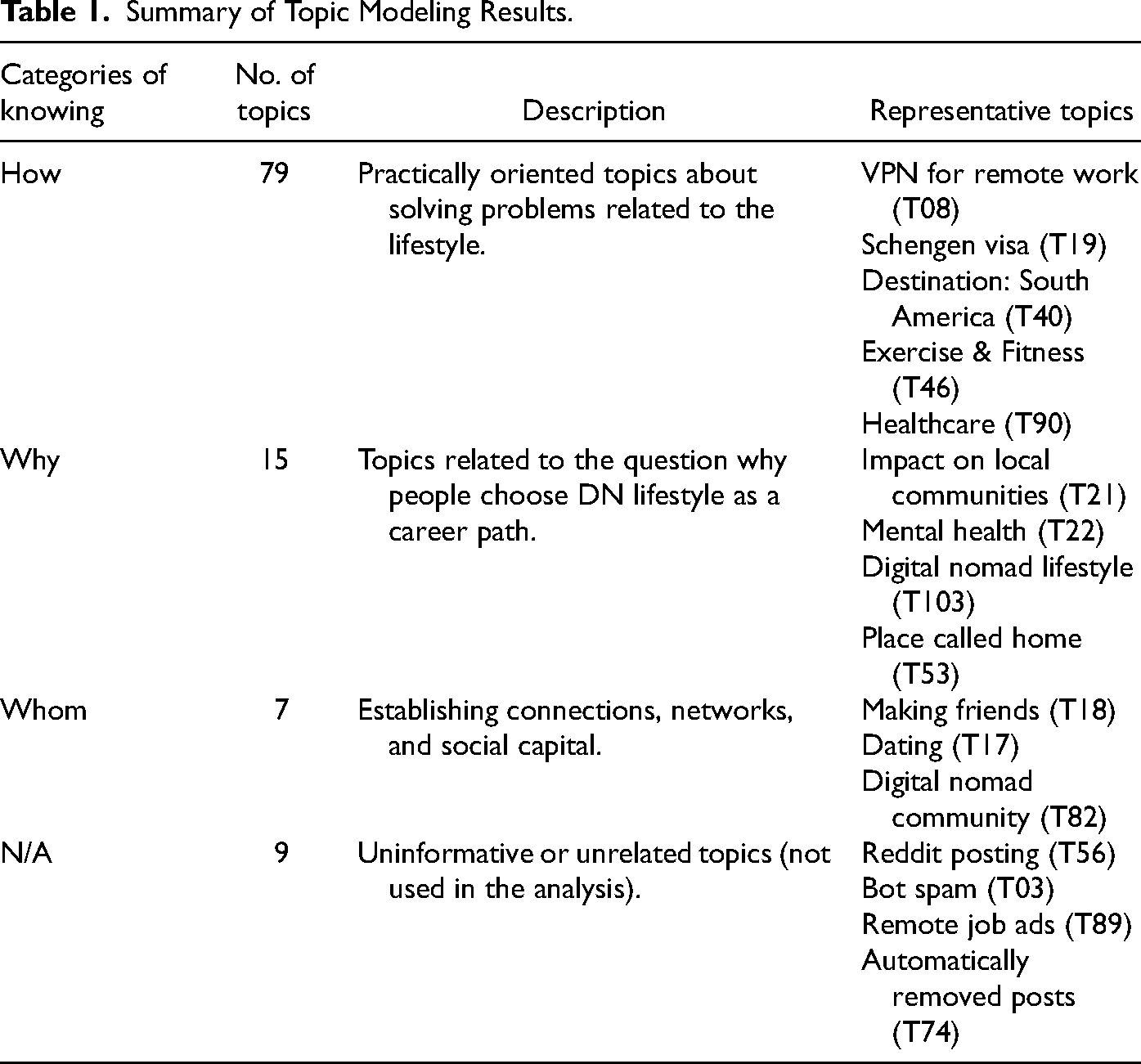
By applying the Intelligent Career framework to digital nomadism, this study contributes both to the careers and digital nomadism literatures and it informs new forms of migration. Specifically, by juxtaposing the two concepts, and going into more depth on motivations, use of human and social capital, we seek to provide new knowledge related to the experience of life and work as a DN. We obtained our data by analyzing Reddit threads and comments with LDA algorithm and coding the resulting 110 topics according to intelligent career framework and DN themes. We present the summary of results of topic modeling in Table 1, with more details behind the process of coding and categorizing available in Supplemental material.
Summary of Topic Modeling Results.
Digital Nomads’ Narratives: Comparing and Contrasting Career Journeys through the Intelligent Careers Framework
Knowing-Why: Work, Leisure, and the Love/Hate Relationship with the Concept of “Home”
The “knowing-why” category does indeed describe person-career fit content in terms of decision-making, however, this is typically related to push and pull factors of most often related to geography/lifestyle context (landscape, culture), as major factors in one's decision to pursue this type of career choice. This is attested by quotes such as:
You have to think first about the transport and the weather. Bogota is quite alternative city, full of culture stuff probably more than Medellin. The paisas for me are more the stereotype of Latino. I think they’re both worth checking out for the experience and all. Beside, you’re already in South America, might as well. However, they don’t compare to Medellin. So I’d say go there to visit and come back to Medellín. How long do you think I should stay in Lima to get a feel for the city? I have heard it's quite a boring city but I love Peruvian food. So I'm hoping the food will make up for what it lacks otherwise. I have been to Bogotá before for work: while it is certainly a beautiful city and I would recommend visiting, I wouldn’t recommend staying long term. I would visit for a few days or a week at most and then return back if you love Medellin.
Importantly, the underlying motivations of DNs to traverse the globe, immerse oneself in diverse cultures, and break free from the confines of traditional office structures is not merely a career strategy, but an alignment with personal values (Chevtaeva and Denizci-Guillet 2021). Knowing-why can be viewed as a compass guiding DNs as they navigate the complexities of this lifestyle. It encompasses the recognition that their career choices are not solely about financial success or professional advancement but an intentional pursuit of a life rich in experiences, cultural immersion, and personal growth. Knowing-why emerges as an indispensable aspect of the career decision-making process, illuminating the path towards a purposeful and fulfilling professional journey that resonates with the core values and aspirations of “how one wishes to live one's life” (Mancinelli 2020; Miguel et al. 2023).
Among various motivations to move to a certain location versus others however, weather and food are very commonly shared as key forces that influence one's decision. This is, for example, clearly not the case with traditional migrants, whose main driver is the economy or the stability of the country and of course the visa/migration type policies. However, for DN's one of the major debates and reasoning behind becoming a DN has to do with a concept of what is meant and wished to be one's “home.” This is discussed at length and well summarized in the following quote:
My concept of ‘home’ has changed. I definitely do have a home. It's just very different from what others think of as one, as well as how I used to view it. Mine is no longer limited by location or possession. No single item, or even the collection of items, is my home. Rather, its’ my mindset.
The loneliness has come to extreme, in the past 5 years I never had this feeling now it's weird; I feel old, tired of visa applications, visa runs, choosing a place to go next, suddenly the need of having a serious relationship…maybe the cold weather and snow changes my mood badly. I bought a ticket and going back home soon; staying with my mom for 1-2months to see if it's better than living abroad perpetually. Then I’ll decide to get back with my world journey or not.
Knowing-How: Pragmatism and Everyday Practicalities
From our findings, we can observe that by far the majority of topics clustered under the “knowing-how” category. Yet, these follow a much more practically oriented narrative, which is in contrast with what has been typically observed in the context of other career actors. Namely, DNs seem more focused and concerned with the every-day practicalities related to work, infrastructure, logistics of set-up etc., as opposed to questioning or discussing the value of their human capital, skills and experiences related to working abroad. Yet, when “knowing-how” is discussed beyond daily practicalities, it is typically focused on structural visa barriers. For example:
Schengen is a bitch for non EU/Schengen passport holders though. My passport allows us visa-free access to the Schengen area, I visited the Schengen area for about 80 + days (less than 90 days) and have returned in 2020 with no problems. My passport is visa-free in the Schengen area for 90 days.
or
Is it possible you might get in? Sure, you might get lucky. But at any point you could get caught - random police check, even up to when you exit, and they realize you have massively overstayed your original 90 days.
Finally, majority of knowing-how themes clustered around remote work options in terms of benefits and (im)possibilities related to the particular country: its legal system, making money/method of pay for their work, and/or finances/ cost of living. However, when it comes to the “how” related to the type of work or jobs discussed, we find very much a “niche” area and that is what makes DNs privileged in some way. Their focus is on the jobs and areas that often fully “portable” and independent, thus defying any potential strong connection to the context of the “common office space” or organizational boundaries. For example, DNs most often discuss writing/content creation, freelancing/(video) content creation, online teaching, start up business, or web development. Moreover, these types of jobs or occupations also testify to the potential generational presence among DNs. While based on our data collection and analysis we cannot testify to that with certainty, these occupational domains are only more recent or nascent types of work.
This is an interesting finding, especially in the context of current knowledge economy whereby the war for talent is still prevalent in various sectors, such as high tech for example. This may point to the less worrisome context of work that DNs may experience, by being more fully in control of their own career context and relationship to any potential employer or organization with whom they may have a more “transactional” relationship.
Indeed, the success of the digital nomadism lifestyle relies heavily on meticulous planning and administrative prowess (Hensellek and Puchala 2021). Furthermore, DNs must adeptly navigate time zones, accommodation arrangements, and connectivity issues (Green 2020; Mancinelli 2020). The ability to seamlessly transition between work and personal life demands a well-organized and efficient “knowing-how” approach to task management. Administrative tasks, such as handling visas, finances, and healthcare, become crucial elements in sustaining a sustainable nomadic lifestyle (Thompson 2018). Moreover, the work setup itself is paramount, requiring a reliable internet connection, suitable workspaces, and the right technological tools (Al-Hadi and Al-Aufi 2019; Nash et al. 2021). This pragmatic orientation reflects broader migration dynamics, where practicalities often precede traditional motivators like career advancement or skill acquisition.
Knowing-Whom: Local Versus Digital, Work Versus Non-Work
The “knowing-whom” category is surprisingly also distinct from what has been observed in earlier research. We find an interesting mix of online–offline, local destination communities, and business colleagues (and other nomads), reflected in the Reddit topics. Much of the social capital reflected in these findings seems rather “unorthodox” and connections as well as communication medium is online and perhaps less personal in nature. This is in stark contrast with usual focus on networking and local labor market challenges in the more “in person” or migration career context.
This dimension is evident in the intentional cultivation of relationships with remote colleagues, clients, and fellow nomads (Nash et al. 2021; Prester et al. 2023), but also with members of local communities that they reside in (Mancinelli 2020; Thompson 2021; Woldoff and Litchfield 2021). These connections contribute to the nomad's career development, opening avenues for collaborative projects, skill exchange, and knowledge sharing (Jarrahi et al. 2019; Wang et al. 2020).
On the side of personal relationships, while most DNs highlight the motivation to independently travel the world and make various DN lifestyle decisions autonomously, when it comes to relationships, the available solutions seem more complicated. They either find a partner who is equally mobile and enjoys DN lifestyle, or they must come to terms with settling down in some way, as described below:
We were nomadic together for the first 4yrs of our relationship. Eventually we got really burnt out and started to crave the stability of a home base. It's really hard to have certain hobbies when constantly on the road, and we missed having a consistent social life and support network.
There is also sometimes a sense of “them” others (i.e., family or friends back home), who do not engage in this lifestyle and their sometimes lack of understanding for the “trill” or motivation to continue this over time. The discussion about “knowing whom” centers around the ability to have more stable relationships, thus, either finding ways to be “nomadic together” or another solution has to be made.
Some also noted feeling burnout from constant change of location, adaptation and craving stability, consistent social life and support network. Nomads oscillate on a continuum between those that are completely committed to being nomadic as part of their routine whose “home is road” versus those for whom the romantic notions of DN lifestyle fade over time due to lack of consistent relationships, constantly varying work hours etc. This struggle and again the “push and pull” between being a nomad and importance of relationships is captured below:
I’ll be working remote for as long as I can and then call it quits, but I guess I’ve grown rootless enough to just hang around here ‘for now’, ‘even if ‘for now’ means an undefined time. I fell in love with someone wo doesn’t have a clear path to remote work. (they are resident in a city I’ve spent a lot of time for the last 2yrs). A nomadic life is important to me and returning to it is my ultimate goal, but I also highly value relationships.
When you are frequently able to return to ‘some home base’, the same place and spend more of your time there, you have more opportunity to build strong relationships, date people, work with local volunteer groups, attend local events and meetup groups, join a gym, become a regular at local bar or coffee shop, and just generally act like a participating member of the community.
Discussion and Conclusion
Our findings related to DN's conversation over Reddit platform offer new insights into career journeys of this group that to some extent resonate with broader themes in the migration literature, particularly in relation to the agency, as well as structural dynamics of contemporary migration. Our work also builds on D'Andrea's (2006) analysis of nomadic strategies among lifestyle migrants, who often prioritize flexibility and the ability to navigate different cultural and regulatory environments. In addition, the overwhelming emphasis in our findings on the “knowing-how” dimension in many ways aligns with research indicating migrants’ focus on navigating practical challenges, highlighting the importance of adaptability and resourcefulness for both DNs and migrants.
Thus, we find that three ways of knowing reflect different forms of knowledge accumulated over the course of a career and are available in this case for nomadic, global, and digital career actors who may use it as “currency” in moving between geographies and jobs. Previously accumulated career capital and experience may serve as a trigger or motivation to engage in nomadic type of career, but as one progresses and gains more experience living their “nomadic” lifestyle, their career competencies will also increase and translate perhaps in even more global future career.
Specifically, some of the “knowing-why” themes related to economic factors and destination appeal dovetail with the push-pull theory, which posits that economic disparities and the attractiveness of destinations drive migration decisions (de Haas 2021). However, the unique blend of work and leisure motivations among DNs underscores a more contemporary form of migration, where lifestyle choices play a significant role, extending beyond mere economic calculus. This finding builds on Benson and O'Reilly (2009), who explored how lifestyle considerations increasingly influence migration decisions, blending economic motives with the pursuit of personal fulfillment and quality of life in chosen destinations. Thus, while “knowing-why” motivations clearly differ from traditional migration narrative around economic and more permanent destination related labor market for example, DNs journeys are not without challenges, specifically those related to travel exhaustion, not having a “home” and lack of belongingness (i.e., even to what is considered “home”), all too often leading to feelings of loneliness. This may lead to emerging body of work on social isolation and loneliness at work (Cardon and Arwine 2024), importantly in the context of “transitory” homes.
The “knowing-whom” category, on the other hand, highlights the role of online and offline networks in establishing social capital, suggesting that DNs navigate social integration differently from traditional migrants. The reliance on digital platforms for networking reflects a shift in how migrants build and maintain relationships, emphasizing the importance of technology in facilitating contemporary migration patterns. Indeed, Ryan's (2011) work on migrants’ use of social networks for integration suggests that online platforms have become crucial in maintaining connections and facilitating migration experiences, indicating a shift towards more fluid and more dispersed forms of community and support. This is also reflected in location planning and global (digital) information exchange about particular locations that represent migration targets (short-term vs long-term). These insights suggest that digital nomadism encapsulates a blend of traditional migration drivers with the nuances of the digital age, offering a unique vantage point on the evolving nature of work, lifestyle, and the role of migration in the global economy. Moreover, knowing-whom themes also touch on complexity of private relationships over time, and potentially finding solutions (i.e., being “nomadic together” or having to compromise and settle down for a partner). Many also discussed missing more permanent and consistent social circle or close friends, summing it up as: “living nearly friendless in a real world …you have friends, but they are temporary.”
Taken together, the narrative of DNs suggests various themes that provide a clear departure from the more traditional and often permanent migration scripts. Firstly, the portrait of DNs in this study contradicts the classic narrative of migrants as passive actors you are pushed around the globe by the macro forces. Instead, DNs present an extreme agentic profile, as individuals who make unique and independent career and life choices and impose these on the world. Yet, they still must navigate and manage some structural constraints, barriers, and institutions; however, they feel in many ways as “freed” from usual local and life permanency that is captured in traditional migrant career pathways. In particular, the types of “barriers” that resonate with the migration literature are typically related to visa/general administrative barriers and obstacles related to overcoming them (in specific countries/areas) — (i.e., related to how to stay longer in (migrate to) a particular destination above and beyond usual visa restrictions). This illustrates a tension or a continuum between an inherent drive of DNs to switch locations often, and an inclination to “stay longer” (only if needed). However, overall, DNs’ narratives are only to some extent related to the classic cost-benefit calculation, and perhaps more related to the lifestyle factors than specific work-related factors/opportunities in the given location. These decisions are to some extent reminding us of similar considerations as many migrants must make, but yet with different focus, as explained below.
This cost-benefit approach among DNs extends to how they manage their tax residency and financial obligations. Many DNs take advantage of low-cost countries’ infrastructure, benefiting from affordable living and business resources without significantly contributing to the local economy beyond tourism or consumption sectors. Their limited involvement in areas such as taxes, social services, or long-term investments raises questions about the sustainability of this lifestyle. It also highlights potential ethical concerns about the socio-economic imbalances they may create, benefiting from the local infrastructure while providing minimal economic returns to those regions. These dynamics underscore a key privilege of digital nomadism: the ability to navigate global systems for personal and financial benefit while evading some of the responsibilities typically associated with more permanent residents or traditional migrants. However, it also reveals a potential downside, as this model may not foster sustainable engagement with the host country's broader economy or society.
The traditional migrants, on the other hand, conduct their cost-benefit analysis with very different, more permanent decision-making in mind. They typically engage in a cost-benefit analysis with the goal of long-term or permanent settlement in a new location. Their decisions are often shaped by factors such as long-term economic opportunities, social stability, and family integration, which involve a deeper commitment to the host country. Unlike DNs, whose moves are often driven by temporary lifestyle or work flexibility, traditional migrants tend to prioritize establishing roots, building permanent careers, and accessing comprehensive social services and legal stability in their new environment.
Another significant finding relates to DNs’ rejection of the “settling down” mentality is another contrast to the traditional migration narrative. Specifically, DNs engage in embracing a continuous sense of movement as the world is open to their “exploration”; this finding is inherently connected to the new forms of working, enabling this extreme sense of agency in choosing a location for work and life. In fact, given the seeming freedom to “choose location,” most narratives we analyzed debate the pros and cons of each location and its unique context related opportunities. Thus, the decision to move abroad, even if temporarily, is driven by the newly acquired freedom to work from anywhere leading to extreme agency in choosing a specific work/life location. Most importantly, no location is necessarily going to be their “new home” forever!
While we know a lot about migration patterns, generally, as well as their “three ways of knowing” (Zikic 2015; Crowley–Henry et al. 2023) digital nomadism is a very recent, rapidly growing as well as evolving phenomenon (Hannonen 2020; Hensellek and Puchala 2021). Thus, lessons learned from our study are only some initial indicators as to what implications and what DNs’ trajectories may look like in relation to well-established more permanent migration trends and policies.
One important implication is that as many countries and companies across the globe (according to a recent report by the Migration Policy Institute (MPI 2024)) are facilitating special visas and other accommodations for DNs, these developments may potentially sway some migrants away from traditional migration trajectories and perhaps lure them towards DN options. However, not all migrants are a unified group and motivations and trigger or push factors depending on the country of origin and destination country may also differ in many ways.
In conclusion, one of the major differences in the type of choices that migrants versus DNs must make is related to the extreme freedom in the choice of location. DNs travel independently of any location attachments, driven by the fully remote work opportunities, they live with a constant sense of “temporality” to their lifestyle (i.e., always inherent in the possibility to leave and move again). Their work and career lives are fully portable. These key differences between DNs and migrants are clearly stemming from the new future of work narrative (Thompson 2020; Hensellek and Puchala, 2021).
Our paper presents some initial evidence for how DNs’ lifestyle, values, motivations and related challenges of their daily routines may inform and compare to more traditional and permanent narratives of migration. Lastly, these topics cannot be studied in isolation of the consistent advances in technology and ways that work is conducted remotely but equality impacting the nature of jobs and occupations due to AI and other such developments.
Looking ahead, the conversation about digital nomadism versus classic migration journeys must be integrated with the future of work literature and increasing freedom of workers to choose how and where they work. In addition, more attention could be paid to the generational aspect of the DN phenomena as well as the role of gender in pursuing and managing DN lifestyle. Moreover, one must consider how the constantly evolving digital advancements and policy developments can mitigate various structural challenges that are still part of DNs life and work decision making. For example, the work of Veen, Barratt, and Goods (2020) on the gig economy and digital platforms offers important insights into how digital infrastructures could evolve to better support the needs of remote workers, including DNs. Additionally, the study by Faraj, Pachidi, and Sayegh (2018) on digital work and organizational platforms underscores the importance of creating digital ecosystems that foster both autonomy and a sense of community among remote workers. Finally, reflecting on the findings of this study, we find that the six categories identified by Cook (2023) in the digital nomadism literature do not necessarily adequately cover Reddit topics explored here — thus, the need for a bottom-up approach towards a revised categorization is an additional contribution to the digital nomadism literature.
Supplemental Material
sj-xlsx-1-mrx-10.1177_01979183241306343 - Supplemental material for Digital Nomads in Conversation: Reddit-based Analysis and the Future of Nomadic versus Migrant Career Journeys
Supplemental material, sj-xlsx-1-mrx-10.1177_01979183241306343 for Digital Nomads in Conversation: Reddit-based Analysis and the Future of Nomadic versus Migrant Career Journeys by Jelena Zikic, Ivan Zupic and Matej Černe in International Migration Review
Footnotes
Declaration of Conflicting Interests
The authors declared no potential conflicts of interest with respect to the research, authorship, and/or publication of this article.
Funding
The authors disclosed receipt of the following financial support for the research, authorship, and/or publication of this article: This work was supported by Slovenian Research Agency (ARIS). Core project funding J5-4574, P5-0441 and J7-50185.

Supplemental Material
Supplemental material for this article is available online.
References
Supplementary Material
Please find the following supplemental material available below.
For Open Access articles published under a Creative Commons License, all supplemental material carries the same license as the article it is associated with.
For non-Open Access articles published, all supplemental material carries a non-exclusive license, and permission requests for re-use of supplemental material or any part of supplemental material shall be sent directly to the copyright owner as specified in the copyright notice associated with the article.
