




Abstract
Digital nomads who travel internationally while working remotely with digital technologies constitute a small but increasing migrant population that has attracted significant research attention lately. Since 2020, there is also a corresponding rise of “digital nomad” visas adopted by several countries around the world to cater for this type of global mobility and even to attract digital nomads. This paper reviews the resurgence of digital nomadism and a concomitant emergence of digital nomad visas to analyze how and why they emerged. The findings allow for categorizations of such policies in terms of their heterogeneity of designs, objectives, and implications. Our findings reveal that the states offering digital nomad visas have designed their visas either through creating a brand new or an adaptive policy approach — the choice of the policy design approach explains the states’ policy priorities. Our analysis shows that digital nomad visas are motivated by three broader socioeconomic interests of the visa issuing countries which include the promotion of tourism, attraction of foreign investments and entrepreneurship, and talent acquisition through a migration policy model. Furthermore, the digital nomad visas invoke the notion of “hypermobility” and permeability of state borders in light of widespread adoptions of digital technologies in work and employment; however, there are paradoxes and contradictions embedded within these policies which manifest through restrictive and exclusionary criteria based on wealth, skills, and nationality. The paper concludes with some critical observations on the novelty of digital nomad visas as a novel migration regime.
Introduction
Digital nomads, notably people who travel while working remotely using digital technologies, are a small but increasing migrant population that has attracted significant media and research attention in the last decade. With the remote work trends accelerated and normalized by the COVID-19 pandemic, digital nomadism has received further impetus (Cook 2020; Hermann and Paris 2020; Hannonen, Quintana and Lehto 2023), though it is not completely a novel phenomenon. In academic scholarship, digital nomads are variously described as location-independent workers (e.g., Marx et al. 2023), voluntarily working individuals from across international borders (Reichenberger 2018; Hannonen 2020; Chevtaeva and Denizci-Guillet 2021), and as workers seeking work–life balance (Simova 2023). The predominant focus of the academic research has been on digital nomads’ lifestyles, mainly pertaining to self-identification and self-perception (Nash et al. 2018; Aroles, Granter and Vaujany 2020; De Almeida et al. 2021), work modalities (Cook 2020; Wang et al. 2020; Nash, Jarrahi and Sutherland 2021), social interactions (von Zumbusch and Lalicic 2020), and how they leverage remote work to live in often affordable locations around the world (Mancinelli 2020; Eckhardt and Atanasova 2024). Cook (2023, 259) defines digital nomads as individuals who “use digital technologies to work remotely, they have the ability to work and travel simultaneously, have autonomy over frequency and choice of location, and visit at least three locations a year that are not their own or a friend's or family home.”
Though considered a fringe activity in the pre-pandemic era, digital nomads have captured attention of states as evidenced through “digital nomad” visas that several countries around the world have introduced to attract and retain them (Hannonen 2020; Hermann and Paris 2020; Chevtaeva and Denizci-Guillet 2021; De Almeida et al. 2021). Since Estonia and Barbados, in 2020, pioneered the digital nomad visas, over 50 countries in Europe, Africa, Asia, Latin America, and the Caribbean have reformed their legislative and immigration systems to accommodate digital nomads (see Dreher and Triandafyllidou 2023; Sánchez-Vergara, Orel and Capdevila 2023; KPMG 2024). Such policy reforms range from launching brand new standalone digital nomad visas to adapting and retrofitting preexisting visitor or investment/business visas. Though all such visa programs are described as digital nomad visas, they differ from one another in terms of lengths of stay, eligibility criteria, and documentation procedures (Koskela and Beckers 2024). As a common denominator, digital nomad visas allow transnational remote workers — be they salaried employees of companies based in another country, or as self-employed entrepreneurs, or freelancers — to legally combine work and travels which were previously compartmentalized into separate visa regimes.
Through such a fusion of tourist and temporary work visas, digital nomad visas break away from traditional global visa regimes which demarcate international migrants into separate fixed categories such as tourists, economic migrants, international students, or foreign investors/businesspersons. Since digital nomads are conceived to be on perpetual move across borders, they also challenge long-standing understandings in migration governance scholarship that generally categorizes states as source, transit, or destination countries with a state's migration policies assumed to align with its categorization (KC and Triandafyllidou 2023). Though at a nascent stage, digital nomad visas which about 50 countries have formulated are emerging as the new infrastructures of global migration and mobility. Such a rapid diffusion of digital nomad visas within a short period of about 4 years is an intriguing policy phenomenon. Given the limited academic research on this burgeoning global digital nomad visa regime, we ask two questions in the paper: (1) How have digital nomad visas been designed by the states? (2) What policy objectives do states intend to achieve through these visa programs? We investigate these questions by drawing on the primary qualitative data gathered through semistructured interviews with relevant stakeholders and an analysis of digital nomad visas and other related documents and gray literature. Our findings reveal that the states offering digital nomad visas have designed their visas either through a brand new or an adaptive policy approach — the choice of the policy design approach aligns with the policy objectives of the states which we typologize into three broader strategic policy priorities: promotion and diversification of tourism, attraction of foreign investment and entrepreneurship, and talent acquisition through migration. We argue that though digital nomadism and digital nomad visa policies marketized by many states invoke the notion of “hypermobility” and permeability of state borders in the context of widespread adoptions of digital technologies and the concomitant transformations in modalities of work and employment, these visa policies demonstrate paradoxes and contradictions which manifest through various exclusionary criteria based on wealth, skills, and nationality.
The rest of the paper is structured as follows. In the next section, we provide a brief overview of digital nomadism and digital nomad visas, broadly construed, that have emerged within the last 4 years. The section that follows outlines our research design and methodology which combines semistructured interviews with 25 relevant stakeholders comprising state officials, transnational intermediary-like agencies, and visa brokers and with digital nomads themselves and an analysis of 50 digital nomad visas and gray literature. The next section proceeds to discuss the brand new and adaptive policy approaches adopted by states in formulating their digital nomad visas; the former refers to the creation of standalone new visas targeting digital nomads and the latter reforms and retrofits the preexisting visas to accommodate transnationally working individuals. We then move on to develop a typology of digital nomad visas in terms of the states’ broader strategic policy objectives. The final section lays bare the paradoxes and contradictions embedded within the digital nomad visas as the new infrastructures of and barriers to global migration and mobility.
Digital Nomadism and States’ Policy Responses
The term “digital nomad” was initially coined to refer to nomadic lifestyles resulting from advances in electronics engineering that enabled linkages between any two locations on the planet through a “video link” to facilitate exchanges of “people, documents, and pictures” (Makimoto and Manners 1997). The antecedents of digital nomadism can be said to even further date back to the early 1980s when the International Business Machines Corporation took telecommuting from concept to reality by enabling some of its employees to work from home as a testament to the effectiveness of its technological advancement (Useem 2017). In both academic and gray literature, digital nomadism is associated with the information and communication technologies, financial services, scientific research, or other professional sectors that do not require a physical presence for the delivery of services (see also Hooper and Benton 2022). Iliescu (2021, 99) employs the neologism “knowmad” to describe the digital nomad as a “nomadic knowledge worker – that is, a creative, imaginative, and innovative person who can work with almost anybody, anytime, and anywhere.” Digital nomads are thus perceived as an emerging global meritocratic professional elite with a high-tech skill set that put them in a position of power in relation to their employers (Iliescu 2021) or imagined as people embodying the exercise of freedom and autonomy working from a hammock on a beach (Reichenberger 2018; Woldoff and Litchfield 2021). Digital nomadism is even described as a manifestation of the contemporary form of coloniality where the high-tech workers of the rich countries traverse the world while maintaining their Silicon Valley salaries (McElroy 2020).
In contrast to the knowmads described above, some scholars (e.g., Chowdhury et al. 2018; Wang et al. 2018; Thompson 2019) have portrayed digital nomads as members of the gig economy, working as freelancers earning an income through completion of short-term contractual projects with no social security or as startup entrepreneurs. Thompson (2021) describes digital nomads as the disempowered people who resort to digital nomadism as an adaptive response to their downward mobility and employment precarity within neoliberal economies of the Global North. In the face of increasing challenges of affordability of home ownership, competitive and insecure labor markets, and skyrocketing inflation, the millennials and Gen Zs are particularly drawn to digital nomadism as an alternative (Eckhardt and Atanasova 2024). However, digital nomadism can be practiced as an adaptive strategy against the impacts of neoliberalism only by rich people from the Global North who can take advantage of their countries’ geopolitical and economic power in the form of “strong passports” that enable them to temporarily to travel to and work from lower-cost countries in Southeast Asia and Latin America to afford the lifestyles increasingly unachievable at home (Mancinelli 2020). Such a pursuit for lower costs of living by traveling to less expensive locations of the Global South has been described as geoarbitrage (Hannonen 2024). Digital nomads may thus be seeking individualized solutions to structural problems of capitalism, but the impacts of geoarbitrage can leave repercussions for destination communities as the advent of the rich foreigners may drive processes of gentrification (Hayes and Zaban 2020; Sigler and Wachsmuth 2020).
Although “digital nomads” are perceived to be a homogenous group of international travelers who combine work and leisure while traveling, a closer look into the phenomenon reveals significant heterogeneity among those who are characterized as such. In terms of the types of work, Aroles, Granter, and Vaujany (2020) use five modalities to capture the professional lives of digital nomads: remote employment, entrepreneurship, freelancing, salaried employee, and having multiple professional activities. Cook (2023) categorizes digital nomads into five distinct types: freelancers, business owners, salaried, experimental (aspiring to be a digital nomad in freelancing/business), and the armchair digital nomads (imagining digital nomadic lifestyle). From a historical viewpoint, Holleran (2022) describes the rise of digital nomadism in three distinct phases. The first phase lasted from approximately 2010 until 2020 when digital nomad mostly from the affluent countries of the Global North made the most use of casualized labor to live in low-cost locations in the Global South. The second phase began with the COVID-19 pandemic with travel restrictions and border closures with the digital nomads in need of state welfare in accessing vaccination and disease control (Holleran 2022). The third phase of digital nomadism refers to a hypothesized post-pandemic future marked by states vying for digital nomads through digital nomad visas using various marketing strategies and incentives (Holleran 2022).
Digital nomadism has captured states’ imagination as seen through about 50 countries around the world designing digital nomad visa policies with South Korea and Japan introducing their visas in December 2023 and April 2024, respectively. Koskela and Beckers (2024) note that digital nomad visas are evolving from ad hoc pandemic response to strategic tools for socioeconomic development. Mancinelli and Molz (2024, 11) characterize them as “border artistry” of states created to filter desirable foreigners granting them special rights with the intent of gaining economic benefits. Some research (e.g., Hooper and Benton 2022; Sánchez-Vergara, Orel and Capdevila 2023; Mancinelli and Molz 2024) on digital nomad visas has explained their emergence largely as an offshoot of the pandemic. An OECD report goes so far as to say that such visas “are mainly issued by tourism-dependent economies or countries facing economic challenges” (OECD 2022, 1). Toivanen (2023, 76) considers digital nomad visas as a “new public service” created by states alongside other new services and products such as global health insurance, international online banking, and coworking spaces provided by various private sector agencies.
Some scholars (e.g., OECD 2022; Sánchez-Vergara, Orel and Capdevila 2023; Bednorz 2024; Mancinelli and Molz 2024) examine digital nomad visas as regularizing legal frameworks in response to the increasing numbers of international travelers integrating touristic travels and work. Krakat (2021) describes digital nomad visas from a legal perspective as a new visa category much akin to temporary work visas in terms of the rights they grant. Drawing on a review of gray literature, Bednorz (2024) analyzes digital nomad visas that were formulated until January 2023 from a tourism policy perspective. The states offering digital nomad visas have either used a legitimizing or a strategic approach to designing their visa policies (Bednorz 2024). The visas designed through the legitimizing approach lack any explicit policy priority, while those formulated through the strategic approach reinforce another existing or emerging policy priority (Bednorz 2024). Against this backdrop, our paper advances this academic scholarship on digital nomad visas, both analytically and methodologically. Our analytical contribution lies in the interdisciplinary analysis of the digital nomad visas from a governance perspective of global migration and mobility which, though significant, is lacking from the existing scholarship. Examining these visa policies from a migration governance lens is crucial since digital nomads are a new category of international migrants which the International Organization for Migration (2019) defines as anyone “who is outside a State of which he or she is a citizen or national” on a permanent or temporary basis and in documented or in irregular situations. Methodologically, the paper analyzes the digital nomad visa documents, combined with semistructured interviews with diverse stakeholders and gray literature.
Methodology
This paper draws on an analysis of policy documents pertaining to digital nomad visas and gray literature combined with 25 semistructured interviews with relevant stakeholders. The policy documents included 50 digital nomad visa-related documents mainly related to eligibility criteria, application procedures, and the required documentation for potential applicants of digital nomads. The documents were retrieved from the relevant agencies of states offering digital nomad visas. We also accessed information about the digital nomad visas from two other databases maintained and updated by KPMG and World Tourism Organization. The analysis included mapping and analyzing the provisions of each visa policy with a view to answering our two research questions. The policy analysis provided a way for understanding how the states designed their digital nomad visas and with what objectives they did so.
Given that no other elaborate policy documents issued by the relevant states were publicly available, a total of 25 semistructured interviews were conducted by the first author with three groups of relevant stakeholders comprising relevant state actors and agencies (10 interviews), private sector intermediary-like agencies providing different types of support to digital nomads (7 interviews), and 8 interviews with the digital nomads themselves. Our aim was to capture and understand what all the three categories of stakeholders would interpret the policy rationale of the digital nomad visa programs. First, the state actors included government officials mostly from Canada-based embassies and consulate offices of the countries with digital nomad visas and the foreign investment board members. Second, the private stakeholders included those occupying the middle space such as intermediary agencies or consulting firms such as Boundless Crew, Fragomen, Nomad Capital, and Digital Nomad Nation which work in different spheres of global mobility such as human resources, taxation, and labor laws in facilitate travels, accommodation, work permits, and health insurance. Third, the digital nomads we interviewed were mostly from the rich countries of the Global North and who were differed age groups and had lived in and worked from different countries of the Global South (e.g., Indonesia, Vietnam, Peru, Mexico, Costa Rica, Thailand, Bolivia, Colombia) and other locations.
The interviews were conducted in person, virtually, or as email responses between August 2023 and August 2024. Since the state elites have access to intimate knowledge about policymaking (Markiewicz 2024), we initially planned to interview government authorities directly involved in the policy design and policymaking process of digital nomad visa programs and approached ministries and other relevant state agencies, but we received no responses. As an alternative, over 30 Canada-based embassies and/or consulate offices of the countries offering digital nomad visas were approached but we were able to interview 10 Toronto- and/or Ottawa-based embassy and/or consular officials. The rest of the embassies were either unwilling or unavailable to provide any further details. Some embassy officials even shifted their responsibility to other government agencies refusing to comment on their countries’ digital nomad visas. The fact that many embassy officials were either reluctant or disinterested to speak about their policies demonstrated that the digital nomad visas were at a nascent stage and both policymakers and policy executers themselves lacked in-depth knowledge of or clarity about their designs and objectives. For instance, the Hungarian embassy official we approached stated that they were not “authorized to answer questions” related to digital nomad visas advising us to rather approach the ministry officials in Hungary. Likewise, the Czech government official refused to share any details about their digital nomad visa citing that all that needed to be known was available on their webpage.
Since interviewing the state authorities who were directly involved in designing the digital nomad visas was challenging, we found gray literature useful to derive important information about digital nomads though various types of online forums and communities of digital nomads, blogs, and the social media. The analysis of the data was guided by our research questions notably to understand how digital nomad visa policies were designed and what the rationale underpinned the development of these visa policies from the states’ perspectives.
Emergence of Digital Nomad Visas
Policy design refers to the act of defining policy objectives and the policy tools formulated to deliver those objectives (Howlett and Mukherjee 2014, 291; Hoppe 2018b). The initial phase in the policy design and policymaking processes is to identify the problem and clearly articulate the issue. Since the digital nomad visas were largely a response to the remote work trends created by the COVID pandemic, the state policy actors were left with limited time to deliberate. All three groups of stakeholders we interviewed considered the COVID pandemic a “big push” for the emergence of digital nomad visas. However, digital nomadism as a practice preceded the emergence of these visas as noted by one of the digital nomads we interviewed: We were already doing this [digital nomadism], and we were working nomadically and remotely, so nothing really changed for us in terms of where we were but for a lot of the world it changed drastically. (Virtual interview, November 17, 2023)
Digital nomadism was practiced by misappropriating tourist visas. Though working under a tourist visa was an “illegal” practice, many countries considered enforcing this violation of law of low priority, or some countries even were indifferent to penalizing this. The question as to what indeed propelled states to design a separate legal visa category that completely broke away from the long-standing international visa regime that bifurcated foreign tourists and international workers into two separate policy categories. As stated by the Fragoman consultant in our interview, the digital nomad visa of the United Arab Emirates (UAE) is diametrically opposed to the country's traditional immigration system based on kafala (sponsorship) in that the digital nomad visa does not require an international remote worker to be sponsored by their employer from inside the country — it is rather that other way around meaning that the employer should now be based outside the country. Digital nomad visa policies thus demonstrate complete ruptures within the traditional immigration systems of the country.
Hoppe (2018a) argues that a mere reality is not adequate to pose as a policy problem, but it has to be actively constructed as such in the process of claims-making to persuade others. The identification of digital nomadism as a problem issue is thus directly linked with the pandemic that acted as a tipping point in the widespread adoptions and normalization of remote work trends creating potential avenues for transnational remote work for the states to capitalize on. MBO Partners (2024) notes that digital nomadism previously remained mainly confined to the traditional high-skilled workers in the ICT sectors, but the pandemic expanded it into diverse professions including creative services, education and training, sales and marketing, finance and accounting, consulting, coaching, and research. A digital nomad said, “So rather than going for a vacation people are going there for months out of a year. It is a beautiful blend of both worlds” (Virtual interview, December 14, 2023). Another digital nomad noted: A lot of jobs have moved to digital platforms working online, and this is widely appealing to many people. Countries around the world are recognizing this and they are offering visas for digital nomads. Since many people can work online, that doesn’t become a problem anymore. (Virtual interview, November 17, 2023)
It is at this juncture that digital nomad visas were designed as legal instruments to profit the increasing trends of digital nomadism as Sassen (2000) contends that states are strategic institutions that are innovative in making legislative changes aligning themselves with the reconfigurations of the global economy. Digital nomadism emerged as an arena of strategic profitability.
Our analysis revealed that private sectors, various types of nonstate profit-seeking transnational agencies (e.g., Fragomen, GPMG) which operate as intermediaries in facilitating the post-pandemic neo-digital nomads, have played as key actors in both the expansion of the gamut of digital nomadism and the rapid uptake of digital nomad visas. On the one hand, private agencies have created digital nomadism as the aspirational new “normal” of the contemporary world through the promotion of celebratory imaginaries and representations of digital nomads as free-moving cosmopolitans, and on the other hand, they oftentimes filter access to such modes and modalities of work and travel. Such imaginaries propagated by private actors exert influence on the states and their immigration policies in both covert and overt ways — through consultancies to state agencies and in some cases through active campaigns and lobbying with the claims to cater to the skilled workforce and talent they need. A private sector stakeholder in our interview noted that digital nomads are “keen to explore the world” and they are “always on the lookout for new favourable policies” (Email response, March 11, 2024). The influence of private sectors in both the formulation and rapid uptake of digital nomad visas could be discerned, but the extent to which and how the influence played into the internal dynamics of state agencies was complex to gauge.
The Estonian digital nomad visa can be taken as a case in point. As noted by the official of the Toronto-based Estonian embassy, the government had, in 2018, assigned the private international mobility agency “Jobbatical” with the mandate of investigating digital nomadism and submit a report. The Estonian parliament amended the country's 2009 Aliens Act paving the way for a digital nomad visa which was officially approved in June 2020 making Estonia a pioneer country in introducing the digital nomad visa. The legislative change “created a legal framework to accommodate” transnational remote workers and minimized the “misappropriation of the tourist visa” (Virtual interview, November 16, 2023). Likewise, in Canada, as shared by the Immigration and Citizenship Canada in an email response, private stakeholders, particularly from the tech industry, catalyzed the “government to explore and consider new policies that would facilitate the entry and stay of digital nomads” (December 13, 2023). The government officials of the other countries interviewed also acknowledged their consultations with private stakeholders in the process of designing digital nomad visas, but they were reluctant to disclose what types of stakeholders were consulted with. Though immigration policymaking is an absolute legislative prerogative of states, nonstate actors have had sway over the policy policymaking processes of digital nomad visas.
The questions as to who makes the decisions and how decisions are made are crucial in immigration politics and policymaking (Hollified and Wong 2015), but given the sheer heterogeneity of legislative and constitutional provisions of the countries offering digital nomad visas, it is not always easy to find definitive answers to these questions. However, two policy design approaches have been adopted by the states in the formulation of their digital nomad visas: a new policy or an adaptive policy approach. The new policy design refers to the formulation of a new standalone digital nomad visa, and the adaptive approach involves retrofitting a preexisting visa, mainly either a visitor or an investment visa (Table 1).
States’ Policy Design Approaches to Digital Nomad Visas.
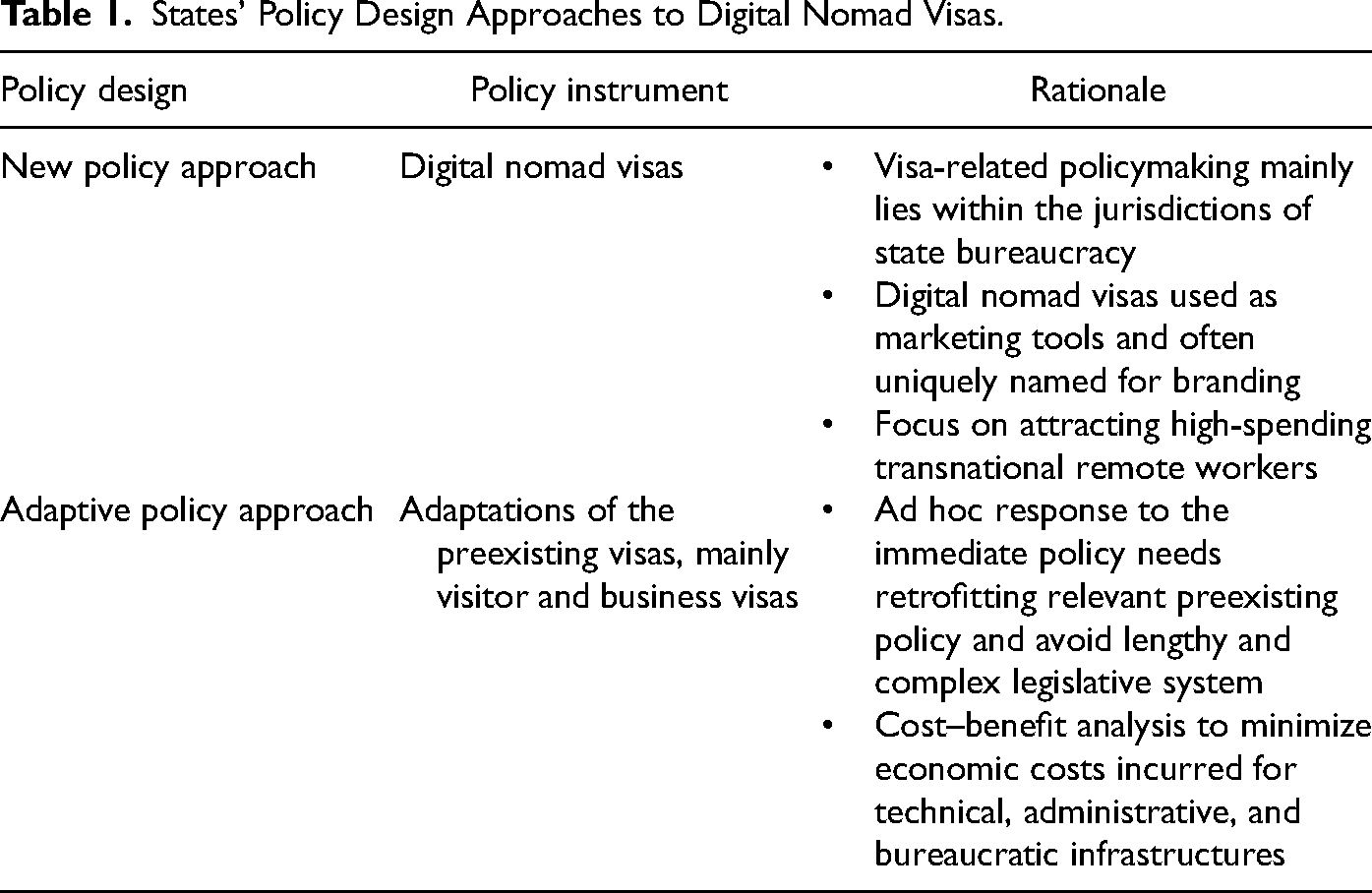
The new policy approach has been adopted mostly by tourism-dependent economies that focus on attracting high-earning and high-spending transnational remote workers. Additionally, such visas are formulated in those countries where visa-related policymaking mainly lies within the jurisdictions of state bureaucracy. A common element of most standalone digital nomad visas is that the states have given them unique names with a view to marketing their countries as ideal destinations for digital nomads.
The adaptive approach that involved retrofitting the preexisting visas was adopted by the states to avoid legislative and bureaucratic complexities and political sensitivities. Such a reformist approach was preferred since creating a new visa category would have entailed changing immigration laws through legislative procedures of the parliament. Adapting existing policies rather than establishing a new visa category for remote workers lies in the reduction of costs and time. The government officials stated that the reason for preferring the adaptations of the preexisting visas rather than formulate a new digital nomad visa was expediency and expenditure — in terms of investment in developing online portal and hiring of additional visa processing personnel. The adaptive approach allows policymakers to cope with the uncertainties that confront them by creating policies that respond to changes over time and that make explicit provision for learning. Ad hoc policies are preferred in situations of uncertainties and unpredictability (Walker, Rahman and Cave 2001), so the states find themselves in “wait and see” sort of situation. The approaches taken by the states in designing their digital nomad visa policies explain their policy aims and policy priorities based on their specific economic, legal, and developmental strategies.
Policy Objectives of Digital Nomad Visas
Our findings revealed that the restructuring of the visa regime and immigration policies either through the formulation of new digital nomad visas or the adaptations of preexisting visas were largely motivated by the states’ broader socioeconomic and development strategies within the context of the increasing trends of remote work, digitalization of work, demographic changes, and the competition for skilled workers. Digital nomad visas reflect the way in which states invent, innovate, and reorganize themselves with new policy tools to maximize economic benefits and profit from wealth, power, and knowledge. Digital nomad visas are intended to be used by states as instruments to reinforce three preexisting strategic policy objectives which include the development and diversification of tourism, promotion of foreign investment and entrepreneurship, and the acquisition and retention of human capital and tech talent. The type of remote workers a country hopes to attract to digital nomad visas as different “strategic approaches” that are designed to meet each country's already existing policy goals (Bednorz 2024) and their specific legal, economic, sociocultural, and political contexts (Koskela and Beckers 2024).
We however posit that it is not easy to draw a clear line between these three different policy priorities, nor are they completely separate policy domains. Digital nomad visa policies also come with idiosyncratic features so much so that the digital nomad visas of Bahamas and Bermuda include even students in their programs given that they meet the required eligibility criteria, mainly financial means to support themselves during their stay. As shown in Figure 1, we develop a typology of digital nomad visas into three broader categories in terms of their policy priorities that include the promotion of tourism, attracting foreign investment and entrepreneurship and the acquisition of skilled workers.
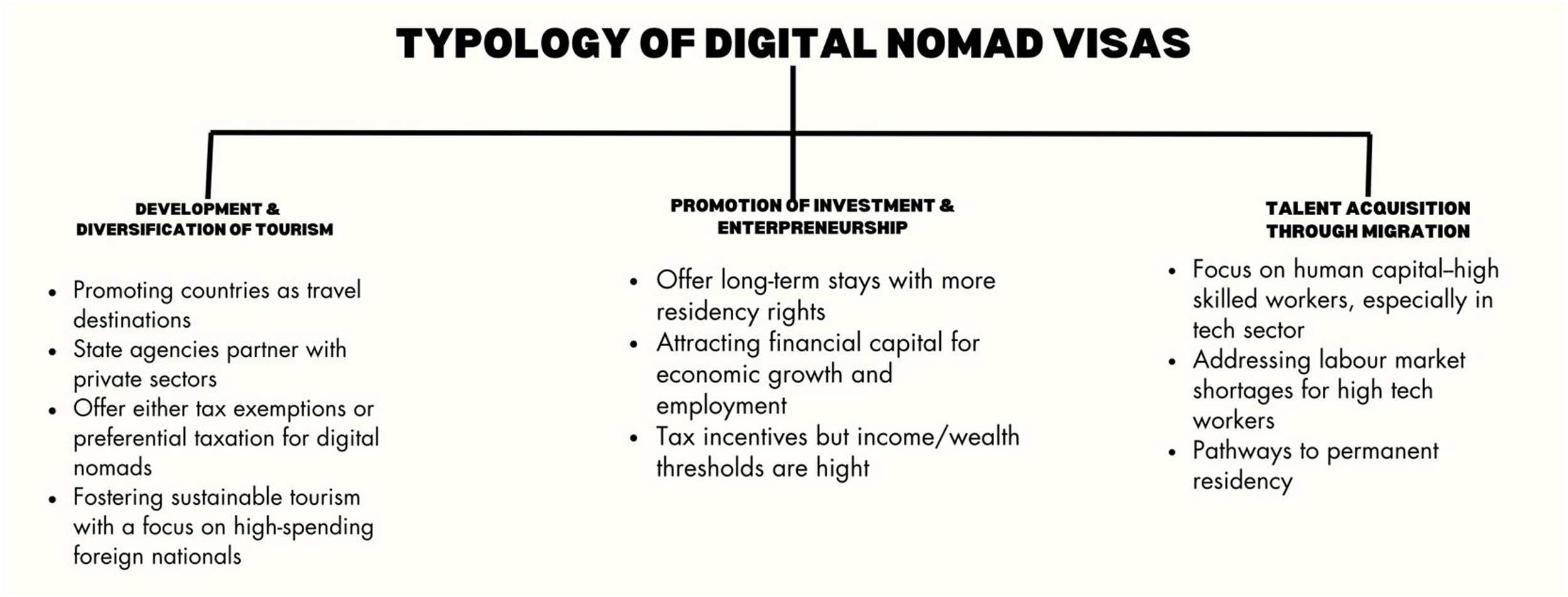
Typologizing digital nomad visas from a policy perspective.
Promotion and Diversification of Tourism
The middle- and low-income tourism–dependent economies in particular have developed standalone new digital nomad visas with the aim of attracting larger numbers of tourists as a lever of their economic development. Many such digital nomad visas were launched amidst the pandemic with the intent of resuscitating tourism revenue impacted by border closures and travel restrictions on international visitors or help increase spending in the off season or in more remote regions (Ehn, Jorge and Marques-Pita 2022; Holleran 2022). Sánchez-Vergara, Orel, and Capdevila (2023) found that the promotion of tourism and leisure industry was at the core of most digital nomad visas they analyzed. Razavi (2022) describes digital nomad visas as a “rushed and over-engineered solution designed to repurpose tourism infrastructure.” Such policies aim to boost their local economies through consumption of local goods and services rather than retain digital nomads through the creation of pathways to permanent residency. The states using digital nomad visas as strategies for developing tourism are small states, mostly the Small Island Developing States such as Antigua and Barbuda, the Bahamas, Barbados, Cabo Verde, and Dominica (World Bank 2023). Some Southeast Asian countries, especially Thailand and Indonesia, have likewise designed their digital nomad visas to boost the local economies of Chiang Mai (Thailand) and Canggu (Indonesia) (Jiwasiddi et al. 2024).
The countries which aim to promote tourism through digital nomad visas use them as marketing tools to attract wealthy transnational remote workers. Thirty-nine percent of destinations exempt digital nomads from tax payments (WTO 2023). Such visas marketize their countries with the unique names of the digital nomad visas such as the Cayman Islands’ Global Citizen Concierge Program or the “Belize Work Where You Vacation” and the “Dominica Work in Nature Program.” They expand access to the digital nomad visa — Iceland offers 6-month stays under its remote worker visas, Croatia and Dubai 1-year stays, Antigua and Barbuda 2-year stays. Most tourism-centric visas operate tools of a mutual economic trade-offs for states for the digital nomads and states in that the former benefit from tax exemptions or in some cases tax evasion, while the latter benefit from the generation of employment and income for locals. Such tourism-inclined digital nomad visas largely target the rich citizens of the Global North countries; the international migrants from the countries with “weak” passports remain most likely disadvantaged.
Attraction of Foreign Investment and Entrepreneurship
As noted by a Toronto-based consulate official of a country offering a digital nomad visa, digital nomads “come to your country, they spend their money, and they might come up with innovative business ideas. Why lose them?” (In-person interview, October 24, 2023). These countries intend to attract foreign investment and business entrepreneurship either by directly bringing in foreign investments or forging international and national business connections. As noted by a global mobility agency official in our interview, the UAE, though aiming to attract rich and highly skilled people in the short-term, through its digital nomad visa, the country's ultimate aim is to invite and retain foreign investments. The manifest content of the digital nomad visa is that digital nomads are supposed to leave the country after 1 year, but the long-term goal is to use the short-term stay as a social trigger to attract and retain high-tech talent and skilled immigrants into the country for investment. In other words, digital nomad visa programs appear as a corollary of investor or “golden” visas for wealthy individuals. In that sense they certainly do not drastically break away from such migration regimes but rather add one more option to the existing ones. As with investor and golden visas, there is little interest on whether the visa holder will stay in the country for a long time and will aim to contribute to society more broadly.
Estonia is another example of investment as a policy priority — its digital nomad visa is a spin-off from its e-Residency program, a legal toolkit for establishing and running a digital business. It promotes and complements this legislation by encouraging and facilitating nomads’ engagement with the local startup business. The Estonian embassy official noted that digital nomads “bring new knowledge and added value to the local business environment and startup ecosystem. While living, travelling, and working in Estonia, the digital nomads would be spending their income by using goods and services here” (Embassy of Estonia official, in-person interview, October 26, 2023). Thailand's Long-Term Residence welcomes “qualified individuals” who fall into one of the four categories: wealthy global citizens, wealthy pensioners, work from Thailand professionals, and highly skilled professionals. Thailand has instituted the Board of Investment of Thailand who is solely responsible for attracting foreign investments has also been assigned with the responsibility of issuing digital nomad visas and promoting their visa brand through their embassies. According to the officials of the Board of Investment of Thailand, rather than attracting salaried employees with high earnings, the emphasis was placed on the amount of capital such international remote workers can bring into the country for investment.
Talent Acquisition through Migration
Though digital nomads are supposed to be in perpetual transience and movement across international borders, some countries intend to use digital nomad visas to acquire and retain tech talent and human capital. Such visas aim to attract highly skilled foreign workers offering additional benefits such as discounted rates for visa renewals, fast-tracked application processes and income tax exemptions. Migration model digital nomad visas, though not explicitly stated, expect international remote workers to set up a business or find employment with local employers, with the possibility of transitioning to another legal status afterward or even permanent residency. In its digital nomad strategy, the Canadian government's immediate goal is to attract and retain tech talent anticipating them to transition into permanent residency and citizenship in the long run (KC and Triandafyllidou 2023). Canada released its Tech Talent Strategy in 2023 with new application pathways to attract highly skilled and commercialized talents. In an email response, the official from Immigration, Refugees and Citizenship Canada stressed on the need to make their visa policies “agile” and “evolving” in the face of the increasingly complex and changing trends of migration to “strengthen our communities as well as meet the social and economic challenges of the future” (December 13, 2024).
The primary focus of such visas is thus on the highly skilled digital nomads with the flexible previsions that allow digital nomads to seek employment with local employers. Such a migration-oriented policy model permits local employers to tap new pools of talent. Contrary to many policy considerations surrounding the visa which assumes the holder will remain for a one-time medium duration stay, Canada is attempting to use the attractions of a visitor stay to lure longer-term workers and therefore fill labor shortages and inject tech talent. The IRCC source stated that digital nomads “who find work with a Canadian employer can also apply for a work permit from within Canada” (IRCC, email response, December 13, 2023). Canada, for instance, offers an additional 3 years of residency to 6-month digital nomad visa holders who manage to find work with a Canadian employer. In sharp contrast to this, the visas with the strategies of tourism development and the attraction of foreign investment and entrepreneurship described above impose strict legal restrictions on digital nomads being locally employed. Another example is Germany which officially formulated the Migration of Skilled Persons Act in March 2021 and introduced the “Blue Card Act” which facilitates the faster granting of residence permits for highly skilled persons from outside the EU. Many OECD countries, through their digital nomad visas, aimed to attract skilled and highly skilled professionals (OECD 2022).
As Makimoto and Manners in their book Digital Nomad (1997) stated, “Just as we are already seeing governments competing with each other to attract industrial investment, we may see governments competing with each other for citizens.” In the post-industrial society that celebrates “knowledge” workers, digital nomad visas aim to attract and retain human capital. Yet most visas do not have a strategy of retention either in the form of an avenue for permanent residency or by allowing for integration into the local labor market (Hooper and Benton 2022; OECD 2022), though the states expect them to stay. This reality poses an important policy challenge for states, one in which they must develop digital nomad policy holistically to include considerations of their (temporary) residence status, taxation, access to health and welfare policies, and access to education and training. Since digital nomads do not fall within traditional international migrant and migration policy categories, they often exist and travel within legal and policy gray zones.
Implications for Global Migration and Mobility
Though digital nomad visas invoke the notion of “hypermobility” and permeability of state borders, our analysis of the eligibility criteria of the digital nomad visas create further barriers to international mobility by thus laying bare paradoxes and contradictions inherent in these policy documents. These paradoxes mainly manifest through the eligibility criteria set by the visas in terms of high-income bars, documentation, and even skill sets. The states hold transnational remote workers practicing digital nomadism self-responsible seeking their self-sufficiency setting high eligibility thresholds in terms of their income, wealth, and health insurance though they are made to pay taxes to the governments in many cases. Such a strategy is the immigration policy with a neoliberal logic (Joppke 2024). In our interview, a digital nomad noted: … it's a bit excessive. You should provide lots of documents, you have to provide bank statements, provide proof of employment, some people have to hire a lawyer and have a notarized letter. It seems like a lot. I think it is definitely a deterrent. (Virtual interview, November 17, 2023)
One digital nomad interviewed pointed at the incompatibilities and redundancies in countries’ taxation and insurance systems that act as barriers to practicing digital nomadism. Digital nomad visas suggest that states are under tremendous pressure to flexibilize their traditional immigration policies to make room for new modes of work trends and international mobility while being rigid and reluctant to let go of their sovereign prerogatives over border controls. Policy paradoxes of the nation states — making immigration systems more permissive and borders porous in the face of transformed realities and traditional restrictive immigration policies rooted in the notion of jealous guarding of sovereignty.
The citizens of the geopolitically and economically powerful countries with “strong passports” can easily circumvent such barriers by misappropriating visitor visas and working clandestinely. As noted by a digital nomad in our interview, many countries such as Mexico and Vietnam do not care about working under tourist visas. A digital nomad we interviewed rented out her home in Vancouver and moved to Hội An in Vietnam where the cost of living was way less. Another digital nomad stated: If I have the option of going to Thailand and Vietnam, and if Vietnam gives me an easy one-year digital nomad visa and Thailand is going to become complicated, I’m not going to go to Thailand. I’m going there where it makes my life easier. (Virtual interview, November 17, 2023)
All the digital nomads we interviewed noted that they did not utilize the new digital nomad visas and practiced digital nomadism under visitor visas since using the tourist visa was easy and straightforward. They revealed that they entered countries on tourist visas kept their work activities to themselves. A digital nomad stated: I don’t use a digital nomad visa because I don’t stay anywhere longer than what is permissible under a tourist visa. I know that technically I shouldn’t be working but no one cares. (Virtual interview, December 12, 2023)
This demonstrates a dynamic interplay between states’ attempt to capitalize on digital nomadism through putting new legal tools in place and the digital nomads’ resistance against tougher restrictions. Mancinelli and Molz (2024) describe this as “border artistry” where digital nomads leverage state-imposed constraints into creative forms to practice digital nomadism. Our interviews with the private stakeholders also revealed that some international mobility service-providing agencies act as intermediaries to navigate through the immigration systems not only to find suitable locations and process documentation but also to circumvent states’ immigration bottlenecks through their transnational networks and taking advantage of contradictions and incongruences that underlie such visa programs. However, the citizens of poor and politically fragile countries, particularly those from “weak passports” countries, generally require travel visas to travel internationally (Czaika, de Haas and Villares-Varela 2018). The digital nomads with “weak passport” countries confront tougher visa application processes and significant bureaucratic hurdles (Baskin 2022), let alone circumventing the bottlenecks created by tough eligibility criteria.
There are mutual trade-offs of economic benefits for states, intermediary agencies, and digital nomads. States benefit from the development of their economies, revenue generation, and foreign business and investments, while digital nomads benefit from low costs of living and tax exemptions particularly in the small and low- and middle-income states, among others. States turn a deaf ear to digital nomads using tourist visas to work as transnational remote workers as digital nomads we interviewed said they had lived in and worked from countries with no such policy instruments in place but without any legal consequences. This shows a selective enforcement of laws. The other beneficiaries of digital nomadism include various private intermediary agencies. Such a tripartite transactional practice of mutual benefits for the states, private agencies, and the digital nomads from the rich and geopolitically powerful countries of the Global North entail the potential of producing detrimental impacts on many locals. The locals in the capital city of Mexico have resisted against inflation and price hikes in real estate caused by the surge of digital nomads (Financial Times 2022).
Digital nomad visas are emerging as both new infrastructures and barriers in global migration and mobility — they create another migration and mobility pathway for the citizens of geopolitically and economically powerful countries while posing barriers and bottlenecks for those from countries with weak economic and geopolitical power. Other research (see, e.g., Thompson 2019; Cook 2020; Wang et al. 2020; Matsushita 2023) also suggests that most digital nomads, except some anecdotal evidence, come from the “strong passport” countries, and this demonstrates that who can move and who should stay put depend on people's positions within the matrix of geopolitical power primarily based on nationality, skills, and wealth. The digital nomad visas entail the potential of further widening the gap between those with the ability to enjoy their mobility rights and those who are not capable of moving. These infrastructures of migration mediate people's access to migration primarily in terms of nationality, wealth, and skills and illustrate how privilege and precarity within global migration and mobility are created, materialized, and sustained.
Conclusions
In conclusion, digital nomad visas are new legal instruments and infrastructures of global migration and mobility formulated by states as a response to the increasing trends of international remote work in the wake of the COVID pandemic. Given that no policy tools were in place to allow transnational remote workers, digital nomad visas are a novel policy category to bridge touristic travels and work-related migration which were previously considered separate policy categories. However, looking at these policies from a policy perspective in terms of what the states offering these visas aim to achieve, our analysis has shown that they are not a paradigm policy shift though they may at first glance seem to completely break away from the traditional immigration politics and policy. It is because these visas have been designed with the aim of achieving and reinforcing three preexisting strategic policy priorities of the states which include the promotion and diversification of tourism, attraction of foreign investment and business entrepreneurship, and the acquisition and retention of human capital, especially the knowledge of workers with high-tech skills. Furthermore, digital nomad visas are not a radical departure since they operate on the same traditional migration policy logic of inclusion and exclusion of international migrants based on their wealth, skills, and nationality, though they invoke the notion of “hypermobility” and permeability of state borders. There operates a paradox of some sorts in that these visas, on the one hand, intend to open their national borders to accommodate the rapid transformations taking place in the modalities of work and mobility, and on the other hand, they create restrictions and barriers further augmenting the inequality within global migration and mobility. Digital nomad visas operate a triple barrier of wealth, nationality, and skills — welcoming those with high income, skills, and strong passports — confirming globally unequal regimes of mobility and immobility. In addition, within the practice of digital nomadism and the operation of digital nomad visas, there are mutual trade-offs involved between states, intermediary agencies, and digital nomads particularly from the geopolitically and economically powerful countries with strong passports.
As evidenced through digital nomadism practiced in diverse professions and the emergence of new actors such as various types of private profit-oriented intermediary agencies as well as the new infrastructures, the landscape of global migration and mobility is going through transformations at a rapid pace unlike in any other period in history. These new actors, structures, and geographies of global migration and mobility are bound to stay with us given the advancements of digital technologies, reconfigurations of global economy, and competitions for highly skilled human capital.
Footnotes
Declaration of Conflicting Interests
The authors declared no potential conflicts of interest with respect to the research, authorship, and/or publication of this article.
Funding
The authors disclosed receipt of the following financial support for the research, authorship, and/or publication of this article: This work was supported by the Social Sciences and Humanities Research Council of Canada (grant number 1-51-46818).
