




Abstract
Stories about those uprooted from their homes are almost always stories about families, the youngest children within them and those who cared for them. From the ancient world when grand deportations accompanied military defeats to contemporary displacement unleashed by conflict, persecution, and climate change, forced movement unsettles family homes, creates new routines, and reshapes the constant work which necessarily surrounds family life, from cradles to graves. Lately, I have become particularly fascinated by the continuous, often “invisible” care that offspring and those who raise them demand during both “extraordinary” and “ordinary” times. How do we as human beings sustain, cherish, and honor life through care and how does the invisible work associated with this care change over (all different types of) time? Like all great historical questions, these inquiries repel easy answers. The shock of human deracination, however, has the potention to render the invisible visible and pushes caregiving into a more glaring light. The experience of displacement, uprootedness, and forced movement reveals the invisible work attached to various forms of caregiving explicitly. Motion, or more precisely the legacy and history of motion, helps reveal facets of invisible work in these cases and others that find space in this special issue and found voice at a conference that I convened at Leiden University in September 2022. The contents of this introduction and the articles which follows will demonstrate this repeatedly across geographical, historical, and interdisciplinary contexts.
An Introduction to a Special Issue of the International Migration Review
Stories about those uprooted from their homes are usually stories about families, the youngest children within them, and those who cared for them. Even narratives focused on (presumably) “single” actors almost always include “unchosen” families left behind, “chosen” families created along the way, and “sought” families at various destinations. From the ancient world when grand deportations accompanied military defeats to contemporary uprootings unleashed by conflict, persecution, and climate change, forced movement unsettles caregiving patterns, forces new routines for children who need them and reshapes the constant work which necessarily surrounds family life, from cradles to graves. 1 Lately, I have become particularly fascinated by the continuous, often “invisible” care that offspring and those who raise them demand during both “extraordinary” and “ordinary” times (Daniels 1987, 403). 2 I am a historian of the Jewish experience throughout historical time, modern central and eastern Europe (which I define as the region between Salzburg, Sarajevo, and St. Petersburg), and the diasporas unleashed from it. 3 Most of my writing, research, and teaching stems from a particular expertise in the Second World War, the Holocaust, and the revolutions that shaped this region in the 1930s and the 1940s more broadly, but, of course, questions of caretaking, especially the caretaking of the youngest among us, transcend time and space in a way that few historical questions do. The specificity and universality of care became even more evident to me two years ago, during a global pandemic, as a toddler swarmed around me and a determined infant pulled at my not-so-milky breast. 4 How do we as human beings sustain, cherish, and honor life through care, and how does the invisible work associated with this care change over (all different types of) time, even in the midst of forced displacement?
Like all great historical questions, these inquiries repel easy answers. We can (obviously…?) agree that all humans require intervention at their birth, demand everything as babies, need relentless care as they grow, inevitably seek medical treatment, and receive (sometimes even plan for) some form of end-of-life or after-life attention. Often, the archival record, scientific data, the narratives drawn from both, and the literature that explores these assumed universalisms struggle to capture the invisible work done by biological and circumstantial caregivers who nurture families across generations. Despite this wide aperture, I am (luckily) far from the first scholar to ponder the past and identify this gap between what documentation remains and how people cared for the children encircling their steps in the past.
Thinkers attentive to the invisibility of care and how we labor to describe it operate in various contexts across historical time. Experts on colonial and postcolonial era North America like Jill Lepore and Laura Thatcher Ulrich convincingly capture “the very dailiness, the exhaustive, repetitious dailiness” of Jane Franklin's household obligations and Martha Ballard's constant work as a mid-wife in late eighteenth century Maine, respectively (Thatcher, 17). 5 Far away from the nascent United States, Nicole Barnes has identified midwives and the care they provide as integral to policies of state expansion in modern China. 6 This incursion of “state power into domestic spaces” has played out in other contexts, as Lynn Hunt reveals in her work lacing family with the French Revolution and as Claudia Koonz and Marion Kaplan have shown from German and German-Jewish vantage points respectively in modern German history. 7 Beyond state borders, scholars such as Tara Zahra, Jessica Reinisch, and Rebecca Clifford have detailed how international institutions such as the United Nations Relief and Rehabilitation Administration, the International Refugee Organization, and the Jewish Joint Distribution Committee cared for the millions of adults and children who survived the Holocaust and the Second World War. 8 Across the world from postwar Europe, Thuh Linh Nguyen's work on French Colonial Vietnam observes imperial intrusion as well as local innovation with regard to birth care and early child care, especially in the 1930s and 1940s. Using files of colonial midwives, a close reading of medical journals and documents related to infant food distribution, she argues that “the mixed results of childcare programs like other projects concerning maternal and infant health in Vietnam revealed both the limits of colonial power and the persistence of local forces in determining the kinds of services available to Vietnamese people”. 9
Visualizing invisible care often demands extremely rich sources (like the diary of Martha Ballard and the letters of Jane Franklin mentioned above), extremely varied source bases and/or extremely innovative readings of documents not necessarily written from a caregiver's perspective. Diapers, from the standpoint of early childcare, leave different kinds of cloth and paper trails. Early modern historians of the Jewish experience, such as Elisheva Baumgarten, Sara Ifft-Decker, and Deena Aranoff, know this. Their research recreates the household work done by (both Jewish and especially in the case of Ifft-Decker and Baumgarten non-Jewish) women using marriage and inheritance contracts, rabbinical letters fluttering between Ashkenazic communities, and, in the case of Aranoff, Ladino lullabies sung across generations. 10 Outside of the childhood home, scholars like Dorena Caroli, who has written a systematic study of newborn baby care in France, and Mara Benjamin, who includes a discussion of “nonparental adults who participate in intimate caregiving” in her honest study about the “physical and psychological work” which accompanies children, have expanded our understanding of the so-called “village” required for the sustenance of children in our times and those before. 11 Finally, I hope the special issue in your hands mirrors recently published edited volumes like The Family in Past Perspective: An Interdisciplinary Exploration of Familial Relationships Through Time and Care in the Past: Archaeological and Interdisciplinary Perspectives in chronological breadth and contextual diversity. 12 I find myself in fierce agreement with the editors of the latter volume, who wrote that “the topic of care in and of itself has been less of a focus and has remained often only hinted at in discussions of topics to which it should be central” (Powell et al., 2). This quote brings me to the specific intervention of this special collection of papers: entangling varied stories about displacement, uprootedness, and forced movement with a focus on familial care.
The shock of human deracination across time and space has the potential to illuminate the “invisible” and pushes caregiving related to families into a more glaring light. 13 This special collection of papers will repeatedly demonstrate this across geographical and historical contexts. For example the work of Franziska Maria Lamp, whose article visualizes the work which surrounds (single) displaced mothers in postwar Austria. Administrators from the United Nation's Relief and Rehabilitation Administration and other humanitarian organizations scrambled to provide for displaced (often one-parent) households while the female heads-of-households in question found opportunities to assert for themselves and their children in bureaucratic processes. 14 Or consider, Barış Ülker's contribution which embeds us in the business of an undertaker working for families with Turkish heritage in modern day Berlin. 15 These dead bodies remain tethered to former homelands, distinctive cultural practices, and religious expectations. The work of caregivers caring for the dead and the families they leave behind reveals a particular nuance about the delicate nature of this type of invisible work. Or focus on the article by Melissa Walls who draws from her decades-long medical research with Native Americans in (what is now called) the Great Lakes region of Canada and the United States. 16 She studies the extended consequences of forced displacement across generations and seeks to understand the mental and physical health consequences that demand specific types of caregiving now and in the future. Forced motion, or more precisely the legacy and history of forced motion, helps reveal facets of invisible work in these cases and others that find space in this special issue and found voice at a conference that I convened at Leiden University in September 2022.
That conference, entitled Families in Transit: Child-bearing, Child-rearing and Inheritance during Displacement, assembled a fearless group of interdisciplinary experts highly attentive to the craft of writing, committed to using a range of sources and sensitive to the connections and disconnections that cut across their collective research. Aware that the questions I ask about having and raising families were timeless, time-determined, and timely, I began an almost unrestricted search for new conversation partners with rich and varied expertise, who would stimulate a sweeping change in my thinking and perhaps, in the right venue (in-person or in-writing), the collective thinking of others. A generous grant awarded by the Royal Dutch Academy (KNAW) logistically enabled me bring fifteen colleagues to Leiden, including two scholars, Claire Zalc and Albert de Jong, who gave compelling keynote talks (on what we learn about the family from the trajectories of Polish Jews facing the Shoah and endogamy within groups like the Mandeans after displacement, respectively). 17 The different contexts highlighted by Zalc and de Jong appealed to those of us (and I think it was all of us!) attentive to long-term consequences of displacement and how they impact family structures over decades, generations, and across cataclysmic events. Beyond this, both keynotes allowed for the percolation of a broad type of thinking steeped in incredible expertise. The shorter, individual papers struck a similar balance.
The case studies explored across three days in Leiden populated a vast chronology, from Caroline Waerzeggers’ paper on marriage and inheritance among well-integrated Judeans who remained in Babylon and made use of the Babylonian tradition of writing and archiving in the 6th century BCE to the incisive remarks by Valeria Korablyova on the “flickering diaspora” of Ukrainian war refugees (most of them women, 74% of whom have children and 83% of whom have an undergraduate degree) and their divided families across the contemporary European Union. 18 Across a timeline of roughly two and half millennia, conference attendees considered a range of caregivers who attended to families, from the Kazakh and Uzbek midwives who cared for suckling mothers and their kin in wartime Soviet Central Asia (Sarah Cramsey), the purveyors of regenerative holidays for children in post-World War II Europe (Lorraine McEvoy), the administrative scribes who obtained information about families applying for a Nansen passport in the wake of the First World War (Ismee Tames) and undertakers familiar with cultural and religious sensitivities who catered to “migrant” families (Ülker) in Berlin. 19 Finally, at this event, those involved learned alongside exquisite writers like Adnan Mahmutović as he revisited his own memoir linking spitefulness to the experience of Bosnian refugees and Mary Fraser Kirsh as she embedded diverse, un-biological caregivers for child survivors of the Holocaust into a historical narrative that was moving as well as accurate. 20 Storytelling, as Ismee Tames noted at the conference, permeates our species. Attention to the craft of communicating stories about displaced families provided us with a fresh foundation for considering the relationships between our diverse contributions.
Other themes seized our collective attention, and next, I would like to spotlight three which have particular resonance for my own research on uprooted families. Across the next few paragraphs, I will explore “unengaged caregivers” (discussed by Bassel Akar and Mary Fraser Kirsh), “terms and conditions” (examined by so many of us but especially by Marlou Schrover 21 , Barış Ülker, and Adnan Mahmutović) and finally (to borrow a concept detailed by Melissa Walls which became a red thread running through our conversations in the wake of her talk) “the drama of the trauma.” Each of these concepts inform my current work on care during the Holocaust. One aspect of that broader project concerns the Polish Jewish families who expanded rapidly in the Soviet Union during the Second World War and the mélange of caregivers who supported this surprising baby boom with (mostly) invisible work that I am working to unearth using archives, personal testimonies, and statistics. And more universally, when I think about invisible work, unsettled families, and the complicated ways that displacement becomes an inheritance, these three themes particularly stretch from our meeting in Leiden to the articles which are now presented here and, finally, to my introduction for this “narrative of our narrative.”
Any ontology of care must include a discussion about the “unengaged caregivers.” By “unengaged,” I mean the caretakers who go about their caring with reluctance, due to mental illness (postpartum depression is subsumed here), stress as a result of their own displacement or their own personal circumstances which make it difficult to offer care (for biological family members or others). At the conference, “unengaged caregivers” were everywhere. In Bassel, Akar's work with Syrian refugee parents in Lebanon where conversations include plentiful discussions about what skills add up to “good parenting.” 22 “Unengaged caregivers” can be yet found again in Mary Fraser Kirsh's article about those who could sometimes provide more superior care than biological parents to children in the wake of war and genocide. And in the case of Czechoslovaks who found themselves caring for young refugees of the Greek Civil War in the 1940s after a presidential decree had expelled most of the German minority from that once-diverse central European state. Nonbiological and circumstantial caregivers cared not only for children but also for the tired, burnt out and “unengaged” parent. Especially in the latter circumstance, Kateřina Králová reminds us, we must be careful to weigh the work of “biological parents” against the necessary “it takes a village-esque” work of “others.” 23 Greek peasants raising their children in the mountains and then dispersed by a bloody conflict exacerbated by burgeoning Cold War divisions had different ideas about “the family.” So even when we concede that such a category exists, is historical and has social, culture, economic, and political power we must weigh the family's exclusive obligation vis-à-vis care and problematize the dynamics with surround them. And yet, if the history of parenting (and especially displaced parenting) remains paltry, the history of “unengaged” parenting is even more so.
This history is often paltry because the sources are often patchy (to echo a comment by Lorraine McEvoy).
24
Sometimes, though, honest assessments of the difficulty inherent in parenting, especially parenting in extraordinary conditions, bubble up to us. I found such brave voices in my own research on Polish Jews scattered throughout the Soviet Union during the Second World War and the Holocaust.
25
Ethel Karp strikes me as an “unengaged” mother, at least at some moments between 1939 and 1946. Her oral testimony recorded in 1997 details a brutal period in her reproductive life which coincided with a global war and genocide. She became pregnant three times across during this seven-year period: she miscarried once, had two live births, and contemplated having an abortion more than once while living in Dzhambul between 1943 and 1945. In her own words, her second pregnancy in 1943 was “fine,” but she didn’t want to have the baby. I didn’t have food, I didn’t have nothing. I slept on a cement floor . . . Why do you think I had to try this? It bothers me all the time. So I went to the doctor’, she continued, ‘and I said do something to me. So he said, “You have 2,000 roubles?” I said, “No.” He said, “you will have a baby.” So I had a baby (Karp 1997).
26
This unwanted baby became Ethel's only family after her husband, Gecel, was arrested by the People's Commissariat for Internal Affairs or NKVD for a second time.
But even the love of her daughter, which she detailed through greasy tears, could not soften the stark reality that Ethel and many other displaced parents faced then, before, and since: “it was hard to raise a baby (Karp 1997).” A year later, Ethel was pregnant again and desperate again. With no money for an abortion, she consulted other woman around for another option. She “took water from the well,” and “drug store pills” from someone. The mixture left her weak and unable to move. Afterward, she drank warmed vodka with peppers. The combination of remedies almost killed her. Her daughter Dora was born on the night of Yom Kippur in 1945. According to Ethel, Dora was “not so healthy, she needed medical attention for a few years . . . but she was so beautiful, she was so gorgeous (Karp 1997).” Ethel's “unengagement” is pierced by very clear moments of intense engagement. I am so grateful for her honesty and the honesty of other displaced Polish Jewish mothers, fathers, and siblings who remind me that the hard work of caring for families becomes even more complicated when uprooted from “ordinary” conditions.
Other oral testimonies shed light on “unengaged caregivers” within this group and help us understand the difficulties and benefits of creating and caring for families during this period of mass displacement. To begin with the difficulties, Miriam Lewant neé Storch recalled from her teenage years in Tashkent that the years in the Soviet Union were hard, not for the obvious reasons, but because the adults “had constantly to take care of children” (Lewent 1996). Amidst this upheaval, it should not be surprising that mothers and fathers placed their children in Soviet daycares while they worked, made use of local children's home documented by the Moscow-based Union of Polish Patriots (Związek Patriotów Polskich), relied on the help of older siblings or circumstantial local caregivers to care for youngsters and needed full-time caregiving options when they returned to Poland in 1946. 27 Do these decisions to let “others” care for their children make them “unengaged”?
Not necessarily. It depends on how we measure the intensity of parenting and define caregiving more generally. And I should note at this juncture, some Polish Jewish voices captured in oral testimonies (that form a backbone of my current research on caretaking during the Holocaust) describe their displacement during the war years as an opportune time to create a family or focus on the daily care that young children demand. Toba Schachter (b. 1917, Tomaszów Lubelski) recalled that “it was easier with a child than without (Schachter 1996).” Others echo this sentiment and help us consider that caregiving work, which seems “invisible” to us, gave their daily lives during this extraordinary time a visible rhythm and visible (at least to them) meaning. Recent interventions focused on mothers within the Jewish experience throughout history have nuanced what seems obvious vis-à-vis care and have helped me understand my own work on caregiving and invisible work in more complex ways. Perhaps, then, one broader takeaway that comes with identifying “unengaged caregivers” points to the limits of interdisciplinary exchange. The “unengaged parents” whom Bassel Akar identifies in his real-time sociological work related to parenting, education, citizenship, and the legacies of the Naqba demands a real-time prescription that is unnecessary for the historian seeking to understand the world of Ethel Karp. The concept of “unengagement,” it seems, remains a historically and contextually contingent category that demands both universal and specific definitions. While understanding the contours of “unengagement” is helpful, its relevance is somewhat limited.
This is not the case with “terms and conditions,” a concept which stimulated an electric discussion at our Leiden conference precisely because this idea cut through almost all the conference presentations and circulates within all the papers gathered here. As Adnan Mahmutović brilliantly details in his own work, there are always “terms and conditions” or expectations of behavior and participation when we talk about refugees. These begin at the moment of “welcoming” or, to be more specific, like Barış Ülker, the “fetishization of the welcoming.” From the first handshake in the country or community that accepts a refugee, a power dynamic spins outward and inward, creating “hosts” who strive to help those they can (subconsciously or consciously) look down upon (Valeria Korabylova) and arrivals who should act as “ideal refugees.” 28 Mary Fraser Kirsh's historical work on adoptions of displaced Jewish children after the Holocaust echoed a comment by Mahmutović on this point: “You want to adopt a miserable child but not too miserable, not too much trauma, just the right amount of trauma.” I’ll return to this idea of trauma more explicitly in the last part of this introduction, but for now, let's think about trauma within the framework of acceptable behaviors between those who have not necessarily moved and those who have. Kirsh said it eloquently when she noted that there are “not-so-well articulated contracts of responsibility” that figure in her work on parentless children in the 1940s and beyond. The caregivers and their charges whom she identifies in her article propelled Kirsh to ask “what do you need to do as a refugee and who needs to worry about that.” These “terms and conditions” produced an extra level of anxiety and emotions in Kirsh's article in this special collection. In Mahmutović's memoir and the comments he offered on it, “terms and conditions” also produced something else: inat, what he loosely translates into English as “spite.” Of all the papers collected here, I find that Mahmutović's contribution to this collection on his own displacement after the Yugoslav wars of the 1990s chimes symphonically with Kirsh's narrative about caretakers like William Robert Fitzgerald Collis and Olga Eppel. Both authors seem particularly attentive to the idea of the “ideal refugee” and how that assumption colors the histories we write about caring for them.
Listening to my colleagues and reading their work in this special collection has propelled me to consider “terms and conditions,” the power dynamic that infuses welcoming gestures, and how both relate to “perceived time” in my own work. The Polish Jewish mothers, fathers, and children whom I explore in my research dealt with each of these issues at multiple junctures and across many contexts in a very short time. On the roads away from the part of Poland that was quickly becoming “Nazi-occupied,” in formerly Polish territories that became part of the Soviet Union in fall 1939, when they boarded trains, arrived in labor installations, moved toward the cities, towns, and collective farms in Central Asia, moved back to unfamiliar, changed, and sometimes violent spaces in Poland during a massive repatriation campaign in 1946, looked for stable housing amidst a civil war when (due to shifting borders, hollowed out cities, the vanishing of medium and smaller sized towns) “good” property was scarce, (for a majority) decided to exit Poland semilegally via (usually) Czechoslovakia, arrived in displaced persons spaces in occupied Austria and Germany and pursue opportunities elsewhere, in France, Belgium, Palestine, or across deep seas. 29 When did the “terms and conditions” stop applying for these families or for their descendants (When did they receive citizenship? When did they feel sustained economically? As their children “integrated” to invoke another loaded word?)? To answer this question demands precise articulations of timing and time that people living their everyday lives rarely possess. As Stefan Zweig reminds us in an autobiography written during his own (and his wife's) forced displacement, “It remains an irrefragable law of history that contemporaries are denied a recognition of the early beginnings of the great movements which determine their times (Zweig 1943, 271).”
For the expanding Polish Jewish families in my focus, each departure or arrival initiated a new set of “terms and conditions” and a new power dynamic that had to be learned, adapted, and lived. I know this because others like Kirsh and Mahmutović have stimulated my thinking, not necessarily because my sources have demonstrated this systematically. And this is a(nother) limitation of using oral testimonies recorded many decades after the event. Despite all they can teach it, it's not easy to weigh time, to recognize how the short-term divided from the long term in reality, not only in memories. Further as the “Holocaust” gained resonance over years and decades, “terms and conditions” once attached to those who survived it changed and new (equally demanding? more demanding?) “terms and conditions” related to memorialization, postwar manifestations of anti-Judaism and even other injustices coalesced. A discussion of “terms and conditions,” the ability of governments and institutions within them to really open doors, the limits of hospitality of altruism, and even definitions of the “ideal refugees” hinges on ideas about perceived otherness, societal sympathy for the displaced as a defined group and, of course, change over time. I need to be more attentive to “terms and conditions” and the discussion surrounding them that is captured so eloquently in the contributions gathered here.
I take with me one more concept from the three days I spent among these contributors and the other conference attendees in Leiden (a “cozy” town, to use Mahmutović's description, which has its own complicated relationship with refugees who left and refugees who stayed and have stayed): the “drama of the trauma.” This catchy phrase originated in Melissa Wall's presentation when she referred to the continued impact of forced displacement within indigenous communities across both short- and long-term time frames. This aftermath drama unleashes real medical consequences among the people she and her team study while also hovering over communities in a more metaphysical sense. Melissa's command of public (mental and physical) health, her steady, longitudinal medical research among indigenous peoples across what is now known as North America and her unique ability to translate her work to other experts far from her own expertise made her an ideal for inclusion in both the conference and this special collection. Moreover, the concept “drama of the trauma” which she introduced in Leiden and described here became a leitmotif for conversations that began in the Netherlands and continue in the written contributions gathered here.
Wall's description of narratives that ensnarl their tellers struck on an important tension that ran through almost all our individual case studies spread across so many disciplines: we want to explore forced uprootedness and the caretaking around it, but this preservation can prevent us and those we study from moving forward. As Valeria Korablyova said so eloquently, we can become “rooted in stories, stuck in stories, afraid that when you disconnect from the story you will lose your identity.” She continued, “the symbolic death of the story is more threatening that your personal survival.” Her work on Ukrainian women and particularly mothers recognized the “drama of the trauma” but tries to look beyond it. Her research (the most contemporary research presented at our conference) revealed empowerment, thriving, perseverance, and agency in the face of trauma. Valeria's observations on the power relations inherent in the “drama of the trauma” extended to comments offered by others. Bassel Akar compared Melissa's invocation of this term to a related theme (“The return”) that percolates through his own work pertaining to descendants of the Nakba. In Lebanon, for example, each of the 18 different “sects” have grown “tired of each other's narratives” invoking trauma. It was interesting, Akar noted in reference to Melissa's research, that the concept comes from “inside” the group and not from the “outside” (which as a whole often fails to effectively recognize victimization). Again, we found ourselves talking about the stories we tell ourselves and the stories we write about others. When do these stories become more complicated … more uncomplicated…and how do we capture what edges closer to “the truth” (with a capital “T”?) in both cases and all the cases in between?
These stories about the “drama of the trauma” and those that we write about it can imprison both the subjects of our research and us. Mahmutović invoked Chimamanda Ngozi Adichie as he reminded us about the “danger of the single story.” Such tellings, according to Adichie herself, “show a people as one thing, as only one thing over and over again, and that is what they become.” Her words intersected even more deeply with the thinking represented in our little group. “Power,” she pinpoints, “is the ability not just to tell the story of another person, but to make it the definitive story of that person (Adichie 2014, 3).” Digesting this wisdom, we might ask how the stories we tell define uprooted families and their caregivers in some ways but not in others. In our little community, Mahmutović noted, there is a diversity of “dramas of the trauma.” For some of us, he asked us to remember that there is nothing necessarily “wrong” with having a victim narrative. We should not deprive the displaced of the “right to a victim narrative” if that is the experience they want to prioritize.
What narratives will you find written across the following pages of this special collection? A careful reader will find six “narratives of narratives,” stories that we have written about the persistence of certain stories, about the caregivers who create and care for families across individual lifetimes and across generations. Those attentive will find six contributions that are cognizant of basic facts which cut across the human experience and our discussion. To be human is not to be consistent (Mahmutović). The problem is not that humans are mortal, they are unexpectedly mortal (Korablyova quoting Mikhail Bulgakov). The answer is not more laws (Tames). Religion is not only nice (Ab de Jong). We, as observers and participants, can easily get stuck in certain stories (Ülker). There is a meaningful tension between statistics, materials, and stories (Korablyova). And to circle back to my own truths and the impetus behind this conference and this special issue, caregiving preoccupies a substantial portion of most people's lives. It's often the most meaningful part. And yet, the invisible work of caregiving often leaves behind scant evidence during both ordinary and extraordinary times (Sarah Cramsey).
And finally, you who read this special collection will access a truly interdisciplinary and multivalent social and political economy of care told from historical, literary, personal, medical, and sociological perspectives. Six articles by Franziska Maria Lamp, Mary Fraser Kirsh, Adnan Mahmutović, Barış Ülker, Ismee Tames, and Melissa Walls which draw on a variety of methods and documents. From anthropological observations and detailed interviews of undertakers in Berlin to ultra-careful readings of administrative documents preserved for generations in paper and digital form detailing the persistence of statelessness and the contours of solo parenting, we will learn. We will also learn from serious medical research evaluated in accessible terms to published memoirs and an interrogative reassessment of a searing memoir written more than a decade ago. This introduction and the six articles following it have matured since our conference convened roughly one year ago and have incubated under the watchful eye of generous blind reviewers, the watchful eye of IMR's editorial team and myself, who read many versions of each article included in this collection. As Mahmutović jested when we discussed the production of this collection in the last session of our conference, he has “seen worse anthologies.” So have I. In fact, I dare say that this is one is pretty good.
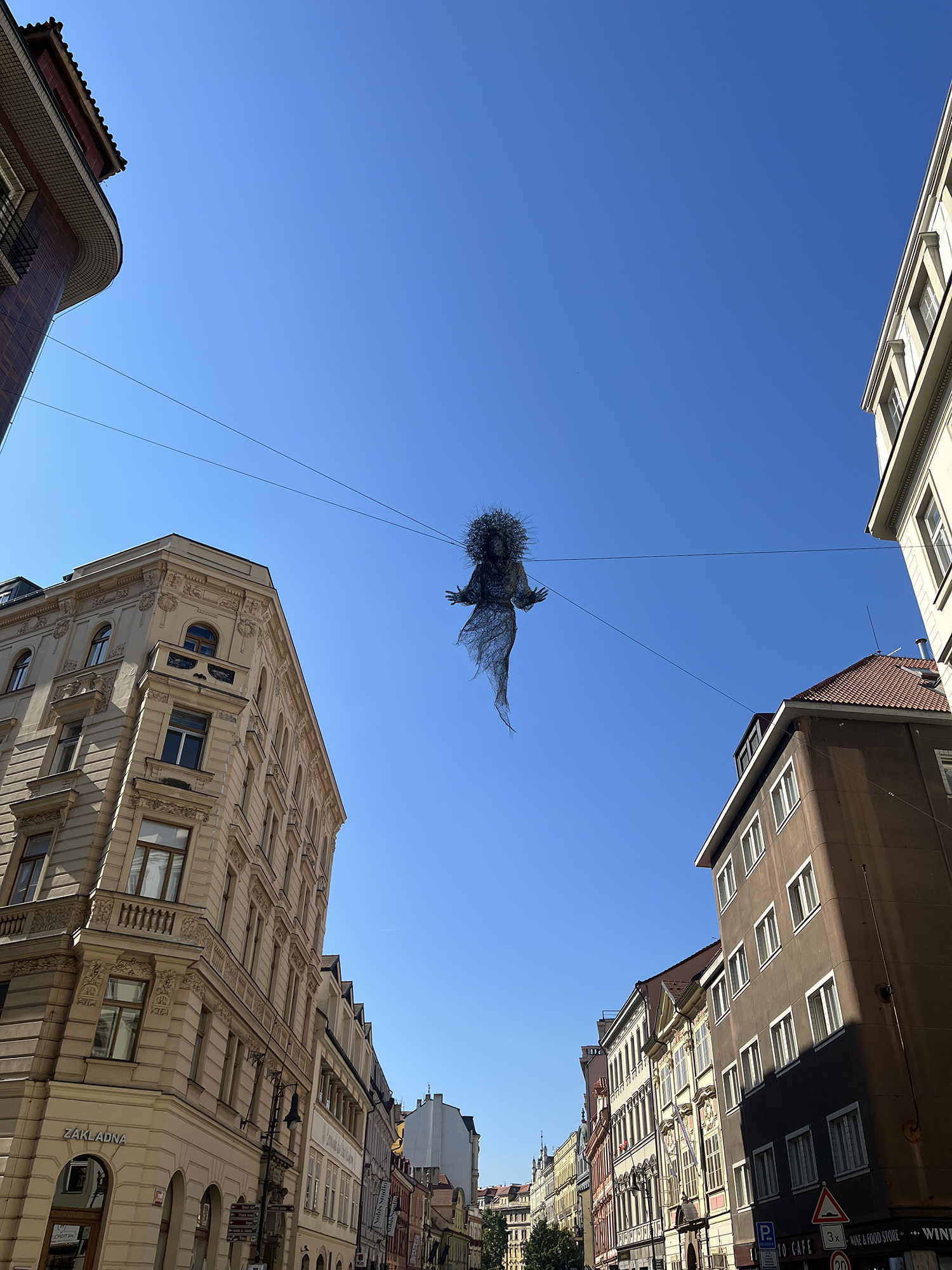
“Vinok,” by Veronika Psotkov. Suspended above Dlouhá Street in Prague. Dedicated to mothers impacted by the war in Ukraine.
Footnotes
Declaration of Conflicting Interests
The author declared no potential conflicts of interest with respect to the research, authorship, and/or publication of this article.
Funding
The author received no financial support for the research, authorship, and/or publication of this article.
