




Abstract
Scholarship in Migration Studies and Forced Migration and Refugee Studies recognizes that migration and immobility can be the result of various, mixed motivations. Empirical work and conceptualizations of forced and “lifestyle” migration consider some of this complexity. Scholarship on immobility has also examined various, mixed motives. Finally, migration theory development has recently begun to incorporate various “non-economic” motivations, mainly into frameworks originally aimed at tackling economic/labor migrations, mainly integrating force and/or environmental factors. However, efforts to conceptualize and theorize on how and why motivations overlap or are interrelated (positively or negatively) are more scant, less explicit, and less systematic. In this paper, I provide a broad systematic taxonomy of migration and immobility motivation overlap and interrelation. First, I describe the six main (im)mobility motivations discussed in the literature—namely economic, labor-related, safety-related, environmental, family-related, and related to self-fulfillment—organizing them around the degree to which they are driven by extrinsic and/or intrinsic rewards and costs. Second, I provide a general typology of possible ways in (im)mobility motivations become “alternative” to and/or concurrent with each other, and how these instances operate at individual and/or population levels. Third, I examine how the different motivations fit within three important theories of micro-level decision-making in the literature, exploring different points of overlap and interrelation between mechanisms within and across analytical perspectives. I conclude discussing the potential implications of this motivation integration.
Various strands of scholarship in Migration Studies and Forced Migration Studies recognize that people migrate/stay due to various, mixed motivations. 1 Conceptualizations of forced migration recognize that people hold a complexity of motives, even in more dire displacement situations (Betts 2013; Crawley and Skleparis 2018; Bloch and Donà 2018; Zetter 2018, but, for an argument on the limits of this idea, see Mandić 2022). Likewise, scholarship considers the economic underpinnings of “lifestyle” migration along its more central self-fulfillment components (Benson and Osbaldiston 2014b). Recent scholarship has also considered various motivations in the production of immobility—the absence of migration either borne out of willingness and ability to stay, the unfulfilled desire to move, or from the acquiescence that may come with not being able and willing to migrate (Schewel 2019; see also Carling 2002; de Haas 2021; Gewirth 2009). Finally, empirical research has identified several types and mixtures of (im)mobility, both within populations (Benson and Osbaldiston 2014b; Boustan 2007; Garip 2012) and individuals (Crawley and Skleparis 2018; Garip 2017; Marston Jr 2020).
Despite the acknowledgment and empirical examination of the heterogeneity in and intricacy of migration motivations, migration scholarship has advanced less on theorizing the potential links between these various motives. To be sure, many migration theories today do go further than explaining movement due to a single particular motivation, be it economic, related to labor, force, environmental strain, family, or self-fulfillment. For example, there has been a longstanding consideration of various alternative and/or overlapping economic motives behind migration decisions, as well as of some non-economic factors influencing labor migration decisions (e.g., Massey et al. 1993; Massey et al. 1998; Morawska 2012). In addition, recent work has further incorporated various types of factors into frameworks typically used to understand economic migrations, including those related to force (FitzGerald and Arar 2018; Poole 2022), environmental strain (Hunter and Simon 2022; Riosmena 2022; Zickgraf 2021), or self-fulfillment (e.g., via “lifestyle” migration, see Benson and O’Reilly 2016).
Despite these advances and recent attempts to integrate various motivations into the same analytical framework(s) (de Haas 2021; Riosmena 2024), scholarship could further benefit from additional theorization that further integrates these different motivations with each other, engaging in a deeper exploration of whether and how said motivations overlap and interrelate. A lack of theorization and conceptualization of the overlap and interrelation between motives can otherwise lead to a selective, incomplete, and perhaps flawed attribution of the causes of (im)mobility.
In this paper, I propose how various (im)mobility motivations may overlap and/or be interrelated within and across some of the analytical frameworks most widely used in Migration Studies, focusing on those explicitly aiming to explain micro decision-making and examining linkages at both individual and population levels. Given that much of empirical work is at least partially theory-driven, analytical lenses and theoretical frameworks provide important guidance for the understanding and framing of (im)mobility. Theorizing and conceptualizing also helps (re)create the categories we study (see discussion in Crawley and Skleparis 2018).
I first introduce and define the six most important (im)mobility motivations in the literature, organizing them according to the types of “rewards” and “costs” that are more likely to produce them. Second, I offer a classification of possible ways in which motivations may overlap and/or relate to each other at both individual and population levels. Third, I provide a synthesis of key “micro” theories that specifically consider the way in which (im)mobility decision-making occurs, integrating all six key motivations, and identifying mechanisms within these theories where motivation overlap and interrelation likely occur. I conclude by briefly discussing the substantive, policy, and measurement implications of this added complexity.
Types of (Im)mobility Motivations
Individual behavior—including lack of action—is an (in)voluntary response to a mix of motivations. 2 We generally and loosely label those that are more salient and central as “primary” while referring to those that are less relevant—reinforcing the decision or, less commonly, muddying its waters—as secondary. Psychologists, philosophers, and scholars in related fields often further divide motives into a continuum between “intrinsic” and “extrinsic.” Intrinsic motivations are related to the desire for self-fulfillment—meeting one's aspirations and/or capacities 3 (Gewirth 2009) while extrinsic motives refer to external compensation, reward, and/or punishment (Spielman et al. 2019, 332). 4
Figure 1 shows the main migration and immobility motivations discussed in the literature along a continuum of the main type of extrinsic/intrinsic rewards and/or costs involved. Most migrations likely primarily follow extrinsic motivations, perhaps especially rewards. Among these, “labor” motives—where income opportunities from work are a major drive behind a decision to move or stay—are implicitly regarded as the most common (e.g., de Haas 2021). 5 Labor migrations are largely but not a perfect subset of those motivated by “economic” factors. That is, the pursuit of work opportunities is often mainly/fully driven by an individual's 6 reaction to or anticipation of financial necessity, desire, and/or planning.
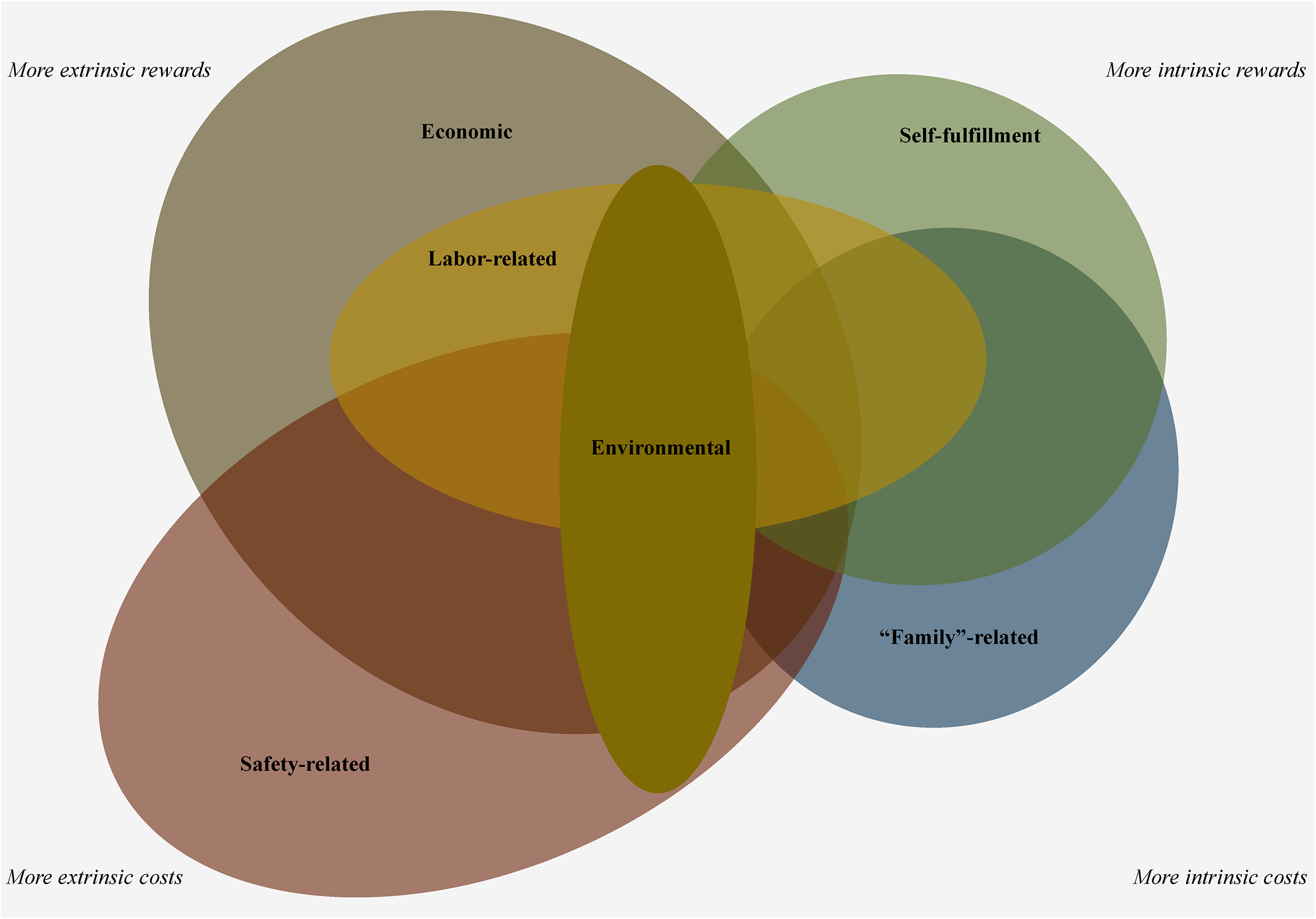
(Im)mobility motivations by type of reward/costs mainly associated with them.
Extrinsic costs can also be quite relevant. Besides those related to different forms of economic dislocation, these include safety-related motivations arising from war, persecution, political and economic turmoil, and “non-environmental” disasters (Arar and FitzGerald 2022; FitzGerald and Arar 2018; Poole 2022), as well as environmental-related motives, including both rapid- and slow-onset events (Black et al. 2013; Black, Kniveton, and Schmidt-Verkerk 2011; Hunter and Simon 2022).
While arguably less common as primary motives, intrinsic rewards and costs can of course be very important factors in (im)mobility decisions. Family—or more broadly, love-, kinship-, and companionship-related—factors can motivate (im)mobility through the intrinsic rewards of being with loved ones (e.g., Garip 2017, Chapter 4; Hondagneu-Sotelo 1994). However, family-related motivations can also be borne out of intrinsic costs. For example, people face normative expectations to fulfill familial duties, which may drive them to (not) migrate (e.g., Garip 2017, Chapter 4). Others may move away from or to avoid reunifying with family to get away from different forms of social control or stigma.
Various intrinsic motivation related to the pursuit of different forms of “self-fulfillment” may also elicit (im)mobility. Within this broader set of motives, scholars have examined various kinds that arise mainly—or at least partially—from the pursuit of intrinsic rewards (see discussion in Benson and O’Reilly 2016). These include the interrelated but not always overlapping “lifestyle,” “retirement,” and “amenity” migrations (Benson and Osbaldiston 2014a), as well as “digital nomadism” (Woldoff and Litchfield 2021). 7
In addition, people may take into account important intrinsic costs in their decisions to move or stay. Adding to those related to familial obligations, expectations, or pressures, individuals may also move (stay) seeking to maintain or achieve bodily or spiritual autonomy, a fuller exercise of their identity and/or capacities (Gewirth 2009), migrating (staying) when the costs of doing so in sending areas are high (low). Indeed, structural factors often play an important role in influencing whether, when, and for whom intrinsic motivations produce particular forms of (im)mobility (Parreñas 2020; Luibhéid 2019; Nawyn 2010; Schewel 2019). In some situations, barriers that would otherwise be intrinsic costs like social pressure can cross into the extrinsic realm, becoming threats, persecution, or the like (e.g., Camminga 2020; Carrillo 2018).
Because people are exposed to various kinds of structural forces, most (im)mobility decisions are likely the result of a combination of intrinsic and extrinsic motives. This is reflected in Figure 1 by the overlap between the various types. Two features are worth noting. First, no motivation is a perfect subset of any other, not even labor and economic motives given that work-related (im)mobility may not always be exclusively or even mainly economically motivated. For example, a particular (extralocal) job opportunity—or, more broadly, occupation—could be sought after mainly or partly due to its intrinsic rewards. Likewise, individuals seeking novelty, particular amenities, being with loved ones, or even facing extrinsic costs related to, e.g., safety generally have economic needs/motives, often labor-related (see also Benson and O’Reilly 2016; Crawley and Skleparis 2018; Garip 2017, Chapter 4). 8 Similarly, retirement migrants often take economic considerations like cost of living into account alongside particular intrinsic rewards related to their self-fulfillment (Benson and O’Reilly 2016).
Second and more importantly, different rewards and costs may not always operate in consonance with each other. For example, a person could be motivated to stay by intrinsic rewards—like a sense of local identity and the desire to be with loved ones in sending areas—while being motivated to move by other intrinsic rewards, like a desire to explore the world or being with other loved ones living elsewhere may motivate to move. Other intrinsic and/or extrinsic motivations could be further layered on, in what Schewel (2019) calls “push–pull–repel–retain,” the interplay of which can produce various types of overlap, competition, and interrelation, discussed further in the next section.
Motivation Overlap and Interrelation at Individual and Population Levels
Population movements—or, sometimes, their absence—are almost invariably produced by various forces in ways that suggest the existence of various (im)mobility motivations (Bakewell 2010; de Haas 2010; de Haas et al. 2019; Garip 2012; Garip 2017; O'Reilly 2012). However, not all migration motivations that can potentially affect (im)mobility necessarily operate at all times. Overlap and interrelation also have distinct—if related—implications for individuals than for aggregate/population flows. 9
This is reflected across the different panels in Figure 2. The first possibility, shown in panel I is that, a priori, people may have alternative—virtually, mutually-exclusive—motivations to migrate (stay). This occurs when particular sets of conditions producing a motivation or mixture thereof are negatively correlated with the conditions producing an altogether different motivation or mixture thereof. Most notably, this occurs when the presence of a particular condition eliminates—or, at least, negates the influence of—another. While I do not think this happens frequently, such situation could arise as a result of major social, economic, political, or environmental shocks. Most clearly, an outbreak of larger-scale conflict could severely dampen the forces producing otherwise “typical” labor-related, family-related, and self-fulfillment motives, and mainly or even only elicit safety-related ones. 10
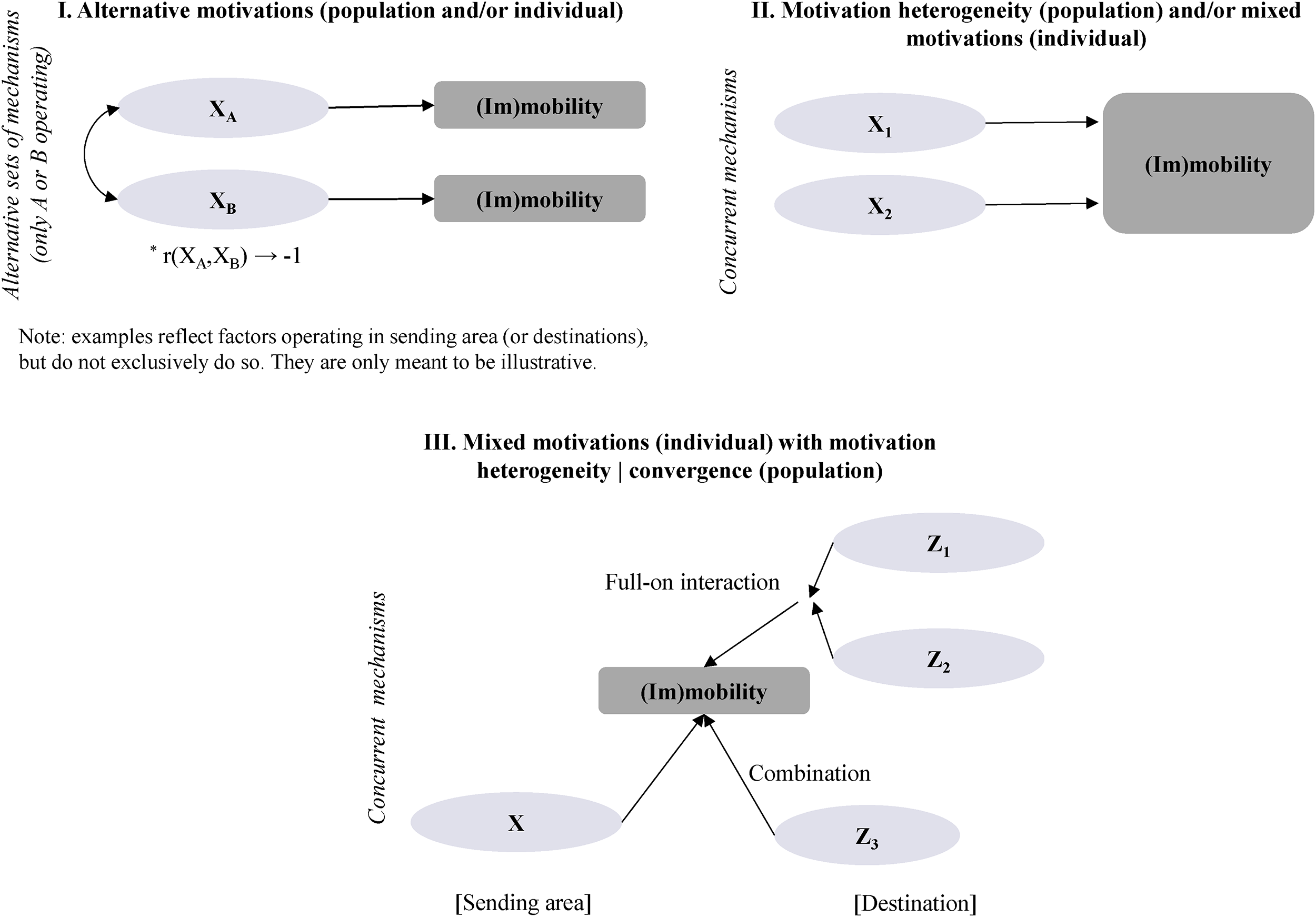
Types of possible interrelation between motivations.
Importantly, these shifts could affect the same individuals—e.g., would-be labor migrants becoming displaced or involuntarily immobile—and/or a whole different group of people. The latter could occur if the aforementioned shocks produced drastic reductions in the mobility of people in the labor force while simultaneously (displacing) children, the elderly, and other “economically inactive” individuals. 11 In this example, would-be labor migrants would also be likely to become voluntarily/involuntarily immobile, e.g., choosing to stay and resist/fight, or staying reluctantly, e.g., due to draft laws prohibiting the emigration of military-age individuals. That is, the conditions producing mobility for some can also lead to immobility for others. 12
Despite the possibility of alternative motives, mechanisms affecting (im)mobility motivations more likely “coexist” in various ways. First, these forces could operate more or less independently, with a couple of possibilities. As illustrated in Panel II in Figure 2, at the extreme, when independent mechanisms operate separately—on completely different individuals—they would produce population heterogeneity in motivations, with individuals each following different motivations, either relatively pure or more mixed ones. This could occur, for example, if the mechanisms producing labor-related migration disproportionately affected small landholders in rural areas while the conditions producing amenity migration via digital nomadism were more likely to appeal to young urban middle-class individuals, as they often do.
While this situation is perhaps more likely than the existence of alternative mechanisms, it is perhaps less so than a messier mixture of forces affecting the same individuals, even if unevenly and differentially across them. This is illustrated in Panel III in Figure 2. Most typically perhaps, as shown in the lower part of the panel, flows increase when conditions in sending areas associated with emigration line up with conditions favoring immigration in destinations. A classic example is that of the movement of ethnic Jews from the “Pale of Settlement” in the Russian Empire to the United States in the late nineteenth century. As elegantly examined by Boustan (2007), emigration was highest when pogrom violence combined with economic cycles in the United States (for evidence of this combination of factors with other historical and contemporary cases, see Hatton and Williamson 2005; Clark, Hatton, and Williamson 2004; Garip 2012; Garip 2017; Massey and Espinosa 1997; Piore 1979). While confluence could result from the mere addition of separate subgroups moving for safety and economic motivations, it is likely more common to see displaced individuals making mobility decisions based on economic circumstance (see also Crawley and Skleparis 2018).
In addition, mechanism confluence could occur within sending areas or destinations, with mechanisms interacting to produce a particular (im)mobility regime. This is illustrated on the top right side of Panel III in Figure 2 for the case of destinations. For instance, in his study of undocumented migration from Mexico to the United States in the earlier part of this century, Villarreal (2014) found that the dramatic decline in undocumented migration from Mexico ca. 2006–2009 was likely due to the convergence of declines in labor demand at the onset of the Great Recession and (to a lesser extent) the rise in US border and interior immigration enforcement. While, in both examples, the combination of factors most likely affected the motivations of the same individuals, each of these sets could have also/alternatively differentially affected different segments of the population.
As I argued in the outset, the possibility for motivation overlap and/or interrelation has not been explicitly theorized much. I thus examine them in the context of some of the most important “micro-level” frameworks use in Migration Studies (e.g., based on de Haas 2021; Fussell 2012; Massey et al. 1993; Massey et al. 1998; Garip 2012; Morawska 2012; Riosmena 2024; Schewel 2019). I focus on micro approaches because of their explicit focus on decision-making—while also describing the structural forces more likely to influence individual motivations and decisions—allowing for a more explicit integration of motivation overlap and interrelation. 13 These theories have also been commonly used to integrate economic/labor motivations with those force-related (FitzGerald and Arar 2018; Poole 2022) and environment-related factors (Hunter and Simon 2022; Riosmena 2022; Zickgraf 2021).
Motivation Overlap and Intersection Within Theories of (Im)mobility Decision-Making
The Aspirations–Capabilities Framework
Aspirations–Capabilities (AC) is an important analytical lens, one explicitly considering both migration and immobility decisions since genesis (Carling 2002). Perhaps because of its most recent development relative to that of other frameworks, AC has not been used as extensively to guide empirical research (but for some important examples, see Carling 2002; Mata-Codesal 2018; Schewel 2015). Still, the framework has indeed been applied empirically and holds analytical value and further empirical promise because it offers a parsimonious view of how motivations to migrate/stay may be produced and (not) taken to full fruition, something other frameworks have not explicitly considered traditionally. 14
More specifically, the main contribution of AC has been to offer a fairly cogent and elegant explanation for (im)mobility decisions, as the outcome of the combination of aspirations and abilities/capabilities. Aspirations are defined as “the overall perception that one alternative (here, migration or staying) [being] better than another” (Schewel 2020, Footnote 1). Capabilities are anything that empower individuals to potentially move/stay (e.g., de Haas 2021, 2), helping realize their aspirations on this regard (Carling 2002; Carling and Schewel 2018). In my reading of the concept, this includes all actual or potential resources individuals have at their disposal or are otherwise likely able to garner in order to maintain or change their location. 15
Various possible combinations of aspirations and capabilities produce particular types of migration and/or immobility. These are presented in Figure 3, where aspirations and capabilities are not depicted as orthogonal to each other in order to visually convey their likely endogeneity. In particular, AC scholars argue that aspirations and capabilities are intertwined in various ways. Most importantly, aspirations are often shaped by capabilities (Carling 2002, 36–37; Carling and Schewel 2018, de Haas 2021). Even if capabilities do not directly influence aspirations, both capabilities and aspirations could be shaped by the same underlying factors (see de Haas 2021, Figure 2), producing the potential for endogeneity between them.
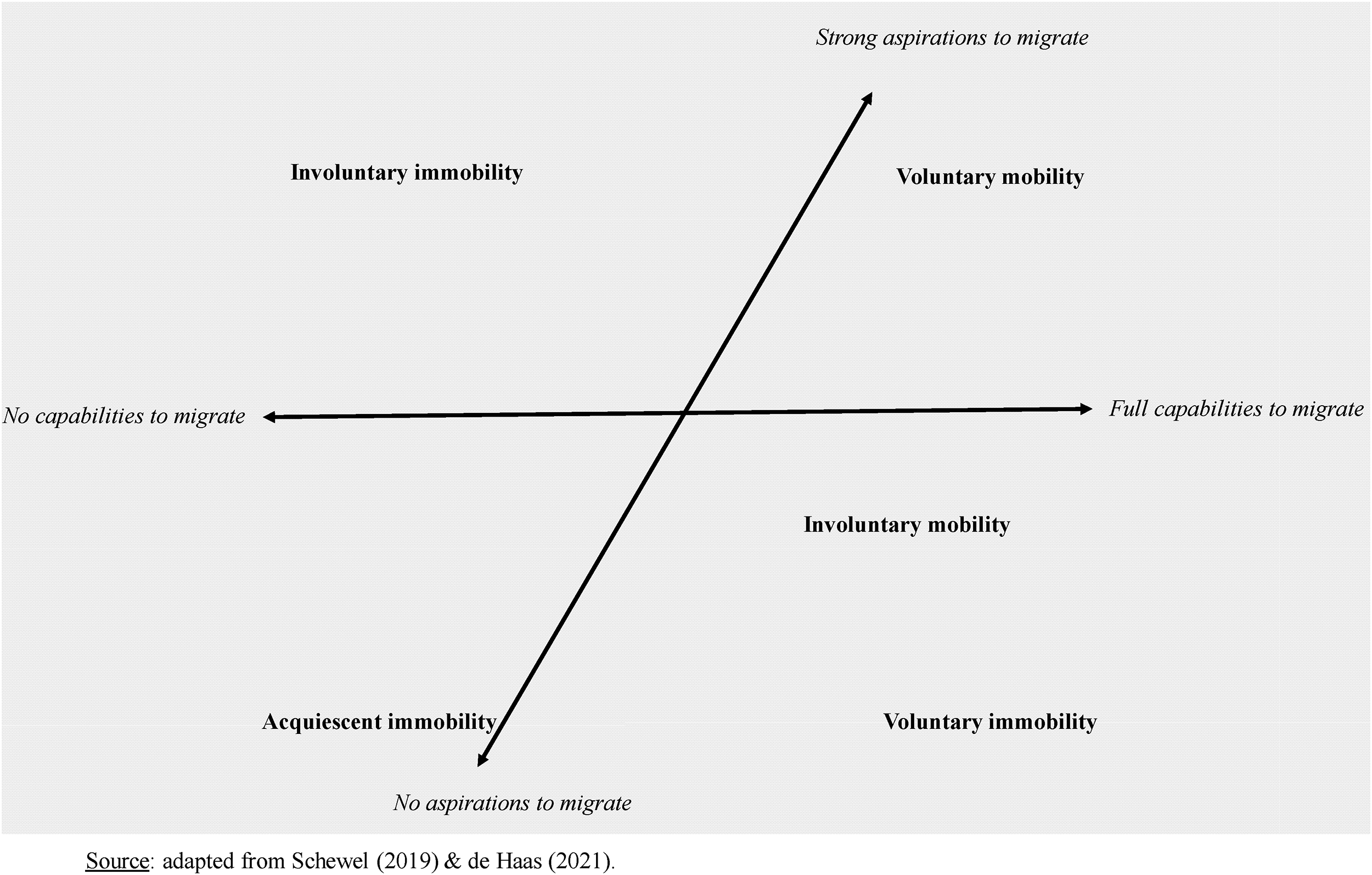
(Im)mobility outcomes according to level of capabilities and aspirations.
In AC postulations to date, all mobility occurs among people with a fair degree of capability. 16 In this sense, aspirations are the main factor differentiating types of mobility along a continuum of volition—again, only among people with higher capabilities. 17 Involuntary moves are those where people with low aspirations to migrate need to do so. In these circumstances, mobility is an undesired outcome, presumably only precipitated by particular political, environmental, economic, or familial events/shocks/conditions or their fallout. 18 In contrast, voluntary mobility is that in which individuals are both capable and aspire to migrate.
Immobility can also be classified along similar AC continua and is arguably produced by an even richer mix of capabilities and aspirations. Carling's (2002) seminal work helped conceptualize and raise awareness on involuntary immobility, a product of low capabilities and high aspirations to migrate. Most commonly perhaps, many individuals may be involuntarily immobile more or less constantly due to high costs of migration (see Carling and Schewel 2018). In addition, people may also be intermittently rendered involuntary immobile—their aspirations aroused and/or their capabilities dampened—by more sudden (e.g., violent or environmental) shocks or their after-effects (see Foresight, 2011; Zickgraf 2021; Piguet 2018).
In her treatise on immobility—tackled under an AC perspective—Schewel (2019) proposed two additional types of immobility: voluntary and acquiescent (see also Carling and Schewel 2018; Mata-Codesal 2018; Schewel 2015). While both varieties are the result of (similarly?) low aspirations, 19 they differ more radically in terms of the capabilities held by individuals. That is, voluntary immobility arises when people hold no/low aspirations to migrate “despite” being perfectly—or, at least, potentially—capable of doing so.
In contrast, people with low capabilities and no/low aspirations to migrate may be really more passively “acquiescing” to not move than fully choosing to. Indeed, Schewel (2020) argues that the existence of acquiescent immobility in particular “challenges prevalent neoclassical and push-pull perspectives that assume the aspiration to migrate should be greatest among those that have the most to gain (often in economic terms) from migration” (335–336). An important question is what factors produce higher aspirations to migrate among folks with low capabilities. In other words, why are some people involuntarily immobile while others practice acquiescent immobility? Most clearly, having spatially elongated family and other social networks—and the intrinsic rewards and costs associated with them is a very likely “discriminating” factor (e.g., DeWaard et al. 2022), but there could be other, perhaps less obvious, ones.
In my view, the more specific types of motivations discussed throughout this paper and shown in Figure 1 are the fabric underlying migration aspirations described by AC proponents, giving them additional texture and, more importantly, added analytical leverage. Indeed, AC scholars recognize that there may be various kinds of motivations underlying (im)mobility, particularly discussing extrinsic (or “utilitarian”) and intrinsic types. In fact, AC scholars sometimes argue that intrinsic rewards are unheralded (primary or secondary) motives to move. In one of the most thorough expositions of AC to date, de Haas (2021) describes several empirical studies in which (South–North) migrations that may otherwise be characterized as only or mainly motivated by labor are viewed by migrants themselves as providing different forms of intrinsic rewards (see de Haas 2021, 19 and references therein). Engaging with the work of Amartya Sen, de Haas argues that migration and immobility can be not only: an instrumental-functional means-to-an-end to improve people's living conditions but also as a potentially wellbeing-enhancing factor in its own right. This alludes to the intrinsic, wellbeing-enhancing (non-instrumental and non-utilitarian) dimension of migration and this, at a philosophical level, also expands our understanding of mobility not so much as the act or capability of moving but as the ability to decide where to live, including the option to stay at home. (20)
20
Likewise, to better accommodate for immobility, Schewel (2020) offers an expansion of push–pull factors 21 by introducing three additional types: repel, retain, and “internal constraints” on decision-making. “Internal constraints” are perfectly akin to intrinsic costs. In addition, Schewel argues that (the intrinsic rewards from) holding different social relations are key “retain” factors, producing place attachment and embeddedness. Finally, repel factors are intrinsic and extrinsic costs of moving (see Schewel 2020, 340–341).
In short, AC scholarship recognizes the existence of a similar set of extrinsic and intrinsic motivations overall consistent with those presented in Figure 1. Furthermore, by raising awareness of the unsung relevance of intrinsic motivations, AC formulations imply the existence of motivation heterogeneity of the kind discussed in the prior section. Most importantly perhaps, the framework's explicit examination of immobility—in particular, the involuntary type—makes it clear that overlap does not always occur between forces operating in the same “direction” (e.g., pushing and pulling). Instead, immobility can be the result of paradoxical motivations, due to some and in spite of others. For example, in his classic study of (im)mobility in Cape Verde, Carling (2002) pointed to the degree that globalization simultaneously increases (extrinsic and intrinsic) aspirations to move while erecting substantial extrinsic barriers. This kind of counterbalancing is also true of mobility—even the most voluntary type 22 —even if involuntary forms of (im)mobility highlight this issue more clearly.
Like most conceptual treatments of (im)mobility motivations in the literature, AC-related theorizing does not explicitly address overlap and interrelation of the kind depicted in Figure 2, Panel III. To be sure, empirical illustrations in AC work the possibility that people make (im)mobility decisions due to specific factors but despite others. For instance, Schewel (2020, 340–341) discusses how immobility can arise out of loyalty to one's home country (an intrinsic cost or reward, depending on how this sense of loyalty is internalized) despite deteriorating local conditions in economic or security terms.
These examples suggest the possibility that the AC framework can certainly accommodate for motivation overlap. However, a more explicit conceptual formulation of overlap and a deeper consideration of interrelation could improve the understanding of immobility and migration decisions both. This should include theorizing on how individuals sort through the different factors producing different types of extrinsic and intrinsic rewards and costs affecting both their aspirations and capabilities to migrate and/or stay. This will also require a more explicit conceptual model of how aspirations are formed and change (see note 19), including their relationship with arguably more stable preferences used in economic models like those discussed next.
Rational Choice, Cost–Benefit Frameworks I: The Human Capital Model
A longstanding and highly influential analytical perspective in economics and various other social sciences, typically referred to as rational choice, boils down the act of (migration or immobility) to individual, by-and-large logical considerations of the likely benefits versus costs of moving. 23 The most traditional formulation of this view is known in Migration Studies as “Neoclassical” economics—a specific version of what contemporary economists refer to as the Human Capital Model (HCM) or Theory (Bodvarsson, Simpson, and Sparber 2015, 8–9; Williams and Baláž 2012, 169), which includes not only Neoclassical formulations, but also the so-called New Economics of Labor Migration (NELM, see Abreu 2012)—discussed later.
Under rational-choice, cost–benefit (RCCB) models like the Human Capital Model, spatial differences in wellbeing incentivize individuals to evaluate one or a mix of expected origin–destination experiences in order to maximize the net present value of their well-being, i.e., “utility,” following the form depicted in Equations 1 and 2, adapted from Massey et al.’s (1993) influential formulation, updated to reflect recent RCCB scholarship addressing the role of costs, risks, uncertainty, and various types of preferences and endowments on migration decisions (see Bodvarsson, Simpson, and Sparber 2015; Clemens 2020; Czaika, Bijak, and Prike 2021; McKenzie 2022; Williams and Baláž 2012).
Under the model, individuals are much more likely to migrate to a particular destination when their estimation of the expected net present returns to migrating there (ER in Equation 1) are positive. In other words, people anticipate that a combination of present and future benefits (Y terms in Equation 1, for potential destination j [dj] and origin area o, respectively) and costs of moving versus staying (C terms in both equations)—weighed by various considerations discussed later, and subject to budget constraints at age x (βx)—will be overall favorable by moving. While this heuristic is relatively straightforward, there is a fair degree of potential complexity in terms of what people deem as benefits and costs and how they may anticipate them. Most notably perhaps, individuals’ location preferences matter considerably (see Dustmann and Görlach 2016, 111). And while these preferences are not explicitly modeled in either equation, they are quite consequential in influencing what enters both Y and C terms. In addition, people's time preferences—shaped in part by the degree of aleatory uncertainty they perceive about the future—determine the time horizon and, thus, discount rate (r in both equations) they are willing and able to take into account when weighing expected benefits versus costs (see, in particular Bodvarsson, Simpson, and Sparber 2015; McKenzie 2022). Location and time preferences along with the type of information one might be able to obtain about various local and extralocal issues are all potential sites for the production of the various migration motivations.
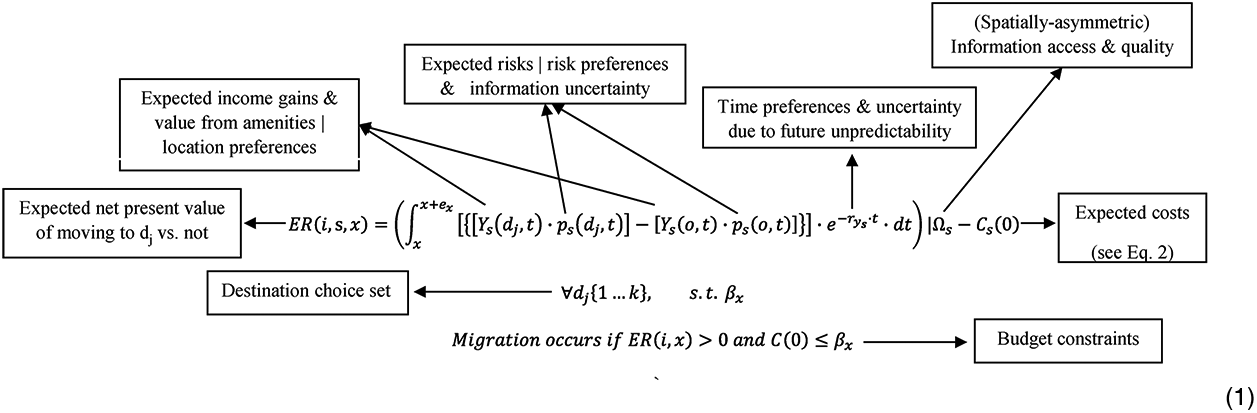
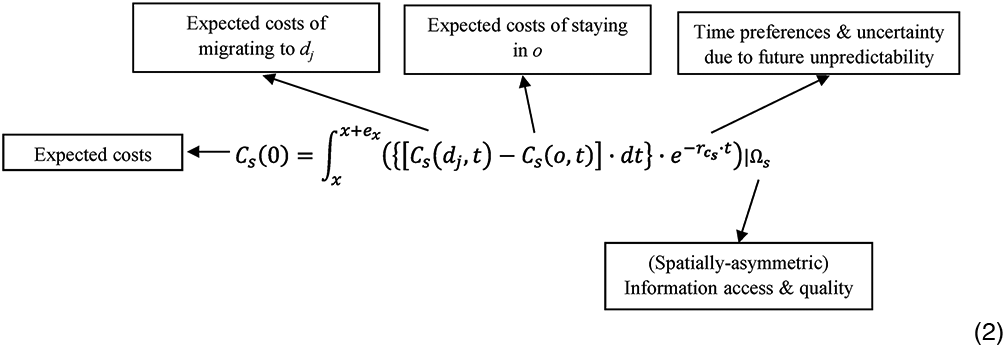
Individuals also weigh in their perceptions of the added risks and uncertainty around the likelihood of accruing the benefits they would expect to obtain and the costs they would expect to incur. While these are mainly expressed through the p terms in equation (1), the discount rates could also include estimations of the level of uncertainty about the future along with one's degree of tolerance to such uncertainty (Bodvarsson, Simpson, and Sparber 2015; Czaika, Bijak, and Prike 2021; Williams and Baláž 2012). Finally, all of these calculations are (heavily) dependent on the amount, quality, and uncertainty around the information individuals have access to, expressed in the Ω terms (or functions) in both equations (see Czaika, Bijak, and Prike 2021).
In the model, migrations traditionally occur when two conditions are met. First, the expected benefits of moving versus staying—and of moving to that destination relative to another—need be higher than the expected costs of moving there versus those of staying or of moving elsewhere. Second, the (generally, pecuniary) costs of moving—not of moving versus staying—need be lower than the budget constraints the individual is subject to at that particular time. If either of these conditions is not met, individuals would then stay immobile until circumstances—or individuals’ assessment of them—change. This is perhaps why financial budget constraints have been singled out as a key reason why migration rates are lower than perhaps expected historically (Hatton and Williamson 2005) and contemporarily (e.g., Angelucci 2015), and why involuntary immobility often occurs (Carling 2002), even if factors like risk aversion could have an important role in immobility as well (Czaika, Bijak, and Prike 2021; Schewel 2015).
While RCCB frameworks like the Human Capital Model were originally designed to explain economic motivations—with most focusing specifically on labor-related ones—these frames can also recognize that non-economic factors—and, thus, various extrinsic and intrinsic motivations—enter cost–benefit calculations. One could conceivably plug in extrinsic and intrinsic rewards and costs related to any and all the motivations in Figure 1 into the framework. The main differences across these motivations would be on whether which types of benefits or costs matter more in decision-making and on whether costs or benefits dominate.
In sharp contrast to labor-related motivations, where benefits are expected to dominate, forced mobility due to rapid-onset environmental change, war, and various other types of turmoil, violence, or insecurity can motivate movement in the absence of clear net benefits and be driven by the very high costs, risks, or uncertainty of staying (see also FitzGerald and Arar 2018; Hunter and Simon 2022; Millock 2015; Piguet 2018; Piguet 2013). As briefly described before, family-related motivations might drive people to move or stay via high intrinsic benefits of being with loved ones and/or by the high intrinsic costs of separation (Garip 2017, Chapter 4; Hondagneu-Sotelo 1994). Similarly, the search for self-fulfillment may provide high intrinsic benefits to moving (staying) despite other benefits/costs of staying (moving), for example, to reduce the costs or increase the benefits of having a particular identity (Benson and Osbaldiston 2014b; Carrillo 2018; O'Reilly 2012, Chapter 4; Woldoff and Litchfield 2021). Perhaps even more often, many forms of (e.g., gender, sexual, ethnic, racial, or religious) identity—in turn related to self-fulfillment—are very much affected by economic and political circumstances that shape costs and benefits of moving.
There is, at least in theory, plenty of room for overlap in motivations as all of these extrinsic and intrinsic costs could be entering people's lives at the same time. However, because it is incredibly hard to measure and compare these different benefits and costs in similar metrics or footing (e.g., Czaika, Bijak, and Prike 2021; Kahneman 2011), the question of which motivation combination is more salient for people is not simple to test empirically, especially given the critiques to RCCB models as not realistically depicting how people make migration (or immobility) decisions (e.g., de Haas 2021).
Likewise, note that there is also an important gap between the ex ante considerations contemplated in RCCB models—in anticipation of events that people deem will likely unfold given current conditions—with the much direct and likely exclusive measurement of ex post behavior in the vast majority of empirical studies (for exceptions, see Dillon, Mueller, and Salau 2011; Quiñones et al. 2023). This matters as the mix of motivations may vary ex ante versus ex post.
Rational Choice, Cost–Benefit Frameworks II: The New Economics of Labor Migration
Even if not widely recognized in many theoretical syntheses, NELM is an RCCB model with similar underpinnings to NE (see Abreu 2012, 48). In fact, contemporary migration scholarship within the field of Economics often does not explicitly distinguish between these two traditions while describing features broadly consistent with them (e.g., Bodvarsson, Simpson, and Sparber 2015; Dustmann and Görlach 2016; Yang 2006).
Despite many similarities, NELM formulations have provided three major extensions to RCCB models (see Abreu 2012; Brettell and Hollifield 2015; Fussell 2012; Morawska 2007), all of which refer to non-labor economic motivations and, to a lesser extent, non-economic motives. First, individuals do not only look at their own likely (income) trajectories to make (im)mobility decisions, but also to their wellbeing or social status relative to a reference group (Massey et al. 1998, 26–28; Bodvarsson, Simpson, and Sparber 2015, 24). When such relative deprivation is high, individuals are expected to be more likely to aspire to and migrate in order to find higher, more secure forms of income.
The very notion of relative deprivation and the way in which a reference group is defined links the extrinsic motivations typically included in RCCB models with intrinsic motives. Despite this possibility, analytical frameworks on immobility—including NELM—do not explicitly focus much on the social psychology of motivations, even if we know that structures, institutions, or actors affect one's freedom and independence (in terms of, e.g., gender or sexual identity and sexuality, Nawyn 2010; Luibhéid 2019) in ways that might affect the definition of one's reference group and whether relative deprivation is at play.
Second, NELM expanded the main factors entering people's utility calculations beyond labor markets (and related policies). Individuals may overcome credit or capital market failures by migrating, with the specific purpose of saving funds to purchase, build, or remodel a home or finance productive inputs for farming, equipment, or other types of capitalization (Massey et al. 1998, Chapter 9; Smith and Mazzucato 2009; Sheehan and Riosmena 2013; Woodruff and Zenteno 2007). Likewise, people may also migrate to overcome inexistent or inefficient crop insurance markets/policies (e.g., see Dillon, Mueller, and Salau 2011; Quiñones et al. 2023) as well as, perhaps, other insurance (e.g., related to retirement, Sana and Massey 2000). These are, of course, economic motivations that go beyond even if they are clearly interrelated to labor. In addition, scholars have pointed that a desire to overcome market imperfection in sending areas while continuing to invest (financially or emotionally) back in them is suggestive of a strong preference for consumption and life in places of origin (Lindstrom and Lauster 2001). A mixture of countervailing extrinsic and intrinsic motives to move and stay could be thus producing—as we shall see, mobility for some family members, immobility for others.
The broader economic, social, environmental, and/or political uncertainty credit, capital, and insurance markets are aimed at reducing can also produce various forms of forced displacement (see FitzGerald and Arar 2018; Poole 2022; Riosmena, 2022; Van Praag and Timmerman 2019) and immobility (Marston Jr 2020; Van Praag 2021; Zickgraf 2021), something scholars have indeed explored theoretically and empirically in the studies cited (see also Riosmena 2024). Less examined perhaps are the various types of extrinsic and intrinsic social and social-psychological factors that can affect the very interest and goals of these investments, who is expected to engage in them, as well as the preferences for staying in the sending area described before. These factors need to be further examined empirically under this and other lenses and further deepened theoretically.
A third additional contribution of NELM is to focus on collective risk management as opposed to individual utility maximization. Under NELM, the labor of various members of a family, household—or, potentially, other collectives—is “allocated” across, e.g., space, to reduce/minimize, e.g., market failure risk in tandem with the pursuit of maximum utility. While moves consistent with NELM are mainly or exclusively characterized as labor-related, family dynamics are important. Collective planning and labor allocation exist in the first place because of mutual trust that resources garnered by the different members will be shared, with remittances from migration playing a particularly important—but not unique—role. This focus clearly suggests an entanglement between extrinsic “labor” and at least some intrinsic “family” motivations even if NELM in particular has been criticized for failing to address more explicitly how (e.g., patriarchal) power differentials affect collective decision-making and, thus, who migrates and who stays and for which reasons (e.g., Abreu 2012, 59; Black et al. 2013; Hofmann and Chi 2022, 2497; Hughes 2021; Hondagneu-Sotelo 1994; Nawyn 2010, 752; Skeldon 2014, 23; Zickgraf 2021, 126). Additional theorization and empirical examination of the different motives espoused by family members and their interrelation (and conflict) could provide additional insights into how (im)mobility decisions are made and, again, despite what factors or influences.
Conclusions
Longstanding scholarly and policy interest in understanding what “drives” (im-)mobility faces the challenge that motivations to move/stay may be multiple, mixed, countervail each other, and fluctuate over time. Prior conceptual work has largely focused on examining specific or otherwise a limited set of motives like forced migration or lifestyle migration and their interplay with economic motivations. While this may be overall reasonable because people may hold a limited set of main motivations in many/most migration flows, zooming in on specific motives also has potential trade-offs. Such focus might lead to potentially missing alternate, overlapping, and interrelated motivations people hold—partially explaining their behavior, or heterogeneity therein. As an important analogy, the “push–pull–repel–retain” forces driving immobility (Schewel 2019) may produce additional, different, and—more importantly—more complex motivations than those otherwise arising from examining push–pull mechanisms, as is often done when studying migration.
In this paper, I have sought to contribute conceptually to the examination of multiple (im)mobility motivations and linkages therein in three ways. First, I defined six key (im)mobility motivations, attempting to systematize their underlying elements by classifying them according to the extrinsic/intrinsic rewards/costs that are more likely to produce each motivation. This depiction provides a more extensive set of types to consider while offering, I hope, a cogent way to understand the most basic differences between them.
Such a classification could guide future deductive and, more loosely, inductive empirical work. Examining the relevance of various types of extrinsic and intrinsic rewards and costs and their role in influencing people's desires to move/stay and their behavior could provide us with a deeper understanding of when and why some motivations are irrelevant, alternate, overlap, and how they are mixed. Understanding perceptions around these motivations can also provide a clearer sense of the role of underlying structural forces producing differential rewards and costs in migration and immobility outcomes. In particular, this could help understand heterogeneity in the way these forces influence the decision-making of people in different social categories like social class, gender, and sexuality, who may be subject to different mechanisms and, thus sometimes, motivations to migrate/stay than others (see also Riosmena 2024).
As a second contribution, building off various strands of empirical, conceptual, and theoretical scholarship, I have also proposed a categorization of the possible ways in which (im)mobility motivations may alternate, overlap, and interrelate. Besides recognizing the possibility that mechanisms operate concurrently but separately from each other—thus producing different and potentially “purer” motivations—I described three additional ways in which overlap between motives may occur via the mechanisms producing them. These mechanisms can: (a) be independent of each other, but act in tandem to produce a mixture of motives across individuals; (b) interact more fully, also producing more mixed motivations within individuals, in addition to population heterogeneity; or (c) being (strongly) negatively correlated, occurring alternatively with changing conditions and thus producing changing motivations within individuals and/or across “subgroups.” Whether these possibilities hold in particular contexts are, of course, empirical questions. I hope that proposing this classification helps scholars identify possible ways in which migration and immobility motivations could be operating.
Empirical testing is quite often guided by analytical frameworks, even if loosely and despite the fact that such frameworks may not always closely reflect on-the-ground decisionmaking. As a third and final contribution, I have attempted to further integrate these various motivations within the three main “micro” theories of migration decision-making in the literature, namely the AC framework as well as RCCB frameworks like the Human Capital Model (a.k.a., “Neoclassical” Economics) and the New Economics of Labor Migration. To provide a broader view, I summarize the most important mechanisms uncovered and integrated in this more detailed exposition in the Appendix. While the instances and examples provided here are most likely not exhaustive, I hope they provide a stepping stone for deeper theorizing and conceptualization of these different links.
Throughout my exposition of these frameworks, I discussed the way in which they explicitly accommodate for various motivations, or making implicit links more explicit. I also deliberated on the implications of some of these theories’ tenets for motivation overlap and interrelation. While showing the pliability of theories, I hope my exposition also opens up new avenues of motivation and theory integration and improves empirical testing. The micro frameworks examined here do accommodate for various motivations and allow for overlap and interrelation, in addition to their other and important contributions. However, none conceptualize the way in which motivations are formed (or not) via preferences and aspirations of varying intensity and kind. For this, I believe we need additional social-psychological frameworks or add-ons, building off but going beyond the many contributions of Prospect Theory in particular, an analytical lens extending and relaxing rational choice that is, however, less used in Migration Studies (for a review and exceptions, see Czaika, Bijak, and Prike 2021). Empirically, my exposition adds to the arguments put forth by other scholars (e.g., Crawley and Skleparis 2018; Schewel 2019) on the need to go beyond examining the push–pull forces explaining migration/immobility of the type that seems to best describe why people migrated/stayed, considering a wider variety of factors that could better explain individual decisions and their degree of (in)voluntariness. Such emphasis might also improve our understanding of the way in which (im) motivations are formed, develop, and are realized or frustrated. As a result, the better we understand individual (im)mobility decisions, the better we will also grasp population heterogeneity in motivations.
Scholarship conceptualizing and theorizing (im)mobility motivations in more depth and breadth should help improve the understanding of migration and immobility beyond scholarly circles. In particular, there is a tendency—particularly by policymakers and the public—to label moves as “labor,” “economic,” “political,” “family-related,” or, less commonly, for “self-fulfillment” of some sort. To be sure, it is quite likely that many migrations are primarily driven by a particular factor—and that main factor is indeed often economic in nature, with economic gain from work playing an outsized role. As such, centering empirical measurement on a specific motivation is productive in generating a deeper understanding of its (e.g., economic) underpinnings. However, this focus comes with important tradeoffs as described. Incorporating other motivations more organically into models will be more likely by dealing with them more explicitly in conceptualization and theorizing. And while such efforts do not always or quickly seep into everyday commonsense on mobility, they should overall increase the likelihood that such seepage takes place, or otherwise should help elicit more dissonance from more black–white representations of mobility.
Footnotes
Declaration of Conflicting Interests
The author declared no potential conflicts of interest with respect to the research, authorship, and/or publication of this article.
Funding
The author(s) disclosed receipt of the following financial support for the research, authorship, and/or publication of this article: The project this research is part of benefited from a sabbatical leave and travel support from the University of Colorado at Boulder; from a research leave and travel support from the University of Texas – San Antonio; from administrative and research support through the University of Colorado Population Center (CUPC) funded by Eunice Kennedy Shriver National Institute of Child Health & Human Development of the National Institutes of Health under Grant P2CHD066613; from National Science Foundation Grant 1416860; and from conversations at the CUPC Climate Change, Migration, and Health Conference Series supported by the NIH, under Grant R13HD078101–05..
