




Abstract
There is a growing awareness in migration research that traditional interpretations and approaches to measuring and evaluating integration do not adequately fit the increasingly fluid and unpredictable patterns of migration observed today. Focusing on the transnational and liquid migration characteristic of Eastern European migrants, we propose a new conceptual framework that explains contemporary processes of migrant incorporation from the perspective of migrants themselves. Our model accounts for the “breadth and depth” of integration and contrasts deep integration and assimilation with functional adaptation, and integration into a certain group or network with integration into society as a whole. The analysis is based on comprehensive mixed-design research of Latvian migrants which includes a survey of 6,242 Latvian emigrants, as well as 15 in-depth interviews with internationally-mobile global talents. The bottom-up perspective that we employ sheds new light on how migrants themselves think about, and experience integration in their everyday lives.
Introduction
In recent decades, the practices of international mobility have become increasingly fluid and the aspirations, goals, and lifestyles of migrants increasingly diverse (Grzymala-Kazlowska and Phillimore 2018). The growth of transnational companies and international organizations has fueled global international mobility (Faist 1997), while in the European Union, the free movement of workers has given a rise to various complex and liquid patterns of migration (Ryan 2018; Bygnes and Erdal 2017; Mieriņa 2019). Regarding contemporary East-West migration within the EU, scholars sometimes use the term “new migration” (Engbersen et al. 2013; Penninx, Spencer and Van Hear 2008; Favell 2008). In contrast to the “old type” of migration that constituted mostly of circular migrants such as seasonal workers, and settlers who were looking to settle permanently, the “new type” of liquid migration includes transnational and footloose migrants (global nomads, intentionally unpredictable migrants, searchers, adventurers) who are much more mobile and unpredictable (Engbersen et al. 2013; but see also Grabowska-Lusinska 2013; Eade et al. 2007; Luthra, Platt and Salamońska 2014, 2016; Düvell and Vogel 2006). Engbersen and Snel (2013, 960–961) call this new type of mobility “liquid migration”—migrants try their luck in multiple countries of destination, which resembles “transnational commuting” rather than traditional migration.
However, only for some are the borders wide open, the labor market is truly global, and a liquid lifestyle is actually accessible (Helbing and Kriesi 2014; Naumann, Stoetzer and Pietrantuono 2018; Hainmueller, Hiscox and Margalit 2015). Research has found that highly skilled professionals (Kuvik 2012) or “global talents” (Solimano 2008) constitute the core of the “new type” of liquid migration (Düvell and Vogel 2006). Among them are: (1) technical talents (IT, engineers, etc.); (2) scientists and international students; (3) healthcare professionals (doctors and nurses); (4) entrepreneurs; (5) managers and professionals in international organizations; and (6) cultural talents, also sportsmen with an international career who are highly sought after worldwide. While the highly mobile group is small (Bygnes and Erdalb 2017; Grzymala-Kazlowska 2016), it includes the most sought-after transnational elite (Beaverstock 2005). Countries have been desperate to attract these professionals to facilitate innovation and economic development, as losing the competition leads to brain drain and the prospect of remaining on the periphery of the global economy (Wallerstein 1974; Toma and Villares-Varela 2019; Haque and Kim 1995; Atoyan et al. 2016; Yeoh and Lam 2016).
Nevertheless, integrating a highly diverse, mobile, and uprooted group of professionals may pose some challenges for the receiving society, including for its social cohesion (Yeoh and Lam 2016; Shubin and Dickey 2013; Mügge 2016). Given the mobile mindset and migration practices of the “new type” of migrants, separation (maintaining one's own cultural heritage and not developing ties with mainstream society) or social marginalization (no ties to native or host culture and society) are outcomes which are highly likely (Berry 1992).
How well the conventional integration concepts and theories are able to adequately characterize the processes of incorporation of these highly mobile groups of migrants in the complex societies that exist today is, however, increasingly questioned. The classical theories were developed to explain the “traditional,” “old type” of migration (Engbersen et al. 2013), when immigrants settled in new countries and integrated into majority communities, yet they fail to explain the everyday lived experiences of migrants, who might not settle permanently, who maintain close ties with several countries or who move to super-diverse neighborhoods where no group can be considered as the majority (Grzymala-Kazlowska 2016; Boccagni and Hondagneu-Sotelo 2021; Crul 2016; Shubin and Dickey 2013; Levitt 2001).
Integration policies typically tailored to fixed populations might not fit the highly mobile individuals that represent the “new type” of liquid migration (Grzymala-Kazlowska 2016; Shubin and Dickey 2013). Moreover, it is unclear if they are even interested in forming stable connections and relationships, and whether a failure to do so indicates a problem. Considering their young age, highly mobile lifestyle, and global identity (Duvell and Vogel 2006; Eade et al. 2007), they might not be interested in “integration” in the traditional sense, or at least have a very different take on what “integration” means. The daily life and local contacts of the international students are often confined to a small cosmopolitan circle of other students and staff at school or university, and global professionals—to their international professional circles. Still, they might consider themselves to be well integrated despite their perceived lack of integration by experts, politicians, or the receiving society (see Berry 1992).
The existing literature does not provide sufficiently strong empirical evidence of how the “new type” of migrants think about, understand, and experience integration. The typologies of CEE migrants that offer some insights into their migration patterns, identities, and orientations, sometimes rely on merely theoretical contemplation, qualitative data, or quantitative data that has significant limitations in terms of sampling design and/or sample size (Luthra, Platt and Salamońska 2014, 2016; Engbersen et al. 2013, and for mixed design, see Grabowska-Lusinska 2013). The characterization of the “new migration” mostly relies on a limited number of questions about migration histories, plans and aspirations, identities, and attitudes. Moreover, it has almost exclusively been based on studies of Polish migrants in one (usually the UK) or a few receiving countries (Luthra, Platt and Salamońska 2014; Drinkwaterand Garapich 2015; Düvell and Vogel 2006; Trevena 2013; Grabowska-Lusinska 2013), and it is unclear to what extent these findings can be generalized.
Scholars agree that empirical research on the incorporation of the increasingly mobile, uprooted, or transnational EU migrants in increasingly diverse societies is insufficient and greatly needed (Ryan 2018) and our research aims to fill this gap. We are able to do this by drawing on data from a new large-scale quantitative survey specifically aimed at exploring these issues, and in-depth interviews with Latvian migrants in a diverse set of countries whose patterns of liquid mobility fit the “new type” of migration. Not only does our study shed new light on the peculiarities of this group but it also allows for broader theoretical generalizations, challenging the way we think about integration in general.
Based on our empirical study, we offer a new conceptual framework that bridges existing theories and integrates concepts such as homing (Boccagni and Hondagneu-Sotelo 2021), social embedding (Ryan 2018), anchoring (Grzymala-Kazlowska 2016), and “banal integration” (Ekmanis 2020) under a broader “umbrella” that reflects the process of migrant incorporation as seen by the mobile CEE migrants themselves. It accounts for the “breadth and depth” of integration, mainly from functional adaptation to deep integration and/or assimilation, and from integration into a narrow circle of people (“bubbles”) to integration into society as a whole. Among our findings is the understanding that highly mobile EU citizens primarily think of integration in terms of being able to live comfortably and “fitting in” (functional adaptation) rather than “belonging” or adjusting to the host community (integration/adaptation). Cultural adaptation and psychological attachment might occur as the next step, but they are not seen as a requirement for “integration” by migrants. Still, even the most uprooted migrants cannot “float around” in a state of liquidity or mobility but need to form material, relational, and psychological connections in order to achieve psychological well-being. In fact, we find that for them connections to their homeland have a particularly pivotal importance. The proposed model allows to better illustrate contemporary processes of migrant incorporation beyond the outdated and often contested narratives of “assimilation” and “integration.”
Theoretical Approaches to Integration
The point of departure for us that drives our bottom-up interpretive approach is that the concept of “integration” has become politicized, and excessively pragmatic, frequently failing to consider what “integration” actually means, especially in the light of the new and emerging forms of mobility (Penninx and Garcés-Mascareñas 2016; Ryan 2018; Grzymala-Kazlowska 2018). The integration goals, i.e., what kinds of behavior, aspirations, and attitudes are desirable and expected from migrants are defined by policymakers, government practitioners, or experts, while the lived experiences, perspectives, and needs of migrants themselves are insufficiently acknowledged (Erdal 2013; Ekmanis 2020). The common conceptualization of integration as a process of reducing the gap between immigrants and the receiving population in terms of education, employment, attitudes, and in other areas (Huddleston, Niessen and Tjaden 2013), visibly disregards possible cultural differences, diverse lifestyles, and individual aspirations of different groups of migrants (Crul 2016). Reimagining of integration in a more migrant-centric, fluid way is important (Shubin and Dickey 2013), and this study contributes to the recent stream of research that has tried to do so.
Generally, the term “integration” is understood as the participation of immigrants in the receiving society and their incorporation into it (Grzymala-Kazlowska and Phillimore 2018). It is seen as a dynamic two-way process, the creation of mutually positive attitudes and co-operative relationships among individuals (Shubin and Dickey 2013; Garcés-Mascareñas and Penninx 2016). To avoid possible confusion with assimilation (giving up the migrants’ original identities and cultural practices in favor of those of the dominant culture in the host society), some authors (e.g., Glick Schiller et al. 2004) prefer the term “incorporation” instead. The conceptualization inevitably assumes that there is some dominant majority culture, identity, and value system that the migrants need to adjust to (Penninx and Garcés-Mascareñas 2016). Nowadays however, an increasing number of cities and communities can be characterized as internationalized and super-diverse with no monolithic mainstream society but a multitude of diverse groups (Vertovec 2007; Crul 2016; Grzymala-Kazlowska and Phillimore 2018). This raises the question of not only who integrates but also “into what?.”
The segmented assimilation theory (Vermeulen 2010) holds that instead of integrating into mainstream society migrants tend to integrate into their ethnic communities, which can lead to either permanent poverty and assimilation into the underclass (Portes and Zhou 1993) or pluralistic integration (Thränhardt 2004) where the retention of one's own culture and group belonging serves as a buffer against downward assimilation. Nevertheless, the emphasis on ethnic communities as a unit of analysis is problematic, for assimilation may be determined by a multitude of other factors (such as gender, profession, education, etc.) not just ethnic origin (Crul 2016). The principle of homophily (McPherson, Smith-Lovin and Cook 2001) holds that people tend to socialize with others like themselves, not just in terms of ethnicity but also in terms of education, profession, age, income, and gender.
In the context of super-diversity, Buhr's (2018) ideas of spatial integration into urban space provide a useful insight. He looks at migrants as skilled agents, and links integration in an urban space with the ability of migrants to navigate it and be aware of its resources rather than adjusting to any specific culture or identity. A similar functional approach is proposed by Bommes (2012: 113) who ties the concept of migrant assimilation simply to “the conditions under which they succeed or fail to fulfill the conditions of participation in social systems.”
Analytically, integration is typically divided into several dimensions. Luthra, Platt and Salamońska (2016) distinguish between economic, subjective, and social integration. Huddleston, Niessen and Tjaden (2013) look at integration outcomes in the areas of employment, education, social inclusion, active citizenship, and a welcoming society which can be cut across four thematic dimensions:
the structural dimension, including labor market participation and educational attainment; the cultural dimension, which refers to language competency, values, and norms; the interactive dimension, dealing with friendship and marriage patterns; and the identificative dimension, which mainly deals with feelings of belonging and identity (Kraler and Reichel 2010).
As illustrated by the “integration paradox,” success in one dimension does not guarantee success in another. Instead of strengthening the sense of belonging and positive attitudes toward the host society, structural integration can, in fact, have the opposite effect; highly educated migrants are more likely to feel relatively deprived and distance themselves psychologically from the host society because of increased perception of discrimination (Verkuyten 2016)—an effect also observed among migrants following the new patterns of migration (Luthra, Platt and Salamońska 2016).
Recognizing the limitations of the classical theories of assimilation, integration, and transnationalism, several new concepts have been proposed that might be better suited for analysis of the process of integration in conditions of increasingly complex and fluid migration. One such concept is the concept of “homing” (Boccagni and Kusenbach 2020). Homemaking or “hom-ing,” as the authors label it, is a process that encompasses all the practices whereby people try to make themselves at home in a certain social context, at an intersubjective and societal level (Boccagni and Hondagneu-Sotelo 2021). A “home” is not simply a location or a material site such as a house, but rather a special kind of emplaced social relationship, tied to deeply rooted emotions, memories, and symbols, as well as the senses of identity and belonging. The authors of the concept argue that “Perceiving one's country, or at least one's city or neighborhood as home […] is a powerful, albeit implicit indicator of integration.” (Boccagni and Hondagneu-Sotelo 2021). Sometimes people might feel at home in a virtual space—more so than in the physical place in which they live (Boccagni and Kusenbach 2020).
Building on social capital theories, Ryan (2018) proposes the concept of “differentiated embedding.” As migrants are often connected to spatially dispersed places and people, embedding is presented as a dynamic and differentiated process through which migrants negotiate attachments and belonging to varying degrees in different social and structural settings (Ryan 2018). People can feel a different degree of attachment to their workplace, neighborhood, and wider community. Besides wider structural contexts and opportunity structures, many other factors can facilitate embedding, such as acquiring an education in a particular country, having children and family there, having stable employment, as well as a subjective sense of belonging and attachment (Ryan 2018).
On a similar note, Grzymala-Kazlowska (2016; 2018) proposes the idea of “social anchoring” which refers to the processes of finding significant (subjective and objective) footholds which enable migrants to feel “settled down” and to acquire socio-psychological stability and security in new, uncertain or substantially changed life settings. “The anchors people use allow them to locate their place in their world, give form to their own sense of being and provide them with a base for psychological and social functioning. In this way, anchoring represents a means of both adaptation and integration.” (Grzymala-Kazlowska 2016: 1130). Besides social ties as the main anchors, the concept also embraces other footholds including cognitive, economic, educational, material, legal, cultural, spiritual, historical, habitual, and emotional. The strongest anchors are those related to self-concept, individual values, beliefs, and memory (Grzymala-Kazlowska 2016). In her analysis, Grzymala-Kazlowska (2018) finds that people tend to establish multiple anchors in different social spaces or countries, attesting to their transnational lives. Some anchors can be transferred while others need to be created anew. Persistent anchors, which link migrants to the country of origin might prevent people from integration, however, anchors can also stabilize immigrants and be used as resources for integration (Grzymala-Kazlowska 2016).
Finally, Indra Ekmanis (2020) proposes the concept of “banal integration,” drawing attention to banal manifestations of social integration in quotidian and national life that exist at the ground level, in the “domain of everyday life,” and that are often overlooked yet very significant. They do not necessarily require extensive effort on the part of the individuals, as they are a natural and intrinsic part of daily life. Instead of being political, labeled, grouped, and conflictual, “banal integration” is unlabeled and unnamed, uncategorized, invisible, unmarked, and routine. It can be observed in public spaces of social interaction (e.g., cafés, shops, libraries, schools, associations), and manifests not via certain “integratory events” but by their absence (Ekmanis 2020). When “integration” becomes invisible it has, in essence, achieved its goals (there are no “problems” that integration would need to solve).
While the new theoretical frameworks recognize the flexibility, variety, simultaneity, and changeability in how migrants form connections and attachments, and help to understand the processes of migrant incorporation in various areas of life, they do not tell us much about the perception of integration in the eyes of migrants, and they lack empirical evidence regarding the applicability of these concepts to liquid migration.
Target Groups and Related Hypotheses
Central to our study are the two groups characterized by Engbersen and colleagues (2013) as belonging to the “new type” of liquid migration.
In contrast to the “old type” of circular migrants such as seasonal workers, and settlers, transnational migrants maintain strong economic, political and sociocultural ties to both country of origin and country of destination, and operate in transnational social fields (Levitt 2001; Mügge 2016; Levitt and Schiller 2004). Combining different traditions, they form hybrid cultural forms and transnational identities (Clifford 1994). Maintaining strong symbolic ties to one country or community, and social and cultural differentiation do not inhibit the successful forming of various connections, linkages, and attachments to the host country and community (Levitt and Schiller 2004; Engbersen et al. 2013, Bygnes and Erdal 2017). In fact, Berry's (1992) model of acculturation calls this specific strategy “integration” as opposed to assimilation (giving up one's own cultural heritage and adapting to the host culture).
The other category of the “new type” of migration is less established in the literature, and as a result, scholars define and label it somewhat differently. Some authors place more emphasis on their global mindset and migratory habitus of “intentional unpredictability”: (Engbersen and Snel 2013; Grabowska-Lusinska 2013; Luthra, Platt and Salamońska 2016) their lives are characterized by uncertainty in terms of job security and the length of their stay abroad, which they accept and embrace; many do not want to put down roots somewhere and therefore maintain strong symbolic ties with their country of origin (Drinkwater and Garapich 2015; Shubin and Dickey 2013). Others point to their high mobility and “rootlessness,” describing their condition as “lasting temporariness” (Grzymała-Kazłowska 2005), “no rooting” (Burrell 2006), or “settling within mobility” (Burrell 2006). However, in essence they all point to the same sub-group of highly mobile migrants who have a very cosmopolitan orientation and are ready to move from one country to another depending on work opportunities. We will describe it using Düvell and Vogel's (2006) term “global nomads.”
Our research questions focus on whether these migrants find integration important (RQ1), and how they understand (RQ2) and experience (RQ3) integration in their everyday life. We explore these questions in three sets of hypotheses.
In the context of their uprooted migratory habitus or lack of commitment to one country, transnational migrants and global nomads might be inclined to interpret integration mainly in instrumental/functional rather than sociocultural terms (Erdal 2013) (H1a). They are also likely to oppose any rigid frameworks and underscore individual autonomy and fluidity in how integration is understood (H1b).
Not planning to build their future permanently in their new country of residence or being unsure of their plans, global nomads, and transnational migrants might be less interested in integrating as they would see it as a (potential) waste of time (H2a). On the other hand, researchers argue that people tend to have a natural need to establish at least some sense of security, familiarity, and rootedness in their lives, especially in conditions of extensive changes and instability (Grzymala-Kazlowska 2016). Thus, we expect that even the most mobile and rootless groups of migrants need a place they could call “home,” that provides them with some sense of “normalcy,” psychological stability, and predictability (Bygnes and Erdal 2017; Boccagni and Hondagneu-Sotelo 2021; Grzymala-Kazlowska 2018) (H2b).
The weakened (or dual) attachments of the new type of migrants are sometimes considered a threat to the stability and cohesiveness of communities (Shubin and Dickey 2013; Mügge 2016); however, we expect global nomads and transnational migrants to be generally content with their social integration, or lack of it (H3a). At the same time, we expect a split between successful integration in some areas and a lack of integration in others to manifest in these groups in particular (H3b). Lacking stable and predictable commitments, global nomads and transnational migrants might be inclined to invest less in social contacts, learning a new language, and engaging in political activities, and instead focus on work and economic returns (Luthra, Platt and Salamońska 2016; Shubin and Dickey 2013; Engbersen et al. 2013; Mügge 2016, Erdal 2013). From a practical standpoint, too, maintaining social ties across dispersed sites can be expensive and difficult over time (Mügge 2016). Thus, their “rootless,” global identities can lead to social marginalization (Berry 1992) or belonging neither “here” nor “there” (Engbersen et al. 2013). In general, we expect that despite being well integrated structurally and economically, the new type of migrants will not make as much headway in cultural, interactive, identificative, or civic integration (H3c). Finally, we expect the integration experiences of migrants to vary depending on the integration context. Research indicates that smaller localities may provide more opportunities to build diverse \ “bridging” social ties that transcend group boundaries and, thus, facilitate integration (Valentine 2008; Nannestad, Svendsen and Svendsen 2008). However, considering the specific mindset of the new type of migrants, we expect them to feel better in larger, more open and culturally diverse cities that provide vast opportunities for networking with people like oneself (H3d).
Materials and Methods
Data
A mixed design research method was applied, which combined a quantitative survey of the Latvian diaspora with semi-structured in-depth interviews with global nomads and transnational migrants. Despite its small size of just under 2 million inhabitants, Latvia is one of the countries with the largest net emigration rates in Europe (Mieriņa 2020), and Latvian migrants are on average much younger and more educated than people who stay and live in the country (Atoyan et al. 2016). In recent years, the intensity of emigration has slowed, nevertheless, the size of the diaspora is growing (Hazans 2020).
The quantitative data were drawn from a large-scale web survey conducted between September 24, 2019, and November 11, 2019. A large variety of recruitment channels and sources were used to recruit respondents—both general and diaspora-specific—accompanied by a media campaign (Online Appendix B). We also took advantage of the large database of e-mail addresses of emigrants collected in previous projects of the University of Latvia involving respondents who had agreed to take part in future studies (Mieriņa 2019). In total, 6,242 members of the Latvian diaspora aged 15 and over took part in the survey. Detailed sample characteristics are available in Goldmanis and Mieriņa (2021) and Online Appendix A.
To correct for self-selection bias inherent in the sampling design, sampling weights were applied (see Goldmanis and Mieriņa 2021). The quantitative data allows us to acquire accurate estimates of the size and characteristics of these groups of migrants, as well as their self-identification and attitudes toward integration.
To gain a deeper insight into the integration processes and migrants’ own perceptions and lived experiences, 15 in-depth interviews were conducted with migrants from Latvia whose migration patterns correspond to those associated with liquid migration (according to their own judgment and initial interviewer assessment). The interviewees exhibited the same migration patterns as the respondents selected from the quantitative survey—they either considered themselves as living in two (or more) countries (transnationals) or had frequently moved between countries (global nomads). Nine of them were men, six were women; 10 of them were employed, three self-employed, and two were currently not employed; most were under the age of 30 and living comfortably on their income which fits both their characteristics in the quantitative data as well as their description often provided in the literature (see Engbersen et al. 2013). They represent a wide range of occupational groups that Solimano (2008) and others describe as the most internationally mobile “talents”—from diplomats and mobile employees of international agencies and NGOs to businessmen, self-employed freelancers, consultants, students, professional sportsmen, lecturers, and academics. It must be noted as a limitation though that blue-collar workers such as builders and other craft and related trade professions, plant and machine operators, and assemblers, and people with secondary education or less that constitute a sizeable share of transnationals and global nomads (Online Appendix A) are under-represented among our interviewees as we sought to primarily shed light on the most typical representatives of the new type of migrants—the highly skilled professionals or internationally mobile global talents. The broad coverage of countries includes the UK, Sweden, Denmark, France, Spain, Estonia, Lithuania, US, as well as two small countries in Oceania and the Caribbean (anonymized). In all cases, we sought informed consent from research participants, in line with the national and EU legal framework on data protection. Interviews were conducted remotely, recorded with permission, transcribed, anonymized, and coded in NVivo 12. To test the reliability of coding, the first three interviews were coded by both authors, i.e., the codes were reviewed and re-checked in the transcripts by the second coder to establish the degree of agreement. As the intercoder reliability turned out to be quite high (percentage of agreement—68%), the remaining interviews were coded individually.
Main Indicators
The attitude of migrants to integration was explored using a direct question: “How important for you is it to integrate into society in [country]?,” with answers ranging from “Very important” to “Not important at all” on a 4-point Likert scale, Table 1). This allows to shed light on RQ1 about the importance of integration for migrants, and particularly H2a.
Importance and Evaluation of Integration (%).
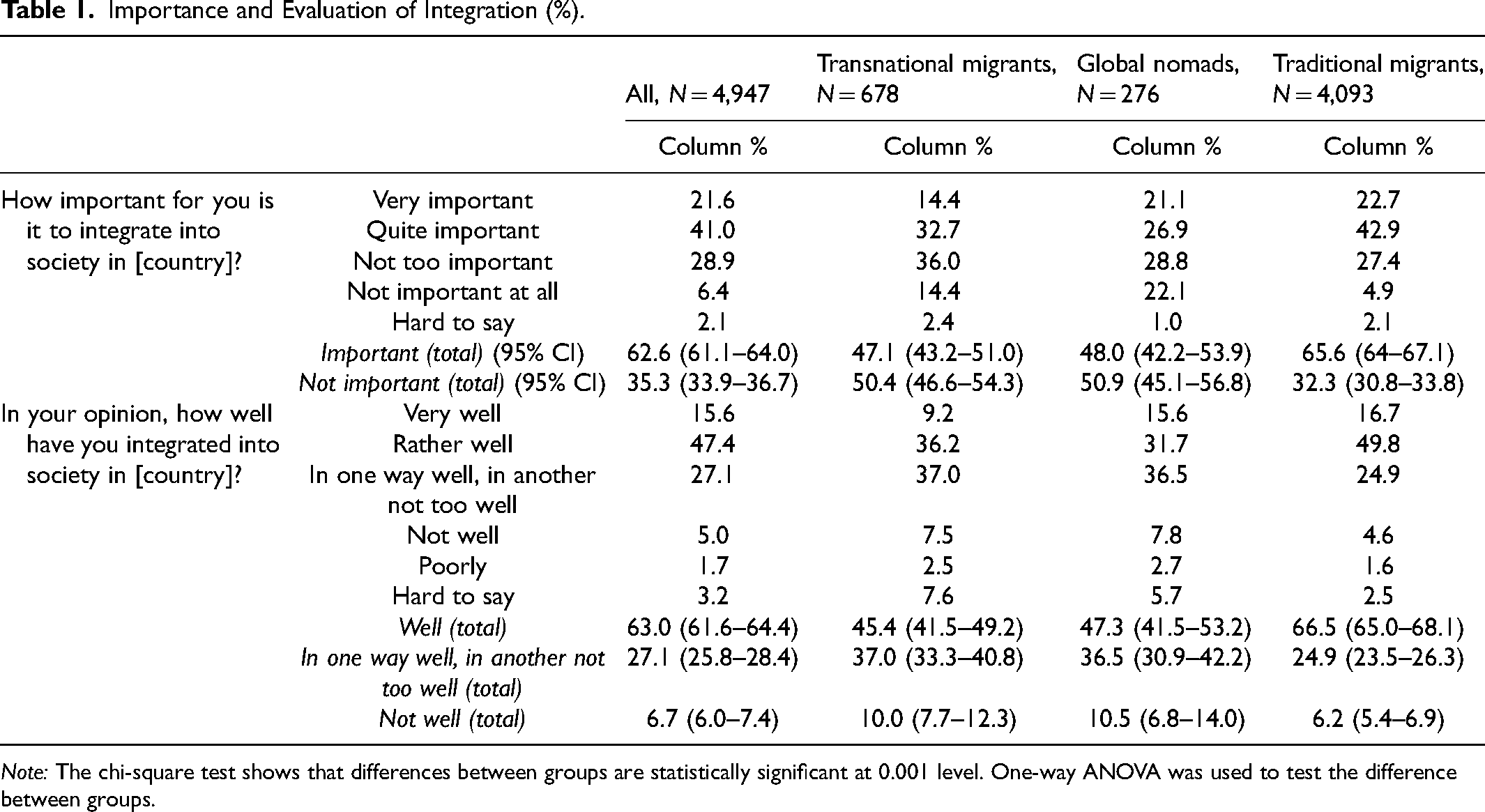
Note: The chi-square test shows that differences between groups are statistically significant at 0.001 level. One-way ANOVA was used to test the difference between groups.
Next, we asked our respondents: “In your opinion, how well have you integrated into society in [country]?“—from “Very well” to “Poorly” on a 5-point Likert scale, Table 1) revealing how content the migrants themselves are with their integration success (H3a, H3b). The following two questions help revealing how migrants interpret and experience integration (RQ2, RQ3):
In what way have you integrated well into the community in [country]?
In what way have you not been successful in integrating into the community in [country]?
There were nine answer options offered, in addition to “Other” and “Difficult to say” (See Table 2). These questions are crucial for answering H3c.
Marginal Means of Beliefs About the Reasons Behind Good or Poor Integration Controlled for Age, Gender, and Education.
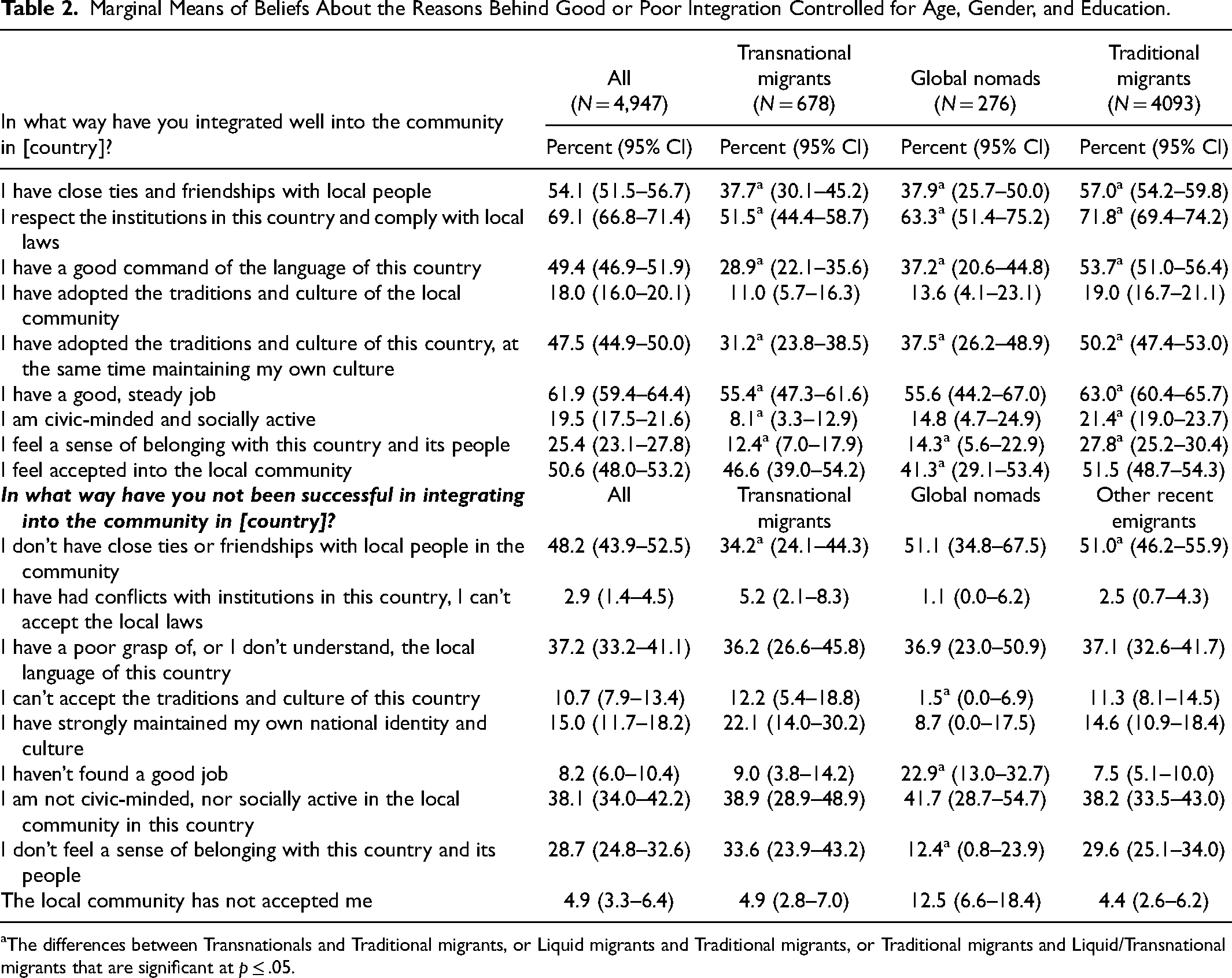
The differences between Transnationals and Traditional migrants, or Liquid migrants and Traditional migrants, or Traditional migrants and Liquid/Transnational migrants that are significant at p ≤ .05.
Self-ascribed identity can also be an indicator of integration, thus, we asked our respondents: “Which of these terms best describes how you see yourself in [country]?“ offering categories such as permanent resident or citizen of this country, immigrant, short-term migrant or guest, newcomer or newly-arrived person, member of the Latvian diaspora, Latvian living abroad or Latvian from abroad, global citizen or other (Table 3).
Marginal Means of Self-Ascribed Identity Controlled for Age, Gender, and Education.
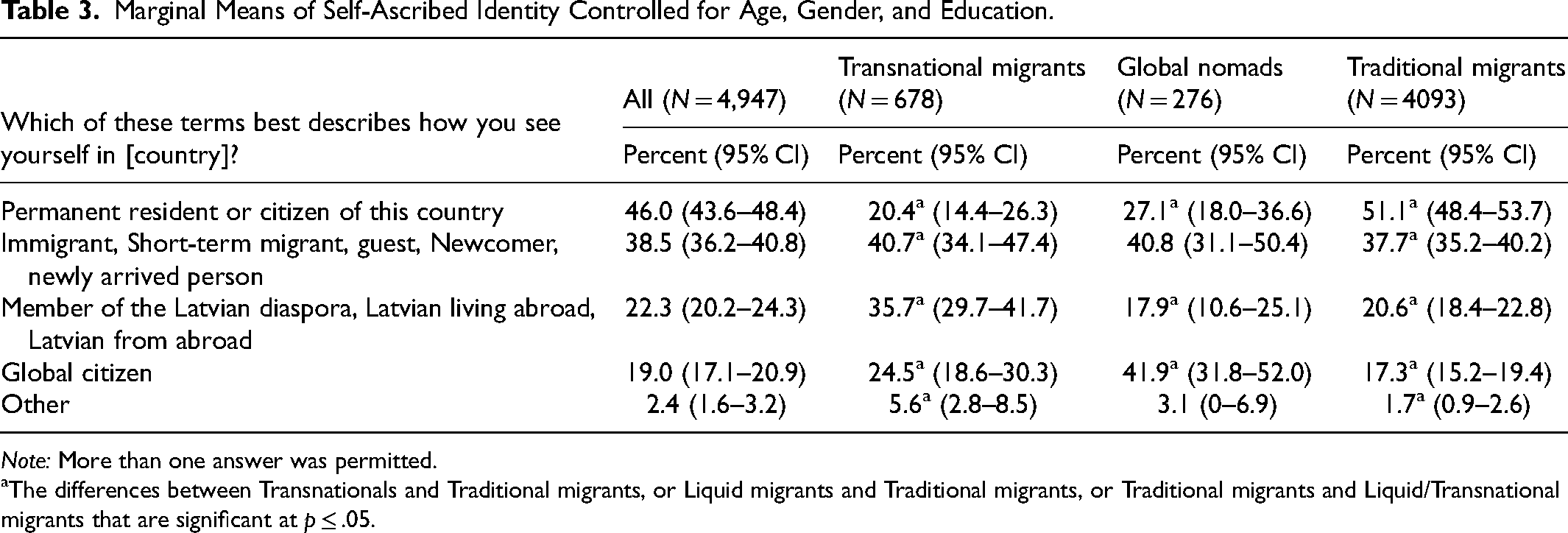
Note: More than one answer was permitted.
The differences between Transnationals and Traditional migrants, or Liquid migrants and Traditional migrants, or Traditional migrants and Liquid/Transnational migrants that are significant at p ≤ .05.
Analysis
The quantitative data were analyzed using simple univariate and bivariate statistics, analysis of variance and covariance, as well as chi-square statistics to test for the significance of differences between groups. In contrast to the “old type” or traditional migrants, the majority of global nomads and transnational migrants are male, and they tend to have a higher level of education and qualifications, thus, they fit the previously provided description of “global talents” (Appendix A). This is pivotal in ensuring opportunities to enjoy a mobile lifestyle that is not available to others. In the analysis of covariance, it was important to control for age, gender, and education in order to make sure that differences between our target groups and other migrants still persist when we account for their different socio-demographic characteristics. We do not control for occupation or profession because they can be chosen by the global nomads and transnational migrants specifically due to their mobile mindset and lifestyle (some of our interviews provide evidence of intentional choice of an international/ global career path).
For primary coding of the qualitative data, we used the holistic approach (Miles, Huberman and Saldaña 2018; Saldaña 2021) that involved cutting the text into broad topic areas to get an overall sense of the contents of interviews and the emergent themes. The researcher got familiar with data and identified the main themes discussed, such as “home,” “integration indicators,” “fitting in vs. belonging,” “friendships vs. being accepted,” and “segmented assimilation.” Analytical memo and jotting was used to facilitate the process and acquire tentative ideas for further more detailed coding of the data in NVivo. The researcher thoroughly read each of the interviews and coded everything that seemed important for this study, for example, short phrases or words were used as preliminary nodes. In this first stage of coding the preliminary structure was formed. After finishing the line-by-line coding, the process of categorization of codes through sub-coding or pattern coding (Saldaña 2021) began, and the coding structure was refined. Coding categories were collapsed, expanded and revised, merged with other codes, or deleted till the final version. The process was both deductive (guided by the literature) as well as inductive—based on the information that emerged from the empirical material. The codes focused mainly on categories or themes, in addition to some theoretical constructs that came about naturally from the interviews, and relationships with people in the context of integration. The final list included 35 codes such as “Employment,” “Bubble,” “Contacts with Latvia,” “Emotions, satisfaction,” “Integration as a two-way process,” “Obstacles to integration,” “Global mindset, parallels with internal migration,” “Relationships with locals,” and “Own needs.” Our analysis mixes case-oriented and variable-oriented approaches (Ragin 2014), as we try to understand each case in-depth, yet also look for underlying similarities and themes that cut across cases. In implementing cross-case analysis, we found Yin's (2015) approach, i.e., the replication strategy as the most useful for our goals. We analyzed whether the patterns observed in some cases could also be observed in others, and whether they matched our theoretical assumptions. Although our findings cannot be considered representative, our aim was to use cross-case analysis to deepen our understanding and explanation of the processes under study, and to provide confidence in at least some generalizability or transferability of our findings to other contexts beyond particular cases.
Classification of Respondents
Interviewees in the qualitative part of the study were selected based on their self-identification with our target group. Potential interviewees were informed that the aim of the research is to gain in-depth understanding of the increasingly common new type of mobile migration patterns among Latvian migrants, i.e., liquid migration, which may involve living in more than one country, or constantly changing the country of residence. Since there were no strict assignment criteria, it is not possible to designate specific interviewees as either “global nomads” or transnational migrants.
In the quantitative analysis, however, we had to define such criteria for the purpose of analysis. As the most typical characteristic of transnational migrants is their strong ties with more than one country, we conceptualize this group in our quantitative survey using the question “Where do you currently live?“ and specifically the answers “I’m alternating between Latvia and another country,” or “Mostly outside Latvia” were indicative of this, meaning that the person has not fully committed themselves to one nation-state. Overall, 15.4% of the members of the Latvian diaspora could be classified as transnational migrants. One of the most characteristic traits of “global nomads” is their rootlessness and readiness to move to another country at any time. They were conceptualized based on two questions: “How many countries outside Latvia have you lived or worked in for at least three months in a row?” and “Since 2014, how many times have you moved to live in another country (for at least three months)?.” Those who had lived in at least three countries and moved at least three times since 2014 (e.g., in the last 5 years) were classified as global nomads—an overall figure of 5.9% of members of the Latvian diaspora. While it is possible that some of these people have already settled, we expect that their mindset will not change that fast, and that the liquid lifestyle they experienced would still reflect in their attitudes and beliefs about integration. We specifically tried to avoid questions on attitudes, dispositions, or attachments in conceptualizing these categories as they are of interest themselves. While the percentage of respondents classified as global nomads might appear small in numeric terms, considering the total stocks of intra-EU migrants (Gendronneau et al. 2019), they might constitute up to one million people among intra-EU migrants alone (assuming that the share of global nomads in other European countries is similar to Latvia). Moreover, their value as “global talents” should not be underestimated.
Circumstances at the time of emigration can affect integration goals and opportunities, therefore we limited our sample to those who emigrated in the year 2004 or later, i.e., since Latvia joined the EU. To acquire a better understanding of our target groups, in the analysis, we contrasted their answers with the answers of traditional post-accession emigrants from Latvia who do not exhibit liquid patterns of migration (e.g., the “old type” of temporary workers, or settlers). The total number of all recent emigrants retained for the analysis is 4,947, among them 678 transnational migrants and 276 global nomads. There is some overlap between global nomads and transnational migrants, as 100 respondents were classified as belonging to both categories.
Results
Subjective Interpretations of “Integration”
In-depth interviews confirmed that global nomads and transnational migrants primarily see integration in instrumental or functional terms (H1a). For our interviewees, integration was typically about being comfortable in their everyday lives, from being able to access the same services as the locals, communicate and understand the necessary information, up to the smallest details such as understanding local jokes and knowing which person to buy the best apples from at the market. [Integration means] the fact that you do not have any problems in your host country, you feel the same as in your own country, you do not have difficulties in communicating or you have no difficulties in receiving any services (Andrejs).
Successful integration was often associated with feeling like one “fits in” (iederīgs) instead of “belongs” (piederīgs). I do not feel like a foreign body, either from my point of view or from the way we, as foreign [workers], are perceived. I don't feel like I belong [in the sense that I am part of that society], but I fit in (Vilnis). “Fitting in,” according to our interviewees, means knowing how to behave (including by respecting the local culture and traditions) and feeling accepted in the local society. At the same time, there was a strong opposition to assimilation. Our interviewees saw integration as a two-sided process, an exchange of new ideas, beliefs, and cultures that both sides should be interested in and could benefit from, with neither side having to give up their identity and values.
Interaction with the locals, alongside language skills (both interrelated), was seen as the most important part of integration, as without it “fitting in” and feeling fully comfortable in everyday situations would be impossible. […] if you have people around you, then you will feel a little better integrated because you're not alone, and that you may have a neighbor to go to and ask for salt, for example. [These are] everyday things, but in fact when you are away in another country, they are very important (Marta)
Everyday interactions like those described by Marta and others are at the core of the so-called “banal integration” (Ekmanis 2020). Close ties or friendships with the locals were considered by all types of migrants as one of the main signs of success or failure to integrate (Table 2).
Sense of belonging to the host country or its people, or an ability to accept their traditions and culture, was mentioned by global nomads significantly less often as a reason why they felt integrated, or not well-integrated (Table 2). This confirms H1a that due to their global mindset global nomads generally place less emphasis on culture and identity as an indicator of the success of integration. Similarly, Erdal (2013) found that for Pakistani transnational migrants in Norway, cultural issues were largely outside the realm of integration. Still, a few of our interviewees thought that developing a sense of belonging to the local society could be a secondary step of integration.
The answers of our interviewees also tie in with Ekmanis’ (2020) argument that “banal integration” is very difficult to pick up with standardized measures. They were sceptical about any concrete indicators that would determine if someone is well-integrated or not. This determination, they thought, could perhaps only be made by migrants themselves, based on their subjective feelings. This finding confirms H1b.
Importance of Integration
Many of our interviewees had not even thought about integration and whether it was important to them, as they had been comfortable enough in their lives and did not face any problems in their host countries. Quantitative comparisons using one-way ANOVA revealed that in contrast to the traditional migrants (Sig. < 0.001), every second transnational migrant and global nomad found it not important to integrate into the host society (Table 1).
The main reason for their lower interest in integration was—as expected (H2a)—insufficient motivation, often connected to unclear plans for the future. Respondents did not expect the integration process to move very far during short stays. Some thought that one can only start thinking about integration after a period of a year or even longer, which is more that many members of our target groups stay in one place. Integration was seen from a rather selfish standpoint. Some considered integrating important in order not to feel isolated and to be accepted, but it was mainly to the extent they felt they needed it: “I am integrating right now as much as necessary to live my daily life in peace” (Artūrs). “I can't think of a good reason that would be of benefit to me” (Vilnis). Despite recognizing the importance of social ties, not everyone was interested in forming friendships with the locals. Migrants who planned to stay in the host country for a longer period considered integration “more worth it.” They were genuinely interested in the culture of the country and tried to integrate because they did not want to feel simply like tourists or passers-by.
The frequent lack of regard for integration can be best understood through the lens of identity. In the survey, we asked our respondents how they would describe themselves in their new country of residence. In contrast to the traditional migrants who typically saw themselves as “permanent residents or citizens of this country,” global nomads and transnational migrants—controlled for age, gender, and education—significantly more often described themselves as global citizens, or immigrants, newcomers, short-term migrants, or guests (Table 3). Some saw themselves as “world citizens” or Europhiles and saw Europe as one borderless space and perceived moving to another country as not much different than moving to another city in their country. The differences in the quantitative data held when controlled for age, gender, and education, except that the difference between global nomads and the traditional migrants identifying as immigrants, guests, and newcomers was rendered insignificant. Even those who described themselves as permanent residents of the country often also mentioned some other identity (30% among transnationals and 41% among global nomads). Their global, mobile, and rootless lifestyles reflect onto their self-image and identity and, subsequently, on their attitudes toward integration.
Global identity is particularly common among global nomads (40%), lending support to Engbersen and Snel's (2013) argument that this group indeed has a migratory habitus—a conscious and intentional rootlessness which separates them from other groups, even those with transnational lifestyles. The fact that approximately one in five did still consider themselves permanent residents of the country probably reflects their demand to be seen as equals with the locals: “Well, I see them [the population of the host society] as my fellow citizens; they are part of the same society that I am. We are equals, like individuals in their rights and freedoms” (Kaspars).
The analysis also revealed some other differences between global nomads and transnational migrants. While global nomads were least likely (Sig. < 0.05) to identify themselves in relation to their Latvian roots (a Latvian living abroad, a member of the Latvian diaspora), transnational migrants were significantly more likely to do so, demonstrating a stronger psychological connection to their country of origin.
In-depth interviews revealed that despite their uprooted and global identities, most migrants still felt a strong emotional connection with their country of origin. Almost all our interviewees felt that their “home” was Latvia, even if they lived and worked somewhere else. Our interviews also revealed the importance of life course for how migrants identified with their new country of residence. Two of our transnational interviewees, who had lived for long periods in Denmark and Sweden and had spouses and children there—and in one case, had acquired citizenship—noted that their home was in both countries. Latvia was for our interviewees a special place where their roots are, and a place they can always return to. The biggest factor in making Latvia “home” was their family. The majority of interviewees were in an early stage in their life, i.e., they were not married and had no children, and their closest family members still resided in Latvia.
Importantly, we found that close emotional ties to Latvia as “homeland” was mostly related to upbringing and sense of patriotism acquired early on in life. A liquid lifestyle does not diminish or may even fuel these feelings, and they do not stand in the way of a truly liquid lifestyle. Several of our interviewees made a point to emphasize that as “free spirits” they are not too deeply grounded and can still move someplace else with ease. “Latvia is my homeland, my birthplace, and of course I will always call this my home, but I do not feel trapped there—I can easily leave and go somewhere else.” (Ivars). However, as indicated in H2b, having a “home” to return to is important and provides them with a much-needed sense of psychological stability and safety.
Are Global Nomads and Transnational Migrants Well-Integrated?
In the quantitative survey, we asked our respondents what they thought about their own integration. Less than half of the global nomads and transnational migrants believed they had integrated “very” or “rather” well, whereas almost 40%—significantly more than among the traditional migrants (Sig. < 0.001)—could point to some areas where they had integrated well, and some where they had not (Table 1). As expected (H3b), the “new type” of mobile EU citizens serves as an excellent example of integration as a multi-dimensional process where migrants can do very well in some areas and not so well in others. The fact that the number of people who acknowledged the importance of integration and saw themselves as well integrated is still high even among the most mobile groups (even though it is significantly lower than among the traditional migrants, Sig. < 0.001) could be related to their specific understanding of what “integration” means.
We further asked our respondents why they felt they were well integrated or not well integrated. Approximately half of the global nomads and transnational migrants who felt that they have integrated well, believe so because they have a decent job. Another major source of their beliefs is that they respect the host country's institutions and laws (Table 2). Thus, as expected (H3c), they claim to be well-integrated primarily in economic and legal/ institutional terms. This is also confirmed by our qualitative study. Most interviewees had a good job and, good education, were comfortable in their daily life and felt that they are contributing to society. In general, they considered themselves integrated mostly in terms of “fitting in” and not “belonging.”
In addition, for many feeling accepted into the local community (Table 2) is an indicator of their integration success. However, controlled for the basic socio-economic parameters, global nomads were less convinced than others of their success in this area. Transnational migrants rarely mentioned social and civic activism as something that would point to their successful integration, and both transnational migrants and global nomads mentioned a good command of the language of the country less often than the traditional migrants.
The quantitative data further show that compared to the traditional, “old type” of migrants, the “new type” of migrants do not place as much emphasis on a sense of belonging and identifying with the local society and its culture, as well as friendships with local people as possible indicators of their integration success. Overall, these results lend strong support to hypothesis H3c.
While respondents felt accepted in the host society and characterized their relationships with locals as “good” or “neutral” (because of minimal contact), forming local friendships is the main challenge they face. This is less of a problem for transnational migrants (Table 2). Other most frequently mentioned obstacles are a poor grasp or lack of understanding of the local language and not being socially active in the local community in the host country. Of those few who were civically active, their engagement was mainly in online activism in Latvia, and not in their new country of residence. This was due either having no spare time or having little understanding of local political issues.
In-depth interviews showed that those who had lived in the country for a longer period of time, had family and friends living locally, and/or spoke the local language felt better integrated, whereas those traveling around and moving often did not feel integrated in one particular country.
Integration into What?
As expected, the integration context and its possibilities were rated very differently in cities and small communities. Moving to a city made it easier to “blend in” as a migrant and therefore feel like one “fits in.” However, in large multicultural cities, there is no real local society to integrate into. […] you can be in Berlin, Paris, the big metropolitan regions and not meet any locals. […] it seems that even if you are integrated, you are still alone […] The crowd is so big that I don't know if it can be called integration, it's more like “blending in.” Nobody notices whether you are there or not, because there are so many people. It's more of a personal feeling, but anyone fits in there (Laura)
Moreover, our interviews confirmed the importance of the culture of the receiving country. The United States was mentioned as a place where it is easy to blend in due to its multicultural nature and well-known culture, while in smaller and more homogenous localities, sometimes locals are only willing to accept the migrant if they have assimilated to some extent. Thus, the support for H3c depends on how “integration” is understood. The new type of migrants indeed can better “fit in” in larger and more diverse communities, yet it is easier to form meaningful ties with locals in smaller localities.
The interviews revealed that instead of integration into the society at large, global nomads, and transnational migrants sometimes integrate into certain groups in society (usually an international workplace), or even a virtual community. The concept of a “bubble” characterizing the environment the migrant lives or lived in came up several times. One such example is the academic environment: The academic world is creating a bubble for itself that is, in a sense, tied to the place where its university is located, but at the same time not fully […] Now in England we are a very diverse and international crowd of a similar kind—Americans, Irish, Germans, Austrians, Italians, Swiss, Latvians… [laughs] So contact with the external environment is quite small! (Vilnis).
With few exceptions, our respondents were not involved in the Latvian diaspora community, nor did they try to get involved in it. Instead, it was more common to be part of an expatriate community of people from different countries created through education or workplace connections. At least one respondent noted that the formation of bubbles is a problem and does inhibit integration: There are those who live in large numbers and build their own communities from which they do not emerge. […] From this point of view, integration is precisely the ability to mix in, so that these small nuclei also eventually merge and become [part of] a whole (Edmunds).
Discussion
Our study confirms that the “old” concepts of integration and assimilation do not adequately characterize the processes of incorporation in the new, more dynamic migration conditions, at least not from the perspective of the migrants themselves. Global nomads and transnational migrants do not interpret integration as a linear adjustment to a “mainstream” host society, nor do they think of integration in sociocultural terms, thus, models such as Berry's (1992) are unable to adequately describe their process of incorporation. Instead, most interviewees talk about integration as “fitting in” and being able to “navigate the system,” accessing the necessary resources to enable a comfortable life in the receiving society, which best fits the functional interpretation by Buhr (2018) and Bommes (2012). The quantitative survey suggests that functional understanding of integration is, in fact, prevalent among other groups of migrants representing the traditional forms of migration, too. They also consider respecting the institutions, complying with local laws, as well as knowing the local language and having a job as some of the most important indicators of integration; however, they place significantly more emphasis on friendships with locals and adopting the local culture and identity as part of successful integration.
Global nomads and transnational migrants often end up in superdiverse cities or multicultural international collectives, in conditions which highlight even more clearly the limitations of classical integration theories (Grzymala-Kazlowska and Phillimore 2018; Crul 2016). While smaller localities provide more opportunities for migrants to establish place-specific social ties and to become incorporated into the local society in the traditional sense of assimilation (Grzymala-Kazlowska and Phillimore 2018), in multicultural cities migrants find it easy to “fit in” while maintaining their culture, values, and identity.
While empirically this study is focused on the case of Latvia, we believe that our findings are as relevant to migrants from other EU/ EEA states that allow for free movement of people across borders. In light of these findings, we present a theoretical model that conceptualizes integration in the context of new forms of mobility and prioritizes migrants’ interpretation of integration. The proposed analytical model (Figure 1) takes into consideration (1) the “depth” and (2) the “breadth” of integration.
We argue that migrant incorporation can be seen as a gradual, yet dynamic process. First, it proceeds as “functional adaptation.” Functional adaptation allows migrants to become functional elements of society as a social system. Migrants are well-integrated structurally (Huddleston, Niessen and Tjaden 2013), i.e., are involved in the labor market and/or education, have sufficient income, and contribute to society. They have sufficient knowledge, language skills, and the legal status to access the necessary resources, and they follow the rules and “navigate the system” well enough to meet their everyday needs. Overall, they feel comfortable and accepted as “fitting elements” of society. Functional integration echoes with Ekmanis’ (2020) concept of “banal integration” as it allows migrants to go about their everyday lives without any problems or hindrances—daily life runs smoothly and any integration “issues” are nonexistent. This is a strategy of incorporation most characteristic of global nomads, particularly in superdiverse cities which provide few opportunities for contact with any homogenous local culture or society yet consist of many diverse groups and thus are more open and adjusted to internationally mobile guests.
The next step is what we call “deep integration” (a term used by some of our interviewees). While it resembles the traditional interpretations of integration as adjustment to the receiving society (Penninx and Garcés-Mascareñas 2016), our analysis suggests that deep integration needs to be seen as a socio-psychological process at the core of which is a change in identity and social embedding in the local community and society. In the process of “deep integration,” migrants develop a sense of attachment, belonging to or identification with the host society, a sense of “home” in the new country of residence due to various subjective and emotional factors. They are tied with the local society via “anchors” such as friendships or family ties, they develop an interest and understanding of its culture, begin participating in its festivities and traditions, and engaging in matters of local civic interest. Deep integration is possible without migrants giving up their own culture and identity, as it often happens for transnational migrants (Levitt and Schiller 2004). Deep integration is most easily achieved in small yet culturally open communities, but it still takes time and motivation on the part of the migrants as well as openness from the receiving society.
The final step that can (but does not necessarily) follow, is “assimilation.” In this case, a migrant essentially gives up their native cultural traits, and fully blends into the receiving society, becoming indistinguishable from the natives (as in Berry 1992). Our interviews reveal a belief that the conditions for assimilation are more favorable in smaller and more homogenous localities; however, it depends on the migrant's own wishes and takes considerable time. The global nomads and transnational migrants we interviewed were not interested in assimilating, it is not a strategy that appeals to them. Instead, they saw themselves as equals with the locals, and considered the exchange of ideas, mutual learning, and diversity of cultures, rather than assimilation or adjustment to “mainstream society” as something valuable that benefits both sides, challenges much of the normativity in existing integration paradigms. Nevertheless, as assimilation can be considered as the final stage of migrant incorporation, it is necessary to include it in the model.
Next, as noted in the literature, there is often no homogenous society to integrate into (particularly in superdiverse cities), and even if there is one, people often tend to integrate into smaller “bubbles” (groups or networks) that they are members of—their work teams, international educational campuses and ethnic communities or even sub-cultures. As a result, they may have little contact with the “outside world,” the people living in their neighborhood, and few opportunities to absorb the local culture, traditions, and language. Ryan's (2018) theory of differentiated embedding holds that people are members of a multitude of circles with different attachments to each of them. Still, our interviews show that instead of, for example, ethnic communities, as suggested by segmented assimilation theory (Vermeulen 2010), the primary “bubbles” for transnational migrants are those associated with their professional environment consisting of others like themselves. A lack of meaningful bridging ties to the host society can be counterproductive to the integration of migrants into wider society (Nannestad, Svendsen and Svendsen 2008).
Our analysis confirms that migrants with the most uncertain life and career plans are generally less interested in integrating than the traditional migrants (Luthra, Platt and Salamońska 2016; Shubin and Dickey 2013). Instead, transnational migrants and global nomads maintain symbolic ties to their homeland that acquire for them a special meaning and importance. Due to subjective, symbolic, and emotional anchors (Grzymala-Kazlowska 2016) such as a sense of belonging, heritage, memories, as well as family ties, Latvia was always considered “home”—regardless of their actual living situation. In fact, our study suggests that maintaining a strong emotional footing someplace is what allows global nomads to maintain unstable and unpredictable migratory habits while fulfilling the natural human need for stability, security, and psychological comfort (Boccagni and Hondagneu-Sotelo 2021; Grzymala-Kazlowska 2016).
While global nomads and transnational migrants felt accepted by the host society, their contacts with the local people and culture were rare and mostly superficial. They were weakly embedded in civic and political life in their host country, expressed a strong resistance to assimilation, and intended to maintain their own identity and culture. Becoming attached to the new host country as “home,” as well as embracing its culture (deep integration) usually only happens with time, in rare cases, usually when the heaviest “anchors” such as family are moved there or established anew. Most global nomads develop only a weak sense of social and psychological embedding in (Ryan 2018), and attachment to, their host country. Thus, in terms of Berry's (1992) model of acculturation, separation (maintaining one's own cultural heritage and not developing ties with mainstream society) is the strategy which best characterizes this group. This is both due to a combination of the contextual conditions they often operate in (e.g., international work groups and superdiverse cities), as well as them having insufficient time and uncertain plans for the future. At the same time, most of our interviewed global nomads were well-integrated structurally and economically and faced no difficulties in their daily life (structural adaptation). In this regard, they themselves felt integrated and were content with their situation.
The fact that global nomads and transnational migrants are well integrated in some areas and not so well in others, provides a perfect example of why it is important to acknowledge nuance and multidimensionality when talking about “integration.” Referring to Luthra, Platt and Salamońska (2016) classification, economic integration characterizes functional adaptation, while subjective and social integration are part of deep integration. In terms of Kraler and Reichel's (2010) classification, only structural integration refers to functional adaptation while the cultural, interactive, and identificative dimensions are all part of deep integration. Finally, even though we talk about integration as a gradual process, the aforementioned steps do not need to follow each other sequentially—some migrants will stop at Step 1, for some Step 1 and 2 or 2 and 3 will overlap, as migrant incorporation is a dynamic process.
We believe that our conceptual model characterizes the processes of incorporation not just of the most mobile groups of contemporary migrants but other groups of migrants as well. It illustrates that it is crucial to differentiate between functional adaptation and traditional concepts of deeper integration and assimilation, and to shift the focus from culture as the core of integration and instead acknowledge the importance of everyday “banal” interactions.
In more general terms, our research shows that it is important that any attempts to facilitate integration should become more holistic, dynamic, and open-minded, and take into account the unique perspectives and needs of migrants. As we saw, for migrants themselves it is often enough to be functionally adapted to feel well integrated, despite society often expecting a deeper integration or, in some cases, assimilation into society. To attract internationally mobile global talents, it is important to ensure their functional adaptation so that they feel comfortable in their daily life, while also making efforts to form bridging ties that would break the “bubbles” they are usually a part of.
Future studies focusing on the new type of liquid migration should pay more attention not just to “global talents” typically associated with white-collar jobs but also to blue-collar workers—builders, welders, machine operators, and others. Even without a high level of formal education they are in high demand internationally and nowadays constitute a significant share of the transnational and global nomads.
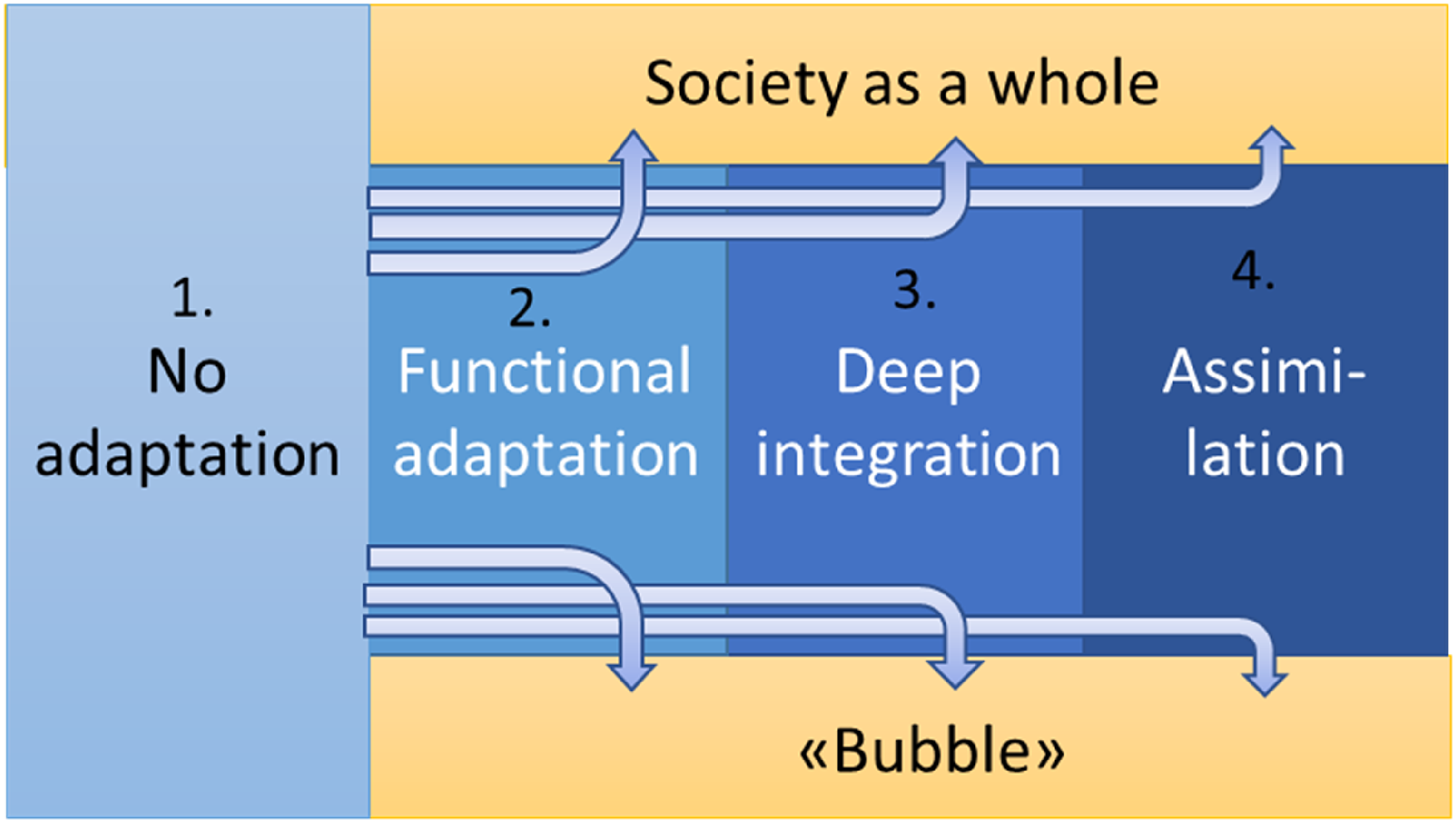
The analytical model.
Supplemental Material
sj-docx-1-mrx-10.1177_01979183231221743 - Supplemental material for Reimagining “Integration” in the Light of the New Forms of Mobility
Supplemental material, sj-docx-1-mrx-10.1177_01979183231221743 for Reimagining “Integration” in the Light of the New Forms of Mobility by Inta Mieriņa and Marika Laudere in International Migration Review
Footnotes
Acknowledgments
The authors are grateful to the Master's students of the Faculty of Social Sciences at the University of Latvia for conducting the in-depth interviews, and to Inese Šūpule and Mārtiņš Kaprāns for their helpful comments on earlier versions of the paper.
Declaration of Conflicting Interests
The author(s) declared no potential conflicts of interest with respect to the research, authorship, and/or publication of this article.
Funding
The author(s) disclosed receipt of the following financial support for the research, authorship, and/or publication of this article: This work was funded by the Latvian Council of Science, project “Exploring Well-Being and Social Integration in the Context of Liquid Migration: A Longitudinal Approach” (Latvijas Zinātnes Padome), under Grant number lzp-2018/1-0042.

References
Supplementary Material
Please find the following supplemental material available below.
For Open Access articles published under a Creative Commons License, all supplemental material carries the same license as the article it is associated with.
For non-Open Access articles published, all supplemental material carries a non-exclusive license, and permission requests for re-use of supplemental material or any part of supplemental material shall be sent directly to the copyright owner as specified in the copyright notice associated with the article.
