




Abstract
Tokyo illustrates a particularly interesting case of differential inclusions of transnational migrants in urban spaces, as the novel turn in migration policy in coordination with urban economic development has induced the arrival and diversification of migrant populations into the city. With the recent historic opening of the country to lower-skilled labour migration as well as measures to (re-) attract the global economy, thus incentivising transnational corporate professionals to relocate to specific national economic zones within the city, Tokyo is in a new socio-spatial diversification process. With a non-ethno-focal lens on transnational migration and focusing on upper-class transnational corporate migrants, this article discusses diversification regarding the newer arrivals of migrants who are differently included in the urban spaces as compared to older generations of migrants. It delivers novel accounts of a diversifying transnational migrant groups’ socio-spatial patterns within Tokyo, which illustrate the dynamics of differential inclusions resulting from the superdiversification of urban societies. The article gives new insights into the socio-spatial diversification dynamics of transnational urban spaces in a long-neglected but highly topical Asian arrival city, and conceptually reflects such localised superdiversification of urban spaces on a global scale.
Introduction
Taking Japan as an example for a study on migration issues might appear unusual at first sight, especially as discourses on the myth of homogeneity are persistent in the country (Oguma, 2002; Onuma, 1993; Weiner, 1997). However, there is a clear change as regards migration issues in Japan which can be seen as the start of a superdiversification (Vertovec, 2007). Particularly in urban arrival cities, such as Tokyo, there has been a shift from ethno-focal migration to a more diverse notion to transnational migration (Liu-Farrer, 2020; Vertovec, 2019; Yamamura, 2018). In fact, the change in Japan’s migration policy to open its doors to lower skilled migration, as a belated countermeasure to the labour shortage caused by the shrinking and ageing society, is now causing changes in the differential inclusions in cities (Ye, 2017, 2019; Yeoh, 2006), including in Tokyo. Whereas spatially, ethnic towns and the concentration of ethnic communities in less privileged or even deprived areas of Tokyo have much been described and discussed (Ishikawa, 2021; Lie, 2004; Oishi, 2008), the interesting phenomenon of newer arrivals from the diversified group of high-status migrant professionals of transnational corporations has not yet found much attention.
By focusing on the particular case of transnational corporate elites (highly skilled, affluent and mobile) as part of the increasing diversification of transnational migration, this article brings a novel perspective to the discourse on differential inclusion in cities. It connects differential inclusion and the socio-spatial diversification of transnational professionals’ patterns and brings them into the larger context of spatial superdiversification with its local and global dynamics. It contributes to the research on transnational professionals from a migration perspective and discusses their differential inclusion specifically in Tokyo but also in the network of global cities on a larger scale.
Following the research question of how Tokyo’s diversification regarding the newer arrivals which go beyond the ethnic lens are differently included in the urban spaces as compared to older generations of migrants based on ethnic group affiliations, this article discusses how such migration-led diversification results in socio-spatial differential inclusions in arrival cities, both locally but also from a global urban perspective. 1 It delivers novel accounts of non-ethno-focally based transnational migrant professionals’ socio-spatial patterns within Tokyo, which illustrate the dynamics of differential inclusions resulting from the superdiversification of urban societies. It thus calls for an approach which brings together the socio-spatial (super-)diversification of global cities and the changing constellations of the network of such arrival cities from a dynamic perspective.
In the first section, the spatial superdiversification of global cities is discussed against the background of transnational migrations. Based on the socio-spatial patterns of transnational migration from above, specifically transnational financial professionals in Tokyo, it will be illustrated that transnational spaces reach beyond simple understandings of ethnic towns or locations of workplaces, to encompass a larger area used for different socio-spatial practices. Reflecting on the diversification processes already found within this particular social group, it is then argued that socio-spatial diversification is indeed occurring in manifold ways through the different transnational migrations, where these are not limited to one specific global city but are spread throughout the network of global cities. The main contributions of this article are empirical evidence on the differential inclusions of new arrivals within the city of Tokyo, which demonstrates the diversity of socio-spatial patterns of transnational migrants, and a conceptual reflection on the spreading of this phenomenon of local socio-spatial (super-)diversification within the global scale of the network of global arrival cities.
Socio-spatial diversification and transnational migration
The aim of this article is to further develop the theoretical understanding of urban diversity, which encompasses literature on differential inclusion (Ye, 2016; Yeoh, 2006) but also on superdiversity (Meissner, 2015; Vertovec, 2007). By bringing together research on transnational professionals and expatriates (Beaverstock, 2013: 2917; Cranston, 2016), especially in the context of global cities (Yeoh and Chang, 2001; Yeoh and Willis, 2005), and delivering novel empirical data on an under-researched group of transnational corporate elites (at least regarding their socio-spatial patterns beyond their business roles), the article contributes both to the discussion of transnational professionals and their differential inclusion in cities and to the further contextual embedding into the debate on the ‘spatiality of superdiversity’ (Yamamura, 2022a).
Contemporary societies are increasingly characterised by the ‘diversification of diversity’, or superdiversity (Vertovec, 2007). Whereas scholars still tend to focus more on the variety of ethnicities as the main aspect of such superdiversity (Vertovec, 2019), the concept goes beyond different ethnic or national backgrounds, and points also to legal status, socioeconomic status, skill level, religion, language and sex, as part of the diversity of individual characteristics of a population. In fact, what is diversifying is the constellation not only of the migrant population but also of non-migrants who are affected by diversification. Such ‘growing complexity, acceleration of changes and increased interconnectedness across societies as well as diversification of migrants’ (Grzymala-Kazlowska and Phillimore, 2018: 179) challenge our understanding of the world. Diversity indeed has become a novel phenomenon widely discussed in research (Meissner, 2015; Vertovec, 2012). It is also becoming an important paradigm in policy-making, challenging policy-makers to accommodate different aspects of such complexifying societal contexts for the different social groups (López Peláez et al., 2022), especially with regards to issues of integration (Crul, 2016; Grzymala-Kazlowska and Phillimore, 2018) but also urban planning and policies (Oliveira and Padilla, 2017; Pemberton, 2017).
Vertovec’s (2007) seminal work takes London as an example for the novel dynamics of superdiversity and argues that the urban as a lens through which to study superdiversity has become the norm in research (see also Meissner and Vertovec, 2015). ‘Cities are the sites of negotiations of differences’ (Geldof, 2016: 127) and are where the different facets of diversity, be they related to religion, migration or any other social aspect, come together (e.g. Becci et al., 2017; Geldof, 2016; Phillimore, 2013). Urban diversity has thus become an increasingly important research field not only for urban planning and design but also for the social sciences in the broader sense. Recent discourses in the field of urban diversity have begun focusing on the diversity of cities and neighbourhoods (Yamamura and Lassalle, 2020). They examine particularly issues of conviviality and social encounter in mixed cities or neighbourhoods (Heil, 2020; Valentine, 2008; Vincent et al., 2017; Wessendorf, 2013, 2014; Wilson, 2017; Ye, 2016) and ‘everyday multiculturalism’ (Wise and Velayutham, 2010). This thread of research mostly focuses on the opportunities embedded in the social encounters of people of different backgrounds and the urban places in which these encounters take place.
The discourse on the urban spaces of superdiversity, thus, concentrates on the common places of encounter within neighbourhoods (Yamamura and Lassalle, 2020). The concept of ‘commonplace diversity’ (Wessendorf, 2013) describes the development of high levels of conviviality and inclusivity in urban space to a degree that ‘ethnic, religious and linguistic diversity [is] experienced as a normal part of social life and not as something particularly special’ (Wessendorf, 2013: 407). While it is suggested that ‘social spaces […] play an important role in the process of familiarisation with people who are different and in getting accustomed to communicating across difference’ (Wessendorf, 2013: 410), the urban spaces and the differential inclusion in cities remain abstract and the actual ‘spatiality of superdiversity’ (Yamamura, 2022a) under-researched.
Recent research at the nexus of transnationalism and urban studies highlights the spatial expression of diversity in urban spaces, such as in debates around planetary or transnational gentrification (Fernandez et al., 2016; Hayes and Zaban, 2020; Lees et al., 2016; Sigler and Wachsmuth, 2016), where transnational migrants play a key role in closing global rent gaps and contribute to the transformation of urban spaces locally. However, while discussing the ‘re-spatialisation of global inequality’ (Hayes and Zaban, 2020: 3010), the question on the actual differential diversification in the cities that arise from such migration patterns remains unanswered. In fact, though transnational migration from above, i.e. of transnational corporate professionals (Beaverstock, 2013, 2017; Carroll and Fennema, 2002; Faulconbridge, 2007, 2008; Morgan, 2001) or even the transnational capitalist class (Robinson, 2017; Sklair, 2001), has been much discussed for its economic and societal roles (Hoyler et al., 2018), little is known about its impact on urban transformations through the migrants’ own socio-spatial practices. Studies on gated communities (Atkinson and Blandy, 2013; Blakely and Snyder, 1997) or on the concept of upper-class citadels (Marcuse, 2000) are classical approaches to differential inclusions, or actually exclusions, of upper-class residents and often also of upper-class migrants in city spaces. Yet socio-spatial differentiations within cities that go beyond physical exclusive spaces are still rare. There have been calls to investigate them further as part of discourses on global migration and transnationalism, particularly in the context of these privileged migrants’ implications for the destination sites (Croucher, 2012; Kunz, 2016; van Bochove and Engbersen, 2015), which translates into their differential inclusion in cities. Empirics are especially limited when it comes to transnational migrants beyond the ethno-focal groups.
Linking to the critique to ethno-focality in transnationalism research, and also taking the superdiversity lens to contemporary migration into cities (Meissner and Vertovec, 2015; Vertovec, 2007; Wimmer and Schiller, 2003), this article delivers a novel view on the differential inclusion of highly mobile transnational professionals in their socio-spatial patterns as not simply economic actors but also social beings in the cities. In such globally connected cities, the dual migration of transnational migration from above and below is thought to be channelled more strongly than in other arrival cities (Sassen, 2001; see also Yeoh, 2013; Yeoh and Chang, 2001). The superdiversity approach calls for looking at the spatial diversification that results from the different transnational migration types and patterns in urban spaces (Yamamura, 2022a, 2022b), i.e. the differential inclusion in cities.
Observing Tokyo as an arrival city
Japanese society, led by the capital city Tokyo, has long lost its unrivalled dominant role in Asia, actually now even lagging behind through its ‘Lost Decades’ of economic downturn while other strong Asian countries and cities, such as Singapore or Hong Kong, have emerged as the new Asian global cities. Winning a stronger role and eventually heading the global economy in the Asian region (again) is a clear focus of the Tokyo metropolitan government (Tokyo Metropolitan Government, n.d.). As has often been observed in Asian developmental states’ involvement in the global city-making and also particularly in Tokyo’s past (Hill and Fujita, 2000; Hill and Kim, 2000, 2000; Kamo, 2000; Olds and Yeung, 2004; Perry et al., 1997; Saito, 2003; White, 1998), the Japanese and Tokyo metropolitan governments are currently putting forward several measures in close collaboration and coordination aiming to bring Tokyo back onto the global economic parquet. The global city of Tokyo is being ‘re-made’, supported inter alia by the national government designating a national strategic zone with deregulation and other incentives to attract foreign companies and talents back to Tokyo. Winning momentum also through the organisation of the mega-event the Tokyo Olympics 2020, 2 for which public and private investments flowed into urban revitalisation and development projects in the whole of the metropolitan area, Tokyo is currently undergoing a major urban transformation.
With the new turn in migration policies allowing not only highly skilled but also lower skilled migration, with the aim of alleviating the severe labour shortages, 3 Japan and in particular Tokyo appears to be on the verge of an important turning point. The urban population is separating slowly but surely from the myth of the homogenous Japanese society (the ‘myth of homogeneity’ or the ‘monoethnic myth’, see Murphy-Shigematsu, 1993; Onuma, 1993; Weiner, 1997). As recent research shows (Liu-Farrer, 2020), the share of foreign population is increasing slowly, yet the range of nationalities and legal statuses has been diversifying. 4 As of 2020, approximately 2.3% of Tokyo’s population were foreigners, above the national average of 1.7% which has been increasing over the last decade. With larger population groups of Chinese and Koreans but also of other Southeast Asian nationals in the metropolitan region, Tokyo has areas with relatively high percentages of foreign residents, such as Shinjuku (over 10%) or Minato (7%), in contrast to the less than 2% of the total Japanese population. In this respect, ethnic towns and other ethnic group-based changes in the neighbourhoods within Tokyo have been well researched, with different transnational or multicultural groups as study objects (Ishikawa, 2021; Lie, 2004; Oishi, 2008). However, the dynamics and complexity of spatial diversification that are not yet empirically thoroughly covered are the migration and spatial inclusion of the migrant groups of transnational professionals. Additionally, their high-qualified and more exclusive migration to Tokyo is further accompanied by novel migration policies aimed also at lower skilled labour migrants to service them in specific designated neighbourhoods. Against this background, it is not an understatement to point out that there is a migrant-led diversification underway, a novel migration trend of new(er) arrivals in Japan (Liu-Farrer, 2020) transforming the urban society and space, making Tokyo an interesting arrival city with regards to urban differential inclusion.
Methods and empirical case
This article is based on extensive empirical research in Tokyo, with problem-centred qualitative interviews (Witzel and Reiter, 2012) with 45 highly skilled, highly affluent and highly mobile transnational corporate elites. 5 These professionals were chosen because they worked for specifically transnational corporations in the financial industry and in higher managerial positions, such as Vice Presidents, CFO or CTOs, and so were a group of transnational migrants involved in the business-wise decision-making processes of transnationalisation. Further, they had extensive experience abroad with short- and long-term assignments, and so qualified as highly mobile transnational migrants with social practices crossing national borders. The duration of stays ranged from one and a half years to long-term residence of five years and even multiple residence (in Japan for the second time). Due to the specificity of this group, no self-initiated expatriates, family migrants or highly educated but middling migrants 6 were included in the sample. They were mostly highly skilled migrants, business visa holders or inter-company transferees.
To incorporate critique on the ethno-focal lens within transnationalism research voiced by Glick-Schiller et al. (2006), transnational migrants were selected not according to their ethnicities or nationalities but according to their affiliation to transnational corporations of the financial industry. The diversity of ethnic backgrounds was thus high, with ethnicities and nationalities including US-American, UK British including Scottish and English, Australian, German, Japanese, Indian, Singaporean, French, Italian, Korean, Chinese-Singaporean and Slovak (including mixed backgrounds). Japanese transnational professionals were also included in the sample as long as the profile as a highly mobile higher management professional in a transnational corporation in the financial industry applied. Despite these diverging ethnic backgrounds, the interviewees make their own transnational group through their professional affiliation. By such industrial and professional commonality, the selection allows intragroup comparisons (Denzin and Lincoln, 2011).
Interviews lasted between 30 minutes and two and a half hours (average 45–60 minutes); the time constraint was unavoidable due to the occupational context of transnational financial professionals. Another constraint was the use of telephone interviews due to professionals’ high mobility. As is common in executive and elite research, access to the field was limited, so gatekeepers and the snowballing technique were used to reach professionals with the required characteristics (Desmond, 2004; Hertz and Imber, 1995; Littig, 2009).
The ‘problem’ of the problem-oriented interviews was the socio-spatial patterns of the transnational professionals as migrants. They were interviewed about their socio-spatial patterns both in their business and private lives, consisting of social activities and interactions with different social groups and the location choices for these socio-spatial practices. Such practices go beyond capturing work or residential locations, also encompassing locations for social mingling and interacting with other foreigners or with locals, e.g. for going out after work, doing sports, socialising with befriended families or running daily errands. The interviews first focused on socio-spatial patterns in Tokyo and then on general patterns of travel, both business and private, as well as travel to other global cities. Interviewees’ reflective discussions on their socio-spatial patterns also encompassed reflections on changes in their life courses, as well as on their cultural or professional identities and their perceptions and evaluations of their lifestyles.
The interviews with transnational migrants were further complemented by expert interviews. Representatives from the five largest real estate and relocation companies servicing transnational corporate professionals were interviewed for their perspectives on the residential locations of their customers. Interviews with employees of the district administration of the Minato ward and of the main transportation company were also conducted to understand the larger infrastructural policies, or non-existence thereof, in which foreign residents are embedded.
The interviews were conducted mainly in English but, where requested or naturally occurring, Japanese or German were also spoken. In some cases, interviewees code-switched during the interview or even within sentences. The interviews were recorded and transcribed for further analysis. Data were selectively coded according to Mayring’s (1994) approach of qualitative content analysis. From the content analysis, two ideal-typical patterns emerged. The two patterns of the gaijin ghetto and the Pro-Tokyoite can be translated into a homogenisation of these transnational professionals as diversified new arrivals, distinctly different from ethno-focal ‘old’ migration, and also a localising group within these new arrivals leading to a socio-spatial differential inclusion within the cities, mirroring the superdiversification of cities. There were indeed differences and nuances within the group as well as some fluidity, however these two ideal types emerged as dominant in the spectrum of different socio-spatial patterns.
Local socio-spatial patterns of transnational professionals in Tokyo
Based on qualitative interviews with 45 transnational corporate professionals, instead of the non-ethno-focal lens on transnational migration that has been adopted before, this article presents the local socio-spatial patterns of this specific migrant group, who are work-wise transnational in their corporate contexts but also transnational in their private lives as migrant individuals. What makes their socio-spatial patterns distinct from other migrants is primarily their affiliation to transnational corporations and thus to a transnational community different from each of their own ethnic or national backgrounds. The corporate and even industrial affiliation, that is, to the financial industry or more broadly advanced producer services to transnational corporations, is the linchpin of their socio-spatial patterns. With the resources they have, particularly financial capital to maintain the living standards but also social networks within this particular transnational capitalist class, they constitute their own transnational spaces in areas that are in different locations from ethnic towns within a city, their so-called gaijin ghetto, which is the place of non-ethno-focal diversification in Tokyo.
Transnational expat bubbles or the gaijin ghetto
The gaijin ghetto is the place people normally associate with the ‘expat area’, 7 with at least bilingual (English and the local, here: Japanese) services and also Western goods to be bought. Shops and restaurants are directed towards foreign residents, as is the housing, which is equipped with amenities adapted to the Western lifestyle. These areas are very limited in geographical extent, covering merely 4 km 2 in the upper-class areas within the Yamanote central area. 8 They specifically span an imagined triangle between Roppongi and Azabu in the Northeastern corner and Hiroo and Ebisu in the Southwestern corner, with Shibuya as the Northwestern corner. They also include a few suburban exclaves of expatriate-dominated residential areas, such as Denenchofu, 9 and work-related areas in the newly developed waterfront area around Tennozu-Isle and Odaiba. Everyday practices are characterised by socialising with other transnational professionals and their families, little interaction with Japanese in the local neighborhoods 10 and attending events of institutions and organisations related to the consulate or the corporation, such as sports or other leisure activities within the community of transnational professionals.
Characterised by such multilingual environment and linguistic landscapes, one transnational professional describes the gaijin ghetto as follows: Oh, people call it the expat bubble. If you want to, you never have to interact with anybody Japanese. You can go to the American schools. There are two American … I call them American … there are two Western grocery stores. Ehm, you don’t ever have to explore, but we were really quite good at it. (KW45)
Beyond the local economy adapting to these residential groups, the interviews with transnational professionals also clarify the connectedness of these socio-spatial patterns not only to the availability of services and products but also to a lifestyle related to the availability of resources: Well, I think, you know, first of all there’s, I don’t know which comes first, the chicken or the egg, but if you want to live in a luxury house or apartment, one that’s large and has all the types of amenities you’re used to, the greatest concentration of them are in the Azabu area, some are now, yeah, and there’s another Gaijin area … But, so if you prefer a certain type of apartment, you’re looking for an apartment that is at least – whatever – 200 square metres and has top appliances and several bedrooms and so forth … the greatest concentration of them is in the areas, and then the schools are nearby, the shopping is nearby, the American club is nearby, I work in, ehm, nearby, in, near Miyako Hotel, Ark Hills. So, everything is, there’s the greatest concentration of housing and the other amenities and schools and that’s what attracts people to these areas. (DS37)
Transnational professionals are supported by different ‘expat packages’, that is, the services and resources provided by their corporations to assist them to integrate in the local city. Depending on corporate position, the extent of support differs, yet the key role in the socio-spatial inclusion of these migrants in the city is played by intermediary actors of the auxiliary industry of real estate and relocation companies. They direct them into such areas as the gaijin ghetto and lead to business and service providers aimed at this customer base concentrating in these areas: So I didn’t want to live somewhere where I had to spend a long time commuting, ehm so that’s why I said, okay, all right, I am not doing that somewhere and that was where I spoke to the real estate agent about interviews to do a few places in Minato, Azabu, a couple of places in my current neighbourhood […] It was an agency that actually does handle a lot of expat-type people, but they were pretty good, they spoke English which was pretty important for me at that time. (HU29)
The involvement of such real estate or relocation agents in the socio-spatial dynamics of differential inclusion of these transnational migrants also becomes clear from the narrative of the service provider side: Well, these customers from overseas want their comfort; that is where we take them. As part of my personal services, as I need to have more than the competition, I take them to Costco and help them [in my private time] with shopping or the move. (Real Estate Agent 03)
Differences between transnational professionals: Pro-Tokyoite
The gaijin ghetto or the transnational expat bubbles may sound familiar from journalistic reports and anecdotal evidence, as well as from research on gated communities (Atkinson and Blandy, 2013; Blakely and Snyder, 1997), on the urban upper class concentrating in specific residential areas (Marcuse, 2000) and on transnational professionals or expatriates (Beaverstock, 2018; Farrer, 2018; Kunz, 2018; Spiegel et al., 2019; Yeoh and Willis, 2005). A novel socio-spatial pattern distinct from these ‘typical’ expatriate patterns that emerged in the research was that of the Pro-Tokyoite. This pattern is a clear distinction within the already diversified transnational professionals’ group. These Pro-Tokyoites are part of the transnational professionals group, yet by their more pro-localising behaviours and social interactions, they lead to different socio-spatial patterns within the urban space and result in the urban forms of differential inclusion of these transnational migrants into the otherwise predominantly Japanese (upper-class) areas beyond the gaijin ghetto.
The Pro-Tokyoite type is a more diversifying pattern, but it also covers the gaijin ghetto due to the similar residences and workplaces, thus also social interactions with co-workers; however, transnational migrants of this pattern also venture out of the small ghetto. The locations are still centred in the Yamanote area but are more dispersed and also go into areas which were characterised by gaijin ghetto migrants as being too Japanese or too local. These areas are still upper class but are more dominated by Japanese peers. The spatial difference goes hand in hand with these professionals’ social practices and also their attitudes regarding socio-spatial preferences. For example, whereas the gaijin ghetto type stays close to the transnational professionals’ community and places their children in international schools, Pro-Tokyoites also place their children in international schools but if possible in those with more emphasis on a bicultural curriculum. Further, instead of sending their children to extracurricular activities organised by the international school or even the consulate, they prefer, for example, to send them to art classes at a local art school: Actually it is funny, we are talking to our daughter, our older one, about joining an art class that is run through a Japanese school and in a Japanese part of town. And I think she will be doing that and it is part of our goal for her to get more exposure to Japanese language and culture. (LK25)
Such behaviour can also be seen in the leisure activities of the parents and the whole family. The parents take yoga classes with locals instead of going to the Tokyo American Club or a corporate club. It is interesting to note that language proficiency is not a prerequisite for such behaviour. Even with just a few broken Japanese phrases, they try Japanese restaurants with no English menu or waiting staff, following advice they have actively sought from local Japanese co-workers instead of asking for recommendations from foreign co-workers: We have a lot of help with searching for things. A lot of it comes from recommendations from Japanese spouses of friends, who were friends with these couples. Some of them from … come from clients [who] recommend areas or specific places. Certainly, the entire staff here speaks Japanese and, you know, is able to help make reservations in an easier way. So, if I call the ryokan
11
hotel, I say: please tell them that we do not speak Japanese so don’t ask us many questions while we are there unless [laughs] they speak English. We go to restaurants and again, well, we don’t know whether they speak English or not before we go, or if they don’t have an English menu we’ll just learn how to say ‘Osusume wa nandesuka’
12
very quickly, so that we can usually get fed anywhere we go. (AB10)
Indeed, language skills are crucial for inclusion in the local social environment, yet it is more an issue of attitude towards openness that distinguishes the Pro-Tokyoite from those of the gaijin ghetto. In fact, interestingly, there were Pro-Tokyoites with little or even no Japanese language skills, as well as, vice versa, fluent Japanese-speakers among the gaijin ghetto. Similarly, having a Japanese spouse was not necessarily a prerequisite or causally related to the tendency to one or the other socio-spatial pattern. 13
As the following quote demonstrates, the venturing out of the gaijin ghetto is an intentional choice for a different lifestyle, a ‘conscious effort’ (BM21) as an interviewee pointed out. Yet, it also shows how the class-based socio-spatial pattern remains clearly a dominant characteristic also for these transnational migrants: Well, I didn’t wanna live in an expaty kind of ghetto. I didn’t want to live somewhere like that. And I just liked the area. It’s a beautiful area and it’s more local, you know. Don’t get me wrong, it’s a high neighbourhood, like three movie stars in my building, but they were all Japanese, right? (JN17)
As the Pro-Tokyoite’s socio-spatial patterns show, such different inclusion of transnational migrants beyond the ethnic towns but also beyond the expatriate ghetto is a complex interwoven diversification of socio-spatial patterns. The Pro-Tokyoite’s transnational spaces are not exclusive and are more fluid depending on the capacities and resources of the transnational professionals: We also say that we, where we shop for food varies … we go to Japanese supermarkets when, often because ingredients we can find were better or more interesting and we were willing to […] experiment a lot with that sort of thing. But there are definitely times where we feel like we need to just take it easy and we do not want to challenge … we can go to the National Azabu where everything is products from around the world that is very easy, everybody speaks English. So, there is definitely a […] it is easier to feel safe and when you do not feel like making the effort of really being in a place where you do not speak the language, you can make it easy. (AB34)
What these empirical findings demonstrate is that the socio-spatial patterns of transnational migration from above – encompassing both gaijin ghetto and Pro-Tokyoite – and below diverge from each other. It is not the whole of Tokyo that is affected by migrant-led diversification but only specific areas, thus the socio-spatial divergence of migrants from above and below is not surprising. The crucial insight that these empirics bring is that there are already diversification processes visible within the rather small social group of transnational managerial elites, which is presumably reflected in all social groups along the socioeconomic strata. Beyond the common sense of ethnic communities living distinctly next to each other, there is an increasing diversification of socio-spatial patterns within these groups. This diversification thus impacts also the urban landscape and social practices within the arrival cities globally.
Differential inclusions in arrival cities as a global phenomenon
The implication of the Tokyo narratives is that there is also a replication of such transnational socio-spatial patterns in other cities that are affected by the global transient migration or sojourns of transnational professionals. This is exemplary especially within the network of global cities.
Universal convergence: Homogenisation to gaijin ghettoes
The gaijin ghetto elaborated above has probably come as little surprise because the phenomenon is commonly well known to global professionals and business expatriates. The topic has been much discussed in the context of transnational professionals and global city research. Mass media, non-fiction authors and academics alike have been reporting on these ‘expats’ or global elites. Yet, the socio-spatial implications of their social behaviour on the spatiality have not been fully explored. In line with research on globalising cities and more recently also on transnational gentrification that goes beyond a local phenomenon, one of the interviewees with gaijin ghetto patterns states: Well, just because if you live, like, in most business hotels there, a template, and they offer very much the same thing. I mean, that’s the business model, like, India is an emerging market but they have Hiltons, they have Grand Hyatts and everything, same stuff. […] And so that is generally where I’d be and you look at the room – they look the same. Menus, I mean, maybe they’ve got a little bit of the local food but generally you have the same basic Westernized stuff on there, plus local so it’s pretty … you can get pretty lost and not get a sense of where you are. (IN04)
The gaijin ghetto can be regarded as part of this ubiquitous trend of Westernisation or generally globalisation. Mobile professionals, like those interviewees of transnational financial corporations, find such spaces within Tokyo but also the respective global cities on their business trips and other assignments. Such spaces show increasing similarity and – more importantly with respect to these professionals’ usually limited time and resources – are associated with convenience. The dispersion of the ‘same’ businesses and the ‘same’ services was described by one interviewee as ‘Roppongisation’. This neologism expresses the reproduction of places like Roppongi – one of the core gaijin ghetto places – in other global arrival cities: And yeah, it’s true that Ebisu or Roppongi, what I can see, is quite similar to what I see in Singapore. […] Maybe they [Jakarta] will try to copy what they see in Singapore. But now, it is the centre of Jakarta: some of the shopping malls or the office buildings, all these restaurants, they are quite similar. Even this Roppongisation gets through but that takes much longer. (MM09)
The overall context of the production of such gaijin ghetto transnational spaces lies in the dynamics of the global economy, in which transnational corporate strategies and, as part of them, transnational professionals are embedded. As already noted, mobility in a restricted time context is typical for the industry, as is the dependence of these migrants on the motions of the global economy. It becomes more than clear how much the speed and frequency of migration, and the attached transnational socio-spatial patterns, are dependent on the global flows of capital. Also, the dynamics of the global economy in the form of the shifting foci of the global cities can be observed in the transnational professionals. In the course of this global economic development, shifts of not only flows of capital but also transnational migrants and with them their social networks can be observed. As one of the interviewees, who had left for Singapore, recounted: ‘Virtually all the expats had left. All of my friends had dwindled away until, finally, it was my turn to go’ (MG04).
The overall locations of the gaijin ghettos are constantly on the move on the global scale due to the global mobility of these transnational corporate professionals, but also of the balances of global economy. As we can see, for example with Hong Kong nowadays or London and Brexit a few years ago, or even Tokyo with changing its significance in the global economy, the balances or the status of cities in the global circuit are changing (see global city discourses, Derudder, 2012). Moreover, discussions on global city-regions have also shown shifts within the metropolitan regional development and thus have shown strong dynamics (Scott, 2001; Yamamura, 2019). Even on the local side, urban development projects, such as new waterfront areas, show dynamics. Last but not least, the different dimensions of diversification happening on the transnational migrants’ side, including changes in career or socialisation due to family or friendship, lead to changes in the urban forms of differential inclusion.
However, the actual nature of the gaijin ghetto remains actually rather constant. What remains ‘constant’ though is the general tendency of the socio-spatial pattern, where clustering or cocooning of expats occurs in specific high-end areas. The gaijin ghettos can be found in virtually any global city where transnational professionals sojourn (see also debates on transnational gentrification, Hayes and Zaban, 2020; Sigler and Wachsmuth, 2016). With the reproduction of their social networks and socio-spatial patterns in the cities in which they move, they contribute to a kind of global socio-spatial convergence of the global cities (see Figure 1, depicting the similar ‘cocoons’ in the global cities within the network). This trend could also be called Roppongisation, based on the previous narratives. What Roppongi is to Tokyo, so Holland Village or the Orchard are to Singapore, Happy Valley and Southside (e.g. Stanley and Tai Tam) are to HongKong and Canary Wharf and South Quay are to London (Butler, 2007; Choi et al., 2020; Pow, 2017; see Figure 1). Interestingly enough, this convergence itself is already diverse in that these transnational spaces are produced by a transnational professional class which is socio-economically homogenous with its own lifestyle and culture of globalism (Yamamura, 2022a). Yet, this social group itself is increasingly diverse in its social constitution of ethnic and national backgrounds. This homogenisation amongst professionals of multicultural and multi-ethnic backgrounds is in line with recent transnational corporate strategies aimed at creating a global mindset (see the ‘universalist perspective of HRM’, as in Brewster, 2007).
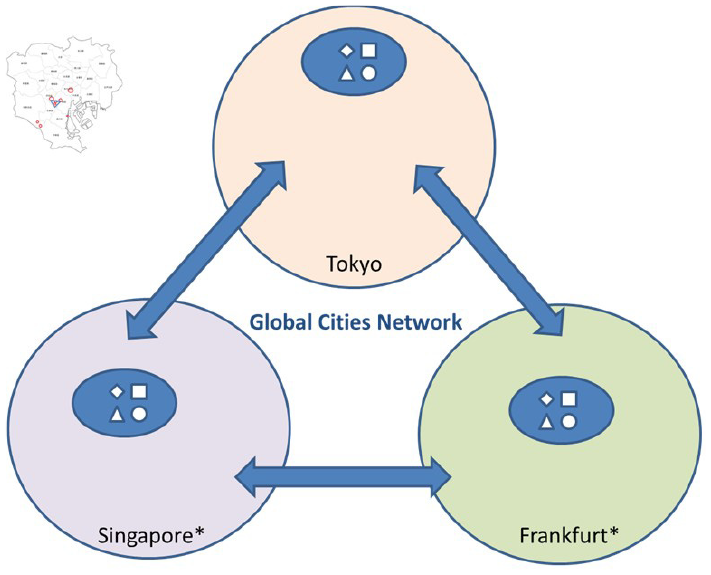
Universal convergence of gaijin ghettos in global arrival cities.
The universality of the superdiversification of Pro-Tokyoites
The other side of the spectrum of the transnational socio-spatial patterns is fairly different from these high-speed and constantly dynamic, yet characteristically universal, gaijin ghettos. As discussed in previous sections, the socio-spatial characteristics of Pro-Tokyoite transnational spaces emerged as a distinct and novel phenomenon. Although there must have always been adventurous individuals venturing out of comfort zones or allowed spatial areas, the collectivised socio-spatial pattern of the pro-localising persons within the particular group of transnational elites has not been empirically and conceptually discussed in recent research. The Pro-Tokyoite space consists of proximity to the local upper-class socio-spatial patterns, yet also overlaps with those of the gaijin ghetto (see comparison of Figures 1 and 2, with the same core ‘cocoon’ in both, yet diverging areas going beyond them in Figure 2). The overall attitudes of Pro-Tokyoite transnational migrants tend to be different and the social interactions and building of networks include a larger diversity of people. In particular, they include local non-migrants but also transnational migrants from different countries, encompassing also locals who are returnees or who have previous migration experience.
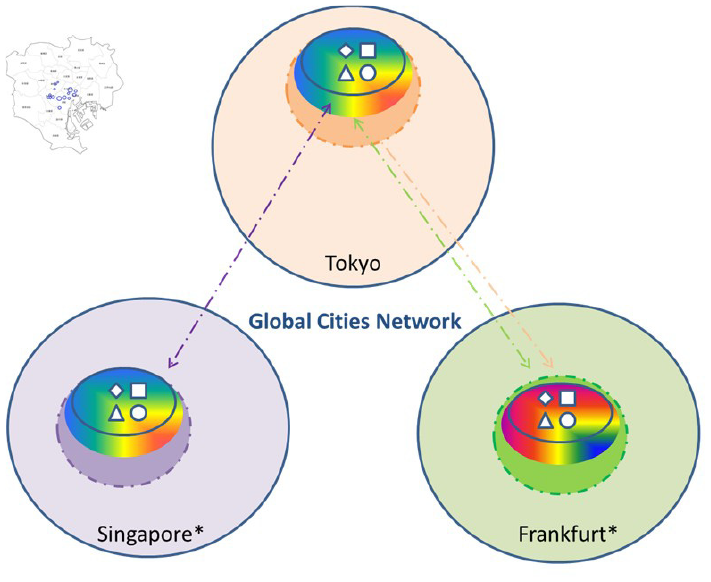
The universality of the superdiversification of Pro-Tokyoites.
The diversity of people is also reflected in the even stronger overall diversification of transnational space on a global scale. The Pro-Tokyoites do not only intermingle with the Japanese in Tokyo. When they move to other global cities – which they do as much as other transnational professionals of the gaijin ghetto type – they also start to bind ties to the local people there. Thus, Pro-Tokyoite as a terminology becomes a mere archetype of the universal trend of transnational professionals merging with the local peer group. They produce the transnational spaces through their social practices, yet with uniquely local characteristics. So, the Pro-Tokyoite will also become a Pro-Parisien, Pro-New Yorker, Pro-Hong Konger, etc. wherever they move within the global cities network (see Figure 2). Although the dynamics of the transnational space of the Pro-Tokyoite are rather constant in terms of the upper-class lifestyles, the accumulation of these Pro-Global-Cityites, so to say, brings about a group of transnational migrants each with multi-layered and highly diverse socio-spatial patterns. The Pro-Tokyoites themselves are a superdiverse group of transmigrants, with each being a hybrid in that their socio-spatial patterns overlap with the gaijin ghetto, especially due to their involvement in the transnational business communities and their corporate context. They also venture out to the more local upper class, not adopting the universalist view but instead incorporating local cultures and socio-spatial practices. At the same time, the group of these transnational migrants, though similar in their Pro-Tokyoite attitudes and behaviours, is still diverse in itself. The multiple Pro-Global-Cityite characters accumulate with the experience of transnational migrations and also differ in the constellation depending on the individuals’ professional and personal migration destinations (as depicted by the multi-shade areas beyond the gaijin ghetto circles in Figure 2). Additionally, further diversity is added on depending on each individual’s own ethnic, religious and cultural backgrounds. These Pro-Tokyoites, thus, illustrate the diversity within transnational corporate migrants, or the extent of superdiversity.
The dynamics of transnational migrations for urban superdiversity
As gaijin ghetto and Pro-Tokyoites are ideal types on a spectrum of socio-spatial patterns, it also needs to be emphasised that such socio-spatial practices, that is, localised and localisable interactions and activities among transnational migrants, are dynamic. The dynamism of the differential inclusion in the urban space is multidimensional and related closely to discourses on class-based transnational migration patterns (Yamamura, 2022a).
As noted in the introduction to the Tokyo case, it is not only the new and preferential arrival of transnational professionals that causes novel dynamics in the city space. It is also the lower skilled migration specifically aimed at servicing upper-class migrants within the city. One the one hand, there are schemes in Japan to allow domestic workers to be brought over by highly skilled professionals. 14 On the other hand, since 2015 the foreign housekeeper’s scheme has allowed the hiring of low-skilled migrants in specific national strategic zones, explicitly accommodating the needs and services of the global upper class. Such migration policies can be found not only in Japan but also in other arrival cities and countries (e.g. Singapore, Hong Kong, Canada). Such policies not only enable but also enhance the polarised transnational migration on both ends of the socioeconomic strata. This reflects the dual migration of ‘transnational elites’ and ‘permanent underclasses’ into world cities (Friedmann and Wolff, 1982; Sassen, 1988). Through such polarised new arrivals of transnational migration, intersecting spaces are produced. The differential inclusions of migrants in the cities are a combination of the transnational migrants from below working in these upper-class areas, partly also as live-in domestic workers, and them also being socialised and networked in ethnic towns, following the ‘old’ arrivals’ patterns (Ye, 2017; Yeoh, 2006).
Another aspect of differential inclusion in arrival cities is the dynamics among the transnational professionals, which is connected to their industrial and socio-economic class affiliation similar to other migrants. Those migrants who lose their jobs or positions due to economic downturns cannot maintain the lifestyle and socio-spatial patterns with the lower income. This was the case with one of our interviewees, 15 who had kept his work but with a local contract exempting him from the privileges of ‘expat packages’. With a change in available capital, issues arise around rent costs, international school fees and generally the living standards of these upper-class neighbourhoods. Relocation within the city, usually to a less central area, would be the consequence of such dynamics, resulting also in the change of social networks and practices bound to the locations.
The case of such transnational migrants, who start losing their status as upper-class transnational professionals, thus becoming upper middle-class migrants, in a certain sense reflects the point that Sassen (2011) and other scholars make in the discourse on the difference between the global city and the global city-region (see also Pain, 2011; Scott, 2001). Although it is less the case of a positive connotation of equal distribution of capital for the middle class but more of a dramatic change in the lives of transnational families falling victim to global economic dynamics, their pattern can be still regarded as exemplary for the middle classes who are drawn out of the city centre. Just as urban sociologists such as Fainstein (2011) have noted, such migrants are forced to relocate, not fully to the periphery but to the less central parts within the metropolitan area, as a consequence of the high living costs which they cannot afford anymore due to decreased monetary resources. Simultaneous with the forced relocation comes the risk of children having to change schools, which in turn is successively connected to the change in the social communities and socio-spatial patterns. These dramatic situations – which have occurred during the recent economic crises – are a reflection of what Fainstein described as the phenomenon of ‘those global cities whose fortunes are particularly tied to financial markets’ (Fainstein, 2011: 295) and by which the residents in them are vulnerable to these dynamics.
Differential inclusion in arrival cities: Spatial superdiversity
This multidimensionality of migrations into cities nowadays, which is what Vertovec has conceptualised as superdiversity (Vertovec, 2007, 2017), creates an overall phenomenon in arrival cities, which can be called spatial superdiversification. As part of the socio-spatial forms of differential inclusion in these cities, they can be said to experience an almost exponential diversification. They diversify through the multiple and frequent transnational migrations and mobilities of people themselves, but also through the intersections of transnational spaces of an even larger diversity of other international and transnational migrants. 16 Features of social practices from other urban contexts of the Pro-Tokyoites start to mix together as the ethnically and culturally diverse group of transnational professionals diversifies even more. Such multi-layered diversity leads to a pure socio-spatial superdiversification of these diverse global cities.
Moreover, as dynamic as these transnational migrants’ lives can be, changes in their careers (intended or unintended) but also importantly in their private lives, e.g. inter-group marriages or friendships, can lead to diversifications of their socio-spatial patterns. Changes in family socialisation through children or spouses can substantially contribute to differing socio-spatial patterns within the same city. Especially in the long run, with further generations of transnational migrants growing up in these transnational spaces – such as third-culture children 17 – the multidimensional superdiversification of transnational spaces, in particular spanning the increasing number of globally connected cities, will progress even more.
The spatiality of superdiversity needs to be understood as a dynamic process, thus more adequately perceived and discussed as a spatial superdiversification. The socio-spatially different patterns and the consequential spatial diversification are inherently connected to the different contexts of differential inclusions in arrival cities. They are dynamic in their nature, shifting spatially and with time, whereas the socio-spatial dynamics are processes that are influenced by but also find their spatial expressions at both the global and local levels. The urban phenomenon of spatial superdiversity is one of a differential inclusion because the different migration types that cause multidimensional diversification are inherently connected to policies and legal schemes that differently include the migrant groups in the cities (Ye, 2016; Yeoh, 2006). Indeed, in addition to policies differentially including migrants, with schemes privileging highly affluent and highly skilled migrants but also channelling accompanying domestic workers with such corporate professionals, it must also be noted how much the corporate context also contributes to the reproduction of the geographies of differential inclusion, and to superdiversification in (global) cities.
These socio-spatial forms of differential inclusions actually also bring new perspectives of hierarchisations of spaces in these arrival cities. The hierarchies go beyond ethnicity, but along the line of institutional-political embeddedness as migration policies coupled with economic policy give a structural framework to the different migration schemes. Such approaches have recently been taken up by scholars on the migration industries of highly skilled migrants (Cranston, 2016; Koh and Wissink, 2018). Access to global but also local mobilities is bound to the privileged legal status of corporate professionals. Moreover, the corporate hierarchy of positions and attached privileges, especially financial capital but also social capital, regarding access to local resources becomes crucial for the forms of differential inclusion of arrival cities. Indeed, the global and local contexts and spatiality of superdiversification demonstrate the inherent connection between these socio-spatial dynamics and socio-economic, class-based behavioural patterns of transnational migrations related to the differential inclusion of arrival cities.
Conclusion
The differential inclusion of new or at least increasing diversification of arrivals into specific cities, such as global cities, creates hubs for the diversification of migration inflows. The phenomena of gaijin ghetto and Pro-Tokyoites appear to be universally spreading in society, especially in the context of the transnational spaces spanning arrival cities. The multiple layering of such socio-spatial patterns contributes to an even stronger socio-spatial diversification in these cities. Such differential socio-spatial inclusions in the urban society occur along the line that is not ethno-focal anymore, but superdiverse according to socio-economic status, industrial or corporate affiliation and even lifestyles – the socio-spatial forms of differential inclusion depend less on ethnic background and more on socio-economic and socio-cultural capital. The intersections of different transnational migrant groups in specific areas of the arrival city add to the dynamics of spatial superdiversity. Indeed, as the concept of superdiversity implies the diversification of the migrant population itself, with different socioeconomic or legal statuses and further dimensions of diversities of individuals (Vertovec, 2007), the spatial superdiversity can be expected to expand also to the overall urban population beyond the group of privileged migration and even to the overall urban population.
The multi-layering also refers to the fact that each transmigrant has different sets of global cities they have migrated to before, thus bringing a diversity of Pro-Global Cityite experiences of socio-spatial patterns. With all of the different personal backgrounds and the multitude of experiences in arrival cities, there is ultimately created a spatial diversity in these cities unique to the current global migration era. In addition to the diversity already observable within this group of transnational corporate professionals of the financial industry, which as the socio-economically elite of the global society is marginal in total population, the diversity even becomes exponentially diversified if all other transnational migrant groups and each of the sub-groups’ socio-spatial patterns are taken into consideration.
This article delivers novel insights into an otherwise elusive group of transnational corporate elites regarding their under-researched socio-spatial patterns beyond their role as economic actors in the network of global cities. The novelty of this research is also the attempt to analyse such socio-spatial patterns that can be observed locally and to contextualise them into the global phenomenon of urbanisation. By providing this empirical evidence on transnational corporate elites and analysing it from a transnational migration perspective, as well as discussing spatiality in cities, the article offers a novel socio-spatial take on superdiversity and brings spatial superdiversification into debates on urban diversity, particularly on differential inclusion in cities. The forms of differential inclusion in these arrival cities do not only encompass the framework of migration policies (Ye, 2016; Yeoh, 2006) and migration industries (Yamamura, 2022b) but are also connected to and contextualised in the corporate context. The corporate context impacts the reproduction of specific geographies of superdiversity within the network of global cities. This article thus is not solely an empirical contribution to the global city of Tokyo. It contributes theoretically to the research on transnational professionals from a migration perspective and discusses their local socio-spatial forms of differential inclusion specifically in Tokyo but also in the network of global cities on a larger scale. Its main contribution lies in its discussion of the actual different socio-spatial forms of differential inclusion and the bringing of spatial superdiversification into the larger structural debates on differential inclusions.
In fact, as a future research agenda, it will be not only academically but also socio-politically interesting to further look into such intersecting (or ‘merging’) spaces where different migrant groups beyond the ethno-focal lens cross socio-spatial paths. This would lead to an even more fine-grained understanding of socio-spatial forms of differential inclusions of migrant-led diversity in cities. Moreover, the multi-scalar embeddedness particularly of the political-institutional frameworks for these different types of migrants is another avenue of research that could bring insights into the trends in global urbanisation with regards to homogenisation on the one hand, and differentiations on the other, leading to new socio-spatial diversifications in arrival cities.
Footnotes
Declaration of conflicting interests
The author declared no potential conflicts of interest with respect to the research, authorship, and/or publication of this article.
Funding
The author received no financial support for the research, authorship, and/or publication of this article.
