




Abstract
Recently, increasing migrant-led diversity of urban spaces can be expected to be especially observed in global cities, where global flows of capital, goods and people are concentrated. Although this connection between the global phenomenon of transnational migration and the local socio-spatial impacts on the cities appears evident, empirical research on the ‘relationship of migrants and cities’ remains underexplored. Discussions on global city makers have focused primarily on global economic actors, and have paid little attention to actors involved in shaping these global cities locally. This paper sheds new light on the role of migration industries in shaping global cities on the local level, being based empirically on qualitative interviews with transnational migrants and service providers in Tokyo. It discusses how the novel constellation of service firms for the transnational migration from above and below, that is, corporate migration industry in contrast to the conventional migration industry of labour migration, not only contributes to the global flow of transnational migrations into specific cities, but also draws them into specific socio-spatial patterns within the local urban space. By bringing these different types of migration industries conceptually together, it illustrates how socio-spatial diversification processes within global cities are embedded in the global economy (global city makers) but also locally directed by intermediary actors of migration industries (global city shapers). Embedding migration industries into the global cities perspective, it bridges the gap on urban transformation from the global to the local.
Introduction
City spaces and migration–or as Çağlar and Glick-Schiller (2011) pointed out, ‘the relationship of migrants and cities’ (p. 2) instead of migration to specific cities or migrant lives in cities, is still a topic that has been paid little attention. Especially in times of migration-led diversification as a novel societal phenomenon, also known as superdiversity (Vertovec, 2019), it remains rather unclear which mechanism of migration and actors contribute to such migration-led shaping of cities worldwide. Cities that have been mentioned in the context of superdiversity are well known multicultural cities, like London or New York, yet also cities from the Global South, such as Johannesburg, as well as cities in Asia have been associated with the concept of superdiversity. Indeed, global or world cities, economic command and control centres of the global economy (Sassen, 2001), have been associated with such migrant flows from their early days (cf. Sanderson et al., 2015). While global city research had pointed out these cities as ‘strategic places’ for advanced producer firms (Taylor et al., 2014) and the makers of such cities as being specific economic actors of the global economy (Hoyler at al., 2018), the conceptual idea of global cities being one of the core locations where transnational migration from above and below flow in (mentioned by Friedmann and Wolff, 1982; Sassen, 2001) has not been further looked into. Embedded originally in the world system theoretical and economic geographical approaches, global cities research has much discussed the global city making ‘from above’ by focusing on the transnational corporations deciding on the location of global cities and the locations of corporate real estates in such cities (Lizieri and Mekic, 2018; Parnreiter, 2015). However, little has been done on the migration side of these global cities (with exception of Yamamura, 2018, and in quantitative terms, Sanderson et al., 2015). The question of how migration industries connected to these corporate mobilities lead to not only the making but also shaping of the global cities has been so far neglected. Though recent research on ‘global mobility industries’ (Cranston, 2018) has alluded to the connection, the migration–cities nexus and the mechanism on the shaping of the cities have not been further dealt with conceptually. Simultaneously, though identifying global cities such as London as being superdiverse (Belabas et al., 2020; Hall, 2015; Vertovec, 2007), the spatiality of migrant-led diversification has not been fully explored either, beyond ethnographic explorations and discourses on the side of migration research. Research is still scarce in such a (super)diversity approach when it comes to the structural issues and intermediary actors as part of the mechanism that supports and mediates migration flows and thus shapes the cities. In fact, migration industries are only briefly mentioned as an impacting factor of superdiversity in general (cf. Vertovec, 2007), but research on them in the context of spatial diversification is still missing.
This paper thus aims to focus on ‘the relationship of migrants and cities’, meaning how cities are shaped by the diversifying migration, by uncovering mechanisms of migration industries, of transnational migration above and below, in shaping the city of Tokyo as an exemplar for one of the well-established global and potentially superdiverse cities. By bringing the research on transnationalism from above, including transnational highly-skilled migration, into the picture of the well-researched, more conventional migration industries of lower-skilled migration from below, it brings new insights into the migration-led diversification of cities, that is, the shaping of the city through migrants and intermediaries of the migration industries. Whereas migration industries from below have been primarily described in national or ethnic-based contexts, that is, intermediaries ‘brokering’ in migrant communities in-between nation-state systems (cf. Kern and Müller-Böker, 2015; Lindquist, 2017), the migration industry that directs transnational migration from above reflects a non-ethno-focal lens and gives more clues into the functioning of the city-shaping in the global context. As recent research on ‘elite mobilities industry’ (Koh and Wissink, 2018) along with ‘global mobility industries’ (Cranston, 2018) have noted, the migration industries for such transnational migrations indeed follow different logics and constellations. In fact, recent literature has started going beyond the conventional idea of brokers in migrant communities and mediating in corporate labour markets (Findlay and Li, 1998), and points out the diversity of intermediary actors taking part in the migration industries (cf. Jones and Sha, 2020). A conceptual re-consideration and exploration of different patterns of migration industries regarding the migration type, such as those for highly-skilled and lower-skilled migration, and their specific roles in the city-shaping of global and superdiverse cities, can give valuable insights into the migrant-led diversification of urban spaces from a more global perspective.
Literature review
Migration as an inherent part of the globalisation process and thus the creation of global cities had actually been realised from the beginning of the world city theory (cf. Sanderson et al., 2015). Friedmann and Wolff hinted at the importance of labour migration in shaping or characterising world cities in their physical, economic and social dimensions (Friedmann, 1986; Friedmann and Wolff, 1982), and they also mentioned the dual structure of ‘transnational elites’ and the ‘permanent underclass’ (Friedmann and Wolff, 1982: 322) in these cities. Sassen in her seminal works on global cities (1988, 1991, re-edited 2001) goes more into the details on the issue of social polarisation and its dual migration. However, although this nexus between migration and cities was fundamental in the formation of world cities and the theory, the global city research has long neglected this perspective. While the global city formation has been extensively researched from the economic geographical side of corporate geographies and the interconnectivity of cities, often quantitatively analysing cities in the global network (cf. Beaverstock et al., 1999; Carroll, 2007; Derudder et al., 2010; Taylor et al., 2002), the migrant-focused research on global cities remained rather limited. Transnational professionals, who factually are migrants, have been researched predominantly in their context as economic actors and in their business networks (Beaverstock, 2004; Carroll and Fennema, 2002; Faulconbridge, 2007; Morgan, 2001), but not in their role as migrants in the urban extent. As for the debate on the global city formation from a more qualitative point of view, the edited volume on global city making by Hoyler et al. (2018) makes a strong exception in the otherwise increasingly quantitative research within the Globalization and World Cities research network (cf. GaWC, n.d.). There, issues of global city-making are approached, discussing the role of economic actors in making global cities. Yet, the approach is from a relational economic geographical perspective (Hoyler et al., 2018), focusing mostly on corporate impacts rather than taking a migration lens to the issue of global city spaces. Apart from a contribution by Yamamura (2018) in the volume, which looks at the urban spaces of transnational professionals, the urban actors discussed in the space-making focus on corporate real estates (Lizieri and Mekic, 2018; Parnreiter, 2015) and do not cover transnational professionals’ perspective on the urban spaces as migrants. The other notable, yet quantitative approach on the nexus is Sanderson et al. (2015), measuring global urban centralities and their connection to immigration. The measurement results in the confirmation that global cities are indeed central in international flows of labour migrations. Yet empirical evidence on how exactly these connections between the migrations and global cities are created and how the cities are shaped locally remains out of scope.
A complementary part of the larger picture of the alluded dual migration to global cities, which can be regarded as key to understanding the spatial diversification in cities, can be found in transnational migration literature.
1
As a matter of fact, the ‘transnational turn’ in migration research (Brettell and Hollifield, 2014; King, 2012) resulted in a burgeoning of literature on transnational migration from Glick-Schiller et al.’s (1992) seminal work until now (Kivisto, 2001; Pries, 2013; Vertovec, 1999). However, what needs to be focused on here once again is the migration–city nexus in these literatures. Developing from the idea of transnational urbanism by Smith (2001), several researchers had analysed the specific context of migration in the urban, particularly with Yeoh and other authors bridging the gap on the nexus of global or globalising cities and transnational migration (Yeoh and Chang, 2001; Yeoh et al., 2000). Yet, as Glick-Schiller and Çağlar (2011) pointed out, conceptual debates on the connection between cities and migration still remained underexplored. Newer approaches developing from transnationalism debates, namely those on superdiversity—coined by Vertovec 2007 and since having become established in different fields
This leads to the third part of the overall picture, which is the literature on migration industries. Though migration industries have recently emerged as a viable research field and perspective in research migration (see Cranston et al., 2018; Jones and Sha, 2020), it is still nascent and has not yet brought substantial clarity to the ‘black box’ of migration phenomena (Lindquist et al., 2012). In particular, the nexus of migration and cities in the context of migration industries has been paid little attention so far. Especially in the context of the transnational professionals or expatriates, research from a migration industry perspective has given new insight into the mechanism in which they migrate and discusses the implications on urban spaces (Beaverstock, 2011). Research has discussed the ‘global mobility industry’ (Cranston, 2018) as an outsourced international human resource process of corporations, with Koh and Wissink (2018: 593) also discussing intermediaries who ‘enable, structure, and create transnational migration lifestyles’ or Sandoz opening the debate on who is defined as ‘wanted immigrants’ and who is not (2019). The interesting aspect of these intermediaries is, in fact, that there is a clear diversification happening, which might also be the key to understanding the spatial diversification in specific arrival cities through migration industries. Indeed, while the diversification of the urban population and urban spaces themselves has been well acknowledged in migration research (Meissner and Vertovec, 2014; Yamamura, 2022a), the diversification of migration industries in accordance with the diversifying migration streams has only recently come into focus (Gammeltoft-Hansen and Sørensen, 2013; Garapich, 2008). As much as debates on migration industries stem from more migration policy related fields (cf., Gammeltoft-Hansen and Sørensen, 2013; Jones and Sha, 2020), the context to the urban space and its shaping through migration industries, however, is still an underexplored field.
This paper now is an attempt to connect the missing links between the three fields: transnational migration/superdiversity, migration industries and cities. Global cities in this context are particularly interesting as locations of migration-led diversification, as these are where different types of transnational migrations from below and above come together. By taking the migration industry lens to migration into cities and the urban shaping through the migration industry, it contributes to the debate on the overall nexus of migration and cities. Bringing these inherently connected aspects together, it demonstrates how the local shaping of cities is embedded in a mechanism of migration industries acting on a global scale. It thus contributes to a better conceptualisation of the increasing socio-spatial (super)diversification of cities in the age of global migration.
Empirical case: Global city Tokyo and changes in Japanese migration policies
Tokyo, as the capital of one of the economically strong countries of post-World War II times, had been identified as one of the big three global cities by Sassen’s original seminal work (1991). Yet, with the emergence of other strong Asian economies, such as Singapore and Hong Kong, while Japan struggled through its Lost Decades of economic downturn, Tokyo lost its primary positions in the world cities ranking (see data in GaWC, nd). Bringing Tokyo back on the global economic parquet and heading the global economy in the Asian region again has thus become a proclaimed aim of the Tokyo metropolitan government. As it has been often observed in Asian developmental states’ involvement in the global city making including in Tokyo’s past (Hill and Kim, 2000; Olds and Yeung, 2004; Saito, 2003), the Japanese national and Tokyo metropolitan government are putting forward several measures in close collaboration and coordination to reach this aim. The global city Tokyo is thus in re-making, supported by the national government designating, for example, a national strategic zone with deregulation and other incentives to attract foreign companies and talents back to Tokyo, and also supporting the organisation of mega-events such as the Tokyo Olympics 2020.
The Japanese government has finally decided after decades of migration-reluctant policies to open its doors, not only to highly-skilled migration (which has been relatively liberal throughout the post-war eras), but explicitly also to lower-skilled migration. In the 1980s, to address specific labour shortages, Japan had actually developed schemes to bring in lower skilled foreign workers for its booming industries, yet only allowed this under the cover of ethnic migration targeting descendants of Japanese emigrants, and keeping the doors shut to regular labour migration (cf. Surak, 2013). Japan and in particular Tokyo appears to be at the verge of an important turning point as the government, under the pressure of drastic labour shortages combined with ageing and shrinking population, introduced new ‘specified skills visas’ to allow lower-skilled migration 2 especially into selected industries. Regulated with skills tests, along with demonstrating conversational skills in Japanese, this visa scheme allows lower-skilled migrants to work a maximum of five years. With regard to highly-skilled migration, the Japanese government has kept the doors open and clearly promotes the attraction of a foreign workforce by offering a so-called ‘points-based preferential immigration treatment for highly-skilled foreign professionals’ scheme. Elements of the preferential treatment are related to legal conditions for the migrant, such as the permitted period of stay or permission to be involved in multiple economic activities, but also involve the co-migration of others, including spouses but also domestic workers (cf. Ministry of Justice, 2019).
The latter aspect, of bringing one domestic worker, is one of the most evident ways of how the national migration law embedded in the larger context of economic policy not only enables but also enhances polarised transnational migration on both ends of the socio-economic strata. This reflects quite clearly what has been much discussed in earlier studies in world or global cities research, on the dual migration of ‘transnational elites’ and ‘permanent underclasses’ into global cities (cf. Friedmann and Wolff, 1982; Sassen, 1988). The preferential treatment of highly-skilled professionals with their domestic worker is one aspect. Another one is the foreign housekeepers’ scheme introduced in late 2015, which permits hiring foreign workers without permanent residency as housekeepers in aforementioned national strategic zones in different cities throughout Japan. It is clear that allowing permits for foreign workers in this domain is not aimed at Japanese families, but for foreign companies and investors that are supposed to be lured into these special economic zones. The lower-skilled migration is also explicitly accommodating the needs of and services aimed at the transnational expatriate community, such as building a cleaning management and accommodation industry as well as a food service industry. These are industrial sectors that transnational migration from above and below fostered and are increasingly found in cities such as Tokyo—two very contrasting transnational migrations intersecting in Tokyo.
Although the overall statistics on foreign residents in Japan may create the image of little change over the last decades, the actual diversification of the population is evident. From being 1–1.5% of foreigners in the total population, migrants now account for above 2% of the population, and apart from decreases between 2009 and 2012 due to the global financial crisis and the Great East Japan Earthquake coupled with the Fukushima nuclear catastrophe, the numbers are rising (Ministry of Justice, 2019). Also, statistics on the composition of the foreign population show a diversification, not only regarding the countries of origin and nationalities, but also regarding the skills as reflected in the visa types (Ministry of Justice, 2019). Such diversification is especially observed in Tokyo, where the majority of the foreign population is concentrated. Migrants now make up almost 4% of the city’s population with 550,000 residents compared with less than 2.5% in 2000. Whereas until the mid-1980s Korean and Chinese as well as the US-Americans made up over 80% of Tokyo’s foreign residents, currently the variety of countries of origin has increased, with migrants from the Philippines, Vietnam, but also Nepal, Taiwan and India, along with Myanmar and Thailand making up more than a fifth of the foreign residents (see Tokyo Metropolitan Government, n.d.). Such diversification of the migrant population has resulted in ethnic towns and neighbourhoods emerging in different parts of Tokyo, such as the Korean Town in Shin-Okubo (western part of Tokyo) or the Little India in Nishi-Kasai (eastern part). In contrast, the financial elite has been concentrated in the central district of Minato ward, where approximately 8% of the foreign population resides and where embassies and foreign corporations are also located.
What is interesting in the spatial diversification is the differentiation according to historically less prestigious areas to the east of the city (Shitamachi) where some migrant communities can be found, versus the concentration of transnational professionals and affluent foreign residents in the Yamanote area, which follows the history of the segregated city. These areas used to be part of the upper, respectively aristocratic class in the Edo feudal era, which had been expropriated and confiscated during the Meiji restoration, that is, the abolishment of the feudal system in the mid-19th century, and after being used as military properties were given to foreign embassies and consulates (cf. Seidensticker, 1985; Yamamura, 2022b).
Methodology
This paper is based on extensive empirical research in Tokyo, with problem-centred qualitative interviews with 45 transnational corporate professionals and a further ten lower-skilled transnational labour migrants. These interviews with different types of transnational migrants have been further complemented by expert interviews. The five largest real estate and relocation companies servicing the transnational corporate professionals were interviewed on their perspectives on the locations of residences for their customers.
On the one hand, the transnational migration from below has been empirically analysed on the basis of Filipino migrants in Japan. The Filipino community is one of the largest minorities, apart from Chinese and Koreans, whose migration networks and history are embedded in fully different historical and geopolitical backgrounds and cannot be contextualised in the recent migration policy changes of the Japanese government. The migration industry through which Filipino migrants come to Japan, however, can be regarded as a proxy for other labour migrations, especially from South-east Asian countries. They are institutionally embedded in the bilateral policy agreements of Japan and other Association of South-east Asian Nations (ASEAN) countries, and where brokers act as intermediaries in the migrant communities, enabling the migration between the countries according to the overall labour market dynamics and migration policies. This will be referred to as the ‘conventional migration industry’ henceforth as the patterns and mechanism of brokers have been well studied in other country contexts and are similar to them.
On the other hand, the transnational migration population from above was intentionally selected irrespective of their ethnic or national backgrounds. Reflecting the key importance of the financial industry in the global city context, corporate migrants were selected according to their affiliation to the financial industry, yet this applied specifically to those with transnational migration experiences, that is, frequent career-related mobility and relocations, including residential and work experience in Tokyo. In contrast to the transnational migration from below, the migration industry through which these foreigners are enabled into mobility will be henceforth distinguished as the ‘corporate migration industry’ to signify the importance of the corporate assignments in the migration process. These highly-skilled and privileged migrants from above are embedded in transnational corporate structures and migrate because of corporate decisions. This migration industry relies little or not at all on ethno-focal migrant communities and the administrative processes of the migration is managed through corporate actors as will be further discussed.
The interviews were conducted mainly in English, but when either requested or naturally occurring Japanese was also spoken, including moments of code-switching. The interviews were recorded and transcribed for further analysis. Data were selectively coded according to the approach of qualitative content analysis by Mayring (2004).
Analysis and discussion
Starting from the empirical findings on transnational migration from below, that is, Filipino migrants in Tokyo, this section first discusses the mechanism of city-shaping from the perspective of the conventional migration industry, which is the migration industry through which labour migrants come not only to Japan but particularly into the metropolitan region of Tokyo. As it will become clear, this side of the story somewhat resembles the existent literature on the migration industry where brokers manage and channel labour migration between the countries of origin and destination (cf. Faist, 2014; Jones and Sha, 2020; Lindquist, 2017). Yet, what is novel about this account is the spatial patterns that emerge from the involvement of the migrants in this system of the migration industry. Then, changing the perspective to the transnational migration from above, the following section discusses the mechanism of the corporate migration industry, particularly focusing on how these intermediaries draw transnational migrants into specific areas within the city of Tokyo. It also discusses the constrains of the corporate system, which relies heavily on the migration industry intermediaries and how much this reliance also shapes the urban space of the migrants themselves. Finally, the co-existence of these two distinct migration industries in the same city is discussed. Though embedded in different migration policy contexts of higher- and lower-skilled migration, they together lead the transnational migrant population to specific areas within the same city and thus contribute to the global city shaping.
Mechanism of global city shaping: The conventional migration industry
As interviews with recently arrived Filipino migrants show, the migration networks that recent migrants from the Philippines rely on and use as the source of information and support are based mainly on family and friends, that is, strong ties. Due to the proactive dispatchment of Filipino labour migrants throughout the world through the Philippine Overseas Employment Administration (POEA), those in Japan mostly have closer relatives and at least acquaintances in their social network who have emigrated, too. Though family members and friends might have moved to Canada or Australia, and might not always be present in Japan, with the large number of Filipino overseas workers in these countries, the communities of co-ethnics are existent and also heavily used to share experiences and social capital before and upon arrival. As one of the interviewees who came through a language school, changed into employment in a Japanese firm and recently to a transnational company recounted his background and arrival: My aunt and my cousins are in Canada, and I have friends who went to Australia. They are everywhere. We are everywhere. That is the Filipino thing. (…) So, I got the job through my friend’s sister who told me about the language school in Japan. They come to Philippines, a lot of them. And I went to school and came to Japan. I didn’t know anybody here, my family and friends are in Canada and Australia, but the here are many Filipinos. Different people. (Interviewee B05)
As much as the information and connections within the co-ethnic migration networks are crucial for transnational migrants from below coming to Japan, the migration industry that manages the migration channels is of considerable importance, too. As it is conventionally the case with unskilled and lower-skilled migration to higher economic countries, Filipino informants emphasised the role of brokers. The migration industry of Filipinos consists of recruitment agencies cooperating with employers often in manufacturing or agricultural industry, even coupled with government registered intermediaries, who recruit and accompany them and execute the visa application process (cf. Debonneville, 2021). As language fluency is crucial to the integration to the labour market and also a prerequisite to securing a stable visa, language schools both in the home country and in Japan upon arrival play a prominent role within this migration industry.
I went to the Japanese language school in Manila first. There, I had to learn Japanese, complete first test so I could come to Japan. I was here as language student, and I started baito [translation: part-time job] in the company I got working visa later. The school took care of everything, the visa, getting job. (Interviewee B01)
It is through such language schools, the Filipino migrants report, that they first receive the student visa status, and also receive information and more importantly references for companies that will be employing and provided them with working permits upon completion of Japanese language courses. The role of international education as a novel migration industry has been pointed out by other authors on Chinese migrants to Japan, too (Liu-Farrer and Tran, 2019). It points at the necessity of this route especially because of the Japanese government’s reluctance to open doors to labour migration. Such information on recruitment agencies and language schools is shared within the co-ethnic communities, leading to a highly interwoven system of the migration industry with the migration network (as illustrated on the left-hand side of Figure 1, below).
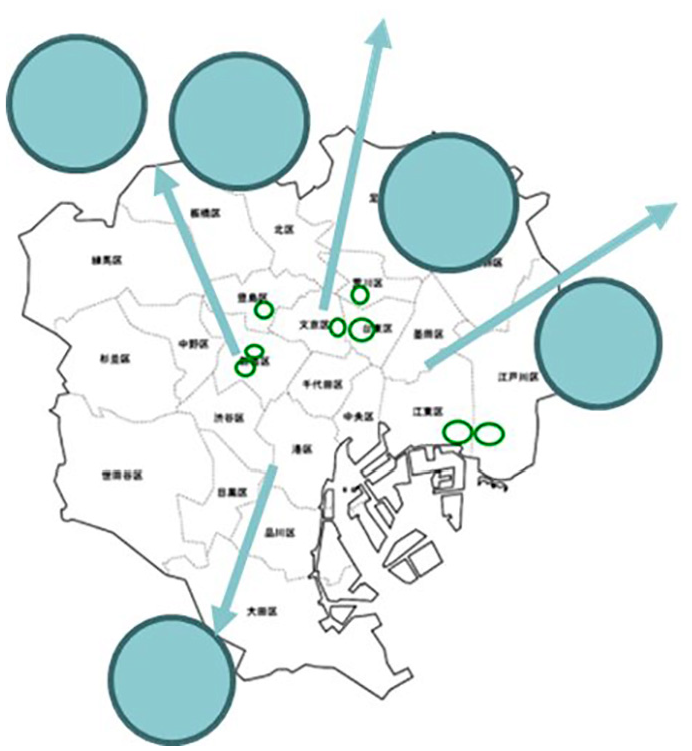
Ethnic towns (in green circles) and the main border hubs of Filipino migrants from below.
In the urban context, this particular linkage and embeddedness of migrants in the ‘conventional migration industry’ results in specific socio-spatial patterns, which define the shaping of the city. The urban spaces of such migrants from below are strongly related to the location of the language school, where they are obliged to study during their student visa status, and more importantly also either to the location of the company housing when once employed or to where co-ethnics reside. The companies cooperating with recruitment agencies decide primarily on the residential location and through that also the geographical extent of the everyday socio-spatial practices of these migrants. As one of the Filipino migrants explained: I’m not here as Genba [colloquial terminology signifying construction workers], but everybody who come here and work in factories or at genba [construction site], they all live far away. It is closer to where they work, they get there in buses and live in the dorms out there. The company give them housing and they get picked up and go to work. They don’t have time to come to Tokyo so I don’t see them in the week. On weekends, I go and meet them. (Interviewee B03)
As depicted in the map based on the interviews with Filipino migrants, their housing and everyday life tend to be located at the outskirts of the Tokyo metropolitan area in logistic hubs (see Figure 1). In these border cities, such as Omiya (as entry point to Saitama prefecture) or Funabashi city (the city in Chiba prefecture right at the border with Tokyo), with their function as major transportation hubs to the adjacent prefectures, housing is more affordable for the companies and also close by the work in the manufacturing and agricultural industries. A similar pattern of the outskirts can also be observed for care homes spread in the broader metropolitan area, where migrants would also be located.
The other points of interest for these migrants from below are the aforementioned language schools, which can be either located close by these border cities, too, or in more central locations, such as Shinjuku or Ikebukuro (western edge cities of the Tokyo city centre), and social meeting places. As one of the Filipino care worker migrants explained: In-between work and language school, there is nothing more. School is in Shinjuku, the company chose it, and we live here [in Adachi in eastern part of Tokyo]. Actually, the housing fee is already deducted from my salary because the company organises it all. (Interviewee B05)
With such tightly scheduled weekly routines, there is not much time for further activities, yet shopping for Filipino foods and socialising with other Filipinos are carried out in more central areas like in Ueno (Ame-yoko area and Ueno park) or Catholic churches which even partly offer services in Filipino for the large community around Tokyo. What is interesting to mention here is the online space of social media, which is crucial in sharing and receiving information not only for the migration process itself, but in finding the locations for the urban practices within the Tokyo global city region such as accessing the community market. The ‘shop under Ameyoko’, for example, has been mentioned as one of the main grocery shops where Filipino and other South-east-Asian food can be purchased, and is well propagated among these migrants by social media. When asked where he went for ethnic food-shopping, this Filipino migrant pointed out: Go to Ueno Ameyoko in the underground, there’s where everybody goes. (…) I found it [Asian food store run by Filipino] through Facebook and my friends told me about. We go there on weekend. (Interviewee B07)
Mechanism of global city shaping: The corporate migration industry
By contrast, the combination of migration industry and migration networks at the other side of the social strata of the transnational migrants is somewhat similar, but the actual mechanism functions quite differently (see Figure 2; right side). The transnational professionals do not draw social capital through their co-ethnic communities, with usually no network of family or close friends migrating. The main resources they refer to in social terms are business networks, which are not based on ethnic or national communities. Through such business networks they receive offers for new positions and are headhunted, and these are also the co-worker communities they go to when it comes to sharing information about the destination of their business appointment and local housing: We have a lot of help with searching for things. A lot of it comes from recommendations. Some of them from… come from clients [who] recommend areas or specific places. (Interviewee PL32)
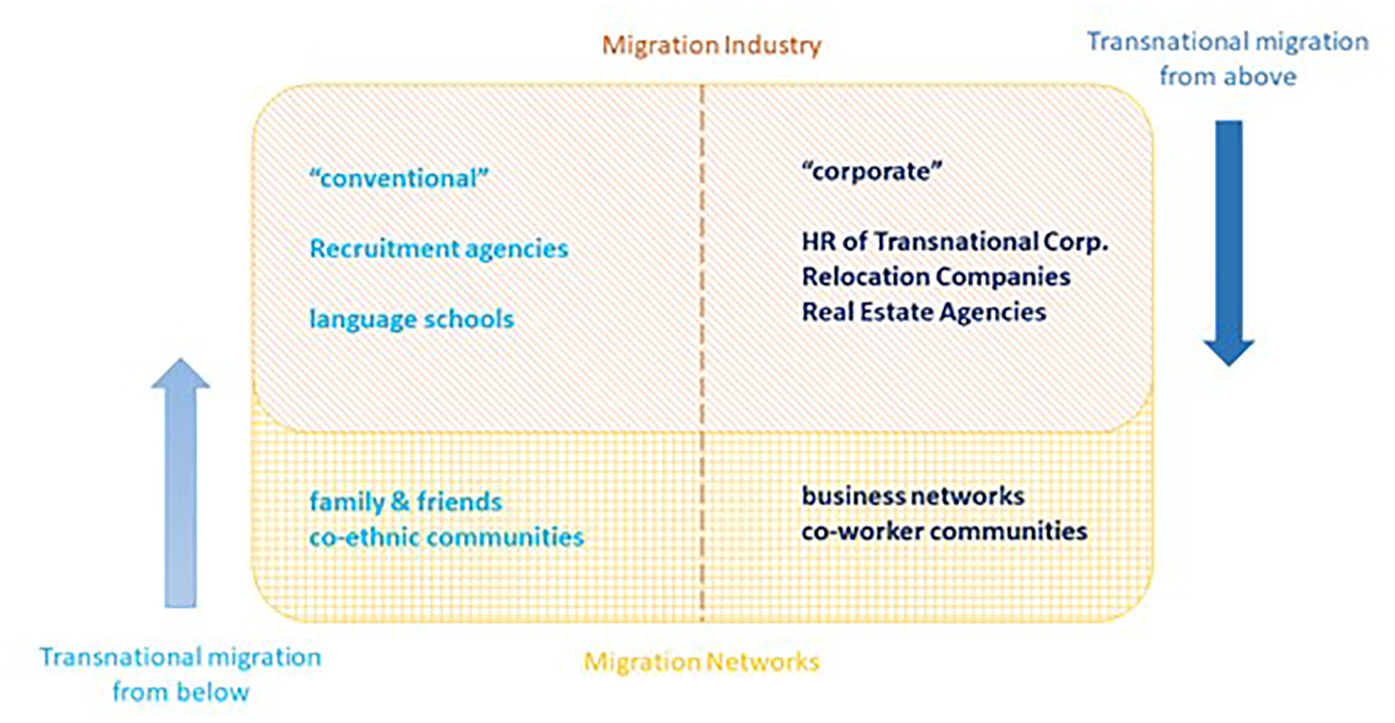
Migration industries and networks of transnational migration from below and above.
The migration industry in this case is completely focused on the corporate context, with the transnational corporations’ HR divisions organising the migration. The practical administrative process of migration is outsourced to relocation companies that are in close contact with the HR persons, deciding on the allowances and options in the form of relocation packages given to the individual transnational professionals. Being part of either highly-skilled visa schemes or intracompany transfers, the visa process is relatively easy to handle compared with those for the lower skilled, where tests and regulations are stricter. As managers of relocation companies explained the procedure, the relocation companies rely on a pool of contracted local consultants or relocation agents, who then refer the transnational professionals to the possible housing through their own local network of real estate agencies or in some cases even personal contacts with landlords. The choices of potential residential housing depend on the migrant’s position within the company that commissions the relocation. As reported by the relocation companies, the transnational migrant professionals are given different ‘expat packages’, which define the number of potential residential houses offered to them and the services, such as practical advice and support on finding schools or any shopping possibilities. The lower the position, the less comprehensive the packages, thus limiting the options for their residential choices. The services offered by relocation companies start from moving out of the current work location, the whole process of visa and resident permit application to finding housing and any further institutions needed. In exceptional cases, relocation companies can also be dealing with ‘VIP packages’, which would be fully open in costs, allowing any service that the incoming professional (normally at highest managerial level) desires for the relocation. These accounts of real estate and relocation companies demonstrate the impact that the mechanism of the corporate migration industry has on the actual shaping of the global city.
In contrast to the conventional migration industry where migrants from below are embedded more in social networks of co-ethnics and their locational choices directed by the migrant community, transnational migrants’ relocations not only to the specific global city but also within the city are defined by their affiliation to the transnational corporation and the context there. The housing that they are offered depends on their position within the corporation, whereas the choices are pre-selected through the commissioning of the search to professionalised relocation and real estate agencies. These commissioned agents contribute to the socio-spatial concentration of such transnational migrant professionals in specific areas of the city. In the case of Tokyo, these areas are around Minato ward where, due to the concentration, street-level urban landscapes also change. Non-Japanese signs along with multi-lingual services and supermarkets are common features in such areas. Buildings in these upscale areas accommodate newer real estate with Western-style living without traditional Japanese tatami mattresses, which are more often found in older apartments. High-end hotels and serviced apartments aimed at these transnational professionals along with high-end clubs and restaurants can be also found in these areas. As one of the interviewees mentioned: Because I used to stay in the Imperial Hotel. And then they moved from the Imperial Hotel into a serviced apartment. And the serviced apartment they put me to was in the middle of Azabjuban. So when my wife came over, obviously, there are more westerns rounds there … there are a couple of international supermarkets. Restaurants tend to be a little bit more foreigner-friendly. They have pictures or they will have English menus tucked away somewhere. (Interviewee JG34)
Quite clearly embedded into such corporate context and managed by the intermediary actors of the migration industry in the form of relocation companies and real estate agencies, transnational professionals’ urban spaces begin to be strongly drawn to the choices made by these actors. Amongst the different socio-spatial patterns that can still be observed within the group of transnational professionals (see Yamamura, 2018), one pattern also well-known from other global cities is the creation of ‘expat bubbles’. These areas are located either in central parts of Tokyo with a longer history of prestigious foreign residents in the Minato ward (where consulates and embassies can be found) or in newly developed areas within the central city with upscale buildings, supported by urban renewal and redevelopment projects. Such prestigious urban projects started with Roppongi Hills, but also stretches further to Atago Green Hills or Omotesando Hills. Services and businesses located and being offered in these areas contribute to the comfortable lifestyle for transnational professionals. As one interviewee explains the core characteristics of the ‘expat bubble’: Oh, people call it the expat bubble. If you want to, you never have to interact with anybody Japanese. You can go to the American schools, there’s two American … I call them American … there’s two Western grocery stores. Ehm, you don’t ever have to explore (…). (KW45)
One prime institution for the socialisation of these professionals, with and without family, is the Tokyo American Club (TAC), mentioned by the majority of interviewees. The TAC was originally founded in 1928 and in its ‘sixth incarnation’ provides sports facilities, restaurants and facilities for other leisure activities exclusively for members, as well as an area for invited guests of members for business meetings. The exclusivity of the club, which has the US ambassador to Japan as the honorary president, is well illustrated in the self-description of being ‘quite possibly the finest private club facility in the world’ with several aspects of the sports and leisure facilities that are ‘world-class’, also offering ‘superlative meeting, party and conference facilities’ (TAC homepage).
Other significant institutions in these areas are educational and socialisation facilities. The locations of international schools—and also stops for the school buses to international schools—which are partly in the suburbs, for example, the American School in Japan (ASIJ), are a crucial aspect for transnational professionals with children when choosing their residence. Asked about the relationship transnational professionals had to expatriate areas, one of the interviewees answered the following: First I lived in, first time I came back as a professional I lived in, ehm, the Meguro area and then I moved into Daikanyama and then I got closer and closer to what I call the Gaijin ghetto. [laughing] Yeah, it’s just comfortable. So, you know, when we came back, we lived in Moto-Azabu, Minami-Azabu for eighteen years and it’s just, you know, I don’t want to live like, I should be honest, I don’t want to have the Japanese lifestyle, I want to live a more comfortable lifestyle, near schools. My kids‘ve been to Nishimachi, so they could walk to school or shopping is convenient, so I don’t feel, we need to…we’re happy, you know, living in a Gaijin area, it’s just comfortable. (Interviewee DS37)
At the same time, the real estate agencies—being aware of these preferences regarding the schools—focus on the bus stops when marketing their housing for professionals by providing their own maps of the inner city with international-customer-based shops, schools and their bus lines.
In fact, real estate companies, as they claim, ‘know the needs of their global expats’ (RE29). Real estate agents specialised in house rental to highly-skilled professionals explain their behaviour as the result of experience with expats and their (assumed) knowledge of their needs: ‘these customers from overseas want their comfort; that is where we take them’ (RE30). As one transnational migrant recounted: As a foreigner, when you go to a real estate company and you say you’re looking for a place, they have in their mind an ideal what you want. And it’s houses with, you know, maybe foreign appliances but different than the properties that they might show Japanese people with the same number of kids and the same whatever. Different properties, they show you altogether, certain properties, I’m sure, everybody who has rented that property for the history that it’s been on the market has always been foreigners. (OP30)
However, as another professional, who was more eager to venture out to ‘more local’ residential areas that Japanese co-workers recommended, yet was not acquainted with the geographical locations, recounts, he was also unwillingly drawn into an expat bubble: It was funny when I was looking for apartments I kept asking the brokers I do not want to be limited to just this thing, thirty-five choices here [in the expat bubble] and no choices outside. I said, what about Aoyama and Meguro and all these places I have heard great things about. We would like to look a little bit more than just here and I did not know the residential areas and I haven’t been in them very much. So, I always felt like he kept driving in circles that I could not figure out where we were. And then I said ‘Wait, that building looks familiar’ and we make a ride and come back and then he showed me another apartment. I said, ‘You are only showing me a part—like even if I ask you to go somewhere else. (AB35)
The transnational corporate strategy that somewhat constrains the agency of transnational professionals is the increasingly time- and cost-efficient relocation of their employees. The relocation process has changed in the last decades, especially enabled by the technical development of the internet and the services provided via the internet. Through the digitalisation of society, relocation steps have been increasingly outsourced to intermediary relocation and real estate companies. As interviewees of long-established Japanese real estate companies specialised with highly-skilled transnational customers remembered, transnational corporations used to send their prospective expatriates to their destined city to search and decide on their future residences until the 1990s. Nowadays, however—as both corporate members as well as real estate agents pointed out—in a trend particularly enhanced after the global financial crisis, relocations are mainly organised by intermediary companies pre-selecting housing for professionals, emailing information and pictures on which decisions are made from a distance. Such pre-selection as part of time and cost reducing strategy for transnational corporations is a further mechanism of the limited immobility pattern in the respective city as relocation and real estate agencies define what is thought to be needed. Several transnational professionals have mentioned only seeing pictures via email before arriving and relocating to their new housing in Tokyo.
While the transnational corporations make their decisions on an economic basis as to the cities to which they dispatch transnational professionals and also locate their subsidiaries and headquarters, in doing so they act as global city makers. Yet, the corporate migration industry, which consists of the Human Resource division of transnational corporations as the ones commissioning the multinationally-operating relocation companies that collaborate with relocation and real estate agent locally, shapes the actual global city by drawing these transnational migrants into specific areas of global cities. These areas where they are ‘chosen’ to relocate to, become the hubs within the city where multilingual services, upscale gastronomy and further shops concentrate in the global city. This then leads to unequal socio-spatial development within the global city (see Hayes and Zaban, 2020, special issue on transnational gentrification).
Migrant-led diversification: Migration industries as global city shapers
The spatial dimension of the migrant-led diversification of global cities is embedded in an interwoven context of different economic and political actors at different levels. They are embedded not only in the local urban context, such as urban redevelopment projects on the prefectural or city level,
3
but also in the national governmental policies, especially regarding migration policies as discussed above. Furthermore, it is also accompanied by the context of global economy with corporate strategies and international institutions that direct favourable conditions for it (cf. Brewster, 2006). The economic actors of the migration industry or industries are clearly aware and sensitive of such changes in migration policies as that is the main resource on which their capital accumulation is based. As an interviewee from a relocation company with subsidiaries in several global cities commented: That is why we have lawyers in our house and also have local contracted relocation agents. We take care of the visa issues and know which permits are possible for whom and who they can bring with them when they relocate. Things change, but we always know what the conditions and laws are. (Interviewee RC01)
Relocation companies managing the migration of highly-skilled transnational migrants maintain well-established contacts with public administration in the migration offices that allow, at times, expedited processing of visa applications or at least information on the status which are often otherwise barred to applicants, as reported by Interviewee RG02 from a large transnational relocation company. The interviewee commented that even the location of the housing is crucial as the public administration differed from city to city: It is easier for us to get the clients to [City A] because we know the migration officers there. For our VIPs, we can get them through [the visa application and residential permit process] quicker there. That would be different if the client wanted to move to [neighbouring City B]. (Interviewee RG02)
Migration industries from below also navigate through the novel policies and find channels to allow migration, such as through a two-step migration—first as a student and then as an employee. Migration networks from below, too, react to changes. However, while highly professionalised transnational corporations and relocation companies from above have direct access to information and the public administration, advice on new possibilities of migration channels on the side of migration from below is spread slowly. For migrants from below, the experiences from their social networks need more time to gather experience and knowledge.
For the transnational migrants from below, the role of migrant communities remains strong on the local level. They do not only support and enable the cross-border migration from one country and place to another. The embeddedness in migrant communities as well as in the migration industry also has impacts on the local spatialisation with the ethnic towns and communities concentrated in the city. Korean Town in Shinokubo or Indian district in Nishi-Kasai are examples of such ethnic towns. In the case of the transnational professionals, the reliance on their type of migrant network, which is the business community, remains relatively low. The migration itself is not directly related to the information of their co-workers and the advice on relocation remains limited. It is normally limited to the last decision on housing from the pre-selected choices given by the commissioned real estate agencies or relocation companies. Decisions are thus mostly directed by the transnational corporations they work for, which in turn are directed by the global economy and the constraints of the global competition. With the time- and cost-efficient strategy of relocating their employees globally, transnational corporations rely on corporate migration industries, consisting of relocation and real estate agencies. The migrants themselves then are strongly dependent on the choices that these economic actors make.
These migration industries are thus not only involved on the global scale in supporting and directing migrants from their countries of origin to the novel location. They are also in both cases involved in the actual distribution of these migrant groups within the city and by directing the options for residences. The residential location then also shapes the local socio-spatial patterns of the migrants from both above and below on a daily basis. Indeed, there is a question of the ‘chicken or the egg’, in terms of the residential locations being chosen according to the availability of migrants-specific or at least accommodating businesses and services (especially in the case of transnational migration from above), or the local economy adjusting to the residents coming into the neighbourhood. What is clear in any case is the factual diversification of urban space through the migrant diversities. It is a socio-spatial one, that is, by visible diversity and diversifying social interactions in the city space.
Conclusion
The two-fold perspective of transnational migrations from above and below and their distinct migration industries co-evolving in the urban space gives a more comprehensive view on how migrant-led diversification as part of the global city shaping is occurring in cities such as Tokyo. In fact, as the two interview sets demonstrate, the city population itself and also the urban landscapes are being diversified through the migrant population. Not only is the number of different nationals and ethnic backgrounds increasing, the migrant-led diversification also implies the targeted spatial distribution and direction of these transnational migrants to specific areas within the city. In this mechanism of settling and locating transnational migrants from above and below, migration industries—though substantially different in nature between what have been identified as conventional and corporate migration industries—play a crucial role. Conventional migration industries of labour migrants from below still strongly rely on migration networks and remain focused on ethno- or national-focused migrant communities as discussed in migration industry literature (cf. overviews in Cranston et al., 2018; Gammeltoft-Hansen and Sørensen, 2013; Jones and Sha, 2020). Through the particular navigation of migration schemes, these migrants remain in an urban space defined by the location of the residences given by brokers, usually close to their workplace and language schools—all in the outskirts of the city centre. On the other hand, the corporate migration industry from above is strongly contextualised in the corporate strategy and consists of real estate and relocation companies. The corporate migration industry draws migrants to specific neighbourhoods in the city centre which they perceive as matching the lifestyles of the migrants. By these directions of migrants into specific areas in the city and to specific socio-spatial patterns, migration industries of both types from above and below can be regarded as the city-shaping actors in times of increased global migration.
Furthermore, being embedded in the larger context of global cities, this case also points at the global nature of this mechanism of migration industries from above and below, directly impacting the cities which are interlinked in the global network. The global cities perspective indeed brings the global context of migrant-led spatial diversification specifically in cities on a larger scale. These two strands of migration industries from above and below together lead to a more comprehensive conceptual understanding of the socio-spatial dynamics in the migrant-led diversification processes of urban spaces in global cities, bringing the idea of distinguishing global city makers (global players, transnational corporations and service providers) from the actual global city shapers (who directly impact the socio-spatial practices of transnational migrants), in which migration industries apparently take a large role. By taking the perspective of the migration industries as the shapers of urban space, this paper contributes to the much-needed debate on the ‘relationship of migrants and cities’ (Çağlar and Glick-Schiller, 2011), uncovering the mechanisms of migration industries by which cities are being shaped to superdiverse cities by the different transnational migration from above and below. It illustrates and conceptualises the migrant-led diversification in cities to a more contextual debate beyond an ethnography of superdiversity in cities.
It must also be noted that there is an increase in diversification of migration industries and characteristics of migrants themselves occurring. It is not only the transnational migrations from above and below in the strict sense that come into arrival cities, such as global cities. The numbers of transnational migrants that are skilled and also those that do not have a corporate background, for example, using migration channels such as descendant or spousal visas or the international language schools as a channel, are increasing. With these diversifications of migrants comes the diversification of urban spaces, leading to the actual superdiversity in these cities that attract global migration.
Footnotes
Declaration of conflicting interests
The author declared no potential conflicts of interest with respect to the research, authorship, and/or publication of this article.
Funding
The author received no financial support for the research, authorship, and/or publication of this article.
