




Abstract
Uganda hosts the largest refugee population on the African continent and the third highest worldwide. The country also has one of the world's most progressive refugee policies. Refugees are allowed to work and operate businesses anywhere in the country, which is uncommon in other African countries and beyond. Despite the large refugee population, their impact on employment and the associated dynamics remains poorly understood. This paper explores the impact of the presence of the refugee population on local employment opportunities and how it is connected to refugees’ sociocultural and livelihoods background and local refugee policies. Drawing on in-depth interviews with local hosts, government officials, and refugee agencies, we show that hosting refugees enhances opportunities and competition for jobs. We argue that refugees’ presence mainly affects unskilled locals in sectors that align with refugees’ livelihood backgrounds. The locals in distant sectors and the highly educated and experienced locals face less competition in employment. Moreover, refugees’ complementary livelihoods have the potential to minimize refugee-host competition for jobs.
Introduction
The Ugandan government and people are generally considered to be refugee-welcoming (UNDP 2017). This is at least partly due to the social–cultural and linguistic similarities between some refugees and hosts. For example, several communities separated by the Uganda–South Sudan colonial borders shared similar cultural and linguistic backgrounds (Collins 1962; Leonardi and Santschi 2016). Given this cultural proximity, South Sudanese refugees received more acceptance in northern Uganda (Collins 1962).
The hospitality that refugees receive from the Ugandan people and government may also be viewed as gestures of reciprocity as many Ugandans also sought asylum in neighboring countries, especially in Sudan when Uganda went through political instability (Dunn 2004; Kasfir 2005; Roberts 2014). Many high-level government officials, including the current president (YK Museveni) and his family, were once exiled refugees (Museveni 2011). This historical experience of Ugandans and their political elites may explain the progressive refugee policies in the country that welcome and guarantee freedom to refugees from neighboring countries and beyond. Despite not sharing a border with Somalia, Uganda, hosts tens of thousands of Somali refugees (Iazzolino and Hersi 2019). They enter Uganda through other countries, such as Kenya, most likely attracted by the freedom and rights the country provides to refugees (see Betts et al. 2019). Despite Uganda's long-standing record of hosting refugees, the country's progressive refugee policy has been tested by the escalation of violent conflict in South Sudan, which caused more than 2.4 million South Sudanese to flee to neighboring countries (UNHCR 2018b). With over 1.5 million refugees, Uganda hosts the largest refugee population on the African continent (UNHCR 2021). About one million refugees come from South Sudan alone (Schiltz et al. 2019).
Despite the large refugee population, our knowledge and understanding of their impact on local employment and associated dynamics remains limited. Some aspects of refugees’ impact on employment have been widely studied in the Middle East (see Fallah, Krafft and Wahba 2019), Europe (see Bloch 2008; Marbach, Hainmueller and Hangartner 2018), and America (Card 1990). The current study builds on and contributes to the growing body of literature on refugees’ impact on employment by focusing on Africa's largest refugee-hosting nation, Uganda. The research contributes to the literature by exploring Uganda's unique refugee policies (see Varalakshmi et al. 2016) and how they influence refugees’ impact on local employment. The study also examines the link between refugees’ livelihood background and their impact on employment, providing rare insights into how refugees’ complementary livelihoods could minimize refugee-host competition for jobs. Past studies on refugees’ impact on the labor market have been focused mainly on the skill gap between the refugees and host yet ignoring the above key nuances. The current research also provides a broader understanding of refugees as a diverse group in terms of their sociocultural and economic livelihood background, as this diversity influences their impact on employment. Past research treated the refugees as a homogeneous group, limiting the ability to examine individual group dynamics analytically.
Drawing on data from in-depth interviews with host community members, government officials, and refugee organizations, this article provides new insights from the perspectives of the host community (see Taylor et al. 2016). Previous research on the dynamics of employment focused on the economic activities or perspectives of refugees alone (see Betts et al. 2014; Taylor et al. 2016; Tumen 2016). Host community members’ perspectives and lived experiences have largely been overlooked (Kreibaum 2016). This study attempts to fill this gap by examining host community members’ everyday experiences and perspectives. “Employment” is broadly defined to include job opportunities, remuneration, and working conditions. The remainder of the paper is structured as follows: A review of relevant literature is presented next, followed by methodology, findings, and discussion and conclusion.
Refugees and Employment
Past research generally portrays refugees’ economic activities as an economic contribution to the host communities (see Betts et al. 2014; Turner 2016). The impact on employment tends to be trivialized and often established by assessing the number of locals working in refugee-owned enterprises (World Bank 2019). This approach oversimplifies the actual or perceived refugee-host employment-related interactions and animosities in the wider society. Indeed, many countries restrict refugees’ direct participation in the labor market as they are perceived to heighten competition for jobs (Betts et al. 2019; Turner 2016; Zetter and Ruaudel 2018). In European countries, refugees are believed to cause labor market distortion (Marbach, Hainmueller and Hangartner 2018). Chambers (1986) analyzed the economic impact of refugees on host communities in Sub-Saharan Africa and identified “poor and unskilled hosts” as “hidden losers,” as the socioeconomic opportunities generated by refugees’ presence only benefit locals who already have access to resources. The unskilled and poor hosts lose from competition for resources and previously available work opportunities (Musasizi 2022; Ongpin 2008; Walton 2012; Zaytoun et al. 2017). A more optimistic perspective suggests that if refugees are allowed a significant amount of freedom to engage with the local economy, they can create jobs in formal and informal sectors (Betts et al. 2014). This view aligns with Ugandan refugee policy that allows refugees to work and operate businesses (Varalakshmi et al. 2016). This is not to argue that the Uganda refugee response strategy is without blemish. The country's progressive refugee policy has been criticized for inadequacies in refugees’ local integration, limited support for urban refugees, and overlooking host community members (International Refugee Rights Initiative 2018). However, this research has explored these critical issues by exploring the hosts’ views and opinions regarding refugees’ presence and aspects of Uganda refugee policies. Uganda's response to refugees still requires significant improvement (International Refugee Rights Initiative 2018). However, with more countries increasingly closing their borders to refugees and denying refugees fundamental movement rights, Uganda's refugee policy offers important insights (Betts et al. 2016).
Unlike other African countries where refugees are encamped with limited freedom of movement and work rights, in Uganda, refugees are placed in organized settlements where they live alongside host community members (Betts et al. 2014; Omata 2012). This would suggest that their impact on employment in countries with restrictive refugee policies may vary significantly from nonrestrictive countries such as Uganda, where refugees compete directly in the labor market with the locals. Studies conducted in Uganda have shown that the freedom and rights extended to refugees enabled the creation of more jobs and improved host communities’ living conditions (Betts et al. 2014). The entrepreneurial refugees employ fellow refugees and locals in their businesses, something considered impossible in countries where refugees are not allowed to work and run businesses (Betts et al. 2017). Some refugees are believed to own large franchise businesses; for example, the City Oil (a gas station), which has many branches around Kampala—the capital, was reportedly owned by Somali refugees (Omata and Kaplan 2013). Research conducted in Kampala found that 41 percent of the employees in refugee-owned businesses were locals (Betts et al. 2014, 2017). The refugees in Uganda run other small businesses, such as salons, shops, and restaurants, where they employ many fellow refugees and locals (Betts et al. 2019).
A study of the workforce in enterprises owned by refugees within Kampala revealed that the locals comprised 40 percent of the total employees (Clements, Shoffner and Zamore 2016). Instead of competing against the natives for the limited number of jobs, the refugees started new businesses and created more jobs in these communities (Clements, Shoffner and Zamore 2016). A World Bank (2019) report identified that the proportion of locals employed in refugee-owned enterprises was far too high in the capital city—Kampala; about three in four employees were locals. The report highlighted that the jobs created by refugees in Uganda are unlikely in countries with restrictive refugee policies, such as encampments that limit refugees’ economic and social integration.
Although locals are employed in large numbers in refugee-owned businesses, they are still relatively less likely to be employed than fellow refugees of similar ethnic backgrounds or countries of origin (Omata 2012; Omata and Kaplan 2013). Most refugees belong to ethnic and national networks linking each other to employment opportunities (Monteith and Lwasa 2017; Omata 2012). According to Omata (2012) and Monteith and Lwasa (2017), the Somali groups in Kampala employed Somalis, and a similar pattern was observed among the Congolese, Eritreans, and other refugee groups. In Kampala, newly arrived Congolese would receive support from fellow refugees who had arrived before; the Congolese refugee Churches and related organizations help refugees find work and navigate the asylum process (Lyytinen 2017; Monteith and Lwasa 2017).
When most refugees are employed within companies and organizations owned by fellow refugees, it reduces the competition for jobs between refugees and hosts in the public domain, such as in government sectors. Omata (2018) argued that refugees in Uganda create their own ethnic or national economic enclaves, reducing economic rivalry between refugees and the local population in public spaces, and minimizing the negative perception of refugees. While refugees may not create more jobs for the locals, they do not necessarily have to increase competition for jobs in the host communities (Hakiza 2014; Omata 2018). However, this does not mean that refugees do not take away jobs from the locals. It is still possible that refugees’ access to the labor market may displace some locals from jobs for which both the locals and the refugees have the required skills and experience (Clemens, Huang and Graham 2018). No study has explicitly compared the skills or income levels of refugees and hosts in Adjumani, Uganda. This void is addressed in this paper.
Beyond Uganda, the refugee employment dynamics have also not been studied widely. The main focus has been on how refugees create jobs or displace locals from jobs yet overlooking the locals’ views and experiences of living with refugees (Kreibaum 2016). About four decades ago, Chambers (1986) noted that not only the perspectives of locals had been overlooked in refugee research but also the enormous socioeconomic challenges they experienced after the inflow of a large refugee population. Chambers (1986) argued that a large inflow of refugees may be associated with increased competition for economic opportunities, including jobs and a decline in wages, affecting mainly the locals as refugees tended to have access to free food and housing from refugee agencies. For example, the Syrian refugee crisis in Jordan caused many difficulties, including high unemployment among the locals as they competed for jobs with the refugees (Betts, Bloom and Weaver 2015; Zaytoun et al. 2017).
In Tanzania, a large inflow of refugees in the Kagera region increased competition for jobs in the informal sector, particularly the farming sector (Mabiso et al. 2014). Despite refugees being subject to work restrictions, especially outside the camp, those who worked illegally could still displace locals from jobs as they tended to be available and work for lower wages (Chambers 1986; Mabiso et al. 2014). More research in Africa and beyond has identified a significant decline in jobs and wages after the influx of refugees in the host communities (Kibreab 1985; Walton 2012). The hosts face tough competition in the job market, and the declining wages worsens their living condition as prices of goods and services increase significantly after the inflow of refugees (Walton 2012; Zaytoun et al. 2017). The depression of wage rates in host communities is caused by the sudden increase in labor supply resulting from the refugee inflow and their willingness to accept lower wages (Kibreab 1985; Zetter and Ruaudel 2016). The local employers take advantage of the refugees’ situation and underpay them (Kaiser 2006). Refugees likely accepted lower wages because they were already provided with food rations and allowance assistance, and wages were considered supplementary (Zaytoun et al. 2017).
Overall, the positive impact of refugees on the host communities comes primarily through increased employment opportunities. In Tanzania, the presence of refugees led to the inflow of international relief organizations, which employed a significant number of locals (Whitaker 2002). In Kenya, locals living close to camp experienced an increase in jobs (Alix-Garcia et al. 2018). In Uganda, direct refugee-host interaction increases the level of economic activity in the area, which benefits local households (D’Errico et al. 2022). However, in both Tanzania and Kenya, the local policies restricted refugees’ access to the labor market outside the camp. The refugees often depended on food aid, the small businesses they operated inside the camp, and remittances (Alix-Garcia et al. 2018; Turner 2016). The limited work rights of refugees might have reduced labor market competition between refugees and hosts, presenting a scenario different to the situation in Uganda, where refugees engage freely with the local labor market (Betts et al. 2014). This article examines the interplay between the arguably less restrictive Uganda's local refugee policies and the perceived high competition for jobs and how the livelihood background of refugees impacts employment in the host communities.
Methodology
The study was conducted in the Adjumani district, West Nile region in northern Uganda, and the fieldwork spanned from June to November 2019. Located approximately 436 kilometers northwest of the capital—Kampala, Adjumani is one of the closest districts of Uganda to the South Sudan border. The refugees in Adjumani outnumbered the local population (Herbert and Idris 2018). Almost all refugees resettled in the Adjumani district came from South Sudan through the Elegu border and collection point (UNHCR 2018c). The district has a total population of 432,000, including 240,905 registered refugees distributed across the 18 designated refugee settlements in the area (Komakech et al. 2020; UNHCR 2018c) (Figure 1).
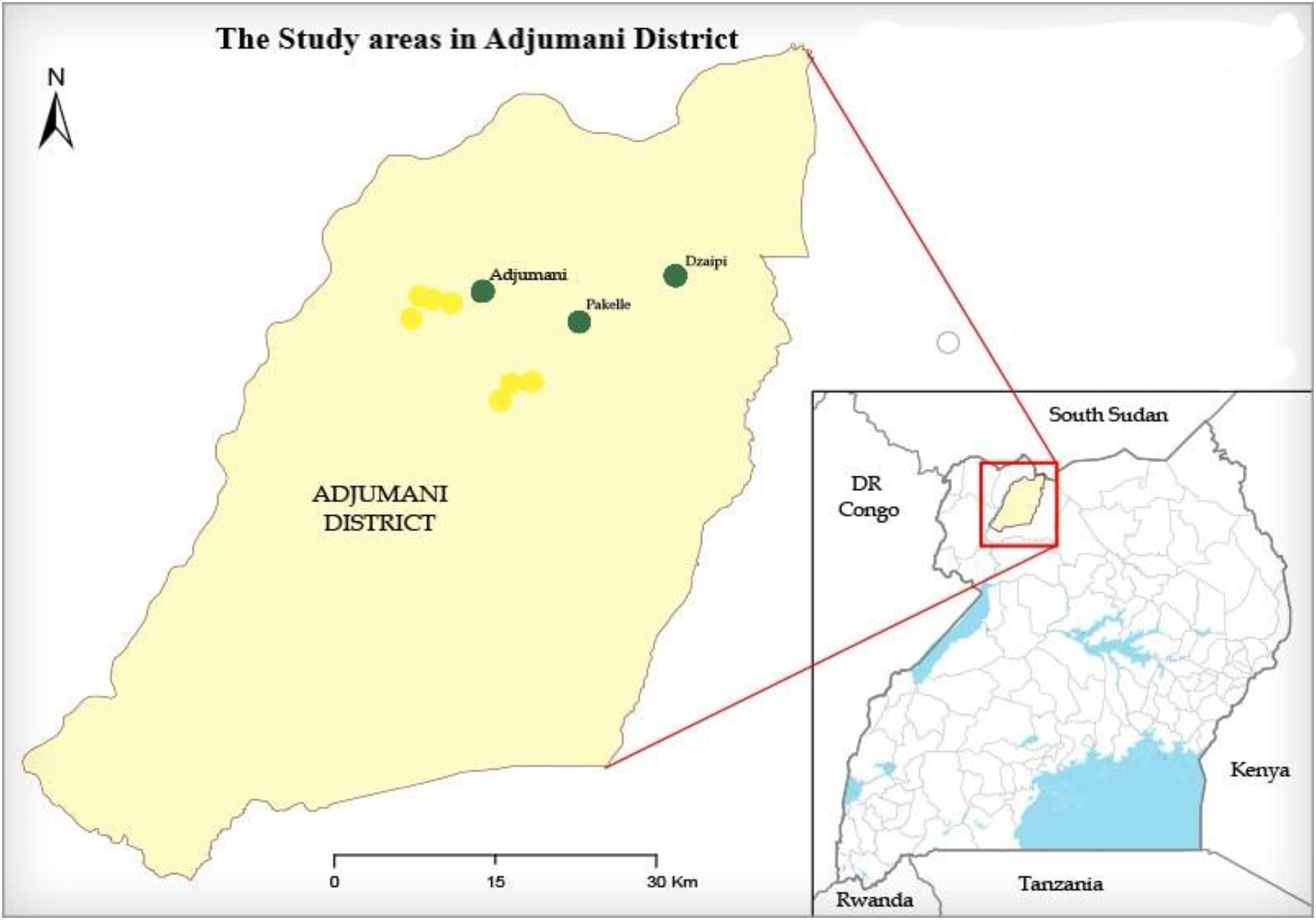
Map of Adjumani District Showing Study Locations.
Adjumani district has a long-standing history of hosting refugees, mainly from South Sudan. Indeed, South Sudan is Uganda's highest refugee country of origin. At the time of the study, it was the third-highest refugee-hosting district in Uganda after Yumbe and Arua. It had the highest number of refugee settlements (18), both newly established and old settlements (UNHCR 2018c), and had the highest refugee-host ratio in the country, with refugees making up about 59 percent of the total population (UNHCR 2018a).
The Study Participants and Sampling
The study applied criterion and purposive sampling to select participants from a broader sample. Criterion sampling is considered most appropriate for phenomenological research. Under this procedure, participants meet predefined criteria, mainly relating to their lived experience with the phenomenon being studied before being included in the study (Moser and Korstjens 2018). In comparison, purposive sampling is well suited for ethnographic studies; it involves using a variety of key informants who must be insiders of the study population and most knowledgeable about the culture of the group that is being researched (Moser and Korstjens 2018). Under purposeful sampling, the researcher intentionally selects people who can best explain the phenomenon under examination (Moser and Korstjens 2018). The participants for this research included host community members and key informants, hereafter referred to as KIs. Semistructured interviews and focus group discussions were conducted to gather relevant data.
Using criterion sampling, host community members both in rural and urban areas were recruited from the national voter register, which was accessible both online at www.ec.or.ug and at all district offices of the electoral commission across the country. This register lists all local residents by their local councils/villages. It included information on residents’ names, gender, date of birth, and village or council of residence. After carefully assessing the register of residents in the selected communities, the researchers developed a tentative list of potential participants from each participating village. The participants were stratified by gender and age (i.e., male and female; 18–29, 30–49, and 50+). Given the phenomenological nature of the research, the current study only included participants who had lived in the host communities for at least three years.
Fifty interviews were conducted with the local community members, comprising 28 (56%) males and 22 (44%) females. The research also involved four focus group discussions with the host community members, each comprising 5–8 participants. The focus groups were gendered—two were conducted with male participants and two with females from the selected villages—Miniki and Onigo. The researchers used purposive sampling to select the key informants. These included two cultural leaders, two local leaders (politicians), and two NGOs, each represented by one participant (including UNHCR). One government representative from the Office of Prime Minister (OPM), which is responsible for refugees and host communities, was also interviewed.
While some respondents were from urban centers (Adjumani and Dzaipi towns), most of the participants were from rural areas including the villages of Miniki and Onigo in Dzaipi subcounty located about 25 km from Adjumani town. The two villages were selected because they were surrounded by several large refugee settlements, including Elema, Baratuku, and Nyumanzi, and the hosts in these villages regularly interacted with refugees socially and economically. Also, the refugees in these settlements differed regarding some key sociocultural and economic aspects. For example, there were several tribes of refugees each with its own culture; some refugees were crop growers, while others were herders. There were also entrepreneurs who had shops in and outside the settlements. Some refugees were in a protracted situation, while others had arrived recently. The hosts in the two villages (Onigo and Miniki) were the most suitable for the study because of their everyday experiences living with refugees from diverse backgrounds.
Findings
Refugees, Hosts, and Competition for Jobs
While refugees may have heightened the competition for jobs in some sectors, it appeared that their presence also generated job opportunities in other sectors. This was most evident among the skilled workers who were mainly employed in the humanitarian assistance sector. From the participants’ point of view, locals with higher levels of formal education had greater chances of being employed by refugee agencies and under refugee-related government programs. As an elder and clan leader observed: … people who had education certificates. … were employed as OPM's field officers, … as distribution clerks for OPM and UNHCR … refugees have [thus] brought new jobs. In fact, … one of my sons is working with the refugees in the settlement under the OPM program. (Kizito, 84, clan leader)
The presence of refugees attracted many local and international relief organizations and government refugee programs under the Office of the Prime Minister, which employed a significant number of hosts, especially skilled workers. Most well-paid jobs in the local and international organizations were suitable for educated and experienced Ugandans from urban areas. However, most refugees were in rural areas. In other words, the economic opportunities generated by refugees’ presence mainly benefit a small group of hosts who already have access to resources (Chambers 1986; Walton 2012). As was observed in a focus group discussion: … people who work for organizations like LWF (Lutheran World Federation) are not from our villages here. … those LWF workers who speak Madi are from [towns] like Adjumani. (Baru, 39, Male FGD)
Many host community members expressed these sentiments as a way of expressing how the government and development partners have overlooked them in favor of locals from urban areas or other places: … there are no such jobs like working in the office for hosts in this village. It is not common to find [rural hosts] employed by refugee organizations. … MTI (Medical Team International) [normally] want to employ doctors and nurses from other places. (Edema, 35, Female FGD)
The unequal benefit from job opportunities generated by refugees’ presence between rural and urban dwellers was perceived negatively by the rural hosts, who thought they were shouldering a heavier burden of hosting refugees than the urban hosts. Although over 90 percent of refugees in Uganda were being hosted in rural communities (Azia 2019), a disproportionately high number of skilled workers from urban areas occupy positions in settlements. The practice of bringing in skilled workers from urban areas by refugee agencies may have been due to limited numbers of skilled workers in rural areas and may reflect the education inequalities between rural and urban.
Farm work was the most common source of employment in rural areas among hosts. Many host community members worked as agriculture laborers for fellow community members and refugees engaged in farming. However, farm work was rarely viewed as gainful employment. Many hosts involved in farm work did not regard themselves as employed and only mentioned it after probing. It was viewed as a usual thing people do as a supplement to their farming activities rather than employment that is highly valued. When asked about employment opportunities due to refugee presence, Odu-Madi, for example, noted that “some people have been employed in UNHCR; these NGOs have increased the available jobs in host communities.” As a rural host, when asked whether the presence of refugees has created casual jobs in his village, he noted: “[not here] but young people who have moved to the settlements ride Boda-Boda (motorbike taxis) or work in [restaurants].” When he was asked whether there were some hosts employed as farm laborers, he wondered whether that was also a job: Is that also a job? Yes, some people go and dig but not only for refugees, they dig even for the locals. But you cannot do that all the time like a job because you also have your own farm to take care of. Because you need enough food [for your family] … I [used to] build huts (temporary mud and grass thatched small houses) for refugees, but some people also dig and build pit latrines and get some little money. (Odu-Madi, 51)
There are several explanations for rural hosts not recognizing farm work as a job. First, farm work such as bush clearing was not new to hosts. Even though farm work was thought to have increased with the presence of refugees, it was something they were doing previously. Second, while it was paid work, it was synonymous with the daily work routines related to their own farming. In their view, doing the same work for money once in a while did not make it any different. As was explained in a focus group: … there are no jobs here. If you need some money, you can plant beans, maize and sorghum for refugees, and they will pay you some money. Many [hosts] women help refugees with cultivation to get some money. (Bunia, 46, Female FGD)
While local hosts despised farm work as an employment, they acknowledged that refugees’ presence increased jobs in this sector and workers were predominantly hosts. In urban settings in and around the settlements, many unskilled hosts found jobs in construction, transport service, especially “Boda-Boda” (motorbike taxi), restaurants, bars, and shops, and performed manual work at refugee-related organizations. In these sectors, especially site construction, refugees were thought to have displaced locals from employment, confirming the view that refugees increase competition for jobs and mainly displace unskilled laborers (Chambers 1986). As one participant expressed: Jobs are very scarce because many refugees are leaving settlement to work [in Adjumani]. That is why [hosts] are struggling. … young people are going back to the villages to join farming which is better. (Chandi, 40)
While the competition for jobs may have increased, the demographic changes brought by the refugees’ presence increased socioeconomic activities in an area previously known only for subsistence farming. The vibrancy caused by surrounding refugee settlements created economic possibilities that resulted in more wage earners across the informal sector: Some get work in restaurants because some refugees and people from [other parts of Uganda] who run restaurants want to employ people who speak Madi because some of them do not know our language. (Pavuga, 43, Female FGD)
Working in a restaurant was emphasized repeatedly, and one participant further explained how it was dominated by young women, reflecting a gender benefit from refugees’ presence: [The number of] women selling food has increased because of high demand due to settlements. … some are self-employed while others are employed by other people. … it is a [woman] job, [especially] young women. (Opeba, 31)
Population growth due to refugees resulted in more people joining the labor market as employees or self-employed in their own businesses. However, it appeared that most unskilled laborers competing for jobs in the informal sector were young people who had migrated from nearby villages, leaving the farming sector to older adults. Many participants, including those who had moved to nearby towns and settlements from villages, expressed that life was increasingly becoming unaffordable.
The Cost of Living
There were concerns among the host community members that the cost of living was increasing, and, in their opinion, this was associated with the inflow of refugees. Abandoning the farming sector, for instance, may have affected production, causing a scarcity in food supply as many participants were concerned about the increasing food prices. The benefits from farming, which many locals had abandoned, seemed to outweigh the low-paid jobs in construction, bars, and restaurants. This explained the hosts’ frustration and subjective low levels of economic well-being, especially among the unskilled group, despite the perceived increase in economic activities. As one participant expressed: Some people came from villages, but they cannot find work in town [there are no jobs]. There is land for farming, but most people of my age don't want to do farming. They want to live a town life, yet they have no stable jobs. During the day, they are playing cards and betting. At night, they will go and steal and sell in the settlement. (Palada, 27)
In addition to perceiving refugee settlements as easy places for transacting stolen goods, many participants described life after the inflow of refugees as a struggle, especially those in the informal sector. These local hosts had a negative view of their economic life and blamed it on the increased competition for resources caused by the refugee population. This group of host community members viewed refugees as better-off and competitors and tended to express negative sentiments about refugees and relief organizations. They attributed the rising cost of living to the growing number of refugee settlements in their area.
Despite the perceived increase in work opportunities in some sectors, many hosts were concerned with rising cost of living affecting mainly low-wage earners in the informal sector. The locals employed in the informal sector exhibited a low level of satisfaction from their jobs, as was also observed by Kreibaum (2016), and tended to have negative views about their economic life. Akuku, for example, had two families, one in the village (Onigo) and the other in a small town nearby. While his second wife was employed in Nyumanzi refugee settlement, Akuku explained how things were getting out of hand as his wife's job was nowhere near sustaining the family with the most basic needs: The cost of living is too high, because of the refugee population. A bundle of cassava [local staple food] we used to sell at UGX1,000 is now UGX2,500. … we used to give refugees cassava for free but now we are also buying it. Things are getting very bad … the money my wife gets cannot even buy food for the family. I have to get food from my farm in the village. (Akuku, 52)
Local farmers could have benefited from the increased cost of food prices, but because of engaging in mainly subsistence farming, they could not produce enough for the rapidly growing population. Refugee settlements also influenced the migration of predominantly young people from rural areas to settlements and nearby towns, affecting the farming sector. This aligned with a study conducted in Tanzania over two decades ago, where rural–urban migration due to refugee settlement caused severe food shortages (Whitaker 1999). While work opportunities may have increased the number of wage earners, the transition from unpaid household farming activities to paid or self-employed work after the arrival of refugees did not necessarily translate into a better economic life among the hosts. Despite Akuku's wife being employed, he viewed his family's living conditions as deteriorating. Like many others, Akuku was concerned about the increased cost of living resulting from refugees’ presence and believed their lives would be much better without his wife working if they had remained in farming. While there was a perceived increase in wages (see next section), the increase still did not match the high cost of living.
The Wages
The demographic changes resulting from refugee flows affected the perception of wages in the host community. The participants explained that many young people migrated from villages to seek employment in nearby settlements and towns. However, contrary to previous studies that found refugees to depress wages (Mabiso et al. 2014), the participants in this research perceived a general increase in wages for skilled and unskilled jobs. The refugee agencies were particularly paying more than the government and the private employers, and many government workers, especially the health workers and teachers, quit their jobs for better pay in refugee agencies: The pay rates have gone up. Some people working in government are leaving [for refugee agencies] … I heard that the doctors and nurses here at our dispensary are applying for jobs in MTI (Medical Team International). (Obudra, 47)
Similarly, a government primary school teacher commented that: … [fellow teachers] who work for NGOs used to get more money than us [government employees]; the [district authority intervened] because many teachers were leaving government jobs. … [our pay has also been increased now]. (Odoa, 51)
The general assumption that refugees cause a high labor supply and a wage decline (Dadush and Niebuhr 2016; Diaconu 2015) does not seem to apply to skilled work. But many other sectors are not immune. For example, construction workers reported high competition for jobs, reduced wages, and long working hours due to refugees. Battio, who was a builder working with a construction company in the settlement, recounted his experiences: We are paid a lower rate in the [settlement]. [As] a Mason I am paid UGX20,000 (AUD 7.50) a day [in other places], but UGX15,000 (AUD 5.60) by contractors in the settlement. … there are many [refugee and local youths] in [construction]. … some refugees were builders in Juba, but some learned it after arrival. They get training sponsorship from refugee organizations like LWF. (Battio, 29)
The construction workers were aggrieved not only at their pay rates but also about the working conditions. Unlike the Syrian refugees in Jordan, who distorted wages by accepting lower wages (Zaytoun et al. 2017), the construction workers in Uganda did not believe that the decline in wages resulted from refugees accepting lower payments. As Battio noted: “the refugees cannot accept lower pay, it is the hosts who do that sometimes.” The contractors took advantage of youths seeking employment in the sector. The uniqueness of the construction sector was attributed to the large number of semiskilled youths seeking work in the sector. Some refugees were engaged in construction in their country of origin, and their past experiences may have attracted them to the construction sector. In contrast, others were being trained in Uganda with the help of refugee organizations. This aligned well with the policies that emphasize developing refugees’ capacity through training (Zetter and Ruaudel 2018). The refugees’ livelihood background influenced the refugees’ choice of employment. However, as discussed below, local refugee policies influenced their participation in the labor market and competing for jobs, especially in the formal sector.
Refugee Livelihood Background
Despite having the right to work and operate businesses in Uganda, refugees in rural areas, especially the Dinka tribe, did not seek employment in agriculture. The agricultural laborers were predominantly the local hosts, and there was no competition from refugees. According to some hosts, farm jobs such as digging, harvesting, and clearing bushes were not dignified jobs for “clean” and “wealthy” refugees, especially the Dinka. These jobs would not only make one dirty but were also perceived to be physically demanding and attracted little pay. The refugees who wanted “light, easy, and well-paying jobs” would not seek such employment. As was observed in a focus group discussion: … it is only [hosts] who [do farm work] for money. … even when [refugees] want to grow their own crops, they hire hosts to do all the garden work. The refugees, especially Dinkas, don’t come here looking for such jobs. They don’t want dirty jobs like digging. (Inya, 63, Female FGD)
Many local hosts described some refugees as well-off individuals receiving financial support from different sources and, therefore, have no interest in “dirty” farm work. These refugees were believed to receive remittances, food, and financial support from relief organizations and own many cows: … Dinkas have a lot of cows, some of them even have cars. … refugees have relatives in [developed] countries who send them money. They’re rich. They cannot do this kind of [farming] work. (Baru 39, Male FGD)
While some locals associated refugees’ lack of participation in agricultural work with their wealth, there was also a view that the refugees’ culture and livelihood background did not suit agricultural work. This view was widely held by refugee agencies, government officials, and some local hosts. The refugees, especially those from the Dinka tribe, were mainly pastoralists with limited involvement in growing crops: … it is their culture to have cattle. That is why the Dinkas in Baratuku and Nyumanzi settlements have herds of cattle. We’re encouraging them to engage in small-scale farming to get food for their families. Our development partners have projects that support small business, but refugees prefer keeping animals, which requires a lot of land because it is their culture and livelihood back in Sudan. (Tadrupasi, OPM)
This was in contrast to research in Tanzania, where Burundian and Rwandan refugees competed with locals for agricultural work (Whitaker 1999). This discrepancy is due to the differences in refugees’ livelihood backgrounds. Unlike the South Sudanese Dinka refugees, who were predominantly pastoralists, Burundian and Rwandan refugees were crop growers in their country of origin. Refugees with urban, backgrounds preferred to live in urban areas and competed with hosts for paid or self-employment opportunities within the settlement and nearby towns. As a participant noted: Some of the refugees came from [large cities like] Juba or Nimule; they find rural life [in Elema] very difficult. … [they work]in restaurants and shops, but some of them have started their own restaurants and shops in the settlements, and they get a lot of customers because of refugee population. (Tako, 38)
Refugees would seek employment or become self-employed in some sectors and not in others depending on their livelihood experiences. This meant that hosts in some sectors experienced high competition for jobs compared to others.
Refugee Policies
Uganda's national policy entitles refugees to work and operate businesses anywhere (Varalakshmi et al. 2016). Other specific policies prioritize refugees in the provision of socioeconomic benefits, including jobs. These policies influence how employment opportunities in refugee-related organizations are distributed between refugees and host community members. These policies include the Refugee and Host Population Empowerment Framework (REHOPE), which emphasizes 70/30 refugee-host benefits (Herbert and Idris 2018). As expressed by a local leader: The [refugee agencies] and government came up with a way of sharing jobs between refugees and hosts. Seventy percent of jobs are allocated for refugees and 30 percent for the hosts. This helps refugees, not the hosts. Getting a job is harder for locals. Most jobs are reserved for refugees. The refugees have a greater chance of being employed by NGOs than the locals. (Local leader)
To hosts and their leaders, programs such as REHOPE that favors refugees in employment do not consider the dreads of host community members after the arrival of refugees. Development agencies must commit 70 percent of their assistance to refugees and 30 percent to the hosts, including jobs and other socioeconomic support (Herbert and Idris 2018; UNDP 2018). The refugee agencies explained that the approach was intended to help refugees sustain their families and to facilitate resilience and self-reliance among refugees in the shortest period possible: … the competition for jobs between refugees and hosts is there. Normally, we interview all people who qualify for the job. But we give 30 percent to hosts and 70 per cent to refugees. … this is how it works, if [we] want to employ ten people, we know that seven will be refugees and three will be locals. The hosts are aware of this ratio because the OPM has been mobilizing them. … everything we do aligns with the government agreement, and the government is represented by OPM. (Atidri, 45, LWF)
The claim that hosts were well informed about the 70:30 split was not evident as many participants seemed unaware of the intentions of NGOs and felt left out: The proportion is supposed to be 70 percent for hosts and 30 percent for the refugees. If not that, then at least 50 percent [should be allocated to hosts] and 50 percent for refugees, but these NGOs have refused deliberately, I don’t know why. (Chandiga, 74)
The hosts who had given out their land for refugee settlements and were sharing all their community resources with the refugees explained that they expected nothing but equal opportunities. Many of them expressed concerns that their “sacrifice” to host and share limited resources with the refugees were being taken for granted by the government and refugee agencies. The host community members who had anticipated that the presence of refugees would generate more jobs were unhappy with how refugees were being favored and blamed their poor living conditions on refugees.
It was felt that some organizations were not even fulfilling the promise of allocating 30 percent of the jobs to the “real” local hosts as they tended to employ Ugandans from other places despite the agreement to prioritize locals in the host communities. The host community members, especially those who were well-educated, expressed their discontent and blamed the government for not following up: Jobs have been created for hosts, but some organizations do not employ people from here. They’re employing the Acholi and Banyankole, who are not hosting refugees. The real hosts are not given a chance. They ignore us, which is not good. (Edea, 51)
While hosts acknowledged that refugees’ presence had created more jobs, they were concerned with how they are shared. The “real” hosts competed with Ugandans from other places for the 30 percent, which was very disappointing to them: … jobs have increased, but there is a cry, the real hosts are being denied jobs. Last year, this matter was taken to the [district] council, and these NGOs were called, but nothing has changed. Jobs are given to refugees and [Ugandans from other places]. … [we] gave our land to the refugees; they should consider our people. (Chandiga,74)
It was felt that Ugandans from elsewhere were preferred over the “real hosts,” which was on top of favoring refugees in the recruitment process. However, the government and partner organizations viewed the favorable treatment of refugees as the objective. They insisted that “real hosts” were given priority over Ugandans from other places: “the people who hosted refugees are given priority in all [our development programs], and this is across all our development partners” (Tadrupasi, OPM). Despite the perceived systematic preference for refugees in the recruitment process, particularly with relief agencies, the locals and refugees employed each other in their businesses. The participants described refugees working for hosts and hosts working for refugees in shops, bars, and restaurants within Adjumani town and nearby settlements. When participants were asked how they found refugees as coworkers or employees, many described the relationship as good and close.
Discussion and Conclusion
Hosting refugees in large numbers has implications for employment and working conditions in the host communities (Whitaker 1999; Zaytoun et al. 2017). Past research emphasized refugees’ levels of education and willingness to accept lower wages in assessing their impact on employment (Alshoubaki and Harris 2018). In general, highly skilled refugees displace hosts from employment. The unskilled group becomes a socioeconomic burden for the state, and by accepting lower pay, they displace local hosts from work and reduce wages (Diaconu 2015). Our findings showed that hosting refugees can generate jobs in some sectors and increase competition for jobs in others. This was critically dependent on the refugees’ livelihood background and local refugee policies that allow them to make choices of employment and livelihood. More restrictive policies may offer limited options for refugees. They may encourage them to engage in activities that do not align with their background and illegal activities (Whitaker 1999; Zetter and Ruaudel 2018).
Less restrictive policies enable refugees to selectively seek employment or become self-employed and compete with hosts for jobs only in some sectors that are more proximate to their background. Despite refugees’ full working rights in Uganda (Betts et al. 2019), refugees, especially the Dinka tribe, did not seek employment in farming as they were culturally more inclined to pastoralism. They concentrated more on livestock rearing than competing for the already limited jobs in the farming sector. This shows how refugees’ sociocultural background shapes their choice of employment or livelihood in the host communities if local policies allow refugees to engage in diverse livelihood activities. The Dinka are traditionally known for their pastoralist activities with a high cultural attachment to cattle (Deng 2010).
Only a small group of refugees, mainly the Kuku and Madi tribes who were farmers in their country of origin, sought employment in the agricultural sector. According to an earlier study, refugees in Adjumani were 26 percent less likely to work in the agricultural sector than the local hosts (Taylor et al. 2016). In contrast, the Burundian and Rwandese refugees in Tanzania who were originally farmers competed and displaced local agricultural labors (Maystadt and Verwimp 2014; Whitaker 1999). The differences between the Rwandan and Burundian refugees in Tanzania and the South Sudanese refugees in Uganda underscore the importance of refugees’ livelihood backgrounds for understanding their potential impact on employment opportunities in the host communities.
Most countries treat refugees as a homogeneous group and often limit their freedom and work rights to avoid potential labor market distortion, especially in the informal sector (Mabiso et al. 2014; Zaytoun et al. 2017; Zetter and Ruaudel 2016). This narrative does not hold as refugee populations are diverse, and their impact on employment in host communities is complex. While the Dinka refugees may not create jobs for hosts, they do not compete with hosts for jobs either. This would suggest that refugees are diverse, and harnessing their complementary skills and livelihood backgrounds could minimize refugee-host competition for employment and other resources.
It was also observed that some refugees who competed for jobs in the informal sector, such as restaurants and construction in and outside the settlement towns, had migrated from urban areas and held similar jobs in their country of origin. The construction workers, for example, noted that some refugees they worked with were in the same sector in “Juba” a big city in South Sudan. This was thought to be the case with some refugees in bars and restaurant businesses in and around the settlement towns, highlighting the relevance of refugees’ backgrounds. Suppose refugees have the freedom to participate in the labor market. In that case, they have the opportunity to choose the type of livelihood in which to engage even when opportunities are scarce. This notion of free will in employment of refugees contrasts the general view that refugees are always up for anything due to a lack of options (Wilson 2012).
Past research has associated the overexploitation of refugees with limited work opportunities (Maystadt and Verwimp 2014; Zetter and Ruaudel 2016). However, this appears to be more apparent in places where refugees’ work rights and movement, especially outside the camp, are highly restricted. The local employers tend to exploit refugees who seek to work illegally in the country (Whitaker 1999). The freedom and work rights extended to refugees in Uganda enable them to decide on the type of employment, negotiate wages, or even become self-employed in and outside the settlements. Hosting refugees also has implications for wages and cost of living. While the increase in wages seems to have had a limited impact on improving the living conditions of people due to the high cost of living, it was clear that hosting refugees can increase wages. In other words, if refugees are allowed to participate in the local economy, they can make a significant contribution to the economic growth of the host communities. This concurred with past research by Betts et al. (2014, 2019). Refugee policies that forbid refugees from exercising fundamental rights and freedoms such as work, movement, and trade exacerbate their conditions and may encourage accepting lower wages and high dependence on the host state. In the long run, refugees are perceived as a burden, affecting hosts’ perceptions of refugees (Loyal 2011).
Besides the general refugee policy allowing refugees the right to work and operate businesses anywhere in the country, under the self-reliance program, Uganda has more policies favoring refugees in accessing employment and other social and economic benefits (Hansen 2018; Herbert and Idris 2018). Under the REHOPE program, the development agencies that are major employers, especially in remote districts where the majority of refugees are hosted, must commit 70 percent of their assistance, including jobs to refugees and 30 percent to the hosts (UNDP 2018). These programs are intended to promote resilience, rights, and self-reliance among the refugees because, compared to local hosts, refugees may face more difficulties in accessing livelihood opportunities, including jobs. It appears that this approach has promoted independence among refugees, which is reflected in their employment choices and ability to negotiate higher wages. At the same time, policies that were perceived to favor refugees caused discontent among the hosts who believed they deserved equal opportunities with the refugees. The actual or perceived socioeconomic inequalities where refugees are favored over the hosts can lead to refugee-host conflict (Agblorti 2011; Berry 2008). This appeared to be more apparent when refugees were perceived as wealthier than hosts. Indeed, many participants described some refugees as well-off individuals.
The skilled hosts found employment with refugee organizations, and government programs were created due to refugees’ presence. Nevertheless, many “real” hosts felt left out in favor of refugees and, to some extent, Ugandans from other places. They blamed the government and refugee organizations for not adhering to their promise of prioritizing “real” hosts. There are precedents of negative perceptions of refugees, for instance, in Ghana, resulting from the socioeconomic support that excluded host community members (Codjoe et al. 2013). It is not the arrival of refugees that results in the refugee-host employment-related animosities but rather their arrival in combination with a set of policies that are perceived as favoring one group over the other.
Overall, our findings revealed that hosting refugees can generate new jobs for skilled host community members, especially within the humanitarian sector. The well-educated and experienced workers had more chances of being employed by relief organizations and government programs for refugees. The competition for jobs was more visible among unskilled hosts, but this also varied significantly across sectors: sectors more proximate to refugees’ livelihood backgrounds saw the highest competition for jobs. The refugees were more likely to seek employment in similar sectors they were involved in while in their country of origin. This was because local refugee policies allowed refugees to participate in the local economy directly and make decisions on the type of employment. More restrictive policies that discourage refugees’ participation in the labor market may encourage refugees to opt for any work, including illegal ones, to survive in their new locations. The Ugandan refugee policy, which allows refugees to work and operate businesses, affords them the leverage to make decisions on employment and negotiate wages.
Footnotes
Declaration of Conflicting Interests
The author(s) declared no potential conflicts of interest with respect to the research, authorship, and/or publication of this article.
Funding
The author(s) received no financial support for the research, authorship, and/or publication of this article.
