




Abstract
Since 2007, Scandinavia has emerged as a new destination for Romanian Roma engaging in circular migration for begging and street work. Using policy documents from parliamentary debates in Norway, Sweden, and Denmark, survey data on Romanian migrants in Stockholm, Oslo, and Copenhagen, and qualitative fieldwork in Scandinavia and Romania, this article explores the dynamic relationship between Scandinavian policy responses and migrant selection and adaptations. First, we demonstrate how the Scandinavian countries differ in their approach to migration for begging as a policy problem, resulting in different contexts of reception. Second, we show that these different contexts of reception have given rise to differences in the selection and adaptations of migrant beggars and street workers in each of the three capital cities. Third, we hypothesize that the relationship between policy responses and migrant adaptations should be conceptualized as a process of cumulative causation, where pre-existing policy differences are reinforced through positive feedback.
Introduction
Scandinavia has a reputation for being equality oriented, open, and humanitarian and for providing social protection for their citizens from the cradle to the grave (Kuhnle and Alestalo 2017). The welfare states of Sweden, Norway, and Denmark have essentially eradicated poverty, earning them consistently high positions in worldwide quality-of-life rankings (Martela et al. 2020). However, through the European Union's internal market and especially after the 2007 expansion to include Romania and Bulgaria, acute poverty has re-entered Scandinavia under the European Union's “free movement of labour” clause (Djuve et al. 2015). 1 While hundreds of thousands of Central and Eastern European citizens have responded to pull forces in Scandinavian formal labor markets, a much smaller, yet highly visible, migrant stream has emerged, composed largely of Romanians who self-identify as Roma or Gypsy and who sleep in parks, cars, shelters or makeshift camps in the forest, and engage in begging and other forms of informal, street-level income-earning activities such as recycling bottles and scrap metal or plying music in the streets (Friberg 2020; Tyldum and Friberg 2022).
As EU citizens, these migrants’ presence in Scandinavia is not formally challenged, but because they usually operate outside the formal labor market, they effectively lack access to social rights and pathways to residence (Tervonen and Enache 2017). Their activities in the public realm have attracted extensive media attention in Scandinavia, and policymakers across the political spectrum have faced a growing public demand for action (Borevi 2021). However, since EU regulations place severe limitations on the Scandinavian states’ opportunities to restrict the free movement of EU citizens, and since EU migrants only gain access to social rights through formal employment, policy options based on either border control or regular welfare services appear unrealistic or unattainable. Instead, Scandinavian policy responses have focused on efforts to exclude migrants by criminalizing activities such as begging and rough sleeping in public and to alleviate acute suffering by providing basic emergency services through non-governmental organizations (NGOs) (Tervonen and Eache 2017). Yet, although the above description applies to all three countries, the level of hostility or openness toward these new migrants varies considerably across the otherwise relatively similar Scandinavian states, creating uneven policy environments for migrants to negotiate (Djuve et al. 2015; Borevi 2021). This variation makes Scandinavia an interesting case for comparative research on this issue.
This article focuses on the dynamic relationship between policy responses and migrant adaptations in the three Scandinavian countries, exploring two sets of questions and the relationship between them. First, we ask how post-2007 migration for begging and street work in Scandinavia has been framed and responded to as a policy problem, focusing on differences between Denmark, Sweden, and Norway. Second, we ask how migrant beggars and street workers, in turn, have adapted to these different policy environments, in terms of the selection of migrants going to different destinations and their livelihood strategies once there, focusing on differences across the three capital cities—Copenhagen, Stockholm, and Oslo. Third, we discuss the potential feedback mechanisms operating between policy responses and migrant adaptations.
We use three different data sources: parliamentary debates about begging between 2007 and 2018 in the three countries, quantitative data from a large comparative survey among Romanian migrant street workers in each of the capital cities of Stockholm, Oslo, and Copenhagen, and qualitative data from fieldwork in both Scandinavia and migrant-sending communities in Romania.
In the first part of our analysis, we show that despite strong similarities in the countries’ overall welfare state institutions, there are significant variations in how migration for begging and street work has been framed as a social problem and in how the three countries have responded to this new, seemingly hard-to-manage phenomenon, resulting in three rather different policy environments, which migrants must negotiate. Denmark, where migration for begging is commonly framed as a criminal problem, has adopted an exclusionary, restrictive response. Sweden, where migration for begging is mostly framed as a social problem, has taken a much more lenient line toward migration for begging and street work. Norway, where the issue is described through competing frames, has opted for decentralized governance, occupying a middle ground between the other two states with policy responses combining some punitive measures and basic social services.
In the second part of our analysis, we describe how the three countries’ divergent contexts of reception have resulted in three rather different migrant populations with rather different survival strategies in each of the three capital cities. Whereas Copenhagen has attracted a more resourceful population of mostly men who are able to handle themselves in a hostile policy environment, making money in a variety of ways, Stockholm has attracted a more vulnerable population with more women and families, mostly making an income from begging and collecting bottles. Once again, we find Norway in the middle, with Oslo's migrant population being more mixed.
Finally, we hypothesize that the differences in composition and livelihood strategies in each capital city, in turn, have influenced how the migrants’ presence has been framed and responded to politically. Thus, we argue that the relationship between policy frames and responses, and migrant selection and adaptation, should be conceptualized as a form of cumulative causation, reinforcing pre-existing differences in policy between the three countries.
The article contributes to the literature on Roma migration in Europe and on policy responses to this migration (e.g., Sigona and Vermeersch 2012; Yıldız and De Genova 2018; Magazzini and Piemontese 2019, 242) by focusing on the distinct features of the Scandinavian welfare states as destinations. In addition, we contribute to the literature on systems and feedback in migration processes (e.g., De Haas 2009; Bakewell et al. 2016a) by moving beyond the dominant focus on migrant networks and, instead, exploring how different policy responses to migration may produce self-reinforcing feedback loops through mechanisms of migrant selection and adaptation.
Migration for Begging and Street Work—A Systemic Approach
With the emergence of new patterns of migration among marginalized Eastern European Roma in an expanded European Union, a growing literature has noted that while EU law guarantees all EU citizens the right to free mobility and basic human rights, national governments in Western Europe have—when it comes to Roma citizens of new EU countries in Eastern Europe who travel westwards—often responded to this mobility through moral panic and by attempting to criminalize their activities in public spaces (Sigona and Vermeersch 2012; Nacu 2012; Yıldız and De Genova 2018). Tervonen and Enache (2017) use the concept of everyday bordering to describe how, in the absence of national borders, efforts to deter the arrival of Roma migrants in Finland have been relegated to various public gatekeepers, such as the police, security guards, renovation workers, and service providers through a myriad of small acts of exclusion (Tervonen, Pellander and Yuval-Davis 2018). Others have addressed the precarious inclusion of these migrants, who, after all, have access to some, albeit very limited, services and assistance from the welfare state (Misje 2021). Borevi (2021) characterizes the situation of marginalized intra-EU migrants operating outside the formal labor market as a dual insider/outsider status: insiders because they have the right to free movement within the European Union/EEA, but outsiders because they have no access to social rights or permanent residence.
There is, however, considerable variation in how the Scandinavian states have responded to this specific kind of mobility (Djuve et al. 2015; Borevi 2021). Our basic assumption is that the ways in which this phenomenon is framed in public discourse as a social policy problem affects not just policy responses and specific regulations but also how migrant beggars are approached and dealt with among actors such as the police, social workers, and NGOs (e.g., Bacchi 2009; Maynard-Moody, Musheno and Musheno 2003). If national and municipal governments respond to migration for begging among marginalized EU citizens differently, these differences in policy responses will create different contexts of reception to which migrants must adapt and which they must negotiate.
There is an extensive literature on how Eastern European Roma use their new-found freedom of movement as EU citizens and how they respond to social stigma and exclusion, with different kinds of coping strategies (Sardelić 2017; Magazzini and Piemontese 2019, 242). Ravnbøl (2019), for example, uses the concept “patchwork economy” to describe the micro-economic strategies of Roma migrants traveling between Copenhagen and Romania, who stitch together various unreliable income sources at home and abroad to manage debts and support their families. Grill (2015) describes how migrants Roma from Slovakia in the United Kingdom oscillate between paid physical labor and skillful maneuvring within different state systems. Friberg (2020) and Tyldum and Friberg (2022) describe how Roma migrants to Scandinavia organize their travel through tight-knit family networks that provide social support and information, allowing people to engage in circular migration despite having limited formal and economic resources at their disposal. Friberg (2020) also argues that maintaining a distinct Roma identity provides protection against social stigma associated with activities that people tend to look down upon, such as begging. This distinct identity must be understood in the context of the historical and continuing marginalization of Roma, which has been accompanied by social adaptations that have shaped this group's relationship with outsiders and the state (Brazzabeni, Cunha and Fotta 2015; Stewart 2013). For example, studying how Roma migrants in France deal with securitization, Legros and Lièvre (2019) apply Foucault's concepts of counter-conduct and tactics to distinguish between two different ways of resisting or circumventing state governance. Whereas counter-conduct refers to practices of denial and disobedience that conflict with laws and regulations, tactics are adaptations that are not in direct conflict with laws and regulations but, rather, ways of maneuvring within them, usually not anticipated by authorities (Legros and Lièvre 2019).
In this article, we argue that adaptations to different kinds of policy environments—in terms of the migrants’ survival strategies and the selection of migrants going to different places—in turn feed back into the policy process regarding how to respond to the presence of migrant beggars, by influencing how the issue of migration for begging is framed as a social policy problem. To capture this interdependent relationship between policy responses and migrants’ adaptations, we adopt a systemic perspective on migratory movements. In its most basic form, a migration system is defined by 1) a set of interacting elements (flows of people, ideas, institutions, practices, strategies, and so on) and 2) the dynamics governing how these elements change in relation to changes within the system itself or in the wider environment (Bakewell 2014). However, although the concept of migration systems, first used by Mabogunje (1970), has experienced a certain revival in recent years, empirical research has struggled to identify the boundaries of different migration systems and, thus, to distinguish between them (e.g., Engbersen, Snel and Horst 2016). In a more “modest” version of a systemic approach, Bakewellet al. (2016b) focus on how migration takes on a systemic character based on the dynamic interaction and feedback between different elements. One commonly referred example is how the expansion of migrant networks generates a self-reinforcing dynamic, from initial pioneers to the establishment of large-scale transnational communities—what Massey (1990) described as the “cumulative causation” of migration, or how the establishment of transnational migrant networks and communities changed the conditions under which subsequent migrations were conducted. The literature on systems and feedback in migration processes have traditionally focused on how migration affects subsequent patterns of migration, through some type of social network effect. This focus on social networks is true in older studies of migration systems and cumulative causation (see e.g., Massey et al. 1987; Fawcett 1989; Gurak and Caces 1992), as well as in more recent contributions (see e.g., van Meeteren and Pereira 2018; Snel, Engbersen, and Faber 2016). However, as Bakewell (2014) has noted, there is a need for scholarship that expands this narrow focus on migrant networks. There is now an emerging literature that has brought attention to feedback mechanisms within and between other elements of migration systems, including the role of immigration policy (Simon 2019) and economic crisis’ (Fonseca, Esteves, and McGarrigle 2016). This article joins these efforts by discussing how differences in policy responses toward marginalized intra-EU migrants across three Scandinavian countries have created feedback effects (through mechanisms of migrant adaptations and selection) by changing the conditions under which subsequent policies were developed.
Methods
The analyses presented here are based on a comparative study of Sweden, Norway, and Denmark drawing on a mixed-methods approach. The Scandinavian countries are interesting cases for several reasons. First, despite similarities in terms of welfare state institutions and social policy, the three countries have diverged in their citizenship policies and responses to immigration more broadly over the last few decades, with Sweden maintaining an inclusive multiculturalist approach, Denmark adopting increasingly protectionist policies, and Norway following a third, somewhat unsystematic way characterized by both liberal and restrictive policies (Brochmann and Hagelund 2012; Hagelund 2020). In addition, when the new issue of begging among intra-EU migrants emerged in the post-2007 period, significant differences remained in the legal status of vagrancy laws across the three countries, meaning that substantially different policy tools were available to policymakers (Borevi 2021). This means that although the three Scandinavian countries are rather similar terms of legal access, climate, and social and economic conditions, they differed considerably in their initial specific responses to migration for begging among Romanian Roma when the issue first appeared on the political agenda in the years after 2007.
To answer our research question on how begging and street work have been understood and responded to in the Scandinavian countries, we analyze parliamentary debates in Norway, Sweden, and Denmark between 2007 and 2018, using documents accessed from each country's parliamentary database. 2 Our analysis of these documents focus on how migration for begging was framed as a policy problem and how these frames, in turn, shaped what was regarded as legitimate and relevant arguments and policy responses (Schön and Rein 1994; van Hulst and Yanow 2016). To answer our research question on how migrants have adapted to the different policy environments in the three countries, we analyze quantitative survey data on migrant populations collected in the three Scandinavian capital cities, combined with qualitative interview and fieldwork data collected in Scandinavia and in sending regions in Romania. Whereas the survey data describe differences in the migrant populations’ composition and adaptation strategies, the qualitative data describe how migrants themselves interpreted and responded to the regulatory environment in the three cities.
The quantitative data consist of surveys of a total of 1,269 migrants—466 in Stockholm, 438 in Oslo, and 385 in Copenhagen—conducted in Summer and Autumn 2014, using respondent driven sampling (RDS). RDS was developed within public health and HIV research to study hard-to-reach populations, such as injection drug users and men who have sex with men, using network sampling (Heckathorn 1997), but has over the last decade gained popularity within migration studies to target populations that are difficult to sample using traditional techniques (Tyldum and Johnston 2014). Respondents can remain fully anonymous and are paid both to take part in the survey and to recruit new respondents. This sampling technique has proven effective when trying to reach otherwise difficult-to-reach populations (Tyldum 2021). Although resembling snowball sampling, it incorporates methodological and statistical elements in data collection and analysis that enable better assessment of bias and variance (Heckathorn and Cameron 2017). Eligibility criteria included being from Romania—whether of Roma or non-Roma background—and not having a regular job or place to live in Scandinavia. The survey sites—churches in Oslo and Stockholm and a storefront location in Copenhagen—were set up to create a safe and trusting environment for the respondents, and all interviews were conducted by Romanian or Romani-speaking interviewers.
We supplement the quantitative survey data with qualitative interviews conducted in Romanian sending regions as well as the three Scandinavian capital cities. In each Scandinavian capital city, we conducted in-depth interviews with approximately 15–20 migrants, as well as with NGO-based social workers, healthcare workers, and police. In Romania, we visited three different regions through four separate fieldworks (two areas surrounding Targu Jiu, one visit to Bacau, and one visit to Buzau) in 2014, 2015, and 2016. All visited areas had high levels of outmigration to Scandinavia. We interviewed families of migrants, return migrants, and non-migrants, as well as community leaders, social workers, teachers, and NGO representatives. More than 100 qualitative interviews were conducted in Romania by various members of the project team. Migration between Romania and Scandinavia is often very clustered, as people in one community usually go to the same destination. In this article, however, we pay particular attention to interviews conducted in communities with migratory links with multiple destinations across Scandinavia, where people were able to compare different destinations.
Policy Responses to Migration for Begging in Scandinavia
Immigration and immigrant integration have emerged as major social policy issues in Scandinavia (Brochmann 2017). Today, restrictive labor immigration and asylum policies, as well as policies designed to regulate wages and working conditions for labor migrants and to integrate refugees into the labor market, are considered necessary by policy makers across the political spectrum (Brochmann 2022). The challenge posed by migrant beggars is different, however, they do not create low-wage competition in the labor market, and the “ welfare tourism” discourse prevalent soon after the eastward EU expansion is irrelevant, as migrant beggars have practically no access to social rights (Borevi 2021). However, Scandinavian populations have been socialized to expect social equality and a relatively high standard of living among all members of society (Rothstein and Stolle 2003; Kuhnle and Anestalo 2017). The conspicuous presence of acute poverty in public spaces has therefore provoked intense media coverage and emotionally charged public debates, to which policy makers have tried to respond within the limits placed by EU law (Djuve et al. 2015).
To understand how the Scandinavian states did respond to migration for begging after 2007, it may be useful to take a step back and examine how begging has been conceptualized historically, in Scandinavia and elsewhere. According to the literature on begging as a social phenomenon, two different understandings of the issue can be identified, and the kinds of policy responses seen as legitimate and appropriate by policy makers and the public are tied to which of these frames is dominant (Schön and Rein 1994; van Hulst and Yanow 2016). On the one hand, the criminal frame sees begging as either being or at least related to some form of immoral and criminal activity, and the preferred policy solutions within this frame usually involves some form of criminalization and punishment. The social frame, on the other hand, portrays begging primarily as a symptom of social marginalization, drug addiction, psychological illness, or other types of social problems, and the preferred policy measures thus usually involve some type of social or health policies (Erskine and McIntosh 1999; Hopkins 2000; Baker 2009; Borevi 2021).
Historically, Scandinavian states’ approaches to begging have undergone a shift from a criminal frame to a social frame (Baker 2009). Legislation prohibiting begging and vagrancy was introduced in Scandinavia as elsewhere from the nineteenth century (ibid.), and at the time, there was already a clear connection between the criminalization of vagrancy and negative attitudes toward Roma ethnics. For example, both Denmark, Sweden, and Norway all enacted laws in the same period—in 1875, 1914, and 1927, respectively—designed to specifically exclude Roma or “Gypsies” from access to the territory. However, with the development of modern welfare states, legislation prohibiting begging and vagrancy was gradually revised or abolished across Europe (Baker 2009). From the 1960s onwards, the dominant view in Scandinavia was that criminal law was neither efficient nor appropriate to tackle problems of homelessness and begging, and by the time intra-EU migration for begging appeared on the political agenda in Scandinavia after 2007, the social frame had become the dominant approach to begging in all three countries (Borevi 2021).
When it came to dealing with poverty among EU migrant beggars, however, regular social policy mechanisms were now largely out of reach, because EU citizens cannot access social rights on par with residents without legal employment (Bruzelius 2019). With a single exception for the Swedish Green Party, no political party in Scandinavia has ever proposed using regular social policy tools for this category of migrants (Borevi 2021). Instead, the social frame on begging was, for this category of migrants, translated into proposals to offer temporary shelter and emergency help via NGOs or efforts to improve living conditions in the migrants’ home countries (Djuve et al. 2015; Misje 2020). At the same time, the criminal frame for dealing with begging re-emerged in all three Scandinavian states in the years after 2007. In public debates on the issue, it was commonly argued in all three countries that begging constituted an offense to public morality and a nuisance to passers-by or that begging was connected to more serious criminality such as burglary and theft, often followed by calls to re-criminalize begging and/or penalizing rough sleeping and illicit camping in public spaces (Borevi 2021). For example, in 2009, the Danish government proposed a bill introducing measures “to counteract band-related criminality and various forms of criminal acts committed by foreigners in Denmark,” with the intention of making it easier to expel EU citizens who committed offenses covered in the Aliens Act concerning “gamblers, pickpockets, skill players, beggars or trick thieves” (Government bill L 174–2008-09, 71). The criminal frame also came in another, partially conflicting version, particularly in Norway, whereby beggars were perceived to be forced into begging by human traffickers and where policy responses involved legislation to track down and punish the exploiters and to criminalize begging to remove the market for traffickers (Borevi 2021; Tyldum and Friberg 2022).
Despite the three countries’ similarities in their historical shifts from a criminal to a social frame of conceptualizing begging in the post-war years, and back to a criminal frame after 2007, there were considerable differences between the countries in how migration for begging was framed in policy discourse. There were also key differences in in terms of when and how the shift away from a criminal frame was legislatively formalized. In Sweden, the ban on begging was abolished in 1986, whereas Norway's begging ban was not formally abolished until 2006 (Borevi 2021). By contrast, Denmark never removed its ban on begging, although begging was partly decriminalized via 1960s legal amendments limiting the ban's enforcement (Borevi 2021). Thus, the available policy tools were quite different in the three countries when the new migrant beggar phenomenon emerged.
Denmark is the country where the criminal frame and corresponding punitive efforts targeted at foreign beggars have been most salient, and since Denmark's historical ban on begging was never abolished, this policy tool was available when begging surfaced as an issue in relation to EU migrants after 2007 (Borevi 2021). After 2007, the ban was selectively enforced, explicitly targeting foreigners by introducing strengthened penalties for the so-called “insecuritising begging” based on the argument that only foreigners begged in the intrusive and threatening manner that caused a security issue, whereas Danes allegedly used a more passive style (Parliament [DK] 2015). In 2017, the Danish parliament agreed to remove the regulations, which limited the ban's enforcement entirely so that the police would no longer issue a first warning and beggars could be sentenced unconditionally for two weeks when first apprehended (Government [DK] 2017). Since 2007, there has been a cross-party consensus regarding the social frame's appropriateness in relation to Danish beggars, whose social, psychological, and addiction problems are seen to explain why they beg, and the criminal frame in relation to foreign beggars, who are regarded as criminals and whose begging activities are seen as linked to other more serious criminality (ibid.). A recurring theme in Danish parliamentary debates has been the criticism against social provisions for homeless foreigners in Denmark, such as the Copenhagen initiative, “ A Warm Bed,” which offers shelter in sub-zero temperatures, since social provisions, according to policy makers, will encourage more poor people to come (Parliament [DK] 2011). According to Danish NGOs, organizations that offer services to foreigners risk losing public funding, and compared to Norway and Sweden, migrant beggars and street workers in Denmark have limited access to basic services such as sanitation, food, and shelter.
Norway was the first of the three countries to put the question of begging on the political agenda in parliament, and this could partially be attributed to the timing of the Norwegian decision to abolish the ban on begging two years before Romania's accession to the European Union (Borevi 2021). Arguably, the strong and principled commitment to the social frame, shown by all parliamentary parties in relation to the 2005 law change, implied that criminal policy tools targeted at beggars, native or foreigners, were, for a long time, taboo in Norwegian political discourse. For example, a proposal to give the police expanded tools to expel beggars who disturbed the public order was rejected on the grounds that it contradicted the 2005 principled stance on the general begging issue (Parliament [NO], 2007). Simultaneously, the social frame was combined with a particular version of the criminal frame, under which foreign beggars were perceived as victims of exploitation and trafficking, and legislative amendments were introduced to make efforts to track down and punish the exploiters of beggars more effectively (Government [NO] (2006). After 2012, however, a discursive change could be seen, as several parliamentary parties started campaigning for punitive efforts also targeted at beggars (Motion [NO], 2013. In contrast to the situation in Denmark, however, Norway's main justification for proposing a ban on begging was to combat the exploitation of beggars by traffickers (Parliament [NO], 2013. Such a ban was seen to “ take away the market” for exploiters, as beggars were still largely viewed as victims, rather than as perpetrators of crime (Parliament [NO], 2013). In 2013, the Norwegian parliament agreed to allow municipalities to introduce local bans on begging, but the minority government's main coalition parties were not able to gain support for initiatives to introduce a national ban on begging (Government [NO], 2014). Few municipalities have introduced bans, but in the capital city, Oslo, a ban on sleeping outdoors, explicitly targeting foreign beggars, was put in place in 2014, and adaptations of police regulations have made it easier to expel foreign citizens apprehended for minor offenses (Tyldum and Friberg 2022). At the same time, substantial funding has been directed toward NGOs with the explicit purpose of providing shelter and basic services to foreign beggars, including food, shelter, sanitation services, and basic health care (ibid.).
Sweden is the country where the social frame has been most dominant, with a strong focus on targeting the push factors in migrants’ home countries through various attempts at negotiating with and putting pressure on governments in Romania and Bulgaria to reduce poverty among Roma (Parliament [SWE], 2012 ), combined with proposals to respond to the short-term needs of marginalized intra-EU migrants residing in Sweden by coordinating social help and services provided by Swedish municipalities, state authorities, and NGOs (Parliament [SWE], 2012 A). Sweden is also the only Scandinavian country where proposals to offer public language training and a “shelter guarantee” for this category of migrants have been discussed in parliament, although this was voted down (Motion [SWE], 2014). From 2010 onwards, the criminal frame was also represented in parliament by the Sweden Democrats, and from 2015, a gradual shift toward the criminal frame can also be noted among the Conservative party, which started campaigning for the introduction of a ban on the “organization of begging” (Parliament [SWE] 2015). The Social Democratic-Green Party coalition government, however, rejected a ban on begging but agreed to extend police powers to use forced evictions to combat illegal camping (Government [SWE] 2015).
There are considerable similarities among the three Scandinavian states regarding actual policy responses to the new inflow of migrant beggars: none of the countries include this category of migrants in their regular social policy provisions, and the task of providing rudimentary services has largely been relegated to the NGO sector. In addition, all countries, to some extent, use criminal policy tools to deter the arrival of marginalized migrants. Nevertheless, the degree to which marginalized migrants are offered basic services, as well as the degree to which criminal policy tools are used to deter their presence, varies considerably between the three countries, and these differences can be linked to differences in the salience of the two policy frames referred to above.
In Sweden, the social frame is most clearly represented and is, in policy terms, translated into a comparatively “soft” approach emphasizing the need to improve living conditions for migrants in their home countries and address their short-term and emergency needs while residing in Sweden. In Denmark, the criminal frame is most apparent, and the country has gone the furthest in pursuing a “tough” approach, with extensive use of criminal law measures to regulate the presence of poor EU migrants and restrictions on NGO funding for servicing homeless migrants. Norway is characterized by a more decentralized approach to restrictions and basic services, where major cities like Oslo practice a combination of punitive measures and allocation of funds for basic services. In sum, despite similarities in their overall institutional contexts, the three countries thus represent significantly different policy approaches which, in turn, have created distinctly different contexts of reception for migrants. The next section explores how migrant beggars and street workers have adapted to these different environments.
Migrant Adaptations to the Scandinavian Contexts of Reception
Although Romanians of both Roma and non-Roma backgrounds migrate to Scandinavia, begging is mainly performed by people who self-identify as Roma and who live in deeply entrenched poverty in Romania (for demographic and socio-economic characteristics of the populations of Romanian street workers in the three cities, see Table 1). Migrants’ adaptations to their contexts of reception in Scandinavia, therefore, cannot be fully understood without considering how historical experiences of exclusion and marginalization among Romanian Roma have shaped both their livelihood strategies and strategies of adaptation and resistance more generally (Friberg 2020; Stewart 1997, 2013). These adaptations imply a certain resilience in the face of hostility and harsh living conditions, which, in turn, contributes to making this migration practice hard to regulate for countries of reception (Friberg 2020). Following Legros and Lièvres's (2019) distinction between counter-conduct and tactics, we can distinguish between migrant practices, identified in all three cities, that were in direct violation of the law (counter-conduct) and migrant practices that could be described as ways of maneuvering within the system (tactics). Examples of counter-conduct practiced by at least some groups of migrants in all three cities include drug dealing, various scams, and pickpocketing. Many would overstay the three-month period; it is allowed to stay in another member state without registration. Although illegal, this was easy to do in all three cities since there was no registration of first entry. Our fieldwork and survey data show several examples of counter-conduct in response to the host-country policy. In Copenhagen, some migrants defied the ban on begging by being mobile and able to run if the police arrived. During fieldwork, rough sleeping was banned in Oslo and Copenhagen, but migrants would sleep covertly in parks and abandoned buildings. In all three cities, migrants erected illegal camps on the outskirts of the city. Tactics, or ways of maneuvering within the system, were even more common. For example, many migrants practiced circular migration, going back and forth between Romania and Scandinavia regularly and, thus, circumventing issues of residency permits. In Copenhagen, where begging was forbidden, many played music, collected bottles for recycling, or sold magazines instead. When rough sleeping was forbidden in the city center, as in Oslo and Copenhagen, people slept in parked cars, or camps hidden in the surrounding forests.
Key indicators From Three Separate Samples of Homeless Romanians in Stockholm, Oslo, and Copenhagen. Weighted RDS Estimates, N = 1,269.
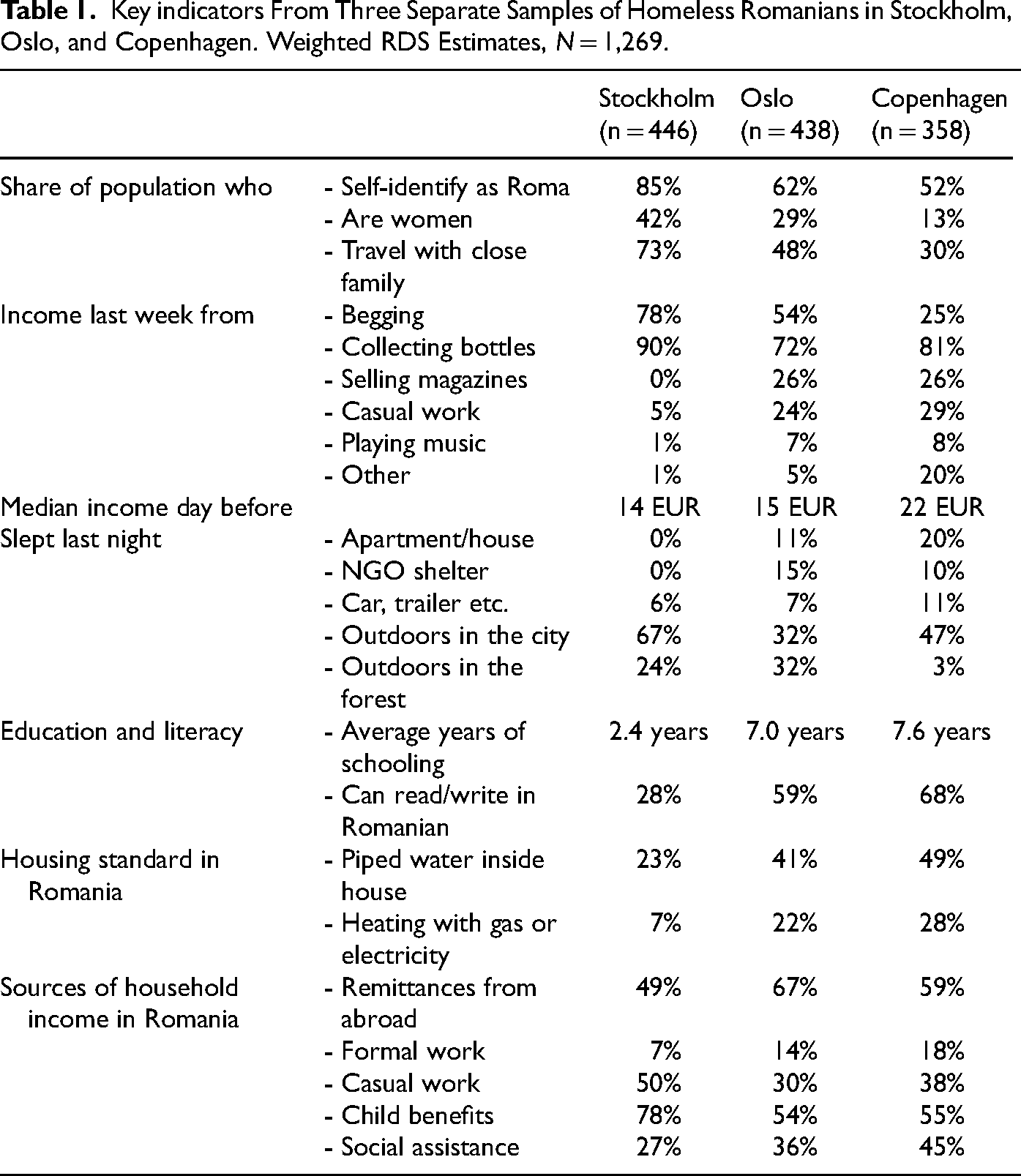
Because the regulatory environments in the three countries were so different, the skills necessary to adapt and maneuver within these environments also differed. Regulations that affect migrants’ ability to earn money, such as a ban on begging, or policies that regulate access to safe places to sleep, such as a ban on rough sleeping or provision of emergency shelters, will influence migrants’ decisions on where to go. Our survey data showed that the more money migrants could earn and save on their trips to Scandinavia, the more likely they were to plan to continue their migrations to Scandinavia. Similarly, respondents who reported feeling unsafe while sleeping in Scandinavia were less likely to have intentions of returning (analyses not shown here, see also Djuve et al. 2015 for details). Due to a lack of reliable population estimates, it is difficult to assess how the different policy environments in the three Scandinavian countries affected the absolute numbers of migrants going to each destination (there appear to be fewer in Copenhagen, but visibility in public is a poor indicator). However, our data indicate that the selection of migrants going to the three cities differed considerably in terms of demographic characteristics such as education, gender, ethnic identity, family and network structure, previous migration experience, and resources (See Table 1). 3
In Stockholm, our sample included people from rural and highly marginalized so-called “traditional” Roma communities, both men and women, young and old, who traveled in family groups, and who predominantly made a living through begging and collecting bottles. As shown in Table 1, 85 percent of the migrants in Stockholm identified themselves as Roma, and 42 percent were women. Seventy-three percent reported that they traveled with close family members, and 78 percent reported that their primary income was from begging, with a median income of 14 EUR the previous day. Only 23 percent reported having piped water inside their houses back in Romania, and only 7 percent reported to have any household income from formal work in Romania. On average, the homeless Romanian migrants in Stockholm had an average of only 2.4 years of schooling, and only 28 percent reported that they could read or write in Romanian. While in Stockholm, as much as 91 percent slept outdoors, either in the city or nearby forests.
In Copenhagen, by contrast, the sample reflected a more resourceful but also “tougher” group who had extensive experience living on the street and could generate income through various legal and illegal means. Here, most migrants were young men—with only 13 percent women. Only about half identified themselves as Roma, often traveling alone or with non-relatives but less often as a family unit—only 30 percent reported that they traveled with close family members. On average, they had more formal education—on average, 7.6 years of schooling—and 68 percent reported that they could read and write in Romanian. Only 25 percent reported having significant income from begging. Still, they were able to generate a significantly higher income compared to those in Stockholm and Oslo—with a reported average of 22 EUR per day. In Romania, 66 percent reported having piped water inside their house, and 30 percent had household income from formal work. While in Copenhagen, only 50 percent slept outdoors, whereas the rest slept in cars or various makeshift housing arrangements. 4 Finally, as shown in Table 1, the population of Romanian migrant beggars and street workers in Norway fell somewhere between those in Denmark and Sweden on these demographic and social parameters.
The differences between the three capital cities in terms of the characteristics and compositions of the migrant populations described in Table 1 thus mirror the differences between the three countries in terms of policy environments. With its more challenging, more hostile policy environment, Copenhagen boasted a tougher and more resourceful population of migrants. Stockholm—with its more lenient policy environment, boasted a, in some ways, more vulnerable migrant population, with much more women and families. Oslo lay somewhere in between the two other cities in both respects.
The qualitative data indicated that this correlation between the policy environment and the characteristics of the migrant population was no coincidence. In interviews across communities in Romania, people shared how Denmark, especially Copenhagen, was not perceived as a suitable place for women and the elderly, not only because the income-earning activities available there were less suitable for them (the public typically perceived women and elderly as more “deserving” and could earn more from begging) but because staying in Copenhagen was considered more dangerous and demanding. “You can earn good money in Copenhagen,” as a young man who had been there several times put it, “but you have to be able to run fast,” explaining how he had to be constantly on the move to avoid police and security guards. Men who had been to Denmark talked extensively about being chased or even beaten by police and having their money and possessions confiscated, as well as dangerous encounters with criminal gangs. During interviews, people who had been to Copenhagen, mostly young men, often emphasized their toughness and ability to survive and make money under harsh conditions. Going to Sweden—and, to some extent, Norway—was described differently. One group of women in a village connected to both Stockholm and Copenhagen told us that “Copenhagen is not a place for old ladies like us—we are not șmecher [‘street wise’ or ‘hustlers’] like those guys” (referring to a group of men from the same village who had been to Copenhagen). They explained that in Stockholm, where they regularly traveled, “you can bring a mattress and sleep in the streets or a city park without any trouble.” When asked if they feared the Swedish police, they laughed and described how the police would “serve us tea while we are begging in the streets.” While such statements belied the hardship many migrants experienced in Sweden, they were symptomatic of the different images the two countries had among people in many migrant-sending areas in Romania.
Our findings thus suggest that Denmark's more restrictive policies, to some extent, have deterred women and elderly migrants who depended on begging to make a living but that these policies did not similarly deter more resourceful—or “street smart”—young men and/or those involved in drug sales or other criminal activities not affected by anti-begging policies. By reducing competition over limited resources, restrictions on begging and rough sleeping may even have made Copenhagen more attractive for those who could cope in this more hostile environment (as indicated by higher reported earnings in Copenhagen). Stockholm, on the other hand, appears to have been more attractive to migrants who could earn more money from begging, including women and older adults, who tended to illicit more sympathy, and who were more dependent on emergency shelters and basic provisions from NGOs. Our quantitative and qualitative materials thus clearly indicate that the different policy environments in the three countries have shaped the selection and adaptations of migrants going to the three destinations, resulting in somewhat different migrant populations in the three capital cities.
Feedback Between Migrant Adaptations and Policy?
In the first part of our analyses, we showed that begging and street work were framed and understood differently in the three countries shaped, including what kinds of policy responses were considered appropriate, giving rise to different political contexts of reception in each of the three Scandinavian countries. In the second part of our analyses, we showed that these different contexts of reception affected the selection of migrants going to the different destinations, as well as their adaptive strategies of survival—resulting in the somewhat different populations of migrant beggars and street workers in each of the three capital cities. Our third claim, however, is more speculative, as we hypothesize that the different characteristics of migrant beggars and street workers in each country, in turn, have influenced how begging and street work have been framed and understood in the three countries’ respective political debates. Since street workers in Denmark are more often young men, operating in the shadows and on the run from police and security guards, it has likely been easier to discuss the issue within a criminal frame and to garner support for restrictive policies and criminal measures. In Sweden, where people were more likely to encounter older women begging outside the local grocery store and showing pictures of their grandchildren, the issue was more easily discussed within a social frame, making it easier to garner support for policies aimed at poverty alleviation and support. This is supported by our reading of news stories about Romanian migrants in the three countries’ major outlets during our fieldwork, which suggests that in Denmark, Romanian beggars and street workers are almost exclusively described as men. In contrast, in Sweden, and to some extent Norway, news articles more often portray women, often focusing on the children or grandchildren back home. This is not surprising, given that in our survey, women made up 42 percent of the homeless Romanian migrant population in Stockholm, 29 percent of the population in Oslo, and only 13 percent in Copenhagen.
We thus argue that the relationship between how migration for begging and street work has been framed in political debates in Scandinavia, what kinds of policy responses have been implemented in the three countries, and how migrants have adapted to the different political contexts of reception in Scandinavia can be conceptualized as a process of cumulative causation, as illustrated in Figure 1.
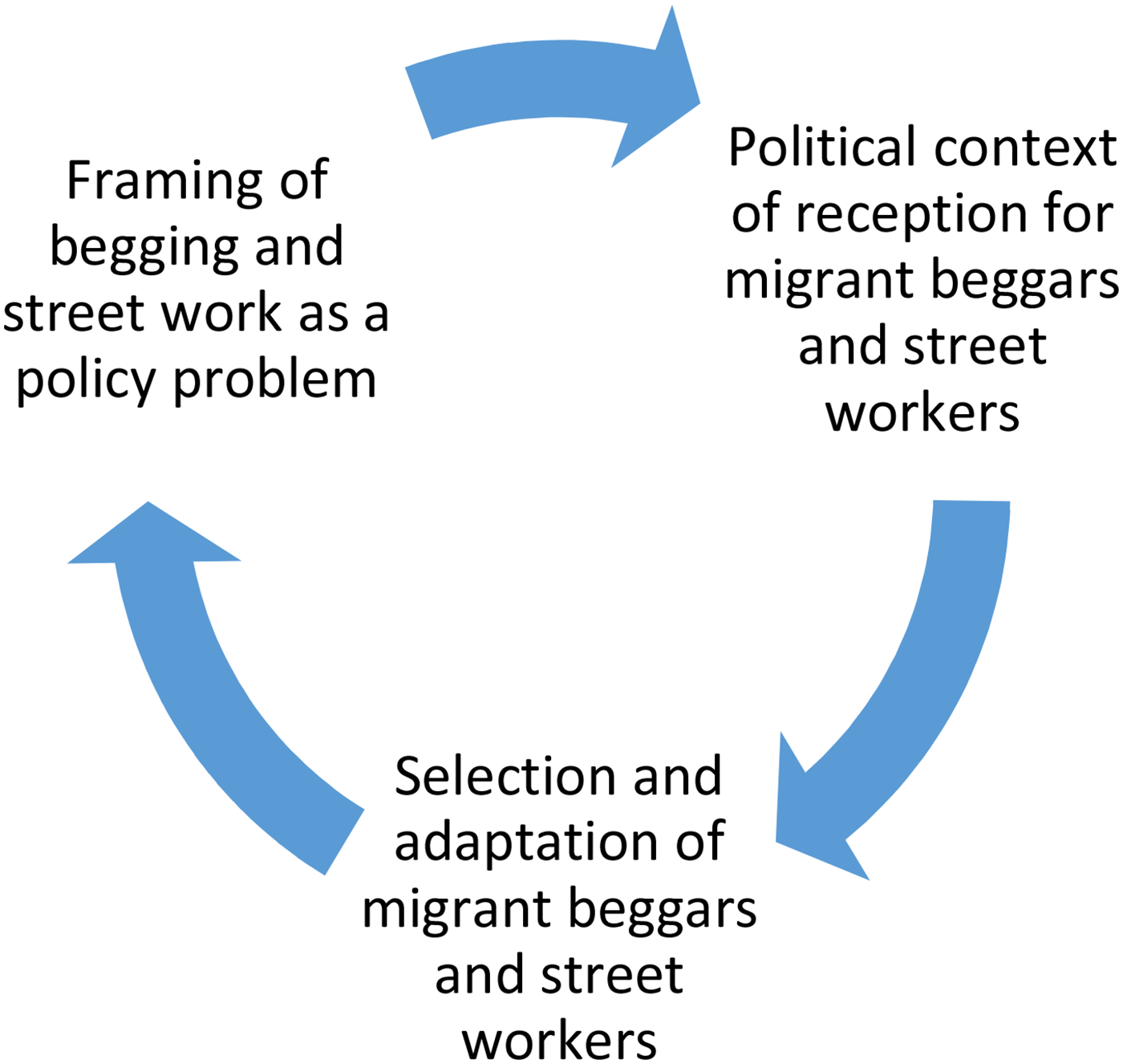
The Cumulative Causation of Migration for Begging and Street Work in Scandinavia.
The three Scandinavian welfare states face similar challenges in dealing with migration for begging and street work. As Borevi (2021) has noted, to some extent, there has been a shift in all three countries toward framing migration for begging increasingly as a criminal problem. However, whereas attempts to criminalize begging have been voted down in both Sweden and Norway, Denmark has continued to tighten its anti-begging legislation. Based on the findings presented here, however, we argue that there has been a process of divergence whereby differences in policy environments in the three countries have interacted with the selection of migrants and their adaptive strategies in ways that are likely to have reinforced pre-existing differences in public discourse and policy responses between the three countries.
Conclusion
This article asked how post-2007 migration for begging and street work has been framed and responded to as a policy problem in Scandinavia and how migrant beggars and street workers, in turn, have adapted to these policy environments. Our analyses show that when begging re-emerged in Scandinavia after 2007, the pool of available policy responses was shaped by two competing pre-existing policy frames: on the one hand, a criminal frame, which saw begging as a form of criminal activity often stereotypically attributed to Roma ethnics, with policy solutions that revolve around criminalization and punishment, and, on the other, a social frame that saw begging as a symptom of social inequality and marginalization, with policy solutions in the realm of social and health policies. Although both policy frames have been present in all three countries and despite their similar institutional contexts, the three countries had substantial differences. In Denmark, migrant beggars and street workers encountered a policy environment characterized by protectionist immigration discourse and vagrancy laws that punished beggars. Here, a criminal frame for understanding begging and street work was, by far, the most dominant approach, with punitive efforts directed at foreign beggars as the primary response and strict limitations on NGOs’ abilities to provide basic services to this group. In Sweden, migrant beggars encountered a policy environment characterized by multiculturalist immigration discourse and long-abolished vagrancy laws. Here, the social frame dominated, with a strong focus on tackling the problem of poverty and marginalization at its roots. In Norway, immigration discourse lay somewhere between Denmark and Sweden. At the time of Romania's accession to the European Union in 2007, the old vagrancy law had recently been abolished. Here, the social frame was initially combined with a particular variant of the criminal frame focused on punishing the exploiters of beggars, with the introduction of some punitive measures over time, combined with the allocation of public funding toward NGOs for essential services.
The different policy responses in Sweden, Norway, and Denmark gave rise to different contexts of reception to which migrant beggars and street workers had to adapt. Throughout migrant-sending communities in Romania, Scandinavia was considered an attractive destination for circular economic migration. Still, the three countries were considered suitable destinations for different people. Our analyses show that migrants’ adaptations, through selecting destinations and using different livelihood strategies, gave rise to somewhat different populations of Romanian migrant beggars and street workers in the three capital cities. Whereas this population in Stockholm primarily consisted of family groups of rural and highly marginalized so-called “traditional” Roma who begged and collected bottles, the population in Copenhagen was composed of a “tougher” group of primarily young men with more formal education, language skills, and previous migration experience but also more widespread substance abuse and more diverse, and more often illegal, strategies for generating an income.
Finally, although our data do not allow us to determine the causal direction between policy environment and migrants’ adaptations, we have argued for the existence of a feedback loop whereby differences in the migrant populations, in turn, influence how the issue is framed and responded to in the political realm. The more lenient policies in Stockholm have attracted a more socially vulnerable migrant population, thus reinforcing the public's perception that this phenomenon should be understood through a social frame. In contrast, Denmark and Copenhagen attracted a somewhat “ tougher” group, able and willing to take their chances in a more hostile policy environment, thus reinforcing the public's perception that this phenomenon should be understood through a criminal frame.
Our findings contribute to the understanding of the migration of marginalized Roma from Eastern to Western Europe by exploring how the diversity of this phenomenon is interlinked with the different kinds of policy responses it has been met with across different countries of destination. Theoretically, we contribute to the literature on feedback in migration systems. Whereas much of the existing literature discusses feedback in terms of the social network effect (see Bakewell, Kubal and Pereira 2016), our findings highlight the ways in which migration-related policies affect the subsequent framing of migration as a social policy problem and the appropriate means of handling it, creating a self-reinforcing process of cumulative causation. Based on the analysis presented here, we argue that a promising area of future research would be looking at how cross-country variation in policy measures (i.e., integration policies, refugee settlement, citizenship policies, and so on) may generate similar kinds of feedback mechanisms.
Footnotes
Declaration of Conflicting Interests
The author(s) declared no potential conflicts of interest with respect to the research, authorship, and/or publication of this article.
Funding
The author(s) disclosed receipt of the following financial support for the research, authorship, and/or publication of this article: This work was supported by the Norges Forskningsråd, NO Grants 2014-2021 (grant number 247823, 22/2020).
