




Abstract
The Dutch government introduced the Act on Extraordinary Measures for Urban Problems in 2006 to bolster local regeneration efforts. The act enables local governments to stop specific groups of deprived households from moving into designated neighbourhoods. More specifically, the Act allows local governments to refuse a residence permit to persons who have lived in the metropolitan region for less than six years and who do not receive an income from work, pensions or student loans. The policy is based on the idea that reducing the influx of poor newcomers improves liveability by providing a temporary relief of the demand for public services and by making neighbourhoods demographically ‘balanced’ or ‘socially mixed’. This review examines the socio-spatial effects of the Act in Rotterdam between 2006 and 2013. While the Act produces socio-demographic changes, the state of the living environment in designated areas seems to be worsening rather than improving. Our findings show that the policy restricts the rights of excluded groups without demonstrably improving safety or liveability. The review concludes with a reflection on how the Act may signify a broader change in European statecraft and urban policy.
This paper provides a policy review of a piece of legislation introduced by the Dutch government in 2006: the Act on Extraordinary Measures for Urban Problems. The Act’s main goal is to give municipalities more discretion to improve neighbourhoods’ liveability by prohibiting jobless newcomers from moving into rental dwellings in areas considered particularly vulnerable or distressed. Local governments that apply the Act can refuse a residence permit to persons who have lived in the metropolitan region for less than six years (the newcomer criterion) and who do not receive an income from work, pensions or student loans (the income criterion). 1 The Act was first introduced in 2006 in four neighbourhoods in Rotterdam South (Carnisse, Hillesluis, Oud-Charlois, Tarwewijk), and in 2010 a fifth neighbourhood, Bloemhof, was added. Although the Act has been and remains controversial, it has since been implemented more widely and for more purposes (Ouwehand and Doff, 2013; Schinkel and Van den Berg, 2011; Uitermark et al., 2017). This policy review focuses on the Act as it was applied during the period up to 2013, when application was limited to the abovementioned five neighbourhoods.
The Act raises a number of vexing questions. Some questions are political, moral and legal: Is it legitimate to limit the rights of already vulnerable groups in order to improve distressed areas? Is it acceptable to discriminate against people on the basis of their employment situation or duration of residence? From an ethical point of view, it may be argued that the policy’s goals or effects are immaterial when fundamental rights are curtailed. Yet individual rights can be, and often are, suspended when it serves a greater good. Proponents have argued that the government should opt for the most effective policies, even if those policies violate the rights of some groups under some conditions (see Uitermark et al., 2017). This would imply that the policies are exclusionary but effective. In this policy review, we focus on the question of efficacy by evaluating the Act’s socio-spatial effects. We answer two questions. First, what are the social characteristics of those who are not eligible to live in designated areas and how did the policy affect their housing market position? Second, how did the designated areas change in terms of social composition, liveability, and safety in the years after implementation? Our findings can serve as input for broader debates regarding the policy’s effects and the possible trade-offs between efficacy and rights in urban policy. From an international perspective, the Act may seem singular in its methods, but its goals relate to familiar themes in urban policy: social mixing through area-based initiatives. As such, it constitutes an extreme case where individual rights have been suspended in the interest of creating stable and integrated urban neighbourhoods.
The following section frames the Act in terms of debates on social mixing and social integration. After a methodological section covering data and methods, two empirical sections discuss the effects on excluded groups and on areas respectively. After summarising our findings, we conclude by reflecting on the findings in view of broader policy trends.
Social mixing policies
There is a long history of state planners seeking to influence or alter the social composition of urban neighbourhoods (e.g. Sarkissian, 1976). One motivation for social mixing might be that deprived households benefit if they live amidst more affluent households. In the Western European context, these arguments have not been particularly convincing, given the relatively low levels of segregation and small ‘neighbourhood effects’ (Galster, 2007; Miltenburg, 2017). Research suggests that poverty and deprivation are rooted in structural inequalities and that neighbourhood restructuring does not affect the cause of marginality (Andersson and Musterd, 2005; Sampson, 2012; Slater, 2013). Given the weak or absent evidence base for policies countering neighbourhood effects, some have argued that social mixing policies in Western Europe may also serve functions of statecraft. Uitermark (2003) pointed to the influence of local administrators and service providers in devising Dutch urban policies. For these local professionals, concentrations of marginality were experienced as an uneven burden to shoulder. Deconcentration and less population turnover would allow them to provide services with lasting results and make deprived neighbourhoods more manageable (Uitermark, 2003; see also Uitermark, 2014; Wacquant, 2008).
Governments can intervene into neighbourhoods’ population compositions in various ways. Housing voucher programmes, such as Moving to Opportunity and Section 8 in the USA, allow selected poor households to enter more affluent areas (Stone and Stoker, 2015). Such individual-focused policies are less common compared with area-based initiatives, that rely on renewal, new housing development, and other interventions in the built environment. Through housing market restructuring and tenure conversion, a new population may be accommodated. This change may be done by inserting affordable or social rental housing in relatively affluent areas. While this has been done in Sweden in the past (Bergsten and Holmqvist, 2013), the reverse – introducing private housing in concentrations of social housing – has been far more common.
The 1990s and 2000s saw the emergence of holistic neighbourhood policies in a number of countries, including the French Politique de Ville, the Swedish Metropolitan Initiative, the English New Deal for Communities, and the Dutch Big Cities policy (see Dikeç, 2007; Finn et al., 2007; Parkinson, 1998; Uitermark, 2014; Van Gent et al., 2009). Such area-based initiatives employ a range of measures in the fields of housing, education and employment to upgrade neighbourhoods. These policies are usually undergirded by attempts to change the population composition of deprived neighbourhoods. By selling off, renovating, or demolishing public housing and adding more upscale dwellings, urban policies aim to deconcentrate stigmatised and deprived population groups while attracting residents with more status and higher incomes. 2 In addition to comprehensive restructuring, the state may also rely on targeted investments in housing, transportation infrastructure and public space to attract more affluent newcomers (Van Gent, 2010). Although the benefits for residents have been disputed, these policies have been praised for developing integrated and joined-up policy approaches (Finn et al., 2007; Musterd and Ostendorf, 2008). While some of these policy measures are still in effect, this type of urban policy has been losing momentum in recent years. By 2012, the UK, the USA, Sweden and the Netherlands had by and large dissolved most national programmes that relied on area-based initiatives in deprived neighbourhoods.
Social mixing redux: Act on Extraordinary Measures for Urban Problems
The Act on Extraordinary Measures for Urban Problems was developed in 2002 and 2003, at a time when integrationist urban renewal policies were still fully operational. At the time, the newly elected government of Rotterdam – led by Leefbaar Rotterdam– argued that the extant policies fell short. Leefbaar Rotterdam had just emerged in local politics with a populist agenda that problematised the immigration of poor and migrant groups (Uitermark and Duyvendak, 2008: 1494). In their view, the extraordinary problems facing Rotterdam and the ineffectiveness of previous efforts meant that unconventional measures were needed. Its main concern was that all efforts to improve neighbourhoods would remain ineffective as long as there was an influx of poor newcomers. Rotterdam’s plea for new measures led to protracted debate in national parliament. Ultimately, national government parties (Christian democrats, conservative liberals and the liberal democrats) and several opposition parties – including the social democrats – agreed on national legislation that would halt this influx: the Act on Extraordinary Measures for Urban Problems. The measures provided by the Act aim to ‘actively countervail existing income segregation in the city in the short term, and, as such, improve the living environment in designated areas’ 3 (Tweede Kamer, 2005: 12).
By preventing poor newcomers from moving in, the Act aims to improve neighbourhoods in two ways (see Figure 1). First, it is anticipated that employed people will fill up the housing vacancies that otherwise might have been filled by jobless newcomers. This is considered ‘necessary for a healthy socio-economic base’ (Ministry of the Interior and Kingdom Relations, 2014: 1), which should in turn translate into neighbourhoods that are more livable. Second, the Act aims to increase the effectiveness of existing policies by providing temporary relief from the influx of poor newcomers. Several policymakers use the Dutch proverb ‘dweilen met de kraan open’, which literally translates as mopping while the tap is running, to emphasise that existing problems cannot be effectively addressed until the influx of weak households (seen as potential problem cases) slows or stops. According to the theory informing the policy, as soon as administrators can focus their efforts on resolving existing problems, it will be much easier to improve neighbourhood liveability (Figure 1). To fulfill this second policy aim, municipalities therefore have to demonstrate that they have already implemented a range of social and neighbourhood improvement measures before they can obtain permission from the Minister to implement the Act.
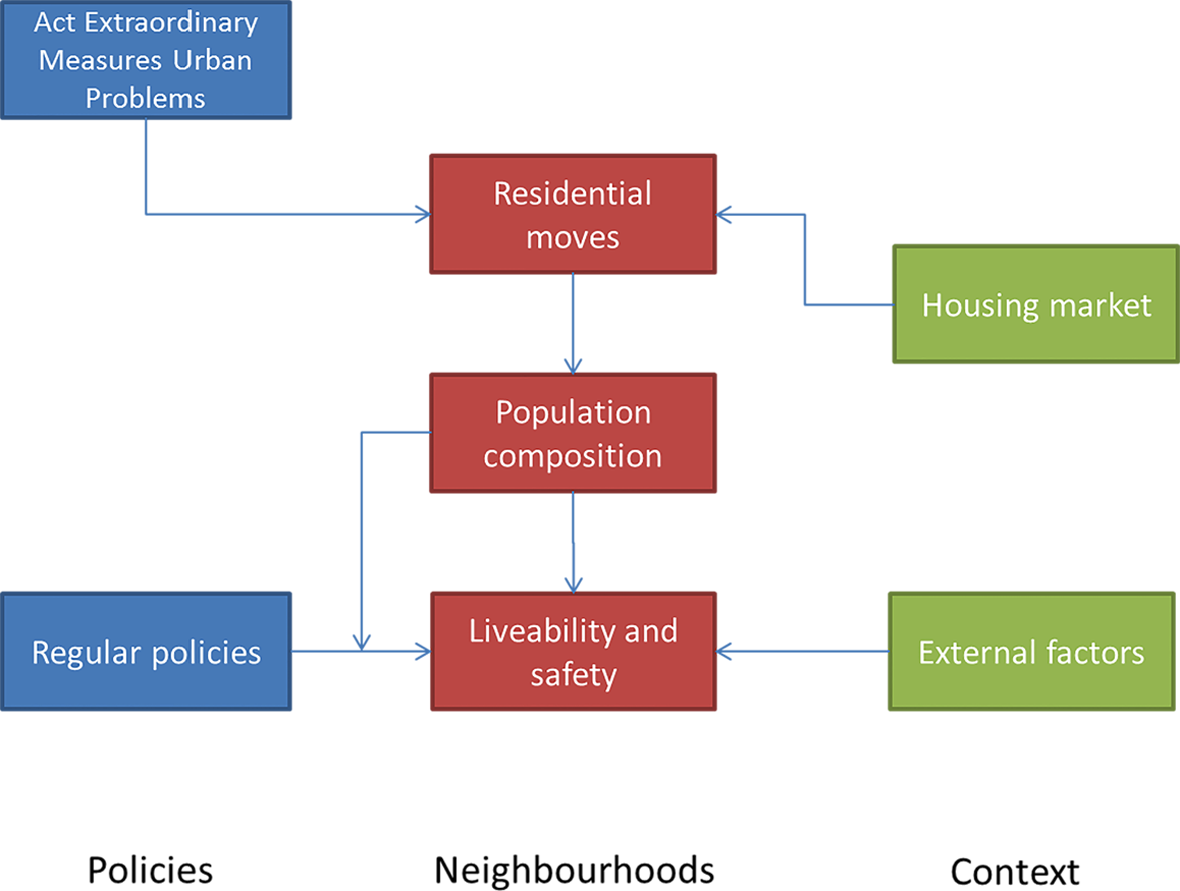
Theory informing the Act on Extraordinary Measures for Urban Problems (chapter 3, article 8).
In sum, the policy is based on the idea that reducing the influx of poor newcomers improves liveability through different pathways. While dictionaries define liveability as the degree to which the living environment matches the needs and expectations of its residents, in Dutch policy practice the concept refers more to the status of a neighbourhood as measured by the value of its real estate and (predicted) levels of neighbourhood satisfaction (see De Wilde and Franssen, 2016; Kaal, 2011; Uitermark et al., 2017).
While the Act constitutes a new and arguably more extreme form of urban policy – i.e. the a priori exclusion of certain groups of tenants – the overall goals of the Act are the same as those of previous integrationist urban policies. Policymakers still aim to counteract a spiral of neighbourhood decline by making neighbourhoods demographically ‘balanced’, by which they mean that the proportion of poor and low-income households should not be too high. The official focus is on socio-economic change, yet the origins of the Act are also to be found in concerns over too much immigration and too little integration: ‘Living in a concentration area is, in the eyes of the government, detrimental to the integration of especially the non-native population who is low or uneducated and non-proficient in Dutch’ (Tweede Kamer, 2005: 12). While the Act was explicitly designed to be implemented along with (existing) integrationist policies, more recent developments suggest that the Act also serves as a substitute for social mixing policies. Although there are social policy measures that target deprived neighbourhoods in Rotterdam South, the Big Cities Policy of the 1990s and 2000s and the housing restructuring funds have been de facto dissolved. As a result, in Rotterdam the Act has now become an important tool to change the social composition of the areas designated for its implementation.
The Act may signal a broader change in policy logic. As governments move away from integrated programmes and costly physical interventions, they may increasingly resort to more affordable policies that aim to stabilise or upgrade neighbourhoods by excluding deprived residents while attracting more privileged residents. Although the Act is (as far as we know) unique, there are several other cases of governments opting to (temporarily) exclude residents with the purported aim of protecting vulnerable estates or neighbourhoods from decline. In Denmark in the 1990s and early 2000s, the central government allowed municipalities and housing associations to control the influx of immigrants and marginalised groups to deprived areas (Fridberg and Lausten, 2004; Skifter Andersen, 2003). In Milan, municipal bylaws to fight urban decay in the Padova-Trotter area have imposed curfews on local stores and restaurants, while enlisting property owners to identify undocumented immigrants (Bonfigli, 2013; see also Bricocoli and Cucca, 2016). In the USA, previously convicted individuals may disqualify – or face large obstacles – from obtaining public housing, receiving housing vouchers or residing with friends or relatives who are in public housing (Stone and Stoker, 2015; Walter et al., 2017). In Sweden, administrators in Landskrona (near Malmö) are experimenting with policies to prohibit low-income households from settling in renovated rental housing (Baeten, 2016). While some of these have been temporary ‘emergency’ measures, or successfully contested, they may serve as a precursor to, or testbed for more permanent modes of statecraft (Uitermark et al., 2017). We therefore view the willingness of governments to rely on such measures as a shift in dealing with urban poverty and marginalisation. We will return to this shift from integrationist to exclusionary policies in the conclusion, both because it is significant in itself and because it is important to understand the efficacy, or lack thereof, of the Act on Extraordinary Measures for Urban Problems.
Methods and data
This evaluation looks at the effects of the Act on individuals who are no longer able to move into designated areas, as well as the development of the social situation in the designated areas. Our study relies mostly on quantitative methods commonly used in population geography and residential mobility studies. In addition, we conducted 11 formal interviews with local policymakers, civil servants, and housing association officials. We also interacted with several policymakers from the Ministry of the Interior and Kingdom Relations. This qualitative data provides us with context for the Rotterdam case and has helped us reconstruct the theory informing the policy (see Figure 1).
Our analyses focus on the characteristics and behaviour of individuals who are ineligible for a housing permit in designated areas. Not all of them will have wanted or tried to move into the designated areas. Since we have no way of knowing who would have been interested in moving to these areas, we have looked at the group that – on the basis of its residential history and employment situation – would have been refused a housing permit if it had tried. We refer to all people in this group as ‘excluded residents’, since the Act prohibits them from entering the areas as tenants. Excluded residents are defined as individuals who are part of households in which no one meets the eligibility requirements. This means that no member has sufficient years of residency and has no income from work, pensions or student benefits and is not a business owner. In addition, we define a reference group to compare residential and mobility behaviour. These individuals also have no source of income from work, etc., but do have sufficient years of residency in the region to be eligible. This group has a similar socio-economic status to excluded residents but is not affected by the Act.
To study the policy’s impact on excluded residents, we use longitudinal data sets from the System of Social-statistical Databases (SSD) of Statistics Netherlands. These data sets are based on register and tax data and have individual-level data on age, gender, immigration status, household composition, income, source of income, education, housing tenure characteristics, and neighbourhood of residence for each year. Residency data are available from 1998, so we can ascertain a six-year presence in the region (one of the eligibility criteria) from 2004. Our analyses focus on the period 2004 until 2013. As the Act was introduced in 2006, we have data from two years before implementation to compare trends.
To gauge the social development of the designated Rotterdam neighbourhoods, we use additional data provided by the Statistics Department of Rotterdam Municipality. This includes housing market data and the Safety Index, the latter of which is a composite indicator consisting of register and survey data measuring safety at the neighbourhood level. We were able to use several composites related to theft, violence, burglary and drug-related nuisance as well as data on vandalism, local nuisances and residents’ assessments of their neighbourhood’s cleanliness, repair and safety (see Noordegraaf, 2008). Because the official Safety Index also includes variables on population composition and housing stock (e.g. ethnic minorities, unemployment and social housing as negative predictors), we use a modified version excluding these dimensions. The definition of the neighbourhoods follows that of Statistics Netherlands, which was also used to designate the areas in which to implement the Act.
Designated areas
After some experimentation, permission to implement the Act in four neighbourhoods in Rotterdam South was requested in 2006: Hillesluis, Carnisse, Oud-Charlois and Tarwewijk. Based on unemployment rates, housing market structure and a prognosis of an increase in non-native population, the expectation was that problems of a social, economic and physical nature would accumulate beyond control, and therefore application of the Act was deemed necessary. Bloemhof was added in 2010 based on multiple composite ‘liveability’ indicators. The following evaluation covers these five areas for the period until 2013. In Rotterdam, selected streets in the Delfshaven borough were subsequently added in 2014. Outside Rotterdam, Capelle aan den IJssel, part of the Rotterdam region, and the city of Nijmegen requested and received permission to implement the Act in 2015, followed by Vlaardingen – also part of the Rotterdam region – in 2016. 4
Results
Excluded residents
As mentioned, the Act allows for the exclusion of residents by socio-economic status and duration of residency. Based on these criteria, and on the status of other household members, we have been able to identify around 20,000 adult individuals in the Rotterdam region for each year who would have been excluded by the Act (to compare, a total of 957,846 adults were living in the region in 2013). Table 1 shows the characteristics of this group. From 2004 to 2008 we see a steady drop in the number of excluded residents in the region. After the 2008 economic crisis, their number rises again and stabilises in 2012 and 2013 to nearly 19,000 individuals. Excluded residents predominantly live in the Rotterdam municipality rather than in the surrounding region. Compared with the reference group, excluded residents are younger, and are more often male and living in single-person households. They are also more likely to be first or second generation immigrants. More recent years have seen an increase in labour immigrants from Central and Eastern Europe, a group viewed as problematic by several local politicians and officials.
Characteristics of excluded residents in Rotterdam region, 2004 and 2013. Distributions in %.
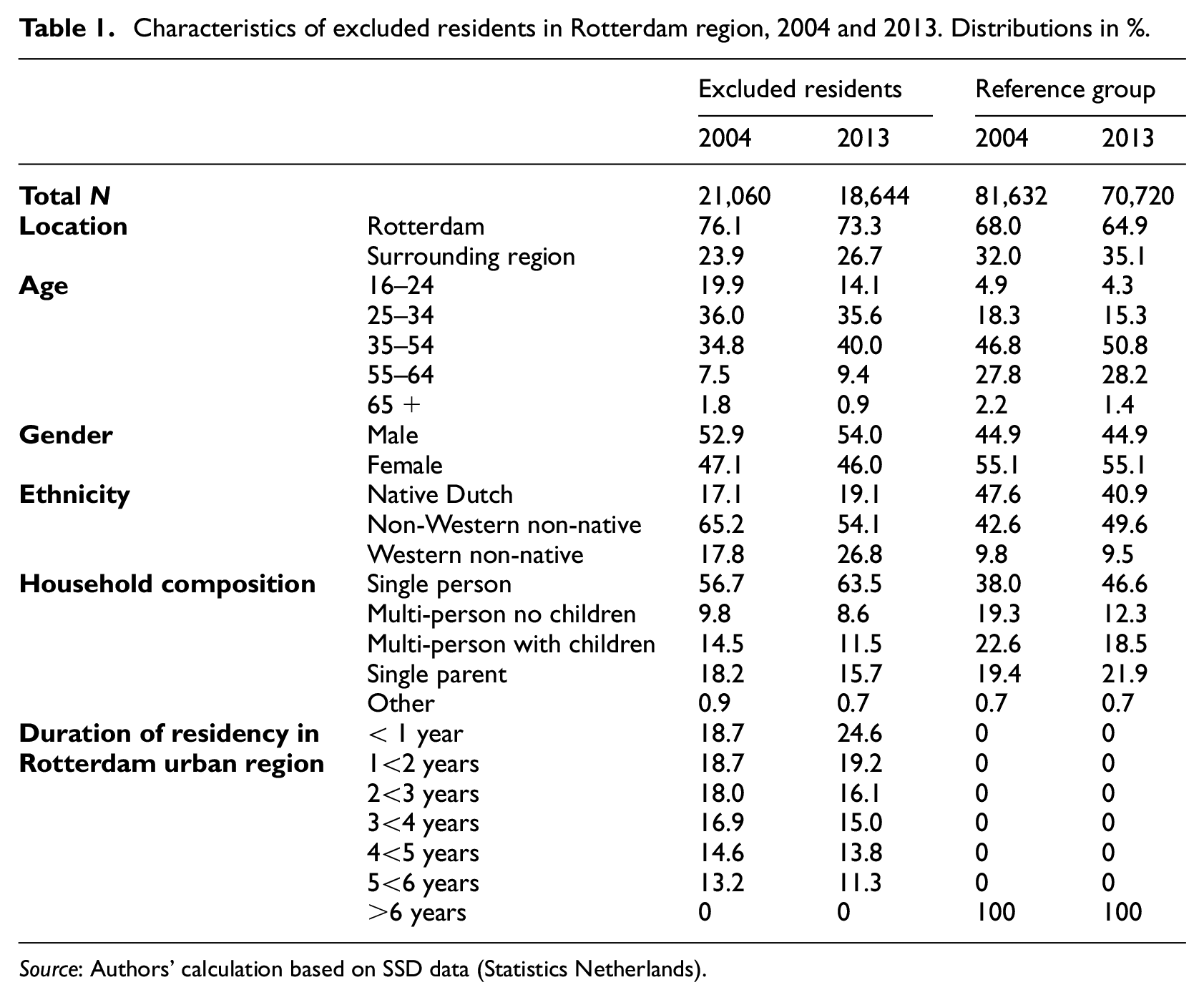
Source: Authors’ calculation based on SSD data (Statistics Netherlands).
Newly arrived excluded residents have less personal income than the reference group. Yet this difference vanishes within five years. This implies that excluded residents show considerable social mobility, particularly young individuals (data not shown), though on average they retain a low income. Lastly, the group has a dynamic composition; every year about half of the group is no longer categorised as excluded. Between 2008 and 2013, 27% of the excluded residents moved out of the region, 22% had found employment, 31% had achieved sufficient years of residency, and 4% had both found employment and had sufficient years of residency.
Housing market position of excluded residents
A requirement for the Act’s designation is that it should not constrain excluded households too much in finding accommodation elsewhere within the region. In other words, it should not impede the housing market position of excluded residents. Figure 2 shows that annual residential mobility rates are high among the excluded group, and have in fact increased since the Act was implemented in 2006: from 34% in 2004 to 38% in 2013. It must, however, be borne in mind that the total group of excluded residents also includes those who have newly moved to the region in the preceding year, meaning that a share of the group has moved by definition. In 2004, 18.7% of excluded residents (3931 of 21,060 residents) had moved to the region in that same year; by 2013, their share had increased to 24.6% (4578 of 18,644). When looking at excluded households who have lived in the Rotterdam region for at least one year, mobility rates are relatively high but remain fairly stable over time at around 19%. These trends suggest that the Act has not had a considerable impact on the residential moving opportunities of the targeted population, nor has it led to a more restricted influx of unemployed residents moving in from outside the region. The relatively high mobility rates can at least partially be explained by the fact that excluded residents are often relatively young adults in small households. This group typically tends to move house more often, because of life course events in early age. It may also indicate that excluded residents struggle to access secure housing and instead have to settle for more temporary and precarious housing arrangements, leading to the formation of chaotic and capricious housing pathways (Hochstenbach and Boterman, 2015).
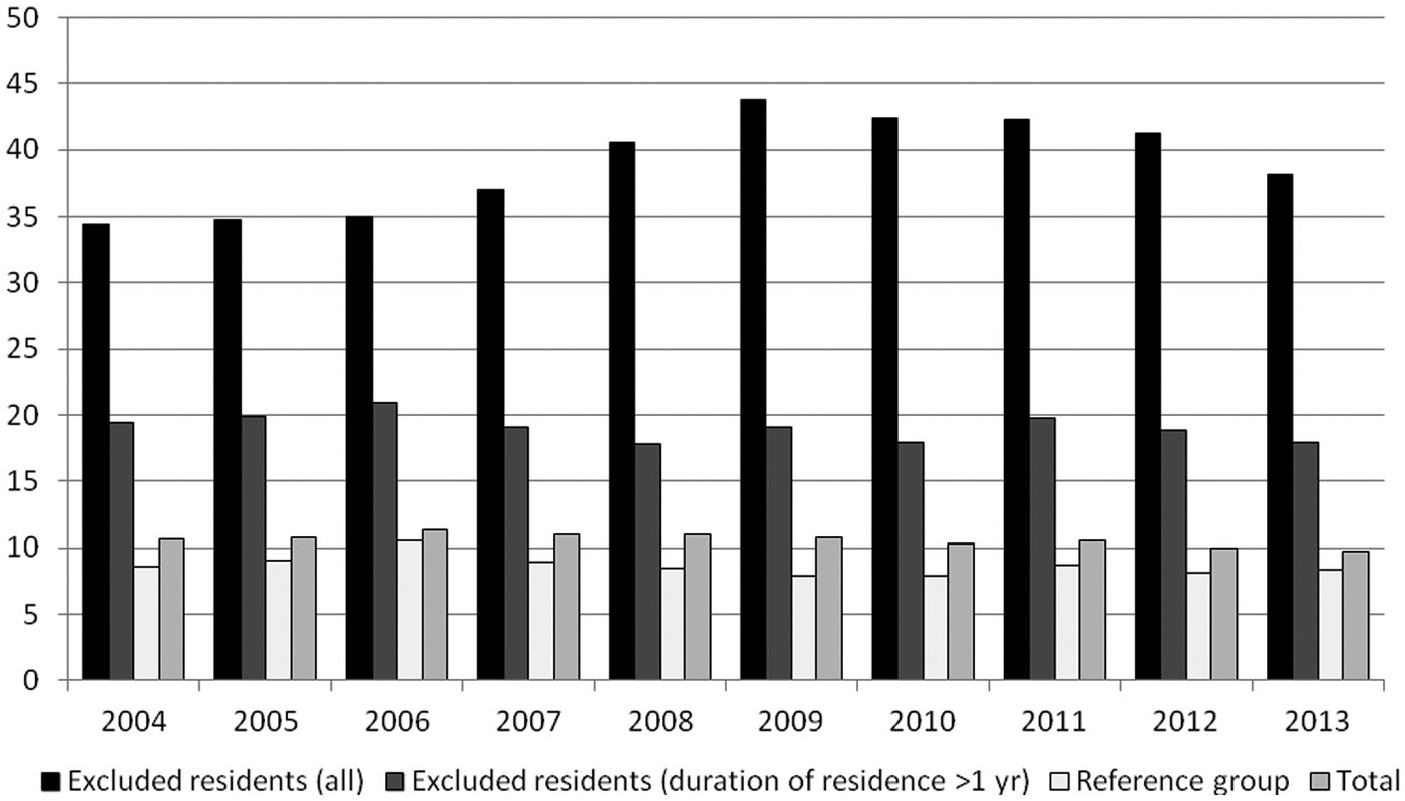
Residential mobility rates (% moved of group, during the previous year) of different population groups, compared over time 2004–2013.
While mobility rates are largely unaffected by the Act, there are notable shifts with regards to where excluded residents move to (see Table 2). Of all excluded residents that moved to or within the region in 2004, 79.7% moved to or within the Rotterdam municipality. In the year following the Act’s implementation this share did somewhat decrease, but with 73.4% in 2013, Rotterdam remains the most important destination. Since around 63% of all movers settles in Rotterdam, excluded residents remain overrepresented here. During the 2004–2013 period, only Schiedam, which borders Rotterdam, stands out as a new destination for excluded residents: in 2004, 5.2% of all excluded residents settled in Schiedam, and this increased to 8% in 2013. The eastern part of Schiedam in particular has many affordable private-rental dwellings providing easy access.
Moving destinations (municipalities in the Rotterdam region) of excluded residents in 2004 and 2013, compared with all moved residents. Presented data include moves within and from outside region.
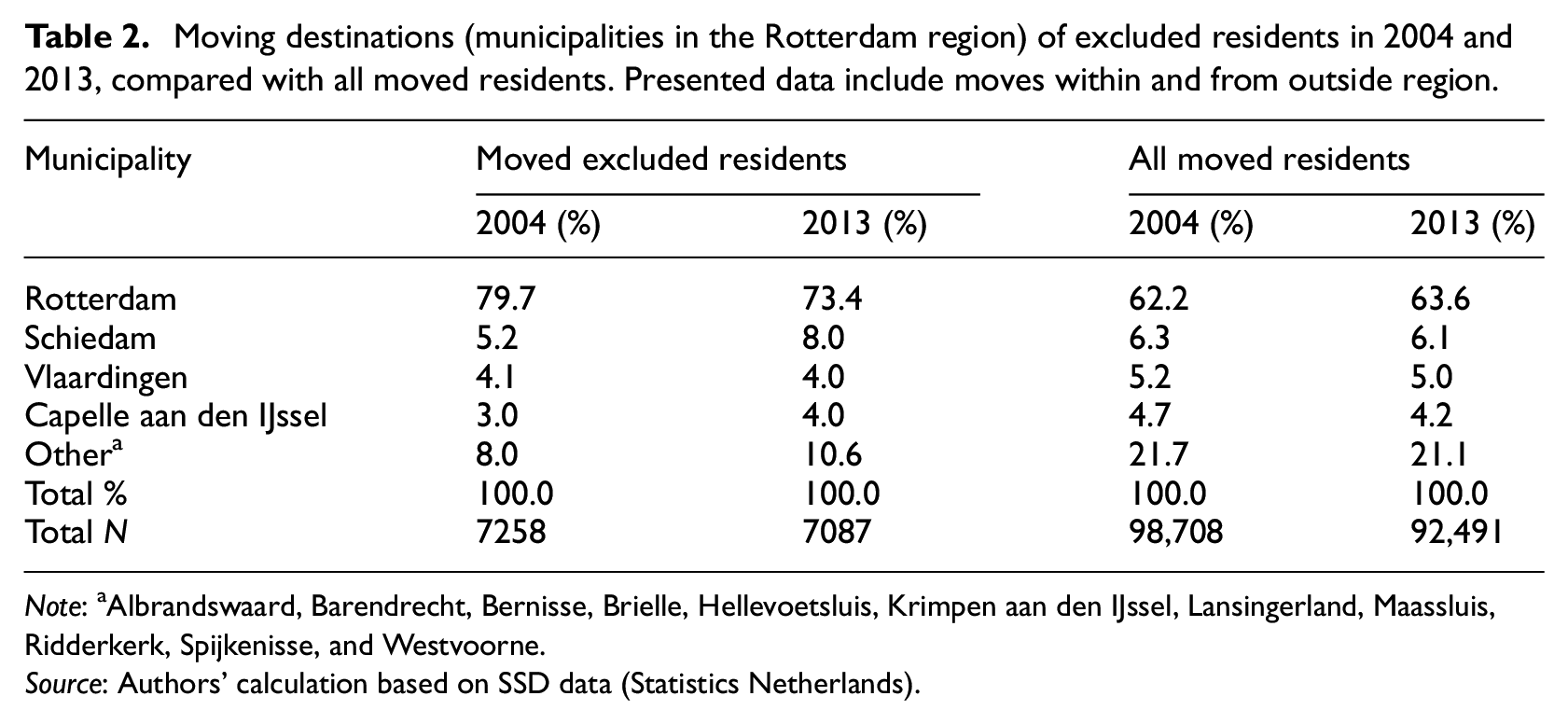
Note: aAlbrandswaard, Barendrecht, Bernisse, Brielle, Hellevoetsluis, Krimpen aan den IJssel, Lansingerland, Maassluis, Ridderkerk, Spijkenisse, and Westvoorne.
Source: Authors’ calculation based on SSD data (Statistics Netherlands).
The most notable spatial shifts take place within Rotterdam. Figure 3 compares the influx of excluded residents in 2004/2005 with 2012/2013 by mapping the percentage point change between these two time periods. The map confirms that the Act has led to a substantial decrease in the influx of targeted individuals into the designated neighbourhoods. Carnisse is the exception with a 0 to 1 percentage point increase, partly because the area was already subject to an experiment that was the predecessor of the Act. Decreasing shares can also be seen in the city’s central neighbourhoods, as these are subject to processes of gentrification (Hochstenbach and Van Gent, 2015).
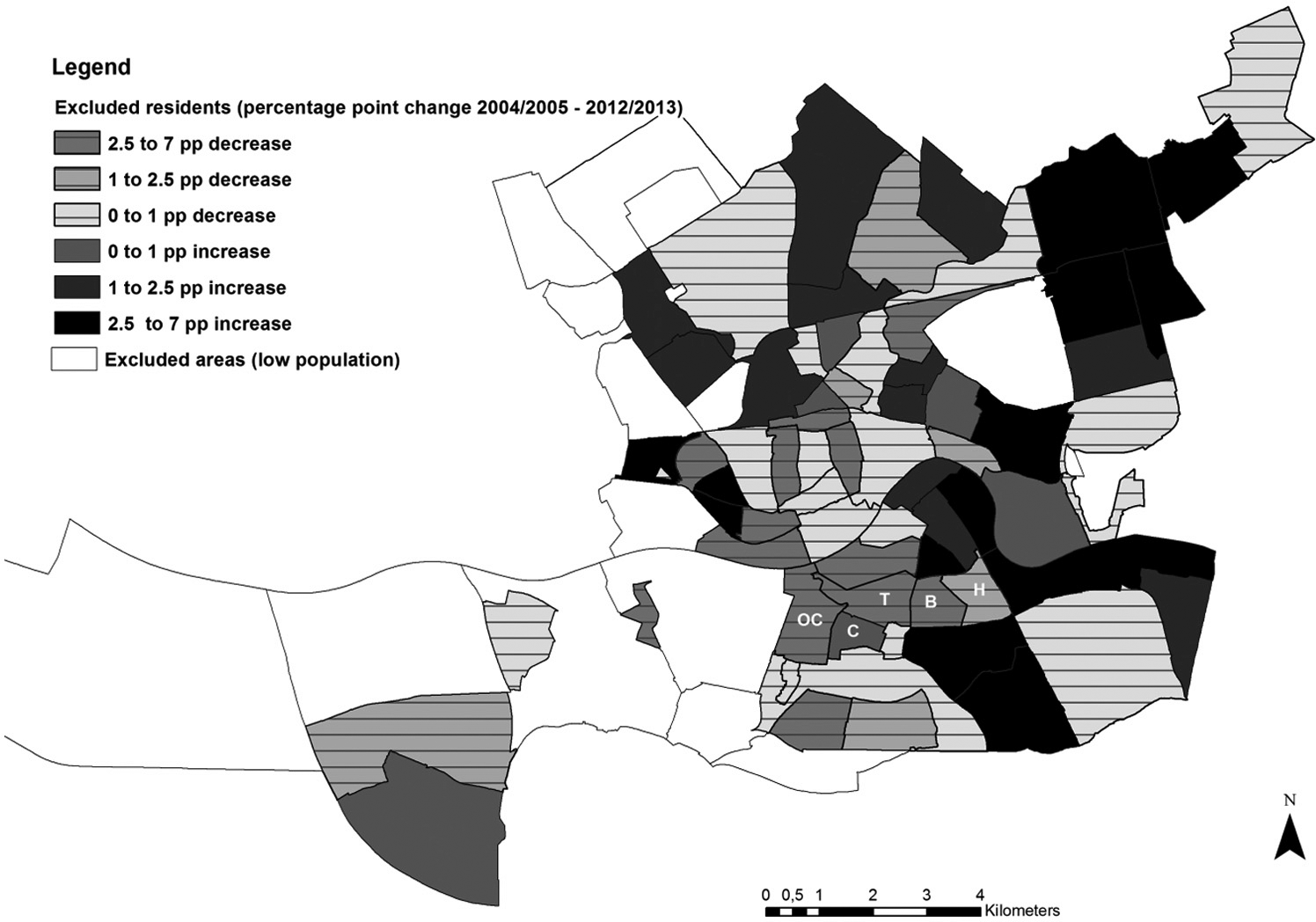
Change in excluded residents moving into or within a neighbourhood (percentage point change between 2004/2005 and 2012/2013) (OC: Oud-Charlois, C: Carnisse, T: Tarwewijk, B: Bloemhof, H: Hillesluis).
Figure 3 reveals three ‘clusters’ where the influx of excluded residents has notably increased. First, there are several low-status neighbourhoods adjacent or close to the designated neighbourhoods. These are characterised by high shares of low-income households and large shares of low-quality private-rental dwellings. Nearby neighbourhoods where there was a decrease in excluded residents have generally been subject to intensive urban renewal processes and changes in the housing stock. Second, a cluster of relatively poor neighbourhoods with a large cheap private-rental stock exists in the west of the city. A third cluster is located in the east of the city, where post-war housing estates and low-rise family dwellings dominate. Shares of low-income and unemployed residents are generally low here, yet the ageing housing stock has meant a process of relative downgrading. To be sure, several northern neighbourhoods also saw an increase in excluded residents, but these high-status areas continue to have a substantial underrepresentation of low-income households.
In sum, the Act has had notable effects on the housing market position of excluded residents. Residential mobility does not seem to be affected, but the geography of such mobility is. By curtailing the influx of residents in the designated areas, the Act has redirected a share of low-income households to other neighbourhoods that are either similarly low-status or subject to socio-economic downgrading. Excluded residents are faced with structurally decreasing options. This is due to the Act, but may also be attributed to regular housing policies. Renewal and tenure conversions led to a decrease of 16,574 rental dwellings in Rotterdam’s housing stock between 2006 and 2014. The Act excludes targeted residents from an additional 20,108 rental units in the designated neighbourhoods. For excluded residents, this amounts to a total decrease in accessible units from 208,531 in 2006 to 171,849 in 2014 (−18%). Our analyses indicate that for many excluded residents, an important coping strategy to deal with their precarious housing position is to share a dwelling with multiple households. 5
Change in social composition in designated areas
The Act has proven to be effective in changing the mobility behaviour of recently arrived low-income residents. The question is whether this has led to substantial changes in the designated areas’ social composition. It may be that other unemployed residents – the reference group – replace excluded residents, as often predicted by local officials. Between 2004 and 2013, however, the reference group also decreased in size in the designated neighbourhoods (Table 3). In other words, the reduced influx of excluded residents was not substituted by an increased influx of other unemployed residents. This is also the case when looking at the composition of in-movers. Instead, the share of working residents increased at an above-average rate in the designated neighbourhoods. The increase in low-income employed residents is mostly the consequence of residential moves, as the former have come to replace excluded residents among in-movers. The increase in employed households with a middle or higher income can be attributed to in situ upward social mobility and decreasing moves out of these neighbourhoods. 6 Since the implementation of the Act, the proportion of employed residents has thus increased at an above-average rate in the designated areas, at the cost of different groups of unemployed residents in general.
Socio-economic population composition in designated neighbourhoods and Rotterdam (2004 and 2013) in, and percentage point change.
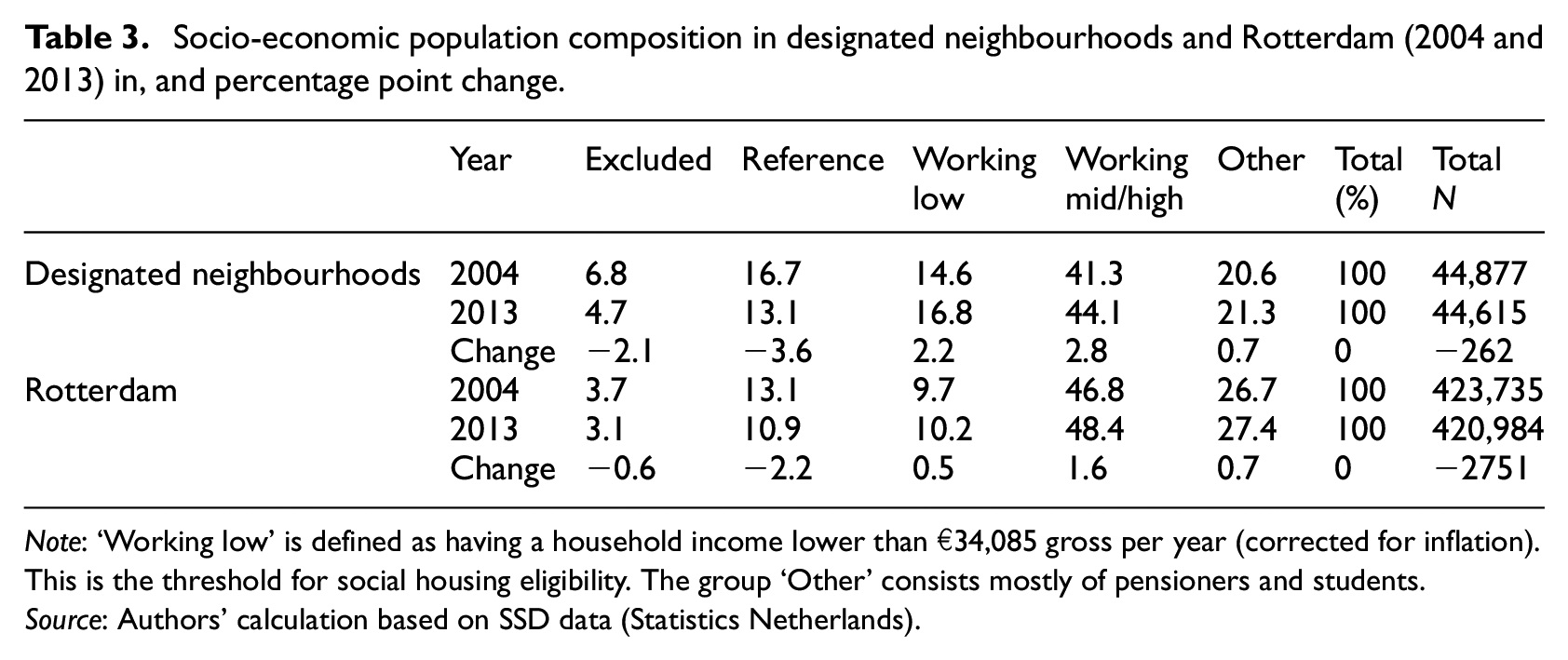
Note: ‘Working low’ is defined as having a household income lower than €34,085 gross per year (corrected for inflation). This is the threshold for social housing eligibility. The group ‘Other’ consists mostly of pensioners and students.
Source: Authors’ calculation based on SSD data (Statistics Netherlands).
Conditions of the living environment in designated areas
According to the theory of change underpinning the Act, a change in population composition should have direct and indirect effects on the social and physical conditions of the designated neighbourhoods. A longitudinal analysis of the (modified) Safety Index illuminates how safety figures and perceptions changed over time from 2001 to 2013 in the designated neighbourhoods and in the city overall (Table 4). The index scores are meant to be comparable over time or across spatial units. Prior to the Act’s implementation, between 2001 and 2006, safety scores improved in all designated neighbourhoods in line with citywide improvements. Between 2006 and 2013 – during which time the Act was in place – safety scores declined in all designated neighbourhoods, while the citywide score more or less stabilised. Further analyses of the various dimensions of the index show similar relatively negative trends. The designated neighbourhoods show particularly negative developments for ‘cleanliness and repair’, ‘nuisance’, and ‘traffic’ – the dimensions that come closest to capturing the concept of liveability (data not shown).
Modified safety index score per year in the designated neighbourhoods.
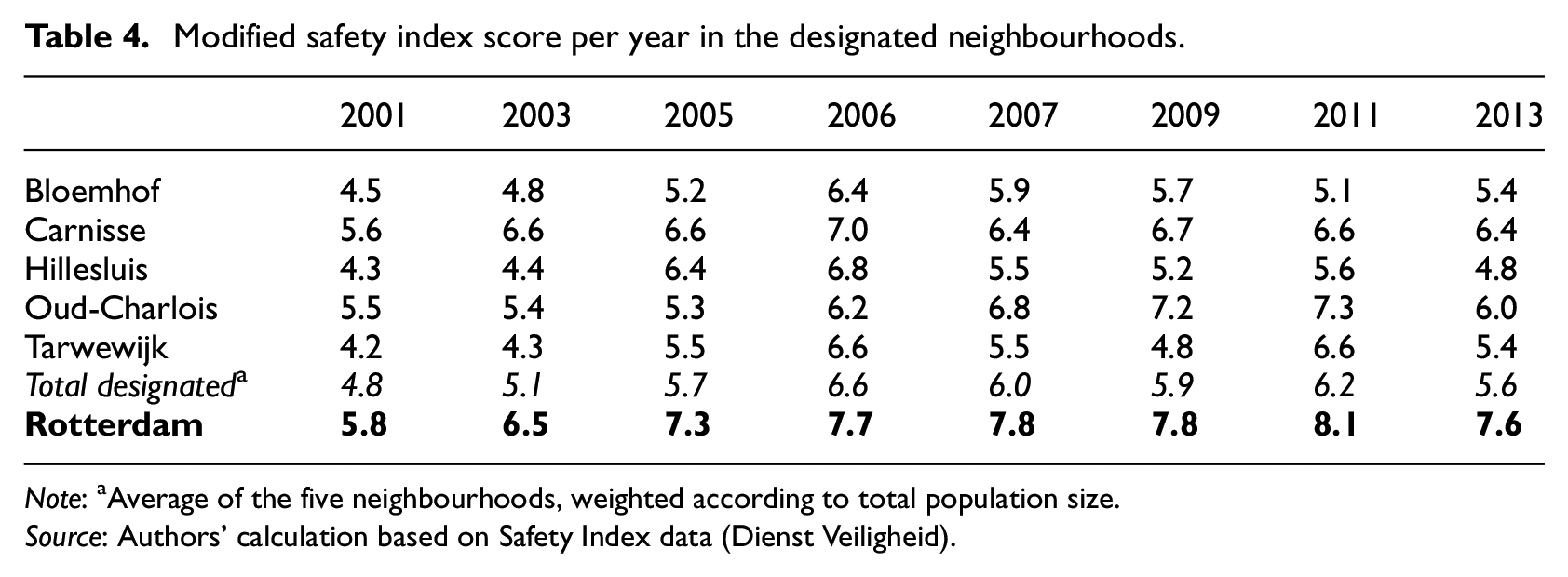
Note: aAverage of the five neighbourhoods, weighted according to total population size.
Source: Authors’ calculation based on Safety Index data (Dienst Veiligheid).
Our ecological analyses confirm these trends (Table 5). We conducted linear regression models with the change in the relative Safety Index for the 2006–2013 period. These models control for various neighbourhood characteristics and other housing market interventions such as demolitions, new-build developments and tenure conversions. These analyses indicate that the designated neighbourhoods have performed significantly worse on the Safety Index than other neighbourhoods in the city. Additional analyses for various sub-periods confirm these findings. Although it is impossible to assert how these neighbourhoods would have fared if the Act had not been implemented, these findings do not provide any evidence that the Act, or any other measures specifically targeting these areas, have been successful.
Neighbourhood-level linear regression models (N = 58), dependent variable: change in modified Safety Index 2006–2013.
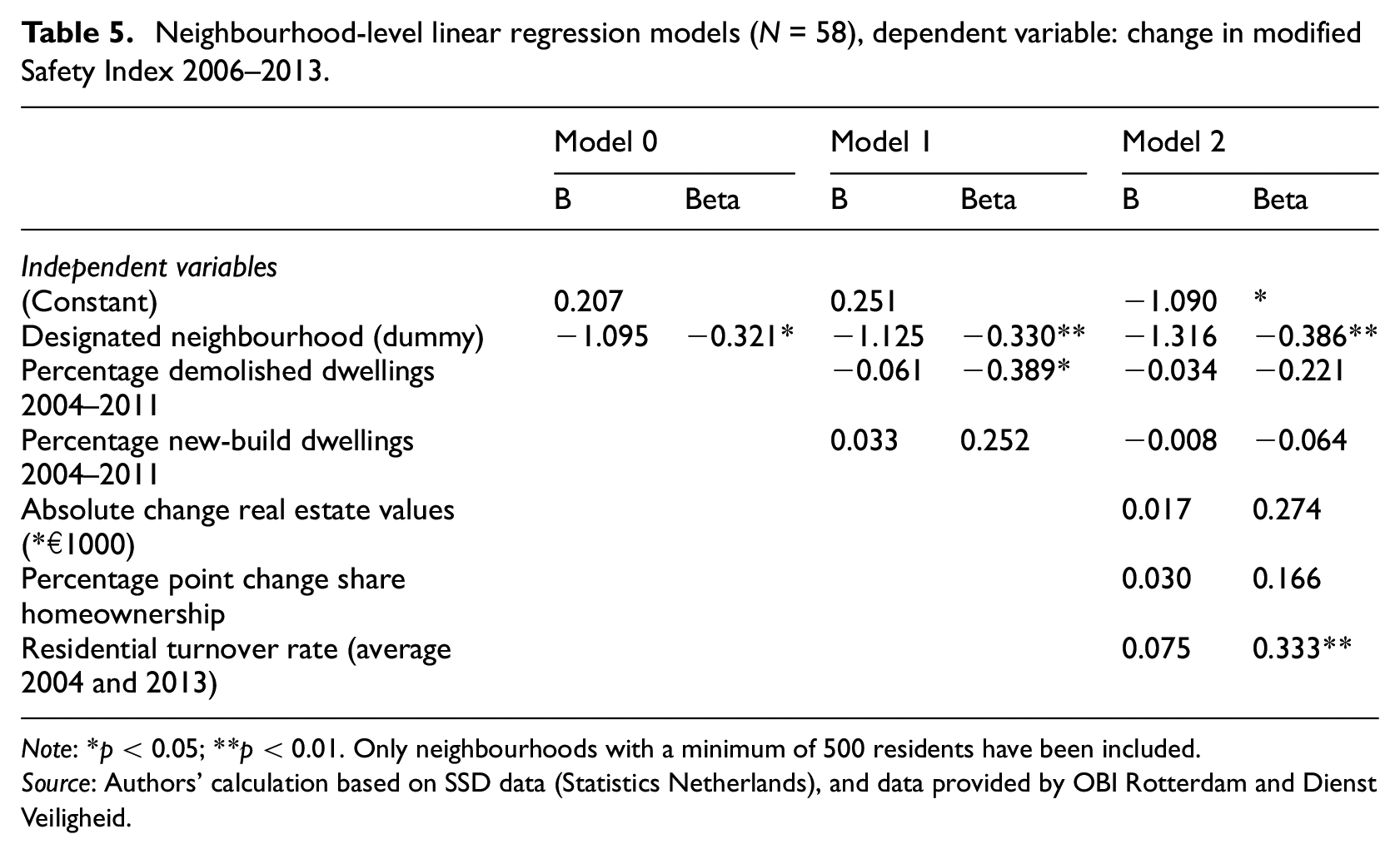
Note: *p < 0.05; **p < 0.01. Only neighbourhoods with a minimum of 500 residents have been included.
Source: Authors’ calculation based on SSD data (Statistics Netherlands), and data provided by OBI Rotterdam and Dienst Veiligheid.
Discussion and conclusion
Our evaluation sought to gauge the socio-spatial effects of the controversial Act on Extraordinary Measures for Urban Problems in the Netherlands, particularly its exclusionary provisions designed to support local policies and improve local social conditions. As such, the Act affects excluded individuals as well as designated neighbourhoods. First, the Act is effective in excluding residents who have no income from work, pensions or student benefits and an insufficient length of residency in the region. As a consequence, this group of low-income residents – often young, male, single, and non-native – is forced to find residence in other areas with accessible and affordable housing. These are often private and affordable rental dwellings located in relatively deprived urban neighbourhoods and in the downgrading post-war periphery. Together with changes in housing market structure – notably the sale and demolition of affordable rental dwellings – the Act contributes to a worsening housing market position of excluded residents. With regard to spatial effects, the five designated areas show a slow shift in social composition as a result of residential mobility and in situ social mobility. The share of excluded residents is decreasing, as is the share of the reference group, while more people in employment are moving in. Also, while this evaluation is unable to pinpoint the exact causality, the state of the living environment in the designated areas seems to be worsening rather than improving. Given the Act’s objectives and extraordinary means, the lack of results is remarkable, but not unprecedented in urban policy evaluations (see Lawless and Pearson, 2012; Permentier et al., 2013).
This paper has evaluated a new iteration of urban policy and social mixing; one that banks on exclusion rather than targeted physical interventions to mix and integrate populations in urban marginality. Our findings show that the Act on Extraordinary Measures for Urban Problems has had effects on residential mobility flows and population mix, but has had little effect on living conditions. There may be various reasons for the lack of effects on living conditions. One reason may be that the policy simply does not work at all. Given the complete absence of positive indications, this is a very plausible explanation for our findings. Another reason may be that the policy has had positive effects, but that its impact has been outweighed by other developments pushing in a different direction. The discontinuation of renewal funds and other budget cuts may help to explain why we find that – grosso modo – liveability and safety have decreased at an above-average rate in the designated areas since implementation of the Act. Whatever the explanation, it is clear that the Act has not provided an extra boost to vulnerable neighbourhoods, as it officially aims to do. It has, however, had an effect on the social composition of the designated neighbourhoods. Apart from the more fundamental issue that the Act suspends the rights of specific groups of people, this finding suggests that the mobility and choices of unemployed residents have been restricted. We consider this both a cost and a sacrifice. However, this is not how the government has interpreted the results. In an official response to the findings presented in this paper, the Minister of Housing stated that it is inherently difficult to pinpoint causality, but that the changes in the social composition in the designated areas do confirm that the policy is on the right track (Ministry of the Interior and Kingdom Relations, 2015). This response dovetails with local administrators who argue that the Rotterdam Act serves them well.
The implementation of the Act may seem to be small-scale, but it has a self-propelling and expansive tendency. Administrators of some areas that have captured the migration flows of excluded residents have proceeded to use the Act to close off neighbourhoods in their jurisdictions (see Uitermark et al., 2017). The Act was also expanded in 2016 to not only improve living conditions but also target public safety more directly. It now holds provisions to allow the exclusion of residents based on police records of crime, ‘anti-social behaviour’, and suspicions of extremism and radicalism. 7 These policy changes represent a further step towards a reliance on profiling and exclusion.
The exclusionary design of the Act may also travel across borders. The Dutch case is unique in terms of scope and legal framework, although a few similar initiatives have been deployed elsewhere. Yet, the Act may foreshadow a shift in European policy making, as it may be understood as part of a broader trend towards ‘lean and mean’ statecraft (see Peck, 2012). Such governance is lean in the sense that it is agile, targeted, versatile, selective and affordable. This does not necessarily imply that these policies are cost-effective – as the lack of real results in improving social conditions in our case suggests – but they do not require large-scale and long-term investments. Interestingly, the interviews we conducted reveal that most local practitioners are content with the Act, but also lament the lack of funds to restructure and renew the areas wholesale; they embrace the Act as a second-best option. So, policies such as the Act may serve as a comparatively affordable stand-in for more conventional social mixing initiatives. Recognising that the Act is not a panacea, the Rotterdam government and central government have stepped up efforts to improve coordination among professionals in the neighbourhoods of Rotterdam South (the so-called National Program for Rotterdam South). The ideal of the mixed and integrated neighbourhood therefore appears to live on as it does in other European countries (Uitermark, 2014), but current policies working towards the realisation of this ideal have to make do with much less funding than during the heyday of urban restructuring policy.
Second, policies may be mean in the sense that they locate the cause for social problems in groups suffering from stigmatisation and deprivation. Yet from a perspective of social costs and benefits, our findings raise serious questions about whether the costs of impairing freedom of movement for a specific socio-economic group add up to any social improvement. While the criteria for excluding residents seem clear-cut, our analyses show that a wide net is cast. A dynamic and diverse group of low-income residents is targeted, with the implicit assumption that these individuals are a burden. At the expense of the rights and entitlements of this group, the government expands its discretion by increasing its possibilities to exercise power in the form of enclosure and exclusion. The Act originates in right wing politics that promote strong-arm tactics with the promise of ‘getting things done’ and reasserting control over the city (Schinkel and Van den Berg, 2011; Uitermark and Duyvendak, 2008; cf. Dikeç, 2007; Smith, 1996), but its adoption and expansions were supported by a wide spectrum of political parties who were all sensitive to the underlying sentiment that you cannot make an omelette without breaking an egg. Our results demonstrate that breaking an egg does not necessarily make an omelette.
Footnotes
Acknowledgements
The empirical sections draw on a policy evaluation, which was commissioned by the Ministry of the Interior and Kingdom Relations. The evaluation report was published as Hochstenbach et al. 2015. The authors would like to thank the members of the advisory committee for their comments and suggestions on the report. The analysis presented here is the sole responsibility of the authors and does not necessarily reflect the position or opinions of the advisory committee, the Ministry, the Parliament, or the Government. This paper presents results based on the calculations by the authors using non-public microdata from the System of Social Statistical Datasets of Statistics Netherlands.
Declaration of conflicting interests
The author(s) declared no potential conflicts of interest with respect to the research, authorship, and/or publication of this article.
Funding
The aforementioned evaluation report was commissioned and funded by the Ministry of the Interior and Kingdom Relations following a request for an independent evaluation by members of the Dutch Parliament. Justus Uitermark acknowledges the financial support of a VENI-grant from NWO, the Netherlands Organization for Scientific Research (#451-12-035).