




Abstract
In contemporary urban areas, a growing ‘generation rent’ is finding shelter in expensive and precarious private rental housing. Tenant organisations and legislative initiatives have been pushing to improve housing conditions for renters, yet have been met with strong resistance. Intense policy and academic debates have ensued. This paper delves into the discourses used by dominant actors involved in legislative changes affecting the private rental sector in Catalonia and Spain. Through a critical discourse analysis of the positions of governments, opposition parties and landlord organisations, we identify three main arguments employed to limit or contest ‘post-neoliberal’ measures favouring tenants: ‘the vulnerable landlord’, ‘the counterproductive effects’ and ‘the violation of property rights’. Each of these arguments is placed under theoretical and empirical scrutiny, revealing important weaknesses. By unsettling dominant discourses, we contribute to advancing the terms of the debates and sketch out the coordinates for a counter-discourse informed by critical theory and the interests of renters rather than rentiers.
Introduction
The private rental sector (PRS) has reemerged out of the contradictions of financialised homeowner societies, becoming central to contemporary urban conflicts (Aalbers et al., 2020). A new ‘generation rent’ has arisen in the process, especially in countries deeply affected by the 2008 global financial crisis (Byrne, 2020). After decades of neo-liberal deregulation, however, the PRS has been proving a relatively expensive, precarious and poor quality housing option (Daniel et al., 2023; Mckee et al., 2017; Waldron, 2023). In this scenario, tenant organisations and legislative initiatives have been pushing for a ‘New Deal’ for renters, yet are facing strong opposition (Vidal, 2021).
Various tenant protections and strategies for affordable rental housing are being reconsidered and intensely debated, both in the public sphere as well as in academia. Rent controls have been put back on the table and stirred renewed discussion in various countries, such as in Germany (Cohen, 2023), the UK (Marsh et al., 2023; Slater, 2021), Ireland (O’Toole, 2023), Hong Kong (Lau, 2019) and Spain (Pareja-Eastaway and Sánchez-Martínez, 2023), amongst others. Rising urban rents have also sparked debate regarding their relation to housing supply, acquiring particular salience in the USA around a popularised NIMBY–YIMBY (Not in my backyard – Yes in my back yard) dichotomy (Been et al., 2018; Manville et al., 2022; Rodríguez-Pose and Storper, 2019, 2020). The distributive consequences of public interventions over the PRS and their implications for small scale landlords have also been raised (Hulse et al., 2019; Rabiyah, 2020; Tranjan, 2023). Central to these debates are conflicting approaches towards addressing the global urban housing affordability crisis (Wetzstein, 2017). They also reflect conflicting material interests around housing property relations.
What are ultimately in dispute are the established market-based frameworks for urban and housing governance and policies, and specifically in the PRS. A growing body of literature has examined recent policy moves away from market logics in the PRS in various contexts through the lens of ‘post-neoliberalisation’ (Byrne, 2022; Hochstenbach, 2023; Kadi et al., 2021; Schipper, 2015). All studies point towards variegated, limited and contested departures from the neoliberal rationales of commodification and market rule. Kadi et al. (2021: 367–369) highlight ‘neoliberal discourses’ and the ‘influence of the real estate industry and the financial sector’, exerted through lobbying and ties to ruling parties, as some of the ‘structural factors’ that impede more profound policy transformations. This diagnosis overlaps with that of other studies which highlight the importance of discourse and ideology, ‘understood broadly as dominant beliefs endorsed by key policy actors’, as Marsh et al. (2023: 740) put it, in shaping the regulation of the PRS (Bryant, 2004; Lau, 2019; Marsh et al., 2023).
In this article we apply the lens of ‘post-neoliberalisation’ to select and discuss pro-tenant measures that have been introduced in the PRS in Catalonia and Spain in recent years. Tenant rights and protections have expanded in uneven and limited ways, yet have faced significant legal reversals and political backlash. Our objective is to identify the main arguments employed by governments, opposition parties and landlord organisations to limit and/or contest pro-tenant measures and to put these arguments up to theoretical and empirical scrutiny. We aim to demystify and problematise the unstated assumptions and limited empirical basis underpinning these arguments. The material interests invested in this discursive battleground are also brought to the fore through a political economy contextualisation. Together, a critical outline and assessment of the discourses contesting pro-tenant measures is provided.
Whereas current debates on different tenant protections and strategies for affordable rental housing often develop in a siloed manner, we consider them instances of a broader contention between established neoliberal and emerging ‘post-neoliberal’ paradigms. This approach aids in clarifying the terms and conditions of these debates, which we then seek to further advance on the basis of the Catalan/Spanish case. The latter can be seen as a ‘paradigmatic case’ (Flyvbjerg, 2006) of the rise of the PRS from the ashes of the 2008 mortgage crash and of its associated housing affordability problematic and socio-legal struggles. In this sense, it has prototypical value for tracing the discursive battle lines being drawn around the contemporary urban ‘rental housing question’ (Soederberg, 2018). Through this approach, we contribute to characterising and advancing the terms of this debated question as it unfolds across different geographies, specifically, by identifying the most forceful arguments mobilised to limit tenant rights and by revealing their theoretical and empirical weaknesses. Via this engagement, the contours of a counter-discourse also emerge, which is informed by the monopolistic character of landownership and is grounded in the tradition of social constitutionalism and the history of public interventionism in housing.
The paper is structured as follows. The next section outlines the political economy contextualisation and the critical discourse analysis methodology employed. The following three sections are each dedicated to analysing and critically appraising one of the three main arguments identified: the ‘vulnerable landlord’, the ‘counterproductive effects’ and the ‘violation of property rights’. The concluding section summarises the analysis, which underscores the theoretical and empirical shortcomings of dominant discourses and sketches out the outline of a counter-discourse that is informed by the interests of renters rather than rentiers.
Analysing the context and content of dominant discourses on the urban rental housing question
The current urban ‘rental housing question’ (Soederberg, 2018) relates to capital switching to ‘secondary’ and ‘quaternary’ circuits (Aalbers, 2008), namely the built environment and finance, in its relentless search for profitability. The ‘hyper-commodification of housing’ driven by the neoliberal project (Marcuse and Madden, 2016) has facilitated it as a conduit for capital flows seeking ‘spatio-temporal fixes’ (Harvey, 2006) to recurrent crises. It is in this light that the shift of capital from the mortgage to the rental market can be understood. The expansion of mortgage credit has been driving housing prices increasingly beyond the reach of household incomes (Aalbers et al., 2020). Where taken furthest, this dynamic underpinned the global financial crisis of 2008. The subsequent labour devaluation and new financial regulations further narrowed the homeownership horizon (Byrne, 2020). Investment in housing property has since been driven by institutional and individual ‘buy-to-let’ investors, bolstered by policies promoting public housing privatisation and PRS growth (Aalbers et al., 2020; Hochstenbach, 2023; Ronald and Kadi, 2018).
In post-crisis Spain, this displacement was enabled by a policy package that liberalised rental contracts, offered fiscal exemptions for Real Estate Investment Trusts (REITs) and privatised large housing portfolios (Gil and Martínez, 2023; Vives-Miró, 2018). This policy package contributed to generating expectations of profitability in the PRS and of revalorisation of housing more generally. Crucially, it helped bailed-out banks offload their ‘toxic assets’ and clean their balance sheets to meet EU and international regulations (Yrigoy, 2020). As a result of this ‘post-2008 crisis resolution regime’ (García-Lamarca, 2020), global institutional investors took a stake in the Spanish and Catalan PRS, whilst a ‘generation landlord’ (Ronald and Kadi, 2018) also rode the wave. The latter leveraged wealth accumulated during previous cycles to acquire devalued properties and incorporate them into an expanding PRS (Boertien and López-Gay, 2023). Altogether, both macroeconomic management and a diversified landlord class aligned interests around high rents.
This trajectory faced resistance from newly established right-to-housing and tenant organisations (García-Lamarca, 2017; Martinez, 2019; Martínez and Gil, 2022). Grassroots organising, lobbying activities and popular legislative initiatives have driven recent legislative changes in both the Spanish and the Catalan parliament, which holds significant competencies in housing. 1 These changes occurred amidst electoral shifts following social discontent in the wake of the 2008 crisis, which in Catalonia also manifested through the independentist movement (Charnock et al., 2014). New municipalist platforms won important victories at the local level in 2015, including the mayoralty of Barcelona going to a housing rights activist, and the new left populist party Podemos joined a centre-left government in 2019. In the Catalan parliament, legislation received support from independentist parties, partly as a tactic of institutional confrontation with Spain over competencies.
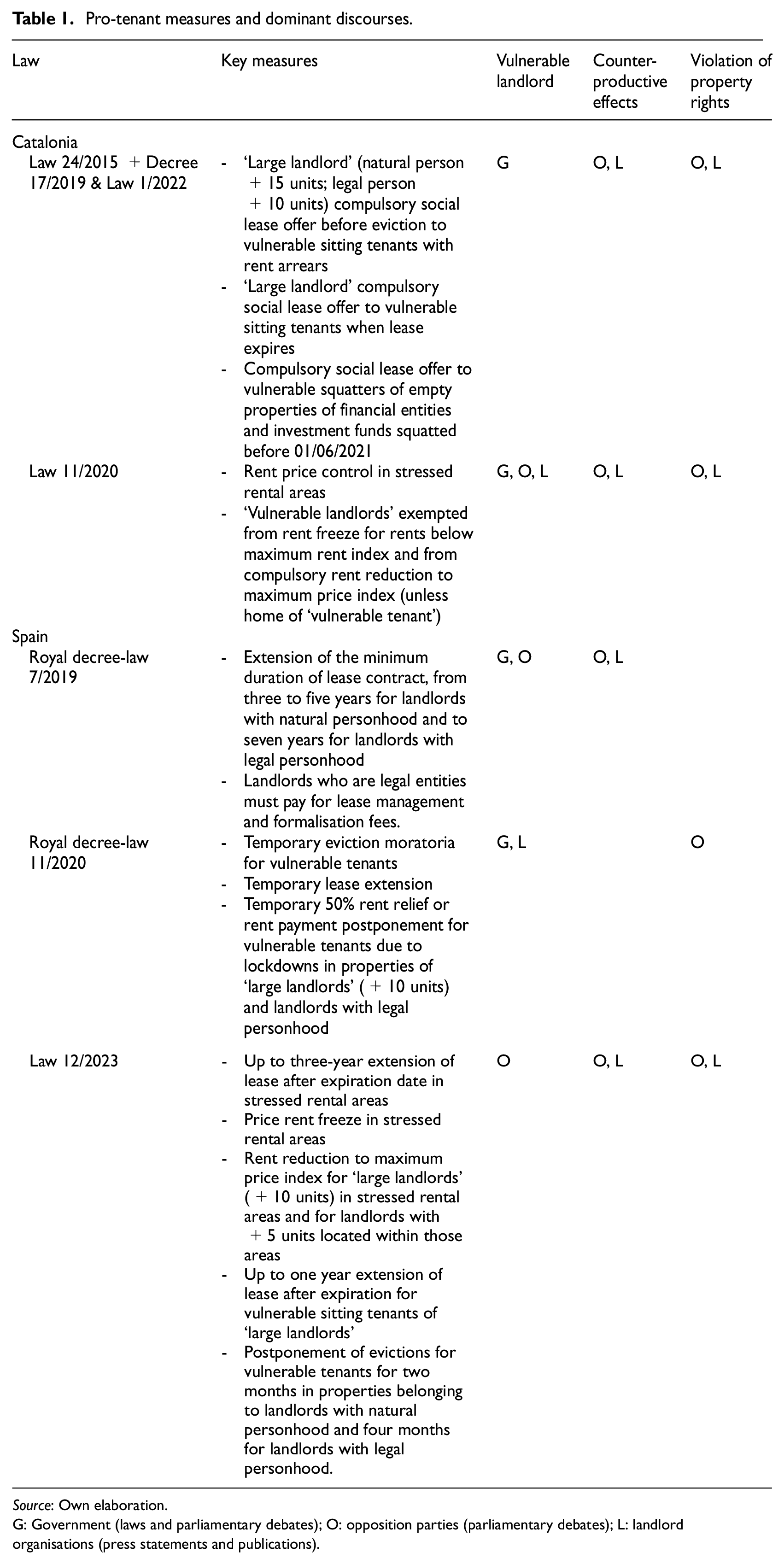
The central column of Table 1 summarises the main ‘post-neoliberal’ measures introduced in favour of PRS tenants, including those during the COVID-19 emergency response (Royal Decree-law 11/2020). The Spanish Constitutional Court revoked the Catalan rent control law (Law 11/2020) a year and a half after its introduction for overstepping competencies. Some articles of the Catalan law to address the emergency in the housing sector (Law 24/2015) and its extensions (Decree 17/2019 & Law 1/2022) have also suffered temporary suspensions or permanent revocations for the same reason. The Spanish Right to Housing Law (12/2023) stalled in political gridlock for three years before it was passed in the run up to regional and municipal elections in May 2023.
Pro-tenant measures and dominant discourses.
Source: Own elaboration.
G: Government (laws and parliamentary debates); O: opposition parties (parliamentary debates); L: landlord organisations (press statements and publications).
We conducted a critical discourse analysis of the arguments used to limit the scope of and/or contest these pro-tenant measures. Discourse analysis has a diverse trajectory in urban and housing studies (Hastings, 1999, 2000; Jacobs, 2006; Marston, 2002) and has been used as a methodological tool for policy-oriented and applied research. We draw from the strand of discourse analysis that Lees (2004) identifies as descending from the Marxist tradition of political economy and ideology critique. This approach posits a dialectical relationship between social practices and discursive practices (Fairclough, 1992). That is, discourses are understood as part and parcel of the antagonistic material relations between social groups and classes in contemporary society. From this perspective, neoliberalism is not just a discursive phenomenon (Phelan, 2014), but also a ‘class project’ (Harvey, 2005). We employ critical discourse analysis with the broader objective of contesting dominant discourses and meanings and showing how bias is mobilised in urban and housing policy communities (Marston, 2002). Throughout the paper, we consider both the social positions and the assumptions underpinning the arguments analysed, as well as tackle them on their own terms. Through this route we also engage in agnotology, the study of the propagation of ignorance and disinformation, in the context of urban knowledge production (Slater, 2021).
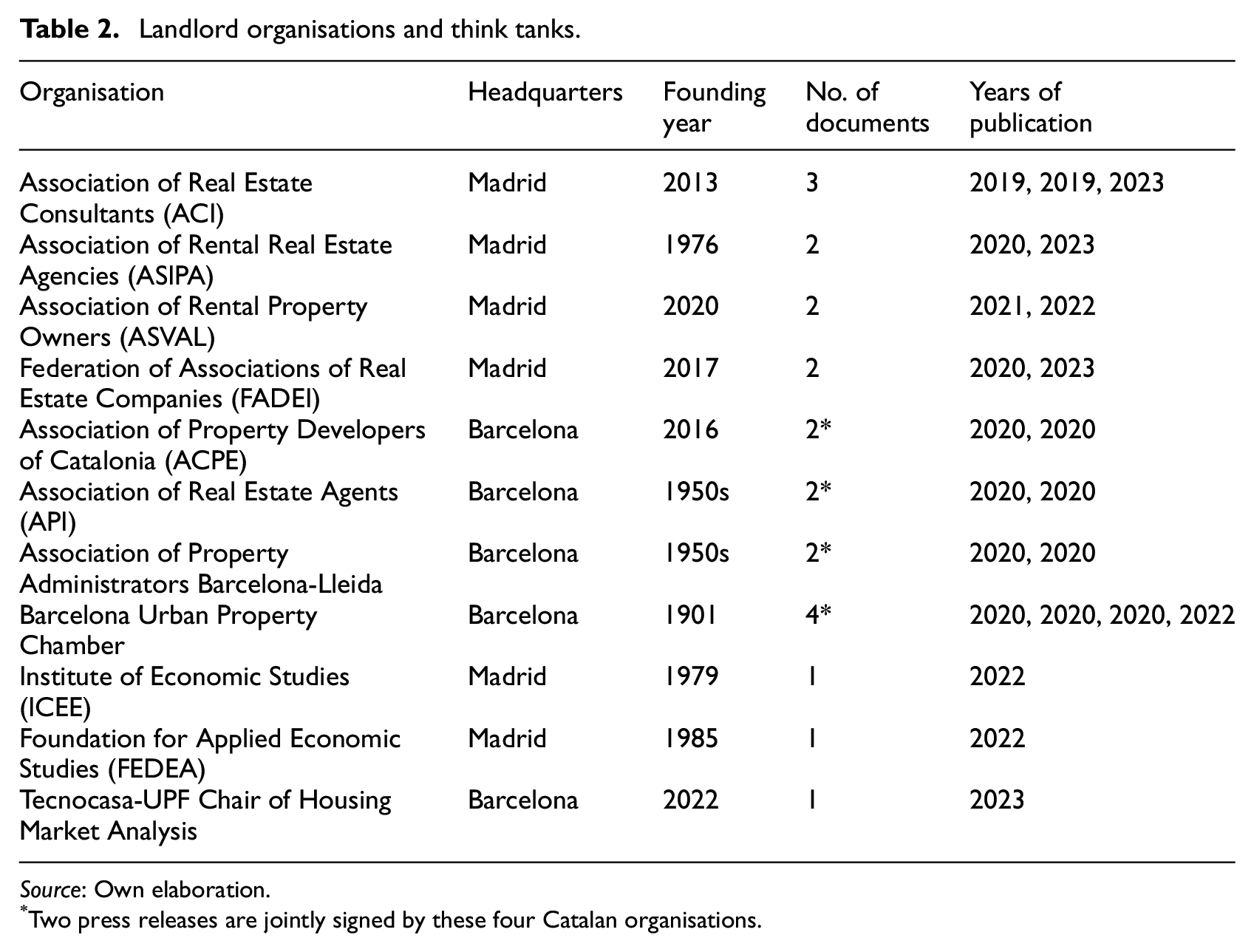
We analysed discourses from dominant actors involved in legislative changes affecting the PRS: the government, opposition parties and landlord organisations. For the government perspective, we examined the preambles of seven selected legislations, as they present a succinct justification of the measures, as well as the official transcripts of government spokesperson interventions during the parliamentary debate in the voting session of each law. Oppositions parties’ discourse was sourced from official transcripts of their spokesperson’s interventions in each of these selected parliamentary debates. It is in this decisive space that their positions and the direction of their vote is conclusively reasoned and their main arguments presented, both to the chamber and to the public. Altogether, seven preambles and eight parliamentary debate transcriptions were selected. 2 As for the voice of landlords, we analysed the press statements and publications produced by their main interest organisations in response to the measures (see Table 2). These include organisations with a long history, such as the Barcelona Urban Property Chamber, as well as relatively recent organisations created in the post-2008 crisis landscape (Guzmán, 2021). We also included relevant documents produced by think tanks with links to corporations with interests in residential real estate. A total of 16 documents representative of the landlord perspective towards the pro-tenant measures were collected.
Landlord organisations and think tanks.
Source: Own elaboration.
Two press releases are jointly signed by these four Catalan organisations.
All the material was coded and arguments were grouped together according to their underlying substantive message. We combined deductive and inductive approaches to coding, as we had already identified key arguments from our everyday following of the debates, but were also open to allowing for new themes to emerge from the texts. We built interpretative (thematic) codes grouping descriptive sub-codes and classified the sources into three document families (government, opposition and landlords). Through iterative abstraction, we refined the interpretative codes to capture each argument’s essence.
Three main arguments emerged. The first argument, the ‘vulnerable landlord’, portrays the majority of landlords as ordinary persons whose livelihood depends on rental income. Pro-tenant measures thus pose a distributive problem, as benefiting tenants harms landlords in similar measure. This is largely an empirical claim that has been constructed on the back of a paucity of available data. The second argument, the ‘counter-productive effects’, claims that pro-tenant measures ultimately harm tenants by disincentivising rental housing maintenance and supply. This assertion is based on a theoretically informed interpretation of the workings of the housing market influenced by popularised orthodox economics-101 formulations. The third argument, the ‘violation of property rights’, argues that public restrictions placed upon the uses and prices of rental properties infringe landlords’ property rights. This is a normative argument on the contents of property rights.
Table 1’s right-hand columns show that these arguments have been used recurrently by governments (G), opposition parties (O) and landlord organisations (L). Essentially the table illustrates how the same arguments have been employed to address a variety of different measures. This suggests that dominant actors are driven by entrenched beliefs, interests and/or ideological motivations, rather than by a nuanced assessment of each measure. Whereas the ‘vulnerable landlord’ argument is mostly mobilised by governments to justify restricting the scope of measures, the other two arguments are often used by opposition parties and landlord organisations to contest them entirely. In the next three sections we do not provide an in-depth analysis of the forms and context in which these discourses circulate, but instead examine the theoretical and empirical validity of these claims.
The vulnerable landlord
Recent pro-tenant legislative changes in Catalonia and Spain have introduced differential treatments for different types of landlords based on size and legal status (see Table 1), making them more politically palatable but also limiting their scope and impact. Landlords who are natural persons are often equated with small landlords, ordinary citizens deserving similar consideration and protection as tenants. For instance, the exposition of motives for the COVID-19 emergency law stated that, ‘In Spain, 85% of rental housing is owned by a landlord who is a natural person, a small property-owner … an equilibrium between counterparties is guaranteed to avoid passing on the vulnerability of tenants to landlords, especially to those for whom rental income is essential’ (Real Decreto-ley 11/2020, 2020: 9). Similarly, during the parliamentary debate on the rent control law passed in Catalonia a few months later, the Catalan president argued that, ‘we need to take into account both the vulnerability of tenants and the vulnerability of small property-owners’ (Parlament de Catalunya, 2020: 27). The distinction between types of landlords has been contested by the Association of Rental Real Estate Agencies (ASIPA), who, in response to the COVID-19 emergency measures, claimed that it ‘discriminates’ against institutional investors who, ‘represent millions of individual citizens that decide to join their savings to facilitate larger collective investments … punishing, without justification and indirectly, private savers, many of whom are pensioners’ (Simón and Sempere, 2020). As such, this differentiation between landlords has been leveraged to argue for further limiting the scope of pro-tenant legislation. The ‘vulnerable landlord’ narrative mirrors those in other countries depicting landlords as ‘everyman archetypes’ (Hulse et al., 2019), ‘mom-and-pop’ investors who are ‘struggling’ (Tranjan, 2023) or even ‘victims’ (Rabiyah, 2020). However, the available data challenges these portrayals.
The ‘vulnerable landlord’ narrative circulates in a context where data on PRS ownership structures is limited and debated. The Spanish government’s figures, according the competent Ministry, are an ‘approximation based on secondary sources’ (Negro, 2021). In Catalonia, 70% of rented stock belongs to natural persons, as per the Catalan Land Registry (OHB, 2020). However, specific data on the size and socio-economic profile of these landlords is even scarcer, only allowing for estimates. Using the Living Conditions Survey (ECV in Spanish), the largest national survey with data on household rental income, we estimate that ‘landlord households’ constituted 9% of all households in 2021 3 (see also, Gil et al., 2023). The Survey of Household Finances (EFF in Spanish) suggests 7% in 2020 (Delclós et al., 2023: 11). A survey by the Centre for Sociological Research (CIS, 2018) indicates that the percentage of Spanish households renting out housing on a continuous basis (excluding short-term rentals) was 3.9% in 2018. Despite variations, all sources point towards a significant landlord minority.
The primary contention in the distributive conflict between tenant and landlord households revolves around their income disparities. Due to data limitations, approximations from the Living Conditions Survey are used. In 2021, the average annual disposable income for ‘landlord households’ was €46,725, with a median of €40,293. Subtracting rental earnings, these figures drop to €39,931 and €33,602, respectively. In contrast, tenant households earned an average of €22,183 and a median of €18,457. Even after deducting rental income, tenant households earn only 55% of what landlord households earn. Considering the mean and median disposable income at a national level as well, €30,552 and €25,876 respectively, most landlords are among the wealthier segments of the Spanish population. The EFF paints an even starker contrast, with median incomes of €76,504 for landlord households and €27,984 for tenant households (Delclós et al., 2023: 14).
Economically vulnerable landlord households are thus rare. Based on the Living Conditions Survey, 25.4% of landlord households earn less than €26,000 and 9.4% less than €15,000 (the two first quartiles of the national rent distribution). Only 6.5% of landlord households are at risk of poverty 4 and could be deemed ‘vulnerable landlords’, representing just 0.6% of all Spanish households. In contrast, 36.3% of tenants are at risk of poverty. If rents were reduced by 20%, the percentage of vulnerable landlord households would increase by less than one point, to 7.4% (0.7% of all households), if rents were halved, to 9.5% (0.9% of all households), and if they were suspended entirely, to 15% (1.3% of all households). The results suggest that the vast majority of landlord households can afford a reduction (due to rent controls) or suspension (due to emergency eviction moratoriums) of their rental income. More so when considering their wealth in asset ownership.
Regarding the claim that large corporate landlords, such as REITs and Private Equity Firms, represent the aggregated savings of millions of individual citizens, data on the geography and profile of these investments tells a different story. Whereas pension funds are a significant source of capital for institutional investors in rental housing (Gabor and Kohl, 2022), this capital does not belong to Spanish citizens. Spain’s capitalisation pension system is relatively underdeveloped, with only 25% of households having a pension plan (
The counterproductive effects
The second main argument against legal measures favouring tenants suggests potential counterproductive effects on the supply of rental housing. As articulated by the spokesperson of the Catalan liberal-conservative party during the Spanish parliamentary debate on extending the minimum duration of lease contracts, ‘the risk of the regulations that we establish is that … some property owners, due to the regulation, will offer fewer flats for rent’ (Congreso de los Diputados, 2019). This perceived risk intensifies when discussing more ambitious measures such as rent price controls. In the words of the spokesperson for the liberal right-wing party Ciudadanos, Few policies produce such unanimity in the opposite sense. The Swedish economist Assar Lindbeck said that price controls are the best way of destroying a city besides bombing it. Paul Krugman has insisted that few topics have been so profusely studied in economics and that there is a very broad consensus that limiting rental prices reduces the quality and quantity of housing supply. (Congreso de los Diputados, 2019: 51)
Such a categorical position, however, rests on shaky foundations.
Theoretically, this viewpoint hinges on the supply and demand dynamics of rental housing, assuming competitive market conditions. However, rental housing markets are inherently monopolistic due to the finite nature of land and its exclusive private ownership. The monopolistic character of landownership was acknowledged by political economists from Adam Smith to Henry George, but later obviated by the neoclassical turn in economics (Evans, 1991). Yet, land rent theory from a political economy perspective has regained attention (Ward and Aalbers, 2016). In Marxist rent theory, it is private property relations that enable the ‘absolute rent’ extracted by landowners (Bradley, 2023). Landowners can demand a positive return on all land in use and create artificial scarcity as land is withheld unless this premium is paid (Evans, 1999; Walker, 1974). Ownership can be more or less concentrated and there can be more or less land available for housing development. Regardless, landowners will not face direct competition for the uniquely located plots of land they own. The rents they extract as a result are added to the production costs and profits of housing provision in the determination of housing price. The latter thus incorporate a monopolistic component.
In such a scenario, landlords can charge whatever the demand will bear. In cities that concentrate employment opportunities, for instance, demand for rental housing can become highly price inelastic. Unless they can move up the property ladder, which is not the case for ‘generation rent’, tenants are stuck between a rock and a hard place; either tolerate rising rents, face homelessness or move away from employment opportunities and placed-based social networks, not least facing the economic costs involved in moving homes. Tenants are relatively captive customers and this allows landlords to inflate prices, underpinned by the extraction of monopoly rents (Berry, 2014; Moreno Zacarés, 2024). Consequently, there is room for public intervention in rental markets to control rents without necessarily affecting landlords’ ability to cover costs and even earn the general rate of profit. There is potential to eliminate rents derived solely from monopolistic control over a scarce resource.
Right-leaning political parties and landlord organisations argue that the problem of scarcity can be mitigated by expanding the supply of private rental housing. The underlying reasoning is that high rental prices stimulate new housing supply, which will eventually lower rents. Public regulations that hamper profitability prospects, the argument goes, disincentivise the market provision of additional rental units. However, as Murray (2020, 2022a, 2022b) demonstrates, the logic of profit-maximisation in the context of price growth can actually limit housing supply expansion. Rather than viewing housing as a new product created whenever its price exceeds its production costs, land and housing function as assets. The provision of housing is actually a capital reallocation decision away from land and financial capital, each of which are already providing the owner a return. For landowners, rising house prices make supplying housing today more attractive, ‘but also make waiting more attractive, thus reducing the responsiveness to price’ (Murphy, 2018: 264). There is an economic payoff to delay, the capitalisation of rising land values, and so an in-built ‘speed limit’ on new housing supply (Murray, 2022a). No collusion is needed. Private landowners, driven by maximising returns, will not necessarily supply housing faster or cheaper. On the other hand, when market conditions become unfavourable, new developments quickly stall to avoid future loses. Taken together, expecting the cyclical dynamic of the private market to swiftly supply its way down to significantly lower rents contradicts market incentives. Unlike capital accumulation through commodity production, accumulation based on rent extraction has an ‘inflationary logic’ (Moreno Zacarés, 2024).
In Spain, rents have soared in metropolitan areas, with private capital focussing on closing larger ‘rent gaps’ in the existing built environment rather than on increasing supply. After the banking sector’s restructuring, the ‘toxic assets’ from the 2008 crisis were not immediately reintroduced into the housing market. Instead, their new owners waited for their revaluation (Carmona, 2022). Constraining housing supply has been both a means and an outcome of the strategy of buying cheap to sell/rent dear. An indicator of this is the unsold housing stock, which continues to be significant and has only gradually declined since the last real estate crisis (MITMA, 2022). As for new-build rental housing, only 271 privately financed Build-To-Rent (BTR) housing units were completed in 2019, 1335 in 2020 and 3166 in 2021 (Atlas, 2021). Projections point towards another 53,060 housing units in the pipeline (Atlas, 2022). This amount is far from the various estimates of future demand for rental housing in Spain (Atlas, 2021; Secretaria d’Habitatge i Inclusió Social, 2021). Thus, new supply in the private rental sector in a context of sustained rent price increases has been glaringly insufficient. The private rental sector itself implicitly recognises this by advocating for public–private partnerships for affordable housing provision. These proposals include providing public land and both direct and indirect subsidies for private rental housing projects (ASVAL, 2022; Barcelona Global, 2019; García Montalvo et al., 2022). However, whilst public subsidies are demanded to ‘de-risk’ investments (Gabor and Kohl, 2022), public regulations are dismissed.
The counter-productive effects argument, then, loses force given how little the unregulated private market has to offer in terms of adequate and affordable rental housing provision in the first place (see also Slater, 2021: 98). While public regulations could potentially exacerbate the problem, they should be evaluated on a case-by-case basis rather than through broad generalisations. The alleged scientific consensus against rent price controls exemplifies this. In a recent literature overview on the effects of rent control, Kholodilin (2022) notes that a majority of studies show a decline in rents in rent-controlled dwellings, while they are divided on the effects on new residential construction. With regards to housing quality, most studies do detect a deterioration in dwellings subject to regulation (Kholodilin, 2022). In a detailed analysis of some of the studies on this latter question, however, Olsen (1988: 305) identifies serious methodological flaws which lead him to conclude that, ‘there is no compelling test of the hypothesis that rent control leads to worse maintenance of the controlled stock’. Marsh et al.’s (2023: 743) more qualitative review of the literature notes that, ‘evidence rests on a relatively narrow base in terms of housing market context, institutional context, policy design, and theoretical framing’. Diamond et al. (2019) also point out that the literature generally lacks detailed data and natural experiments resulting in little well-identified empirical evidence. Overall, it is hardly a solid consensus.
As Arnott (1995) argues, first-generation rent controls (price freezes) need to be assessed independently from the more flexible second-generation rent controls. The latter’s heterogeneous package of regulations, and thus incentive structures, further requires a case-by-case analysis. Yet, as Marsh et al. (2023) point out, research evidence in this policy debate is often overshadowed by political dynamics. In the case of Catalonia’s short-lived rent control law, empirical studies have disagreed on its effects upon rental housing supply (Bosch and López, 2022; Jofre-Monseny et al., 2023; Kholodilin et al., 2022; Monràs and Montalvo, 2022). These differences largely stem from theoretically-informed methodological decisions, affecting the databases employed, the time periods chosen for the analysis and the units of observation used for comparison. For instance, Monràs and Montalvo (2022) argue that there was a drop in supply after the law’s enactment, but do not account for the sharp increase in signed tenancy agreements in the weeks leading up to it (Jofre-Monseny et al., 2023). Yet, the former working paper has been more widely cited by the media and landlord organisations than the latter peer-reviewed publication.
The violation of property rights
The third primary argument against recent pro-tenant measures in Catalonia and Spain is that they infringe upon landlords’ property rights. As articulated by the spokesperson of the right-wing Popular Party during the parliamentary debate on the Catalan rent control law, ‘a right like housing … should never, never, be applied at the expense of another fundamental right, such as private property’ (Parlament de Catalunya, 2020: 65). Two months earlier, a joint press release by various Catalan landlord organisations had claimed that, ‘some of the measures proposed are contrary to the protection of private property’ (AIC et al., 2020b). Similarly, in response to the extension of the Catalan 24/2015 law, they claimed the decree ‘blurs the right to private property’ (AIC et al., 2020a). In relation to the Right to Housing Bill in Spain, the Institute for Economic Studies think tank contended that, in recent years, interventionist experiments in housing regulations have proliferated, which have meant a breach of property rights … The Bill recognises the right to temporary suspension of evictions and other processes of repossession of the home for up to four months … which constitutes a temporary regulatory expropriation of housing, and, therefore, a clear violation of the right to private property. (IEE, 2022: 3)
These views reflect an absolutist perspective on property rooted in neoliberal principles (Turner, 2008), overlooking its social function.
Liberal democracies and their constitutions uphold private property rights, enacting extensive legislation to safeguard and perpetuate them. However, no liberal political regime based on the rule of law grants absolute rights to private property owners, especially in the domain of housing (Hojer Bruun et al., 2018; Kholodilin, 2018). Post-World War II, the rise of the welfare state saw social citizenship rights also enshrined at constitutional levels. These are an expression of the tradition of ‘social constitutionalism’, in which property rights are inscribed within the pursuit of equitable wealth redistribution and the general interest (Casassas and Mundó, 2022; Pisarello, 2011).
The Spanish Constitution’s ‘social function of private property’ principle (art. 33) (Rodríguez, 2018), mirrored in other European and Latin American constitutions (Foster and Bonílla, 2011), adheres to this social constitutionalism tradition. This permits restrictions on property rights, provided they serve the general interest and legal provisions are enacted. Article 128 further states that the nation’s wealth, regardless of ownership titles, is subordinate to the general interest, while article 47 mandates the prevention of real estate speculation. European legislation also designates policies promoting social and affordable housing as matters of general interest, exempting them from full free market competition protection (Ponce, 2011). Altogether, there is a legal basis for the pro-tenant legislation introduced in Catalonia and Spain.
The section will focus on the Catalan law addressing the housing sector emergency (24/2015), and its amendments and extensions (17/2019 and 1/2022), as it has faced the most criticism for infringing property rights. Specifically, it mandates large private landlords to offer social leases to vulnerable sitting tenants facing eviction. This measure can be seen as a form of ‘housing rationing’, a forceful redistribution measure in severe housing shortage contexts (Kholodilin, 2018). Kholodilin’s (2018) overview of housing policies from 1910 to 2018 reveals that 36 out of 47 examined countries/provinces have employed such measures. It is crucial to note, moreover, that the compulsory social lease offer has limited scope and does not overhaul the established legal framework for real estate business. The 24/2015 law primarily shares the responsibility of providing affordable housing for impoverished households between the state and large landlords. Given the low taxation rates and prevalent tax evasion, this measure can also be viewed as a compensatory ‘tax in kind’ imposed on the wealthiest landlords. Overall, it is a vital measure to achieve modest wealth redistribution and address an emergency housing situation.
Lastly, it is worth addressing the measure as it pertains to squatters, given the added controversy. The current penal code penalises squatting but does not distinguish based on the squatters’ economic and social conditions. The 24/2015 law provides clarity to prevent evictions that exacerbate problems for vulnerable dwellers. This legal provision is not dissimilar from regulations such as France’s ‘winter truce’ and the numerous legalisations of squatted buildings in countries like France, Germany, England, The Netherlands, Italy, Denmark and Spain (Martínez, 2020: 190–233). Many of these can be interpreted as squatter-led housing policies which are followed up by the authorities to address both acute affordable housing shortages and speculative vacant property hoarding (Martínez, 2020, see also: Fox et al., 2015; Watson, 2016).
Conclusions
This paper has identified and critically examined the main arguments used to challenge or limit pro-tenant measures in the PRS in Catalonia and Spain following the 2008 mortgage crisis. The discourses of dominant actors – governments, opposition parties and landlord organisations – have been analysed as expressed in decisive and significant spaces, moments and formats. Such discourses are among the ‘structural factors’ that hinder more profound post-neoliberal transformations of housing policies (Kadi et al., 2021). Three main arguments have been identified as the most forceful, compelling and recurrent against the diverse pro-tenant measures in recent legislation. Their repeated use in different guises suggests deeply rooted beliefs and interests embedded in neoliberal urban and housing trajectories, beyond the specific content of the different measures. As such, these claims warrant thorough critical examination. Our analysis has highlighted significant theoretical and empirical weaknesses, allowing us to nuance or refute their core assertions.
Firstly, we illustrated how the characterisation of landlords who are natural persons creates an image of socio-economic vulnerability. However, the available empirical evidence does not corroborate this portrayal. While most of the Catalan and Spanish PRS is owned by natural persons, these landlords represent a relatively affluent social minority. This finding aligns with recent studies in similar contexts (Hulse et al., 2019; Rabiyah, 2020; Ronald and Kadi, 2018; Tranjan, 2023). We took a step further to analyse the percentage of landlord households at risk of poverty, revealing that this group is minimal and cannot be reasonably considered an obstacle for pro-tenant measures. This observation encourages similar empirical investigations in other countries where ‘mom-and-pop’ landlords are also depicted as vulnerable.
Secondly, we addressed the argument that pro-tenant measures are counterproductive as they disincentivise landlord maintenance and supply of rental housing. We contended that such discourses overlook the monopolistic nature of landownership, which justifies public intervention. Furthermore, empirical evidence is weak and does not sustain the argument in the blanket terms in which it is presented. Instead, the impact of pro-tenant measures should be evaluated on a case-by-case basis. The notion that an unregulated PRS can resolve the housing affordability crisis lacks both theoretical and empirical backing. These insights contribute to broader international discussions on the potential unintended consequences of public intervention in rental markets, especially concerning rent controls (Marsh et al., 2023). The appropriateness of rent controls is not just an empirical question but also hinges on often-overlooked theoretical assumptions about land market dynamics.
Thirdly, the claim that pro-tenant measures infringe upon the property rights of landlords is characterised as an absolutist perspective on private property. This view neglects the historical interventions in housing markets by liberal democratic regimes and is misaligned with social constitutionalism and welfare traditions. Remembering and reclaiming this legacy after decades of neoliberal marketisation is a strategy for reactualising it today. The urban movement that perhaps has gone furthest in this sense is the ‘Expropriate Deutsche Wohnen & Co’ campaign in Berlin, which has sought to leverage Article 15 of the German Constitution to socialise 250,000 apartments owned by large-scale corporate landlords in the city (Kusiak, 2021).
Our discussion on private rental housing reform in Catalonia and Spain resonates with similar debates across different geographies. Our characterisation of the main arguments contesting pro-tenant measures contributes to clarifying the terms of the debates as they circulate in local and global housing policy and academic circles. By unsettling dominant discourses and highlighting their theoretical and empirical shortcomings, we suggest that the ‘burden of proof’ against pro-tenant measures continues to lie on them (see also Rodríguez-Pose and Storper, 2020). Concurrently, we have outlined the coordinates of a counter-discourse that recognises the monopolistic nature of landownership and that is grounded in the tradition of social constitutionalism and the history of public interventionism in housing. These insights constitute the initial steps towards conceptualising ‘post-neoliberal’ measures, ‘beyond a conceptualisation focused on what they are not (neoliberalism)’ (Byrne, 2022: 17). Significant work remains, both theoretically and empirically, to develop an urban housing agenda that is both rigorous and politically useful to the social and political forces struggling for the right to housing.
Footnotes
Acknowledgements
We are grateful to Callum Ward, Rodrigo Martínez Mazza and the participants of the Uppsala Political Economy Group seminar for their useful feedback on the manuscript.
Declaration of conflicting interests
The author(s) declared no potential conflicts of interest with respect to the research, authorship, and/or publication of this article.
Funding
The author(s) disclosed receipt of the following financial support for the research, authorship, and/or publication of this article: This research has received funding from the European Union’s Horizon 2020 research and innovation programme under the Marie Skłodowska-Curie grant agreement No. 101026179, the Spanish Ministry of Universities and European Union NextGeneration EU Maria Zambrano Fellowships and FORMAS (The Swedish Research Council for Sustainable Development) project reference number: 2019-00349.
