




Abstract
While assimilation theories implicitly assume that immigrants’ acceptance as “one of us” derives from their high levels of socioeconomic attainment in destination countries, little is known about the subjective experience of national belonging among the new immigrant elite in Western Europe. In this article, I assemble an analytical framework to study perceived acceptance within the national imagined community among immigrant-origin individuals who have already achieved high socioeconomic attainment at destination. Empirically, I look at subjective experiences of stigma and national belonging through in-depth interviews with forty-two professionals of North and Sub-Saharan African origins in France. How do these high-status individuals experience stigma, and how do they negotiate and claim inclusion as worthy members of the French imagined community? Respondents generally perceive only moderate levels of racial stigma in their daily lives, and I find that upper-middle-class culture empowers them to use cultural elitism to deflect racism as intellectually backward and illegitimate. However, I also find that self-identified Muslim respondents face widespread religious stigmatization that cast them as outsiders to French society. They respond to this stigmatization by distinguishing themselves from “undesirable” Muslims, rather than by denouncing anti-Muslim prejudice per se. These divergent experiences suggest that acceptance within the French nation is shaped by religious difference and remains actively negotiated after the achievement of social mobility. Overall, the paper suggests that cultural repertoires play a key role in enabling immigrant-origin individuals to claim national belonging in everyday life.
Introduction
Scholars of migration have recently taken an interest in the new immigrant elites, particularly by focusing on the determinants of their upward mobility (e.g., Crul et al. 2012). Such a focus is understandable, as migration scholars often regard immigrant socioeconomic attainment as the critical yardstick of assimilation (Alba and Nee 2003; Gans 2007; Heath, Rothon, and Kilpi 2008, Waters and Pineau 2015; see also Schachter 2016). In assimilation theories and related empirical (quantitative) research, the absence of immigrant-specific disadvantages in educational, occupational, and spatial attainment (i.e., parity in life chances and absence of downward mobility) are hallmarks of assimilation (Alba and Nee 2003). Meanwhile, cultural aspects of assimilation, such as belonging and acceptance by the native majority, are often conceived as its endpoint and implicitly assumed to develop from upward mobility across generations (see also Nee and Alba 2013, Schachter 2016: 981–4, Drouhot and Nee 2019, Waters and Pineau 2015). But is upward mobility sufficient for acceptance in the mainstream national community?
This article makes two core contributions to the scholarship on assimilation and immigrant upward mobility: a theoretical and an empirical one. First, I rely on conceptual tools from cultural sociology and social theory (Goffman 1963, Giddens 1990, Lamont 1992, 2000, 2018, Anthias 2002, Lamont et al. 2016) to assemble an analytical framework on national belonging and assimilation. This framework productively extends the objectivist, macro-level, behavioral focus of neoassimilation theory (Alba and Nee 2003). Second, I use this framework to examine the subjective experiences of stigma and national belonging among immigrant-origin, upper-middle-class individuals in France. How do such individuals perceive and respond to challenges regarding their place in the French “imagined community” (Anderson 1983) and claim membership in the nation? Using data from forty-two in-depth interviews conducted between 2011 and 2017, I find that respondents used their upper-middle-class status to deflect stigmatization and to disempower the use of ethnic and racial categories against them by stigmatizing racism as intellectually backwards. I argue that this response to stigmatization was enabled by the French repertoire of cultural elitism, which allows members of the upper-middle class to claim worth through social distinction based on intellectual refinement (Lamont 1992, Bourdieu 1984). Conversely, respondents who self-identified as Muslims typically reported feeling like cultural outsiders, despite high levels of socioeconomic attainment. Unlike their non-Muslim counterparts, Muslim respondents had difficulty reversing stigma and, instead, tried to differentiate themselves from “undesirable” Muslims who gave their religion a bad name. Their predicament, I argue, reflects the absence of cultural repertoires to reconcile national and religious belonging in a period when negative portrayals and debates about Islam were generalized in the public sphere (Deltombe 2013, Bleich and van der Veen 2021).
The rest of the article is organized as follows. First, I provide a theoretical discussion of the relationship between socioeconomic attainment and belonging in neoassimilation theory and review past empirical studies on stigma management among the new immigrant elite in Europe. I, then, present an appropriate analytical framework to study national belonging and the research design I used to study upwardly mobile, immigrant-origin individuals in France. After presenting major findings, I discuss my study vis-à-vis past works on “bright” ethnic boundaries and emphasize the significance of cultural repertoires and other aspects of the framework employed here to advance the study of assimilation. Overall, this article shows how acceptance in the imagined community remains actively negotiated in everyday life after the achievement of upward mobility and high socioeconomic attainment. In doing so, it helps center subjective experiences of national belonging among immigrants and their children as the key to refining scholarly understandings of the assimilation process.
From Immigrant Mobility to National Belonging? Oversights in Assimilation Theory
This article advances the study of belonging in relation to other domains of assimilation within the original formulation of neoassimilation theory (Alba and Nee 2003). In their influential account of assimilation, Alba and Nee (2003) propose a largely structural (rather than cultural) theorization of the “mainstream,” defined as “that part of the society within which ethnic and racial origins have at most minor impacts on life chances and opportunities” (ibid:12, original emphases; Alba 2005). The authors posit that socioeconomic mobility 1 out of ethnically segmented labor markets and neighborhoods in migration societies is shaped by antidiscrimination law (such as the 1964 US Civil Rights act) and structure of the economy. Such mobility is centrally identified as the “siren call to assimilation” (Alba and Nee 2003, 67)—the latter being defined as “the decline of an ethnic distinction and its corollary cultural and social differences” (10). While neoassimilation theory focuses on measurable empirical trends in immigrant socioeconomic mobility and intermarriage as crucial yardsticks for assimilation, Alba and Nee (2003: 11) still construe assimilation's endpoint as something more subjective and commonly felt across immigrant- and native-origin populations: “Individuals’ ethnic origins become less and less relevant in relation to the members of other ethnic groups (typically, but not necessarily, the majority group), and individuals on both sides of the boundary see themselves more and more as alike” (see also Schachter 2016). In essence, assimilation is, thus, a boundary shift whereby those previously seen as outsiders move inside the group of “us” sitting inside the boundary.
Yet, as Schachter (2016: 983–4) aptly notes, it remains unclear how the symbolic change from “them” to “us” identified as assimilation's endpoint take place. While research on assimilation has focused on socioeconomic attainment and intermarriage (Alba and Nee 2003 chapter 6; Heath, Rothon, and Kilpi 2008; Waters and Pineau 2015; Drouhot and Nee 2019), there is little theoretical understanding of the connection between mobility and belonging. Research often conflates mobility and assimilation and assumes that objective socioeconomic and demographic patterns of immigrant mobility lead to immigrants’ subjective sense of acceptance within the community (Gans 2007; Schachter 2016).
Why such a missing mobility-belonging link? With roots in demography (e.g., Adida, Laitin, and Valfort 1976, Alba 1985) and economic sociology (e.g., Nee 1998), neoassimilation is firmly objectivist and behavioral in its outlook and chiefly concerned with the formulation of causal mechanisms and testable propositions for population-level patterns (e.g., Alba and Nee 2003 chapter 1; Nee and Alba 2013; Drouhot and Nee 2019). Within the boundary literature (the emergence of which predates neoassimilation theory, e.g., Barth 1969; Lamont 1992), such an analytical lens is consistent with the study of social boundaries—“objectified forms of social differences manifested in unequal access to and unequal distribution of resources (material and nonmaterial) and social opportunities” (Lamont and Molnár 2002, 168) and inferred from large-scale phenomena like ethnic segregation. In his early writing on assimilation among Italian Americans, Alba (1985) had already adopted an avowedly structuralist, macro-level approach to group boundaries and explicitly dismissed microlevel accounts of culture, the study of which “is not decisive for resolving questions of ethnicity” (136). Such an approach does not imply that neoassimilation scholarship does not pay attention to culture—it does. In recent studies, I, for instance, identify religion as a key domain of cultural difference for which assimilation dynamics are measurable and meaningful (Drouhot and Nee 2019; Drouhot 2021). Rather, I contend that in its original formulation, neoassimilation theory explicitly eschewed culture in terms of lived experiences of group membership and meaning-making in everyday life. A lack of attention to culture is also apparent in Alba's (2005) writings on “bright” and “blurred” boundaries in which he exclusively focuses on macro-level institutions such as church-state and citizenship regimes.
Yet, the subjectively felt commonality theorized as assimilation's endpoint mentioned above is an inherently cultural, rather than simply behavioral, outcome and more consistent with symbolic than with social boundaries—informal, subjective “us” and “them” cognitive distinctions enacted in everyday life that “separate people into groups and generate feelings of similarity and group membership” (Lamont and Molnár 2002, 168). Ironically, the behavioral, objectivist approach with a penchant for a population-level analytical lens at the core of neoassimilation theory and related empirical works has resulted in this scholarship devoting relatively little attention to symbolic boundaries, which are admittedly difficult to operationalize in quantitative research (see Bail 2008; Schachter 2016 for prominent exceptions) and typically studied through micro-level, qualitative accounts (e.g., Lamont 1992; see Lamont and Molnár 2002 for a review). Nevertheless, symbolic boundaries offer a promising way to think about and study the type of belonging conceived as assimilation's endpoint. A core motivation in this article, then, is acknowledging the significance of symbolic boundaries and other conceptual tools to study culture and consolidating their place alongside the original neoassimilation framework (Levitt 2005). To further understand the links between mobility and belonging at the level of meaning, it is necessary to focus on the lived experiences of stigma and belonging among upwardly mobile immigrants themselves.
The Rise of an Immigrant Elite in Western Europe
The newly rising immigrant elite experiencing high levels of socioeconomic attainment in Western Europe offers a strategic research site to think through the missing mobility-belonging link within neoassimilation theory. A nascent literature has sought to understand the structural determinants of opportunities for social mobility among the second generation (Heath, Rothon, and Kilpi 2008; Crul et al. 2012) and, more recently, studied the trajectories and experiences of immigrant-origin individuals into high-status occupational milieus (Crul, Keskiner, and Lelie 2017). This literature helps shed light on their subjective experiences of upward mobility and can yield initial cues on the issue of belonging. I briefly review it below.
Shahrokni (2015) studied identity dilemmas among immigrant-origin youths in France's elite colleges, while Berger, Essers, and Himi (2017) explored how highly educated Muslims in the Netherlands manage religious identity in the workplace. Similarly, Belgian, Dutch, and German studies document subtle forms of stigma encountered by immigrant professionals, including being singled out, feeling exoticized, and essentialized as a member of a stigmatized group (Essers and Benshop 2009; Van Laer and Janssens 2011; Konyali 2014; Waldring, Crul, and Ghorashi 2015; Konyali and Crul 2017; Waldring 2018). Other scholars have highlighted class and ethnic identity challenges among upwardly mobile immigrant-origin individuals (Schneider and Lang 2014; Slootman 2014). Konyali's (2014) study of Turkish individuals in corporate business showed they emphasize merit and downplay ethnic solidarity, while Yanasmayan's (2016) research on highly educated Turkish migrants in Western Europe revealed their efforts to establish a place in existing ethnic hierarchies. Overall, recent studies show the need to negotiate inclusion into high-status educational and occupational spaces, rather than fitting in naturally (Konyali 2014; Schneider and Lang 2014; Slootman 2014; Yanasmayan 2016).
However, I am aware of only two studies explicitly focused on national belonging and perceptions of national symbolic boundaries, neither of which focuses on the new immigrant elite. In France, Beaman (2017) showed how Muslim middle-class individuals consciously mobilize elements of the official political culture regarding secularism to frame their religious practices as compatible with central cultural tenets of the French Republic. In Denmark, Simonsen (2018) describes how second-generation respondents from Middle Eastern-born parents simultaneously feel attached to but also rejected from the nation, finding “a sense of confidence and agency for those who manage to claim it [national belonging] and conversely a loss of power for those who do not” (135).
Few qualitative studies on upwardly mobile immigrant-origin populations focus on national belonging, possibly due to fears of engaging in “methodological nationalism” (Wimmer and Glick Schiller 2003). However, this gap is regrettable as research shows that immigrant minorities themselves see belonging primarily in national terms (Koopmans and Statham 1999). Additionally, belonging is crucial to well-being and personal fulfillment and a fundamental motivation in human behavior (Fiske 2010). National belonging provides a meaningful and stable sense of “ordered reality” through everyday practices, material objects, talk, and spatio-temporal arrangements (Skey 2013, 94). Despite globalization, national belonging remains analytically significant since individuals nevertheless construe themselves, others, their collective past and future, and their need to belong through the lens of the nation (Skey 2010, 2013)—arguably still “the decisive locus of membership even in a globalizing world” (Brubaker 2010: 77).
An Analytical Framework to Study National Belonging
To advance the study of national belonging among upwardly mobile, immigrant-origin individuals, I create an analytical framework using cultural sociology (Lamont 1992, 2000; Lamont et al. 2016) and social theory (Goffman 1963; Giddens 1990; Anthias 2002; Skey 2010, 2013). This framework has two goals. First, it provides a consolidated way to consider the connections between mobility, belonging, and stigmatization in everyday life. While prior research has used concepts like boundaries and boundary-making, it has done so haphazardly and without regard to national belonging. A consolidated framework allows for the study of national and other forms of belonging that have been examined in previous studies (e.g., belonging and stigma at work, see Van Laer and Janssens 2011). Second, it productively extend neoassimilation with analytical tools that take meaning and the lived experiences of group membership seriously. Although it has limitations, neoassimilation helps us understand intergenerational adaptation among immigrant groups in many Western societies (Drouhot and Nee 2019) and is worth building upon. This article aligns with recent qualitative studies critiquing, extending, and refining neoassimilation in US (e.g., Jiménez 2017) and European contexts (e.g., Midtbøen and Nadim 2021).
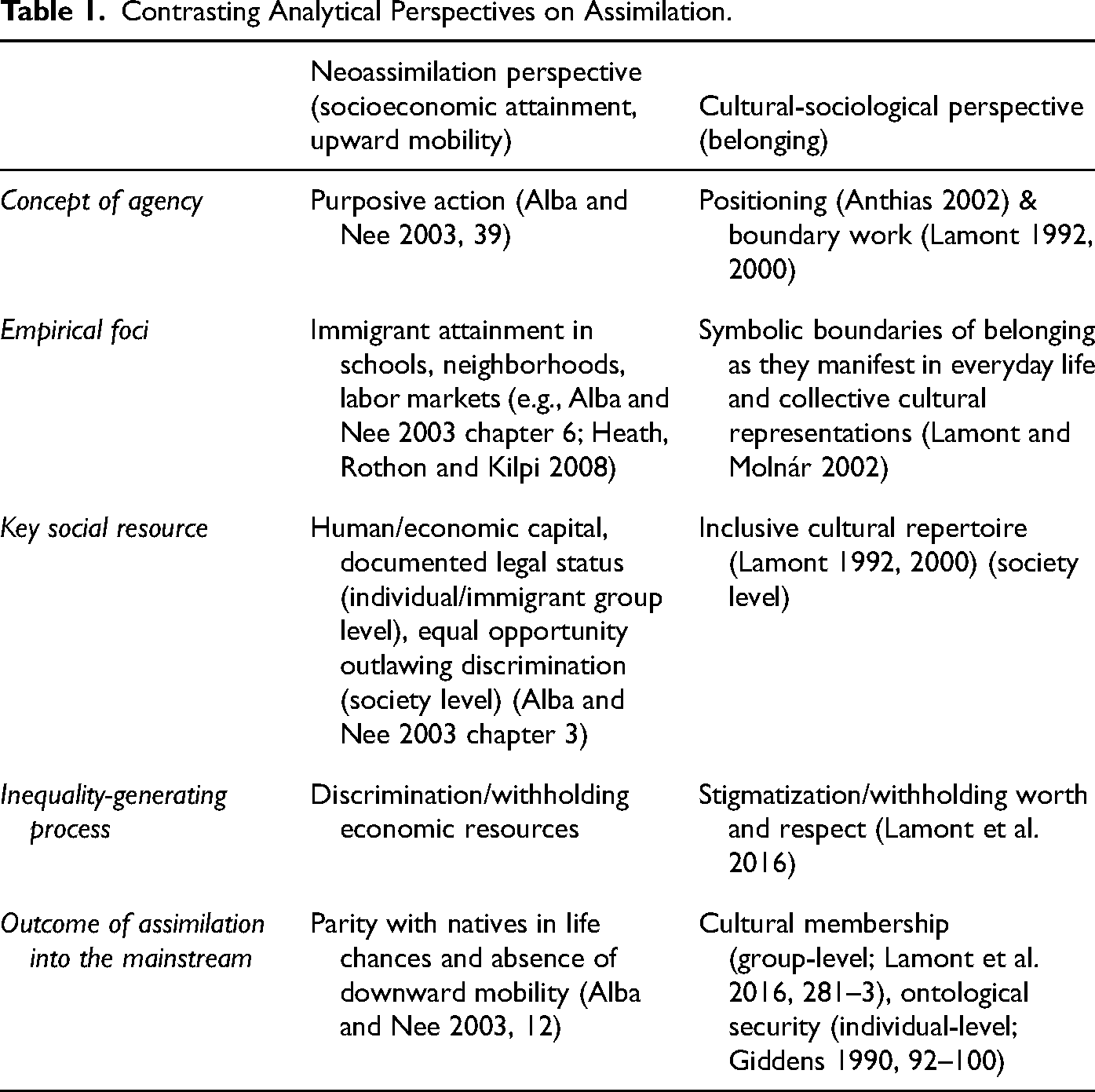
Neoassimilation explicitly centers on purposive action—utilitarian adaptations to opportunities for socioeconomic advancement in specific institutional settings, like labor markets, where equal opportunity is guaranteed under the rule of law (Alba and Nee 2003; Drouhot and Nee 2019). By contrast, a perspective focused on national belonging considers how immigrants manage stigma and achieve belonging through positioning—narratives to interpret one's location within a larger national community (Anthias 2002)—and boundary work—subjective distinctions to distance oneself from others deemed inferior (Lamont 1992, 2000). While positioning primarily refers to discursively identifying oneself in the national imagined community, boundary work involves judgment about others (as well as judgment about the judgments of others) (Lamont 1992). A crucial resource for positioning and boundary work is cultural repertoires—collectively shared scripts and narratives that are properties of societies but available for meaning-making by individuals, such as national myths, ideologies, and class cultures (Lamont 1992, 2000; Lamont et al. 2016, 20–22). While neoassimilation focuses on material inclusion and theoretically regards parity in life chances as signaling assimilation, a perspective focused on belonging considers cultural membership as the outcome of group-level assimilation—that is, when a group is considered worthy within the larger imagined community of “us” (Lamont 2000; Lamont and Molnár 2002; Lamont et al. 2016, 281–3). At a micro-level, I re-conceptualize cultural membership as the subjective experience of ontological security—a diffuse sense of comfort, home feeling, predictability, and trust in the social order and the national community as they appear to be (Giddens 1990, 92–100; Skey 2010). Ontological (in)security can analytically be conceived as the subjective experience of in(ex)clusion within the nation. It is analytically distinct from boundary work and positioning insofar as the former are belonging processes, while the latter is a belonging outcome.
Beyond a sole focus on immigrant progress in schools, neighborhoods, and labor markets, I focus here on the symbolic boundaries of belonging—everyday distinctions constituting common-sensical notions of “us” and “them” and how such notions might expand to include immigrant-origin populations after they achieve upward mobility (Lamont 1992; Lamont and Molnár 2002; Bail 2008). Classificatory struggles over symbolic boundaries are enacted in everyday life through stigmatization events (i.e., interaction in which one party negatively qualifies the other's social identity) (Goffman 1963; Lamont et al. 2016). 2 At a basic level, I interpret the residual salience of stigmatization and the ontological insecurity it produces in the subjective experience of immigrants and their children as signaling that assimilation is incomplete. Table 1 summarizes my framework construing national belonging as the endpoint of assimilation.
Contrasting Analytical Perspectives on Assimilation.
The Current Study: Stigma and National Belonging Among the New Immigrant Elite in France
Here, I apply the analytical framework proposed above to study how high levels of socioeconomic attainment in France convert (or not) into national belonging among upper-middle-class, immigrant-origin individuals. Empirically, I ask: How do high-status, socially successful members of visible immigrant minorities negotiate their inclusion as “one of us” in France? How does their class background shape their experiences of belonging (i.e., their positioning and ontological security) and perceptions of symbolic boundaries around what it means to be French? How do they respond to stigmatization to justify their worth in the imagined community through boundary work? No study has examined the subjective experiences of national belonging among high-status, immigrant-origin individuals in France or elsewhere in Western Europe. By focusing on those who are highly assimilated as per the metrics typically used in assimilation research (e.g., Alba and Nee 2003; Heath, Rothon and Kilpi 2008), my goal is to leverage the new immigrant elite as a strategic research site to see how high attainment relates to the lived experiences of national group membership in everyday life.
France is a particularly relevant case to do so. A country of intra-European immigration since the nineteenth century, postwar migration from North and Sub-Saharan Africa led to perennial societal concerns for a putative lack of “integration” (Hargreaves 2007). The politics of diversity and inclusion in France have bundled together issues of urban segregation, racism, and more recently, religion and the accommodation of Muslim minorities (ibid). Empirically, I use in-depth, semistructured interviewing with forty-two immigrant-origin professionals conducted between 2011 and 2017. Focusing on their experiences of stigmatization and discrimination, I exploit the phenomenological potential of in-depth interviewing to study the positioning and boundary work in which individuals engage to negotiate their belonging in France. I strategically used my social location as non-Muslim, French individual without a migration background to adopt the position of a listener with little prior or implicit knowledge so that interviewees had to explicitly spell out their experiences to me (Arendell 1997).
In the absence of detailed ethnic statistics (Simon 2008) and given that immigrant-origin individuals with an upper-middle-class status remain relatively rare in the population at large, sampling interviewees posed substantial logistic challenges. Interviewees were, therefore, recruited through snowball sampling with multiple starting seeds to ensure sufficient diversity. No referral chain was longer than six respondents. I used occupation and educational attainment to identify upper-middle-class background (Lamont 1992). A small group of respondents had parents with university degrees, but most had parents with much lower education than themselves and were upwardly mobile across generations. No relevant difference in interviews emerged on the basis of parental educational attainment, and I, therefore, regard upward mobility and upper-middle-class status as synonymous in this study. I used broad regional origins (e.g., Maghribi or Sub-Saharan African) and immigrant status to identify respondents of the relevant low-status immigrant groups in a French context (i.e., groups that accumulate disadvantages due to their stigmatized, postcolonial ethnoracial origins and their being historically composed of low-skilled workers from countries with limited levels of compulsory education).
Study participants together formed a group of highly educated professionals of North and Sub-Saharan African background representing a new immigrant-origin “elite” (i.e., first- and second-generation individuals who achieved high levels of attainment in the labor market relative to their immigrant group). Some respondents could be considered elite vis-à-vis their immigrant and native counterparts (e.g., lawyers and doctors). Twenty-seven interviewees were male, and twenty-seven were French-born (conversely, fifteen were first-generation immigrants). All foreign-born respondents were permanent immigrants, and all respondents but one held French citizenship. Interviews were carried out in the Paris area, as well as in mid-sized cities in Eastern France, and took place in public places or in respondents’ offices or homes.
Interviews lasted approximately 90 min and featured a similar set of core, open questions regarding respondents’ biography and professional trajectory, their subjective sense of membership in the national-cultural community (positioning), their experiences of stigmatization and discrimination, and their “feeling home” (ontological security). I did not ask about racial or religious stigmatization per se but let interviewees inductively identify and interpret the nature of stigmatization events on their own after my general prompts to elicit answers on “racism”—a term I voluntarily eschewed to define. A crucial component of interviewing was the respondents’ own interpretation of the causes of such incidents to elicit boundary work as responses to perceived stigmatization—in other words, how they responded to stigmatization experiences in terms of meaning-making and boundary work, rather than behavioral strategies. Hence, there was variation in the latter parts of interviews, as probing and follow-up questions depended on answers to earlier questions. In particular, Muslim respondents’ discussion of religious stigma resulted in intragroup boundary work involving specific, in-depth discussion of religious identities and practices. Interviews were all conducted in French and later (partially) translated in English. Table 2 gives a breakdown of respondents by gender, age, profession, immigrant origin, and whether they self-identified as Muslims.
Demographic Characteristics of Respondents.
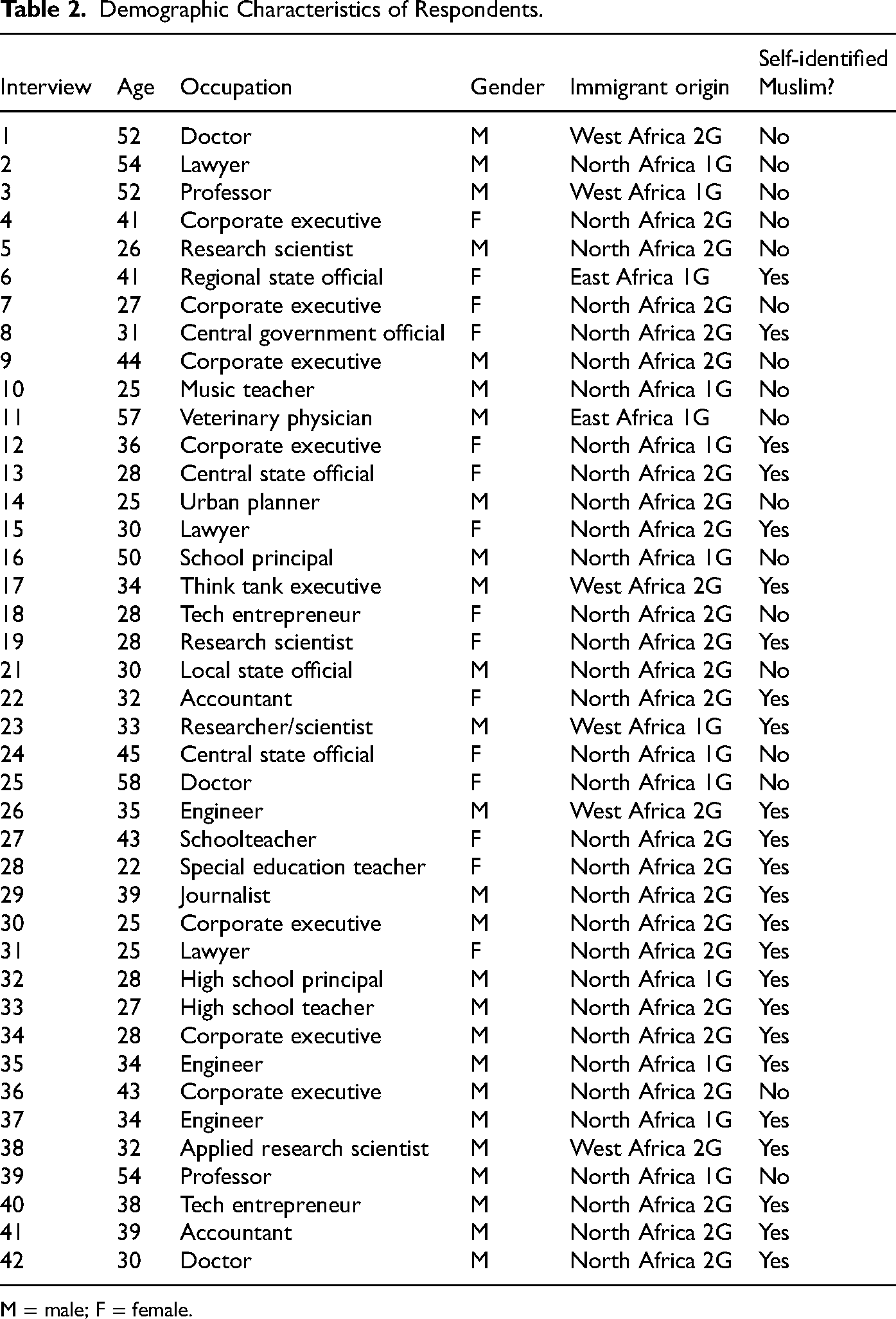
M = male; F = female.
Data analysis followed an iterative, inductive logic broadly (but not fully) modeled after grounded theory (Strauss and Corbin 1998; Rubin and Rubin 2012; Deterding and Waters 2018). To analyze the data gathered in the first phase of fieldwork, I produced “index codes” (rather than line-by-line coding; see Deterding and Waters 2018: 19) to capture my interpretation of large chunks of transcribed texts and allow comparability across interviews and easy retrieval. I used index codes to reduce the data in a more direct fashion than the theoretical coding approach found in grounded theory (Deterding and Waters 2018). Index codes were, for instance, “feeling of discrimination at work,” “Anecdote of racism in childhood,” etc. Cross-interview patterns emerged from aggregating and comparing these index codes across interviews. Re-reading index codes, in conjunction with analytic memoing on emerging themes and in-depth reading of relevant literature (e.g., Lamont 1992), later led to the formulation of analytic codes (Deterding and Waters 2018, 21:23), especially around responses to stigmatization and the characterization of cultural repertoires mobilized by respondents. This characterized the second phase of fieldwork. Hence, there was variation in the latter parts of interviews, as probing and follow-up questions depended on answers to earlier questions. In particular, Muslim respondents’ discussion of religious stigma resulted in intragroup boundary work involving specific, in-depth discussion of religious identities and practices. Interviews were all conducted in French and later (partially) translated in English. Table 2 gives a breakdown of respondents by gender, age, profession, immigrant origin, and whether they self-identified as Muslims. More detail on fieldwork phases, data analysis and other aspects of the research design are available in the accompanying online appendix.
National Belonging Among Upper-Middle Class, Immigrant-origins Individuals in France
Proud Members of the Republic: Positioning Within the National Community and Claiming Membership
Most respondents strongly identified with French national culture and had positive views of mainstream French institutions (e.g., schools, criminal justice). Their definition of “being French” often mobilized the repertoires of the Enlightenment and French Republicanism, which sees national belonging as a matter of individual will rather than ethnicity (Brubaker 1992). They typically framed their occupational success stories as part of a tradition of colorblind inclusion in France. Respondents used such positioning within the nation to reject nativism and ethnic exclusion as un-French, especially among non-Muslim, foreign-born respondents. A West African-born, naturalized medical professional explained: I think I am a fine French citizen and that I am able to talk about French culture just as well as those who claim only they really belong. Sometimes, I encounter people who are a little rigid about all of this, and I tell them, “This is not what French culture is all about.
Q: You mean, racism?
Yes, among people who are racist. And even historically, France has always been a welcoming place. France is the country of Human Rights, the country of opening up to others, and the country of assimilation of various immigrant flows, since the Antiquity until now and in recent times … The Italians, the “ritals” [slang] as we used to call them, the Spaniards with Franco, the Portuguese, the Polish in the mines of the North, and their descendants are culturally French, so I don’t really see how someone can claim to belong just because he has deep roots here.
Older and foreign-born respondents typically noted a decrease in interpersonal occurrences of overt racism in their lifetime. None reported facing hostile behavior based on ethnicity in their workplaces. Some were even cautious about interpreting personal rejection as racial injustice, as they believed it could lead to “communitarianism” and harm the civic community—another hallmark of official culture revolving around the “indivisible” French Republic (Brubaker 1992).
Away from the polite and educated social milieus in which respondents lived, respondents reported that the hostility of certain natives manifested more clearly in electoral periods. High electoral scores from the far right served as an important reminder that France as a whole might not be as inclusive as their immediate social environment. Yet, a typical Republican rhetoric also informed the cultural response interviewees put forward, in which the National Front
3
defended a misguided idea of France. In the words of a Moroccan-born elected official, As far as I am concerned, the Front National is not part of the Republic. I am sorry, but no way … France has benefited from waves of immigration that made it what it is today, one of the most respected nations in the world. And foreign populations have been necessary in order to feed this virtuous circle. It is not just about the Gallic village [village gaulois]. The FN defends this notion of a Gallic village, but it does not exist. For me, fighting racism is also a pillar of France. And it is what honors it abroad and why it can be seen as an example. It is the cradle of Human Rights, and of the Enlightenment, let's not forget it, French history is also about that.
Q: You think people who vote for the FN forget this aspect of history?
No, it's not that, they simply don’t know it. They definitely don’t know it.
In this excerpt, the respondent used the themes of ignorance and social progress to locate hostility toward immigrants outside the realm of Frenchness. Such a response is part of a broader reliance on upper-middle-class culture, to which I now turn.
Making Sense of Racial Prejudice: A Kind of Backwardness
When discussing discrimination in France, interviewees often shared personal stories of overt racism in public spaces, such as name-calling, insults, and threats of violence. Even though these instances were rare, they played a significant role in boundary work and defining behaviors perceived as primal and uncultured. For instance, an African-born male doctor working in Eastern France recalled experiencing xenophobia twice while using public transportation as a medical and junior high school student: One day a bus driver told me: “So you’ve come here to screw our wives, snow white?.” I was 12, and I did not understand what he meant … I mean, I had learned a rather literary French back in [African capital] …, and my friends later told me what it actually meant.
Once I took the subway, I sat down and an older person got up, spat on the ground and said “you n****!.” Whatever …”
An elected official also recalled similar interactions and commented,
This is a primal form of racism. Primal because it is really the reaction of an animal in a jungle … I mean it just makes no sense. Someone who is just insulting, I mean, I don’t see him as an animal, but almost, because it is a violent behavior. I just find it primeval.
Both respondents opposed such overt hostility to a sense of civilization with which they were endowed with. One's mastery of a rich, formal French actually prevented him, at first, from understanding a grossly racist remark is analogous to the other's qualification of outwardly discriminatory remarks as primitive. Similar accounts of managing public interactions with hostile natives depicted the despised French stereotypical figure of the beauf – a rude, chauvinistic, and unintelligent individual without taste or etiquette. In these accounts, a subtle stigmatization of typically “vulgar” ways of talking and acting served to invalidate hostility from natives without intellectually engaging with it, at the time of the interaction or when recounting the story during the interview. Nonchalant reactions (“whatever”) typically served to mark such aggressive verbal and bodily expressions as unfit to contest respondents’ place in society. The strong engagement of body and words in public interaction, valued as virility and honesty in French working-class culture, is typically stigmatized as impolite and uncivilized in middle and upper-middle-class cultures (Pinto 1984).
Among respondents, the stigmatization of certain manners and speech as inferior was inseparable from the stigmatization of racial prejudice as an intellectual defect. A reliance on the repertoire of cultural elitism (Bourdieu 1984; Lamont 1992) to characterize race-based prejudice as culturally backwards cut across interviews. In one instance, when a Tunisian-born music teacher was denied service at a restaurant, he explained that his intellectual background empowered him to get over his initial frustration: Q: What made you get over it so easily?
It is because I think I know where it is coming from. I know it is a preconceived belief, I know the person who reacts like this doesn’t think at all, so why bother …? I was raised this way. As I told you, my father is a very cultivated individual; he really is a thinker.
Q: What is it that he taught you that was useful for you when facing racism?
To think. Yes. To think … When you face something, you have to try to understand it, where it comes from and so on. It is much more satisfying than just reacting. Can you imagine, about what I just told you at [name of the bar], here I come, I am not even seated yet, I haven’t ordered anything and the waitress comes and tells me, “Sorry, no coffee served on the terrace.” I could have reacted pretty badly. And it would have been somewhat legitimate … But no. No way.
In this interview excerpt, the respondent's dichotomy between reaction and reflection paralleled the boundary work of other interviewees contrasting a sense of civilization with hostile natives’ “crass” attitudes. He framed racist attitudes as a type of irrational, knee-jerk reaction opposed to his own sense of intellectual sophistication. He elaborated:
No, it doesn’t bother me … That stuff does not affect me. There are times it arouses pity, you know? I am someone who is really open-minded, and you know, there are times [those reactions] are just appalling. It arouses pity because if I could talk to the person, I could show her that I am much more open-minded, much more cultivated, you know. And if she sought to know how I came here, what I am doing, and so on, I am sure she would change her mind, you know?
Interviewees’ boundary work coalesced around being intellectually sophisticated. Being “cultivated”—an imperfect translation for “cultivé” in French, having in-depth knowledge in diverse areas and being intellectually accomplished beyond one's professional sphere—operated as a powerful discursive device. This emphasis on gratuitous knowledge and “legitimate didacticism” (Bourdieu 1984, 24–5) is a key element of social distinction in the French context, and was central to respondents’ responses to stigma.
Corollary to respondents’ cultivated character was a sheer “ignorance” and “inculture” among the native stigmatizers—an intellectual defect identified as the backbone of prejudice. Respondents stigmatized inculte individuals’ ignorance of fields of knowledge as diverse as biology, history, or law—which they, by contrast, claimed a strong command of by virtue of their work or leisure reading. Respondents thus implicitly claimed superior ways of knowing by punctuating their discourses with references to historical cases, experts, and statistics in contrast to anti-immigrant discourses presented as folk knowledge. This discursive sophistication is a hallmark of legitimate culture valuing abstract and deductive knowledge compared to working-class modes of knowing valuing experience (Bourdieu 1984; Pinto 1984). It implies a hierarchy in which “culture” and knowledge operate as corrosive agents against bigotry: “someone who is cultivated, who is open-minded towards the world, who reads a lot, can’t be racist,” as an Algerian-born official put it.
Interviewees were more forgiving toward the regrettable attitudes of uneducated, ignorant people than toward others held to higher intellectual standards. A French-born lawyer of Algerian ancestry and a practicing Muslim reported understanding how someone “who has less education, who is less cultivated, who is not as smart” could be prejudiced and that she herself could think this way “if she was a little dumber than she actually is.” When asked about what to think of racially prejudiced colleagues, she elaborated: It is less acceptable insofar as lawyers are educated, smart people. I have a friend, his grandmother has never seen an Arab person in her whole life … She watches T.V., and she hears about urban riots by blacks and Maghribi people who burn cars. I can understand why she would be racist and afraid. It is silly, because she is ignorant … Even though I don’t approve, I can understand … But a lawyer who has been exposed to a lot of people, who knows full well that an Arab is not any less worthy than a yellow or a white person, indulging in racism, no I can’t accept it. Then I can actually judge that person and say, ‘He is just a dummy.’
Life Behind the Bright Boundary: Religious Stigma and Ontological Insecurity Among Muslim Respondents
While cultural elitism emerged as the predominant way to disempower racial stigma and claim worth in the French nation, religious affiliation shaped Muslim interviewees’ experiences. While this article does not focus on religious stigma per se and while the religious affiliation of non-Muslim respondents appeared irrelevant, Muslim interviewees’ predicament emerged during fieldwork. Muslims respondents’ attachment to the French nation was high, and they generally claimed to be “as French as anyone else” (Beaman 2015). Yet, when comparing their perceived evolution of stigma and discrimination in everyday life, Muslim respondents typically told a different story. They agreed that blunt racism and race-based prejudice were fading away, but perceived anti-Muslim acts and discourses in everyday life to have been increasing. In that regard, my results suggest a uniquely religious dimension of stigma (Adida, Laitin, and Valfort 2016) and depart from recent research on the “racialization” of Muslims, and the argument that experiences of racial and religious marginalization are linked (Galonnier 2019). 4 Rather, my qualitative data offer vivid illustrations of the micro-level, subjective experience of national membership in everyday life behind a “bright” boundary (Alba 2005), whereby one's worth and place within the imagined French community is perennially politicized and questioned.
Depending on their age and personal story, Muslim respondents identified various tipping points for a change in public attitudes towards Islam, including 9/11, Nicolas Sarkozy's presidency, and various terror attacks in the 2010s. 5 To understand Muslim respondents’ subjective experiences, it is useful to mobilize Simonsen's (2018, 134) distinction between belonging in—identifying with a country and its history and having one's life settled in that country for the foreseeable future—and belonging with—feeling that others think you belong with them. While their belonging in France was self-evident, no self-identified Muslim respondent reported that she perceived the national cultural community to have grown more accepting of Islam and Muslims over time, regardless of how these categories were defined across interviews. Religiously observant individuals who prayed, fasted, or wore a religious sign 6 generally reported growing difficulties in articulating religious practices and daily life. For Muslim interviewees, avoiding the image of someone “who does not want to integrate” (qui ne veut pas s’intégrer) constituted an important aspect of self-presentation.
The meaning of appearing “integrated” varied across interviewees and contexts: for some, especially women, 7 it meant managing expectations of gender traditionalism to appear as “modern” Muslims. Some felt the need to hide their religion in public spaces to be “discreet” Muslims. For others, “integrated” meant condemning and dissociating themselves from self-identified Muslims perpetrating terror attacks in casual conversation with non-Muslim others.
However, navigating interpersonal relations was not the most challenging aspects of daily life among Muslim respondents. Rather, the essence of the religious stigma they experienced was a diffuse, but poignant contradiction: that of being seen, discussed, and considered primarily as Muslims in a country where religion should be a matter of private opinion, as per the official tenets of laïcité. One female respondent, a senior executive at a major transportation company, explained. For a while, I have felt that secularism [laïcité] has been something aggressive and still is today. I am all for secularism the way it was defined in the 1905 law because it allows for the cohabitation of different religions. But I am not for a fundamentalist and dogmatic secularism [laïcisme intégriste, dogmatique].
Q: It is something you have personally felt? This weight?
Yes, sometimes I have this impression. Staying positive and benevolent in that context is hard. For a while, I have had the feeling that I am forced to just be a Muslim. But I am not just Muslim. I am French, I am a woman, I am a worker, I am a mother. They just see my Arabness [on me renvoie à mon arabité], which is a part of me as well, as well as my religion. And I am aware that for some, I am not fully French. For me, I am, and I am at peace with that. I know some people in my situation are not at peace with that. But I am. I think in French, I dream in French. I was schooled in France. And I take part in the national French effort.
Despite such positioning within the French imagined community, respondents’ subjective experiences of a bright boundary were identifiable in the uniform and unambiguous way they reported a generalized anti-Muslim discourse in the realm of politics and mass media. When asked about how the atmosphere in France vis-à-vis Islam had changed in the 2000s, a French-born Muslim of Moroccan parents (and a medical doctor) referred to a change in public discourse: It's very subjective … But my impression, like that of many other Muslims, is that on television, in the media and especially in politics, we are constantly criticized as Muslims specifically. And this has been like this for a while … I would say this has been like this since 2004 and the law on the veil in public schools. And I feel that they are always trying to cast us in a same mold.
Q: Who is “they” here?
It is mainly right-wing politicians, but also left-wing ones now, relayed by certain journals and pundits … It's not that we are not integrated, it's that certain such persons do not want to integrate us.
Q: And this has been since 2004?
Yes. I feel like I was insulted then. And that I have often been insulted since.
Respondents lamented both the quality, focusing on select cases that reflected poorly on Muslims, and the quantity of political and news coverage on Islam. They had come to expect the same reporting or articles on halal slaughtering, illegal mosque building, and other topics as they coincided with celebrations of the Muslim calendar. About a third of respondents, mostly from the second generation, reported that they simply stopped watching television in the last few years because of this excessive coverage. Several regretted the fact that many public conversations on Islam occurred without the voice of Muslims themselves, instead drawing on pundits or theological scholars whom respondents did not see as legitimate. This lack of authentic representation led to the impression of a constant conversation “about us but without us,” as one interviewee put it, and a worry that negative media framings reflected the general population's opinion. Yet, many were pleasantly surprised at recent electoral results, including the 2012 and 2017 presidential elections. Muslim interviewees realized, in the process, that media and political framings of Islam were not necessarily shared in the public at large, as a female respondent shared about the 2012 election of moderate-left president Hollande: I was very angry some time ago, and I was telling myself, “I am going to leave France.” That was four or five years ago. I had discussed this with one of my old bosses. And finally I decided against it. I thought I would stay, I would fight.
Q: When was this exactly?
This was after the terror attacks by Mohammed Merah. 8 The climate was really, really tough. I really thought about it [leaving]. But I did not do it. What reconciled me is that there had been the 2012 elections afterwards, and I told myself, “The media is trying to have us believe that the whole of France is against Muslims, but in fact it's not the case.”
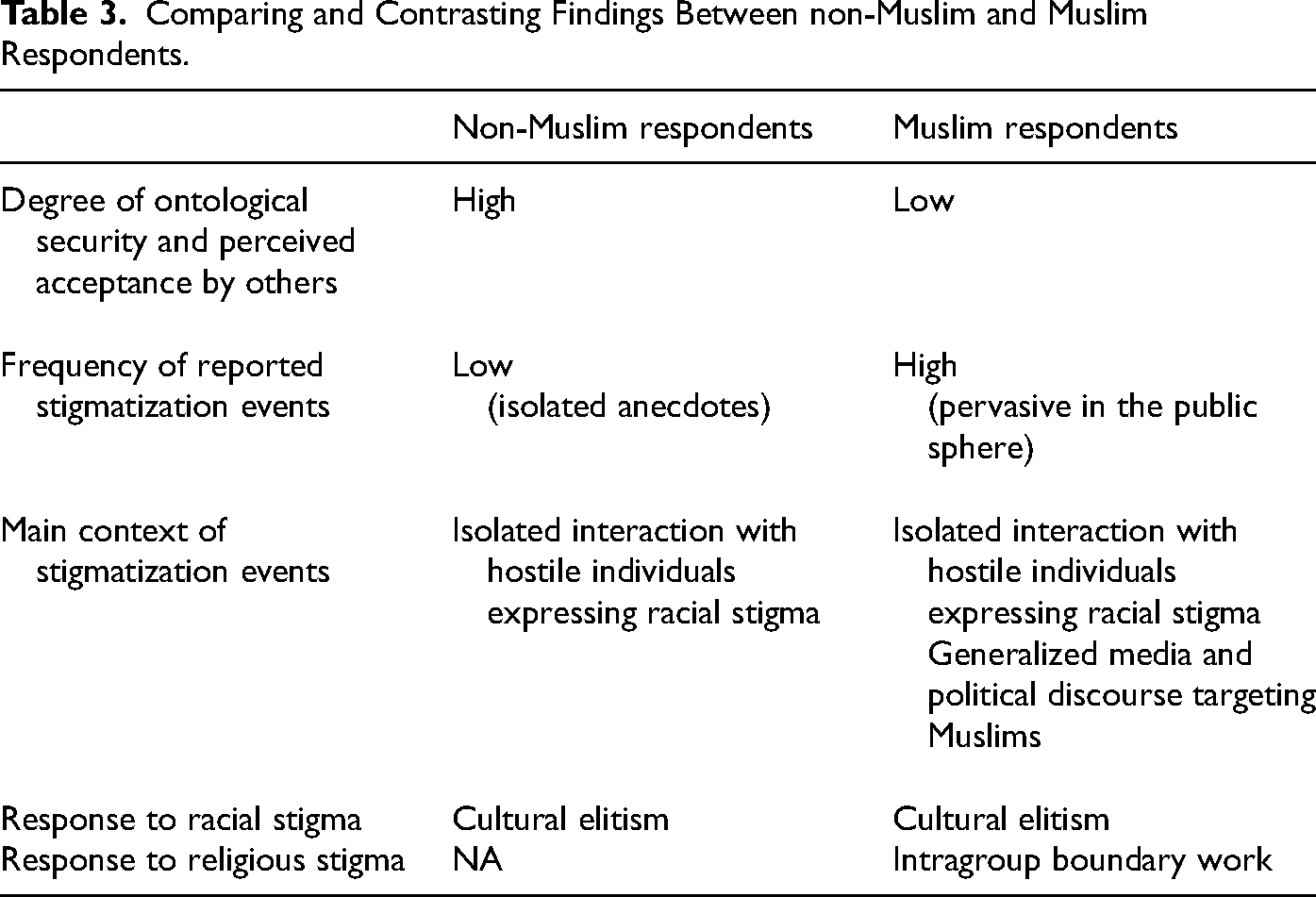
In the excerpt above, the interviewee reported realizing during the May 2012 presidential elections that the situation was not so bad as she had thought, based on the climate following Mohammed Merah's religiously motivated terror attacks in March of the same year. Importantly, this situation for upper-middle-class Muslim respondents represents an inversion of that for non-Muslim upper-middle-class immigrants, for whom daily life was rather incident free and who only occasionally realized that hostility was “out there” when the anti-immigrant far right scored high in various elections. Overall, the interview material suggests that the recurring politicization of Islam and the general “climate” Muslim respondents perceived as hostile resulted in ontological insecurity—the inability to feel safely at home and to have a stable and predictable future in France. Concretely, such a climate took a big toll on Muslim respondents’ ability to envisage a stable future in France. Past and present plans to leave, such as those expressed by the respondent above, were explicitly mentioned by four other interviewees. Some planned to return to their parents’ homelands (e.g., Morocco or Algeria) to practice and live their faiths as they pleased. Others thought of emigrating and often compared the negative French context to places they perceived as more inclusive of religious minorities, such as the UK. Such desires were more clearly expressed by those who had grown up in France, compared to foreign-born individuals who had naturalized and exhibited a rather typical immigrant optimism. (see Table 3)
Comparing and Contrasting Findings Between non-Muslim and Muslim Respondents.
“This is not What Islam is About”: Intragroup Boundary Work Around Religious Authenticity
Compared to non-Muslim respondents, a crucial difference among Muslims was their approach to claiming membership and worth in the French nation when facing stigmatization. Unlike non-Muslims, Muslims did not seek to dismiss Islamophobia as illegitimate. While they criticized negative media coverage and discourse by French politicians, they generally did not challenge anti-Muslim sentiment among the public, understanding that negative perceptions were fueled by constant negative coverage of their religion in the media. Rather, they responded to stigmatization by depicting themselves as better representatives of Islam than those who, in their opinion, gave it a bad name. Such depiction generally meant framing their own religious practices and identities as personal, nuanced, and universalist, rather than communitarian and dogmatic, and typically presenting themselves as “liberal Muslims.” In doing so, they revealed the long shadow of an Islam-specific “integration discourse” (Duyvendak et al. 2016)—recurrent national discussions regarding the nature of Islam, its purported incompatibility with secularism and Western liberal democratic norms, its inherent social conservatism, and its links to religiously motivated acts of terrorism. Such an integration discourse pushed respondents to take a stand when discussing their own views.
This leitmotiv in the data is particularly remarkable, given respondents widely varied in their own religious practices and identities (Killian 2007; see also Drouhot 2021 for a study of religious heterogeneity among Muslims in France). Upon describing his own religiously liberal views, for example, one interviewee spontaneously criticized excessively dogmatic religious approaches, such as wearing the face veil (niqab), which he had recently seen at a wedding party: God did not put us here on Earth to live in these shackles, to live closed off from the world in a veil, without a critical mind, and living with a narrow mind, without exchanging, and inevitably, in the end, becoming dumb, becoming an idiot. At this wedding, I saw a girl I used to know, she was so good at school, she studied, and now she is wearing the veil? Maybe she is happy, I don’t have the monopoly of the definition of happiness, but my perception, when you look at these women, walking next to their men, is that they aren’t. They don’t smile, they don’t seem to really live … They are just … sort of locked up.
Respondents discussed their approach to Islam regarding media-stigmatized images, which they attributed to misguided interpretations of religious texts by those representing their religion in public controversies. They referred to “their” vision of Islam, acknowledging its internal diversity and the legitimacy of their educated interpretations (Killian 2007). They emphasized the separation of strict religious rituals from faith and personal values to belong in the Muslim community. Many argued that Islam was not only about following scriptures but also moral values like generosity toward the poor and respect for the elderly. When asked about how Muslims could gain greater acceptance in France, a female respondent working as a senior official replied, If we could get together around values of generosity, sharing, respect, humanism. And curiosity, which I think is also an Islamic value, to want to be educated rather than to be passive and to just get swallowed in. I mean, to determine the type of life you want to lead, which is a common aspect in a lot of religions and philosophies. This, I would like us to have more emphasis on. Conversely, what I sometimes regret is this more obscurantist approach, a bit less educated and learned, which uses this [religion] and could use something else. A lot of these people are just thugs, for me … Typically, terrorists, I mean little pricks, really, sorry for me they are just little thugs. They could have done anything; they could have gone into the mob or criminal networks. It's just the same thing, except it has this Islamic “hat” on it. It is so unfortunate for others that it is this “hat” in particular.
Muslim respondents did not use cultural elitism to deflect anti-Muslim attitudes, but used it to criticize radical interpretations of Islam. In this respect, Muslim respondents drew on similar tools and themes as non-Muslim respondents but directed it at other, undesirable Muslims, blaming some versions of Islam rather than native, non-Muslim French harboring hostility. They typically framed culture and knowledge in a narrative of religious self-actualization in which respondents came to “their” vision of Islam through autonomous reading and questioning. In doing so, they presented their religious trajectory as a worthy, personal quest and as differentiated from the figure of the radical Muslim who was uneducated and uncritical in her approach.
Discussion and Conclusion
This article described the experience of national belonging among high-status, immigrant-origin individuals in France. It asked: how does their social position shape their experiences of national belonging, and how do they negotiate their cultural inclusion as “one of us”? To date, the emerging literature on upwardly mobile immigrant-origin individuals has focused on their “fitting in” in high-status educational and occupational milieus, rather than belonging within the larger imagined community of the nation—arguably the endpoint of assimilation and a crucial reference point for collective identity (Brubaker 2010; Skey 2010, 2013). I proposed an analytical framework extending the neoassimilation perspective traditionally focused on socioeconomic attainment and upward mobility and leveraged the study of the new immigrant elite to show how high socioeconomic attainment converts (or not) into national belonging in everyday life.
I found that non-Muslim respondents typically relied on cultural repertoires from French republicanism to claim membership in the national, imagined community. I also found that Muslim and non-Muslim respondents used aspects of upper-middle-class culture—namely, cultural elitism—to deflect experiences of racial stigmatization and claim national membership. I documented a different pattern among Muslim respondents experiencing lower levels of ontological security (i.e., a lower sense of comfort and ability to “feel at home”) and a specific religious stigma, particularly pronounced among the second generation. Despite their strong expressed attachment to the nation, Muslim respondents had a complicated sense of religious and national belonging, as they felt constantly targeted in the public sphere. In response, their boundary work coalesced against other Muslims whom they saw as giving their religion a bad name. Importantly, Muslim respondents appeared unable to dismiss such prejudice as being socially illegitimate, as they did with race-based prejudice and racial stigma. These results are broadly in line with recent research on polite responses to stigma among middle-class Muslim activists, who were found to urge other Muslims to “behave” and to challenge stigma through discretion and discipline, rather than challenging the legitimacy of anti-Muslim stigma in France (Dazey 2021). However, they diverge from past studies on behavioral strategies among Muslim professionals who occasionally “resisted” marginalization in the workplace and asserted their place by asking for permissions to pray at work (e.g., Berger, Essers and Himi 2017). When it comes to the subjective experiences of inclusion in macrolevel units like the nation, ordinary Muslim individuals cannot pragmatically seek inclusion as they can in the realm of work.
Empirically, this article complements work identifying unique barriers to integration and cultural membership among Muslim minorities in western Europe (Heath and Martin 2013; Adida, Laitin, and Valfort 2016; Drouhot and Nee 2019). It illustrates the microlevel, lived experiences of “bright” boundaries against Muslim minorities mentioned in Alba's (2005) influential account. Going beyond Alba's ecological focus on church-state regimes and citizenship laws creating exclusion, however, this article points to the everyday politicization of cultural differences occurring below the radar of formal institutions. Such politicization is a constituent aspect of “bright” boundaries as lived by those whose social identity and experience of inclusion are directly impacted.
What makes such boundaries “bright”? The same civilizationist narrative that allowed non-Muslim respondents to dismiss racism as culturally backwards has become a key rhetorical weapon against Islam of the populist right in several European countries, including France and the Netherlands (Slootman and Duyvendak 2015; Duyvendak et al. 2016; Brubaker 2017). An anti-Muslim, civilizationist narrative makes it effectively much harder for Muslim individuals to dismiss anti-Muslim stigma through cultural elitism and other aspects of upper-middle-class culture. Rather, it places the burden on Muslim individuals to differentiate themselves from undesirable Muslims. My results, therefore, extend existing work on the new immigrant elite by showing that stigma in everyday life occurs not only or even mainly in the realm of work (e.g., Crul, Keskiner, and Lelie 2017) but also in the more abstract level of the imagined national community, where difference and ideas of “us” are continually politicized, particularly in the mass media (Skey 2010, 2013). In sum, the everyday politicization of cultural difference is essential to understanding the experiences of those excluded by bright boundaries.
Theoretically, this article highlights cultural repertoires’ importance for the assimilation process, showing that inclusive repertoires are necessary for the conversion of socioeconomic attainment into belonging. Non-Muslim respondents’ cultural elitism aligns with Lamont's (1992) study on the French upper-middle class, which found a reliance on snobbism and high culture as a strategy for social distinction. In contrast, my findings show that Muslim individuals’ sense of belonging depends on the availability of inclusive cultural repertoires that destigmatize and normalize Islam in France. Beyond the French case, these findings suggest that national cultural repertoires should be construed as properties of societies enabling or complicating assimilation among immigrant-origin populations in ways analogous to that of formal institutions (Nee 1998), like immigration and equal opportunity law. While the latter may enable or complicate immigrants’ socioeconomic trajectories (Alba and Nee 2003; Nee and Alba 2013; Nee and Drouhot 2020), national cultural repertoires may enable or complicate immigrants’ claims to belong within the national community of “us,” regardless of socioeconomic attainment (Lamont 2000; Lamont et al. 2016).
By taking meaning and worth within the imagined community of belonging seriously, a cultural perspective emphasizing cultural repertoires and other tools for meaning-making can productively extend neoassimilation theory. My findings show that the negotiation of belonging among high-status immigrant-origin individuals continues after socioeconomic attainment. Thus, some degree of socioeconomic success appears to be a necessary, but not a sufficient, condition for assimilation. The nationally specific nature of cultural repertoires warrants further work in other national contexts, including other European countries and the United States. The framework proposed above can be used in future studies to better understand how context affects assimilation and shed light on the social conditions under which ongoing migration cumulatively contributes, or not, to a broadening of the imagined community of the nation-state.
Supplemental Material
sj-docx-1-mrx-10.1177_01979183231172106 - Supplemental material for Fitting in at the Top? Stigma and the Negotiation of Belonging Among the New Immigrant Elite in France
Supplemental material, sj-docx-1-mrx-10.1177_01979183231172106 for Fitting in at the Top? Stigma and the Negotiation of Belonging Among the New Immigrant Elite in France by Lucas G. Drouhot in International Migration Review
Footnotes
Acknowledgments
Direct correspondence to l.g.m.drouhot@uu.nl. I wish to thank Asad L. Asad, Mabel Berezin, Kendra Bischoff, Tom Davidson, Margot Dazey, Filiz Garip, Lorène Guerre, Christine Lang, Radu Pârvulescu, Jan Spieker, Victor Nee, participants in the Migration and Migrant Groups research seminar at McGill University, members of the sociology research practicum at Cornell University, the panel on "Imagined Identities" at the 23rd International Conference of Europeanists in Philadelphia, the session on Comparative Perspectives on Racialization and Migration at the 2017 Meeting of the American Sociological Association in Montreal, members of the Socio-Cultural Diversity Department at the Max Planck Institute for the Study of Religious and Ethnic Diversity in Göttingen as well as the Editor and reviewers at IMR for useful feedback on earlier versions of this paper. I thank my respondents for their time and generosity in answering my questions, and the countless individuals who offered logistical help at one point or another during fieldwork. I dedicate this paper to the memory of two persons who provided particularly crucial support in the early phase of this project, Pascale Cantoni and Lucette Cantoni.
Declaration of Conflicting Interests
The authors declared no potential conflicts of interest with respect to the research, authorship, and/or publication of this article.
Funding
The author gratefully acknowledges the Graduate School (Research Travel Grant Award and a one-year Sage Fellowship), the Center of Economy and Society (Seed Grant) and the Institute for European Studies (Manon Sicca Research Grant) at Cornell University for funding and supporting this project over the years.

Supplemental Material
Supplemental material for this article is available online.
Notes
References
Supplementary Material
Please find the following supplemental material available below.
For Open Access articles published under a Creative Commons License, all supplemental material carries the same license as the article it is associated with.
For non-Open Access articles published, all supplemental material carries a non-exclusive license, and permission requests for re-use of supplemental material or any part of supplemental material shall be sent directly to the copyright owner as specified in the copyright notice associated with the article.
