




Abstract
Classic, segmented, and neo-assimilation theories delineate immigrants’ assimilation trajectories. Classic assimilation, since the early twentieth century, treats newcomers’ and established groups’ interactions as leading to ethnoracial pluralism within one culture. Segmented-assimilation, since the 1990s, examines non-European immigrants’ experiences, and considers how factors such as ethnic capital, immigration policies, and racial discrimination cause assimilation into upper, middle, and underclasses. Neo-assimilation, since the early 2000s, posits that assimilation compels upward mobility into a diverse mainstream. While the progenitors of each theory have pointed out the other's deficiencies, in this paper we simultaneously compare the three theories in light of the scientific method's criteria of deductive-inductive hypothesizing and falsification. We find that classic theory follows the scientific method and is falsifiable. In comparison, we find that because segmented- and neo-assimilation each depart from the scientific method in three ways they are not readily testable or falsifiable. We discuss the implications for migration and assimilation research.
Keywords
Introduction
For almost a century, researchers have relied on classic, segmented-, and neo-assimilation theories to explain immigrants’ experiences in their new countries. Classic assimilation theory emerged in the early 20th century primarily to examine European ethnic trajectories in the United States (Park 1928b; Gordon 1964). It was anticipated that immigrants would learn the cultures and languages of their new home and that, over time, the established groups would accept the newcomers. Such group relations were said to lead to ethnoracial pluralism under one culture. Segmented-assimilation theory emerged in the 1990s to examine non-European groups’ experiences (Portes and Zhou 1993). Theorists speculated that factors such as ethnic capital, immigration policies, and racial prejudice combine in different ways, leading immigrants into either upper, middle, or underclass categories. Since the early 2000s, neo-assimilation considers all immigrant groups and argues that the assimilation process or the erosion of ethnoracial differences compels upward mobility into an inclusive mainstream (Alba and Nee 2003). Which among these competing accounts is the most accurate theory?
The practitioners of each theory are aware of their competition. Jockeying for the best theory title, they have underlined the others’ limits. As classic assimilation's founders exited the academy, the new generation of researchers, later known as segmented assimilationists, pointed to the classic theory's silence on how racial prejudice blocks immigrants’ mobility (Portes and Zhou 1993; Zhou 1997; cf. Gans 2007 on mobility versus assimilation). In response, neo-assimilationists revived the optimistic outlook of classic theory. Questioning the existence of an underclass outcome, they claimed that the second-generation “kids are (mostly) alright” (Alba, Kasinitz and Waters 2011), and that segmented-assimilation's predictors such as ethnic capital or immigration policies do not account for the diverging outcomes (Luthra, Soehl and Waldinger 2018). Segmented assimilationists have responded by saying that neo-assimilation's mainstream outcome is so broad that it includes all native-born and immigrant groups alike and, hence, is a self-fulfilling truism (Portes, Fernandez-Kelly and Haller 2005, p. 1003). Last but not least, some from a European standpoint have also critiqued neo-assimilation for imposing its mainstream concept onto other countries as “if they were the U.S.” (Favell 2016, p. 2353). Is there a way to find the accurate theory without partaking in this decades-long discord?
The solution we propose here is to examine the three theories against the same standards. We use the scientific method's hypothesis and falsification criteria to compare the formation and emergence of the three frameworks and what they explain. The scientific method's criteria provide an ideal means of uncovering flawed theories and streamlining research practices (for similar studies, see Davis 2017; Dooley and Goodison 2020; and Karimi and Wilkes 2022). The method furnishes researchers with two tools. The first is to provide instructions for building (deductive or inductive) theories that are logically and empirically consistent with empirical evidence. The second is to provide a process of testing the available theories (Hempel 1965; Popper 2002 [1945], 2011 [1935]; Bradburn, Cartwright, and Fuller 2017). While much of social theorizing tends to focus on the first component, the second component, with its intention of theoretical falsification, makes the scientific method indispensable for replacing old frameworks with newer ideas. The aim is to eliminate the empirically-theoretically weak theories and to identify the theory that best explains the social world. 1
In what follows, we begin by discussing the scientific method of deductive-inductive hypothesizing and falsification. Next, we examine how assimilation theories were developed. We engage with the original texts of the theories in three sections on classic (Park 1914, 1915, 1928; Gordon 1964), segmented- (Portes and Zhou 1993; Portes and Rumbaut 2001; Portes, Fernandez-Kelly and Haller 2005), and neo-assimilation (Alba and Nee 1997, 2003; Alba 2006). 2 In each section, our goal is to consider whether the theories, in their formation phase, mapped onto either deductive or inductive methods and whether they are logically and empirically falsifiable. We find that classic assimilation followed the deductive method with an undertone of the Weberian ideal-type approach. This makes the theory falsifiable. Conversely, we find that segmented- and neo-assimilation partially followed the scientific method. The theory-building phase entailed three significant departures from the scientific method for each. These departures have led to built-in conceptual inconsistencies, which render segmented- and neo-assimilation untestable and unfalsifiable. In conclusion, we build on the important insights from these theories to discuss the implications for future migration and assimilation research.
The Scientific Method
Theories, hypotheses, and tests are all restricted to a bounded context or “initial conditions” such as a population or a socio-geographical context (Popper 2002 [1956]). All theories used today were originally empirical hypotheses. Hempel (1965, p. 178; see also Cartwright 1983, p. 104), for instance, distinguishes between two stages in humankind's knowledge production, inductive empirical hypothesizing or generalizations and, second, theorizing or theory formation. Theorizing in social sciences focuses on theory-building (Swedberg 2017; see Brettell and Hollifield 2022 for theorizing in migration studies). Such theorizing ranges from realist and rational choice theories (for reviews, see Kroneberg and Kalter 2012 and Fuhse 2022) to feminist (Davis 2008) and constructivist theories (Abend 2019; Mahoney 2023). In comparison, the scientific method of hypothesizing and falsification, or critical rationalism, contains this theorizing process and the practice of falsification.
As such, the scientific method supports not only theory development but also theory testing. There is a division of labor in the sense that some can theorize, and others can complement the scientific process by testing the theories. The resulting falsification can often serve to weed out the methodologically and empirically distorted theories. Out of this collaboration comes the last standing theory, the one with the highest explanatory power to make sense of the world. Humility is baked into the scientific method's process; the next falsification test might falsify the revered theory and open space for newer ideas. This is how science advances. There are cases where scholars have offered alternative criteria to find the best available theory. A close examination reveals that these criteria are insightful but also only variations of falsification, including Lakatos’ (1978) normative-historiographical criteria, Burawoy's (1990) falsification of falsification methods, and Leiberson's (1985) probabilistic method (see Popper 2011 [1945], p. 408 and Hempel 1965, p. 237 for critiques of frequentist approaches). 3
Deductive and Inductive Hypothesizing
In the process of knowledge production, a deductive hypothesis uses an already-established theory to contemplate and predict the emergence of new outcomes. Simply, if C1 + C2+ … = E1 represents the hypothesis, a deductive hypothesis has the cause C1 and C2 variables and searches for an unknown effect E1 or outcome. For instance, assume a comprehensive theory on the relationship between smoking and cancer. A curious researcher can then use this theory to proffer a deductive hypothesis on the relation between smoking with other unobserved health outcomes such as infertility. In sociology, this type of deductive hypothesizing remains marginal (but see Kiser and Hechter 1991). 4 The closest is the Weberian-Simmelian ideal-type method (see Abend 2019 on “thick concepts”). As with deductive hypothesizing, ideal-type hypothesizing seeks to turn the “unstructured” empirical world into “structured” concepts with a priori boundaries and representations (Bradburn, Cartwright and Fuller 2017).
The difference between pure deductive and ideal-type hypothesizing is that, while the former emphasizes direct deduction from a previous theory, the latter combines deduction with broad empirical observations (Hempel 1965; Chapter 7). This is achieved through “constructing provisional ‘transitional’ types and ‘combinations’ of them” (Lazarsfeld and Oberschall 1965, p. 191). These ideal-type or pure concepts are abstract “ideal” images which are not found in the “real” empirical world (Weber 1978). Scholars use these ideal types to deduce and test hypotheses about the empirical world. Deductive and ideal-type hypothesizing does not imply that observations and empirical experiments are dispensable, but that theories give priority to empirical observations since it is the theory that makes sense of any observations and experiments. Throughout this process, concepts and theories come as close as possible to explaining the empirical world. 5
In contrast, the inductive method starts with immersion in, and/or the collection of empirical data. A pattern is observed within a context. Next, there is an attempt to find the causes or predictors of the pattern. Simply, if C1 + C2 + … = E1 represents the hypothesis, an inductive hypothesis has the outcome E1 and hypothesizes about the C1 and C2 variables. For instance, a researcher working with a particular population observes the emergence and rise of infertility rates in the said population. The researcher can then use this observation to formulate an inductive hypothesis about the potential causes of the observed infertility outcome — this outcome has a priori observable boundaries. To help identify the predictors, awareness of previous studies and theories is a must (Popper 2002 [1956], p. 124; Burawoy 2019; see Glaser and Strauss 1967 on grounded-theory method).
Once researchers hypothesize the predictors, they compile more data over time. More in-depth and longitudinal data play the role of internal empirical tests to weed out the impertinent predictors. If further observations support the hypothesized predictors, the researchers can present their findings to the scientific community for further external tests. Overall, the inductive method entails a continuous process of finding the correlation between outcomes and predictors (Timmermans and Tavory 2007, p. 8). In sociology, the works of Durkheim (1912 [1961]) on religion and Bourdieu (1984) on class and classification show that an in-depth case study approach suffices for concept and theory development insofar as it “accounts for much of the relevant behavior” (Glaser and Strauss 1967, p. 30). 6
Falsification
Inductive and deductive methods offer hypotheses but a hypothesis “cannot be asserted and then assumed as law” or theory as if its validity is a given (Dooley and Goodison 2020, p. 26). To be accepted as a theory by the scientific community, a hypothesis must be capable of “being tested by a confrontation with experimental findings” so to distinguish the empirically and logically valid ideas from prophecies (Hempel 1965, p. 3). As such, scientific tests’ goal is to falsify the correlation that a hypothesis has suggested. The difference is that the tests falsify a deductive hypothesis’ predicted outcome and falsify an inductive hypothesis’ proposed predictors. This is why it is essential to understand how a theory was initially developed. The knowledge about the “how,” or the deductive versus inductive method, helps researchers identify whether their tests falsify a hypothesized outcome, the impact of a predictor, or both. Researchers outline their hypotheses, including all the concepts and methods, a priori or before data collection and tests.
Researchers break down the correlation into four testable statements to test the hypothesized correlation. For instance, classic assimilation hypothesizes a correlation between language skills and making outgroup ties or language ↔ outgroup ties (Gordon 1964). Accordingly, one can hypothesize four possibilities: if language skills exist, outgroup ties exist (H1 test hypothesis is what the theory predicts); if language skills exist, outgroup ties cease or if language skills cease, outgroup ties exist (H0 null); if language skills cease, outgroup ties cease (neither). Evidence for the first hypothesis would corroborate the theory, evidence for the nulls would reject it, and evidence for the last does not say much about the theory.
When a hypothesis withstands empirical tests, the said hypothesis is corroborated but not verified indefinitely. Deductive or inductive, “all theories are trials; they are tentative hypotheses, tried out to see whether they work; and all experimental corroboration is simply the result of tests undertaken in a critical spirit, in an attempt to find out where our theories err” (Popper 2002 [1956], p. 80). With each passing test the assertive power of a theory, increases but never becomes bulletproof against falsification. The next test may falsify the hypothesis and theory. Therefore, there is an asymmetrical relation between corroboration and falsification. As such, falsification is different from statistical probability or confirmation models such as the Bayesian approach, which takes the “[statistical] degree of corroboration, or of confirmation, or of acceptability, with probability” of the hypothesis (Popper 2011 [1945], p. 408). 7 Instead, falsification requires knowing “what tests, what trials, it [hypothesis] has withstood” before the conclusion is accepted (ibid, 248). 8
To summarize, Figure 1 outlines the scientific methods of hypothesizing and falsifying.
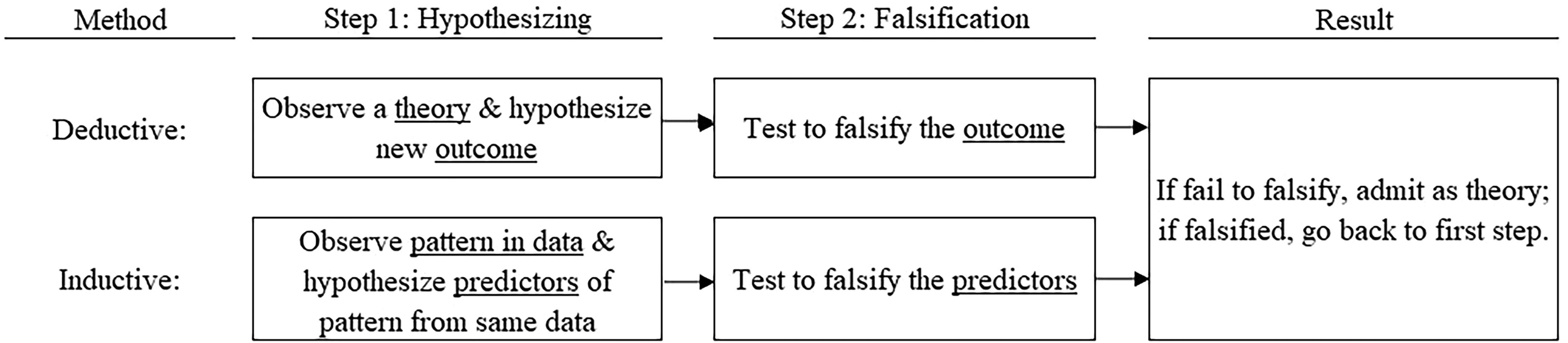
Scientific method of hypothesizing-falsification.
As Figure 1 shows, the scientific methods of hypothesizing and testing entail a process of offering hypotheses from theory or data and, through falsification, selecting the best hypothesis. The scientific community then admits this hypothesis as theory until a better, more accurate hypothesis (and theory) emerges. In this process, the function of scientific tests is to falsify and limit the range of hypothesized outcomes and predictors. A hypothesis and, later, a theory that explains any and all outcomes and predictors is not scientific. The improbability of falsification “is not a virtue of a theory (as people often think), but a vice” (Popper 2014 [1965], p. 48). This is because, without the possibility of falsifiability and, hence, replaceability, researchers cannot offer new ideas to move the knowledge production process forward. Simply, unfalsifiability means scientific stagnancy.
Scientific Methods and Assimilation Theories
Classic Assimilation
Deductive, but more precisely, ideal-type hypothesizing, à la Simmel and Weber, informs classic assimilation theory's explanations of group relations (Park 1915; Gordon 1964, p. 69; see Kemple 2019 and Kivisto 2022 on Park's intellectual relation to Simmel and Weber). Classic assimilation's focus is on hypothesizing the outcome of assimilation. Park (1915, p. 578) imagines group relations as unfolding within an ideal-type institution, “a psychophysical mechanism … through which private and political interests find corporate expression”. This abstract institution, when defined as a nation, encompasses social groups or “national types which exhibit definite [linguistic and moral] uniformities” (Park 1914, p. 606). Having conceptualized the context of group relations as such, Park contemplated the outcome of such relations. He borrowed from other sciences, such as the theories of physiology, to outline how people interact and potentially become part of a community or an entity larger than the total sum of the individuals (ibid, p. 611). He then defined assimilation as a “symbiosis” process where “peoples and races who live together, sharing in the same economy, inevitably interbreed, and in this way if in no other, the relations which were merely cooperative and economic become social and cultural” (ibid). Park (1928b, p. 891) hypothesizes that, in the long run, when national types meet, they achieve a degree of cultural pluralism and solidarity sufficient for national existence.
Gordon (1964, pp. 69–71) slightly updated the anticipated outcome as ethnoracial plurality within the national culture. He then hypothesized that the assimilation process takes place in a series of seven steps, each of which, in sequential order, can be considered an independent cause or predictor for ethnoracial pluralism outcome. He takes several precautions. He distinguishes between the “cultural patterns” of a society —language, law, political associations, etc. — and different groups’ “overwhelmingly favorable … contributions made by way of cultural patterns” (ibid, p. 73 italics in original). Then, he argues that, in the United States of his time, these institutionalized cultural patterns closely resembled those of the “middle-class White Protestant Americans” (Gordon 1964, p. 74). Such patterns differ across societies according to their local norms and institutions — hence Favell's (2016, 2022) critique that contemporary researchers pay insufficient attention to the context of assimilation research.
In classic assimilation, the first step, acculturation, or behavioral assimilation, entails adapting norms such as language, workplace etiquette, respect for the rule of law, and individual liberties. Next, structural assimilation — as opposed to economic structures — implies that, with acculturation, individuals can go beyond their immediate family and ethnic group to make friendships and social relations with other groups. These relations lead to the pivotal element of intergroup marriages and, therefore, to the decline of exclusive ethnic affiliations. As a result, in the fourth step, the spread of group relations leads to wholesale identification as members of a national society. This sense of peoplehood has a snowball effect on the assimilation process. From here on, majority groups recognize immigrants’ assimilation attempts and gradually offer attitudinal, behavioral, and civic inclusion. Racial prejudice declines and, consequently, de jure discrimination is hypothesized to subside (see Abascal 2020 on majority groups’ response). The process unfolds over a timeframe of two or more generations. Gordon (1964, p. 71) qualifies this ideal-type model, “not only is the assimilation process mainly a matter of degree [for each group], but, obviously, each of the stages or subprocesses distinguished above may take place in varying degrees.” That, for instance, means “acculturation of the minority group may take place even when none of the other types of assimilation occurs simultaneously or later, and this condition of ‘acculturation only’ may continue indefinitely” (ibid, p. 77; see Telles and Sue 2019 on durable ethnicity, and Williams and Ortega 1990 on structural assimilation as the starting point of assimilation).
Classic theory delimits the context of such an ideal-type assimilation process according to the specific national contexts and subgroup conditions. Regarding the former, Park and Gordon are aware of the practical limitations of their ideal-type models, particularly the ethnic and racial barriers to coexistence as a nation. Park (1928a, p. 20) observes that industrialization and the development of professional echelons within various racial groups close racial distances and lead to the development of “biracial organizations” across the country. He (1914, p. 611) readily admits that racial markers put “between the races the invisible but very real gulf of self-consciousness” and limit the possibilities of becoming “a mere individual, indistinguishable in the cosmopolitan mass of the population.” Similarly, Gordon (1964, p. 60) expands on the cultural and institutional conditions of the “meeting of peoples” in the United States, “the attempted incorporation of the American Indian on the White conqueror's terms, and the massive immigration into this land of over 41 million people, largely from Europe but also from the other Americas and to a smaller extent from the Orient.” Again, he underlines that despite the “modern industrialism and urbanization and operating under a democratic political system” (ibid, p. 18), “there is no good reason to believe that white Protestant America has ever extended a firm and cordial invitation to its minorities” (Gordon 1961, p. 281).
To explain the role of subgroups, classic assimilation uses the concept of “ethclass,” the “social space created by the intersection of the ethnic group with social class” (Gordon 1964, p. 51; see also Warner and Srole 1945, p. 71). This ideal-type concept resembles Weber's (1978, p. 155) Stände or status group. In contrast to the Marxian horizontal economic class divides — i.e., ethnicity within the class — the Stände define themselves and others in terms of social estimation of honor, the combination of material and ideal values — i.e., class within ethnicity. The result is the economically unequal “societies who live along the lines of ‘ethnicity’” with each ethnicity comprising different social classes (ibid, p. 157; see also Du Bois 2015, p. 35). Gordon (1964, pp. 44–45) argues that, in the United States of his time, there were six social classes ranked from the “old family” aristocrats, to mid-level college-educated professionals and semi-skilled workers, to lower-level “unskilled laborers and the frequently unemployed.” The mid-level social classes, due to demographic and institutional prominence, shaped the core culture. The intersection of social class lines with ethnic boundaries creates the “ethclass.” Individuals can gain entry to different levels of social class within their ethnicity, but assimilation depends primarily on crossing ethnic lines. Gordon argues that class upward mobility does not necessarily entail leaving and crossing the primary ethnic group boundaries (ibid, pp. 46–47). If upwardly mobile individuals leave their ethnic groups, they may risk alienation and loss of social capital (Gordon 1961, p. 280).
According to these theoretical and contextual observations, classic assimilation theorists hypothesized several outcomes for the future of assimilation in the United States, including the biracial organization of society (Park 1914, 1928). Park had observed first-hand the rapid social transformations in Europe. At the time, the old multiethnic empires were falling apart, giving way to ethnic nation-states. With this in mind, and observing the tensions between whites and African Americans, Park (1914, p. 628) hypothesized the possibility of a federalist system “based upon the autonomy of the different races; a bi-racial organization of society.” Over a decade later, however, he observed that racial distances had somewhat dwindled due to economic prosperity and industrialization. He then predicted that there would be a time when racial groups will have equal footing in society, “the distances which separate the races are maintained, but the attitudes involved are different. The races no longer look up and down: they look across” (Park 1928a, p. 20).
Later, Gordon (1981, p. 182) hypothesized that assimilation could lead to a monolingual ethnically plural society, a bilingual pluralism such as Canada, or a multilingual pluralism such as Switzerland. Gordon observed that intermarriage and identification with Anglo-Saxons did not follow what the Anglo-conformists had speculated in the 20th century and interpreted this group pluralism as a sign that “Anglo-conformity and the melting pot” ideas were misleading (1961, p. 283). 9 He emphasized that monolingual ethnic pluralism would be the future of American life (Gordon 1964, p. 114). He (1981, p. 181) believed that, under American democratic values, different national groups could maintain a healthy degree of group separation while creating shared cultural patterns sufficient for national coexistence. For group pluralism not to lead to inequality, Gordon (1964, p. 240) underlined the role of the intellectuals and policymakers who must legitimize such plurality “in the public consciousness.”
To test the classic assimilation theory, researchers have used empirical observations and experiments to falsify the hypothesized correlations in the ideal-type model (inter alia see Brown 2006; Telles and Ortiz 2008; Schachter 2016). Some studies corroborate the theory, and some challenge the theory's optimism about intergroup relations. Indeed, in hindsight, it is clear that the assimilation process in the United States has not led to a biracial organization of society or to a Canadian-style pluralism. These two hypothesized outcomes have been empirically falsified. But classic assimilation's prediction about monolingual ethnoracial pluralism is not far from the empirical reality of US life today. Again, such empirical effectiveness does not mean this theory is inherently correct but that, for the time being, it stands as a falsifiable theory that explains US group relations. 10
Segmented-Assimilation
Inductive hypothesizing partially informed the development of segmented assimilation. To build the hypothesis, scholars observed three segmented assimilation outcomes along class lines: some immigrants join the mainstream upper classes, some the “white middle class,” and some the poverty-ridden “underclass” (Portes and Zhou 1993). 11 The authors, in keeping with the inductive method, ask how and why “the process has become segmented” (ibid, p. 82). To find explanations for these outcomes, segmented-assimilation theorists use “selected ethnographic material and survey data from a recent survey of children of immigrants” (ibid, p. 75). As such, segmented-assimilation takes upon itself to discover the predictors that lead to the segmented outcomes.
To delineate the context of the theory, segmented assimilationists point to the de-industrialized hour-glass economy and racial prejudices in the United States. Portes and Zhou argue that immigrants accept entry-level menial jobs while the second generations shun the same jobs and this “disjuncture” creates a gap between first- and second-generations’ “material conditions and career prospects” (ibid, p. 76). In addition, the “rapid process of national deindustrialization … has left entrants to the American labor force confronting a widening gap between the minimally paid menial jobs that immigrants commonly accept and the high-tech and professional occupations requiring college degrees that native elites occupy” (ibid). Further, the racialized national context differs from the 20th century's environment wherein, for descendants of European immigrants, white “skin color reduced a major barrier to entry into the American mainstream” (ibid; cf. Karimi, Thompson and Bucerius 2023 on the cross-national contexts of racial barriers).
Then, within such a context, one can glean the predictors of segmented outcomes “from the standpoint of immigrant youths”: “The first is color, the second is location, and the third is the absence of mobility ladders” (ibid, p. 83). Later on, segmented-assimilationists refine these a: family or human capital, family structure, and the modes of incorporation. The latter itself comprises another three elements of government policy (positive, neutral, hostile to immigrants), ethnic capital (high, mid-range, low), and racial prejudice in the labor market (positive or negative). Segmented assimilation outcomes emerge it is argued, based on the different ways that these predictors combine and impact different immigrant groups (Portes, Fernandez-Kelly and Haller 2005, p. 1011; Haller, Portes and Lynch 2011, p. 755; see Portes and Rumbaut 2001, p. 283 for a table outlining the predictors, and Appendix 1 here for our adaption of the table).
Assimilation into upper classes results from consonant acculturation when both the first-generation parents and their second-generation offspring adapt to American culture and support one another's upward mobility in the mainstream. Assimilation into the middle classes happens when, through selective acculturation, first- and second-generations adapt to a new culture but retain their ethnic ties for mobility and protection against discrimination. Assimilation into the underclass results from dissonant acculturation whereby second generations adapt too quickly and abandon their ethnic communities. These second generations lose access to ethnic communities and fall prey to discriminatory job markets and inner-city cultures and, thereby, experience downward mobility. They join a “rainbow underclass” culture along with Black and Puerto Rican groups (Portes and Rumbaut 2001, p. 59; see Warner and Srole 1945, p. 147 for a precursor to the segmented outcomes).
In sum, scholars observed three segmented class outcomes and inductively hypothesized how numerous predictors combine to engender these outcomes. Researchers have tested for the correlation between various combinations of the hypothesized predictors and segmented assimilation outcomes. These combined predictors do not correlate with the outcomes (e.g., Luthra, Soehl and Waldinger 2018). One reason is that segmented assimilation deviates from the inductive method of hypothesizing in three ways. These deviations mean that segmented assimilation is not readily testable and is, hence, unfalsifiable.
First, the theory's key hypothesis suffers from conceptual boundary ambiguity (see Bradburn, Cartwright and Fuller 2017 on a priori concepts). Scholars observed three segmented assimilation patterns, but the theory does not define these patterns or outcomes as a set of empirical concepts (Jung 2009, p. 385; see Wacquant 2022 on the problematic roots and use of underclass). Simply, what economic and social criteria demarcate the underclass status? Similarly, concerning the predictors’ meanings, segmented assimilation hypothesizes acculturation as language skills and knowledge of local customs, the “first step towards assimilation” (Portes and Rumbaut 2001, p. 53), yet operationalizes it as language skills (ibid, p. 145). It is not immediately clear what the conceptual difference is between (consonant, selective, and dissonant) acculturation or language skills versus education; is one the outcome of the other, or are they collinear outcomes of other preceding predictors such as modes of incorporation? Further, despite listing several predictors, the hypothesis does not delineate the causal sequence of how each predictor impacts other predictors to arrive at either one of the segmented outcomes. For instance, it is argued that some “minorities are underprivileged in terms of economic rewards,” but instead of outlining how this underprivileged status emerges for each group, it is said that the “causal sequence leading to these outcomes” is immaterial since “regardless of how it comes about” these groups exhibit the same pattern or outcome (Portes, Fernandez-Kelly and Haller 2005, p. 1030; see Turner 2022, p. 184 on intermediate variables that have no effect in the seemingly causal sequences). In addition to conceptual and processual ambiguities, there is no indication in the hypothesis regarding the kinds of empirical evidence on intergenerational (im)mobility that could falsify the hypothesized predictors.
Second, as per the inductive method, a hypothesis outlines the predictors of an observed pattern from the same dataset. However, in segmented assimilation, the source of the hypothesized predictors remains undefined. Canonical publications start with qualitative stories of first- and second-generations coming from the world's four corners (Portes and Rumbaut 2001, 2006). Some nationalities’ stories point to the role of immigration policies, some to generational disconnect, and some to the role of ethnic economies. Ideally, in inductive research, predictors, when extracted from one nationality's assimilation outcome, would initially remain applicable to that specific nationality. However, instead of such a case-by-case analysis, the segmented-assimilation hypothesis blends and presents a bundle of predictors as if one group's experiences (read: predictors) would be readily applicable to other groups. 12 This means that one cannot tell which predictors impact which groups or from which stories some of these predictors emerged. 13
Third, a scientific approach to hypothesizing accepts the falsifying evidence to provide space for the hypotheses with higher explanatory power. Yet, segmented-assimilation researchers do not address the empirical tests, which do not corroborate the hypothesized predictors. For instance, some studies test for a causal link between acculturation types and socioeconomic outcomes and conclude that “types of acculturation do not seem to matter much for socioeconomic outcomes” (Waters et al. 2010, p. 1185). 14 Others, skipping the role of acculturation types, measure the link between modes-of-incorporation predictors and educational outcomes. For precision, they replace national groups with skin color categories and find a negligible correlation between the predictors and education outcomes — the exception being “darker group-level skin color is associated with … a 0.18 decrease … in years of education” (Luthra, Soehl and Waldinger 2018, p. 27; see also Waldinger and Catron 2016). That these studies do not corroborate the hypothesis is not a surprise, given that the hypothesized predictors of the segmented outcomes do not directly emerge from the same data but are pulled from elsewhere.
Instead, such falsifying evidence is treated as exception cases (see critiques by Sakamoto, Takei and Woo 2012; Sakamoto and Hsu 2020). For instance, despite being destined for downward mobility according to segmented assimilation, Asian Americans demonstrate high rates of socioeconomic mobility (Pew Research Center 2020). Achievements are made into the model minority myth: Asian Americans are upwardly mobile but have had a long history of exclusion and, currently, have to work much harder than the rest, experience discrimination, and remain at the margins of the nation (e.g., Walton and Truong 2022). Further, it is argued that immigrants’ success is not due to the US opportunities, but an outcome of the human capital that they had amassed in their home countries and brought to the United States (e.g., Lee and Sheng 2023). Another case is the upwardly mobile groups who, instead of upper-class mainstream identities, still advocate ethnic identification (e.g., Mora 2014). This evidence is explained as an exception, as a symptom of “reactive ethnicity” which pushes these upper- and middle-classes into the ethnic communities (Portes and Rumbaut 2001, p. 148). Instead of abandoning its hypotheses of upward or downward mobility when faced with adverse evidence, segmented assimilation creates a chain of exceptions and has, thereby, become an unfalsifiable theory that wants to explain all outcomes (Gratton 2002; see Karimi and Wilkes 2022 on fitting the data into erroneous models). 15
Neo-Assimilation
A mixture of deductive-inductive hypothesizing informed the formation of the neo-assimilation hypothesis. Neo-assimilation observes racial diversity in the mainstream and explains this diversity as resulting from a process of assimilation. Here, the mainstream is the core set of social institutions where the native majority groups feel most at home (Alba and Nee 2003, p. 12; Alba, Beck and Basaran Sahin 2018, p. 101). In the mainstream, “individualistic and collectivist adaptation” (Alba and Nee 2003, p. 63) strategies are more important than race or skin color as barriers to assimilation (ibid, p. 48). Accordingly, a key question for neo-assimilation is “how then should assimilation be defined, given the prospects for a more racially diverse society arising from large-scale immigration of non-Europeans?” (ibid, p. 10). The answer is to define assimilation, in light of the mainstream outcome, as “the gradual erosion of ethnic, racial, religious, and other differences as determinants of life chances for immigrants and their children” (Drouhot and Nee 2019, p. 178). The result is a framework in which the mainstream is the outcome and assimilation is the predictor.
According to scientific methods, a hypothesis starts with a theory and hypothesizes a new outcome (deductive) or with empirical data and hypothesizes new predictors (inductive). Indeed, as per the deductive method, neo-assimilation relies on neo-institutionalism theory to understand social processes such as assimilation. Neo-assimilation, however, does not hypothesize a new outcome different from the already-observed mainstream outcome. Comparatively, as per the inductive method, the mainstream is neo-assimilation's outcome or “observed pattern [of] unprecedented ethnic, racial and religious diversity” (Drouhot and Nee 2019, p. 178). Neo-assimilation does not hypothesize new predictors different from the already-observed assimilation process. As a result, it is apparent that neo-assimilation combines and partially follows the deductive and inductive methods. The theory departs from the scientific methods of hypothesizing in three ways, making the theory not readily testable.
First, neo-assimilation starts with neo-institutionalism theory to make sense of the already-observed pattern or outcome, the mainstream. This is as if neo-assimilation is using neo-institutionalism as a predictor-provider tool. Neo-institutionalism theory maintains that individual actions and various policies layer up to shape the institutionalized ways of life in each country. Then, a feedback cycle between individual behaviors and institutions reproduces a normative consensus that sustains the institutions and prevailing life patterns (Mahoney and Thelen 2010). Accordingly, neo-assimilation explains the interactions between individuals’ actions and the institutions. In neo-assimilation, these interactions entail “the purposive action of individuals and the informal (i.e., networks and norms) and formal (i.e., rules and laws) constraints” (Alba and Nee 2003, p. 53).
Still, instead of extracting predictors from neo-institutionalism, neo-assimilation departs from neo-institutionalism to offer its own argument: as a result of the increasing numbers of nonwhite immigrants and the purposive actions of individuals, “ethnic stratification orders ultimately tend to become undone” (Alba and Nee 1997, p. 839) and, after that, the mainstream breaks away from Whiteness (Alba and Nee 2003, p. 13). This hypothesis is somewhat different from what neo-institutionalism, the underlying theory, would predict. The latter theory maintains that institutional consensus breaks on rare occasions when a sudden and irreversible divergence emerges between social institutions and individuals. The divergence disrupts the feedback cycle and stalls institutional functions (Ellermann 2015). Because these are rare moments, neo-institutionalism emphasizes that the institutionalized ways of life are modifiable but not easily replaceable. Therefore, if neo-assimilation hypothesizes a break from the institutionalized way of life in the United States, it would be desirable to delineate the specific predictors that shape such a break. To date, such predictors are missing from neo-assimilation writings (Alba and Nee 2003, p. 54).
Second, as with segmented assimilation's underclass, the social and economic definition or boundaries of the mainstream are lacking; hence the absence of clarity as to what kinds of data could falsify the existence of the mainstream. It is stated that “even in segregated neighborhoods, minority citizens know very well what the mainstream is” (Alba and Duyvendak 2019, p. 111); in each society, there are several “mainstreams” each of which is “internally diverse, differentiated by region, religion, and social class” but not necessarily “ethno-racially exclusive” (ibid, p. 110). Because neo-assimilation accepts that racial differences have already dissolved in the mainstream, it is unclear who the native-born majority is or what the prevailing life patterns in such mainstreams are. As such, the inclusion–exclusion criteria for the mainstream remain undefined. There is no way to “measure assimilation against any fixed racial characteristics” (Favell 2022, p. 37). Most recently, Alba (2020, p. 147) has argued that the mainstream still “reflects the social power of the White majority, which effectively controls the institutional and social spaces.” Regardless, assimilation research has invariably operationalized the “mainstream” as non-Hispanic whites’ ways of life.
Third, there is a circular reasoning between predictor and outcome in neo-assimilation. As mentioned above, neo-assimilation takes the assimilation process as the predictor but a predictor contingent on the mainstream outcome. The outcome entails the predictor, and the predictor leads to the outcome. For instance, a core component (or a predictor?) of the assimilation process is boundary blurring. Boundary blurring presumes two groups. If individuals from one group want to join the other, they adopt the cultural behaviors of the target group and “cross” the boundary onto the other group. The process ultimately leads to blurred indistinctive boundaries (Alba and Nee 2003, p. 60), “to hyphenated, if not hybrid, identities, which allow individuals to feel that they remain part of the group of origin” (Alba 2006, p. 356). 16 In this process, boundary-blurring is simultaneously the individuals’ actions, or predictors, “that can affect assimilation” (ibid, p. 348), a “blurred-boundary context” of assimilation (ibid, p. 356), and a “blurred boundary idea” of assimilation (ibid, p. 354 italics added). That is, boundary-blurring is a predictor, a context, and an outcome. It is not entirely clear whether the individuals are assimilating or whether the mainstream is blurred and, thereby, expanding (see Popper 2002 [1956], p. 76). As the outcome and predictors are not separable, they cannot be tested as such (see Goldthorpe 2001, p. 5). There seems to exist no way out but to abandon assimilation and, instead, adopt “the generic process of incorporation and prefer this term to the more one-sided and race-related (at least in the United States) concept of integration” (Drouhot and Nee 2019, p. 179 italics added).
Discussion
The scientific methods of hypothesizing and falsification entail a process of selection by falsification. Scholars proffer bold hypotheses and test them against empirical data. These tests remove the inaccurate hypotheses from the research arena, providing space for the hypotheses and theories that best explain one phenomenon at a time. The analysis thus far has entailed mapping the three assimilation theories onto the scientific methods. Figure 2 provides a visual illustration of whether assimilation theories, in their formation phase, followed or departed from the scientific method.
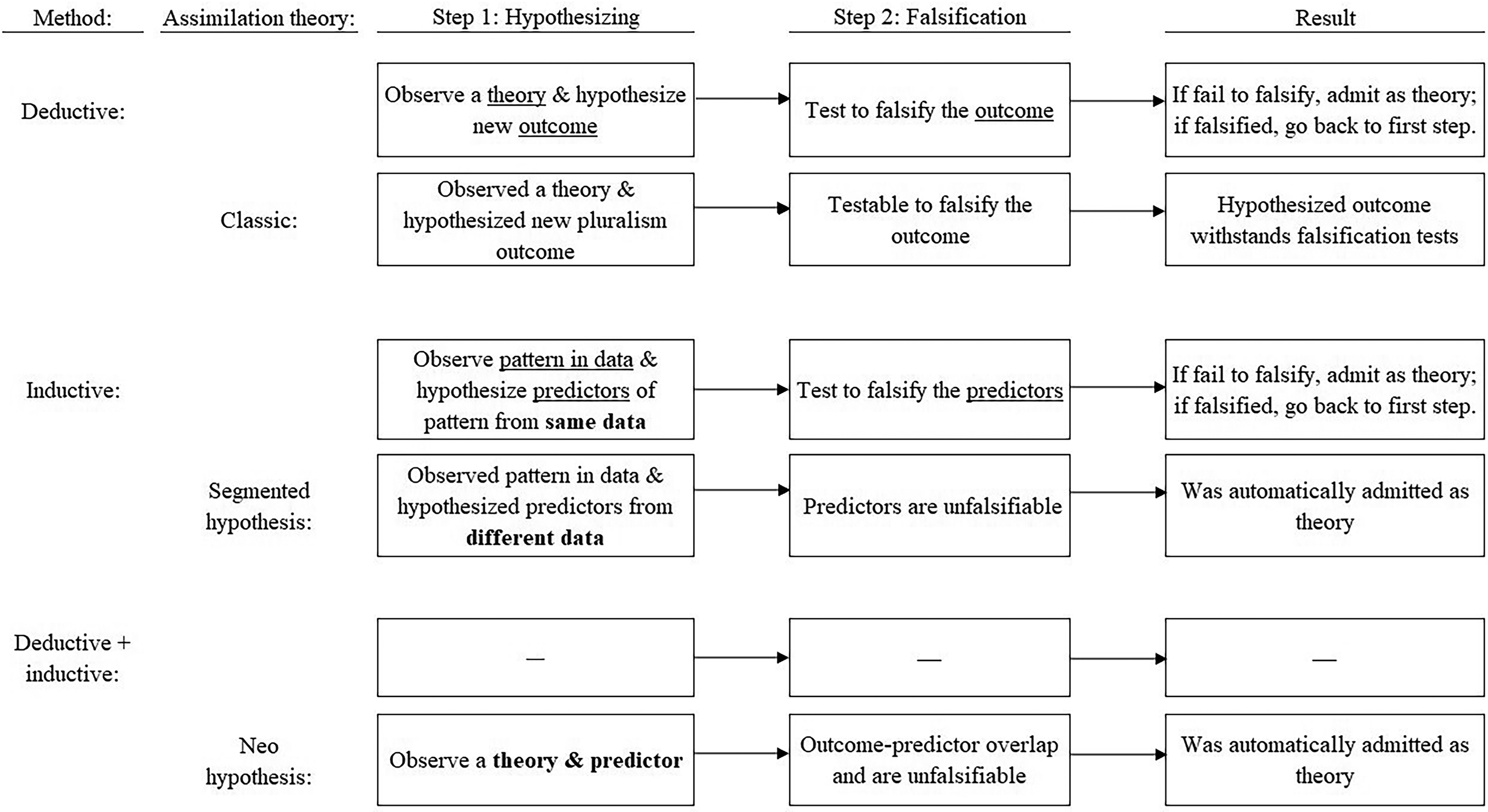
Scientific method of hypothesizing-falsification versus assimilation theories.
The first two rows in the figure show the deductive method and, below it, the classic assimilation theory. The theory was developed in accordance with the deductive (ideal-type) approach, given that it directly maps onto the method's hypothesizing and falsification steps. The central hypothesis is about how predictors such as acculturation, structural assimilation, and civic inclusion lead to different outcomes such as the bi-racial organization of society, Canadian-style federalism, and ethnoracial pluralism. The hypothesis can be falsified by showing that the outcomes have not materialized. Indeed, looking at US society, it is clear that the United States is not a biracial society nor a Canadian-style bilingual country. Yet, classic theory's prediction of ethnoracial pluralism within a nation seems to have withstood the test of time. The theory continues to hold, though it could be falsified in the future.
The middle two rows show the inductive method and the formation of segmented assimilation. The framework started with the inductive method's logic of observing empirical patterns of behavior, such as the segmented class outcomes, with a view to discovering the predictors that explain this segmentation. Instead of following the method to hypothesize the predictors of the observed outcomes from the same data, segmented assimilation introduced predictors that seem to have risen from outside the data. Further, segmented assimilation's outcomes, such as the underclass, lack a priori socioeconomic demarcation (Bradburn, Cartwright and Fuller 2017). Lastly, contrary to the falsification step, falsifying evidence, when provided, is qualified as exceptional rather than falsification of the hypothesis. Overall, the hypothesis is unfalsifiable but has been admitted as a theory.
The bottom row in Figure 2 illustrates the formation of the neo-assimilation framework. This row does not contain a method line because the hypothesis combined the elements of both inductive and deductive approaches. Such a combination has yet to be proposed as a scientific method and should not be confused with the abductive method. This combination is unfalsifiable since neo-assimilation draws on a previous theory, i.e., neo-institutionalism, but instead of hypothesizing new outcomes, neo-assimilation relies on neo-institutionalism to explain the causes of the mainstream (as per inductive method); the mainstream outcome's a priori inclusion–exclusion criteria remain undefined; and assimilation process circularly depends on the mainstream outcome.
Thus, for segmented- and neo-assimilation, scientific falsification remains a challenge. These “theories base their historical forecasts on an interpretation of history which leads to” a particular set of desired outcomes (Popper 2011 [1945], p. 9). Segmented assimilation is therefore likely to appeal to a belief in inequality and neo-assimilation to a belief in progress (see Iceland, Silver and Redstone 2023). We agree with Favell's (2022) point that these hypotheses are not generalizable across contexts. But the limitation is not only due to their statistically decontextualized categories. These perspectives do not follow the scientific methods of hypothesizing to offer a universal hypothesis that lays out the core argument in an “if C, then E” form.
Conclusion
This article examined the development and consolidation of classic, segmented, and neo-assimilation frameworks to see which best explains immigrants’ experiences. We deployed the scientific method's deductive-inductive hypothesis and falsification criteria to compare the frameworks (Hempel 1965; Popper 2002 [1935]; 2011 [1945]; Bradburn, Cartwright and Fuller 2017). Our key finding is that classic assimilation follows the deductive method and is, therefore, scientific and falsifiable. Still, given the theory's lifespan, it requires amendments to explain the unprecedented transnationalization and racial diversification of immigration patterns. Segmented- and neo-assimilation, however, did not follow the scientific methods and are therefore not testable nor falsifiable. They cannot capture and explain immigrants’ assimilation trajectories.
We propose to rethink assimilation research by updating the underlying tenets of the impressive body of work known as assimilation theory. For instance, segmented assimilation's core concepts, such as underclass, can benefit from amendments to specify, for instance, what level of income or types of housing imply the underclass, or lack thereof, and in what sequence the predictors combine to lead to upper, middle, and underclass assimilation. Following recent critiques (e.g., Luthra, Soehl and Waldinger 2018), segmented-assimilation scholars could also consider replacing their national categories with skin color categories as determinants of socioeconomic attainment. Already, in their section on “patterns of ethnic self-identification,” Portes and Rumbaut (2001, p. 154) report that the children of Canadian and European immigrants identify as “plain American” while all other non-European second-generations adopt hyphenated or ethnic identities (ibid, p. 161). This observation points to skin color gradation differences along the white–nonwhite spectrum than particular nationalities.
Further, compared to earlier times when assimilation theories were developed, the world has become more transnational. Most individuals, both immigrant and native-born, have access to international media and global travel options, forming greater awareness of other cultures. Such connections and flows of data and populations, termed as ethnic replenishment thesis, can challenge a national view of the assimilation process by delaying the decline of ethnicity into a purely symbolic form across generations (Jiménez 2010; Telles and Sue 2019). To reexamine the relationship between transnationalism, ethnoracial categories, and the commonplace predictors of assimilation is, then, an imperative. As a preamble, elsewhere, we have offered a transnational perspective (Karimi and Wilkes 2023a, 2023b) that distinguishes between what newcomers do and what the majorities contribute to assimilation (see also Jimenez 2017). In this view, social groups and racial categories are transnational in that they are connected to racialized geographies beyond one nation's boundaries. This perspective would shift assimilation from a national to a transnational process. Overall, such updates, when tailored to fit particular national contexts, produce logically and empirically consistent hypotheses that accurately explain assimilation in each context.
Footnotes
Appendix
Acknowledgments
We would like to thank the three anonymous reviewers and IMR's editor for their constructive comments. We would like to thank Dr Thomas Kemple and the members of the UBC Centre for Migration Studies for their valuable engagements and feedback on the earlier drafts of this article.
Declaration of Conflicting Interests
The authors declared no potential conflicts of interest with respect to the research, authorship, and/or publication of this article.
Funding
The authors received no financial support for the research, authorship, and/or publication of this article.
