




Abstract
Migrant housing investments in the countries of origin are a demonstration of their transnational engagement and their potential contribution to local development. Yet, these investments remain relatively understudied on a large scale. In this paper, we explore three related questions on the drivers, prevalence, and development of transnational housing, drawing on an original survey of Ecuadorian and Indian migrants in different European cities. First, what factors account for the likelihood of migrants owning a remittance house? Second, for those migrants without houses abroad, what factors account for the likelihood of aspiring to have a remittance house in the first place, as opposed to “not being interested”? Third, how do factors affecting the likelihood of owning a remittance house compare to those affecting the likelihood of being a remittance house dreamer? Our findings suggest that, among those without a remittance house, the likelihood of being a transnational house dreamer decreases with the length of residence abroad, while the length of stay has no statistically significant impact on the likelihood of transnational house ownership. We also find that migrants with greater economic capacity are less likely to be dreamers and more likely to be transnational house-owners, suggesting that the difference between being a transnational house-dreamer and a transnational house-owner is often financial. Finally, greater attachment to the country of origin increases the likelihood of being both a transnational house owner and a transnational dreamer. We also discuss how the results change across migrant groups and across genders.
Keywords
Introduction
Why migrants invest in housing in their countries of origin, often with little likelihood to return there for good, is a question that creeps across much research on so-called remittance houses (Boccagni, and Bivand Erdal 2021; Fletcher 1999; López 2015; Klaufus 2022; Schielke 2023). Both the actual investment in new houses back “home” and the aspiration to have one seem to be widespread, and yet there is scarce large-scale evidence on the topic. This is unfortunate, not only because it entails a lack of clarity on the actual prevalence of transnational housing, but also for its significance in the broader economy of international migration. As a matter of fact, this way of investing remittances has much to say about migrant identities, allegiances, and life projects, as well on their patterns of consumption and, ultimately, on the social and economic impact of migration in the countries of origin. In short, housing investments are a central and yet rather neglected aspect of migrant transnationalism, “without such investments necessarily being tied to return migration” (Bivand-Erdal and Carling 2021: 2).
Our paper contributes to fill the research void in this respect, drawing on an original database on migrant homemaking, thereby responding to three key research questions. The first is precisely what factors account for the likelihood of migrants owning a remittance house? This has been explored in several local case studies, which point to the role of financial considerations (e.g., Osili 2004; Smith and Mazzucato 2009), retirement intentions (Pauli and Beford 2018), social expectations (Bose 2014) and social status (Firang 2020; Osman et al. 2022), as well as family obligations (Schaab and Wagner 2020) (see, for a synthesis, Boccagni, and Bivand Erdal 2021). However, this has rarely been addressed through larger-scale quantitative datasets as we do in this study, with a focus on three variables that, as the literature shows, can significantly affect the likelihood of transnational house ownership: Migrants’ length of residence, economic capacity and attachment to the country of origin.
Second, what factors account for the likelihood of wanting a remittance house in the first place, as opposed to “not being interested”? Much of the research on transnational migrant housing tends to sample on the dependent variable: It focuses only on those migrants who do engage in transnational housing. We know less about those who are not interested in transnational housing, or would like to buy a transnational property but are unable to do so (what we refer to as transnational house-dreamers). There is a promise, however, in investigating the differences between migrant house dreamers and owners.
Third, how do factors affecting the likelihood of owning a remittance house compare to those affecting the likelihood of being a remittance house dreamer? This question provides unique insights into transnational house ownership dynamics. For instance, if the difference between being a transnational house-dreamer and a transnational house-owner is largely a financial one (i.e., economic constraint), then migrants with greater economic capacity should be less likely to be dreamers and more likely to be transnational house-owners. In addition, if transnational house-dreamers are simply transnational house-owners in waiting, then over time they will invest in housing in the country of origin. We should see a pattern of increasing transnational house-ownership and a decrease in the share of those who are dreamers.
In addition to answering these key questions, we explore whether patterns of remittance house ownership and dreaming are consistent across migrant groups and genders. Much of the research on this topic is focused on a single group, location, and in several cases gender. While we accept that findings on transnational house ownership are never fully generalizable, in order to validate our knowledge it is important to understand to what degree the same results can be found across different migrant groups and genders.
In order to explore these questions we rely on an original survey that we conducted across several countries and migrant groups during 2019. This survey took place as part of HOMING: The Home-Migration Nexus project, a large cross-country initiative to understand the home-migration nexus (Boccagni 2017). In the survey, Ecuadorian migrants were interviewed in London, Madrid, and Milan, while Indian migrants were interviewed in London (same questionnaire across countries and groups). This diversity of locations and migrant groups provides a unique opportunity to explore factors that affect the likelihood of being a transnational house-dreamer and how those may differ from the factors affecting the likelihood of being a transnational house-owner.
Our analysis leads to four key results. First, among those without a remittance house, the aspiration to have one—and hence the likelihood of being a “house dreamer”—decreases with length of residence abroad. Migrants who have been abroad for 21 years or more are 14 percentage points less likely to be dreamers compared to those who have been 5 years or less in the host country. Second, length of residence has no statistically significant impact on the likelihood of transnational house ownership. That is, once we control for relevant factors, people with a relatively short immigration record are as likely to own a remittance home as long-resident migrants. Third, migrants with greater economic capacity are less likely to be dreamers and more likely to be transnational house-owners. Being in employment increases the likelihood of transnational house ownership by 8 percentage points. This suggests that the difference between being a transnational house dreamer and owner is often a financial one. Finally, greater attachment to the country of origin increases the likelihood of being both a transnational house owner and dreamer. Those who expect to be back in their countries of origin in ten years are 12 percentage points more likely to own a remittance house and, if they do not own one, are 28 percentage points more likely to want one. This suggests that transnational house ownership is also the result of attachment to the country of origin.
We also show that there are no differences in these dynamics across sub-samples of males and females for transnational homeownership. However, among those without a house, the likelihood of aspiring to have one decreases more for the female sample as the length of residence increases. In short, men are more likely to keep being transnational house dreamers than women.
Migrants and Transnational Housing Investments
Why Invest in a Remittance House? A Literature Review
There is a large literature on the determinants of remittances and household expenditure patterns related to receiving remittances that span research across countries and categories of migrants (Adams 2011; Vargas-Silva 2017). While the remittances literature has provided important insights, issues related to migrants’ transnational housing practices have received less attention. In this paper, we contribute precisely to the literature on the drivers, prevalence, and development of transnational housing. Research on this topic has grown considerably on a worldwide scale (Boccagni, and Bivand Erdal 2021), covering also migration from Ecuador (Boccagni, and Pérez Murcia 2021; Klaufus 2012; Mata-Codesal 2014) as well as from India (Taylor 2013; Bose 2014).
Importantly, we focus on housing aspirations and not only homeownership. There is a strong argument for separating the housing aspirations of individuals and families from the choices that they make regarding homeownership, as “those who are not planning or engaged in a move of home still have housing aspirations, as do those with little choice” (Preece et al. 2020: 88). Housing aspirations are different from housing choices, needs, and expectations. For instance, individuals could have housing aspirations, including transnational ones, which do not correspond to their earning capacity (Bruce and Kelly 2013).
Producing more knowledge on the development, reach and distribution of transnational housing matters for the topic in itself, but also for its broader societal significance. In fact, home ownership in the country of origin is a key, if under-studied outcome of the development of “migration industries” after migrant settlement, and with ongoing prospects of circular and return migration (Hernandez-Leon 2013; Cranston, Schapendonk and Spaan 2018). A new or better house of one's own is widely seen as a suitable embodiment of migrant broader aspirations, as “socially situated but also future-oriented” sets of desires that inform people's attempts at improving their perceived conditions (Carling and Collins 2019: 914). Home ownership in the countries of origin is also a compelling indicator of migrants’ transnational engagement over time (Carling 2022). Assessing the conditions under which non-owner migrants keep nourishing a remittance house dream, or give up to it, facilitates a better understanding of the expected “directions” of their future life projects, on the one hand; of the likely persistence of their transnational connections (and their contribution to local development) over time, on the other hand.
Within the broader field of migrant transnationalism, development, and cultural circulation, several case studies have illuminated the economic, social, and even moral significance of transnational housing investments. So-called remittance houses are typically meant to materialize migrants’ interdependence with the households and local communities of origin (Blunt and Dowling 2006), and hence the reproduction of dynamics of transnational attachment across multiple locations (Bertelli et al. 2022). While embodying the migrant tension to display loyalty, belonging, and success, these buildings may end up being also a clear marker of their absence, and of their impossibility to return in the short term (López 2015). Researching into them requires, therefore, a time-sensitive approach. As several ethnographies show, these houses have a life course of their own, which does not necessarily go hand in hand with that of their individual or family owners (Sandoval-Cervantes 2017; Pauli and Bedorf 2018; Lozanovska 2019). The same building can assume different meanings and functions, over time, for younger and older migrants, male and female, long-settled and newcomers. While being formally owned by someone living abroad and expected to return at some point, a remittance house may turn into the ordinary dwelling of other family members, or just be rented out. However, it may also remain empty, incomplete, or poorly maintained, if it becomes clear that migrants’ permanent return is only a “myth.” It is no coincidence that the literature includes many studies of houses that are unfinished, abandoned or at best occasionally inhabited (Aguilar 2009; Dalakoglou 2010; Erdal 2012; Freeman 2013; Haluzik 2022).
There is no reason to assume that all migrants invest in transnational housing though. As plausible and far less discussed in the literature is an opposite scenario – the absence of any investment in a special place to show migrant transnational connectedness and hope for return. What if there is no remittance house in one's country or local community of origin? Does that simply reflect migrants’ lack of interest in transnational housing, or also a more ambiguous configuration—possibly a housing “dream” (Fletcher 1999) that has not come true, for reasons that require further investigation? Is there a “myth of the remittance house” that parallels the “myth of return” and may persist, just like the latter, regardless of its actual achievement? If so, who is more likely to cultivate it over time? Just like an active transnational housing investment, the aspiration for it may be temporally patterned in ways that have not been captured so far, given the lack of dedicated data. So, we ask through the dataset on which this paper draws, what accounts for the retention of this dream over time, and for the likelihood that it comes true?
For sure, exploring the dream of a house—rather than the house already built, or under construction—leads us into a slippery empirical terrain. It involves an emotional orientation that may change over time, rather than an objectified social practice. However, while the dream as such is abstract and elusive, it is telling of migrant nostalgia and emotional attachment to the community of origin, and possibly of their desire to return at some point (Bolognani 2015). At a more general level, the distribution of the housing dream is revealing of migrants’ degree of identification with the pervasive ideology of homeownership as an inherently desirable aim, possibly as a symbol of modernity to be achieved in the country of origin, if not in the settlement one (Liu 2002; Masterson-Algar 2016; Firang 2020; Wagner 2023). How persistent the imaginary is, and among which migrants, is a question worth investigating further, as we do in this paper by comparing different cohorts of migrants from the same national groups and in the same local contexts of settlement.
Researching migrant (dreams of) remittance houses through a quantitative dataset is an unusual option. With limited exceptions (e.g., Kuuire et al. 2016a; Kuuire et al.2016b), the literature on migrant housing across borders consists of place-specific ethnographies with less scope for generalization. Generalizations are important because—as the wealth of in-depth local studies shows—so-called remittance houses are widespread on a virtually global scale. Yet, even with the merit of single ethnographies, we still know too little of their social determinants, as well as of the trajectories of transnational housing along the course of migration. Our paper contributes along these lines.
While the existence of transnational housing investments is well documented across migration systems, they are not necessarily the most frequent or desirable option for migrants themselves, as an exclusively qualitative understanding might suggest. The coexistence of these contrasting aspirations shows that transnational housing is a complex and selective process, just like migrants’ negotiation of the transnational social fields they are part of (Boccagni and Pérez Murcia 2021). However, it does raise another significant question: why do some migrants engage in homeownership across borders whereas many more apparently do not, or cannot? How does the balance between the ones and the others change over time, and due to which factors? As important, and remarkably unexplored in the literature, does gender make any difference here? As a general argument, following the New Economics of Labour Migration (Starks and Bloom 1985), we can expect that housing decisions be made at a household level rather than at an individual one. Nonetheless, are migrant men and women's likelihood of being transnational house owners, on one hand, and dreamers, on the other affected in the same way by different factors such as length of residence?
Addressing this question enables us to move beyond the predominant focus on migrant houses as distinctive and autonomous artifacts. Against the risk to decontextualize and exceptionalize them, it is important to appreciate the subjective and structural factors that lead migrants to invest in housing or not. Building or purchasing a house through remittances is only the last step of a decision-making process, at the evolving intersection between aspiration and capability (de Haas 2021), which calls for attention in itself. Among which migrants and depending on which factors, then, is the remittance house an achievement, a dream, or just an irrelevant option?
Migrants as Transnational Housing Investors: A Typology
For the purpose of this paper, we divide migrants into three types as shown in Figure 1. First, there are migrants who are transnational house-owners (A). The other two groups in Figure 1 reflect those that do not own a house in their country of origin. The share of those migrants who actually want a house in their country of origin are those we refer to as transnational house-dreamers (B). The others are simply not interested in this type of investment (C). 1
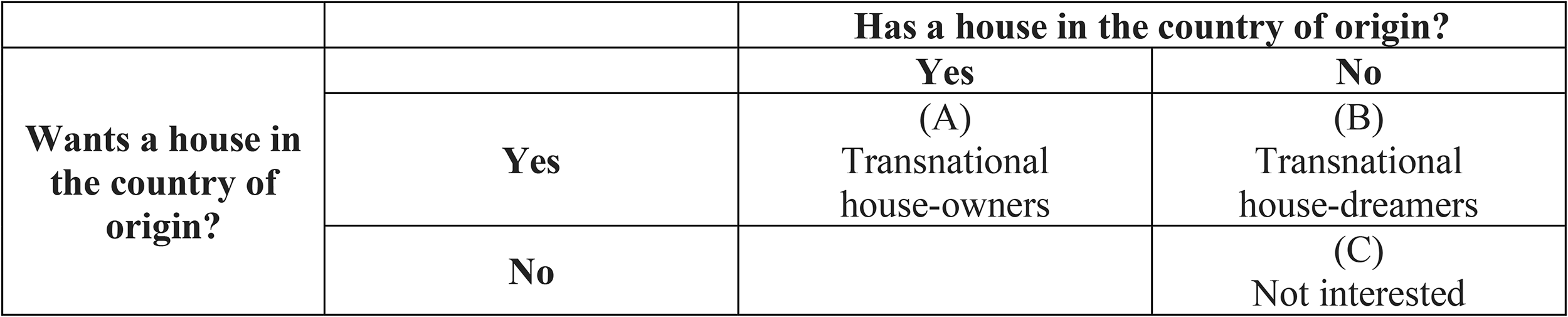
Migrants as transnational housing investors: A typology.
In the subsequent analysis, we focus on two comparisons. First, we explore the likelihood of being a transnational house-owner versus not having a house in the country of origin (i.e., A versus B and C). Second, we focus on those who do not own a house in the country of origin and explore the likelihood of being a transnational house-dreamer versus not being interested in transnational housing (i.e., B versus C in Figure 1).
Exploring the Influence of Length of Stay, Economic Capacity and Country Attachment: Our Hypotheses
In this context, we develop a series of hypotheses for three different aspects: Length of residence, economic capacity and attachment to the country of origin. The selection of hypotheses has been driven by the previous engagement with the extant literature. Our selection acknowledges the key role attributed to temporal variables (i.e., length of residence), as well as economic capacity and transnational attachment, all across the literature on the development of remittance housing. On the other hand, the pre-existent literature, due to its constitutive limitations, does not provide satisfactory answers to the influence of these variables across the divide between homeowners and non-homeowners over time, which is the fundamental and innovative aspect that our hypothesis-building work aims to explore.
In order to facilitate the discussion we present these hypotheses focusing on the comparative aspect concerning the likelihood of being a remittance house owner and a remittance house dreamer. This corresponds to our third question: how do factors affecting the likelihood of owning a remittance house compare to those affecting the likelihood of being a remittance house dreamer?
We start with the hypothesis related to the length of residence. In this regard, we are interested in exploring if changes in the likelihood of being a transnational house-dreamer and a transnational house-owner move in the same direction or not as the length of residence increases.
Housing investments and homeownership require a protracted accumulation of dedicated resources over time. Likewise, migrants may accumulate a certain amount of savings as they settle abroad, over time. If the aspiration to own a transnational house remains present, then they should switch from being dreamers to being transnational house-owners. In the longer term, those migrants without a transnational house should be less likely to want one (i.e., not interested).
However, it is possible to think about scenarios in which H1 does not hold. In particular, if the desire for transnational house-ownership disappears as migrants settle abroad, the likelihood of being a dreamer and the likelihood of being a transnational house-owner will both decrease as the length of residence in the destination country increases. This idea follows the argument on the “temporal limits” of transnationalism, as a set of practices and ties that tend to decrease over time, as people settle abroad (Waldinger 2015; Jones 2020). This temporal pattern might hold true also for migrant housing investments. In this case, the aspiration to have a transnational house and actual transnational house ownership move together and both decrease over time as migrants settle in their countries of residence.
Next, we explore the role of economic capacity. In this respect, we are interested in knowing if additional economic capacity makes a difference regarding transnational house-ownership and the aspiration to it, and what this means for the overall nature of migrant aspirations and economic priorities.
As migrants’ capacity to afford a transnational house increases, those who are dreamers should switch to be transnational house-owners. Those with less financial capacity might want to buy property but cannot afford it. Again, though, it is possible to think about alternative scenarios, particularly those in which migrants with the financial capacity to buy a home abroad do not invest in one for a myriad of reasons. This might have to do with the priority given to economic needs and concerns in the country of settlement, but also with alternative consumption or investment options in the country of origin, ranging from family-related expenses to the contribution to entrepreneurial activities (de Haas 2007).
Finally, we explore the role of attachment to the country of origin. We are interested to know if cross-border ties and attachments have an influence on migrant housing investments; put differently, if transnational housing reflects primarily an emotional, possibly nostalgic attachment, or rather more instrumental and pragmatic concerns.
It is also possible to think about scenarios in which H3 does not hold. For instance, transnational house ownership could relate more to a financial decision and less to emotional attachment to the country of origin (see Wagner (2023) on the interdependence, and possibly the friction between the two aspects).
Data and Methods
Our analysis relies on a face-to-face survey conducted in London, Madrid and Milan during 2019. The research design followed a center sampling approach (Baio, Blangiardo, and Blangiardo 2011; Blangiardo 2008; McKenzie and Mistiaen 2009; Reichel and Morales 2017) in selected neighborhoods and public locations. This is a useful approach to surveying migrant communities when there is no sampling framework available. The methodology relies on sampling in a number of “aggregation centres” that the target migrant population visits with some frequency. For example, the Elephant and Castle shopping center, a key meeting place for Ecuadorians in London (Marquez Reite and Patiño-Santos 2021; McIlwaine 2011), was one these aggregation centers for our survey. So were the gurdwaras (Sikh houses of worship) in West London, for their Indian counterpart (Bertolani et al. 2021). Sampling only one type of location will likely miss some migrant groups. Hence, it is important to sample at multiple locations. Other aggregation centers in our survey included religious sites (i.e., churches and temples), cultural festivals, restaurants, and beauty salons. The goal is to obtain a sample representative of migrants who have visited at least one of the aggregation centers during the sample period.
The main advantage of the center sampling approach, compared to alternatives such as snowballing, is that it is likely to result in a sample that is more representative of the migrant community that is being targeted and involves less time and cost (McKenzie and Mistiaen 2009). The disadvantage is that there is a need for a short questionnaire as individuals are less inclined to spend time answering questions in a public place compared to a home visit.
Overall, the main priority in the sampling was for consistency in the data collection across the three locations and migrant groups, to maximize comparability (Boccagni, and Vargas-Silva. 2021). The analysis below includes 1,107 first-generation Ecuadorian migrants (i.e., born in Ecuador and residing abroad), with 251 interviewed in London, 489 interviewed in Madrid and 366 in Milan and 447 first-generation Indian migrants interviewed in London. The purpose of our analysis is not to compare Ecuadorians with Indians, women with men or results across the three locations. Instead, our aim is to explore the hypotheses described above and, as a second step, explore whether the results hold across migrant groups and genders.
The interviews were conducted in Spanish for Ecuadorians and English for Indians. The choice of the questions and of the precise words to articulate them was driven not only by the existing literature but also by the findings of the HOMING project's previous qualitative fieldwork with migrants in the three cities (Miranda-Nieto, Massa and Bonfanti 2020). Moreover, the clarity of each question was subject to a pilot test and was discussed with all the interviewers in dedicated training sessions, prior to data collection.
In the different analyses, we estimate a series of linear probability regressions. That is, we estimate Ordinary Least Squares regressions in which the dependent variable is a dichotomous variable. While there have been some concerns in the literature about estimating linear probability regressions, such as the fact that estimates are not constrained to the unit interval (Gomila 2021; Huang 2022), we address these concerns by examining the predicted probabilities from our estimates.
In the first analysis, which uses the full sample, the dependent variable denotes that the respondent is a transnational house-owner against the option of not having a transnational house (i.e., A versus B and C in Figure 1). In the second analysis, which only includes those who do not yet own a house, the dependent variable denotes that the respondent is a remittance house dreamer against the option of not being interested in a remittance house (i.e., B versus C in Figure 1).
The purpose of these regression analyses is not to make strong claims of one-way causal connections between the variables, as we do not have experimental data on transnational housing issues. Moreover, some of these variables can affect the other ones (e.g., attachment to the home country and transnational house-ownership). The purpose of our analysis is to estimate the strength of the statistical association between the variables and contribute quantitative insights to debates on transnational housing practices that have so far been mainly based on qualitative data.
As indicated by Table 1, close to a third of all respondents are transnational house-owners and almost half of those that do not own a transnational house would like to have one. This also implies that the other half (i.e., 50.4 percent) is not interested in transnational housing. While this figure is merely descriptive, it already shows that, contrary to what we might expect from the literature (which tends to sample on the dependent variable), transnational housing is widespread, but far from universal.
Means and Observations for the Dependent Variables.

Table 2 reports the means of the independent variables included in the regressions. There are four sets of variables. First, we explore the role of length of residence in the country of destination. For this purpose, we created variables indicating different lengths of residence in the country: 5 years or less, 6–10 years, 11–15 years, 16–20 years and 21 years or more. We use sets of five-year categories in order to ensure that each category contains at least 10 percent of the total observations. In this case, those migrants who have spent fewer than five years in their country of residence represent the control group. The main concentration in our sample is of migrants who have spent between 16 and 20 years abroad.
Means of the Independent Variables.
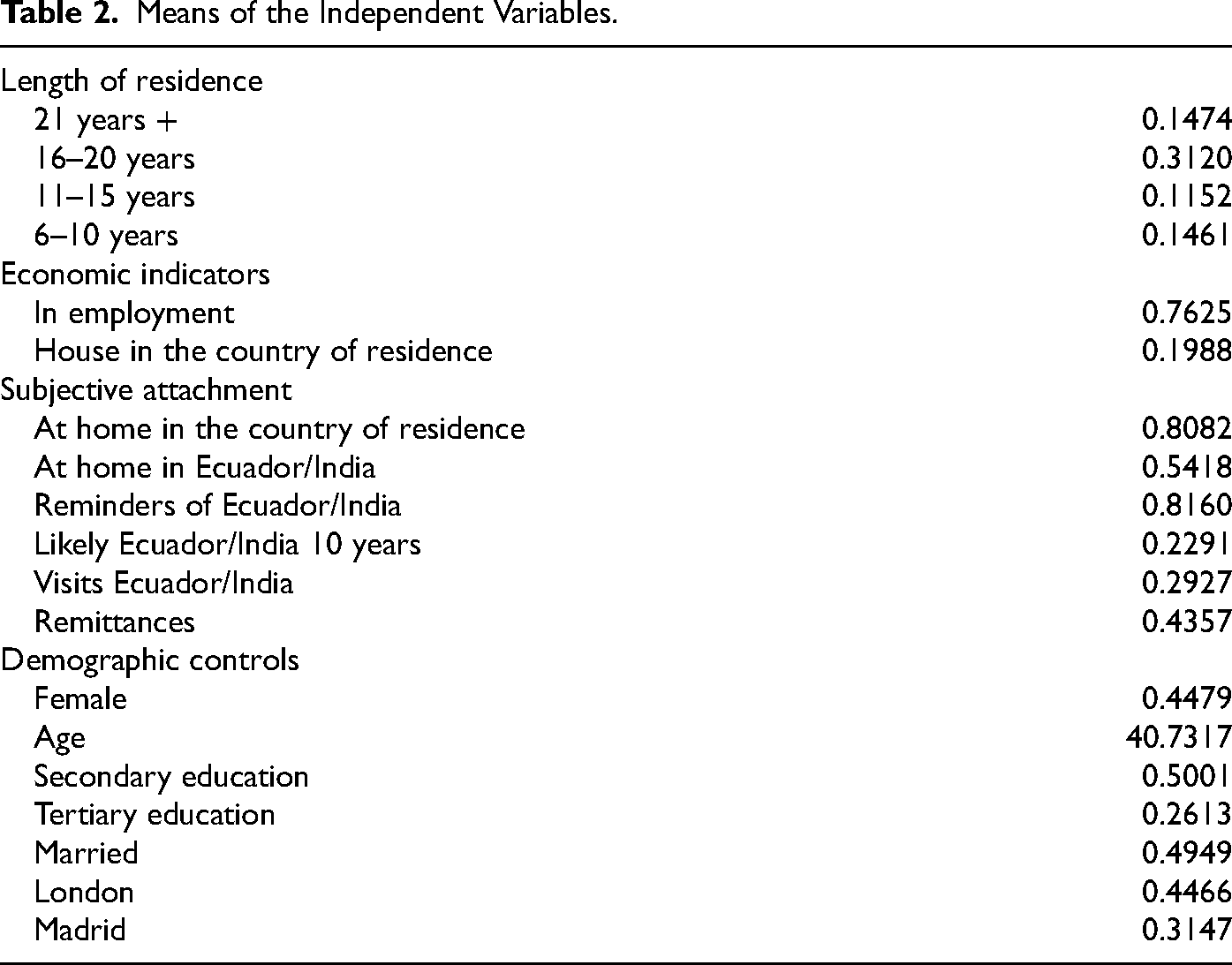
Second, we focus on economic indicators. While there are many possible indicators of economic capacity, we focus on whether the person is in employment and house ownership in the country of residence. During the development of the survey, it became clear that asking our respondents about employment status was less sensitive than asking about related aspects that reflect economic conditions such as earnings, occupational category, or receiving welfare payments. We include house ownership in the country of residence given the focus of the study on homeownership decisions. Employment rates are relatively high, with more than three quarters of those in the sample being in employment. On the other hand, house ownership in the country of residence is low at just 20 percent, a gap of 10 percentage points with transnational house ownership.
Third, we have a series of subjective indicators of attachment. During the development of the survey, it was difficult to come up with a single indicator of attachment that would cover the main aspects of interest. Hence, we decided to include different measures in the questionnaire. These include feeling at home in the country of origin, having reminders of the country of origin in the house (e.g., paintings), being likely to be living in the country of origin in a decade, visiting the country of origin frequently and remitting money home. Depending on the particular indicator between 22 percent and 82 percent of the respondents will report one of these subjective indicators.
Finally, we include a series of demographic controls in the estimation including gender, age, education, marital status, and city of residence. The Online Appendix reports the details of all the variables included in the estimation.
Results
Full Sample
In this section, we present the results in graphical form, but the Online Appendix includes the full regression tables for all estimations. Figure 2 presents the main results for the full sample. The figure presents the regression coefficients from an estimation in which the dependent variables indicate either that the respondent has a remittance house (Panel A) or is a house dreamer (Panel B). The error bars represent 95 percent confidence intervals, i.e., if the error bar crosses the zero line, then the regression coefficient is not statistically significant.
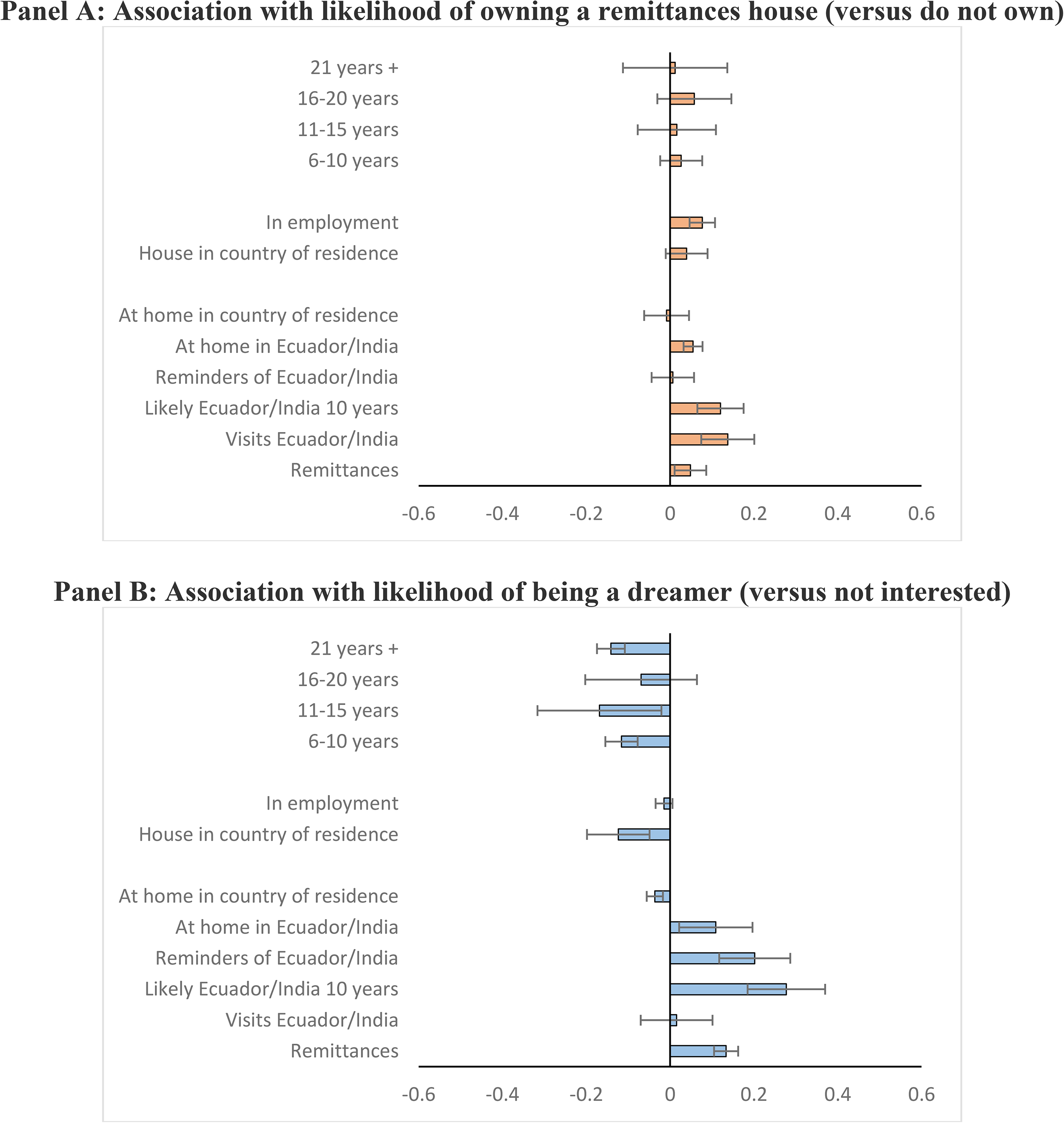
Results for the full sample.
Looking at the effect of the time variables, we see that the effect is statistically insignificant for owning a house (versus not owning). This does not correspond to H1. In essence, there is no clear linear association between length of stay abroad and house ownership back home—long-stayers are neither more nor less likely to invest in transnational housing than their newcomer counterparts.
However, the effect of the time spent in the country of settlement is negative and statistically significant for the likelihood of being a dreamer (versus not being interested). For instance, among those without a remittance house, migrants who have been abroad for 21 years or more are 14 percentage points less likely to be dreamers (or alternatively 14 percentage points more likely to not being interested in transnational housing) compared to newcomers (5 years or less in the host country).
As our analysis shows, the time spent abroad makes the remittance house dream less salient. While this does not necessarily entail that migrants lose emotional or relational attachment with the community of origin, it does indicate that they could see less scope and rationale for a transnational housing investment over time.
Concerning employment and house ownership in Europe, the results are broadly supportive of H2, about the critical role of economic capacity in shaping the difference between owners and dreamers. In this case, being in employment increases the likelihood of transnational house ownership by 8 percentage points. On the other hand, the likelihood of being a dreamer decreases by 12 percentage points for those who own a house in the country of residence. In short, homeownership in the country of settlement, which is itself a costly and self-selective effort (Mundra and Oyelere 2018), seems to discourage the imaginary of investing in a house back “home” at some point in the future, among those who do not yet have one. Having said that, there is not necessarily a trade-off between homeownership in Europe and in the country of origin. The coefficient between the two variables is actually positive, although it is not statistically significant.
Finally, as far as the subjective attachment to the country of origin is concerned, several factors tend to have a positive impact on the likelihood of house ownership and the likelihood of being a dreamer, as suggested by H3. For instance, those who expect to be back in their countries of origin are 12 percentage points more likely to own a transnational house and if they do not own one are 28 percentage points more likely to want one (versus not being interested). There is a close relationship between homeownership in the country of origin, and the aspiration for it, and the intention to return. Of course, neither the desire to buy a house nor the one to return will always or necessarily come true (Bertelli et al. 2022).
The migrants who feel at home in their country of origin are more likely (6 percentage points) to have a house there, and far more likely to dream of a remittance house, if they do not have one (11 percentage points). The likelihood of being a transnational house dreamer is also positively associated with the use of Ecuadorian/Indian symbols on material cultures in the domestic environment within the country of settlement. However, it is not associated with more costly transnational social practices, such as return visits.
Results for Different Migrant Groups
In this sub-section, we look at the results separately for each migrant group. As we explained above, our purpose is not to compare these groups. Ecuadorians and Indians are very different migrant groups and transnational housing dynamics are likely to be different. Instead, our purpose is to explore the degree to which the hypotheses presented apply to each group. Whenever this is the case, the validity of our overall findings is strengthened. If the results were different across groups, this would highlight the need for more research on transnational housing that takes into account different migrant groups in order to achieve robust conceptual and empirical conclusions.
Figure 3 reports the results for Ecuadorian migrants. These are broadly similar to those presented in Figure 2, which is not a surprise as more than two-thirds of the overall sample is composed of Ecuadorians. However, there are some key differences. Now the time variable (i.e., 21 years +) is significant for both the likelihood of transnational house ownership (positive) and of being a dreamer (negative). In particular, those who have been 21 years or more abroad are 7 percentage points more likely to be transnational house owners and 10 percentage points less likely to be dreamers. This is consistent with the ideas put forward in H1. As far as Ecuadorians are concerned, therefore, the length of stay abroad does make a difference to the likelihood of transnational homeownership (which increases accordingly), and to the likelihood of being transnational house dreamers (which decreases, as a result). There are grounds to see Ecuadorian transnational dreamers mostly as owners-in-waiting, which will likely shift to the other category when their conditions allow.
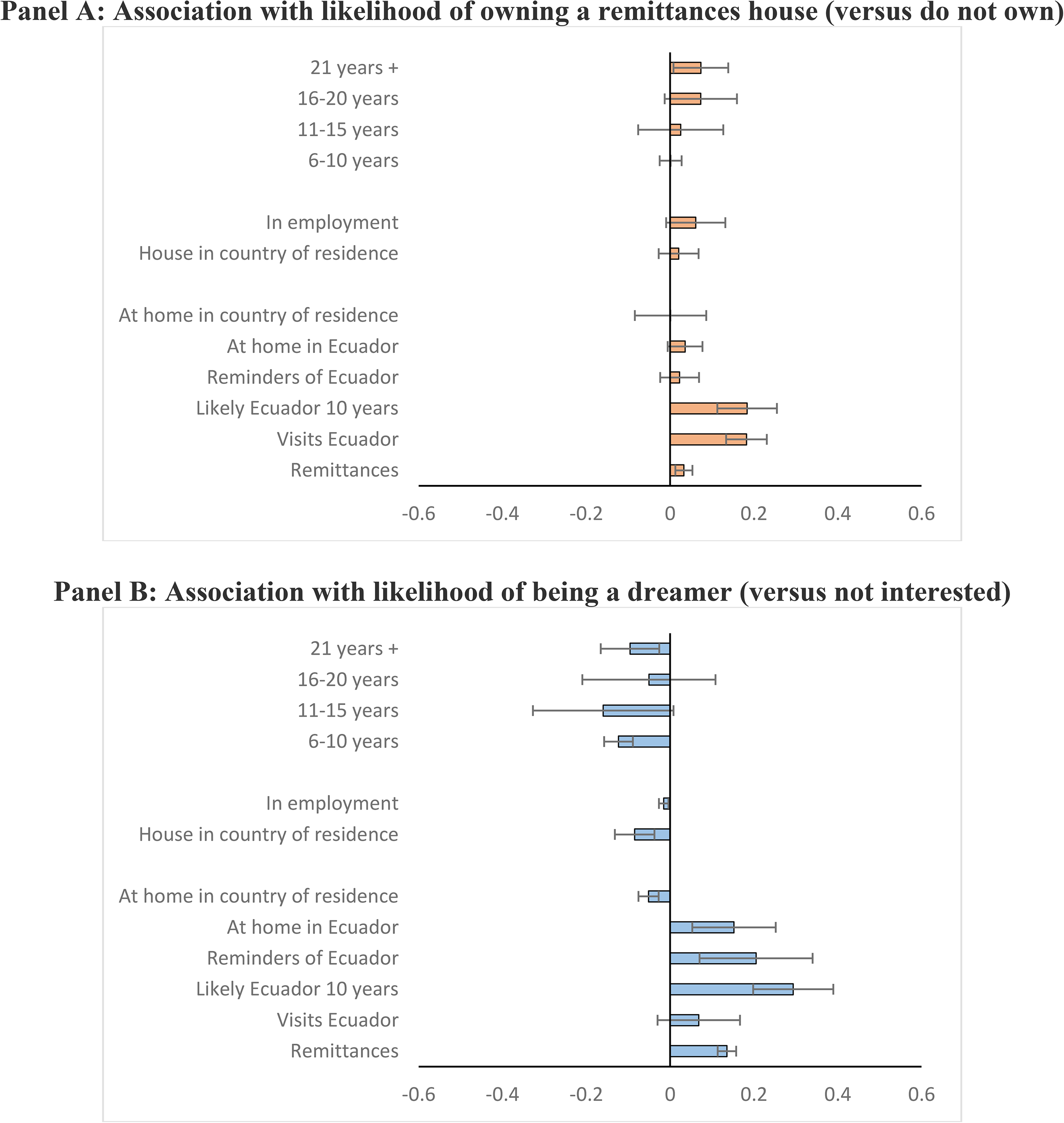
Results for Ecuadorians.
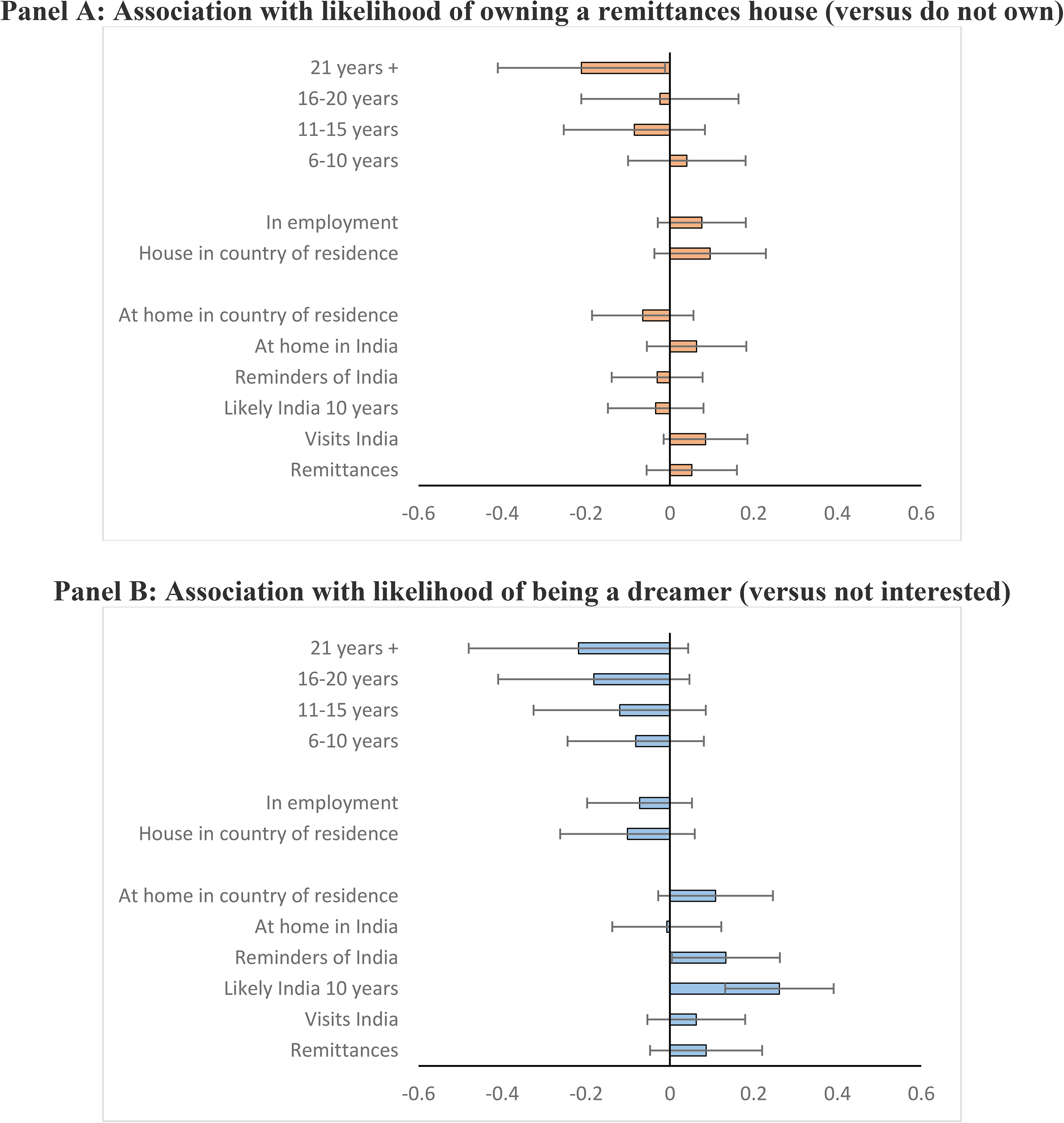
Figure 4 presents the results for Indians. Note that for Indians the sample is less than half the size of the one for Ecuadorians, so we can expect much less statistical significance in the coefficients. Overall, the results for Indians are somewhat different. First, the coefficients related to length of residence tend to be negative. Those who have been 21 years or more abroad are 21 percentage points less likely to be transnational house owners. Moreover, while the coefficients on length of residence are not statistically significant for the estimation in which being a dreamer is the dependent variable, there is a clear trend of the coefficients becoming larger as length of residence increases. This means that for Indians there is more evidence that as they settle abroad, the likelihood of being a dreamer and the likelihood of being a transnational house-owner both decrease. Yet, this remains an exploratory conclusion, as the estimated coefficients are not statistically significant.
Results for Indians.
In turn, the coefficients on economic conditions are not statistically significant, but point in the same direction as the results for Ecuadorians, suggesting that greater levels of income lead to a higher likelihood of being a transnational house owner and a lower likelihood of being a dreamer (versus not being interested).
Finally, the results suggest that the subjective attachment variables do not have a major impact on the likelihood of transnational house ownership for Indians. This is in contrast to H3. Yet, in this regard, there seems to be a difference in the likelihood of being a dreamer versus not being interested in transnational housing. The subjective variables do have a positive statistically significant impact on the likelihood of being a dreamer. Most notably, those likely to be in India in 10 years’ time are 26 percentage points more likely to be dreamers.
Results for Different Genders
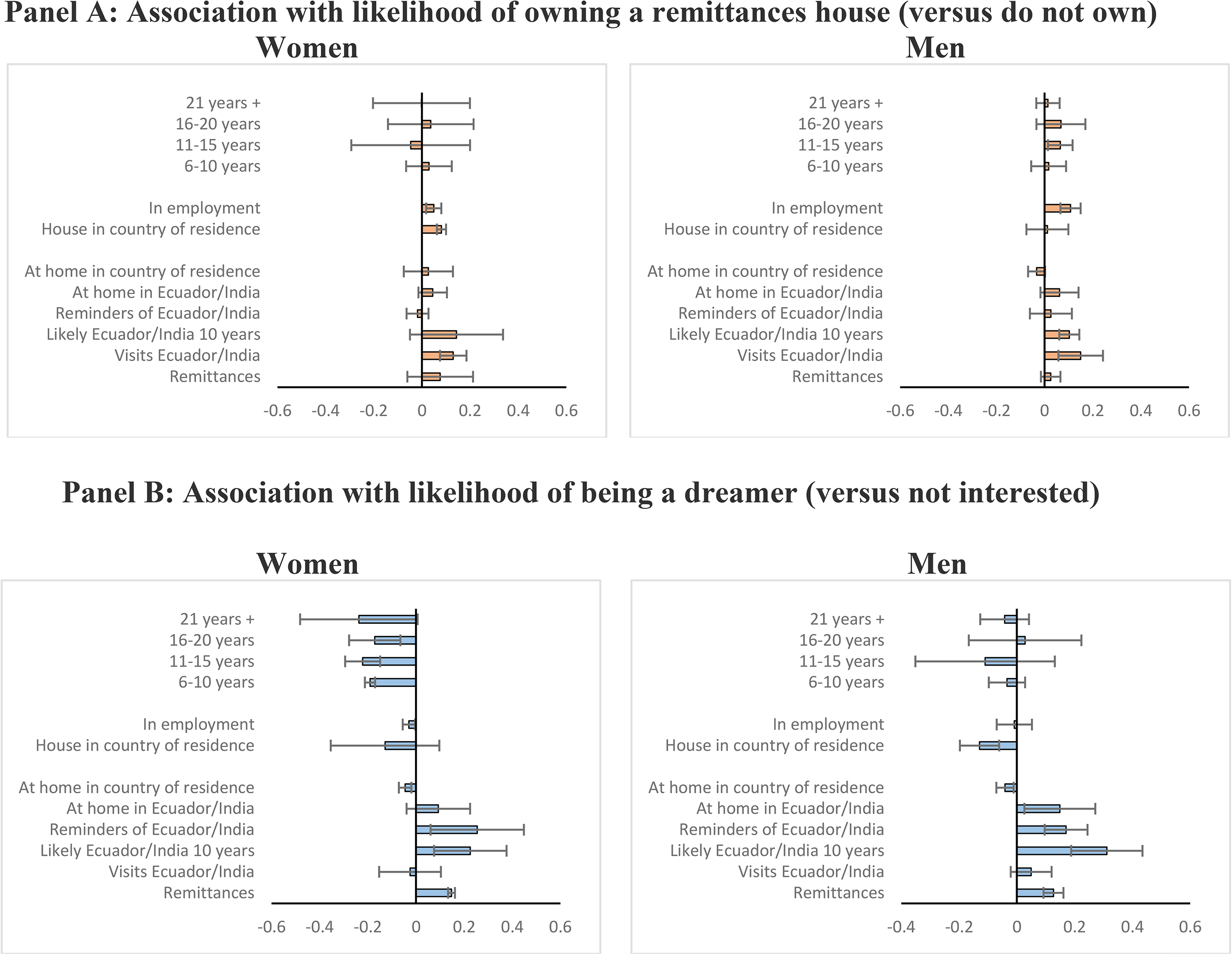
Figure 5 presents the results with the sample separated across genders. Looking first at house ownership, we see that the patterns are broadly similar. Length of residence (not statistically significant), economic conditions (employment is positive and significant for both) and homeland attachment (partly significant) operate in similar ways for male and female migrants. Note that we would expect fewer significant coefficients in these estimations given the smaller sample.
Results for different genders.
In short, the factors affecting the likelihood of homeownership in the country of origin are broadly similar across genders. There are greater differences concerning the likelihood of being a dreamer, though. Our analysis shows a clear trend of decreasing likelihood of being a dreamer for women, but not for men. Still, the coefficients regarding economic conditions abroad and attachment to the home country are broadly similar across gender in terms of their impact on the likelihood of being a dreamer.
It could be that over time women shift their attachments to other aims, whereas men are more likely to keep seeing the remittance house as part and parcel of their expected aims as migrants. This gendered difference calls for further elaboration and refinement in future research on migrant transnational housing.
Conclusion
Our article started with the promise to address a limitation in the literature on transnational migrant housing: the paucity of quantitative evidence on the factors that shape the underlying decision-making. Against this background, and through an original dataset on Ecuadorians and Indians in three European cities, we have cumulated evidence related to four key results.
First, length of stay has no statistically significant impact on the likelihood of transnational house ownership. However, it is important to highlight that this result does not hold for every migrant group. For instance, once we focus on the sub-sample of Ecuadorians, there is evidence that length of residence increases the likelihood of homeownership. This probably reflects the relatively limited temporal reach of Ecuadorian migration to Europe, which started almost from scratch in the late 1990s compared with Indian migration to the UK (only 11 percent of Ecuadorians have spent 21 years or more abroad, compared to 23 percent of Indians). The latter, even when first-generation migrants are considered, relies on the far more extended and pervasive settlement of a multi-generational, diasporic community. As a result, transnational housing investments may have already been made by earlier immigrant generations, to a certain scale, rather than being the cumulative outcome of more recent immigrant flows.
Second, the likelihood of being a transnational house dreamer decreases with the length of residence abroad. That is for migrants, the longer their stay, the higher the likelihood that the house dream loses salience. This means that the promise of potential housing investment in the country of origin is shaped by migrants changing life circumstances over time—in fact, by the changing location of the place in which they ultimately feel most at home (Boccagni and Vargas-Silva. 2021). This finding is consistent with the shift of return (at least as a permanent option), in the life projects of most migrants, from a short-term horizon to an elusive, long-term “myth,” as extensively shown in the literature (King & Kuschminder, 2022). However, it also shows that only a prospect of return can keep nourishing the “house dream” as time goes by and material constraints may militate against it. Here, we also find important differences across sub-samples, particularly gender. Women drive the decrease in the likelihood of being a dreamer as length of residence increases. The effect is not statistically significant for men. This invites more attention to gender differences, and possible inequalities, in future research on migrant transnational engagement over time—housing being a significant indicator to be considered in this respect.
Third, migrants with greater economic capacity are less likely to be dreamers and more likely to be transnational house-owners, suggesting that the difference between being a transnational house-dreamer and a transnational house-owner is often a financial one, related to an economic constraint. If the migrants that do own a remittance house are overall a minority, this may be because many others are not interested in this kind of investments, but also—and as often—because they simply cannot afford it. As our analysis suggests, the aspiration to own a remittance house does inform the life projects of rank-and-file labor migrants, in the short term. Whether they achieve it or not—the second being, importantly, far more often the case—is primarily due to the limited economic resources accessible to them. Interestingly, home ownership in the country of settlement is associated with a decrease of the likelihood that migrants keep dreaming of a remittance house if they have not already bought one. If and once migrants have made a major investment toward a house of their own in the country of settlement, they may well have little resources left—even only imaginative ones—for a remittance house. All this being said, as our data show, transnational housing investments are not significantly correlated with those in the country of settlement.
Finally, greater attachment to the country of origin increases the likelihood of being both a transnational house owner and a transnational dreamer, suggesting that transnational house ownership is also the result of attachment to the country of origin. Indeed, a remittance house is also meant to embody such attachment, somehow compensating for physical absence, to the eyes of those who keep living there. Particularly important are migrants’ expectation to return “home” in the future, as well as the frequency of their return visits. In this respect, a remittance house can be seen as a reflection of the meaningful transnational ties of migrants, primarily in a family domain. This is not surprising in itself—if anything, it confirms the significance of homeownership as a way for migrants to make visible, tangible and productive their cross-border ties and allegiances. More surprising, however, is the simply descriptive finding from which our analysis starts: Contrary to common sense, including the academic one, remittance houses are not the rule. In that respect, our findings open up an avenue for researchers to appreciate the other side of the moon about migrant housing—what lies out there and yet is typically missed from the observation. The (hyper)visibility of remittance houses, and their prevalence in the moral economy of migrant narratives, do not mean that this housing configuration is the straightforward and “natural” outcome of transnational migration. In practice, the opposite is more often the case, for reasons that have primarily to do with economic constraints, but also with the gradual prevalence of interests and needs related to everyday life in the countries of settlement over time. It becomes imperative, then, to shift further the analytical focus from the existence of remittance houses as a given, to the constellations of structural and biographical factors that account for it—or indeed, for their absence.
This calls for further and comparative research on transnational housing, i.e., on the constellation of factors that make home ownership in the country of origin a more or less desirable, viable and sustainable option over the course of migration. Conceptually speaking, therefore, the transition from house to housing (Wagner 2023) is as urgent and fruitful as the parallel one from home to homing (Boccagni 2017).
In addition to providing some of the first results on transnational house ownership (and the aspiration for it), our findings highlight the need for more large-scale transnational house ownership studies which highlight the heterogeneity of results across sub-populations of the migrant population, including but not limited to, gender and country of origin. While our own findings are still exploratory, they certainly pave the way for further investigation, particularly in relation to gender differences. That migrant women may shift their transnational investments from the house (which is a gendered marker of status, as much as an indicator of desired stability) to other more pragmatic and less ostentatious concerns, over time, is a working hypothesis that deserves further empirical test in future research on transnational migration and housing.
Finally, while we do not focus on the role of diaspora-related policies in motivating housing investments back home, we acknowledge that it is becoming more common for countries to have these policies. Such initiatives can range from tax incentives to the availability of loans, based also on the setting-up of dedicated property fairs (Zapata 2022). For instance, in Ecuador there is the Bono de Vivienda para el Migrante, which is a housing subsidy for migrants. While some version of the program has existed for several years, reports suggest that the takeover has been relatively small (Hinojosa Lara 2013). Future research can focus on evaluating the impacts of these programs.
Supplemental Material
sj-docx-1-mrx-10.1177_01979183231170812 - Supplemental material for Dreaming of a Remittance House: Understanding Transnational Housing Aspirations
Supplemental material, sj-docx-1-mrx-10.1177_01979183231170812 for Dreaming of a Remittance House: Understanding Transnational Housing Aspirations by Carlos Vargas-Silva and Paolo Boccagni in International Migration Review
Footnotes
Declaration of Conflicting Interests
The authors declared no potential conflicts of interest with respect to the research, authorship, and/or publication of this article.
Funding
The authors disclosed receipt of the following financial support for the research, authorship, and/or publication of this article: This project was funded by the European Commission H2020 ERC-StG HOMInG, Grant/Award Number: 678456.

Notes
References
Supplementary Material
Please find the following supplemental material available below.
For Open Access articles published under a Creative Commons License, all supplemental material carries the same license as the article it is associated with.
For non-Open Access articles published, all supplemental material carries a non-exclusive license, and permission requests for re-use of supplemental material or any part of supplemental material shall be sent directly to the copyright owner as specified in the copyright notice associated with the article.
