




Abstract
This article examines whether the Syrian refugee inflow to Jordan has displaced other immigrant workers in the Jordanian Labor Market. Using data from Jordan, before and after the Syrian refugee influx (in 2010 and 2016), we investigate whether male immigrants’ labor market outcomes, compared to male Jordanian nationals, were affected by Syrian refugees. We control for the geographic sorting of refugees within Jordan using an instrumental variable approach. We find that male immigrants were more likely to be underemployed (i.e., work in the informal sector, work fewer hours, and earn lower monthly wages) in areas with high concentration of Syrian refugees. These findings suggest that the main competition that occurred in the Jordanian Labor Market, between 2010 and 2016, was not between refugees and male Jordanian nationals, but between refugees and male immigrants. These results suggest that studies examining the impact of refugees on the labor market should consider the effects on immigrants who are likely to be more vulnerable than natives.
Introduction
The Syrian War has caused a mass exodus of Syrians, who have taken refuge in several countries (UNHCR 2018). The last census indicated that in 2015, Jordan, a neighbor of Syria, was hosting more than 1.3 million Syrian refugees (DoS 2015). Since the Syrian War began in 2011, despite the massive influx of refugees to Jordan, the number of non-refugee immigrants in Jordan has not decreased (DoS 2015). In 2010, prior to the Syrian crisis, immigrants represented 8 percent of Jordan's population, but the share of immigrants more than doubled to 18 percent by 2016. 1 Between 2004 and 2015, Jordan had received an additional 1.6 million immigrants, and immigrants and refugees together increased Jordan's population by about 45 percent (DoS 2004, 2015). Given the substantial number of immigrants in Jordan, the potential impact of the Syrian refugee influx on non-refugee immigrants in Jordan is a critical issue. Whether refugees displace immigrants is an important question for policymakers interested in the welfare of refugees, immigrants, and other vulnerable groups.
There is a growing literature on refugees’ impact on host communities (see, for example, Becker and Ferrara 2019 and Verme and Schuettler 2021, for recent reviews). In particular, the impact of refugee supply shocks on the host economy's labor market has been widely analyzed by economists, especially the case of the impact of Cuban refugees from the 1980 Mariel boatlift on Miami's labor market, suggesting no or small negative effects on natives (e.g., Card 1990; Peri and Yasenov 2019; Borjas 2017; Clemens and Hunt 2019). A few studies have also analyzed the effects of refugee supply shocks on host countries’ labor markets in lower income settings (e.g., Maystadt and Verwimp 2014; Ruiz and Vargas-Silva 2016; Alix-Garcia et al. 2018). For example, Maystadt and Verwimp (2014) found that agricultural workers in Tanzania suffered from fiercer competition in the labor market due to Rwandan and Burundian refugee inflows, while Ruiz and Vargas-Silva (2016) show that refugee flows affected the allocation of natives in Tanzania across economic activities in the long run.
More recently, the impact of Syrian refugee inflows has become a subject of concern for policymakers and academics. Several studies have examined Syrian refugees’ impact on Turkish labor market outcomes (e.g., Del Carpio and Wagner 2015; Tumen 2016). Tumen (2016) finds that Syrian refugee inflows led to a small reduction in informal employment among natives in Turkey. Also, a few studies have focused on refugees’ impact on firms’ behavior. For example, Altındağ, Bakış and Rozo (2020) study the impact of the Syrian influx on firms’ behavior in Turkey, finding that Syrian refugees had a positive impact on local businesses and firm creation (in particular in the informal sector), but also led to a reduction in natives’ employment in the informal labor market. Overall, the evidence suggests that refugee inflows tend to have limited or small negative consequences for the host population in the labor market. Other studies on refugees’ impact have examined outcomes such as consumer demand, prices, natives’ wellbeing, education, and housing, among others (see Becker and Ferrara 2019; Verme and Schuettler 2021, and Ruiz and Vargas-Silva (2013) for recent surveys on the impact of forced migration).
Two papers specifically examine Syrian refugees’ impact in Jordan. Fallah, Krafft and Wahba (2019) studied Syrian refugees’ impact on Jordanians’ labor market outcomes, finding that Jordanians did not experience adverse labor market outcomes in areas with higher exposure to refugees, even after controlling for individual fixed effects. Yet one potential untested explanation for these findings is whether refugees compete with immigrants rather than with natives. In a similar fashion, Malaeb and Wahba (2019) provide a descriptive picture of migration patterns in Jordan between 2010 and 2016, examining immigration, emigration, and return migration patterns. Although they document that immigrants were more likely to be informally employed and had different occupations and economic activities in 2016, compared to 2010, they do not provide causal evidence on the relationship between refugee concentration and immigrant outcomes, which is our focus in this article.
Here, we examine the effect of the influx of Syrian refugees on non-refugee immigrants in the Jordanian Labor Market. To the best of our knowledge, our study is the first to explore refugees’ impact on immigrants in a host country. As such, our main contribution to this literature on the impact of refugees is to investigate this unexplored question: What are refugees’ effects on immigrants’ labor market outcomes? It is important to note at the outset that to the term “immigrants” in this article excludes refugees. In other words, we examine the impact of the refugee influx on non-refugee immigrants’ labor market outcomes relative to natives. Also, it is important to highlight that we focus on the impact of refugees on male immigrants, compared to male nationals, because female labor force participation among immigrants (7 percent) and nationals (18 percent) in Jordan is very low (see Krafft and Assaad 2021).
Although there is a growing literature on refugees’ impact on the labor market (e.g., Tumen 2016 and Fallah, Krafft and Wahba 2019), this issue remains understudied. Also, despite a sizeable literature on immigration's impact on natives (e.g., Edo 2019), only a few studies have examined the effect of newly arrived immigrants on other existing immigrant groups and the substitution/complementarity between these two groups in the labor market. For example, Manacorda, Manning and Wadsworth (2012) show that new immigration primarily reduced the wages of previous immigrants relative to natives in the United Kingdom, suggesting imperfect substitution between natives and immigrants. They concluded that previous immigrants competed with new immigrant groups, but they did not study refugees’ impact on other immigrants.
Our context is different, given that we focus on the effects of refugees who, unlike economic migrants, were forced to flee their origin country with few possessions and thus typically have little evidence in support of their qualifications (e.g., Becker and Farrara 2019). Refugees and immigrants might be competing for the same jobs, however, if they have similar demographic and educational characteristics, potentially leading to competition and immigrants’ displacement. Alternatively, it could be that refugees and immigrants are imperfect substitutes; if they have different skill sets, immigrants might not be affected by the refugee influx.
In general, in a simple labor demand and supply framework, one can think of three types of labor (natives, immigrants, and refugees). The higher the homogeneity in the skill set among the three types of labor, the higher the competition between them. In this case, wages or work hours are likely to be driven down. However, if only immigrants and refugees have similar skill set, this higher homogeneity in immigrants and refugees’ skill set would affect immigrants’ wages and/or hours with respect to natives. If all three types of workers differ in characteristics, then the wages and employment of natives and immigrants might not be affected. In the case of these three groups being complements to each other, a refugee influx would potentially even lead to an increase in wages and employment of natives and immigrants. According to theory, the expected effects are ambiguous; thus, we attempt to answer this empirical question in analysis that follows.
We use a rich individual-level longitudinal dataset — the Jordanian Labor Market Panel Survey (JLMPS) for 2010 and 2016 — that spans the periods before (2010) and after the Syrian refugee influx (2016), see OAMDI 2016 and OAMDI 2017. We assess the impact of the refugee influx on male immigrants relative to male Jordanian nationals and examine several extensive and intensive labor market outcomes — namely, labor force participation, employment, formal and informal (jobs with no job contract or social security coverage) work, weekly work hours, and hourly and total wages. We use refugees’ varying concentration at the sub-district level to capture the share of refugees in the population at the sub-district level. We also address refugees’ sorting across sub-districts (i.e., the potential endogenous choice of Syrian refugees’ locations in Jordan), since more than 85 percent do not live in camps (UNHCR 2018). We employ instrumental variable techniques and follow the refugee economic literature in utilizing distance to camps as our main instrument for identifying the sorting of refugees (e.g., Fallah, Krafft and Wahba 2019). Although most Syrian refugees do not live in camps in Jordan, they live close to camps to access aid and public provisions targeted to refugees, such as education and health services (UNCHR 2018). We also augment our analysis with data from Egypt, the source of the largest immigrant group in Jordan, where we observe immigrants’ characteristics before and after the refugee influx to ascertain that the profile and characteristics of immigrants coming into Jordan did not change between 2010 and 2016.
Our findings suggest that male immigrants experienced negative labor market outcomes in Jordan, relative to male Jordanian nationals, because of the refugee influx. We find evidence that male immigrants were underemployed — more likely to work in the informal sector, work fewer hours, and earn lower monthly wages — because of refugee inflows. Hence, our results highlight that although male Jordanian nationals did not experience worse labor market outcomes in areas with high concentration of refugees, male immigrants were adversely affected. These results are important for policymakers interested in the welfare of immigrants who might become underemployed and potentially worse off because of competition with refugees.
The rest of this article is organized as follows. Section 2 describes the institutional setting of Syrian refugees in the Jordanian Labor Market, as well as background on immigrants in the Jordanian Labor Market. Section 3 introduces the JLMPS data we use and describes our sample. Section 4 explains our identification strategy and discusses potential threats to identification and our empirical methodology. Section 5 presents our findings and conducts various heterogenous analysis and robustness checks. We conclude by summarizing our main findings on the impact of refugees on the labor market outcomes of male immigrants relative to male Jordanian nationals in Section 6.
Background and Institutional Setting
The Syrian War that erupted in 2011 caused a mass exodus of 4.7 million people to neighboring countries (UNHCR 2018). By the end of 2016, the UNHCR reported 655,000 registered Syrian refugees in Jordan (UNHCR 2016). However, many Syrians do not register with UNHCR (ILO 2017a). According to the 2015 Jordanian Census, the total number of Syrians in Jordan was more than 1.3 million. At the same time, compared to the 2004 Census, there was a substantial increase in immigrants, from 354,000 to 1.65 million (excluding Syrians) and from 38,000 to 1.27 million Syrians. 2 In 2015, Egyptians comprised 5.4 percent of the total population in Jordan and 34.4 percent of the non-Jordanian population (DoS 2015). Thus, in 2015, the total population in Jordan was 9.5 million where 6.6 million were Jordanians, and refugees and immigrants amounted to about one-third of the total population (DoS 2004, 2015).
Refugees in the Jordanian Labor Market
Since Jordan shares its northern border with Syria, most Syrians are concentrated in northern Jordan (Dos 2015). Upon arrival in Jordan, refugees who enter the country legally are sent to a refugee camp, while other refugees end up in urban areas (UNCHR 2018). More than 85 percent of refugees live outside camps in Jordan (UNCHR 2018). Syrians generally work in casual day-to-day jobs to avoid obtaining a work permit, or enter into a sponsorship agreement with an employer (ILO 2017a).
In February 2016, the Jordan Compact was developed which included international humanitarian aid to Syrian refugees and macro financial assistance to the Jordanian government, as well as trade concessions by the European Union (EU) to ease Syrian refugees’ access to work permits in Jordan (European Commission 2016). Before the Compact, if refugees lived in camps, they had to secure a Jordanian sponsor and pay expensive fees to obtain a work permit (ILO 2017a). The Jordan Compact was based on the knowledge that most refugees worked informally in Jordan, had limited job mobility due to work permits tying them to certain sectors and employers, and faced potential exploitation when tied as a worker to a sponsor (ILO 2017b). Practitioners and policy advocates hoped that permits would enhance refugees’ social protection and working conditions (ILO 2017b). As a result, the new permit system for refugees was launched in phases: waiving fees in April 2016, waiving employers’ requirement to submit proof of social security in June 2016, and waiving medical examinations requirement in September 2016 (ILO 2017b). This new system aimed to create 200,000 new work permits (ILO 2017b). Despite an increase in available work permits, there were only about 40,000 work permits issued by mid-2017 (ILO 2017b). According to the ILO (2017a), the low uptake of work permits was due to information frictions and refugees’ reluctance to assume formal permits, as well as many employers’ reluctance to offer formal employment with work permits (ILO 2017a). Hence until 2016, the time of our analysis, refugees’ labor force participation remained low and mostly in the informal sector (ILO 2017a).
Immigrants in the Jordanian Labor Market
Before the refugee influx, Jordan had mainly unskilled immigration, and high skilled Jordanian emigration (Wahba 2014). Immigrant workers were, on average, less educated than native Jordanian workers (Wahba 2014). Indeed, many occupations, such as public sector jobs, are reserved for Jordanian citizens alone (Wahba 2014). Immigrants tended to be confined to the private sector, mostly in informal employment with no contracts (Wahba 2014). Non-Jordanians worked in trade, services, construction, manufacturing, and agriculture and were heavily concentrated in unskilled occupations: elementary occupations, craft workers, service jobs, and sales workers (Wahba 2014). Immigrants were employed in less attractive jobs compared to natives. Although the 2015 Census documented a substantial increase in the number of immigrants between 2004 and 2015, little is known about their characteristics and labor market outcomes- an issue we examine in detail in the rest of this article.
A primary concern for our analysis is whether the government had tightened its regulations on other immigrants because of the refugee influx after 2011. After signing the Jordan Compact in February 2016, the government could have reduced the number of work permits for other nationalities. However, there is little evidence to support any tightening of regulations on other immigrants in Jordan as the number of immigrants increased (DoS 2004, 2015). If such tighter regulations were put in place toward the end of 2016, it is likely they would have affected future immigrants, as opposed to immigrants who were already working and living in Jordan in late 2016 and early 2017, at the time of the JLMPS 2016 survey. 3 Also, as of 2017, the ILO (2017b) found that more than 75 percent of immigrant workers in Jordan worked illegally, without work permits, and that most immigrants and refugees were concentrated in agriculture, construction, and manufacturing. This suggests that, so far, there is no evidence of a policy change in granting work permits to immigrants. Overall, the institutional setting summarized above provides the context for the labor market structure faced by refugees and immigrants in Jordan. In the next section, we examine the extent to which immigrants were affected by exposure to high density of refugees.
Data
To evaluate the impact of the refugee influx on immigrants, we use the JLMPS for 2010 and 2016. 4 The data are nationally representative (after weighting to account for sample stratification along geographic lines). The first wave was conducted in January–March 2010, before the Syrian War (in 2011). The 2016 JLMPS wave was fielded between December 2016 and April 2017. 5 Both JLMPS waves were a collaboration between the Economic Research Forum (ERF) and the Jordanian Department of Statistics (DOS). The survey covered around 5,000 households and more than 25,000 individuals. The 2016 sample contains a refresher sample of 3,000 households to capture non-Jordanian, mainly Syrian refugee households. 6 The JLMPS contains rich information on individual and household demographics as well as labor market outcomes and job characteristics of Jordanian nationals and immigrants in Jordan. Our analysis uses both waves as pooled cross-sectional data. As very few immigrants from 2010 were tracked in 2016, primarily due to the temporary nature of economic immigrants in Jordan (see Wahba 2014). The 2010 and 2016 JLMPS contain a household questionnaire, an individual questionnaire, and a household enterprise questionnaire. In addition to current information on the labor market (including detailed and rich information on employment, sector, economic activity, wages, hours, and informality), the JLMPS also collected retrospective information on the various labor market characteristics of workers, with start and end dates, enabling one to construct employment histories for natives. In addition, JLMPS collected data on immigrants’ labor market outcomes in Jordan.
We also supplement our analysis with the 2004 and 2015 Jordanian Censuses. To capture refugees’ impact on the labor market outcomes of immigrants, relative to those of natives, we use information from the 2015 Jordanian Census on Syrians who lived in each sub-district in 2015. Due to the difficulty in identifying a person as a refugee in the census, we refer to all Syrians as refugees in 2015. We measure the share of refugees as the proportion of Syrians in each sub-district divided by the total population of the sub-district in Jordan in 2015. 7
We focus our analysis on male immigrants and male Jordanian natives only, 15–59 years of age, since female labor force participation in Jordan is too low to enable us to distinguish the effects by gender (Krafft and Assaad 2021): only 18 percent of Jordanian women and 7 percent of immigrant women participate in the labor market, based on the 2016 JLMPS. 8 Our two groups of interest are male immigrants (all non-Jordanians, excluding Syrians) and male natives (Jordanians). A person is identified as an immigrant if their nationality was not Jordanian or Syrian and if they were not a refugee (i.e., did not live in a camp, not registered as a refugee, and did not flee their country, due to violence or persecution). Our pooled cross sectional sample consists of 16,077 male individuals — 7,264 in 2010 and 8,813 in 2016. About 10 percent of our sample of men 15–59 years old were immigrants in 2010 (13 percent in 2016). For our analysis, we exclude Syrians (refugees), as we focus on male immigrants versus male Jordanians. The share of male immigrants jumped from 8 percent to 18 percent between 2010 and 2016. Overall, most immigrants in Jordan are Arabs, and Egyptians are the largest single non-refugee immigrant group, comprising 4 percent in 2010 and 13 percent in 2016 of the population in Jordan based on JLMPS 2010 and JLMPS 2016.
As seen in Table 1, almost three-quarters of working age male immigrants and Jordanian males were active in the labor force (LF), but both groups experienced a drop in labor market participation in 2016. Those who were not in the labor force were mostly students. Nearly all male immigrants in the labor force were working, and very few were unemployed. We find that most male immigrants worked in informal jobs (e.g., in jobs with neither job contract nor social security coverage), while male Jordanians had much lower levels of informality. However, male Jordanians reported higher hourly wages but similar work hours compared to male immigrants. Furthermore, approximately 40 percent of male Jordanians worked in the public sector, while almost no male immigrants did.
Descriptive Statistics of Male Immigrants and Male Jordanians, in 2010 and 2016.
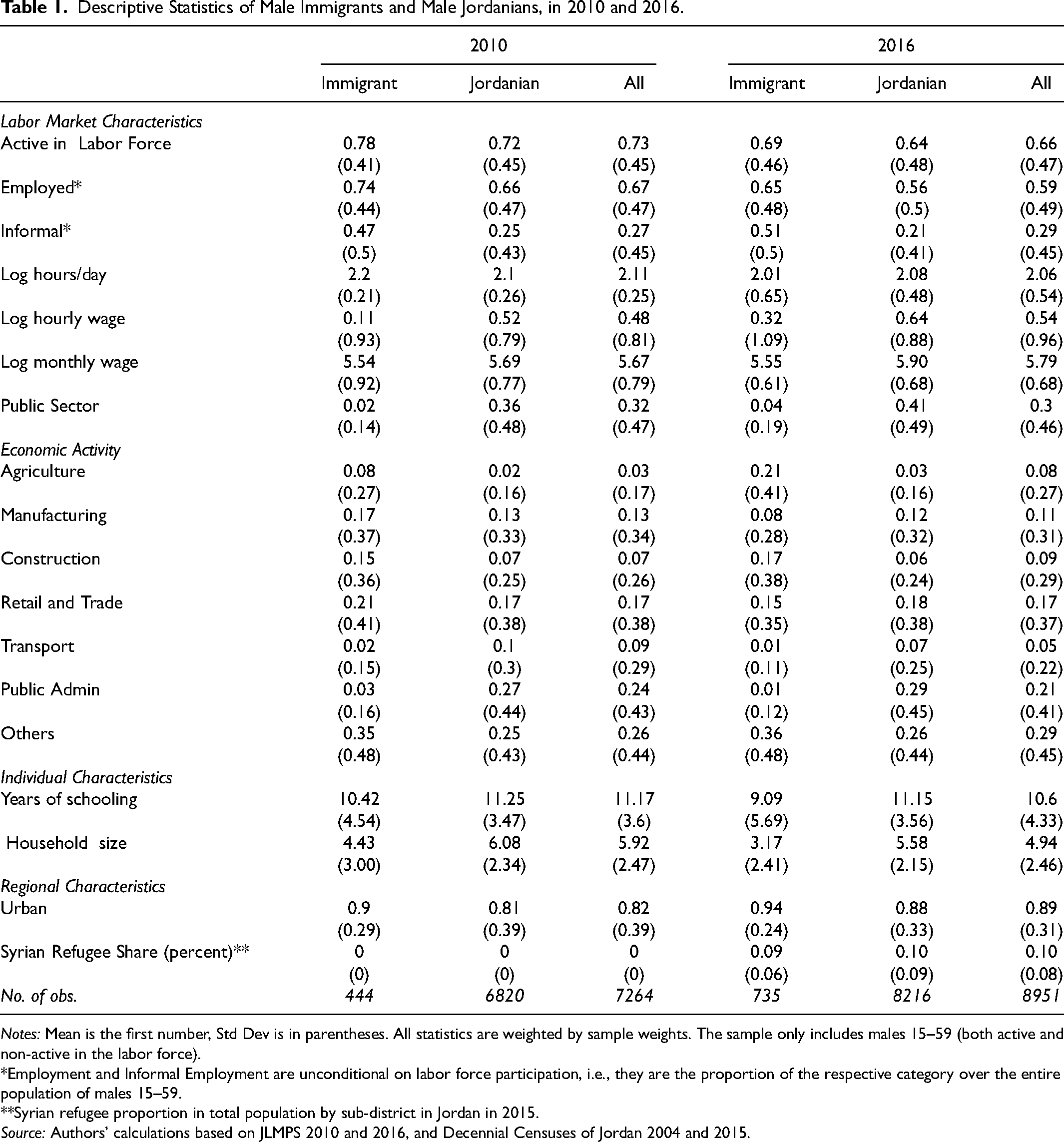
Descriptive Statistics of Male Immigrants and Male Jordanians, in 2010 and 2016.
Notes: Mean is the first number, Std Dev is in parentheses. All statistics are weighted by sample weights. The sample only includes males 15–59 (both active and non-active in the labor force).
*Employment and Informal Employment are unconditional on labor force participation, i.e., they are the proportion of the respective category over the entire population of males 15–59.
**Syrian refugee proportion in total population by sub-district in Jordan in 2015.
Source: Authors’ calculations based on JLMPS 2010 and 2016, and Decennial Censuses of Jordan 2004 and 2015.
In terms of economic activity, we observe significant changes in male immigrants’ economic activities between 2010 and 2016: there was a substantial increase in agricultural work and a decrease in both construction and manufacturing work. However, male Jordanians exhibited no differences in economic activities between the two waves of data. Malaeb and Wahba (2019) found that immigrants reduced their engagement in sectors that had a higher concentration of refugees; refugees mostly worked in manufacturing (24 percent), construction (24 percent), and wholesale and retail trade (21 percent). This suggests that exposure to refugees might have affected the economic activity of male immigrants in Jordan, an issue we will address in our estimations.
Comparing individual characteristics, we find that on average, male immigrants had fewer years of schooling, compared to male Jordanians, and that the gap between the two groups widened in 2016. Indeed, Table A1 shows male immigrants’ educational levels declined between 2010 and 2016. Household size was smaller for male immigrants than for natives, and in 2016, household size became even smaller as immigrants tended to immigrate as single males. Also, most male immigrants and male Jordanians lived in urban areas. Interestingly, both male immigrants and Jordanians faced similar exposure to the refugee population: the mean concentration of Syrian refugees at the sub-district level was around 10 percent with 9 percent standard deviation. We examine below the impact of this exposure on male immigrants’ labor market outcomes relative to male Jordanians.
Empirical Challenges
This article aims to examine the impact of refugee inflows on male immigrants in Jordan. We examine several labor market outcomes of male immigrants relative to male Jordanian nationals. We capture refugees’ impact using their share at the sub-district level controlling for male immigrants’ and male Jordanians’ individual and labor market characteristics. The estimation of the effect of refugees is challenging mainly because of: (i) the selectivity of immigrants, and (ii) the locational sorting of refugees. We discuss, in turn, these empirical challenges.
Immigrant selectivity
Our first concern is that our results might be driven by immigrant selectivity, since we do not have panel data on immigrants and use two pooled cross sections. For example, it is possible that due to the high refugee influx: (i) fewer immigrants came to Jordan, or (ii) those who came were different from earlier immigrants (2016 versus 2010) in terms of characteristics, or (iii) those who came possibly returned because of competition with refugees and, thus, are not observed due to attrition. To examine this immigrant selectivity concern, we first examine data from the 2004 and 2015 Jordanian Census. In 2015, Jordan hosted 1.3 million Syrians on top of an additional 1.6 million foreigners, compared to 354,000 foreign nationals in 2004. Hence, evidence suggests that the refugee inflows did not reduce immigration. Of course, we cannot say what the counterfactual would have been, but at least the concern about the impact of refugee influx on reducing the number of immigrants into Jordan is not warranted, as, in fact, the number of immigrants increased between 2010 and 2016. One explanation for this increase in the number of immigrants is that neighboring countries experienced political and economic turmoil that might have sustained the immigrant flow despite the refugee inflow.
Second, we examine whether the composition of male immigrants in 2016 was different from that in 2010. We find that male immigrants were significantly less educated in 2016 than in 2010, and that there were more uneducated male immigrants in 2016 (see Table A1; JLMPS 2016). Furthermore, we find that the nature of immigration to Jordan became more temporary in nature between 2010 and 2016. Indeed, by examining the distribution of immigrants’ household size, we find that approximately 43 percent of immigrant males in 2016, versus 21 percent in 2010, migrated individually without their families (even though 50 percent of those who reported household size equal 1 were married). Hence, we control for those observable differences in immigrants’ characteristics in our estimations.
Third, to shed light on return migrants, we check whether male immigrants in Jordan were pushed to leave, due to the refugee influx, and, hence, compare the characteristics of current immigrants in Jordan to immigrants who returned from Jordan. We focus on Egyptian male immigrants, since they constitute the largest male immigrant group in Jordan and since we have access to rich and nationally representative data in the Egypt Labor Market Panel Surveys (ELMPS), see OAMDI 2019. We use mainly ELMPS 2018 — which survey return Egyptian migrants and collect information from Egyptian households on current members who were overseas migrants. 9 While these data do not contain information on migrants who left Egypt with their whole households, we believe they are representative of migrants to Jordan, given the low proportion of those who migrated to Jordan with their whole families (based on JLMPS 2016). Therefore, in this analysis, we examine whether Egyptians who migrated to Jordan before 2011 were significantly different from those who left after 2011.
Table A2 shows the educational level of Egyptian male immigrants in Jordan in 2018 and those who had migrated to Jordan but returned to Egypt in 2018. The data indicate no significant difference in terms of either group's educational composition. We also examine the differences in Egyptian male immigrants’ characteristics before and after the refugee crisis, by comparing Egyptian male migrants who first migrated to Jordan before and after 2011 in Table A3. Despite Egypt experiencing political turmoil itself during the same period (e.g., Krafft, Assaad and Rahman 2021), which may confound some of the results, evidence indicates that, on average, Egyptian male migrants who migrated before and after 2011 were not significantly different from one another. Overall, the evidence shows that our concern about the selectivity of immigration is not warranted, and that controlling for observable characteristics addresses any remaining concerns about the potential selectivity of immigrants.
Sorting of refugees
The second main threat to our identification strategy, which aims to show the causal relationship between refugees and the labor market outcomes of immigrants relative to natives, is the geographical sorting of Syrian refugees within Jordan. Previous research on the impact of refugees was able to use settings where forced displacement is exogenous, and therefore, they could employ a difference-in-differences estimator of the impact of refugees (e.g., Card 1990). In the context of the Syrian crisis, Balkan and Tumen (2016) and Akgündüz, van den Berg and Hassink (2017) explore the impact of the refugee influx on the Turkish labor market and argue that refugees’ location in Turkey has been driven, at least in part, by exogenous forces (e.g., government dispersal policies). Similarly, Maystadt and Verminp (2014) argue that there is no threat to identification in their setting of Tanzania because refugee settlement was politically, rather than economically, motivated; therefore, refugee locations were exogenous to labor market conditions. On the other hand, more recent work in Turkey, by Del Carpio and Wagner (2015), argues that refugees’ locations within Turkey are endogenous. Also, Ruiz and Vargas-Silva (2016) examine the endogenous sorting of refugees from Burundi, using a two-stage least squares methodology, where distance to the border and to the camps are used as instrumental variables.
In our context, the influx of Syrian refugees was also exogenous to conditions in the Jordanian Labor Market; that is, due to the war in Syria, Syrians were pushed to flee to Jordan (a neighboring country). At the peak of their arrival in 2012–13, many who registered with the authorities and the UN refugee agency were channeled to the nearest camps with available capacity (initially, the Zaatari camp and later the Azraq camp) (UNHCR 2018). However, as time passed, refugees found ways to exit the camps and settle in urban areas (UNCHR 2018). At the time of our survey in 2016–17, more than 85 percent of refugees had relocated outside the camps (UNCHR 2018), suggesting that refugees might have self-selected into their subsequent locations and that sorting behavior might be a threat to identification.
Identification Strategy
To control for the geographical sorting of refugees, we use an instrumental variable (IV) approach. The 2015 Jordanian Census suggests that refugees were highly concentrated in the capital city of Amman, in the two governorates bordering Syria (Irbid and Mafraq) in northern Jordan, and in the areas where the two largest Syrian refugee camps (Mafraq and Zaraqa) are located. We use the distance to the largest Syrian refugee camp (Zaatari) — measured as the shortest distance (in logs) between the sub-district and the Zaatari Syrian refugee camp — as our main IV. The Zaatari refugee camp, built in 2012 by the Jordanian Government in response to the refugee influx, is the largest Syrian refugee camp (Ledwith 2014). It is situated in the desert of northern Jordan close to the Syrian border, and is exogenously determined as far as refugees are concerned, as it was chosen due to proximity and land availability (Huynh 2015). Although many Syrian refugees live outside of camps, they still locate around camps where financial assistance, food, and public services are delivered to refugees (UNHCR 2018). In fact, since 2012, Zaatari has become Jordan's fourth largest city (Ledwith 2014).
Threats to identification
Our chosen instrument (IV) is quite common in the migration/refugee literature. 10 For example, Ruiz and Vargas-Silva (2016), Rozo and Sascha (2021), Alhawarin, Assaad and Elsayed (2021), and Fallah, Krafft and Wahba (2019) all use distance to refugee camp to instrument for the sorting of refugees when studying refugees’ impact on various outcomes such as labor market, housing, and education. However, one potential concern for our analysis is that distance to camp could be associated with economic outcomes directly, especially informal employment opportunities (see Alix-Garcia et al. 2018, in the Kenyan context). Given that immigrants are more likely than Jordanians to work in informal sectors (ILO 2017a), the IV would potentially have a direct impact on the outcome variable for immigrants. Nonetheless, the conditions that led to the findings in the Kenyan case examined in Alix-Garcia et al. (2018) differ drastically from those of the Jordan case. Indeed, Alix-Garcia et al. (2018) argued that their results are very context-specific as Northern Kenya is a particularly desolate setting, and refugees were confined to camps and were not integrated. Thus in their setting distance to camps had a direct impact on economic outcomes. However, in Jordan, refugees, and their impacts, are not confined to camps, as the majority (85 percent) live outside camps (UNHCR 2018).
Also, our empirical strategy compares areas with high and low exposure to refugees, as a continuous variable, on the labor market outcomes of male immigrants relative to male natives. Although immigrants are, in general, more likely to be involved in informal work compared to natives (ILO 2017a), our argument hinges on the fact that distance to camps directly affects the share of refugees, which, in turn, affects informality. Distance to camps does not directly affect immigrants’ probability of informality. We test this conjecture further in Table A4 in the Online Appendix, Panel A, where we regress informality on distance to camp for male immigrants and Jordanians, controlling for individual and sub-district effects. We do not find a significant correlation for either. In other words, our instrument is not positively correlated with immigrants’ informality; hence, there are no concerns that our instrument might violate the exclusion restriction.
Furthermore, and to ensure that our IV does not violate the exclusion restriction, there should be no direct relationship between camps and immigrants’ location. Indeed, we find, that the share of male immigrants is not correlated to distance to camp (Dist Camp 16) at the sub-district level, and that the immigrant dummy is also not a function of distance to camp (see Table A4, Panel B in the Online Appendix). Although we find a negative correlation between being an immigrant and the share of refugees, as expected, when we control for the share of refugees, we find no relationship between immigrant and distance to camp. Hence, these tests reassure us about our IV's validity; however, we also show both the ordinary least squares (OLS) and the two-stage least squares (2SLS) results below. We also check our IV's robustness in Section 5.3, using alternative instruments, and our results hold.
Another concern is that bordering governorates to Syria could potentially be affected independently by the war in Syria compared to other regions/governorates. For example, it is plausible that northern regions in Jordan had stronger trade with Syria and, hence, could be differently affected by the war, compared to southern regions. Since we are interested in the differential impact of the share of refugees in the sub-district on other male immigrants relative to male Jordanians, it would be a concern if only male immigrants, but not male Jordanians, are affected by border effects, for example, of weaker trade. Another issue is that regions/governorates in Jordan also differed, even before the war, in levels and trends of economic growth and development (e.g., Mafraq vs. Aqaba) (DoS 2015). Thus, we include sub-district fixed effects to capture omitted variables related to heterogeneity across sub-districts.
Empirical Strategy
Our empirical approach relies on a continuous treatment effect in a two-stage least squares setup, since it is difficult to construct a placebo or a control group for the areas of high density of Syrian refugees; the low-density areas would, nevertheless, have some refugees and the assumption that these areas are “untreated” may be a strong one. Our main model examines the impacts of refugee concentration patterns on male immigrants’ relative to male Jordanians’ employment and labor market outcomes.
To control for sorting of refugees, we use the log distance from sub-district to Zaatari refugee camp (Camp
s
) and Camp
s
interacted with Iist the immigrant dummy.
12
The first-stage equations can, therefore, be written as:

Main Analysis
First, we focus on the results of the OLS analysis based on the full sample of male immigrants and male Jordanians, aged 15–59, where we control for individual characteristics and sub-district fixed effects in Table 2. The estimates suggest that greater exposure to refugees was associated with male immigrants’ higher employability, more informal work, and fewer work hours. At the same time, Table 2 shows that sub-districts with high concentrations of refugees had higher wages, a finding which supports previous studies showing that refugees/immigrants tend to locate in areas where the labor market is favorable (e.g., Becker and Ferrara 2019). This finding also suggests that not controlling for the sorting of refugees might lead to biased estimates. Hence, our 2SLS estimates control for the endogenous sorting of refugees, where we use distance to the camp and distance to camp interacted with the immigrant dummy as IVs for the proportion of Syrian refugees and the interaction thereof with the immigrant dummy. The first stages of our 2SLS are mostly above the Stock and Yogo critical values for Kleibergen Paap rk Wald F statistic (for weak identification), so we reject the weakness of instruments but acknowledge that the instrument is not overwhelmingly strong. 14 However, the results of the first stage coefficients are significant and in the expected direction as shown in Table A7 Panel A in the Online Appendix. There is a negative relationship between the distance to camp and the share of refugees, and a positive one with respect to immigrants.
OLS and 2SLS : Migrants and Jordanians, Males 15–59 Years old.
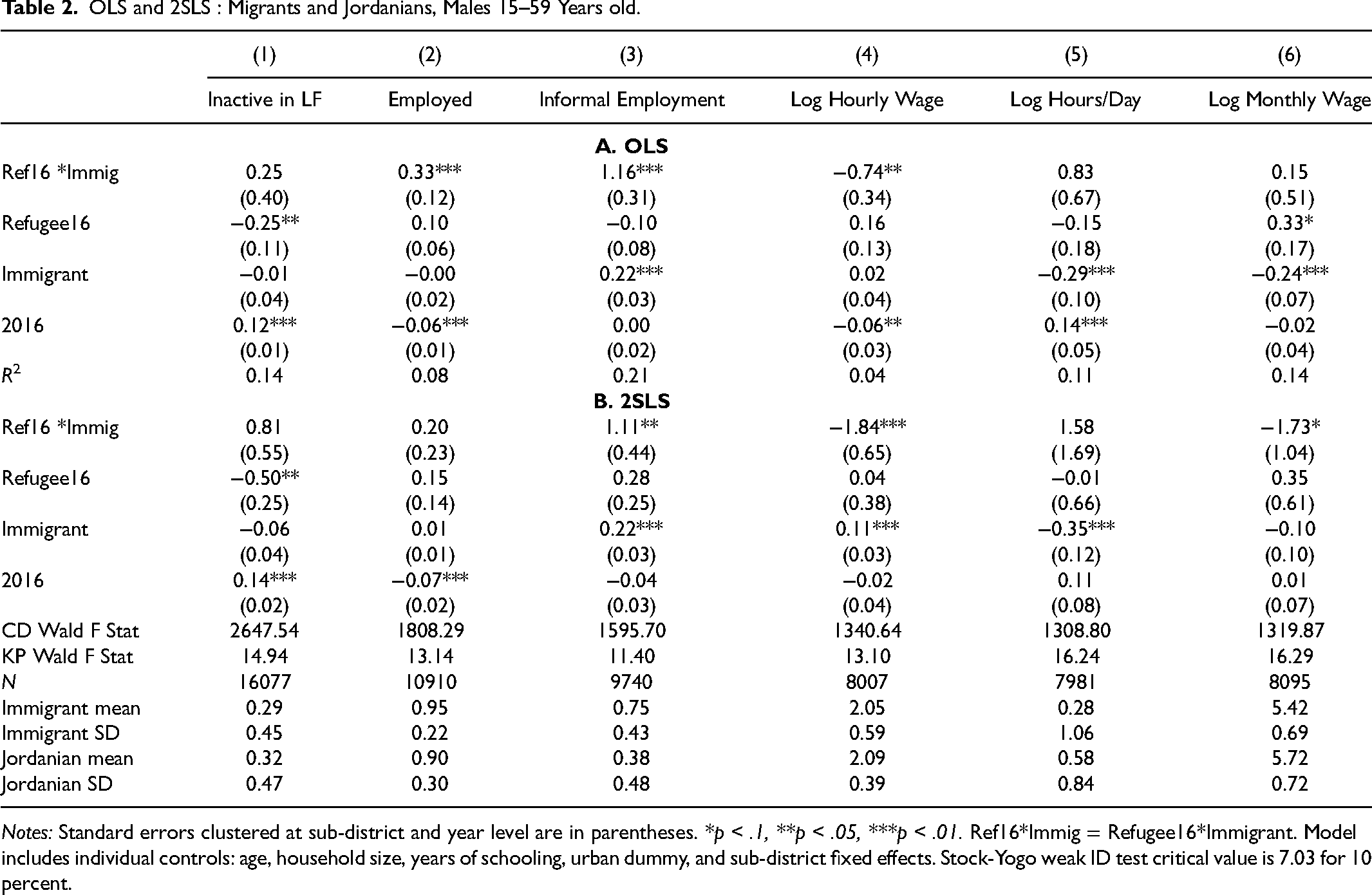
OLS and 2SLS : Migrants and Jordanians, Males 15–59 Years old.
Notes: Standard errors clustered at sub-district and year level are in parentheses. *p < .1, **p < .05, ***p < .01. Ref16*Immig = Refugee16*Immigrant. Model includes individual controls: age, household size, years of schooling, urban dummy, and sub-district fixed effects. Stock-Yogo weak ID test critical value is 7.03 for 10 percent.
The results of the Second stage of the 2SLS in Table 2 Panel B show that in 2016, there was more inactivity and less employment overall, compared to 2010. Also, the immigrant coefficient, which captures the effect of being immigrant relative to Jordanian, shows that male immigrants were more likely to be employed informally, to work more hours, and to earn less than male Jordanians. However, in terms of the impact of exposure to refugees on male immigrants, we find that there was a negative effect on male immigrants in terms of labor market participation in areas of high Syrian refugee density. Also, as the Syrian refugee proportion increased in a sub-district, male immigrants were much more likely to be engaged in informal employment, 15 as the differential effect was significant and much larger in magnitude than the average effect. Moreover, higher refugee density caused male immigrants to work fewer hours but had an insignificant effect on their hourly wages, although the effect on male immigrants’ monthly wages was negative and significant. Interestingly, comparing the coefficients of OLS to the 2SLS suggests that for participation and employment, the OLS overestimated the impact of refugees on male immigrants’ participation and employment and underestimated the impact of refugees on male immigrants’ hours and wages. Overall, our findings suggest that male immigrants were more likely to be underemployed (i.e., more likely to be inactive, to be employed informally, to work fewer hours, and to earn lower monthly wages) in areas where there was a large concentration of refugees, even after controlling for the potential sorting of refugees.
To examine whether the impact of the Syrian refugee influx was heterogeneous among different groups of male immigrants, we conducted several further analyses. First, since Jordanian labor law allows refugees work permit in particular sectors (agriculture, manufacturing, construction, food and beverage, and domestic cleaning) referred to as “Open sectors” (ILO 2017a), we examined refugees’ impact on male immigrants in those specific sectors. Table 3, Panel A, presents the OLS estimates, while Table 4, Panel A, presents the 2SLS estimates. We restrict our sample to those employed in those three open sectors and find the same patterns observed previously: male immigrants were adversely affected if they were employed in the open sectors where there was higher concentration of refugees, as male immigrants were more likely to be informally employed, work fewer hours, and earn lower monthly wages.
OLS: Heterogeneous Effects: Migrants and Jordanians, Males 15–59 Years Old.
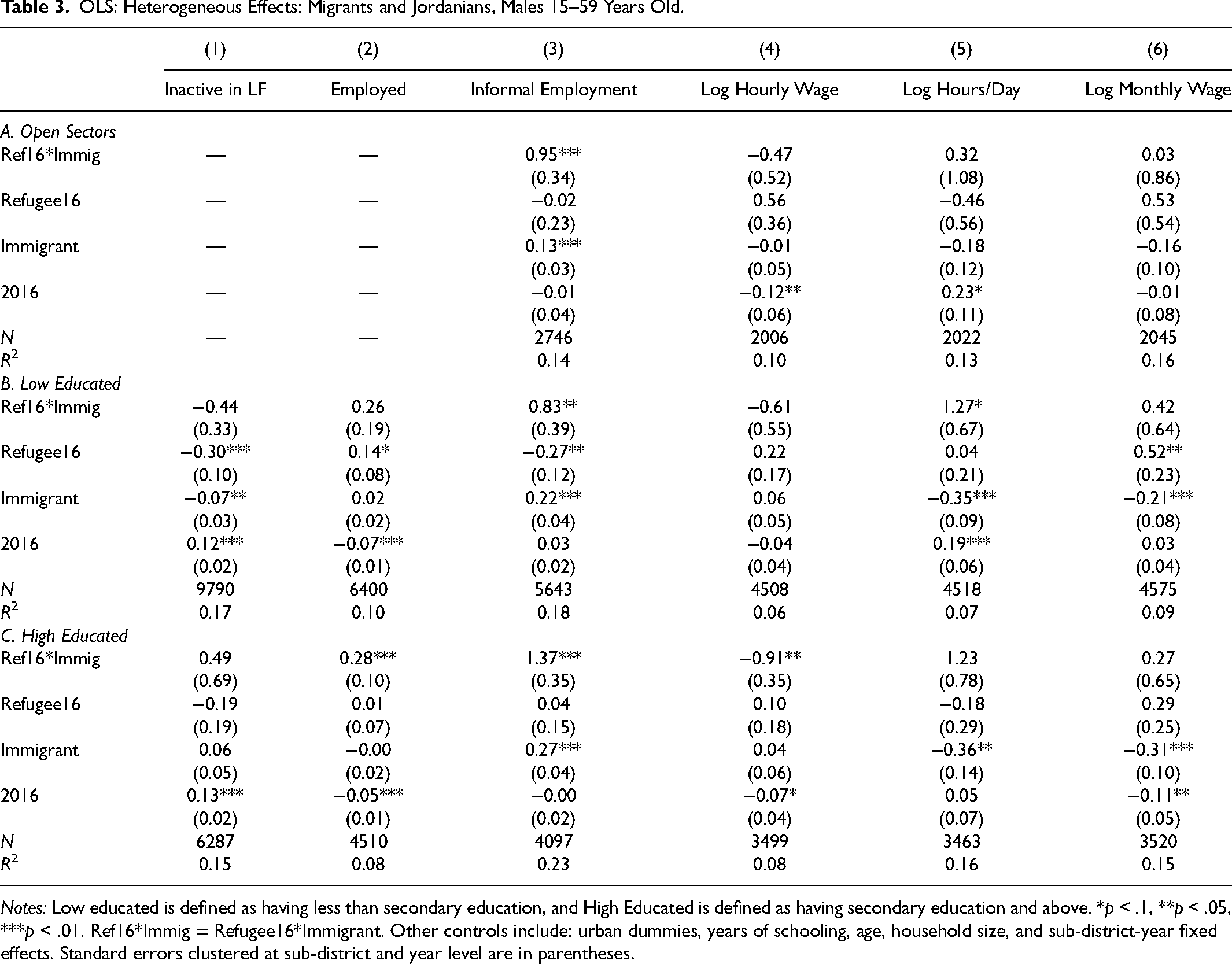
OLS: Heterogeneous Effects: Migrants and Jordanians, Males 15–59 Years Old.
Notes: Low educated is defined as having less than secondary education, and High Educated is defined as having secondary education and above. *p < .1, **p < .05, ***p < .01. Ref16*Immig = Refugee16*Immigrant. Other controls include: urban dummies, years of schooling, age, household size, and sub-district-year fixed effects. Standard errors clustered at sub-district and year level are in parentheses.
2SLS: Heterogeneous Effects: Migrants and Jordanians, Males 15–59 Years old.
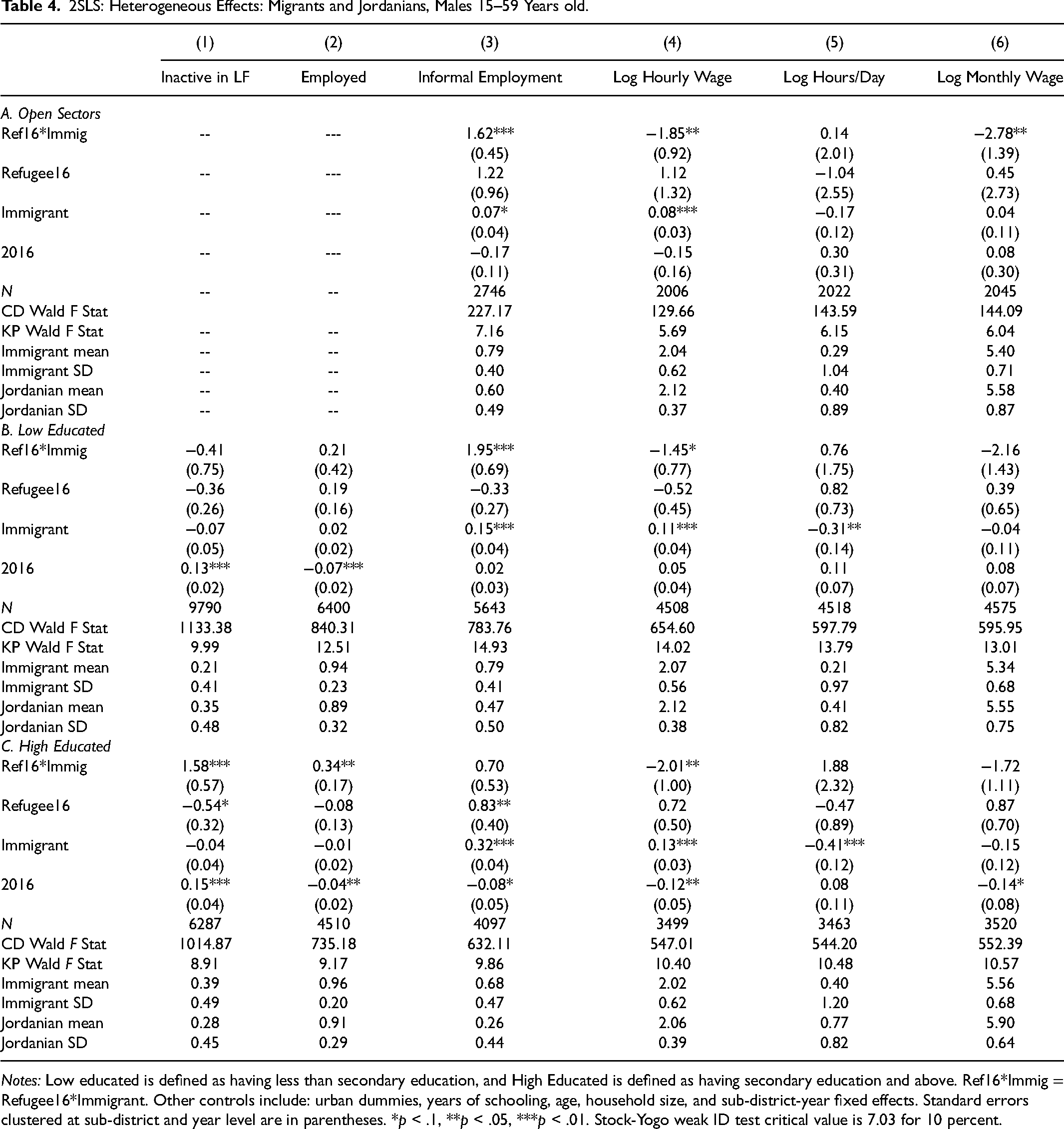
Notes: Low educated is defined as having less than secondary education, and High Educated is defined as having secondary education and above. Ref16*Immig = Refugee16*Immigrant. Other controls include: urban dummies, years of schooling, age, household size, and sub-district-year fixed effects. Standard errors clustered at sub-district and year level are in parentheses. *p < .1, **p < .05, ***p < .01. Stock-Yogo weak ID test critical value is 7.03 for 10 percent.
Second, we distinguish between highly educated (secondary and above) and low educated (below secondary educated) workers. Table 3, Panels B and C, and Table 4, Panels B and C, show the OLS and 2SLS estimates, respectively. Focusing on the 2SLS, the results show that for both educational groups of male immigrants in areas with higher refugee concentration, they were more likely to be informally employed and work less than those living in areas with lower Syrian density. However, highly educated male immigrants were also more likely not to participate in the labor market in areas with high refugee concentration. Both groups were likely to experience a negative impact on their monthly wages, although the effect for those with low educational levels was not significant. Hence, these findings suggest that all male immigrants, regardless of education levels, were affected by the influx of refugees.
We also repeat our main analysis, restricting our sample of male immigrants to Egyptians only. Egyptians comprise the largest single nationality group of immigrants in Jordan and have a historical presence in the Jordanian Labor Market (DoS 2004). Further, we have the possibility to observe and compare Egyptian migrants’ characteristics before and after the refugee influx in Jordan, using a nationally representative dataset from Egypt using ELMPS 2018. Thus, any concerns about immigrant selectivity in Jordan are quelled, as discussed in Section 4.1.1. Table 5 shows that Egyptian male immigrants experienced similar patterns to other male immigrants. They were more likely to work in the informal sector and experience a reduction in their work hours and wages because of the refugee influx to Jordan. Hence, these analyses confirm that higher exposure to refugees was associated with male immigrants’ higher underemployment.
OLS and 2SLS: Egyptian Immigrants and Jordanians, Males 15–59 Years old.
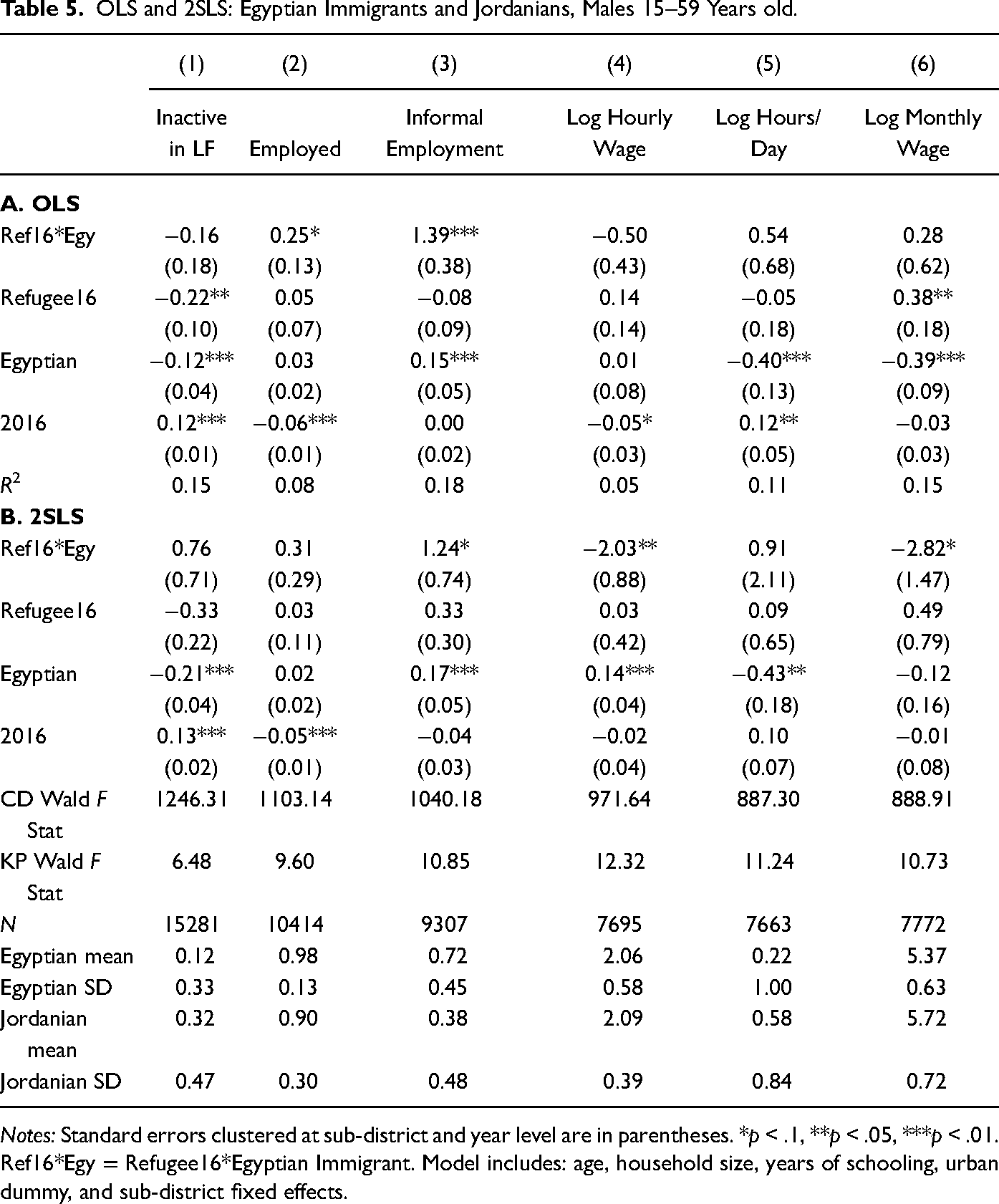
Notes: Standard errors clustered at sub-district and year level are in parentheses. *p < .1, **p < .05, ***p < .01. Ref16*Egy = Refugee16*Egyptian Immigrant. Model includes: age, household size, years of schooling, urban dummy, and sub-district fixed effects.
We conducted several tests to check our estimates’ robustness. First, we focused on natives only and restricted the analysis to Jordanian males (15–59 years of age). Interestingly, Table 6 shows that there were no effects of refugees on male Jordanians’ labor market outcomes (i.e., male Jordanians did not experience worse labor market outcomes in areas with higher refugee concentration) consistent with Fallah, Krafft and Wahba (2019). 16 The result that there was no impact of refugees on male Jordanians suggests that refugee inflows mostly affected male immigrants, rather than male Jordanians.
OLS and 2SLS: Jordanians Only, Males 15–59 Years.
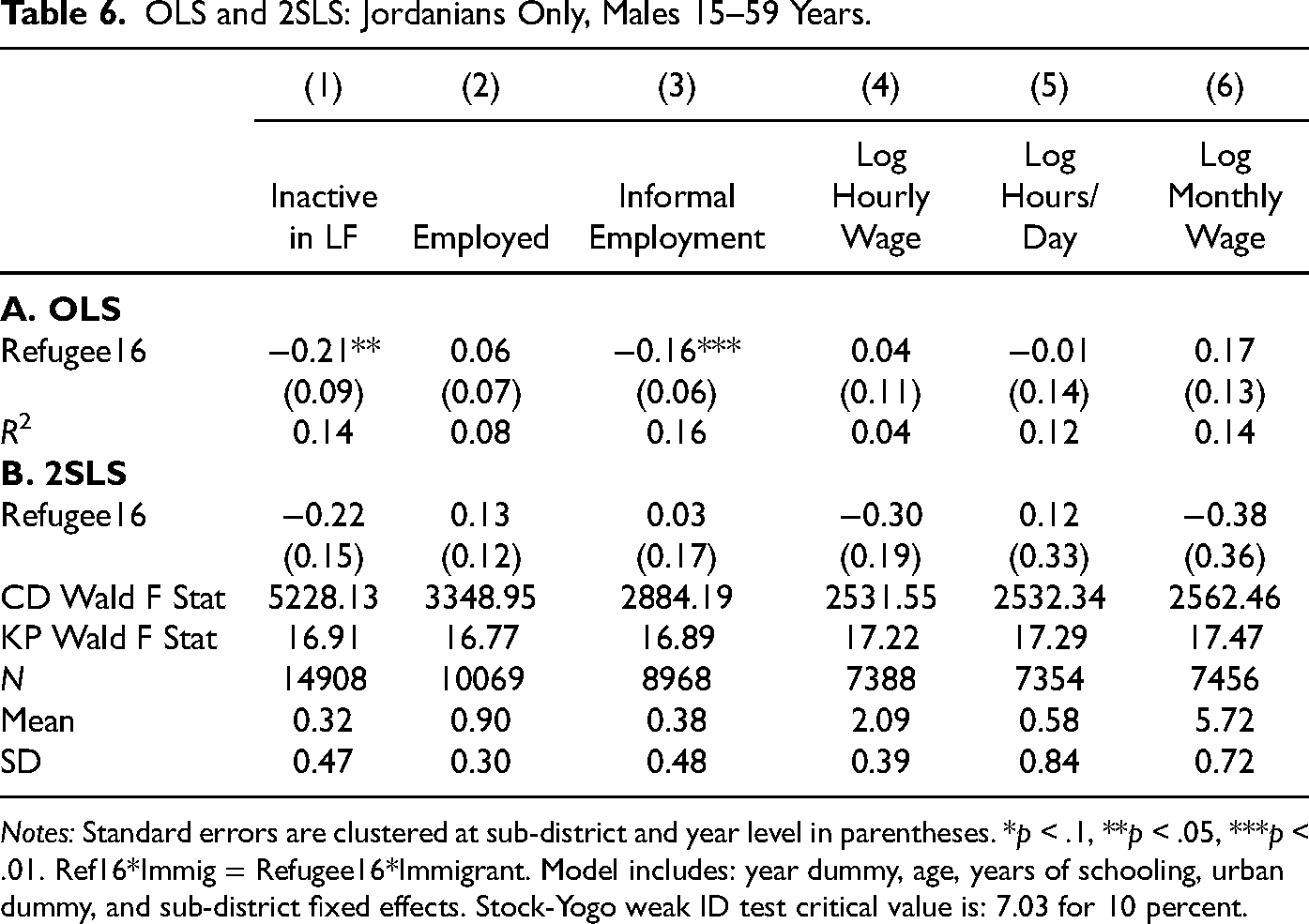
OLS and 2SLS: Jordanians Only, Males 15–59 Years.
Notes: Standard errors are clustered at sub-district and year level in parentheses. *p < .1, **p < .05, ***p < .01. Ref16*Immig = Refugee16*Immigrant. Model includes: year dummy, age, years of schooling, urban dummy, and sub-district fixed effects. Stock-Yogo weak ID test critical value is: 7.03 for 10 percent.
Second, we checked our results’ robustness, using alternative IV. We also used log distance to border and its interaction with the Immigrant dummy as an alternative IV for refugees sorting and immigrant sorting. Distance to border was measured as the shortest distance (in logs) between the sub-district and the border with Syria, given the high concentration of refugees in those bordering governorates. 17 Table A7, Panel C, in the Online Appendix, shows that the distance to border was significant in the first stage, albeit weak, while Table A5, Panel A, in the Online Appendix, shows that all previous results hold, using this alternative IV.
We also used the historic proportion of immigrants in sub-district out of total immigrants in Jordan in 2004 based on the Census and its interaction with the Immigrant dummy. The immigration share pre-dates the Syrian crisis and should capture immigrants sorting, as it is common for new (economic) immigrants to settle where previous immigrants did or where they established social networks (Munshi 2003). However, the first-stage estimates show that the immigration shares were not significant in predicting the sorting of refugees or immigrants in 2016, as the latter were more likely to choose their location based on refugees’ locations, rather than on immigrants’ previous location. We also experimented with using this historic immigration share and log distance to camps, as well as their interactions with immigrant dummy. The first stage was consistently weak, but all our previous main results were qualitatively unchanged. 18
Third, to check our estimates’ robustness, we used the share of Syrian refugees at the district level, finding similar, though weaker, results (Table A5, Panel B in the Online Appendix). Also, given the change in immigrants’ education levels between 2010 and 2016 and to ensure that the results were not driven by the potential change in the immigrants ‘education levels, we excluded education as a control. All results are unchanged (Table A5, Panel C, in the Online Appendix), confirming that the estimates were not driven by education but, rather, by exposure to refugees. Finally, to check the robustness of our methodology and the assumption of parallel trends and since the retrospective data for immigrants are limited in 2016, due to temporary migration, we regressed the employment outcomes for male immigrants versus Jordanians in 2010 (prior to the refugee influx) on the refugee share in 2016. We find no significant correlation (Table A5, Panel D, in the Online Appendix), suggesting no concerns regarding pre-trends affecting our estimates. Thus, overall, all findings remain robust to our choice of instrumental variables and show that male immigrants were pushed into informality and had to compete more for work because of the refugee inflow. Our results indicate that although male natives were not affected, male immigrants competed with refugees and, therefore, experienced displacement in the Jordanian Labor Market.
Sorting of immigrants
To probe our findings further, we discuss few potential channels through which male immigrants might react to the refugee influx. One potential way through which male immigrants might alter their behavior is locational sorting (i.e., immigrants may alter their locations of choice vis-à-vis those of refugees). In fact, male immigrants might also choose their location depending on where refugees sort; they might avoid areas where refugees settled or might find refugee-concentrated areas more attractive due to changing labor demand. As documented in Malaeb and Wahba (2019) there was a decrease in male immigrants’ location of settlement in governorates with higher refugee proportions (e.g., Amman, Mafraq, and Irbid) and an increase in those governorates with lower proportions (e.g., Balqa, Jerash, and Aqaba) between 2010 and 2016. This change in the share of immigrants at the regional/sub-district level between 2010 and 2016 suggests that male immigrants reacted to the influx of refugees by choosing sub/districts with lower concentration of refugees. Despite this potential sorting, we still find that immigrants were impacted by refugees.
Alternative adjustments
Another margin where immigrants can adjust their labor market behavior is if they choose self-employment. However, only 6 percent of male immigrants in our sample were self-employed, and when we run a 2SLS on the linear probability of self-employment and hours worked conditional on being self-employed (Table A6, Panel A, in the Online Appendix), we did not find any significant impact of refugees on informal employment or log hours for the self-employed.
Finally, another potential adjusting mechanism due to the crisis in Syria and the close trading relationship between Jordan and Syria is the impact of refugees on the tradeable versus non-tradeable sector. Trade effects could be non-symmetrical between male immigrants and male natives. If male immigrants were working in the tradable sector more than male natives, the impact of trade loss might be more pronounced for male immigrants. However, we do not find evidence to support a differential impact of refugees on the tradeable versus non-tradeable sector. The decline for both male Jordanians and male immigrants between 2010 and 2016 was around 17 percent. For Jordanians in 2010, 21.2 percent worked in tradeable, and in 2016, 17.7 percent did, while for male immigrants, 33.7 percent worked in tradeable in 2010, compared to 27.4 percent in 2016. There was no significant impact on male immigrants’ work hours or wages but higher informality in areas with higher concentration of refugees in the tradeable sector, while in the non-tradeable sector, all results held — higher informality, fewer hours, and lower hourly and monthly wages in areas with higher exposure to refugees (Table A6, Panels B and C, in the Online Appendix).
Discussion
Since it is not straightforward to interpret the magnitude of the effects above, we provide a quantification of the significant impact of exposure to refugees in Table 7. The predicted probability of male immigrants’ inactivity was 35 percent (10 percentage points higher) in areas with high refugee exposure (those above the mean share of refugees), compared to in areas with low refugee density (those below the mean). Similarly, the predicted probability of male immigrants being engaged in informal employment rose to 75 percent from 70 percent in high versus low refugee density areas, although the average for male Jordanians was 38 percent with no significant difference between high and low refugee density areas. In areas with higher refugee concentration, male immigrants worked at least 1.5 fewer hours per day than in areas with lower concentration. Also, male immigrants earned 9 percent lower monthly wages, due to competition with refugees. Furthermore, the impact of the refugee influx was more apparent in the open sectors where male immigrants and refugees worked. In the agricultural sector, male immigrants worked less than 6 hours a day, compared to over 8.3 hours a day in areas with fewer refugees. In construction, a similar pattern was observed, as male immigrants worked only 6.2, rather than 8.1 hours per day. Although the impact of refugees is magnified when looking at real monthly wages, in agriculture, male immigrants earned 22 percent less, and in construction 27 percent less, in areas with high refugee concentration.
Predicted Effects of Refugees Density on Immigrants’ and Jordanians’ Outcomes, Males Only 15–59 Years.
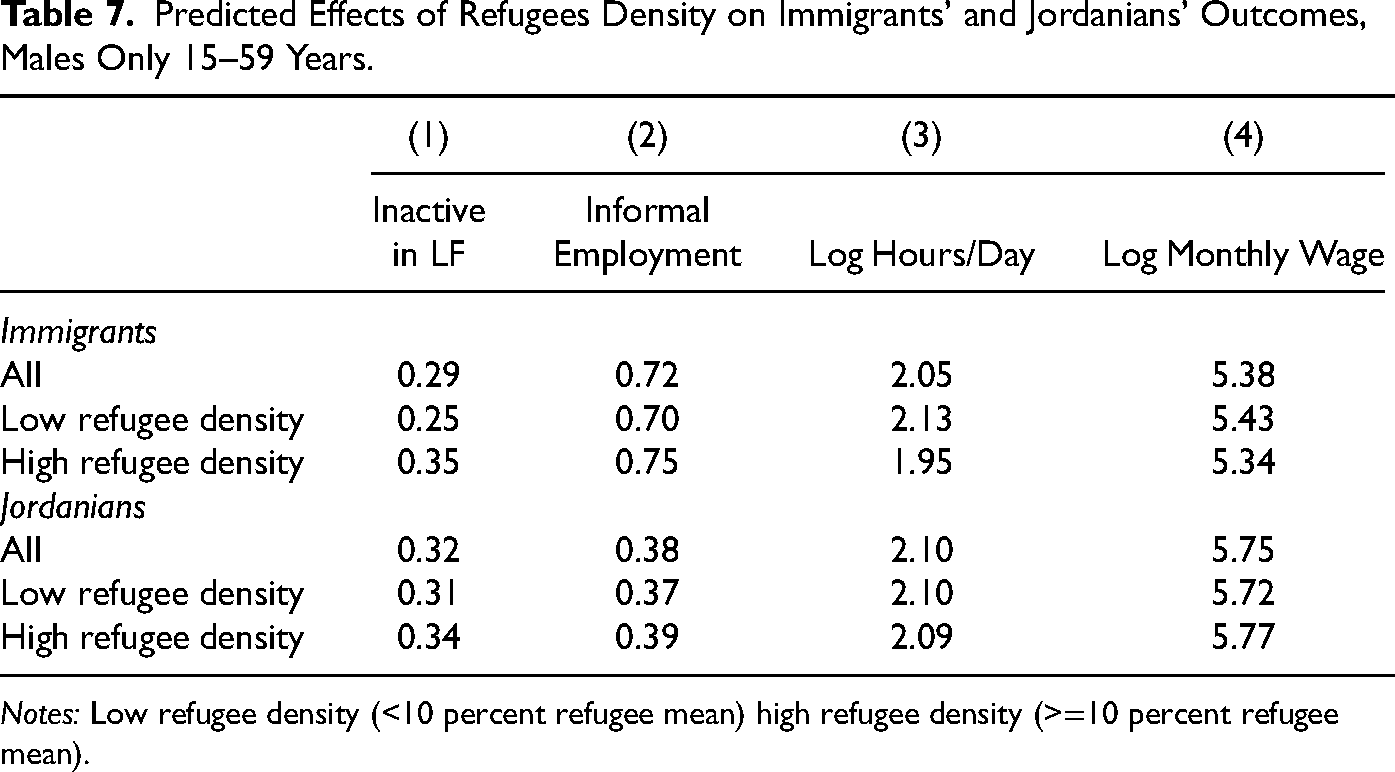
Predicted Effects of Refugees Density on Immigrants’ and Jordanians’ Outcomes, Males Only 15–59 Years.
Notes: Low refugee density (<10 percent refugee mean) high refugee density (>=10 percent refugee mean).
There has been increasing interest in refugees’ impact on host-country labor markets (e.g., see Verme and Schuettler 2021, for a review of this literature). The war in Syria has resulted in a large-scale outflow of refugees to other countries (UNHCR 2016). Given the scale of Syrian refugee flows, there has been a growing interest in refugees’ impact on natives in host countries (e.g., Tumen 2016 and Fallah, Krafft and Wahba 2019). Very little research, however, has focused on the potential effects of refugee inflows on non-refugee immigrants in host countries. We use the case of Jordan to study this issue in a place where both the refugee influx — 1.3 million — and the size of the immigrant population — around 1.6 million in 2015 — are both substantial; by 2015, the Jordanian population had increased by 45 percent.
We examine the impact of the Syrian refugee influx on male immigrants’ labor market outcomes, compared to male nationals, in Jordan. We find that male immigrants were more likely to be engaged in the informal sector in areas with higher exposure to refugees. Also, results suggest that male immigrants worked fewer hours and, therefore, earned lower monthly wages because of the influx of refugees in Jordan. Our methodology considers the sorting of refugees, using an instrumental variable approach. Our findings show that high exposure to Syrian refugees did not adversely affect male Jordanians in the labor market, but that male immigrants were more negatively affected. Our article is the first, to the best of our knowledge, to show refugees’ impact on other male immigrants. Male immigrants in Jordan experienced less job security and lower earnings (over 20 percent lower), particularly in sectors where they competed with refugees (i.e., male immigrants became underemployed in areas with high concentration of refugees).
In conclusion, our findings underscore the importance of considering the implications of hosting refugees in the international migration literature, not only on natives but also on other potential vulnerable groups, such as immigrants. Our study suggests that refugee influx might have wider implications beyond the impact on the host community if refugees displace other immigrants and result in lower wages for immigrants. Thus, future studies should examine if refugees lead to lower wages in other host countries, and whether lower wages for immigrants result in lower remittances by immigrants, given the importance of remittances for immigrants’ families in origin countries for poverty reduction. Moreover, our results highlight the need to protect not only refugees, but also other vulnerable groups who might be directly or indirectly affected by the inflow of refugees. In conclusion, providing adequate help and support to all the populations (nationals, immigrants, and refugees) in the host country that receives refugees is critical for ensuring any potential economic and social pressures are minimized.
Supplemental Material
sj-docx-1-mrx-10.1177_01979183221149015 - Supplemental material for Impact of Syrian Refugees on Male Immigrants’ Labor Market Outcomes in Jordan
Supplemental material, sj-docx-1-mrx-10.1177_01979183221149015 for Impact of Syrian Refugees on Male Immigrants’ Labor Market Outcomes in Jordan by Bilal Malaeb and Jackline Wahba in International Migration Review
Footnotes
Disclaimer
The views and opinions expressed in this paper are those of the authors and do not necessarily reflect those of the institutions to which they belong.
Declaration of Conflicting Interests
The author(s) declared no potential conflicts of interest with respect to the research, authorship, and/or publication of this article.
Funding
The author(s) disclosed receipt of the following financial support for the research, authorship, and/or publication of this article: This research is supported by the British Academy's Sustainable Development Programme.

Supplemental material
Supplemental material for this article is available online.
Notes
References
Supplementary Material
Please find the following supplemental material available below.
For Open Access articles published under a Creative Commons License, all supplemental material carries the same license as the article it is associated with.
For non-Open Access articles published, all supplemental material carries a non-exclusive license, and permission requests for re-use of supplemental material or any part of supplemental material shall be sent directly to the copyright owner as specified in the copyright notice associated with the article.
