




Abstract
According to acculturation theories, members of immigrant second-generation minorities hold a broader cultural competence — a bicultural fluency — for living in two cultures, compared to members of the native majority who are mainly limited to the mainstream experience only. In this paper, we employ a new research method to acculturation research — the Imitation Game — to investigate this claim. Our case concerns second-generation Finnish Somalis and majority Finns. With a mixed-methods approach, we examine degrees of cultural competence among members of each group in their mutual interactions. Contrary to acculturation theories, the second-generation Finnish Somali cohort does not display greater bicultural fluency than the Finnish native majority. We show evidence of how cultural fragmentation among the Finnish Somalis and the prevailing social distance between them and majority Finns limit their chances of developing bicultural fluency. The result demonstrates partial sociocultural marginalization among the Finnish Somali second generation, and may indicate a higher risk of marginalization among second-generation immigrants than acculturation theories have suggested. This study presents the Imitation Game as a new way of outlining the sociocultural foundations of ethnic relations in the context of migration and integration, and pinpointing potential domains of social exclusion between or cultural division within groups.
Introduction
The societal integration of immigrants and their descendants is a pressing issue in both academia and politics in contemporary western societies (Drouhot and Nee 2019). Adapting to the language and culture of the new society, also known as acculturation, is considered a major element of social integration (Alba and Nee 2003). Selective acculturation refers to immigrants and their descendants learning the culture of the country of settlement while also retaining or reconstructing (Gans 1997) a distinct way of life among coethnics (Portes and Rumbaut 2001). As a result, members of immigrant-origin minorities who acculturate selectively can acquire bicultural fluency, that is, a native command of not only their familial ethnic and cultural ways but those of the native majority as well. Therefore, acculturation theories (e.g., LaFromboise, Coleman and Gerton 1993; Berry 2005) posit an understanding of culture as an additive competence: people can acquire knowledge and an understanding of another's way of life without necessarily substituting one cultural element for its equivalent. Assimilation theories go so far as to claim that many of the mainstream ways of doing and thinking are available to all social groups, including those who do not identify with or follow them (Alba and Nee 2003). Both acculturation and assimilation theories suggest that members of immigrant-origin minorities acquire at least partial fluency in both cultures, in contrast to members of the native majority, who are generally limited to the mainstream experience only. In this article, we explore the claim of greater bicultural fluency among immigrant-origin minorities in comparison to native majorities. Our case concerns a group of second-generation Finnish Somalis and members of the native majority in Finland.
Acculturation theories have been challenged by a number of scholars for taking for granted the division of society into ethnic groups and cultures, and they advise researchers to study instead how social groups emerge from relational and situational practices (Brubaker 2004; Wimmer 2008). Migration research, in particular, highlights the complexity and unboundedness of culture in immigrant societies, with notions such as transnationalism (Levitt and Schiller 2004), superdiversity (Vertovec 2007), and hybridity (Bhabha 2012). Drawing on this literature in investigating bicultural fluency among Finnish Somalis and majority Finns, this research does not assume the existence of two distinct cultures represented by members of each group. Instead, the variable cultural uniformity among members of each category as well as the potential bicultural fluency across groups will be the targets of empirical inquiry. We will proceed with a mixed methods analysis of how — and how accurately — members of each group can recognize the identity of one another in a sociological experiment known as the Imitation Game (henceforth IG).
So far, the IG has been used to study a wide range of topics, such as gender and sexuality (Collins and Evans 2014), religion (Evans et al. 2021), chronic illness (Wehrens 2015), and national identities (Collins et al. 2019). This article is the first to use the IG in the context of international migration and to address the rather traditional topic of acculturation. The IG adds to existing acculturation research in four ways:
It explores acculturation on the basis of informants’ actual cultural competences (Atkinson and Heritage 1984), rather than their reported self-assessments, identification with, or preference toward a culture. It captures acculturation as an additive competence by examining the extent to which people can display knowledge and understanding of a culture without necessary adopting that culture. It empowers participants to become proxy-researchers (Collins et al. 2017); data are generated from the perspective of informants themselves, instead of being based on researcher-generated scales and measures. The data are based on interactions between two groups, which allows the researcher to address acculturation as an interactional accomplishment in the context of a social relation (Garfinkel 1967; Arminen, Segersven and Simonen 2019), rather than treating groups as separate entities.
The mixed-method approach consists of quantitative and qualitative analyses. The quantitative results show that neither group is fluent in the culture of the other, indicating mutual social separation between them. Through qualitative analysis, we open up how majority Finns and Finnish Somalis exhibit and evaluate fluency, drawing on knowledge, experience, values, and language. Despite similarities between the groups in their strategies of identifying group membership, we have found a remarkable difference in their ability to utilize group-bound values. While majority Finns can find commonality in a coherent set of norms, Finnish Somalis fail to do so due to internal diversity and hybridity. The cultural fragmentation seems to stem from the acculturation itself, as it diversifies the immigrant-origin group according to their varying responses to the hosting majority culture. Social separation, along with cultural fragmentation, signals a risk of sociocultural marginalization among second-generation Finnish Somalis, and we argue that it may be a more likely outcome among second-generation immigrants than previous acculturation theories suggest.
Cultural Fluency in Interaction
This article investigates acculturation in terms of cultural fluency and competences. Inspired by ethnomethodology, we define cultural fluency as having “the competences that ordinary speakers use and rely on in participating in intelligible, socially organized interaction” (Atkinson and Heritage 1984, 1). The definition corresponds with Swidler's (1986) seminal argument of culture as a “tool kit” of habits and skills from which people can adopt different lines of conduct as they move from one cultural context to another. Ethnomethodology has shown that many of the cultural competences underlying the fluency of everyday interaction are tacit, which means that acquiring fluency in a culture requires interaction and socialization within that cultural community (Garfinkel 1967).
Cultural competences are also consequential for the maintenance of social boundaries. Sacks (1979) observed how a group of young “hotrodders” carved out their autonomous sub-culture with an elaborate set of knowledge and vocabulary about cars, which they used to distinguish fluent members from nonmembers. As such, cultural fluency involves not only the ability to “pass” as a member but also the ability to recognize fluency (or a lack thereof) in others. By extension, bicultural fluency includes the ability to exhibit and evaluate fluency in two distinct cultures.
In the context of migration, Alba and Nee (2003) evoke a similar understanding of culture with the concept of human cultural capital, considering it an important resource in generating trust, forming social ties, social mobility, and the overall ability to function effectively within a given society. Previous research on cultural competences in migration research includes surveying and interviewing peoples’ experiences and knowledgeability of minority vis-à-vis mainstream culture (Zea et al. 2003) and the acquisition of formal and tacit skills (Baláž et al. 2021), or by using proxies, such as education or language proficiency tests in the host and minority languages (Nee and Sanders 2001; Portes and Rumbaut 2014). Ethnographic approaches include exploring how cultural fluency is displayed in everyday life by observing ethnic behaviors and expressions among individuals navigating between cultures (Sall 2020). Sociocognitive experimental work investigates bicultural competences in how individuals can switch between cultural schemas in response to cultural cues (Hong et al. 2000). This article adds a new method to this literature, exploring cultural fluency as an actual competence, as it is exhibited and evaluated in interaction by members themselves. We consider a detailed description of the IG method a useful foundation for further specification.
The Imitation Game
Social scientific use of the IG originated in the field of science and technology studies as a method for measuring the distribution of expertise in society (Collins and Evans 2007). In this article, we push the method beyond the theories of expertise, developing it into a tool for studying the cultural aspects of social relations. The IG is essentially a role-playing game between two groups. The participants assign themselves to either group — in this case, “Majority Finn” or “Finnish Somali” — according to self-identification. The experiment takes place in a classroom equipped with computers and the players interact anonymously through typed conversation (see Evans, Collins and Weinel 2019 for other variants). Each participant plays three roles: (1) Judge, (2) Non-pretender, and (3) Pretender. The Judge and the Non-pretender are members of the same group, and the Pretender is not. The Judge's task is to identify the membership of the respondents through a series of self-made questions. The Non-pretender answers truthfully, while the Pretender answers as they think a member of the Judging group would answer. The software displays the answers simultaneously to the Judge, on the basis of which the Judge selects which answer comes from the Pretender and types the reason for their choice, as well as their level of certainty on a scale of 1 to 4. Each participant asks as many questions as they need (a minimum of three) to identify the respondents, and finishes the game with a final assessment of all the question-answer sequences. Figure 1 illustrates the allocation of roles in the experiments.
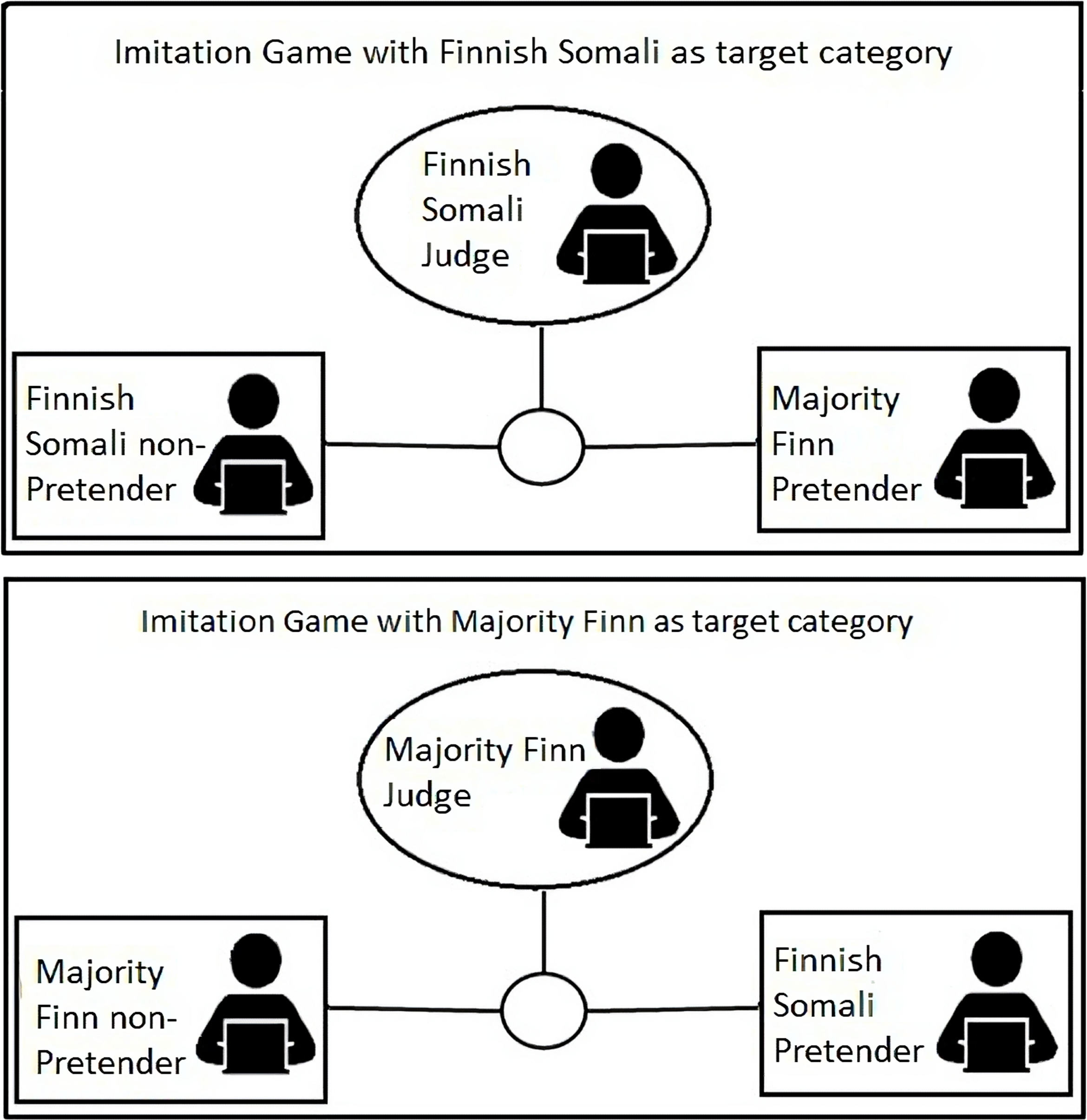
Allocation of roles.
The IG complements more established methods in a number of ways. First, while surveys can measure distributions of cultural competences in a quantitative way, the data are usually limited to informants’ subjective self-reports and assessments. In the IG, members and nonmembers alike display and evaluate cultural fluency in practice as they interact in the experimental environment. This allows the researcher to address whether participants are actually fluent, rather than relying on self-reports. Second, while ethnographic observation explores cultural fluency in practice, it is often limited to how social groups interact with or talk about one another. Through the task of imitation, participants in the IG are compelled to take on the perspective of another and display fluency in domains they do not necessarily live in or identify with. 1 This allows for research on cultural fluency as an additive competence — peoples’ capacity to talk “as” one another (Collins and Evans 2014). Third, unlike most methods where the questions are established and answers are evaluated externally, including surveys or language tests, or interviews and focus groups where the discussion is led by the researcher, in the IG the participants can ask questions about whatever topics they think are likely to distinguish group members from non-members, and evaluate the competence of others according to their own criteria (Evans, Collins and Weinel 2019). Thus, the data are produced from the perspective of the participants themselves. The researcher is relieved of the difficult and potentially reifying task of determining the criteria of competence or incompetence pertaining to any given group, and can instead analyze the criteria established by the participants themselves as they draw boundaries in interaction. Fourth, most traditional research designs take the ethnic group as the point of departure and collect data from groups as isolated units. The limitation of this is that it overlooks how groups are nested in and emerge from social relations (see Wimmer 2008 for a similar critique). In the IG, the data are collected from two groups in interaction, which allows the researcher to address acculturation in the context of a specific social relation and cultural fluency as an interactional accomplishment between members and nonmembers (Arminen, Segersven and Simonen 2019).
In this article, we investigate bicultural fluency by measuring how accurately and exploring precisely how Finnish Somalis and majority Finns “judge” (i.e., identify group members from Pretenders) in the IG. The founding proposition in IG research is that the Judges’ accuracy in identifying group members tells the extent to which the members of the pretending group are competent in the culture of the Judging group, which in turn indicates their degree of social inclusion in the Judging group (Collins and Evans 2014). Because members of minority groups usually spend their lives immersed in majority discourse, they should be fluent enough to “pass” as a member of the majority, resulting in a low degree of identification accuracy among majority Judges. In contrast, because members of majorities have spent less time in minority cultures, they should be less fluent, resulting in a high degree of identification accuracy among minority Judges (Collins and Evans 2014). This hypothesis aligns with the aforementioned acculturation theories’ claim of greater bicultural fluency among immigrant-origin minorities than their respective majorities. To our knowledge, all published IG research thus far have supported the hypothesis, showing that minorities are consistently more successful in imitating majority groups than the other way around.
Ethnomethodologically inspired IG research (Arminen, Segersven and Simonen 2019) argues that the hypothesis of greater biculturalism among minorities involves the assumption of a society divided into social groups with distinct cultures. Instead, social groups differ in how actively they represent themselves, which affects their ability to distinguish between members and nonmembers in the IG. That is, where the Judging group is latent (i.e., does not have group-bound cultural commonalities), Judges cannot form revealing questions or distinctions to evaluate the fluency of others (Arminen, Segersven and Simonen 2019). In contrast, members of an active group possess shared knowledge and experiences, which they can use to recognize members from nonmembers. As such, the Judges’ accuracy depends not only on the Pretender's fluency but also on the degree of groupness (Brubaker 2004) among members of the Judging group, making the variable internal cultural uniformity among members of a group an integral part of IG results (Segersven, Arminen and Simonen 2020).
Combining IG theory so far, bicultural fluency among Finnish Somalis entails not only (a) sufficient fluency in mainstream ways to pass as a majority Finn when pretending, but also (b) the possession of sufficient cultural commonalities among group members to accurately distinguish between fluent group members and non-fluent majority Pretenders. Having measured their identification accuracies, we will explore qualitatively how each group evaluates fluency with distinct identification strategies, which will provide more insight into their sociocultural foundations and group relations. Before turning to detailed operationalization, we review the information gathered through previous research on our case, which forms the basis of our analysis.
Finnish Somalis in Finnish Society
Selective acculturation usually requires that certain conditions be met, such as a sufficiently large ethnic community, public support for maintenance of a distinct way of life, and broad access to the social life of the mainstream (Portes and Rumbaut 2001). Somalis migrated to Finland in the beginning of the 1990s. They were the first large wave of immigrants in a nation with a history of emigration rather than immigration. Today there are about 23,000 people with a Somali background in Finland, over half of whom live in the Helsinki region. More than 9,000 of the Finnish Somalis are part of a growing second generation (Statistics Finland 2021). The Finnish Somali population is heterogeneous, with divergent migration histories, including intra- and intergenerational differences between new arrivals and the second and third generations (Tiilikainen and Hassan Mohamed 2013; Tiilikainen, Ismail and Tuusa 2013), as well as divided transnational clan affiliations (Bjork 2017). The diversity reflects Finnish Somalis’ identifications: almost half of them identify as both “Somali” and “Finn,” and the other half identify solely as “Somali” (Pitkänen, Saukkonen and Westinen 2019). Furthermore, especially the second generation goes beyond ethnonational categories by drawing boundaries of identification around in-betweenness and transnational diasporic ties (Oikarinen-Jabai 2012; Armila, Kananen and Kontkanen 2019).
In spite of the heterogeneity, there are signs of a collective cultural life and cohesion. First, Finnish national immigration policy officially aims toward biculturalism among immigrants by supporting the maintenance of culture and language and fostering social inclusion in mainstream society (Saukkonen and Pyykkönen 2008). There are several Finnish Somali associations, all covered by the Finnish Somali League umbrella organization (Tiilikainen and Hassan Mohamed 2013). Practically all Finnish Somalis are Muslim. The local mosque functions as a social space and reproduces shared discourse and norms within the community (Mubarak, Nilsson and Saxén 2015; Al-Sharmani 2017). This literature suggests that Finnish Somalis are a socially active community, supported by state policy, further distinguished from the mainstream by Islamic faith and organized through mosques.
The second-generation Finnish Somalis grew up in neighborhoods and attended school where native Finns are a clear majority, making for a classic assimilation situation with a small immigrant-origin minority living alongside one clear majority group. The Nordic countries, including Finland, have been associated with demands of thick linguistic and cultural socialization and “blending in” with the majority (Mohme 2014). By international comparison, there is little economic or regional segregation, and there are practically no ethnic enclaves to speak of (Dhalmann and Vilkama 2009; Vaalavuo, van Ham and Kauppinen 2019). Nine years of compulsory education in the Finnish school system serves to foster daily contact with the majority, and the Finnish school has been defined as a site of sociocultural reproduction of mainstream culture (Alitolppa-Niitamo 2004). Reports on language competences among the Finnish Somali second generation are scant, with evidence ranging between full and partial bilingualism (Halonen 2007; Mubarak, Nilsson and Saxén 2015). In spite of spatial and institutional inclusion, informal exclusion in the form of widespread discrimination and racism has been revealed by researchers (Sotkasiira and Haverinen 2016; Ahmad 2019). Almost half of Finnish Somalis report having no friends among the majority, and intergroup marriages are extremely rare (Liebkind 2000; Pitkänen, Saukkonen and Westinen 2019). The silent neighbor is a recurring topic among Finnish Somali informants, reflecting their puzzlement at the lack of interaction between neighbors in Finnish neighborhoods (Tiilikainen, Ismail and Tuusa 2013). To summarize, the Finnish Somali second generation in Finland exemplifies formal institutional and spatial inclusion, coupled with informal separation through discrimination and a scarcity of intimate relations between the groups.
The institutional position of the Finnish native majority has been studied more sparsely than the minority. Due to a very recent history of immigration, the share of persons in Finland with an immigrant background has increased from 0.8 percent in 1990 to 8.5 percent in 2021. Immigration is concentrated in the Helsinki region, where the share of persons with a foreign background is 17.6 percent in 2021 (Statistics Finland 2021). In spite of the demographic change, Finland (including Helsinki) remains a region with one numerically dominant native majority. This demographic predominance ensures that majority Finns occupy most leading positions in key institutions, such as the education system, the economy, the polity, and the media, making them the gatekeepers and arbiters of mainstream culture, symbolic boundaries, and “Othering” within the nation (Keskinen et al. 2016). The differences in population size and positions of power reinforce the supposition of a greater bicultural fluency among the minority; whereas members of the Finnish majority can go about their lives with little or no knowledge of Finnish Somali culture, the Finnish Somali second generation is immersed in mainstream society on a daily basis, and forced to learn mainstream ways of doing and thinking to gain access to resources and opportunities. It is important to note that although Finland has the reputation of a culturally and socially uniform nation (Saukkonen and Pyykkönen 2008), this is argued to be a myth overshadowing an ethnically and culturally diverse history (Keskinen, Skaptadóttir and Toivanen 2019). As such, the hypothesis of greater bicultural fluency among Finnish Somalis first becomes a question of whether there is a uniform “mainstream” to acquire fluency in, which forms part of the empirical inquiry in this article.
Recruitment and Sample
We gathered the data through a series of experiments at the University of Helsinki in 2018. There were 40 participants, half of whom self-identified as majority Finns and half as Finnish Somalis. The games were played in the Finnish language. IG experiments require that an equal amount of informants from both groups turn up at the same place at the same time to actively participate for about two hours. The extensive nature of the event requires committed and active participation, which makes recruitment of large samples challenging, especially among small and difficult-to-reach minorities. We have found snowball sampling to be a strategy that works, as many find the IG enjoyable, and word of mouth is a persuasive way of engaging potential participants.
We recruited the majority Finns via university email lists and regional groups on Facebook. The sample mostly includes university students (70 percent); the rest were working in media, consulting, and IT. They were aged between 18 and 55, with an average age of 31, which reflects the high average age of university students in Finland. Six of them identified as men and 14 as women.
We initially recruited the Finnish Somali participants through the Finnish Somali League, followed by snowball sampling. Thus, the sample includes active members and contacts of the association and their friends and acquaintances. All Finnish Somali participants were born in Finland, except for one, who had arrived at the age of three. Most (60 percent) were either secondary school or university students. The rest worked in healthcare, tourism, and media. They were aged between 18 and 30, with an average age of 22. The relatively young age reflects the recent history of Somalis in Finland.
The recruitment captured a segment of the Finnish Somali community where social relations are structured according to gender. Two male respondents participated in the first experiment, which failed to commence for technical reasons. In the second experiment, which was successful, the Finnish Somali cohort included only women. For the subsequent experiments, we relied primarily on snowball sampling, which failed to reach men, such that the total Finnish Somali sample includes only women. Thus, the methodology, which relies on the activeness of the social group itself, produced a self-generated representation of the group. That is, all participants were members of the group in a way that was defined for the researcher by the group itself. The sample is less diverse than the population as a whole, and we will elaborate on how this affects the experiment when discussing the results. With regards to the experiment, however, the crucial aspect is that all participants were full and representative members of the culture.
When conducting experimental research, it is essential to ensure that the participants are not harmed in any way. Ethnicity and identity can be sensitive topics, particularly in contexts of discrimination, which is why we treated the subjects with as much sensitivity and respect as possible. We followed the ethical guidelines recommended by the Finnish Advisory Board on Research Integrity. 2 We informed all participants in detail about the research setting and goals before they could agree to participate in the research. Participants could choose freely which group they represented, emphasizing self-identification as the ultimate criteria of group membership. In introducing the game, we highlighted how the IG is about going beyond stereotypes, to engage in the deeply human exercise of trying to take on the perspective of another. Indeed, the IG has been used as a pedagogical tool for generating experiential knowledge among players (Wehrens and Walters 2018). All participants provided written, anonymous feedback about the game experience. The large majority of them reported positive experiences, and no one reported negative experiences. Finally, to ensure that all participants understood the rules of the game, we provided both oral and written instructions. Furthermore, the layout of the IG software requires that players switch pages to change roles, reminding them which role they are playing at each moment.
Data
The IG generates both qualitative and quantitative data. The qualitative data include the written “sequences”: the Judge's question, the Pretender's and Non-pretender's answers, and the Judge's assessment. The quantitative data include information on whom the Judge identified as a Pretender and whether the identification was correct (only visible to the researcher after the game) and the Judge's confidence (ranging from 1 = “I am pretty unsure” to 4 = “I am pretty sure”). The qualitative data in its entirety tell how the group members described themselves, how they were enacted by non-members who tried to pretend to be them, and how the Judges accomplished the identification of the respondents. The quantitative data inform how successful and confident the Judges were in terms of their identification. Furthermore, the types of identifications in the assessment sequences can be classified and their success rates can be quantified.
We have analyzed both the individual IG sequences (question–answer–assessment) and the final assessments. The minimum amount of assessment sequences in each game is three, although most Judges asked four to seven questions before proceeding to the final assessment. The total amount of sequences is 163, produced by 40 unique games. Each sequence is composed of four turns, so the total number of individual turns analyzed is 652, which makes the dataset large enough for both qualitative and quantitative analysis (for further explication of IG mixed-methods possibilities, see Collins et al. 2017; Segersven, Arminen and Simonen 2020).
Analysis in Three Phases
Our analysis proceeds in three phases. First, we attend to the quantitative data and establish the identification ratios (IRs) (i.e., measuring how accurately each group can identify group members from non-members). Second, we analyze the qualitative sequences to see how the participants identified group members. Last, we perform an in-depth qualitative analysis to elaborate and enrich the findings derived from the previous phases.
Phase 1: Identification Ratios
We use two standardized IG measures to analyze the quantitative data: the IR and sequential identification ratio (SIR) (Collins and Evans 2014; Segersven, Arminen and Simonen 2020). We refer to both together as (S)IR. These measures indicate how accurately the Judges identified group members from the Pretenders. The former measures the accuracy of final assessments and the latter the accuracy of sequence assessments. We derive the measures in the same way. First, we label all the assessments with a confidence rating of 1 (“I am pretty unsure”) as “Undecided.” The remaining (confidence ratings 2–4) are either correct or incorrect. Then we divide the number of excess correct assessments (correct assessments minus incorrect assessments) by the total number of assessments (correct + incorrect + undecided), giving a value between 0 and 1. Zero indicates that Judges made an equal amount of correct and incorrect judgements, meaning that their assessments were no more accurate than random chance. A value of one means that Judges identified the respondents correctly in all their assessments. We have argued that bicultural fluency among Finnish Somalis will allow them to (a) pass as members of the majority, and (b) accurately identify group members from majority Pretenders. More specifically, bicultural fluency is evidenced in the IG as a (S)IR score:
close to zero among majority Finnish Judges, and significantly higher than zero among Finnish Somali Judges
Table 1 displays the number of correct, incorrect, and undecided identifications and the (S)IR values per group.
Identification Accuracy.
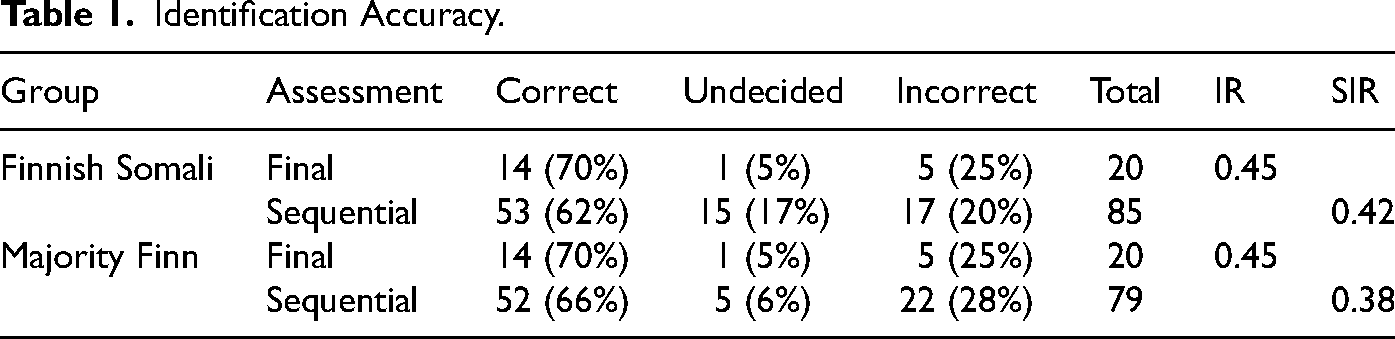
The final assessments show an equal score between the groups. The sequential assessments are also similar, with about two-thirds of identifications being correct, a quarter incorrect, and the rest undecided. A higher amount of undecided assessments among Finnish Somali Judges indicates more uncertainty among them. Turning to the (S)IR, both groups identified Pretenders with higher accuracy than random chance (IR and SIR = 0) in both final assessments (IR = 0.45) and sequential assessments (Finnish Somali SIR = 0.42; Majority Finns SIR = 0.38). A one-sample t-test supports this interpretation, showing that all (S)IR scores are significantly higher than zero. 3 First, this is evidence of how both groups are active social groups (Arminen, Segersven and Simonen 2019) whose members share cultural competences that are largely unavailable to the other group. In terms of acculturation, the Finnish Somali cohort lacks bicultural fluency, as most of them were unable to successfully pass as members of the majority. In all, the results point toward segregation, which means that the two groups maintain distinct cultural ways, along with limited social contact across boundaries.
Although the Finnish Somalis have a slightly higher SIR than the majority, the difference is almost negligible. The results challenge the claim of greater bicultural fluency among minorities and leads us to ask how the Finnish Somali group, having grown up and been socialized in neighborhoods and schools dominated by the native majority, were not better at imitating the majority group, most of whom have only little contact with Finnish Somali culture. To gain a more sophisticated understanding of these results, we turn to the second phase and analyze how the participants assessed the membership of the respondents.
Phase 2: Identification Strategies
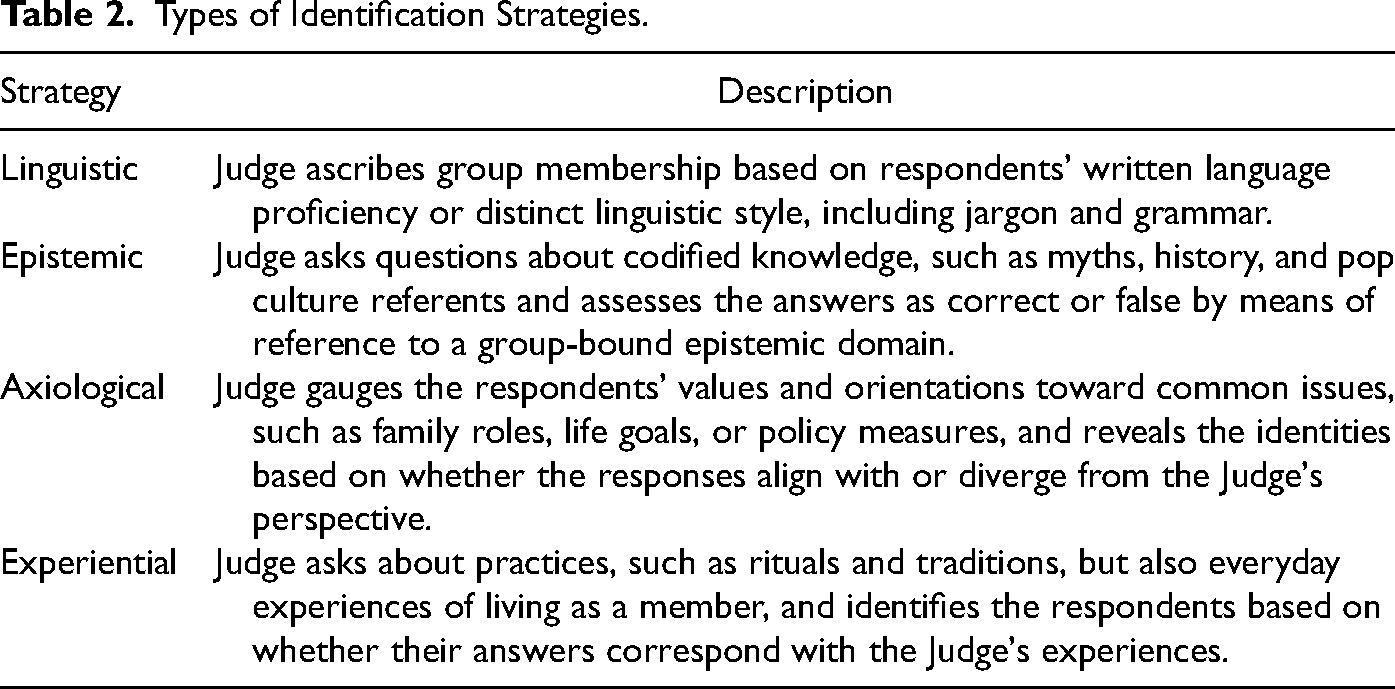
Previous IG research has found that questions and assessments can be categorized according to four distinct identification strategies (Table 2) (Segersven, Arminen and Simonen 2020). Each identification strategy represents a distinct way of evaluating the competence and knowledgeability of respondents. The analysis of identification strategies is inspired also by ethnomethodological conversation analysis (Sacks 1984; Sidnell and Stivers 2013). This means that each strategy captures the participants’ own orientation toward the game interaction, revealing their respective methods of assessing the identity of the speakers and their ways of constructing the group (Arminen, Segersven and Simonen 2019). 4
Types of Identification Strategies.
The analysis of identification strategies proceeds in two steps. First, we outline the distribution of identification strategies by tabulating each question-answer-assessment sequence according to the type of identification strategy used. The distribution of identification strategies reveals the perceived cultural differences between the groups. That is, while each identification is an act of boundary maintenance in its own right, it can either be aligned with actual differences or based on misrepresentations or a false sense of unity among members. To see which identification strategies correspond with actual differences in cultural competences between the groups, we then discern the accuracy of each identification strategy. The integrated analysis of the distribution and accuracy of identification strategies gives insights into the sociocultural foundations of the groups, and pinpoints potential domain-specific differences in acculturation between them (Segersven, Arminen and Simonen 2020).
Perceptions of Cultural Difference
Based on our qualitative analysis of IG interaction, we classified each question-answer-assessment sequence according to the identification strategies players used to identify group members. Aggregating the sequences according to the identification strategy used, we gain the distribution of identification strategies, as summarized in Table 3.
Distribution of Identification Strategies.
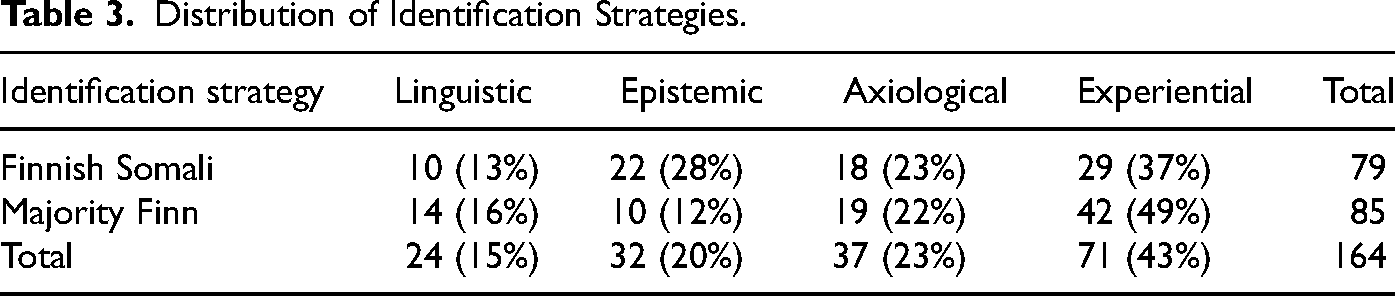
The widespread use of all the strategies by both cohorts means that the participants perceived and evoked difference in linguistic, epistemic, axiological, and experiential ways. We consider this an indication of the broad resonance of ethnic schemata (Dimaggio 1997) and further evidence of the activeness of the groups. Nevertheless, there were also differences in the use of identification strategies; whereas the Finnish Somalis relied more on epistemic identification, the majority used more experiential identification. This means that the Finnish Somali cohort evaluated group differences more in terms of exclusive knowledge than the majority, who differentiated predominantly in terms of distinct experiences. This may reflect the participants’ understanding of the patterns of social enclosure between the groups. Because Finnish Somalis are immersed in mainstream society through school and media, majority Finns can expect them to have access to mainstream epistemic domains, such as national myths and pop culture references. Meanwhile, they seemed to expect that access to mainstream experiences may require deeper access, and assessed experiential identification as a preferred strategy. In contrast, as the majority has only limited contact with Finnish Somali life, Finnish Somali Judges seemed to expect that even the epistemic domain is unknown to the majority.
Finnish Somali Axiological Identification — A Failed Strategy
The observed use of identification strategies may correspond with actual differences in cultural fluency between the groups, revealing a domain-specific gap in cultural competences, but they can also be inaccurate and expose prejudice toward the other group or a false sense of unity among members. To examine whether the identification strategies correspond with actual differences in cultural competences between the groups, we link the coded data with the SIR to observe the accuracy of each strategy. Table 4 summarizes the identification accuracy of each strategy per group.
Accuracy of Identification Strategies.

The total SIR shows that both groups had an almost equally high accuracy in identifying group members, indicating segregation. However, the total SIR hides important differences in the success of identification strategies between the groups. Both groups had a high SIR in using epistemic, linguistic, and experiential identification, with minimal differences between them. The Finnish Somalis were slightly more accurate when using experiential and linguistic identification. Majority Finns had a slight advantage in using epistemic identification. The similar scores of these strategies suggest that the groups were internally uniform and symmetrically separated in these domains.
The most salient result is the difference in the SIR of axiological identification. Whereas axiological identification was a relatively accurate strategy among the majority Finns (SIR = 0.47), the Finnish Somalis were no more accurate than random chance (SIR = 0.00). The high axiological SIR among the majority is evidence of how members of the majority can systematically enact a shared set of values and norms, which the Finnish Somalis consistently have difficulties articulating fluently, resulting in them being exposed as Pretenders. While a high SIR designates an internally uniform and externally exclusive domain, a low SIR can derive from two distinct reasons. First, it can be due to the openness of the judging group; that is, they share a coherent set of values and axioms but these are widely known among the pretending group. Alternatively, the judging group is latent (Arminen, Segersven and Simonen 2019), meaning that they lack a coherent worldview; where there is an absence of shared, uniform discourse among members, there can be no shared standards of fluency or evaluations thereof. To elaborate on the findings so far, we proceed to a qualitative analysis of the thematic content of axiological sequences.
Phase Three: Discovering Axiological Uniformity, Exclusivity, and Fragmentation
In what follows, we investigate why axiological identification was a successful strategy among the majority and a failed strategy among the minority. Family life emerged as a recurring topic in both groups.
Exclusive Domain: the Modern Nuclear Family
First, we analyze a sequence in which a majority Judge asks an open question “What does family mean to you?” In the answers, the respondents appear to construct very different family models, which the Judge also points out in their assessment.
5
Majority Finn. Axiological identification.
myself. An outsider can also belong to that family if they experience a connection with us, but you will remain an outsider if you don’t know how to live together in our joys and sorrows. My own family to me means safety and support in all situations. partner. I see my family quite seldom, but we are often in contact by phone. When we meet, we usually cook together and catch up. important values are, for example, moving out on your own, and contact is maintained often electronically or by phone. In Answer 1, family also goes before one's own interest, and the family is in my opinion understood more broadly than usual in a Finnish family, where the nuclear family is probably the most important. In Answer 1, the feeling of support and safety is highlighted, values that are particularly important to members of the other group.
The respondents had an almost parallel approach to the question but described different understandings of family. Respondent 1 evoked a privileged (line 2) and extended family unit; membership can extend to include those who experience belonging and show solidarity (lines 3–5). In contrast, Respondent 2 enacted an exclusive nuclear family by contrasting family with friends and partners, maintaining a clear boundary between them, as well as noting that they are all important (lines 7–8).
The Judge raised three pieces of evidence regarding the identity of the respondents. First, they considered individual independence and distant family relations as evidence of a “native Finnish” youth (Response 2). Second, the importance and loose membership presented by Respondent 1 did not accord with the Judge's idea of a usual Finnish family, which is centered around the nuclear family (lines 12–15). Third, the Judge considered “feeling of support and safety” to be characteristic of Finnish Somali families (lines 15–17). According to the Judge, whereas Respondent 2 provided a competent native Finnish answer, Respondent 1 not only provided an inaccurate account of majority Finnish families but also a transparent description of Finnish Somali families.
Majority Finns made a total of 10 questions about the family, of which 9 led to correct assessment and 1 to being undecided. Thus, discussing family relations was both a common and effective question type (SIR = 0.9). The participants constructed a dichotomy that resonates with a classical sociological divide between modern and traditional social ties: related to a higher sense of individualism was the optional nature of marriage and small family units among the majority, whereas related to collectivism was the inevitability of marriage and large family units among Finnish Somalis. The sequence, underscored by the SIR scores, shows how the dichotomy is coherent and mutually shared among the majority, and largely unavailable to the Finnish Somalis. We believe that the minority's limited fluency in majority Finnish family discourse derives from the paucity of informal and familial relations, underscored by very rare exogamy between them (Puur, Rahnu and Tammaru 2021). However, the social distance between the groups should be mutual, leaving us with the question of why Finnish Somalis failed to distinguish between members and majority Pretenders when using a similar axiological strategy.
The Hybrid Finnish Somali Family
In the following example, a Finnish Somali Judge asks how the respondents would react if their child decided to change faith. Hypothetical situations usually lead to axiological identification, as they allow Judges to probe the axioms that guide the respondents’ perspectives on the proposed situations.
Finnish Somali. Axiological identification.
“inner peace”? Do you allow this and stay in contact with them after that? Do you encourage your child to follow their heart? encourage them to follow their heart. Religion is important to me and my family, so we would have tough times ahead of us. own child, but my relatives
6
would not accept it. I would want my child to be happy but the situation would be terrible. accept it than they do themselves. A Somali does not care about the relatives when we are talking about changing religion. Instead, the problem would be that the parent themselves cannot accept it. If you can accept it yourself, why do you even care about the relatives? In Finland, contacts with the relatives are not as intimate as normally in Somalia. The relatives do not meddle in the family's internal matters. Instead each parent raises their own children in the way they want.
The first turn involves multiple questions, each specifying the question of how to react when your adolescent child wants to change religion (lines 1–3). Both respondents claim that they would not abandon their own child (lines 4, 7–8). Respondent 1 asserts that it would be difficult for the family (lines 5–6), whereas Respondent 2 highlights disapproval by the relatives (line 8). The Judge identifies Respondent 2 as a Pretender, claiming that they portray a false idea of the role and significance of relatives in parenting in Finnish Somali families (lines 10–13). The Judge elaborates on the decision by drawing a distinction between Finnish Somali family life, which circulates around the nuclear family, and family life in Somalia, where the relatives are more involved (lines 15–18). Thus, the Judge constructs a similar dichotomy, as in the previous example, between modern and traditional social ties, this time in terms of intimacy and the accountability between the exclusive nuclear family and the inclusive extended family. However, instead of distinguishing between Finnish Somalis and majority Finns, the Judge differentiates between Somalis in Finland and Somalis in Somalia, opening up a division within the minority rather than between the groups. The respondent was revealed to the Judge as incompetent by expressing an understanding of the family which the Judge associated with Somalis rather than Finnish Somalis.
The Judge's description is consistent with previous research, according to which traditional values in Somali families in Finland are going through rapid change (Degni, Koivusilta and Ojanlatva 2006; Abdulkarim 2013). Change generates diversity within the group between those who maintain ancestral values and others who adopt elements of the mainstream. Furthermore, by combining elements of the Finnish mainstream (orientation toward the nuclear family) and of ancestral Somalia (Islam and religious fidelity), the Judge constructs a hybrid conception of the Finnish Somali family, exposing potential ambiguity in ways of talking about the family. The internal diversity — together with the flux and hybridity of family conceptions — makes the domain loose, undermining attempts at differentiating between group members and Pretenders based on fluency in that domain.
Discussion
Contrary to claims of greater bicultural fluency among immigrant-origin minorities than native majorities (Portes and Rumbaut 2001; Alba and Nee 2003; Berry 2005; Collins and Evans 2014), the total (S)IR scores indicate an almost equal lack of bicultural fluency between Finnish Somalis and majority Finns. Based on an initial approximation, the equally high scores indicate segregation, as both groups form internally uniform cultures with limited contact between them. Yet, they also raise the question why Finnish Somalis were not more successful at imitating than the majority, as even in the context of segregation they should have more knowledge of the mainstream culture, rather than the other way around.
The failure of axiological identification among Finnish Somalis along with the success among the majority shed light on this question. Among majority Finns, axiological repertoires of family life were mutually shared among members. Finnish Somali respondents lacked these articulations, exposing themselves as Pretenders. The exclusivity of family life in particular is likely to derive from the lack of familial relationships between the groups. Finnish Somalis, on the other hand, struggled to find commonality among members; this was exemplified by the heterogeneity and hybridity of family norms. As such, the failure of axiological identification derived from the internal differences among the Finnish Somali cohort, rather than fluency among majority pretenders. Diversity among the minority makes it easier to pretend to belong to the group than the majority, which may explain the almost equal total accuracy in spite of the asymmetric relations between the groups. The absence of a shared, uniform discourse seems to reflect the divergent acculturation paths (Alitolppa-Niitamo 2004) between those who maintain ancestral values and those who adapt to the norms of the surrounding society. It appears that acculturation itself and the usual social conditions that characterize the life of the immigrant second generation — living in-between cultures, assimilative pressure, and transnational and diasporic social ties — generate internal diversity and cultural fragmentation among them.
Our results indicate that developing bicultural fluency is more challenging than acculturation theories suggest. On the one hand, gaining fluency in another culture requires widespread access to it, including the formation of primary relations; on the other, acculturation itself generates cultural fragmentation among the minority. Instead, cultural marginalization, that is, partial social separation from the broader society, along with cultural fragmentation among coethnics, seems to be the more likely second-generation acculturation profile. Given the role of competence in mainstream culture for social mobility (Alba and Nee 2003), together with how a shared culture among members contributes to much needed mutual support and solidarity among otherwise discriminated against minorities (Berry 2005), these results highlight the extra challenges imposed by acculturation on the children of migrants trying to get ahead in their native society.
Caveats
IG research (Collins and Evans 2017) draws on the principle that even a small number of fully socialized members can inform about the shared cultural features of that group; this point was made already by Sacks (1984). Yet, it is important to assess the potential bias generated by the samples of this study. Our recruitment technique reached active members of the Finnish Somali League and their acquaintances. This means that they are likely to be more socially engaged among coethnics and interested in their cultural background, as well as more similar to each other than the Finnish Somali second generation overall. In addition, including women only, the data lack potential gender-based differences. We suspect that if the IG results are influenced by variables beyond membership in either group, a more representative sample in terms of gender, ethnic engagement, and social networks would be more heterogeneous, and thus less accurate in identifying group members than the cohort in this study. A similar bias is likely to exist among the majority. Most of the majority Finns in this study were university students. The similar socioeconomic background makes the sample more homogeneous than the population as a whole and thus more likely to have a higher degree of accuracy than a more representative sample would have. Whether our selection of participants is representative in terms of intergroup contact is difficult to assess. At the very least, we believe that the more isolated segments in both populations are not represented, as participation in the research implies an interest in engaging with members of the other group. Accordingly, more representative samples might appear more separated than the cohorts in this study.
A further caveat relates to organizing the IGs in the Finnish language. Differences in mother tongue, as well as age, suggest that majority Finns have more advanced written Finnish-language proficiency than Finnish Somalis. Communicating subtle group distinctions can require a level of linguistic sophistication, which would put those with lower written language proficiency at a disadvantage in terms of demonstrating and evaluating cultural fluency in the experimental context. Furthermore, just like the Finnish Somali second generation at large, the participants in this study were quite young. Developing bicultural fluency requires not only access and socialization in two or more groups, but also time. It could be that people develop bicultural fluency gradually through life as they gain more experiences to compare and reflect upon. Lastly, the experiment omits Somali language skills, which is surely the most significant cultural competence pertaining to the Finnish Somali cohort. If it had been possible to choose language, we suspect that the minority would have distinguished fluent members with far more accuracy, indicating greater bicultural fluency among the minority than the majority, as theories suggest.
Methodological Contribution
The methodological aim of this paper was to participate in the expansion of the IG beyond its home field of science and technology studies (Collins and Evans 2007) and develop it into a method for researching the cultural aspects of ethnic group relations. In doing so, we have engaged with acculturation theories, addressing the claim of greater bicultural fluency among immigrant-origin minorities. We have drawn on ethnomethodology to conceptualize cultural fluency and competence, and operationalized them in the IG with a mixed methods analysis of how accurately each group can identify their group members and their strategies for doing so. We have further specified four ways in which the framework can contribute to existing methods.
To begin with, the quantitative results showed that neither Finnish Somalis nor majority Finns have fluency in the culture of the other. While surveys can measure degrees of cultural competence between populations, they often rely on participants’ self-reports which may downplay or exaggerate their actual knowledgeability and, importantly, people can have diverse understandings of what exactly culture refers to. The IG contributes to this approach with an experiment which tests whether they are actually competent in a given culture, and whether that culture exists as a mutually shared coherent set of cultural competences in the first place.
Second, the results of this research are based on data generated from the perspective of the members themselves. Participants assist the researcher with their deep understanding as socialized members by asking questions about topics they regard as pertinent — with minimal influence from the researcher. To produce data from a similar standpoint, researchers may require deep ethnographic immersion; even then, the researcher is faced with the dilemma of how to identify and mark a given skill or attribute as “competence” in a particular culture without engaging in boundary work themselves. This feature is especially important when studying underrepresented groups, and it is particularly useful where the researcher is not a member of the studied group themselves.
Third, this research measured informants’ fluency in a culture, rather than whether they live in accordance with that culture. That is, the findings do not tell us whether the Finnish Somali have different family values than majority Finns, but rather that they lack fluency in those values. Further, the results do not indicate that there is a singular worldview among majority Finns; instead, they reveal that they are equipped with a similar way of talking about the world (e.g., regarding family life) and can recognize members accordingly. Thus, the IG allows for studying culture as a tool kit of competences that people can choose to use according to the situation and cultural context, given that they have acquired those competences. Therefore, the IG can contribute to research on the acculturation of values as a method for exploring the possibilities of mutual understanding across groups with disparate worldviews. For instance, IGs can be combined with surveys to determine whether people who hold different attitudes can nonetheless understand and exhibit fluency in each other's values.
Fourth, as the data is produced by two groups in interaction, the IG generates relational knowledge about acculturation. For example, while the Finnish majority appears uniform and exclusive in relation to Finnish Somalis, previous IG research in Finland on the topic of religion, contrasting the secular majority and active Christian minority, found that the secular majority, which represents roughly the same population as the majority Finns, was unable to find common ground among members; this was marked by an inability to generate revealing questions or make successful evaluations (Segersven, Arminen and Simonen 2020). Comparatively speaking, while the Finnish secular majority appears latent and heterogeneous in relation to devout Christians, they become active and uniform in relation to Finnish Somalis.
In contrast to IG research to date, the results were the first to reject the central IG hypothesis of higher identification accuracy among minorities. By employing the IG in the context of immigration we have learned that the method is sensitive to forms of social separation beyond the already acknowledged minority–majority asymmetry (Collins and Evans 2014). Although members of minorities live immersed in majority culture, their acquisition of cultural fluency can be restricted by domain-specific separation, such as an absence of primary relations. The hypothesis assumes unconstrained access among the minority, something which may not occur, particularly in the case of a minority that is discriminated against.
By having two groups play “against each other,” the IG risks overemphasizing the relevance of the categories involved, and accentuating separateness and difference along ethnic lines. As such, researchers should emphasize to participants how the challenge of the game is to go beyond stereotypes and to take on the perspective of another. In sum, given the central role of biculturalism in acculturation and immigration research and the pressing social implications associated with marginalization, further IG research between different groups in different immigration contexts is required. Future research can go beyond established ethnonational categories. Experimenting with different kinds of groups and subgroups would not only help to clarify potential biases but also potentially lead to new discoveries about how ethnic cultures interlock, for example with gender, class or locality. While the focus of this article has been on ethnicity and migration, the framework proposed here can be used to research any social relation, limited only by the researcher's sociological imagination.
Footnotes
Declaration of Conflicting Interests
The author(s) declared no potential conflicts of interest with respect to the research, authorship, and/or publication of this article.
Funding
The author(s) disclosed receipt of the following financial support for the research, authorship, and/or publication of this article: This work was supported by the Koneen Säätiö, Ella ja Georg Ehrnroothin Säätiö.
