




Abstract
Attitudes on whether immigrants should culturally adapt to their receiving society or maintain the customs of their origin context vary – not only between majority and minority populations but also within these groups. Focusing on adolescents in the German context, this study investigates whether such acculturation attitudes are shaped by the ethnic composition of a person’s neighbourhood context. Building on arguments from theories of intergroup contact, concentration effects and reactive ethnicity, we expect different effects for minority and majority adolescents. To empirically investigate these expectations, we combine survey data on N = 4621 adolescents and their parents with geocoded information on the characteristics of their neighbourhood contexts. Exploiting an intergenerational set-up to account for neighbourhood selection, we find indication of neighbourhood effects among minority adolescents. Among majority youth, acculturation attitudes turn out to be unrelated to neighbourhood ethnic composition.
Introduction
In recent years, immigration to Western countries has increased substantially, resulting in ethnically more diverse societies. Along with the great potential the new arrivals bring to a receiving society, their incorporation poses a number of challenges. Therefore, the question of acculturation is strongly contested: To what extent should immigrants and their offspring adopt the cultural practices of the receiving society, maintain their own customs and traditions, or do both at the same time? Such attitudes towards the acculturation of immigrants diverge, both among the majority populations of receiving societies and among immigrants themselves.
In sociology, researchers agree that the acculturation of immigrants is fundamentally related to local contexts. Classic theoretical accounts of immigrant incorporation argue that immigrants usually acquire the cultural practices of a receiving society over the course of a few generations. However, ‘if a minority group is spatially isolated and segregated […] the acculturation process will be very slow’ (Gordon, 1964: 78). More recent perspectives even acknowledge that acculturation may come to a complete stop or go into reverse, depending on where immigrants live (e.g. Portes and Rumbaut, 2001; Zhou, 1997). Resonating with these views, public debates in Western Europe equally revolve around the question whether spatial isolation from the mainstream exacerbates acculturation: immigrants living in spatial separation from the majority population are expected to refuse mainstream cultural practices, making residential patterns an impediment to acculturation and to societal cohesion as a whole. Similarly, the degree to which majority members are open towards minority cultural practices is argued to depend on the ethnic makeup of the neighbourhoods they live in, with potential ramifications for the incorporation of immigrants.
Although it is subject to public debate, empirical knowledge on the place dependence of acculturation attitudes is sparse and fragmented. Only a handful of empirical studies investigating people’s acculturation attitudes considered the ethnic composition of their place of residence (Berry et al., 2006; Breugelmans and van De Vijver, 2004; Güngör, 2007; Neto, 2002). While some of these studies indicate local differences in acculturation attitudes, they provide very limited evidence as to why such differences exist: Do people with different attitudes sort into different neighbourhoods or do neighbourhoods shape people’s attitudes? This article aims to address this question by explicitly testing whether neighbourhoods really affect their residents’ acculturation attitudes.
To do so, we turn to the empirical case of Germany. Like many other Western countries, Germany has a sizeable and increasing population of immigrant origin, with more than 20% of the general population and more than one-third of the children born in recent years having a migrant background (Bundesamt für Migration und Flüchtlinge, 2016; Statistische Ämter des Bundes und der Länder, 2013). Moreover, the issue of cultural differences is subject to intense public debate (Ersanilli and Koopmans, 2011). This not only underlines the substantive importance of our study but also means that most respondents will have a consolidated opinion on the topic of interest.
To address many of the challenges that come with the estimation of neighbourhood effects from observational data, we rely on a simple but powerful empirical strategy: first, we concentrate on the acculturation attitudes of adolescents, who themselves did not select into the contexts in which they live. When investigating neighbourhood effects among adults, such selection effects frequently render the estimation of causal effects impossible. Second, we exploit the intergenerational nature of our data, which contains information on parents’ acculturation attitudes as well as a rich set of other background characteristics. Adjusting for these characteristics, we can further account for selection effects that operate through the neighbourhood choice of the surveyed adolescents’ parents. Based on this empirical strategy, the analysis, though correlational, can help identify neighbourhood effects on acculturation attitudes.
To summarise, both theoretical arguments and public discourse suggest that local contexts may make minority members reluctant to adapt to majority culture and majority members reluctant to accept minority culture. In this article, we test whether such effects of ethnic neighbourhood composition on the acculturation attitudes of minority and majority members really exist.
Background
Attitudes towards the acculturation of immigrants
How should immigrants acculturate? Answers to this question are numerous, stirring up heated debates among majority and minority members alike. Following a well-established tradition in psychological research on acculturation (cf. Berry, 1995, 1997), we differentiate individuals’ acculturation attitudes along two dimensions. The first dimension, cultural adaptation, asks whether immigrants should adapt to the customs and traditions prevailing in the receiving culture; the second dimension, cultural maintenance, considers whether immigrants should maintain their own customs and traditions. Taken together, individuals can therefore hold one of four normative positions: they may want immigrants to (1) maintain their own cultural practices while adapting to those of the receiving country (i.e. integration), (2) maintain while not adapting (i.e. separation), (3) not maintain while adapting (i.e. assimilation) or (4) not maintain while not adapting (i.e. exclusion).
Previous research showed that minority and majority members differ in their acculturation attitudes: while minority members usually regard integration as most desirable, many majority members are also in favour of an assimilationist position (for Germany, see Pfafferott and Brown, 2006; Zagefka and Brown, 2002). However, differences are not only observed across but also within minority and majority groups (e.g. Pfafferott and Brown, 2006; Piontkowski et al., 2000) but we know little about the structural determinants of such variation. In particular, few studies have so far investigated whether acculturation attitudes relate to the ethnic composition of people’s place of residence, despite recurrent theoretical arguments for the dependence of acculturation on local contexts (Abrahamson, 1996; Gordon, 1964; Portes and Rumbaut, 2001; Suttles, 1968). Studying acculturation attitudes in the Netherlands, Breugelmans and van De Vijver (2004) compare majority members across three different neighbourhoods. They find that majority members living in the neighbourhood with the highest minority share are most likely to lean towards integrationist attitudes. Using a much larger sample, though at the cost of relying on subjectively perceived neighbourhood compositions, Berry et al. (2006) investigate the place dependence of minority youths’ acculturation attitudes across 13 Western countries. They find that minority adolescents reporting to have many co-ethnic neighbours are more likely to hold separationist attitudes. Two other studies, however, find no statistically significant differences across neighbourhoods of varying (self-reported) ethnic composition – neither among adolescents of Turkish origin across neighbourhoods in Belgium (Güngör, 2007) nor among adolescent immigrants across neighbourhoods in Portugal (Neto, 2002). Given the limitations of previous studies – which focused on minority members only while relying on simple associations that do not account for methodological problems, on very few neighbourhoods or on respondents’ subjective assessments of local contexts – more research on the relation of local contexts and acculturation attitudes is clearly needed.
Why local neighbourhoods may affect acculturation attitudes
Three theoretical arguments suggest that local contexts may affect adolescents’ attitudes towards the acculturation of immigrants. While we cannot differentiate these different mechanisms empirically, we lay them out not only to demonstrate why neighbourhood effects are plausible but also because they help to form expectations about differences in effects among majority and minority members.
The first argument is grounded in the literature on intergroup contact, suggesting that frequent social exchange between groups can lead to improved attitudes and greater openness towards the out-group (Allport, 1954; Pettigrew and Tropp, 2006). In areas with a higher minority concentration, minority members interact less often with majority members. Hence, their attitudes towards the majority group and towards cultural adaptation to the majority culture will tend to be less favourable. Majority members in these areas, experiencing greater out-group contact, will tend to be more open towards minority groups and thus more strongly favour maintenance of minority-specific customs and norms. Research on ethnic prejudice is in line with this expectation, as majority members in ethnically mixed areas usually express less prejudice than those in majority-dominated areas (Dustmann and Preston, 2001; Schneider, 2008; Weins, 2011).
A second argument as to why acculturation attitudes depend on the place of residence stems from sociological work on local concentration effects, suggesting that a person’s ‘norms tend to be shaped by those with which he or she has had the most frequent or sustained contact and interaction’ (Wilson, 1987: 61). In areas with a higher minority concentration, ethnically specific customs and norms are more likely to take hold among minority members and become part of their everyday lives; they will therefore more strongly favour cultural maintenance. Majority members living in these areas may become more familiar with customs and norms of ethnic minorities – however, adopting these customs and norms in their daily lives seems plausible only in areas with a very high minority concentration. Given that such neighbourhoods rarely exist in Germany (see Alba and Foner, 2015; Friedrichs, 2008; Musterd, 2005), we do not expect that concentration effects will affect majority members and their acculturation attitudes.
Finally, a third argument for why local contexts affect minority adolescents’ acculturation attitudes comes from the literature on immigrant integration and the concept of reactive ethnicity, ‘a mode of identity formation, highlighting the role of a hostile context of reception in accounting for the rise rather than the erosion of ethnicity’ (Portes and Rumbaut, 2001: 148). If minority members feel rejected by the receiving society, they are thought to turn towards their own ethnic origin – in terms of their social contacts, identities, customs and norms. Most quantitative evidence gathered in recent years suggests that reactive ethnicity is far from universal and only a marginal phenomenon among immigrants in European countries (Portes et al., 2018; for Germany, see Diehl and Schnell, 2006). We would thus expect reactive ethnicity to be strongly context-dependent, most likely evoked by living environments that are highly ethnically segregated given that a ‘dissimilar context heightens the salience of ethnicity and of ethnic boundaries’ (Portes and Rumbaut, 2001: 151). Hence, minority members may less strongly favour cultural adaptation to the receiving culture and more strongly favour maintaining their own culture.
All three mechanisms suggest the presence of neighbourhood effects: for minority members, we expect that a greater minority share in the neighbourhood affects both attitudinal dimensions: attitudes towards cultural adaptation should be less favourable in ethnically concentrated neighbourhoods while attitudes towards cultural maintenance should be more favourable. For majority members, we only expect effects on attitudes towards cultural maintenance, which should be considered more favourable in neighbourhoods with a high share of minority residents.
Challenges in the assessment of neighbourhood effects
Attitudes towards the acculturation of immigrants may vary across local areas for a number of reasons; not all of them imply a causal effect of neighbourhood ethnic composition as suggested above. Any attempt to empirically assess whether local neighbourhoods affect acculturation attitudes therefore faces several challenges that have received little attention so far.
The first and most central challenge is to account for selection into neighbourhoods (see Dujardin et al., 2009; Durlauf, 2004; Galster, 2008; Hedman and van Ham, 2012). In general, residential choices are far from random, and individuals select specific neighbourhoods to live in. Hence, if the underlying selection criteria are related to individuals’ acculturation attitudes, what appears to be a neighbourhood effect may in fact reflect selection into specific neighbourhoods. Most directly, acculturation attitudes may drive people into (or out of) specific areas. For example, majority members who reject cultural maintenance among immigrants may be less willing to live in ethnically mixed neighbourhoods that confront them with minority cultural practices on a daily basis. In a similar vein, minority members who refuse to adapt to the cultural practices of the receiving society may avoid majority-dominated neighbourhoods, in which the pressure to assimilate will be stronger. But even if residential choices are not directly driven by acculturation attitudes, indirect selection may still be an issue. Minority members living in ethnically concentrated areas are, for example, more often recently arrived immigrants, whereas minority members of the second or third immigrant generation may have moved to more majority-dominated areas (Massey and Denton, 1985; Massey and Mullan, 1984). Moreover, residents of areas with high minority concentration tend to have fewer economic resources, and the minority members among them have worse language skills and feel a greater social and cultural distance from the receiving context than their counterparts in majority-dominated areas. Given that these attributes may come with specific acculturation attitudes, neighbourhood-specific patterns in attitudes may in part originate from selection into specific neighbourhoods.
A second challenge in the assessment of neighbourhood effects is to account for potential correlated neighbourhood effects. It may be that neighbourhood attributes that correlate with ethnic composition also have an effect on residents’ acculturation attitudes. Correlated neighbourhood effects are most likely to originate from neighbourhood socioeconomic composition: effects of concentrated socioeconomic disadvantage at the neighbourhood level on various outcomes have been investigated in past research (e.g. Chetty et al., 2016; Elliott et al., 1996; Wodtke et al., 2011), and there is also evidence of consequences of neighbourhood quality on residents’ acculturation attitudes (Groenewold et al., 2014). Therefore, correlated neighbourhood effects may be yet another reason why we observe a relation between the ethnic composition of a neighbourhood and the acculturation attitudes of its residents even in the absence of effects that originate from ethnic composition.
To meet these challenges, especially that of selection into neighbourhoods, various empirical strategies have been devised in past research, such as experimental set-ups allocating housing vouchers at random, instrumental variable approaches exploiting exogenous variation in variables related to neighbourhood characteristics, longitudinal studies investigating changing neighbourhoods over time, sibling models assessing within-family differences in neighbourhood exposure, and regression adjustment approaches explicitly controlling for selection and other confounding features based on rich survey data (for reviews, see Durlauf, 2004, and Galster, 2008). To the best of our knowledge, however, none of these approaches has so far been employed to assess the place dependence of acculturation attitudes: previous studies are purely correlational, investigating an association between neighbourhood composition and attitudes without attempting to consistently account for confounding processes. By contrast, our study provides first estimates of neighbourhood effects on acculturation attitudes that are adjusted for likely sources of selection and correlated neighbourhood effects.
Data and measures
To investigate the place dependence of acculturation attitudes, we use data from the first wave of the ‘Children of Immigrants Longitudinal Survey in Four European Countries’ (CILS4EU; Kalter et al., 2016). CILS4EU surveyed adolescents of majority and minority descent in England, the Netherlands, Sweden, and Germany with a particular focus on the incorporation of immigrants into their receiving societies. Data were collected in 2010/2011 on the basis of a random sample of all secondary schools in a country, 1 drawing schools with probabilities in proportion to their size and oversampling those with a high share of minority students. In each school, the survey targeted all students from two randomly drawn ninth-grade classrooms. Accounting for this outlined sampling procedure via respective sampling weights provided in the data (as outlined below), CILS4EU yields nationally representative samples of students at the age of 14–15 years (for more detailed information, see CILS4EU, 2016). Aligning with previous studies on the development of acculturation attitudes, the data thus cover the decisive and formative period of early adolescence (e.g. Krosnick and Alwin, 1989; Vollebergh et al., 2001). Doing so, they may provide rather conservative estimates of the phenomenon of interest, as neighbourhood effects often consolidate at a later age with continued exposure to the local environment (e.g. Wodtke, 2013; Wodtke et al., 2011). As well as adolescents themselves, one of their parents was interviewed. The parental survey provides a wealth of information on parents’ background characteristics, including their socioeconomic background, indicators of their social and cultural integration and their acculturation attitudes. For the German part of the survey, we also have access to objective measures on the characteristics of the neighbourhoods in which respondents live. The combination of this fine-grained neighbourhood information and an intergenerational set-up make the German CILS4EU data particularly suitable to investigate neighbourhood effects while accounting for the methodological problems associated with their estimation (see next section).
For the core dependent variable, attitudes towards immigrant acculturation, we rely on two items. The first addresses the dimension of adaptation, asking respondents whether they agree that ‘immigrants should adapt to German society’, measured as a 5-point Likert item (‘strongly disagree’, ‘disagree’, ‘neither agree nor disagree’, ‘agree’, ‘strongly agree’). The second item refers to cultural maintenance, asking respondents whether they agree that ‘immigrants should do all they can to keep their customs and traditions’, using the same response categories. Both items are part of the adolescent and the parental interview, making them directly comparable. Analytically, we consider the two items both separately and combined, as suggested by Berry’s two-dimensional acculturation model. In the latter case, we assume respondents to hold integrationist attitudes if they do not report to ‘disagree’ or to ‘strongly disagree’ on both dimensions, as this represents positive attitudes towards both adaptation and cultural maintenance. 2 Exclusionist attitudes, on the other hand, are reflected by disagreement on both dimensions. Assimilationist attitudes are characterised by disagreement on the item of cultural maintenance and agreement on the item of adaptation, and attitudes are considered to be separationist in the reverse set-up. Table 1 provides a descriptive overview of the dependent variables and the remaining variables we use in the analysis.
Descriptive statistics: means/percentages (with standard deviations in parentheses).
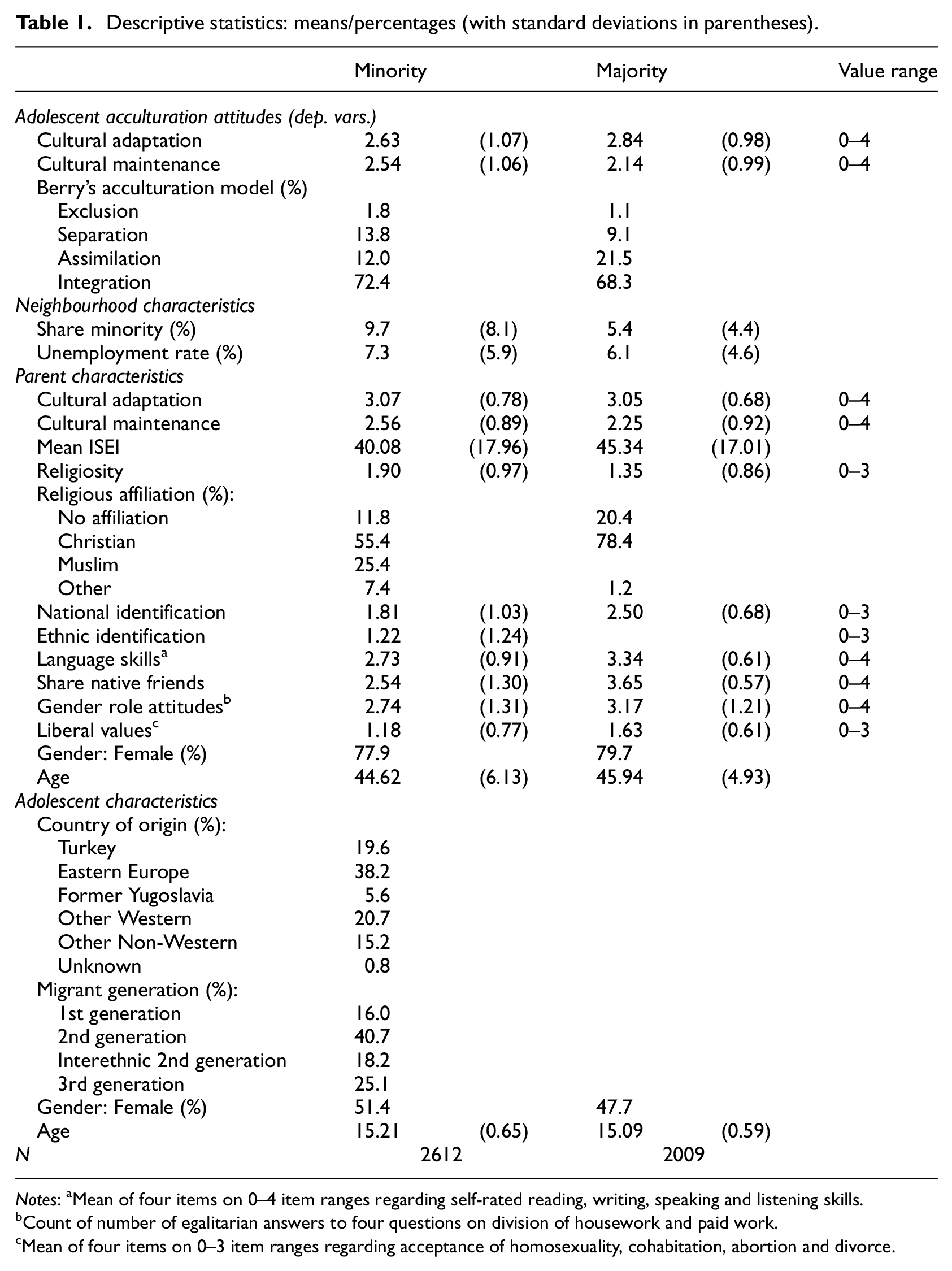
Notes: aMean of four items on 0–4 item ranges regarding self-rated reading, writing, speaking and listening skills.
Count of number of egalitarian answers to four questions on division of housework and paid work.
Mean of four items on 0–3 item ranges regarding acceptance of homosexuality, cohabitation, abortion and divorce.
Next to acculturation attitudes, a number of background factors are accounted for, which are mainly taken from the parental survey. Socioeconomic background is indicated by parents’ occupational status as measured by the mean ISEI score of parents’ occupations. We account for the responding parent’s religious affiliation, differentiating unaffiliated parents, Christian parents, Muslim parents and parents with other religious backgrounds. Furthermore, we consider parents’ religiosity, measured as a four-point item regarding the perceived importance of religion. A variety of indicators reflect parents’ integration into the receiving society: we assess parents’ German language skills with an index that averages four items referring to self-rated reading, writing, speaking and listening skills, which are each measured as five-point items. Social integration is captured by an indicator measuring the share of German friends on a five-point scale. National and ethnic identification are each measured with a four-point scale that asks for the degree to which parents feel they are a member of Germany and their ethnic group; the latter is available for minority parents only. Furthermore, we use two broad measures of cultural attitudes that assess parents’ gender role attitudes and liberal values.
Finally, we account for socio-demographics that are known to shape acculturation attitudes (Arends-Tóth and van de Vijver, 2000; Berry et al., 2006; Sam, 1995), factoring in both parents’ and their children’s sex and age as well as minority adolescents’ ethnic origin and immigrant generation. We differentiate between the largest minority groups (i.e. of Turkish, Eastern European and Yugoslavian origin); among the remaining ethnic origins, we differentiate between minorities of Western, Non-Western and unknown origin. Furthermore, we account for immigrant generation, differentiating between minority adolescents of first, second, interethnic second (i.e. one German parent and one ethnic minority parent) and third generation. 3
Our measures at the neighbourhood level stem from data provided by the geomarketing company ‘Microm’, which we merge with each respondent’s home address. The ‘Microm’ data offer spatial composition measures at fine-grained levels of aggregation, splitting postal code areas into smaller subunits with, on average, 500 households. Neighbourhoods, as defined here, thus correspond with respondents’ direct local surroundings at about a five-minute walking distance (and somewhat larger distances in less densely populated areas). The ethnic composition of these neighbourhoods is assessed on the basis of the ethnic origin of residents’ names (see Kruse and Dollmann, 2017; Mateos, 2007). This household-level information is aggregated at the neighbourhood level, yielding our independent variable of main interest: the share of minority members in the neighbourhood. Additionally, we account for the unemployment rate at the neighbourhood level in order not to confound the effects of neighbourhood ethnic and social composition.
Methods
To study whether acculturation attitudes are place-dependent and, in particular, a function of the neighbourhood ethnic composition, we combine a classical regression adjustment approach with an intergenerational perspective. Adjustment approaches have rightfully been criticised for being suggestive rather than definitive. In particular, the identification of neighbourhood effects critically hinges on the assumption that all core sources of selection into neighbourhoods have been observed and accounted for (e.g. Durlauf, 2004; Leventhal and Brooks-Gunn, 2000). While our analysis is to some degree confronted with this critique as well, it addresses key methodological challenges of identifying neighbourhood effects – in particular, selection effects – by studying the acculturation attitudes of adolescents, who are not directly but only indirectly affected by selection effects: residential choices are usually not made by adolescents themselves but by their parents (e.g. Dujardin et al., 2009). Selection into neighbourhoods can therefore only be indirect – if (1) parents select into specific neighbourhoods because of their personal characteristics, and (2) these personal characteristics shape their children’s attitudes towards acculturation. Such indirect selection effects, however, can be accounted for more easily than direct selection effects.
Part of our strategy to handle indirect selection is to exploit the intergenerational nature of our data, which allows us to take into account parents’ acculturation attitudes when investigating whether adolescents’ attitudes depend on neighbourhood composition. This allows us to explicitly control for neighbourhood selection on the basis of (parental) acculturation attitudes.
Notwithstanding these advantages specific to the intergenerational design, further selection effects may be present if there are parental background characteristics that drive neighbourhood choices while at the same time influencing adolescents’ acculturation attitudes – such as parents’ socio-economic background, their ethnic identification or their cultural attitudes. To account for such selection effects, we use the rich information the CILS4EU provides in its parental survey and explicitly adjust for these parental characteristics. As introduced above, we include parents’ socioeconomic background, their ethnic origin and their cultural and social distance from the German receiving society in terms of their religious denomination and religiosity, their language skills, the ethnic composition of their pool of friends, their national and ethnic identification, their liberal moral values and their gender role attitudes.
Finally, we also account for the possibility of correlated neighbourhood effects. Specifically, we control for neighbourhood socioeconomic composition, measured by the unemployment rate at the neighbourhood level, in order not to conflate neighbourhood effects due to ethnic composition with effects due to social composition.
With these precautions taken, the regression adjustment approach we use should provide credible and conservative estimates of neighbourhood effects. To quantify these effects, we analyse the two attitudinal dimensions both separately, using ordinary least squares regression, as well as combined in Berry’s two-dimensional acculturation model, relying on multinomial regression. We use results from the latter set-up to demonstrate how the predicted probabilities of different types of acculturation strategies vary by neighbourhood ethnic composition. Throughout the analysis, we use multiple imputation to account for item non-response in the data set and conduct weighted analyses to reflect the CILS4EU sampling scheme. The weighted analyses account for different sample selection probabilities of schools of different size and ethnic composition, and of classrooms within schools. Furthermore, the weights adjust for non-response at the school, classroom and student level. For a detailed description of the sample design and weighting, see CILS4EU (2016).
Results
A first look at our key independent variable – neighbourhood ethnic composition – suggests that minority concentration is generally limited in the contexts we study. Minority adolescents live in neighbourhoods with an average minority share of 9.7%, while majority adolescents live in neighbourhoods with a minority share of 5.4% on average (see Table 1). In part, these findings reflect the moderate levels of residential segregation in Germany (cf. Alba and Foner, 2015; Musterd, 2005). Importantly, however, the low mean minority concentration masks substantial variation in the composition of German neighbourhoods, particularly among minority adolescents (standard deviation of 8.1% among minority and 4.4% among majority adolescents). Moreover, the low mean estimates are partially due to the fact that the measure of neighbourhood composition relies on information from name-based classification, which tends to underestimate the contextual variation actually present (Kruse and Dollmann, 2017). While this underestimation may limit the descriptive value of the data, it makes a test for the place dependence of acculturation attitudes even more conservative.
Turning from the key independent variable to our dependent variables, Table 1 provides information on minority and majority adolescents’ acculturation attitudes. Comparisons along the two attitudinal dimensions, cultural maintenance and cultural adaptation, show opposing tendencies: concerning cultural maintenance, minority adolescents hold more favourable attitudes than their majority peers (i.e. mean values of 2.54 among minority versus 2.14 among majority members on a scale from 0 to 4, yielding a mean difference of 0.4, p < 0.01). Concerning cultural adaptation, the reverse holds true, with majority members holding more favourable attitudes than their minority peers (i.e. mean values of 2.84 among majority versus 2.63 among minority members on a scale from 0 to 4, yielding a mean difference of 0.21, p < 0.01).
We arrive at similar conclusions on differences between minority and majority adolescents when combining attitudinal dimensions in Berry’s acculturation model, a finding that aligns with previous research on the case of Germany (e.g. Pfafferott and Brown, 2006; Zagefka and Brown, 2002). Integrationist attitudes that highlight the importance of both cultural maintenance and adaptation are widespread among both majority and minority members, though slightly more frequent among the latter (72% versus 68%). Differences between the groups are more obvious for assimilationist and separationist attitudes: the former, which emphasise cultural adaptation at the cost of cultural maintenance, are observed more frequently among majority members (21% versus 12%). On the other hand, separationist attitudes that highlight cultural maintenance at the cost of cultural adaptation are less frequent among majority adolescents (14% versus 9%). Finally, exclusionist attitudes that reject both maintenance and adaptation are observed very infrequently among both majority (1%) and minority members (2%).
Place dependence of acculturation attitudes and neighbourhood effects
In the analysis to follow, we provide two core measures of the place dependence of minority and majority members’ attitudes: first, a descriptive gross measure from a bivariate regression that illustrates whether attitudes differ between adolescents living in neighbourhoods with low minority shares and those living in neighbourhoods with high minority shares. Second, a corrected net measure that accounts for various sources of confounding, thus providing more credible evidence on actual neighbourhood effects in accordance with the mechanisms discussed above. In the analysis, we use percentiles of the distribution of the neighbourhood minority share as our main indicator of ethnic composition; all results are substantively identical when relying on the absolute level of the local minority share.
Table 2 shows core results on the gross and net measure of place dependence when analysing the two dimensions of acculturation separately. Full model results can be found in Table A1 in the Appendix (available online). Considering adolescents with a minority background, the gross models indicate that acculturation attitudes indeed vary with neighbourhood composition. Adolescents living in neighbourhoods with a higher minority share consider it more appropriate for immigrants to maintain their cultural practices and hold less favourable opinions on the adaptation to the receiving country culture. Both effects are statistically significant at conventional levels (p < 0.01). After accounting for various sources of selection and correlated neighbourhood effects, the coefficient estimates on attitudes towards cultural maintenance drop by more than 50% of their initial size, suggesting that some of the gross differences are driven by confounders. On the other hand, estimates concerning attitudes towards adaptation do not change substantially across models. 4 Importantly, statistically significant differences according to neighbourhood composition persist along both dimensions in the net models (p < 0.05). Given the unusually wide range of control variables we adjust for and our intergenerational set-up, we are confident that the results from these models indeed indicate the presence of neighbourhood effects.
Results from linear regression models with attitudes towards cultural maintenance/adaptation as dependent variables.
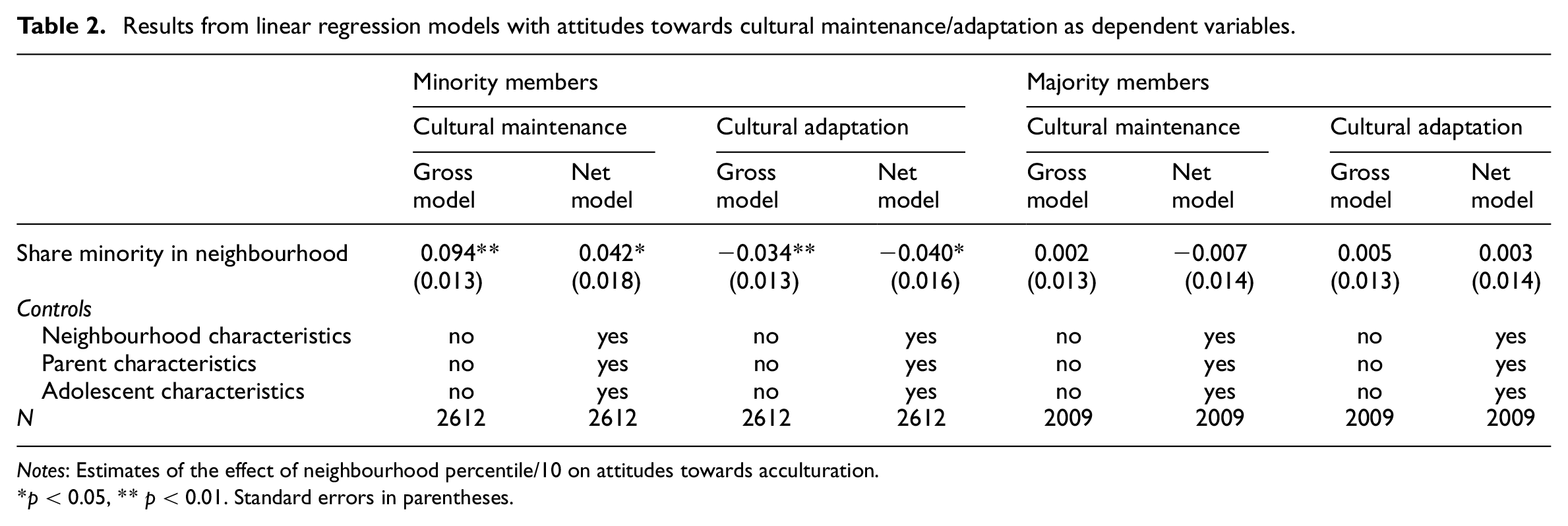
Notes: Estimates of the effect of neighbourhood percentile/10 on attitudes towards acculturation.
*p < 0.05, ** p < 0.01. Standard errors in parentheses.
The analyses so far have treated immigrant adolescents as a single homogenous group but, given variation in ethnic origin and immigrant generation, effects may vary between subgroups. However, follow-up analyses (see Tables A2 and A3 in the Appendix, available online) provide little evidence on systematic variation in neighbourhood effects according to both ethnic origin and immigrant generation. 5
While attitudes towards acculturation therefore prove to be place-dependent among minority members, with effects largely comparable across subgroups, Table 2 shows that there is no variation in acculturation attitudes by neighbourhood composition among majority adolescents. Neither in the gross nor in the net models do we see an indication of variation in attitudes across neighbourhoods. Coefficient estimates for both cultural maintenance and adaptation are small in size and far from reaching statistical significance at conventional levels.
The analysis suggests that acculturation attitudes of majority adolescents do not depend on neighbourhood composition while those of their minority peers do. However, the results provide little information on the size and substantive importance of these neighbourhood-based differences. To assess the importance of neighbourhood composition for the acculturation attitudes of minority adolescents, we therefore investigate the dimensions of maintenance and adaptation simultaneously, following Berry’s acculturation model, and study how the probability of holding specific types of attitudes varies across the range of neighbourhood ethnic composition. Owing to its low prevalence, we do not address the case of exclusionist attitudes (i.e. attitudes that favour dis-integrating from both the origin and the receiving society culture). Furthermore, we focus on the net models that account for selection into neighbourhoods.
In Figure 1, we present core results from the multinomial regression models for minority adolescents (full model results can be found in Table A4 in the Appendix, available online). Panel (a) displays multinomial regression coefficients, treating separationist attitudes as the reference category; it shows how higher minority concentration in the neighbourhood is related to the probability of holding integrationist, assimilationist and separationist attitudes. Arrows pointing from one category into another indicate that the latter category is significantly (p < 0.05) more likely relative to the former in neighbourhoods with higher minority shares. The graph shows that, with higher ethnic concentration, minority adolescents are more likely to hold separationist than integrationist or assimilationist attitudes (p < 0.05). This reflects the tendencies towards cultural maintenance and against adaptation at high neighbourhood minority shares we also observed in the unidimensional linear models above.
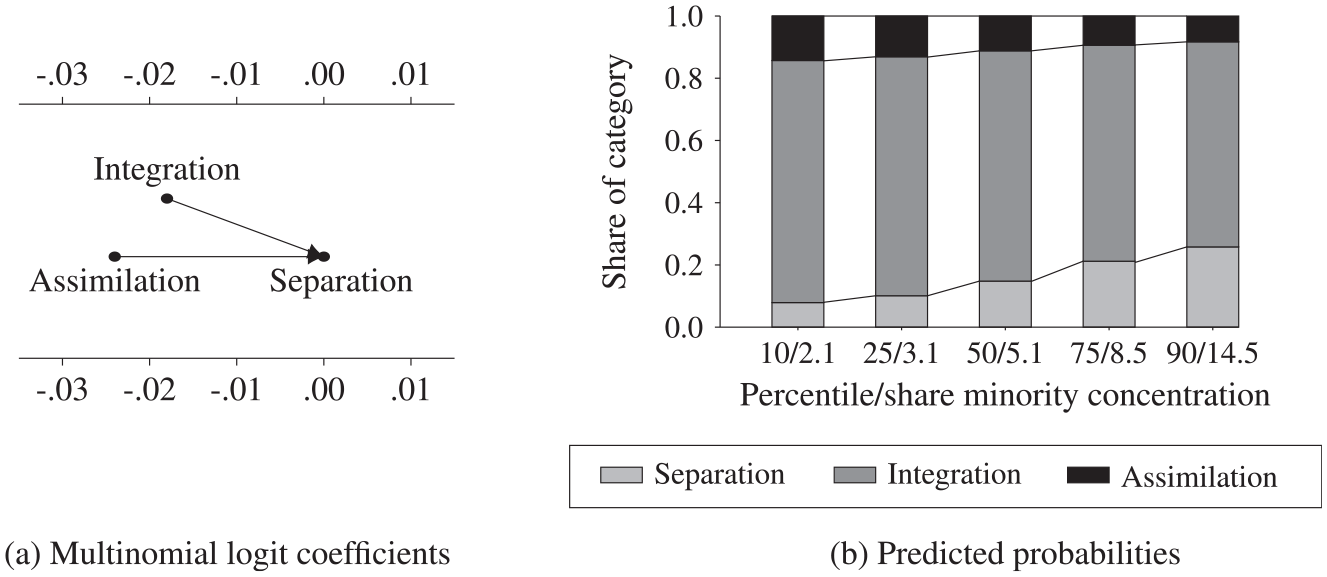
Coefficients and predicted probabilities from net multinomial regression models for minority members (separation as reference category).
In panel (b) of Figure 1, we quantify the importance of neighbourhood ethnic composition by plotting predicted probabilities for the different acculturation attitudes at different percentiles of minority concentration in the neighbourhood. The panel demonstrates that the share of adolescents holding separationist attitudes is substantially higher in neighbourhoods with high minority concentrations. Considering predictions from the net model, the share of adolescents with separationist attitudes is at a low 8% at the first decile of the distribution of ethnic concentration (minority share of 2.1%), but gradually rises to 26% at the ninth decile (minority share of 14.5%). Correspondingly, the share of adolescents with assimilationist attitudes is lower in areas with high ethnic concentration (8% at the ninth and 14% at the first decile). The same holds true for integrationist attitudes, which dominate with 78% at the first decile but are less widespread in areas with high levels of ethnic concentration (66% at the ninth decile). This variation in attitudes along different levels of ethnic concentration is substantial, suggesting that minority adolescents disproportionately favour the maintenance of heritage culture over immigrant adaptation in neighbourhoods with a large minority population. We do not find evidence of comparable place dependence of acculturation attitudes among majority adolescents: as in the linear regression models reported above, the multinomial logit analyses show no evidence of systematic variation in attitudes according to neighbourhood ethnic composition among majority members (see Table A4 in the Appendix, available online).
Discussion
In this study, we investigated whether the acculturation attitudes of minority and majority adolescents depend on the local context they live in – in particular, the ethnic composition of their neighbourhoods. Drawing on accounts of intergroup contact, concentration effects and reactive ethnicity, we expected that minority adolescents living in neighbourhoods with high minority concentrations would be less favourable towards immigrant adaptation, thus stressing the importance of heritage culture maintenance over the adoption of cultural practices of the receiving society. For majority adolescents, we expected higher minority concentrations to be associated with stronger support for minorities’ cultural maintenance, though we generally expected the place dependence of attitudes to be less pronounced among members of the majority.
Our empirical analyses partly support these expectations: in neighbourhoods with higher levels of ethnic concentration, minority adolescents indeed were more likely to hold separationist attitudes, supporting the maintenance of minorities’ heritage culture at the cost of adopting cultural practices specific to the receiving society. While in neighbourhoods with low minority concentration our models predicted less than 10% of minority adolescents to hold such separationist attitudes, they predicted more than 25% to hold comparable attitudes in the neighbourhoods with the highest minority shares. Exploiting the intergenerational design of our data and a rich set of controls, these estimates are already corrected for a variety of selection effects and other potential confounders, suggesting that the neighbourhood context indeed shapes acculturation attitudes among minority adolescents. Among majority adolescents, we found no evidence that acculturation attitudes are place dependent.
Interpreting these findings, we should keep in mind that ethnic segregation is rather moderate in the German context. First, finding evidence of systematic variation in attitudes despite low levels of ethnic segregation is remarkable and suggests that attitudinal variation across the minority population may be even more pronounced in the case of stronger residential segregation. Second, finding no such variation among majority adolescents may be because minority concentrations are too low to exert a measurable influence: acculturation attitudes may be less relevant for majority adolescents and thus subject to greater contingency, as majority youth are not themselves targets of such attitudes. Third, the low absolute levels of minority concentration allow us to speculate on the mechanisms underlying the observed place dependence of attitudes: while reactive ethnicity seems more likely to operate if minority adolescents live spatially isolated in highly segregated neighbourhoods, interaction with majority members may already be curbed in neighbourhoods with only moderate minority shares; accounts of intergroup contact and concentration effects therefore appear as more obvious explanations for the observed variation. While we cannot explicitly put these different mechanisms to the test in our study, we hope that future research can shed more light on the mechanisms that link neighbourhood composition to acculturation attitudes.
Our findings suggest that changes in the ethnic composition of neighbourhoods may bring about attitudinal changes, at least among minority adolescents. From this perspective, interventions targeting residential (de-)segregation may seem to be promising to also foster integrationist attitudes among minority adolescents. However, several considerations are in order: first, given the limited range of neighbourhood compositions in Germany, we were unable to assess potential threshold effects of the neighbourhood composition. Neighbourhood effects due to increased out-group contact, for example, may level off at higher levels of concentration once sufficient meeting opportunities are provided; other mechanisms, such as reactive ethnicity, may only operate at higher levels of ethnic concentration. In order to develop dependable and effective interventions, knowledge about effects for a broader range of neighbourhood compositions is necessary. Second, the neighbourhood may be only one of several contexts to be targeted by an intervention. Given this study’s focus on adolescents, schools would be an obvious alternative. Neighbourhood characteristics strongly shape school compositions as adolescents tend to attend schools close to their homes (Burgess et al., 2004; Karsten et al., 2003). Under such conditions, the neighbourhood effects we observed may reflect indirect effects, with neighbourhood ethnic composition shaping school composition and school composition shaping attitudes. Additional analyses suggest that in our case of adolescents in Germany, schools at best account for a small part of the observed association between neighbourhood compositions and attitudes (results not shown here, available upon request), 6 suggesting that neighbourhoods themselves are of key importance. However, in other settings, contexts such as schools or workplaces may turn out to be more effective targets of interventions than neighbourhoods.
Our study can only provide a first assessment of the role neighbourhoods play in shaping the acculturation attitudes of minority and majority members. From a methodological perspective, we have tried to provide credible estimates of neighbourhood effects by relying on the intergenerational nature of our data and by explicitly controlling for a wealth of potential confounders. However, we are limited by the fact that we only have explicit information on the characteristics of one of the surveyed adolescents’ parents, meaning that our measures of parental characteristics – particularly in the domain of acculturation and other cultural attitudes – are incomplete. Furthermore, our estimation approach rests on the assumption that we could observe all important confounders, which we cannot test empirically. We hope that our study is followed by other rigorous empirical approaches set out to test whether local neighbourhoods shape attitudes towards the acculturation of immigrants.
Supplemental Material
Kretschmer_Supplementary_Files – Supplemental material for Neighbourhood effects on acculturation attitudes among minority and majority adolescents in Germany
Supplemental material, Kretschmer_Supplementary_Files for Neighbourhood effects on acculturation attitudes among minority and majority adolescents in Germany by David Kretschmer and Hanno Kruse in Urban Studies
Footnotes

References
Supplementary Material
Please find the following supplemental material available below.
For Open Access articles published under a Creative Commons License, all supplemental material carries the same license as the article it is associated with.
For non-Open Access articles published, all supplemental material carries a non-exclusive license, and permission requests for re-use of supplemental material or any part of supplemental material shall be sent directly to the copyright owner as specified in the copyright notice associated with the article.
