




Abstract
What explains patterns of circular migration during protracted refugee displacement? We examine circular refugee migration (CRM) between Syria and Lebanon, focusing on why refugees undertake trips to their home country and how they navigate them. We draw on in-depth interviews and focus groups with Syrian refugees in Lebanon, bus and taxi drivers working between Lebanon and Syria, UNHCR border monitoring staff, and Syrian community leaders. We show that without consideration and measurement of CRM, research risks misinterpreting refugee movements. We offer an analytical framework for describing and interpreting refugee trips back to their home country, grounded in understanding people's capabilities and constraints. The findings suggest that CRM is a high-stakes survival strategy that people are compelled to rely on during protracted displacement, with three key empirical regularities. First, refugees traveling between the host country and home country face considerable risks, including forced conscription, arrest, and violence on smuggling routes. Second, CRM is usually driven by urgent needs related to healthcare, documentation, and family. Third, CRM often reveals a disconnect between intentions and outcomes due to worse-than-expected conditions—planned circular migration may result in unplanned return, and planned return may end in unplanned circular migration.
Introduction
This manuscript examines circular refugee migration (CRM) between Syria and Lebanon, studying why refugees undertake trips to their home country and back to the host country and how they navigate the journeys. 1 Circular trips can be an important refugee survival strategy during protracted displacement in response to the compound effects of years living in exile. Even if permanent return is not a viable prospect in the near term for many refugees, they may nonetheless make circular trips to their country of origin (Bakewell 2002; Manji 2020; REF and Samuel Hall Research 2023). While CRM is a recurring phenomenon in protracted refugee crises, a scarcity of research and data limits our understanding of the phenomenon. CRM challenges us to improve how refugee movements are conceptualized and measured. Without attention to CRM, research risks mischaracterizing refugee movements, obscuring potentially important survival strategies, and treating linked legs of travel as independent events.
This paper presents original qualitative data on CRM between Lebanon and Syria. We ran in-depth interviews and focus groups in Lebanon with Syrian refugees, bus and taxi drivers who transport people between Lebanon and Syria, UNHCR protection staff responsible for border monitoring, and Syrian community leaders (Arabic sing., shawish; pl., shuwashaa). Some empirical questions include: What forms does CRM take, and how do Syrians describe and experience these movements? What shapes Syrian refugees’ intentions to undertake circular trips, and how do they make decisions about moving, staying, or returning? What factors enable or constrain Syrians’ ability to move or not move?
Motivated by our empirical findings, we introduce an analytical framework to improve understanding of CRM. It offers a structured approach for analyzing refugees’ return migration decision-making and experiences during protracted displacement, with implications for how refugee mobility is measured and interpreted. Drawing on the capabilities framework (see Sen 1984, 1993, 1999, and Nussbaum 1988, 1992) and two-step approaches to classifying migration (Carling and Schewel 2017), we distinguish between return intentions, return behavior, and capabilities. The capabilities framework is valuable for analyzing CRM because it shifts our focus from what refugees are merely able to do (abilities) to whether they can pursue outcomes they value (capabilities). This distinction is crucial in refugee contexts, where severe constraints often mean that observed behaviors do not reflect choices aligned with valued goals. We focus on refugees’ freedom to choose (or not) valued movement and residence, with explicit attention to the constraints and choices refugees face. Our empirical results suggest that although refugees’ movements always reflect an ability, they may flow from an absence of migration capabilities. A capabilities perspective is needed for interpreting CRM as a part of how refugees navigate constrained options during protracted displacement.
In addition to serving as the foundation for the analytical framework, the empirical findings shed light on the motivations, challenges, and experiences of Syrian refugees traveling between Lebanon and Syria. First, the data show that for most Syrians, CRM is both perilous and costly, and it is not undertaken casually or frequently. From the financial burden of travel to threats such as arrest, kidnapping, extortion, or death, CRM presents numerous challenges. Refugees traveling formally face dangers at government checkpoints, including forced conscription, arrest, and interrogation. Those traveling informally contend with harsh mountain conditions, extortion by smugglers, and potential violence or harassment.
Second, Syrian refugees pursue CRM when they face pressing needs that require a trip to Syria but do not want to return to Syria permanently. The most frequently cited reasons are medical and health-related issues, need for important documentation, and critical family matters. Participants viewed CRM as largely driven by the prohibitive costs of healthcare in Lebanon, including both medical services and medications. Even considering the financial and safety risks of travel, many regard seeking healthcare in Syria as the only means to access life-saving treatments.
Third, the data reveal a frequent disconnect between refugees’ migration intentions and subsequent outcomes. Despite refugees’ best efforts to plan for the future, navigating extremely constrained options often leads to outcomes that undermine their hopes and intentions. Some refugees who travel to and stay in Syria were in fact trapped due to depleted resources, in this way suffering involuntary immobility in their home country. Conversely, many circular trips begin as planned returns, but upon arrival, refugees find that life in Syria is even more difficult than expected and leave Syria again.
Our findings highlight the risk of misinterpreting refugee mobility when analysis is based on reported intentions and observed behavior, as is common practice. Even when both intentions and behavior are measured, interpretation of refugee movements will be ambiguous. This should concern both practitioners and scholars. Most data measuring refugee mobility—whether used in refugee/humanitarian programming or academic research—relies on only intentions and/or behavior to measure and interpret migration. Empirical research should move beyond current data limitations to incorporate refugees’ capabilities and constraints into interpretation, in addition to measuring both intentions and behavior to characterize movement patterns.
The findings are also relevant for ongoing public debates surrounding refugee programming and policy. Practitioners often aim to allocate limited resources and resettlement opportunities to the most vulnerable refugees, using criteria to identify them. If circular movements are interpreted as indicators of capability and safety rather than possible signs of constraint and vulnerability, humanitarian actors may make systematically incorrect targeting decisions. At the time of the study, some politicians in Lebanon argued that parts of Syria had become safe for return, and that CRM indicates that Syrians, particularly those undertaking these trips, no longer required protection in Lebanon (Yahya 2018). The assumption that refugee travel to their home country demonstrates a capability to reside there safely has also been applied in European asylum cases (InfoMigrants 2024; van Brunnersum 2024). Our paper challenges that logic: the ability to travel does not necessarily indicate safety or capability, nor does it negate the need for protection.
Theory: Understanding CRM Under Constraint
The majority of research on refugee trips back to their home country focuses on questions related to return and not CRM. This work typically treats refugee return as a binary outcome, where refugees are either classified as intending to return within some specified time period or not (Ghosn et al. 2021; Alrababah et al. 2023), or as having returned or not (Beaman, Onder and Onder 2022; Blair and Wright 2022). This binary framework leaves CRM conceptually and empirically underdeveloped, with neither clear analytical definitions nor established measurement approaches.
Although only a few studies directly examine CRM, they provide a valuable foundation for developing our analytical framework. Bakewell (2002) studies Angolan refugees in Zambia, finding that cross-border migration to Angola functions as a livelihood strategy shaped by structural limitations rather than straightforward return. He critiques repatriation programs for oversimplifying refugee movements to the home country, often misinterpreting them as one-time returns rather than part of a broader adaptive strategy. Chatty and Mansour (2011) analyze the protracted displacement of Iraqi refugees in Syria, Jordan, and Lebanon, noting that constrained options trap many in precarious urban settings with limited pathways to stability. They argue that these refugees are compelled into repeated, high-risk journeys in response to restrictive conditions in both host and origin countries. Betts et al. (2023) focus on secondary movements of refugees in East Africa, revealing how aspirations for international migration frequently diverge from actual mobility patterns due to people's limited options. They frame internal migration and circular trips as adaptations within constrained environments.
Other work has looked at the broader class of refugee mobility, providing lessons for CRM. Valenta et al. (2020) analyze the mobility and evolving statuses of Syrian refugees, showing how shifting legal and policy regimes compel refugees to adapt their trajectories, often resulting in repeated movements and precarious conditions. Dinc and Eklund (2024) show that refugees may feel “trapped” even after crossing international borders, as restrictions in destination countries can block mobility and adaptation. In this way, refugee mobility outcomes arise from conditions in multiple countries and from continued structural constraints in asylum contexts. Etzold et al. (2019) argue that repeated movements during protracted displacement often are shaped by overlapping displacing, marginalizing, and immobilizing forces, and often need to be interpreted as a means of survival rather than an indication of expanded capabilities or improved conditions. Across the studies, CRM emerges as an adaptive survival strategy that refugees use to navigate structural constraints and limited options in both host and origin countries.
A Model of CRM
Building on this scholarship, we provide an analytical framework for describing and interpreting refugees’ trips to their home country. The framework emphasizes constraints, process, and limited options in shaping decision-making and outcomes. We do this with two goals in mind. First, we provide a simple tool for more accurate description of refugee trips back to their home country. Second, we use the concept of capability constraints for interpreting refugees’ movement patterns and decision-making. We propose that measuring both refugees’ intentions and behavior is needed to describe their movements, and that a capabilities perspective is necessary for accurate interpretation of those movements.
For the goal of description, we draw on Carling and Schewel's (2017) concept of two-step models of migration, which they introduce as a generalization of Carling's original aspiration–ability model (Carling 2002) and similar approaches. Two-step approaches conceptualize mobility as being realized through two stages: the evaluation of a specific movement as a potential course of action and the realization of actual mobility or immobility. Our model focuses on refugees who travel to their home country and aims to more accurately describe their mobility or immobility. We define the stages of the two-step model for CRM as intentions and outcomes. The first dimension of the two-step framework captures their evaluation of the migration goal for the trip: either permanent or temporary travel back to Syria. And the second dimension considers the subsequent outcome of their trip to Syria.
We categorize refugee return trips to the home country into four types based on intentions and outcomes. First, we examine whether individuals intend their trip to Syria to be temporary or permanent at the outset. We follow Carling and Schewel (2017) in defining intentions as a forward-looking plan to undertake a specific mobility-related act. By forward-looking plans, we mean intentions held prior to the initiation of movement to Syria. While intentions may change as individuals acquire new information or experience conditions during travel, our analysis focuses on initial intentions rather than subsequent revisions. Second, we assess whether people travel back to Lebanon after the trip or remain in Syria. Migration behavior refers to the observable actions individuals take in moving from one location to another, resulting from the full range of decisions and conditions associated with the initiation, execution, and aftermath of movement. As discussed below, these dimensions are helpful for analyzing refugee mobility as migration under profound constraints. After discussing the descriptive content of the 2 × 2 model, we will introduce concepts from the capability approach to interpret the content of each of the four cells.
CRM, Constraints, and Capabilities
We see in each cell of the model that intentions and behavior can describe a CRM outcome but are insufficient for interpreting the movement. The same intentions-behavior outcomes may arise from very different motivations or constraints. To address this gap, we draw on the capabilities approach developed by Sen (1984, 1993, 1999) and Nussbaum (1988, 1992), which focuses on individuals’ freedom to pursue valued ways of being and doing. We also draw on scholarship that theorizes capabilities in migration (de Haas 2021) and capabilities in displacement (Ali 2023; Müller-Funk, Üstübici and Belloni 2023). This body of work shifts our focus from available actions toward valued options, process, and the constraints shaping decision-making, offering a productive lens for analyzing refugee mobility as migration under profound constraints.
Refugees’ Capabilities: Freedom, Process, and Value
The concept of capabilities shifts analysis of refugee mobility beyond observed behavior toward assessing individuals’ substantive freedom to do and be what they have reason to value. 2 Within people's capabilities sets, they can freely choose from outcomes they value, which Sen and Nussbaum define as functionings, comprising doings (actions) and beings (states or conditions). In the context of migration generally, doings map onto the action of moving or not moving, and beings map onto the condition of residing somewhere as a result of that choice. With CRM specifically, we consider a set of potentially overlapping functionings: the ability to stay where one is, the ability to return home, and the ability to undertake CRM. We are concerned not only with whether refugees move, but with whether they are able to execute their mobility and residence (both before and after the mobility choice) in safety and dignity.
Sen (1984, 1993) and Nussbaum (1988, 1992) developed the capability approach to assess poverty and well-being as determined not solely by individual endowments or choices, but also by social, political, and economic structures that constrain opportunities and perpetuate inequality. 3 The framework has since been applied across many domains. Sen (1999) and Nussbaum (2011) notably applied the frameworks to questions of economic development. In order to theorize the relationship between development and migration, de Haas (2021) articulates an aspirations–capabilities framework where people's decisions to move or stay reflect both migration aspirations and the external conditions that shape and enable those aspirations. His framework provides a conceptual basis for interpreting mobility as a choice made within and shaped by the structure of available options.
Scholars have used the capabilities framework to conceptualize displacement not simply as movement, but as the absence of meaningful choice from safe and dignified options. Ali (2023) builds on Sen's concept of capabilities to define displacement as the experience of disruptions to a person's valued ways of living through a coercive process, rather than merely describing migration under threat from one location to another. Etzold et al. (2019) also links displacement to capabilities, proposing that the central feature of protracted displacement is that people's capabilities and opportunities are severely limited for prolonged periods of time. Displacement, in these applications, is the experience of a loss of capabilities. In contexts of war or catastrophe, people often face a choice set where none of their available options constitute capabilities. Scholars have described such constrained decision-making from a set of bad options in varying terms. de Haas (2021) describes refugees as migrating because they lacked a “reasonable option” to remain, meaning an option that does not involve serious danger, exploitation, or threats to life (p. 23). Ali (2023) theorizes these sets of bad options during displacement as “immoral proposals.” Many refugees fled home because they lacked an option for safe or dignified residence, and they continue to face profoundly constrained choices when considering return. Refugees may navigate a narrow set of bad migration options—returning to danger, remaining in precarity, or risking circular travel that endangers both. These mobility decisions should be interpreted through the lens of capabilities: not just what refugees do, but whether they have the freedom to choose among reasonable options for movement and residence in safety and dignity.
The capabilities framework is useful for its distinction between capabilities and abilities. While the two terms are largely synonymous in common parlance, within the capabilities framework, an ability simply means that someone can do something, while a capability implies that someone has the meaningful freedom of choice to do or be something of value for them in leading a dignified life. 4 , 5 A refugee who lacked a valued option to remain in place, therefore, may have had the ability to remain while lacking the capability to do so. 6 Such distinctions are important for discussing refugee return or CRM. The international refugee regime maintains that refugee return should be voluntary, safe, and dignified. As such, the question of whether a refugee merely has the ability to return is relatively trivial. In the Syrian refugee context in Lebanon, barring physical impairment or extreme poverty, most individuals can physically travel to Syria. Most Syrians in Lebanon could purchase a bus ticket from Beirut or Chtoura to Damascus, even if doing so would result in their arrest at the first government checkpoint they encounter. A more important question is whether a refugee has the capability to return to their home country—that is, whether the movement and residence linked to return would be valued, either intrinsically (e.g., longing for home, ending exile) or instrumentally (e.g., accessing healthcare, renewing documents, maintaining family ties). 7 We use safety and dignity as shorthand for conditions without which movement and residence are unlikely to be valued, whether for intrinsic or instrumental reasons. This framing of value allows for variation across individuals and contexts, while also aligning with common policy-frameworks for return (e.g., UNHCR 2004; Inter-Agency Standing Committee [IASC] 2010).
The capabilities approach focuses on individuals’ freedom to choose or not to choose, rather than solely on outcomes. This requires attention to both the process of choice and the range of alternative options available. A realized action—an ability—may not constitute a capability if it is not valued or if it occurred under coercion or in the absence of reasonable alternatives. As Sen (1999, p. 76) argues, process and freedom of choice among alternatives have intrinsic value. People derive value from knowing that they have the freedom to choose to move, even if they do not choose to do so. In Nussbaum's (2011) normative formulation, the central prescriptive aim of policy should be expanding capabilities, not to secure particular outcomes or behavior. For instance, a capabilities approach holds that policy should aim to expand refugees’ ability to choose freely whether to return or not, rather than promoting return per se.
By directing us to consider people's choice sets as an object of study, the capabilities approach allows us to distinguish between the capabilities individuals possess and those they lack—specifically, those they ought to have but do not—enabling a discussion of a capabilities gap. The absence of valued options is analytically significant. Refugees’ movements are often described as “involuntary” or “forced” not because they lacked any choices, but because they lacked a reasonable option to stay in their home country. In parallel, some refugees return to their home country because they lack a reasonable option to stay in the hosting country. Such returns do not constitute a capability and fall short of the standard for voluntary dignified return. We can also apply this lens to consider people who remain in war zones, who may do so not because they are better off than those who flee, but because they lack a capability to leave (Schewel 2020). Focusing on a capabilities gap allows us to move beyond a reductive binary of “forced” versus “voluntary” migration. When individuals lack access to valued options for movement or residence, their movements must be interpreted differently from the same observable behavior undertaken by people who can choose from a range of valued options.
Interpreting the Two-Step Model of CRM
The capabilities framework centers the importance of process, value, and the range of options available when interpreting the two-step model of CRM in Figure 1. Refugees’ return hopes and plans cannot be accurately interpreted without considering the limited and often undesirable options available to them during displacement. Refugees residing in neighboring countries face the prospect of returning to a home country devastated by war. Some people may decide to return permanently. Others may plan to undertake circular trips for specific purposes (e.g., healthcare or documentation). The psychological challenges of these decisions should not be understated. Despite the dream of a satisfying life back home and the priorities of the international community to promote voluntary, safe, and dignified return, these facts are often in tension with the reality in the home country. People living as refugees may look across the border and see violence, war trauma, economic collapse, and destroyed infrastructure. Even after the formal end of conflict, returning can pose great hardship. Müller-Funk, Üstübici and Belloni (2023) propose that ambivalence is a more accurate representation of mobility aspirations for many refugees than a unitary desire to stay or return.
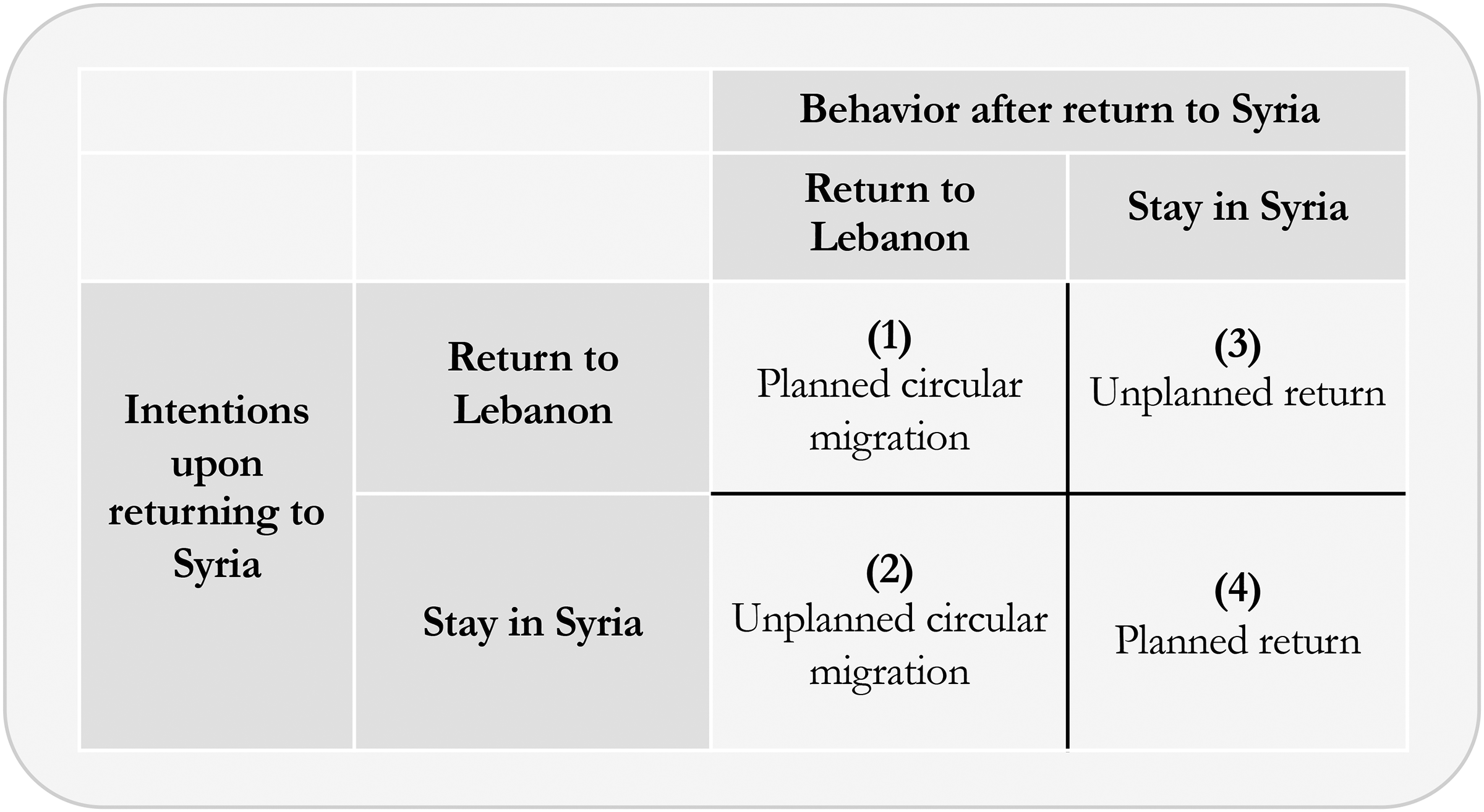
A framework of refugee movement between the hosting country and home country.
The data point to a recurring tension between the limited and often undesirable options available to refugees, around which they must make mobility plans, and their aspirations for a secure return. On the one hand, when people discussed mobility, travel to Syria, and staying in Lebanon, participants largely did not focus on aspirational futures. Instead, they emphasized concrete plans for meeting pressing needs under profound constraints. On the other hand, aspirations for return were generally described as distant or unattainable, impeded by the severe conditions facing Syrians back home at the time of research in 2022, and therefore not a basis for mobility planning. Reflecting this pattern in respondents’ accounts, we focus our discussion on what Carling and Schewel (2017) call intentions—a forward-looking plan to undertake a specific mobility-related act—rather than a general preference for migration or a broader life goal. 8 The term intention reflects the limited choices that refugees have in these contexts. While aspiration may imply a degree of desire or positive affect, the term intention better captures the inner conflict and tension that often lies behind refugees’ mobility decisions. During displacement, individuals often face a set of bad options, all of which are costly and risky, and none of which constitutes a capability. Refugees may not view migration as a desired end or as a means for a better life, but rather as a reactive effort to manage acute risk or simply survive.
As an analytical category, migration behavior should be viewed as a result of the processes and choices through which individuals navigate constraints, structural forces, and personal circumstances. The empirical study of refugee behavior requires attention to whether observed actions can be interpreted as evidence of capabilities, but this cannot be done directly by observing actions. Drawing on the work of de Haas (2021), Ali (2023), and Müller-Funk, Üstübici and Belloni (2023), scholars should devise empirical measurement strategies—whether qualitative or quantitative—for constraints and capabilities in order to avoid misinterpreting behavior as evidence of valued choices. This task is challenging for several reasons. First, the same mobility behavior may reflect either the successful realization of one's intentions or responses to constraints that prevented a preferred alternative course of action. Second, although observable behavior demonstrates an ability to act, that ability alone does not constitute a capability. 9
In addition to the conceptual motivation for focusing on intentions and behavior, we are also guided by applied and empirical considerations. First, from an applied perspective, data on refugees typically measures intentions and/or observed behavior, making these dimensions relevant for scholars studying displacement. Second, our empirical findings show that refugees’ migration outcomes frequently diverge from their original plans due to unexpected circumstances and challenges. Given the importance of this finding for understanding refugee return, we define the model to reflect that unanticipated outcomes are an important part of refugee mobility trajectories.
Research Design
We designed and ran focus group discussions (FGDs) and key-informant interviews (KIIs) in March 2022 in four regions in Lebanon: Beirut (the country's largest city), Bekaa (its main agricultural region), Tripoli (the second largest city), and Akkar (a remote rural region in the far north). We chose to carry out the research in four distinct regional contexts to capture a diversity of perspectives and experiences related to CRM. 10 We worked with a local survey firm to coordinate a team of experienced moderators who conducted FGDs and KIIs in person, respecting COVID-19 safety measures. Below we describe the design and conduct of FGDs, then the KIIs, then we discuss analysis and interpretive considerations.
Focus Groups
Moderators carried out 8 FGDs with 6–8 Syrian refugees living in Lebanon (average of 6.5 participants) to learn about their knowledge of and experiences with circular movement between Syria and Lebanon. The focus groups lasted 2 h on average. FGDs were designed to recruit a broad cross-section of the population, reflecting our interest in how Syrians think about, prepare for, and evaluate potential travel to Syria. We stratified FGD recruitment by gender and location in Lebanon (including neighborhood-level stratification in urban sites). 11 We designed a random sampling strategy in which a UNHCR staff person with access to the proGres (Profile Global Registration System) database randomly sampled lists of men and women in each selected region between the ages of 18 and 55. 12 Staff at the survey firm conducted FGD recruitment by calling potential participants from the sampling lists provided by UNHCR. If phone contact was successful, potential participants were read an informational and informed consent script over the phone and were free to decline participation with no negative consequences. The recruitment calls were limited to consent and scheduling; participants were not asked about CRM during the recruitment calls. Upon arrival for the in-person FGDs and KIIs, participants were read a second consent script and were free to decline participation without consequence. Participant discussion of CRM only began after this process was completed.
KIIs
Moderators also conducted eight KIIs, lasting 1 h on average, with individuals who had experience related to CRM: cross-border bus and taxi drivers, UNHCR protection staff responsible for border monitoring, and Syrian community leaders (shuwashaa). Each of these groups provides distinct knowledge on CRM. Drivers have repeated first-hand exposure to cross-border travel. Shuwashaa often serve as brokers or coordination points in Lebanon's informal refugee camps and neighborhoods, linking Syrians with humanitarian actors and municipal authorities. In some cases, they also facilitate contact with smugglers when needed. KII participants were identified through purposive recruitment of people with direct experience or specialized knowledge of CRM and at least 2 years of experience in their position. Cross-border drivers and shuwashaa with relevant experience were identified through the networks of local moderators. For KIIs with UNHCR staff, the authors identified participants through their networks via direct correspondence with UNHCR offices.
Design Considerations
The research design is informed by our long-term experience in the research context. One author lived in Beirut for 32 months between 2013 and 2020, with 15 months carrying out participant observation in a Syrian NGO and an informal refugee camp. The other author lived in Lebanon for 2 years, working in the Syria response in a humanitarian organization from 2020 to 2022.
The two data collection modalities generate distinct and complementary data, which we use for triangulation across diverse perspectives to identify recurring patterns and variation. KIIs capture specialized professional knowledge from people whose work directly exposes them to CRM. FGDs, in contrast, reveal general, non-expert knowledge of CRM. Understanding Syrians’ perspectives on travel to Syria requires attention to the general population, not only those with personal experience, since many individuals who may need to consider engaging in CRM do so without prior experience. We anticipated that group conversations would allow participants to build upon one another's partial or second-hand accounts in ways that individual interviews could not. We also anticipated that participants might feel more comfortable discussing CRM in conversation with other Syrians rather than in individual interaction with an interviewer. The richness of the data suggests that both the KIIs and FGDs were successful in eliciting active discussion.
We designed data collection to mitigate potential bias stemming from both the sensitivity of CRM and our partnership with UNHCR. We implemented measures to protect participants, reduce discomfort, and support data quality. Participants were informed that they were not required to share identifiable personal information and could speak in general terms. During the introduction to the FGDs, we encouraged participants to recount experiences as second-hand stories if this felt more comfortable. This approach functioned as a protection strategy and as a way to facilitate discussion of sensitive aspects of CRM that might otherwise have been difficult to raise. This constrains our ability to separately analyze first-hand accounts, second-hand accounts, and general community knowledge, but was the result of a deliberate choice in response to the ethical and practical trade-offs of our topic. Nonetheless, the data reveal that many Syrians possess detailed knowledge of CRM, its risks, and the strategies to mitigate them.
Effective moderation is central to the quality and interpretation of KII and FGD data, as conversational methods are shaped by facilitation and group dynamics. Narratives may disproportionately emphasize salient or risky cases if more routine experiences are discounted, and accounts may reflect social desirability or moral filtering. The facilitation of group discussion can influence conversational dynamics, potentially crowding out some perspectives or giving an appearance of consensus that overstates underlying agreement. We took steps to mitigate these concerns in the research design and analysis. First, we hired experienced moderators and one of the authors provided project-specific training. The training included guidance on managing group dynamics, encouraging participation from quieter participants, facilitating discussion of sensitive topics, and probing both agreement and disagreement. Second, we triangulate across FGDs and KIIs, using consistency across data types and sites to interpret patterns.
We designed the study to identify a breadth of perspectives across multiple regions in Lebanon rather than immerse in one community. In-depth, single-site fieldwork can facilitate rapport and contextual understanding and is often well suited to studying sensitive topics. In this case, however, data collection occurred under COVID-19 restrictions that limited travel and prolonged, in-person engagement. Further, concentrating research in one location in a small country context posed potential risks related to identifiability. A multi-site design allowed us to capture variation in experiences while reducing participant concerns that might limit openness or participation.
Data and Analysis
Our qualitative coding proceeded as follows. The survey firm recorded the FGDs and KIIs, transcribed them in Arabic, and translated the transcripts into English. They provided the Arabic-language recordings and the transcripts in both languages. One of the authors is an Arabic speaker, and they listened to audio recordings of the focus groups and interviews, in addition to reading the transcripts. After receiving the translated transcripts, we developed a coding guide. Initially, we selected a purposive sample of transcripts, stratified to capture demographic diversity across participant groups. Using this sample, we conducted iterative refinement of the coding guide to establish clear definitions, boundaries, and examples for each code. Once finalized, we applied this guide to code all transcripts, double coding all transcripts in Dedoose, a process that generated useful insights in itself by structuring deep engagement with the transcripts. After coding, we further analyzed data by reviewing the set of excerpts under each code theme, which allowed us to identify regularities and variation within each topic.
We developed our analytical framework inductively from our qualitative data. We began by identifying recurring themes in how refugees described their decision-making, which led us to consider how they explained their perceived options and constraints. These patterns guided us to engage with relevant theoretical concepts, drawing on work on capabilities, displacement, and two-step models of migration. Our use of the capabilities framework was iterative and grounded in participants’ narratives rather than imposed ex ante. Refugees’ discussions of their decision-making revealed the centrality of constraints in people's mobility planning and suggested that circular movement often reflects the absence, rather than the presence, of valued options. The patterns we saw in participants’ accounts—especially their frequent framing of mobility as a response to necessity rather than a valued opportunity—led us to our own application of the capabilities framework. Throughout this process, we remained open to revising our theoretical interpretation as new patterns emerged from the data.
Limitations
One limitation of the project is that we cannot estimate the frequency of CRM or the relative prevalence of the four types of movement shown in Figure 1. This lack of data is part of what motivates our study. Very little existing data captures CRM with sufficient granularity to track these dynamics (but see, Etzold et al. 2022 13 ). Our analytical framework provides a foundation for addressing this gap, with implications that include improving the design of future surveys and monitoring systems. Describing population-level CRM prevalence will require research designs suited to collecting reliable quantitative data on CRM.
Another limitation is that all participants were residing in Lebanon at the time of data collection, and the data may place greater emphasis on experiences with circular movement than on first-hand accounts of permanent return. Nonetheless, the data include repeated discussion of both planned and unplanned permanent returns, including personal accounts of family members and second-hand narratives. These discussions allow us to examine how refugees understand and plan for trips to Syria, including preparation for intended permanent return and anticipation of the risks of becoming stuck during intended circular trips. Our analysis does not assess the prevalence of different mobility trajectories but instead provides descriptive accounts of how refugees understand and navigate movements to Syria.
Finally, the research reflects refugees’ migration considerations from a specific point in time, and subsequent developments will alter relevant (im)mobility dynamics. For example, travel to Syria following the country's December 2024 regime change falls outside the temporal scope of this study's empirics. This research reflects participants’ knowledge about CRM as of early March 2022, when we conducted the FGDs and KIIs. Therefore, the stories in the data are about experiences and circumstances from before March 2022. Accordingly, prices and dollar equivalents also apply to the same period.
Research Context: Conditions for Syrian Refugees in Lebanon
Most Syrian refugees in 2022 faced profound challenges in both Lebanon and Syria. In Lebanon, Syrians faced acute legal and economic insecurity amid the country's protracted financial collapse and restrictive refugee policies. Beginning in 2019, Lebanon's economic crisis led to the currency losing over 90% of its value, and prices of food, fuel, and rent rising steeply. Despite their diverse backgrounds, education, and pre-migration socioeconomic status, by 2021, 88% of Syrian households in Lebanon lived in extreme poverty, even with aid that many received and often relying on debt to cover basic needs (UNHCR et al. 2022, p. 11). Access to healthcare and drugs is sharply constrained by high costs, even after accounting for financial support from humanitarian organizations (UNHCR et al. 2022, pp. 77–78).
Lebanon does not formally recognize Syrian refugees and is not signatory to the 1951 Refugee Convention or the 1967 Refugee Protocol. UNHCR status and legal residency in the country were separate matters. Syrians could register with UNHCR until May 2015, when UNHCR suspended registration following a decision by the Government. After that, Syrians could be “recorded” with UNHCR to receive limited services but lacked refugee status in the country. In 2021, approximately 85% of Syrian adults in Lebanon lacked valid legal residency due to costly and challenging renewal procedures, leaving them at risk of arrest and restricting access to employment, services, and freedom of movement (UNHCR et al. 2022, p. 33). Syrian refugees were only allowed to work in three sectors: agriculture, construction, and sanitation. Even with this limited right to work, fewer than 2,500 Syrians were issued work permits in 2023 due to the cost and legal challenges (Baroud 2025). The vast majority of working Syrians do so informally, which facilitates abuse and exploitation by leaving no legal recourse against employers (HRW 2021). Under these conditions, social networks become an important channel through which refugees exchange information, coordinate responses to shared problems, and attempt to access scarce resources (Masterson 2024). Other realities of the climate of exclusion and marginalization for Syrians included threats of evictions, municipal curfews, shelter dismantling, xenophobic violence, and anti-refugee rhetoric (HRW 2018, Lehmann and Masterson 2020).
Conditions for travel and return to Syria remained difficult in 2022. Across the border, the Syrian government maintained arbitrary detention and surveillance of returnees (SNHR 2021, HRW 2021, Amnesty International 2021). Recovery of housing was a major hurdle: while some Syrians—often in regime-held zones and areas that saw less wartime destruction—were able to reclaim their home, many returnees have found properties destroyed, occupied, or expropriated (ICG 2020, pp. ii, 24–25). Many people in Syria faced economic strain and service gaps (EASO 2020, pp. 36–37). These challenges included inadequate access to reliable water and healthcare due to compromised infrastructure, though this varied by location, depending on the scale of wartime bombing and destruction (EASO 2020, pp. 13, 26). Hyperinflation, unemployment, and forced conscription further undermined prospects for dignified reintegration (ICG 2020).
Navigating Migration Between Lebanon and Syria
We now present the results from the FGDs and KIIs. Our analysis focuses on three primary themes. First, we assess how refugees manage mobility between Lebanon and Syria, focusing on formal and informal routes, risks, and means of travel. Second, we discuss the role of constraints and vital needs in driving trips from Lebanon to Syria. Third, we explore the frequent divergence between intended and realized movement outcomes.
Formal Trips
We refer to formal trips as those in which travelers cross borders through official crossing points and fulfill the legal requirements for exit and entry. Informal trips, in contrast, refer to crossings between Lebanon and Syria that occur without formal authorization from one or both states, primarily in the form of travel outside official crossing points.
In early 2022, formal travel for Syrian refugees involved several requirements. To leave Lebanon, refugees needed a Syrian passport or ID, and either a negative PCR test or proof of full COVID-19 vaccination. 14 Entry into Syria required a passport or ID, a USD 100 fee (with an inconsistently applied exemption for those “displaced due to terrorism” 15 ), and a recent PCR test or vaccination for those over 12. Syrian authorities checked for outstanding obligations, like military service for men aged 18–42. (EUAA 2020). 16 To enter Lebanon, Syrians needed a Lebanese citizen as a sponsor/guarantor 17 and clearance through paying their dues to Lebanese General Security. 18 If they did not have a sponsor and they were coming for a short visit, then the Lebanese authorities requested proof of bank accounts with at least 2,000 USD 19 and a hotel reservation. 20
When traveling formally, the means of transportation are mainly buses or taxis, which depart from various points in Lebanon, including Beirut's Kola intersection and Chtoura in Bekaa. The drivers interviewed for this study transported refugees taking mostly formal trips. They checked if the passengers had the correct documents to travel to Syria to provide the service as they did not want to risk running into issues with the authorities. 21
Informal Trips
Most refugees taking informal trips hire a smuggler, although a minority travel independently. For the majority, taking an informal trip begins with contacting a smuggler. Participants state that smugglers promote their services on social media, including Facebook and Instagram. Participants reported that knowledge of smugglers is widespread, and they considered it easy to find a smuggler's phone number. In border areas, many people directly know someone they could hire as a smuggler. 22 After contact and agreement, the smuggler arranges the trip, including transportation and any bribes needed to cross. 23
Informal CRM often requires refugees to use multiple forms of transportation within a single journey, typically involving a combination of taxi, motorbike, and walking. For instance, a driver may drop a passenger near the Lebanese–Syrian border, where the passenger crosses on foot through the mountains, while the driver crosses formally and then drives to an arranged rendezvous point on the other side. 24
Risks
Formal and informal travel between Lebanon and Syria pose serious but distinct risks. Research participants identify two predominant circumstances that entail major risks when traveling formally. The formal route requires passing through Syrian government checkpoints, which can pose various risks to travelers. These risks are viewed as greater for men, due to military conscription and a higher likelihood of being on a wanted list. First, military service is mandatory for men aged 18 to 42, and checkpoints are known as places where men are detained and enlisted in the armed forces (EUAA 2020). Second, the formal trip is risky if an individual may be wanted by security (or mistakenly believed to be wanted). Men are more likely to be wanted by the government (“targeted by the state”), often for suspected political activities or involvement in the uprising and revolution. 25 Some participants noted that soldiers at checkpoints sometimes arrest or detain people even when they are not formally wanted. 26
Before taking a trip to Syria, many adult refugees in Lebanon, particularly men, ask someone in Syria (or with connections in Syria) to look into whether they are wanted. This person is commonly a family member, another trusted acquaintance, or a lawyer. This person then checks with Syrian authorities if the name has a record (for example, wanted for an investigation):
27
First, [a prospective traveler] should be in contact with a lawyer in Syria before leaving. Of course, the start is with a quadruple check (which is checking his name within the wanted lists of the four main intelligence services). If his name is on any of those lists, he cannot cross formally because the name would be circulated to all border crossings, so smuggling is the way to go, and most people go this way. That being said, even if the person is on the wanted list, anything could still be possible via favoritism, nepotism, or bribes. The lawyer could guarantee the safety of the client by checking the name first and working a way out by bribing or using contacts to take the name off the list. Then he can call his client and tell him it is safe to enter Syria formally.
28
A very important issue here is matching names. For example, if you have a clean record, not convicted, and then ask your relatives in Syria to issue a record holding your name, you might be informed that you are convicted or wanted for investigation just because your name matches someone else's […] who has issues with the security authorities.
30
Participants explained that the risks associated with state authorities in Syria are not limited to checkpoints, formal travel procedures, or inclusion on state security watchlists. Many refugees anticipate facing insecurity in Syria due to community-level social and political dynamics. Respondents described an environment in which suspicion, personal grievances, and informal accusations can lead to harassment or detention. Individuals reported fearing false accusations of illegal political activities, sometimes made by community members seeking to settle personal disputes. Accusations, even if baseless, could trigger arrest and detention: Often people cannot go to their hometown. Take me for example, if I were to go to my hometown, I’d be accused of having participated in protests [ten years ago]. In my hometown, if I had a problem with someone, they could just accuse me of being pro-regime or anti-regime, or with the Kurds or against the Kurds. I would prefer to just avoid all this trouble. I wouldn’t go to my hometown.
31
I want to return to Syria, but I cannot guarantee that I would arrive safely. There is nothing against me. I’m not wanted by the state. But people could hurt me with false reports […] They could make a fuss about me being a shawish in a camp in Lebanon, or the fact that I did media interviews. This would spark a lengthy investigation, and I would be called regularly to be interrogated. I will never feel safe and secure.
32
Constraints and Necessity Driving Circular Movements
Participants consistently reported that Syrian refugees undertake CRM primarily to address essential needs that cannot be met within Lebanon. Medical necessity was a predominant driver. Respondents repeatedly emphasized that prohibitively high medical costs in Lebanon effectively deny all but the wealthiest the ability to access necessary care in the country. As result, Syrian refugees who face critical medical needs have no viable alternative but to travel to Syria, even when accounting for the risks. 33 This finding aligns with research that finds widespread inability to afford medical care in Lebanon among Syrian refugees (Strong et al. 2015).
Although refugees have fled Syria, many still have financial, legal, and family ties to the country. Resolving high-stakes legal matters—such as retaining ownership of family property or securing civil and legal status—often requires physical presence in Syria. Participants explained that leaving these issues unresolved while remaining in Lebanon could result in unreasonable outcomes, such as the loss of a family home. Participants reported that such situations left them with no acceptable alternative but to undertake dangerous trips to Syria to secure property or legal status, despite the risks involved. 34
The FGDs and KIIs also examined a range of other potential drivers––including holidays, weddings, work in Syria, or school schedules in Lebanon—but participants generally did not view these as significant motivations for trips to Syria because CRM is simply too dangerous to undertake for non-vital reasons. Overall, these findings lead us to the conclusion that circular migration is usefully interpreted within a capabilities framework as action under severe constraint. Participants understand trips to Syria as undertaken out of necessity when acceptable alternatives are absent, rather than as the exercise of a valued freedom to travel to Syria.
Unplanned CRM and Unplanned Return
Refugees’ trips to Syria often do not end as originally planned. Some people who planned to return permanently to Syria may unexpectedly travel back to Lebanon. Many of these people felt forced to flee their home country again due to harsh and dangerous conditions they faced after return. Others who expected to make a short trip to Syria may get stuck there. We refer to these two unintended migration outcomes as unplanned CRM and unplanned return.
As we explore below, the data reveal a stark contrast between refugees’ intentions and the realities they face upon return, highlighting the prominent role of constraints in shaping movement patterns. Unplanned CRM and unplanned returns are recurring themes in our data, indicating that refugees often lack the resources or information needed to fulfill their intentions. Both of these types of trips are driven by refugees’ vulnerabilities, and these constrained journeys often exacerbate the very hardships people set out to overcome, leading to greater vulnerability and precarity.
Participants noted that those with limited or inaccurate knowledge about conditions in Syria often undertake movements that do not align with their intentions, including unplanned returns. Respondents stated that many refugees who engage in CRM mistakenly believed that conditions would be better in Syria but after arriving find that it is unlivable. Many people return only to discover a severe shortage of public services,
35
continuing security risks,
36
and a collapsed economy with high prices and few job opportunities.
37
The data reveal a pattern in which refugees underestimate the extent or persistence of Syria's economic and social collapse—a theme consistently observed across FGDs and KIIs: Some of them went aiming to settle there [in Syria] but life has become so difficult there. One friend told me before returning to Syria, “I’ll go to Syria and live on a piece of bread and I’ll manage.” After returning, however, he realized that life there is much worse [than in Lebanon]. He told me, “It's bitter [in Lebanon] but [in Syria] it's double the bitterness.”
38
Participant: The majority of people who go back to Syria return to Lebanon after finding out that they cannot cope with the conditions in Syria. […] They would stay if the conditions were safe […]. Participant: I would estimate that about half who go back actually stay there and half end up fleeing Syria again, returning to Lebanon. I have heard many stories of people who returned to Syria intending to stay, but confronting the high cost of living there, they had no choice but to return to Lebanon […]. Participant: I’d say that the majority who go to Syria to settle find that they cannot live there due to harsh conditions and end up returning to Lebanon. My neighbor returned to Syria. Shortly after arriving she called us and told us that although conditions are very hard in Lebanon, they are much better than in Syria. She advised us to stay in Lebanon and never think of going back to Syria.
39
Planned and unplanned trips often have distinct drivers.
The data also indicate that unplanned circular migration and unplanned return often deepen refugees’ vulnerability, particularly by exacerbating financial precarity. Refugees frequently sell possessions, exhaust savings, or give up housing in Lebanon to finance their journey to Syria. 40 Upon returning to Lebanon, they face heightened challenges in securing housing, accessing aid, and finding work, as their initial departure may affect their residency and refugee status. Other Syrians travel to Syria to assess conditions and become trapped, unable to re-enter Lebanon. 41 This cycle of unplanned movement leaves refugees with fewer resources and less support than they had before their trip to Syria, making it difficult to rebuild their lives in either country. 42
Discussion
Multiple and Interdependent Capabilities
The flexibility of the capabilities framework can lead to inconsistent usage or conceptual slippage. We offer several clarifications to guard against ambiguity in how we apply the capabilities approach. We propose a capabilities-based interpretation of refugee trips to their home country, focusing on constraints on people's substantive freedom to choose in safety and dignity a valued movement (including not moving) and residence. We focus primarily on mobility capabilities, including both trips that refugees value intrinsically and those whose value derives from their role in achieving other functionings. This distinction is important because functionings are often interdependent: achieving one may be a precondition for others. As our data reveal, mobility is sometimes pursued not as an end in itself but as a means of achieving or restoring other functionings, such as accessing healthcare or renewing documents (see, also, de Haas 2021). In our manuscript other functionings are treated as valued ends that motivate mobility, rather than as primary objects of analysis. This choice focuses analytical attention on our research question, but necessarily elides potentially valuable findings that could emerge by treating other functionings as objects of primary empirical interest. Future work could foreground additional dimensions of capabilities alongside refugee mobility, allowing for deeper analysis of capabilities as multiple and interdependent, and possibly hierarchical in their relative value. Research on CRM could examine how gender, class, and region of origin moderate refugees’ opportunities, motivations, and constraints surrounding circular movement.
Another capabilities dimension that may be informative in future work concerns the social and relational contexts in which mobility capabilities are formed. Although not centered in our analysis, this dimension matters because CRM is embedded in broader structures of mobility and immobility. The residence and (im)mobility of refugees’ family and friends shape how refugees’ capabilities are formed, valued, and constrained. Individuals who remain in Syria constitute part of the social and economic networks that influence the perceived value of trips to Syria. Further, communication with family members, neighbors, or peers in the home country informs perceptions of safety, opportunity, and return viability. Future research could examine these dynamics more directly by analyzing the role of cross-border households and networks in CRM.
Our framework treats refugees’ choice set of valued options and capabilities gaps as objects of study. Focusing attention on both the availability of options and their value facilitates empirical study of person's meaningful freedom to choose, and the safety and dignity of the process. As a result, key interpretive differences follow from how one defines these standards, such as what is valued or not (i.e., “value-objects” in Sen's terms). In our treatment, choosing the least-bad option from bad alternatives does not in itself constitute a capability. Refugees may lack any option that meets basic thresholds of safety or dignity but nonetheless act strategically to preserve essential aspects of well-being—such as health, documentation, or family unity. A Syrian refugee who travels to Syria for life-saving medical care that they cannot afford in Lebanon may succeed in maintaining health. However, if they had no reasonable alternative, undertook the trip under duress, or needed to travel via dangerous routes or smuggling, we would not interpret this as evidence of a capability. 43 While such individuals achieve a functioning (e.g., receiving care), they do so without the genuine freedom to choose otherwise. In our application, a capability for healthcare access implies not only the ability to obtain services, but also that doing so does not require sacrificing other valued freedoms or functionings, such as safety or residence.
We adopt a strict interpretation of the value requirement for capabilities for two reasons. First, a looser standard is inconsistent with participants’ own accounts. Even when describing travel to Syria for healthcare—one of the more plausibly valuable forms of CRM—respondents did not frame these trips as expressions of freedom to pursue a valued end. Instead, people undertake serious risks in traveling to Syria because healthcare in Lebanon is prohibitively expensive. More generally, across the range of reasons discussed, participants described trips to Syria as undertaken when people had “no choice” (p. 27) and “felt forced” to travel (pp. 25, 27). Second, a strict interpretation is theoretically generative. In protracted displacement contexts, mobility choice sets may consist entirely of bad options. In such settings, treating any chosen action (i.e., a realized ability) as a capability risks stripping the concept of its normative and interpretive content. Distinguishing refugees’ abilities from capabilities clarifies that value and process are essential for interpreting refugee mobility.
Lessons for Research
Researchers studying refugee mobility should examine intentions and outcomes, as well as capabilities and constraints. While a full methodological guide for applying the framework lies beyond the scope of this manuscript, we offer several considerations for future work on refugee migration. First, researchers should clearly define their project's usage of aspirations or intentions to avoid slippage and mismeasurement. This is important because beliefs about abilities and options can shape reported goals and plans (see, e.g., adaptive preferences, Elster 1983). We encourage researchers to use Carling and Schewel's (2017) typology of aspiration concepts and associated measurement strategies.
Second, migration behavior data may appear deceptively straightforward, but an important challenge lies in linking theoretical concepts to empirical measures. Many refugee movement datasets do not link distinct cross-border journeys made by the same individual, leaving us unable to distinguish returns from repeated or circular movements. Further, taking data defined by administrative categories risks mischaracterizing displacement, obscuring the underlying logic of refugees’ choices and constrained options. How an organization that provides migration data codes a refugee or a return in a given case may not align with the conceptual definition in an academic project. Even qualitative research faces challenges, as observation is necessarily time-bounded and may miss subsequent events that transform an intended return into unplanned CRM, or an intended circular trip into unplanned return.
Third, studying refugee return through a capabilities lens requires measurement of value, options, and constraints. Capabilities require that people have real freedom to choose (or not choose) an action or condition that they value. In measuring and describing options and constraints, we discourage the use of binary categories such as “forced” or “voluntary” movement. In our framework, all action is constrained action: individuals exercise agency, but often within severely limited choice sets. We encourage conceptualizing options and constraints as the set of alternatives that participants perceived as available at the time of decision-making. Questions that probe respondents’ beliefs about their well-being under alternative courses of action can help distinguish access to valued options from choices among undesirable ones. Researchers should measure how people assess the value of their options and how they interpret the reasons for undertaking particular actions. While such self-reports should not be treated as strong evidence of the causal drivers of choice, participant narratives are relevant for studying capabilities because they reflect how people understand and value their options.
Policy Implications and the Question of “Solutions”
The findings challenge common policy assumptions that observed return reflects progress toward resolving displacement, and that cross-border movement indicates reduced vulnerability. We find that mobility frequently functions as a survival strategy rather than a step toward the resolution of displacement. Temporary trips to the home country, for instance, may allow refugees to access medical care or renew civil documentation—activities essential for maintaining life and legal status but not indicative of reintegration or permanent return. In our data, respondents often reported undertaking these trips only because they lacked reasonable alternatives, which underscores the need to distinguish between the ability to move and the capability to achieve a valued outcome through movement. Movement itself should not be conflated with the resolution of displacement. These conclusions align with frameworks for durable solutions, such as the IASC criteria and Kälin and Chapuisat (2018), which argue that resolution of displacement should not be judged by movement alone, but by whether displaced people are able to live in safety, enjoy essential rights, and access critical services.
Three policy implications follow. First, monitoring and program data must reform to avoid conflating movement with resolution of forced displacement. Monitoring systems should not treat cross-border movement as return or reintegration and should integrate repeated or partial movements with contextual interpretation. Further data on the motivations behind movement—such as health access or legal status—should inform assessments of vulnerability and displacement status. Targeting strategies should incorporate an analysis of mobility-related motivations as CRM often signals unmet needs or response to risk rather than reduced vulnerability. Recognizing this is critical to avoiding programmatic blind spots and supporting aid allocation that better reflects conditions of vulnerability.
Second, future program design and registration systems should consider how to support cross-border capabilities, accepting the reality of cyclical and cross-border mobility rather than penalizing it. Where CRM is common, coordinated service provision across borders—especially for health and legal documentation—may be highly beneficial. Further, CRM may reflect efforts to preserve basic functionings, such as health, documentation, or family cohesion. Policy may be able to reduce pressures that drive high-risk movement by expanding legal pathways for temporary trips to the home country and improving access to services in host states.
Third
Conclusion
This manuscript examines circular movements of Syrian refugees in Lebanon in 2021–2022, explaining when and why refugees take trips to Syria, how they travel, and the challenges they face surrounding the journeys. The study's empirical findings paint a picture of CRM as a high-stakes survival strategy during protracted displacement. First, refugees face very serious risks when undertaking both formal and informal CRM and Syrians do not undertake them casually or frequently. At the same time, despite CRM's risks, smuggling is an accessible way for people to undertake CRM with high chances of success. Second, refugees typically pursue CRM when they face pressing needs that can only be met in Syria, including medical needs, documentation, or critical family matters. Third, the data reveal a frequent disconnect between refugees’ intentions and subsequent outcomes. Some refugees who intend to make a circular trip become trapped in Syria due to unforeseen constraints. Such cases should be understood as involuntary immobility and not mistaken for planned return. Conversely, some intended returns are aborted after arrival, as refugees encounter worse-than-expected conditions and flee Syria again. These movements are better interpreted as continued displacement rather than as safe circular trips.
While the empirical findings document patterns of refugee movements from Lebanon to Syria, the broader contribution of the paper is conceptual and analytical. The framework that we offer demonstrates that intentions and outcomes can describe refugee movements without adequately explaining them. Incorporating capabilities into analysis allows researchers to distinguish movement that reflects survival strategies during protracted displacement from movement that reflects genuine freedom to choose. This framework offers a way to interpret refugee mobility that avoids conflating movement with safety, agency, or the resolution of displacement.
Taken together, the empirical findings and the analytical framework developed in this paper yield several implications for research on refugee migration. Most centrally, they show that interpreting refugee trips to the home country requires attention to intentions and capabilities, not only observed movement or location. Measuring refugee migration solely through observed behavior risks mischaracterizing the phenomenon by eliding the analytically distinct processes of planned and unplanned outcomes. People who return permanently may not have intended to stay, and people who planned to return permanently may not have been able to do so. Focusing only on intentions is similarly insufficient, as it overlooks the constraints and coercive factors that may prevent individuals from realizing their intentions. Even when data on both behavior and intentions are available, researchers may still misinterpret mobility without attention to capabilities. As our findings show, two-step models of migration face interpretive challenges in contexts of extreme constraint: people may realize their migration intentions yet continue to experience displacement, lacking basic capabilities to realize valued ways of living (Ali 2023). Each type of migration described in our model—planned circular movements, unplanned circular movements, unplanned return, and even planned return—can at times represent displacement and further disruption of people's lives. Pairing data on refugees’ intentions and behavior with data on capabilities will support more accurate measurement and interpretation of refugee mobility. Future work should develop and apply metrics of refugees’ migration-related capabilities. Taken together, these steps will help work on mobility in protracted displacement to improve conceptual clarity, reduce reliance on administrative categories, and improve alignment between theoretical concepts and empirical measures.
Footnotes
Acknowledgments
We thank Tracey Mulfair, Theresa Beltramo, Jedediah Fix, and Tae-Yeoun Keum for their helpful comments. We thank Sara Ahmed and Maryo Jajo for their research assistance.

Ethical Considerations
This project was reviewed and approved by the University of California, Santa Barbara, Human Subjects Committee under IRB protocol 2-21-0666.
Funding
The authors disclosed receipt of the following financial support for the research, authorship, and/or publication of this article: This work was supported by the United Nations High Commissioner for Refugees (grant number NA).
Declaration of Conflicting Interests
The authors declared no potential conflicts of interest with respect to the research, authorship, and/or publication of this article.