




Abstract
Some host community members (HCMs) develop positive attitudes toward refugees, while others do not. The current literature on perceptions of refugees offers different explanations for these varied responses to intergroup encounters (positive contact, negative contact, and exposure). Nevertheless, few scholars have examined the outcomes of intergroup relations at the microlevel to better understand the various impacts of intergroup encounters between HCMs and refugees. Even fewer scholars have focused on the everyday implications of HCMs’ attitudes toward refugees in response to changing local demographics. In this article, I argue that in addition to the type of intergroup encounters, the locations where these encounters occur at the neighborhood level serve as a critical factor in understanding HCMs’ sociospatial attitudes or their attitudes toward refugees at the microlevel of everyday life. In doing so, I introduce the concept of everyday strategies to describe the sociospatial attitudes that HCMs adopt in different types of urban public spaces following their encounters with refugees in neighborhoods that have experienced a large refugee influx. Empirically, the analysis draws on interviews conducted with 60 HCMs in Bursa, Turkey, in 2018 and, through the concept of everyday strategies, extends the literature on HCMs’ attitudes regarding refugees. Overall, this article contributes to the wider study of international migration by detailing the influence of microlevel intergroup encounters on HCMs’ sociospatial attitudes in a South-South forced migration context.
Introduction
Over the last decade, migration scholars have shown a growing interest in the outcomes of intergroup encounters (e.g., contestations and negotiations) between host community members (HCMs) and refugees (Alanya et al. 2015; Bloom et al. 2015; Gorinas and Pytlikova 2017; Hellwig and Sinno 2017). In this article, the term “encounter” refers to three types of contact described in most works cited here: positive contact, negative contact, and mere exposure. Positive contact occurs when HCMs’ interactions with outgroup members diminish prejudice, reduce anxiety, increase empathy, and involve more intimate forms of sociality, such as friendship (Allport 1954). Negative contact occurs when ingroup members experience increased prejudice or anxiety toward outgroup members (Laurence and Bentley 2018; Laurence et al. 2018). Lastly, exposure has been defined as “simply being around and casually observing people of different ethnic backgrounds” (Dinesen and Sonderskov 2015, 553).
Prior studies of intergroup encounters in the context of migration have often concentrated on two streams of scholarship. Firstly, research focuses on intergroup encounters between HCMs and refugees and the effects of these encounters on HCM attitudes and refugee policy preferences (Dinesen and Sonderskov 2015; Bansak et al. 2017; Hangartner et al. 2018; Laurence et al. 2018). The second stream of research centers on the geographies of encounters and highlights the role of urban public spaces during intergroup encounters between HCMs and immigrants (Valentine 2008; Cook, Dwyer and Waite 2011; Vertovec 2011; Piekut and Valentine 2017).
Nevertheless, the literature on intergroup encounters falls short of analyzing the microlevel outcomes of intergroup encounters between HCMs and refugees, particularly the everyday implications of intergroup encounters in urban public spaces (c.f., Petermann 2014). Thus, while the current explanations of intergroup encounters have provided a thorough understanding of HCMs’ attitudes toward refugees, they fail to detail to what extent the locations where intergroup encounters occur might influence the microlevel outcomes of these encounters. I address this gap in the literature on intergroup encounters by focusing on sociospatial attitudes or the attitudinal outcomes of intergroup social interactions that are shaped by specific urban public spaces (Wessel 2009; Dirksmeier et al. 2014; Powers et al. 2022).
This focus requires new attention to encounters in urban public spaces to better understand the everyday dynamics of HCMs’ attitudes toward changing local demographics. Few scholars have examined the outcomes and effects of intergroup relations at the microlevel, and even fewer have focused on the everyday implications concerning HCMs’ attitudes toward refugees in response to changing local demographics. Thus, I argue that in addition to the type of intergroup encounters, the location where these encounters occur at the neighborhood level serves as a critical factor in understanding HCMs’ attitudes toward refugees at the microlevel of everyday life.
To contribute to better understandings of HCMs’ attitudes toward refugees, this article analyzes where intergroup encounters occur in HCMs’ everyday lives, focusing in particular on urban public spaces in neighborhoods, defined here as physical spaces such as streets, parks, playgrounds, squares, pavements, bazaars (also known as public markets), and mosques where physical encounters occur between various individuals and groups (Carr et al. 1992; Amin 2002; Van Eijk 2012) and become “routines of everyday life” (Purcell 2002, 102). In cities, distinct urban public spaces often correspond to different primary functions for individuals, and these urban public spaces have the potential to influence individuals’ perceptions (Amin 2002).
Moreover, it is important to distinguish among different types of urban public spaces to understand variations in individuals’ perceptions of intergroup encounters. Carr et al. (1992) differentiate between urban public spaces according to an individual's need-based or leisure-based use of such spaces. Hence, locations such as parks and playgrounds are designated, for Carr and their co-authors, mostly for leisure, while public spaces for commercial activities, such as markets, bazaars, and grocery shops, or communal or individual religious activities, such as mosques, are seen as need-based. Although some of these spaces can satisfy people's needs and leisure activities, the differentiation of urban public spaces adopted in this article centers around these public spaces’ primary function.
The key research question this article poses is: How do intergroup encounters in urban public spaces influence HCMs’ sociospatial attitudes toward refugees in their everyday life? To answer this question, I develop the concept of everyday strategies, defined as the sociospatial attitudes developed by HCMs toward refugees in different types of urban public spaces that have experienced the demographic change (Figure 1), such as neighborhoods undergoing a large refugee influx. As I show, sudden demographic change can affect HCMs’ everyday spatial strategies, in turn influencing their perceptions of refugees during intergroup encounters in different urban public spaces.
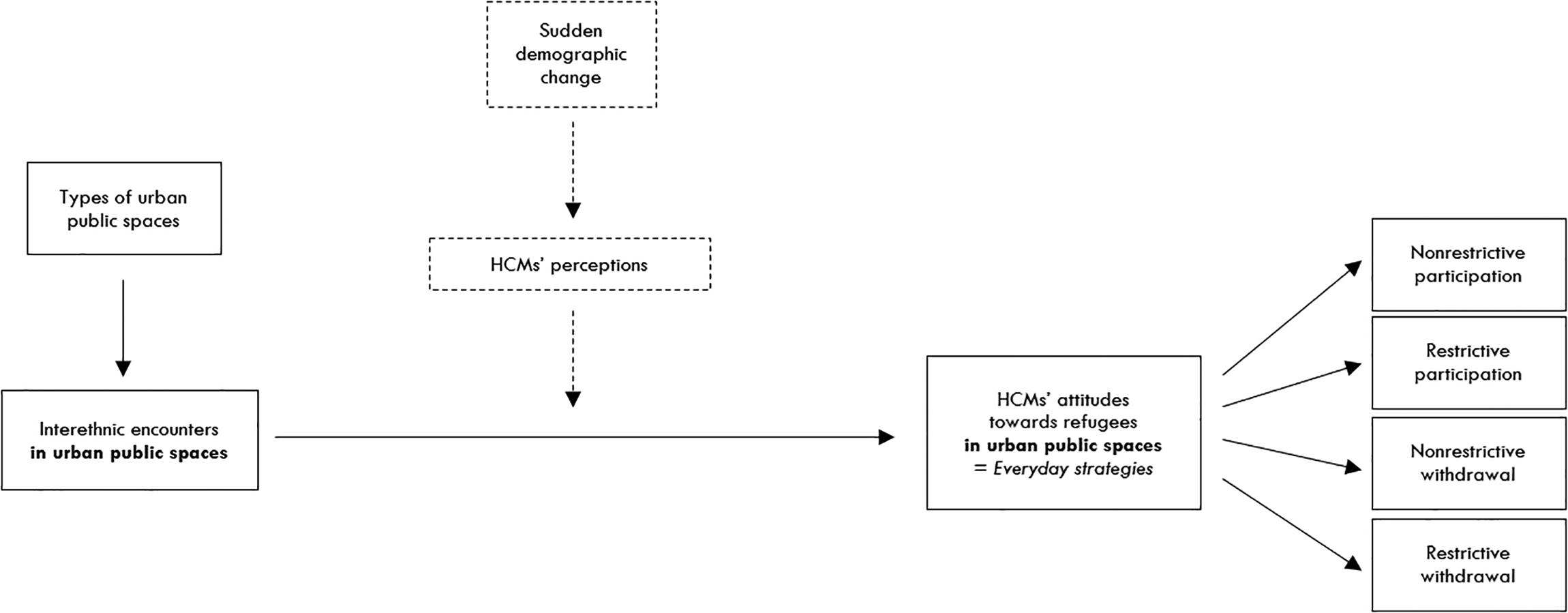
Theoretical framework.
Everyday strategies manifest themselves according to four patterns. The first is nonrestrictive participation, which occurs in all types of urban public spaces when HCMs adopt a positive, negative, or neutral attitude toward refugees. The second pattern, restrictive participation, occurs in need-based urban public spaces when HCMs develop negative attitudes toward refugees. The last two patterns are characteristic of leisure-based urban public spaces: nonrestrictive withdrawal, when HCMs’ attitudes toward refugees tend to be positive, neutral, or negative, and restrictive withdrawal, when HCMs develop negative attitudes toward refugees. Because everyday strategies are based on attitudes that may change according to the space individual HCM is in, the same individual can adopt different strategies in different spaces.
In developing these ideas, I make two major contributions to migration studies. First, by expanding the study of intergroup encounters to microlevel outcomes and by offering a space-related analysis, I provide key insights into the implications of HCMs’ daily attitudes at the microlevel that can help explain why some HCMs develop positive attitudes toward refugees while others do not. My second contribution is my focus on a non-Western, predominantly Muslim country (Turkey), where HCMs and refugees generally share the same religion (Islam) but not the same language (HCMs mostly speak Turkish, while Syrian refugees typically speak Arabic). Thus, this article expands the growing literature on intergroup encounters between HCMs and refugees in the Global South by detailing a case of South-South forced migration (Bochmann 2018; Fajth et al. 2019; Alrababah et al. 2020; Hartman and Morse 2020; Rosenzweig and Zhou 2021).
The article is organized as follows. The next section reviews the literature on intergroup encounters and urban public spaces within migration studies, before outlining the article's theoretical framework. The third section describes the research design and study context and, then, discusses its methodology, composed of 60 semistructured interviews with HCMs in Çarşamba, Turkey. The fourth section introduces everyday strategies and presents empirical evidence. The fifth section concludes and discusses potential areas for future research.
Theoretical Framework: Intergroup Encounters and Urban Public Spaces
Intergroup Encounters in Migration Studies
Conceptualizations of intergroup encounters between HCMs and outgroup members derive from two theories—intergroup contact theory and group threat theory—which offer distinct interpretations of the impact of such encounters (e.g., Allport 1954; Dinesen and Sonderskov 2015; Laurence and Bentley 2018). Intergroup contact theory understands the impact of interactions between ingroup and outgroup members in terms of reducing prejudice in ingroup members’ perceptions of outgroup members (Allport 1954; Amir 1969; Pettigrew 1998). As Pettigrew and Tropp's (2006, 2008) meta-analyses demonstrate, positive contact diminishes prejudice by increasing information about and empathy toward outgroup members. However, not all contact is positive, and some studies on intergroup encounters have also emphasized that negative contact does not reduce prejudice (Laurence and Bentley 2018; Laurence et al. 2018). Amir (1969), for example, divided the conditions of contact into favorable and unfavorable categories, with the latter having the potential to exacerbate intergroup tensions. Similarly, Barlow et al. (2012, 1631–1637) showed that negative contact—for example, “being pestered by a foreigner”—could overcome positive contact outcomes, depending on the content and frequency of such interactions.
In this article, I include a third type of encounter associated with group threat theory—mere exposure. Defined as encounters without interaction, mere exposure encapsulates solely being in the same vicinity as different group members and indicates that, despite the possibility of increased contact, not everyone chooses to or does engage with others (Laurence 2014; Dinesen and Sonderskov 2015). In other words, although exposure to outgroup members has the potential to increase contact, according to Laurence (2014, 1331), mere exposure cannot be expected to result in contact, since outgroup and ingroup members might choose to solely experience “coexistence without mixing” or “casually being around.”
Thus, mere exposure offers a framework to analyze HCMs’ threat perceptions, based on group threat theory, which derives from prejudices of ingroup members toward outgroup members by solely being around outgroup members (Blumer 1958; Blalock 1967; Bobo and Hutchings 1996; Stephan et al. 2000). Building on Blalock (1967), Adida et al. (2016, 123) describe group threat theory as a prediction to understand ingroup members’ attitudes toward outgroup members when an increase in the outgroup members’ relative size occurs. As this description indicates, while contact involves some type of interaction resulting from engaging with the other, group threat theory takes into account exposure (without necessarily involving contact) to an outgroup member and argues that perceptions of threat, which could derive from exposure, are sufficient to develop negative attitudes toward outgroup members.
The two overarching threat perceptions within group threat theory are realistic threat and symbolic threat (Riek et al. 2006). A realistic threat encapsulates the concerns of ingroup members who find themselves in a situation where they must compete directly for resources following an increase in the number of outgroup members (Quillan 1995; Hjerm 2009; Lancee and Pardos-Prado 2013). A symbolic threat, by contrast, manifests itself as anxiety caused by value- and norm-based differences between ingroup and outgroup members and generates uneasiness in ingroup members toward outgroup members (Petermann 2014; Gorinas and Pytlikova 2017; Hangartner et al. 2018; Van Heerden and Ruedin 2019). For instance, focusing on Syrian refugees, Hangartner et al. (2018) measured the impact of Greek nationals’ casual observations of refugees on Greek islands, showing that increased exposure to Syrians led to increasing symbolic threat perceptions and, consequently, more restrictive asylum policy preferences. Hainmuller and Hopkins (2014) compared the two threats and concluded that symbolic threat perceptions override realistic threat perceptions.
One prominent finding of scholars examining attitudes toward outgroups is that intergroup encounters naturally occur in contexts characterized by an increase in the outgroup size (McLaren 2003; Semyonov et al. 2004; Schneider 2008; Pettigrew et al. 2010; Schlueter and Scheepers 2010; Van Assche et al. 2014; Von Hermanni and Neumann 2019), defined in either objective or subjective term. The former (objective) refers to the actual number of outgroup members within a given area, while the latter (subjective) looks at ingroup members’ perceptions and ideas about how many outgroup members are within a given area (Semyonov et al. 2004; Schlueter and Scheepers 2010). These findings echo studies suggesting that differences in intergroup encounters are influenced not only by the type of encounter, as discussed above, but also by the context where the encounter occurs (Semyonov et al. 2004; Hopkins 2010; Schlueter and Scheepers 2010; Pottie-Sherman and Wilkes 2015). Together, the studies mentioned here found that a subjective increase in outgroup size was sufficient to influence HCMs’ attitudes toward immigrant and refugee outgroups but the development of these attitudes was also dependent on the contextual elements that made contact and threat salient (Pettigrew et al. 2010). Although both group conflict and group threat theories have shown the role of encounter types on group relations, they fall short of demonstrating the role of the location where these encounters occur and whether different spaces of intergroup encounters might influence the outcomes of ingroup members’ attitudes toward the outgroup.
Urban Public Spaces in Migration Studies
Scholars following a spatial approach to migration studies have examined the influence of different types of spaces, such as public spaces and workplaces, on intergroup encounters (Valentine 2008; Cook et al. 2011; Vertovec 2011; Piekut and Valentine 2017). Similarly, this article examines intergroup encounters from a spatial perspective, focusing on urban public spaces as key areas of physical encounters between newcomers and HCMs and analyzing the immediate outcomes of these encounters (Valentine 2008). Since each individual or group will experience urban public spaces differently (Purcell 2002; Mitchell 2003; Brenner et al. 2012; Schmid 2012; Mehta 2014), such experiences entail negotiation, contestation, or conflict over the use of public spaces (Purcell 2002; Mitchell 2003; Brenner et al. 2012; Mehta 2014; Alanya et al. 2015). The use value of urban public spaces corresponds to the appropriation of space by individuals’ or groups’ actions (Carr et al. 1992), which mostly leads to the territorialization of urban public spaces by particular groups (Amin 2002, 965). Therefore, in addition to the type of intergroup encounters (e.g., contestations and negotiations), the location of these encounters in urban public spaces serves as a fundamental factor in understanding HCMs’ attitudes toward refugees at the microlevel.
In this endeavor to insert urban public spaces into the analysis of intergroup encounters, I investigate where intergroup encounters occur through the politicized places hypothesis developed by Hopkins (2010). Directly highlighting the role of space on intergroup encounters, this hypothesis suggests that the local context is crucial when a sudden demographic change occurs, as this change influences the attitudes of individuals in that area, who “will find it easier to draw conclusions from their experiences [about the incoming group]” (Hopkins 2010, 43). Therefore, the immediate context in which intergroup encounters unfold must be factored into the analysis of everyday life if we want to understand ingroup members’ local perceptions of and encounters with the outgroup.
A sudden demographic shift can reveal itself through visible indicators, including racial, religious, and ethnic elements, during intergroup encounters (Wright and Citrin 2011). Thus, within a politicized context, I have based my analysis of intergroup encounters on the concept of group membership, defined as “objective inclusion in a group [that] does not necessitate an internalized sense of membership” in which “group members need to share common interests or at least perceive that they do” (Huddy 2013, 738, 750). I am not downplaying the importance of identifying differences between individuals or groups in terms of class, religion, ethnicity, or other factors (see Hellwig and Sinno 2017; Konitzer et al. 2019). In this case, however, I situate my analysis within the assumption that identities are embedded in social contexts (Howarth et al. 2013), which are ingroup membership (HCMs) and outgroup (refugees) membership.
To expand this hypothesis and offer a theoretical contribution to the literature on HCMs’ attitudes toward refugees, I argue that intergroup encounters in different urban public spaces in neighborhoods influence the everyday lives of HCMs and refugees and represent microlevel outcomes. Because the local effect of demographic change is observable in many urban public spaces of neighborhoods (Huckfeldt 1986) and because “encounters are produced differently in different spaces” (Piekut and Valentine 2017, 176), different urban public spaces have the potential to host different encounters. However, how different urban public spaces influence encounters between HCMs and refugees has not been addressed in existing research and is, thus, this article's major focus and contribution to migration studies.
Research Design
Case Selection and Context
In this study, I focused on Syrians in Turkey. Following the civil war in 2011, many Syrians left their home country and moved to other locations, particularly neighboring states (UNHCR 2020). Within a short time, Turkey had taken in the largest number of Syrian refugees in the world (UNHCR 2020). Although Turkey is a signatory to the 1951 Geneva Convention, its adoption of geographical limitations to the definition of “refugee” means that the Turkish government does not recognize people from outside Europe as refugees (Directorate General of Migration Management [DGMM] 2021). However, in 2014, in response to the growing number of Syrians in the country, Turkey's government introduced a special status for Syrians, known as “Temporary Protection,” which allowed Syrians access to healthcare services, education, and basic facilities but did not include legislation to allow refugee settlement (DGMM 2021). Since that time, 90 percent of Syrians living in Turkey have settled in urban areas, leading to demographic changes both between and within provinces (DGMM 2021).
Among all nonborder provinces in Turkey, Bursa hosts the second highest number of registered Syrian refugees, after Istanbul (DGMM 2021). Located in northwestern Turkey (Figure 2), Bursa is also Turkey's fourth largest province, with a population of 2,936,803 (Turkish Statistical Institute [TUIK] 2018). As well as being a major province, Bursa is Turkey's industrial center for the automotive, textile, furniture, and canned food industries, which have been pull factors for migrants from inside and outside Turkey (Kaya et al. 2020). Thus, Bursa has been home to numerous waves of migrants throughout Turkish history, mainly from eastern and southeastern Turkey (Kurds) and the Balkans (Muslims and ethnic Turks from Greece, Bosnia, and Bulgaria) (Council of Europe 2018).
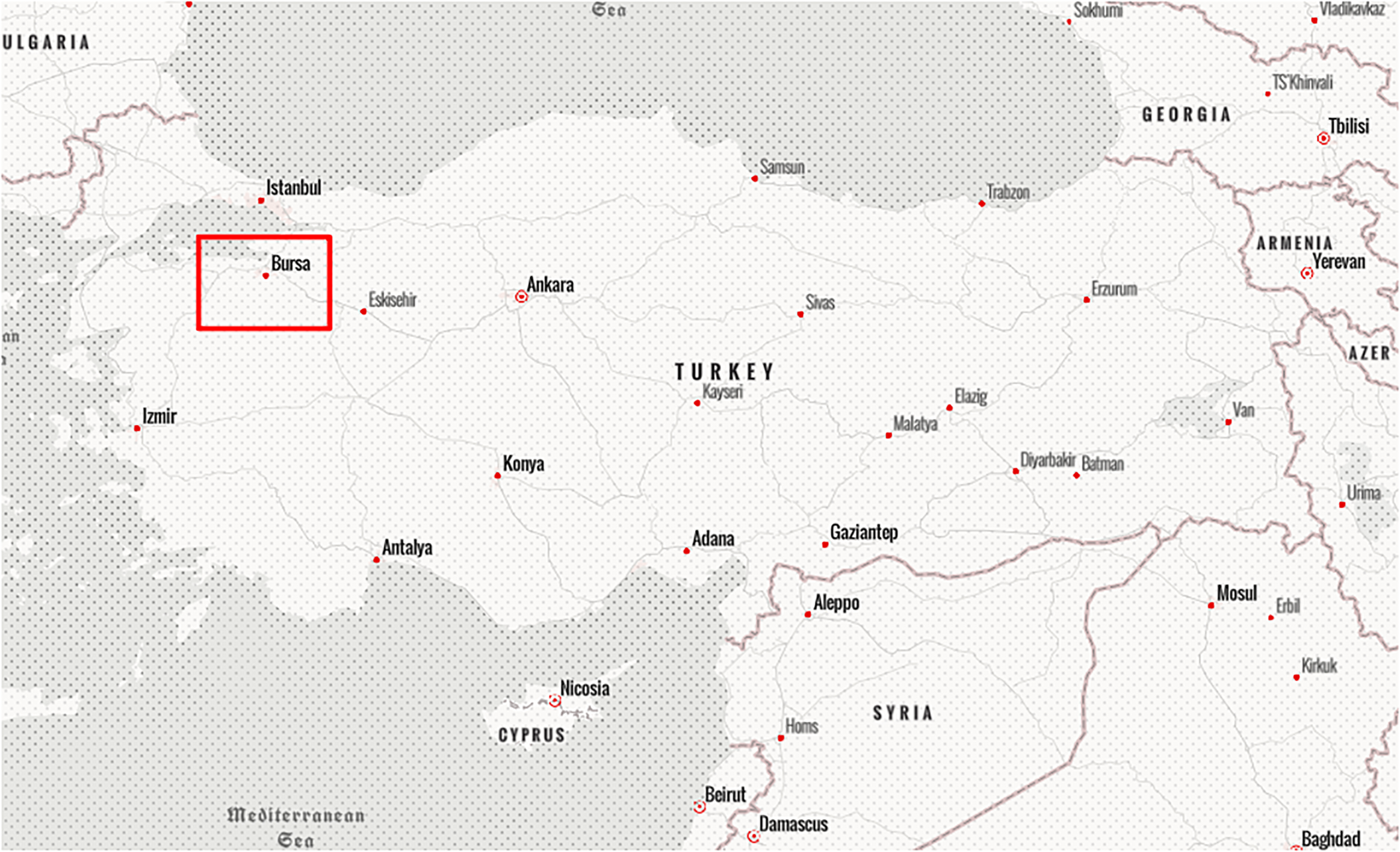
Bursa in Turkey.
Located in the center of Bursa, Çarşamba is a rectangular area (Figure 3) comprising eight neighborhoods that function informally as one big neighborhood. Walking from northern to southern and from eastern to western Çarşamba takes 20 min. Additionally, Çarşamba's center is 20 minutes by foot from Bursa's center (lower dot in Figure 3). At the time of the research, approximately 24,000 HCMs resided in Çarşamba (TUIK 2018), an area that has experienced waves of demographic change in recent decades. For example, in the 1990s, sex workers arrived from different parts of the province, and after sex workers left the area in the late 1990s, Roma people came in as tenants during the 2000s and left in the late 2000s (N2 1 ). Not long before the Syrian influx, Çarşamba was left with empty apartments and shops (N22, N29). Thus, for Syrian refugees arriving in Bursa, Çarşamba was an attractive area because of its proximity to the city center and available housing (N35), transforming Çarşamba into a hub for Syrians.
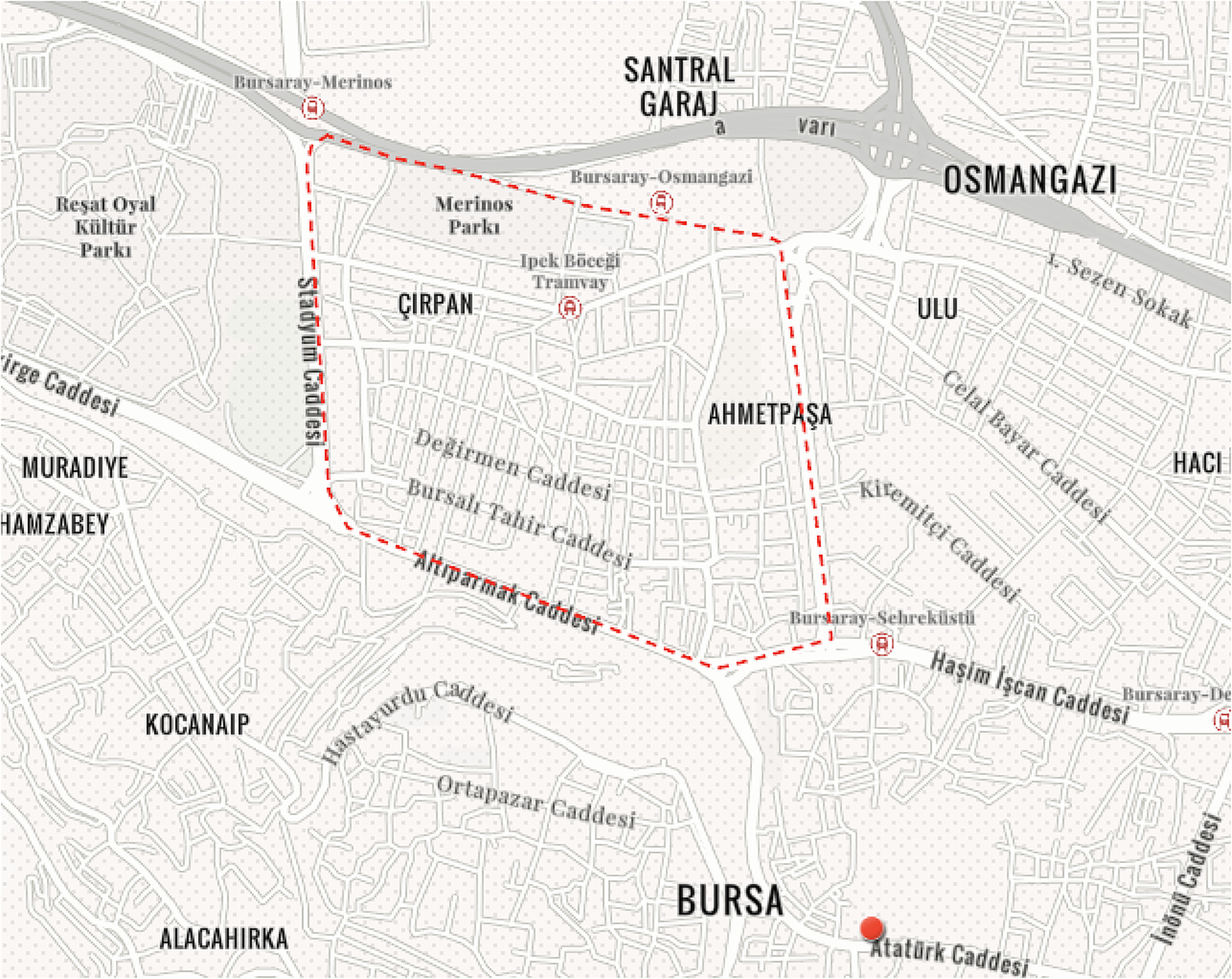
Carsamba in Bursa.
I selected Çarşamba as my study site because it suited “an intensive study of a single unit to understand a larger class of (similar) units” (Gerring 2004, 342) and allowed me to “examine one or more cases for the purpose of developing more general theoretical propositions” (Levy 2008, 5). This type of case study reveals explanatory or contextual variables that contribute to extending an existing theory (George and Bennett 2005, 83). Furthermore, intending to generalize my findings according to mid-level theory (Yin 2003, 37–41), I focused on Çarşamba to make a conceptual contribution that could be applied to similar cases in other regions that have experienced sudden demographic change.
Data Collection and Methodology
This article's principal data came from 60 semistructured interviews conducted with 27 female and 33 male HCMs living and working in Çarşamba in October and November 2018. Thirty respondents were primary or middle-school graduates, while 21 were high-school graduates and nine were university graduates. In addition, the sample included 25 individuals between the ages of 25 and 44, 28 individuals between the ages of 45 and 65, and seven people over the age of 65. Notably, my aim was to investigate diverse opinions and perceptions of the topic under study, rather than to reach a certain interview count (O’Reilly and Parker 2012).
I conducted all interviews in Turkish and translated the interview material into English. Having grown up in Bursa, I am familiar with its context, culture, and language, which facilitated access to a variety of HCMs in the area, as well as rapid rapport-building. I adopted snowball sampling through three different channels to obtain the maximum possible diversity among interviewees. Although many interviewees perceived me as an “insider,” due to our shared traits, my education at a foreign institution also led them to categorize me as an “outsider” (Carling et al. 2014; Fedyuk and Zentai 2018; Irgil 2021). Thus, my position as both insider and outsider simultaneously reinforced my rapport with interviewees, while causing them to perceive me with a level of skepticism, both of which, I presume, influenced the data collection process.
In light of Turkey's political situation and to reduce the adverse effects of skepticism, I chose to take handwritten notes, instead of recording interviews, to increase the likelihood that potential interviewees would agree to talk to me. Each interview lasted approximately one hour. After each interview, I typed the notes on my laptop and later coded all interviews in ATLAS.ti. For the same purpose, I received verbal consent from everyone I interviewed after I showed them how I would identify them with a code to protect their anonymity (e.g., N15-22102018-M-48-S-CIR). Both strategies proved beneficial throughout fieldwork and increased interviewees’ willingness to be interviewed.
In interviews, I asked participants about their basic demographic information, their socioeconomic status compared to other people in the neighborhood, and their individual or family migration history (both within and beyond Turkey). After gathering this information, I asked 28 questions about changes in the neighborhood, HCMs’ engagement with Syrians, the neighborhood's history during different periods, everyday activities that took place in the area, and the people the HCMs typically encountered. As this segment of each interview began, I asked whether interviewees knew any Syrians and followed up with questions about the content and frequency of their encounters with Syrians. I also elicited interviewees’ opinions about Syrians’ activities within Çarşamba and asked them to compare the Syrian refugee migration with previous migration waves into Bursa.
During fieldwork in Fall 2018, I was in Çarşamba six days per week, observing the streets, parks, mosques, and bazaars and taking pictures and fieldnotes, in addition to collecting news articles concerning Syrians from local newspapers and columnists to complement my analysis. I also conducted preliminary field trips to the area in January and June 2018 and a follow-up trip in March 2019. In addition, I completed eight elite interviews with Bursa's ex-mayor (in power between 2009 and 2016), the district mayor of Osmangazi (in power since 2009), the directors of local nongovernmental organizations in Bursa, and experts in migration and asylum in Turkey to gain detailed information about Çarşamba, Bursa, and Syrian refugees. These elite or expert interviews are often used as a complementary field method in political contexts that can lead to difficulties in retrieving information (Beamer 2002).
Everyday Strategies and Its Patterns
Everyday strategies manifest themselves in four patterns in Çarşamba: (1) nonrestrictive participation, (2) restrictive participation, (3) nonrestrictive withdrawal, and (4) restrictive withdrawal. Below, I describe these patterns in detail, supporting each pattern with empirical evidence.
Sudden Demographic Change in Çarşamba's Urban Public Spaces
As I argue that HCMs’ attitudes toward refugees are influenced by the social dynamics of everyday life within the social context of forced migration, it is crucial to analyze the influence of sudden demographic change when examining HCMs’ everyday strategies. Of course, other differences between groups, such as ethnicity, may well have had some impact on HCMs’ attitudes toward refugees. Hence, to better dissect HCMs’ different perceptions about Syrians, I asked about their thoughts on the influence of Syrians’ arrival on Çarşamba, both positive and negative, and whether there were any differences between previous demographic changes in Çarşamba and Syrians’ arrival.
According to interviewees, Syrians’ increasing presence in Çarşamba had both positive and negative consequences for HCMs. Multiple interviewees stated that before Syrians’ arrival, many shops and apartments in Çarşamba were empty (e.g., N1, N4, N5, N9, N13, N14). Therefore, Syrians economically revitalized the once-empty area by setting up new businesses (Ozdal 2017). Some HCMs mentioned that previous demographic changes, such as the arrival of sex workers and Roma people, had already started to change Çarşamba and that Syrians merely represented an extension of these earlier changes. For example, N22 described different demographic changes in the neighborhood, saying, Until the 1990s, the elite dwelled in this district. Then, the elite moved to the western parts of the city. After the 1990s, the district received a lot of migration. The ones who left their apartments rented their apartments out. At one point, people from Eastern Turkey came. At another point, prostitutes and transvestites came to the neighborhood, which started in 1998. Africans came; then, once the neighborhood of Roma people was demolished, they [Roma people] came. Now, we are under the invasion of Syrians.
Meanwhile, N19 discussed the impact of various waves of demographic changes on the neighborhood, observing, Ten years ago, before Syrians, there were prostitutes [sic]. We were not able to go outside. Now, it is better. Now, once the Syrians came, they [prostitutes] left. After the arrival of the Syrians, the neighborhood has gotten better. At least we can go outside at night.
N58, who originally came from Bulgaria (among Bulgarian-Turks), shared an immigrant's perception of the different demographic changes, stating, I am also a migrant from Bulgaria myself, I mean, my family. There has been discrimination against them [migrants from Bulgaria] too; they [Turks] did not want them, either. They [Turks] did not want the ones from Eastern Turkey, either. Now, they [Turks] are doing the same to them [Syrians].
At the same time, when asked whether the Syrian arrival was different from previous migrant waves, some HCMs categorized the refugees’ arrival as different “because they [were] Arabs” (N2, N39, N41, N46). When I asked how specifically Syrians’ arrival was different, some interviewees clarified that Bulgarian-Turks were “consanguineous” (N32, N54) or “cognates” (N9) and that Kurds from southeastern Turkey were “from within our borders” (N40, N58). These statements demonstrate a perceived difference between Syrians and previous demographic changes.
In light of these comparisons, I asked interviewees to describe the major difference between previous demographic changes and Syrians’ arrival in Çarşamba. The answer was almost unanimous: “sudden” and “immense” demographic change (N3, N7, N32, N14, N36, N38), which HCMs described as “feeling like [we] are a minority now” (N16, N31), and that arrival of Syrians “feels like an invasion” (N34) or “appropriation [by Syrians]” (N37). As these examples show, outgroup members—in this case, Syrians—brought something, explicitly or implicitly, to their interactions with ingroup members which influenced the latter's attitudes (Huddy 2013) and became salient in an ingroup–outgroup context. Although sudden demographic change influenced all spatial strategies, its influence differed according to the type of urban public space where an encounter between HCMs and Syrians occurred, as I demonstrate in the next section.
The Patterns of Everyday Strategies
Nonrestrictive Participation
Nonrestrictive participation, which occurred in all types of urban public spaces, encompassed the positive, negative, and neutral attitudes that emerged in discussions with HCMs interviewed. In this pattern, HCMs continued to use both leisure- and need-based urban public spaces as they had previously. Hence, drawing parallels with Purcell (2002), I argue that HCMs mobilizing this strategy viewed refugees’ use of urban public spaces as an extension of their presence in the area and, thus, acceptable. For instance, N20 noted that Syrians “have to live,” and N25 stated that “they [Syrians] are in a difficult situation in which they are trying to adapt.” In contrast to N20, who had been solely exposed to Syrians in Çarşamba's urban public spaces, N25 had five Syrian employees with whom she had regular encounters. In a similar vein, a housewife who stated that she liked Syrians said, “If the parks belong to the municipality, they [Syrians] have the right to come” (N58). Moreover, N4, who not only had Syrian store-owner acquaintances but also noted that the neighborhood's sudden demographic change made him feel as if he was “living in the Middle East,” also talked about Syrians’ use of urban public spaces as their “most natural right… should they stay at home? If he lives in this neighborhood, he will benefit from this neighborhood's social spaces.” Each of these statements corresponds to neutral, positive, or negative attitudes toward Syrians but suggests a similar pattern of acknowledging Syrians’ use of urban public spaces.
Therefore, among all everyday strategies described in this article, HCMs who engaged in nonrestrictive participation tended to demonstrate an understanding and tolerance of refugees’ use of urban public spaces, regardless of their attitude concerning refugees themselves. As this finding indicates, ingroup members perceived outgroup members’ urban public space use as a continuance of the latter's presence in these public spaces. This perception led ingroup members to accept outgroup members’ use of urban public spaces, regardless of ingroup members’ attitudes toward outgroup members.
Restrictive Participation
Restrictive participation occurred in need-based urban public spaces (e.g., mosques or bazaars) and led some HCMs to develop a negative perception of refugees. Within this pattern, HCMs acknowledged Syrians’ use of these spaces and continued to use certain urban public spaces simultaneously with Syrians. However, in contrast with the previous pattern, HCMs mobilizing this strategy categorized need-based urban public spaces as areas where they could not avoid Syrians; thus, to these HCMs, these locations represented negative contact under unfavorable conditions and increased intergroup tensions (Amir 1969).
My fieldwork shows that HCMs might have concealed their discontent concerning Syrians in their acknowledgment that Syrians also needed to use these spaces, deepening the already-existing potential for societal conflicts. For instance, N18 described her time at the bazaar as a struggle, saying, The bazaar is very crowded. The vegetable seller [native Turkish speaker] cannot express himself properly [in another language]; she [the Syrian] also does not understand the vegetable seller. I am waiting for her to communicate; then I am late for work. If I need to do something urgently, I have to wait at the market, at the bazaar. I go to the market; I have to wait in line behind Syrians; it makes me lose my nerve.
In this case, HCMs who were not happy about sharing need-based urban public spaces showed their discontent in expressing “frustration” (N35), “limitation” (N39, N44, N47), and “discomfort” (N43) with the negative contact they experienced with Syrian refugees. For instance, talking about her unfavorable encounters with Syrians in bazaars, N28 said, “When Syrians are among us…, it just does not work that way. I cannot walk properly. I cannot hang around freely. I am getting stressed before going to the bazaar.”
Moreover, many HCMs considered mosques to be “open to everyone” (N2, N13, N16, N22, N25, N26, N45, and N53). Nonetheless, and despite sharing the same religion with refugees, HCMs’ worship practices differed from those of Syrians, leading to conflicts. As N22 explained, For instance, you enter the mosque, which [is] a place to worship, [and] one of them [Syrians] washes his feet and walks in[to] the mosque with wet feet. You should wear your socks after washing your feet and then enter. Everything has its own customs and manners. If they were abiding by the rules…, but they do not. There is a difference in worshipping manners.
Some HCMs thought that wearing socks represented the proper way to enter a mosque (N12, N22, and N24) and were disturbed at the sight of barefooted Syrians walking into mosques. Following local HCMs’ demands, area mosques posted signs in Arabic that said, “Please do not enter the mosque barefoot or with wet feet” (Fieldnote). Verbal altercations often ensued when HCMs noticed barefoot Syrians in their mosques. N12 recounted one such instance, remembering, “Just yesterday evening, there had been a fight over entering [the mosque] barefoot.”
These examples link the type of urban public space and HCMs’ perceptions of Syrians accessing these spaces. A common theme in interviews revealed that when HCMs felt unable to limit Syrians’ use of need-based urban public space and when both parties had to use this space simultaneously, HCMs’ resentment toward refugees had the potential to exacerbate existing intergroup tensions. This finding aligns with the outcomes of negative contact suggested by intergroup contact theory (e.g., Laurence and Bentley 2018; Laurence et al. 2018).
Nevertheless, and marking another contribution of the article, these findings about an ingroup and outgroup that share religion but not language expand the literature on intergroup encounters to a South-South forced migration context. As mentioned earlier in this article, these examples support group membership as an identity that can act as an overarching tie binding HCMs as ingroup members, leading HCMs’ to develop negative attitudes toward refugees, as outgroup members, despite commonalities, such as sharing the religion of Islam. For instance, when talking about mosques, HCMs focused on differences in each group's religious practices, such as how they enter the mosque, rather than on the fact that both HCMs and refugees were in the mosque to pray. Therefore, examining the space-related attribute of intergroup encounters provides further insights into how similarities and differences between ingroup and outgroup members shape the ways that ingroup member attitudes are influenced by encounters in urban public spaces.
Nonrestrictive Withdrawal
Nonrestrictive withdrawal occurred in leisure-based urban public spaces and involved HCMs who developed positive, neutral, or negative attitudes when merely exposed to Syrians. Such public spaces included streets, parks, and playgrounds and corresponded to free-time activities. Hence, HCMs could avoid Syrians in these locations if they chose to do so. In this case, HCMs were merely exposed to refugees but avoided direct contact or interaction, focusing on their perceptions of threat, as stated by group threat theory (e.g., Blalock 1967; Dinesen and Sonderskov 2015).
In the case of Çarşamba, HCMs’ statements indicated an overarching symbolic threat associated with sudden demographic change. For instance, N35 described observations that led to avoidance: When we went to the park during the summer, everywhere [was] filled with Syrians. We returned home without seeing or hearing anyone who speaks Turkish. Now, I do my social activities by going to the other areas of the city.
Along the same lines, a young mother of two (N1) reflected on how her use of parks had changed since the Syrian influx: I used to go to the park on the weekends. Now, they [Syrians] are all over the place. There are more Syrians than Turks. I didn’t go to the park over the summer. I used to go before. Now I’m trying to go at times when they [Syrians] are not there.
This pattern demonstrates similarities with what Putnam (2007, 151) described as “hunkering down,” referring to HCMs who withdrew to “huddle unhappily in front of a television.” As a further example, a real-estate consultant (N21) living and working in Çarşamba complained, “We cannot say, ‘You cannot go [there]’ to anyone.” Therefore, although HCMs did not openly oppose or verbally condemn Syrians’ use of leisure-based urban public spaces, they claimed that “neighborhood locals do not go outside because Syrians are everywhere—locals do not want to run into them” (N25). I detailed this strategy, despite its parallels with “hunkering down,” to demonstrate that limiting the categorization of withdrawal and its related attitudes to “hunkering down” is not sufficient to explain the variation in HCMs’ attitudes about refugees, as there is withdrawal and not objecting to outgroup members’ use of urban public spaces, which is nonrestrictive withdrawal. Yet there is also withdrawal and objecting to outgroup members’ use of urban public spaces, which is the strategy I analyze in the next section.
Restrictive Withdrawal
Restrictive withdrawal applied to HCMs who discontinued or changed their habits in leisure-based urban public spaces to avoid Syrians. In contrast to nonrestrictive withdrawal, HCMs adopting restrictive withdrawal would have preferred that Syrians did not use these urban public spaces because of their perception that they could not use these spaces if Syrians were there. This pattern occurred when HCMs developed negative attitudes toward refugees. As an example, N9 expressed his frustration with Syrians going to parks in a way that revealed his opposition to their presence in these public spaces: Syrians come to the park and are just spreading all over the place. They are more comfortable [in the park] than the locals as if they are here for a trip and we are the refugees. They are limiting my living space.
These HCMs described their grudging choice to avoid exposure to Syrians by not going to certain urban public spaces and stated their discomfort with the high numbers of Syrians present. Nevertheless, interviewees’ avoidance of exposure did not stop them from feeling threatened by Syrians’ use of these urban public spaces, which they explicitly did not want Syrians to use. For example, N43 said, “Their [Syrians’] appropriation did not happen in a good way; they appropriated while discriminating against us.” Similarly, N8 claimed, “Their [Syrians’] kids are playing where your kid would play… as if the country belongs to them and as if we are the refugees.” Thus, the increased outgroup presence negatively influenced these interviewees’ attitudes, even though HCMs acknowledged that refugees were allowed to use these spaces, parallel to the findings in the literature on intergroup encounters (Semyonov et al. 2004; Schneider 2008; Van Assche et al. 2014; Von Hermanni and Neumann 2019).
Yet, this article differs from abovementioned studies by involving both HCMs’ perceptions of refugees and HCMs’ claims about Syrians’ use of these leisure-based urban public spaces. My evidence shows that HCMs who exhibited restrictive withdrawal expressed “hunkering down” as they did not want to use the urban public spaces, which is similar to HCMs with nonrestrictive withdrawal strategies. Yet, HCMs’ that fall under restrictive withdrawal strategy also stated that they did not want Syrians to use these urban public spaces either, which goes beyond what has been detailed in nonrestrictive withdrawal and demonstrates a difference between the two strategies. In other words, while these HCMs (under restrictive withdrawal strategy) preferred to “hunker down” and avoid these spaces, they also begrudged Syrians’ use of these same spaces, wanting refugees to “huddle unhappily in front of a television” like them, thus exhibiting a qualitatively different form of withdrawal adopted by HCMs (under nonrestrictive withdrawal strategy). For instance, in the previous strategy of nonrestrictive withdrawal, HCMs did not prefer to use the urban public spaces when refugees were using them and stated that they did not have a say in whether refugees could use urban public spaces. Yet, within restrictive withdrawal, HCMs clearly stated their objection to refugees’ use of urban public space, which they perceived as a restriction on their own use of these spaces. Hence, these findings that differentiate between withdrawal patterns demonstrate the importance of analyzing ingroup member attitudes toward outgroup members not only solely by looking at the outcome (withdrawal) but also by taking a step further to understand whether there are different motivations behind the act of withdrawal. In this case, the different motivations behind HCMs’ withdrawal that influence HCMs’ preferences concerning Syrians’ use of urban public spaces have the potential to indicate HCMs’ different levels of acceptance toward refugees and might lead to different microlevel outcomes of HCMs’ attitudes, as shown in the difference between restrictive withdrawal and nonrestrictive withdrawal strategy.
Conclusion
This article has examined how different urban public spaces—and the types of encounters that take place within them—shape HCMs’ everyday strategies in Çarşamba, Bursa, Turkey. I introduced and defined the concept of everyday strategies as the sociospatial attitudes that HCMs developed in their relations with outgroup members in different types of urban public spaces. More specifically, this article analyzed how a sudden demographic change affected the types of interactions HCMs experienced with refugees in different types of urban public spaces. As the analysis revealed, in addition to the type of encounters that occurred between ingroup and outgroup members, where these encounters occurred is equally important to understanding HCMs’ attitudes toward refugees. This revelation enabled me to reach two significant findings.
First, unlike the literature on geographies of encounters that treat all urban public spaces as homogenous and interchangeable (e.g., Carr et al. 1992; Valentine 2008; Piekut and Valentine 2017), I identified how urban public spaces are divided into different types, according to their use values. This differentiation of urban public spaces indicates that the type of spaces where encounters take place help shape HCMs’ attitudes toward refugees. Specifically, HCMs’ perceptions of refugees’ use of need-based urban public spaces indicated more potential for negative contact than mere exposure. Thus, attention to HCMs’ perceptions of refugees’ use of different types of urban public spaces adds another layer to the literature on intergroup encounters and highlights the role of context when analyzing encounters (Valentine 2008; Pettigrew et al. 2010; Piekut and Valentine 2017). From a policy perspective, authorities should consider the spatial aspect of intergroup encounters when developing policies related to the impacts of sudden demographic change on HCMs’ everyday lives in the context of refugee arrivals.
Second, detailing microlevel outcomes from a sociospatial perspective when analyzing HCMs’ attitudes toward refugees can shed new light on and nuance previous findings that focus on attitudes with macrolevel outcomes (Rustenbach 2010; Enos 2014; Dinesen and Sonderskov 2015; Bansak et al. 2017; Gorinas and Pytlikova 2017; Hangartner et al. 2018). This nuancing of HCMs’ attitudes is significant, as it is likely to reveal opportunities for more positive encounters between HCMs and refugees and to identify in which contexts these positive encounters between these two groups are more likely to occur, rather than categorizing HCMs’ attitudes under one withdrawal pattern, as previous studies have done. Hence, as I show that there are different withdrawal patterns associated with different attitudes, this second finding can serve as the basis for future studies and policymaking in contexts characterized by sudden demographic change and highlight the role of contextual elements in developing policies to support positive intergroup encounters. For example, in addition to asking HCMs about their attitudes toward refugees during intergroup encounters, questions related to where and in which type of urban public spaces encounters occurred should be asked to enable migration scholars to trace differences in attitudes based on both the where and what type of encounters. Tracing these differences can also enable policymakers to address the potential cooperation and conflict spaces that can assist their efforts to facilitate productive everyday intergroup encounters.
On a general level, the question of whether a causal link exists between an influx of outgroup members and the adoption of the everyday strategies presented in this article requires further research. In addition, the concept of everyday strategies must be tested on a larger scale through surveys or comparative qualitative case studies to determine whether these patterns apply to other contexts and have similar or diverse outcomes. Moreover, while this article demonstrates the nuances between HCMs’ different everyday strategies, it does not explain why certain individuals adopted certain patterns and others did not. Thus, this question also awaits an answer.
For migration scholars, the spatial strategies described in this article underscore the need to broaden understanding of encounters between HCMs and refugees, particularly in urban public spaces and in the Global South (e.g., Adida et al. 2016; Statham 2016; Gorinas and Pytlikova 2017; Van Heerden and Ruedin 2019). By analyzing an example of South-South forced migration in which HCMs and refugees share religion but not language, this article expands the scope of analysis to contexts with similar ingroup–outgroup elements and offers potential explanations as to why some HCMs develop positive attitudes toward refugees while others do not. Understanding the explanations for different attitudes of HCMs’ toward refugees can also be key to addressing current policymaking challenges in neighborhoods with mixed demographic groups by analyzing not only the intergroup interactions but also where those interactions occur.
Footnotes
Acknowledgments
The authors would like to thank Andrea Spehar, Andrej Kokkonen, Benjamin Gonzalez O’Brien, Deniz Inal, Elif Naz Kayran, Goksin Ugur, Loren Collingwood, Nicholas Loubere, Paul O'Shea, Peter Esaiasson, Ricard Zapata-Barrero, Zeynep Balcioglu for their constructive comments at different stages of this article. The authors also want to thank the participants of the PhD Workshop on International Migration and Human Rights at Uppsala University (November 14–15, 2019), the Centre for Advanced Middle Eastern Studies (CMES) Seminar at Lund University (February 4, 2020), and Malmö Institute for Studies of Migration, Diversity and Welfare (MIM) Seminar at Malmö University (February 6, 2020) for their able feedback. Finally, the authors want to thank the editor and three anonymous reviewers for their extremely helpful comments.
Declaration of Conflicting Interests
The author(s) declared no potential conflicts of interest with respect to the research, authorship, and/or publication of this article.
Funding
This work was supported by the Stiftelsen Wilhelm och Martina Lundgrens Vetenskapsfond under Grant [2018-2272].
