




Abstract
Chinese cities are making a name for themselves through what Guthman calls an ‘accumulation by spectacle’. Studies elucidate the fast change of the urban fabric and the interconnection of commercial profits with pro-state propaganda during mega-events. The spectacle appears as a once-in-lifetime chance for a city, orchestrated during a specific time and in purpose-built venues. This article, however, argues that efforts of spectacularisation expand to everyday life. I take the marginalisation of the urban poor in Guangzhou, that is, street vendors and beggars, as a starting point to understand governmental ideals, strategies and patterns of controlling public space. The data is based on fieldwork, government documents, yearbooks and newspapers. Engaging in the discussion on what Debord termed the ‘society of the spectacle’, I explain how urban management concentrates on areas serving (1) tourism and commerce, (2) memorial politics, (3) government relations and (4) transport and traffic; and follows the pulse of (1) annual events and seasonal holidays, (2) recurring political dates, (3) exceptional mega-events and (4) regular urban development campaigns. These zones and periods of increased control intertwine and culminate in an ‘ideal’ public space excluding poverty and other elements contesting the city’s success images.
Introduction
Beijing’s Olympic Games 2022 were a celebration in images, of sport and culture, architecture and innovation – a ‘choreographed display of China’s shifting place in the world’ (Buckley and Myers, 2022: n.p.). Urban scholars examine sports events, Expos and Universiades in China’s biggest municipalities to observe the fast change of urban fabric turning into a ‘triumphalist space’ (Marvin, 2008: 255), the interconnection of commercial profits with pro-state propaganda (Bao et al., 2019; Brady, 2009a; Broudehoux, 2017; Guthman, 2008; Schneider, 2019). With the French philosopher Guy Debord (2002, 2006) they speak of a ‘society of the spectacle’, which combines the incentives of capitalism and authoritarianism. These mega-events appear as a once-in-lifetime chance for a city (Gotham, 2011), being orchestrated during a specific time and in purpose-built venues. This article, however, argues that the efforts of spectacularisation expand into the everyday.
I concentrate on state approaches to public space as a crucial stage of urban image production, taking the city of Guangzhou – an early pioneer in Chinese reform policies, the capital of Guangdong province and host of the Asian Games 2010 – as a case study. Exploring the theme of ‘visibility and concealment’ (Broudehoux, 2017: 87), which is core to spectacularisation, I focus on the example of visible poverty, that is, the governmental exclusion of peddlers and beggars from public space. During the reform process these people were marginalised by the police, the Bureau of Civil Affairs and Chengguan– the ‘Bureau of Integrated City Management’. However, by constantly ‘re-conquering’ the commons this group of people sheds light on how marginalisation is repeated, making state efforts of shaping public space visible to us. In the following, I consider the governance history of the last 40 years and ask how and why state actors in Guangzhou expel street vendors and beggars from public spaces. I will argue that their exclusion policies aim at image creation and will contextualise managing ‘vagrants’ in the wider production of the urban spectacle.
Following Debord, I define spectacularisation as staging urban space to create dominant images and impressions of the city that guide social relations (Debord, 2006: 12). While Debord has been criticised as incoherent in his concepts and ignoring the spectator’s agency (Gotham, 2011: 201; Schneider, 2019: 68), his poetic dystopia inspires and can serve as a Weberian ‘ideal type’– a ‘limiting concept against which reality is measured’ (Weber, 2012: 127, emphasis in original) to highlight the empirical contours.
The article proceeds as follows: After elucidating concepts of the urban spectacle, I explain my approach, methods and data collection. Next, the study traces government policies against visible urban poverty in the discourse of civilising public space and sheds light on the growing importance of Chengguan as an institution for tightening urban management. The study’s main focus is on governance structure: Chengguan patrols proceed according to zones and periods of increased control, that is, areas for (1) tourism and commerce, (2) memorial politics, (3) government relations and (4) transport and traffic, and during (1) annual events and seasonal holidays, (2) recurring political dates, (3) exceptional mega-events and (4) regular urban development campaigns. Finally, I argue that these patterns and rhythms interconnect and culminate in an ‘ideal’ public space excluding poverty and other elements contesting the city’s success story. Moreover, state efforts of spectacularisation – combining political and economic incentives – go beyond the extraordinary and introduce the spectacle into the everyday.
The urban spectacle
In Guy Debord’s ‘society of the spectacle’ (Debord, 2006, 2002, first published in 1988 and 1967 respectively), appearance is key. Images take centre stage as the spectacle ‘is a social relation between people that is mediated by images’ (Debord, 2006: 12). In capitalist modernity, the representation of products would whitewash exploitation and social separation while the contemporary ‘hyper-connectivity’ (Briziarelli and Armano, 2017: 26) through (social) media – mixing ‘authenticity’ with advertisement – creates an even stronger illusion of unity and the spectacle’s naturalness (Briziarelli and Armano, 2017; Debord, 2002; Gardiner, 2000; Wu, 2020).
Spectacularisation translates into space, and scholars – especially those working on post-Fordist cities – apply Debord’s concepts to make sense of entrepreneurial city governance. Fuelling commodification and consumption, culture and art industries, mega-events and ‘sportainment’, cities try to win in a globalised competition for tourists, investments and international standing (Ferreri and Trogal, 2018; Gotham, 2002; Harvey, 1987; Ren, 2017; Zukin, 2010). Between extraordinary architecture and ‘hyperbuilding’ (Ong, 2011), public space is crucial to the city’s attractiveness (Bodnar, 2015). While the ‘aesthetic logic of capital’ (Gerrard and Farrugia, 2015: 2219) manifested in the public/private ‘commons’ may evoke feelings of equality or distinction through consumption, elements contradicting the impression of social peace and commercial success – such as visible poverty – are steered away with the help of hard or ‘soft policies of exclusion’ (Thörn, 2011: 989, see also Bodnar, 2015; Gerrard and Farrugia, 2015; Kennelly and Watt, 2011). Therefore, interpreting Debord in the 21st century means acknowledging the image-centred sanitising processes of public space.
As a Marxist, Debord always assumed governmental support for the capitalist spectacle to a certain extent. Nevertheless, he differentiated degrees of state involvement and pointed to two modes of spectacularisation: During the ‘concentrated spectacle’, authoritarian leaders would stage their ideology in parades and propaganda, conveying their message through focussed violence and silencing opposing voices (Debord, 2002: 8, 2006: 41; e.g. Kielman, 2020; Lee, 2011). In contrast, the ‘diffuse spectacle’ evolves without a centre and yet infiltrates the whole of society by seductive consumption (Debord, 2006: 15; e.g. Wu, 2020). Regarding China, a growing body of literature refers to his ‘integrated spectacle’ (Debord, 2002: 9) where economic and political means and incentives combine as China’s ‘party-state capitalism’ shows a ‘blending of state power and firm organization, funding and activities, a mixture that renders such dyads increasingly irrelevant’ (Pearson et al., 2021: 209). The spectacle, then, is a communication technique to secure commercial profit plus discursive power and the rule of the Communist Party (Brady, 2009a; Broudehoux, 2010, 2017; Ong, 2011).
Respective research examines mega-events such as Olympic, Asian or University Games, Expos or Green City Campaigns when the metropolitan hosts hope to soften local budget constraints, accelerate local GDP and spur spatial redevelopment (Bao et al., 2019; Lin et al., 2018; Mangan et al., 2013; Shin, 2012; Theurillat, 2022). The spectacle’s prestige justifies even immense destruction of the urban fabric and large-scale relocation of inhabitants (Bao et al., 2019; Broudehoux, 2017; Lin et al., 2018; Shin, 2014), while it produces monumental images for the political stage that speak of national glory and the success of the government and party. For Anne-Marie Brady, the Olympic Games are a ‘campaign of mass distraction’ (Brady, 2009b: 5), relying on comprehensive PR illuminating social unity – as Debord predicts – while hiding the problems existent before or caused by the spectacle (also: Bao et al., 2019; Broudehoux, 2017; Lin et al., 2018; Mangan et al., 2013; Marvin, 2008; Shin, 2012, 2014).
However, most of that research concentrates on the extraordinary, while Debord feared the spectacularisation of the quotidian (Debord, 2006: 109–117; Gardiner, 2000). This study takes everyday life into view as conceptualised by Debord’s mentor Henri Lefèbvre and integrates the previously mentioned discussion on the importance of public space: The following chapters focus on the mundane outdoor places and repetitive activities, on patterns and rhythms of spectacularisation of publicly accessible spaces as the core of urban socialisation and city branding (Gardiner, 2000: 200; Lefèbvre, 2007). I define spectacularisation as staging urban space to create dominant images and impressions of the city, to guide opinions, behaviour and social relations. While ‘[s]pace has become a key medium of control in urban China’ (Morris, 2022: 826), we still lack information on the overall governance approach to the commons (see Dai et al., 2019; Huang et al., 2018; Morris, 2021; Zang and Pratt, 2019; Zhong and Di, 2017). Therefore, the state’s efforts in image production (versus the spectator’s view, see Gardiner, 2000; Schneider, 2019; Wu, 2020) will take centre stage. Mechanisms of ‘visibility and concealment’ (Broudehoux, 2017: 87) are best understood through the example of visible poverty; thus, I take the government’s handling of peddlers and beggars as a starting point to understand the spectacularisation at the city level. By answering in what way and for what reason state actors try to expel them from public space, I will elucidate how image creation is repeated through intertwined zones and rhythms of increased control and how efforts of spectacularisation expand to everyday life.
Data and methods
This article concentrates on the governance of public space during China’s crucial phase of reforming and opening up (1980–2019). It draws on data from document analysis and fieldwork, considering a potential discrepancy between rules and enforcement of public order. State actors’ strategies and discourses have been analysed through Chinese primary sources such as laws and regulations (1980–2020) specifically issued by the Guangzhou City Government, the Bureau of Civil Affairs and the Chengguan Bureau; newspaper articles, state websites, reports (municipal and district level) and propaganda material such as posters in public space. Furthermore, I examined local chronicles and yearbook entries (1984–2020) regarding street vending and panhandling, urban events, public hygiene and campaigns ‘to build a spiritual civilisation’. This material illustrates the relative governance foci. I conducted fieldwork in Guangzhou’s inner-city districts (2011–2014), including non-participant observation of street vendors’ and beggars’ negotiation of public order. I interviewed 67 peddlers, 50 people with experience in panhandling and 10 members of the low-level security personnel (Chengguan patrols and police officers). Additionally, I conducted participant observation, collaborating with a mobile hawker from summer to autumn in 2012. All interviewees are anonymised. Following Michael Rose, the subalterns’ tactics of appropriating public space are used to illustrate the state’s ‘practices of domination’ (Rose, 2002: 387).
Ideology and regulations to exclude visible poverty from public space
While exclusionary stances in contemporary cities are often explained through neoliberalism, Guangzhou’s approach has to be positioned in China’s political thought history: With the onset of the country’s reform and opening policies in 1978, city governments were not only encouraged to introduce market mechanisms but also to keep the ideological upper hand by building a ‘spiritual civilisation’ with productive and patriotic citizens (Boutonnet, 2011; Cartier, 2016). The idea of ‘wenming’ (civilisation/civil behaviour) derives from early Chinese discourses on nation-building and connotes progress, modernity and reaching a higher level of development, while bringing to mind China’s competition with ‘Western’ nations (Boutonnet, 2011; Pow, 2007). It carries the notion of the modern state being able to shape society, while public space is both means and proof of successfully treading the right path. Moreover, Boutonnet reminds us: ‘To be wenming, cities, when required, also need to be rid of their “bad habits” like poverty, migrants and homeless people, to show the bright side of society only. So wenming involves a spectacle: it is about displaying, showing and staging something that is made to appear wenming’ (Boutonnet, 2011: 102).
Guangzhou’s yearbooks, local chronicles and government publications show that the ideological dimensions of ‘Building a Spiritual Civilisation’ are intertwined with practical approaches to improving public space as infrastructure and as a representational stage of the city (Guangzhou City Chronicles, 2010: 388ff; Guangzhou Yearbook, 1984–2000; Flock, 2020). The civilisation campaigns of the 1980s and 1990s translated into fighting ‘dirt, chaos, and deficiencies’ and became a means to keep control over a city in transition to a market economy and developing into a popular migration hotspot. Most peddlers and panhandlers were (and are) migrants from the countryside with little chance of entering the urban labour market or who deliberately choose the economic freedom of these branches (Bell and Loukaitou-Sideris, 2014; Flock, 2014; Flock and Breitung, 2016; Huang et al., 2018).
Early bans on mobile vending emerged in 1986 and were soon embedded in these civilisation campaigns. The city’s initial ‘Management Regulations for Cityscape, Environment and Hygiene’ categorised peddling as one of the ‘Six Forbidden Behaviors’ and ‘Six Kinds of Chaos’ (Guangzhou City Government, 1986; Guangzhou Yearbook, 1989–2016). At the same time, beggars were increasingly perceived as ‘mangliu’ (aimless, dangerous vagrants) and taken out of the city by the police, the Bureau of Civil Affairs and its centres of ‘Custody and Repatriation’ (Flock, forthcoming: chapter 7.1). However, after a scandal of violence and death in 2003, the police lost jurisdiction, and the Bureau of Civil Affairs forfeited the right of coercion (State Council, 2003). Former centres of ‘Custody and Repatriation’ became ‘Assistance Stations’ and part of the expanding welfare programme under the Hu-Wen administration (Flock, 2014; State Council, 2003). Nevertheless, the Guangzhou government continues to see both hawking and begging as a question of control and an aesthetic nuisance (Flock, 2023).
This is where the Bureau of Comprehensive City Management (Chengguan) comes in: Established as a relatively powerless ‘Team’ in 1985, the institution reached the level of a municipal bureau in 2008, taking on more than 200 tasks regarding hygiene and environment, construction and trade, transport and traffic (Xu and Jiang, 2019: 68). Chengguan is obliged to maintain public order regarding ‘shirong’ (cityscape) and take care of administrative offences in the abovementioned fields. Its patrols deal with street vendors and beggars in everyday life.
During fieldwork, I found the rhetoric, respective regulations and implementations contradictory. In addition to an official ‘zero tolerance’ regarding mobile vending throughout the urban area, Chengguan (in Guangzhou and other cities) has a reputation for being relentless, even inciting violent resistance (Xu and Jiang, 2019; Zhong and Di, 2017), which stood in contrast to my observations: Patrols were often reluctant, lax and uninterested in the nearby vendors (similar: Dai et al., 2019). My interviewees confirmed that patrols rarely used their right to issue fees or confiscate stalls and goods. Beggars, however, are not covered by Chengguan’s jurisdiction (according to the law and my interviewees); nevertheless, I observed how the former were expelled from public space, avoided patrols and rarely could be found in the city’s shopping streets (a ‘high income’ space for panhandling).
Scholars explain the discrepancies mainly regarding peddling (there is little research on panhandling, see Flock, 2023) and offer various reasons: Chengguan’s lack of resources, poorly trained patrols, insufficient legal basis, indifference towards the human costs of modernisation (i.e., violence) versus maintaining social stability reducing conflicts (i.e., the ‘soft’ approach; Dai et al., 2019; Flock and Breitung, 2016; Hanser, 2016; Li, 2020; Ma and Che, 2008; Swider, 2015; Xu and Jiang, 2019; Xue and Huang, 2015). As these scholars primarily speak about exemptions, fallouts and individual policies, they do not explain how standard governance works or is supposed to work. This article offers the lens of the spectacle – the hiding and highlighting of images – as a more comprehensive framework and shows how urban management procedures alternate according to zones and rhythms of increased control.
Zones of increased control
Guangzhou’s logic to spatially concentrate attention and personnel appears in various regulations, programmes and enforcement strategies. From an early date, reports and ordinances on public hygiene or against ‘Six Kinds of Chaos’ speak of ‘focus areas’ and ‘window areas’ (e.g., Guangzhou City Government, 1986; Guangzhou Yearbook, 1989–1990). The latter term evokes associations with the city’s visual representation and connection to the outside world. Accordingly, the local government chooses prestigious and popular spaces as zones of increased governance to be exceptionally ‘clean and sanitary’ (Guangzhou City Government, 1986, 2007). In the first decade of reforms, the ordinances generally listed spaces of: (a) transport and traffic, such as bus and train stations, shipping piers, airports, pavements, footbridges and main roads; (b) of leisure and tourism, such as sightseeing spots, parks, squares and shopping streets; and (c) spaces of foreign exchange, such as consulates (Guangzhou City Government, 1986, 1991). When institutionalised, Chengguan’s directives became more precise, naming particular streets and localities, focusing on the city’s main arteries, leisure areas and tourist destinations (Guangzhou City Government, 1999). In preparation for the Asian Games, the government specified 100 streets of concentrated urban management – mainly located in the city centre, that is, in Yuexiu (30), Tianhe (29), Liwan (22) and Haizhu (17) (Guangzhou City Government, 2008). Three years later, the list expanded to 148 roads and 82 priority areas (Guangzhou Chengguan Office, 2011). Among the latter, 68 are devoted to tourism, commerce, memorial politics and urban culture and 14 to public transport (Guangzhou Chengguan Office, 2011). These regulations remained in force in the following years. They refer to the focus of urban management in general and include a strict ban on street vending. 1
Zones of increased control mean more personnel who patrol more frequently. The Chengguan Bureau and sub-district government branches have hired additional private security for certain zones – for example the main shopping streets in Liwan and Yuexiu district (personal observation, also in Xu and Jiang, 2019; Zhang, 2005). According to the interviewed patrols, every team on the streets is assigned a specific section. The standard procedure stipulates staking out an area, setting spatial priorities and returning repeatedly (interview 20 March 2012; 20 March 2013, see also: Guangzhou Chengguan Office, 2018; Research and Development Group on Operational Practice of City Management, 2006). The patrols aim to remove undesired elements and people from the zone they are responsible for (observation; interview with security personnel 25 August 2012, 14 April 2012 and 28 July 2014). They do not focus on rule enforcement in general but within their particular spatial perimeter. During fieldwork, this was evident on many occasions: At the Kecun subway station, the patrol shooed peddlers up to the next column, but no further, merely defending a certain radius. In the shopping areas of Liwan and Yuexiu district, Chengguan did not pursue street vendors beyond their territory. Instead, they stopped in front of the small alleys, sent hawkers to the other side of the street and pushed them behind spatial markers.
Zones of increased control are characterised by extended competencies, as the example of managing beggars elucidates: Since the policy change of 2003 explained above, the Guangzhou city government and its Bureau of Civil Affairs regularly complain about lacking legal authority to go against ‘professional beggars’– a dysphemism for the undesired activity (Wang et al., 2020; Xu et al., 2005). Thus, several local ordinances now define begging as an aesthetic nuisance, ‘detrimental to the city’s international image’ (Zhu, 2008, n.p.), and as illegal in prestigious areas (Guangzhou Civil Affairs Bureau et al., 2005, para. 7). In interviews, beggars and patrols themselves emphasised that the latter had no jurisdiction (interview with panhandlers 2 September 2012; interview with security personnel 29 November 2011 and 12 April 2012), nevertheless, patrols still expelled them from the designated zones (observation). Thus, beggars in areas of commerce and entertainment were most often either hidden (in the crowd, not obviously asking for alms or individually approaching possible donors) or positioned themselves at the edges and around zones of increased control.
The beggars’ behaviour indicated what the regulations confirm, that zones of increased control were surrounded by layers and rings of decreasing control. Guangzhou’s Chengguan Bureau emphasises a street hierarchy, differentiating governance efforts, attention and penalties between ‘main streets and focal areas’, ‘side streets’ and ‘other places’ (Guangzhou Chengguan Office, 2018, para 1, 2021).
Most of the vendors I interviewed were familiar with Chengguan’s approach and tried to avoid confrontation. They took advantage of the spatial hierarchy and hid ‘in plain sight’ outside the patrols’ area of responsibility. Take Mr Huang – the street vendor I collaborated with – he liked to withdraw from the pedestrian shopping street to the alleyways where Chengguan never followed and assumed a new business spot as soon as they were gone. He emphasised that patrols leave you alone as long as you are on the move (interview 25 May 2012), while Ms Mang confirmed what I had observed more than just once, that when Chengguan patrols approach you, they often let you pack your things and leave (interview 13 November 2012). Thus, vendors stayed flexible – with a cart, a foldable table or blanket or just showing the goods in their hands. The so-called ‘cat-and-mouse’ game (Hanser, 2016: 370; Xu and Jiang, 2019: 71) between Chengguan and hawkers was not a hunt but appeared as an established performance, the rules known to its participants – revolving around zones of increased control.
Periods of increased control
Governance of public space also has a rhythm. Urban management combines street hierarchy with temporal differentiation, that is, administrative offences are more severely punished when they take place during ‘core times’ (Guangzhou Chengguan Office, 2021, appendix paras 22–24; for other cities: Zang and Pratt, 2019). Moreover, fieldwork and the analysis of government data show that periods of heightened attention repeat according to: (a) annual events and seasonal holidays; (b) recurring political dates; (c) exceptional mega-events; and (d) regular urban development campaigns.
(a) Seasonal holidays comprise traditional (or re-invented) festivities and vary locally to a certain extent. In the case of Guangzhou, they include the Spring Flower Market and the subsequent Spring Festival (January–February), the Dragon Boat Festival (April), the Tomb Sweeping Festival (July), the Mid-Autumn Festival (September) and the Double Nine Festival (October). The exact dates are calculated according to the Chinese lunar calendar. In addition, there are state-designated holidays such as Labor Day (May 1) and the National Celebration week (October 1–7), while temple fairs (mostly February–April) and the Canton fairs (April and October) develop commerce and tourism. During these periods, the number of visitors and locals on Guangzhou’s streets rise and more security personnel are deployed (Guangzhou Chengguan Office, 2018; Guangzhou Yearbook, 2003, 2005, 2007, 2009–2015; for other cities: Zang and Pratt, 2019).
(b) Recurring national political appointments are embedded in the People’s Republic state system. The National People’s Congress meetings, the People’s Consultative Conference (annually) and the National Party Congress (every five years) set the country’s course, determine its political elite and stage legitimacy. Accordingly, public space in China’s cities is supposed to be free of conflict (i.e. Guangzhou Yearbook, 2014, entries on police and media relations; Wade, 2016). In addition, political anniversaries – of the Party or the People’s Republic – are celebrated on urban representational squares (Kielman, 2020; Lee, 2011). However, such festivities can be a double-edged sword: Celebrating the May Fourth Movement is a joyful event for the state, as the movement of 1919 led the way towards the People’s Republic; however, it also stands for the uprising of the youth and intellectuals against the establishment. The anniversary ‘could serve as a silent signal for “unorganized” collective action’ (Wu, 2010: 30). Another important date in this calendar is June fourth, commemorating the start of the Tian’anmen demonstrations in Beijing in 1989. On this day in Guangzhou, I counted 51 policemen, 14 police buses and a temporary station of the better armed ‘special forces’ in and at the People’s Park – a place located next to the city government and usually hardly guarded (similar Sapio, 2010: 172; Truex, 2019; Wu, 2010). Two days later, they were gone. How long before and after the day of commemoration the controls are increased depends on the current political climate (interview with police officer 20 July 2014).
(c) Mega-events are accompanied by a strict public order regime (for other cities: Bell and Loukaitou-Sideris, 2014). Overall, the number of evicted mobile stalls increased by 100,000 compared to the previous year (Guangzhou Yearbook, 2010, 2011). About half – 230,000 out of 443,000 – had to leave shortly before or during the Games (Guangzhou Yearbook, 2011; Liu, 2010). Regarding beggars, the number of repatriations increased each year that the Asian Games approached. The local Assistance Stations recorded 97 cases in 2004, but 18,823 cases in 2009 (Guangzhou Civil Affairs Bureau, 2010), while the Bureau of Civil Affairs promised to ‘build a protective wall around Guangdong and Guangzhou’ (Guangzhou Civil Affairs Bureau, 2010, n.p.). Panhandling Mr Qi explained that usually the Assistance Station was not interested in beggars in front of the temples. However, during the Asian Games, the patrols picked him up, got him a train ticket and accompanied him to the platform to ensure his departure (interview 24 August 2014). Unsurprisingly, of the 36,082 cases ‘offered care’ in 2010, more than half were offered in the month of the Asian Games (12 November to 20 December) (Guangzhou Civil Affairs Bureau, 2010).
(d) Urban development campaigns are often presented as a national competition among Chinese cities, while striving for the title of Hygienic City or Civilised City greatly impacts governance. Both campaigns developed through the abovementioned idea of ‘Building a Spiritual Civilisation’ and are divided into preparation, inspection and follow-up phases. Therefore, the years 2011 and 2012 were crucial for Guangzhou: the inspection for the Civilised City was due in September 2011; its follow-up and the re-evaluation of the Hygienic City campaign took place in August and September of the following year. Even though the regulations mention secret inspections, this time, the time windows were fixed and known to the city. The closer the date, the higher the pressure, which was reflected in greater control of public space (Guangzhou Chengguan Office, 2018, para. 3; for other cities: Zang and Pratt, 2019).
The campaigns were announced on ubiquitous propaganda posters and during related activities in local newspapers (e.g., Southern Daily, 2012), such as the ‘Week for a Clean Environment’ (31 August to 7 September). Around that time, I was a participant-observer among the street vendors in Liwan district and learned how Chengguan announced the coming phase of tighter inspections. A patrol approached my partner and asked him to cease hawking for the next few days – specifically until 7 September – implying that we could come back afterwards and continue our business. The patrol and his colleagues continued to talk to the peddlers around us, distributed handbills – in Chinese and Arabic – to the Muslim hawkers, saying:
Dear Compatriots […], we would like to ensure a smooth conduct of the national inspection for the ‘Creation of the Civilised and Hygienic City’ to preserve an excellent impression of the city and its surroundings. […] Listen to the instructions, do not peddle on main roads, intersections, bus and train stations, boat docks, at schools or near markets.
While patrols and street vendors negotiated about the exact leaving time, the number of patrols increased over the next few hours. Chengguan appeared in larger groups and more frequently than usual plus were faster, making their rounds on an electric cart. The strategy was being present, surrounding the vendors and disturbing business (similar to Morris, 2021). The hawkers left one by one, and most of them did not come back the next day. While in this case, Guangzhou became successful through ‘soft law enforcement’ (similar Dai et al., 2019), other cities witnessed the harsh treatment of vendors during times of increased control (Bell and Loukaitou-Sideris, 2014: 238; Zang and Pratt, 2019: 238 f.).
Spectacularising public space
Zones and periods of increased control intertwine, that is, when attention is heightened, the selected areas and surrounding layers are controlled even more strictly. Rules of conduct change from one spot to just a step away, while the time windows set the pulse of possibilities over the year for vendors and beggars. Figure 1 visualises this web structure of space and time and the intensified blocks of control. However, crackdowns on the visibility of urban poverty in other cities (Morris, 2022; Pils, 2020) suggest that zones of increased governance extend their radius, and respective rhythms gain velocity. At the end of my fieldwork, the sidearm of the Liwan square – once a peddling hotspot – was now ‘clean’. Instead of stalls with orange juice and mugs, I was greeted by a sign concreted into the ground stating: ‘Within this strictly controlled pedestrian zone, unlicensed street trading is absolutely forbidden’ (emphasis added).
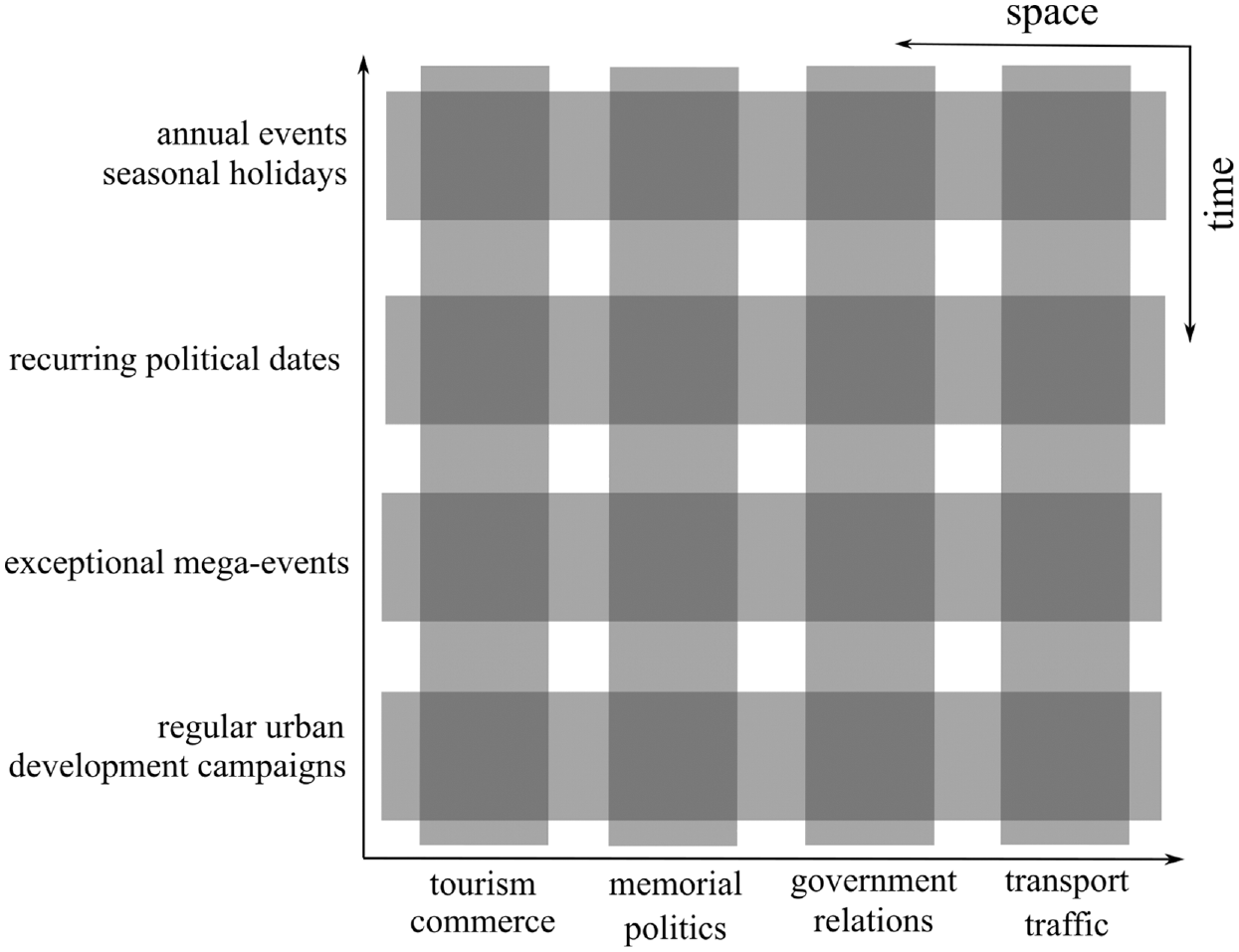
Interweaving zones and periods of increased control.
Why is this approach to managing public space a form of spectacularisation? Because the image takes centre stage. The Chengguan Bureau and its patrols create islands and snapshots of the ‘ideal’ public space –‘mostly motivated by a top-down preference for modernity, uniformity and conformity’ (Li, 2020: 81). The procedures are neither legally legitimised nor supposed to benefit urban inhabitants. Arguments such as fighting tax evasion, food and traffic dangers (in the case of street vending; Bell and Loukaitou-Sideris, 2014) or offering poverty relief (in the case of beggars; Flock, 2023) dissolve under the emphasis on ‘shirong’– cityscape – which is the dominant explanation in government publications. Guangzhou government defines the term as the ‘overall impression of the city to the outside world, [it] refers to the appearance of urban buildings, structures, public facilities and places closely related to the environment, as well as the streetscape’ (Guangzhou City Government, 1997: para 42, emphasis added). Shirong means image, not reality and it is created for perceiving the city, not living in it. The image is maintained through a campaign-style approach, that is, resources are pooled to achieve maximum results in a specific place at a specific time – a Potemkin village. While the spectacle might influence all urbanites, the target group, however, is the ‘outside world’– visitors, tourists, high-skilled human capital, influencers, journalists, investors or political superiors.
Why is this an integrated spectacle? Because the motivation to sustain the image is political as well as economic, as in China’s authoritarian state these two dimensions interweave. Although the Communist Party holds on to power through ‘performance legitimacy’ (Zhu, 2011), ‘performative governance’ never stopped playing an important role (Ding, 2020). The similar wording reflects different but combined strategies as the former refers to economic output and improving living conditions, and the latter to the ‘theatrical deployment of language, symbols and gestures to foster an impression of good governance among citizens’ (Ding, 2020: 525). Similar to cities in the US or the UK, evicting beggars, street vendors and other undesired people means taking elements out of sight that might disturb the consumption experience and leave consumers in no doubt about the positive world offered to them (Gerrard and Farrugia, 2015). At the same time, this world is supposed to attract investments in architecture and retail development, advancing urban ‘domestication by Cappuccino’ (Zukin, 2010: 4). Moreover, when ‘[s]haping and managing visibility’, Brighenti (2007) explains, ‘the question arises of what is worth being seen at which price – along with the normative question of what should and what should not be seen. These questions are never simply a technical matter: they are inherently practical and political’ (Brighenti, 2007: 327). Street vendors and beggars function as symbols whose visibility is an accusation against the government. They question the modernity of the city, the management skills of its leadership and the welfare system of a party that presents itself as the vanguard of the common man. Zones and periods of increased control can therefore be understood as a means of the integrated spectacle from various perspectives: to present a politically opportune public space or to support the diffuse spectacle – which again stabilises Communist rule.
How does this spectacle shape social relations? Cleaning public space is accompanied by massive propaganda – advertisements, pictures and slogans that connote an urban utopia. The poster series ‘Creating a Civilised City’, for example, most often shows high-rise buildings in a green environment, while mottos such as ‘let us build a civilised family garden together’ indicate social cohesion and harmony. In this logic, the latter is achieved when the disturbing elements are eliminated; the civilised city is achieved by taking street vendors and beggars out of the picture. Boutonnet and others see the wenming campaigns as a discourse on citizenship, defining who belongs to the national community aspired by the Communist Party (Boutonnet, 2011; Cartier, 2016; Pow, 2007). Similarly, we see city governments evicting the ‘low-end population’ and creating spaces for people with high suzhi (quality; Morris, 2022; Pils, 2020; Zhang, 2018). In this story, public space plays a crucial role as it is supposed to be open to all members of a society, which implicates, those without access are not part of society. They are more likely to be overlooked by passers-by and politicians, and do not equally partake in urban socialisation. They cannot benefit from the shared resource, which is public space, and are denied an economic basis to survive in the city. Spectacularisation drives a wedge between the more and the less affluent residents and defines the latter’s relation to the urban community.
Why is this a process of spectacularising everyday life? The literature on urban spectacles in China primarily refers to the extraordinary. This study showed that we have to widen our perspective on public space’s integrated spectacle where the state carries political and economic dimensions deep into the mundane. The zones of increased control mentioned above – such as the Beijing shopping streets, Heroes Square and Martyrs Park – all belong to everyday spaces for shopping, buying groceries, getting to the metro and doing evening gymnastics. They are a far cry from localities usually associated with urban spectacularisation, such as the Olympic stadium in Beijing. Moreover, while a selling point of mega-events is their uniqueness, they must be contextualised in the wider rhythm of governing public space. Lefèbvre (2007: 7) explains ‘no rhythm without repetition’, which can be traced through periods of increased control. They follow several dates of the year, set a pulse, and condense into a continuous exposure of the ‘ideal’ cityscape. Thus, efforts of spectacularisation reach everyday life.
Conclusion and outlook
This study explained the state logic to govern public space in Guangzhou. This city is a trendsetter in China, while various sources suggest there are similar management tendencies in other Chinese municipalities (e.g. Bell and Loukaitou-Sideris, 2014; Dai et al., 2019; Morris, 2022; Xu and Jiang, 2019; Zang and Pratt, 2019). Public space is governed through zones and periods of increased control. Areas of (1) tourism and commerce, (2) memorial politics, (3) government relations and (4) transport are dominated by the state’s ideal for public order enforced during (1) annual events and seasonal holidays, (2) recurring political dates, (3) exceptional mega-events and (4) regular urban development campaigns. Zones and periods of increased control combine personnel with extended competencies, for example, police, Chengguan and the Assistance Stations collaborate and might exceed their authority. The result is fragmented and cadenced public space, marginalising the urban poor. Thus, patterns and rhythms of increased control interweave and introduce a version of Debord’s ‘integrated spectacle’ into everyday life.
While spectacularisation refers to staging public space to create dominant images, how the marginalised, the participants and the audience react and get involved is another question for further research. So far, we see that establishing zones and periods where mobile hawking is ‘more’ and ‘less’ forbidden undermines the citywide street vending ban. Denying beggars access to popular public spaces contravenes the ‘benevolent turn’ of the new welfare laws. Research has shown that vendors and beggars adapt to the spatial pattern and use it to their advantage as much as possible (Flock, 2014, 2023; Flock and Breitung, 2016; Hanser, 2016; Morris, 2021). Differentiated control offers opportunities for their business, but it also requires additional means of mobility and innovations to appropriate public space. However, the characteristics of the urban poor are low or volatile income, high age and illness. Those we see on Guangzhou’s streets can still handle the state’s inspections, while the excluded others stay invisible.
The concept of the spectacle makes us understand why street vendors and beggars are not the only ones affected by zones and periods of increased control. During fieldwork, Chengguan patrols, for example, expelled street singers and artists from their designated zones and police officers checked the identity papers of ‘suspicious’ young migrants to prepare for the Hygienic City competition (interview with policemen 29 August 2012). ‘Building a Spiritual Civilisation’, the campaign that informs official conceptions of modernity, targets a broad range of behaviour in public space – from polite language to disturbing public order – and various social groups. It also builds the ideological basis for experiments of digital governance and Social Credit Systems. This article concentrated on the development of governing public space established during China’s crucial phase of reforming and opening up (1980–2019). Whether these rules were strengthened afterwards or complemented by the logic of the pandemic requires further research.
Footnotes
Declaration of conflicting interests
The author declared no potential conflicts of interest with respect to the research, authorship, and/or publication of this article.
Funding
The author(s) disclosed receipt of the following financial support for the research, authorship, and/or publication of this article: This article is supported by the research project ‘Megacities-Megachallenge. Informal Dynamics of Global Change’ (German Research Foundation (DFG)), the German Academic Exchange Service (DAAD), the Chiang Ching Kuo Foundation and the research project ‘Social Worlds: China’s Cities as Spaces of Worldmaking’ (funded by the Federal Ministry of Education and Research (BMBF).
