




Abstract
Little is known about whether Syrian refugees intend to return to their origin-country and what affects their return migration intentions. We introduce a theoretical framework for voluntary return, identify the refugees’ decision-making context, and empirically assess the model with a sample of 577 Syrian refugees living in Germany and Turkey in 2018. Three return scenarios were presented in the survey: (i) returning to Syria within two years, (ii) returning when Syria is as safe as before the civil war, and (iii) ever returning. The three scenarios were conceived very differently by the refugees, highlighting the dynamic nature and context dependency of the concept of voluntary return. Syrian refugees in Turkey were more likely to regard their stay as temporary (76 percent), compared to those in Germany (55 percent, p-value of difference = .000). Similarly, structural factors of the origin- and host-countries, that is, the origin-governorate and the current location, were considerably influencing return intentions. Concerning individual factors, female and highly educated refugees had a lower willingness to return. Those who were married were less inclined to return in the short run, yet refugees who self-identified as poor indicated their desired return in the long run. We also analyzed whether random exposure to information regarding return impacted refugees’ intentions. We found a negative, albeit insignificant, impact of information, suggesting that host governments cannot expect (rapid) information dissemination to impact refugees’ decision-making about voluntary return. Our findings underscore that neither proximate nor distant host-countries should bank on the speedy return of the Syrian refugees.
Keywords
Introduction
In March 2022, the Syrian civil war entered its 12th year (BBC News 2022). It has resulted in more than 6.7 million internally displaced people and about 6.6 million refugees (UNHCR 2021a). The majority of Syrian refugees are concentrated in countries bordering Syria, particularly Turkey, but a significant number are also hosted in European Union (EU) countries, mainly Germany (UNHCR 2019a). The unprecedented influx of Syrian refugees over recent years has resulted in political, social, and economic challenges for host-countries, with social tensions rising in the wake of mass migrations that occurred in 2015 (Amaral, Woldetsadik, and Armenta 2018; UNHCR 2021a). EU citizens are concerned that the increase in refugees has increased the risk of terrorism and reduced citizens’ chances to secure jobs or social benefits (Amaral, Woldetsadik, and Armenta 2018). In addition, the alleged threat that refugees pose to host communities has been used by right-wing populist parties in Europe to win votes by playing on insecurity and fear and distracting the electorate from national issues (Holmes and Castañeda 2016).
The United Nations (UN) and some European host-countries, as well as the Syrian government, consider refugees’ return to their origin-country as the desired solution to the Syrian civil war (Council of the EU 2017; Yahya, Kassir, and el-Hariri 2018). Yet the EU is hesitant to commit funds to the reconstruction of Syria in light of ethical issues related to being a party to consolidating Bashar Al-Assad's victory (Batrawi 2018). For its part, the Syrian government has been discussing its plans for rebuilding Syria for some years: in 2016, reconstruction deals were reached between Russia, China, Iran, and Syria (Batrawi 2018). However, rebuilding in Syria progresses slowly, and concerns remain that the Syrian government's urban reconstruction policy is “enabling demographic engineering, [and] rewarding political loyalty” (Batrawi 2018, 8).
Given political challenges in neighboring as well as across EU host-countries (Holmes and Castaneda 2016) and Syria's unclear future, this article explores whether Syrian refugees in Germany and Turkey consider return migration 1 an option. Syrian refugees’ voices have seldom entered the debate on refugee policy as repeatedly demonstrated during the now already sixth conference in Brussels about the future of Syria (Yahya, Kassir, and el-Hariri 2018; European Union External Action 2022). A key barrier to making their voices heard is the difficulty of accessing their perspectives on the war, fleeing, refuge, and desires to return, due to cultural and language barriers and the high level of fear and insecurity among refugees in host-countries (Georgiou and Zaborowski 2017; Yahya, Kassir, and el-Hariri 2018). We overcome these challenges by collecting systematic information from 577 Syrian refugees by means of a structured survey and employing Syrian nationals 2 directly as enumerators in our research activities. We assess whether the end of the Syrian civil war would be justification enough for Syrians to return. Overall, more than two-thirds of the interviewed survey respondents expressed a desire to return to Syria one day. However, fewer than 40 percent indicated that they wanted to return if Syria was just as safe as before the war, and only about one-third intended to return after two years in the host-country.
Similar to the analysis presented here, a 2019 report about the return migration intentions of Syrians residing in Egypt, Iraq, Lebanon, and Jordan found that the great majority (79 percent) wanted to return one day (UNHCR 2019b). In an updated 2021 report, the share of those who wanted to return one day dropped to 70 percent, despite almost 90 percent not being able to meet their basic needs in the host-countries (UNHCR 2021b). In this article, we conduct a multivariate analysis assessing the determinants 3 of refugees’ return decisions. Our approach is similar to Alrababa’h et al. (2021), who studied the return intentions of Syrian refugees in Lebanon and found that 63 percent wanted to return one day and that the origin-country situation, including security concerns and economic prospects, drove return intentions.
We pose three main research questions. First, are Syrian refugees considering returning to Syria in the near future? Second, how do the individual and contextual factors influence the decision-making about return? By individual and contextual factors, we refer to the individual and structural determinants related to Syrian refugees’ intention to return to their origin-country. The individual determinants are for example age, gender, education, and economic well-being, the structural determinants are captured by the governorate-of-origin in Syria and the place of relocation in the host country. In addition, we assess the role of new information for refugees’ decision-making about returns. We ask: how does exposure to information of relevance for return influence return intentions? By studying whether new information affects return considerations we can address the extent to which governments and the media can influence refugees by providing them advice. The information component of our analysis is implemented as a survey experiment motivated by Turton and Marsden (2002), who found that Afghan refugees in Iran and Pakistan were influenced by massive media campaigns about large aid flows for Afghanistan and promises of peace and security by the international community were very much encouraged to return to their origin-country, resulting in an estimated 1.7 million refugees who returned in 2002.
In addition, we contrast two types of host-countries: the proximate, culturally close neighbor Turkey, which as a host-country provides temporary protection, and the distant, culturally different country Germany, which provides permanent protection to Syrian refugees, serving as a possible resettlement country. In a first step, we present survey responses from 577 interviewees to three return scenarios — (i) returning to Syria within two years, (ii) returning when Syria is as safe as before the war, and (iii) ever returning. In the next step, we link the assessments of the return scenarios with the refugees’ individual characteristics, assess whether new information leads to updating whether origin-country, as well as host-country characteristics, that is, where the refugees come from and where they are located, are determinants of return migration intentions. The combined assessment of return scenarios and explanatory determinants is implemented in a multivariate regression framework. We position and interpret our findings in relation to the existing literature about return migration intentions and to qualitative feedback that was collected during the survey. We focus on Germany and Turkey to address to what extent host-country differences are reflected in refugees’ decision-making. By understanding the factors that feed into refugees’ decision-making and helping them form return migration considerations, we not only give refugees a voice but also highlight them as agents of development because it is ultimately the refugees themselves how to decide whether, how and under which circumstances they return to their origin-country. Ultimately, this article allows us to better understand what is required by refugees to consider staying or returning and which elements are most important to them.
The remainder of this article is organized as follows. The context section briefly outlines the Syrian refugee crisis. The empirical and theoretical literature on refugees’ return migration section summarizes the existing empirical and theoretical literature on refugees’ voluntary return migration. The survey design, study population, and sampling are introduced in the survey design, study population, and sampling section. The empirical model is presented in the empirical strategy section and in the results section. The concluding section provides some policy recommendations.
Context
The war in Syria is a highly complex conflict, due to the multitude of parties involved, including the Syrian government and its allies, the international coalition led by the United States, and the many opposition groups (i.e., the Kurds, the People's Protection Unit, and the Islamic State of Iraq and Sham — ISIS) (BBC News 2019). As a result of the conflict, Syria's GDP dropped by an estimated 63 percent between 2010 and 2016, and its infrastructure was heavily damaged (World Bank 2017).
Due to fighting associated with the war, many Syrians have left the country (UNHCR 2021a). In the early years of the crisis, civilians fled mainly across the borders (UNHCR 2021a). According to the UN (UNHCR 2021a), neighboring countries host the vast majority of the more than 6.6 million Syrian refugees, with Turkey being the recipient of 3.6 million Syrian refugees (UNHCR 2021a). In 2015, when the conflict intensified, Syrians began to cross the Mediterranean, seeking asylum in Europe (Beauchamp 2015). Within Europe, Germany has received the highest number of Syrian refugees, with 679,465 officially registered Syrian asylum applicants between January 2015 and December 2021 (Eurostat 2022).
In this article, we rely on the commonly accepted definition of “refugee” from the 1951 UNHCR Refugee Convention, which states that a refugee “is someone who is unable or unwilling to return to their country-of-origin owing to a well-founded fear of being persecuted for reasons of race, religion, nationality, membership of a particular social group, or political opinion” (UNHCR 2010, 3). Thus, we consider a refugee to be any individual who seeks refuge independent of their legal status in the respective host-country.
In Germany, the right to asylum is laid down in the constitution (Federal Office for Migration and Refugees 2019a), and the country is also a signatory of the 1951 Geneva Convention (German Federal Government 2022). Germany has a long history of receiving immigrants and refugees 4 (Constant and Massey 2003) with a total foreign population of almost 12 million people by the end of December 2021 (Statistisches Bundesamt 2022). Germany is one of the most popular asylum destinations in Europe, due to its strong economy and favorable policies toward refugees (Neumayer 2004). Most importantly, Germany provided almost all Syrian refugees permanent protection in 2015, followed by subsidiary protection 5 in 2016 and 2017, with both groups of protection holders able to apply for permanent residence (Valenta et al. 2020; MacGregor 2021). Therefore, it is not surprising that the number of asylum-seekers in Germany increased dramatically between 2014 and 2017, largely as a result of the war in Syria, with around 1.5 million asylum-seekers from Syria, Afghanistan, Iraq, and Eritrea over that period (Grote 2018). In 2017, 94 percent of Syrian nationals seeking asylum in Germany were approved (Asylum Information Database 2018a), making Syrians the largest group applying for asylum in Germany and the third largest community with a migrant background in Germany (Statistisches Bundesamt, 2020).
Turkey is also a signatory of the 1951 Geneva Convention but in 2013 established a stand-alone legal framework implemented by the General Directorate of Migration Management (Asylum Information Database 2018b). Covered under this legal framework are more than 3.5 million registered Syrian refugees residing in Turkey (UNHCR 2020). Syrians hosted in Turkey as a result of the war in Syria are considered guests under “temporary protection” which entitles them to services and assistance in Turkey and the right to stay in Turkey until a more permanent solution can be found (UNHCR 2022). Contrary to the protection status provided in Germany, Syrian refugees in Turkey are considered “temporary guests” who are expected to return home after the conflict's resolution (UNHCR 2022). 6
Return migration must be narrowly understood since there are more than 6.7 million internally displaced people in Syria (UNHCR 2021a): return to a place other than their own house, street, or village cannot be considered as return unless refugees themselves have chosen this option (Warner 1994). Yet considering the high level of destruction across Syria, as well as the already-high population density of the few areas considered “safe” in the country, the idea that people can return to their own homes is currently not realistic for the majority of the Syrian refugees (Jordan, Akil, and Shaar 2022). Keeping in mind that return to the place-of-origin is largely impossible for Syrians at the current stage, our analysis focuses on intended voluntary return to a place that refugees would consider their home.
Empirical and Theoretical Literature on Refugees’ Return Migration
The literature on migration is large, covering aspects from the decision to migrate (Levy and Wadycki 1974; Schlottmann and Herzog 1981) and internal versus international migration (Adams and Page 2005; de Brauw, Mueller and Lee 2014; Lucas 1997) to wage differentials between host- and source-countries (Dustmann 2003a), remittances (Akobeng 2016; Stark and Lucas 1988) and return migration (Collier, Piracha and Randazzo 2018; Reinhold and Thom 2013), to name just a few prominent topics.
In addition, socio-economic data from economic migrants reveal that return migration is a common feature among labor migrants (de Coulon and Piracha 2005; Dustmann and Kirchkamp 2002; Piracha and Vadean 2010). Moreover, the decision to return is not taken exclusively on economic grounds (Kunuroglu et al. 2018; Tezcan 2019; Dustmann 2003b). Kunuroglu et al. (2018) show that the ambition to return tends to be already present when migrants leave their origin-country because of a sense of belonging often reinforced by perceived discrimination. Similarly, Tezcan (2019) demonstrates that Turkish immigrants in Germany are more likely to intend to return when they identify as Turkish rather than German. Another motive for return migration is concerns about children (Dustmann 2003b).
Compared to the large literature on economic migration and return that is briefly introduced above, the literature on refugees’ return migration is considerably smaller (Dadush 2018). While the binary separation between refugees and migrants has its limitations (Hamlin 2021), economic migrants and refugees tend to be different and we do not do justice to refugees if we simply treat them as economic migrants (Dadush 2018). The main differences between refugees and economic migrants are (i) their reasons for leaving the origin-country, (ii) their legal status in the host-country, and (iii) the length of time that they remain out of the origin-country (Dadush 2018). Other possible differences include their experiences of hardship and trauma and their ability to return to a safe environment (Jordan, Akil, and Shaar 2022).
We are aware of a small number of quantitative studies about refugees/informal migrants and return migration (e.g., Dadush 2018; Black et al. 2004). The literature on refugees’ (voluntary) return points to a mix of different strategies being employed to encourage return migration (e.g., Dadush 2018; Black et al. 2004; Turton and Marsden 2002). For example, host-country return migration efforts start with motivating voluntary return including the signing of tripartite agreements as well as “go and see, come and tell” visits (IRRI 2010). But host-country return migration efforts also contain the creation of fear of forced return among the refugees and deportations as a result of deadlines and restrictions on access to assistance (ibid). The host-country context should not be underestimated in shaping refugees’ return desires and return conditions. For example, Karooma (2014) found that Uganda's hospitality toward Rwandan refugees contributed to the refugees’ reluctance to return. In turn, Turton and Marsden (2002) showed that return of Afghan refugees from Iran and Pakistan was triggered by decreasing access to employment, education, and health services in the host-countries but even more so by the provision of assistance to returnees.
The origin-country situation is, thus, equally important for return migration aspirations and attempts. From Syrian refugees in Iraq, Jordan, and Lebanon, we know that insecurity in Syria is a major deterrent to return, making returns infrequent and selective so far (World Bank 2020). In post-conflict Burundi, Fransen, Ruiz, and Vargas-Silva (2017) compare returnees with non-migrant households and found that in terms of the main source of capital, livestock holding, and perceived well-being, returnees fared worse compared to those who had stayed. In addition, Eastmond (2006) highlights that return is not necessarily a one-time decision but rather a dynamic process where holding on to property in the origin-country and regular (long-term) visits play key roles in the decision to permanently move back to the origin-country. A study closely related to our work assessed the intended return migration of undocumented migrants from Mexico to the United States (Ravuri 2014). While the length of stay was not a significant determinant of undocumented Mexican migrants’ intended return to their origin-country, land ownership in Mexico was. In turn, those who invested in property in the United States wanted to stay there.
Next to the academic literature on refugees’ return migration and repatriation 7 , the political debate about (voluntary) return and repatriating refugees is vibrant in host-countries, and numerous policy papers assess (assisted) voluntary return and host-country programs to fund such return (Black et al. 2004) and the appropriate timing as well as origin-country security requirements (Black, 2002). For Liberian refugees living in Ghana, Omata (2003) shows that the presence of secure shelter, education, and job opportunities in their origin-country fed into refugees’ decision to return. Similarly, Al-Ali, Black, and Koser (2001) identified the following factors as preventing Eritrean refugees in the United Kingdom from returning home: low wages, no decent health system, lack of quality education, and lack of housing. Kibreab (2003) distinguishes between refuge in developed and developing countries, arguing that refugees in developing countries often experience indignity and lack of respect. Moreover, they tend to have no prospect of obtaining the rights of citizenship and, thus, aim for refuge in developed countries or return as quickly as possible –an angle that we also assess by comparing Syrian refugees in Turkey and Germany. Last but not least, Al-Rasheed (1994) studied Iraqi refugees in London, highlighting that they were a diverse group and differed substantially in their desire to return home. Despite all this evidence across different contexts, according to Koser and Kuschminder (2015), the biggest bottleneck in studying refugees’ decision to return is the lack of reliable data to assess the structural and individual conditions that affect return migration. This article furthers understanding of the individual, home-, and host-country factors involved in the refugees’ decision-making about return migration.
Existing theoretical models about return migration are mainly within the context of economic migration and tend to focus on skill accumulation and work effort (Dustmann, Fadlon, and Weiss 2011; Galor and Stark 1991), although modern models can incorporate reasons for returning to the origin-country, including border enforcement and homesickness (Nakajima 2019; Lessem 2018; Angelucci 2012). Yet, for refugees, migration is not primarily related to skills or effort but to (perceived) origin-country risks. Djajić (2013) explicitly incorporates origin-country institutions in his model of return migration in which migration dynamics are linked to the process of capital accumulation in the origin-country. Yet again, and contrary to labor migrants, refugees typically do not accumulate capital in their origin-country but rather experience loss of property (Stefansson 2006). We must account for these differences between economic migrants and refugees when conceptualizing refugees’ decision to migrate along with the intention to return to their origin country.
In this article, we model the refugees’ return migration or, rather, their intentions to return to their origin country. Our model builds on Black et al. (2004) and extends it to include the time dimension (e.g., duration of stay) and the refugees’ individual expectations about the future. Most importantly, our theoretical framework begins from the assumption that the concept of return is intricate and can refer to different moments in time and different circumstances in the host- and origin-countries. There is no one single definition of return migration. Thus, current return intentions are considered to be shifting and potentially volatile, meaning that they change based on presented scenarios and planning horizons. This understanding of return migration is similar to Sirkeci and Cohen's (2016) culture of migration approach that highlights the continuity of migration flows responding to perceptions of human insecurity. We argue and conceptually model a continuity and a continuum of considerations about (return) migration.
Our framework takes the decision to flee the origin-country as taken. Concomitantly, we acknowledge that the initial decision to flee also incorporates the selection of a proximate or distant host-country and this selection of host-country has implications for future return migration plans (Kunuroglu et al. 2018). Consequently, we argue that even the simplest model of intended return must account for three points in time, since return intentions are a function of (i) the past decision to flee, the circumstances of the escape, and the outcomes, (ii) current experiences and conditions, and (iii) future expectations and aspirations. The third point in time, the future, can only be expressed in expected terms, reinforcing the challenge of precisely predicting refugees’ return migration. Accounting for temporal dynamics also allows us to integrate new information and inputs and ensuing shifts in the perception of return.
In addition, and as identified in the previous literature on refugees’ decision-making about return to their origin country, there are various push and pull factors (Black et al. 2004; Parkins 2010) that are linked to structural and political aspects in the origin- and host-countries, as well as individual attributes. The structural factors encompass the political context and institutions, the underlying social and cultural conditions, the economic situation, and environmental conditions (Black et al. 2004). The individual factors include demographic aspects, such as age, gender, and marital status, as well as social aspects, such as family unification, economic considerations of “a better life,” and access to education (Parkins 2010). Thus, against this background, the reflection about return migration is made on the basis of multiple, intertwined factors that are re-calibrated based on new information. We take all these factors together to model the decision-making process, as shown in Figure 1.
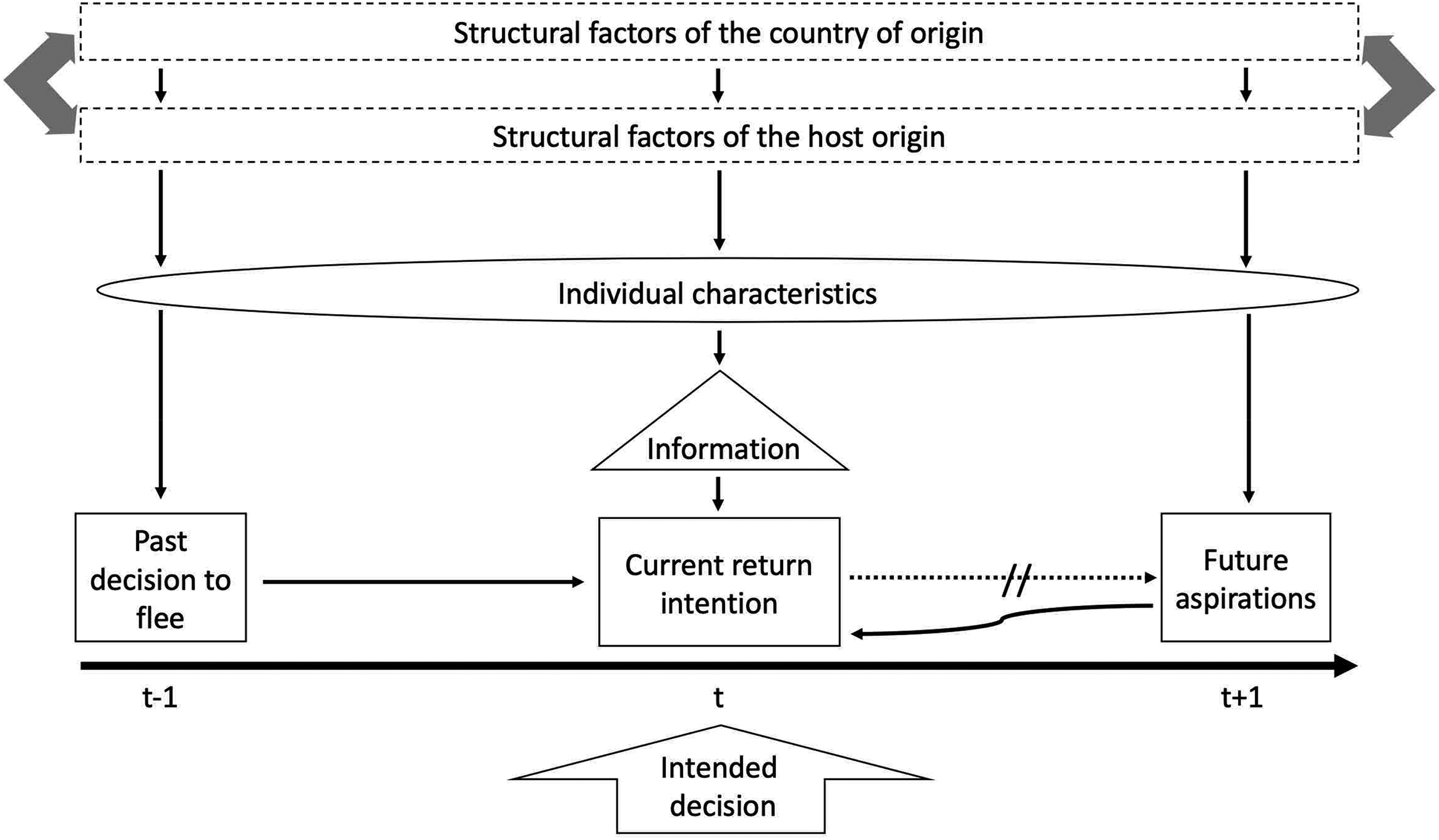
Factors determining decision-making about intended return.
As the bottom of Figure 1 shows, the point of decision-making is the present, when the intention about return migration is formulated and shared based on the past selection of a host-country and against the background of the experienced structural conditions in the origin- and host-countries. Put differently, return intentions are affected by comparing conditions in the origin- and host-countries (Faist 1999; King 2000). In addition, return intentions are affected by individual characteristics, especially age and gender (King 2000; Reichnert 2002), as well as social relations and a sense of belonging (Black et al. 2004; Nakajima 2019).
The present situation when the decision-making takes place is additionally influenced by new information, whether in the form of news items or policy interventions that provide (dis)incentives to stay in the host-country or return to the origin-country (Arb 2001; Bloch and Atfield 2002). Future aspirations are expectations and unknown; only their expected value can be shared at present. As for the past and present situation, the shape of expectations depends again on the structural context in which the decision-maker finds herself, as well as personal factors (Black et al. 2004). Moreover, expectations also incorporate the planning horizon and are, thus, dynamic. The possibility of differences in the planning horizon is indicated with “//” in Figure 1, pointing to the fact that there are different return scenarios (i.e., the concept of intended return is not static). Importantly, future expectations are reflected back into the presence, where expected decisions about return are formulated.
While this model provides some structure for the context in which return migration decisions are made and the factors feeding into these decisions, different people come to different personal decisions (Malmberg 1997; Fisher and Martin 1999). Yet, from a policy perspective, it is crucial to identify whether there are any systematic patterns, for example, in the perceived differences between origin- and host-countries. By quantitatively assessing the above-depicted theoretical relationships with a sample of Syrian refugees in two different host-countries — Turkey and Germany — we advance the literature on refugees’ decision-making about return to their origin country.
Survey Design, Study Population, and Sampling
The host-countries of Germany and Turkey were selected for three reasons. First, they represent the host-countries with the highest number of Syrian refugees in their respective areas (UNHCR 2021a, 2021c). Second, they play key roles in policy discussions and actions about refugee management, as manifested in the EU-Turkey Refugee deal and the EU Migrant Relocation and Resettlement scheme (Smeets and Beach 2020). Third, the two host-countries portray different contexts in terms of proximity to Syria, the type of protection they provide to the refugees, and the economic, political, and cultural conditions (Constant and Massey 2003; Neumayer 2004; UNHCR 2022), and are thus appealing to a comparative analysis.
The study population is Syrian refugees who moved to Germany and Turkey as a result of the war in Syria (i.e., after 2011). The selection criteria were as follows: respondents had to be at least 18 years old and have the autonomy to make the return decision for themselves and, if applicable, for their families. As a result of these criteria, the majority of respondents were male household heads, in line with the dominant Syrian culture in which the husband (or eldest male) is the family's decision-maker (Vulnerability Assessment of Syrian Refugees in Lebanon – VASyR 2017). There was no restriction on the date of arrival (as long as it was after 2011) or current legal status in the host-country.
The survey questionnaire was developed, based on the existing literature on refugee's return migrations (Black et al. 2004), and the experience of one of the authors of working with Syrian refugees and internally displaced persons as a humanitarian worker for five years. The survey questionnaire was initially formulated in English and, then, translated into Arabic to ensure proper comprehension. Questions about different scenarios of return migration are very sensitive for refugees, who tend to be afraid that voicing their opinion freely might affect their situation in the host-country or in relation to the Syrian regime (Hennessy-Fiske, Mai-Duc, and Glionna 2015). We, therefore, took great care in setting up the survey questionnaire and in creating a safe environment during the survey. Data collection ethics were implemented with an explicit focus on respondents’ privacy and anonymity and the need for sensitivity when asking about difficult experiences, such as the loss of family members. Ethical approval for this study, including the incorporated survey experiment 8 (more below) was obtained from the ISS Research Ethics Committee. Survey participation was voluntary, and informed consent was obtained.
While we aimed for proportional random sampling, we could not get the necessary sampling frames and did not want to risk biased answers (social desirability bias due to fear) as a consequence of the participation of a government agency in the sampling. We, therefore, opted for exponential, non-discriminative snowball sampling. The first recruited individual in the sample provided at least one referral, which was explored and included in the sample. Every newly recruited participant similarly provided referrals until primary data from sufficient individuals were collected. While we cannot claim representativeness, given our sampling approach, we minimized response bias by implementing a referral approach.
A total of 577 survey interviews were conducted in Germany and Turkey over a period of three weeks in August 2018: 241 interviews in Germany and 336 interviews in Turkey. We opted for a short survey period to reduce response bias from a changing political environment. Moreover, we explicitly chose the summer holiday period for the surveys to further reduce the possibility of changing political dynamics influencing responses.
In Germany, surveys took place in North-Rhine Westphalia, which is the most populated German state (Statistisches Bundesamt, 2017) and hosts the highest number of Syrian refugees (Statistisches Bundesamt, 2018). Surveys took place in two cities and the adjacent rural area.
9
These locations can be considered representative of Syrian refugee lives in Germany, as refugees do not decide where to live and German authorities use the so-called EASY quota system (in German: “
In Turkey, the selection of representative locations was approached differently, as refugees have relative freedom to choose the governorate in which they wish to reside (UNHCR 2015). Syrian refugees tend to live in Istanbul and in cities close to the Syrian border (Güçer, Karaca, and Dinçer 2013). According to the Turkish Directorate of Immigration, the main cities hosting Syrian refugees in Turkey in 2018 were Istanbul (563,963), Şanlıurfa (469,215), Hatay (442,091), and Gaziantep (392,998) (Mülteciler Derneği 2018). Refugees prefer to stay in the Turkish governorate closest to their Syrian province-of-origin (Mülteciler Derneği 2018). Based on this locational sorting, surveys were conducted in four Turkish cities which account for more than half the Syrian refugees in Turkey. 10 Data collection in Turkey took 13 days and was conducted by 17 Syrian nationals.
To assess the role of new information for return migration intentions in an empirically rigorous way, we implemented a survey experiment in which we randomly divided refugees into three groups and presented them with positive, negative, or no information about Syria and relocation support. The experiment was carried out after the background information about socio-demographic and economic characteristics was collected, and prior to survey questions asking about the intention to return. We randomly exposed one out of three respondents to a negative news item about Syria in the form of a video clip lasting 2.7 minutes and issued by Aljazeera news channel in Arabic. The negative news item presented the latest facts about the numerous challenges that Syrian returnees from Lebanon were facing when moving back to Syria. The second group of respondents received a positive information shock about support for returnees. We put together a one-page leaflet with supportive information providing guidance about return, including relevant links and addresses. 11 The remaining one-third of respondents served as a control group. We deliberately presented powerful images and messages directly related to return migration to assess whether the new information affected refugees’ return migration intentions. We aimed at approximating the type of rapid information that reaches refugees through social media. The experiment was designed such that the first interviewee of every survey enumerator entered the control group (receiving no information), the second interviewee was exposed to the negative treatment, and the third interviewee received the positive treatment.
Empirical Strategy
Our empirical strategy identifies the determinants of intended return migration. We set up the model in a staggered way. First, we only control for the selection of host-country (Germany versus Turkey), for origin- and host-country-specific structural effects (governorate-of-origin and current location dummies) along with pre-determined, socio-demographic characteristics (age, gender, etc.). Next, we add educational and economic characteristics, and, finally, we add the role of new information (i.e., our survey experiment). We carefully chose all variables to be pre-determined. The resulting empirical model is as follows:

In addition to our parsimonious main model, we conducted two partial correlation analyses to identify (i) whether escape-related variables and perceptions of the current situation were associated with return migration intentions (backward-looking) and (ii) whether expectations for the situation in Syria were linked with intended return (forward-looking). This analysis of backward and forward-looking factors accounts for the complex decision-making process, as theoretically motivated in the empirical and theoretical literature on refugees’ return migration section. Although our outcome variables are binary, we decided to employ the linear probability model as the main specification, since we include a considerable number of linear fixed effects, given the relatively small sample of 577 observations.
Results
Descriptive Statistics
Return Migration Intentions
Descriptive statistics for our sample are presented in Table 1. With respect to the intention to return to Syria, we observe that only about one-third intended to return after two years of stay in the host-country and that fewer than 40 percent indicated that they wanted to return if Syria was as safe as before the war. The low willingness to return in the near future is not surprising, since survey interviews were carried out in Summer 2018, when the war was ongoing. Note that we deliberately presented a scenario that described Syria as being as safe as before the war (i.e., such a situation built on the assumption that the Al-Assad regime was still in place, a scenario that seemed likely). If we look at the more distant future, the intention to return increased: more than two-thirds of interviewed respondents desired to return to Syria one day. 13 The varying support for the different return scenarios highlights that return migration is not a static concept but responsive to changes in conditions and time horizons (see conceptual considerations in the empirical and theoretical literature on refugees’ return migration section).
Descriptive Statistics.
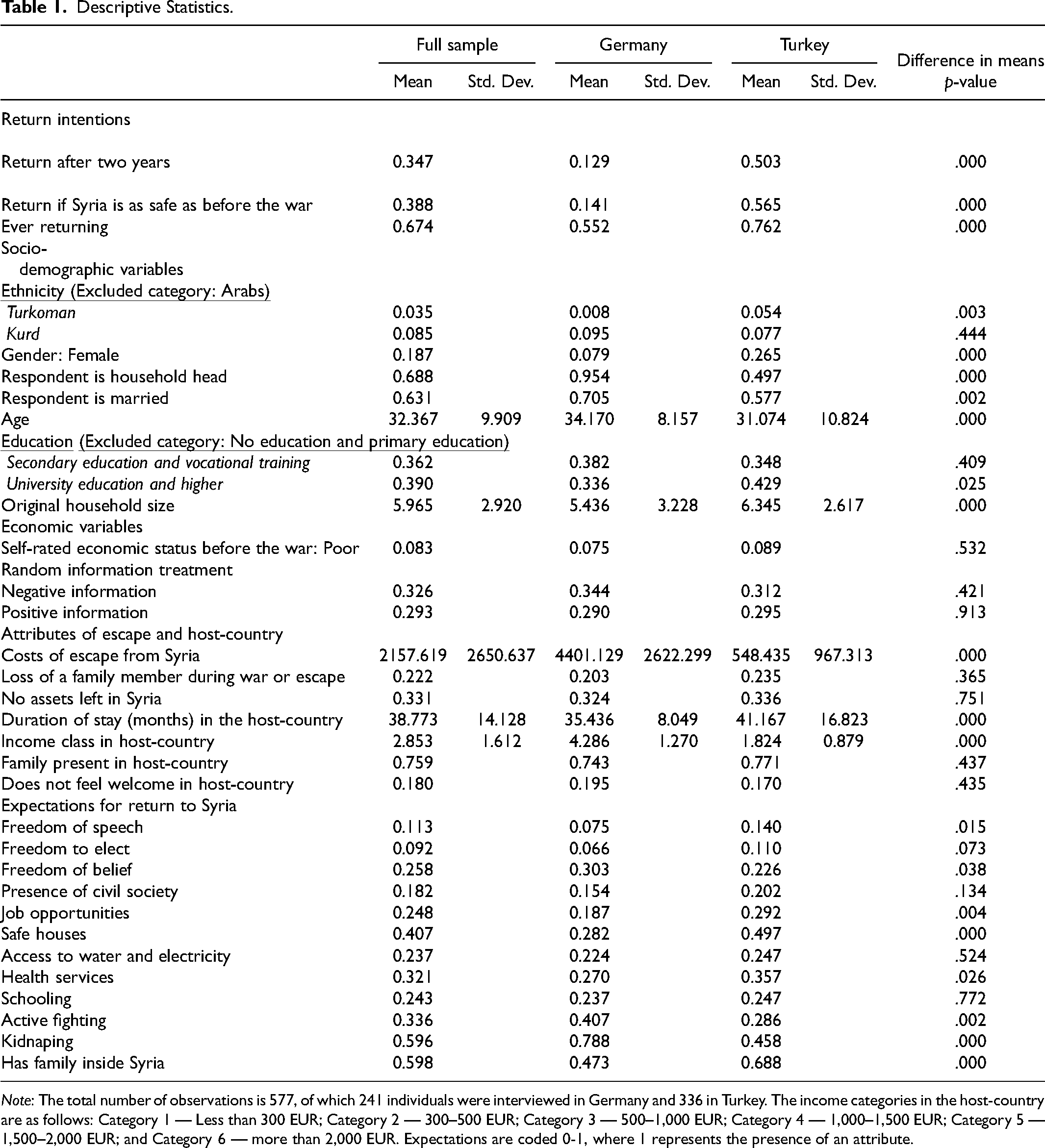
Note: The total number of observations is 577, of which 241 individuals were interviewed in Germany and 336 in Turkey. The income categories in the host-country are as follows: Category 1 — Less than 300 EUR; Category 2 — 300–500 EUR; Category 3 — 500–1,000 EUR; Category 4 — 1,000–1,500 EUR; Category 5 — 1,500–2,000 EUR; and Category 6 — more than 2,000 EUR. Expectations are coded 0-1, where 1 represents the presence of an attribute.
There were marked differences in intended return migration between those refugees in Germany and in Turkey (Table 1). Only 13 percent of refugees in Germany wanted to return after two years, compared to half the refugees in Turkey. The situation was almost identical for returning if Syria was as safe as before the war. Of those respondents in our sample who made it to Germany, roughly half indicated that they wanted to return to Syria eventually, whereas more than 75 percent of respondents in Turkey wanted to go back one day. These differences between Syrian refugees in Germany and Turkey in the intention to return were not only large in size but also statistically significant, suggesting that the pool of refugees in the two countries was different and that the selection of a host-country is made by the refugees while concomitantly considering the possible (lack of a) desire to return. We further deduced that refugees experience different socioeconomic circumstances in the two host-countries. Another key difference between the two host-countries that is embedded in the differing return likelihoods is that Germany initially granted permanent protection to almost all incoming Syrian refugees and all refugees granted permanent or subsidiary protection can apply for permanent residence in Germany.
Individual Background Characteristics
Turning to the background characteristics of the refugees in our sample, the majority of respondents were Arabs, with less than 5 percent being Kurds and 8.5 percent being Turkomans. The German sub-sample included far fewer women (only 8 percent versus 27 percent in the sub-sample collected in Turkey). It is, therefore, not surprising that the German sub-sample included more household heads — 95 versus 50 percent — and more married individuals — 71 versus 58 percent. Refugees’ average age was roughly three years higher in Germany, but in terms of secondary education and vocational training, the two sub-samples were identical (i.e., 36 percent of the sample had secondary education or vocational training). However, there was a difference of almost 10 percentage-points (pp) in the share of individuals with university education between refugees in Germany and Turkey. Syrian refugees in the Turkish sub-sample had a higher education level on average because we purposefully sampled highly educated individuals in Turkey, expecting that they were most comparable to those who made it to Germany. Yet, this focus on highly educated respondents resulted in some over-representation of those with university degrees in the Turkish sub-sample. In addition, we asked about household size in Syria. On average, households consisted of six members, with those respondents who made it to Germany coming from smaller households, suggesting that only those who had to care for fewer dependents managed to organize their escape to Germany. Turning to refugees’ economic situation, we observe a similar share of individuals in both host-countries who classified themselves as being poor prior to the war.
Survey Experiment
As the descriptive statistics show, the survey experiment was equally implemented across countries. The negative information was provided to 33 percent of the survey participants and the positive information to 29 percent, the remaining group received no extra information (control group). Implementation differences across countries are small and statistically insignificant. In addition, we assessed that the two treatment groups and the control group have similar socio-demographic and economic characteristics and thus that the experiment was truly randomly implemented. Detailed balancing statistics can be found in the Online Appendix (Part 1, Table A1). Overall, the experiment was randomly implemented along predetermined variables.
Backward- and Forward-Looking Aspects
Next, we inquired about the escape and refugees’ perception of the host-country. The costs of escape were more than eight times higher for Syrian refugees in Germany compared to those in Turkey, possibly hinting at the price of permanent protection. Refugees are well aware of the differences in protection status across the two countries. From the qualitative data, we learned that refugees considered these higher costs as an investment in “the future,” especially their children's future (Online Appendix, Part 2). The loss of a family member during the war or escape was reported by roughly one out of five individuals, independent of the host-country in which they were located. One-third of all respondents across both sub-samples had no assets left in Syria, indicating that they had cut financial ties with their origin-country. As documented by earlier research (Eastmond 2006; Ravuri 2014), refugees who keep property in their origin-country tend to have a considerably larger connection with their old home and are more likely to return. The duration of stay was almost six months shorter, on average, for refugees in Germany. The shorter duration of stay is not a surprise, since most refugees did not directly arrive in Germany but had to stop in other countries, which is time-consuming. Refugees in Germany reported a higher average income, between 1,000 and 1,500 EUR a month, whereas refugees in Turkey reported an average income between 300 and 500 EUR per month. These income differences reflect the two countries’ different economic situations and hint at the economic stability that refugees who opted for Germany likely sought. Concerning the role of social ties, 76 percent of interviewees indicated that they had family in the respective host-country, and 18 percent reported that they did not feel welcome in the host-country, with no statistically significant differences between host-countries.
Finally, we turn to expectations for Syria to which refugees wanted to return. Freedom of speech was desired by 11 percent, and freedom to elect by a slightly smaller share. Freedom of belief was considered important by 26 percent. Overall, these liberties did not receive much attention. Similarly, the presence of an active civil society was only considered important by 18 percent. Yet, more tangible aspects of life, such as the availability of jobs and safe houses, were considered important by 25 and 41 percent, respectively. Access to water and electricity was a pre-requisite for roughly one-fourth, and health and education services were considered important by 32 percent and 24 percent of respondents, respectively. Beyond positive expectations, respondents were concerned about active fighting (34 percent) and kidnaping (60 percent) in Syria. Most of these expectations differed, depending on the chosen host-country. For most categories, except the security-relevant ones, refugees in Germany seemed to be less concerned about the situation in Syria, possibly reinforcing their lower interest in returning home. For the sample as a hole, 60 percent of respondents reported having family in Syria. Yet again, less than half the refugees in Germany told us about such ties.
Multivariate Analysis
Main results
The results of the multivariate analysis are presented in Table 2. Even at a glance, it is clear that across empirical specifications and return scenarios, refugees who went to Turkey considered the option of returning to Syria more likely than refugees who went to Germany. This finding reinforces the descriptive statistics and is the big, coherent result across specifications. The estimated effect varies between an increased likelihood of 23 pp (p-value ≤ .10) for return within the next two years and 51 pp (p-value ≤ .01) for return when Syria was as safe as before the war. The increased likelihood to return to Syria from the neighboring country Turkey highlights that the selection of a host country was the single most important factor influencing return considerations. We further disentangle origin- and destination-specific structural effects. We identify that these structural effects impact return intentions for the two short-term scenarios, supporting the theoretical framework that postulates that decision-making about return incorporates the observed structural/political and institutional differences between the two countries (compare the empirical and theoretical literature on refugees’ return migration section). Next, we turn to individual characteristics. We found that across return scenarios, women were less likely to indicate that they wanted to return. This effect was sizable in magnitude yet not statistically significant, which is possibly linked to the fact that we had a fairly small sample (577 observations) with a small proportion (<19 percent) of women. Contrary to expectations, age was not a significant determinant of return migration intentions. Even if we account for non-linearities (squared term) or cohort-specific effects, age remained insignificant. We attribute the insignificance of age to the fact that 85 percent (65 percent) of our sample was in the age group 20 to 45 (35). In comparison to our sample, with an average age of 32, Mesic and Bagic (2010), who found that return was associated with age, showed that Serbian returnees to Croatia had an average age of roughly 51 years. Concerning the role of household organization, there was some indication that household heads were less inclined to return to Syria, but the effect was small in magnitude and statistically insignificant across scenarios. Moreover, the original household size did not affect return migration intentions. To understand family dynamics better, it is not sufficient to consider only the individual household unit. Rather, a network analysis must be conducted. We aim at understanding some of these dynamics in the correlation analysis and with the qualitative data (Online Appendix, Part 2), which both point to network effects and a role for family ties with the origin-country.
Main Results.
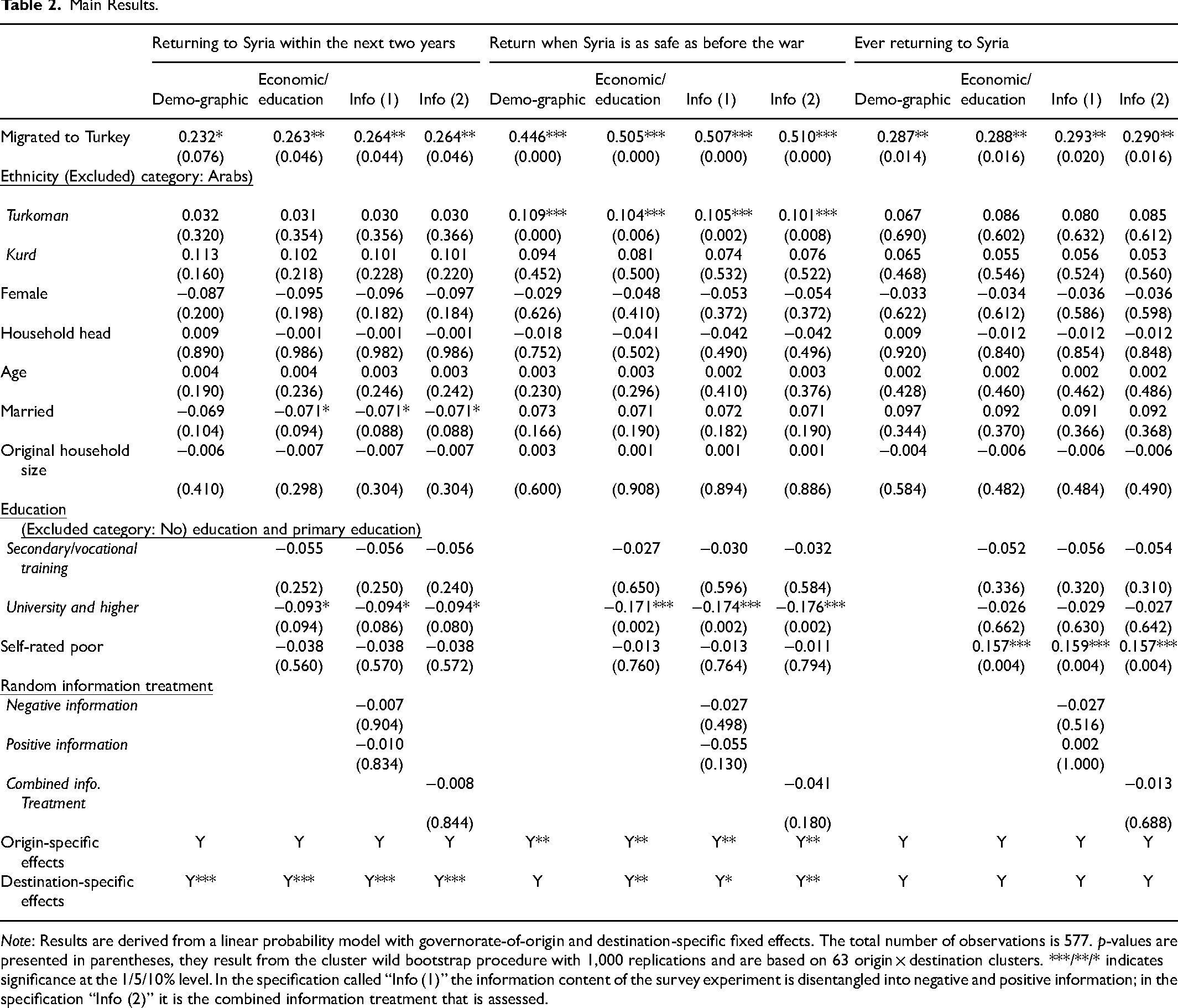
Note: Results are derived from a linear probability model with governorate-of-origin and destination-specific fixed effects. The total number of observations is 577. p-values are presented in parentheses, they result from the cluster wild bootstrap procedure with 1,000 replications and are based on 63 origin × destination clusters. ***/**/* indicates significance at the 1/5/10% level. In the specification called “Info (1)” the information content of the survey experiment is disentangled into negative and positive information; in the specification “Info (2)” it is the combined information treatment that is assessed.
For the most proximate return scenario (i.e., within two years), one finding stands out. Those who were married were less inclined to have intentions of an early return. For the other scenarios, marriage was associated with increased return probabilities, although the association was not statistically significant. The positive coefficient associated with marriage in the latter two scenarios might represent the desire to bring the family back to the origin-country one day but not in the short run that is associated with danger. Furthermore, those who identified as Turkomans were more likely to indicate that they would return to Syria when it was as safe as before the war. The increase in probability was roughly 10 pp and statistically significant at conventional levels. The increased return propensity by Turkomans might suggest that those with an ethnic link to Turkey felt safer returning to Syria and potentially to Turkey again (Eastmond 2006) compared to the excluded category, that is, Arabs.
Now, we turn to the role of education and economics for return migration decisions. Importantly, we show that those with the highest education level (i.e., university and higher) were least likely to be willing to return any time soon. The effect was around 9 (17) pp for the scenario of return within the next two years (return when Syria was as safe as before the war) and statistically significant at the 10 (1) percent level. Note that even for those with secondary education and vocational training, return probabilities were reduced, yet the effect was not statistically significant, which is likely a result of the small sample. We deduce that the educated elite was less likely to have return intentions, implying brain drain and potentially severe negative repercussions for reconstruction in Syria. Education's role in return migration decisions was also reinforced by the qualitative data that we collected. One of the most cited reasons for staying outside Syria was related to children's education or a better future (88 citations, 23 percent of the respondents). In the Online Appendix (Part 2, Table A.2) we provide some exemplary quotes. In addition, economic aspects mattered for those who considered return in the long term. Those who considered themselves poor prior to the war were considerably more likely to indicate their return in the long run (16 pp, p-value ≤ .05).
Survey Experiment
Next, we isolated the influence of new information. Results show that new information, no matter whether positive or negative, reduced the likelihood of return migration. Yet, the actual effect size was small in comparison to the effects associated with the socio-economic variables, and the coefficient estimates were not statistically significant, suggesting that new information did not systematically influence the decision to return. The lack of a reaction to the presented information demonstrates how challenging it is for host governments to reach refugees, even with supportive messages. Put differently, information shared on the spot or simply handed over in a refugee agency is unlikely to impact refugees’ decision-making. This finding held whether we disentangled the information content as presented in the empirical specification called “Info (1)” or considered the combined information treatment (“Info (2)”). Our finding is supported by Turton and Marsden (2002), who showed that only when the media place massive attention on the benefits of return remigration can be potentially induced.
In short, we identify the selection of host country as a key determinant for considerations about return migration. In addition, we observe brain drain, that women might be less willing to return, and that those who self-classified as poor were more likely to consider a return in the long run. New pieces of information, in turn, did not affect decision-making about return substantially.
Results of the Backward-Looking Model
Thus far, our analysis of determinants of return migration has been informative but limited when it comes to the multiple aspects that affect refugees’ decision-making about return (compare the empirical and theoretical literature on refugees’ return migration section). Therefore, we also conducted a partial correlation analysis to identify whether escape-related variables and perceptions of the current situation were associated with return migration intentions. This model is backward-looking as it incorporates past decisions and the perceived status quo. It is meant to give an indication of the interrelatedness of the decision-making processes. Results are presented in Table 3. We show that once the selection of host-country is accounted for, the cost of escape seemed to be truly sunk, and this cost did not affect considerations about return migration. Similarly, the loss of a family member during war or escape did not have strong links with return migration intentions. This finding deserves a second thought as it suggests that even traumatic events associated with the origin-country do not play a strong role when refugees think about the return. In turn, the deliberate decision not to keep assets in Syria appears to have implications beyond the escape and to be related to re-migration intentions. Those who had no assets left in Syria were between 11 (p-value ≤ .01) and 20 pp (p-value ≤ .01) less likely to consider return an option, highlighting that the decision-making about re-migration starts prior to leaving the country. The finding is further reinforced by the qualitative data, showing that those who state that they have no more ties with Syria also do not intend to return (Online Appendix, Part 2). The sense of cutting ties with Syria was most expressed among refugees who made it to Germany.
Backward-Looking Partial Correlation Analysis.
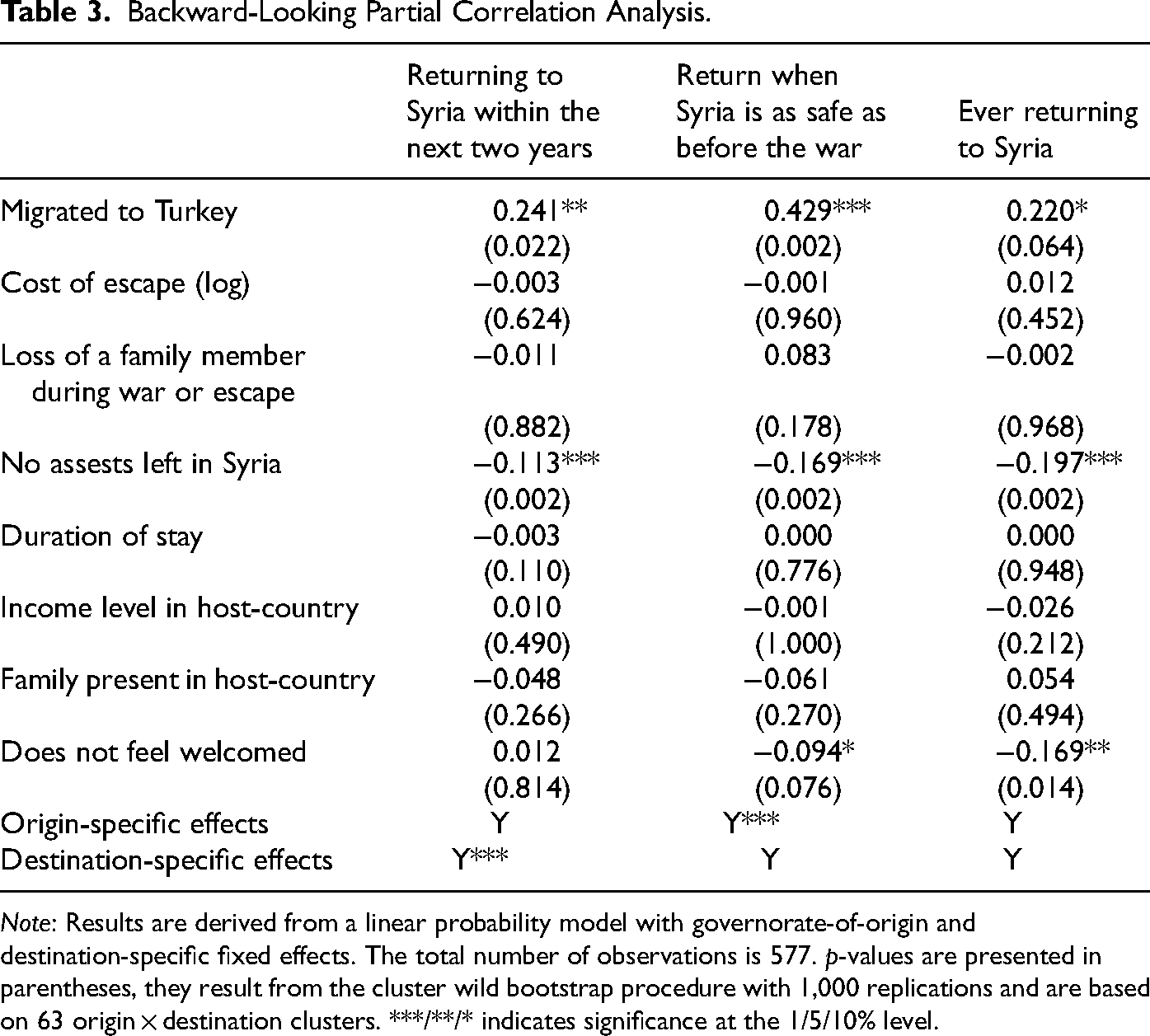
Note: Results are derived from a linear probability model with governorate-of-origin and destination-specific fixed effects. The total number of observations is 577. p-values are presented in parentheses, they result from the cluster wild bootstrap procedure with 1,000 replications and are based on 63 origin × destination clusters. ***/**/* indicates significance at the 1/5/10% level.
Next, we turn to host-country attributes. While extended stays in the host-country are often considered factors that hinder return migration (Dustmann 2003a), we did not find a relationship between any of the three return scenarios and duration of stay. The estimated correlation was small, changed signs, and was statistically insignificant. We attribute this lack of a relationship between the length of stay and return migration intentions to the short-term setting of our study. The average respondent had stayed less than 3.5 years (39 months) in the host-country, and fewer than 10 percent of respondents had stayed five years or longer. Thus, the experience of leaving the origin-country was, for most respondents, close, whereas integration and adaption to the new culture are only at the beginning in these initial 3.5 years of stay. As time goes by, we expect that duration of stay negatively affects return intentions (Jensen and Pedersen 2007).
It is noteworthy to mention that the income level in the host-country was not systematically linked to re-migration intentions when we jointly account for the host country's underlying structural factors, that is, the place of settlement. Moreover, the literature on refugees further suggests that the settlement process and the link with the origin-country largely impact whether refugees want to leave or stay in the host-country (Joly 2002), aspects we address in what follows. Family presence in the host-country reduced return intentions for the proximate scenarios, suggesting that there is a role for network effects. Yet, the coefficient estimate was comparably small and imprecisely estimated. For the long-term scenario, we observed a change in sign.
Moreover, we observe interesting dynamics concerning the feeling of being welcomed. Not being welcomed was not related to the very immediate return scenario (i.e., return within two years). But return when Syria was safe as before the war and ever returning were less likely when respondents did not feel welcomed in the host-country. This identified reduced return likelihood by refugees who did not feel welcome possibly presents a situation of reverse causality, suggesting that those refugees who wanted to stay struggled most with situations that showed them that they were not welcomed. The effect ranged between 10 (p-value ≤ .10) and 19 pp (p-value ≤ .05). Thus, the extended model highlights that the decision-making process about return starts prior to leaving the origin-country and is further affected by the feeling of being welcome in the host-country.
Results of the Forward-Looking Model
In addition to the backward-looking model, we set up a forward-looking model that links return migration intentions to expectations for the future situation in Syria. Results are presented in Table 4. Interestingly, when it comes to expectations for Syria, the selection of host country lost importance. Those refugees who valued freedom of speech were less likely to return in the short run (−44/−19 pp, p-value ≤ .01/.05); in the long run, they were more likely to return, yet the effect was statistically insignificant. Support for the freedom to elect political representatives was positively, albeit insignificantly, associated with the return. The effect was sizeable, suggesting that the lack of significance might be linked to the small sample. Freedom of belief did not play a role — a finding that is not surprising, since our sample was almost 98 percent Muslim. Interestingly, those who valued the presence of civil society were more likely to indicate that they would return when Syria was as safe as before the war (19 pp, p-value ≤ .05).
Forward-Looking Partial Correlation Analysis.
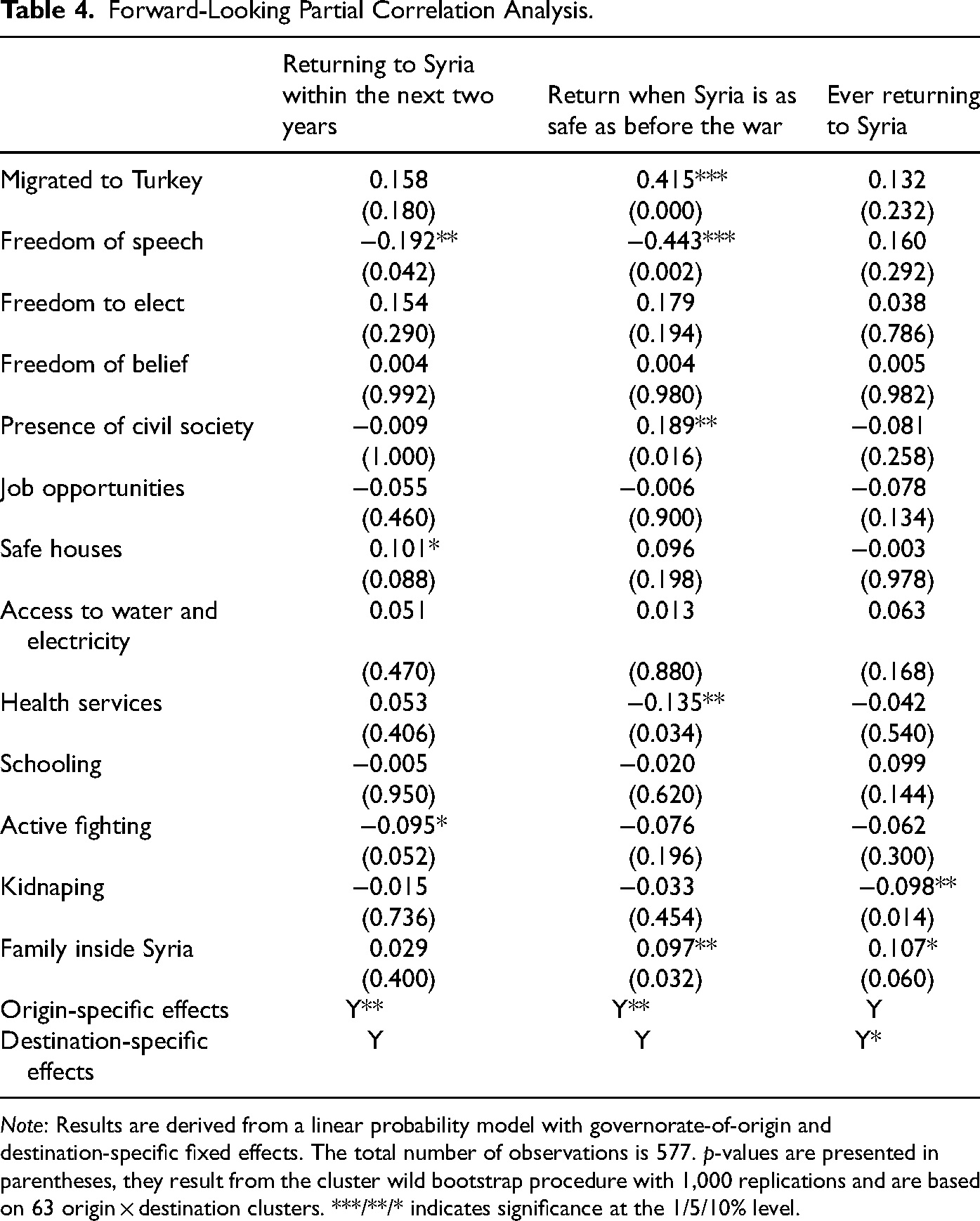
Note: Results are derived from a linear probability model with governorate-of-origin and destination-specific fixed effects. The total number of observations is 577. p-values are presented in parentheses, they result from the cluster wild bootstrap procedure with 1,000 replications and are based on 63 origin × destination clusters. ***/**/* indicates significance at the 1/5/10% level.
In terms of infrastructure and opportunities, we did not identify a single most prominent category that was chiefly associated with return migration intentions. Neither job opportunities nor safe houses, access to water and electricity, health services, or schooling came out strongly. For those considering return within the next two years, safe houses were important (10 pp, p-value ≤ .10).
In turn, those who placed a high value on health services were less likely to indicate that they would return to Syria if it was as safe as before the war (−14 pp, p-value ≤ .05). A high valuation of health services was also negatively associated with return in the long run, although the effect was only about one-third in size and statistically insignificant. Moreover, across specifications, active fighting in Syria and kidnaping were negatively associated with return migration intentions, pointing to the large role refugees attributed to security. In our qualitative data, the most frequently cited reason for not returning was “the security situation in Syria,” with 168 citations (61 in Germany, 107 in Turkey). In the Online Appendix (Part 2), we provide a discussion and some suggestive quotes referring to lack of stability and security, “The Regime,” and torture as reasons for not wanting to return. In turn, having family in Syria increased the interest in returning across scenarios. Family ties inside the country were associated with increased return probabilities of 10 pp for those who considered returning if Syria was as safe as before the war (p-value ≤ .05) and for those who considered returning in general (p-value ≤ .10), pointing once more to the role of family networks for (return) migration decisions. To sum up, our attempt to match return intentions with expectations about Syria further underscores that rapid and large-scale return migration cannot be expected as long as the lingering security issues are not solved. (Family) ties with the country seem too weak to outweigh aspects of personal freedom and security (compare also the qualitative findings in Part 2 of the Online Appendix).
Conclusion
Understanding decision-making about return migration, particularly for refugees, is not an easy task. To support refugees’ decision-making and a fact-based policy discussion, it is important to provide informed, data-driven information from refugees themselves to host-country policymakers as well as the larger public to circumvent populist speech (Holmes and Castañeda 2016; Amaral, Woldetsadik, and Armenta 2018). This article presents a quantitative attempt to disentangle the structural and individual-level factors associated with Syrian refugees’ possible return migration. We contrast Syrian refugees in a highly developed, distant country providing high-level protection, Germany, with those in a neighboring country that accepted most Syrian refugees yet as temporary guests, Turkey. Our results are as follows: refugees in Turkey were more likely to indicate their willingness to return, compared to those in Germany. Even when asked about the eventual return at some point in the future, 45 percent of respondents in Germany and 24 percent of respondents in Turkey stated that they never wanted to return.
Concerning determinants of return, (i) women and the educated elite had a lower willingness to return, and (ii) those who were married were less inclined to return in the short run, yet (iii) those who identified as poor indicated their return in the long run. We also analyzed whether random exposure to information regarding return impacted refugees’ intentions. We found a negative, albeit insignificant, impact, suggesting that new information did not necessarily influence the return decision. The lack of impact from new information demonstrates how challenging it is for host governments to reach refugees, even with supportive messages. In turn, the decision-making process starts prior to leaving home: refugees who deliberately left no assets behind were less inclined to return. Moreover, return migration intentions were affected by those who stayed behind. The analysis underscores the complexity of decision-making about the return that goes beyond the populist speech observed in some host-countries (e.g., Holmes and Castañeda 2016; Amaral, Woldetsadik, and Armenta 2018).
We do not want to conclude without acknowledging that this research suffered from several limitations that must be taken into consideration when assessing the findings. First, we could not employ random sampling, yet we aimed to obtain as representative a sample as possible by relying on a fairly large number of enumerators with different circles of influence and refugees from different governorates-of-origin and at different host locations. Second, we deliberately reached out to household heads and, given the structure of Syrian families, household heads tend to be men, who make far-reaching decisions, such as return migration (Vulnerability Assessment of Syrian Refugees in Lebanon – VASyR, 2017). As a consequence, our German sub-sample had very few female respondents. Third, ideally, we would have observed returned refugees, allowing us to assess the average duration of stay, instead of stated intentions under different scenarios. However, in mid-2018, Syria was still in a state of war, and for host-countries that allowed many refugees to enter, such as Germany and Turkey, a key policy question was what made refugees want to stay or want to go home (Holmes and Castañeda 2016; Amaral, Woldetsadik, and Armenta 2018). Thus, by presenting different return scenarios, we could get fairly close to obtaining an answer to one of the most pressing questions of host-country governments which are in need of informed advice now, not retrospectively. Fourth, refugees’ attitudes toward future returns do not necessarily predict real returns (Ajzen 1991). Notably, the willingness to return was low among Syrian refugees in Germany, where returns are voluntary (InfoMigrants 2019). In addition, the low willingness to return from Turkey may indicate strong opposition to forced returns, implying that large-scale secondary movements are possible if Syrians living in Turkey start fearing deportation. Chances are high that the majority of Syrian refugees stay outside their home country, at least for a very long time (SchengenVisa 2021). Even in the “2002 repatriation season” of Afghans that is considered the most rapid assisted return movement, more than twice the number of people stayed in the host-countries of Iran and Pakistan, compared to those who returned (Turton and Marsden 2002). Fifth, our sample is fairly small, possibly explaining some of the insignificant findings. Future research should aim for a bigger sample to draw even more nuanced conclusions.
What, then, have we learned? The context of reception matters as well as refugees’ social background and other individual characteristics of refugees. Furthermore, if large-scale return migration is desired, policymakers should try to better understand refugees’ preferences and concerns. By understanding refugees’ decision-making process, host-country governments can reach out to them more effectively. Host-country governments should take the time to engage with refugees (Turton and Marsden 2002) and base policy decisions on micro-level evidence (Al-Rasheed 1994). The situation in Syria continues to be unstable, and it remains to be seen whether the country can find a way back to peace in the near future. As our data show, the war's end will not be enough for all refugees to consider returning. Consequently, host-countries should invest in the integration of those refugees who are willing to assimilate. Taking the stance that the presence of Syrian refugees is entirely temporary is not what the data suggest. Finally, to better understand refugees’ perspectives, future research should assess their preferences and aspirations in more detail and examine how preferences and aspirations might change with the duration of stay and experiences accumulated in the host-country. Such research could feed into decisions about the type and scope of effective integration, as well as return migration and repatriation programs.
Supplemental Material
sj-docx-1-mrx-10.1177_01979183221142780 - Supplemental material for Determinants of Intended Return Migration among Refugees: A Comparison of Syrian Refugees in Germany and Turkey
Supplemental material, sj-docx-1-mrx-10.1177_01979183221142780 for Determinants of Intended Return Migration among Refugees: A Comparison of Syrian Refugees in Germany and Turkey by Nawras Al Husein and Natascha Wagner in International Migration Review
Footnotes
Declaration of Conflicting Interests
The author(s) declared no potential conflicts of interest with respect to the research, authorship, and/or publication of this article.
Funding
The author(s) received no financial support for the research, authorship, and/or publication of this article.

Supplemental Material
Supplemental material for this article is available online.
Notes
References
Supplementary Material
Please find the following supplemental material available below.
For Open Access articles published under a Creative Commons License, all supplemental material carries the same license as the article it is associated with.
For non-Open Access articles published, all supplemental material carries a non-exclusive license, and permission requests for re-use of supplemental material or any part of supplemental material shall be sent directly to the copyright owner as specified in the copyright notice associated with the article.
