




Abstract
This article studies how return migration aspirations are formed and realized in the context of protracted displacement. Drawing on a mixed-methods study that included survey research and in-depth interviews in Turkey, Lebanon, and Syria conducted, we study whether respondents aspired to return (i) currently, with the conflict still ongoing; and (ii) in the future, if the war were to end. Our analyses reveal how broader life aspirations play a crucial role in shaping return aspirations, and how current and future return aspirations are separate concepts. Current return aspirations were strongly stratified. For economically vulnerable respondents, current return considerations were often related to survival, whereas for respondents from the educated middle class, current return aspirations were part of their broader life aspirations. Aspirations to return after the war's end were largely driven by a wish to realize broader life goals. Future return aspirations often functioned as a mental coping strategy to keep hope for change in the future — including political change — alive. Return abilities favored those with higher socioeconomic status, those who had remained neutral in the conflict and those willing to take high risks. Overall, our analyses illustrate the usefulness of the aspirations-abilities framework, and the important role of life aspirations, in understanding return-migration decisions in a context of protracted displacement.
Introduction
Refugees are regularly placed under pressure to repatriate by national and international authorities advocating for their return (Sinatti 2015). On the global policy scene, refugees’ return is often presented as a “win-win-win” scenario for receiving countries, origin countries, and returnees themselves (Sinatti 2015). This idea is largely built upon a sedentary humanitarian discourse which attests that people belong to their homeland in an inherent, naturalistic way (Omata 2013, 1288) and emphasizes that many refugees do in fact want to return “home.” Refugees’ voices are, however, often absent in policy debates on return, and while refugees often voice an aspiration to return to their origin country, many never realize it (Valenta et al. 2020).
A large number of refugees do aspire to return, even in situations of protracted displacement — situations without a clear solution and with no political change in sight. In such contexts, one might assume that hopes and aspirations for a return might dwindle if return obstacles persist, while emotional and material investments and ties in receiving societies increase (Rottmann and Kaya 2021). UNHCR reports, have, for example, highlighted that Syrian refugees in the Middle East have high aspirations to return to Syria. A study conducted in Egypt, Lebanon, Jordan, and Iraq, for example, showed that 75 percent of Syrian refugees aspired to return “home” once the conflict is over and that the numbers of those aspiring to return were increasing (UNHCR 2019). Return aspirations of Syrian refugees residing in Europe are lower: A study reported that 55 percent of refugees interviewed in Germany desired to return to Syria one day (Husein and Wagner 2020), whereas only a fifth of Syrians with a temporary asylum permit in the Netherlands aspired to return, if possible (Dagevos et al. 2018, 6). Over the past years, there has been a modest but substantial number of returns to Syria: 56,000 in 2018 (UNHCR 2019). These diverse statistics beg the questions of how return aspirations are formed, and how and when they are realized.
To address this question, this article draws on a mixed-methods study conducted between 2018 and 2020 with self-settled, urban Syrian refugees in Turkey and Lebanon, as well as urban returnees in Syria to address this puzzle. An individual-level survey was conducted with 757 respondents in Turkey and Lebanon and was combined with in-depth interviews with 41 refugees in Turkey (n = 21) and Lebanon (n = 20) and seven returnees in Syria. Respondents to the survey and the qualitative interviews in Turkey and Lebanon were asked to reflect on whether they aspired to return to Syria under two different return scenarios: (i) currently, with the conflict still ongoing, and (ii) if the war were to end in the future. Interviewees in Syria were asked about their motivations for their return and their return trajectory.
Through an analysis of this material using the aspiration-ability framework (Carling 2002, 2014; Schewel 2019), this article makes two main contributions to the literature on refugee return, and on return migration more broadly. First, we provide insights into how return aspirations are formed and imagined in a context of protracted displacement — situations in which refugees are in exile for at least five consecutive years, which is currently the case for three quarters of refugees (UNHCR 2020, 20). In particular, our analysis highlights the importance of taking into account refugees’ broader life aspirations, in interaction with individual characteristics and structural conditions, in understanding refugees’ return aspirations. Theoretical literature on migration aspirations argues that broader life aspirations — defined as “people's perceptions of the ‘good life’” (de Haas 2021, 15) — play an important role in migration aspirations (Carling 2014), but return migration, including refugee return migration, has often been omitted in theoretical discussions around migration aspirations (Aslany et al. 2021, 58). We aim to fill this gap, by exploring refugees’ life aspirations and expectations for the future in relation to their potential return migration.
Second, our study shows how time plays a crucial role in how return is aspired and imagined. We find, for example, that life aspirations — including political aspirations — are particularly crucial for refugees’ return aspirations in a distant future, while for current return aspirations, broader life aspirations play an important role for more affluent groups of refugees. We also show that current return aspirations were strongly stratified. Those who aspired to return to Syria under current conditions were those with financial, social and political capital, while other — more economically vulnerable — groups considered returning currently mostly as a survival strategy. Future return aspirations, on the other hand, served largely as a mental coping strategy across socio-economic profiles to keep hope for a change in the future alive without concrete intentions to return. Based on these findings, we argue that current and future return aspirations are two distinct analytical categories which should be treated as such in research on (refugee) return aspirations.
In the following, we first conceptualize refugees’ return aspirations and life aspirations. We then elaborate on the empirical context of our case study and present our research design and methods. The third part elaborates on the present and future return aspiratsaions of our respondents and the role of life aspirations in the formation of return aspirations in these two different scenarios. The final part summarizes our findings, discusses the limitations of our study and identifies possible avenues for future research.
Conceptualizing Refugee Return Aspirations
Research on refugee return has mostly focused on structural incentives for return, such as access to services and employment opportunities in receiving countries, and security and possibilities of property restitution in origin countries (cf. Rottmann and Kaya 2021). For example, research on Syrian refugees’ return intentions has focused on safety considerations, livelihood opportunities, and access to shelter and basic services (UNHCR 2019), on asset ownership and access to education (Husein and Wagner 2020), and on living conditions and legal status (Valenta et al. 2020). Some recent studies on refugee return have also focused on the more emotional or “affective” dimensions of return decisions. Perez Murcia (2019), for example, studied the memories of home in displacement, arguing that home is consistently experienced by the displaced as a tension between “here” and “there” or “nowhere.” This literature draws inspiration from a more general, recent trend in migration studies to focus on the emotional dimensions of migration decisions (e.g., Collins 2017).
The overall focus on structural conditions in the refugee return literature was inspired by broader theoretical work on return migration, which has mostly focused on labor migration, building on neoclassical insights, the new economics of labor migration (NELM) approach, structural approaches, transnationalism and social network theory (Cassarino 2004; Hagan and Wassink 2020). Recent scholarship on return migration focuses for instance on states’ role in shaping return migration through their policies or institutions. Most of this literature on return policies, however, focuses on return policies of Northern receiving states, especially in “organized” or “forced” return contexts (Kalir and Wissink 2016) or so-called “assisted voluntary” return (c.f., Alpes 2021; Cleton and Schweitzer 2021). Some attention has also been given to return policies of neighboring receiving states in the Global South (Fakhoury and Ozkul 2019; Içduygu and Nimer 2020; Şahin Mencütek 2019).
However, much of this literature does not consider the return aspirations of migrants or refugees and their agency, albeit different levels, in their return journeys and decisions. The aspiration-ability framework (Carling 2002, 2014; Schewel 2019) and recent extensions of it provide a useful framework for exploring these questions. The framework has been used to study a wide variety of migration types, as almost all migrants, including those who are displaced, are considered to have some form of agency (Carling and Schewel 2018; de Haas 2021). 1 Yet, to our knowledge, it has not been applied to a return context in conflict settings.
The concept of migration aspirations emphasizes the importance of migrants’ agency, as it assumes that migrants exert agency over their migration decisions (Carling 2002, 2014; de Haas 2021; Schewel 2019). In fact, the “act” of aspiring itself can be seen as an expression of agency (Borselli and van Meijl 2021). The aspiration-ability framework, therefore, allows us to study the interaction between structure and agency. The aspiration-ability framework conceptualizes migration decisions “as a function of aspirations and capabilities to migrate within given sets of perceived geographical opportunity structures” (de Haas 2021, 2) and, therefore, allows us to incorporate the role of migration policies and associated barriers to migration in the analysis to better understand different hierarchies of globalization and the phenomena of non-migration more broadly.
The framework distinguishes between two steps in the migration process: first, the wish to migrate (aspiration) and, second, the realization of this wish (ability) (Carling and Schewel 2018). The aspiration to migrate has been generally defined as a belief that migration is preferable to staying (Carling 2002; Carling and Schewel 2018; Czaika and Vothknecht 2014; de Haas 2014). When people have a desire to migrate, their ability to do so is dependent on context-specific and macro-level obstacles and opportunities, described by Carling and Schewel (2018, 947) as “the immigration interface.” This interface includes different sets of barriers and requirements. It comprises a range of possible modes of migrating, either in compliance with or in defiance of the various migration regulations, such as legal labor migration, family reunification, asylum migration, and visa overstaying.
While return policies of host countries have been studied in recent years (Fakhoury and Ozkul 2019; Içduygu and Nimer 2020; Şahin Mencütek 2019), how returning refugees perceive return policies and other macro-level obstacles — what we call “the return interface” — has not been studied so far. We define the “return interface” as the macro-level set of barriers and requirements to return migration. These barriers and requirements can include legal obstacles, obstacles to a safe return such as security-apparatus measures, or obstacles to a sustainable livelihood upon return. How refugees react to the return interface may differ from that the immigration interface as ongoing violence, persecution, and insecurity add an additional layer in refugee return aspirations and decisions.
The Role of Life Aspirations
The literature on migration aspirations has focused on migration's instrumental and intrinsic value, with migration aspirations representing either an intrinsic yearning for mobility or a yearning for a specific life-making project related to economic objectives or social mobility (Carling 2014). Along the same lines, de Haas (2014, 23) defined migration aspirations as a function of people's general life aspirations and perceived spatial opportunity structures (see also Carling and Collins 2018). Life aspirations are highly influenced by individual perceptions of local and remote socio-economic opportunities (Carling and Collins 2018; Collins 2018; de Haas 2021). Individuals with different socio-economic characteristics are likely to develop different life aspirations, as they have different perceptions of opportunities in certain contexts (de Haas 2021), which can explain why some individuals leave whereas others stay while facing similar circumstances.
Building on this framework, we examine how refugees’ broader life aspirations interact with structural conditions and individual characteristics in forming return aspirations (Figure 1). Based on previous works by Carling and de Haas, we define a return aspiration simply as a conviction that return is preferable to staying or leaving to go elsewhere; it can vary in degree and in the balance between choice and coercion. Following De Haas (2021, 15), we define life aspirations as “people's perceptions of the ‘good life’. Life aspirations are highly subject to change and may change over people's migration and displacement trajectory (Czaika and Vothknecht 2014). As individuals move through different life stages and are confronted with changing societal conditions, their life aspirations are likely to change, which in turn affects their migrations aspirations (de Haas 2021). We therefore separate current and future return aspirations in the conceptual model, to account for the potentially changing nature of return aspirations. The following section gives a brief overview of the empirical context of our study, sketching the legal context for Syrians in Lebanon and Turkey as well as current conditions for returnees in Syria.
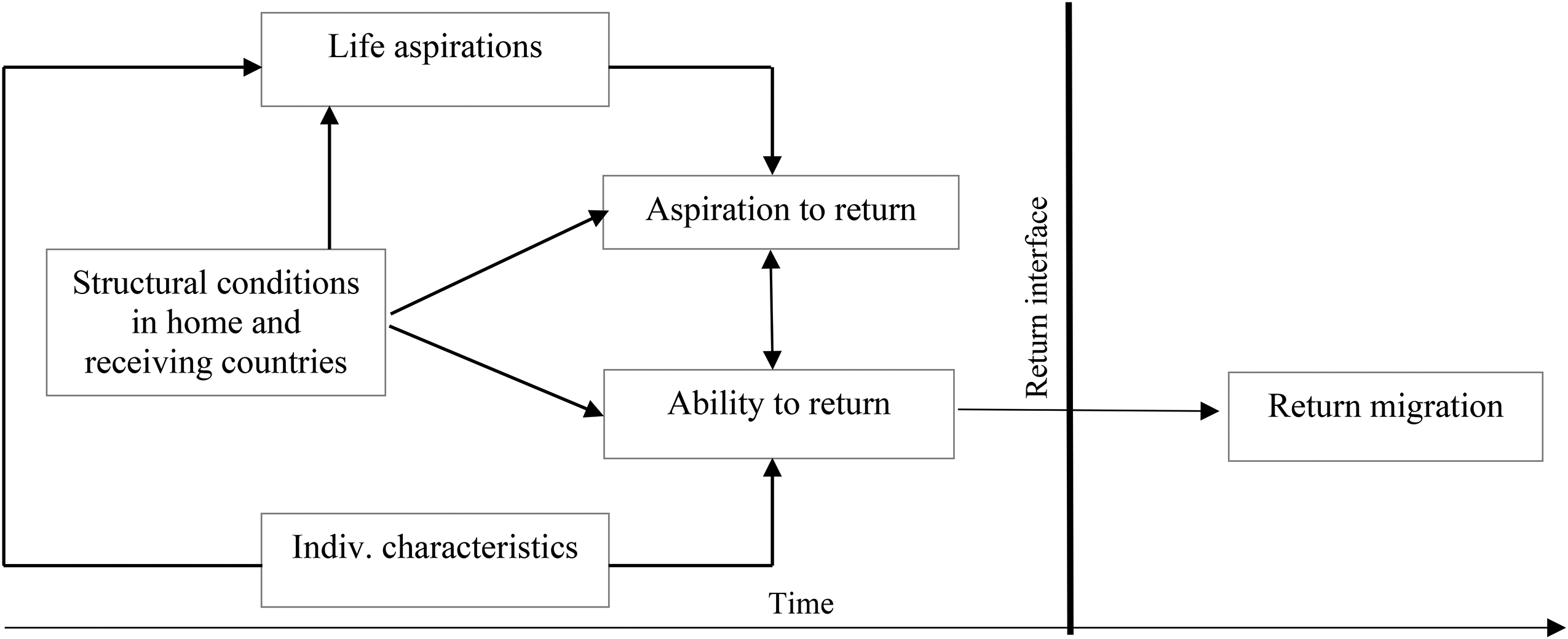
Conceptual model.
Empirical Context
Turkey and Lebanon host a significant share of the global Syrian refugee population, even if quantifying refugees’ numbers remains a difficult undertaking (Sarzin 2017). Turkey currently hosts the world's largest refugee population, with 3.7 million registered Syrians, as of May 2022 (UNHCR 2022). Lebanon has one of the highest refugee-domestic population ratios worldwide, with one-quarter of the country's population considered refugees and government estimates of Syrian refugees of more than 1.5 million (UNHCR 2021).
Reliable statistics on the Syrian refugee population in Lebanon and Turkey are a challenge, given the high percentage of unregistered Syrians with either no legal status or an alternative stay permit (see also our discussion in the online appendix on how this fact impacted our quantitative and qualitative sampling strategy). 2 Overall, Syrian refugee populations in Lebanon and Turkey are young and urban: roughly half are female, and more than half are below the age of 24 (Erdoğan 2019, 7; ILO 2014, 18). The majority of Syrian refugees in Lebanon and Turkey have lived in urban areas in private accommodation (Bircan and Sunata 2015, 230; Kabbanji and Kabbanji 2018, 11; UNHCR 2022).
Syrian refugees in Turkey and Lebanon do not have the legal possibility to obtain a fully-fledged refugee status. Syrians in Turkey are placed under the Temporary Protection (TP) regulation, which includes the principle of non-refoulement, the right to legal stay and access to health and education services (Ineli-Ciger 2014; Toğral Koca 2016). However, the TP regulation does not bestow the explicit right to work. In Lebanon, the Lebanese government does not provide legal protection or issue resident permits based on UNHCR registration. while Syrians who are registered as “refugees” with UNHCR solely have access to — limited — humanitarian aid. Furthermore, in 2015, the Lebanese government suspended UNHCR registrations and since 2014/2015, new restrictions on entry and on applying for and extending residence permits have been in place (Janmayr 2016). Without a valid permit, Syrian refugees may be detained by Lebanese authorities and forcibly returned to Syria (Human Rights Watch 2016). In Lebanon, Syrian refugees are legally allowed to work in construction, agriculture, and cleaning, but since 2015, those registered with UNHCR were no longer permitted to work, resulting in a situation where the vast majority of Syrians work in the informal sector (Kahwagi and Younes 2016).
Return had become a highly sensitive and politicized topic by the time our research for this article took place in 2018. In both countries, starting from 2016, state and non-state actors put policies in place to pressure Syrian refugees to return, and to facilitate this process (Içduygu and Nimer 2020, 420). In Lebanon, for example, non-state actors such as Hezbollah, al-Assad's ally, negotiated the repatriation of Syrian refugees with militant groups. Hezbollah, in cooperation with the General Security Office, opened several offices across Lebanon where refugees could register for return. Similarly, Turkey increasingly encourages returns to opposition-controlled areas in Syria by collaborating with local pro-Turkey actors (Içduygu and Nimer 2020, 421). Also, Turkey's military incursions into northern Syria had clear implications for return, with President Erdoğan repeatedly mentioning the possibility of creating a safe zone in northern Syria and returning refugees (ibid.). In parallel to the emergence of return policies in neighboring host countries, the Syrian regime has closely monitored who returns, with returnees checked both before and upon return by security forces (Fröhlich and Müller-Funk, 2022).
Those Syrians who return to Syria face a context characterized by ongoing persecution, violence, and an extremely difficult economic situation: While violence has waned in many parts of the country, the impact of present and past hostilities on civilians remains the principal driver of humanitarian needs, according to the United Nations Office for the Coordination of Humanitarian Affairs (OCHA 2019, 5). An estimated 11.7 million people were in need of various forms of humanitarian assistance in Syria in 2019 (OCHA 2019, 5). In 2019, basic services such as healthcare, shelter, food, education, water, and sanitation were widely lacking, and the physical destruction was immense: throughout the war, 53 percent of the Syrian population living in urban areas was affected by aerial bombardments and fighting within towns and cities (REACH and UN 2019, 1). The national economy suffered on all levels. While estimations vary, in 2016, the Syrian gross national product decreased by two-thirds (63 percent) from its 2010 level (Vignal 2018). According to 2015 estimates, 83 percent of Syrians lived below the poverty line (OCHA 2019, 6). Despite these difficult conditions, modest numbers of Syrians residing abroad return to Syria (UNHCR 2019). The remainder of the article aims to explain which groups of refugees aspire to return to Syria and why, now and in the future.
Research Design and Methods
This article is based on a mixed-methods research project on the migration aspirations of Syrian refugees residing in four cities in Lebanon and Turkey (Beirut, Tripoli, Istanbul, Izmir). We draw, first, from an individual survey (n = 757) conducted with urban Syrian refugees in these cities in the seventh year of the conflict (2018). Second, we use 41 qualitative interviews conducted in the same localities in 2018, as well as seven qualitative interviews conducted with returnees across Syria in 2020, to identify the mechanisms underlying the quantitative patterns. Data were collected in collaboration with a team of young Syrians who had experienced displacement themselves and who had worked in various non-governmental organizations (NGOs) supporting Syrian refugees. Working with Syrian research assistants followed a participatory logic, and the wish to increase trust among respondents (c.f. Müller-Funk 2020), especially in a context where hostile political discourses on return were omnipresent as mentioned above.
Our research design was a fully mixed, sequential, and equal-status design that mixed qualitative and quantitative research within one or more, or across, stages of the research process (Leech and Onwuegbuzie 2009, 271). We integrated the qualitative and the quantitative research components in the following two ways.
First, our data collection was sequential (i.e., the qualitative and quantitative part and participant selection strategies built upon each other). With our sampling strategy, we wanted to capture both typical profiles of respondents emerging from the survey and “divergent” profiles which were missing in the view of our Syrian research assistants and which were more difficult to capture with the survey. These divergent profiles included higher-educated Syrians, non-Sunni Syrians, and non-Arab Syrians. While the survey's selection strategy was designed to gain insights into the typical profiles of the Syrian urban refugee population, qualitative data collection aimed for diversity in terms of the dependent variable (migration aspirations) and key socio-economic characteristics (gender, educational attainment, religious and ethnic belonging) through purposive sampling. Interviews with returnees in Syria built on the qualitative interviews with Syrian refugees, insofar as we wanted to grasp how returnees had concretely overcome the return obstacles which had been mentioned in interviews in Turkey and Lebanon.
Second, the analysis was integrated into the following four ways. First, individual and structural factors that appeared to be most important in qualitative interviews were included in the regression models if the survey covered these factors. Second, we analyzed survey findings by drawing on the qualitative data to identify mechanisms underlying the quantitative patterns. Third, the qualitative data also helped us understand the survey data's limitations. For example, the survey data revealed little about refugees’ imaginations of a future life in Syria, political return obstacles, and the concrete return abilities linked to them, but the qualitative data, including the follow-up interviews with returnees in Syria, helped us fill these gaps in the analysis. Fourth, when interpreting the qualitative findings, we returned to the quantitative data to reflect on the subset of cases to which they apply. Integrating the qualitative and quantitative approaches has, thus, been essential to our conclusions. The remainder of this section accounts for the qualitative and quantitative aspects of our data and methods.
Quantitative Data and Methods
Our survey aimed to collect data to explore the relations between migration (including return) aspirations, perceptions of living conditions in the receiving country, and imaginations of living conditions in a European destination country. In this article, quantitative data are used to explore how a range of individual and structural variables relate to the current and future return aspirations of Syrian refugees in Lebanon and Turkey (see the Online Appendix for a detailed discussion of each variable included in our models).
The survey had a purposive sampling design, focusing on Syrians living in private accommodation in two cities (including suburbs) in each country, with the objective of capturing the typical lived reality of the average adult urban Syrian refugee. Data collection in border regions had to be excluded for security reasons (see online appendix for details about the sampling strategy and limitations of the quantitative data). Data collection focused on relatively young adults (18–39 years old), as this age cohort is seemingly the most prone to mobility (Timmerman, Heyse, and Van Mol 2010). The survey included a 50:50 gender quota to account for the fact that approximately half the Syrian displaced population in Lebanon and Turkey is female (UNHCR, UNICEF, and WFP 2017, 65; DGMM 2020). Survey questions covered, among other things, the respondent's individual characteristics, migration and flight trajectory, different domains of life in the receiving country, and migration aspirations. Survey interviews were conducted face-to-face in Syrian Arabic by native speakers, with the project lead being present during the entire data collection. This strategy resulted in a high response rate of 82.9 percent in Turkey and 83.6 percent in Lebanon. 3 Data collection also allowed the research team to gain deep insights into respondents’ living conditions, as we visited their homes and had many additional informal conversations.
Table A.1 in the Online Appendix contains an overview of survey respondents’ characteristics (n = 757), which largely align with available statistics. Respondents were, on average, 29 years old, 50 percent were female, 69 percent were married, and 63 percent had children. The vast majority of survey respondent were Sunni Muslims (94.1 percent) and spoke Arabic as their main language; 10 percent spoke Kurdish. The average respondent had attended lower secondary education. Respondents had, therefore, slightly higher educational levels than available statistics would suggest. These higher educational levels could be due to our focus on cities and/or our sampling design, which also included Syrians without UNHCR registration or TP.
Almost half the survey respondents (47 percent) had fled from the Aleppo Governorate; in Turkey, 73 percent of survey respondents originated from this province. Respondents’ lived in precarious conditions in both countries; however, with significantly worse conditions in Lebanon. Some 55 percent had a legal status (84 percent in Turkey and 28 percent in Lebanon). Around 47 percent of respondents had received assistance, such as cash, food vouchers, medical aid, or clothes, during the last 12 months (35 percent in Turkey versus 46 percent in Lebanon). Life satisfaction was considerably lower in Lebanon than in Turkey.
Our analysis used two survey questions as dependent variables. The first question asked whether survey respondents had ever thought about returning with the conflict in Syria still ongoing (current return). The second question addressed an ideal and hypothetical scenario, asking respondents about their preferred mobility choice if they had the opportunity and if the war in Syria ended (future return). Respondents could choose between four options: stay, migrate, return, or return but dependent on the war's outcome. Asking about hypothetical situations was inspired by other surveys which measured respondents’ aspirations in an ideal scenario without any constraints, such as the Gallup World Poll.
The hypothetical future scenario was deliberately phrased in an open way to avoid direct discussion of respondents’ political opinions, so as to increase participation, and in order to avoid re-traumatization, thereby addressing political issues in a sensitive and self-chosen manner. Return conditional on the war's outcome might, therefore, refer to a regime change, a peace agreement, or safety guarantees. From the analysis of our interviews, we understood, however, that all respondents had conditions for returning in the future. Given that a future return was never truly unconditional, we recoded the two future return categories into a single one and draw on the qualitative data to illustrate the conditionalities of a future return.
Qualitative Data and Methods
The interview guide followed the survey's topics but left space for personal narratives. We asked open questions related to respondents' life histories and current living conditions before addressing their migration aspirations and their imaginations about life elsewhere. The interviews helped us understand how migration aspirations were related to other options, including staying in the country, returning to Syria, or migrating elsewhere. Respondents also talked about their political opinions and traumatic experiences in Syria and their hopes for, and imaginations of, the future. Interviews were conducted in people's homes or local cafés depending on the respondent's wish in Syrian Arabic by one of the authors and one research assistant and lasted between one and three hours.
Table A.3a in the Online Appendix contains an overview of interview respondents. We interviewed 25 men and 16 women. Respondents often had overlapping migration aspirations: 21 interviewees aspired to return in the future, 26 aspired to migrate, and 13 desired to stay. Twenty-one had attended university, while six had either no or a primary education, eight had attended lower secondary school, and six higher secondary school. Thirty-two interviewees were Sunni Muslim, three Christian, one Alawi, and one Druze; four respondents identified as atheist. Four respondents were Kurdish, two Syro-Palestinian, one Circassian, and one Turkmen. 22 respondents were identified through the survey, 19 were located through personal networks. Compared to the survey data, and as intended, interviewees had, therefore, more diverse profiles in terms of (higher) educational attainment and religious and ethnic minorities.
The second qualitative data collection consisted of seven follow-up interviews with Syrians who had returned to Syria between 2018 and 2020. We wanted to understand how current returnees had overcome the return obstacles that interviewees had mentioned in the first round of fieldwork. Questions covered respondents’ life and flight trajectories, their perceptions of life in Syria, and actors and factors facilitating or constraining return. We aimed to interview people in different parts of Syria (formerly opposition and pro-regime areas) with divergent socio-economic profiles. However, given security conditions in Syria, it proved impossible to conduct interviews across Syria about such a sensitive topic without existing personal relations and trust. Thus, one former research assistant who had returned to Syria conducted the interviews within her extended personal networks. This strategy resulted in interviews with respondents from Damascus, Aleppo, and Rural Damascus Governorate, five of whom had university education, one lower secondary education and one higher secondary education (see Table A.3b in the Online Appendix). These interviews cannot be considered representative for returnees across Syria but rather help us further unpack the abilities needed to overcome the return interface.
Consequently, all interviews were transcribed in Syrian Arabic and translated into English. The data were analyzed, using Atlas.ti software for qualitative analysis with inductive and deductive coding. All names in the texts are pseudonyms due to security reasons. 4 The ways in which respondents imagined a return to Syria after a possible end of the conflict and return obstacles emerged as central elements in most interviews.
Findings: The Role of Aspirations in Current and Future Return Aspirations
Approximately 30 percent of survey respondents had thought about return under current conditions (Table 1). Such reflections were more prevalent among respondents in Lebanon. When asked about migration and stay aspirations in case the war ended, a majority (65 percent) reported to aspire to return, either unconditionally (40 percent) or conditional on the war's outcome (25 percent). These findings are in line with studies that reveal that the majority of Syrian refugees in the Middle East aspire to return “home” once the conflict is over (UNHCR 2019). Aspirations to return, conditional on the war's outcome, were significantly higher in Turkey.
Return Reflections and Aspirations (Descriptive Statistics).
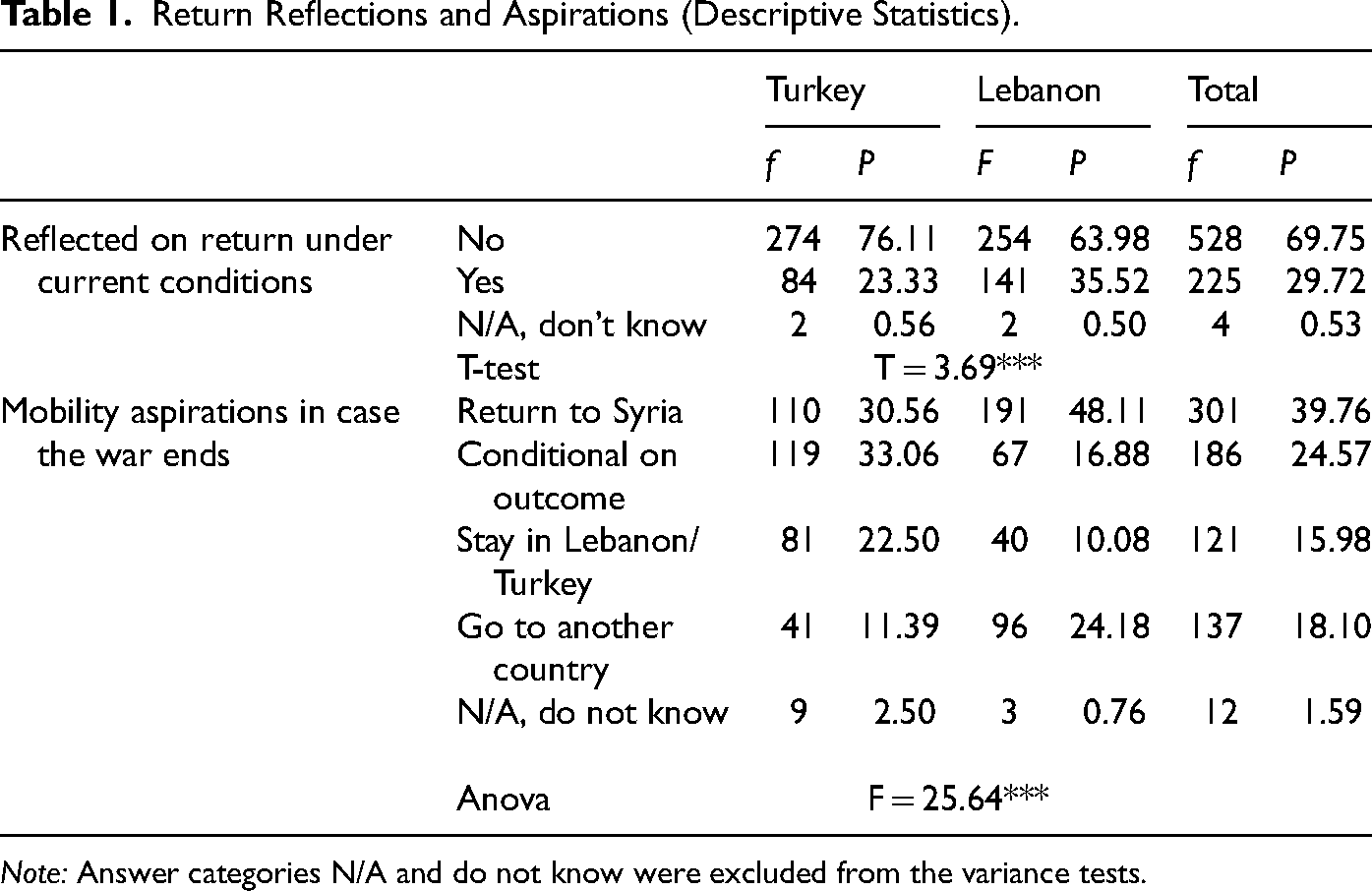
Note: Answer categories N/A and do not know were excluded from the variance tests.
Current return reflections and aspirations to return after the war did not necessarily overlap: of those respondents who considered returning under current conditions, 81 percent aspired to return after the war's end. Also, those residing in Turkey who did not aspire to return after the war mostly wished to stay in Turkey, whereas in Lebanon, the majority of those who did not aspire to return after the war expressed the desire to move to a third country. This begs the question of how current and future return aspirations relate to each other and how they differ, which is what the next two subsections will delve into.
We present a first section on respondents’ current return aspiration and then analyze their aspirations relating to a future return in a second section. In both sections, we start with presenting the regression analyses, and, then, explain the mechanisms underlying the regression models, using the qualitative data. As we show in the first subsection, current return aspirations were strongly stratified. For economically vulnerable respondents, current return considerations were often related to survival, whereas for respondents from the educated middle class, current return aspirations were part of their broader life aspirations. Return abilities favored those with higher socioeconomic status, those who had remained neutral in the conflict and those willing to take high risks. The second subsection shows that aspirations to return after the war's end were largely driven by a wish to realize broader life goals and often functioned as a mental coping strategy to keep hope for change in the future — including political change — alive without concrete plans to realize a return.
Current Return Aspirations Between Survival and Aspirations
The Importance of Individual Characteristics for Current Return Aspirations
Table 2 presents the regression analyses of respondents’ reflections on return under current conditions. First, the models show that several socio-economic characteristics played a significant role in current return reflections, especially those linked to income and education. Respondents with lower secondary education were less likely to aspire to return than those with only primary or no education, whereas those with higher incomes before the war were significantly more likely to aspire to return. These findings corroborate with other studies that highlight education's multi-faceted role in return migration (e.g., McSpadden 2004; Stefanovic, Loizides, and Parsons 2015; van Heelsum 2017). Our qualitative findings suggest that educational attainment affected individuals’ perceptions of the job opportunities and socio-economic positions they could attain in receiving and origin countries.
Return Under Current Conditions.
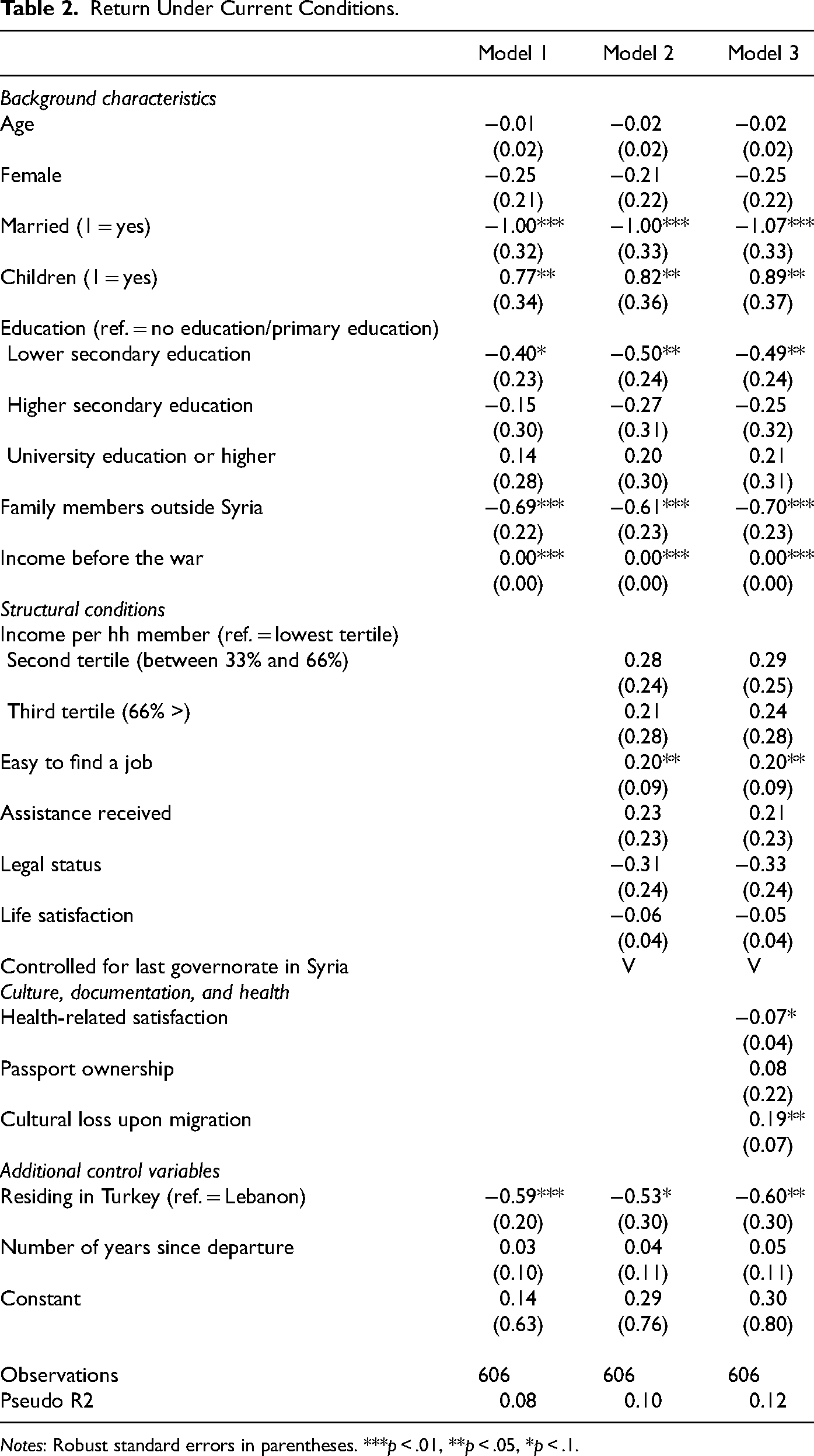
Notes: Robust standard errors in parentheses. ***p < .01, **p < .05, *p < .1.
The significance of lower secondary education is most likely related to the type of job survey respondents had before and after their displacement. Survey respondents with lower secondary education often worked in skilled manual labor in Syria; jobs which are also often more available for Syrians in Turkey and Lebanon, as interviewees explained in qualitative interviews. Some 60 percent of survey respondents who worked in skilled labor in Syria continued to do so after their displacement and experienced, therefore, less professional change and perhaps a less stark social downturn.
The positive finding on income before the war can be linked to two factors, as the qualitative data highlight: first, it is easier for wealthier individuals to generate the funds needed to make a return to Syria less unsafe and to make a living upon return. Second, the significance of income is related to the aspiration to regain lost social status, which might play a bigger role for those who had higher incomes before the war and who faced significant losses in social status after leaving Syria. Other individual characteristics, such as age and gender, were not significantly related to current return aspirations, which contradicts the literature showing that younger people (Stefansson 2006; Tuathail and Dahlman 2004) and women may be less likely to return (McSpadden 2004; Tuathail and Dahlman 2004; Zetter 1994).
Several variables measuring structural conditions in the receiving country, such as income, legal status, assistance and life satisfaction were not significant in our model, which is in contrast to much of the existing research on receiving countries’ conditions for refugee return (e.g., Omata 2013; Saint Pierre, Martinovic, and Vroome 2015; Zetter 1994). The only significant variables related to the receiving country were easiness to find a job and health satisfaction. Respondents who thought it was easier to find a job in the receiving country were more likely to want to return, which is likely related to the type of job respondents found easy to access. Survey respondents often specified that they considered it easy to find a badly paid, insecure job in irregular employment, often in construction, agriculture, and textile production. However, for many, finding employment in such jobs meant a loss of social status, which they were not willing to accept, as is further elaborated upon in the qualitative section. Those who were more satisfied with their health were less likely to consider current return, indicating that medical vulnerability may be a driving factor for current return. In Syria, medical services, if available, are for free, in contrast to Lebanon, where they are private and out of reach for many refugee families, as the qualitative interviews revealed.
Current return aspirations were significantly lower in Turkey and among those respondents who had lived in the Aleppo governorate before fleeing Syria (results available upon request), highlighting especially the importance of return obstacles relating to political factors. Both variables might indicate stronger return obstacles for Syrians who fled from the Aleppo governorate, many of whom went to Turkey. The qualitative data reveal that the significance of last residency (governorate) before displacement is related to specific risks based on the location in Syria that respondents fled from and (assumptions about) their political opinions due to their previous location.
Finally, family considerations and cultural attachment were important for current return aspirations, as married individuals and those who had close family members residing outside Syria were significantly less likely to aspire to return while the war was ongoing. Respondents who felt that migration would lead to a loss of culture were more likely to have current return aspirations, reflecting a strong cultural attachment to Syria. These findings confirm the importance of culture (e.g., Rottman and Kaya 2021) and family in return decision-making (e.g., Omata 2013). In our in-depth interviews, married women often mentioned fears for their husbands’ possible military conscription when reflecting on return.
Overall, the quantitative data reveal that both individual characteristics, particularly educational levels and income, and factors related to the return interface were relevant for current return aspirations. Several variables capturing structural conditions in the receiving country, such as assistance received, legal status, or life satisfaction, did not have the expected significant effect. In the following two sections, we use the qualitative data to first explore how refugees’ broader life aspirations emerge between individual characteristics and structural conditions and influence current return aspirations. We then discuss which resources are needed to overcome the return interface, drawing on the interviews with returnees.
A Stratified Capacity to Aspire
From the analysis of our qualitative data, two groups of respondents emerged who reflected on returning with the war ongoing: (1) refugees living in stark poverty and (2) refugees with a more privileged economic status. The first group had often low educational levels and lived with their children in particularly precarious conditions in the receiving country. Back in Syria, the household head had often worked in skilled or unskilled labor while his wife stayed at home with the children, a lifestyle which had provided them with sufficient income to live a good life, with many owning a house. For these individuals, insufficient abilities to stay, defined as the ability to realize a good life in the place where respondents were living, including financial resources and access to health facilities, were crucial for their return reflections. They were working in the host country in badly paid, insecure jobs in irregular employment in sectors such as construction, agriculture, and textile production, which were rather easy to find but provided insufficient income for daily expenses and medical insurance. Respondents considered returning to Syria either to find alternative income there or to get access to medical treatment. Returning was, therefore, often linked to ideas of mere survival and providing for their families, including their children but also older family members still living in Syria, rather than ideas about “the good life.” This group of respondents was more common in Lebanon, where living conditions were experienced as especially hard. Interviewees referred to this type of return migration as “coerced return” (L4FTr, T2MIst).
Jalal, a 36-year-old father of four, from a Kurdish village in northern Syria, serves as a good example. He had followed a professional training and worked in a gypsum company his family owned, before fleeing Syria in 2011. After a long and unsuccessful journey trying to reach Europe, he and his family eventually ended up in Beirut, where he started to work in construction without a contract. Jalal soon could not pay the renewal fees for their residence permits, and his salary was barely sufficient to meet their daily expenses, including medicine. When he broke his heel in an accident at work, he could not afford surgery without insurance. His heel bone never healed, which prevented him from working. As the family's conditions had become extremely vulnerable in Lebanon by 2018, they decided to return to Syria, where medical treatment was more affordable and where Jalal could get treatment after he received some money from his brother. Returning would also mean being able to survive financially during the months of Jalal's recovery, as they could live in his brother's house, which had remained intact (S6M).
The second group of respondents belonged to Syria's educated middle class before the war. These respondents saw their professional plans and social status shattered through the war and their displacement. Their return reflections were linked to possibilities to realize educational or professional goals upon returning, which they were unable to fulfill in the receiving country. The second group also experienced discrimination in the receiving country but was significantly less vulnerable than the first group. Respondents often highlighted that they felt blocked in their professional advancement. Importantly, these interviewees often had a professional project to which to return in Syria and saw a future there. They often also aspired to stay close to kin who had stayed in or returned to Syria.
The father of one interviewed family, for example, returned from Izmir in 2017, after five years of displacement in Turkey. The father of the interviewee, Hasan a mechanical engineer, worked as a director of a factory located in a suburb of Damascus. The interviewee described their situation as middle-upper class, with the family owning several houses and cars. While the situation in Damascus remained relatively calm, the factory was destroyed in a 2012 bombardment, resulting in the loss of his father's job. Hasan described how the family's wealth gradually depleted over the years. In 2013, when the family's neighbors left for Turkey and with the Syrian–Turkish border still open, Hasan decided to leave. Some months after Hasan's arrival in Izmir, the whole family joined him. With his vast international experience and English skills, his father expected to find a suitable job fast. However, things did not turn out as expected, and he only found a job as a carpenter and a smith, which came as a shock to his father. Hasan described that his father's decision to return was influenced by the stark discrimination he encountered in the Turkish labor market and the loss of social status that came along with it. The improved security conditions in Damascus and the deteriorating health of Hasan's grandfather who had stayed in Syria also played a large role. The next section provides further insights into the abilities needed to be able to realize a return under current conditions.
Overcoming the Return Interface or “Difficulties Come to Average People Who Do Not Know Anyone”
In this section, we analyze the factors related to the “return interface” that Syrians who aspired to return to Syria had to overcome. This section therefore relies on the in-depth interviews conducted with returnees in Syria. The first, most obvious return obstacle in the eyes of many respondents was the ongoing insecurity in Syria and/or the persistence of the Syrian regime. Safety concerns ranged from fears of general violence to fears of targeted persecution and military service. Fears of Syria's secret service were omnipresent, as was a lack of confidence in the regime's guarantees regarding safe return. Respondents who were abroad with family members explained that they would not return out of fear for their husband or son, which can explain why married individuals were less likely to consider returning under current conditions in the regression analysis: There are many Syrians here who are not here because there are bombs in Syria but because we are followed by the security and military forces, we are wanted for the army. These people cannot go back. The majority of families have a son who is wanted for the army. How should they return? […] I don’t feel safe, it's not a safe return. (L15MBei)
Syrian refugees who wanted to return had to apply for security clearance from Syrian security services prior to relocating. In practice, Syrian authorities’ definition and understanding of “security issues” were extremely broad. As a result, approximately 15 percent of all citizens reportedly have security issues (Alpes 2021, 18–20). If during the security clearance process, refugees found that their name was on a blacklist, they had to go through a so-called “reconciliation” process. Reconciliation committees consisted of officers representing the regime's security branches and dignitaries, clerics and officials from the region. During this process, returnees had to share extensive personal information with the Syrian security apparatus, which used such data to blackmail or arrest individuals perceived as a “security threat” (ibid.). The second major return obstacle related to guaranteeing a livelihood upon return, such as repossession or compensation of property, the return of public services and infrastructure, and the necessary economic conditions to rebuild a life being in place.
Interviews with returnees revealed two types of return abilities necessary to overcome these return obstacles with the conflict ongoing. First, respondents who had left Syria for political reasons or to avoid military service, highlighted that they needed financial resources and connections within the security apparatus to make their return as safe as possible. Interviewees needed for instance to pay the exemption fee vis-à-vis military service or inquired whether their name was listed as “a person with a security issue” via contacts they had within the Syrian security apparatus. The Arabic word wᾱsṭɑ was omnipresent in interviews, which translates loosely into “who you know”: The important person was the person who passed us through the checkpoints without showing our identities. He was with the political security. So he did not stop us at the checkpoints… If you know officers who work in the state, especially security people, the Syrian intelligence services, then you will not face many difficulties. Difficulties come to the average people who don’t know anyone who could help. (S3M)
Furthermore, proof of residence or an “entry confirmation” into Lebanon was crucial to be granted exemption from military service. These key documents also favored those with regular residence, often the well-off (S5M). For instance, one returnee, a 25-year-old man from Damascus, whose names had been on a security list because his father had served a six-year-prison sentence for political reasons, explained that his family returned when his father was released from prison and “when the pressures were not the same as before.” He returned to Syria after he paid the exemption fee for military service, after a family member with connections to the security apparatus had taken his name off the security list: “There was a security sign on my name. We fixed the issue in the Department of Immigration and Passports in Syria. Someone from my family came and fixed the matter.”
Second, for those who had remained neutral in the conflict, return abilities were mostly related to the resources needed to rebuild their lives upon return, often including the possibility to return to former property. Interviewees highlighted previous work experience, an existing business, a learned profession, social connections, and property to return to as vital for securing a living: The economic situation in Syria is very bad. The best worker now in the government sector earns SYP 35,000 [per month; EUR 61].
5
I expect a young person who lives alone to need around SYP 100,000 to 150,000. It means SYP 35,000 cannot be sufficient for a family.… There is no economy. (S5M)
Overall, these abilities favored, thus, the return of individuals who were willing to support the Syrian regime, had connections to the security apparatus, or had remained neutral in the conflict as well as those with higher socio-economic backgrounds. These findings point to the importance of political factors in overcoming return obstacles as well as socioeconomic background. This also explains why the numbers of current returns to Syria have been low, given the high number of Syrians who have fled from governorates associated with the opposition and the economic conditions for Syrian refugees in Turkey and Lebanon. Our findings also reveal that some refugees faced such challenging conditions in receiving countries that they considered returning without these abilities, even if it entailed high risks and was ultimately unsustainable.
Imagined Future Return as a Mental Coping Strategy and Hope for Political Change
The Importance of Individual Characteristics and Political Factors for Future Return Aspirations
Our findings on future return aspirations after the war (Table 3) reveal, first, that individual characteristics such as age, sex, and educational attainment played important roles in whether respondents aspired to return. With age, future return aspirations decreased slightly, while men and respondents with children were also less likely to aspire to return after the war. Those with lower and higher secondary education were less likely to consider returning in the future, as compared to those with no or primary education. These findings challenge research showing that older people may be more likely to return than younger ones (Stefansson 2006; Tuathail and Dahlman 2004). However, this might be related to our survey sample that focused on a relatively young age group (18–39). Our findings on educational attainment are also not in line with research identifying higher desires to return among highly educated groups (e.g., Stefanovic, Loizides, and Parsons 2015). As the qualitative data show, both age and education were related to respondents’ imaginations about realizing life aspirations at home.
Future Return Aspirations.
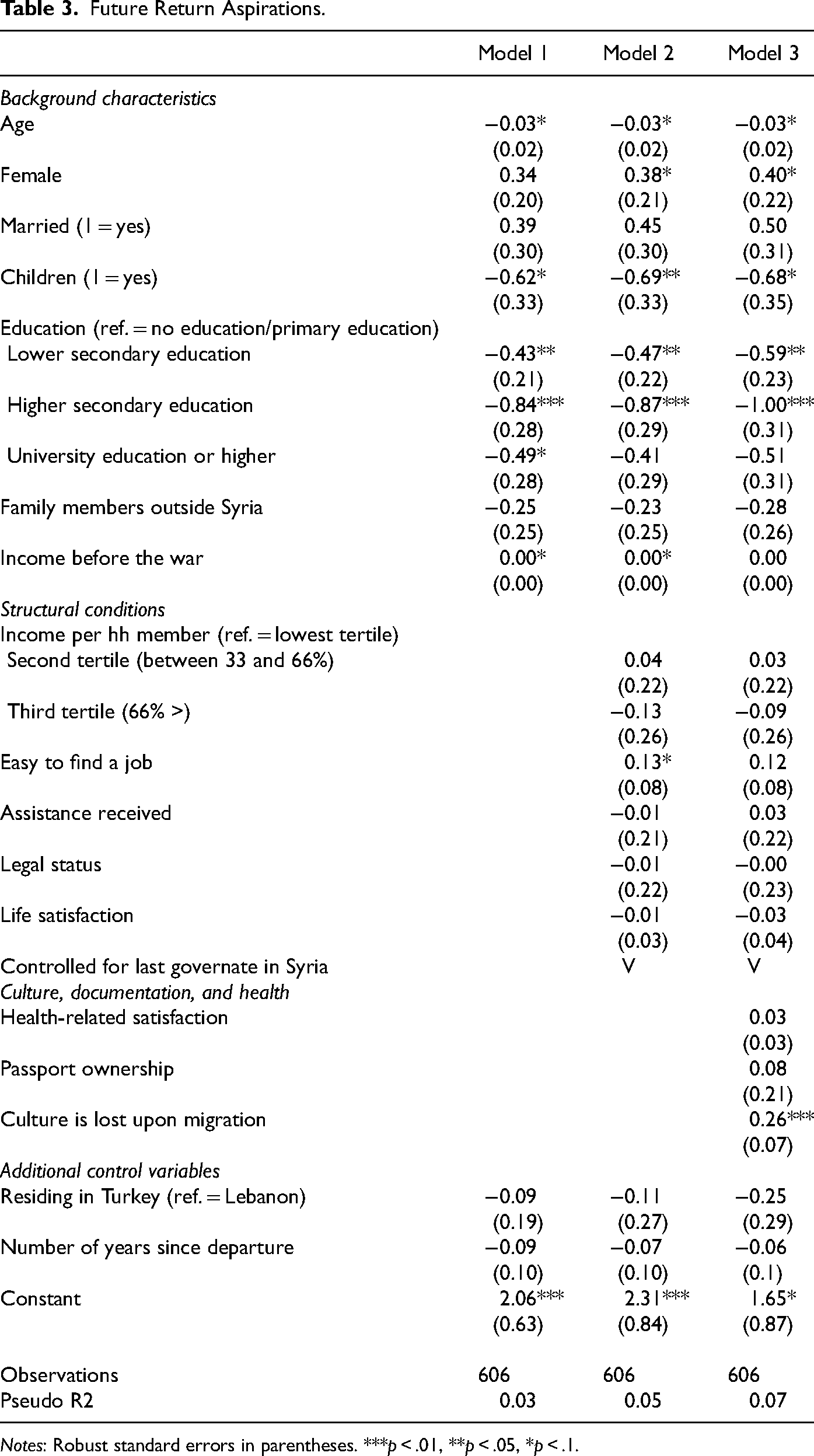
Notes: Robust standard errors in parentheses. ***p < .01, **p < .05, *p < .1.
The second set of variables that capture structural conditions in the receiving country, such as income, easiness to find a job, legal status, health-related satisfaction or overall life satisfaction in the receiving country, were not significantly related to future return aspirations. Also, country of residence did not play a significant role for future return aspirations.
Third, those whose last residence was the Aleppo or Hama Governorate were less likely to have future return aspirations (results are available upon request), indicating the importance of political factors for future return aspirations. Both governorates have been considered “opposition governorates”: Aleppo Governorate was the major opposition area in northeast Syria, while Hama saw several anti-al-Assad protests in 2011, the violent suppression of which contributed to the civil war's outbreak. In the open survey question which asked why respondents aspired to return, respondents often mentioned, alongside their attachment to Syria, political motives (Table 4). They would consider returning if the security situation (20 percent) or the regime (6 percent) changed. Some also mentioned that they would return if there was no military service (7 percent). An explicit regime change was more frequently mentioned in Turkey, while the security situation and military service were more prevalent in Lebanon.
Main Reported Reason for Aspirations to Return After the War's End, by Host Country.
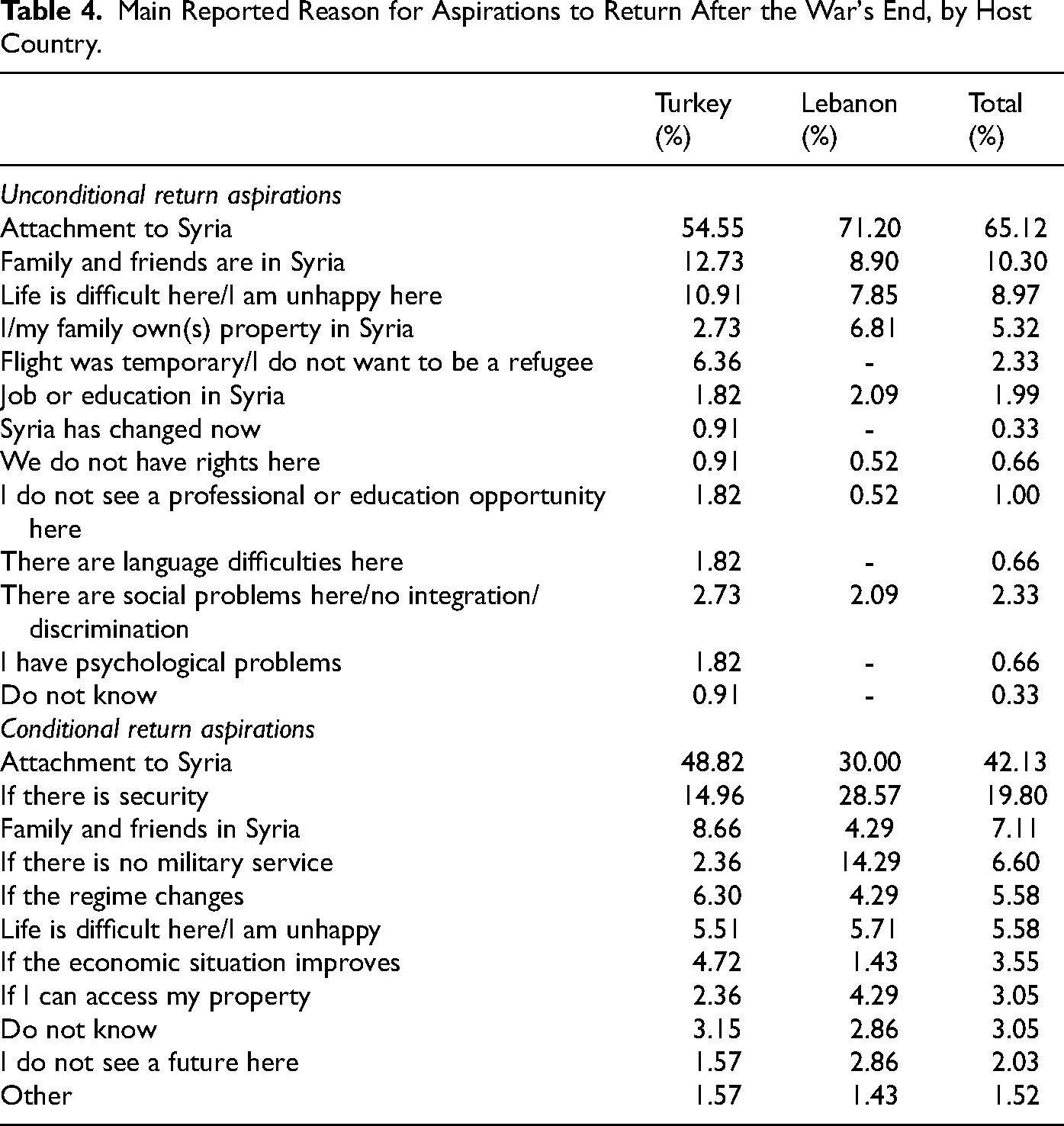
Fourth, perceptions of culture were significant for future return aspirations. Those who felt that migration led to a loss of culture were more likely to aspire to return. The fact that having family members outside Syria did not play a significant role in future return aspirations might be related to the fact that we lack a variable measuring close family members inside Syria. When asked why they aspired to return after the war, the vast majority of respondents mentioned a wish to reunite with family members (see Table 4). This finding confirms the importance of family in return decision-making (Omata 2013).
Taken together, the quantitative findings on the future return scenario suggest that individual characteristics, family considerations, feelings about cultural attachment and cultural loss, and political factors were relevant for future return aspirations. Variables measuring structural conditions in receiving countries, such as assistance received, life satisfaction, or respondents’ legal position or health satisfaction, did not seem to play a significant role in future return aspirations. In the following section, we further explore how future return aspirations are formed by illustrating the important role of broader life aspirations — including ideas about social and political change — in imagining a future return.
Coping Mentally with a Challenging Present: “I Want to Return Strong”
In our in-depth interviews, respondents linked individual characteristics (education, sex, age), the wish to reunite with family members, and cultural attachment to Syria to broader life goals — including hope for social and political change in the future. Future return was imagined by respondents as a strong and independent return, in contrast to a forced or coerced return. Imaginations of being able to live a good life and imaginations of a — less violent and freer — future Syria were situated in a distant future without clear return plans. Respondents imagined returning “strong” and “successful” to Syria in the future, referring to life goals they had had before the war or newly acquired knowledge and experience during displacement. In this way, return aspirations served as a mechanism to cope mentally with the challenging present in which respondents were living by keeping hope for change in the future alive. Respondents clearly refuted the idea of returning to Syria empty-handed and with no active role to play: I would not go back to any country without having something in my hand, which I could build on … to rebuild my region … If I improve, I can help others. To actively do something …. We all think that if we return to our country, we will return strong. (T2Mist)
For many, return aspirations were a result of not being able to realize previous and new broader life goals. Many respondents felt frustrated in their country of residence because it was impossible for them to lead the life they considered a good life, mostly referring to education, work, and family. Respondents talked, for example, about the impossibility of studying or working in their previous profession. A young female interlocutor in Istanbul explained her spouse's motivations to return in this way: My husband is convinced that we will return to Syria; he wants to return. Why? Because all his possessions are there, he was the director of a factory …. Now, here, he is obliged to labor as a worker …. He has a lot of experience …. He told me that if I stayed in Syria and the war didn’t happen, I would run an international company by now. (T18Fist)
In other cases, the respondents’ life aspirations had transformed through their displacement by working in a previously unknown sector (such as civil society), learning a new language (in the case of Turkey), opening a business, or experiencing greater emancipation since their flight from Syria. These respondents aspired to, first, build a life abroad and, then, return successfully, building on their newly acquired skills and experiences (T1Mist). These imaginations were sometimes also linked to plans to live a transnational life between their receiving country and Syria. As a young small-restaurant owner in Istanbul explained, “If the business flourishes, I would live between here and Syria. I would continue my father's business in Syria. I would run two businesses at the same time …. I would open several branches” (I8Mist).
Furthermore, respondents’ attachment to Syria was often recounted as the hope to return to a previous, often lost, lifestyle among close family, especially parents who had stayed in Syria, and a stable home. Linked to such memories was the wish to end the dispersion of family members to different countries and the responsibility felt toward family members in Syria. Home ownership not only was associated with stability and social status, especially belonging to the middle class, but also formed a counterpoint to the current situation in which respondents were deprived of housing rights. A respondent in Izmir for example stated, “I am thinking of returning to Syria in the future …. If my father and mother were not in Syria, I would not return …. If I want to return to Syria, there is my mother, my grandfather, my relatives, our lands, our properties are all in Syria” (T9Miz).
In the qualitative sample, parents were more reluctant to return in the future, believing that their children would not have a future in Syria and referring in particular to the lack of education and professional opportunities. Also, older interviewees aspired to return less often, as they thought that they would need to start life again from zero upon return to Syria, for which they felt too old. These findings show how life aspirations — and therefore return aspirations — are strongly stratified across respondents who are in different life stages.
Hoping for Political Change in the Future
Future return aspirations also related to political aspirations and the broader societal and political environment to which interviewees aspired to return. Above all, they aspired to a safe return after the conflict's end. What safety meant, however, differed across participants. Many interviewees concluded that safety and the persistence of al-Assad's regime were mutually exclusive. This was particularly the case for Sunni interviewees who had previously been involved in the opposition (and their families), young men who had fled Syria to avoid military conscription (and their families), and respondents who had fled from “the governorates of the opposition” as opposed to “the governorates of al-Assad.” For them, a halt to general violence, a change of regime and its security forces, including abolishing military service or an amnesty for those who had deserted the army or were called to army service, were essential conditions for return. For others, deep political reforms — including the existence of a civil and democratic state, stronger women's rights and transitional justice — were important for return. A female respondent from Homs living in Tripoli with her family, for example, explained her viewpoint: There is no safety. Either they say, Bashar [al-Assad] will be removed, then we would all return. But if there is no security, how should we return? They say, we will repair your houses, we will rebuild, but it's all a lie, there is no safety. Of course, Syrians demand to return to their country, and I am one of them. If they tell me there is safety, I would return today, before tomorrow. [Interviewer: This is the best choice?] Yes, this is the best choice. [Interviewer: So do you think about returning or do you imagine returning?] Of course, every day I think about it, every day, we wait for this moment. (LEB5FTri)
Not returning before these conditions were met, thus, represented a very conscious political choice.
Other respondents did not care about a regime change so long as violence stopped and a return to “normal life” was possible. These interviewees wanted Syrian society to return to what it was before the conflict and evoked memories of pre-war Syria as a time when violence was absent (LEB16MBei), when peaceful cohabitation of different ethnic and religious groups was possible (LEB9MBei), and when public services were freely available (LEB10FTri). One respondent explained: I wish Syria to return to what it was before and if not like before, security is sufficient, it's not necessary to reform, so that it's possible that you go from one region to the next without someone saying, this one is Kurdish, and this one is I don’t know what. When we were going out, nobody was asking, this one is Christian, this one is Ashuri, and so one … because we are people from one country. (LEB9MBei)
Many interviewees imagined their active role in Syria's reconstruction, mostly by transforming society with what they had learned abroad and in displacement (LEB7, T13M). A young student in Izmir explained how he imagined his return: I want to return to Syria one day in the future, when I have finished my university, I have the objective to go back to Syria, my objective is not to always stay abroad …. I want to return to build up my country, a bit of patriotism …. So maybe I get experience abroad, and maybe then I come back. After 20 years …, I come back when I am 40, but when I am a person who gained experience in education and has money and everything. (T13MIz)
A third group of respondents had lost hope in future political change altogether and, thus, had no future return aspirations. These respondents described Syria as a society which had been so negatively and deeply transformed by the conflict that they no longer believed in positive political change. A former teacher from Aleppo described how she perceived the change during the war's course: The nature of Syria has changed …. For example, all our neighbors left, there are other people instead. Seventy percent of people who remained in the regions of al-Assad are mercenaries or people who carry weapons, thieves …. Before I came to Turkey, I didn’t let my son play in the street because there are children carrying a bomb around their waist because their father gave them a weapon …. The problem is not only al-Assad, the military and the bombs but the nature of the people present. (T6FIst)
It is difficult to assess how these findings relate to the survey, given that we did not address political questions in the survey; however, they can at least partially explain why future return aspirations in Turkey and Aleppo governorate and of male respondents were lower.
Conclusion
This article applied the aspiration-ability framework to a return scenario in protracted displacement to examine how return aspirations are formed and realized. This allowed us to make three main observations. First, by distinguishing between current and future return and by separating aspirations and abilities to return, we identified broader life aspirations as the missing link between individual characteristics and structural conditions. Broader life aspirations were a structuring element in both current and future aspirations, yet in different ways. We found that current return aspirations were strongly stratified. Return reflections with the war ongoing were often related to either mere survival for the extremely vulnerable or broader life aspirations for the educated middle class. Aspirations to return after the war’s end were largely driven by a wish to realize broader life goals.
Second, return abilities favored those with higher socioeconomic status and those who had remained neutral in the conflict. Those who returned under current conditions were either the least vulnerable or those who were too vulnerable and risked overcoming the return interface, even if return was unsafe and unsustainable. As such, socio-economic background influenced both aspirations and abilities to return. In other words, return obstacles apply unevenly to refugees, who vary in their ability to overcome such constraints. These results confirm previous research on the crucial role of social class in migration (Engzell and Ichou 2019; Rutten and Verstappen 2014; van Hear 2014), and also illustrate how return migration is driven by both abilities to return and inabilities to stay. The inability to stay, or more generally, the factors associated with staying (or immobility), is often neglected in migration studies (Schewel 2019) but is an essential part of return migration decision-making processes. More systematic, comparative research could explore how structural factors shape abilities to stay and how abilities to stay relate to migration aspirations and migration behavior in different contexts.
Third, we argued that return aspirations after the hypothetical end of conflict functioned as a coping strategy to deal with a challenging present without concrete plans to realize a return. Going back was imagined as a “strong return” by those who aspired to do so after the conflict's end, enabling them to realize their broader life goals or to contribute to political change. Future return aspirations were a manifestation of hope for change. Imagining an alternative future than the one respondents faced in the receiving country was, in a way, more important than how to realize it concretely. This finding underlines the more “affective” dimensions of migration decision-making. Including a perspective on how emotions relate to return is important, as it not only provides a nuanced understanding of refugee return decisions but is also an important step in “humanizing migration” (Carling and Collins 2018, 913).
These observations lead us to two main theoretical reflections. First, our findings illustrate the necessity to include broader life aspirations in conceptualizing and understanding return decisions. Our findings showed how some respondents were able to fulfil their life aspirations outside Syria, whereas others were not and strongly longed for a future there. These life aspirations had a large impact on whether individuals aspired to return. As such, return aspirations, like other migration aspirations (Carling 2014), can be instrumental — a means to guarantee survival, to realize life aspirations, or to cope mentally when faced with challenging circumstances. Our findings illustrate how return aspirations are valuable in and of themselves, regardless of their capacity to predict population movements. While future return aspirations are not necessarily predictors of real departures, they can serve other functions, such as dealing mentally with a challenging present or expressing political discontent.
Second, our findings on return aspirations in the two different scenarios (current and future) show how current return aspirations (reflections) and future return aspirations should be treated as separate analytical categories. Firstly, because current and future return aspirations did not necessarily overlap in our study: respondents who wanted to return with the war ongoing did not necessarily aspire to return after the war, and vice versa. Secondly, because, as our analyses reveal, return aspirations in the two different scenarios were impacted by different individual characteristics and structural factors. These findings have methodological consequences as well. Survey questions designed to measure migration aspirations differ significantly in terms of the theoretical concepts applied and the time frames used (Carling and Schewel 2018). This article shows that different ways of phrasing questions to capture migration aspirations will yield different responses. Unaddressed here, but relevant for further research, is how return aspirations develop over time as contextual factors and associated abilities to stay or return change. Research addressing these questions would benefit from longitudinal research designs, for example using a life-course perspective.
Supplemental Material
sj-docx-1-mrx-10.1177_01979183221131554 - Supplemental material for “I Will Return Strong”: The Role of Life Aspirations in Refugees’ Return Aspirations
Supplemental material, sj-docx-1-mrx-10.1177_01979183221131554 for “I Will Return Strong”: The Role of Life Aspirations in Refugees’ Return Aspirations by Lea Müeller-Funk and Sonja Fransen in International Migration Review
Footnotes
Acknowledgments
We are especially indebted to our research assistants who contributed immensely with data collection to this research — most of which happened in very challenging conditions. We are also extremely grateful for comments received from Wendy Pearlman at the ISA Conference 2022, as well as Mathias Czaika, André Bank, Christiane Fröhlich, Kerilyn Schewel, and Hein de Haas, who commented on earlier drafts of the paper, as well as three anonymous reviewers and the editorial team of IMR, whose critical comments helped us to finalize the paper.
Author's Note
Lea Müller-Funk is currently a senior researcher at the Department for Migration and Globalisation, Danube University Krems, Austria and Institute for Middle East Studies and an affiliated researcher at the German Institute for Global and Area Studies, Germany.
Declaration of Conflicting Interests
The authors declared no potential conflicts of interest with respect to the research, authorship, and/or publication of this article.
Funding
The authors disclosed receipt of the following financial support for the research, authorship, and/or publication of this article. This work was supported by the European Commission’s Horizon 2020 Research and Innovation Programme under the Marie Skłodowska-Curie Grant number 748344 (SYRMAGINE: Syrian Imaginations of Europe) and under the European Research Council Grant number 648496 (MADE: Migration as Development). Data in Syria was collected with additional funding from the German Institute for Global and Area Studies.

Supplementary Material
Supplemental material for this article is available online.
Notes
References
Supplementary Material
Please find the following supplemental material available below.
For Open Access articles published under a Creative Commons License, all supplemental material carries the same license as the article it is associated with.
For non-Open Access articles published, all supplemental material carries a non-exclusive license, and permission requests for re-use of supplemental material or any part of supplemental material shall be sent directly to the copyright owner as specified in the copyright notice associated with the article.
