




Abstract
Spatial assimilation theory claims that immigrants’ acculturation and socioeconomic progress will lead to converging neighborhood attainment relative to non-migrant natives. Recently, it has been argued that equalization of local services and life chances across neighborhoods in egalitarian welfare states may delay spatial assimilation by reducing immigrants’ incentives to move out of low-income areas with many (co-ethnic) immigrant neighbors. In this article, we extend this argument to study whether neighborhood equalization also contributes to intergenerational persistence in neighborhood contexts among descendants of immigrants in Norway. Using administrative data, we find that immigrant descendants as adults often remain in neighborhood contexts that resemble their childhood neighborhoods, characterized by relative economic disadvantage and comparatively few ethnic majority residents. Intergenerational persistence in neighborhood contexts is strongest among descendants of immigrants from Pakistan, the Middle East, and Africa. The remaining immigrant–native gaps in spatial economic inequality largely reflect differences in individuals’ education and earnings, family background, and childhood neighborhood context, but these factors matter less for ethnic neighborhood segregation. For both economic and ethnic dimensions of neighborhood attainment, childhood neighborhood context is the factor that matters most in accounting for immigrant–native gaps, whereas individual socioeconomic attainment is the least important. Overall, our findings point to a pattern of “uneven assimilation” among immigrant descendants, where spatial assimilation is slow despite rapid socioeconomic progress across immigrant generations in the egalitarian Norwegian welfare state.
Introduction
The extent to which the socioeconomic disadvantages and place-based inequalities often experienced by immigrants are passed on to their native-born descendants is a cause of great concern among both policy makers and scholars in the increasingly diverse societies in Europe and North America (Alba and Foner 2015; Waters and Pineau 2015). To what degree adult descendants of low-status immigrants settle in residential areas characterized by relative deprivation and spatial isolation from the native-born ethnic majority (i.e., non-migrant natives) is a key indicator of their societal incorporation, but most contemporary research on intergenerational assimilation focuses on individual socioeconomic attainments among descendants of immigrants (Heath, Rothon, and Kilpi 2008; Duncan and Trejo 2015; Drouhot and Nee 2019). There are considerably fewer studies on whether disadvantaged neighborhood contexts are transmitted from parents to children—often referred to as intergenerational contextual mobility (Sharkey 2008)—and on the determinants of neighborhood attainment by immigrant descendants. However, recent research from the United States has found that second-generation immigrants experience considerable upward contextual mobility out of deprived childhood neighborhoods (Tran 2020). In contrast, European studies report strong intergenerational persistence of living in deprived neighborhood contexts among immigrant populations in France (McAvay 2018), the Netherlands (de Vuijst, van Ham, and Kleinhans 2017), the United Kingdom (Zuccotti 2019), and Scandinavia (Van Ham et al. 2014; Gustafsson, Katz, and Österberg 2017; Nordvik and Hedman 2019).
This article investigates intergenerational mobility in neighborhood contexts among descendants of immigrants in Norway and asks whether and, if so, why they experience reduced spatial economic inequality and ethnic segregation relative to natives. To address these questions, we draw on population-wide administrative data with detailed information on residential location in childhood and adulthood, as well as on information on the socioeconomic characteristics of adults and their parents. Our empirical focus is the Norwegian welfare state, which is characterized by redistributive social policies, reduced spatial inequality, and considerable socioeconomic progress among immigrant descendants (Esping-Andersen 1999; Hermansen 2016, 2017b; Wessel et al. 2017; Midtbøen and Nadim 2021).
Our analysis is informed by theories of assimilation, which conceptualize immigrant incorporation in terms of multidimensional and temporal processes in which gradual intergenerational improvement in immigrant minorities’ socioeconomic attainments and declining residential segregation relative to non-migrant natives is the expected development (Park and Burgess 1921; Gordon 1964; Alba and Nee 2003). However, intergenerational socioeconomic and spatial assimilation need not move in the same direction or at the same pace. Instead, patterns of “uneven assimilation” (Price 1969, 215–16) may arise, whereby immigrants’ native-born descendants increasingly start to resemble natives in some aspects (e.g., educational and labor market attainment), while other ethnic boundaries remain strong (e.g., residential segregation and intergroup contact). A key question concerning spatial assimilation theory (Park 1926; Duncan and Lieberson 1959; Massey and Denton 1985) is whether increased acculturation and socioeconomic progress improve neighborhood attainment across immigrant generations.
Moreover, cross-national variation in intergenerational contextual mobility across immigrant generations may reflect differences in how institutional contexts shape the opportunity structure for spatial assimilation. Recently, scholars have argued that egalitarian welfare state institutions and area-based redistributive social policies may slow down the speed of spatial assimilation among immigrants, especially in Nordic welfare states (Koopmans 2010; Wessel et al. 2017). The key claim here is that equalization of neighborhood quality, in terms of local access to decent schools, health care, and other public services, creates a benign opportunity structure wherein immigrants’ incentives for contextual mobility out of low-income and immigrant-dense areas are reduced, despite individual socioeconomic progress (Wessel et al. 2017). However, studies of the intergenerational dynamics of spatial assimilation among immigrant descendants have yet to address this argument explicitly. In this regard, egalitarian Norway provides an interesting institutional setting for exploring whether socioeconomic assimilation moves in parallel with improved neighborhood attainments across immigrant generations.
In light of these considerations, we offer several contributions. First, we contribute empirically to the recent literature that assesses intergenerational contextual mobility in both socioeconomic and ethnic neighborhood dimensions (McAvay 2018; Zuccotti 2019; Tran 2020). Addressing both of these neighborhood characteristics provides a broader perspective on spatial assimilation, compared with prior studies that only focus on socioeconomic neighborhood context (e.g., Van Ham et al. 2014; de Vuijst, van Ham, and Kleinhans 2017; Gustafsson, Katz, and Österberg 2017; Nordvik and Hedman 2019).
Second, we contribute theoretically to ongoing discussions on whether generous welfare state policies, such as those in Norway, delay spatial assimilation among (first-generation) immigrants (Koopmans 2010; Wessel et al. 2017), extending this theoretical discussion to the study of intergenerational contextual mobility among (second-generation) immigrant descendants. Norway provides an ideal case for testing this argument because of the strong socioeconomic progress across immigrant generations found in the country (Bratsberg, Raaum, and Røed 2014; Hermansen 2016; Midtbøen and Nadim 2021), which is not always the case in other European and North American countries (Drouhot and Nee 2019; Heath, Rothon, and Kilpi 2008). According to spatial assimilation theory (Park 1926; Massey and Denton 1985; Alba and Nee 2003), socioeconomic progress should lead to improved neighborhood attainments, which implies that upward contextual mobility should be substantial among immigrant descendants in Norway. In contrast, we argue that spatial equalization in the Norwegian welfare state may reduce successful immigrant descendants’ incentives for moving out of immigrant-dense areas, which are often also characterized by relative socioeconomic deprivation, and, thereby, slow down intergenerational spatial assimilation.
The remainder of the article starts with a discussion of spatial assimilation theory and alternative theoretical perspectives that emphasize intergenerational persistence in neighborhood contexts. Next, we elaborate on the argument for why immigrant minorities may experience slower spatial assimilation in egalitarian welfare states. We, then, discuss previous research on intergenerational mobility in neighborhood contexts, before presenting the Norwegian case, our data, empirical approach, and results. Finally, we discuss our key finding of limited contextual neighborhood mobility among immigrant descendants in Norway, despite strong socioeconomic progress, and draw several conclusions in light of our theoretical framework.
Theory and Background
Contextual Neighborhood Mobility Across Immigrant Generations
Most research on intergenerational mobility addresses persistence in socioeconomic attainment in areas such as education, earnings, or occupational class from parents to their adult children (Breen and Jonsson 2005; Black and Devereux 2011). Following Sharkey (2008), the study of intergenerational contextual mobility extends this focus to address the degree to which neighborhood-level inequalities persist across generations, reflecting both individuals’ movement across residential areas and changes in neighborhood composition around non-mobile individuals (e.g., Swisher, Kuhl, and Chavez 2013; McAvay 2018; Tran 2020). To assess neighborhood persistence among second-generation immigrants, it is crucial to assess whether patterns of intergenerational contextual mobility differ according to immigrant background (Heath, Rothon, and Kilpi 2008; White and Glick 2009; Duncan and Trejo 2015). A central question with respect to neighborhood attainment relates to so-called “locational returns” (Logan and Alba 1993)—that is, whether human capital and socioeconomic progress provide second-generation immigrants with access to improved neighborhood contexts on par with those of natives. Below, we discuss theoretical perspectives with divergent empirical predictions concerning whether immigrant minorities are likely to experience improved socioeconomic neighborhood attainment and reduced ethnic residential segregation or intergenerational persistence in neighborhood contexts.
Spatial assimilation theory predicts a tight link between socioeconomic progress and upward neighborhood mobility (Park 1926; Massey and Denton 1985; Alba and Nee 2003). This theory was developed within the Chicago School's ecological model of urban immigrant incorporation, and Park (1926, 9) formulated its central claim by stating that “change of occupation, personal success or failure… tends to be registered in changes of location.” Spatial assimilation is conceptualized as driven by two individual-level processes: improved socioeconomic status and acculturation into mainstream culture and language (Massey 1985; Massey and Denton 1985; Alba and Nee 2003). Although access to opportunities in mainstream neighborhoods is likely to provide motivation for living closer to natives, the literature on spatial assimilation provides more support for the view that declining ethnic segregation is a by-product of minority households seeking to convert gains in human capital and economic resources into higher-quality housing and more expensive neighborhoods (Massey 1985; Alba and Nee 2003). Massey (1985, 320), for example, claimed that “[u]pwardly mobile immigrants seek out neighborhoods with better schools, more prestige, and richer amenities, places where natives tend to predominate.” In line with Massey’s (1985) statement, this latter view implies that immigrants and their descendants who experience socioeconomic advances may face trade-offs between improved neighborhood quality and continued residence in areas with many (co-ethnic) immigrant neighbors, often characterized by relative deprivation. Nonetheless, the key claim in spatial assimilation theory is that socioeconomic progress across immigrant generations should improve not only neighborhood socioeconomic status but also spatial integration with the non-migrant native majority.
In contrast, alternative theoretical models provide different reasons why neighborhood disparities may persist across immigrant generations (Clark 1992; Logan and Alba 1993; Charles 2003). First, place stratification theory claims that immigrant-origin ethnic minorities face external constraints that sort them into lower-valued segments of the housing market, according to their relative standing in society (Logan and Alba 1993; Charles 2003). Influential residents in “desirable” areas, often members of the native majority, can manipulate space to maintain physical and social separation from groups considered less desirable (Johnson, Pais, and South 2012). For example, ethnic discrimination in both employment (Birkelund et al. 2019; Quillian et al. 2019) and (rental) housing markets (Andersson, Jakobsson, and Kotsadam 2012; Auspurg, Schneck, and Hinz 2019) is well documented. Ethnic discrimination in the labor market is likely to reduce immigrants’ purchasing power, limiting access to affluent areas with expensive housing. Moreover, natives often move out of, or avoid moving into, neighborhoods if the local immigrant concentration rises above a given threshold (Crowder, Hall, and Tolnay 2011; Aldén, Hammarstedt, and Neuman 2015; Wessel and Nordvik 2019). Anticipating possible ethnic discrimination and social exclusion by natives, minorities may also avoid geographic locations where they feel out of place and attach negative neighborhood stereotypes to these areas due to the relative underrepresentation of people they identify as members of their own group (Ellen 2000). The place stratification theory predicts that low-status immigrant minorities will face external barriers in attempts to avoid residential areas characterized by both high proportions of immigrants and spatial disadvantage, leading to intergenerational persistence in both neighborhood dimensions.
Second, the ethnic enclave theory argues that immigrant descendants prefer to settle close to (co-ethnic) immigrants as adults, despite upward socioeconomic mobility (Clark 1992; Logan, Zhang, and Alba 2002). This argument holds that tight-knit immigrant enclaves provide a sense of community and shelter by strengthening shared ethnic identities and in-group solidarity (Breton 1964; Clark 1992). Immigrant-dense areas can provide a range of (nonfinancial) benefits, such as access to ethnic food stores, after-school programs, and other local community institutions, as well as helpful information for minorities navigating the educational system and labor market (Åslund et al. 2011; Xie and Gough 2011). Furthermore, descendants of immigrants may wish to move closer to their kin in adulthood, for example, after they enter parenthood (Clark, Glick, and Bures 2009; Foner and Dreby 2011), which may extend ethnic residential segregation across immigrant generations (Brown 2007; Zorlu 2009). Ethnic enclave theory emphasizes proximity to (co-ethnic) immigrant neighbors as the driver of intergenerational persistence in ethnic segregation, but sociospatial disadvantage will be a by-product if both neighborhood dimensions are closely linked.
Taken together, similar predictions of intergenerational persistence in socioeconomic and ethnic neighborhood contexts are made by the place stratification and ethnic enclave theories, although the former emphasizes external barriers imposed by natives whereas the latter stresses the role of in-group residential preferences (Clark 1992; Logan and Alba 1993; Charles 2003). From an empirical perspective, immigrant–native gaps in adult neighborhood attainment should remain after statistical adjustment for individual socioeconomic attainment, as well as family background and childhood neighborhood context.
Finally, neighborhood disparities may persist owing to the effects of childhood neighborhoods on skill formation, resource accumulation, and socialization that affect immigrant and native residents equally (Sharkey and Faber 2014). Spatial variation in school quality and other local institutions, access to adult role models, and neighborhoods’ social organization may affect children's skill formation and their employment-related outcomes as adults, which in turn shape residential opportunities (Vartanian, Buck, and Gleason 2007; Chetty and Hendren 2018). Childhood neighborhoods may also directly affect parental resource transfers to their children that are linked to local housing prices, property wealth, and the inheritance of dwellings (Galster and Wessel 2019). In addition, neighborhood effects can operate via the transmission of local knowledge and socialization, which shape individuals’ place attachment, typically to the places where they grew up (Hidalgo and Hernandez 2001). Thus, local place attachment may lead adults to return to live close to family and friends in the areas where they spent their youth (Løken, Lommerud, and Lundberg 2013). In summary, if neighborhood effects are important and play an equal role for immigrant descendants and native peers, then neighborhood effects should limit contextual mobility within both groups (Vartanian, Buck and Gleason 2007; Chetty and Hendren 2018). However, unlike the place stratification and ethnic enclave theories, statistical adjustment for childhood residential context should, in this case, reduce estimated net immigrant–native gaps in adult neighborhood attainment.
Neighborhood Equalization in Egalitarian Welfare States
From a comparative perspective, recent scholarship on immigrants’ spatial assimilation has argued that egalitarian Nordic welfare state contexts may weaken the relationship between upward socioeconomic mobility and neighborhood attainment (Koopmans 2010; Wessel et al. 2017). Although welfare states may reduce overall levels of ethnic residential segregation by means of taxes, transfers, and public services (Arbaci 2007), the central argument made by Wessel et al. (2017) is that equalization in neighborhood quality in welfare state contexts reduces immigrants’ need for upward contextual mobility. If so, generous welfare state policies might delay spatial assimilation through a “double compression of differences, first in the system of social stratification and next in the social hierarchy of places” (Wessel et al. 2017, 814).
This “double compression” implies that a compressed wage structure and redistributive social transfers first create low economic inequality (Barth, Moene, and Willumsen 2014), which, in comparative terms, weakens the link between immigrant earnings and their purchasing power in the housing market. Second, redistributive welfare state policies equalize the quality differences between neighborhoods (Wessel et al. 2017), meaning that poor neighborhoods are lifted to higher social standards through subsidies, regulations, and various programs for neighborhood planning and regeneration (Andersen 2002; Andersson 2006). Area-based redistributive measures are also likely to reduce quality differences between schools and childcare centers, health care, and other public services across neighborhoods (Wusten and Musterd 1998; Arbaci 2007). Consequently, immigrants and their descendants may perceive neighborhoods characterized by relative deprivation as being of an adequate and decent standard in terms of public services, safety, and other local amenities.
Therefore, given the reduced sociospatial inequality in egalitarian welfare state contexts, immigrants and their descendants may face a reduced tradeoff between moving into neighborhoods characterized by higher material standards and remaining in immigrant-dense neighborhoods (Wessel et al. 2017). Perhaps counterintuitively, this opportunity structure may delay spatial assimilation more in egalitarian welfare states than in less egalitarian societies, such as the United States, where the spatial concentration of ethnoracial immigrant minorities, neighborhood disadvantage, and residents’ life chances are arguably more tightly linked (Musterd 2005; Alba and Foner 2015). If higher proximity to natives is primarily a by-product of improvements in neighborhood quality and local amenities (Massey 1985), ethnic segregation may be more persistent if immigrant descendants’ incentives to move out of ethnically diverse immigrant-dense areas are weakened in egalitarian welfare state contexts.
Previous Research on Contextual Mobility Across Immigrant Generations
Previous studies from the United States document rigid patterns of neighborhood disadvantage across generations among the non-migrant Black and Hispanic minorities (Vartanian, Buck, and Gleason 2007; Sharkey 2008; Britton and Goldsmith 2013; Swisher, Kuhl, and Chavez 2013; Pais 2017). Sharkey (2008), for example, found that about 52 percent of Blacks continued to live in the lowest income quartile of neighborhoods as adults compared with only 7 percent of Whites. Although not accounting for differences across immigrant generations, Swisher, Kuhl, and Chavez (2013) found stronger relationships between neighborhood poverty in adolescence and young adulthood among people of Black, Mexican, or other Hispanic origins relative to Whites. Statistical adjustment for individuals’ adult socioeconomic attainments reduced the minority–majority gap in neighborhood poverty, but minority members’ neighborhood attainments did not reach those of the most disadvantaged Whites. For Asians, there were no clear gaps in terms of neighborhood poverty relative to Whites.
Recently, Tran (2020) found that second-generation immigrants of Chinese, South American, West Indian, and Dominican origin in New York experienced contextual mobility into neighborhoods characterized by less socioeconomic disadvantage compared with the areas where they had lived with their immigrant parents as children. Although none of the second-generation groups closed the gap in neighborhood attainment relative to Whites, all, except West Indians, fared better than non-migrant Blacks and Puerto Ricans. Overall, the US literature suggests that neighborhood inequality is highly rigid for non-migrant ethnoracial minorities, whereas many post-1965 immigrant minorities seem to experience upward contextual mobility.
In Europe, recent studies from France and the United Kingdom explore intergenerational change in both neighborhood-level ethnic segregation and socioeconomic inequality among immigrant minorities (McAvay 2018; Zuccotti 2019). In France,McAvay (2018) found strong neighborhood stability from childhood to adulthood among both immigrant descendants and natives. However, this pattern was stronger among descendants of non-European immigrant parents (i.e., those of African or Asian/Turkish origin) compared with descendants of immigrants from European countries.1 For minorities of non-European origin, intergenerational persistence in neighborhood ethnic composition is also stronger than the corresponding pattern for neighborhood-level unemployment rates. For the United Kingdom, Zuccotti (2019) found that immigrant descendants, especially those of Paksitani, Bangladeshi, and African background, were more likely than natives to live in immigrant-dense and socioeconomically disadvantaged neighborhoods, even after accounting for individual socioeconomic resources, family background, and childhood neighborhood characteristics. Interestingly, persistence in ethnic neighborhood composition was stronger among immigrant descendants than among natives,whereas such a pattern was less consistent for neighborhood socioeconomic deprivation. Moreover, in both France and the United Kingdom, characteristics of the childhood neighborhood seem to be more important predictors of second-generation neighborhood attainment than individual or parental socioeconomic characteristics (McAvay 2018; Zuccotti 2019).
In Scandinavia, Van Ham et al. (2014) found that immigrant descendants have considerably longer cumulative exposure to low-income neighborhoods from childhood into young adulthood, spending almost 3.5 more years in the lowest income quintile over an 18-year period than do Swedes with non-migrant parents and similar socioeconomic attainment. Similarly, Gustafsson, Katz, and Österberg (2017) found that about half the immigrant descendants from “visible minorities” in large Swedish metropolitan areas (Stockholm, Gothenburg, and Malmö) grew up in the neighborhood quartile with the lowest mean income and that about two-thirds of these immigrant descendants continued to live in this quartile as adults. Furthermore, the intergenerational correlation in neighborhood economic inequality was about three times stronger than the individual-level parent–child income correlation for immigrant descendants. Focusing on Norway's largest metropolitan area, the Oslo area, a prior study also found high intergenerational persistence in neighborhood economic disadvantage among non-European immigrants because almost 40 percent of immigrant descendants who grew up in the lowest quartile of the neighborhood income distribution continued to live in this quartile as adults (Nordvik and Hedman 2019).
Compared with earlier research from Scandinavia, this article's empirical contribution to the literature on intergenerational contextual mobility among immigrants is its focus on both the socioeconomic and ethnic dimensions of neighborhood composition and its exploration of variations in contextual mobility between different minority groups. We also provide a systematic assessment of the relative role of individuals’ socioeconomic attainments and their childhood background (i.e., parental resources and neighborhood context) for adult neighborhood attainments.
Immigration in the Norwegian Welfare State
The Norwegian context is interesting because of its combination of an ethnically diverse immigrant population, generous and redistributive welfare state policies, and comparatively low levels of economic inequality (OECD 2015, 2020). In Norway, large-scale immigrant inflows started in the late 1960s, with a sizable wave of labor migrants from Pakistan, Turkey, and Morocco (Brochmann and Kjeldstadli 2008). After labor immigration was halted in 1975, a substantial proportion of refugees arrived from conflict areas—Vietnam, Chile, Sri Lanka, and Iran in the 1980s and (the former) Yugoslavia, Somalia, and Iraq in the 1990s—whereas family reunifications brought the kin of earlier labor migrants and refugees to Norway throughout the entire period (Brochmann and Kjeldstadli 2008). By 2021, immigrants and Norwegian-born descendants of immigrants composed 18.5 percent of the Norwegian population (Statistics Norway 2021). The relative size of Norway's immigrant population is broadly comparable to other immigrant-receiving countries in Europe (OECD 2020). In Norway's capital city, Oslo, non-European immigrants and their descendants comprise the majority of residents in many less-advantaged residential areas (Kornstad, Skjerpen, and Stambøl 2018).
In Norway, immigrants from low-income origin countries often experience low and declining employment rates over their life course (Bratsberg, Raaum, and Røed 2014), and child poverty is highly elevated for many immigrant minorities (Galloway et al. 2015). Despite disadvantaged childhood origins, many descendants of immigrants experience marked upward mobility in the educational system and labor market, compared with their parents (Bratsberg, Raaum, and Røed 2014; Hermansen 2016, 2017b; Reisel, Hermansen, and Kindt 2019; Midtbøen and Nadim 2021). Children from immigrant households are highly concentrated in immigrant-dense and low-income areas when growing up, but childhood neighborhood segregation appears to contribute considerably less than family background to ethnic disparities in education and adult earnings among second-generation immigrants (Hermansen and Birkelund 2015; Hermansen 2016). School and neighborhood contexts are also of modest importance for socioeconomic attainment among natives (Hermansen, Borgen, and Mastekaasa 2020).
Data and Methods
We use administrative data from Norway, where a system of unique personal identifiers for all residents enables us to link individuals to their residential locations and children to their parents. For each year, starting in 1990, we observe individuals as nested in their residential neighborhood. This multilevel structure allows us both to measure aggregate characteristics of all individuals who live in the same neighborhood in a given year and to compare individuals who lived in the same neighborhood during childhood. We use detailed measures of neighborhood context in childhood and adulthood, adult socioeconomic attainment, and family background. 2
For our purposes, we restrict the sample to all Norwegian-born children with two parents born in Norway and all children of two immigrant parents who either were born in Norway or immigrated before the age of seven years. 3 We select individuals born between 1974 and 1988 and who were current residents in Norway in 2018 and exclude individuals of “mixed origin” (i.e., one foreign-born and one Norwegian-born parent). Furthermore, we exclude a small number of individuals with missing information on residential location in childhood and adulthood or other key child and parental variables. Finally, we select all individuals living in the 30 municipalities with the highest proportions of immigrant descendants at the age of 16 years to ensure comparability in terms of geographic regions in childhood for natives and immigrant descendants. We follow all individuals to the neighborhood contexts where they settled as adults, regardless of whether they moved out of these origin municipalities. Using these restrictions, we include about 80 percent of all immigrant descendants in Norway in these birth cohorts, providing an analytical sample of about 314,000 observations. Table 1 presents descriptive statistics separately for all descendants of immigrants (n = 16,345) and individuals with Norwegian-born parents (n = 297,471). 4
Descriptive Statistics by Immigrant Background.
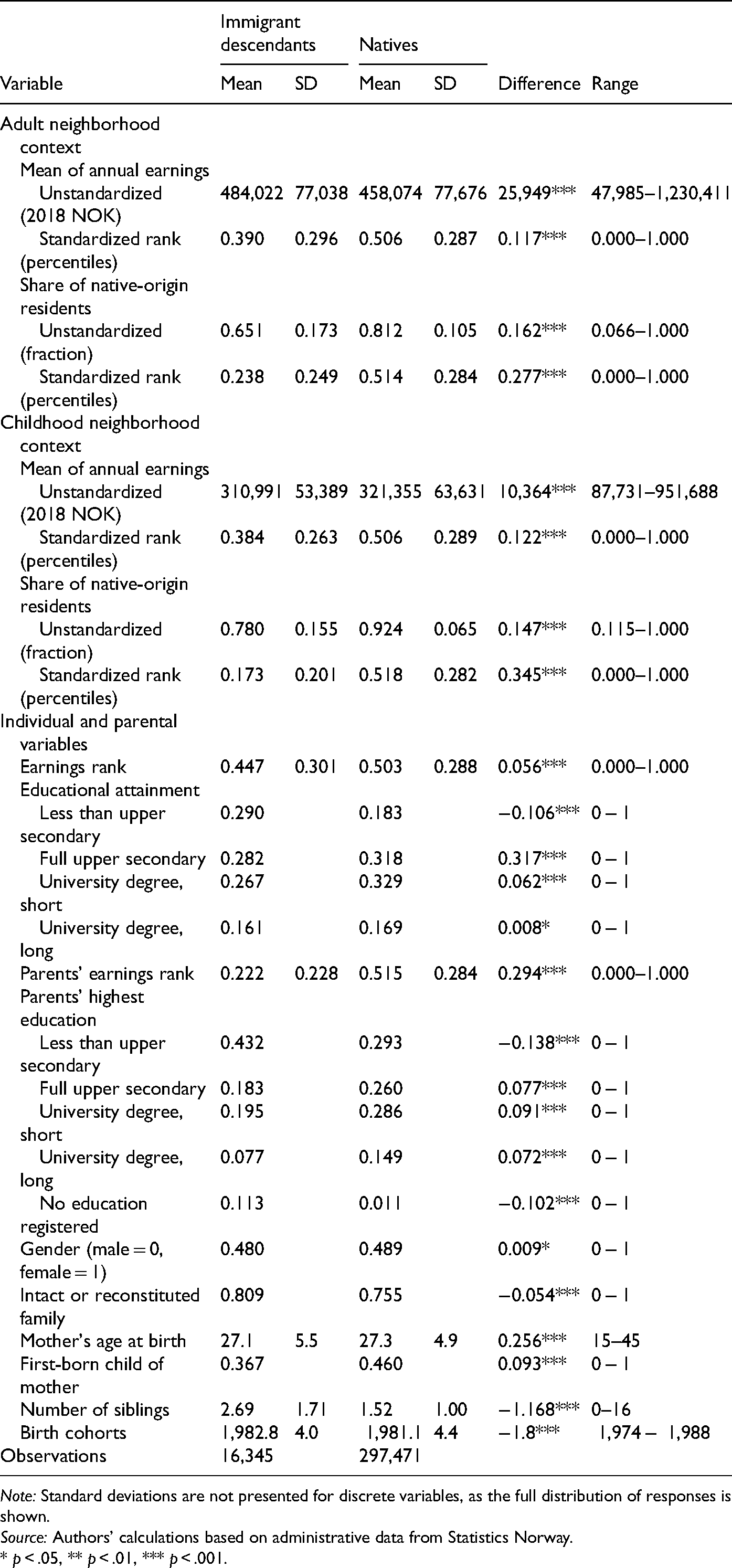
Note: Standard deviations are not presented for discrete variables, as the full distribution of responses is shown.
Source: Authors’ calculations based on administrative data from Statistics Norway.
* p < .05, ** p < .01, *** p < .001.
Variable Measurement
Ethnic origin
Our key interest lies in immigrant descendants’ ethnic origin, defined by the mother's birth country. 5 Those with two Norwegian-born parents are defined as the majority, whereas those with two foreign-born parents are immigrant descendants. We differentiate between eight origin regions: West (i.e., Western Europe, North America, Australia, and New Zealand); Eastern Europe; Pakistan; Vietnam; Asia; Middle East; Africa; and South America (Online Appendix Table A1).
Neighborhood context in childhood and adulthood
We measure neighborhoods using Statistics Norway's “Basic Statistical Unit” classification (“grunnkretser”), which constitutes the smallest geographical entities found in Norwegian administrative data. These units are designed to resemble genuine neighborhoods and are relatively homogeneous with respect to the structure of dwellings and their location (Statistics Norway 1999). There are about 13,700 basic statistical units in Norway; on average, about 350 individuals populate each, but this number is substantially higher in populous municipalities (Statistics Norway 1999).
We measure the characteristics of neighborhood contexts in childhood and adulthood in terms of socioeconomic composition and ethnic segregation. Our two measures of neighborhood composition are aggregated from characteristics of adult residents (18–67 years of age) in the local neighborhood during childhood (mean values in the age range of 13–16 years) and in adulthood (mean values in the age range of 30–34 years). 6 First, we focus on the neighborhood mean annual earnings of adult residents, which we standardize as percentile ranks in economic neighborhood composition within each birth cohort. Second, we measure the neighborhood share of native-born adult residents, which we standardize as percentile ranks in ethnic neighborhood composition within each birth cohort. For neighborhood composition measured in childhood and adulthood, this operationalization yields a symmetric variable that captures each individual's rank measured as the cohort-specific percentile in the neighborhood distribution in terms of both economic and ethnic composition, ranging from 0.000 (lowest) to 1.000 (highest). By standardizing our measures of neighborhood characteristics, we capture the relative distributional position of each person's residential neighborhood in childhood and adulthood and avoid bias related to secular trends of earnings growth, economic conjunctures, and increasing proportions of immigrants in the population in the period of measurement (1990–2018). 7 In the multivariate analyses, we also use fixed effects (i.e., dummy variables) for both municipality and neighborhood of residence in childhood (measured at the age of 16 years). During our observation period, there were about 430 municipalities in Norway.
Children's socioeconomic attainments and family background
To capture individual and parental socioeconomic characteristics, we use information on completed education and annual earnings. 8 Child education refers to the highest education level at age 30 years, distinguishing between four attainment levels. Parental education refers to the attainment level of the parent with the highest education level when the child was 16 years old, using the same classification. 9
Child earnings refer to pretax annual earnings from gainful employment (including income from self-employment; capital income and social welfare transfers are not included). This information is drawn from tax records on annual gross income subject to taxation, captured with high accuracy. We measure annual earnings (including zero earnings) when the child was 30 years old. We rank children based on their earnings relative to other children in the same birth cohort, irrespective of gender. Parental earnings measure pretax annual earnings and income from self-employment. First, we average each parent's pretax annual earnings over the years the child was aged 13–20 years, including zero earnings. Second, we sum parents’ average earnings over this period and rank them relative to other parents with children in the same birth cohort, irrespective of the child's gender. For both children's and parents’ earnings, these symmetric variables measure the cohort-specific percentile rank in the earnings distribution, ranging from 0.000 (lowest) to 1.000 (highest).
Finally, we include measures of birth cohort, child gender, whether the child was the first-born child of his/her mother, number of siblings, mother's age at birth, and a measure of whether the child lived in an intact or reconstituted family at age 16 years (i.e., a household with two adults that either were married or had common children).
Empirical Analysis
The first aim of our analysis is to describe patterns of contextual mobility from immigrant parents (i.e., neighborhood rank in childhood) to their second-generation children (i.e., neighborhood rank in adulthood) in terms of both neighborhood socioeconomic composition and ethnic segregation. To do so, our primary approach is to regress individuals’ adult neighborhood rank on their childhood neighborhood rank. In a standard regression to the mean framework (Dustmann and Glitz 2011; Duncan and Trejo 2015), the bivariate association between child and the parental variables describes how strongly the neighborhood contexts in childhood and adulthood are correlated (i.e., in our case, the neighborhood rank in childhood and adulthood; see also Sharkey 2008; McAvay 2018). If the regression slope equals one, the relative position in the distribution of neighborhood contexts in childhood and adulthood is identical within a given population group (Dustmann and Glitz 2011, 399–401). 10
Plotted in a graphical form, perfect intergenerational stability in neighborhood rank places observations on the diagonal in comparisons of neighborhood positions in childhood and adulthood (i.e., neighborhood rank is the same for both measures). To assess nonlinearity, we plot the mean neighborhood rank in adulthood within each neighborhood percentile rank in childhood for immigrant descendants and natives separately, allowing us to see whether native–immigrant differences in intergenerational neighborhood persistence are stronger among those who grew up in the most economically disadvantaged or immigrant-dense neighborhoods.
We also report results from transition matrices where mobility is defined as immigrant–native differentials in the probability of moving from one point in the distribution of neighborhoods to another (Sharkey 2008; McAvay 2018). Transition matrices provide direct evidence of variations in contextual mobility across the neighborhood distribution by describing the probability that natives and immigrant descendants who lived in a given neighborhood quartile in childhood end up in a given destination quartile as adults (i.e., outflow rates from childhood neighborhood quartiles).
Our second aim is to use multivariate ordinary least squares (OLS) regression to assess the contribution of different factors to patterns of contextual mobility and neighborhood attainment among immigrant descendants and natives. We start by exploring the extent to which the bivariate association between neighborhood rank in childhood and adulthood for natives and immigrant descendants reflects (1) regional variation (i.e., childhood municipality fixed effects), (2) individual socioeconomic attainment, and (3) family background characteristics. Thus, we can break down the original correlation to identify each factor's relative importance for intergenerational neighborhood persistence (Sharkey 2008; McAvay 2018).
Building on Logan and Alba’s (1993) locational attainment model, our final set of analyses assesses how the remaining native–immigrant gaps in adult neighborhood attainment reflect the relative contribution of group-level differences in (1) childhood municipality, as well as the socioeconomic characteristics of (2) individuals, (3) their parents, and (4) childhood neighborhood contexts. In addition to observed neighborhood characteristics, we include neighborhood fixed effects that capture all time-invariant factors shared among neighbors by restricting the statistical comparison to immigrant descendants and natives who grew up in the same neighborhood (Hermansen 2016).
Results
Patterns of Intergenerational Contextual Mobility
We, first, describe the overall intergenerational change in neighborhood context across immigrant generations. Figure 1 documents overall change in the quartile distributions of childhood and adulthood for economic (panels A and B) and ethnic (panels C and D) neighborhood ranks among immigrant descendants as a whole and reveals two striking findings. First, there is a high overrepresentation of immigrant descendants among those in the bottom childhood quartile in terms of both neighborhood economic and ethnic rank. Although 36.6 percent of immigrant descendants grew up in a neighborhood in the quartile with the lowest earnings, 75.6 percent were in the neighborhood quartile with the lowest proportion of native residents in childhood. Second, these native–immigrant gaps in neighborhood contexts persist in adulthood. As adults, 41.3 percent of all immigrant descendants were in the bottom quartile of the neighborhood economic distribution—a higher proportion than in childhood. However, note that the distribution across the other quartiles is slightly closer to that of natives. For the ethnic neighborhood distribution, the corresponding figure is 63.7 percent, which is slightly closer to that of natives. 11 The pattern is one of considerable intergenerational stability in neighborhood contexts, but a key question is whether this pattern varies across second-generation minorities from different origin regions.
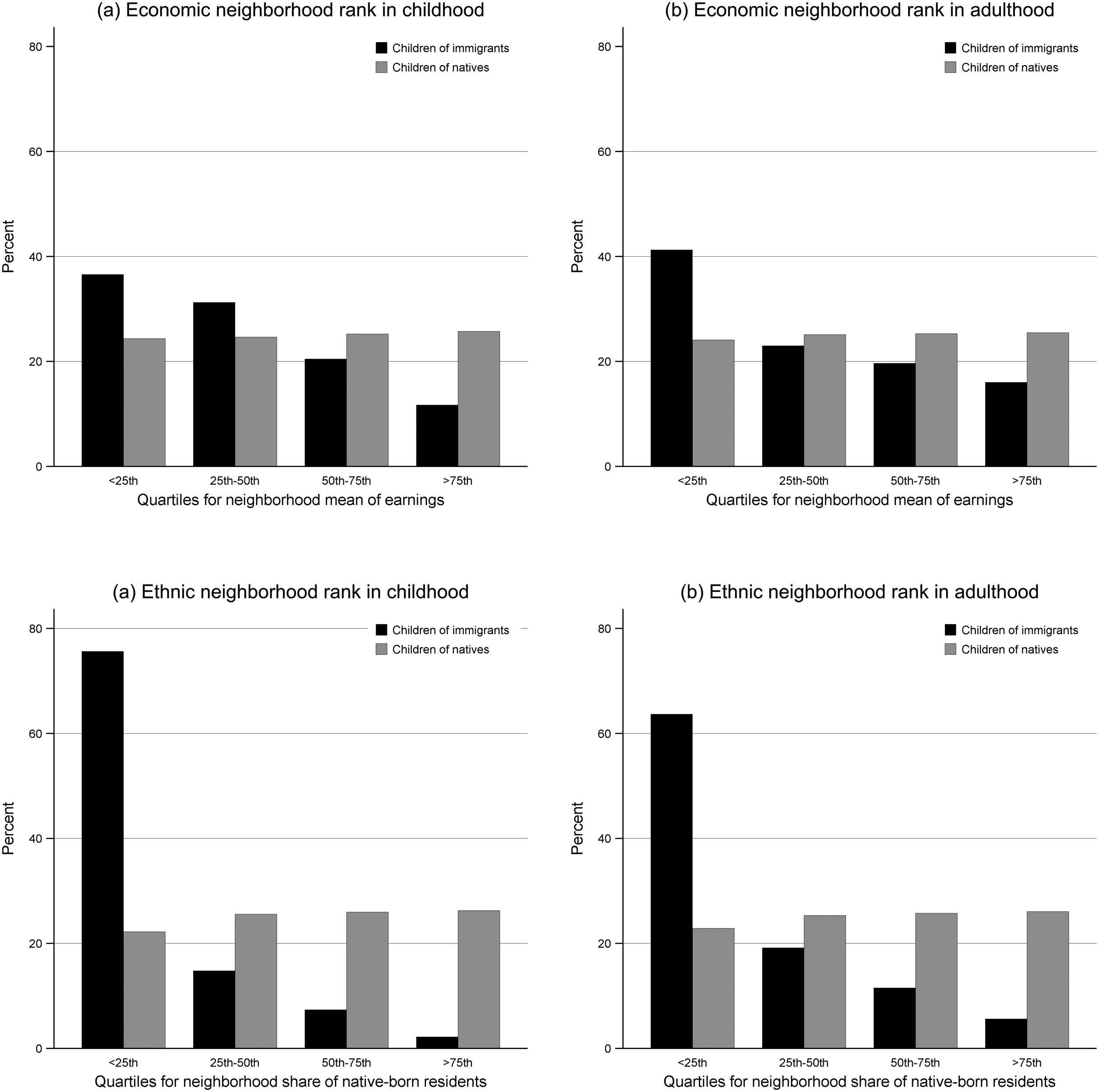
Distribution of neighborhood quartiles in mean of annual earnings and share of native-born residents in childhood and adulthood for immigrant descendants and natives.
Figure 2 shows the mean economic (panel A) and ethnic (panel B) neighborhood rank in childhood and adulthood for each origin group of immigrant descendants and natives. Each circle represents an origin group and indicates the degree of intergenerational change in relative rank in the neighborhood distributions from childhood to adulthood. The center of each circle represents the mean neighborhood rank in childhood plotted against the corresponding rank in adulthood for the relevant origin group, and the circle's size is proportional to the number of immigrant descendants within each origin group. For reference purposes, the black cross represents the corresponding childhood–adulthood mean for non-migrant natives. Finally, the gray line along the diagonal in each panel represents a hypothetical origin–destination slope where immigrant descendants in adulthood completely reproduce the rank of the neighborhood in which they grew up (i.e., the origin–destination slope equals 1). The diagonal line provides a useful benchmark for the level of intergenerational contextual mobility because origin region circles above the diagonal imply upward mobility in neighborhood rank whereas observations below the diagonal indicate downward mobility. 12
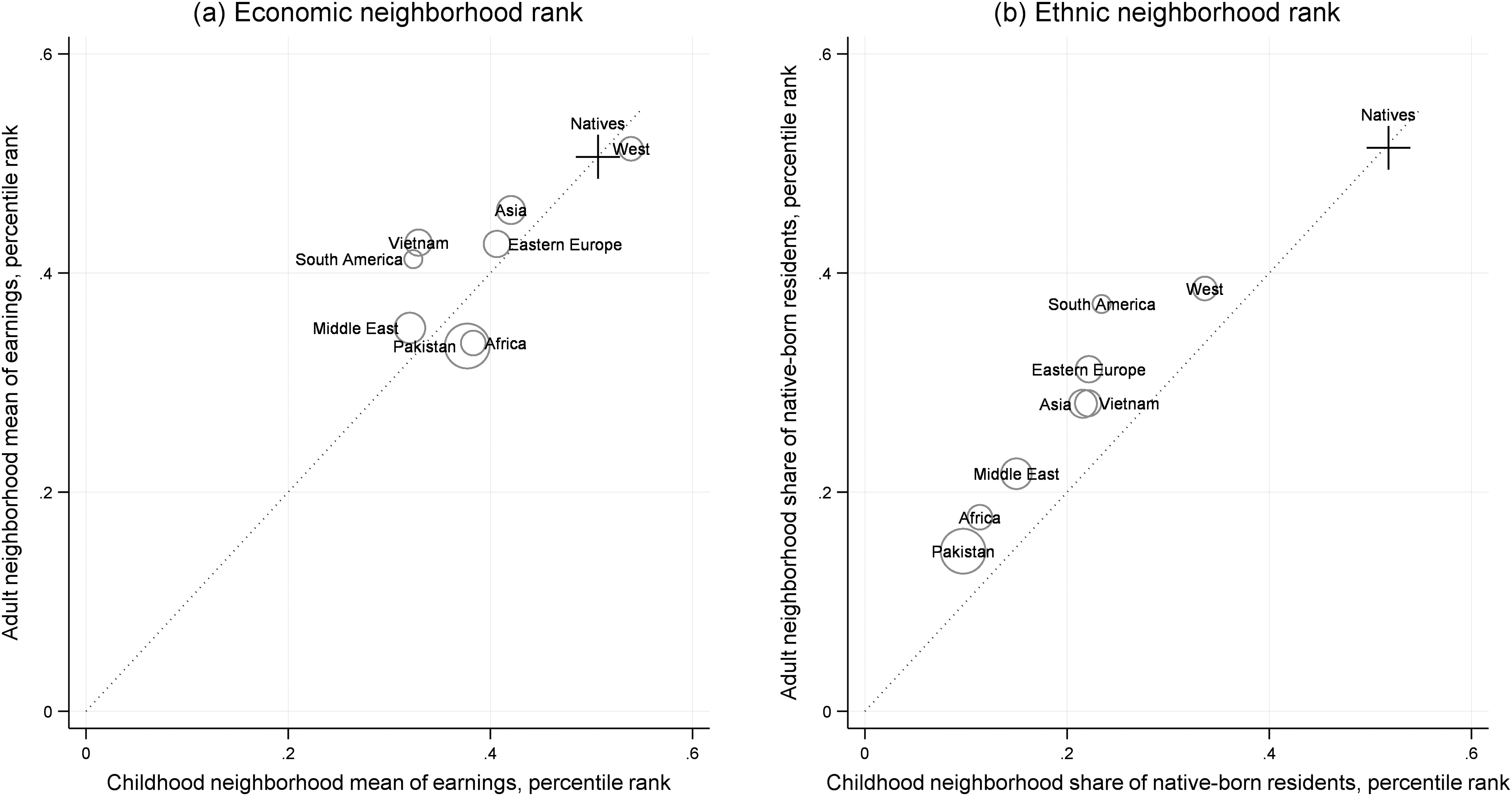
Relation between economic and ethnic neighborhood ranks in childhood and adulthood for immigrant descendants from different regions of origin.
In Figure 2, panel A documents relative persistence in neighborhood economic rank from childhood to adulthood within most origin groups. First, all groups, except descendants of Pakistani and African immigrants, are located above or close to the diagonal, implying that most second-generation minorities either slightly improved their economic neighborhood rank as adults or stayed in neighborhoods similar to those in which they grew up. Second, the South American and Vietnamese origin groups experienced the most pronounced pattern of upward mobility, with an improvement in economic neighborhood rank of about 10 percentiles. In absolute terms, the Western group had the highest economic neighborhood rank in both childhood and adulthood, resembling that of non-migrant native Norwegians.
In panel B, we present results for change in neighborhood rank from childhood to adulthood in terms of ethnic neighborhood rank. Here, we find a slightly different pattern, as immigrant descendants in all origin groups as adults moved up from the diagonal compared with their childhood ethnic neighborhood rank, and this upward mobility was most pronounced in the South American group. This result implies that immigrant descendants, as adults, settled in neighborhoods with a slightly higher relative proportion of native-born adult residents in the overall neighborhood distribution. Relative to their economic neighborhood rank, however, immigrant descendants were clustered in neighborhoods with lower ethnic neighborhood ranks as adults, particularly those in the Pakistani, Middle Eastern, and African origin groups.
Figure 3 reveals how intergenerational neighborhood persistence varies between natives and immigrant descendants across the childhood neighborhood distribution. We plot the mean adulthood neighborhood rank within bins for each percentile of the childhood neighborhood distribution for immigrant descendants as a whole and non-migrant natives separately. Furthermore, the solid and dashed lines plot the linear slope of the bivariate association between neighborhood rank in childhood and adulthood separately for immigrant descendants and natives. The linear childhood–adulthood slopes highlight the central tendencies in the degree of intergenerational persistence in neighborhood context among immigrant descendants and natives, whereas the nonparametric binned percentile plots allow us to assess nonlinear deviations from the overall association in different parts of the distribution of childhood neighborhood contexts.
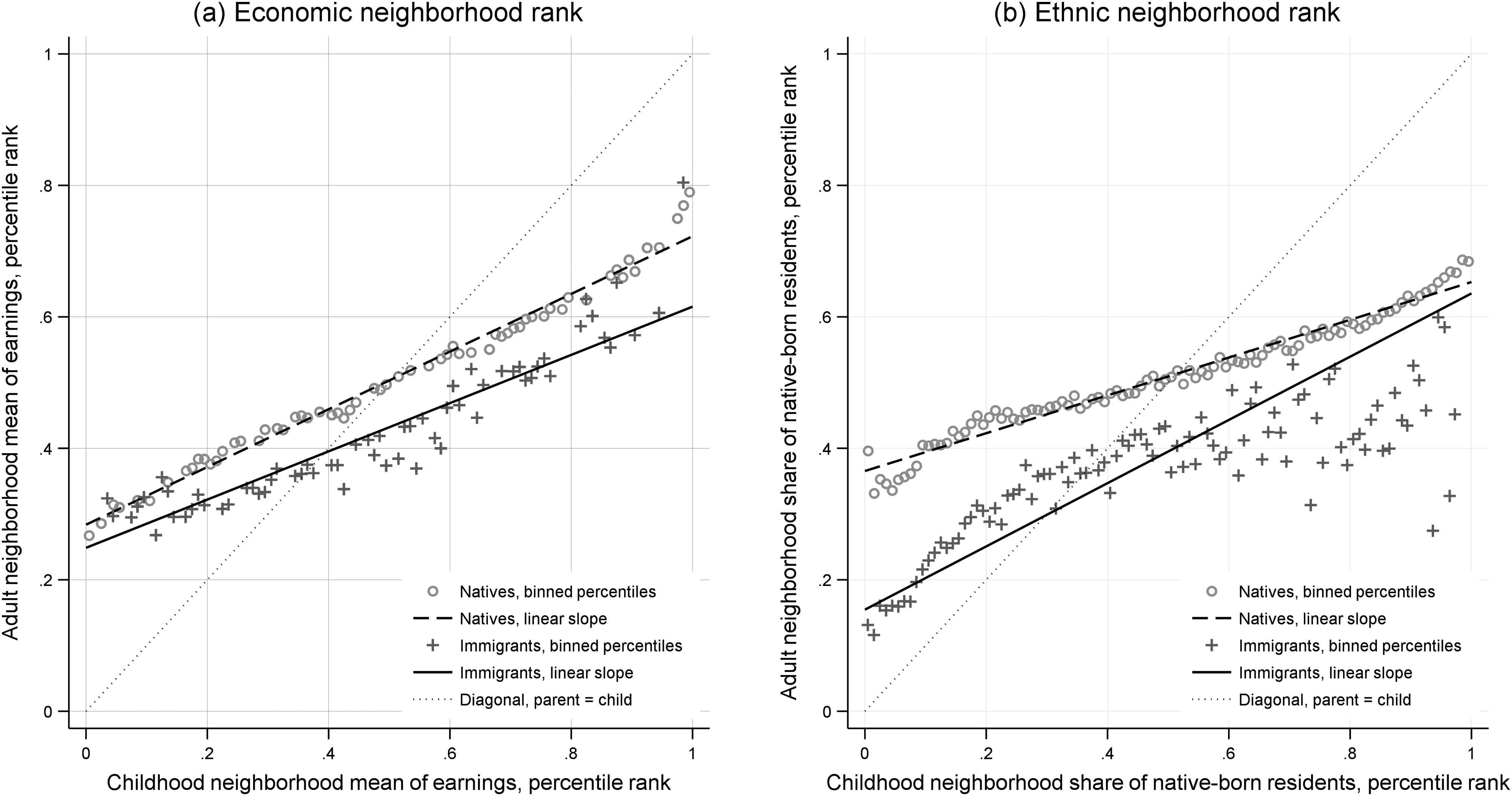
Economic and ethnic neighborhood ranks in adulthood by childhood neighborhood rank separately for natives and immigrant descendants.
Panel A shows a relatively strong linear and parallel relationship between economic neighborhood rank in childhood and adulthood among immigrant descendants (slope = 0.367, intercept = 0.247) and natives (slope = 0.439, intercept = 0.275). Compared with natives, immigrant descendants on average settled in neighborhoods with slightly lower economic ranks as adults. 13 Turning to ethnic neighborhood rank, panel B reveals that the association between neighborhood rank in childhood and adulthood was about two-thirds stronger among immigrant descendants (slope = 0.480, intercept = 0.148), compared with natives (slope = 0.287, intercept = 0.346). Higher intergenerational persistence among immigrant descendants implies that the native–immigrant gaps in adult neighborhood ethnic rank were considerably larger among individuals who grew up in the most immigrant-dense neighborhoods. 14 Correspondingly, the binned percentile plots show a stronger tendency of adult reproduction of childhood neighborhood rank among immigrant descendants who grew up in neighborhoods with high immigrant concentrations, whereas their native counterparts from similar neighborhood origins tended to settle in areas with considerably higher shares of native-born adult residents (i.e., ethnic neighborhood ranks). Native–immigrant gaps were smaller among individuals who grew up in less-immigrant-dense neighborhoods (i.e., higher childhood ethnic neighborhood rank), but these immigrant descendants also had a stronger tendency to settle in more immigrant-dense neighborhoods than natives with similar childhood neighborhood origins.
Figure 4 shows transition matrices of variation in mobility across the distribution of childhood neighborhood quartiles for the non-migrant natives and the different immigrant-origin groups in terms of economic (panel A) and ethnic (panel B) neighborhood composition (i.e., outflow rates as the distribution of individuals by their adult neighborhood quartiles given their childhood neighborhood quartile separately by origin group). Because immigrant descendants were strongly overrepresented among those growing up in neighborhoods with the lowest average earnings and lowest proportion of native-origin adult residents (Figure 1 and Online Appendix Table A3), we focus primarily on the outflow from the lowest neighborhood quartile (i.e., <25th). We compare outflow from the lowest neighborhood quartile to the outflow rates from the other childhood neighborhood quartiles (i.e., 25–50th, 50–75th, and >75th). For natives and immigrant descendants, the rows show the various childhood neighborhood quartiles, and the four blocks within each row represent neighborhood quartiles in adulthood. Thus, we compare immigrant-origin groups and natives in terms of adult movement out of the bottom neighborhood quartile and movement into the bottom quartiles for individuals who grew up in areas represented by other parts of the distribution.
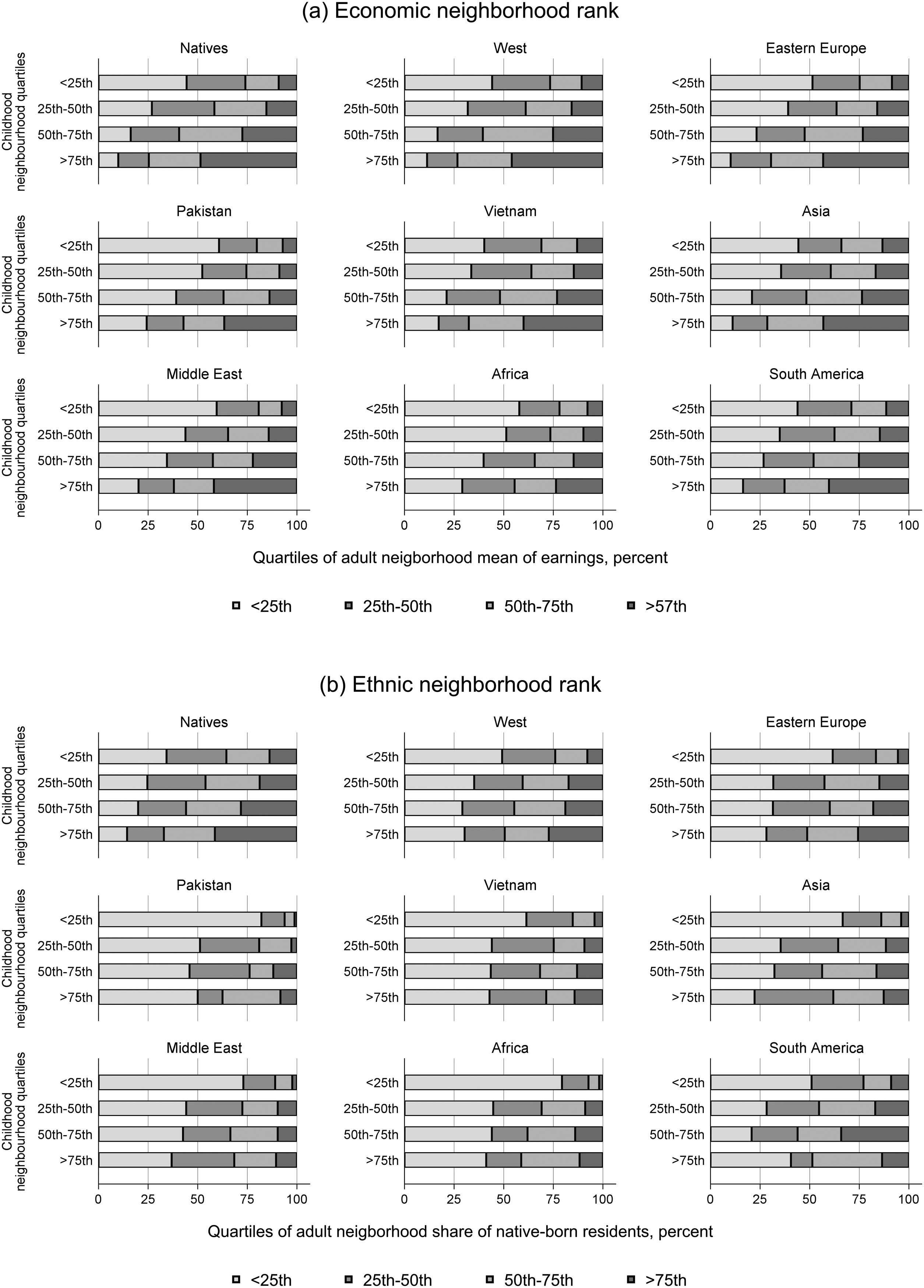
Outflow rates from childhood neighborhood quartiles in terms of economic and ethnic neighborhood rank from mobility tables for natives and immigrant descendants from different regions of origin.
Panel A shows that descendants of immigrants from Pakistan (61 percent), the Middle East (60 percent), and Africa (58 percent) who grew up in the bottom economic neighborhood quartile had a higher likelihood of staying in a neighborhood context in the bottom quartile as adults than did natives (44 percent). For individuals who grew up in the other neighborhood quartiles, these three origin groups also had markedly higher proportions living in the bottom quartile as adults than did natives. For immigrant descendants from the remaining origin regions (i.e., West, Eastern Europe, Vietnam, Asia, and South America) the outflow rates in terms of neighborhood economic composition were not that different from those of their native peers and ranged between 40 percent (Vietnamese) and 51 percent (Eastern European). However, these origin groups had slightly higher probabilities of moving into the bottom neighborhood quartile from other parts of the distribution as adults.
Turning to ethnic composition, panel B shows that immigrant descendants from all origin regions—although most obviously the Pakistani, Middle Eastern, and African groups—were strongly overrepresented among those who both grew up in and, as adults, settled in neighborhood contexts with the lowest proportion of native-origin adult residents. Among natives, 34 percent of those who grew up in the bottom quartile also settled in this quartile as adults, whereas the figures ranged from a low of about 50 percent (Western and South American) to the highest levels among the Pakistani (82 percent), African (79 percent), and Middle Eastern (73 percent) origin groups. For immigrant descendants who did not grow up in the bottom neighborhood quartile, all origin groups were more likely to settle in the bottom neighborhood quartile as adults than natives. Again, this tendency was strongest for descendants of Pakistani, African, and Middle Eastern immigrants.
Overall, our results reveal a high degree of intergenerational neighborhood stability among immigrant descendants who grew up in the most economically disadvantaged and immigrant-dense neighborhoods. Importantly, we also find that immigrant descendants who grew up in less-immigrant-dense neighborhoods (i.e., quartiles 25–50th, 50–75th, and >75th) were also considerably more likely to move into, or remain in, neighborhoods with the highest immigrant concentrations as adults (i.e., downward mobility in terms of ethnic neighborhood quartile).
To put these results into context, we find that the share who remained in the bottom quartile of the economic neighborhood distribution among natives (about 40 higher) is comparable to those reported in studies from Sweden (Gustafsson, Katz, and Österberg 2017) and France (McAvay 2018), as well as for non-Hispanic Whites in the United States (Sharkey 2008). For descendants of immigrants from Pakistan, the Middle East, and Africa, about 60 percent of those from the bottom economic quartile remained there as adults (Figure 4, panel A), which is higher than the proportions of descendants of African (54 percent) and Asian, including Turkish, (47 percent) immigrants in France (McAvay 2018). Gustafsson, Katz, and Österberg (2017) report that 61 percent of immigrant descendants from “visible minorities” (i.e., Africa, Asia, Latin America, and Southern Europe) in Sweden remained in the bottom economic neighborhood quartile, which is comparable to our findings for Pakistani, African, and Middle Eastern descendants.
In terms of ethnic neighborhood segregation, we find that about 30 percent of natives from the most immigrant-dense childhood neighborhood quartile remained there as adults, whereas the corresponding number in France was 42 percent (McAvay 2018). Compared with our estimates for the Pakistani, African, and Middle Eastern origin groups (Figure 4, panel B), McAvay (2018) reports lower figures for descendants of Asian/Turkish immigrants (69 percent), African (63 percent), and Southern European (48 percent) immigrants in France, and the gaps relative to natives are larger in Norway. The analytical approach of Tran (2020) is not directly comparable to ours, but the results show that second-generation immigrants in the United States experience significantly higher rates of upward contextual mobility relative to non-migrant Blacks, although second-generation immigrants have yet to reach parity with non-Hispanic Whites. 15 From a comparative perspective, our results suggest that the level of intergenerational persistence in neighborhood contexts among immigrant descendants in Norway is comparable to or higher than those reported for Sweden, France, and the United States (Gustafsson, Katz, and Österberg 2017; McAvay 2018; Tran 2020).
Assessing Drivers of Contextual Mobility and Neighborhood Attainment
In the multivariate analyses, we start by assessing the extent to which childhood municipality, as well as individual and parental socioeconomic characteristics, accounts for why adult immigrant descendants and natives often remain in neighborhood contexts similar to those in which they grew up. Table 2 shows the bivariate neighborhood rank–rank slopes for each neighborhood dimension estimated separately for immigrant descendants and natives. Using OLS regression, we compare the bivariate coefficient with the coefficients estimated after sequentially adding controls for childhood municipality fixed effects and individuals’ own and parental socioeconomic characteristics.
Estimated Association Between Neighborhood Rank in Childhood and Adulthood among Natives and Immigrant Descendants. OLS Regressions.
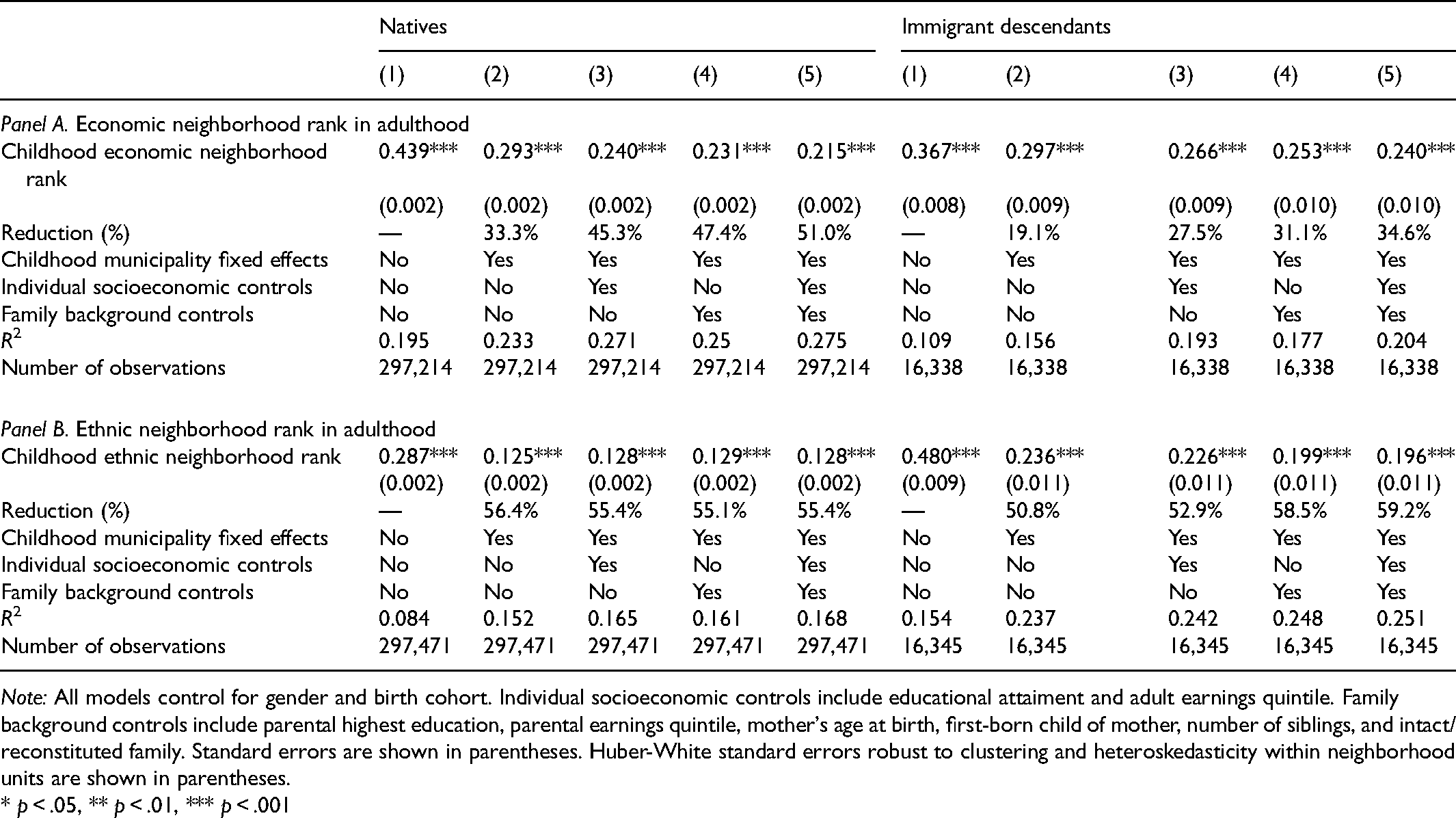
Note: All models control for gender and birth cohort. Individual socioeconomic controls include educational attaiment and adult earnings quintile. Family background controls include parental highest education, parental earnings quintile, mother's age at birth, first-born child of mother, number of siblings, and intact/reconstituted family. Standard errors are shown in parentheses. Huber-White standard errors robust to clustering and heteroskedasticity within neighborhood units are shown in parentheses.
* p < .05, ** p < .01, *** p < .001
Panel A reports the results for economic neighborhood rank. When we control for municipality fixed effects, the coefficients are reduced by 33.3 percent for natives and 19.1 percent for immigrant descendants compared with the baseline model. For natives, including additional controls for individual and parental socioeconomic characteristics separately or together reduced the coefficients relative to the baseline estimate further to 45.3, 47.4, and 51.0 percent, respectively. The corresponding reductions are 27.5, 31.1, and 34.6 percent among immigrant descendants. Turning to Panel B, introducing controls for municipality fixed effects reduced the coefficients for ethnic neighborhood rank by 56.4 percent for natives and 50.8 percent for immigrant descendants. For natives, adding separate controls for individual (55.4 percent) and parental (55.1 percent) characteristics, or both simultaneously (55.4 percent), did not reduce the gaps any further relative to the baseline. In contrast, controls for individual (52.9 percent) and parental (58.5 percent) characteristics separately or in combination (59.2 percent) reduced the coefficients slightly further for immigrant descendants.
For both natives and immigrant descendants, these results suggest that adult individuals’ socioeconomic characteristics, followed by parental characteristics, are of relatively modest importance in accounting for the intergenerational continuity in neighborhood rank in terms of both economic and ethnic composition. However, continuity of neighborhood environment from childhood to adulthood, especially in terms of ethnic neighborhood composition, is more strongly related to the municipality where the individuals grew up. For both neighborhood dimensions, controlling for municipality fixed effects reduces the baseline association for natives more than for immigrant descendants. Nevertheless, the intergenerational correlation in both dimensions of neighborhood environment remains strong for both immigrant descendants and natives after this broad set of controls is included. Although not probing immigrant–native differences in France, McAvay (2018) also found that the broader geographical context, measured by municipality fixed effects, accounted for a greater proportion of the association between economic and ethnic neighborhood composition in childhood and adulthood than did the socioeconomic characteristics of either adult individuals or their parents.
In our final set of analyses, we shift our focus to the relative role of individual socioeconomic attainment, family background, and childhood residential location to account for the remaining gaps in neighborhood attainment between natives and the various origin groups of immigrant descendants. Figure 5 summarizes the estimated native–immigrant gaps in adult economic (panel A) and ethnic (panel B) neighborhood rank for each origin group from a series of OLS regressions. In each panel, we first present baseline native–immigrant gaps before (model 1) and after (model 2) adjusting for municipality fixed effects. Then, we present the estimated gaps in models that separately control for socioeconomic characteristics of adult individuals (model 3) and their parents (model 4), as well as observed characteristics and fixed effects for childhood neighborhoods (model 5). Finally, we control for all child, parental, and childhood neighborhood characteristics simultaneously (model 6). See the legend of Figure 5 for a more detailed description of the different model specifications.
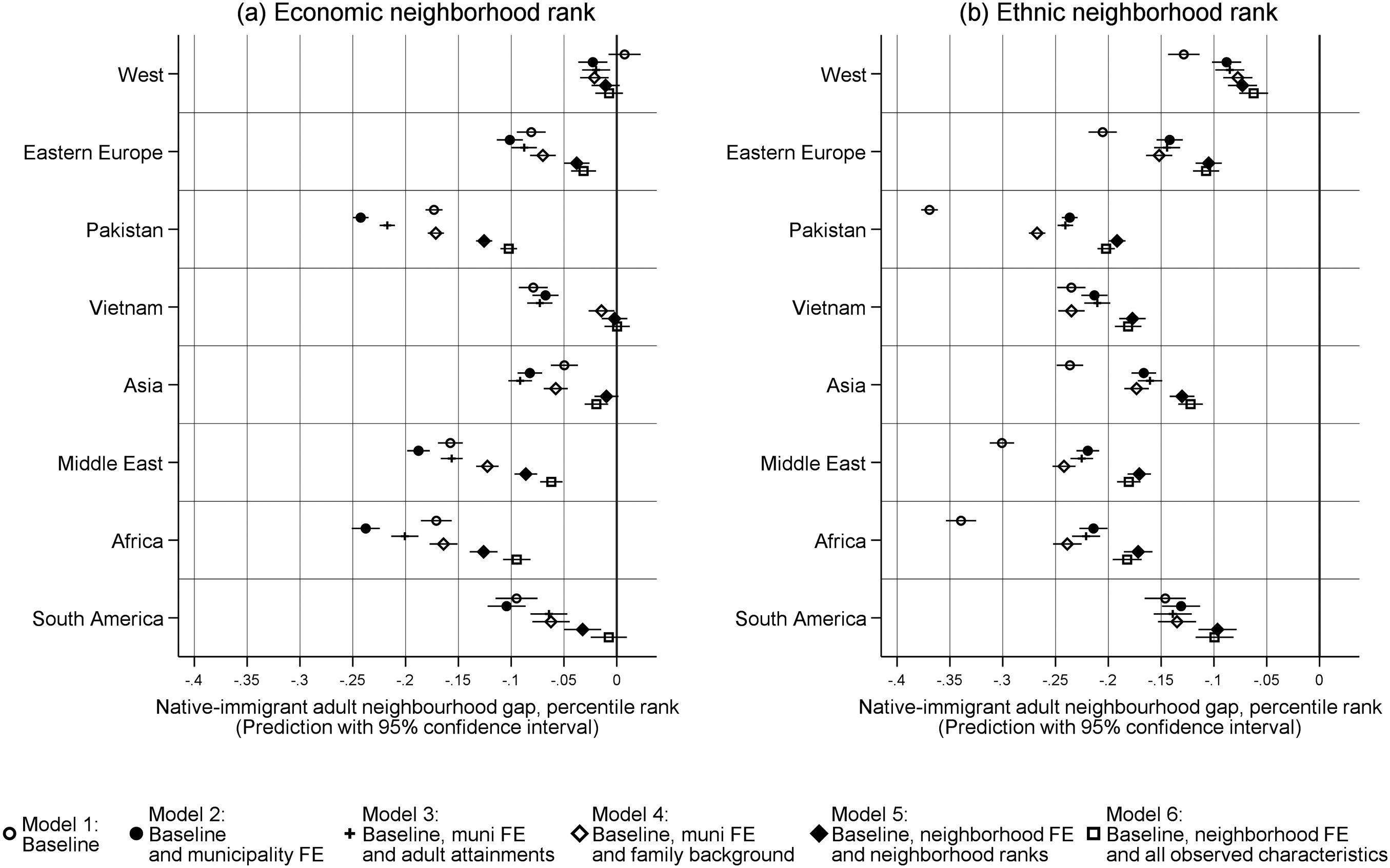
Estimated native-immigrant gaps in economic and ethnic neighborhood rank in adulthood for different regions of origin from OLS regressions.
Panel A shows that the baseline native–immigrant gaps (model 1) in neighborhood economic rank are consistent with the results reported previously and that the largest gaps of about 20 to 25 percentile ranks are found among the Pakistani, Middle Eastern, and African origin groups. There is no baseline gap for the Western group, whereas the Vietnamese, Asian, South American, and Eastern European groups are comparable, with gaps of between five and 10 percentile ranks. Adjusting for childhood municipality increases the gaps slightly for some groups (model 2). Furthermore, adding controls for individual socioeconomic attainments (model 3) is of relatively limited importance, whereas family background tends to matter slightly more (model 4), and controlling for childhood neighborhood context generally reduces the estimated gaps the most (model 5). Net of all controls combined (model 6), we account for between 41 and 61 percent of the baseline gaps for the Pakistani, Middle Eastern, and African groups. For the Vietnamese, South American, and Western origin groups, the gaps are entirely closed after all controls are included, whereas a conditional gap of less than five percentiles remains in the Eastern European and Asian groups.
Panel B reveals a slightly different pattern for native–immigrant gaps in neighborhood ethnic rank. The baseline gaps in ethnic neighborhood rank are generally larger (model 1), but the variation between origin groups is similar to that found for neighborhood economic rank, ranging between 37 and 30 percentile ranks for the Pakistani, Middle Eastern, and African groups and 24 to 20 percentile ranks for the Eastern European, Vietnamese, and other Asian groups. There is also a moderate gap for the Western origin group of about 13 percentile ranks, comparable to that found among descendants of South American immigrants. Adding controls for municipality fixed effects to the baseline model (model 2) reduces the gaps for all origin groups, which is probably due to immigrant descendants generally living in municipalities with higher proportions of immigrant residents. However, adding controls for adult individuals’ socioeconomic characteristics (model 3) or family background (model 4) tends not to reduce the estimated gaps and, for some groups, reveals larger net gaps. However, controlling for childhood neighborhood context (model 5) is related to a relatively small reduction in the estimated gaps for all origin groups compared with the results for economic neighborhood rank, and the gap net of all controls together is very similar (model 6). The full set of controls reduces the estimated native–immigrant gaps between 40 and 46 percent for Pakistani, Middle Eastern, and African immigrant descendants. The baseline gaps are smaller for the other origin groups, but the reductions range between 23 (Vietnamese) and 52 percent (Western). However, often large gaps remain in ethnic neighborhood rank for all origin groups.
To summarize, these results show that immigrant descendants often settled in neighborhoods with similar socioeconomic profiles to those of native peers who were comparable in terms of adult attainment, family background, and childhood neighborhood contexts. However, there remain gaps for descendants of Pakistani, Middle Eastern, and African immigrants. Nevertheless, relative to these very same native peers, immigrant descendants from all origin groups tended to live in neighborhoods with considerably lower proportions of native-born residents as adults. Finally, childhood residential segregation and, for neighborhood socioeconomic composition, family background were more important than individuals’ socioeconomic attainment in accounting for native–immigrant gaps in neighborhood attainment. Similarly, research from France (McAvay 2018), the United Kingdom (Zuccotti 2019), and the United States (Tran 2020) also found that childhood neighborhood context matters more than parental or personal adult socioeconomic status for minority–majority gaps in socioeconomic neighborhood attainment. In terms of ethnic neighborhood segregation, these studies report childhood neighborhood context to be the most important factor and that the remaining immigrant–native neighborhood gaps net of controls tend to be larger for ethnic neighborhood composition than for socioeconomic neighborhood composition. These patterns resemble those we document for Norway.
Discussion and Conclusions
This article has addressed intergenerational transmission of neighborhood context in terms of economic composition and ethnic segregation, from immigrant parents to their adult second-generation children, using high-quality administrative data from Norway. We find that many immigrant descendants of non-Western ancestry who grew up in neighborhood contexts characterized by relative economic deprivation and comparatively few native-origin residents tended to settle in similar contexts as adults. The immigrant–native gaps in adult neighborhood attainment were largest in terms of neighborhood ethnic composition, especially for immigrant descendants who grew up in the most immigrant-dense neighborhoods. The continued overrepresentation of adult immigrant descendants in low-income and immigrant-dense areas reflects both higher immobility relative to natives and higher inflow into such areas from other parts of the neighborhood distributions. However, there is considerable variation across non-Western origin groups because immigrant descendants from Vietnam and other Asian countries, South America, and Eastern Europe tended to live in neighborhoods characterized by less economic disadvantage and higher proximity to non-migrant natives as adults. In contrast, descendants of immigrants from Pakistan, Africa, and the Middle East experienced the most pronounced pattern of intergenerational persistence in low-income and immigrant-dense neighborhood contexts.
Based on these findings, our first conclusion is that the limited degree of intergenerational contextual mobility within most immigrant minorities points to the continued salience of ethnic origin for spatial inequality among immigrant descendants in Norway. Given the high level of socioeconomic progress observed among non-Western immigrant descendants in Norway (Bratsberg, Raaum, and Røed 2014; Hermansen 2016), the high level of intergenerational persistence in neighborhood contexts in the second generation largely contradicts the standard predictions of spatial assimilation theory, which hold that acculturation and socioeconomic gains will translate into improved neighborhood attainment (Park 1926; Massey and Denton 1985). For the second-generation immigrant minorities who grew up in the most disadvantaged neighborhood contexts in Norway, intergenerational contextual immobility in economically disadvantaged and immigrant-dense neighborhoods is similar to that found in Sweden and higher than that reported for France and the United States (Gustafsson, Katz, and Österberg 2017; McAvay 2018; Tran 2020).
Our second conclusion is that marked socioeconomic progress can take place without a corresponding movement toward spatial assimilation. Although net differences in adult immigrant–native gaps in ethnic neighborhood segregation were considerably larger than neighborhood socioeconomic composition, our results show that childhood residential segregation was considerably more important than both individuals’ socioeconomic attainments and family background. We also capture any unobserved characteristics of local areas shared by neighboring children, such as housing prices, the quality of local schools, or the formation of preferences for the residential environment experienced in childhood, by exploiting neighborhood fixed effects. These results are in line with recent studies that point to the centrality of the broader geographic context in childhood for immigrant descendants’ neighborhood attainment (McAvay 2018; Zuccotti 2019). Because research from Norway has found residential segregation to be less important for immigrant–native gaps in socioeconomic attainments (Hermansen 2016), our finding of a more central role of childhood geographic context for neighborhood outcomes could, therefore, reflect socialization processes related to place attachment. Furthermore, the limited influence of personal socioeconomic resources further raises the question of whether the relative lack of spatial assimilation reflects behavioral mechanisms that to varying degrees are related to both persistent in-group preferences for (co-ethnic) immigrant neighbors and external constraints in the housing market.
Nonetheless, a third conclusion is that the observed pattern of limited contextual mobility in Norway is consistent with the claim that neighborhood equalization may weaken incentives to move out of immigrant-dense and low-income neighborhoods among socioeconomically upwardly mobile immigrants and their descendants (Wessel et al. 2017). Because immigrant–native gaps in labor market earnings have been reduced by about three-fourths from immigrant parents to their adult native-born children in Norway (Hermansen 2016), it seems reasonable to expect spatial assimilation to have been more pronounced here than in many other immigrant-receiving Western countries (Heath, Rothon, and Kilpi 2008; Drouhot and Nee 2019). Therefore, persistent neighborhood segregation, despite strong individual socioeconomic progress, may reflect increased scope for in-group residential preferences in the egalitarian Norwegian welfare state setting.
Finally, a fourth conclusion is that the slow movement toward spatial assimilation points to a complex pattern of “uneven assimilation” (Price 1969), whereby immigrant incorporation across different social, cultural, and socioeconomic dimensions is not bound to move in tandem (Gordon 1964; Alba and Nee 2003). If the choice of adult residential location is primarily driven by place attachment and preferences for (co-ethnic) immigrant neighbors, ethnic homophily could explain the limited degree of contextual mobility among immigrant descendants. Importantly, although explanations of intergenerational neighborhood persistence among immigrant minorities that focus on either in-group preferences or external barriers may seem to be competing, these processes could also be self-reinforcing and complementary (e.g., the experience of anti-immigrant sentiments may strengthen ethnic homophily in minorities’ residential choices). More generally, the lack of spatial assimilation, despite socioeconomic progress, highlights the difficulty of separating opportunity barriers from preferences when making inferences about “equality of opportunity” in studies of intergenerational mobility (Swift 2004).
Needless to say, this article has limitations that future research should address. First, we measure neighborhood attainment early in adulthood, which may affect estimated native–immigrant neighborhood gaps. Although life-course dynamics could lead to reduced differences between immigrant descendants and natives (South et al. 2016; McAvay 2018), early adult neighborhood attainment gaps could also widen if immigrant descendants and natives embark on different housing trajectories. Second, research shows that young adults of non-migrant native Norwegian origin often move closer to their parents after entering parenthood (Løken, Lommerud, and Lundberg 2013). For immigrant descendants, a similar behavior would contribute to reproducing patterns of ethnic segregation if immigrant descendants remain close to their kin, and such a pattern could be exacerbated by cultural expectations or family obligations (Brown 2007; Zorlu 2009). Future research should explore in more detail how kinship-based and co-ethnic networks influence residential location decisions among immigrant descendants. Third, limited spatial assimilation among immigrant descendants also provides fertile ground for future qualitative and survey-based research that can provide self-reported information on individuals’ residential preferences and experiences of blocked opportunities. Fourth, many immigrants live in social housing, which often increases ethnic residential segregation, possibly contributing to greater intergenerational persistence in disadvantaged and segregated neighborhood contexts (McAvay 2018; Verdugo and Toma 2018). This article lacked information on (parental) social housing or transition to homeownership, but future research should address how these factors shape immigrant descendants’ contextual mobility.
To conclude, we find a high degree of intergenerational persistence in socioeconomic neighborhood disadvantage and ethnic segregation among immigrant descendants in Norway. The relative absence of spatial assimilation is particularly interesting, given the high degree of upward socioeconomic mobility documented within the same second-generation immigrant minorities in Norway (Hermansen 2016). Together, these patterns indicate that sociospatial disadvantage and relative isolation from ethnic mainstream neighborhoods may be more persistent than socioeconomic disadvantage within contemporary immigrant-origin ethnic minorities. In particular, testing the institutional argument that equalization of neighborhood quality in egalitarian welfare states slows the rate of spatial assimilation across immigrant generations (Wessel et al. 2017) should be a key task for future comparative research.
Supplemental Material
sj-pdf-1-mrx-10.1177_01979183211067771 - Supplemental material for Spatial Assimilation at a Halt? Intergenerational Persistence in Neighborhood Contexts among Immigrant Minorities in Norway
Supplemental material, sj-pdf-1-mrx-10.1177_01979183211067771 for Spatial Assimilation at a Halt? Intergenerational Persistence in Neighborhood Contexts among Immigrant Minorities in Norway by Are Skeie Hermansen, Pål Oskar Hundebo, Gunn Elisabeth Birkelund in International Migration Review
Footnotes
Acknowledgments
Previous versions of this work was presented at the University of Oslo, Stockholm University, the Norwegian Institute for Social Research, and at the 2019 Annual Meeting of the Population Association of America in Austin, USA. We thank the audiences at these occasions for helpful comments, as well as the editors and anonymous reviewers.
Declaration of Conflicting Interests
The author(s) declared no potential conflicts of interest with respect to the research, authorship, and/or publication of this article.
Funding
The author(s) disclosed receipt of the following financial support for the research, authorship, and/or publication of this article: The current study was funded by grants from NordForsk (Grant number 95263) and the Research Council of Norway (Grant Nos. 236793 and 287016). This research used Norwegian administrative data provided by Statistics Norway.

Supplementary Material
Supplemental material for this article is available online.
Notes
References
Supplementary Material
Please find the following supplemental material available below.
For Open Access articles published under a Creative Commons License, all supplemental material carries the same license as the article it is associated with.
For non-Open Access articles published, all supplemental material carries a non-exclusive license, and permission requests for re-use of supplemental material or any part of supplemental material shall be sent directly to the copyright owner as specified in the copyright notice associated with the article.
